
1. PROBLEM DEFINITION
Globally buildings use 31% of final energy, leading to 25% of carbon emissions, of which homes (residential buildings) contribute 22% and 16%, respectively (Cabeza et al. 2022). Over 70% of their current emissions are related to heating and cooling. Housing lifetimes usually exceed the timescales on which net zero goals need to be delivered. Housing retrofit (improvement of existing homes) to zero carbon is therefore required. Retrofit also needs to ensure the thermal comfort for occupants, including responding to the adaptation challenge of increasing ambient temperatures. And it needs to deliver comfort and carbon goals at a reasonable cost.
Retrofit includes both improved fabric and the adoption of better systems of heating and cooling. Figure 1 provides an overview of the overall system and its goals.
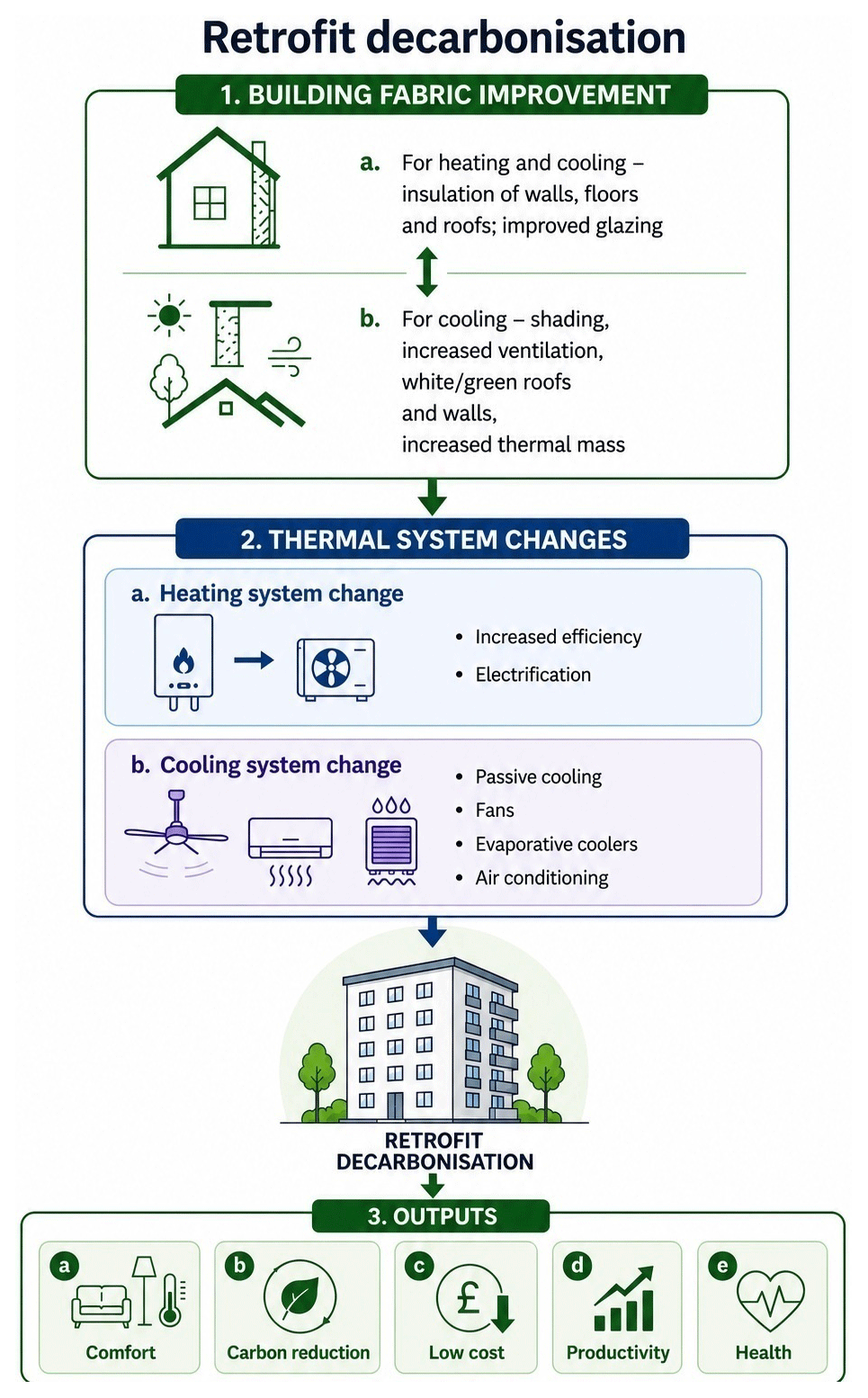
Figure 1
Overview of the building retrofit system and its goals.
Priorities and potential solutions, including the relative roles of heating and cooling, differ by geography and level of economic development. Several factors constrain improvement rates. Residential building lifetimes are longer than those of most other capital stock. Ownership and management are highly distributed and largely undertaken by ‘energy non-experts’, for whom climate mitigation is usually a lower or negligible priority than affordability and comfort. Fabric improvement and thermal systems are mainly installed by small and medium-sized enterprises (SMEs) and/or in the informal economy. Retrofit to high thermal standards is capital intensive and can cause disruption for residents.
This briefing note sets out the priorities for action in building retrofits over the next decade and what policy will be needed to deliver these improvements.
2. CONTEXT AND CURRENT STATUS
Fire was first used for cooking by early humans and became essential as the provider of space heating as they colonised regions with cooler climates. Open fires were dominant, initially using wood and then coal. Dwellings were well-ventilated, enabling heating based on open fires. In recent decades, these have largely been replaced, first by cleaner fuels and then by central heating systems. This allows for more airtight buildings, reducing heat losses in ventilation. New technologies significantly improve insulation in roofs, floors, walls and windows. Heating cultures have changed from heating a single living room to whole-house heating, supplied either by central heating or by larger district heating systems. Household energy use is falling at about 3% per year in Europe, largely because of efficiency improvements in fabric and heating systems (Lapillonne & Raji 2024). However, progress towards the highest levels of retrofit insulation (‘deep retrofit’) has been much slower, at about 0.2% of buildings per year (BPIE 2021).
Cooling demand has been met historically by passive cooling approaches which have a long record of use in vernacular architecture across geographies. However, progress in scaling them is inadequate because of infrastructural, socio-economic and policy barriers. The use of active cooling, particularly air-conditioning, in homes only began in the 20th century. Air-conditioning is now rapidly scaling, in part in response to rising temperatures, and because it is widely accepted as the immediate technological space-cooling solution for warming weather and thermal comfort. There is increasing frequency of high temperatures, and the population experiencing extreme heat at a 2.0°C global temperature rise is projected to nearly double to 3.79 billion (Lizana et al. 2026). As populations and economies expand in some of the world’s hottest regions, energy use in cooling is projected to triple by 2050 (Khosla et al. 2021). This will require electricity generation capacity of 2500 GW, implying myriad socio-economic, environmental and political challenges (IEA 2018).
3. ANALYSIS
Achieving net zero requires a shift to zero-carbon energy systems, with major investments in renewable electricity generation, transmission, storage and energy-efficiency improvements (IPCC 2022). The shift to zero-carbon electricity alone decarbonises electric heating and cooling. But delivering net zero also requires the phasing out of the direct use of fossil fuels in buildings, which poses challenges for electricity demand growth, universal access, social acceptability, finance and supply chains.
Active cooling is already largely electrified, and therefore increased cooling demand will tend to increase electricity use. In the short-term, this will rely heavily on fossil-fuel-generated electricity, resulting in higher emissions. These are exacerbated by emissions of refrigerant gases from air-conditioning, which need to shift to low-global warming potential options. In the longer term, as electricity decarbonises, the main challenge is the need for increased electricity generation, especially at times of peak load. In contrast, in heating, net-zero goals require a systemic change away from using fossil fuels. There is broad scientific agreement that electrification is the only feasible and scalable approach (Cabeza et al. 2022). This will add further to projected electricity demand. Increasing electricity use in both cooling and heating risks slowing the rate at which electricity can be decarbonised. It is therefore important that both cooling and heating use high-efficiency systems and that complementary thermal demand reduction is undertaken—such as fabric improvements—where cost-effective. There are no fundamental scientific or technological blockages to achieving these changes. The case for action is strong. The overall energy-efficiency benefits from displacing fossil fuels are very large—electrification would double global building energy efficiency (Eyre 2021)—and there will be major benefits through cleaner air and improved energy security (Ürge-Vorsatz et al. 2020).
The social and economic context is particularly important in the Global South. Globally, over 600 million people still do not have access to electricity (UN 2026). Universal access is a Sustainable Development Goal and a policy priority where it has not been achieved, in Sub-Saharan Africa and South Asia. Progress to date has been slower than hoped, but low-cost solar provides new opportunities for acceleration (IRENA 2025). For the reasons set out above, access to electricity is critical for decarbonising building energy use.
The scale of investment needed is substantial, posing significant challenges. Rapid growth in solar photovoltaics and battery storage will reduce long-term electricity costs. However, their high capital requirements remain a major barrier for low-income households and developing countries, where access to affordable credit is limited. In the Global South, these investments compete with other priorities of expanding other infrastructures, providing jobs, housing and security, and protecting the local environment.
Providing universal electricity access, installing zero-carbon heating and cooling systems, and improving building fabrics will require billions of individual installations. Within this context, social acceptability matters everywhere. Houses are not just ‘another infrastructure’: they are peoples’ homes and action therefore needs widespread support, particularly for retrofits because they impact everyday lived experiences. The costs and comfort associated with heating and cooling are, at least, as important as carbon to everyday experiences and household decisions.
Increasing supply chain capacity and transitioning it into zero-carbon solutions will take time. Much manufacturing can be centralised, but installation work will remain highly disaggregated. Most of the current workforce is in SMEs and the informal economy and it operates in a ‘low skills equilibrium’, unable to deliver complex or coordinated retrofit (Killip 2020). Programmes have failed through neglecting appropriate skills, even for simple measures such as basic insulation (e.g. Hawke 2010), but especially for deep retrofit (NAO 2025). Upskilling and quality assurance will therefore be critical to successful transformations. The public sector can lead this in social housing programmes.
In most of the Global North, heat decarbonisation needs to be the priority. District heating looks likely to expand in some dense urban areas, but most heat decarbonisation will rely on heat pumps in individual buildings. Reversible air-conditioners—supplying heating and cooling—are likely to play a key role in mid-latitudes, where they are already being deployed in large numbers. Heat pumps currently provide about 10% of global space heating, although progress is uneven across countries (Rosenow et al. 2022). Their market share of new installations globally is growing at 10% annually, with sales now exceeding those of boilers in market leaders. Global capacity is expected to double this decade (IEA 2026) and the gas price crises of 2022 and 2026 have added further impetus. The efficiency improvement that heat pumps deliver will be the main source of home energy efficiency improvement in the next two decades. However, heat pumps face economic barriers in both capital costs and operating costs. Deployment of low-cost insulation measures should also be a priority, especially where it helps mitigate summer overheating risk. However, deep retrofit (i.e. to the insulation standards of high-quality new build) is generally not cost-effective (Galvin 2024). Its progress is very likely to remain slow, as heat pumps are effective without it in almost all buildings (Eyre et al. 2023). Deep retrofit is an option where major changes are planned to buildings, but in the short-term, it will not make a major contribution to decarbonisation of the overall building stock.
Rising global temperatures are increasing demand for space cooling. In the cool temperate regions of the Global North, this is from a low base, so that heating will remain the dominant energy use in homes while the demand for cooling also rises. However, in the Global South and the hotter regions of the Global North, the situation is very different. The Central African Republic, Nigeria, South Sudan, Laos and Brazil are predicted to see the largest increases in dangerously hot temperatures, while the largest affected populations will be in Nigeria, India, Bangladesh, Pakistan, Indonesia and the Philippines (Lizana et al. 2026). Despite the projected rapid increase in air-conditioning, there is estimated to be a ‘cooling gap’ of 2–5 billion people, who will be exposed to heat stress in 2050 but without the capacity to adapt to it with an air-conditioner, making equity a central issue to the future of cooling (Andrijevic et al. 2021). District cooling offers options in some parts of the world. Energy-efficient cooling technologies (e.g. air-conditioners) and low-energy technologies (e.g. fans) are key to managing cooling growth. Critically, passive cooling approaches, which use minimal energy, are necessary to enable affordable and equitable thermal comfort. Retrofit measures include: heat-prevention and -protection measures such as vegetation, water bodies, shading, glazing, green and cool roofs; heat-modulation measures such as insulation; and heat-dissipation measures such as natural ventilation, evaporative and radiative cooling (Khosla et al. 2022). Enabling ventilation is particularly important for dwellings with high thermal insulation to prevent overheating.
Research continues to be needed to address retrofit challenges: to improve technology including its cost-effectiveness, develop new options (e.g. in thermal storage), evaluate progress, and inform policy and social change. There are unresolved debates, including the extent of the changes needed in building fabrics to support decarbonised heating, the balance between passive and active cooling in different geographies, and the interaction of measures to address both heating and cooling.
4. RECOMMENDED ACTIONS
Although most practical action is needed locally, international climate policy provides an important framework. International agreements contain some useful broad agreements, including the Global Cooling Pledge (UNEP 2023) commitment to cut cooling-related emissions by 68% by 2050 and the UAE Consensus (UNFCCC 2023) (agreed at COP28 in 2023) to double rates of energy efficiency improvement by 2030. However, there are few effective mechanisms for delivery, monitoring, capacity-building or financing that are specific to building retrofit.
Nationally, building retrofit transitions will need policy support to address barriers in consumer knowledge and confidence, finance, supply chain development, and installation quality. There are no simple quick fixes; policy needs to be long-term, with comprehensive packages of policies to address the structural barriers. Only regulation can provide the certainty to invest, build capacity and phase out use of fossil fuels; the relative price of electricity needs to fall in many countries; skills need to be developed; quality ensured; and education and advice provided. Low-income households need support to invest. Much of this will need to be done locally, requiring capacity-building at that level. Delivery of this complex policy agenda will be particularly challenging for the least developed countries.
To make progress in this decade, some early actions are needed (Table 1).
Table 1
Policies to support heating and cooling decarbonisation.
| DELIVERY BARRIER | POLICIES |
|---|---|
| International | |
| Lack of clarity in the United Nations Framework Convention on Climate Change (UNFCCC) | Adopt fossil fuel phaseout as a goal |
| Lack of delivery mechanisms for the UAE Consensus on energy efficiency and the Global Cooling Pledge | Build on a coalition of the willing for fossil fuel phaseout, with specific commitments for buildings; inclusion in reporting frameworks |
| Slow phaseout of high global warming potential refrigerants | Strengthen provisions of the Kigali Amendment |
| Limited climate finance availability | Donor countries to increase climate finance for electricity access and clean heating and cooling |
| National | |
| Investor and industry confidence | Mandates; minimum energy performance standards (regularly updated); early mover and low-income household subsidies |
| Consumer knowledge and confidence | Information and advice programmes; installer accreditation |
| Weak incentives in rented buildings; weak regulation of buildings | Building standards at the point of sale or rent; strengthened regulations for retrofit technologies and practices |
| Shortage of trained workforce | Skills development; public investment programmes |
| Poor-quality housing | Housing improvement programmes |
| ‘Spark gap’ (electricity/fuel price ratio) | Higher carbon prices; switch of policy costs away from electricity |
| Lack of support for passive cooling | Programmes to support the use of shading and ventilation |
| Low rate of sectoral innovation | Support for technology and business model innovation |
| Lack of local policy and evaluation expertise | Capacity development |
5. CONCLUSIONS
The technical solutions to retrofit homes to zero operational emissions are known and commercially available. Electrification of heating is essential. Provision of cooling should focus on passive cooling approaches and low-energy cooling technologies to avoid unsustainable growth in the use of air-conditioning. Low-cost fabric improvements will be needed in both cases. The specific measures required depend on many variables, notably building type, geography, climate and economic development. There are many potential benefits in addition to carbon emissions reduction, notably for energy security, affordability, comfort, productivity and health. However, there are substantial barriers to delivery. The investment needed is very large, supply chains have to be transformed, and changes need to be supported by building owners and users. This implies the need for public policy intervention on a much larger scale through coherent packages.
AI DECLARATION
The text was written without use of artificial intelligence (AI) tools. Figure 1 was composed using ChatGPT Edu, with the detailed content specified by the authors.
DATA ACCESSIBILITY
No data were generated during the production of this paper.