
1. INTRODUCTION
Mainstreaming building component reuse, like any circularity practice, requires that reuse become a financially viable choice (Hyde 2026; Ebrahimian & Mohammadi 2024; Kulmala et al. 2002). Firms are economic organisations that must remain financially viable by managing risks, allocating resources and creating value for stakeholders (Freeman 1984; Civera et al. 2025). In this sense, the adoption of reuse practices depends on whether they are perceived as economically rational choices.
The economic viability can emerge through multiple mechanisms. First, technological innovation and process improvements are supply-side mechanisms that may reduce costs, increase productivity or create new value, thereby making circular practices more attractive than linear production systems (Dosi 1988; Nelson & Winter 1982). Second, demand-side mechanisms, including shifts in client requirements and market acceptance, can increase willingness to pay (Gurtner & Starovicova 2026; Herranz-Pascual et al. 2024). Third, institutional interventions such as taxes, subsidies and regulations may alter incentives and legitimacy by changing the relative attractiveness of circular and linear production systems (DiMaggio & Powell 1983; Nyoni et al 2023; Scott 2013). In all cases, adoption depends on how actors evaluate trade-offs under uncertainty (Besanko et al. 2010).
Despite the centrality of economic considerations, it appears that research focusing on the microeconomics of circularity practices remains scarce. Recent research indicates that the circular economy lacks well-developed microeconomic foundations within economic theory (Hyde 2026; Kirchherr et al. 2023; Corvellec et al. 2022). This is particularly evident in construction, where evidence on the economic mechanisms underlying circularity is limited (Yeung et al. 2017). Among these practices, reuse of construction materials is an important sustainability strategy. Although a growing body of research demonstrates the technical feasibility of reuse (e.g. Dervishaj & Gudmundsson 2024) and its environmental benefits (e.g. Al-Najjar & Malmqvist 2025), considerably less is known about the economic conditions under which industry actors choose reuse over conventional demolition and virgin material production.
This gap is particularly important in the case of precast concrete elements (PCEs), which are structural building components manufactured off site and transported to the construction site for assembly. Common PCEs include beams, columns, wall panels and slabs. Recently, industry, scholarly and policy interest in component reuse has been increasing. This reflects broader circular economy efforts focused on environmental sustainability. In the construction sector, this interest is largely driven by concrete’s significant contribution to global CO2 emissions, estimated at approximately 5–8% (Silfwerbrand 2020), primarily due to Portland cement production. Therefore, concrete elements are an important area of circularity owing to their high carbon impact (Al-Najjar & Malmqvist 2025).
A distinctive feature of PCEs, compared to other construction materials, is that they may be reused as structural components without requiring remanufacturing, provided that their technical condition is adequate. This creates a potentially favourable economic and environmental case for PCE reuse. At the same time, PCE reuse involves a sequence of interdependent activities, including inventory, assessment, deconstruction, transportation, storage, matching of supply and demand, redesign and reassembly. Each represents a decision point at which actors must choose between reuse and alternative actions, and coordinate with each other. These decisions are shaped by economic mechanisms that may enable or constrain reuse. The lack of knowledge about the economic mechanisms is problematic for mainstreaming building component reuse, as industry actors need to anticipate the benefits of reuse to invest in technologies, processes and capacities.
To analyse these economic mechanisms, this paper introduces the concept of economic boundary conditions. Economic boundary conditions are defined as the threshold conditions under which reuse becomes economically viable relative to alternative production pathways. These conditions emerge from the underlying economic trade-offs between specific economic mechanisms, such as cost structures, revenue opportunities, transaction costs, risks, institutional incentives and market conditions, that influence actor decision-making. In this sense, economic boundary conditions impact whether reuse-related activities fall within or outside the economically feasible actions available to firms in a supply chain. As Hyde (2026) usefully states, the goal of circular economy research should be to ‘specify the conditions under which firms act as circular agents’ (p. 53) and that ‘where these conditions are absent, “circularity” becomes branding; where they are present, it becomes rational logic for a production structure’ (p. 52).
The paper adopts a supply-chain perspective grounded in microeconomic theory. Reuse is conceptualised as a sequence of decision points across alternative supply-chain pathways, including demolition, reuse and virgin material production. Actors choose between competing alternatives, such as demolition versus deconstruction, disposal versus storage and virgin versus reused materials. Actors compare alternatives based on expected costs, revenues and risks. Importantly, these decisions are not limited to individual firms but depend on decisions of other actors in the supply chain. Therefore, there are interdependencies related to both material flows and decision-making.
Based on a four-year research project and close collaboration with the industry, the paper aims to:
develop a supply chain-based economic framework for identifying decision points and associated economic mechanisms affecting PCE reuse;
review and evaluate current evidence on the economic mechanisms influencing PCE reuse, based on analysis of 54 academic, industry and project-related documents;
provide implications for future research, practice and policy to support the development of economically viable reuse systems.
The paper aims to contribute to the literature on circular construction by introducing a microeconomic framework that links supply-chain decision points and conditions to underlying economic mechanisms. The article complements existing engineering, business and policy perspectives and responds to calls for microeconomic foundations in circular economy research (Corvellec et al. 2022; Hyde 2026; Kirchherr et al. 2023).
The study also has practical relevance. Understanding the economic mechanisms can help managers and investors in assessing reuse opportunities and coordinate activities, and policymakers in designing incentives and regulation. For industry actors, the framework provides a basis for aligning technical decisions, procurement practices and business models with the requirements of circular, reuse-based supply chains. However, the available evidence is limited, and significant uncertainty persists. The main contribution therefore lies in outlining directions for future research.
2. PREVIOUS RESEARCH AND ECONOMIC FRAMEWORK
This section introduces current research and policy drivers on PCE reuse. An economic supply-chain framework is proposed for identifying economic boundary conditions.
2.1 ENGINEERING PERSPECTIVES
One important driver and enabler of circularity practices is engineering, which develops technologies, processes and procedures for PCE reuse. Research has focused on environmental and life-cycle assessment (LCA), material and structural engineering, process and quality assurance, and digitalisation and information management.
LCA-based studies provide knowledge on life-cycle environmental impacts and costs. Al-Najjar and Malmqvist (2025) demonstrate the significant embodied carbon savings of reuse. Material and structural engineering research provides knowledge on PCEs themselves and their potential for reuse. For example, Suchorzewski et al. (2023) focus on assessing the technical condition and remaining service life of components. Similarly, process-oriented studies contribute by designing more efficient and higher-quality processes for reuse. Räsänen and Lahdensivu (2023), for instance, provide a quality assurance procedure focused on assessing building components for reuse. Furthermore, works on digital technologies aims to improve the inventory of components, enable traceability and design and optimise information flows (Dervishaj et al. 2023a; Dervishaj et al. 2023b; Dervishaj & Gudmundsson 2024).
These works reduce technical uncertainty and enable reuse in practice. They also improve reuse as a viable alternative in comparison to the use of virgin materials. Nevertheless, these studies do not themselves analyse economic factors, which as units of analysis would provide knowledge on the economic viability of reuse.
2.2 BUSINESS PERSPECTIVES
Another important strand of research is business studies, which examine actor constellations, their relationships and processes, and emerging business models in PCE reuse.
Industrial ecosystem research provides knowledge on system-level transformation, clarifying actor roles and interdependencies. For example, Harala et al. (2023) analyse how actor roles, interactions and perceptions develop in the transition towards reuse. Value creation and capture studies contribute by specifying how and what types of value are created in reuse practices, and who benefits from them. For example, Riuttala et al. (2024), identify value capture determinants, which are relevant for the economic viability of actors involved. Similarly, Sairanen et al. (2024) examine how circular offerings are perceived by clients. Aarikka-Stenroos et al. (2021) focus on value creation in an industrial ecosystem. In addition, research and industry reports provide evidence from research projects (ReCreate Project n.d.; Återhus Project 2023).
These studies make an important contribution to microeconomic analysis by identifying economic mechanisms. However, they tend to focus on value creation and coordination and are mostly based on qualitative methods, rather than being driven by microeconomic theory or quantitative data. As such, they lack a systematic analysis of underlying economic factors, such as cost structures, risks and investment analysis, that determine the economic viability in practice.
2.3 POLICY PERSPECTIVES
A third relevant category of knowledge concerns policy perspectives, which are driven by legal frameworks. For reuse, relevant EU-level frameworks include the European Climate Law and the Fit for 55 package (European Union n.d.), the EU Emissions Trading System (European Commission n.d.), and related European Commission initiatives. These include the Construction Products Regulation, the Energy Performance of Buildings Directive and the Transition Pathway for the Construction, along with broader waste prevention legislation. Notably, a second emissions trading system (ETS2) has been introduced to cover emissions from buildings, road transport and additional sectors, complementing ETS1 under the European Green Deal (European Commission n.d.). In addition, national legislation, regulation and standards play an important role. Examples include the climate declaration requirements for buildings in Sweden (Regeringskansliet 2021) and recent updates to Danish building regulations (Social- og Boligministeriet 2024).
It is expected that these regulations, when enforced, will incentivise innovation to reduce CO2 emissions in the construction sector. Research should aim to estimate the impact of these regulations on the industry, although the combined effect of this legislative cocktail can be challenging to predict, particularly as emerging regulations are often subject to compromise. This creates uncertainty when estimating economic feasibility. From the industry’s perspective, such uncertainty hampers long-term investment, such as those in new PCE reuse capabilities and capacity. Nevertheless, these policies aim to incentivise such investments, making the status quo of manufacturing conventional carbon-intensive concrete elements less competitive in the market. Therefore, it is reasonable to assume that economic feasibility will increasingly favour low-carbon technologies, such as the reuse of PCEs.
Academic research that focuses on the implementation of legislative frameworks in the construction and related sectors is still scarce but important (e.g. Eriksson & Bostedt 2026; Shahid et al. 2024), and more research is emerging. However, there remains a gap in understanding the specific implications of policy for PCE reuse, as well as in the microeconomic analysis of policy changes in the construction sector more broadly.
2.4 A SUPPLY-CHAIN FRAMEWORK FOR ANALYSING ECONOMIC BOUNDARY CONDITIONS
To complement the engineering, business, and policy perspectives, in this section a supply-chain framework is proposed for analysing economic boundary conditions (Figure 1). The framework is grounded in microeconomic theory, particularly evolutionary perspectives on firm behaviour (e.g. Nelson & Winter 1982) and opportunity cost logic (e.g. Mankiw 2007). Evolutionary perspectives emphasise that firms operate through established routines based on prior investments and learning, which can create path dependencies and lock-ins around prevailing practices (Nelson & Winter 1982) such as standard demolition and virgin material production. As a result, transitioning to reuse requires changes in routines and capabilities, learning and innovation, and coordination across actors (Jacobides et al. 2018; Lundvall 2016). Opportunity cost implies that any decision involves trade-offs between alternative uses of resources, and that actors will prefer the option with the highest expected net benefit (Mankiw 2007).
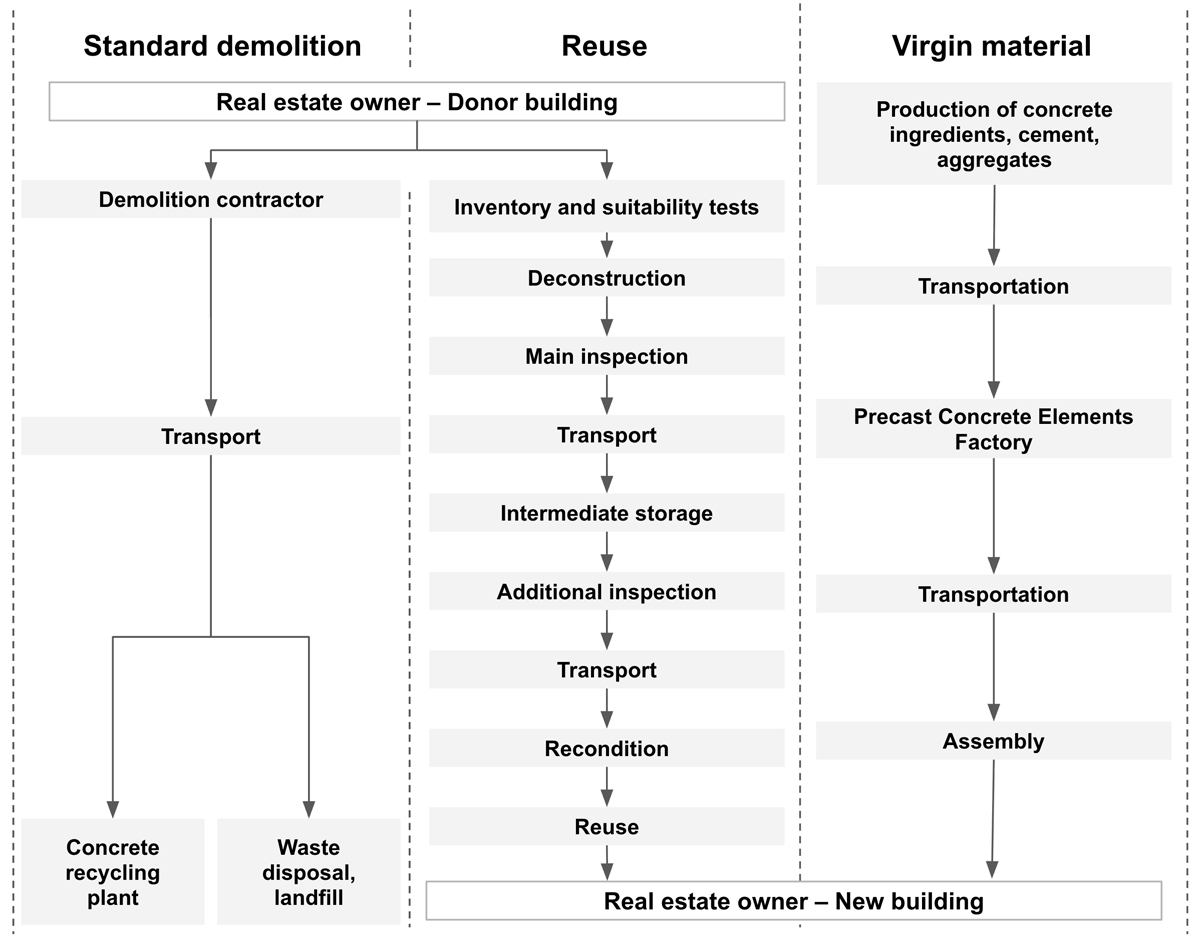
Figure 1
A supply-chain framework for analysing economic boundary conditions.
The framework conceptualises PCE reuse as a sequence of interdependent decisions made by multiple actors operating under constraints and uncertainty. These decisions determine whether elements progress through a reuse pathway or are directed towards demolition and recycling, or if virgin materials are used in new buildings. Reuse is thus a process consisting of multiple decision points, each influenced by economic mechanisms such as costs, risks and coordination requirements.
The framework represents a stylised model of a supply-chain process. It represents activities observed in practice (ReCreate Project n.d.) but recognises that individual projects may deviate from this representation. For example, the number of transport stages, the use of intermediate storage and the inspection and reconditioning activities may vary depending on project conditions, contractual arrangements and actor strategies. Moreover, different types of PCEs may require different assessment and handling procedures. Since reuse supply chains remain in an early stage of development, no standardised process design has emerged.
A central role in this supply chain is played by real estate owners. At the end-of-life stage, they act as material suppliers (donor buildings), deciding whether to initiate demolition or pursue reuse-related activities. At the procurement stage, they act as building buyers, influencing whether reused or virgin materials are selected in new projects. These decisions are made in interaction with other actors, including deconstruction contractors, engineering consultants, logistics providers and reuse intermediaries. Therefore, the economic feasibility depends on coordination across actors, each facing their own economic constraints.
In essence, the framework compares three alternative supply-chain pathways, which represent competing and complementing uses of resources at each decision point. The standard demolition pathway follows a rather linear process from donor building to recycling or disposal of materials. This pathway is characterised by established routines, relatively low coordination complexity, and predictable cost structures.
The reuse pathway involves a more complex sequence from donor building and inventory and suitability tests to deconstruction and material reconditioning for new buildings. This pathway introduces multiple decision points where components may either continue within the reuse supply chain or exit to demolition or recycling. It involves a broader set of actors, including engineers, logistics providers, storage operators and reuse intermediaries. While it may generate value through avoided disposal costs and reduced demand for new materials, it also introduces higher transaction, coordination and uncertainty-related costs.
The virgin material production pathway follows a conventional industrial process from production of concrete ingredients to PCE factory and assembly of a new building. This pathway benefits from economies of scale, standardised production, and established market structures, offering predictable quality, availability and pricing.
These pathways are presented as analytically distinct, but they may coexist in practice. A single deconstruction project may reuse some elements and dispose others, and a construction project may use some elements that are reused and others made of virgin materials. According to opportunity cost logic, actors compare alternatives across these pathways, and the relative costs and benefits determine whether reuse is economically feasible.
Finally, following the evolutionary economics perspectives, the framework acknowledges path dependencies in the construction practices. Existing production capacities and institutional arrangements are largely aligned with standard demolition and virgin material supply chains (ReCreate Project n.d.). This creates structural barriers for reuse supply chains, which require new forms of coordination, investment and learning. As a result, reuse becomes viable only when economic conditions are sufficiently favourable across multiple decision points to overcome these existing path dependencies.
This paper considers this framework through three questions:
Which economic factors influence decisions at the donor building stage to direct components into the reuse pathway rather than the demolition pathway?
Which economic factors influence material choices in new buildings between reuse and virgin material production?
Which economic factors determine the profitability of actors operating within the reuse supply chain?
3. METHODS AND ANALYTICAL APPROACH
The study applies a confirmatory document analysis design, which is motivated by the limited availability of primary cost data. Document analysis enables synthesis of dispersed evidence and supports the identification of economic mechanisms. The study is grounded in a four-year longitudinal research programme involving close collaboration with industry actors in Swedish and Nordic reuse pilot projects (ReCreate Project n.d.). This experience informed the development of the analytical framework.
The empirical material consists of 54 documents (Table 1), including academic literature, industry reports, databases, websites, internal firm documents and project documentation. A detailed list of the documents is provided in Table S1 in the supplemental data online. Documents were identified through database searches, grey literature searches, citation tracking, and materials obtained through research collaborators and ongoing projects. The company-internal documents were received from key informants participating in the project.
Table 1
Data sources
| DOCUMENT TYPE | DOCUMENT COUNT |
|---|---|
| Academic article | 17 |
| Database/website | 11 |
| Industry report | 19 |
| Other report | 4 |
| Firm internal document | 3 |
| Total | 54 |
All documents were analysed using a qualitative document analysis approach. Material was read systematically and coded manually. The analysis focused on identifying cost information related to PCE reuse, economic mechanisms affecting decision-making, risks and uncertainties in reuse supply chains, and other evidence of economic boundary conditions.
4. RESULTS
This section analyses the economic boundary conditions of PCE reuse by linking supply-chain decision points to underlying economic mechanisms and actor roles. The analysis is organised around the aforementioned questions, focusing on six decision points (Q1 and Q2) and two supply chain-level conditions (Q3).
4.1 DONOR-SIDE DECISIONS: DIRECTING ELEMENTS INTO THE REUSE PATHWAY
4.1.1 Decision point 1: demolition versus deconstruction
The initial and most consequential decision concerns whether to pursue standard demolition or reuse-oriented deconstruction, and it determines whether elements enter reuse supply chains. In practice, building owners (here conceptualised as PCE donors or sellers) commission demolition and engineering firms to assess the technical, logistical and economic feasibility (ReCreate Project n.d.).
The economic trade-off associated with reuse is characterised by higher deconstruction costs resulting from labour intensity, planning requirements and coordination needs, balanced against avoided end-of-life costs due to lower volumes sent to conventional waste management, such as recycling plants, backfilling and landfill.
Empirical evidence indicates that deconstructing buildings may cost approximately one and a half to two times more than conventional demolition, although variation is substantial (Ghisellini et al. 2018). Evidence from Swedish pilot projects similarly suggests that deconstruction costs are perceived high, although project-specific costs can vary significantly (ReCreate Project n.d.).
At the same time, reuse can reduce the volume of materials requiring disposal, thereby lowering end-of-life costs. However, no estimates of cost savings were identified in the reviewed material. Disposal costs may vary substantially across regions and countries due to differences in landfill charges, recycling fees and regulatory requirements.
From an actor perspective, building owners bear overall responsibility for decommissioning decisions. They have legal responsibilities and control the selection of suppliers and contractors (Engström & Hedgren 2012; Vigren & Eriksson 2025). However, building owners may have limited expertise or control regarding activities further downstream in the supply chain (Engström & Hedgren 2012).
Consequently, reuse is likely to be more economically attractive in contexts where disposal costs are high or where deconstruction costs are low. Furthermore, the decision is influenced by the coordination costs, available capabilities and incentives of the actors involved.
4.1.2 Decision point 2: inventory, assessment, inspection and reconditioning costs
If deconstruction is pursued, actors must decide whether and how to undertake inventory, inspections, suitability tests and potential reconditioning of PCEs. This involves identifying reusable elements, documenting their characteristics, evaluating their technical condition and remaining service life and determining the extent of the reconditioning required to meet future requirements (Suchorzewski et al. 2023).
The decisions are characterised by cost–uncertainty trade-offs. Actors incur upfront costs for inventory activities, inspections, documentation, suitability testing and the reconditioning efforts. These expenditures can improve reuse by reducing information asymmetries and uncertainty. However, their economic value remains uncertain because future demand, resale prices, project-specific requirements and the eventual costs of reconditioning cannot be known with certainty at the time of assessment. Consequently, actors must weigh the costs of generating information and improving element quality against the expected value that reuse may create.
Existing evidence provides limited systematic data on the cost structures associated with these activities. Although digital tools may improve inventory, documentation and traceability (Dervishaj et al. 2023a; Dervishaj et al. 2023b; Dervishaj & Gudmundsson 2024), their economic implications are not yet well established. At the same time, uncertainty regarding structural performance and quality requirements increases perceived risk. However, recent testing methods, together with findings demonstrating that reused concrete elements can achieve service lives comparable to new structures, reduce this technical uncertainty (Dervishaj et al. 2026). Engineering consultants play key roles throughout this stage, although the allocation of responsibilities and costs may vary across projects (ReCreate Project n.d.).
4.1.3 Decision point 3: disposal, storage, reuse or sale
Following deconstruction and assessment, actors must decide whether to store, sell, reuse or dispose of elements. This decision introduces key economic trade-offs related to storage and market liquidity.
Reuse may require intermediate storage (ReCreate Project n.d.), and costs accumulate over time due to tied-up capital, space requirements and handling needs (Addis 2012). As with any storage costs, these costs increase over time, which is why profitability depends on inventory turnover. Only components with sufficiently high probability of use or resale are economically viable to store (Besanko et al. 2010).
Reuse creates a market opportunity between supply and demand (Riuttala et al. 2024). Reuse may create new revenue through the sale of salvaged elements (Återhus Project 2023; Riuttala et al. 2024; Svedmyr et al. 2024). By establishing partnerships with organisations specialising in material reuse, building owners may monetise components that would otherwise be discarded. Emerging digital platforms and marketplaces (Blocket n.d.; CCBuild n.d.; Loopfront n.d.; Palats n.d.) support the development of a nascent secondary market for construction components.
Overall, weak market liquidity and high transaction costs remain central constraints (Riuttala et al. 2024; Svedmyr et al. 2024). It may be challenging to match supply and demand owing to timing, location, high transportation costs and concerns related to technical quality. Also, price levels and demand may vary significantly across element types. For instance, hollow-core slabs exhibit established reuse potential, whereas other element types have not been identified as particularly economically feasible (ReCreate Project n.d.).
4.2 BUYER-SIDE DECISIONS: REUSE VERSUS VIRGIN MATERIALS
4.2.1 Decision point 4: reuse versus virgin materials
Building buyers face a trade-off between selecting reused PCE-based structures and virgin-material-based structures, balancing differences in cost, uncertainty and performance characteristics.
Building buyers compare the costs and benefits of reused PCEs with those of virgin materials (ReCreate Project n.d.). Here, the cost of the building’s structural frame represents a critical cost component that determines the ‘budget constraint’ or economic flexibility available for adopting reuse-based solutions. To illustrate this using data obtained from a Swedish real estate owner (Table 2), consider an apartment building with a total cost of €15,000,000, where the structural frame and roof system account for 20% (€3,000,000). If the cost of this system increases by 25% (€750,000), the total project cost rises to €15,750,000, corresponding to a 5% increase.
Table 2
Scenarios of how cost increases or decreases impact the total costs of an apartment building
| PROJECT COST | STRUCTURAL FRAME COST | STRUCTURAL FRAME COST CHANGE (%) | NEW PROJECT COST | PROJECT COST CHANGE (%) |
|---|---|---|---|---|
| €15,000,000 | €3,000,000 | –25% | €14,250,000 | –5% |
| €15,000,000 | €3,000,000 | +25% | €15,750,000 | +5% |
| €15,000,000 | €3,000,000 | +50% | €16,500,000 | +10% |
| €15,000,000 | €3,000,000 | +75% | €17,250,000 | +15% |
This simplified calculation demonstrates how changes in element costs translate into overall project costs. This sensitivity analysis show that moderate cost changes may be economically acceptable at the project costs level, depending on the broader project context. Annual cost fluctuations of ±10% are common in construction, indicating that these observed differences fall within typical variability (Statistics Sweden n.d.). The economic significance of these variations depends on the client’s willingness to pay and their valuation of non-cost attributes such as sustainability, risk reduction and reputational benefits, which can influence whether a given cost difference is perceived as acceptable or decisive in investment decisions. Importantly, this logic applies to cost changes driven by any factors, such as material price volatility or regulatory changes.
Other empirical evidence shows that cost outcomes for PCE reuse vary. For example, Eklund et al. (2003) report that a Swedish student housing project was 10–15% more expensive than comparable conventional buildings. Contractors expected that costs could be reduced through economies of scale and the learning-curve effects. In that case, public subsidies covered the additional costs. A more recent pilot project (Återhus 2023) suggests that costs are comparable or slightly higher than conventional construction, with expectations of cost reductions as processes become standardised. For more information on cost levels, see also Huuhka et al. (2015), Küpfer et al. (2023) and Salama (2017).
Overall, economic evidence on costs is limited and mostly based on case studies and pilot projects. Owing to methodological differences and limited data, conclusions on costs remain uncertain. Nevertheless, the analysis suggests that price differences at the structure level may be tolerable within overall construction budgets, and that economic feasibility depends on the magnitude of cost differences, project context and prevailing market and policy conditions. This highlights that, where these conditions are favourable for reuse, reuse can be economically feasible from the demand-side perspective.
4.2.2 Decision point 5: design and compatibility
A further decision concerns whether reused PCEs can be integrated into new building designs (ReCreate Project n.d.). Reused elements may require redesign and adaptation. Economic mechanisms include additional design effort, engineering costs and potential inefficiencies arising from non-standard geometries. Buildings must be usable, buildable, operable and sustainable (Fischer et al. 2017). Design choices involve associated costs. Data and advances in digitalisation, automation and design tools, such as artificial intelligence and digital material tracking, may help in design processes (Brozovsky et al. 2024; Dervishaj et al. 2023a; Dervishaj et al. 2023b; Dervishaj & Gudmundsson 2024; Huuhka et al. 2024). Nevertheless, the reviewed material does not provide economic data or feasibility analysis. Consequently, design remains an important but insufficiently quantified decision point.
4.2.3 Decision point 6: procurement and coordination
Procurement decisions involve selecting suppliers, allocating risk and coordinating activities. Reuse requires additional coordination mechanisms and often relies on a more limited pool of suppliers with relevant reuse experience compared to conventional construction, especially in local markets (Återhus project 2023; ReCreate Project n.d.). This trade-off includes transaction costs related to supplier search, negotiation, certification and contract management. While the reviewed material does not provide economic evidence specifically related to reuse, previous research on procurement and coordination indicates that real estate owners often rely on established supplier networks (Vigren & Eriksson 2025; Vigren et al. 2022) and are conservative in their practices (Engström & Hedgren 2012). As a result, even when reuse is technically feasible and cost-competitive, procurement-related uncertainties and coordination challenges may limit its adoption (Vigren & Eriksson 2025).
4.3 SUPPLY CHAIN-LEVEL CONDITIONS
4.3.1 System-level condition 1: supply chain-level profitability
Economic theories and legal frameworks establish that reuse adoption depends on whether actors can operate profitably under competitive conditions (Besanko et al. 2010; Hyde 2026; Mankiw 2007). If key actors face weak or negative returns, system-wide adoption may be constrained even if reuse is socially or environmentally beneficial.
Therefore, the adoption of reuse practices requires collective decision-making on shared goals, processes and co-investment arrangements. The supply chain-level economic conditions are characterised by trade-offs in how value is created and distributed among firms (Aarikka-Stenroos et al. 2021; Harala et al. 2023; Riuttala et al. 2024; Sairanen et al. 2024; Vigren 2024). Main economic considerations relate to investments in knowledge and capacity that enable reuse, as well as agreements on cost items. Transport costs and available storage capacity, in particular, are system-level constraints that limit reuse to local markets owing to the weight and volume of PCEs (Ghisellini et al. 2018; Svedmyr et al. 2024). Storage costs depend on demand timing and inventory turnover rates. At the same time, reuse generates value through avoided disposal costs and reduced demand for virgin materials. In some cases, reused components may also be substantially less expensive than new ones (Huuhka et al. 2019; Küpfer et al. 2023).
Nevertheless, empirical evidence on profitability distribution and long-term investments remains limited. On the other hand, a central constraint is that construction is generally a low-margin industry, where labour represents a large share of total costs. As a result, time-intensive learning processes associated with new methods can reduce short-term productivity and profitability, creating weak incentives for experimentation and innovation (Besanko et al. 2010). This may reinforce existing production logics and slow structural change.
4.3.2 System-level condition 2: policy incentives and regulatory support
Important system-level conditions concern policymakers and the overall incentive structure for reuse. The central argument of this paper is that mainstreaming building component reuse requires reuse to become a financially viable choice for the actors involved (Ebrahimian & Mohammadi 2024; Hyde 2026; Kulmala et al. 2002) and that firms compare the incentives for reuse with those of alternative production pathways (Mankiw 2007). Currently, reuse supply chains are in a nascent stage of development (ReCreate Project n.d.), but appropriate policy interventions can strengthen their emergence. Relevant policy instruments may include subsidies, tax incentives, public–private partnerships and regulatory frameworks.
Evidence suggests that building owners respond to institutional and policy-related incentives. For example, Eklund et al. (2003) report that public subsidies contributed to a Swedish reuse project. More broadly, the real estate and construction sector is strongly governed by policy and regulatory frameworks, and participation in circular practices may also be driven by stakeholder expectations. For example, municipalities may require publicly owned real estate companies to engage in reuse practices, and financiers may require sustainability measures as part of investment decisions (Eriksson & Bostedt 2026). Also, public–private partnerships, which are widely used in the construction sector, could in principle function as a mechanism for scaling up reuse by enabling coordinated demand, risk-sharing and long-term planning across public and private actors. However, no clear empirical evidence of such arrangements supporting PCE reuse was identified in the reviewed material.
Overall, the economic mechanisms supporting reuse may include direct financial incentives, such as tax reductions, grants, subsidies, access to green finance, reduced insurance costs, compliance with or avoidance of regulatory sanctions, eligibility for government-sponsored sustainability initiatives, and reputational benefits associated with sustainability performance (e.g. Eklund et al. 2003; Eriksson & Bostedt 2026; Riuttala et al. 2024). These mechanisms could be used to improve the relative attractiveness of reuse compared with conventional construction by reducing costs, increasing expected returns or lowering perceived risks. Nevertheless, empirical evidence on these policy instruments for promoting PCE reuse remains limited, and economic incentive mechanisms remain relatively underexplored in the sustainability literature more broadly (e.g. Eriksson & Bostedt 2026; Shahid et al. 2024).
4.4 SUMMARY OF ECONOMIC BOUNDARY CONDITIONS ACROSS DECISION POINTS AND SYSTEM-LEVEL CONDITIONS
Across the analysis, three key patterns are evident.
First, economic data are limited and are derived primarily from pilot projects and nascent supply chains, which do not yet reflect economies of scale or learning-curve effects (Besanko et al. 2010; Mankiw 2007). Therefore, it is not possible to draw strong conclusions about the magnitude of economic mechanisms, such as cost structures or profitability. As Svedmyr et al. (2024) and Küpfer et al. (2023) argue, greater availability of structured economic data from both public and private sources would enable more comprehensive analyses.
Second, reuse remains largely a local activity owing to high transportation costs, limited overall capacity and specialised knowledge requirements (Ghisellini et al. 2018; Svedmyr et al. 2024). This suggests that reuse supply chains depend on agglomeration effects (Besanko et al. 2010), whereby a sufficient concentration of projects, actors and capabilities within a region is required for economically viable supply chains to emerge.
Third, reuse depends on cumulative economic mechanisms across actors and supply-chain stages. The implication is that the economics of reuse should be considered at the system level, accounting for total costs across the supply chain rather than focusing on individual decision points. Table 3 synthesises the findings by linking decision points and conditions to the underlying economic mechanisms and their observed effects on reuse viability, which contribute to total costs at the supply chain level.
Table 3
Summary of economic boundary conditions of reuse across decision points and system-level conditions
| SUPPLY CHAIN STAGE | DECISION POINT/CONDITION | KEY MECHANISMS | EFFECT ON REUSE | MAIN ACTORS |
|---|---|---|---|---|
| Donor stage | Demolition vs deconstruction | Labour costs vs waste costs | Context-dependent | Owner, contractor |
| Donor stage | Assessments and reconditioning | Labour costs and uncertainty | Constraining | Engineers, specialists |
| Donor stage | Disposal, storage, reuse, or sale | Balancing supply and demand | Conditional on demand | Owner, intermediary |
| Buyer stage | Reuse vs virgin material | Price and other benefits vs. availability and risk | Conditional on cost, availability, preferences | Buyer |
| Buyer stage | Design and compatibility | Design costs | Constraining | Designers, architects |
| Buyer stage | Procurement and coordination | Transaction costs | Constraining | Buyer |
| System level | Supply-chain profitability | Value creation and distribution | Requires alignment | All actors |
| System level | Policy and regulation | Incentives, risk reduction | Enabling | Policymakers, public sector, all actors |
A notable feature is that several decision points are primarily constraining, where costs, uncertainty and transaction complexity relative to standard demolition and virgin material use limit reuse adoption. In contrast, at other decision points, the effects are conditional, as they depend on market demand, the availability of actors and elements, and project-specific requirements. At the system level, reuse depends on how value is created and distributed across actors, broader incentive structures established through policy and regulation, and interaction between actor-level decisions and system-level conditions (Hyde 2026; Jacobides et al. 2018).
5. DISCUSSION: IMPLICATIONS AND RESEARCH AGENDA
Current literature and the analysed sources highlight that PCE reuse has a long research history and is supported by a growing body of contemporary studies (Table 1). However, despite this breadth, relatively little attention has been given to systematic economic analysis. This is notable, as economic feasibility is a central determinant of whether innovations are adopted and scaled in practice. While the results provide a structured synthesis of existing knowledge, they also show significant limitations in current research and point to priorities for future work.
5.1 THEORETICAL CONTRIBUTION
The main theoretical contribution of this study lies in conceptualising reuse as a sequence of interdependent economic decisions rather than a single technological or environmental choice. By drawing on microeconomic theory (Besanko et al. 2010; Mankiw 2007) and cost management perspectives (Ebrahimian & Mohammadi 2024; Kulmala et al. 2002; Paranko 2012), the study introduces a supply-chain framework for the analysis of economic mechanisms.
This perspective extends existing research in three ways. First, it complements engineering studies (e.g. Al-Najjar & Malmqvist 2025; Dervishaj et al. 2023a; Suchorzewski et al. 2023) by providing a basis for analysing technical feasibility with economic feasibility. Second, it contributes to business-oriented research (e.g. Aarikka-Stenroos et al. 2021; Harala et al. 2023; Riuttala et al. 2024) by explicitly framing value creation and coordination in terms of economic mechanisms, such as costs, risks and incentives. Third, it responds to calls for stronger microeconomic foundations in circular economy research (Corvellec et al. 2022; Hyde 2026; Kirchherr et al. 2023).
5.2 RESEARCH AGENDA: ECONOMIC MECHANISMS AND EMPIRICAL GAPS
The framework developed in this study provides a basis for structuring research agenda by linking economic boundary conditions to specific stages and actors in the supply chain. Table 4 operationalises this perspective by identifying research areas.
Table 4
Research agenda: economic mechanisms and research gaps in PCE reuse
| SUPPLY CHAIN STAGE | DECISION POINT/CONDITION | RESEARCH GAP | WHY IT MATTERS |
|---|---|---|---|
| Donor stage | Demolition vs deconstruction | Cost structures of deconstruction | Core determinant of supply-side feasibility |
| Donor stage | Assessments and reconditioning | Costs of inventory and assessment | Key source of costs and uncertainty |
| Donor stage | Disposal, storage, reuse or sale | PCE prices and markets | Limits scaling of reuse markets |
| Buyer stage | Reuse vs virgin material | Cost competitiveness and availability | Core determinants of demand-side feasibility |
| Buyer stage | Design and compatibility | Design costs and technical uncertainty | Key source of costs and uncertainty |
| Buyer stage | Procurement and coordination | Transaction costs | Often hidden costs that limit scalability |
| System level | Supply-chain profitability | Overall cost-benefits, profitability | Fundamental condition for all actors |
| System level | Policy and regulation | Policy impact and incentives design | Fundamental condition for all actors |
A central priority concerns the systematic measurement of cost structures across supply chain stages. While existing studies highlight the importance of labour, logistics, material and coordination costs (Ghisellini et al. 2018; Küpfer et al. 2023), there is limited consistency in how these costs are defined, measured and compared across contexts. Research could develop standardised approaches for benchmarking. Such approaches could build on cost management frameworks (Kulmala et al. 2002; Paranko 2012) and incorporate process-based analysis of supply-chain activities.
A second priority relates to the economics of information and uncertainty in decision-making (Besanko et al. 2010). Activities such as assessment, inspection and reconditioning are important for enabling reuse, yet their economic role is not well understood. Research could analyse how different levels of information affect decision outcomes, and how digital technologies may reduce uncertainty and transaction costs (Dervishaj et al. 2023a; Dervishaj et al. 2023b; Dervishaj & Gudmundsson 2024). Furthermore, increased availability of PCEs could lead to the emergence of what may be considered an entirely new market, which is currently in its infancy. The development of such a market could have significant economic implications, as markets function as coordination mechanisms that promote efficiency, facilitate information exchange, and generate signals for investors, with growing markets being particularly attractive for investment.
A third research direction concerns the formation and functioning of markets for reused elements. Future research could examine how supply and demand are matched over time and space, how prices are formed, and how supply-chain activities and intermediaries influence market development. This aligns with broader research on industrial ecosystems and market coordination (Aarikka-Stenroos et al. 2021; Harala et al. 2023). Future research could also analyse the market prices of PCEs and specific actor roles, such as specialised reuse contractors.
On the demand side, further research is needed on the integration of reuse into project-level decision-making. In particular, there is a need to better understand how cost, risk and design constraints are taken into account when building buyers make decisions about reuse or virgin material use. Future studies could combine cost analysis with behavioural and organisational perspectives, such as willingness to pay (Gurtner & Starovicova 2026; Herranz-Pascual et al. 2024), to capture actual decision processes.
Another important area concerns the role of coordination and governance in reducing transaction costs. Reuse supply chains involve multiple actors, making coordination an important determinant of feasibility. Some firms may consider vertical integration to overcome coordination challenges and transaction costs (Besanko et al. 2010). While previous research highlights coordination (Aarikka-Stenroos et al. 2021; Harala et al. 2023; Riuttala et al. 2024; Sairanen et al. 2024), there is limited understanding of how different organisational arrangements affect reuse. Addressing this gap requires further analysis of governance, incentives and cost structures.
At the system level, two interconnected areas require further attention. First, the distribution of costs and benefits across the supply chain remains poorly understood. Existing studies indicate that value is created at the system level but may not be evenly captured by individual actors (Riuttala et al. 2024; Sairanen et al. 2024). Future research could analyse value allocation and profitability using value-chain or ecosystem approaches, building on both economic theory and business research.
Second, the microeconomic effects of policy and regulatory frameworks represent an important but underexplored research area. While policies are expected to influence incentives and reduce risks (Eriksson & Bostedt 2026; Shahid et al. 2024), their impact on concrete decision-making remains unclear. Future studies could examine how instruments such as subsidies, standards and carbon pricing affect actor behaviour and investment decisions. This includes analysing interactions between policy instruments and market mechanisms, as well as their implications for investments. Future research could also address broader economic and institutional dynamics. Küpfer et al. (2023) highlight the potential for reuse to generate new business models, employment and local value creation, but these effects remain underexplored in quantitative terms.
Finally, advancing research in this field requires structured economic data. Future work could already proceed with modelling and simulation-based methods (Ebrahimian & Mohammadi 2024). At the same time, improved data availability, highlighted as a key need in previous studies (Küpfer et al. 2023; Svedmyr et al. 2024), is essential for validating such models. Quantitative methods are especially helpful for analysing scaling of reuse in practice and comparative analyses between standard demolition, reuse and virgin material pathways. Also, further qualitative case studies can give in-depth understanding on the microeconomic mechanisms and boundary conditions.
5.3 LIMITATIONS
This study is subject to several limitations. First, most evidence originates from Nordic and European contexts, which may limit transferability to other regions.
Second, the analysis relies primarily on documents derived from pilot projects and emerging reuse supply chains, where processes are not yet standardised and cost structures reflect early-stage supply chains.
Third, reliable and comparable economic data remain scarce. Key variables such as cost structures, prices and profitability are often not reported, which limits the analysis (Kulmala et al. 2002; Küpfer et al. 2023; Svedmyr et al. 2024). This constraint applies both to the reviewed material and to the broader research field.
Fourth, the analysis does not address more granular task-level decomposition of supply-chain activities, where parts demolition, reuse and virgin material use coexist within the same project, and variation in reuse feasibility across different PCE types. Existing evidence suggests that reuse potential differs between PCEs: hollow-core slabs have higher reuse feasibility (ReCreate Project n.d.). Furthermore, broader societal or economic impacts are not analysed.
6. CONCLUSIONS
This study examined the economic boundary conditions of PCE reuse using a supply chain-based microeconomic framework. The findings show that reuse is not determined by a single factor but by the alignment of economic mechanisms across sequential decision points and system-level conditions. While reuse can be economically viable in specific contexts, Table 3 shows that it remains constrained and conditional on factors such as demand, cost structures and uncertainty, and therefore requires alignment across the supply chain.
The framework and analysis provide a foundation for more systematic economic research on reuse and may contribute to broader circular economy research (Corvellec et al. 2022; Hyde 2026; Kirchherr et al. 2023). Future research can focus on quantifying economic mechanisms, as outlined in Table 4, to reduce uncertainty and improve decision-making.
Advancing this knowledge base is essential for scaling reuse beyond pilot projects. A clearer understanding of economic mechanisms can support managers, investors and policymakers in assessing reuse opportunities, coordinating supply chains and designing effective incentives and regulatory frameworks.
ETHICS AND CONSENT
Ethical approval was not required for this study.
ACKNOWLEDGEMENTS
The authors thank the editor and two anonymous reviewers for their excellent and constructive feedback, and the colleagues at the Center for Integrated Facility Engineering (CIFE) at Stanford University for their constructive feedback and supportive research environment. We also wish to acknowledge the participants of the ReCreate Project for their valuable insights, discussions and contributions, which have informed this research.
DATA ACCESSIBILITY
Data are available from the corresponding author upon reasonable request.
AI DECLARATION
The authors did not use artificial intelligence (AI) in this research or the writing of this manuscript.
SUPPLEMENTAL DATA
Supplemental data for this article can be accessed at: https://doi.org/10.5334/bc.842.s1