
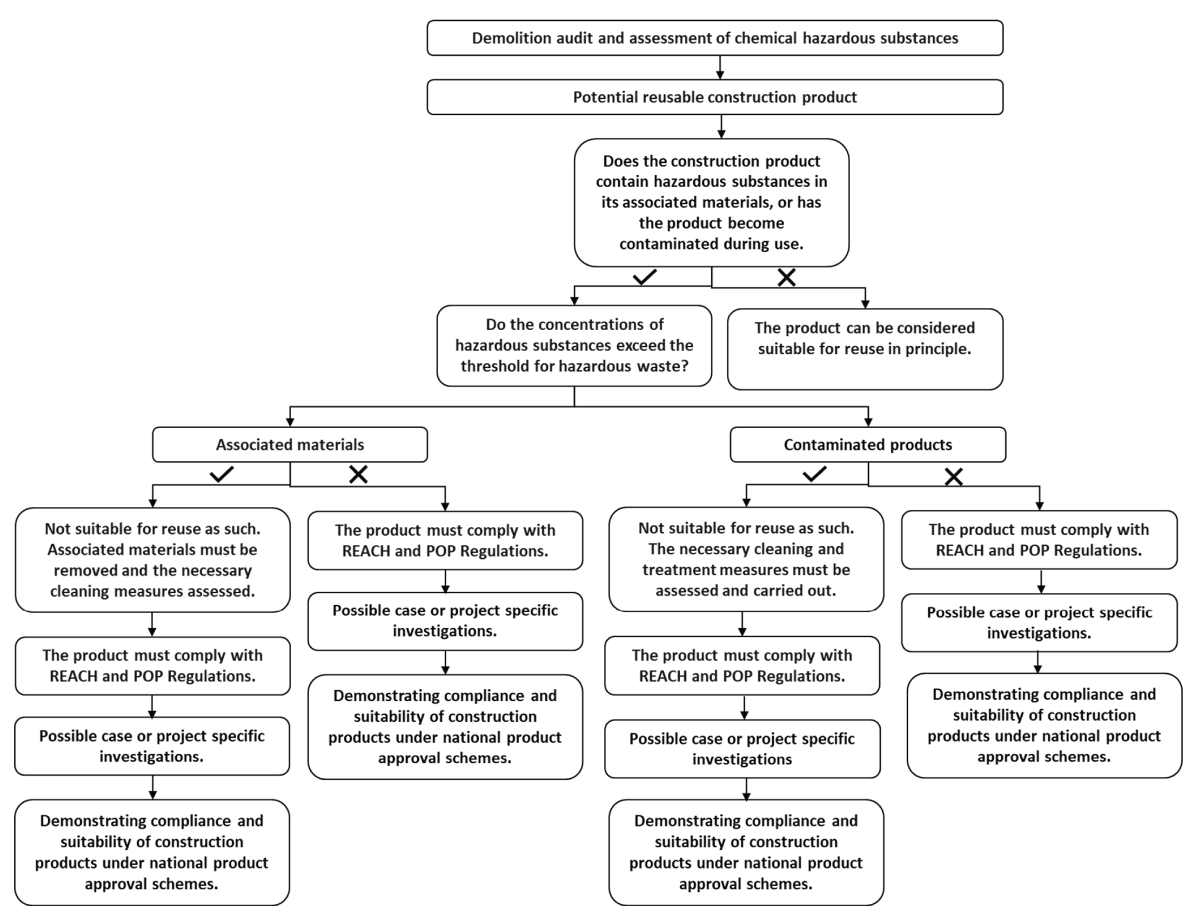
Figure 1
The evaluation process for assessing potentially hazardous chemical substances when reusing concrete construction products in indoor environments.
Table 1
The most common VOC compounds, compound groups or compound categories are based on a dataset of concrete samples analysed using the bulk method (n = 1,382).
| COMPOUND | NUMBER OF OBSERVATIONS | FREQUENCY OF OCCURRENCE (%) | P90 (μg/m3 g) | P95 (μg/m3 g) | Max (μg/m3 g) |
|---|---|---|---|---|---|
| TVOC | 1382 | 100% | 70 | 120 | 7300 |
| 1-Butanol | 968 | 70% | 18 | 35 | 310 |
| 2-Ethyl-1-hexanol | 928 | 67% | 28 | 42 | 1500 |
| Hydrocarbon mixturea | 304 | 22% | 15 | 38 | 7800 |
| C9-alcoholsb | 224 | 16% | 6 | 13 | 200 |
| 2-Methyl-1-propanol | 176 | 13% | 0.7 | 2 | 33 |
[i] Notes: aMixture may include both aliphatic and aromatic hydrocarbons, determined as toluene equivalents. The boiling point range of compounds detected in the hydrocarbon mixture varies by sample. The hydrocarbon mixture presented here may include compounds with boiling points approximately in the range of 50–350°C. bDetermined as toluene equivalents. The P90 value, P95 value, and maximum value (Max) refer to the entire dataset. For details, see Appendix A.
Table 2
Principles and interpretation for hazardous chemical substances assessment in reuse contexts
| PRINCIPLE | INTERPRETATION FOR REUSE ASSESSMENT |
|---|---|
| Process-based assessment | Chemical hazard assessment should be structured as a staged process that progresses from existing information (e.g. use history, demolition audits, constituents) to targeted investigations only when uncertainties remain. |
| Context-dependence | The relevance of chemical hazards is determined by the origin, use environment and intended application of the product. Construction products originating from typical indoor environments are unlikely to contain hazardous substances that would prevent reuse once contaminated surface materials have been removed. |
| Avoidance of unnecessary testing | Assessment approaches should minimise routine laboratory testing and rely on targeted investigations only where justified by identified risks or uncertainties. |
| Exposure-oriented evaluation | The relevance of hazardous substances depends primarily on exposure pathways and the intended use context, rather than on the mere presence of substances. |
| Regulatory integration | Chemical legislation (REACH, POP) should be integrated into reuse processes in a way that supports practical implementation without creating disproportionate barriers. However, the relevance and implications of these obligations may vary between different construction product types and materials and should be assessed on a case-by-case basis. |
| Interface management | Effective reuse assessment requires linking chemical evaluation with demolition audits, documentation practices and building permitting procedures. |
| Information obligations and transfer (SVHC/SCIP) | The transfer of chemical information (e.g. SVHC communication, SCIP data) across life-cycle stages is essential for maintaining chemical safety in reuse systems. |