
1. INTRODUCTION
Promoting circular economy practices in the construction sector is widely recognised as a key strategy for reducing environmental impacts, material consumption and greenhouse gas emissions. Among these strategies, the reuse of construction products has been identified as a particularly effective means of extending product lifespans and reducing the demand for virgin materials. However, despite its recognised potential, the implementation of reuse in building construction, especially for products used in indoor environments, remains limited.
Previous research shows that barriers to the reuse of building components and products are predominantly linked to institutional, organisational and regulatory factors (Adams et al. 2017; Hart et al. 2019; Pomponi & Moncaster 2017). Uncertainties concerning product safety, the allocation of responsibilities and the interpretation of regulatory requirements may hinder or delay reuse in construction projects. One of the most critical and least operationalised areas in this context relates to hazardous chemical substances and their implications for the reuse of construction products in indoor environments. Unlike structural or technical properties, chemical risks are often difficult to detect, quantify and interpret, particularly when product histories are incomplete or when contamination may result from use-phase conditions (Uhde & Salthammer 2007). These uncertainties become especially pronounced when the origin, use history or material composition of construction products is not fully known, or when products have been manufactured prior to the introduction of current up-to-date chemical legislation. In such cases, the presence, behaviour and relevance of hazardous substances may be difficult to assess using existing practices alone.
The chemical safety of new construction products is primarily governed by chemical legislation, notably the REACH Regulation EC No 1907/2006 (2006) and the POPs Regulation EU 2019/1021 (2019). At the national level, building and health protection regulations primarily define requirements related to the overall health and safety of buildings (Finnish Building Act 751/2023; Decree on Health Conditions of Dwellings and Other Indoor Environments 545/2015 (Finland)). However, a key challenge is that current legislation does not provide universally applicable limit or reference values for hazardous substances in construction products, nor clear guidance for their interpretation in the context of reuse in indoor environments. As a result, even extensive laboratory analyses may not, on their own, resolve the question of whether a product is suitable for reuse, and assessments often remain case-specific and subject to uncertainty.
Despite the growing body of research on construction product reuse, the role of chemical hazard assessment within reuse decision-making remains insufficiently conceptualised, and the interpretation of current chemical, construction and product legislation, and their interfaces, in reuse contexts is still unclear and lacks consistent guidance. Recent studies have primarily focused either on material performance and technical feasibility or on regulatory barriers at a general level (Rakhshan et al. 2020), while the practical integration of chemical risk considerations into reuse assessment, product approval and building permitting processes has received limited attention. In particular, there is a lack of approaches that connect chemical and product approval legislation, building-level investigations and project-specific decision-making in a consistent and operational manner. This results in a misalignment between regulatory requirements, available assessment methods and their practical interpretation in permitted construction projects. In response to this, this study explores how chemical hazard assessment can be structured as part of reuse assessment and building permitting process in a context where established practices are still emerging. This study develops a structured set of principles and a stepwise approach that support case-by-case evaluation of chemical safety as part of demonstrating compliance and suitability in project-specific contexts.
1.1 RESEARCH OBJECTIVES
The assessment of hazardous chemical substances in the reuse of construction products is examined within the European and Finnish regulatory context. Particular attention is given to the national construction products approval and building permitting process and to products used in indoor environments. The study focuses on structural concrete construction products, namely concrete hollow score slabs, columns and beams that originate from indoor conditions and intended for reuse in similar indoor environments. The research combines regulatory and literature analysis, expert and authority engagement, and empirical analysis of laboratory data on chemical emissions from concrete products.
The research question addressed in this study is: how can the assessment of hazardous chemical substances in the reuse of construction products be systematically structured and implemented as part of demonstrating compliance and suitability in a way that ensures health protection and regulatory requirements are met without unnecessary testing or hindering reuse? To address this question, the study analyses how hazardous chemical substances assessment can be considered within reuse assessment and building permitting process.
2. MATERIALS AND METHODS
2.1 RESEARCH DESIGN, LITERATURE ANALYSIS AND EXPERT ENGAGEMENT
The regulatory analysis covered European Union (EU) chemical legislation, including key obligations under the REACH Regulation EC No 1907/2006 (2006) and the Regulation on POPs EU 2019/1021 (2019), as well as EU and national regulation concerning construction products (Act on the Approval of Certain Construction Products 954/2012 (Finland); Decree on the Approval of Certain Construction Products 555/2013 (Finland)) and building activities (Finnish Building Act 751/2023). The literature review focused on barriers to reuse, chemical safety, and health aspects of indoor environments. The empirical material was based on interaction with experts and public authorities (n = 116). Written and questionnaire feedback was collected and analysed through consultation rounds.
2.2 EMPIRICAL LABORATORY DATA ANALYSIS
In addition to the qualitative and regulatory analysis, the study utilised retrospective aggregated laboratory data on chemical emissions from concrete materials to provide empirical context for reuse assessments (for details, see Appendix A). The empirical analysis was based on anonymised results from an accredited Finnish testing laboratory, where since the early 2010s a total emission micro-chamber (µ-CTE, bulk emissions) method has been routinely applied to concrete samples. The aggregated dataset comprised concrete samples analysed for volatile organic compounds (VOCs) (n = 1,382) and for ammonia (n = 35) emissions. The data originated from a wide range of building material and condition investigations and were analysed for concentration distributions and occurrence frequencies. The samples included both damage areas and reference locations. The laboratory was not responsible for field sampling; samples were submitted by clients for analysis.
VOC emissions were analysed using a micro-chamber method (µCTE) combined with TD-GC-MS analysis, following established and accredited analytical procedures (Leino et al. 2020; Castagnoli et al. 2019; Schripp et al. 2007). Ammonia emissions were analysed using a flow-through sampling method with ion chromatography. The methods provide estimates of total emission potential and are suitable for comparative assessment of emission levels. A detailed description is provided in Appendix A.
3. REGULATORY AND CONCEPTUAL BACKGROUND
3.1 REUSE OF CONSTRUCTION PRODUCTS WITHIN THE BUILDING REGULATORY FRAMEWORK
The reuse of construction products takes place at the intersection of multiple regulatory frameworks, including construction product regulation and chemical legislation and building safety requirements, which has been identified as a key institutional challenge (Knoth et al. 2022; Rakhshan et al. 2020). Under Finnish legislation, construction products must meet the essential technical requirements of buildings (e.g. structural safety, fire safety and health-related performance) throughout their service life, including health and safety in use. These requirements apply equally to new and reused products, and compliance must be demonstrated whenever products are used in permitted building projects subject to building control approval (Finnish Building Act 751/2023). For indoor environments, products must also be considered acceptable in terms of indoor air emissions, although the criteria for acceptability remain open to interpretation.
A key challenge is that existing procedures for demonstrating the conformity of construction products, such as CE marking, declarations of performance, or national product approval procedures, have been developed for new products and are not directly applicable to reusable construction products. The new Construction Product Regulation (CPR) 2024/3110 (European Union 2024) includes, for the first time, provisions on reuse and enables the future development of harmonised product standards for reusable construction products.
3.2 CHEMICAL LEGISLATION AND REGULATORY OBLIGATIONS
The chemical safety of construction products is primarily governed by the REACH Regulation (2006) and the POPs Regulation (2019). Their obligations apply to both new and reused products when they are placed on the EU internal market, that is, supplied or made available to a third party, whether for payment or free of charge. Under the POPs Regulation, a product already in use before a substance was prohibited or restricted may continue to be used. In such cases, compliance with obligations applicable to new products is not required; instead, the product’s compliance and suitability are assessed case by case.
An important but often under-recognised aspect of chemical regulation in reuse is the information and notification obligations for articles under the REACH Regulation. Under Article 33, the producer or supplier must provide sufficient information if an article contains a substance of very high concern (SVHC) above 0.1% by weight. In addition, Article 7(2) may trigger notification to the European Chemicals Agency if the article contains SVHCs above 0.1% by weight and the total amount exceeds one tonne per producer per year. In reused construction products, assessing these thresholds is challenging because products may originate from multiple demolition sites and substance concentrations may vary. Calculating SVHC concentrations as weight percentages may also require detailed information on dimensions, densities, layer thicknesses and material-specific concentrations, for which no direct guidance currently exists. In addition, demolition audits are not technically designed for this type of assessment. When reused construction products are placed on the EU internal market, responsibility for compliance remains with the producer, seller or supplier.
The information and notification obligations under the REACH and POPs Regulations are not primarily linked to building permits, but to placing products on the EU internal market and transferring information to subsequent users. Nevertheless, they are an essential part of managing chemical safety in reuse and influence how hazardous substance information should be documented and presented in assessments of compliance and suitability.
3.3 HEALTH, INDOOR ENVIRONMENTS AND EXPOSURE ASSESSMENT
Health risk assessment in indoor environments is based on an overall evaluation that considers hazardous substances properties, concentrations in materials, exposure pathways and the intended use and conditions of the construction product. Indoor air concentrations of pollutants are always influenced by the building as a whole, including construction and interior materials, environmental conditions, ventilation, occupants and activities and outdoor air concentrations (Juntunen et al. 2022; Wallenius et al. 2021; Weschler & Carslaw 2018).
In terms of the indoor air quality, the VOC emissions from building products should be assessed. A number of VOCs can be detected by smell at low concentrations, and their odour may be experienced as unpleasant, potentially resulting in nuisance (Wallenius et al. 2022). In Finland, however, there are currently no legislative requirements for such assessment, except for formaldehyde emissions covered by the REACH Regulation. This restriction does not apply to reusable products.
In Finland, there is a voluntary emission classification system for new building materials, known as the M1 classification. Under the M1 classification, a manufacturer can demonstrate the low-emission performance of a building material and the acceptability of its odour in relation to indoor air quality. The voluntary M1 emission classification currently does not apply to reused construction products. For reusable construction products, exposure to hazardous substances may be particularly relevant during dismantling and handling phases, whereas, once installed and during the normal use of a building, exposure may not necessarily occur. If exposure to a hazardous substance cannot occur during the normal use of the construction product in an indoor environment, no health risk to building occupants is considered to exist (European Chemicals Agency 2016). For this reason, the assessment of M1 hazardous chemical substances should always be linked to the intended use and the possibility of exposure. Consequently, assessment should primarily be based on demolition audits, hazardous substance investigations, building use history and site observations, with targeted additional investigations only when necessary.
3.4 METHOD-SPECIFIC REFERENCE VALUES: APPLICABILITY FOR ASSESSING REUSABILITY
In general, no binding measurable reference or limit values for the acceptability of indoor air chemical emissions from construction products are defined in legislation. Based on material composition and concentration analyses, it is generally not possible to draw quantitative conclusions about the volatilisation of compounds into indoor air or their concentrations in indoor environments (Weschler & Carslaw 2018). Such analyses mainly support occupational safety during demolition and waste classification.
Emission measurements can provide semi-quantitative or quantitative information on VOC emissions from building materials (Leino et al. 2020). The total emission or bulk method, the method used in this study, estimates total emission potential (Leino et al. 2020; Pitkäranta 2016; Schripp et al. 2007). However, it is semi-quantitative, its reference values are mainly laboratory-specific rather than health-based, and the results cannot be used to determine surface emission rates or indoor air concentrations (Leino et al. 2020).
Surface emission measurements using FLEC or emission chamber methods are quantitative techniques for determining surface VOC emission rates (Järnström et al. 2007; Leino et al. 2020; Pitkäranta 2016). The FLEC is mainly used in field conditions, whereas emission chamber measurements are carried out under laboratory conditions according to standardised procedures (Järnström et al. 2007; Leino et al. 2020; Pitkäranta 2016). The FLEC method can be compared with typical or atypical material emission levels but cannot be used to directly estimate indoor air concentrations (Leino et al. 2020; Wallenius et al. 2021; Wallenius et al. 2023).
Emission chamber methods are probably the ones most known and used to measure emissions from new construction products. The emission results can be compared with health-based limit values such as those included in the EU-LCI list (European Commission Directorate-General for Internal Market 2023) and the limit values used in M1 emission classification (Leino et al. 2020; Wilke et al. 2004). For reused construction products, however, such measurements are relatively rare because they require larger sample quantities and are significantly more costly than bulk or FLEC analyses (Leino et al. 2020).
3.5 CHEMICAL EMISSIONS FROM CONCRETE AND ASSOCIATED AND ADJACENT MATERIALS
Previous studies show that chemical emissions from concrete are generally low and highly dependent on material age, curing conditions and surface treatments (Chyliński et al. 2021; Hjellström 2004; Shou et al. 2014). Ammonia emissions from concrete have been primarily associated with fresh or recently cast materials and decrease over time (Bai et al. 2006; Hjellström 2004; Lindgren 2010; Shou et al. 2014; Zhu et al. 2022). For example, in a Finnish study, emission measurements of concrete products have shown that the TVOCs, as well as formaldehyde and ammonia emissions and the acceptability of odour, were generally well below the limit values allowed by the M1 emission classification (Hemmilä et al. 2021). According to earlier research, potential sources of ammonia emissions in concrete include binder materials such as fly ash and blast furnace slag, as well as admixtures containing organic nitrogen (Bai et al. 2006; Chyliński et al. 2021; Hjellström 2004; Jang et al. 2014; Lindgren 2010; Shou et al. 2014). In the case of reused concrete products, it can be assumed that the specific emissions are at an acceptable level, as the emissions of used products are generally lower than those of new materials (Zhu et al. 2022).
In fresh concrete, ammonia emissions may exceed the M1 emission classification limit value, but over time ammonia emissions from concrete are likely to decrease. For reused concrete products, ammonia emissions are therefore not expected to constitute a concern from the perspective of indoor air quality. Several studies have also demonstrated that compounds such as 2-ethyl-1-hexanol and other alcohols commonly detected in concrete-related investigations are typically linked to the degradation of PVC floor coverings and adhesives rather than to emissions originating from concrete itself (Sjöberg et al. 2010; Wakayama et al. 2019; Wilke et al. 2004).
In addition to intrinsic emissions, secondary emissions must also be considered in the case of reused construction products. These may result from the chemical or physical degradation or deterioration of materials due to activities occurring during the service life of the building. (Uhde & Salthammer 2007). For example, in concrete floor structures, excessive moisture exposure and the alkaline moisture conditions of concrete have been found to cause chemical degradation of plasticisers contained in PVC floor coverings and the adhesives used to attach them (Sjöberg et al. 2010; Uhde & Salthammer 2007; Wakayama et al. 2019). These degradation products have been detected, for example, in material emission samples and in indoor air (Castagnoli et al. 2019; Järnström et al. 2007; Wakayama et al. 2019; Wallenius et al. 2021; Wilke et al. 2004). As concrete is a relatively hygroscopic and porous material, degradation products from PVC floor coverings and their adhesives can be absorbed into it (Sjöberg 2001; Sjöberg et al. 2010). The concentration of absorbed compounds is typically highest in the immediate surface layer of the concrete and decreases with depth (Sjöberg et al. 2010).
In addition to intrinsic emissions from concrete, potentially relevant chemical risks in reuse contexts are often associated with attached or adjacent materials. These may include surface treatments, sealants, adhesives, coatings and floor coverings, which may contain hazardous substances depending on the building’s age and use history. Typical substances identified in demolition audit and material investigations include polycyclic aromatic hydrocarbons, polychlorinated biphenyls, chlorinated paraffins (e.g. short-chain chlorinated paraffins), phthalates, oil hydrocarbons, asbestos and metal compounds. While many of these substances have low volatility under normal indoor conditions, their relevance may increase in cases of material degradation or during dismantling and handling. Consequently, the assessment of hazardous substances in reused concrete products should focus primarily on associated materials and surface layers, rather than on the concrete itself. It is important to bear in mind that, in foreseeable reuse scenarios, adjacent materials are typically stripped and the concrete product is used essentially as such in its native form (and later reprocessed, recoated or resurfaced).
3.6 DIFFERENTIATION BETWEEN TYPICAL AND NON-TYPICAL USE ENVIRONMENTS
In the reuse of construction products, it is useful to distinguish between what we refer to as typical and non-typical building types and use environments when assessing hazardous chemical substances. Typical building and use environments refer, for example, to residential buildings and office spaces where chemicals that could cause significant contamination of construction products have generally not been used in production or operational activities. Non-typical building and use environments, in contrast, refer to facilities such as industrial buildings, technical spaces or similar settings where the use of chemicals, leaks or accidents may occur.
For construction products originating from typical buildings and use environments, the raw materials are not expected to contain or become contaminated by hazardous chemical substances that would prevent reuse, provided that ancillary materials containing hazardous substances have been removed and the reuse of the product is limited to indoor environments. In such cases, the assessment of hazardous chemical substances can generally be based on the building’s use history, demolition audits, hazardous substance surveys, observations made at the site and reuse assessments, without the need for extensive additional investigations.
In non-typical environments, the assessment of hazardous chemical substances is significantly more case-specific. Potential contamination of construction products may be associated with chemical handling, storage or industrial processes, meaning that the general properties of the construction product alone are not sufficient to assess its suitability for reuse. In these cases, observations made at the demolition site and targeted investigations form the primary basis for the assessment.
An important way to manage uncertainty related to hazardous chemical substances and to reduce potential health and regulatory risks in the reuse of construction products is to use construction products originating from typical and non-typical environments in similar use environments, building types or renovation projects. This ties back to the survey and to the importance of maintaining comprehensive product documentation.
4. HAZARDOUS SUBSTANCES ASSESSMENT IN REUSE CONTEXT
4.1 ASSESSING HAZARDOUS SUBSTANCES IN THE REUSE OF CONCRETE PRODUCTS
The assessment of hazardous chemical substances in reused construction products for indoor environments can usefully be structured as a staged process linked to the overall evaluation of construction product reuse. Decision-making regarding the reuse of construction products is based on combined information about the origin of the products, their use history, observations made at the donor building, possible test results and the intended use.
The first stage of the process is based on reviewing the background information and the use history of the building. The building’s use purpose, previous activities and potential risks related to chemicals provide the starting point for hazardous substance assessment and the planning of possible more detailed investigations. Distinctions between typical building and use environments and non-typical environments, such as industrial or technical facilities, guide the assessment. In typical buildings and use environments, chemicals that would require extensive additional investigations for reuse are generally not assumed to have been used, provided that ancillary materials containing hazardous substances have been removed and the reuse of construction products is limited to comparable indoor conditions.
In the second stage, the assessment of hazardous substances is based on demolition audits and observations made at the donor building. Demolition audits, including hazardous substance assessments and possible investigations carried out as part of them, currently provide a key information base for evaluating the chemical safety of reusable construction products. Site observations, sensory inspections and targeted spot investigations enable risks related to hazardous substances to be identified already before dismantling. This stage is particularly important in situations where potential contamination of construction products is related to the building’s use during its service life rather than to the manufacture of the construction products.
In the third stage, the process may proceed, where necessary, to targeted additional investigations. Extensive or routine hazardous substance investigations are not considered justified in all reuse cases. Instead, the need for additional investigations is determined on a case-by-case basis when uncertainty remains regarding the chemical purity of the construction product raw materials or the possible effects of its use history based on demolition audit and background information. Targeting investigations is an important means of avoiding unnecessary testing in situations where the interpretation of results would remain ambiguous owing to the absence of generally applicable limit values.
In the fourth stage, observations and investigation results related to hazardous substances are interpreted in relation to the intended use of the construction product and potential exposure pathways. In the assessment of hazardous chemical substances, the decisive question is whether exposure to harmful substances can occur during the normal use of the construction product in indoor environments. If exposure is not considered likely to occur under normal use conditions, no health risk to building occupants is considered to arise. In such cases, the relevance of hazardous substances relates primarily to demolition and dismantling, handling and construction work phases rather than to the use of the building itself.
The obligations under the REACH Regulation and the POPs Regulation are not directly linked to building permit requirements but to the placing of products on the EU internal market and to the transfer of information to subsequent users. These obligations form an integral part of the overall assessment, encompassing the identification, documentation and communication of information on hazardous substances (Figure 1). A staged approach supports a case-by-case judgement, reduces interpretative uncertainty and enables chemical safety to be considered in relation to the actual exposure and use context as part of national product approval schemes in the building permitting process. The fundamental assumption at the beginning is that the concrete product as such, that is, in its factory-produced form, does not impose any hazardous compounds or subsequent emissions that would be deemed non-acceptable for indoor air quality.
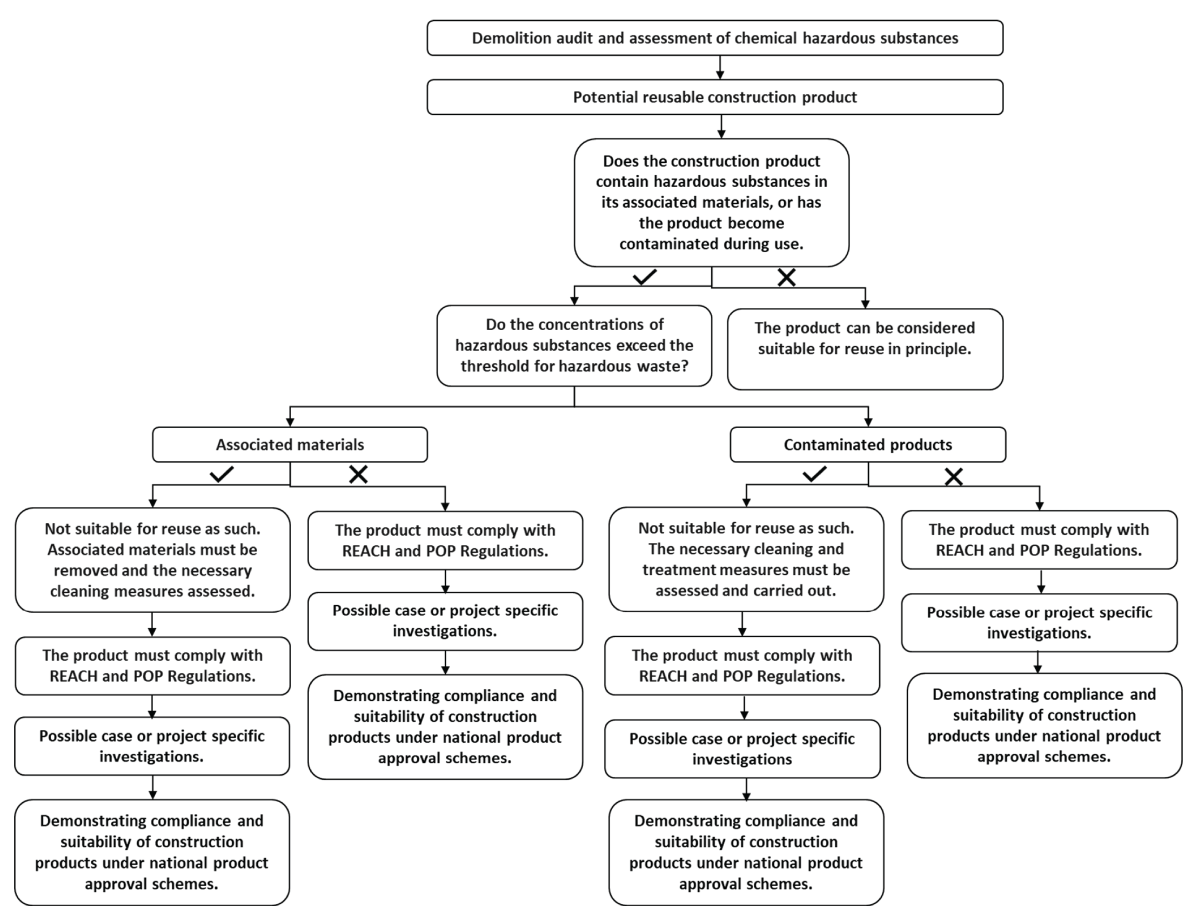
Figure 1
The evaluation process for assessing potentially hazardous chemical substances when reusing concrete construction products in indoor environments.
The expert engagement carried out in the study did not produce extensive or detailed stand-alone findings specifically on hazardous chemical substances, emissions, or the application of related chemical legislation in reuse cases. The number of direct comments on these topics in the workshop and consultation rounds remained limited. This limited and fragmented feedback can be considered a result in itself indicating that the assessment of chemical hazards in reused construction products is not yet a well-established area in current professional practice. Similar observations were made in the project’s authority consultations, where several practical questions related to chemical legislation and its application in reuse could not be answered unambiguously, pointing to a need for further clarification and more consistent guidance.
5. EMPIRICAL EVIDENCE ON CHEMICAL CONCENTRATIONS IN CONCRETE PRODUCTS
The results show that VOC emissions from concrete are generally relatively low. Most samples fall below previously reported FIOH’s (Finnish Institute of Occupational Health) reference levels, with P90 and P95 TVOC values of approximately 70 µg/m3 g and 120 µg/m3 g, respectively (Table 1; for details, see Appendix A).
Table 1
The most common VOC compounds, compound groups or compound categories are based on a dataset of concrete samples analysed using the bulk method (n = 1,382).
| COMPOUND | NUMBER OF OBSERVATIONS | FREQUENCY OF OCCURRENCE (%) | P90 (μg/m3 g) | P95 (μg/m3 g) | Max (μg/m3 g) |
|---|---|---|---|---|---|
| TVOC | 1382 | 100% | 70 | 120 | 7300 |
| 1-Butanol | 968 | 70% | 18 | 35 | 310 |
| 2-Ethyl-1-hexanol | 928 | 67% | 28 | 42 | 1500 |
| Hydrocarbon mixturea | 304 | 22% | 15 | 38 | 7800 |
| C9-alcoholsb | 224 | 16% | 6 | 13 | 200 |
| 2-Methyl-1-propanol | 176 | 13% | 0.7 | 2 | 33 |
[i] Notes: aMixture may include both aliphatic and aromatic hydrocarbons, determined as toluene equivalents. The boiling point range of compounds detected in the hydrocarbon mixture varies by sample. The hydrocarbon mixture presented here may include compounds with boiling points approximately in the range of 50–350°C. bDetermined as toluene equivalents. The P90 value, P95 value, and maximum value (Max) refer to the entire dataset. For details, see Appendix A.
The most frequently detected compounds were monohydric alcohols, particularly 2-ethyl-1-hexanol, which is associated with degradation of floor coverings rather than emissions from concrete itself. Other compounds were detected less frequently and typically at low concentrations, with elevated values linked to use-specific contamination. Ammonia emissions were also low (P90 ~8 µg/m3 g; P95 ~14 µg/m3 g), consistent with previous findings that emissions decrease over time.
Overall, the results suggest that concrete from existing buildings does not exhibit systematically elevated VOC emission levels. Reused concrete from typical indoor environments therefore does not pose significantly increased chemical risks compared with new materials. For possible limitations related to the interpretation of the results, the reader is advised to see Appendix A.
6. KEY FINDINGS ON HAZARDOUS SUBSTANCES ASSESSMENT IN REUSE
The results of the regulatory analysis, the proposed assessment framework and the empirical evaluation of chemical emission data collectively lead to several key findings regarding the role of chemical hazard assessment in the reuse of construction products. These findings (Table 2) highlight how chemical considerations can be integrated into reuse assessment and building permitting process without introducing new routine testing requirements.
Table 2
Principles and interpretation for hazardous chemical substances assessment in reuse contexts
| PRINCIPLE | INTERPRETATION FOR REUSE ASSESSMENT |
|---|---|
| Process-based assessment | Chemical hazard assessment should be structured as a staged process that progresses from existing information (e.g. use history, demolition audits, constituents) to targeted investigations only when uncertainties remain. |
| Context-dependence | The relevance of chemical hazards is determined by the origin, use environment and intended application of the product. Construction products originating from typical indoor environments are unlikely to contain hazardous substances that would prevent reuse once contaminated surface materials have been removed. |
| Avoidance of unnecessary testing | Assessment approaches should minimise routine laboratory testing and rely on targeted investigations only where justified by identified risks or uncertainties. |
| Exposure-oriented evaluation | The relevance of hazardous substances depends primarily on exposure pathways and the intended use context, rather than on the mere presence of substances. |
| Regulatory integration | Chemical legislation (REACH, POP) should be integrated into reuse processes in a way that supports practical implementation without creating disproportionate barriers. However, the relevance and implications of these obligations may vary between different construction product types and materials and should be assessed on a case-by-case basis. |
| Interface management | Effective reuse assessment requires linking chemical evaluation with demolition audits, documentation practices and building permitting procedures. |
| Information obligations and transfer (SVHC/SCIP) | The transfer of chemical information (e.g. SVHC communication, SCIP data) across life-cycle stages is essential for maintaining chemical safety in reuse systems. |
It should be noted that these findings are not based on a single type of empirical dataset but on a combination of regulatory analysis, literature, established practices in hazardous substance investigations, extensive expert engagement and practical experience from the construction sector, complemented by empirical emission data analysis. The limited availability of explicit stakeholder feedback and the lack of established regulatory interpretations in this area further highlight that hazardous substances assessment in reuse is still an emerging field. Consequently, the proposed process (Figure 1) and the principles summarised (Table 2) should be understood as a structured and practice-informed approach grounded in current knowledge and experience, not as a definitive or fully validated model.
7. DISCUSSION
7.1 HAZARDOUS SUBSTANCES ASSESSMENT WITHIN REUSE DECISION-MAKING
The findings suggest that routine laboratory testing is not required in typical reuse scenarios. Targeted measurements are needed only when the origin, use history or potential contamination of a product is uncertain, and sampling is then conducted case by case. A key distinction relates to the origin of the product: concrete elements from typical indoor environments are generally suitable for reuse once associated materials have been removed, whereas products from non-typical environments may require more detailed assessment. Reused concrete products typically have lower intrinsic emissions than new products, as emissions decrease over time owing to volatilisation. However, secondary emissions may occur owing to material degradation or contamination during use. Previous research shows that elevated VOC levels in concrete floor structures are usually linked to degraded surface materials rather than the concrete itself (Putus et al. 2004; Tuomainen et al. 2004). This is consistent with the data analysed in this study, which do not suggest systematically elevated emissions from concrete. The proposed process follows a risk-based approach, where the relevance of hazardous substances is determined by the potential for exposure rather than their mere presence (Brown et al. 2013; Weschler & Carslaw 2018). This aligns with established practices in indoor environmental assessment, where evaluation is based on overall judgement rather than fixed limit values. The findings support earlier research showing that barriers to reuse are often related to the interpretation of risks.
7.2 REGULATORY AND INSTITUTIONAL IMPLICATIONS FOR REUSE GOVERNANCE
A further structural limitation arises from the way chemical risks are currently addressed in existing regulatory frameworks. Construction product regulation and building legislation have traditionally relied on chemical legislation, particularly REACH, to control the use of hazardous substances at the level of material composition, primarily for new products placed on the market. As a result, chemical safety in construction has largely been assumed to be ensured through substance-level regulation during manufacturing, with less attention given to emissions, use-phase conditions or the chemical performance of products in specific applications.
This regulatory logic does not fully address the conditions of reuse. For reused construction products, chemical safety cannot be assessed solely on the basis of compliance with requirements developed for new products or through market placement. Instead, it requires consideration of use history, potential contamination and actual exposure conditions. This highlights the need for a more integrated approach in which chemical, product and construction legislation are considered together. It also indicates that current reuse practices and existing construction and product regulations do not sufficiently recognise the information obligations arising from chemical legislation, particularly in relation to substances of very high concern and associated information flows when products change ownership, nor do they adequately address the need to identify and assess chemical substances, including those originating from components used in manufacturing, in reused construction products.
This creates a structural misalignment in reuse contexts, as chemical legislation focuses on product composition, while reuse decisions require case-specific evaluation of exposure and intended use. As a result, compliance with REACH and POP obligations does not in itself resolve questions related to suitability or health risks in reuse applications.
In this study, the proposed process addresses this gap by supporting case-by-case judgement and linking the evaluation of chemical safety to the origin, use history and intended application of the product. It integrates REACH information and notification obligations into reuse practices by linking hazardous substance identification to demolition audits and reuse assessment, thereby making regulatory obligations operational while maintaining a clear distinction between chemical legislation and building permitting processes.
7.3 LIMITATIONS AND TRANSFERABILITY
A key limitation relates to the absence of universally applicable interpretation criteria for hazardous chemical substances in reuse contexts. Although the proposed approach supports more consistent assessment, interpretation inevitably remains case-specific, particularly in situations where concentrations are low but detectable. This limitation reflects the current regulatory context, in which no binding emission limit values have been established for construction products, and chemical risk assessment is not systematically linked to use conditions or exposure scenarios.
Another limitation concerns the availability and quality of information. Reuse assessment depends on demolition audits and hazardous substance investigations, yet their scope and quality vary in practice. This may lead to incomplete information on product origin, use history and potential contamination, which weakens the basis for assessment. In addition, existing information obligations under the REACH Regulation are not always effectively implemented in reuse contexts.
The empirical analysis of this study focuses on concrete products, and other material groups were not examined. While the dataset is extensive, the findings related to emissions and chemical risks are therefore primarily applicable to concrete and similar mineral-based products, and may not be directly transferable to materials with different surface treatments or contamination conditions. However, while the empirical findings are material-specific, the proposed assessment approach is not limited to concrete and may be applicable to other construction products, provided that material-specific characteristics, emission behaviour and contamination risks are appropriately considered.
Although the study is based on the Finnish regulatory framework, the findings related to regulatory interpretation challenges and the proposed assessment approach are broadly transferable to other EU countries. REACH and POPs Regulations are directly applicable across the EU, and similar interpretative uncertainties have been identified in international literature (e.g. Hart et al. 2019). The results therefore highlight structural challenges that are not specific to a single national context but relevant to reusing governance more widely.
7.4 FUTURE RESEARCH DIRECTIONS
Based on the findings, a key area for further research relates to the systematic generation and use of knowledge on hazardous chemical substances in reuse contexts. Research is needed to develop product group- and period-specific knowledge that can reduce the need for case-by-case assessment of REACH-related obligations for individual products and support more generalised and proportionate assessment approaches. Such knowledge would enable the identification of typical substance content and associated obligations for defined product categories and construction periods, thereby reducing repeated product-specific evaluations. This builds on the type of empirical and contextual understanding developed in this study for structural concrete products.
In this context, information on hazardous substances and related regulatory obligations should be better structured and integrated into reuse-related documentation, including demolition audits, product data and information flows between stakeholders. Further development is also needed in guidance for demolition audits and hazardous substance assessments to better support reuse, as current practices are largely oriented towards demolition and waste management and do not always provide sufficient information for reuse decision-making.
Future research should also focus on the practical implementation of chemical hazard assessment and REACH information obligations in reuse projects. In addition, further work is needed to develop approaches that better integrate chemical, product and construction legislation, and to support the assessment of chemical safety based on use conditions and exposure.
8. CONCLUSIONS
This study examined the role of hazardous chemical substances in the reuse of construction products in indoor environments within existing European and national regulatory frameworks. The findings highlight a fundamental misalignment between chemical legislation, which governs the placing of products on the market, and building regulation, which governs their use in specific building contexts. This distinction is particularly relevant in reuse situations, where products are reintroduced into use under project-specific conditions.
The results suggest that chemical risks in reuse are primarily context-dependent and should be assessed in relation to exposure conditions, product origin, and use history. For structural concrete products from typical indoor conditions, intrinsic emissions are generally low and decrease over time, while potential risks are more often linked to attached or adjacent materials.
To address these challenges, the study proposes a stepwise approach for integrating chemical considerations into reuse assessment and building permitting processes. The approach builds existing practices, such as demolition audits and specifically purpose based targeted assessments, and supports proportionate, case-by-case evaluation without a need for predetermined routine comprehensive laboratory testing package.
Overall, hazardous chemical substances do not appear to constitute a general barrier to reuse in typical indoor environments, particularly for structural concrete products under conditions similar to those examined in this study. However, the lack of structured knowledge and consistent interpretation creates practical challenges, and more consistent regulatory interpretation and better integration of chemical, product and building-level assessment practices are needed to support safe and scalable reuse. The proposed assessment approach may also be applicable to other construction products, provided that material-specific characteristics and exposure conditions are appropriately considered.
Appendices
APPENDIX A
A.1 DATA AND EXPERIMENTAL METHODS
In this study, the results of concrete samples analysed in the laboratory of the Finnish Institute of Occupational Health by using the bulk emission method were examined. The number of concrete samples submitted for VOC analysis during the period 01/2011–05/2022 was n = 1382. For ammonia analysis, the number of concrete samples submitted during the period 01/2015–05/2022 was n = 35. The concrete samples originated from a wide variety of buildings, including offices, schools, kindergartens and workspaces. The dataset was used to examine typical emission levels and their variation across a large number of samples investigated.
The volatile organic compound (VOC) emissions of the concrete samples were analysed using a micro-chamber device, micro-chamber/thermal extractor (µCTE) (Castagnoli et al. 2019; Schripp et al. 2007). Concrete samples delivered to the laboratory were weighed into the micro-chamber, through which nitrogen was passed and directed to Tenax TA or Tenax TA–Carbograph 5TD sorbent tubes. The typical sample mass of concrete was approximately 6 ± 2 g and the sampled air volume approximately 4 ± 1 dm3. Compounds adsorbed onto the sorbent tubes were analysed using gas chromatography with thermal desorption and a mass-selective detector (TD-GC-MS). The analytical method is accredited, whereas emission sampling itself is not accredited. The VOC analytical procedure was based on ISO 16000-6 standard.
Compound identification was based on comparison with reference standards and mass spectral matching against the Wiley Registry of Mass Spectral Data and NIST/EPA/NIH Mass Spectral libraries using spectral similarity scores. The total concentration of volatile organic compounds (TVOC) was determined as toluene equivalents. TVOC was calculated from the chromatogram in the range between n-hexane (C6) and n-hexadecane (C16). Concentrations of individual compounds were determined either using pure reference standards or as toluene equivalents. Individual compounds were quantified, or as many as necessary to account for at least two-thirds of the total peak area within the TVOC range.
The measurement uncertainty of the VOC analytical method without sampling (95% confidence interval) is 15–40%, with an average of approximately 30%. The uncertainties for individual compounds quantified as toluene equivalents, and often also for compounds outside the TVOC range, are higher than those mentioned above, and their concentration determination is semi-quantitative. The method’s limit of quantification (LOQ) is compound-specific, averaging approximately 4 ng per sorbent tube sample. In the total emission method, the LOQ is influenced case-by-case by the amount of concrete weighed and the volume of sampled air.
Ammonia emissions from the concrete samples were analysed in a similar manner to VOC emissions, but emission samples were collected using a flow-through method for approximately 24 hours onto sulfuric-acid-treated activated carbon. The ammonia adsorbed onto the sorbent was extracted from the activated carbon using ion-exchanged water and analysed as ammonium by ion chromatography using conductivity detection according to a working instruction based on the OSHA standard method ID-188. The analytical method is accredited, whereas emission sampling itself is not accredited. The overall measurement uncertainty of the ammonia analysis (95% confidence interval) at the limit-of-quantification level without sampling is 27%. The limit of quantification of the ammonia analytical method is 2 µg per sorbent tube sample. In the total emission method, the LOQ is influenced case-by-case by the amount of concrete weighed and the volume of sampled air.
The results of the total emission method are reported in units of micrograms per cubic metre per gram of sample (µg/m3 g).
A.2 DATA ANALYSIS AND PRESENTATION OF RESULTS
In the VOC emission data (n = 1382), there were approximately 150 individual compounds or compound mixtures detected in total. First, the frequency of occurrence (%) was determined by examining the number of observations which exceed the LOQ. We set the frequency criteria to be 10% to have relevance for statistical evaluation. For most of the compounds, the frequency was < 10%. From the data, we excluded a few individual compounds that elute outside the TVOC range (according to ISO 16000-6) and which have higher than normal measurement uncertainty (e.g. ethanol, acetic acid and acetone). For the compounds that had the set frequency, the 90th percentile (P90), the 95th percentile (P95) and the maximum concentration (Max) were examined.
A.3 REPRESENTATIVENESS AND LIMITATIONS OF THE DATA
The bulk emission method provides an estimate of the total emission potential of a material rather than surface-specific emission rates or indoor air concentrations. Reference values derived from bulk measurements are intended to support comparative interpretation and the identification of atypical emission levels, but they are not health-based and cannot be used to assess health risks directly (FIOH 2025).
Concrete samples submitted for the bulk emission analysis typically originate from sites where floor material damage or indoor air quality problems are suspected or confirmed. The concrete samples may originate from both potentially directly damaged areas and undamaged reference areas. The analysed samples include concrete samples taken both directly from the surface and from various depths (e.g. approximately 0–50 mm). The laboratory does not have detailed information about the sites or buildings, and the purpose and objectives of the clients’ research are not necessarily known to the laboratory. Sampling methods used by clients may vary, and it is possible that these differences affect the emissions of volatile compounds. For instance, differences may arise between samples taken by drilling or chipping, depending on whether the concrete heats up, releasing some volatile compounds owing to a temporary rise in temperature, or whether water cooling is used, causing some compounds to dissolve during the process (Sjöberg et al. 2010).
Some of the analysed concrete samples may have contained minor impurities of the adjacent materials, such as flooring material glue and/or screed. The contribution of these material impurities to the observed emission levels cannot be excluded.
ACKNOWLEDGEMENTS
The authors thank the research team and funders.
AI DECLARATION
Artificial intelligence (ChatGPT) was used for language editing.
DATA AVAILABILITY
The data underlying this study are partly available in publicly accessible background materials in the Finnish context. Additional empirical data is not publicly available due to confidentiality and data ownership constraints but can be made available from the corresponding author upon reasonable request.