
1. INTRODUCTION
Modern methods of construction (MMC), including prefabrication, off-site manufacturing and modular construction, are widely promoted as responses to housing shortages, productivity pressures and environmental targets. International evidence shows that industrialised construction can shorten delivery cycles, improve quality consistency and reduce site waste, but adoption remains uneven because these methods require changes in standards, approval routines, procurement, professional coordination and legitimacy, not only changes in engineering technique (Gibb & Isack 2010; Lessing et al. 2015; Nahmens & Ikuma 2012; Pan & Goodier 2012; Wuni & Shen 2020).
This distinction is important. A large body of MMC/IBS research identifies barriers such as high capital cost, fragmented supply chains, regulatory uncertainty, skills gaps and market resistance (Agapiou 2022; Alhawamdeh & Lee 2024; Bello et al. 2023; Wuni & Shen 2020). Such lists are useful but they often treat constraints as separate factors. Less is known about how these constraints interact institutionally, for example how a missing technical standard increases audit exposure, how audit exposure encourages conservative inspection behaviour and how conservative inspection behaviour reduces developer confidence in factory investment.
Vietnam provides a critical case for examining these interactions. The country has committed to delivering at least one million social housing units for low-income households and industrial park workers by 2030 while also pursuing a national net-zero commitment by 2050 (OECD 2025; PM of Vietnam 2022; PM of Vietnam 2023b). These agendas converge in the building production system: decisions about design standardisation, material sourcing, factory production, logistics and inspection affect not only speed and cost but also accountability for quality, safety and long-term performance.
The focus on social housing is deliberate. Social housing is not simply a subsector of Vietnam’s housing market; it is a policy-led delivery system shaped by affordability objectives, beneficiary rules, preferential regimes, price scrutiny and public approval procedures. Existing studies have documented administrative delays, credit constraints, supply-demand mismatches and uneven implementation across localities (Dinh et al. 2025; PM of Vietnam 2022; Tran & Duong 2026; Vu Phuong & Thieu Thi Thanh 2025). These conditions make social housing a strong empirical setting for analysing institutional readiness: IBS may support faster and more consistent delivery, but it must operate within a governance regime that is highly sensitive to cost validation, public accountability and resident protection.
From a governance perspective, the empirical puzzle is therefore not simply why IBS uptake is limited. It is how institutions make some forms of industrialisation legible and low-risk while making others appear procedurally uncertain, financially exposed or socially unproven.
The present study treats equity and resident protection as an implication of institutional readiness rather than as a separate justice framework. In social housing, resident-facing accountability matters because durability perceptions, warranty regimes and post-occupancy evidence shape whether industrialised housing is accepted as permanent and safe rather than temporary or experimental (Fainstein 2013; FEANTSA 2025; Fraser 2010; ILO 2024; WGBC 2023).
Vietnam’s construction sector has already signalled reform intent through building information modelling (BIM) policies and broader digitalisation initiatives (Government of Vietnam 2024; PM of Vietnam 2023a). However, digitalisation, housing regulation, environmental commitments and industrialised production have developed unevenly (Succar 2009; Succar & Kassem 2015; Whyte 2019). A phased BIM mandate, for example, does not automatically make BIM-based production data acceptable as statutory evidence for factory manufacturing or modular inspection.
Existing scholarship on Vietnam’s social housing sector primarily addresses affordability, land and credit access, administrative sequencing and project delivery delays (Bach & Thi Huong Quynh 2025; Dinh et al. 2025; Hoa & Tuyen 2021; Nguyen 2024; Vu Phuong & Thieu Thi Thanh 2025). Research on modular construction in Vietnam has also identified technical, financial and stakeholder barriers (Bach & Thi Huong Quynh 2025; Jayaweera et al. 2025). The gap addressed here is more specific: how institutional arrangements condition movement from lower-tier precast use towards higher-tier panelised and volumetric modular systems in a policy-led social housing regime.
Accordingly, this study asks: how do regulative, normative and cultural-cognitive institutional arrangements enable or constrain the scaling of IBS across different levels of industrialisation in Vietnam’s social housing sector?
Drawing on expert interviews (n = 21), the paper develops an institutional readiness model for IBS in Vietnam (IRM-VN). The model is not presented as a universal template; it is a Vietnam-grounded analytical framework showing how readiness depends on alignment among rule recognition, organisational capability and social legitimacy.
The paper makes three contributions. First, it clarifies how institutional theory can explain uneven MMC/IBS diffusion beyond lists of barriers. Second, it demonstrates that readiness is tier-sensitive: precast systems can be absorbed into existing governance routines, while volumetric modular systems expose deeper gaps in codification, inspection and accountability. Third, it offers a staged policy pathway for institutional alignment while specifying which lessons are context-specific and which may be analytically relevant to comparable policy-led housing systems (Scott 1987; Scott 2014).
2. BACKGROUND AND ANALYTICAL FRAMEWORK: INSTITUTIONAL READINESS FOR MMC/IBS
This section first reviews the institutional challenges associated with MMC/IBS adoption and then specifies the analytical framework used in the study. Institutional theory is used as the primary lens, while the sociotechnical transition literature provides contextual background for understanding why industrialised construction involves more than the substitution of one construction method for another (Bergek et al. 2008; Geels 2002; Geels 2019; Kivimaa & Kern 2016; Rogge & Reichardt 2016).
2.1 INSTITUTIONAL CHALLENGES IN MMC/IBS ADOPTION
IBS encompass a continuum of off-site and modular approaches, from precast components to panelised, hybrid and volumetric systems. Higher levels of industrialisation shift construction logic from site-based production towards standardised design, factory manufacturing, coordinated logistics and early design freeze. This shift can improve productivity and quality but it also changes when decisions must be made, where evidence of quality is produced and who carries risk if errors occur after fabrication has begun (Gibb & Isack 2010; Lessing et al. 2015; Nahmens & Ikuma 2012; Pan & Goodier 2012; Wuni & Shen 2020).
The adoption problem is therefore institutional as much as technical. Approval bodies may recognise conventional drawings, on-site tests and sequential inspections more readily than factory quality records or model-based compliance evidence. Developers may see potential time savings but remain reluctant to invest in factories when demand pipelines are fragmented. Consultants may accept BIM as a coordination tool while lacking fabrication-ready libraries, model governance and design for manufacture and assembly (DfMA) routines. Residents may value lower cost and faster delivery while still associating durability with cast-in-place reinforced concrete (Doan et al. 2025; Jeong et al.. 2024; Sánchez-Garrido et al. 2023; Widanage & Kim 2024; Xu et al. 2025).
This study uses ‘readiness’ to capture the degree to which these rule systems, professional routines and legitimacy mechanisms are aligned with the production logic of IBS. Readiness is not equivalent to adoption rate. It refers to the institutional conditions that make adoption procedurally recognisable, organisationally feasible and socially credible.
2.2 INSTITUTIONAL THEORY AS THE PRIMARY ANALYTICAL LENS
Institutional theory conceptualises social systems as stabilised by regulative, normative and cultural-cognitive pillars (Pan & Goodier 2012; Scott 1987; Scott 2014). In this paper, the regulative pillar refers to formal rules, technical standards, approval procedures, cost norms, inspection responsibilities and public accountability requirements. The normative pillar refers to professional routines and expectations, including design coordination, contractor involvement, BIM/DfMA competence, fabrication tolerance and supply-chain discipline. The cultural-cognitive pillar refers to taken-for-granted assumptions about what counts as durable, safe, permanent and legitimate housing.
Institutional theory provides the analytical architecture. The transition and policy-mix literature is used only as contextual background for understanding the coordination demands of MMC/IBS across rules, markets and professional practice (Kivimaa & Kern 2016; Rogge & Reichardt 2016; Rogge & Stadler 2023).
This choice also reduces the risk of conceptual layering. Rather than mapping every empirical theme onto several theoretical vocabularies, the analysis asks a simpler question: which institutional pillar is most implicated when stakeholders explain why higher-tier IBS is difficult to scale?
2.3 FROM BARRIERS TO INSTITUTIONAL READINESS
The paper distinguishes an institutional readiness approach from a conventional barrier framework. A barrier framework asks what prevents adoption. An institutional readiness approach asks how barriers become mutually reinforcing across rules, capabilities and legitimacy. For example, a missing modular standard is not only a technical documentation problem; it affects audit defensibility, inspection behaviour, developer risk, supplier investment and public trust.
Building on this distinction, IRM-VN conceptualises institutional readiness through three interdependent dimensions:
Regulative alignment: the extent to which approval, appraisal, inspection, cost norms and accountability procedures recognise factory-based and modular production.
Organisational-technological capability: the extent to which relevant actors possess the skills, digital workflows, supply-chain coordination and production infrastructure required for integrated IBS delivery.
Cultural-cognitive legitimacy: the extent to which regulators, developers, professionals and residents regard IBS as safe, durable, accountable and appropriate for social housing.
Readiness is understood as tier-sensitive rather than uniform across IBS applications. Established precast systems may be accommodated within conventional standards and inspection routines, whereas panelised, hybrid and volumetric modular systems require deeper institutional alignment because they redistribute quality evidence, risk and responsibility across the design–factory–site interface. Figure 1 summarises this analytical framework, which guides the empirical interpretation developed in the following sections (Kauppinen et al. 2024).
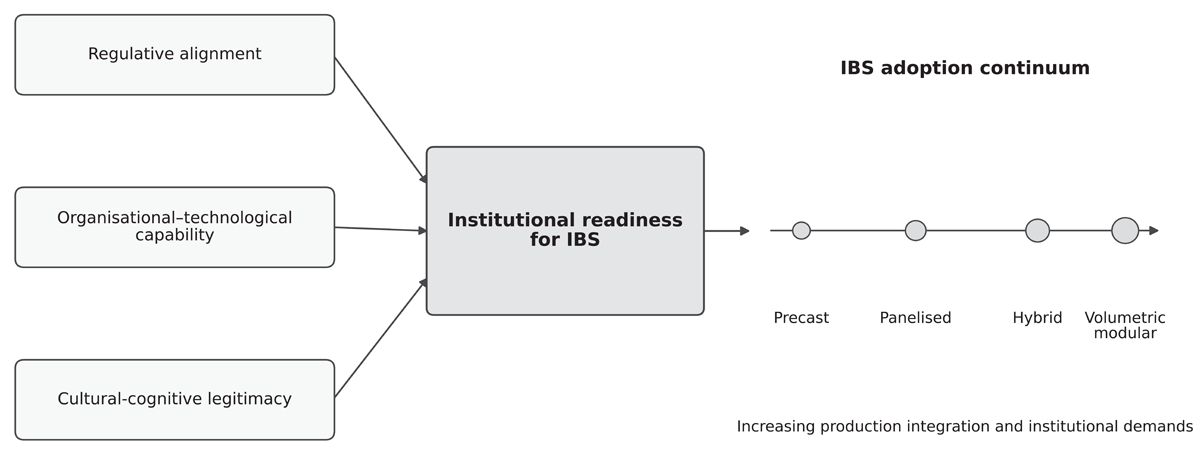
Figure 1
Institutional readiness framework for tier-differentiated IBS adoption in Vietnam’s social housing sector.
As illustrated in Figure 1, institutional readiness is conceptualised through three interdependent dimensions: regulative alignment, organisational-technological capability and cultural-cognitive legitimacy. Together, these dimensions shape the conditions under which IBS adoption can extend from established precast applications to more integrated panelised, hybrid and volumetric modular systems. The framework is used as an interpretive lens for analysing tier-differentiated readiness rather than as a linear maturity model.
3. METHODS
3.1 RESEARCH DESIGN AND POSITIONING
This study adopts an interpretivist qualitative design to examine how institutional arrangements condition readiness for IBS in Vietnam’s social housing sector. Readiness is not treated as a measurable variable fixed in advance but as a relational condition inferred from how actors describe rules, routines, capabilities, risk allocation and legitimacy.
Institutional theory was used as the primary interpretive lens. The empirical specification of IRM-VN was developed through dialogue between inductive coding and theoretical interpretation. This means that the empirical themes were generated from interview material first, and only afterwards organised through the regulative, normative and cultural-cognitive pillars (Scott 1987; Scott 2014).
3.2 SAMPLING STRATEGY AND PARTICIPANT PROFILE
A purposive, criterion-based sampling strategy was used to capture institutional perspectives across the state–market–industry configuration governing social housing. Participants were selected for substantial professional experience in housing policy, regulatory oversight, project development, design, cost control, construction delivery or IBS supply. A total of 26 semi-structured interviews were conducted. Five interviews were excluded after screening because they did not meet the relevance or analytical-depth criteria. The final analytical corpus comprises 21 expert interviews across government/regulatory actors (GOV), developers/project owners (DEV) and consultants, contractors or IBS suppliers (CONS).
An anonymised participant profile, including interview IDs, stakeholder groups and experience ranges, is provided in the supplemental data online (Appendix A). The sample is designed for analytical generalisation rather than statistical representativeness.
3.3 DATA COLLECTION PROCEDURES
Interviews were conducted in Vietnamese, recorded with informed consent and transcribed verbatim. They lasted approximately 60 to 90 minutes. The interview protocol covered regulatory approval, standards and permitting, cost appraisal, organisational and technological capability, procurement and market incentives, sustainability potential, public perception and future policy pathways. A visual prompt showing the IBS continuum – precast, panelised, hybrid and volumetric modular – was used to encourage tier-specific discussion.
Selected quotations were translated into English by the research team. Translation prioritised conceptual equivalence over literal word-for-word rendering. Where necessary, translated excerpts were checked against Vietnamese transcripts to ensure that institutional meanings, especially around appraisal, acceptance, quality control and warranty, were preserved.
3.4 DATA ANALYSIS AND CODING STRATEGY
Data analysis followed the Gioia methodology (Gioia et al. 2012). First-cycle coding stayed close to participant language and identified concerns such as approval ambiguity, standards gaps, audit defensibility, factory recognition, design freeze, logistics, cost norms, pipeline fragmentation and public trust.
Second-cycle coding consolidated these first-order concepts into second-order themes through constant comparison across the 21 interviews. Evidence coverage was recorded at the level of unique interview IDs to support traceability but was not used as a proxy for prevalence, consensus or analytical significance. The second-order themes were then organised and interpreted through the institutional dimensions of regulative alignment, organisational-technological capability and cultural-cognitive legitimacy. These dimensions were applied after theme development as an organising lens rather than as predetermined coding categories. The expanded data structure, supporting interview IDs and evidence-coverage summary are provided in Appendix B and Figure S2 (both located in the supplemental data online).
The appendices in the supplemental data online provide the audit trail: participant screening and profile (Appendix A), expanded Gioia structure and interview excerpts (Appendix B), saturation traceability (Appendix C), cross-stakeholder pattern comparison (Appendix D) and an institutional-pillar traceability matrix and governance indicators (Appendix E).
3.5 CREDIBILITY, REFLEXIVITY AND LIMITATIONS OF THE CORPUS
Credibility was strengthened through triangulation across regulatory, developer and delivery-side actors. Divergent interpretations were examined rather than collapsed into a single consensus position.
A reflexive limitation is that the sample is composed of expert and elite respondents embedded in governance, development and professional delivery systems. Their accounts are well suited to analysing institutional rules and professional routines but they do not directly represent residents, financiers or local community organisations. This limits claims about lived resident experience and household acceptance. The study therefore treats resident-facing legitimacy as perceived and interpreted by institutional actors, not as a direct measure of resident attitudes.
Conceptual saturation was assessed sequentially across the retained interview corpus. The three aggregate institutional dimensions had stabilised by interviews 17–18, while later interviews refined the boundaries and empirical specification of existing second-order themes without expanding the dimensional architecture. Appendix C provides the theme-emergence matrix and cumulative traceability plot (Figure S3 in the supplemental data online).
4. FINDINGS AND ANALYSIS
The findings are organised through the three institutional lenses of IRM-VN. This structure should not be read as proof that the theory generated the themes. Rather, the themes were first identified from interview accounts and are presented here through institutional theory to show how constraints cluster across rules, routines and legitimacy. Throughout the section, the emphasis is on respondents’ perceptions, disagreements and conditional judgements.
To make the analytical sequence explicit, Figure 2 distinguishes the empirical development of the findings from their subsequent theoretical organisation. First-order concepts were generated from the interview corpus using respondent-near coding. These concepts were then compared and consolidated into second-order empirical themes. Only after this inductive development were the themes organised and interpreted through the institutional dimensions introduced in Section 2.
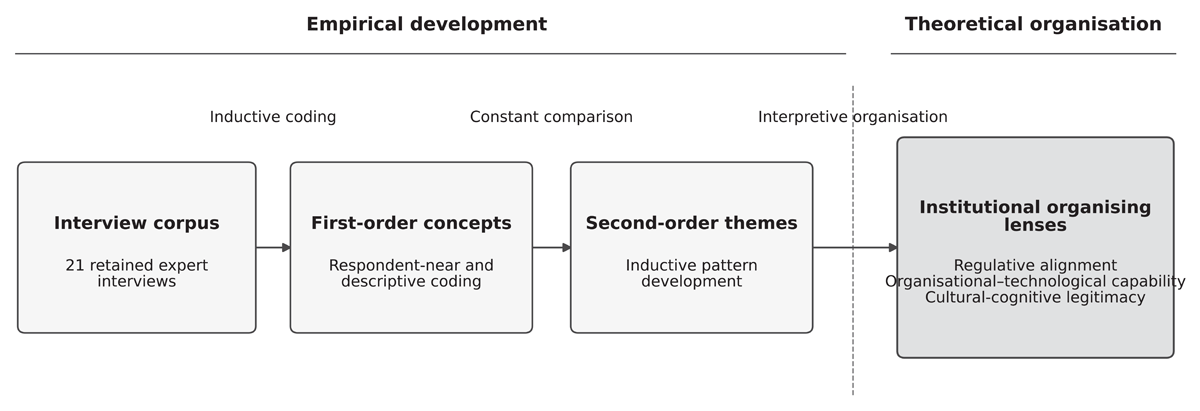
Figure 2
Evidence architecture of the qualitative analysis.
As indicated in Figure 2, the three institutional dimensions structure the presentation of the findings but do not replace the empirical themes derived from the interviews. Within each dimension, the analysis reports areas of stakeholder convergence, disagreement and qualification, as well as differences across IBS tiers. This distinction reduces the risk of circular reasoning by separating theme development from theory-informed interpretation.
The distribution of explicitly documented interview support across the second-order themes is reported in Figure S2 in the supplemental data online. These coverage counts strengthen analytical traceability and indicate the breadth of documented support within the corpus; they should not be interpreted as measures of prevalence, consensus or thematic importance. The analysis therefore prioritises the content, context and explanatory significance of participants’ accounts across stakeholder groups and IBS tiers.
4.1 REGULATIVE ALIGNMENT: PERMISSIVE POLICY, UNCERTAIN APPROVAL
Across interviews, respondents generally did not describe IBS as legally prohibited. Instead, they described a gap between policy-level support for innovation and the practical codification needed for approval, inspection and cost validation. Lower-tier precast components were often viewed as manageable within existing standards, whereas panelised and volumetric systems created greater uncertainty because the documentation, connection requirements and factory-site responsibility boundaries were less settled.
A government respondent explained that, when modular configurations are proposed, appraisal officers often ask for additional clarification because the system does not fit neatly within established technical categories (I03-GOV). Another government respondent linked this uncertainty to audit exposure: officers must later justify why they accepted a non-traditional solution (I04-GOV). Consultants similarly noted that approval risk increases when a design departs from reinforced-concrete conventions even if the solution is technically plausible (I01-CONS).
The key contradiction is that policy support and procedural confidence do not move together. Several participants supported IBS in principle, especially where it could improve speed, standardisation and quality. Yet the same respondents also emphasised that officials and developers need codified benchmarks before higher-tier systems can be accepted routinely. This is why regulative readiness appears tier-dependent: precast components are familiar enough to be absorbed, while volumetric systems remain institutionally exceptional.
Permitting routines also remain site-centric. Respondents reported that factory quality assurance is not always treated as equivalent to statutory site-based verification. One consultant observed that, even when components are tested in factories, authorities still prefer physical verification on site because that remains the traditional control point (I05-CONS). This creates duplication: factory quality assurance/quality control (QA/QC) can improve quality but it does not automatically reduce inspection burden if official procedures still require conventional site evidence.
These accounts suggest that the central regulative issue is not absence of permission but lack of procedural legibility. IBS becomes harder to scale when the approval system cannot clearly answer four practical questions: what standard applies, what evidence is acceptable, who is responsible across factory and site and how cost and quality are defended under audit.
4.2 NORMATIVE AND ORGANISATIONAL CAPABILITY: FROM CONSTRUCTION PROJECT TO PRODUCTION SYSTEM
Respondents described higher-tier IBS as a shift from project-based construction to a more production-oriented system. This shift requires earlier coordination, tighter design freeze, fabrication-aware modelling, reliable logistics and repeatable demand. Several consultants and developers emphasised that errors become more expensive once production starts because design changes cannot be absorbed on site in the same way as in conventional construction (I02-DEV; I05-CONS; I06-CONS) (Ketokivi & Mahoney 2017; Williamson 1985; Williamson 2010).
This temporal shift generated mixed evaluations of cost and risk. Some respondents expected IBS to shorten construction time and improve quality once repetition and scale are achieved. Others cautioned that early-stage design, moulds, transport, storage and lifting can increase exposure if project pipelines are fragmented or if drawings are not fabrication-ready. The data therefore do not support a simple claim that IBS is cheaper or faster. They support a conditional claim: IBS becomes economically and operationally attractive when design standardisation, throughput stability and approval recognition are aligned.
BIM was viewed as important but insufficient on its own. Respondents generally saw BIM integration with factory production as feasible, but they distinguished visual coordination from production-integrated digital capability. Consultants called for standardised modular libraries, fabrication-aware modelling routines and clearer model ownership and change-control procedures (I14-CONS; I15-DEV; I16-CONS). Without these routines, BIM remains a representational tool rather than a digital thread linking design, manufacturing, inspection and maintenance (Doan et al. 2025; Jeong et al. 2024; Sánchez-Garrido et al. 2023; Widanage & Kim 2024; Xu et al. 2025).
Supply-chain and logistics capability were also uneven. Dense urban sites limit storage and assembly space; long-distance transport increases coordination difficulty; and dispersed provincial pipelines make factory investment speculative. Developers stressed that national housing targets do not automatically translate into predictable factory throughput because projects are procured, approved and delivered across different provinces and timelines (I20-DEV).
These findings locate readiness not only at the level of individual firms but also at the level of ecosystem routines. A capable designer or factory cannot compensate for fragmented approvals, unstable pipelines or missing interfaces between BIM, cost appraisal and statutory acceptance. Organisational-technological capability is therefore relational: it depends on whether actors can coordinate early enough and repeatedly enough to make off-site production reliable.
4.3 CULTURAL-COGNITIVE LEGITIMACY: DURABILITY, WARRANTY AND CONDITIONAL TRUST
Legitimacy concerns were not framed as blanket resistance to IBS. Rather, respondents described conditional trust. Regulators and professionals often recognised potential benefits – faster delivery, more stable quality control, less weather dependence, lower site disturbance and reduced waste – but they also emphasised the need for demonstrable performance before public confidence can stabilise (Muñoz et al.. 2025; Noor Azhar et al.. 2024; WGBC 2023; Wuni & Shen 2020).
Several participants linked acceptance to Vietnam’s cultural-cognitive benchmark of reinforced concrete. Cast-in-place reinforced concrete is widely associated with permanence, asset value and durability. Modular or assembled systems may therefore be judged through a sceptical comparison unless residents and regulators can observe real projects over time. One consultant noted that households may retain negative memories of older assembled-prefabricated housing (‘lap ghep’: prefabricated construction) and therefore require improvements in architecture and quality before perceptions change (I10-CONS). A developer similarly observed that stakeholders have not had enough time to experience new construction technologies and verify performance (I20-DEV).
This evidence helps reposition the paper’s justice argument. The issue is not only whether IBS can be efficient or low-carbon; it is whether lower-income residents are protected from becoming test subjects for uncertain systems. Respondents repeatedly pointed to pilot projects, long-term warranties, maintenance commitments and post-occupancy evidence as mechanisms for building trust (I19-CONS; I20-DEV). These mechanisms connect legitimacy to accountability (Fainstein 2013; FEANTSA 2025; Fraser 2010; ILO 2024; WGBC 2023).
Environmental legitimacy was also conditional. Some respondents expected factory production to improve material control and reduce dust, noise and waste. Others said Vietnam lacks sufficient data to assess net-zero contribution directly. This disagreement is important: environmental benefit should not be assumed as a general claim. It requires project-level measurement, performance reporting and comparison with conventional baselines.
4.4 CROSS-STAKEHOLDER SYNTHESIS: NO SINGLE BARRIER LOGIC
The findings indicate that institutional readiness is not uniform across IBS technologies. Existing institutional arrangements are comparatively more accommodating of precast applications, which remain closer to established construction, inspection and professional practices. As production becomes more integrated through panelised, hybrid and volumetric modular systems, the requirements for regulatory recognition, early-stage coordination, production-oriented digital capability and long-term performance assurance become more demanding. Figure 3 synthesises these tier-specific differences across the three institutional dimensions.
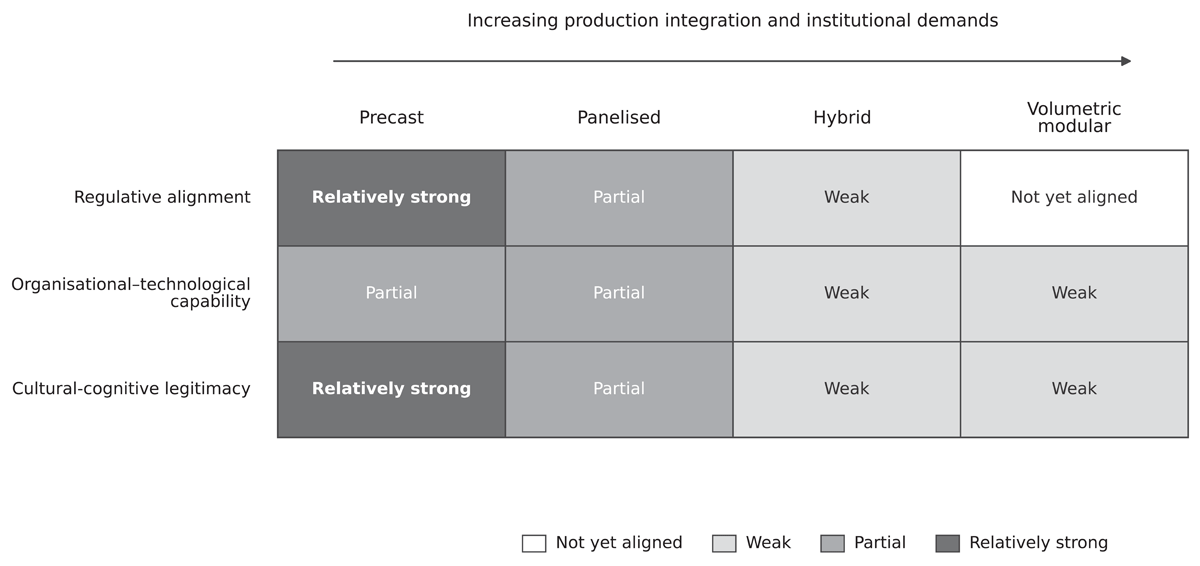
Figure 3
Tier-differentiated institutional readiness for IBS adoption in Vietnam’s social housing sector.
The matrix provides a qualitative synthesis of the evidence reported in Sections 4.1–4.3 and the supporting materials. Categories represent comparative analytical assessments rather than measured scores, adoption rates or statistically derived readiness levels. ‘Relatively strong’ denotes comparatively established institutional accommodation; ‘partial’ indicates that enabling arrangements exist but remain incomplete or inconsistently applied; ‘weak’ indicates substantial unresolved constraints; and ‘not yet aligned’ indicates the absence of a sufficiently recognised or stable institutional pathway. The classification of hybrid systems is provisional because the interview evidence addressed this tier less directly than precast, panelised and volumetric modular systems.
As shown in Figure 3, readiness declines as IBS applications require deeper integration across design, manufacturing, logistics, inspection and post-construction accountability. Precast systems benefit from comparatively established standards, production experience and familiarity among regulatory and industry actors. Panelised systems display partial readiness: several technical and organisational foundations are present but approval practices, production integration and assurance mechanisms remain uneven. Readiness for hybrid and volumetric modular systems is weaker, particularly where existing procedures do not clearly recognise factory-based quality evidence, modular interfaces or the redistribution of responsibility across the design–factory–site chain. The matrix therefore supports a tier-sensitive interpretation of IBS adoption rather than a binary distinction between adoption and non-adoption.
Cross-stakeholder comparison shows differentiated risk logics. Government actors foregrounded codification, audit defensibility and accountability. Developers foregrounded capital exposure, demand absorption, price/cost appraisal and throughput continuity. Consultants and suppliers foregrounded design precision, BIM–DfMA integration, logistics and quality control. These positions overlap but they are not identical.
The empirical findings are therefore better presented as expert interpretations than as objective facts about IBS performance. Respondents generally supported the direction of industrialisation, but their support was conditional on different institutional assurances. This is the central empirical nuance: Vietnam is not simply unready for IBS. It is partially ready for lower-tier systems and selectively unready for higher-tier systems whose risk profile exceeds current codification, coordination and legitimacy mechanisms.
Taken together, the findings indicate that the three dimensions of institutional readiness are interdependent. Regulative alignment shapes whether factory-based evidence and non-conventional production processes are recognised; organisational-technological capability determines whether actors can meet the coordination and precision requirements of integrated delivery; and cultural-cognitive legitimacy affects whether IBS is regarded as credible, durable and appropriate for social housing. Weakness in one dimension can therefore constrain readiness in the others.
Across themes, the barriers to higher-level IBS adoption appear primarily institutional. Regulatory ambiguity generates approval inertia; sequential governance constrains early design integration; risk is redistributed towards early stages without commensurate procurement and liability reform; and logistics and supply chains remain fragmented.
The findings also indicate that the three dimensions of institutional readiness are articulated differently across stakeholder groups. Government respondents most often framed IBS through questions of approval, inspection and procedural defensibility; developers emphasised capital exposure, throughput stability and market absorption; and consultants and supply-side actors focused more strongly on coordination precision, digital-production integration and delivery feasibility. Figure 4 summarises these cross-stakeholder evidence links by showing how documented theme–interview connections cluster across the three institutional dimensions.
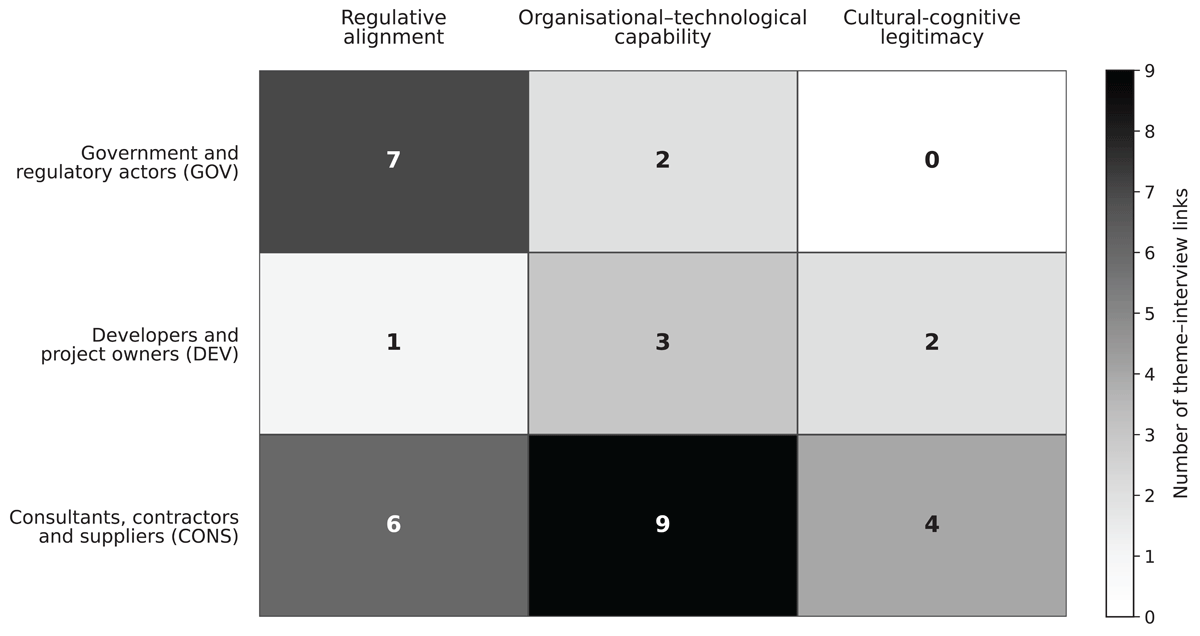
Figure 4
Stakeholder evidence links by institutional dimension.
Note: Cells report themes from interviews rather than unique respondents. A single interview may yield more than one theme. The matrix visualises documented analytical emphasis, not prevalence, agreement or statistical frequency.
As shown in Figure 4, stakeholder groups do not engage IBS through identical institutional concerns. Government evidence is concentrated most strongly within regulative alignment, reflecting recurrent attention to approval recognition, codification, inspection and audit defensibility. Developers are linked more closely to organisational-technological capability and selected legitimacy concerns, particularly where investment risk, pipeline continuity and market confidence shape adoption decisions. Consultant and supply-side evidence spans all three dimensions but is most heavily concentrated in organisational-technological capability, underscoring the importance of design integration, fabrication coordination, logistics and production-oriented digital workflows. Institutional readiness is therefore not a single shared problem but a configuration of differentiated stakeholder logics.
5. DISCUSSION
5.1 READINESS BEYOND BARRIER LISTING
The first contribution is to move from barrier listing to institutional interaction. Many barriers identified in this study – standards gaps, cost norms, skills, inspection routines, market trust and high upfront investment – are familiar from the MMC literature (Agapiou 2022; Alhawamdeh & Lee 2024; Bello et al. 2023; Wuni & Shen 2020). The contribution of IRM-VN is to show how these barriers become mutually reinforcing in a policy-led social housing regime. For instance, incomplete modular codification increases approval discretion; discretion increases audit defensibility concerns; defensive approval slows recognition of factory QA/QC; and weak recognition reduces the investability of factory-based production.
This is the analytical difference between a barrier model and a readiness model. A barrier model identifies obstacles. A readiness model explains why removing one obstacle may be insufficient unless related rules, routines and legitimacy mechanisms also change.
5.2 TIER-SENSITIVE INSTITUTIONAL READINESS
The second contribution is the tier-sensitive interpretation of IBS readiness. Precast components can often be handled within existing approval and inspection systems because they remain close to conventional reinforced-concrete logic. Higher-tier panelised and volumetric systems are different: they shift evidence, liability and coordination from site execution towards early design and factory production. This creates a deeper institutional challenge than simply approving an alternative material or component.
Transaction-cost reasoning helps explain why this shift matters, but it is not used as a separate theoretical framework. Higher-tier IBS increases asset specificity and front-loaded commitment. If approval standards, change-control rules and demand pipelines remain uncertain, actors rationally avoid large irreversible investments (Ketokivi & Mahoney 2017; Williamson 1985; Williamson 2010).
This tier-sensitive finding also clarifies why the social housing context matters. Social housing combines affordability objectives with public scrutiny of price, quality and beneficiary protection. These conditions can make IBS attractive as a delivery solution but they also raise the threshold for evidence, auditability and warranty confidence. Industrialised social housing therefore requires not only production capability but also public governance mechanisms that make quality and accountability visible.
5.3 CONTEXT-SPECIFIC FINDINGS AND WIDER ANALYTICAL RELEVANCE
This study avoids claiming that IRM-VN is directly transferable across the global south. Some findings are strongly Vietnam-specific: the one-million-unit social housing programme, provincial implementation fragmentation, the role of public appraisal and audit, and the cultural-cognitive durability benchmark associated with reinforced concrete (OECD 2025; PM of Vietnam 2022; PM of Vietnam 2023b).
Other mechanisms may be analytically relevant in comparable policy-led housing systems: the need to recognise factory QA/QC, the challenge of front-loaded design freeze, the importance of demand aggregation for factory investment and the role of demonstration projects and warranties in building legitimacy. These are not universal prescriptions but sensitising mechanisms that can guide comparative research on MMC institutional readiness.
6. POLICY PATHWAY: A PHASED INSTITUTIONAL ALIGNMENT STRATEGY
The staged pathway remains useful, but this paper presents it as an adaptive governance strategy rather than a linear reform checklist. Each stage addresses the dominant uncertainty that prevents the next stage from becoming viable.
6.1 STAGE I: MAKE HIGHER-TIER IBS PROCEDURALLY LEGIBLE
Stage I should focus on targeted regulatory clarification rather than wholesale legal reform. The immediate need is to make panelised and volumetric systems legible within approval, appraisal and inspection routines. This includes technical guidance for modular connections, documentation templates, acceptance criteria for factory-produced components, and rules for model-based change control after design freeze.
Recognising factory QA/QC as statutory-relevant evidence is especially important. Without this recognition, off-site production may add a parallel quality process without reducing site-based inspection burden. This undermines the productivity case for IBS and reinforces conservative approval behaviour.
6.2 STAGE II: BUILD CAPABILITY THROUGH AGGREGATED PILOTS AND CERTIFICATION
Stage II should treat pilot projects as learning infrastructure, not as isolated showcases. Aggregated pilots using repeatable social housing typologies can generate comparable evidence on cost, quality, time, waste, defects and resident satisfaction. They can also support training for DfMA, modular assembly, tolerance management, BIM-based production documentation and factory-site quality coordination.
Certification should cover not only products but also roles and workflows: certified installers and supervisors, BIM–DfMA competence, model governance, QA/QC documentation and post-occupancy feedback. This would help convert individual project experience into sector-level routines.
6.3 STAGE III: STABILISE THE ECOSYSTEM THROUGH DEMAND COORDINATION
Stage III addresses the scale problem. National housing targets do not automatically create stable factory throughput if projects remain fragmented across provinces and timelines. Demand aggregation – through bundled procurement, framework agreements, coordinated sequencing or standardised typologies – can reduce investment risk for factories and suppliers.
Ecosystem stabilisation also requires logistics planning, industrial clusters or coordinated supply-chain platforms, and digital traceability across design, manufacturing, transport, installation and maintenance. These instruments are necessary because higher-tier IBS is not only a construction technique; it is a production and coordination system.
6.4 POLITICAL AND INSTITUTIONAL REALISM
The pathway should not be read as politically neutral or administratively automatic. Approval officers may prefer conventional templates because they are audit-defensible. Developers may avoid factory investment without predictable pipelines. Consultants may continue using BIM mainly for visual coordination if production-linked requirements are not demanded by clients or regulators. Provincial implementation may remain fragmented even when national targets are ambitious.
Adaptive monitoring is therefore required. Indicators should track whether approval times for IBS converge with conventional baselines, whether factory QA/QC documentation is accepted, whether integrated BIM–DfMA workflows are used, whether certified installers and supervisors increase, whether pilot performance is publicly reported and whether repeat adoption occurs after initial projects. These indicators should be interpreted as governance signals, not as narrow output targets.
7. CONCLUSION
This paper has examined why IBS remains concentrated at lower levels of prefabrication in Vietnam’s social housing sector despite policy endorsement and technical feasibility. The findings show that Vietnam is not simply ready or unready. It is institutionally more ready for precast systems than for higher-tier panelised and volumetric modular systems.
The main constraint is not a general absence of engineering capability. It is the incomplete alignment of rules, professional routines and legitimacy mechanisms with a production logic based on early design freeze, factory evidence, standardisation, coordinated logistics and long-term accountability. Precast components can be accommodated because they remain close to conventional construction categories. Volumetric modular systems expose deeper gaps in codification, inspection, cost appraisal, supply-chain stability and resident-facing trust.
The study contributes an institutional readiness model for Vietnam that reframes MMC/IBS adoption as an alignment problem rather than a list of discrete barriers. The model is Vietnam-grounded but it identifies mechanisms that may inform comparative research in other policy-led housing systems: factory QA/QC recognition, design-freeze governance, demand aggregation, production-integrated BIM and warranty-based legitimacy.
For policy and practice, the implication is more specific: promoting industrialised social housing requires governance reform before, during and after construction. Before construction, standards and appraisal pathways must make modular systems procedurally legible. During construction, digital and factory-based evidence must be recognised. After occupation, warranty, maintenance and performance evidence must build public trust. Without these mechanisms, higher-tier IBS is likely to remain experimental rather than mainstream.
ACKNOWLEDGEMENTS
The authors gratefully acknowledge the British Council’s financial support.
AI DECLARATION
Generative AI tools were used during revision to suggest alternative wording, structural options and clarity improvements. The authors independently selected, revised and verified all changes. AI was not used to collect or generate interview data, conduct transcription, code the interviews, generate themes, select quotations or make analytical interpretations.
AUTHOR CONTRIBUTIONS
T..Q.N.: Writing – original draft, Writing – review & editing, Conceptualization, Investigation, Methodology, Formal Analysis, Validation. B.N.N.: Writing – original draft, Writing – review & editing, Conceptualization, Investigation, Data curation, Formal Analysis, Validation, Visualization. T.H.Q.T.: Writing – review & editing, Investigation, Conceptualization, Validation. Z.A.: Writing – review & editing, Methodology, Project administration, Validation, Funding acquisition.
DATA AVAILABILITY
Anonymised participant profiles, interview protocol, representative excerpts, coding structures and saturation traceability are provided in the supplemental data online. Full transcripts are not publicly available because they contain potentially identifiable professional and organisational information.
ETHICAL APPROVAL
Ethical approval was granted by the Ethics Review Board of the Institute of Investment and Construction Management under reference ERB-2025-08-VN-INT on 16 October 2025 through a minimal-risk expedited review. All participants were adults, received the approved study information and provided written informed consent before interview; they could decline to answer questions or withdraw without penalty.
SUPPLEMENTAL DATA
Supplemental data for this article can be accessed at: https://doi.org/10.5334/bc.809.s1
Appendices A–E provide the methodological and evidential audit trail for the study, including participant screening, interview protocol, expanded Gioia data structure, saturation analysis, cross-stakeholder comparison and governance indicator framework.