
Table 1
Overview of procurement models, characteristics and impact on industrialised retrofit
| PROCUREMENT MODEL | CHARACTERISTICS | IMPACT ON INDUSTRIALISATION | REFERENCES |
|---|---|---|---|
| Traditional/de-coupled (design–bid–build) | Lowest-price selection, fragmented project-by-project funding and sequential roles | Reproduces fragmentation, limits standardisation and externalises coordination costs onto building associations | Hall et al.2014; Lihtmaa & Kalamees 2024; Pikas et al.2021 |
| Integrated renovation design and construction/system level | Integrates project delivery vertically (building design engineering, and main contractor) and horizontally (fabricators), multi-year agreements, and bundled (district-level) procurement | Lowers transaction costs, stabilises demand and incentivises industry investment in factory capacity and digital infrastructure | Rose et al.2021; Straub & Meijer 2025 |
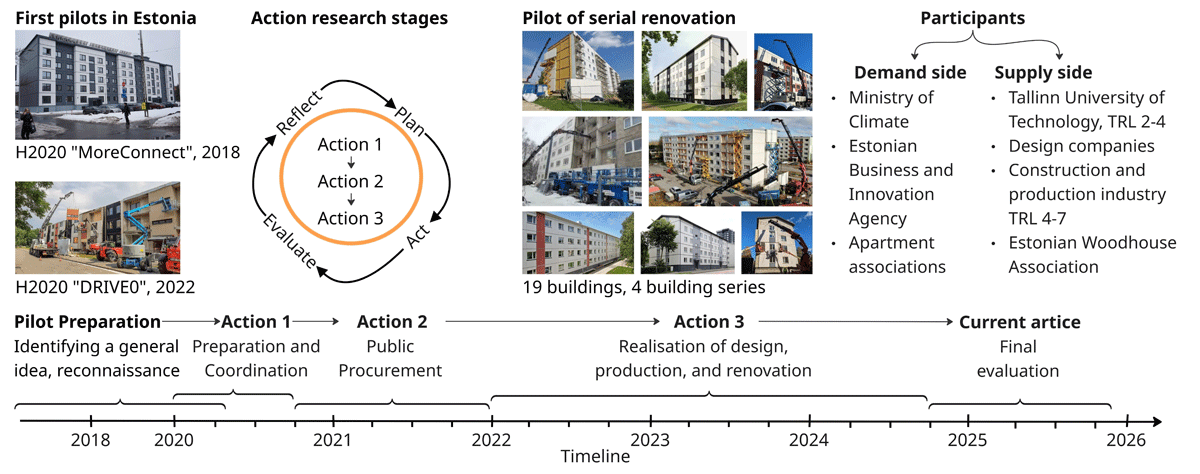
Figure 1
Timeline of the industrialised retrofit pilot programme in Estonia, from individual building to the governance of a serial retrofit of apartment buildings.
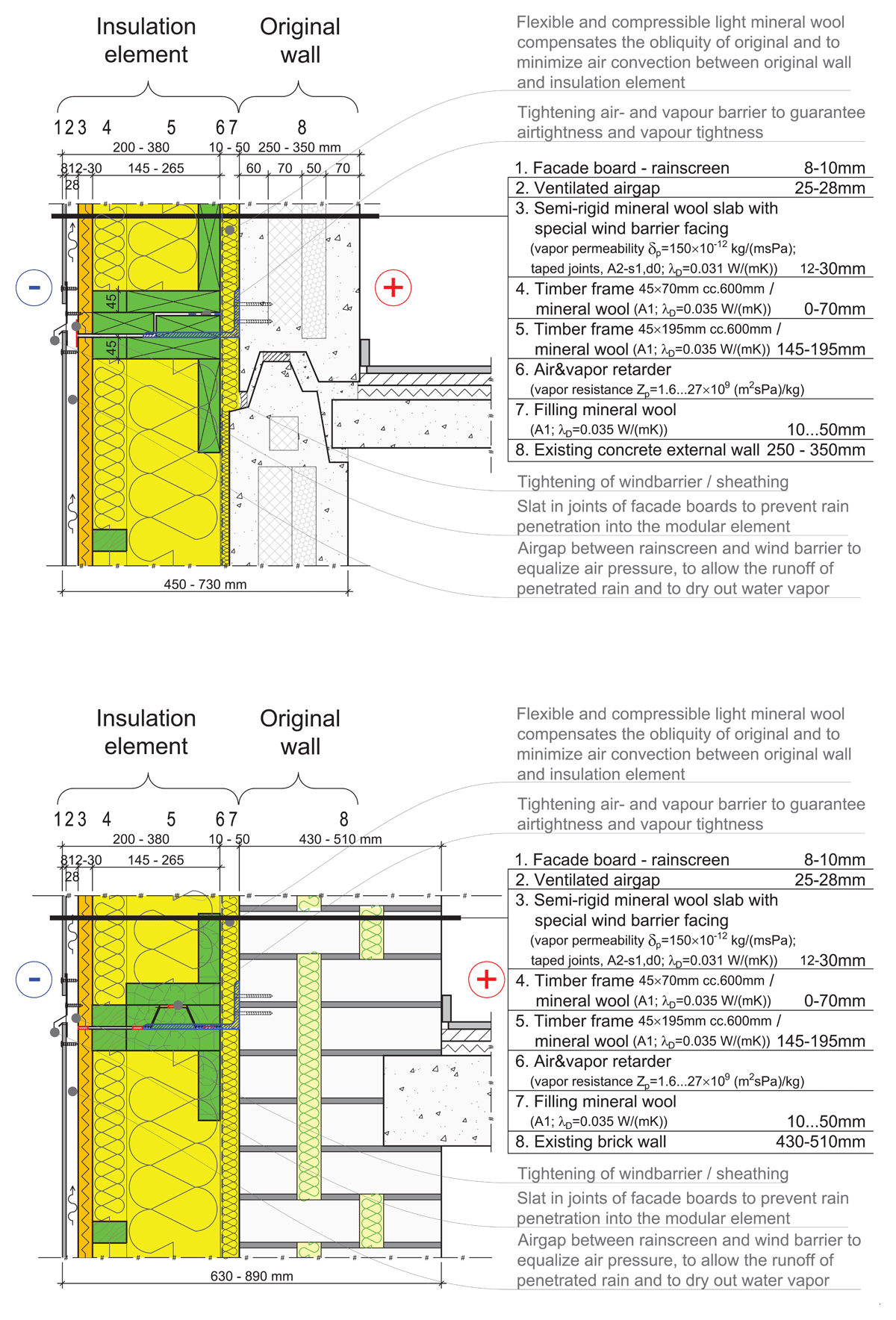
Figure 2
Principal solutions for prefabricated insulation elements for the industrialised retrofit of concrete (above) and brick (below) external walls.
Table 2
Interview participants, background, experience and background information
| STAKEHOLDER | NUMBER OF INTERVIEWEES (% OF STUDY PARTICIPANTS) | ROLE | BACKGROUND INFORMATION |
|---|---|---|---|
| Apartment associations | 10 (53%) | Board members/association representatives | No prior major renovations; mixed background |
| Design companies | 2 (100%) | Architecture, structural, MEP designers | Represented two different design companies established in 2006 and 2012, staff 12 and 3, and 12 and 7 buildings in consortia |
| Fabricators | 2 (100%) | Element production and design managers | Represented two different fabricators established in 2000 and 2003, staff 25 and 51, and 10 and 9 buildings in consortia |
| Main contractors | 2 (100%) | Site and project managers | Represented two different contractors established in 1996 and 2008, staff 139 and 12, and 10 and 9 buildings in consortia |
| Quality inspection/owner’s supervision | 2 (17%) | Quality control and commissioning | Represented two different companies. In total, there were 12 owners’ supervision companies |
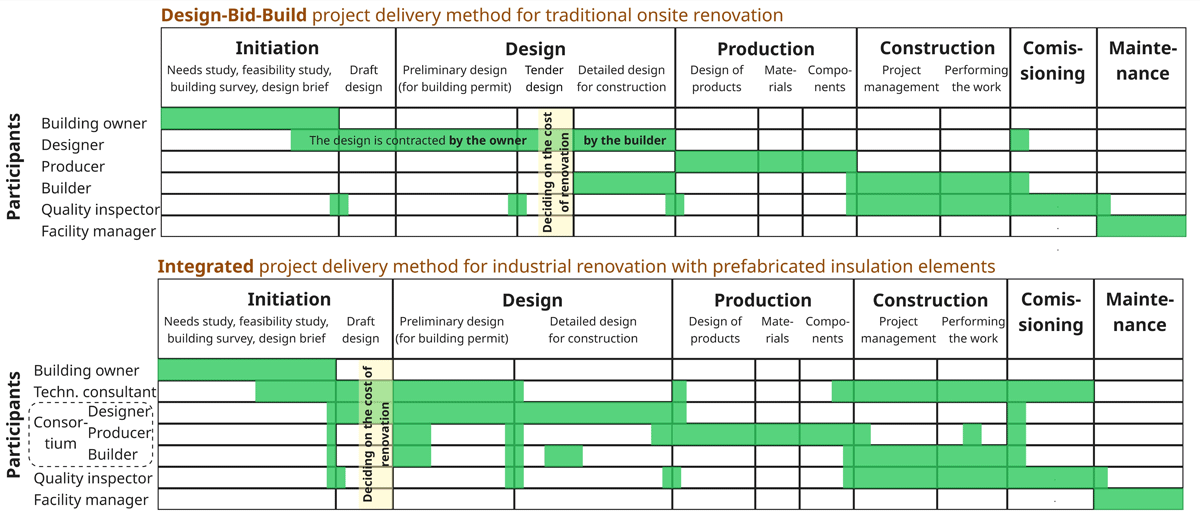
Figure 3
Comparison of participant involvement in the renovation of the apartment building at different stages during design–bid–build (above, traditional) and integrated retrofit design and construction project delivery models (below, current study).
Table 3
Procurement scope and activities by actor
| ACTOR | PROCUREMENT SCOPE AND ACTIVITIES |
|---|---|
| Estonian Business and Innovation Agency (EIS) |
|
| |
| |
| Apartment associations (construction clients’ representatives) |
|
| |
|
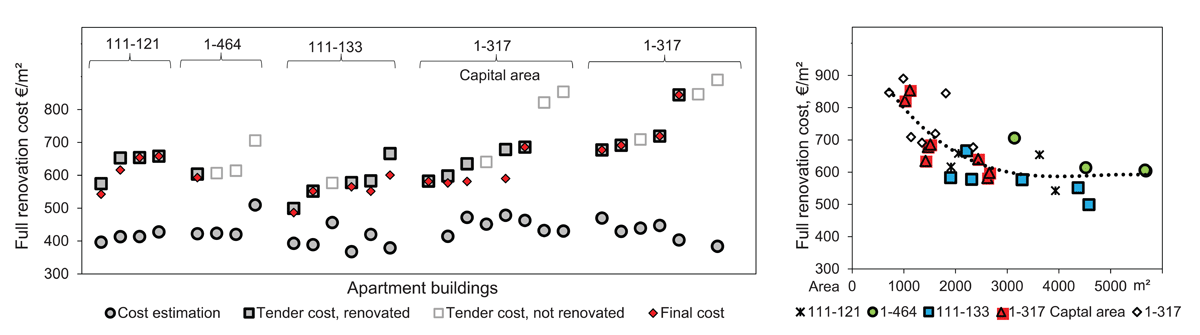
Figure 4
Cost of deep retrofit depending on apartment building type (left) and net floor area (right).
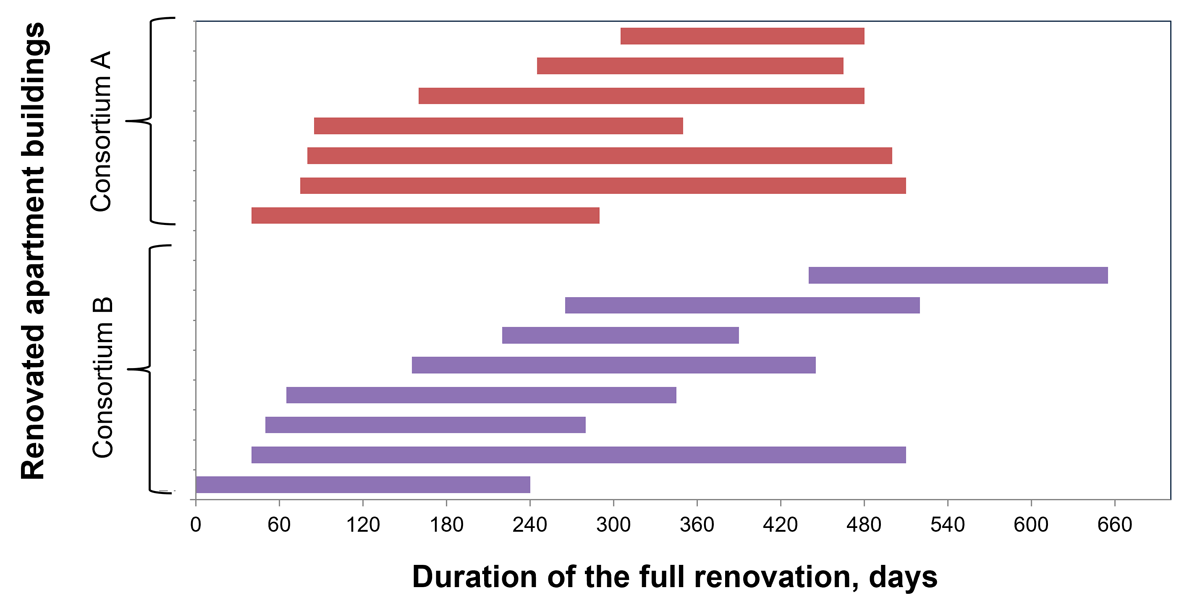
Figure 5
Duration (calendar days) of renovation activities by building, split between the two consortia (design companies, fabricator, the main contractors, quality inception/commissioning) awarded the framework contract.