
1. INTRODUCTION
The provision of affordable, high-quality housing remains a pressing global need, with debates about targets, productivity and construction methods taking place across many countries (Hwang et al. 2025; Langston & Zhang 2021; Lessing & Stehn 2019). These concerns are mirrored in England, where the government has attributed the sector’s failure to deliver more, better quality homes to a perceived lack of innovation and productivity (Hansard 2024). Policymakers (House of Commons 2019; UK Parliament 2024) and others (Daniel et al. 2024; Dowsett et al. 2019; Peters et al. 2023) have linked this to the slow adoption of modern methods of construction (MMC) for housebuilding, focusing on potential technical and operational barriers to its use, but there is comparatively little representative evidence about how different actor groups interpret the policy intended to promote MMC. This matters because policy influence is not linear: initiatives and instruments formed at the centre are filtered through a distributed network of public bodies, market intermediaries and delivery organisations whose fragmented perceptions shape their behaviour. How those perceptions are distributed across the sector, and what they reveal about its governance, has not been established at a representative scale.
The policy framework for the sector is complex: housing, planning and associated legislation have been devolved functions for Scotland, Wales and Northern Ireland since 1998, with further powers transferred since that time (MHCLG 2025), leaving the UK national government responsible for England alone. This has produced four materially distinct national policy regimes and consequently no single UK housing policy that could coherently be studied. England accounts for the dominant share of the UK’s housebuilding output and its policies have therefore been selected as the single-nation object for this study. The paper’s use of the term ‘government’ is in the context of the UK government and policy for England. The paper acknowledges that the UK’s regional workforce is mobile (CITB 2022), with practitioners within Scotland, Wales and Northern Ireland having experience of, and informed opinions on, English policy and housebuilding, so responses from those living in all four nations are treated as being relevant and are referenced in the findings.
Houses, rather than all homes, are at the centre of the discussion about the sector’s productivity, given that the ‘house’ (being a detached or semi-detached residential unit, but not an apartment) remains the most common type of home built each year in England (approximately 75%; ONS 2023). Private housebuilders, as a contracting subsector, remain distinct from general contractors (Payne et al. 2019), concentrating on land acquisition and building houses, rather than constructing other building types. The sector is highly concentrated among volume housebuilders (Gardiner 2021), with lengthy site acquisition programmes and business models that prioritise risk management over technical innovation. MMC manufacturers range from niche specialists to integrated developer–manufacturers; financiers and insurers arbitrate perceived product and process risk; designers and planning consultants interpret an expanding body of regulations and standards; and warranty providers judge performance in use. In such a distributed system, policy success depends not only on formal instruments but also on how actors make sense of them.
1.1 DEFINITIONAL DEBATES AND USE OF THE MMC FRAMEWORK
The use of the MMC descriptor is the product of an iterative debate on the categorisation of innovative offsite construction methods, spanning several decades (Matthews 2024), and though acknowledging the ongoing current debate in England (CLC 2025) around industrialised construction over MMC, there are two principal reasons why the MMC Frameworks Definition (MHCLG 2019) has been used within this research, albeit limited to categories 1–5 which are deemed by many (UK Parliament 2024) to be more appropriate. First, policy influence on the use of MMC is core to the research aim, so the use of the government’s adopted frameworks definition provides logical coherence. Second, while numerous competing descriptors exist locally (Ayinla et al. 2020) and internationally (Vásquez-Hernández et al. 2025), MMC constitutes the predominant term recognised and used across the UK’s four nations, which for the purposes of researching sectoral perception is critically important.
1.2 SECTORAL PERCEPTIONS OF POLICY AND MMC
Research into the limited uptake of MMC in housebuilding has concentrated on technical and operational barriers, and on the business models that explain the sector’s caution. Studies of leading housebuilders attribute slow adoption to production strategies and a de-risked, land-led model that rewards proven approaches over innovation (Lang et al. 2016; Pan et al. 2008; Pan & Goodier 2012; Payne 2013), a reluctance also identified in general contracting (Rahman 2014) and more recently by the competition authority (CMA 2024). These papers explain why the sector behaves as it does, but treat its response to policy as relatively uniform and largely supply-side.
A smaller strand looks beyond the physical building. Payne & Serin (2023) argue that adoption is shaped less by the visible output of construction than by the ‘dark matter’ of business models, regulatory practices and consumer preferences, and that MMC must be understood through the whole development process. Agapiou’s (2022) survey of housing associations found cost and complexity perceptions, rather than skills alone, to be the principal barrier. Both raise the question as to how policy is perceived, but from different perspectives, with neither supported by representative evidence across the whole sector.
Policy inquiries and reviews compound the gap, repeatedly returning to interventions, through demand creation, the skills agenda and planning reform (House of Commons 2019; UK Parliament 2024; Farmer 2016; Peters et al. 2023), on the assumption that the sector will respond to such levers and instruments consistently. Whether the sector perceives these policies as influential, and if that perception is shared across its constituent actors, remains largely untested. This matters because policy influence in a fragmented delivery system depends on how those actors interpret and make sense of it (Hallsworth et al. 2011; Pawson 2002; Ritchie 2024), and because the recurring claim of a disconnect between policymakers and the sector (Barnfield et al. 2025; Morgan et al. 2025) has been asserted rather than measured.
The research gap, therefore, is the absence of representative, sector-wide evidence on how policy influence on MMC is perceived, and the means to determine whether, and how, that perception differs across the sector’s actors.
1.3 INTERPRETING SECTORAL PERCEPTIONS THROUGH GOVERNANCE RELATIONSHIPS
Governance perspectives provide a useful way of interpreting how policy influence may be experienced across fragmented delivery sectors where multiple, but interdependent, actors each hold only partial authority (Kapucu & Hu 2020; Klijn et al. 2025; Provan & Kenis 2008)—England’s housebuilding sector being such a setting. Government may set targets, standards and legal obligations, but lenders, insurers and warranty providers determine what is fundable and insurable (UK Parliament 2024); designers and planning consultants translate policy into drawings and specifications; and contractors, manufacturers and suppliers absorb its execution. Policy influence is therefore not broadcast from the centre to the building site fully intact, but is instead filtered, interpreted and reshaped by the actors through which it passes—each forming perceptions from their own practical experience (Pawson 2002). Those perceptions reveal where actors see advantage or disadvantage (Cairney 2012) and can inform how policy is designed and prioritised (Hallsworth et al. 2011).
Governance theory suggests that, in such a network, an actor’s relationship to policy will shape how they perceive it (Kapucu & Hu 2020). Three policy-related roles can be identified:
Policy-makers originate and set terms of policy, whether public (through government or its agencies) or private (through finance, insurance and standards bodies), whose decisions operate in effect as policy.
Policy-takers receive policy, interpret it and translate it into built projects in their capacity as building professionals, directors of housing developers and housebuilders—they may be expected to respond more effectively to those policy instruments that reduce ambiguity, allocate and manage risk.
Policy-absorbers experience the resulting consequences of policy as applied to the physical building, in their capacity as the contracting and manufacturing workforce, and the wider supply-chain—they may be expected to value the practical capacity of policy that can be accommodated without restructuring their existing approaches.
This three-role framework is derived from network governance theory and is used in this paper as an analytical lens through which to interpret the survey findings, not as a hypothesis built into the survey itself. The structure of grouping variables used by the survey is set out in Section 3, with employer type recorded among the survey’s demographic variables—the analysis subsequently revealed it to be the characteristic most strongly associated with divergence in perception, more so than occupation, location, age or experience. It is that observed result which the governance framework is then used to interpret, examining to what extent the perceptions of policy-makers, -takers and -absorbers align, and whether differing policy priorities between sectoral actors are visible in the data. The framework’s value is assessed against the evidence in Section 4.
1.4 AIM AND RESEARCH QUESTIONS
Existing research has concentrated on the technical and operational barriers to MMC, leaving the sector’s own perception of policy influence, and any disconnect between those who make policy and those that interpret and absorb it, largely untested at a representative scale. Addressing that gap, the aim of this paper is to establish how actors across England’s housebuilding sector perceive the influence of policy on the use of MMC, and to explore what those perceptions reveal about the relationships between different sectoral actors. Accordingly, the study addresses three research questions:
RQ1: Which policy areas does England’s housebuilding sector perceive as having the greatest influence on the use of MMC?
RQ2: How do these perceptions differ across the sector’s actor groups, and which actor characteristic best explains the variation?
RQ3: What do these variations in perceived policy influence reveal about the relationships between different sectoral actor groups?
The paper is structured as follows. The next section describes the methods used to answer these questions. This is followed by the survey findings, and their interpretation through the sector’s governance network.
2. METHODS AND DATA
2.1 METHODS JUSTIFICATION AND RESEARCH DESIGN
The research questions require evidence of how perception of policy is distributed across the whole of England’s housebuilding sector and its constituent governance roles. The research is positioned pragmatically, in that the choice of methods follows from the research questions rather than from prior commitment to a single paradigm (Morgan 2014), and its reasoning is abductive: the survey establishes an observed pattern, for which network governance is advanced as the most plausible explanation and tested against the evidence. Implementing this meant measuring perception across a sample large enough, and representative enough, to support both sector-wide claims and disaggregated comparison between actor groups. A quantitative survey is the established method for this approach (Bryman 2016), allowing perception to be measured consistently across a defined population and compared between subgroups. The methodological requirement was therefore not the choice of instrument, but the means of administering it across a quota-controlled sample calibrated to the sectoral workforce of approximately 1.5 million (ONS 2023).
Conventional postal or online questionnaires rely on non-probability convenience or self-selecting samples (Andres 2012), and even at optimistic completion rates of 25–35% (Hoxley 2008) they could not realistically deliver a quota-stratified sample at this scale within the resources available. Professional polling provided the closest means of doing so. Polling is not a separate method from surveying but the mechanism through which the survey instrument is delivered to a managed, demographically calibrated panel. Polling has been an established instrument for measuring population opinion in the UK since the 1930s (Broughton 1995), and its use in academic public policy research (Barnfield et al. 2025; Kowalik 2019) and by the government (HM Treasury 2020) demonstrates its credibility and rigour for gauging perception (Bryman 2016).
Stratified quota sampling (Kemper et al. 2003; Sue & Ritter 2012) offered the closest fit to the research questions, since it allows the achieved sample to mirror the composition of the sector and supports the disaggregated comparison between actor groups on which the governance analysis depends. The target population was defined as the workforce identifying with and supporting the building sector, a subsector of the wider construction industry numbering approximately 1.5 million (ONS 2023). Sample size calculations (Moss 2019), verified independently by the polling organisation established a sample range from 9604 (a ±1% margin at 95% confidence) to 384 (±5% margin), the latter consistent with the established polling convention for a population of this size; a target of 500 completions was set so that disaggregated analysis at the subgroup level would remain statistically viable.
Stratification was achieved by calibrating response quotas to Standard Occupational Classification (SOC) workforce proportions (CITB 2025), so that the achieved sample mirrored the sector’s occupational composition rather than the convenience of access. Respondents were drawn from the polling organisation’s managed panel, screened for current employment in, or association with, the building sector, with quota-monitoring during fieldwork ensuring each SOC stratum was filled proportionately. Fieldwork ran between 2 and 7 July 2025, and closed on 501 valid completions. The achieved sample’s fit to the sector’s occupational profile is shown in Figure 1; the survey process, management and full instrument are detailed in the supplemental data online.
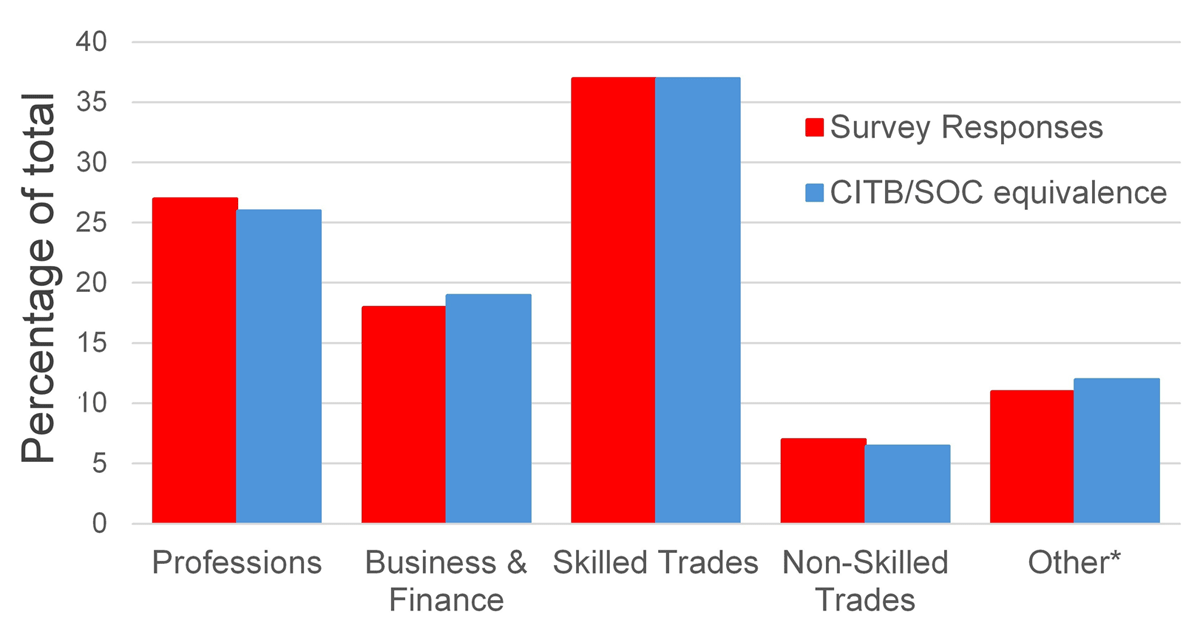
Figure 1
Survey respondents against Standard Occupational Classification (SOC) sector equivalence.
Note: *A 3.5% allowance for SOC’s ‘other’ roles is not recorded within the Construction Industry Training Board’s (CITB) data.
Source: CITB (2025).
2.2 INSTRUMENT DESIGN, SAMPLING AND FIELDWORK
The survey instrument was built on a taxonomy of policy areas derived analytically rather than imposed. It draws on an extensive critical exploratory review of 60 white and grey papers (Morgan et al. 2025), focused on English housebuilding policy, conducted in the tradition of a semi-structured review (Snyder 2019), from which the policy areas that had, or could have had, an influence on the use of MMC were identified and grouped.
Analysis of the arguments within the literature generated 25 policy areas organised into four principal purpose clusters (Figure 2):
Pipeline predictability: skilled labour, interventions, supply-chain stability, targets, planning reform, data and mandates.
Regulations and guidelines: energy use, whole-life assessment, standards, building regulations, health, safety (H&S) and welfare, certification, and definitions.
Commercial market: valuation, procurement, lending, insurance, warranties, tax and grant incentives.
Robustness: quality, consumer experience, durability, corporate key performance indicators (KPIs) and adaptability.
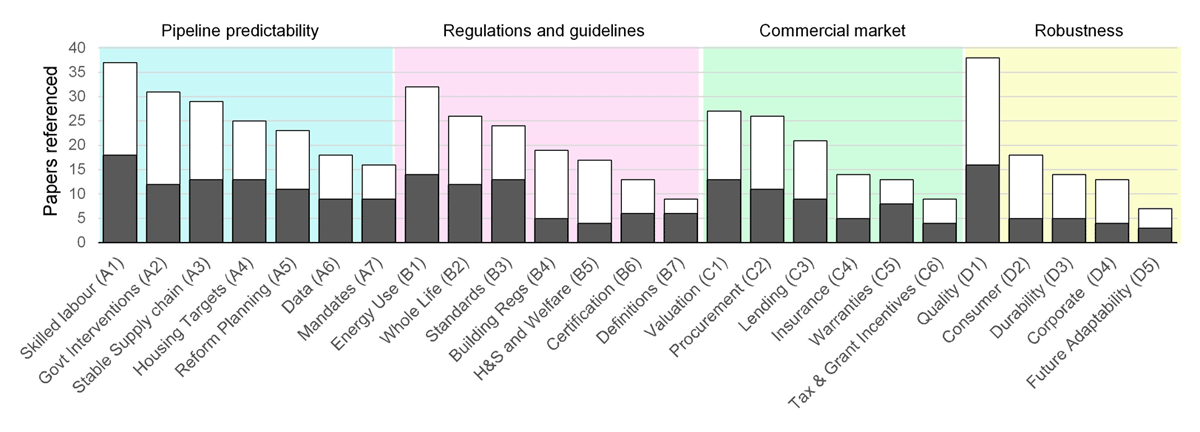
Figure 2
Policy areas referenced within the white (shown in white) and grey (shown in grey) literature review.
Source: Morgan et al. (2025).
This taxonomy is a methodological device used to rationalise the survey’s analysis rather than a theoretical claim or explicit observed result.
By using these four clusters and 25 policy areas (Table 1), the survey recorded each respondent’s perception of (1) the effect on MMC use (Likert scale = 1–5) and (2) importance (Likert scale = 1–5), with an overall impact ranking generated from the combination of the two. These three measures structured the survey and the analysis that follows. Importance records how important the respondent judges a policy area to be to the housebuilding sector. Effect records the degree to which the respondent perceives policy in that area to influence the use of MMC specifically. Impact is the composite of the two, calculated from their combination and rescaled to preserve direction and salience (see Section 2.4), such that a policy area registers as high impact only where it is perceived as both important and effective. Importance and effect are therefore distinct judgements: a policy area may be considered important in general yet have little perceived effect on MMC use, and impact is the measure that captures their interaction.
Table 1
Policy purpose clusters and the 25 policy areas.
| POLICY PURPOSE CLUSTER AND DESCRIPTION | POLICY AREA | POLICY AREA ABBREVIATION | POLICY AREA DESCRIPTION |
|---|---|---|---|
| Pipeline predictability: Policies that enable a predictable demand and supply of homes for housebuilders in England | 1 | Skilled labour | Provision of appropriately skilled labour to the sector |
| 2 | Interventions | Government interventions for research, capital funding and land release | |
| 3 | Stable supply chain | Creation of a stable supply chain for MMC sector | |
| 4 | Targets | Setting of clear housing targets | |
| 5 | Reform planning | Reforming the planning system | |
| 6 | Data | Collection, publication and use of high-quality data | |
| 7 | Mandates | Enforced mandates for MMC use in social housing | |
| Regulations and guidelines: Policies that create the regulations and guidelines to which housebuilders work | 8 | Energy use | Policies directed at reducing energy use in new houses |
| 9 | Whole life | Introduction of whole-life assessments for new houses | |
| 10 | Standards | Establishment of specific standards for MMC components and systems | |
| 11 | Building regulations | Building regulations revised to address MMC systems | |
| 12 | H&S and welfare | Enhanced health, safety and welfare standards for housebuilders | |
| 13 | Certification | Adoption of certification systems for MMC components and systems | |
| 14 | Definitions | Clearer use of the MMC definitions within targets and standards | |
| Commercial market: Policies that shape the commercial and business environment in which housebuilders work | 15 | Valuation | Full valuation of MMC systems for purposes of grants and mortgages |
| 16 | Procurement | Legal and commercial procurement practices to suit MMC stages | |
| 17 | Lending | Provision of competitive lending for houses using MMC systems | |
| 18 | Insurance | Provision of competitive insurance for MMC products and companies | |
| 19 | Warranties | Access to warranties for houses using MMC systems | |
| 20 | Tax and grants incentives | Government incentives for the MMC sector through tax and grants | |
| Robustness: Policies that require housebuilders to focus on quality, value and durability | 21 | Quality | Establishment of quality standards for completed houses |
| 22 | Consumer | Data collection and publication on consumer experiences of MMC | |
| 23 | Durability | Requirement to publish records of the durability of housebuilding systems | |
| 24 | Corporate | Establishment of sector-wide key performance indicators (KPIs) for use in corporate environmental, social and governance (ESG) investment | |
| 25 | Adaptability | Requirements for future adaptability to MMC-built houses |
[i] Note: MMC = modern methods of construction.
Source: Adapted from Morgan et al. (2025) and used for the survey questionnaire.
Beyond the policy-area ratings, the questionnaire recorded self-assessed knowledge of MMC, housebuilding and policy; their personal orientation to innovation through three items, and two consumer-facing judgements: the effect MMC would have on a hypothetical decision to purchase a new house, and their expectation of its price relative to a traditionally built equivalent. A final block of questions captured demographic and organisational characteristics: occupation by SOC, employer type, employer size, region, years of experience and age band. The full question wording, response options and summaries are provided in the supplemental data online.
2.3 DATA-CLEANING AND CODING
Cleaning of the data reduced the number of valid responses from the 508 received to 501, with the polling method able to pre-remove incomplete surveys, ‘speeders’ (responses below 3 minutes), duplicates and geographically irrelevant (non-UK) responses. However, seven responses were removed as ‘straight-liners’ (no variation in Likert responses), in accordance with accepted polling data-cleaning methodology (Barnfield et al. 2025). The Likert responses were coded for the benefit of SPSS, the method, reasoning and application of which is set out in the supplemental data online.
2.4 RESCALING OF DATA FOR GRAPHICAL PRESENTATION
Coded values were rescaled to enable all means (for effect, importance and impact) to be graphically presented (Figures 3, 4, 5) against a normalised 0–10 scale that preserves direction and salience multiplicatively. The calculation method for the rescaling is set out in the supplemental data online. All other calculations used the original, unscaled, coded values.
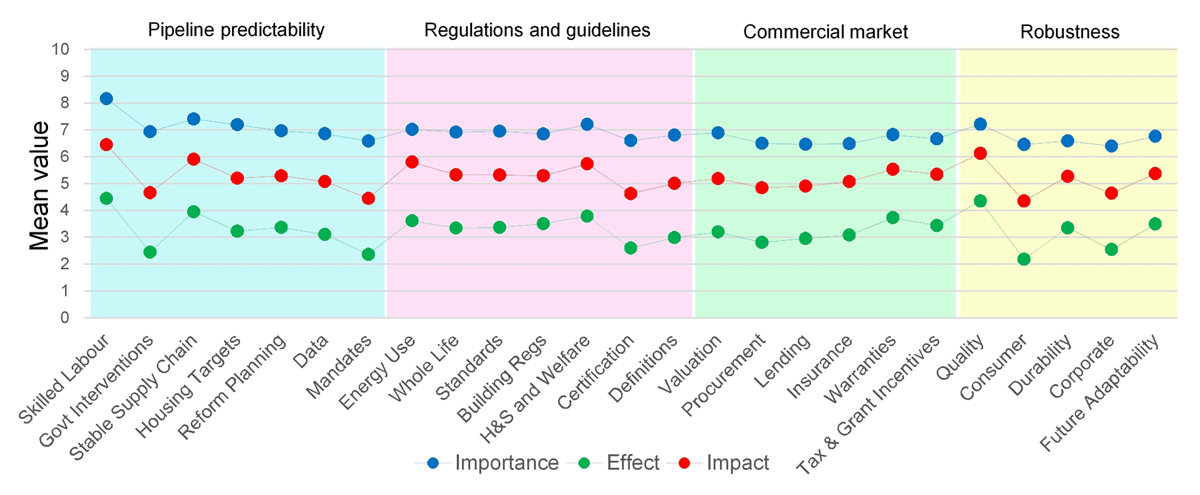
Figure 3
Respondents’ means for each policy area by its importance (blue), effect (green) and impact (red) on modern methods of construction (MMC) use for housebuilding in England.
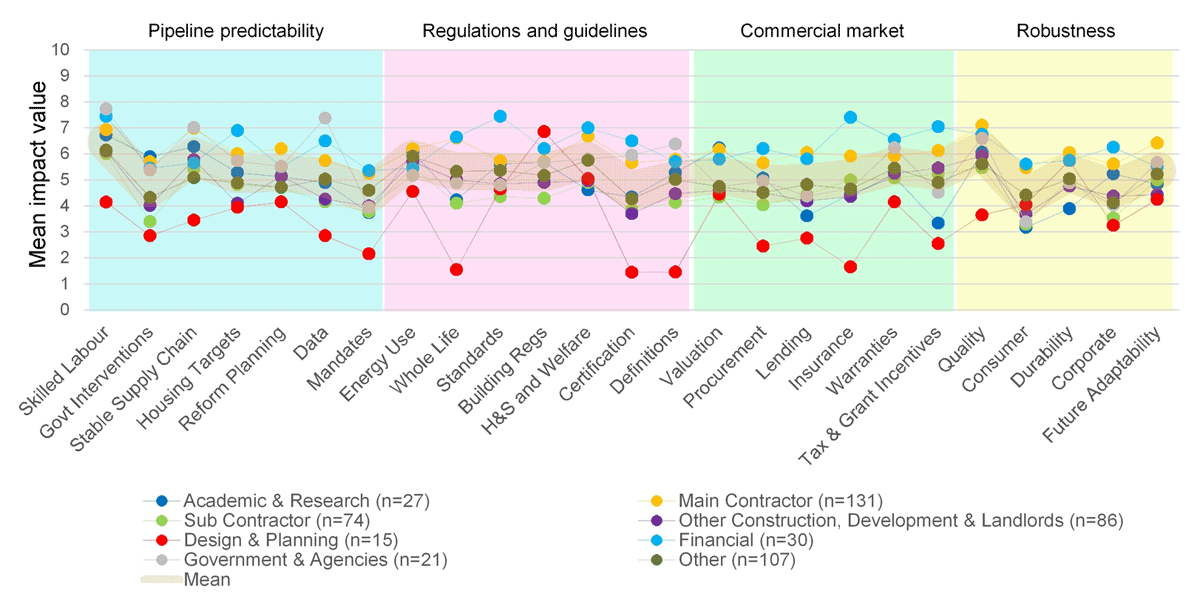
Figure 4
Employer type: means for each policy area by its impact on modern methods of construction (MMC) use for housebuilding in England.
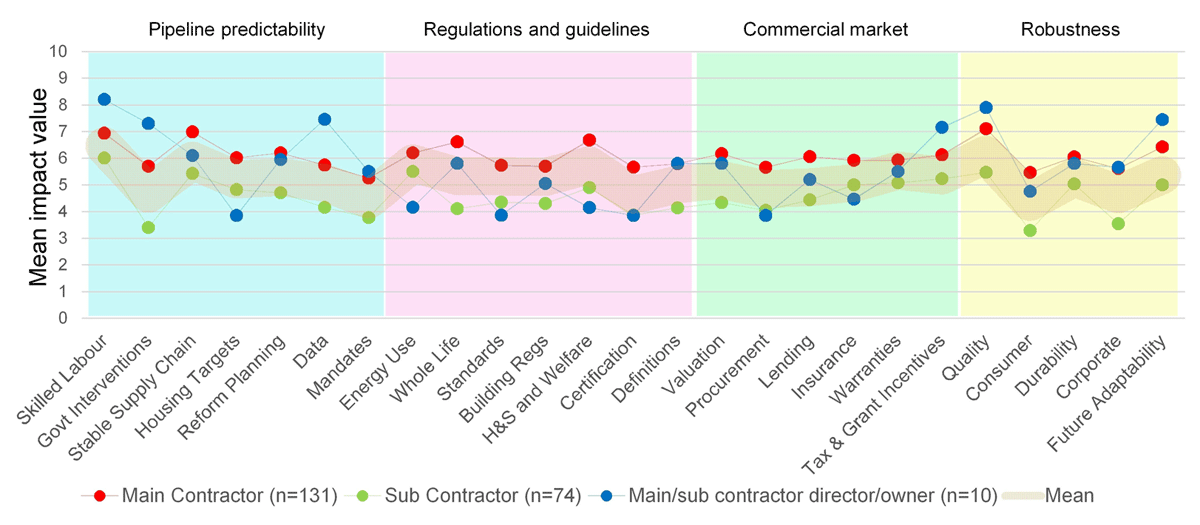
Figure 5
Contractors and their directors/owners: means for each policy area by its impact on modern methods of construction (MMC) use for housebuilding in England.
2.5 ANALYSIS
Given the nature of the ordinal data collected, a non-parametric test was used to check correlational consistency and significance via Kruskal–Wallis analysis (Hinton et al. 2004; Pallant 2020). Four of the survey questions were analysed against the location of the respondents using Kruskal–Wallis (via IBM SPSS), and adjusted by Bonferroni correction to control the overall false-positive rate, to gauge the data’s baseline significance against an assumed null hypothesis for each. Each generated a null hypothesis with a significance p-value > 0.05, suggesting that groups came from samples across the regions with similar distributions and that the dataset had reasonable baseline equivalence for ongoing analysis with no significant correlation based on the regional location of the respondents. Spearman correlations were then applied to assess group associations, knowledge measures, innovation orientation and MMC attitudes.
2.6 LIMITATIONS AND METHODOLOGICAL REFLECTIONS
The survey set out to measure, at a representative scale, how the building sector perceives the influence of policy on the use of MMC in England’s housebuilding, and whether that perception differs by the sector’s actors. It achieved 501 valid responses stratified to the sector’s occupational profile, generating almost 50,000 data points and supporting both sector-wide claims and comparison between subgroups.
The survey’s reach depended on an established polling organisation and its online panel. Polling panels carry known limitations, including self-selection into the panel, panel conditioning and coverage bias against those without internet access. Stratification to SOC quotas mitigates, but cannot eliminate, these effects. The method also shares the general constraint of quantitative surveys, that ordinal responses capture the direction and strength of perception but not the nuance behind it. The explanation of why particular actors prioritise particular policy areas therefore lies beyond what perception data can decide and would benefit from future qualitative research.
In addition, the paper presents synthesised findings and governance interpretation whilst the supplemental data online contain full questionnaire wording, cleaning rules, formulae, SPSS outputs, and additional figures and tables.
3. RESULTS
The results are presented in three stages reflecting the research questions in turn following a brief characterisation of the 501 respondents used for the analysis; the overall ranking establishes which policy areas the sector perceives as most influential (RQ1); the disaggregated and correlational analysis identifies how perceptions differ and which actor characteristic best explains the variation (RQ2); and the patterns of agreement and divergence generate the governance interpretation developed in Section 4 (RQ3). Throughout the disaggregated analysis, a grouping variable is an element along which responses are compared (employer type, occupation by SOC, employer size, region, years of experience or age band); a subgroup is a category within a grouping variable (e.g. main contractors within employer type); and a governance role (policy-maker, -taker or -absorber) is an analytical collection of employer-type subgroups developed in Section 4.
3.1 SAMPLE CHARACTERISTICS
The final sample (n = 501) approximated sectoral SOC proportions (Figure 1) and was geographically broad. Employer types included main contractors, subcontractors, design/planning practices, associated financial organisations (lenders and insurers), government and its agencies, building-related academia and research, and other construction (developers, manufacturers and suppliers). Employer sizes ranged from small firms to large enterprises (Office for National Statistics (ONS) defined). Net self-assessed knowledge was highest for housebuilding (54%), moderate for MMC (46%) and lower for policy (42%), consistent with the distribution of roles. Across MMC categories, respondents were most familiar with pre-manufactured structural members (MMC cat. 3) and flat-panel systems (MMC cat. 2), reflecting their prevalence in hybrid solutions.
3.2 OVERALL RANKING OF POLICY AREAS (RQ1)
The means for importance, effect and impact for all 25 policy areas (Figure 3) show that some policy areas were considered of some importance, but of having little effect on MMC use (such as policies directed at certification or consumers), whilst those deemed to having greater effect significantly boosted the overall impact of others (policies directed at energy use and quality).
The five key policy areas identified through the exploratory literature review match three of the five ranked by respondents for both importance and effect (quality, stable supply chain and skilled labour), and four of the five ranked by impact, with the addition of energy use (Table 2). While the literature had placed a far greater emphasis on government interventions, which appeared in its top five ranked choices, and was acknowledged as being of some importance by respondents, they also ranked it as having little overall effect on the use of MMC, resulting in a low impact value. In contrast, the literature (particularly the grey) failed to highlight H&S and welfare as being influential, and yet respondents perceived it to be an important, effective policy area, and likely to be far more impactful on MMC use. Overall, the comparative analysis suggests that assessing policy areas by impact value, being closely aligned to literature, would be a suitable measure for disaggregated analysis of the dataset groups.
Table 2
Comparison of the literature review policy references, and survey rankings, by importance, effect and impact on the use of modern methods of construction (MMC) in housebuilding in England.
| LITERATURE REVIEW AREAS REFERENCED | SURVEY RESPONSES | |||
|---|---|---|---|---|
| BY IMPORTANCE | BY EFFECT | BY IMPACT | ||
| 1 | Quality | Skilled labour | Skilled labour | Skilled labour |
| 2 | Skilled labour | Stable supply chain | Quality | Quality |
| 3 | Energy use | Quality | Stable supply chain | Stable supply chain |
| 4 | Government interventions | Housing targets | H&S and welfare | H&S and welfare |
| 5 | Stable supply chain | H&S and welfare | Warranties | Energy use |
[i] Note: H&S = health and safety.
The five highest-impact policy areas across the full sample were: skilled labour; quality; stable supply chain; H&S and welfare; and energy use. These areas combine capacity (skills, supply chain), assurance (quality, H&S) and guiding objectives (energy). Their order is consistent with parliamentary inquiries (House of Commons 2019; UK Parliament 2024) and industry reviews that emphasise capability and capacity bottlenecks, risk management, and the need for credible quality assurance. By contrast, housing targets, certification and consumer-directed policies were never ranked in the top five by any subgroup. Respondents appear to view these as either too insignificant or insufficiently transformative relative to everyday delivery constraints.
3.3 DISAGGREGATED ANALYSIS BY GROUPING VARIABLE (RQ2)
The analysis of the mean impact values completed for the groups: SOC, location, age, years of employment experience, employer size and employer type, suggested a varying degree of uniformity to the overall means across all subgroups without significant deviation from policy area choices amongst most. While employer size shares a similar uniformity to SOC, the results suggest a potential correlation between positivity towards overall policy impact and size of employer.
Age of respondents suggested a reasonable uniformity between all but the oldest subgroup, albeit with the next oldest subgroup and the youngest, being the least positive regarding the impact of policy. The oldest subgroup (≥ 65) showed the greatest variation from the overall mean, albeit with a smaller number (n = 16) of respondents. The policy choices from this subgroup are partly supported by analysis by years of experience with a similar pattern of deviations from the mean for the 31–40 years of experience, but with a larger subgroup sample (n = 32).
Disaggregated data based on the geographical location of respondents suggested a pattern of general uniformity compared with the overall mean, except for five areas which had consistent deviations: East Midlands, North East England, East of England, South West England and Greater London. The first two of these areas had the greatest differences from the mean, whilst the latter had some distinct policy choices.
Analysis by employer type (Figure 4) showed two significant deviations from the overall mean for those working in design and planning, and those attached to financial companies. Less significant, but still clear, deviations exist for those in main and subcontractors. Additional analysis (Figure 5) was completed into contractor directors and owners to appreciate whether their perceptions differed to their employees, revealing three policy choices within their top five (data, future adaptability and government interventions, with tax and grant incentives closely behind) that significantly deviate from overall mean, as well as the choices of their employees. Employer-type subgroups exhibited greater divergence than occupation—the subgroups that diverge most are those occupying distinct positions in the policy network, the instigators and interpreters of policy, on the one hand, and its absorbers, on the other, a pattern Section 4 examines and discusses in detail.
3.4 DISAGGREGATED ANALYSIS BY FIVE KEY POLICY AREAS (RQ3)
Analysis of the policy area ranked choices made by the survey’s disaggregated subgroups suggest that the respondent’s characteristics may correlate with their perceptions of policy priorities towards MMC use.
The heat map (Figure 6) of each subgroup’s five ranked policy areas shows considerable consistency towards skilled labour and quality, with the former emerging as the predominant policy choice across virtually all demographic and organisational groups. This choice spans all occupational subgroups, from design professionals to skilled and non-skilled trades alike, indicating that the challenge and capacity of the labour workforce is of primary importance to the whole sector. With a similar level of support, regardless of employer size, it reveals that both small and medium-sized enterprises and larger companies are experiencing similar pressures concerning the availability of skilled workers in relation to the use of MMC. This widespread agreement suggests that policies aimed at appropriately skilling the workforce would command uniform support across the sector.
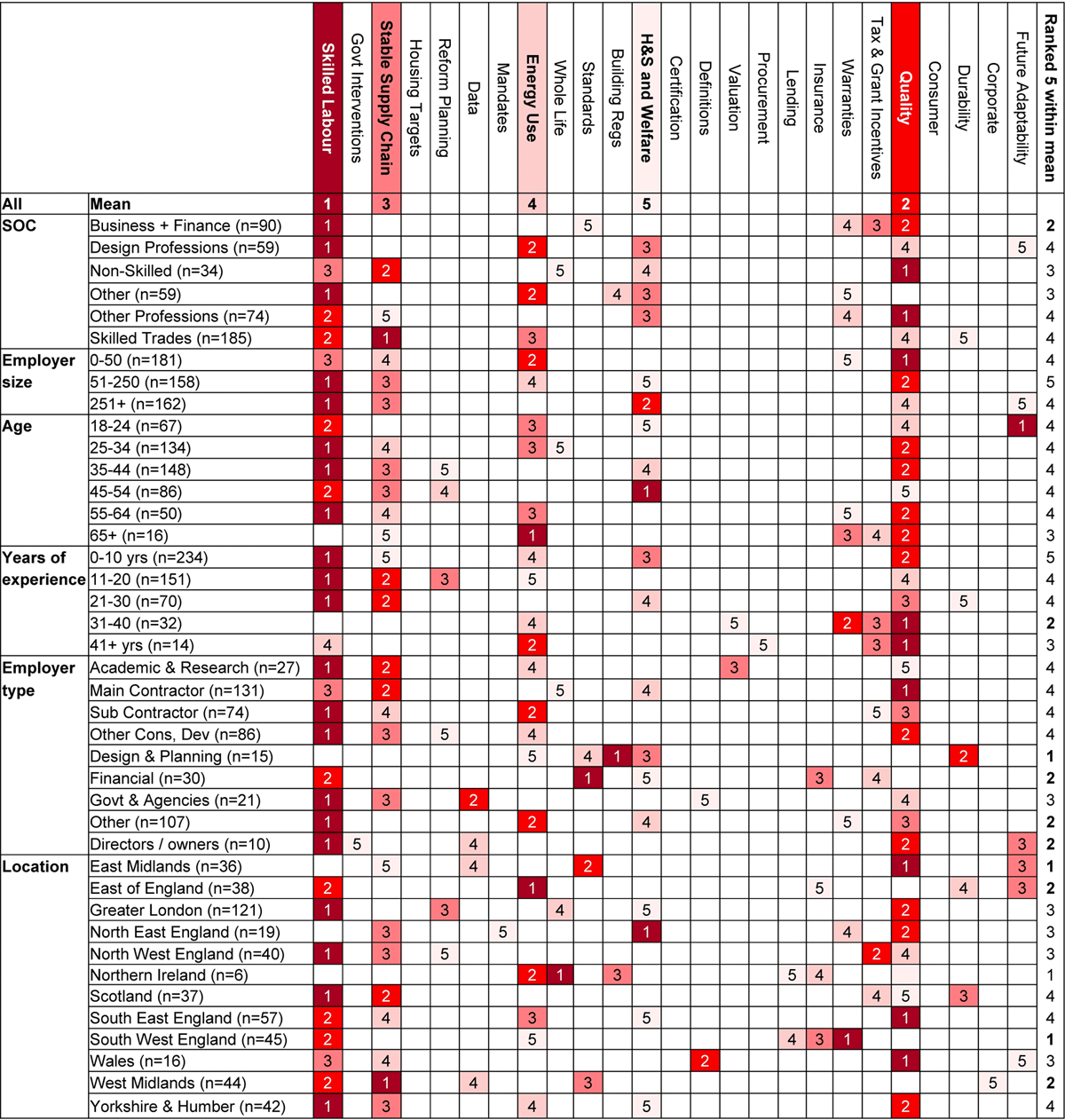
Figure 6
Disaggregated group heat map of five key policy areas ranked 1–5 by their impact on modern methods of construction (MMC) use for housebuilding in England.
Note: 1 = first choice, 5 = last choice.
Policies focused on quality, and those supporting a stable supply chain, are the second and third most chosen areas, albeit with neither receiving the same degree of unanimous support across multiple subgroups. Whilst quality was recognised as an important influence on MMC use within many groups, receiving ranked scores of 1–3 from most subgroups, policies supporting a stable supply chain tended to be ranked slightly lower. Conversely, both choices align with submissions to, and reports of, recent inquiries (House of Commons 2019; UK Parliament 2024) and literature (Morgan et al. 2025), particularly in relation to financial considerations and demands linked to MMC investment by companies, recognised by respondents from employers of all sizes. Notably, the results of the exploratory literature review (Table 2) show a striking similarity to the academic and research subgroup choices, matching the same four (from five) policy areas, signifying a degree of confirmational consistency between the review and the survey.
There are several significant deviations from design/planning and financial companies, and to a certain extent government/agencies. The latter is uniquely focused on data and definitions, indicating that its perception of what influences the use of MMC differs from that of the wider sector. The former two subgroups show a similar divergence of priorities from the overall contracting and development subgroups, which implies a significant lack of agreement on wider policy objectives amongst those who in practice work most closely together, and between policy-makers and those who are the -takers or -absorbers. It is also notable that there is a significant divergence of agreement over key policy choices between the directors and owners of contracting companies and their employees.
Conversely, three policy areas were not ranked within the top five by any subgroup as being impactful on the use of MMC in housebuilding; housing targets, certification and policies directed at the consumer. The former is striking given that perhaps the most discussed current policy is the government’s 1.5 million new homes target for England—it was not ranked as a key policy influencing MMC use in housebuilding by any sectoral subgroup, suggesting evidence of a potential disconnect between policymakers and the sector.
The disaggregated analysis shown in the heat map (Figure 6) suggests that while there is significant sectoral agreement, particularly policies focused on skilled labour, quality and creating a stable supply chain, there is significant divergence in perception across the various subgroups, and that appears as a pattern, not randomly.
3.5 CORRELATIONAL STRUCTURE
The disaggregated analysis raised questions about what was potentially driving the divergence of policy choices by certain subgroups. Bivariate correlation analysis focused on those groups that potentially demonstrated the greatest variation, and their self-assessed knowledge of housebuilding, MMC and policy towards housebuilding. The four groups that demonstrated the greatest divergence from the mean ranked policy choices were: employer type, location, SOC and years of experience. Each was analysed for potential correlational relationships (see the supplemental data online).
The results suggest that employer type (Table 3) better aligns with knowledge of MMC, almost as much for knowledge of housebuilding, but was slightly weaker for knowledge of policy. Unsurprisingly, the results also highlight that those that suggest knowledgeability in one area also claim it for all others (housebuilding and policy = 0.636; housebuilding and MMC = 0.616; MMC and policy = 0.547), suggesting that while self-assessed expertise tends to be consistent across surveys at the individual level, the distribution of that expertise across subgroups is variable, particularly for MMC-specific knowledge.
Table 3
Summary of the correlations between employer type and knowledge of: housebuilding sector, modern methods of construction (MMC), and policy and housebuilding.
| SPEARMAN’S RHO | CORRELATION COEFFICIENT | SIGNIFICANCE (TWO-TAILED) |
|---|---|---|
| Knowledge of the housebuilding sector | –0.212** | p < 0.001 |
| Knowledge of MMC | –0.248** | p < 0.001 |
| Knowledge of policy and housebuilding | –0.094* | p = 0.036 |
[i] Note: Correlation significant at the **0.01 and *0.05 levels (two-tailed).
In addition to questions concerning knowledge of housebuilding, MMC and policy, the survey also asked respondents about their own character values compared with potential innovation, their preferences when purchasing a new house and expectations of price of a new home built using MMC compared with one using traditional methods. The results suggest there is a strong correlation between people who align with innovation, their positivity towards purchasing a house built using MMC and price expectation of that house compared with one built traditionally—signifying that personal values in relation to innovation may be helpful to understanding an actor’s wider beliefs about MMC.
The strongest correlational links are between employer type and knowledge of housebuilding, MMC and policy, and separately, that those personally attracted to innovation are also most positive about MMC itself. Further analysis combining all these relationships confirms a significant link between the specific employer type, alignment to innovation and positivity to MMC, raising questions about whether an individual’s personal values lead them to a specific employer, or if those values are formed after working for specific employers.
The results show that those working for employers in financial and design/planning are more likely to align themselves with innovation overall (Figure 7), particularly clear in response to the survey question concerning latest trends. A majority of all subgroups stated that MMC use on a future house purchase would have a positive effect on the decision (Figure 8), while those employed by financial and design/planning companies shared an increasingly pessimistic trend on the likely higher cost of MMC-built houses compared with all other groups, suggesting a degree of shared insight.
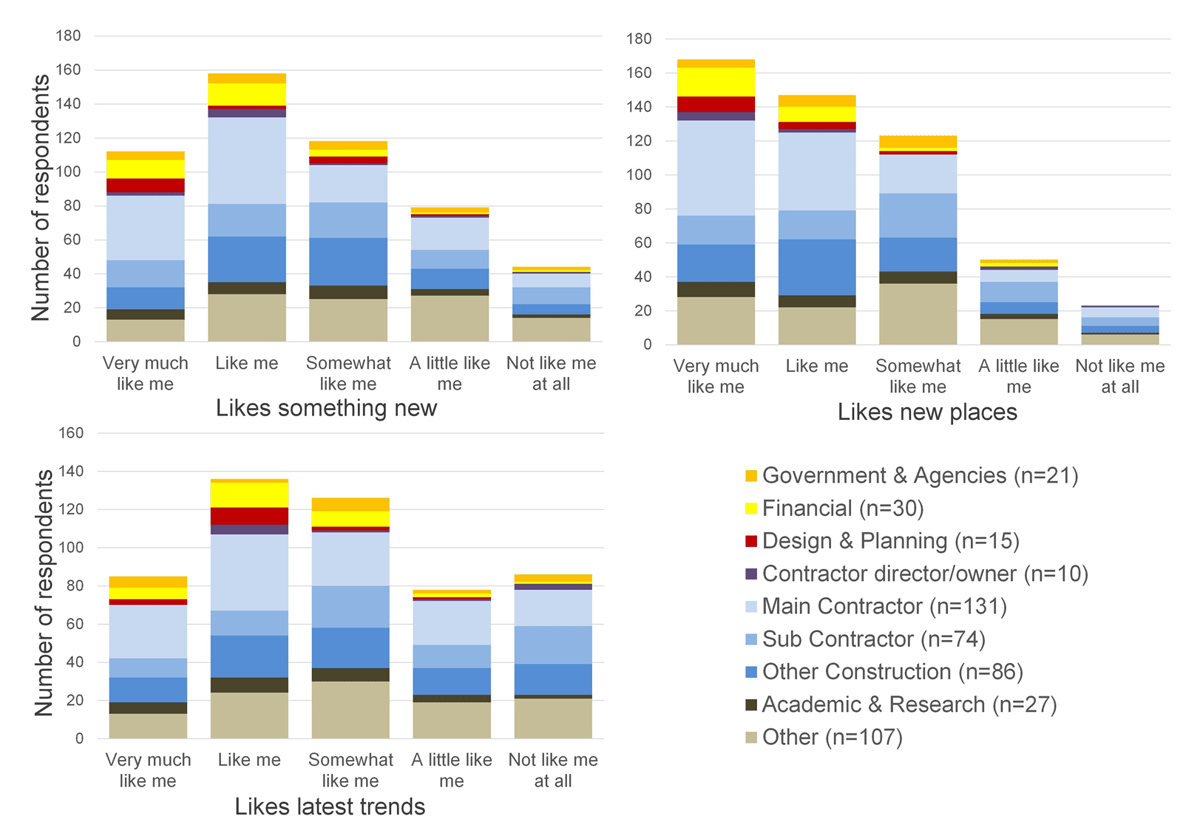
Figure 7
Respondent’s self-assessed personal values in relation to innovation, by employer type.
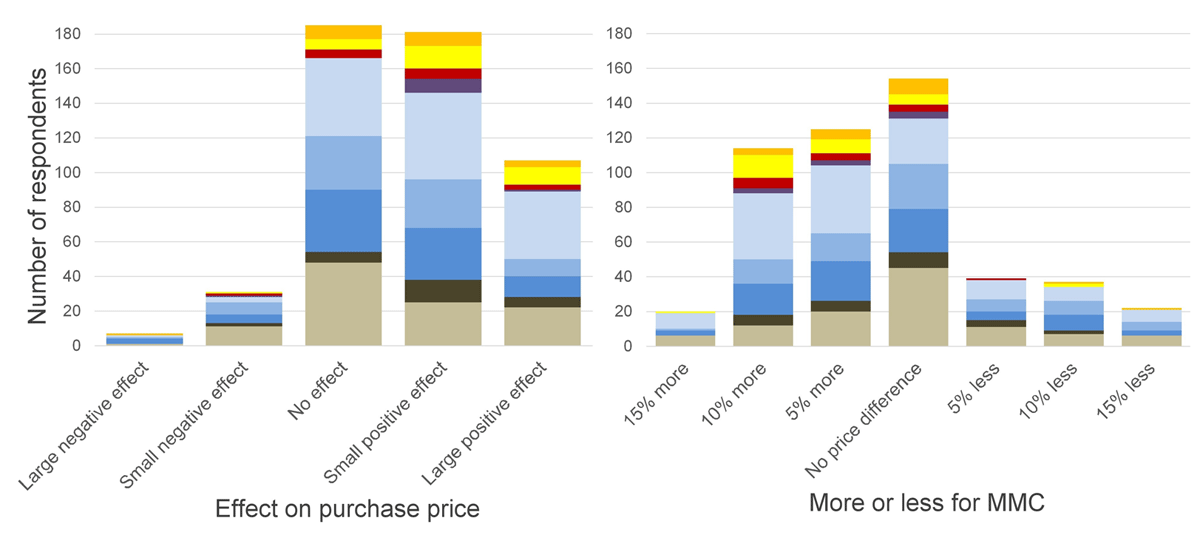
Figure 8
Effect on the decision to purchase a new house built using modern methods of construction (MMC), and the expectation of purchase cost compared with a house built traditionally, by employer type.
Note: See the key to Figure 7.
3.6 SUMMARY
Two important results stand out: a broad cross-sectoral agreement on a small set of influential policy areas centred on skilled labour, quality and a stable supply chain; and a significant divergence of perception by employer type that maps onto the policy-makers, -takers and -absorbers of the governance network as discussed in Section 4.
4. DISCUSSION
The findings suggest that a narrow set of policy areas account for most of the sector’s perceived ability to influence MMC adoption. They also demonstrate that the employer’s role in the governance network was more strongly associated with divergent policy perception than occupation, geography, age or experience. These two findings may also suggest why policy between its makers and the sector is considered disconnected, since whilst all parties agree on the core problems in the abstract, they each prioritise very different areas in practice.
4.1 ALIGNMENT OF GOVERNANCE ROLES
The prominence of employer type is an observed result, established through the disaggregated and correlational analysis, and significant independently of any interpretive framework. Network governance is the lens used to make sense of that result, not its source. The interpretation that follows therefore considers an effect the statistics establish on their own terms. Results for the employer-type group (Figure 9) revealed an intriguing divergence between three of the subgroups and the overall mean, matching the values of each governance network member. Each governance role within the sector’s network is reflected tacitly, and sometimes explicitly, within the ranked choices made by respondents.
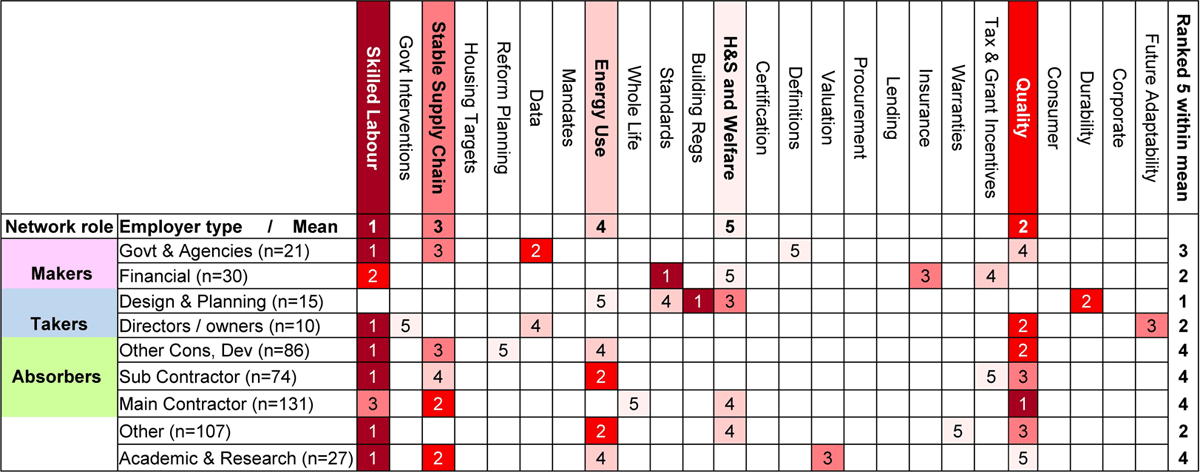
Figure 9
Employer-type heat map of the five key policy areas ranked 1–5 by their impact on modern methods of construction (MMC) use for housebuilding in England.
Interpretation of the data patterns suggests a tripartite governance structure that helps to explain the potential network structure, relationships and time horizons of policy-makers, -takers and -absorbers. The policy-makers (government/agencies and financial) opted for three distinctive policy areas reflective of their role—definitions, standards and data—these being the long-term information infrastructures that facilitate coordination, accountability and evaluation. The policy-takers (building professionals, directors of housing developers and housebuilders) value policy areas that translate into procured, insurable, financeable projects—standards, regulations and government interventions—that reduce ambiguity, allocate and manage risk within project delivery horizons. The policy-absorbers (contractors, subcontractors and other construction) deal with the consequences of policy as applied to the physical buildings, doing so as part of their daily working life, and therefore valuing practicable management of capacity—skilled labour, stable supply chains and quality—the factors that avoid rework and protect reputations within the immediate operational timeframes. That this structure emerges from the perception data alone, without additional impositions, is what the disaggregated analysis contributes to RQ3.
The areas chosen go beyond the limited scope of policy set out by Agapiou (2022), suggesting that the potential influences on the use of MMC in housebuilding are far broader and more complex than those areas associated with a physical building alone. These choices are nuanced to their respective role within the employer group, reflecting personal experience and insights, but also the complexity of decision-making, which the results establish, is rarely being focused on the physical building alone. Each choice is legitimate, but friction arises when policy areas championed by one group create operational costs or fail to address contractual constraints for another. Payne & Serin’s (2023) argument that MMC adoption should only be understood through the whole development process rather than the physical output of a building (Pan 2006) is supported by the present paper.
Analysis of the dataset has helped to confirm the general efficacy of earlier research, with the close alignment of policy area rankings to Morgan et al.’s (2025) literature review of 60 white and grey papers, as well as the choices made by the academic and research subgroup within the survey, reducing the 25 policy areas to five key ones: skilled labour; quality; stable supply chain; energy use; and H&S and welfare.
4.2 CHALLENGES BEHIND NETWORK GOVERNANCE
Establishing employer type as the preferred lens through which to understand the sector’s policy perception also enables the appreciation of its likely network governance and the potential relationships between the various group actors and the likely alignment of their perception and policy. The results suggested three distinct network relationships to policy within the governance structure: those that make policy, those that take and interpret it, and those required to absorb it.
The challenge for effective network governance is having clarity on understanding and the purpose of policy beyond sectoral perception. Whilst it would be reasonable, for instance, to simply acknowledge the need for appropriately skilled labour to the sector—a policy area almost universally ranked as a first choice for influencing the use of MMC for housebuilding—rigorous qualitative interviews may well conclude that each subgroup has a differing perception of the type of skilled labour required, its location, role, how they should be skilled and who should be responsible for skilling it. The conclusion may be that the perception is not universally agreed, nor the probable policy for resolving it, with the policy implications being far wider and more complex than a simple ‘something should be done about X’ agreement suggested through the quantitative survey’s responses.
Two results require a more detailed consideration. The first is an absence. The setting of housing targets for England (and entirely distinct from the other three UK nations) is the most recognisable instrument of current housing policy and yet is ranked by no subgroup within its five most influential policy areas. Whatever the target’s political importance, the sector does not perceive it as a policy that changes how homes are built. It is a finding that should give policymakers warning about headline instruments carrying no perceived operational force. Whilst there may be agreement across network roles about the problems, their divergence on potential solutions may be significant.
The second is the interpretation of the employer-type divergence itself. The governance structure proposed here—that perception follows an actor’s role in the policy network—is one explanation, but may not be the only one. Divergence may also reflect a relative proximity and access, in that those closest to policymakers may absorb their vocabulary and priorities, or capacity for material gain, such that each subgroup raises the policy areas that promote their interests most. These explanations are not mutually exclusive, and perception data cannot distinguish between them. However, what the data do establish is that divergence is structured, organised by employer and consistent with the tripartite approach that network governance anticipates. It may also be true that perceived policy influence reflects a differing interpretation of its impact by each network role—perception of success being relative. The qualitative phase that follows is designed to distinguish role, access and interest as drivers of the priorities observed.
5. CONCLUSIONS
This paper set out to establish how England’s housebuilding sector perceives the influence of policy on the use of modern methods of construction (MMC), and to interpret those perceptions through a network governance lens. Using a stratified survey of the sector has shown that perceived influence concentrates on five policy areas: skilled labour; quality; stable supply chain; energy use; and health, safety (H&S) and welfare (RQ1). In addition, that of all the characteristics tested, employer type is the most strongly associated characteristic to suggest how perceptions differ, correlating in turn with personal alignment to innovation and positivity towards MMC (RQ2), raising questions about whether the organisational context of the workforce weighs more than professional identity. Interpreting these patterns through the governance lens, the divergence is shown to track an actor’s role in the policy network rather than their occupation, revealing a potential disconnect between makers of policy and their emphasis on long-term information infrastructures of definitions, standards and data, and the policy-takers’ and -absorbers’ emphasis on the practical capacity to interpret and enact it (RQ3) within project delivery, or immediate operational time horizons.
The findings have distinct implications for each governance role and their interrelationships. For policymakers, the five key areas indicate where targeted intervention would command the broadest sectoral support, while the potential disconnect between the makers and the rest of the sector suggests that policy framed around definitions and measurement may not be perceived as an influence on those who deliver the houses. Additionally, the prominence of the 1.5 million homes target for England promoted within public debate is not matched by any perception of its influence on MMC use by the sector, despite the two being interlinked by the government. For policy-takers, the building professionals, directors of housing developers and housebuilders, who translate policy into deliverable housebuilding, the results suggest that those instruments that reduce ambiguity, allocate and manage risk are valued higher. For policy-absorbers, the contracting and manufacturing workforce, the consistent priority given to skills, supply chain and quality identifies the conditions under which MMC can be accommodated without restructuring their existing approaches, and the areas where misalignment with makers is most likely to generate operational cost.
Conceptually, the findings extend the application of network governance to the perception of policy in a fragmented delivery sector, showing that a governance reading can organise perception evidence that would otherwise appear disorganised. The finding that employer type is most strongly associated with variation in perception stands on the statistical analysis alone—the contribution of the framework is to interpret that finding, offering policy-makers, -takers and -absorbers as an analytically manageable structure for understanding how a distributed sector receives and applies policy. It provides representative evidence on which targeted interventions to promote MMC adoption, and the anticipated productivity gains from its use, might be applied. These are perceptions, not the policy effects themselves, and the study cannot establish why particular areas are prioritised. Qualitative interviews with senior actors across the governance roles are a necessary next step to examine the specific initiatives and instruments behind the five key areas, to test how far each role’s apparent agreement at the perception level survives closer scrutiny of its meaning, and to establish whether the effectiveness of future MMC policy depends less on the introduction of additional instruments than on recognising how different actors construct, translate and operationalise those instruments within a distributed governance network.
ACKNOWLEDGEMENTS
The authors thank the polling company that administered the survey fieldwork.
AI DECLARATION
Artificial intelligence (AI) tools were not used to generate or analyse the survey data, which were processed by the authors using IBM SPSS, nor to generate the study’s conceptual framework or the interpretation of findings. All analytical decisions, the development of the network governance framework, the interpretation of the results and the final wording of the manuscript are the authors’ own. The authors take full responsibility for the integrity and accuracy of the work.
DATA ACCESSIBILITY
The datasets generated and/or analysed in this study are available from the corresponding author upon reasonable request. Ownership of the dataset rests with the lead author and Loughborough University.
ETHICAL APPROVAL
This work was approved by the institutional ethics committee of the School of Architecture, Building and Civil Engineering, Loughborough University (reference number 2024-18717-19917). All participants provided written consent for participating in the research.
SUPPLEMENTAL DATA
Supplemental data for this article can be accessed at: https://doi.org/10.5334/bc.791.s1