
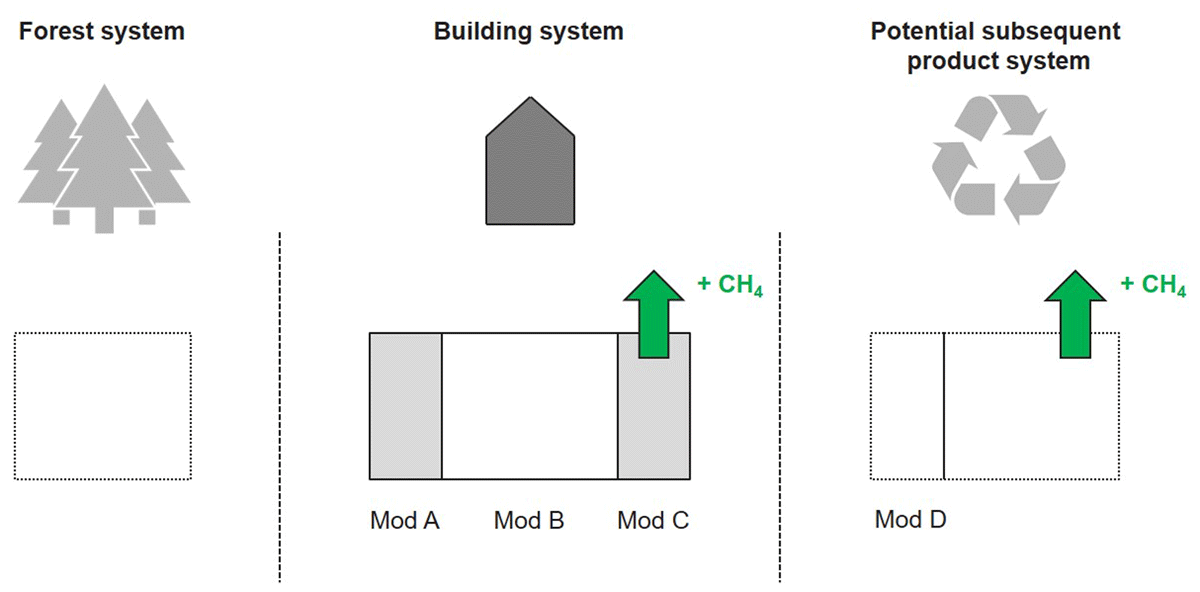
Figure 1
The 0/0 approach to model biogenic carbon uptake and release. Dotted lines indicate the product systems that fall outside the building system boundaries.
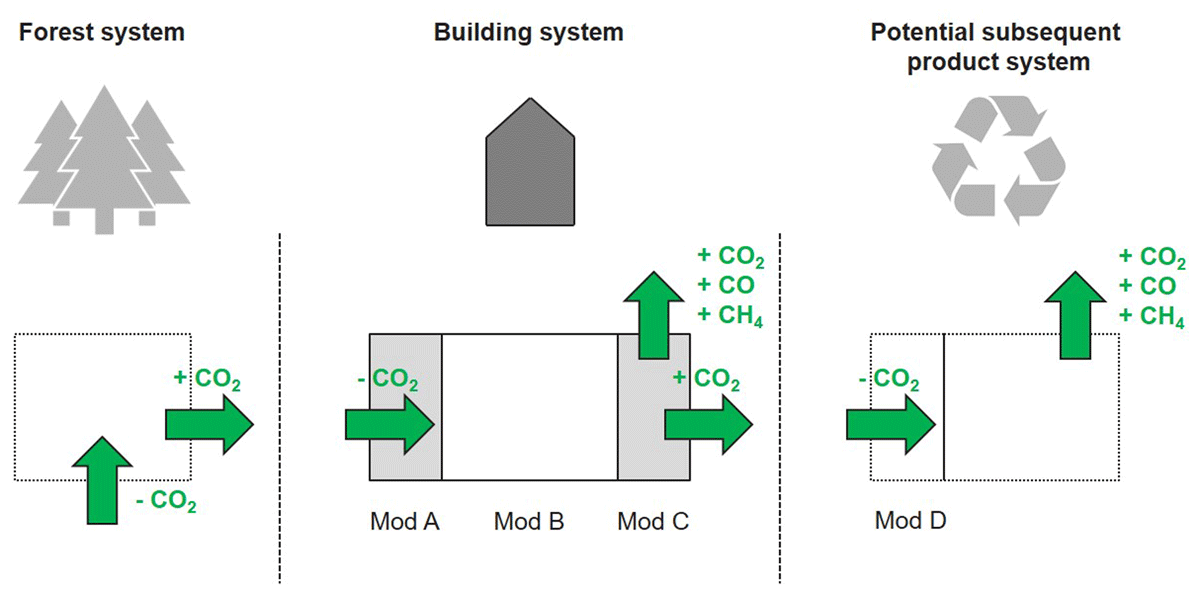
Figure 2
The –1/+1 approach to model biogenic carbon uptake and release. Dotted lines indicate the product systems that fall outside the building system boundaries.
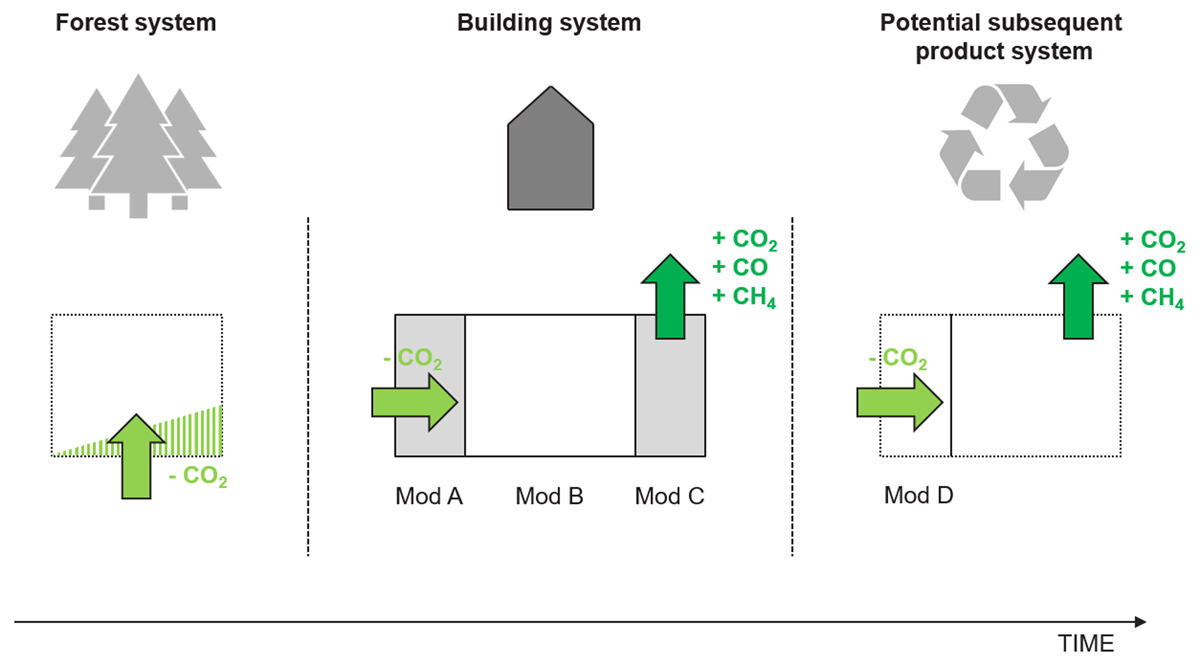
Figure 3
The dynamic approach, considering that trees grow before the use of the harvested wood product. Dotted lines indicate the product systems that fall outside the building system boundaries.
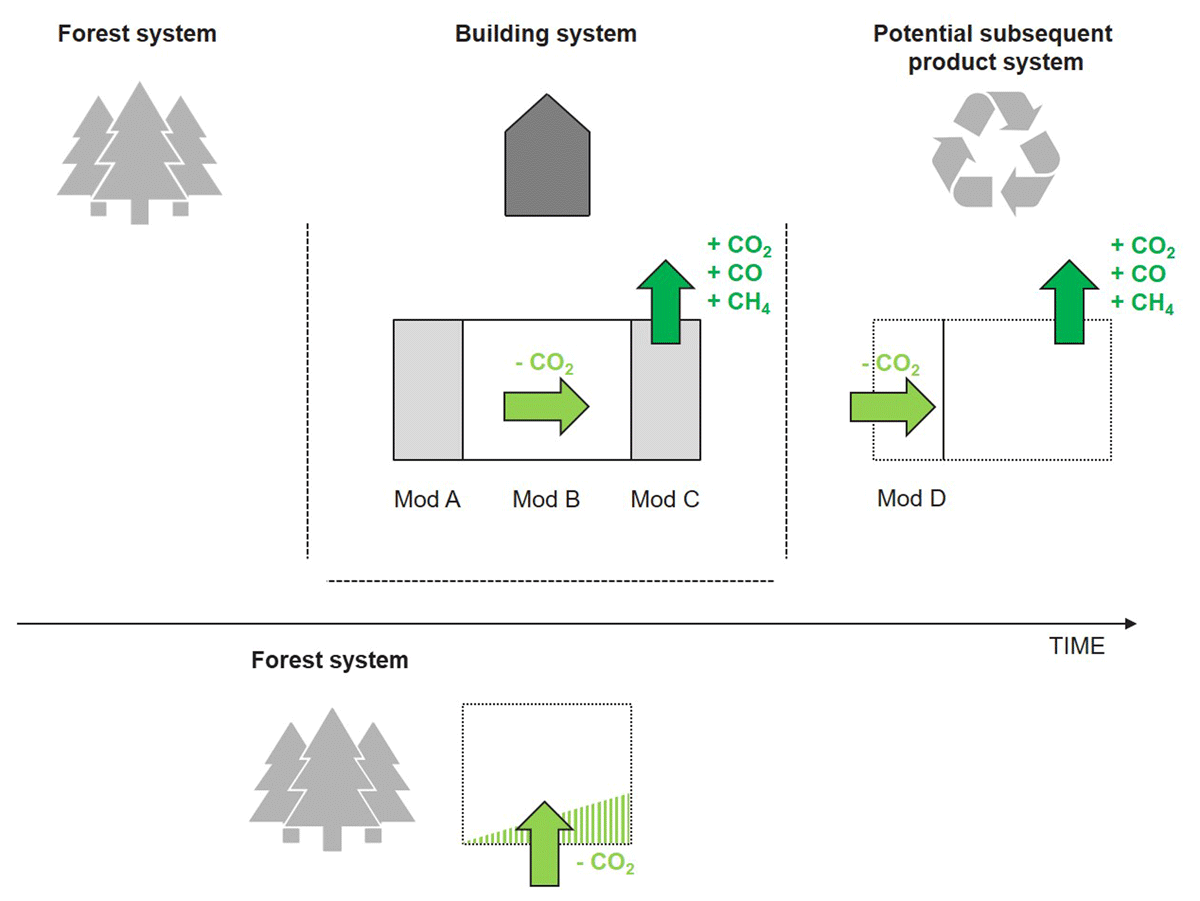
Figure 4
The dynamic approach, considering that trees regrow after harvesting. Dotted lines indicate the product systems that fall outside the building system boundaries.
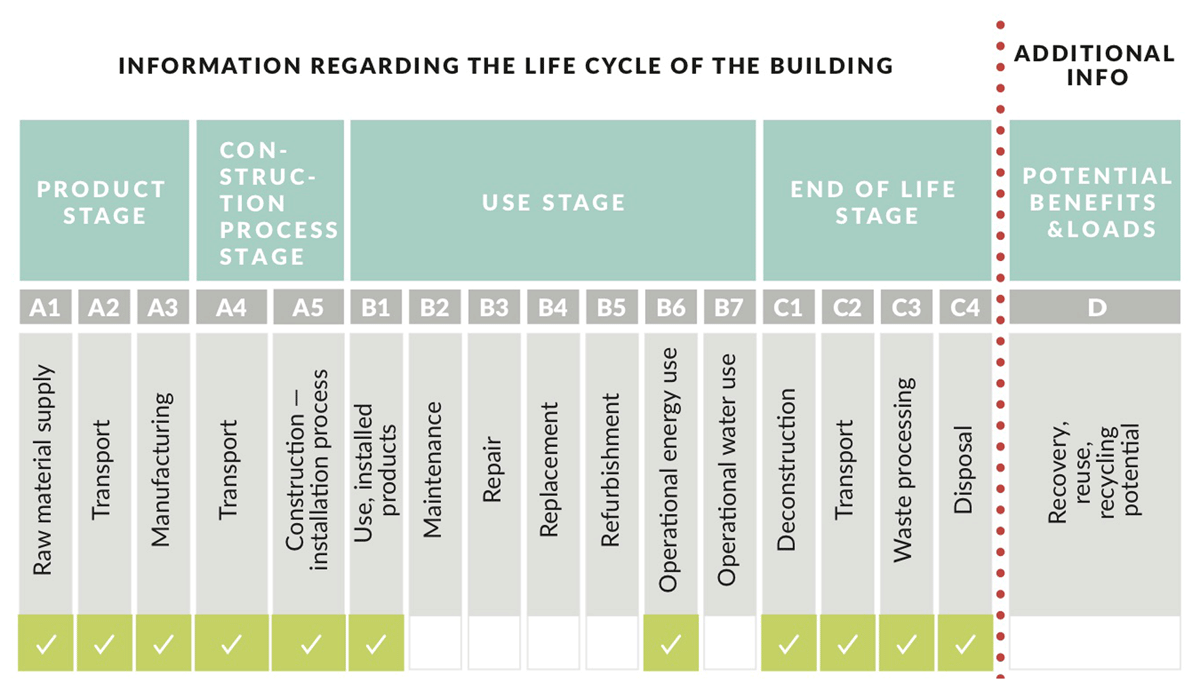
Figure 5
Life-cycle modules according to the EN-15978 (2011) standard. The life-cycle modules considered in this research are indicated in green.
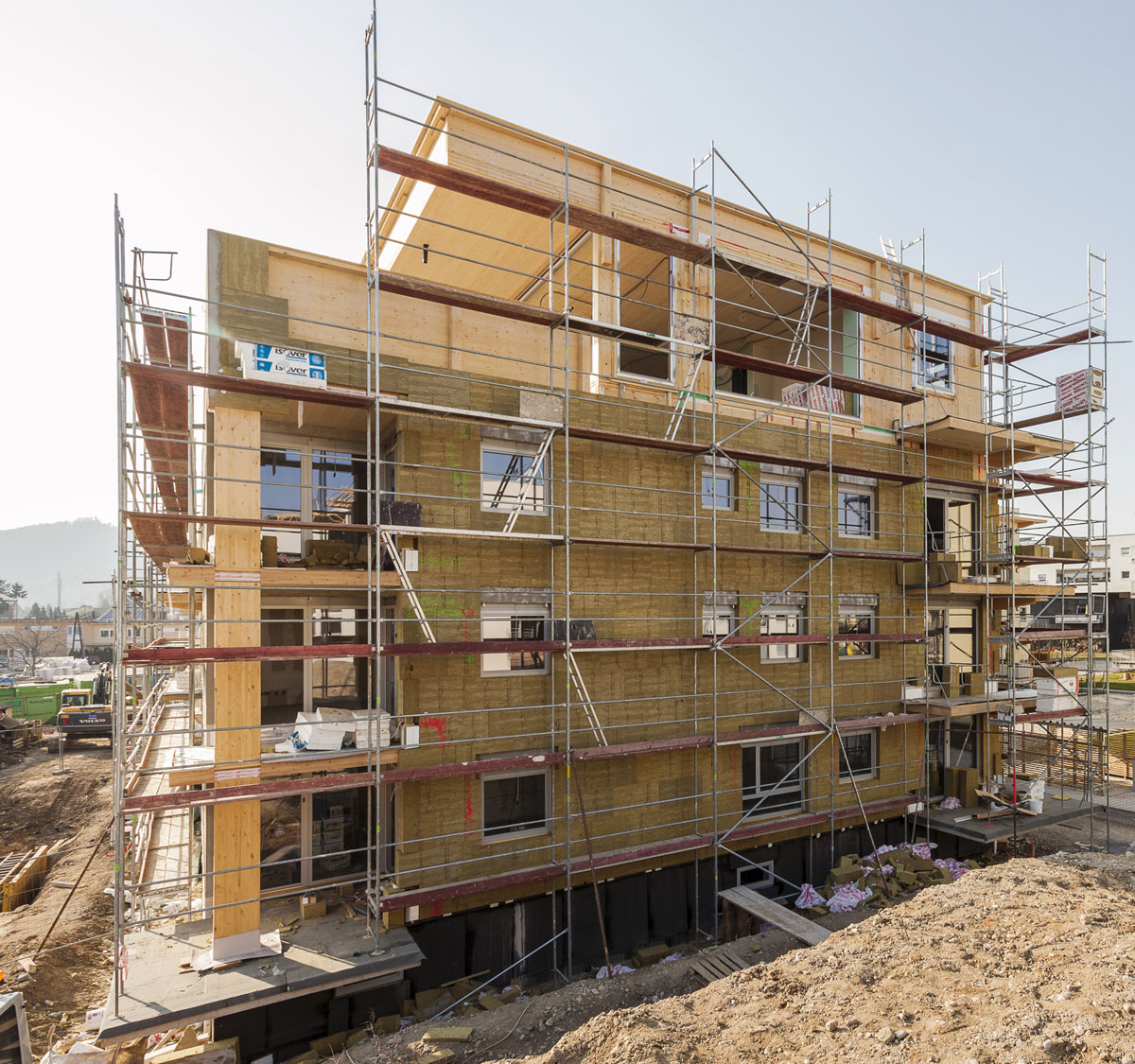
Figure 6
Case study building under construction. Source: Martin Grabner, TU Graz.
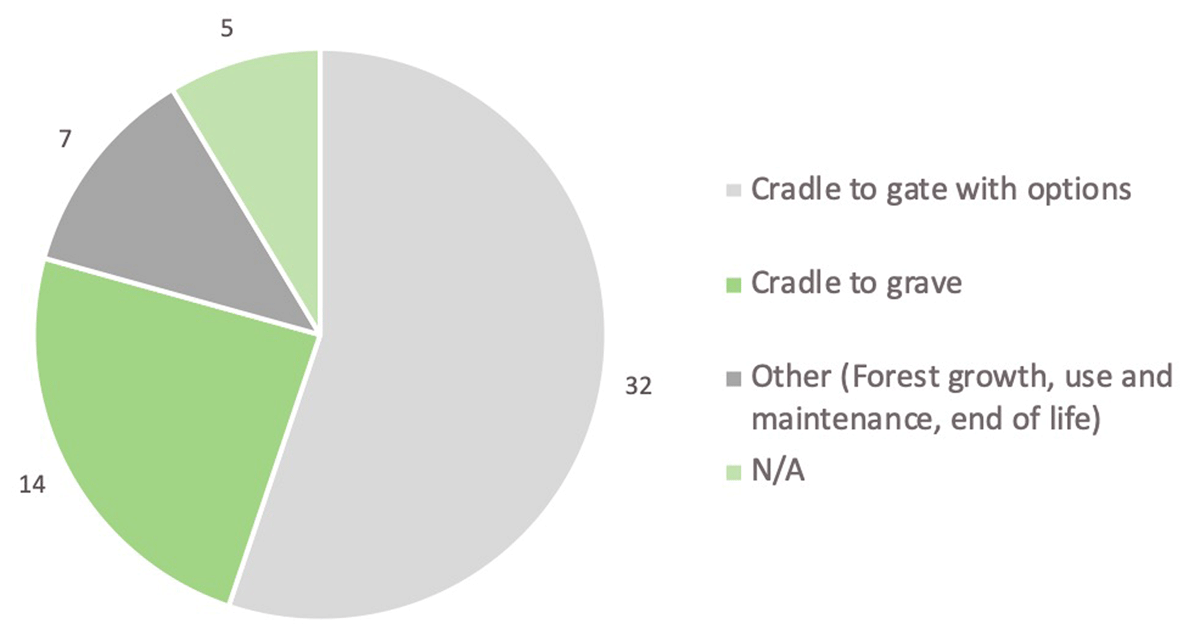
Figure 7
Life-cycle stages considered in the evaluated literature.
Table 1
Overview of the most common standards and their proposal in terms of biogenic carbon assessment.
| Main documents (reference) | Type of approach | Biogenic carbon uptake | Biogenic carbon storage | Biogenic carbon release | Direct land-use change | Indirect land-use change | Additional life-cycle inventory (LCI) indicators on biogenic carbon |
|---|---|---|---|---|---|---|---|
| Module A | Module B | Module C | Module A | Module A | |||
| EC (2013b) | –1/+1 | Yes, CF = –1 CO2e for CO2. Reported separately in the Resource use and Emissions Profile | No, credit for temporary carbon storage may be included as additional information | Yes, CF = +1 CO2e for CO2 and 25 for CH4. Reported separately in the Resource use and Emissions Profile | Yes, assessed based on Ciais et al. (2014). Land-use changes that occurred within a period of 20 years or a single harvest period | No, unless the product environmental footprint category rules (PEFCRs) require to do so | No requirements |
| ISO-14067 (2018) | –1/+1 | Yes, CF = –1 CO2e for CO2. Reported separately in the Resource use and Emissions Profile | No, impact of carbon storage (>10 years) may be documented separately | Yes, CF = +1 CO2e for CO2. Reported separately | Yes, assessed in accordance with internationally recognised methods such as Ciais et al. (2014). Land-use changes that occurred within a period of 20 years or at least a full rotation period. Reported separately | No, methods and data requirements under development | If calculated, the biogenic carbon content will be documented separately |
| ISO/DIS-14067 (2018) | –1/+1 | Yes, CF = –1 CO2e for CO2. Reported separately in the Resource use and Emissions Profile | No, delayed emissions and removals are not allowed; impact of carbon storage (>10 years) may be documented separately | Yes, CF = +1 CO2e for CO2. Reported separately | Yes, assessed in accordance with internationally recognised methods such as Ciais et al. (2014). Land-use changes that occurred within a period of 20 years or at least a full rotation period. Reported separately. Included changes in carbon stock. Land use defined as a different category (different land-use change) | No, methods and data requirements under development | If calculated, the biogenic carbon content will be documented separately. Land use for greenhouse gas emissions and removals occurring as a result of land use through changes in soil and biomass carbon stocks which are not the result of changes to the management of land should be assessed and included |
| EC (2017a, 2017b) | 0/0 | No, CF = 0 CO2e for CO2 | No temporary carbon storage (within 100
years). Credit (–1) for permanent carbon storage (>100 years) | Partially, CF = 0 CO2e for
CO2 and CO, 34 CO2eq for
CH4. Included under the subcategory ‘Climate change-biogenic’ | Yes, assessed based on default land-use change values from PAS 2050 (2011) or Ciais et al. (2014). Land-use changes which occurred within a period of 20 years or a single harvested period. Included under the subcategory ‘Climate change-land use and land transformation’ | No, methods and data requirements under development | Biogenic carbon content reported as additional technical information |
| PAS 2050 (2011) | –1/+1 | Yes, CF = –1 CO2e for CO2. | No, weighting factor for delayed emissions (within 100 years) may be calculated based on linear discounting (2 equations for the storage from 0 to 25 years and from 25 to 100 years). >> applied to bio-based and fossil-based product (polymer). Carbon storage of >100 years considered as permanent carbon storage (permanent negative credit) | Yes, CF = +1 CO2e for CO2 and 25 for CH4 | Yes, based on default land-use change values for selected countries. Land-use changes which occurred within a period of 20 years or one harvest period. | No, methods and data requirements under development | No requirements |
| ILCD (2010) | –1/+1 | Yes, CF = –1 CO2e for CO2. | No, credit for delayed emissions (within 100 years) may be calculated based on linear discounting. Applied to bio-based and fossil-based products (polymer). Delayed emissions beyond 100 years included in ‘Carbon dioxide, biogenic (long term)’ | Yes, CF = +1 CO2e for CO2 | No specified | No, methods and data requirements under development | No requirements |
| ISO-21930 (2017) | –1/+1 | Yes, CF = –1 CO2e for CO2 in the case of sustainable forest management, and 0 otherwise | No, delayed emissions may be reported as additional information | Yes, CF +1 CO2 for CO2 | Yes, CF = 1 CO2e/kg CO2 for non-sustainably managed forest, and 0 otherwise | Not specified | Carbon uptake and emissions reported as LCI indicator (kg CO2) for both biogenic carbon and carbonation |
| EN-15804 (2013) | Not specified | Not specified | Not specified | Not specified | Not specified | Not specified | Not specified |
| EN-15804 (2019) | –1/+1 | Yes, CF = –1 kg CO2e/kg CO2 included removals, transfers and emissions of biogenic carbon. Biomass from all sources except native forests | No, temporary or permanent carbon storage | Yes, CF = +1 CO2e for CO2 (as in ISO-14067 2018) | Yes, CF = +1 CO2 for CO2 | Not specified | Not specified |
| EN-16485 (2014) | –1/+1 | Yes, CF = –1 CO2e for CO2 in the case of sustainable forest management, 0 otherwise | No, effect of delayed emissions may be calculated based on PAS 2050 (2011) or Ciais et al. (2014) and reported as additional information | Yes, CF = +1 CO2e for CO2 | Yes, assessed in accordance with Ciais et al. (2014) for national greenhouse gas inventories | No, methods still under development | Biogenic carbon content will be reported in addition elsewhere |
| Levasseur et al. (2013) | New approach | Dynamic life-cycle analysis approach with time-dependent characterisation factors for all emissions (fossil and biogenic), allowing for the consideration of the effects of delayed emissions and carbon storage | |||||
| Vogtländer et al. (2014) | New approach | Approach based on the global carbon style-benefit of carbon sequestration when there is a global growth of forest and a simultaneous growth of wood | |||||
| Cherubini et al. (2011); Guest et al. (2013) | New approach | Biogenic global warming potential (GWP bio) considering the effect of forest regrowth and carbon storage | |||||
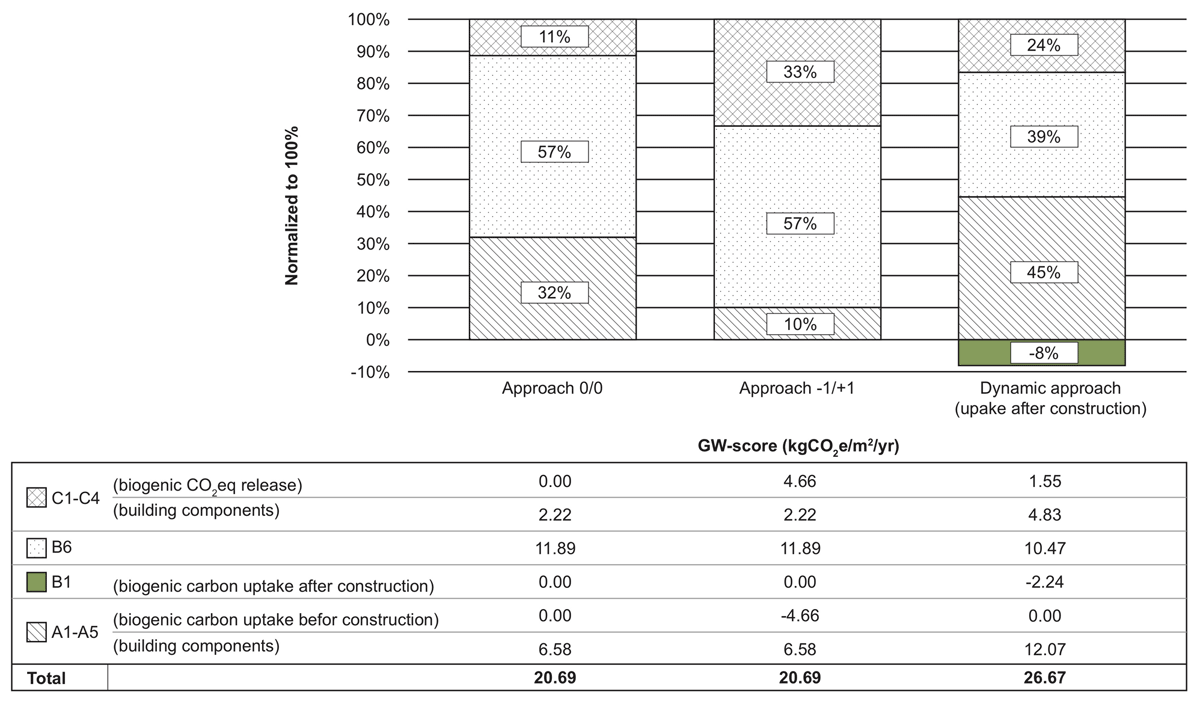
Figure 8
Global warming (GW) scores calculated by different biogenic carbon accounting approaches.
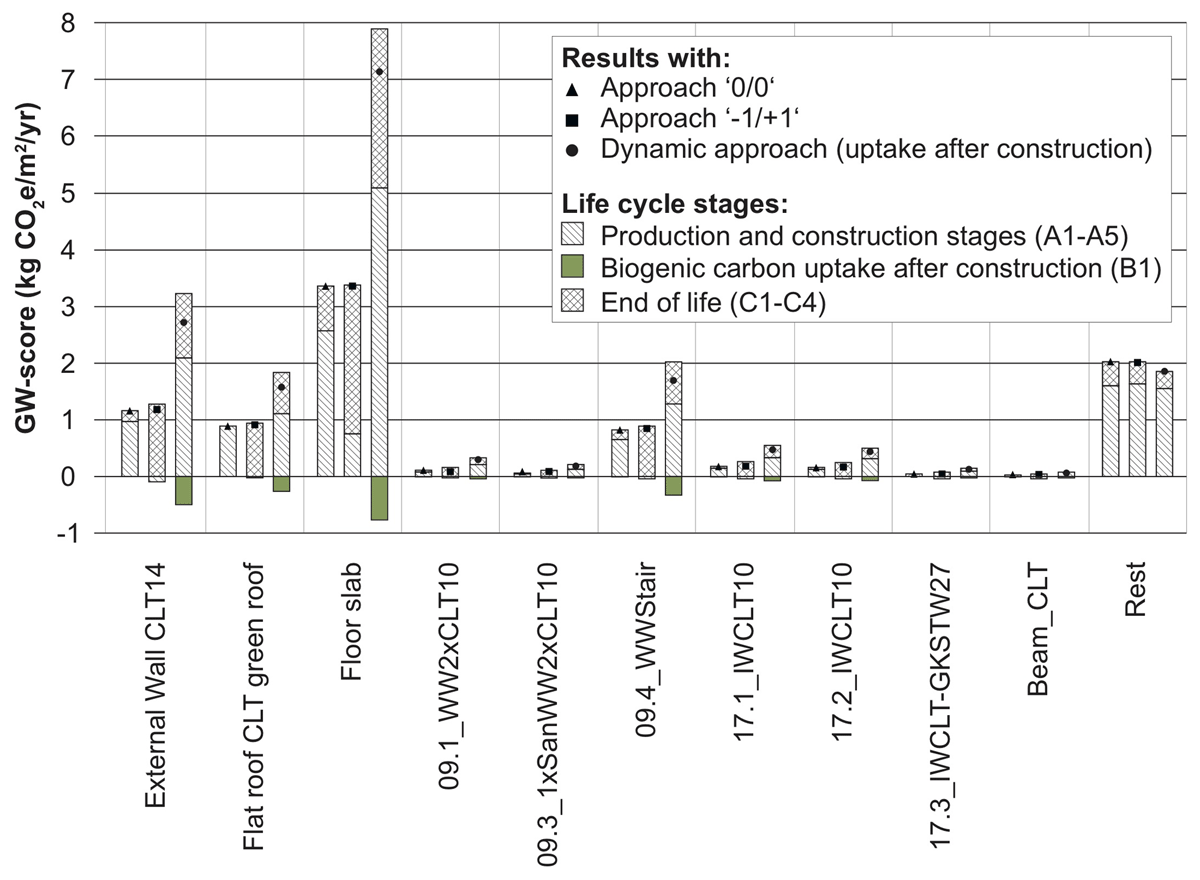
Figure 9
Global warming (GW) scores of building components using static and dynamic approaches.
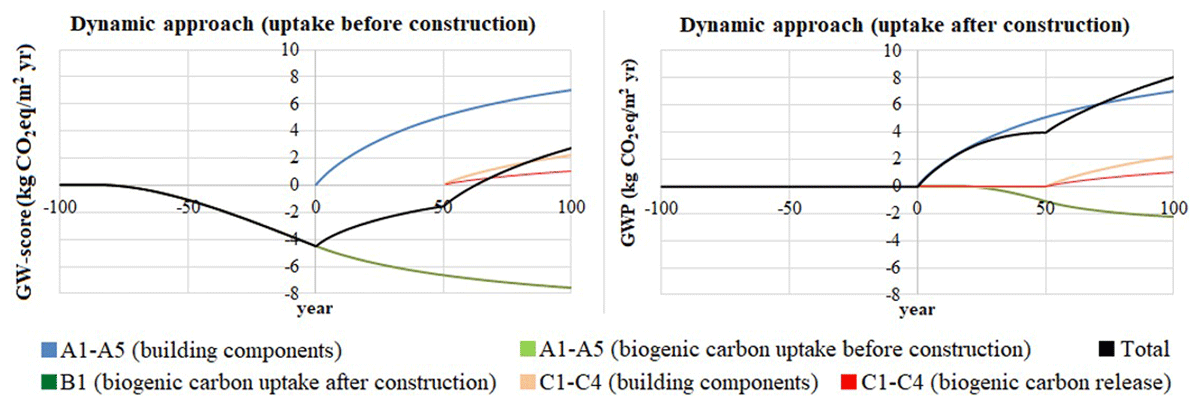
Figure 10
Global warming (GW) scores of the analysed building as a function of the reference service life (year 0 is the construction of the building).