
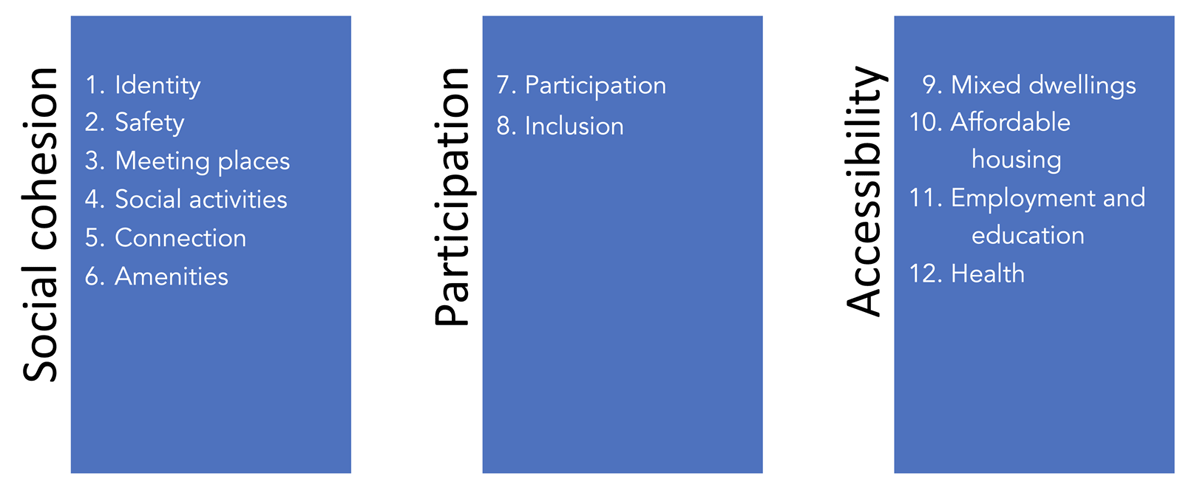
Figure 1
Model of social sustainability indicators.
Source: Adapted from Stender & Walter (2019).
Table 1
Information on interviewees
| ORGANISATION | COMPANY PROFILE | APARTMENTS | PROFESSIONAL ROLES | INTERVIEWEE CODES |
|---|---|---|---|---|
| Public housing company A | • Low-income housing | 11,000 | Business development manager, CEO, FM manager | PubA 1–3 |
| Public housing company B | • Mixed-income housing | 26,000 | FM managers | PubB 1–3 |
| Public housing company C | • Mixed-income housing | R&D manager | PubC 1 | |
| Public housing company D | • Mixed-income housing | 20,000 | FM manager, sustainability manager, CEO | PubD 1–3 |
| Public housing company E | • Mixed-income housing | 24,000 | Business development manager, CEO, energy and environment manager | PubE 1–3 |
| Public housing company F | • Mixed-income housing | 23,000 | Development manager, manager of project managers | PubF 1–2 |
| Private housing company A | • High-income housing • Student housing | 4,000 | CEO, FM manager, technical FM specialist | PriA 1–3 |
| Private housing company B | • Mixed-income housing | 200,000 | Development manager, sustainability manager, sustainability specialist | PriB 1–3 |
| Private housing company C | • Mixed-income housing | 39,000 | FM manager, social sustainability manager | PriC 1–2 |
[i] Note: CEO = chief executive officer; FM = facilities management; R&D = research and development.
Table 2
Coding structure and data analysis
| EXCERPT/QUOTATION | TYPE OF ACTIVITY INTERVENTION | LABEL | INDICATORS BASED ON STENDER & WALTER’S (2019) FRAMEWORK | THEME BASED ON STENDER & WALTER’S (2019) FRAMEWORK AND FRAME OF REFERENCE |
|---|---|---|---|---|
| ‘We decided to start with soccer [football] practice every Wednesday night with the more at-risk youths in the neighbourhood’ | • Organising soccer/football practice | • Sports activity | Indicator 4: Social activity | Social cohesion |
| ‘Do we only want a café where you can get a latté and a piece of pie? What can we do to create a safe place where people want to meet? | • Creating a neighbourhood café | • Socialising | Indicator 3: Meeting places | |
| ‘It’s about finding ways to communicate with our tenants […] then people come to us with fun ideas’ | • Neighbourhood get-togethers | • Socialising • Tenant influence | Indicator 8: Inclusion | Participation |
| ‘Much is about creating bustling living environments and communal areas. Communal garden cultivation has become popular in the last few years’ | • Creating communal gardens based on tenant input | • Tenant participation in development work • Socialising | Indicator 7: Participation | |
| ‘If we purchase cleaning maintenance or garden maintenance, then we have a social clause demanding that the contractors must be willing to take in tenants to work there’ | • Creating employment through social procurement | • Employment | Indicator 11: Employment and education | Accessibility |
| ‘It’s part of the social contract, that you earn your money. You feel good. Most people who are unemployed do not feel good’ | • Employment leads to personal wellbeing | • Better health | Indicator 12: Health | |
| ‘We have insurance and when cars are burning and property is destroyed, that affects our costs. There are a lot of extra costs [caused by criminal activity]’ | • Criminal activity and vandalism create additional costs | • Low social value incurs costs | n.a. | Financial gain from social value creation |
| ‘We cannot kid ourselves: this also means financial gain for the housing company. We earn money by letting our tenants do this work rather than purchasing this service from a supplier’ | • Hiring unemployed tenants to clean the building stock saves costs | • Tenant employment decrease costs | n.a. |
Table 3
Summary of the main findings
| INDICATOR | ACTIVITY INTERVENTION | PERCEIVED EFFECTS FROM INTERVENTIONS |
| Social cohesion | ||
| No. 2: Safety | • Establishing communal spaces such as gardens, refurbishing spaces for leisure, creating shared activities such as sports, tenants working in the neighbourhood | • Deters from criminal activity and creates safer living environments |
| No. 3: Meeting places | • Establishing a café and multicultural centre, communal gardens and recreational spaces | • Creating places for meeting and socialising • Increased connectedness between neighbours • Leads to new work opportunities |
| No. 4: Creating social activities | • Sports activities (e.g. soccer/football, basketball, skiing, swimming, ice-skating), neighbourhood get-togethers, cooking lessons, waste-collection activities, park playdates, swimming lessons, after-school programmes, clubs and hobby associations leasing space at discounted rents | • Offering social activities for tenants deter from criminal behaviour • Increases physical and mental wellbeing • Many of the activities require collaboration with external actors • Collaboration rather than sponsorships |
| No. 6: Amenities | • Cafés, local shops, sport clubs, hobby associations | • Opportunities for social activities and meeting places also serve as amenities and deters criminal activity |
| Participation | ||
| No. 7: Participation | • Collecting input on developing the physical environment, refurbishment projects and creating communal gardens | • Tenant participation in neighbourhood development |
| No. 8: Inclusion | • Neighbourhood get-togethers | • Increase inclusion and socialising with tenants |
| Accessibility | ||
| No. 11: Employment and education | • Social procurement to create employment and internships in suppliers, hiring tenants in-house, company-initiated vocational training programmes, career-building workshops, homework hubs with tutors, providing breakfast in school | • Tenants to gain work experience and have a springboard to the labour market • Learn life skills, improve language proficiency, break isolation • Increase safety and decrease criminality • Improve school grades and graduation rates |
| No. 12: Health | • Creating jobs, internships and vocational training | • Improve personal wellbeing and happiness |