
1. Introduction
As societies aim to decarbonise the building sector in the face of the impending climate emergency, buildings’ life cycle assessment (LCA) has emerged as an important tool in this effort. In the 2010s, the sector’s focus vested primarily in energy efficiency. In the 2020s, the whole-life carbon paradigm has taken over. Now, not only are operational CO2 emissions considered, but also the CO2 embodied in construction materials is acknowledged as a significant factor for a building’s climate performance (e.g. Röck et al. 2020). Importantly, several European countries are in the process of introducing legal limits for how much whole-life carbon buildings are allowed to emit (Kuittinen & Häkkinen 2020).
Like building research in general (Kohler & Hassler 2002), buildings’ LCA has so far been strongly biased toward new build. The literature on the LCA of existing buildings and their repair, refurbishment and renovation certainly exists, but in significantly smaller quantities (Vilches et al. 2017). This is perhaps understandable in that the emerging regulatory CO2 limits will rightly be imposed on new buildings (Kuittinen & Häkkinen 2020). However, the bias is also highly problematic. When the energy efficiency paradigm still prevailed, older buildings were casually vilified for their alleged poor energy performance (as discussed by, e.g., Power 2008). With the new whole-life carbon paradigm, voices have increased suggesting that existing buildings can in fact be the more sustainable choice (e.g. Lützkendorf & Balouktsi 2022).
Nevertheless, the whole-life carbon performance of existing buildings—particularly in comparison with new build—is still very poorly understood. It is a well-known fact in the LCA community that LCAs made by different people at different times cannot easily be compared because assumptions, choices and data sources can influence the results tremendously. Most research papers and reports simply do not provide enough information to enable assessing the significance of such discrepancies between studies. Therefore, to answer the question whether it is more climate-friendly to build a new or to renovate an existing property, comparing unrelated new build and renovation LCAs with one another (as in Schwartz et al. 2018) cannot be recommended. In fact, Schwartz et al. (2018) themselves concluded that this research question could not be answered through the review method that they used. A methodologically sounder choice is to apply consequential replacement LCA (CRLCA).
Generally, consequential LCA (CLCA) is a decision-support tool that investigates environmental impacts that occur as a consequence of a choice. Decisions can sometimes have far-reaching consequences, and the ambitious aim of CLCA is to model all resulting knock-on effects. Therefore, CLCA considers a wider product system than attributional LCA (ALCA), which is only interested in assessing the global environmental burden a product inflicts over its life cycle (European Commission, Joint Research Centre, Institute for Environment and Sustainability 2010: 71). Most building-LCAs are ALCA, while CLCA is only emerging in the building research discipline (Hansen et al. 2023). A subtype of CLCA, CRLCA scrutinises, specifically, the impacts of a decision to replace an existing product with a new one or to continue its use.
CRLCA studies have typically been conducted on mobile objects that have second-hand markets, such as household appliances or cars (e.g. see the summary by Schaubroeck et al. 2020). Some research also exists that investigates the consequences of a decision to retain and renovate a building, or to demolish it and build a new one to replace it. However, the body of literature on buildings is alarmingly slim. In her review, underlying the current research, Salmio (2022) identified only 19 of such studies, though the review’s scope was limited to cold continental climates. In conjunction with searching for these studies, an additional 31 studies from other climates were identified, but not reviewed. In all, a major difficulty in locating such studies was that no shared vocabulary exists to describe either the methodology or the study subjects. For instance, existing buildings may be described as old, renovated, refurbished, retrofitted, reused, repurposed, conserved, retained, preserved, restored, rebuilt, rehabilitated or reconstructed. Perhaps due to this, the review of building-CLCAs by Hansen et al. (2023) identified only one study out of the at least 50 existing publications with the CRLCA framing.
Therefore, the main aim of the current paper is to provide an easily understandable and applicable methodological frame that can (1) help building owners to evaluate and influence the immediate consequences of their decisions, and (2) be incorporated into the CO2 regulation on buildings being rolled out in Europe. While distinctive selections can still be made within the framework that cater to context-specific factors, this will help to harmonise CRLCA for buildings. The introduction of a common name for such studies in the building research discipline is important, as any phenomenon without a commonly accepted name is difficult to discuss or disperse. For this purpose, the paper adopts the concept of ‘consequential replacement framework’ (CRF), a term coined by Schaubroeck et al. (2020).
The development of the CRF for buildings has been inspired by the CRF developed by Schaubroeck et al. (2020) for cars. Second, it has been informed by the review by Salmio (2022) of the 19 CRLCA studies for buildings. The review has helped not only to identify the variety of different choices that can be made of such LCA, but also to recognise choices that can be more problematic than others for a variety of reasons. Some of these are discussed below. Next, the CRF for buildings is proposed. The use of the framework is then demonstrated with the help of case studies on school buildings in Finland.
2. CRF for buildings
2.1 Methodological background
The CRF introduced by Schaubroeck et al. (2020) set out to answer the question whether and when it is ‘greener’ to keep using a product or to replace it. For every considered retention or replacement scenario, the propagated effects must be defined individually; the product system is in fact established by the propagated effects. The CRF is intended for considering the effects of small-scale decisions of individual product owners, but not for large-scale decisions, such as policies. As opposed to the latter, the former do not have substantial impacts on market conditions, which would complicate the cause–effect considerations. Time aspects are focal to the CRF in two ways. First, the CRF should only include processes that can change as a result of the replacement or retention decision. Such processes must occur after the decision has been made and have a plausible cause–effect relation with it. A key difference to ALCA is that the whole life cycle of an existing product will not be incorporated; the already occurred processes are not relevant, as no decision in the present can change past events. Second, a decision’s timing is important in that the propagated environmental impacts can differ depending on when the decision is made. For instance, replacing an energy-consuming product with a more energy-efficient model earlier can reduce operational CO2 but call for increased production, which also has CO2 implications (Schaubroeck et al. 2020).
Having introduced the CRF, Schaubroeck et al. (2020) demonstrate its use on cars. To model consequential effects in the car market, they employ economic input–output (IO) analysis with mathematical modelling. Buildings, however, are inherently different from cars and other objects. Buildings are, with few exceptions, immobile and bound to the land on which they stand. Unlike mobile objects, which can be passed on to new users in second-hand markets for so-called ‘additional usage’ and so substitute for average market mix of products, a building’s replacement decision will result in its demolition. This characteristic of buildings renders the product system of CRLCA simpler than for mobile products. If applied directly on buildings, the approach by Schaubroeck et al. resembles, rather than a replacement situation by a building owner, a situation where a resident or other end-user of a building moves house from an older property to a newly built one. In such a situation, the questions of additional usage and consequential effects on housing or real-estate markets would come into play.
The decision to move house is, however, not in the interest of the current paper, so the CRF must be reframed so that it becomes suitable for evaluating replacement decisions of buildings with LCA methods that building sector researchers and practitioners commonly use. Moreover, there is a need to make the CRF compatible with regulatory schemes for managing buildings’ CO2 emissions, which are based on allocation with carbon factors at the building level. While allocation is often associated as a method for ALCA and CLCA is typically associated with economic IO analysis, in reality the practices are more nuanced and debated (Majeau-Bettez et al. 2017; Schaubroeck et al. 2020; Hansen et al. 2023). Moreover, the ILCD Handbook (European Commission, Joint Research Centre, Institute for Environment and Sustainability 2010: 82) recommends the allocation for CLCA for investigating the effects of small-scale decisions, and with one exception, also for large-scale decisions. Therefore, the introduced CRF will show how allocation and carbon factor-based methods, familiar to the building LCA community, can be coupled with consequential thinking through the CRF to answer the research question about the environmental impacts of building replacement, as follows.
2.2 Scale, scope and system phases
The CRF for buildings covers the small-scale decision by an individual building owner to retain or replace a building. This is also the scale on which building-borne CO2 emissions are presently regulated (cf. Kuittinen & Häkkinen 2020). The demonstrated CRF has not been designed to model the comprehensive effects of large-scale decisions, such as urban planning policies, which will propagate much more complex and wider impacts pertaining to land-use changes, infrastructure construction and traffic, among other things.
Following the example set by Schaubroeck et al. (2020), the CRF does not incorporate past events, such as the original construction or past operation of an existing building. Only its renovation and future operation are included (Figure 1). However, the replacement scenario incorporates the demolition of the existing building because this happens due to the decision. This is a key difference to ALCA, which ignores this cause–effect relation. ALCA would associate the CO2 from this demolition to the existing building’s life cycle and thus omit it from the study.
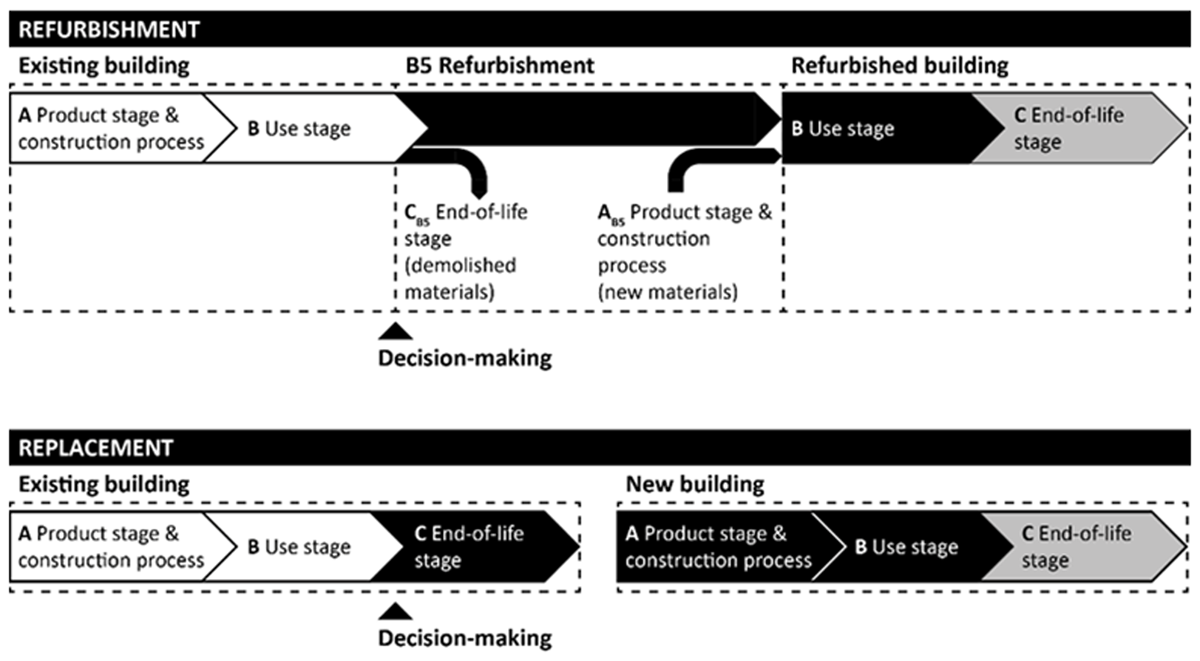
Figure 1
The basic scope of life cycle assessment (LCA) used in consequential replacement framework (CRF) for buildings (for life cycle modules, see EN 15978; CEN 2011).
Note: White modules are excluded; black and grey modules are included; the C module is grey because it situates so far in the future that it has little relevance; and the time boundary can also be kept open-ended (see the next section).
Figure 1 provides the system phases for the very basic scenario, where two functionally similar buildings of the same size are compared. More complex settings are also possible, e.g. comparing buildings of different sizes, or with differing spatial or utilisation efficiencies. However, the more complex the chosen setting, the more complicated it will be to model all relevant consequences. For instance, if one decision-making scenario is considered to serve fewer users than another scenario, it will be necessary to consider where the ‘missing’ users are and to model their building-borne environmental impacts at the other location. With the more complex framings, questions of substitution for the average market mix (cf. Schaubroeck et al. 2020) may need to be addressed. However, they remain outside of the scope of this very paper.
2.3 Time aspects
Buildings rarely have a maximum lifetime but can last almost indefinitely if maintained and repaired when needed. Therefore, the time boundary of CRF can be kept open-ended, and it is often meaningful to do so. This is a key difference to the other types of products on which the CRLCA has been conducted, such as cars and household appliances (Schaubroeck et al. 2020). These products have a limited lifetime, which is short compared with buildings. In terms of the scope given in Figure 1, it is important to note that the refurbishment phase B5 is not a one-off event but should repeat in the use phase (B) at meaningful intervals for both refurbished and new building. These intervals can be drawn from, for example, standard technical lifespans, which may sometimes be already incorporated in building-LCA methods.
As suggested by Schaubroeck et al. (2020), the timing of the retention or replacement decision is significant for buildings, too. First, buildings accumulate CO2 emissions in a dynamic fashion (Figure 2). Due to the more voluminous material consumption of a new building, construction will normally yield significantly more embodied CO2 emissions than renovation. This initial embodied CO2 is called the ‘carbon spike’, a term coined by Heinonen et al. (2011). However, a renovated building’s operational energy performance may not always fully match that of a new build. Therefore, which option is lower in CO2 may change over time. The renovated building is typically lower first, but the new build may eventually catch up. This moment makes up the CO2 payback time of new build, which is a focal concept in the proposed CRF. This dynamic may be influenced by the timing of decision-making, too. A differently timed decision can yield different CO2 emissions because, for example, the CO2 intensity of energy and materials production can change. For example, future energy decarbonisation is already inbuilt into some building-LCA methodologies (e.g. Kuittinen & Häkkinen 2020).

Figure 2
Principle of CO2 accumulation for refurbished and new buildings, and some focal concepts.
Note: This is a theoretical case to illustrate the principles; other kinds of patterns are also possible (Salmio 2022).
Second, the underlying reason for introducing CO2 regulation for buildings is climate change mitigation, which is highly time-sensitive (as pointed out by, e.g. Heinonen et al. 2011). According to the Intergovernmental Panel on Climate Change (IPCC) (2018), the global CO2 budget is running out at such a rate that net-zero CO2 emissions must be reached by the early 2030s to keep global warming below 1.5ºC. This timeframe, circa 10 years from today (2023), serves as a reference point in the paper’s case studies for evaluating climate-friendliness of renovation and replacement alternatives. The acceptability of the CO2 payback time of new build is assessed against it. While it acts as a reference, a longer study period, up to 50 years, is nevertheless recommended. This is because, first, buildings are long-lasting assets and for real-estate management purposes it is informative to understand the CO2 accumulation over a longer term. Second, the accumulation can be highly dynamic (cf. Figure 2) and influenced by future measures, such as renovations or energy decarbonisation, so it is useful to consider the timeframe beyond the 10 years. If, for example, an alternative’s CO2 emissions skyrocket at year 11 due to a major renovation, it is fair to question its climate-friendliness. Third, the IPCC climate scenarios are probabilistic and, as such, subject to a degree of uncertainty. Moreover, they are revised regularly as modelling methods evolve and progress or regress is made at other fronts of the society in terms of CO2 emissions.
2.4 LCA methods and databases, environmental impact categories, and functional units
The presented CRF for buildings is, in principle, compatible with any LCA methods that enable (1) quantifying the environmental impacts—both embodied and operational—throughout the building life cycle, for both new and renovated buildings; (2) distinguishing their distinct timing at the level of a year; and (3) where relevant for the defined scenarios, modelling the potential effects propagated beyond the plot in question. For instance, the CRF can be coupled with national building-LCA methods and databases, given that they fulfil these requirements. In fact, the case studies of the current paper use the Finnish national method (Kuittinen 2019), published by the Finnish Ministry of the Environment (later referred to as the ‘MoE method’). It should be noted, though, that IO analysis, as in the original CRF by Schaubroeck et al. (2020), can be used for buildings, too, as demonstrated by Heinonen et al. (2011).
The environmental impact categories assessed can cover any and all impact categories that the used method and database allow incorporating. However, given the focus on CO2 emissions in building-LCA and regulation, as the minimum, CO2-equivalents should be considered. The current paper’s case studies will do exactly this. The next section discusses in more detail the inventory analysis for the impact assessment.
For the functional unit, different options are possible. A building can be used as a unit, as is done in the case studies that will follow, if the studied options are of the same size and similar functionality. Other alternatives are, for example, surface area (different units, such as gross floor area, net floor area or heated area may be used, as long as the same unit is used for both the existing and the new building), a user, or a usage-hour. However, surface area is more ‘stable’ a unit than a user or usage-hour in that the number of users and the intensity of usage can fluctuate significantly in time, especially over the long term. It is possible to model scenarios for the number of future users or intensity of usage, but significant uncertainty will be related to their actualisation. On the other hand, embodied impacts pertaining to renovation, demolition and construction of surface area are immediately actualised. Therefore, it is recommended that if other functional units than surface area are used, results should always be presented in parallel for surface area for reference purposes.
2.5 Inventory analysis
To quantify the environmental impacts, the construction measures of the new building and the renovation measures of the existing one must be defined. Both the new building and the renovation must be designed at a level of detail that enables this. Obviously, the same level of detail should be used for both buildings in one study. In addition, it is important also more widely that the underlying design is done neutrally, i.e. without an a priori preference for either life cycle extension or new build. This has not been the case in all previous studies; in some of them, a clear bias towards one of the choices (usually the new building) can be observed from the selection of measures (Salmio 2022).
To design justified renovation measures for an existing building, the building must first be surveyed for the presence of decay, harmful substances, and technical and functional obsolescence. The correct remedies, which will be converted into quantities of virgin and waste materials for the LCA, should be selected based on the results of the structural survey.
The bills of quantities resulting from demolition, renovation and construction must be acquired following established quantity survey procedures. For instance, bills of materials can be extracted out of building information models (BIMs).
2.6 Visualisation
Visualisation is a crucial part of the CRF for buildings introduced in this paper, as it is directly connected to the time aspects (section 2.3). While there are many ways to present the results of an LCA and no harmonised guidelines exist (Hollberg et al. 2021), visualisation can significantly influence what kind of conclusions decision-makers draw. The review by Salmio (2022) of CRLCA on buildings has shown that bar and column graphs depicting the accumulated CO2 at the end of a close-ended study period can lead to misguided conclusions when it comes to climate change mitigation. Therefore, in CRF it is recommended that results are always presented as a single line graph showing the cumulative CO2 emissions for all scenarios (Figure 2). This is important to make the time-dependent developments explicit and enable the comparison of the scenarios. Moreover, the line chart visualises the CO2 payback time in an easily understandable manner.
Even if the time boundary of the CRF is often meaningful to keep open-ended due to the long-life potential of buildings (section 2.3), the line graph will have a maximum x-axis value. The reference study period of 50 years used by many building-LCA methods can be recommended as the maximum for this purpose. It covers the near future, which is the most relevant timeframe for climate change mitigation, while still providing perspective beyond it. It should be noted though that uncertainty regarding, for example, possible decarbonisation of materials grows the farther into the future the graph is extended. In a line graph, an open-ended CRF time boundary shows simply as the omission of the refurbished or new building’s end-of-life phase (C).
3. Framework application
3.1 Case study buildings
3.1.1 1950s school building
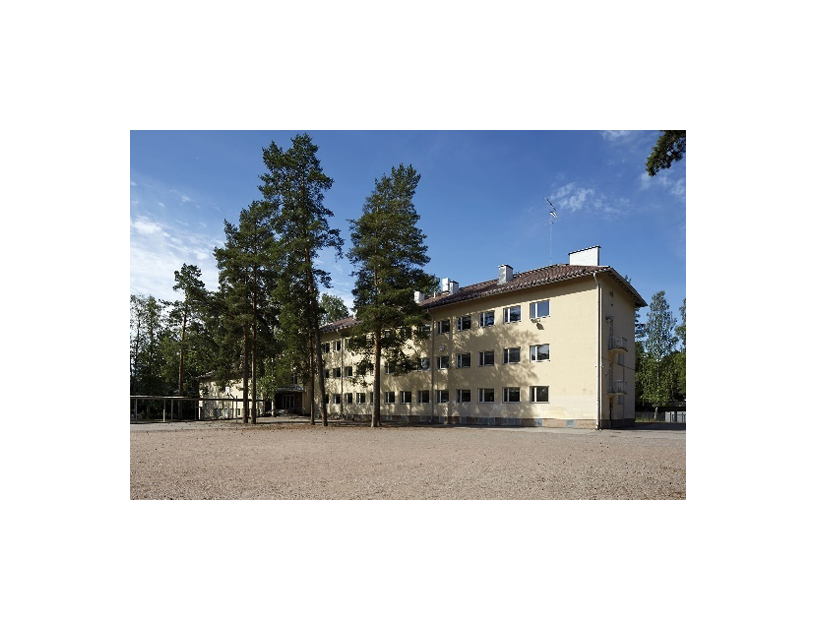
The building used in the case studies for demonstrating the refurbishment scenarios is the Heteniitty school located in Helsinki, Finland (Figure 3). It represents a typical school building from the 1950s, with four floors, a narrow and long shape, load-bearing structures of brick, and plastered facades. The aim was to select a building to represent a cohort of buildings that are increasingly under the threat of demolition. To give the study’s results relevance towards the larger stock of 1950s school buildings, any atypical structures that occurred in the building were exchanged into more typically occurring structures. The structures used in the case study are described in more detail in the supplemental data online.
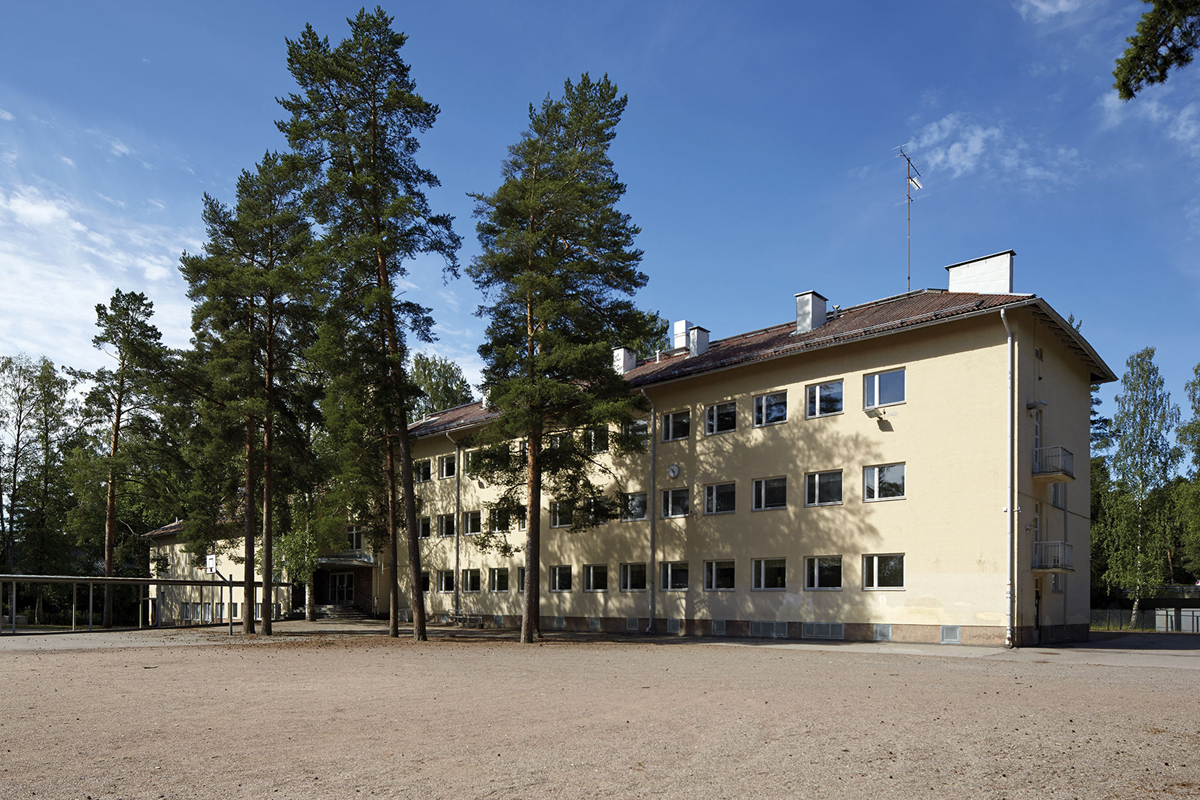
Figure 3
Heteniitty school.
Source: City of Helsinki Media Bank, Mikael Lindén.
3.1.2 2010s school building
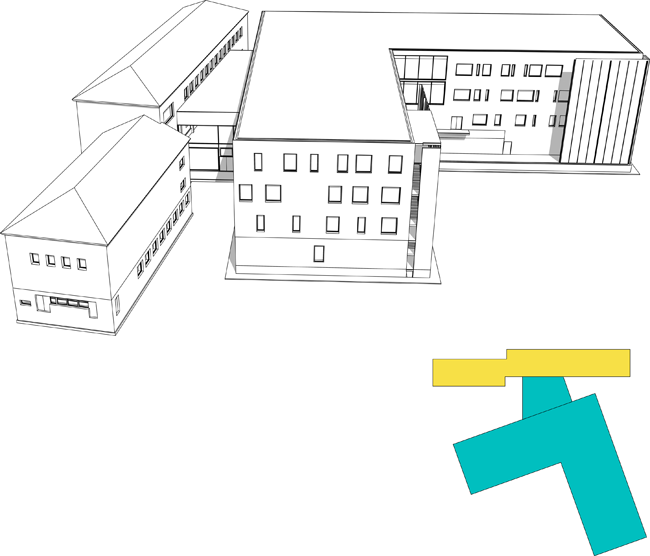
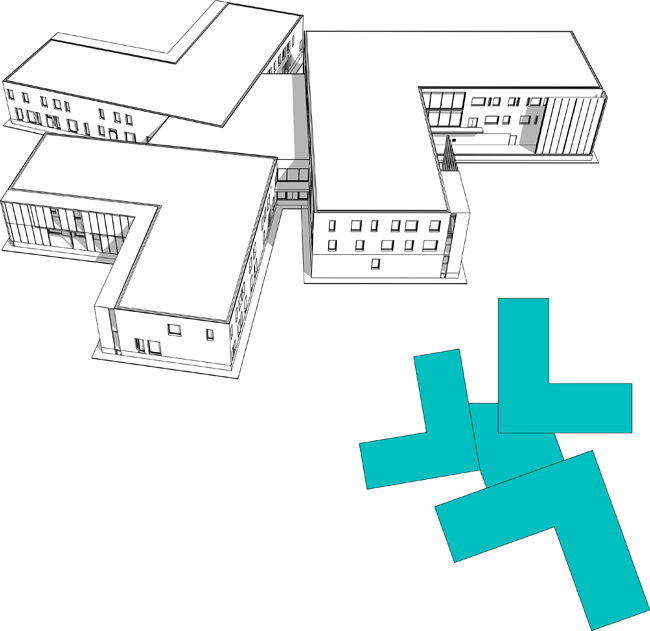
The building used in the case studies for demonstrating the new construction scenarios is Tesoma school, built in 2018 and located in Tampere, Finland (Figure 4). The school’s geometry and structures were used to create three variations of different sizes for the extension and new-build scenarios. In addition to the typical precast concrete building, an alternative with wooden structures was devised. For further information about the structures, see the supplemental data online.

Figure 4
Tesoma school.
Source: Authors.
3.2 Case study refurbishment, extension and new construction scenarios
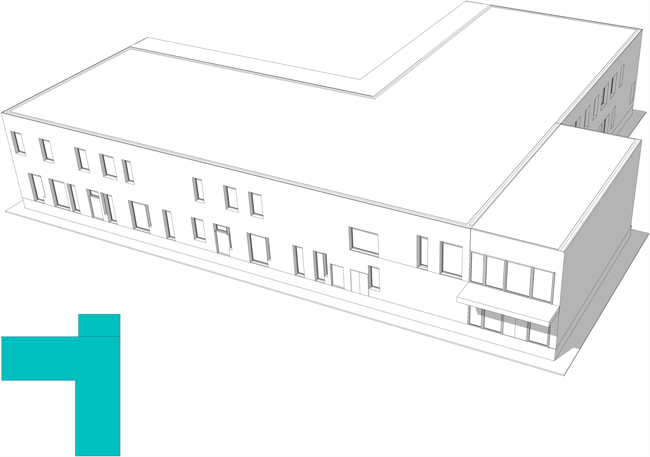
Table 1 gives the scenarios examined in the case studies. The first case study compares renovating or replacing a building of the same size, i.e. R1, N1 and N2. The second case study is concerned with growing spatial needs, so it compares the renovation and extension of the existing building with its replacement with a new larger building, i.e. RE1, RE2, N3 and N4. The third case study considers whether to retain four separate units or to combine functions under one roof, i.e. R1×4, RE1, RE2, N3 and N4.
Table 1
Refurbishment, extension and new construction scenarios.
| Existing case building | O1: Original 1950s school | O2: Original 2010s school building | ||
 |  | |||
| Small school options 2,412 m2 200 students | Refurbishment scenarios | Replacement (demolition and new-build) scenarios | ||
 |  | |||
| R1: Refurbishment Comprehensive refurbishment of the existing school R1×4: Refurbishment of four separate existing schools | N1: New small concrete school Demolition of the existing school and building a new school out of concrete | N2: New small wooden school Demolition of the existing school and building a new school out of wood | ||
| Large school options 9,648 m2 800 students | Refurbishment and extension scenarios | Demolition and new large school scenarios | ||
 |  | |||
| RE1: Refurbishment and concrete extension Comprehensive refurbishment of the existing school and building an extension out of concrete | RE2: Refurbishment and wooden extension Comprehensive refurbishment of the existing school and building an extension out of wood | N3: New large concrete school Demolition of the existing school and building a larger new school out of concrete | N4: New large wooden school Demolition of the existing school and building a larger new school out of wood | |
3.2.1 Refurbishment scenarios
Scenario R1 involves a comprehensive refurbishment of the 1950s school building. As the goal of the study is to be informative towards the 1950s school building stock beyond the singular case study, R1 was selected to include all major repair and renovation measures that such a refurbishment could cover. Building condition-wise, it represents the ‘worst case scenario’. This decision was made to ensure the case study will not undermine the CO2 emissions of refurbishment vis-à-vis new build. In reality, most 1950s buildings do not exhibit repair needs as extensive as in the case study, as at least some of their structures have likely been repaired or renewed over the years. A building’s actual repair needs should always be investigated through a structural survey.
In R1, the natural ventilation system is replaced by mechanical ventilation with heat recovery. Water, sewer, electrical and heating systems are renewed. The building envelope is repaired structurally throughout to achieve better indoor air quality and energy efficiency. The windows and doors, facade plastering and roofing materials are renewed. The details are provided in the supplemental data online. An elevator is added for mobile accessibility. The chosen remedies are based on typical degradation patterns, and best-practice refurbishment methods drawn from MoE recommendations (Weijo et al. 2019). The service life of building parts after repair is assumed to be as in new buildings. Future repair intervals were drawn from the technical lifespans in the MoE method and Rakennustieto (2008).
3.2.2 Extension and new construction scenarios
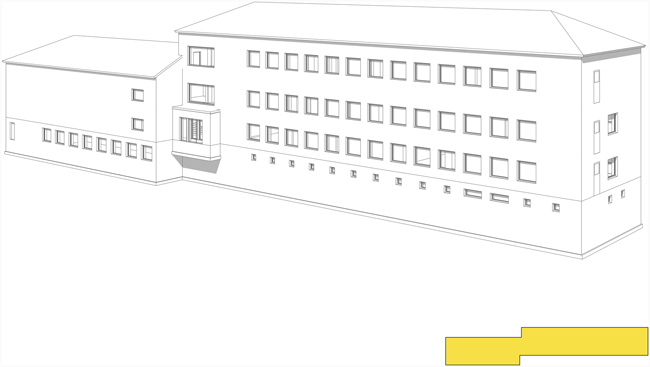
The geometry of Tesoma school was used to create all the extension and new-build scenarios by using one or more ‘L’-shaped wings of the original three-winged building. For the new small-school scenarios N1 and N2, one ‘L’-shaped wing was modified to match the floor area of the 1950s school. For the large new-school scenarios N3 and N4, three ‘L’-shaped wings were used, and for the extension scenarios RE1 and RE2, one ‘L’-shaped wing with four floors was used (Table 1).
Two structurally different versions of the new construction and extension scenarios were formed, one with a conventional precast concrete structure and the other with a cross-laminated timber (CLT) structure. The structures used in concrete new construction and extension scenarios (N1, N3, RE1) are typical and commonly used, based on the structures of the Tesoma school. The walls are precast concrete, the roof and intermediate floors are hollow-core slabs, and the base floor is a concrete slab on ground with thermal insulation. The timber-structured alternatives (N2, N4, RE2) are theoretical but use genuine structures of a CLT building manufacturer, selected in collaboration with the manufacturer’s structural engineer. The load-bearing structures are made of a combination of CLT and glued-laminated timber. The details are provided in the supplemental data online.
As follows from the CRF (Figure 1), the CO2 emissions of the demolition of the original 1950s building (O1) are included in scenarios N1–N4. The renovation and extension scenarios RE1 and RE2 consist of the original refurbished school R1 and an extension out of concrete (RE1) or timber (RE2). The extension is connected to the existing school by a corridor.
3.3 LCA method and data
The LCA was made following the MoE method for the whole-life carbon assessment of buildings (Kuittinen 2019). The new-build scenarios meet the energy efficiency requirements for new construction in Finland, set in Decree 1010/2017 (MoE 2017). For refurbishment works, requirements are set in Decree 4/13 (MoE 2013). The refurbishment scenarios meet the requirements by halving the ‘U’-value of the repaired building part or by being equal to the benchmarks in the regulation.
ArchiCAD was used to create BIMs for the case-study buildings. The BIMs were used for the quantity survey in the product stage. They were also used for simulating the consumption of electricity and district heating in the use phase in IDA ICE 4.8 dynamic energy calculation software. Standardised use for school buildings set in Decree 1010/2017 (MoE 2017) was used. The focal input data are available in Appendix 1 in the supplemental data online. Figure 5 gives the energy simulation results, which act as the input for the operational CO2 calculation.
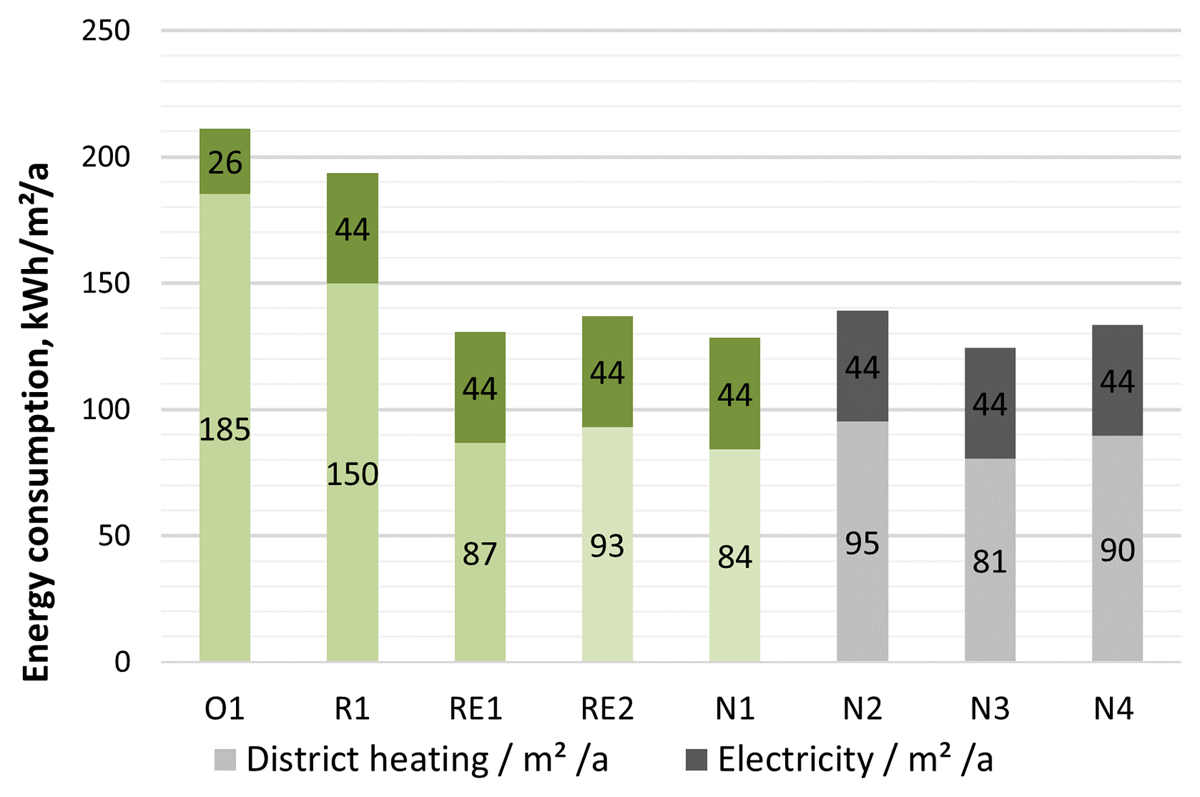
Figure 5
Energy simulation results: input for operational CO2 calculation.
One Click LCA was used for calculating the CO2-equivalents (CO2e) of the scenarios. A reference study period of 50 years, as set in the MoE method, was used. The CO2 emissions (kgCO2e) were calculated by associating the energy consumption and material quantities with emission coefficients from a database. The MoE method assumes a decarbonisation scenario for electricity and district heating. Emission coefficients for materials and energy production were drawn from the open generic national online database CO2data.fi, developed and maintained by the Finnish Environment Institute SYKE. The ‘conservative’ values were used as per the MoE method. As an exception, ready-mixed concrete was calculated with a ‘typical’ value that is consistent with the products used in the market. The purpose was to avoid exaggeration, since concrete is in any case the single largest emitter in new construction. If a material was not found in the generic database, an Environmental Product Declaration (EPD) of a specific product commonly used in Finland was used. For new construction and demolition works (A5 and C1), values customised for educational buildings were used from CO2data.fi. No tabulated value is available for refurbishment works, so the value for new construction work was used also for this phase.
For all scenarios, replacement intervals of building components (B4) were drawn from their technical lifespans specified in CO2data.fi and Building Information File 18-10922 (Rakennustieto 2008). For building systems, a surface area-based tabulated emission value from CO2data.fi was used and their replacement is assumed after 25 years.
4. Case study results
4.1 Retaining or replacing a building of the same size
The first case demonstrates a situation where the spatial needs have not increased, but the existing school building needs an extensive renovation. It is to be decided whether the refurbishment of the existing building or its replacement yields lower CO2 emissions. Figure 6 gives the results.

Figure 6
Accumulation of CO2 for the ‘renovate or replace’ scenarios (small schools R1, N1 and N2).
Note: O1 (continued use, no refurbishment) is given only for reference because it is not a realistic scenario. The use of a close-ended time boundary can be seen as the small elevation caused by the C phase for all scenarios at 50 years. It can be omitted for an open-ended time boundary. The energy decarbonisation scenarios are visible in that instead of being straight lines, the curves ‘bend’ downwards. For a sensitivity analysis, see the supplemental data online.
For all scenarios but O1, the carbon spike can be seen at year 0. This is mainly formed by the embodied CO2 emissions (A1–A5) of the new construction or refurbishment. The refurbishment scenario R1 has the smallest carbon spike (202 kgCO2e/m2). The new concrete building N1 has the highest carbon spike (491 kgCO2e/m2), and the new wooden building N2 is in between (366 kgCO2e/m2). Smaller carbon spikes occur due to the renewal of building services (at year 25) as well as windows and doors (at year 40).
Throughout the 50 years, N1 emits the most CO2. Even though the energy consumption of N2 is almost 30% smaller than that of R1, it takes a CO2 payback time of 40 years for N2 to set off its initial carbon spike in comparison with R1. At year 50, R1 has accumulated in total 972 kgCO2e/m2, N1 has accumulated 1039 kgCO2e/m2, and N2 has accumulated 955 kgCO2e/m2. The difference between N2 and R1 is 2% at year 50. Because the IPCC’s (2018) timeline for climate change mitigation is only circa 10 years, R1 is deemed the most climate-friendly alternative.
4.2 Extending a small building or replacing with a larger building (growing spatial needs)
The second case investigates a situation in which the number of children in the region is increasing and the spatial needs are growing. It is to be decided whether it is more climate-friendly to replace an existing school, which has grown small, with a new one four times larger, or to refurbish and expand the existing building. Figure 7 gives the results.
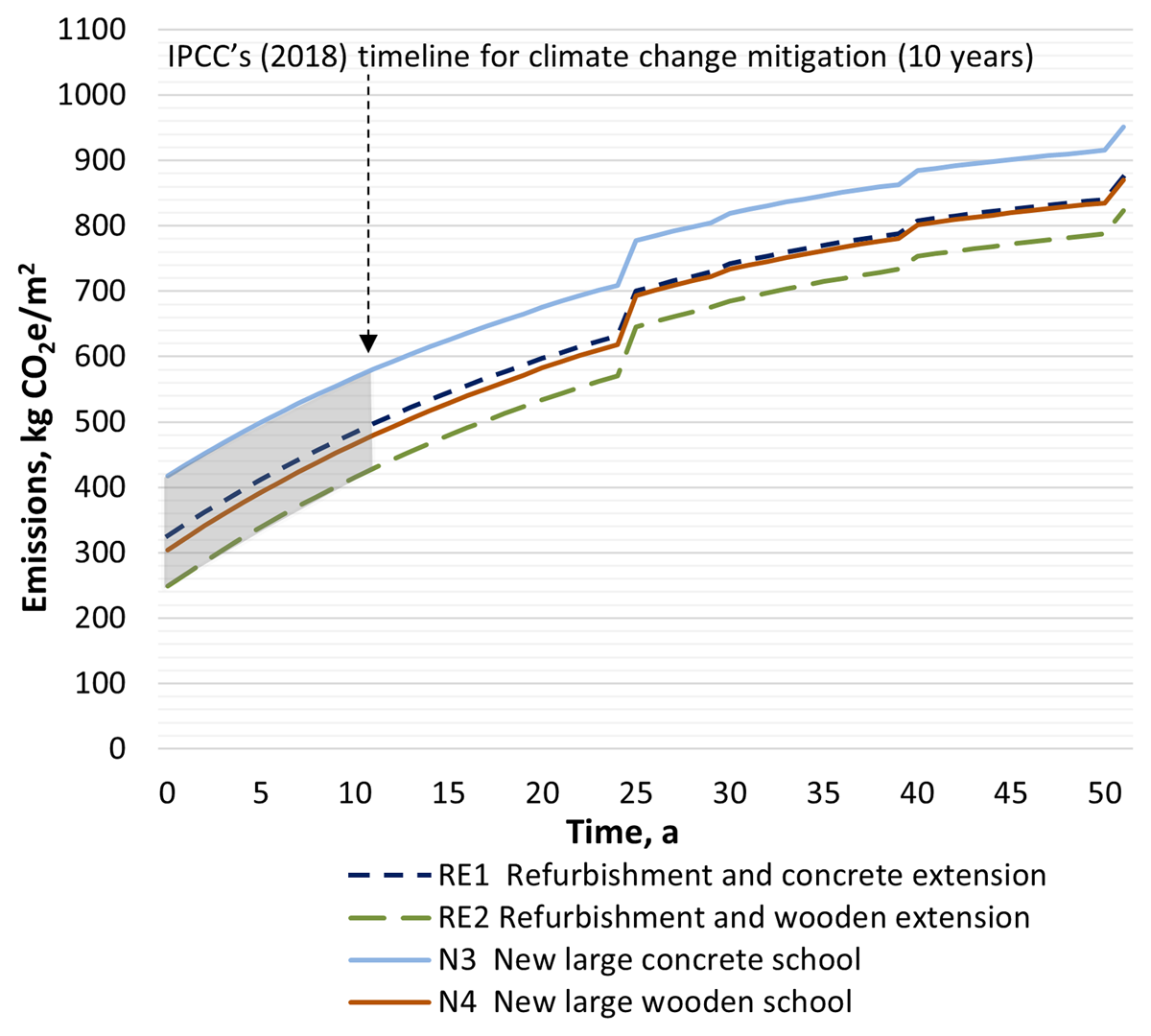
Figure 7
Accumulation of CO2 for the ‘extend or replace’ scenarios (large schools RE1, RE2, N3 and N4).
Note: The carbon spikes during the operation are from building services renewal at year 25 and window and door renewal at year 40, as in the previous case. For a sensitivity analysis, see the supplemental data online.
In the extension scenarios RE1 (concrete) and RE2 (wood), the renovated part covers only one-quarter of the surface area, and three-quarters are made up by the new extension. Therefore, the emission curves become similar in shape and inclination within the new buildings N3 (concrete) and N4 (wood). For the new buildings, a wooden alternative N4 is unsurprisingly lower in CO2 than the concrete building N3. Both extension scenarios benefit from the renovated building in terms of CO2 compared with their new construction counterpart of the same material. So, RE1 is lower-CO2 than N3, and RE2 is lower-CO2 than N4.
Operational CO2 emissions are a bit higher (7%) for the wooden buildings (RE2 and N4) than their concrete counterparts (RE1 and N3). Nevertheless, none of the emission curves cross, so no CO2 payback times are formed during the 50 years. The initial carbon spikes set the mutual order of the scenarios. The renovated building with a wooden extension RE2 has the smallest initial carbon spike, 249 kgCO2e/m2. The difference to N4 is 22%, to RE1 31% and to N3 as much as 68%. RE2 emits the fewest CO2 throughout. The new wooden building N4 has the second lowest CO2, but the difference to the renovated building with an extension out of concrete (RE1) is minor (7% at year 0, which is narrowed down to < 1% at year 50). At year 50, the lowest-CO2 option RE2 has accumulated 823 kgCO2e/m2, and the highest-CO2 option N3 has accumulated 950 kgCO2e/m2. The difference between the scenarios is 15%.
4.3 Renovating multiple small buildings or replacing with a larger building (under one roof)
The third and last case demonstrates a situation where the spatial needs have not increased, but several schools in the area need extensive renovations simultaneously. It is to be decided whether it is more climate-friendly (1) to refurbish all the existing schools (here, four separate buildings), (2) to replace all of them with one single new building that equals their combined size, or (3) to refurbish one building and extend it to match the desired size, while demolishing the rest (here, three schools). Figure 8 gives the results.
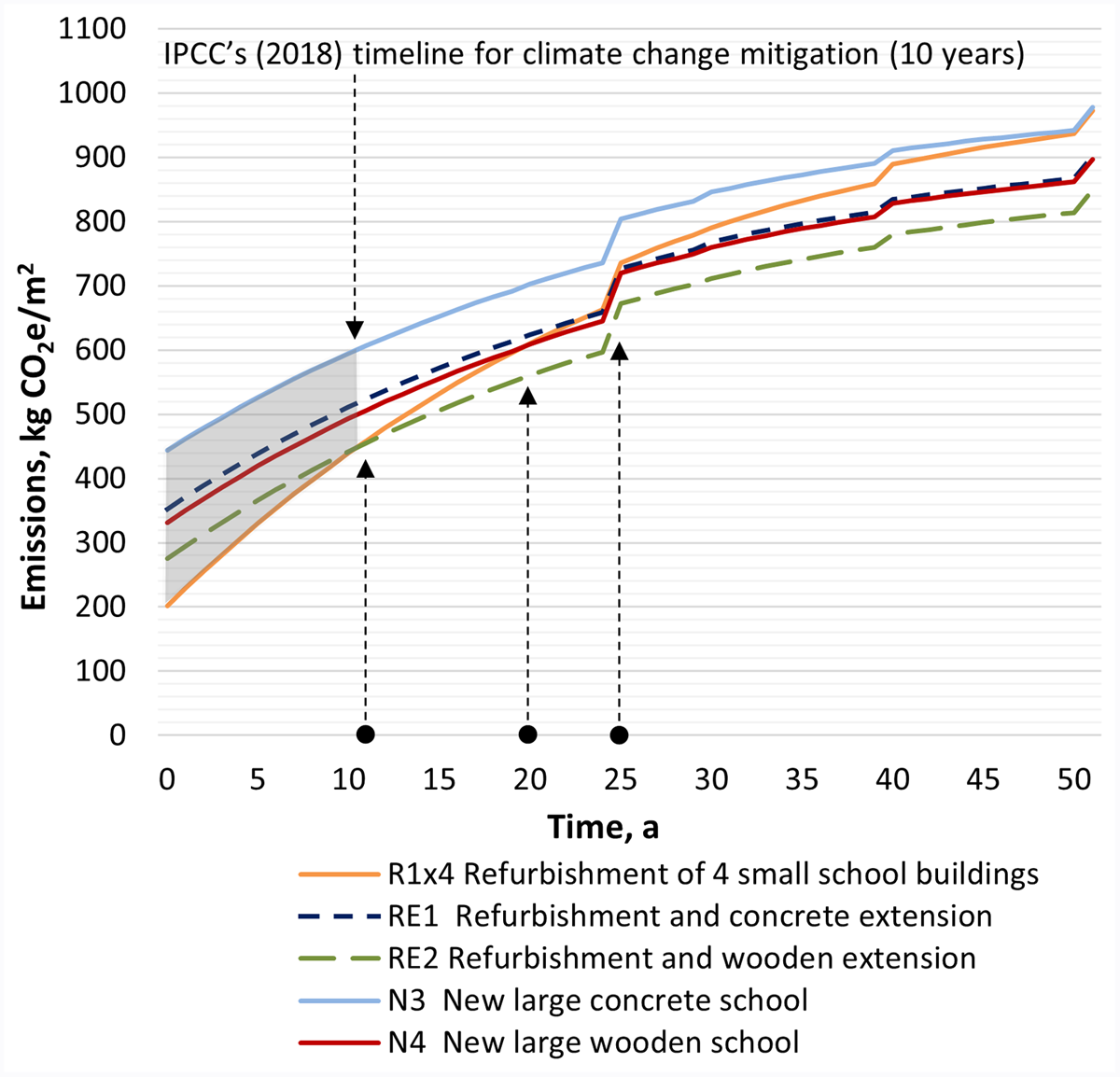
Figure 8
Accumulation of CO2 for the ‘renovate multiple units or combine into one large unit’ scenarios.
Note: In comparison with Figure 6, the scenario of four renovated small schools (R1×4) is new. In addition, CO2 emissions from demolishing four small schools (O1×4) have been added to the new-build scenarios (N3, N4). Respectively, CO2 emissions from demolishing three small schools (O1×3) have been added to the extension scenarios (RE1, RE2). For a sensitivity analysis, see the supplemental data online.
The new concrete building N3 is the least climate-friendly scenario. The four refurbished small schools R1×4 are lower-CO2 than RE2 for the first 11 years, lower-CO2 than N4 for 20 years and lower-CO2 than RE1 for 25 years. If the IPCC’s (2018) 10-year timeframe for climate change mitigation is followed strictly, R1×4 can be deemed the most climate-friendly alternative, but as RE2 is right behind it and performs better after year 11, the opposite conclusion is also justified.
To extend the consequential thinking further, one should also examine what happens on the demolished buildings’ plots. Will they remain vacant or are they reused for new construction? For the purposes of the current paper, it is assumed they remain vacant, as the article’s aims to introduce the CRF and demonstrate its use have already been fulfilled. Should the plots be reused for new construction, the consequential effects of the reuse should be modelled and incorporated in the CRF. This would be a step towards a CRF for the wider built environment, the framing of which approaches that of the original CRF by Schaubroeck et al. (2020). However, it remains outside of this case study’s scope.
5. Discussion
Having compared about 250 unrelated ALCAs of new and renovated buildings, Schwartz et al. (2018) found that the question whether renovation or new build is more climate-friendly cannot be answered with their method. They found that while refurbished buildings exhibited very low and very high whole-life cycle carbon, most were at the higher end of the spectrum. However, when they zoomed in on housing in the UK and Ireland, the results suggested the opposite. As a result, they declared their findings as inconclusive (Schwartz et al. 2018). Moreover, such a comparison omits the consequential environmental impacts, in this case, those of demolishing existing buildings. The current research, then again, introduced a methodological frame, the CRF, that can answer the research question reliably.
The results from the current paper’s case studies show that renovation, sometimes combined with extension, is more climate-friendly than new build. The findings of other similar case studies, reviewed by Salmio (2022) in preparation for the current research, are also overwhelmingly similar, regardless of if the studies used allocation or IO as the LCA method. Thus, the CRF approach clearly demonstrates CO2 saving potential in building retention. Extending service lives of existing buildings conserves the material resources embedded in them. This leads to renovation inducing lower embodied CO2 than construction, as it simply consumes less material than new build. Given that the operational energy consumption of the renovated building is not excessively high, the initial lower embodied CO2 will result in lower CO2 for decades.
In addition to LCA, the CRF can also be used in life cycle costing (LCC). For an example of this, conducted for earlier versions of the first and second case studies, see Huuhka et al. (2021). According to it, refurbishment and extension are more affordable throughout the 50 years.
The limitations of CRF are similar to those of LCA in general and pertain to the fact that the results are assessments based on calculations. However, this is factually the only alternative because a building’s embodied CO2 cannot be physically measured. Operational energy consumptions of existing buildings could be measured, but those of speculative developments (consumption after renovation; that of new build) can at best be simulated. The uncertainties of the case studies relate to those of allocation in general and to those of the MoE method. First, allocation-based approaches may generally overlook some knock-on effects to a degree which can be non-negligible (Hansen et al. 2023). Second, the MoE method uses conservative average carbon factors and tabulated values for processes and products for which authentic data are not acquirable in the early decision-making and design phase, such as construction work (module A5), building service systems and future decarbonisation of energy production. Therefore, some sensitivity analyses were made (see Appendix 2 in the supplemental data online), but their results did not change the conclusions. A degree of uncertainty always also pertains to the choices and potential errors made by the assessor. However, compared with the conventional ALCA alternative (cf. Schwartz et al. 2018), the CRF is built to minimise inconsistent calculation choices between the objects of assessment.
It is important to note that some diverging choices can also be justified. For instance, the condition of an existing building may call for specific renovation measures (as per structural survey) and its physical fabric may prevent the application of others. However, the review by Salmio (2022) also identified several frivolous case studies in the grey literature, the goal of which was not to genuinely uncover the more environmentally friendly option as much as to justify a preselected choice (new build). If it did not outperform the renovation, changes were made that lowered its CO2 emissions. Similar CO2-lowering changes were not designed for the renovation, even though there was neither an obvious reason why nor any explanation. This suggests that inconsistent and unfounded calculation choices were employed to land at a desired outcome. While similar in many characteristics to CRF, such studies should not be mistaken as CRF.
Of course, in LCA the assessor has in principle substantial freedom to define the scope of the assessment and other choices. However, the need to harmonise approaches arises from the desire to use the results in public policy. When administrative decisions are made, e.g. planning or building permits are granted or denied based on LCA results, the results cannot be arbitrary, as public administration must treat applicants equally. Therefore, there is a tendency to introduce more standardised assessment frameworks, which enable benchmarking. They include Level(s) in the EU and national methods in some of its member states, such as the Finnish MoE or the Danish LCAByg, to name just a few (e.g. Kuittinen & Häkkinen 2020). Coupled with these methods, CRF too could be used in public policy and administration, in conjunction with planning or building permits (Huuhka et al. 2021). CRF could help to make administrative decisions whether buildings’ demolition should be allowed to make way for new build, or if they should rather be retained. In this context, reliability is particularly important and grounds for the harmonisation of the CRF, suggested in this paper.
6. Conclusions
The purpose of this paper was to name and provide an easily understandable and applicable methodological framework—the consequential replacement framework (CRF) for buildings—that can help building owners to evaluate whether it will be more environmentally friendly to retain an existing building or to replace it with a new one. While several such case studies have existed before this paper, their terminology and methodology have been highly inconsistent. Naming and harmonising the methodology enables this line of enquiry to properly emerge and the evidence base, as well as its reliability, to be grown. Moreover, a more harmonised methodology creates prerequisites for the CRF to be integrated in CO2 regulation schemes for buildings, which are being rolled out in the European Union.
The paper was inspired by the methodological gap identified by Schwartz et al. (2018), the methodological inconsistencies in the existing body of literature recognised by Salmio (2022), and the CRF for cars by Schaubroeck et al. (2020). It developed the framework for buildings and demonstrated its use with three case studies on school buildings. In all of them, the scenarios that retained, renovated and potentially extended existing buildings were systematically more climate-friendly than new build alternatives. If done neutrally, i.e. without an a priori preference for either renovation or new build, the CRF for buildings can be a valuable decision-support tool in climate policymaking.
The case studies demonstrated the inclusion of the most imminent causal relation, the demolition of one or more buildings that occurs as the result of the building owner’s replacement decision, which is a small-scale decision the consequences of which the owner can influence. However, the paper’s third case study nodded towards extending the CRF’s scope from the building scale towards the wider built environment, where the impacts of land use changes should also be considered. Through such product system extensions, questions pertaining to large-scale decisions, such as wider urban planning policies, will eventually come into play. They, however, remain outside of the scope of the current paper and pose a challenge to be addressed in future research. The authors hope this article will act as a basis for more widespread use of the CRF in building and built environment research, enabling the community to collectively perfect the methodology on all scales.
Acknowledgements
The authors originally developed the consequential thinking in the research project ‘Purkaa vai korjata’ (Purkuko—To Demolish or to Repair), commissioned by the Finnish Ministry of the Environment, for which the authors express their gratitude. Earlier versions of the first and second case study were published in Finnish in Huuhka et al. (2021). The paper was written after the end of the project in the authors’ spare time while being employed at Tampere University. This includes formalising the consequential replacement framework (CRF), updating the first and second case study with renewed values from the CO2data.fi database, and developing the third case study.
Competing interests
The authors have no competing interests to declare.
Data availability
The data that support the case study results of this paper are partly available in the figures and tables of the article or in the supplemental data online, partly available in Open Access sources (CO2 coefficients and tabulated values in the Ministry of the Environment (MoE) method and CO2data.fi), and partly available from the corresponding author upon reasonable request (detailed energy simulation input data, quantity surveys and specific selected CO2 coefficients).
Supplemental data
Supplemental data for this article can be accessed at: https://doi.org/10.5334/bc.309.s1