
1. Introduction
Over two-thirds of UK local authorities have declared climate emergencies and intentions to decarbonise, some as early as 2025. Considered ‘locally determined contributions’ (CCC 2020a), these political declarations signal considerable ambition at the local level to deliver sustainable energy services and reduce energy demand across buildings, transport and local energy systems. However, there are significant gaps between stated ambitions regarding climate change mitigation among local authorities and their capacity to deliver (Bulkeley et al. 2016). Research by the Green Alliance (2020) suggests that English councils can fund around 25–35% of their net zero pledges. Given these limitations and their restricted ability to pursue policies capable of disrupting carbon-intensive systems and practices, the extent to which local authorities can fulfil their roles as important decarbonisers is unclear (Kuzemko 2019). This is particularly relevant in the UK where municipal capacities to oversee and deliver significant infrastructure change were never as developed as in other countries. For example, England has one of the most centralised financialised systems amongst Organisation for Economic Co-operation and Development (OECD) countries (McGough & Bessis 2015) and UK local authorities currently raise 18% of their revenues locally. This is in comparison with European local authorities, such as those in Scandinavian countries, which control 40–70% of their income (Friends of the Earth 2015). Due to a largely privatised and deregulated system, many UK local authorities lack direct control of flows of energy, waste and transport. Following over a decade of austerity, many local authorities have responded with innovative attempts to reduce public spending by allocating resources to markets and competition, thus further reducing their capacity to act directly on climate change (Osborne et al. 2015; NEF 2015).
Concurrently, public procurement is undergoing its most notable transformation in a generation. This is significant to the UK which spends around one-third of all public expenditure on public procurement every year (approximately £290 billion/annum). In 2018–19, total local authority revenue expenditure was budgeted at £95.9 billion. Local authority capital expenditure on roads, housing, schools, public buildings and street lighting amounted to £25.4 billion in 2017–18, while their combined procurement in 2016–17 amounted to £61.6 billion (Tingey & Webb 2020). Public sector procurement, including local authorities, housing associations, schools, universities, healthcare, roads and rail, is responsible for around one-third of infrastructure investment and building work (Killip & Fawcett 2022; ONS 2021). The recently published Transforming Public Procurement Green Paper provides directionality for future public procurement following the termination of the UK–European Union (EU) transition period on 31 December 2020 (Cabinet Office 2021b). It prioritises simplification, value for money and opportunities for small businesses, charities and social enterprises through a single, uniform framework. Crucially, it requires contracting authorities:
to have regard to the Government’s strategic priorities for public procurement in a new National Procurement Policy Statement.
This requirement is due to be enacted in new legislation (UK Government 2022). These national priority outcomes were more recently articulated as follows:
creating new businesses, jobs and new skills in the UK; tackling climate change and reducing waste; and improving supplier diversity, innovation and resilience.
Broadly, these fall under jobs, net zero and social value (Cabinet Office 2021c).
In light of climate emergency declarations, local authorities are keen to deliver decarbonisation whilst generating revenue, and these new procurement priorities appear to provide increasing opportunities to do so. The Climate Change Committee (CCC) (2020a) has highlighted several innovative approaches that align commercial ventures and investments with local authority net zero ambition. This paper discusses two case studies depicting the procurement of local net zero solutions, one on the Energy Efficient Scotland Programme and the other on place-based finance instruments, such as community municipal investments (CMIs). This focus is warranted as the UK’s ‘current delivery of national and local climate ambition is fragmented’ (CCC 2020a: 17). It is also unclear how local authority decarbonisation initiatives fit into the national strategy for net zero, despite 82% of UK emissions being within their scope of influence (UK Government 2021a). According to government:
there are currently no net zero statutory targets on local authorities, and we do not believe that a new general statutory requirement in needed.
In the absence of such statutory targets and associated multilevel governance of net zero, procurement is one of the few options available for local authorities to take climate action. Furthermore, intermediaries (e.g. Scotland Excel, Public Contracts Scotland and the Non-Domestic Energy Efficiency Framework); guidance (e.g. The Construction Playbook, the Government Green Book and the Government Magenta Book); and contract templates (e.g. the Model Service Contract and the Model Contract for Energy Performance Contract) are known to lower transaction costs of the procurement process (Nolden et al. 2016). Such intermediation in the form of European technical assistance programmes has been shown to leverage £37 of investment for every £1 in grant aid (Tingey & Webb 2020).
The aim of this paper is to explore the implications of changing procurement legislation on the ability of contracting authorities to engage in urban and regional restructuring to deliver net zero at a local level. Opportunities and barriers are identified using the examples of bottom-up strategies such as crowdfunding and CMI place-based finance instruments. The top-down approach is characterised by the national legal framework for climate action, net zero targets and procurement rules. Between these two mechanisms lie local authorities, which represent a ‘middle-out’ role as catalysts of net zero by underwriting CMIs and carrying out decentralised procurement. An example is the Energy Efficient Scotland Programme that provides the institutional governance capable of leveraging investment, resources, skills and capabilities to deliver local decarbonisation. A set of emerging questions is formulated that need to be addressed to ensure that the changes to public procurement legislation are understood and can lead to outcomes that balance economic, social and environmental considerations across multiple scales, in the absence of multilevel decarbonisation governance.
The remainder of the paper is structured as follows. Section 2 introduces the legal framework for climate action in the UK. Section 3 focuses on the role of public procurement in local climate action, while Section 4 focuses on the role of local authorities in local climate action. Two case studies are presented: the Energy Efficient Scotland Programme (Section 5) and CMIs (Section 6). Section 7 provides insights into the upcoming changes to public procurement rules, before a discussion in Section 8. Section 9 concludes.
2. The UK’s legal framework for climate action
In November 2008, the UK Parliament passed the Climate Change Act (‘the Act’), ground-breaking national legislation that established the UK’s legal foundation for curbing emissions and addressing climate change impacts (HM Government 2008). As the first parliament to enact legislation to combat climate change, the UK is deemed a global exemplar. It also received national and local support as a framework law that enjoyed great cross-party support. In the UK’s devolved government system, Scotland enacted similar legislation in 2009 (Scottish Government 2009), while Wales did so in 2016 (National Assembly for Wales 2016). Northern Ireland is yet to pass an exclusive climate change law, but has been advised to promulgate one to account for the contextual differences with the rest of the UK. Specifically, Northern Ireland has a relatively higher proportion of livestock emissions (CCC 2020b). The Act and government plans around it still cover Northern Ireland, though.
According to the government advisory body on climate change, the Act has four pillars (CCC 2020b):
‘A legally binding long-term goal: To reduce UK greenhouse gas (GHG) emissions by 2050.
‘A pathway to the long-term goal: 5 year ‘Carbon budgets’ set legally-binding limits for UK GHG emissions as interim milestones on the pathway towards the long-term emissions goal
‘Policy delivery on pathways: The Act enjoins the government to develop policy programmes to implement the legislated emissions reductions [note: this is important for the distinction between law and policy given below].
‘An independent advisory body: The Act establishes the Climate Change Committee (CCC) “to advise the UK and devolved governments on emissions targets and report to Parliament on progress made in reducing greenhouse gas emissions and preparing for and adapting to the impacts of climate change”.’
Mandatory progress monitoring and accountability is another essential element of the Act (Fankhauser et al. 2018), and is arguably a fifth pillar. To comply with this accountability mechanism, the six carbon budgets since 2008 have incrementally demonstrated an ambition to combat climate change. The initial legislative goal was to reduce UK greenhouse gas emissions by 80% by 2050 compared with 1990 levels. The first five carbon budgets were guided by this target. The latest iteration, the sixth carbon budget, applies for the period 2033–37, with aims to reduce emissions by 78% by 2035, and in doing so, it is the first carbon budget expressly to push the UK towards the net zero goal (OECD 2022). This target was not by happenstance. The Act was amended in 2019 with one critical implication: its key aim was revised to espouse the government’s net zero ambition (Hussain 2022). Translating this law into policy, and policy into practice, however, has proven far from straightforward (as discussed in the supplemental data online). The next sections provide an insight into how the translation of putting policy into practice has influenced public procurement and local climate action.
3. Public procurement and local climate action
Until the changes to UK public procurement legislation materialise (see Section 7 on procurement reform), UK procurement law remains a direct ‘copy-out’ transposition of EU law (Sanchez-Graells 2019), with the Public Contracts Regulations 2015 closely mirroring the content of Directive 2014/24/EU (UK Government 2014). EU legislation (and the UK’s transposition) incorporates a minimum mandate requiring that member states ensure that in the performance of public contracts, economic operators comply with applicable obligations in the fields of environmental law.
UK (and EU) procurement law facilitate local climate action through a flexible toolset that allows contracting authorities to action different levels of ambition. In summary:
At a modest level, there are rules that support contracting authorities seeking to avoid doing business with economic operators that fail to meet their environmental responsibilities (e.g. by excluding those that have infringed applicable environmental laws). They also facilitate the use of green technical specifications to promote the uptake of clean(er) technologies, on which the European Commission (EC) develops ‘ready-to-use’ standards that can be relatively easily implemented at the local level: the EU green public procurement (GPP) standards (EC 2022).
At an intermediate level, the rules allow for the use of environmental labels, environmental management standards and environmental award criteria to assess the economic operators’ compliance with requirements that go beyond minimum legal requirements. This allows contracting authorities to decide what level of environmental value constitutes the appropriate mix in choosing the most economically advantageous tender (MEAT).
At an advanced level, the rules allow contracting authorities to facilitate innovation by considering ‘variant’ as well as ‘standard’ tenders for their needs (e.g. to capture additional environmental value as part of the overall technical offers that results from vendor-originated innovation). They allow for the inclusion of contract compliance clauses that mandate specific environmental obligations during the performance of the contract (such as meeting environmentally oriented key performance indicators, such as year-on-year reductions in energy consumption).
At the more ambitious level, the rules allow for the integration of life cycle costing in the relevant award methodology (although this is still fraught with difficulty; Andhov et al. 2019). In addition, they allow the negotiation of and entering into innovation partnerships (a specific form of public–private partnerships—PPP) with the goal of co-producing environmental solutions not yet available in the market, so that the contracting authority can act as a promoter and catalyst of environmental innovation.
As a complement to this flexible framework, EU procurement policy has long sought to encourage and support contracting authorities, especially at the local level, to engage with ever increasing levels of ambition in embedding environmental goals to their procurement activities (EC 2016). The resulting levels of ambition at the national level continue to be considered insufficient by the EC (2017), and in the rollout of the EU’s Green Deal, there is a pipeline of procurement-related measures, such as the adoption of sector-specific minimum green procurement standards that are likely to increase uptake in the medium run (although not without challenges; Andhov et al. 2020).
On its part, UK domestic policy tended to rely on the EU’s direction, but with some specificities. For instance, under the Public Services (Social Value) Act 2012) (UK Government 2012), all contracting authorities at the pre-procurement stage need to consider how such procurement may improve social, environmental and economic well-being of the relevant area. Moreover, following the Brexit vote, the UK started to formulate some separate policy orientations.
As part of a broader effort to reorient procurement towards generating higher levels of social value, in September 2020 the UK’s Cabinet Office adopted a Procurement Policy Notice (PPN 6/20) (Cabinet Office 2020a) establishing a ‘social value model’. This required contracting authorities to give a minimum weighting of 10% of the award criteria to their chosen outcomes, including requirements linked to fighting climate change. In addition to the National Procurement Policy Statement mentioned above (section 1, PPN 5/21; Cabinet Office 2020b), the Cabinet Office also issued a PPN on taking account of carbon reduction plans in the procurement of major government contracts (PPN 6/21) (UK Government 2021b). While PPNs do not directly apply to local authorities, they provide a useful strategic steer although the language in PPN 5/21 around ‘should consider’ and ‘to have regard to’ does not translate into requirements. The next section looks at the role of procurement in enabling local authorities to take climate action.
4. Local authorities and climate action in the UK
As Section 3 suggests, contracting authorities are increasingly well placed to take use procurement as a tool to ensure a just transition to zero carbon. Since 2010, however, UK councils have lost around 60% of central funding because of austerity measures (Davis 2021). Dwindling local authority powers, resources and capabilities, combined with a lack of statutory mandates and resources, often translate into risk-averse organisational cultures that often fail to recognise decarbonisation potentials. The UK is also beset by a lack of coordination and collaborative action between local and central government (Kuzemko & Britton 2020). This implies that even where local authorities can act, this may be rendered ineffectual, especially if they are disjointed from central government in their aims and actions (such as the case with UK local authority attempts at establishing municipal energy companies) (Brinker & Satchwell 2020). National climate policy in turn places a strong emphasis on centralised private sector investment at a national scale to achieve net zero (UK Government 2021a).
Local authorities nevertheless have a key role to play. They are intermediaries between top-down governance (through climate legislation, national net zero targets and procurement rules) and bottom-up mechanisms (such as CMIs). It is argued here that as ‘middle-out’ actors, local authorities are agents of change in several different directions: upstream, downstream and sideways (Janda & Parag 2013). Local authorities are not only suited to link the top and bottom net zero approaches but also complement both centralised government mechanisms and disaggregated community efforts achieving net zero ambitions at the local level. Although they lack power over energy supply decisions, especially those considered of strategic importance, it is within their capacity to support and develop low-carbon transport infrastructure, district heating networks and building retrofits (Sugar & Webb 2022). Local authorities control around 2–5% of UK carbon emissions directly through their own municipal estate, service operations and procurement in their local area, and hold the key powers and duties, listed below (CCC 2020a: 5).
‘An overarching role to support the economic, health and social wellbeing of communities
Planning powers over buildings and transport
Enforcement of building regulations
Powers to ensure buildings meet basic energy efficiency standards
Duties to prevent homelessness and prevent hazards in housing
Duties to manage risk including climate risks such as flooding
Duties and powers to protect the environment, wildlife and heritage
Duties to collect and dispose of waste
Borrowing and investment powers’
Through planning and transport policy, waste services, regeneration and economic development, and other service delivery, they influence around one-third of local area emissions. Furthermore, they enable place-based emissions cuts through council leadership, skills and training programmes, partnerships, innovation, and community involvement (LGA 2021; CCC 2020a). Figure 1 shows local authorities’ control and influence on emissions. Proactive local authorities are starting to shift their emphasis from A. Direct Control towards B. Procurement and Commissioning as a means of addressing C–F given the lack of sufficient public funding since 2010 (Scott 2011). Particular focus lies on catalysing investments and adding value by maximising social, environmental and economic returns from energy systems decarbonisation (CCC 2020a). However, local authorities’ primary borrowing channel, the Public Works Loan Board (PWLB) has seen rates fluctuate since 2018, at the same time that grant income has fallen and the 0% loan facility offered by Salix has been scrapped (Davis 2021). With councils on the front line of delivering net zero infrastructure projects to meet both local and national targets, new low-risk, stable and non-repayable income streams are needed urgently.
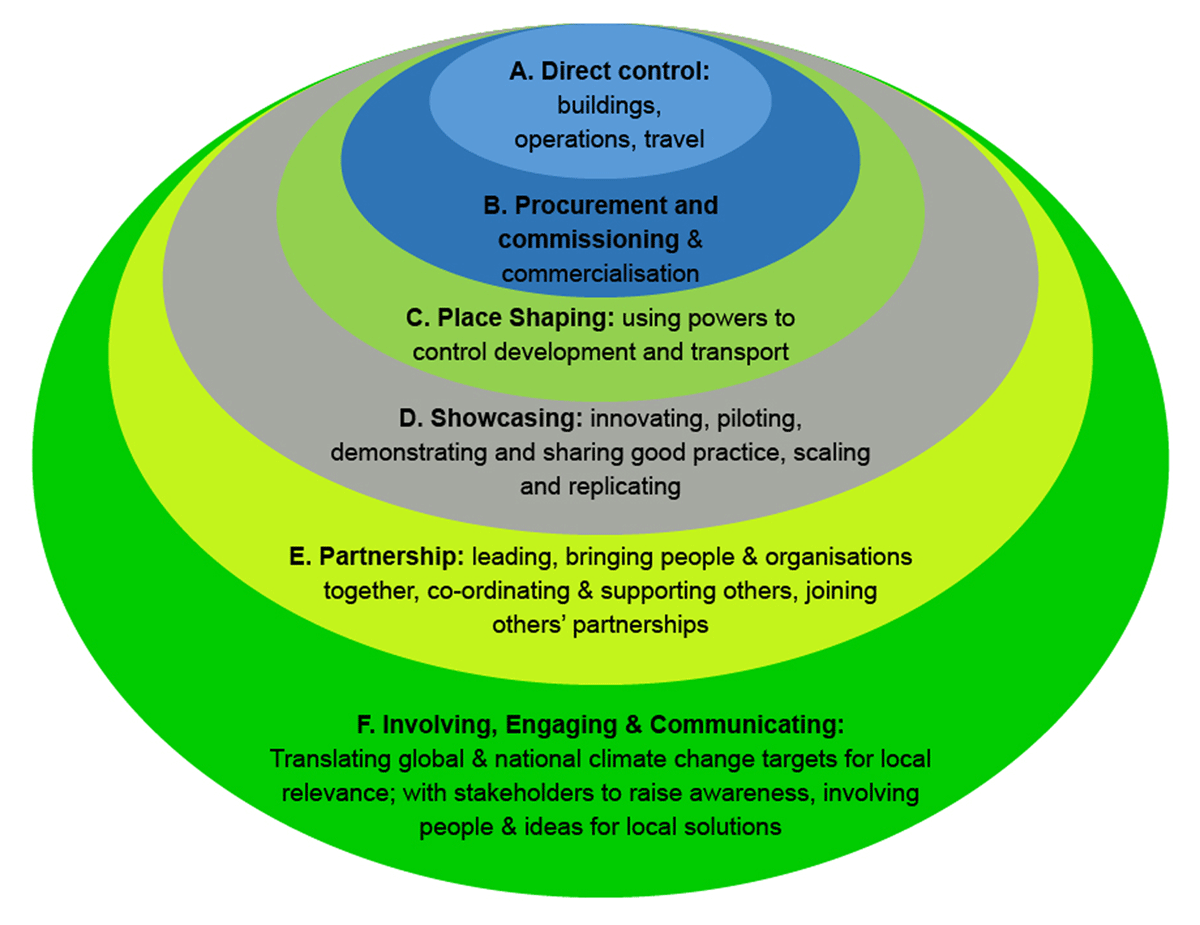
Figure 1
‘Onion’ diagram: the layers of local authority control and influence on greenhouse gas (GHG) emission reductions.
Source: CCC (2020a: 5).
As mentioned in the introduction, recent research suggests that place-based finance opportunities have the potential to leverage significant investments. Tingey & Webb’s (2020) assessment of ambition and value in UK local authority investment identified multiple cases of technical assistance funding leveraging local sustainable investments with a ratio of 37:1. Without funding for such intermediation, however, the procurement processes that leveraged these investments would not have taken place (CCC 2020a).
The absence of a rich approach to multilevel governance in the UK means that procurement is one of the few options currently available to many local authorities. Given the need for new low-risk, stable income streams, local net zero delivery thus relies on successful investment leverage through new forms of place-based investment, new sources of borrowing such as crowdfunding, non-repayable capital and the active participation of residents. Changing public procurement rules and guidelines provide increasing opportunities for local authorities to access low-cost capital for net zero investments while creating jobs and generating higher level social value for communities (Bristol City Council 2022; Davis 2021). Key to their success, however, is the institutional governance of appropriate intermediation capable of reducing transaction costs associated with all stages of the procurement process, ranging from the development of award criteria and tendering to contract awarding and contract management (Nolden et al. 2016; Tingey & Webb 2020). The following section explores some of these opportunities for local authorities and the surrounding institutional governance in further depth by using the case studies of the Energy Efficient Scotland Programme and CMIs.
5. Procuring local net zero solutions: the Energy Efficient Scotland Programme
An interesting example of procurement for net zero is the Energy Efficient Scotland Programme. With buildings accounting for 21% of Scotland’s total carbon emissions, this flagship programme was established by the Scottish government for piloting area-based and locally coordinated delivery of energy efficiency improvements over the next 15–20 years (Scottish Government 2021; Wade et al. 2020a). It is therefore a critical cornerstone initiative for Scotland’s commitment to net zero greenhouse gas emissions by 2045. The Scottish government provided over £0.5 billion of funding to Scottish local authorities to deliver place-based energy efficiency pilot programmes during 2017–21. These included: area-based retrofitting; the development and delivery of local heat and energy efficiency strategies (LHEES); and the development of engagement strategies to encourage retrofit of businesses, private rented and owner-occupied properties (Sugar et al. 2022). Whilst local authorities are positioned as the primary actors to deliver the programme, it is reliant on partnerships with external actors, such as arm’s-length organisations, social enterprises and charities (Wade et al. 2020a).
Due to the technical and specialist nature of energy efficiency and building retrofits by local authorities, this resulted in significant procurement delivery over the course of the Energy Efficient Scotland Programme. The structure of procurement varied across the phases. For Phase 1, procurement was completed centrally by the Scottish government, which resulted in nine of the 12 authorities working with the same consultant. In comparison, Phases 2 and 3 did not include a centrally procured consultant, but instead allowed local authorities responsibility for procuring external support themselves (Wade et al. 2022). Local authorities reflected on the opportunities and limitations of integrating external expertise and support from the consultants for bringing in specialist knowledge and expertise.
Across the programme there were mixed reflections on the extent to which central procurement was successful across the pilots. On the one hand, some parts of the pilots (e.g. LHEES work) were particularly unfamiliar to local authorities, who expressed limited understanding of what to procure for, which could result in limitations to the work that takes place, and potential mismatches in understandings between different partners (Wade & Webb 2020). On the other hand, some council officers reflected that central procurement of consultants resulted in work being less tailored to their locality, and in doing so, highlighted the need for procurement to be developed using institutional knowledge within localities (Wade et al. 2022). This was reinforced in Phase 2, whereby officers regarded local procurement as crucial to the delivery of successful LHEES and for fostering a sense of local ownership of projects (Scottish Government 2022), as well as being beneficial to having consultants locally to manage any potential snagging with work (Wade et al. 2020b). From the pilots, having a centrally procured consultant frequently resulted in lines of command becoming unclear, with ideas for some of the pilots coming centrally from the Scottish government, rather than from the local authorities themselves, since the local authorities were not the primary clients (Wade et al. 2019). As such, in many instances, central procurement went against the local objectives of the programme, which is an important finding for procuring local net zero solutions.
In addition, external procurement, which was conducted by local authorities themselves, was completed via existing and established frameworks, such as Scotland Excel, Public Contracts Scotland and the Non-Domestic Energy Efficiency Framework (NDEE). These had their own unique challenges, as highlighted in Phase 2. For example, local authorities reflected on the challenge of identifying contractors with suitable expertise, particularly for complex projects and mixed-use, hard-to-treat buildings. In some cases, the project complexity could limit the number of contractors available or willing to bid for the work within the timeframe (Wade et al. 2020b), reinforcing issues of the lack of skills and supply chains for net zero projects at the local level. Despite deliberate attempts to procure local consultants, in some cases this could be limited by both the project timeframe and contractor capacity, particularly if the preferred contractor was leading on another large project. This reinforces the need to bring highly skilled workers into the supply chain for complex net zero projects and more clarity for signalling routes to the market to help the delivery of net zero objectives at both local and national levels (LGA 2021). Finally, these pilots demonstrated that local government frequently struggled with the procurement processes for net zero. For example, local authorities reflected on the inability to conduct joint procurement for the domestic and non-domestic sectors, and that procurement was a much lengthier, complicated and unestablished process for the non-domestic sectors. Whilst there is no clear ‘better option’ between central and external procurement, these are key considerations for procuring local net zero solutions, given the context of restricted capacity and capability at local authority level (Energy Systems Catapult 2022).
6. Procuring local net zero solutions: the role of place-based finance
Working with Abundance Investment, local partnerships and a range of professional services and legal firms, the Financing for Society project led by one of the authors identified that two of the major barriers for local councils engaging with alternative finance models was the potential risk of an increased cost of capital (especially when pegged against the PWLB) and the additional administrative cost of trying something new. So pressed for resources, councils were understandably risk-averse when it came to deviating from the norm of how they would typically procure and finance local infrastructure projects (Baeck et al. 2012; CCAF 2018; Davies 2015; Davis et al. 2020; Langley 2016).
As one possible solution, the research team worked with the three council case studies to create CMIs (Davis 2021). This ‘place-based’ financial structure builds upon a model of investment-based crowdfunding to enable a council corporate body to issue local climate bonds tied to specific net zero infrastructure projects in the community. This includes a range of infrastructure projects which are crucial if councils are to meet their decarbonisation targets, and include: installing solar photovoltaic (PV) panels on schools and council buildings; building wind farms and electric vehicle charging points; retrofitting social housing to make homes cheaper to heat and so warmer; and installing LED lighting on transport highways. CMIs direct investor capital immediately and with high visibility towards the delivering of such infrastructure in the local community.
For a nominal fee, the crowdfunding platform eases the administrative cost to councils by developing template documentation to cover legal and technical aspects of the finance structure, as well as managing communications relating to the offer and keeping investors updated both on the progress of their investment and on the net zero projects delivered locally as a result. CMIs thus open new communication channels between councils and their residents about the urgency of the climate emergency and what the council is proactively doing locally to meet its obligations. Research by the LGA (2008) indicates that higher levels of local government transparency and improved communication is important in increasing levels of resident’s support for local services and projects:
people who feel well informed about what their council does are much more likely to think it provides high quality services and that it offers residents good value for money.
As further evidence, those councils that have offered a CMI have seen a marked increase in their reputation among local residents because of taking action. For example, in one case one-in-six investors entitled to a first interest payment via the CMI choose instead to donate their interest back to the council to finance other hard-to-fund net zero projects in the community (Davis 2021). On capital cost, CMIs are structured to match the terms offered by the PWLB, being pegged to UK gilt markets, and offer similar borrowing periods. CMIs can also be blended with PWLB to support infrastructure projects where local connection and larger funding packages may be required. CMIs are thus designed to offer councils an alternative to complex, shareholder-facing and sometimes controversial private finance initiative (PFIs) or PPP structures that have proven to be infrequently aligned to net zero ambitions.
A significant advantage of CMIs is their innovative approach to risk. Investors who choose to purchase a local climate bond via this model take local authority risk, not project risk. Capital is thus at risk based upon the council’s ability to raise its taxes and the likelihood that the council ceases to exist during the term of the investment. Investors do not assume the risk that a given infrastructure project fails. Despite on-going threats to their financial well-being, councils enjoy an institutional longevity beyond high-street banks where people typically consider their money to be safe. It is a fact that, since the global crash of 2008, more high-street banks have ceased trading than councils have been forced into restructuring or placed under spending restrictions.
Aligned with the framework of a just transition to fairer energy futures (Gatto 2022; Heffron & McCauley 2022; Mijin Cha & Pastor 2022), CMIs have been deliberately designed with a minimum investment threshold of just £5 so that as many people as possible can participate in helping their community to achieve net zero, playing their part in responding to the climate emergency. While the financial return on any investment at that level is negligible, research shows that there are tangible social co-benefits to participating in civic projects.
To date, five CMIs have been launched across the UK’s urban and rural communities, and across party political lines. West Berkshire Council (Conservative-led, rural) launched the UK’s first CMI on 16 July 2020, inviting residents to invest over five years at a return rate of 1.2% to support net zero projects in the local community. They hit their £1 million target five days early with the scheme attracting 640 investors, and with 22% of funds raised from the local region. Funds were used to support the installation of a variety of projects within the council’s environment strategy, including rooftop solar PV projects, improvements to cycle ways, the installation of LED lighting and flood defence projects across the community.
Warrington Borough Council (Labour-led, urban conurbation) launched the UK’s second CMI on 25 August 2020, also offering 1.2% over five years. They hit their £1 million target three days early and attracted 500 investors with an average investment of almost £2,000 each. The funds are helping the council to develop two large ground-mounted solar PV farms and a 27 MW battery storage facility, in partnership with Gridserve. As part of its Green Energy Strategy, the council will use electricity and revenues generated by the new solar panels to accelerate other green projects for Warrington’s community, including measures to reduce fuel poverty.
There is clearly appetite amongst investors to move their money in support of local net zero projects (Robins et al. 2020). In spite of their early success, a barrier to the wider uptake of CMIs by councils has been a concern over project pipeline and identifying net zero schemes locally that could be suitable for funding via the offer of a local climate bond. One of the ways in which this barrier could be overcome is to consider using procurement as a means to incentivise the private and/or social enterprise sectors to incorporate crowdfunding into their bids. Such a move may require small changes to procurement rules, which are discussed in the next section.
7. Changing UK public procurement rules
As outlined in Section 1, the UK is in the process of reforming its procurement rulebook, as well as reorienting its procurement policy. The details of the new legislation have only started to emerge with the introduction of the Procurement Bill on 11 May 2022, which will require a substantial amount of secondary legislation and statutory guidance. The direction of travel seems a clear continuation of the Transforming Public Procurement Green Paper (Cabinet Office 2021b). The new rulebook will retain most of the current tools (see Section 4 above). Chiefly, this includes the possibility: to exclude economic operators based on environmental misconduct; to use functional technical specifications with leeway for the inclusion of green procurement criteria; or to use environmental award criteria and contract clauses. These tools encourage high levels of flexibility for contracting authorities, particularly in key areas for the implementation of net zero-oriented procurement projects (such as enabling for tailor-made procedures seeking to co-produce environmental solutions). The new regime is also meant to be underpinned by significant investment in digital platforms and open data, which can allow for the deployment of digital technologies to support the uptake of green procurement (Open Contracting Partnership 2021, 2022), as well as an ambitious training programme that could include training on green procurement.
Arguably, one of the main changes concerns the mandate for local contracting authorities to have regard to the National Procurement Policy Statement (NPPS) at a pre-procurement stage, which significantly expands the earlier requirement in the Public Services (Social Value) Act 2012 (UK Government 2012). In its 2021 version, the NPPS indicates that procurement should be leveraged to support priority national and local outcomes for the public benefit. In addition, contracting authorities should consider the following social value outcomes alongside any additional local priorities in relation to tackling climate change and reducing waste:
Contributing to the UK government’s legally binding target to reduce greenhouse gas emissions to net zero by 2050 (including using multifactor sustainability indices to embed decarbonisation across the entire project right from design to delivery to eventual decommissioning).
Reducing waste, improving resource efficiency and contributing to the move towards a circular economy.
Identifying and prioritising opportunities in sustainable procurement to deliver additional environmental benefits, e.g. enhanced biodiversity, through the delivery of the contract.
The way in which this will be embedded into local procurement decision-making is as yet unclear, with guidance expected to be issued by the Cabinet Office in 2023. It is also ambiguous how new procurement priorities will translate into Scottish procurement legislation as the Scottish government wants closer alignment with EU rules to enable accession in case of independence. However, it appears that the inclusion of net zero considerations in procurement decision-making will acquire a new legal and policy dimension.
8. Discussion: key issues in a changing regulatory environment
With two-thirds of local councils having declared a climate emergency, meeting the ambitious net zero targets they have set for their local area will require billions of pounds’ worth in investment over the coming decades. Yet, following successive cuts to council budgets by central government, local authorities are at the mercy of political changes when it comes to financing their local net zero strategies, despite clear investment opportunities (Sugar & Webb 2022). As a result, current investment across housing, public and commercial buildings, transport, and industry are failing to capture cost-effective carbon savings. This underpins the reality that dependence on political will to achieve these climate goals will not suffice. Legal and regulatory reform as well as innovative sustainable finance and investment options are necessary. According to Tingey & Webb (2020) the changes to public procurement rules and guidance for net zero evaluation are therefore ‘urgent and essential’, including:
shifting public procurement focus towards carbon reduction; seeking alternatives to current procurement and finance arrangements; building the capacity of local authority operations; investment in local community energy organisations and empowering local businesses to participate in procurement; better liaison between national and local government; and de-risking finance by shifting risk to local authorities—as in the case of CMIs.
However, even under changing procurement rules, the willingness and ability of local authorities to use their procurement function to stimulate markets and demand sustainable energy services is largely determined by available resources and capabilities (Davis & Cartwright 2019). As resources and capabilities diminish, both new and old procurement rules are often interpreted conservatively in fear of being challenged, resulting in trade-offs between competing priorities in a context of general risk aversion (Aspey & Craven 2018). Under such circumstances, procurement practices are likely to act as barriers to net-zero delivery at a local level.
The two case studies outlined here demonstrate the importance of institutional governance in providing intermediation to break down these barriers. The case study on CMIs indicates how investor capital can be directed towards the delivery of zero carbon infrastructure in the local community through a crowdfunding platform. It provides evidence how standardised templates to cover legal and technical aspects of the finance structure reduce transaction costs for small-scale, place-based projects without recourse to private project finance or the PWLB. Their small-scale lends itself to their integration into local supply chains and public procurement can play a role in integrating a requirement for such innovative financing and local social value generation into bids.
The case study of the Energy Efficient Scotland Programme suggests that there is a need to balance advantages of centralised procurement, especially if there is a lack of familiarity with what it is being procured, with advantages of decentralised procurement, especially where local institutional knowledge can help refine tendering specifications. It also provides evidence on the importance of intermediation to enable local authorities to procure appropriate place-based solutions at all scales, ranging from those dependent on partnerships with local actors to those involving multinational corporations (Bristol City Council 2022).
This leads to the following questions for future consideration:
What additional support (both internal and external) do local authorities require for defining and evaluating their net zero investments?
What intermediary structures need to be in place for local authorities to avail of changing procurement rules that might enable them to stimulate markets towards net zero through their procurement function?
Given the poor uptake of social value procurement following the Public Services (Social Value) Act 2012 (UK Government 2012), how can the institutional governance thereof ensure that the new Procurement Bill will not suffer from similar lack of uptake?
How can vague language such as ‘to consider’, ‘to have regard to’ and ‘should take into account’ be translated into clear commitment to social and environmental value?
With the danger of new procurement legislation either falling short on detail or proving itself too specific and rigid to take into account changes in policy (as well as primary and secondary legislation), how can environmental and social value be safeguarded through other means of institutional governance?
What sort of institutional oversight is necessary to ensure that the leveraging of billions of pounds of private investment for net zero through procurement delivers social value as specified in tenders?
Despite their dwindling capacities and growing risk aversity, local authorities nevertheless have responsibilities and track records in policy and management buildings, heating and transport systems which provide the basis to adapt supply chains and markets according to net zero ambitions (Kuzemko & Britton 2020). Moreover, apart from legal and financial resourcing, clear institutional implementation mechanisms for decarbonisation are imperative. These require multi-stakeholder engagement and involvement. Each of the governance elements highlighted above (law, policy, regulation, finance, procurement, investment) for local delivery of net zero targets involves different actors who are crucial to the implementation of local decarbonisation. Whereas local authorities have a legacy of managing public resources, private entities, communities and the third sector have a performance history of mobilising resources and successful delivery of services and projects. Therefore, the onus to decarbonise at the municipal level is not just on local authorities as the primary duty-bearer, but also dependent upon the collaborative efforts of resident communities and diverse stakeholders. While procurement and place-based finance have critical roles to play in ensuring that these responsibilities and track records translate into socially valuable net zero investment and delivery, appropriate institutional governance is necessary to intermediate between the different actors, reduce transaction costs and maximise the leverage of assistance programmes (Nolden et al. 2016; Tingey & Webb 2020).
Ironically, the proliferation of intermediaries can add complication by increasing the transaction costs associated with searching and identifying an appropriate framework, assistance programme or contractual arrangement—transaction costs these seek to reduce, for example, through standardisation in the case of contracts and the pre-approval of suppliers in the case of frameworks (Nolden et al. 2016). Avoiding this, and enabling local authorities and the areas they govern to benefit from changes to procurement legislation, might require the establishment of government (arm’s-length) intermediary (see also the argument in favour of an Energy Transformation Commission; Willis et al. 2019).
Such an intermediary might benefit from regionalisation, for example, by linking it to the energy hubs, which have recently been rebranded as net zero hubs, to ensure that the benefits of a local approach to procurement identified in the case studies are not lost. It could also oversee the integration of innovative funding and local social value creation requirements into tenders to diversify the range of stakeholders and shareholders involved in supporting, and benefiting from, the transition to zero carbon. This has been recognised by the Connected Places Catapult which seeks to lower the barriers associated with procuring solutions, involve procurement specialists, up-skills procurement teams and develop gateways for supplier engagement (Connected Places Catapult 2022). Energy Systems Catapult has gone a step further by developing a platform (Net Zero Go) that aims to bring together all the tools and support for the procurement, management and development of net zero projects (Energy Systems Catapult 2022). Under new procurement legislation, and the absence of multilevel decarbonisation governance, such efforts need to be significantly expanded to ensure that social value and net zero become enshrined in procurement procedures while the misallocation of funds is minimised.
9. Conclusions
There is an evident gap between climate change legislation at a national level and the delivery of associated projects and infrastructures at a local level. To date, the Act (and its 2019 amendment) translates primarily into energy supply policy at a national level (UK Government 2021b). Policy support for climate action at a local level is notable in its absence. Scotland is an exception likely due to the lack of powers over strategic energy supply decision-making. Consequently, the focus is more on the demand-side, which is much more place-based and local in nature.
In the absence of supportive policy and a rich approach to multilevel governance in the UK, procurement can play an important role in creating public demand for net zero energy services and demand reductions. Procurement is currently one of few options available to many local authorities. However, the case studies indicate that the institutional governance through intermediation is necessary to balance the benefits of centralised procurement with those of a more place-based approach, as is the case with the Energy Efficient Scotland Programme case study, while incentivising the inclusion of crowdfunding into the bids of the private and/or social enterprise sectors, such as community municipal investments (CMIs).
Local authorities are key ‘middle-out’ catalysts of net zero that oversee local public procurement while underwriting non-state climate action at a municipal level in several different directions: upstream, downstream and sideways. They are also change-agents that intermediate between national climate change and procurement frameworks, on the one hand, and bottom-up mechanisms (such as CMIs), on the other.
At the same time, directing procurement towards social and environmental outcomes entails significant risk. Defining the most advantageous tender with regards to non-economic objectives can lend itself to the misallocation of funds at best, and corruption, cronyism and self-enrichment, something many governments were accused of following panic purchases at the height of the SARS-Cov-2 pandemic, at its worst. Whilst this has been acknowledged (and steps have been taken to reduce this by using various methods and account for social value), place-based investment structures nevertheless may run a similar risk of channelling finance into areas where the skills to set up and manage appropriate instruments are available rather than those where they are not.
On the other hand, it also needs to be recognised that being too prescriptive might complicate procedures and place additional strain on overburdened decision-makers. It might also constrain flexibility and agility which are often sorely lacking among public sector organisations. The result could be the low uptake of social value objectives, especially if accountability frameworks are not in place. CMIs provide a glimmer of hope as they have been proven to attract investments in both urban and rural areas with different political alignments. Such innovations change the risk profile of place-based investments and provide alternatives to net zero delivery through the procurement of institutional delivery partners.
Given the scale of investments necessary to reach net zero, however, institutional governance is necessary to align top-down procurement and bottom-up finance with many other laws, policies and regulations. Many questions such as the ones stated in the discussion will need to be addressed to ensure a commitment towards a socially valuable net zero future.
Acknowledgements
The authors thank the peer reviewers and editors for their constructive comments.
Competing interests
The authors declare that they have no competing interests.
Funding
This paper was written as part of the ‘Finance and Procurement for Net Zero’ project funded by UK Research and Innovation through the UK Energy Research Centre’s Phase 4 Programme (grant number EP/S029575/1).
Supplemental data
Supplemental data for this article can be accessed at: https://doi.org/10.5334/bc.267.s1