
Introduction
Traditional bone setters (TBS) use natural remedies and traditional practices to treat orthopedic injuries, often with limited allopathic medical training. TBS practices have been in use for centuries, passed down through generations of families that are integrated into the communities that TBS serve [1–4]. TBS practices vary widely, including the use of natural balms, massaging, splinting, or other immobilization techniques to treat orthopedic injuries and conditions, ranging from superficial abrasions to the management of complex fractures [1, 5, 6]. While TBS practices can successfully manage some minor orthopedic fractures, significant complications may occur [7–9]. These complications include fracture malunion, non‑union, and gangrenous extremities. These complications can have a dramatic impact on the lives of patients and their families [8, 10–12].
Despite the potentially debilitating complications, patients in low‑ and middle‑income countries (LMICs) continue to trust and use the services of TBS for orthopedic care [5]. This continues despite campaigns to educate patients on the perceived risk of TBS practices [13, 14]. Understanding patients’ reasons and motivations for patronizing TBS is necessary to explore patronage of TBS and to reduce the complications associated with their use. Understanding these reasons may also clarify other cultural, geographic, or financial barriers to accessing allopathic medical care. To our knowledge, this has not been previously investigated or characterized by prior reviews. Thus, a qualitative systematic review of the literature was conducted to assess the reasons and perspectives of patients who patronize TBS.
Methods
Study design and overview
This review was designed using the Preferred Reporting Items for Systematic Reviews and Meta‑Analyses (PRISMA) guidelines.
Search strategy and study selection
Four electronic databases, Web of Science, the Cochrane Central Register of Controlled Trials (CENTRAL), MEDLINE, and Embase (both via Ovid), were searched prior to April 2025. A manual search was also conducted. The search terms used were “bone setting,” “bone setters,” and “bonesetters,” and their synonyms. The full search strategy can be found in Appendix A.
Study screening and data extraction were conducted using Covidence systematic review software (Veritas Health Innovation, Melbourne, Australia). Two contributors (SF, SR) independently reviewed the titles, abstracts, and full texts for relevance. Disagreements between reviewers were settled through collaborative discussion with a third reviewer (CK). Study references were also reviewed for any relevant articles.
Eligibility
This study included articles discussing patients’ reasons for patronizing TBS and exploring their perspectives on TBS. Specifically, articles qualitatively reporting the lived experiences of patients and their perspectives on TBS were included. All articles included were original, peer‑reviewed, full‑text, and written in the English language.
All studies that did not report TBS patients’ reasoning or perspectives on visiting a TBS were excluded. Articles that were not original, peer‑reviewed, full‑text, and written in the English language were also excluded.
Data extraction
Data extraction was completed independently by two reviewers (SF and SR). The data extraction template was created and piloted. The template was validated by contributors SF, SR, and CK, and published on Covidence [15]. The extracted information included study characteristics, patient demographics, study results, including the reasons for attending TBS, and key findings. Given the qualitative nature of the results, no formal statistical analysis was completed in most studies. Instead, descriptive statistics were extracted.
Methodological quality
Each article was assessed in terms of methodological quality. The Joanna Briggs Institute (JBI) Critical Appraisal tool for qualitative reviews was used for each article [16]. Two reviewers independently performed an overall appraisal, and any disagreements were resolved through discussion and, if necessary, conferring with a third reviewer.
Data synthesis and analysis
Data management and descriptive analyses were performed using Microsoft Excel (Microsoft Corporation, Redmond, WA, USA). Given the qualitative nature of the articles collected, no quantitative meta‑analysis could be conducted. Demographics, including age and sex, were pooled. Articles reporting quantitative survey data were collected in Excel, and where possible, missing values (n, N, %) were calculated.
Results
Search results
The search of the 4 electronic databases identified 917 studies that fit the search parameters (Figure 1). Eight additional studies were added following a manual search of databases and article reference lists. Of the 925 studies, 294 duplicates were removed. The 631 remaining articles were then screened based on their title and abstract. A total of 43 studies fit the inclusion criteria, while 588 were excluded. After a full‑text review, 15 studies were excluded based on the exclusion criteria of population, outcome, language, or study design. Ultimately, 28 total articles were included in the review.
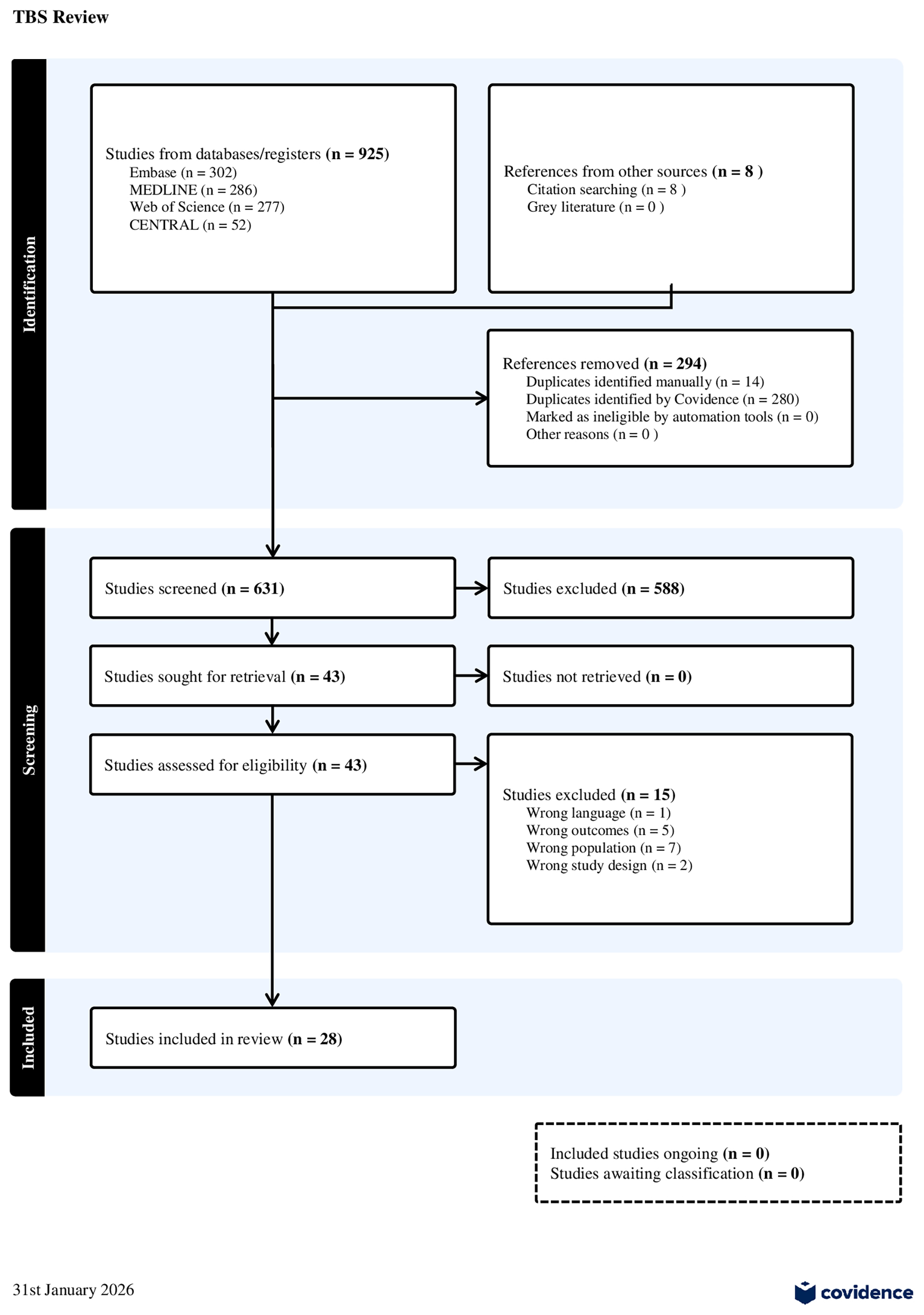
Figure 1
PRISMA diagram.
Of the 28 articles, 5 articles directly quoted patients’ perspectives, while 24 articles reported thematic reasoning behind the patronage of TBS. The results and demographics are summarized in Table 1.
Table 1
Study demographics.
| AUTHOR, YEAR | LOCATION (REGION, COUNTRY) | STUDY DESIGN | PATIENTS (N) | MEAN AGE (RANGE) | MALE (%) | PRINCIPAL REASON (%) |
|---|---|---|---|---|---|---|
| Abang et al. [10] | Nigeria | Prospective observational | 79 | 36.8 (17–83) | 59.5 | No choice |
| Aderibigbe et al. [17] | Nigeria | Cross‑sectional | 400 | 36.3 | 58 | Family and friend recommendation |
| Ali et al. [7] | Pakistan | Retrospective observational | 87 | 16.48 (6–81) | 64.4 | Availability |
| Aries et al. [18] | Ghana | Qualitative | 29* | – | 69 | – |
| Card et al. [19] | Tanzania | Cross‑sectional | 13** | – | – | Other |
| Chowdhury et al. [8] | Bangladesh | Prospective observational | 150 | (1–≥51) | – | Affordability |
| Dada et al. [9] | Nigeria | Prospective observational | 121 | 29.49 (6 weeks–72) | 57 | Affordability |
| Diamond et al. [11] | Nigeria | Cross‑sectional | 192 | 35.1 (10 months–76) | 64.6 | Belief |
| Edusei et al. [6] | Ghana | Qualitative | 16 | (16–70) | 43.8 | – |
| Golge et al. [12] | Turkey | Cross‑sectional | 3422 | – | 58.1 | Belief/preference |
| Hamad et al. [20] | Sudan | Cross‑sectional | 389 | – | 53.2 | Belief |
| Hatipoglu and Tatar [1] | Turkey | Qualitative | 20 | (46–80) | 70 | Belief + availability |
| Idris et al. [2] | Sudan | Prospective observational | 276 | 39.3 | 66 | Belief |
| Jibo et al. [13] | Nigeria | Cross‑sectional | 224 | 29 (1–82) | 79.9 | Affordability |
| Khan et al. [21] | Pakistan | Prospective observational | 60 | 25.57 (5–65) | 73.3 | Belief |
| Kuubiere et al. [22] | Ghana | Observational | 80 | (7–70) | 63.7 | Belief |
| Moton et al. [23] | Pakistan | Cross‑sectional | 999 | 32.59 (7–71) | 63.2 | Belief |
| Nwachukwu et al. [5] | Nigeria | Qualitative | 17 | – | – | – |
| Onyemaechi et al. [24] | Nigeria | Cross‑sectional | 120 | 37.4 (0–80) | 70 | Family and friend recommendation |
| Panda and Rout [3] | India | Prospective observational | 146 | 48.6 | 55.5 | Other |
| Ruhinda [25] | Tanzania | Qualitative | 103 | – | 84 | – |
| Safari et al. [14] | Iran | Prospective observational | 61 | 34.04 (11–75) | 72.1 | Affordability |
| Sayeed et al. [26] | Uganda | Qualitative | 168 | – | – | Belief |
| Solagberu [27] | Nigeria | Prospective observational | 295 | 28 (15–78) | 68.1 | Affordability |
| Udosen et al. [4] | Nigeria | Cross‑sectional | 92 | (0–60) | 78 | Affordability |
| Yempabe et al. [28] | Ghana | Cross‑sectional | 64 | – | 62.5 | Affordability |
| Zarrar et al. [29] | Pakistan | Retrospective observational | 362 | 38.6 (7–87) | 61 | Affordability |
| Zehir et al. [30] | Turkey | Cross‑sectional | 162 | 27.5 | 60 | Other |
| Total | – | – | 7394 | 33.4 (SD = 7.7) | 63.5% (SD = 8.6%) |
[i] *N = 46 overall, only 29 had previously visited a TBS practitioner.
[ii] **N = 212 overall, only 13 had previously visited a TBS practitioner.
Study demographics
Twenty‑eight studies were included in this review: [1–14, 17–30]. The study designs were variable and are reported in Table 1. The studies were conducted in a total of 10 countries. A total of 18 studies were conducted in Africa and 10 in Asia. The country with the most studies was Nigeria with nine studies. Bangladesh, India, Iran, and Uganda had the fewest number of studies, with one each. No study was done in Europe, Australia, North America, or South America.
A total of 8,147 participants were included in the studies. The mean age of participants was 33.4 (SD = 7.7), ranging from 0 to 87. The majority of participants were male (63.5%).
Study quality
The quality of the studies was variable, ranging from strong to decent, and were all included based on the JBI criteria. Articles of overall low appraisal, as per the JBI critical appraisal tool, were noted [16].
Patient reported reasoning
The top three patient‑reported reasons from each article are reported in Table 2. The number of times each reason was cited is reported in Table 3. Patients cited many different reasons as to why they chose to visit TBS: nine articles cited belief in TBS as the main reason, with two citing a general preference for TBS and belief in TBS skill [2, 3, 11, 12, 20–23, 26]. The reasons for using TBS ranged from spiritual beliefs to confidence in the practices of TBS. Eight articles cited affordability as the main reason [4, 8, 9, 13, 14, 27–29]. Other commonly cited reasons were friends/family recommendations and a negative perspective/fear of allopathic medical institutions, each with two articles citing them as the main reason [17, 19, 24, 30].
Table 2
Patient‑reported results by article.
| AUTHOR, YEAR | PRIMARY REASON (%) | SECONDARY REASONS (%) | TERTIARY REASONS (%) |
|---|---|---|---|
| Abang et al. [10] | No choice | Belief | TBS competency |
| Aderibigbe et al. [17] | Family and friend recommendation | Availability | Fear of allopathic medicine |
| Ali et al. [7] | Availability | Family and friend recommendation | Affordability |
| Card [19] | No improvement at allopathic hospital | Family and friend recommendation/no choice | – |
| Chowdhury et al. [8] | Affordability | Belief | Quicker service |
| Dada et al. [9] | Affordability | Family and friend recommendation | Belief in faster healing |
| Diamond et al. [11] | Belief | Affordability | Availability |
| Golge et al. [12] | Belief/preference | Fear of disability | Fear of Plaster of Paris |
| Hamad et al. [20] | Belief | Availability | Family and friend recommendation |
| Hatipoglu and Tatar [1] | Belief/availability | Affordability/negative perspective of allopathic medicine | – |
| Idris et al. [2] | Belief | Less time consuming | Affordability |
| Jibo et al. [13] | Affordability | Avoiding long hospital stay | Belief/family and friend recommendation |
| Khan et al. [21] | Belief | Affordability | Quicker service |
| Kuubiere et al. [22] | Belief | Affordability | Belief in faster healing |
| Moton et al. [23] | Belief | Affordability | Availability |
| Onyemaechi et al. [24] | Family and friend recommendation | Affordability | Belief |
| Panda and Rout [3] | Traditional skill and fame | Affordability | Availability |
| Safari et al. [14] | Affordability | Family and friend recommendation | Belief |
| Sayeed et al. [26] | Belief | Witchcraft | Family and friend recommendation |
| Solagberu [27] | Affordability | Belief in faster healing | Negative perspective of allopathic medicine |
| Udosen et al. [4] | Affordability | Belief in faster healing | Fear of Plaster of Paris/complications |
| Yempabe et al. [28] | Affordability | Belief | Quicker service |
| Zarrar et al. [29] | Affordability | Fear of surgery | Family and friend recommendation |
| Zehir et al. [30] | Avoiding long hospital treatment | Fear of complications | Discomfort in cast |
Table 3
Patient‑reported results by reason.
| REASONS | NUMBER OF ARTICLES AS THE PRIMARY REASON | ARTICLES |
|---|---|---|
| Belief in TBS* | 9 | [1, 2, 11, 20–23, 26] |
| Affordability | 8 | [4, 8, 9, 13, 14, 27, 29] |
| Availability* | 2 | [1, 7] |
| Family and friend recommendation | 2 | [17, 24] |
| No choice | 1 | [10] |
| No improvement at allopathic site | 1 | [19] |
| Preference | 1 | [12] |
| Skill | 1 | [3] |
| Long treatment at medical clinic | 1 | [30] |
[i] *Hatipoglu and Tatar [1] had equal numbers of participants reporting availability and belief in TBS—as a result, they are counted in both categories.
Qualitative patient perspectives
Of the 28 total articles, 5 included quotes from patients regarding their perspectives, experiences, and beliefs regarding TBS. As with the survey results, different themes emerged from the qualitative reporting. Positive perspectives praising TBS and reinforcing the belief in their practices were frequently reported, as were financial concerns [5, 6, 18, 25, 28]. Additionally, a single study reported negative perspectives of TBS, listing treatment failure and the limited ability of TBS to provide pain relief or antibiotics as reasons not to patronize TBS [18].
Demographic association findings
The association between demographic trends and TBS usage was an area of further interest. Twenty‑one articles included an analysis of whether patient demographics played a role in their decision to patronize TBS. While some articles found no association, others found conflicting associations. Jibo et al. and Zehir et al. found that TBS usage was associated with lower educational attainment, while Panda & Rout found the opposite association [3, 13, 30]. Three other studies found that occupation, socioeconomic status, or all demographic factors were associated with patient usage of TBS [10, 14, 17]. In contrast, 14 studies found no association between patient demographics and TBS usage, nor patients’ particular reasons for patronizing TBS [2, 4, 7, 9, 11, 19, 20, 22–25, 27–29].
Discussion
In this study, two major themes representing the patients’ choice to patronize TBS became apparent: belief and preference, and accessibility and affordability.
Belief and preference
We found that independent of accessibility, affordability, and demographics, patients often chose TBS over orthopedic practitioners based on a genuine belief in the practices and effectiveness of TBS. Given the longstanding tradition of TBS compared to the relatively new ideas of allopathic medical practices, Edusei et al. and Nwachukwu et al. both found that this tradition and the associated belief in TBS played a significant role in why patients chose them [5, 6]. This theme was found in many other articles, with belief in TBS being the primary reason cited in nine articles [2, 3, 11, 12, 20–23, 26].
Not only are patients expressing their belief in the practices and the spirituality of TBS’s care, but they are also highlighting the integration of TBS in their communities. In addition to “belief” as a primary reason, two articles found that recommendations from family and friends were the primary determinant in patronizing TBS. These reasons were also present in other articles, with five articles citing this as the second or third most common reason. Our results have shown that patients are actively choosing to patronize TBS based on belief in their practices as well as support in the community for these practices.
This theme highlights an important consideration. Patients are embedded in their communities and largely rely on the recommendations of family and friends for health care [17, 24]. The continuing presence of TBSs in their community, as well as a belief in both the spirituality and practicality of their practice, has been shown to influence patients’ decisions and can promote the patronage of TBS [5, 26, 27]. Exploring the nature of patients’ beliefs in TBS, including delineating between belief in practical applications and spirituality, is an important future direction. Moving forward, it is also necessary to understand TBS practices and how they are integrated into communities to fully understand why patients continue to patronize TBS, despite the complications.
A further contributing factor to patients’ preference for TBS was a history of negative experiences with allopathic medicine. Patients commonly highlighted a negative perspective of allopathic medicine and fear of orthopedic interventions (e.g., surgery, amputation, Plaster of Paris), which could act as another barrier preventing patients from seeking orthopedic care. Reflecting on the attitudes of health care professionals and the education surrounding orthopedic interventions may help to demonstrate why patients hold a negative perspective regarding allopathic medicine.
Affordability and accessibility
As shown in previous articles, patients believe that TBS practices are cheaper than orthodox hospitals [7, 23]. The TBS centers are also thought to be more readily accessible [1, 7]. As a result, patients often choose the cheaper and more accessible treatment.
While different studies found disparate consensus on whether TBS was indeed more affordable, many patients believed that TBS was cheaper. This may contradict the actual costs in some areas. While Ariës et al. found that, on average, hospital treatments were €287 more expensive than TBS treatments, Dada et al. found the opposite, wherein hospital treatments were more affordable, with hospital treatments ranging from $34 to $98 and TBS prices ranging from $18 to $380 [9, 18]. Despite this discrepancy, the belief that TBS was cheaper was pervasive, which influenced many patients’ decision to patronize TBS [18]. Eight studies reported that affordability/cost was the primary reason for patronizing TBS [4, 8, 9, 13, 14, 27–29]. Other studies, including Ali et al. and Hatipoglu et al., found that availability was a primary reason to choose TBS, especially considering the barriers and delays experienced when accessing modern allopathic care [1, 7]. This highlights the importance of reducing health care costs and addressing delays in health care centers as a means of improving patient access to care. In the future, optimizing patient access to care may play a role in decreasing the overall morbidity and mortality of complications secondary to TBS practices.
Demographic association
We also sought to understand whether there was a consistent association with patients’ demographics and their patronage of TBS, and if their demographics influenced their reasons for patronizing TBS. We found no consistent association of demographics and the use of TBS. The geographic distribution of the studies demonstrated a disparity in the amount of research on TBS done in different regions. While countries such as Nigeria and Ghana had many studies conducted across decades, other countries, including Bangladesh, India, Iran, and Uganda, had significantly less research published. This disparity suggests a need for further research on TBS in countries where research on the topic is less established.
Limitations and strengths
The limitations of this study were primarily due to the quality of the included studies. Many of the articles collected had few participants, resulting in small sample sizes. Many studies used convenience sampling, recruiting their participants from hospitals and clinics, resulting in a biased sample of participants with a history of TBS complications. As a result, the participants included in the articles collected may not be representative of the population. Additionally, the results of the initial studies may have been biased by the perceptions of the original investigators. This study also only considered peer‑reviewed articles written in the English language, excluding any relevant grey literature. Given the diversity of languages of the countries studied, relevant articles may have been excluded based on the language criteria. Additionally, while several articles highlighted belief in TBS, the nature of this belief (spiritual/other) was not specified. This may be the result of language barriers (lacking specific translations) or the lack of rigorous methodology in many studies that excluded the definition of terms. Nevertheless, this study still contributes to our understanding of TBS and patients’ perspectives on TBS usage.
Conclusion
The reasons for patronizing TBS are multifaceted and extend beyond pure affordability and access to allopathic medical care. While affordability and access represent important reasons for patronizing TBS that must be addressed, additional considerations were demonstrated. This systematic review suggests that the general preference for TBS clinicians over allopathic practitioners and belief in the benefit of TBS practices is strongly rooted in individuals and communities that TBS serve. The contrasting negative perspective of allopathic medicine was stark.
Of the 28 articles, 27 suggested further public education campaigns on the harms of TBS, while other studies focused on improving the integration of TBS and modern orthopedic interventions to reduce complications. Increasing public education and collaborating with TBS practitioners to improve overall access to high‑quality care, to deepen trust and belief in modern orthopedic practitioners, and to decrease complication rates may be future directions worth considering.
Future studies should seek to expand on the understanding of patients’ perspectives through quantitative means, as well as to pilot interventions promoting the integration of TBS and allopathic medicine.
Competing Interests
The authors have no competing interests to declare.
Author Contributions
All authors had access to the data and a role in writing the manuscript.
Additional File
The additional file for this article can be found as follows:
Supplementary Appendix 1
Example Search Strategy for Medline. DOI: https://doi.org/10.5334/aogh.5295.s1