
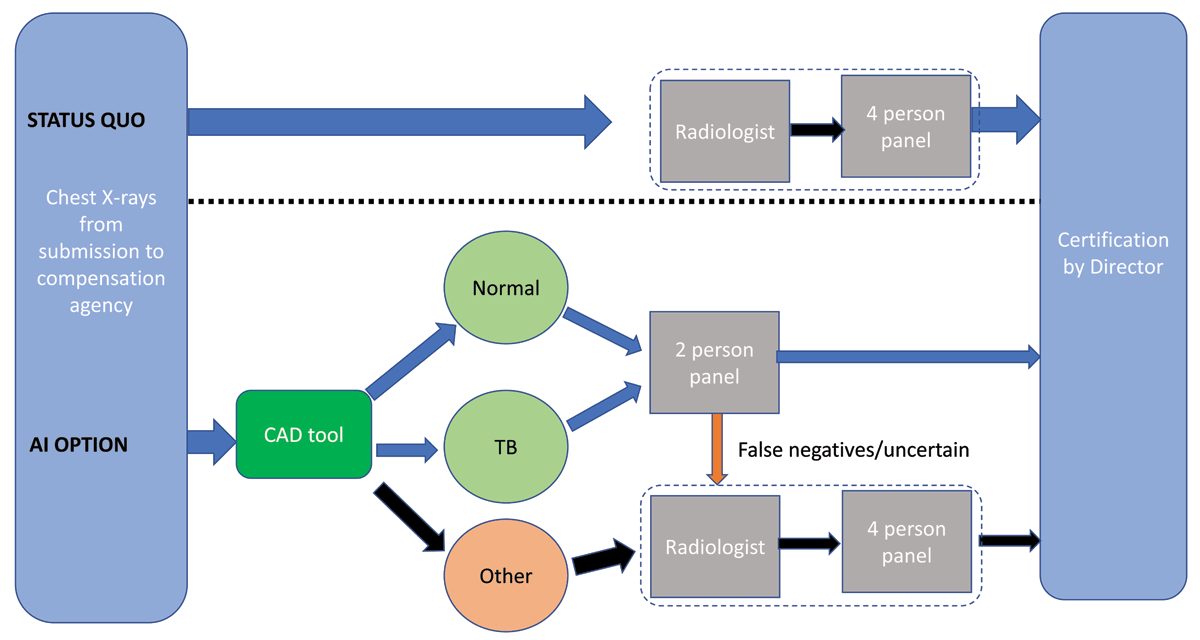
Figure 1
Alternative approaches for assessing compensation claim chest x-rays.
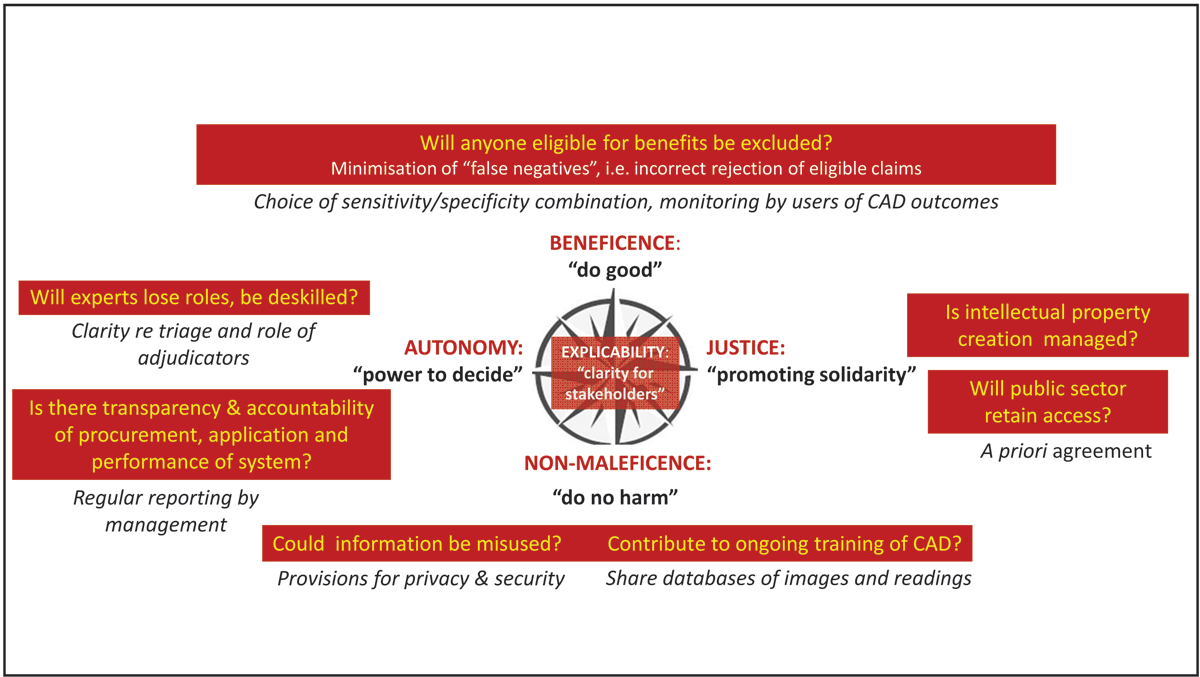
Figure 2
Reflecting on principles of bio-ethics in relation to our CAD application.
Table 1
The case for and against use of an AI application (Computer Assisted Diagnosis of silicosis and tuberculosis) for assessment of claims for occupational lung disease in miners.
| THE CASE AGAINST USING AI (CONCERNS ENCOUNTERED IN THIS CASE) | COUNTER-ARGUMENTS OR MITIGATION | ACTIONS NEEDED |
|---|---|---|
| BENEFICENCE: do good | ||
| AI is of value if accurate. (Concern about rejection of legitimate claims) | Rigorous monitoring and evaluation would need to continue after introduction to ensure satisfactory sensitivity and specificity – so that CAD systems continue to improve with feedback. | Committing resources for ongoing monitoring and evaluation real world applications. |
| NON-MALEFICENCE: do no harm | ||
| Privacy and security of personal information could be compromised. (Concern that privacy will be breached in handling) | Privacy and security of data are equally of concern in systems that do not use AI. Arguably data protection measures could more easily be put in place in data-driven systems. | Protocols covering access to data need to be written/agreed upon by all users. |
| AI training could be subject to bias – for example, if trained against “gold standards” that are themselves inaccurate.(Concern about bias in development of AI) | The AI systems need to be repeatedly assessed for accuracy against different and independent “gold standards” to avoid the biases of any one group of experts. | Willingness to share databases alongside ongoing resource commitment. |
| AUTONOMY: power to decide | ||
| Reliance on AI could decrease availability of needed skilled experts and lead to de-skilling of clinical judgment.(Concern that skilled experts will be displaced) | If the system is used for triage, rather than replacement of human expertise, it would serve to make specialists’ time more efficient and reduce the cost burden of specialist services. Specialists would need to understand the limits of AI to avoid over-reliance on the AI. | In the compensation context, there needs to be a strong understanding amongst all stakeholders that the intent is for triage rather than screening out. Ongoing monitoring is needed to ensure that complacency doesn’t take hold. Also, specialists should be trained to expect and look for false negatives and false positives. |
| Transparency could be diminished such that users are disempowered.(Concern that there will be less accountability) | Assumptions inherent in the systems should be transparent, including accuracy, i.e. sensitivity and specific for each type of assessment. Accountability would need to remain with clinicians who use the system and the medical professionals who sign off on cases. | Sustained commitment to openness and transparency is needed. |
| JUSTICE: promote solidarity | ||
| Proprietary ownership of AI could make it prohibitively expensive for the public sector.(Concern that high cost of AI could limit its use) | As public sector data are being used to train AI systems, a priori agreement would need to be signed off to ensure that the cost to the public sector is reasonable. | A change of payment provisions may be needed, as AI companies depend on royalty revenue unless access provisions are specified for public interest uses. |