
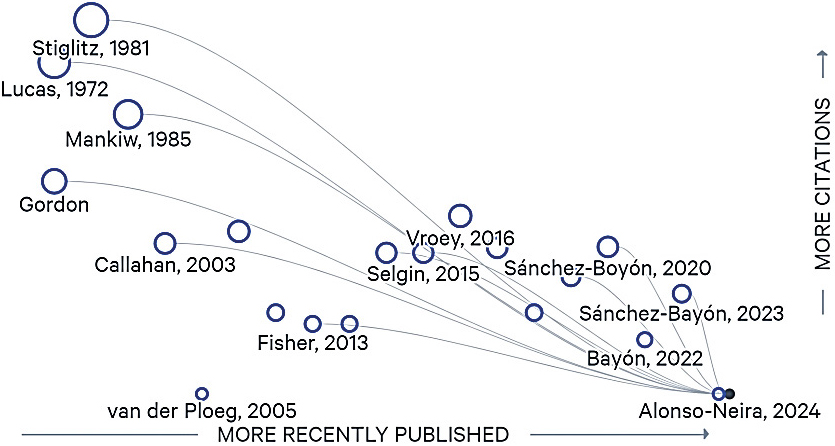
Figure 1.
ALONSO NEIRA’S SUMMARY FOR THE DIALOGUE BETWEEN SCHOOLS OF THOUGHT
Source: Litmaps, 2025.
Table 1.
PUBLICATIONS BY RELEVANCE AND IMPACT
| Alonso Neira, M.A. (2004). “A guide to the study of the macroeconomics of capital.” Market Processes: European Journal of Political Economy, 1(1): 113–186 |
| Alonso Neira, M.Á. (2005). “Monetary theories of the business cycle within the framework of the literature on economic cycles.” Libertas, 12(43): 1–28. |
| Alonso Neira, M.A., Bagus, P. & Rallo Julián, J.R. (2011). “Theories of the business cycle: main contributions and analysis in the light of the insights of the Austrian School of Economics.” ICE, Revista De Economía, 1(858): 71–87. |
| Alonso Neira, M.Á., Bagus, P. & Rallo Julián, J.R. (2011). “The subprime crisis in the light of the Austrian theory of the business cycle: credit expansion, decision-making errors and moral hazard.” Journal of World Economics, 28, 145–174. |
| Alonso Neira, M.Á., Bagus, P., & Rallo Julián, J.R. (2012). “The first global financial crisis of the 21st century: Origins and proposals for reform. An Austrian approach.” Interdisciplinary Journal of Economics and Business Law, 2 (1), 51–80 |
| Alonso Neira, M.A. (2013). “The Austrian theory of the business cycle in mainstream academic literature.” Market Processes: European Journal of Political Economy, 10(2): 463–464 |
| Alonso Neira, M.Á., Bagus, P. & Romero Ania, A. (2013). “An empirical illustration of the Austrian theory of the business cycle: the case of the United States, 1988–2010.” Investigación Económica, 72(285), 41–74. |
| Alonso Neira, M. Á. (2021). “A guide to the study of the macroeconomics of capital: Are there reasons to believe that recessionary cycles are the result of political and business errors?” Market Processes: European Journal of Political Economy, 18(1) |
| Alonso Neira, M. Á., Sánchez-Bayón, A., & Castro-Oliva, M. (2023). “Austrian Theory of the Business Cycle Applied to the Spanish Case: From the Introduction of the Euro to the Great Recession and Recovery.” Journal of Quantitative Methods for Economics and Business, 35, 280–310. |
| Alonso Neira, M.A., Sánchez-Bayón, A. & Castro-Oliva, M. (2023). “An Heterodox History of the Spanish Economy in the Eurozone: An Austrian School of Economics Analysis of Boom and Bust.” *Forum Scientiae Oeconomia*, 11(2), 9–41 |
| Alonso Neira, M.Á. & Sánchez-Bayón, A. (2023). “The yield curve as a leading indicator of recession: Austrian economics insights.” Panoeconomicus, 72(4): 501–524. https://doi.org/10.2298/PAN230217018A |
| Alonso Neira, M.Á. & Sánchez-Bayón, A. (2024). “The Spanish boom-bust cycle within the euro area: Credit expansion, misallocations of capital and recession (2002–2014).” Politická ekonomie, 72(4), 597–625. DOI: 10.18267/j.polek.1429 |
| Espinosa, V.I., Alonso-Neira, M.A., & Huerta de Soto, J. (2023). “The central banking system paradox.” Economics and Sociology, 16(4), 56–72. doi:10.14254/2071-789X.2023/16-4/3 |
| Espinosa, V. I., Alonso-Neira, M. A., & Huerta de Soto, J. (2023). “The Ethics of the Fractional-Reserve Banking System: A Private Property Rights Approach.” Economies, 11(9), 221. https://doi.org/10.3390/economies11090221 |
| Martínez Fernández, I., Alonso Neira, M. Á., & Palma Martos, L. (2023). “Disaggregated savings: Some implications for a capital-based macroeconomic framework.” Cuadernos de Economía, 42(88), 43–60 |
| Title | Time Period | Countries Analysed | Empirical Method | Variables | Theoretical Model | Conclusions | Main Critical Approach |
|---|---|---|---|---|---|---|---|
| “The Central Banking System Paradox” | Q1 1975 – Q4 2022 | United States of America | Granger causality test VAR Model Hysteresis Response Function (HRF) | True Money Supply (TMS), annual real GDP growth as a proxy for the US economic cycle | Austrian Business Cycle Theory (ABCT) | The article uses data from the United States of America between 1975 and 2022 and analyses how changes in the TMS are directly related to changes in real GDP. The results demonstrate that the TMS plays a significant role in explaining the different phases of the business cycle | The stability-efficiency paradox of central banks |
| “The subprime crisis in the light of the Austrian Business Cycle Theory” | 2000–2008 | United States of America | Conceptual review and descriptive analysis | Credit expansion, asset prices, interest rates | Garrison’s model (production possibility frontier, loanable funds market and Hayekian triangle) Austrian Theory of the Business Cycle | As the authors point out, the Austrian approach maintains that the origin of the subprime crisis does not lie in the bursting of the property bubble, but rather in the capital structure brought about by the artificial credit expansion resulting from loose monetary policies. | Intertemporal misalignment and moral hazard in loose monetary policies |
| “The Spanish Boom-Bust Cycle Within the Euro Area: Credit Expansion, Malinvestments and Recession” | 2002–2014 | Spain | Granger causality test Information criteria: AIC, HC, SIC, LR test and final prediction error Models with Almon’s distributed lags | Degree of monetary policy accommodation by the ECB Effect of monetary policy on the term structure of interest rates A proxy for the Spanish production structure Aggregate economic activity in Spain | Capital-based macroeconomics Austrian Theory of the Business Cycle | Granger causality tests show that the cyclical behaviour of the M3 monetary aggregate gives rise to changes in the slope of the Spanish yield curve Furthermore, as the authors point out, using Almon’s models, endogenous inflection points were identified in the effect of the yield curve slope on the cyclical behaviour of the Spanish productive structure and aggregate industrial activity, thus revealing that the economic cycle of the Spanish economy from 2002 to 2014 follows the monetary cycle pattern proposed by the Austrian school | Impact of the ECB’s expansionary monetary policy on the Spanish economy |
| “An empirical illustration of the Austrian theory of the business cycle: the case of the United States, 1988–2010” | Q1 1988–Q1 2010 (quarterly data) | United States of America | Granger causality test Almon’s distributed polynomial lag model | Money supply (MZM) and the slope of the yield curve IPI and ratios of sectoral industrial production indices Industrial Production Index gap (IPI/HP trend | Austrian Theory of the Business Cycle Cantillon effect | As the authors point out, the structure of the production process and the behaviour of aggregate output, as represented by the industrial production index, are subject to the influence of monetary laxity Furthermore, ‘it should be emphasised that the differential positive effect on the early stages of the production process resulting from an artificial increase in the slope of the yield curve, tends to be dampened towards the end of the expansionary cycle, even reversing at the onset of the recession. This result would illustrate the existence of self-perpetuating expansion-recession cycles in line with the predictions of the Austrian school’s view of the business cycle.” | he impact of expansionary monetary policies on the structure of production and the behaviour of aggregate demand |
| “Yield curve as a leading indicator of recession: Austrian economics insights” | 1990 – Q1 2020 | United States of America | First-order autoregressive model (VAR(1)) Granger causality test | TMS growth Ten-year three-month yield spread (SPREAD) Net percentage of domestic banks tightening standards for commercial and industrial loans (BANKS) | Austrian Business Cycle Theory Yield curve | Alonso and Sánchez-Bayón contrast the authorities’ control over short-term interest rates with their inability to influence long-term interest rates, which (in line with Wicksellian theory) do reflect the time preferences of economic agents. According to the authors, this is why the slope of the yield curve anticipates the direction and intensity of monetary policy | The yield curve can anticipate the different phases of the business cycle as conceived in the Austrian Theory of the Business Cycle |
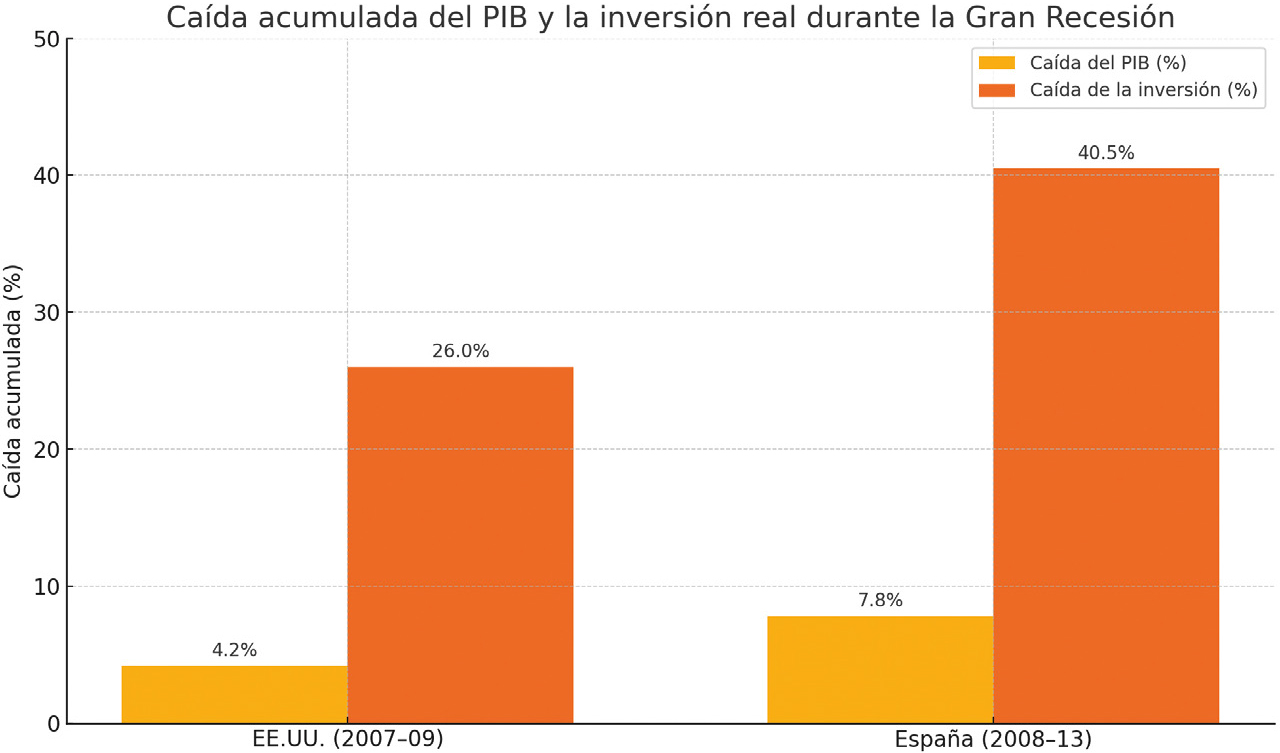
Figure 1.
COMPARISON OF THE CUMULATIVE FALL IN GDP AND REAL INVESTMENT DURING THE GREAT RECESSION IN THE UNITED STATES (2007–2009) VERSUS SPAIN (2008–2013)
Source: author’s own calculations.