
1. Introduction
This paper presents a review of the academic work of Dr Miguel Ángel Alonso Neira (a member of the Austrian School of Madrid, Matarán, 2024), in relation to the updating of the Austrian Business Cycle Theory (TACE) (Hayek, 1929 and 1931; Mises, 1949; Huerta de Soto, 1998) and the advancement of the Macroeconomics of Capital (Garrison, 2001; Hulsmann, 2001; Sánchez-Bayón et al., 2022, 2023 and 2025), with empirical evidence extending beyond the Anglo-Saxon world (Sánchez-Bayón, 2021, 2022a–b and 2025; Sánchez-Bayón and Castro-Oliva, 2022 and 2023). This type of review allows the findings of multiple studies (in this case, more than two dozen high-impact publications by Prof. Alonso Neira) to be combined in order to gain a comprehensive and comparative understanding of the progress made in the field of research, namely the economic theory of the Austrian School and its empirical illustration.
Miguel Ángel Alonso Neira is a Senior Lecturer in the Department of Applied Economics I and Economic History and Institutions (and Moral Philosophy) at Rey Juan Carlos University (in Madrid, Spain). After graduating with a degree in Economics from the Complutense University of Madrid in 1993, he undertook postgraduate studies in the United Kingdom, where he obtained a Master’s degree in Monetary Economics and International Finance from the University of Essex in 1999, on a scholarship from the “La Caixa” Foundation and the British Council. It was there that he was awarded the Leatherland Book Prize (for the best postgraduate student) and received the Extraordinary Prize for his year group. Under the supervision of Prof. Huerta de Soto, he was awarded a PhD in Economics from Rey Juan Carlos University in 2001, with the distinction of ‘outstanding cum laude’, and two years later received the ‘Víctor Mendoza’ National Prize from the Institute of Economic Studies for his work on capital controls and economic policy. He currently co-directs, alongside Prof. Huerta de Soto, the Master’s Degree in Economics of the Austrian School at URJC (one of the oldest and most international specialised degree programmes)1, as well as leading a research group on economic cycles and another group focused on teaching innovation2.
Throughout his career, Alonso Neira has published numerous books and articles in academic journals recognised both nationally and internationally, notably titles such as *Economic Theory of Monetary and Financial Crises and Capital Controls* (2004) and *Expansions and Recessions in a Globalised World* (2017). His academic career spans more than twenty-five years, during which he has been a visiting professor at universities in various countries, including Italy, Germany, Austria, Mexico and Argentina. He has delivered lectures at institutions across Europe and the Americas, and has been invited as an expert to symposia organised by the Liberty Fund in the United States, Argentina and Colombia. His work lies at the intersection of monetary theory, the economics of capital and economic cycles, and he has successfully fostered a dialogue between mainstream economists and the Austrian School (Sánchez-Bayón et al., 2023 and 2024), as well as offering a proposal for the renewal of the latter in line with the Macroeconomics of Capital (as already initiated by Machlup and Garrison for the US, Machlup, 1962 and 1982; Garrison, 2001).
The theory of capital and TACE are distinctive contributions of the Austrian School, thereby enabling a focus on a key factor of production which has frequently been treated by other schools in a homogeneous and/or exogenous manner, as is the case with capital and its impact on productive processes and structure. Based on a dynamic conception of the production process, a multi-stage and intertemporal structure is proposed, which enables the construction of a coherent and empirically testable theory of the business cycle (as well as one that refutes mainstream postulates, Domenech et al., 2024). The work of Alonso Neira constitutes an important contribution in this regard.
2. Research design
2.1. Review method
There are various types of systematic reviews (e.g. the Cochrane method, PRISMA, Cueva et al, 2023 and 2024a-b; Sánchez-Bayón et al, 2024). Most follow a formalised approach to identifying, assessing and synthesising the available evidence in order to answer a specific research question. This methodology requires the development of an inclusion protocol to ensure the transparency and replicability of the study. The Cochrane method (Higgins et al., 2019) distinguishes the following stages when conducting a systematic review:
Definition of the research question
Drafting of the inclusion protocol
Search for studies
Selection of studies
Data extraction
Assessment of risk of bias
Data analysis
Interpretation of results and drawing of conclusions
As this study focuses on a single author and topic, we will adapt the protocol as follows:
Define the research question
Establish inclusion criteria
Search for the author’s works
Select those relevant to TACE
Subsequently, theoretical studies will be separated from empirical ones. The former will be summarised in a conceptual review, whilst the latter will be the subject of a systematic review.
2.2. Research question and inclusion protocol
Although many systematic reviews use the PICO method (Problem, Intervention, Comparison, Outcome), which is typical of the health sciences, in this case the following question is posed: What has been Professor Miguel Ángel Alonso Neira’s contribution to the understanding and dissemination of the Austrian Business Cycle Theory?
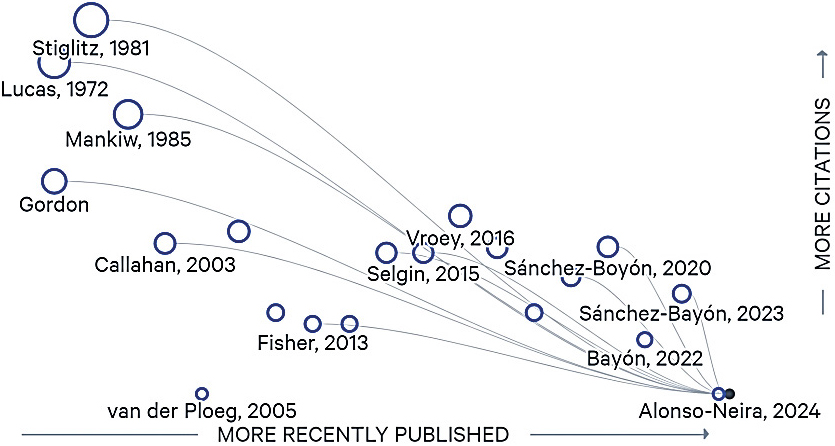
Figure 1.
ALONSO NEIRA’S SUMMARY FOR THE DIALOGUE BETWEEN SCHOOLS OF THOUGHT
Source: Litmaps, 2025.
His main areas of research include: monetary policy, economic and financial cycles, exchange rate crises, financial transaction taxes and national security. However, this review will focus exclusively on his work relating to the Austrian Business Cycle Theory (ABCT) and the macroeconomics of capital.
2.3. Search for studies and selection for inclusion
Following the COSI method (Bidwell & Jensen, 2004), we will distinguish between three levels of search:
— CORE: articles in indexed databases (WoS, Scopus), literature reviews and relevant reviews.
— STANDARD: direct contact with experts, manual search of key journals.
— IDEAL: direct access to the author’s complete body of work. In this case, we have received direct support from Professor Alonso Neira, who has provided us with works not available in traditional databases.
From Professor Alonso Neira’s entire body of work, the following publications have been selected (in chronological order, based on their thematic relevance and impact factor) for inclusion (see Table 1).
Table 1.
PUBLICATIONS BY RELEVANCE AND IMPACT
| Alonso Neira, M.A. (2004). “A guide to the study of the macroeconomics of capital.” Market Processes: European Journal of Political Economy, 1(1): 113–186 |
| Alonso Neira, M.Á. (2005). “Monetary theories of the business cycle within the framework of the literature on economic cycles.” Libertas, 12(43): 1–28. |
| Alonso Neira, M.A., Bagus, P. & Rallo Julián, J.R. (2011). “Theories of the business cycle: main contributions and analysis in the light of the insights of the Austrian School of Economics.” ICE, Revista De Economía, 1(858): 71–87. |
| Alonso Neira, M.Á., Bagus, P. & Rallo Julián, J.R. (2011). “The subprime crisis in the light of the Austrian theory of the business cycle: credit expansion, decision-making errors and moral hazard.” Journal of World Economics, 28, 145–174. |
| Alonso Neira, M.Á., Bagus, P., & Rallo Julián, J.R. (2012). “The first global financial crisis of the 21st century: Origins and proposals for reform. An Austrian approach.” Interdisciplinary Journal of Economics and Business Law, 2 (1), 51–80 |
| Alonso Neira, M.A. (2013). “The Austrian theory of the business cycle in mainstream academic literature.” Market Processes: European Journal of Political Economy, 10(2): 463–464 |
| Alonso Neira, M.Á., Bagus, P. & Romero Ania, A. (2013). “An empirical illustration of the Austrian theory of the business cycle: the case of the United States, 1988–2010.” Investigación Económica, 72(285), 41–74. |
| Alonso Neira, M. Á. (2021). “A guide to the study of the macroeconomics of capital: Are there reasons to believe that recessionary cycles are the result of political and business errors?” Market Processes: European Journal of Political Economy, 18(1) |
| Alonso Neira, M. Á., Sánchez-Bayón, A., & Castro-Oliva, M. (2023). “Austrian Theory of the Business Cycle Applied to the Spanish Case: From the Introduction of the Euro to the Great Recession and Recovery.” Journal of Quantitative Methods for Economics and Business, 35, 280–310. |
| Alonso Neira, M.A., Sánchez-Bayón, A. & Castro-Oliva, M. (2023). “An Heterodox History of the Spanish Economy in the Eurozone: An Austrian School of Economics Analysis of Boom and Bust.” *Forum Scientiae Oeconomia*, 11(2), 9–41 |
| Alonso Neira, M.Á. & Sánchez-Bayón, A. (2023). “The yield curve as a leading indicator of recession: Austrian economics insights.” Panoeconomicus, 72(4): 501–524. https://doi.org/10.2298/PAN230217018A |
| Alonso Neira, M.Á. & Sánchez-Bayón, A. (2024). “The Spanish boom-bust cycle within the euro area: Credit expansion, misallocations of capital and recession (2002–2014).” Politická ekonomie, 72(4), 597–625. DOI: 10.18267/j.polek.1429 |
| Espinosa, V.I., Alonso-Neira, M.A., & Huerta de Soto, J. (2023). “The central banking system paradox.” Economics and Sociology, 16(4), 56–72. doi:10.14254/2071-789X.2023/16-4/3 |
| Espinosa, V. I., Alonso-Neira, M. A., & Huerta de Soto, J. (2023). “The Ethics of the Fractional-Reserve Banking System: A Private Property Rights Approach.” Economies, 11(9), 221. https://doi.org/10.3390/economies11090221 |
| Martínez Fernández, I., Alonso Neira, M. Á., & Palma Martos, L. (2023). “Disaggregated savings: Some implications for a capital-based macroeconomic framework.” Cuadernos de Economía, 42(88), 43–60 |
3. Results and discussion
3.1. Theoretical articles
The following articles are reviewed below (drawn from the table above and organised according to their internal logic in the development of theoretical frameworks), based on their contribution to the aforementioned updated synthesis of TACE and the advancement of the Macroeconomics of Capital, as well as to foster dialogue between schools of thought (promoting a better understanding of Austrian theory).
‘A guide to the study of the macroeconomics of capital’ (Alonso Neira, 2004): This article begins by highlighting two opposing approaches that have historically been followed in the study of macroeconomics: the macroeconomics of perversity and the macroeconomics of perfection. As the professor states, the former is linked to Keynesian theory and rejects the possibility that the allocation of resources can occur efficiently through the market economy, urging the relevant government authority to intervene in the economy. On the other hand, the latter encompasses theories that recognise the ability of markets to allocate resources efficiently, alongside the rational expectations of individuals.
According to the academic consensus, it therefore seeks to reconcile the two approaches: the short-term rigidities caused by involuntary unemployment in the short run with long-term flexibility and full employment, and the joint movement of investment and consumption in the Keynesian short run. However, Professor Alonso Neira draws on a well-known quotation from *Human Action* (Mises, 1949) to highlight the artificial nature of the division between the long term and the short term. The macroeconomics of capital is presented as the tool that provides us with an analytical framework which justifies the efficiency of markets whilst also detailing the contingencies that could cause them to fail.
Sections III and IV set out the fundamentals of the macroeconomics of capital, drawing on Roger Garrison’s (2001) graphical approach. Firstly, economic production is conceived as a dynamic process that arises from spontaneous order and is represented by the Hayekian triangle. Emphasis is placed on the intertemporal nature of capital and how investment affects future output. Secondly, the role of the loanable funds market and the interest rate is highlighted. In this market, suppliers and demanders of funds with different time preferences interact; this relationship is expressed by the interest rate, which may potentially be distorted as a result of central bank intervention. Thirdly, a clear distinction is therefore drawn between sustainable and unsustainable growth, based on the criterion of an increase in the real savings of economic agents. Finally, the professor illustrates the consequences of artificially low interest rates, namely an unsustainable economic structure that inexorably leads to forced saving and an extremely harsh process of liquidation and adjustment.
In Section V, the professor elaborates on the distinction between sustainable and unsustainable growth, once again emphasising the role of interest rates. If interest rates are free from state manipulation, they reflect economic agents’ time preference between present and future consumption, thereby enabling an appropriate allocation of resources. Conversely, manipulation of interest rates leads to a lack of coordination in business decisions, distorting economic agents’ perception of risk. In Section VI, he provides an extensive review of business cycle theory.
Finally, in Section VII, Professor Neira prescribes a series of measures that should be adopted in line with the fundamentals of the macroeconomics of capital. The starting point is the prevention of recessionary cycles by avoiding monetary manipulation. Subsequently, in the event of an inevitable recession, the professor advocates mitigation based on natural market adjustment. Alonso Neira highlights the importance of avoiding expansionary policies during a recession and of establishing a sound institutional framework. The professor then lists a series of specific recommendations for economic policy, primarily fiscal stability, public debt reduction, and economic and financial education. Finally, he asserts that the role of the state must be to facilitate, not to direct. Government interference in prices, wages or interest rates only exacerbates intertemporal misalignments and prolongs crises; according to the professor, the priority must be a flexible market that allows for rapid adjustments. In Chapter VIII, the entire theoretical framework is illustrated with a series of examples, specifically the recessions in Japan, the United States of America and Germany.
‘Theories of the Business Cycle: Main Contributions and Analysis in the Light of the Contributions of the EA’ (Alonso Neira et al, 2011): This paper conducts an in-depth review of business cycle theories, beginning with their conceptualisation and classification into exogenous and endogenous business cycle theories.
The authors begin their historical review with John Maynard Keynes’s most famous work, The General Theory of Employment, Interest and Money (Keynes, 1936). The Keynesian system emerged as a counterpoint to Say’s law. According to the authors, Keynes viewed cycles as the result of variations in investment expenditure caused by fluctuations in marginal efficiency. The waves of euphoria and depression brought about by Keynes’s ‘animal spirits’ (1936) give rise to self-fulfilling prophecies. When optimism becomes widespread, the expected marginal efficiency of capital increases. However, as this increases, bottlenecks arise; consequently, optimism is succeeded by a wave of pessimism that drives up unemployment and undermines consumption. The authors then describe the expansion of Keynesian-inspired mathematical models from the 1930s onwards. Notable among these are Harrod (1936), Samuelson (1939) and Hicks (1950). These models were characterised by a clear bias in favour of state intervention in response to market failure.
The text then covers the discovery of the Phillips curve. In 1958, W. Phillips observed an inverse relationship between the unemployment rate and the rate of wage growth in the British economy. As the authors point out, the discovery of the inverse relationship between price inflation and unemployment served as a justification for the use of aggregate demand policies. Reactions from academics were not long in coming. The article divides these into those led by Phelps (1967) and Friedman (1968), proponents of a Phillips curve augmented by expectations, and those led by Lucas (1972) and Sargent-Wallace (1975). The latter camp would advocate an alternative expectations model. The rational expectations mechanism
The authors then introduce rational expectations models. Business cycle models developed up to the early 1970s were based on the assumption that economic agents made their decisions according to overly simplistic expectation-formation mechanisms. These considerations led to the development of the rational expectations approach, according to which agents use all available information—including relevant economic theory—to form their forecasts. It is assumed that they process information appropriately and that their predictions coincide with those of standard economic models. However, from that point onwards, business cycle theory split into real business cycle models and monetary business cycle models with rational expectations.
The authors then set out the Austrian approach to the endogenous monetary cycle. As the authors explain, ‘the Austrian approach explains that recurring cycles of boom and recession are the result of credit expansion processes carried out by a fractional-reserve banking system. Credit expansion without prior backing from real savings leads to artificially low interest rates, which cause a misalignment between the intertemporal decisions of producers and consumers, resulting in excessive investment in longterm projects that the market will be unable to absorb. Consequently, the productive structure suffers significant distortions that do not correspond to the availability of resources or to consumer preferences, and must ultimately readjust to them”.
Finally, one of the article’s most significant contributions lies in its critique of the Keynesian (and Friedmanian) theory of the business cycle, set out in the epilogue. Keynes regards the interest rate as a purely monetary phenomenon. As he sets out in his General Theory, the interest rate is conceived as the price of liquidity (with particular attention to speculative demand for money in anticipation of higher bond prices). However, the authors insist that the interest rate is, ultimately, an indicator of economic agents’ time preference. In an economy with real savings, a low interest rate would indicate a reduced time preference on the part of its participants. The problem arises when rates fall as a result of monetary easing. Investment in capital goods expands as if real savings had increased, when this need not necessarily have happened. All of this will lead to a distressing period of liquidation and adjustment of bad investments.
“The Austrian Theory of the Business Cycle in Mainstream Academic Literature” (Alonso Neira, 2013): this is a brief update on the academic research carried out by Professor Alonso Neira. In this update, he notes that the Austrian Theory of the Business Cycle (TACE) has attracted considerable interest in the wake of the 2008 financial crisis. In this compilation, the professor lists a series of works by mainstream n economists that align with the fundamentals of the Austrian Business Cycle Theory. Among others, he mentions Caballero (2010), Leijonhufvud (2009) and Ohanian (2010).
In between, there are other publications by Prof. Alonso Neira on TACE, but it is not until the following one that a greater maturity of approach becomes evident.
“The Ethics of the Fractional-Reserve Banking System: A Private Property Rights Approach” (Espinosa et al, 2023): As stated at the beginning of the article, the Fractional-Reserve Banking System (FRBS) is “one of the main phenomena in banking history and predominates worldwide”. Despite the approval it receives from the academic consensus, the FRBS raises numerous questions. The stated aim of the article is to explore the main economic, legal and ethical factors behind the FRBS from the perspective of private property rights.
This is followed by an extensive review of recent literature on the fractional reserve banking system and its economic sustainability. We are made aware of the intellectual clash between traditional approaches and the Austrian School. Whilst the former extol the virtues of credit expansion facilitated by the FRBS and regulated by central banks, the Austrian School criticises the practice, highlighting the misalignment of incentives it entails amongst economic agents.
The authors then present an ethical framework based on private property rights and the principle of non-aggression. They argue that, as a consequence of the creation of money ex nihilo and the phenomenon of double availability, the FRS violates private property rights by enabling multiple parties to hold rights over the same funds. Economic sustainability is closely linked to the protection of private property, as it fosters capital accumulation and sustainable growth based on real savings.
Subsequently, the economic, legal and ethical factors underlying the SBRF are examined. These can be summarised as follows. Economically, it gives rise to boom-and-bust cycles by artificially expanding the money supply (as illustrated by the Austrian Theory of the Business Cycle). Legally, it infringes on depositors’ rights by failing to honour their expectations and effectively turning them into borrowers. Ethically, it argues that the FRBS perpetuates a coercive structure by relying on central bank backing to prevent collapses. Furthermore, in the fifth section, the professor outlines a series of dilemmas related to the SBRF, namely: the full availability of deposits, maturity mismatches and hybrid contracts.
Finally, the authors conclude by summarising the legal, economic and ethical arguments against the SBRF and the need to “rethink the practical implications of the banking system from the perspective of the ethics of private property”. They emphasise that the application of a 100 per cent reserve ratio entails a shift in mindset in favour of private property, which would subsequently legitimise policy reforms aimed at ending fiat inflation, amongst other consequences (although this is not actually the case, Sánchez-Bayón et al, 2023 and 2024).
This is a robust critique of the fractional reserve banking system, emphasising the breach of contract which, as already noted, turns depositors into borrowers by exploiting the monetary nature of the deposited funds. Furthermore, this mechanism encourages artificial credit expansion, which, as the TACE illustrates, fuels the manic-depressive behaviour of the economy.
‘Disaggregated savings: Some implications for a capital-based macro framework’: The article begins by presenting the heated debate between the homogeneity and heterogeneity of savings, which is closely linked to the debate on the nature of capital. Following these considerations, two opposing views are presented. The first defines capital as homogeneous and self-reproducing, whilst the second defines it as a structure or pattern of combinations of heterogeneous and consumable goods.
The article builds on the work of Bagus and Howden (2010) regarding the implementation of a framework for disaggregated monetary savings in line with the position of the Austrian School of Economics. As the authors state, the main ideas behind the constraints on growth were established by Hayek, who highlighted the complexity of capital goods arising from the complementary nature of the relationship between the supply of saved capital goods and the demand for investment in capital goods. The article makes two contributions to the existing literature. Firstly, it defines and incorporates the sub-level of real savings based on the availability of unconsumed income. Secondly, it contributes to the study of the TACE through capital-based macroeconomics, following the approach of Roger Garrison (2001).
The first section, ‘Savings and its embodiments’, addresses the concept of heterogeneity in savings. According to the authors, different forms of savings have varying impacts on the economy. Their position is that capital-based macroeconomics must incorporate this heterogeneous approach when modelling the intertemporal dynamics of production and consumption, distinguishing between real and artificial savings. Subsequently, the second section, ‘The differential market signals of savings’, explores in greater depth the different market signals generated by the various forms of savings. The role of the interest rate as an indicator of economic agents’ time preference is once again highlighted, a role that is distorted in scenarios of monetary laxity. Finally, ‘Reassessing Garrison’s analysis’ proposes a re-evaluation of the graphical tools used by the American author to better incorporate the complexity arising from the heterogeneity of capital.
In short, the categorisation of the different types of savings strengthens the argument that the interest rate is distorted as an indicator of economic agents’ time preferences. The Wicksellian natural rate is lost amidst the vast mass of artificial savings generated by the credit expansion characteristic of loose monetary policies.
3.2. Empirical articles
This section covers the articles in which Professor Alonso Neira, together with other authors, empirically illustrates the TACE and the Theory of Capital, thereby facilitating a better understanding of the theoretical frameworks, as well as providing evidence that connects these theories to reality, which in turn aids dialogue with other more empirical and mathematically oriented schools of thought (without ever falling into their reductionist and instrumental trap, Sánchez-Bayón et al., 2023 and 2024). The articles are systematised below according to their time period, countries analysed, empirical method, variables, theoretical model, conclusions and main critical approach. The systematisation is as follows:
| Title | Time Period | Countries Analysed | Empirical Method | Variables | Theoretical Model | Conclusions | Main Critical Approach |
|---|---|---|---|---|---|---|---|
| “The Central Banking System Paradox” | Q1 1975 – Q4 2022 | United States of America | Granger causality test VAR Model Hysteresis Response Function (HRF) | True Money Supply (TMS), annual real GDP growth as a proxy for the US economic cycle | Austrian Business Cycle Theory (ABCT) | The article uses data from the United States of America between 1975 and 2022 and analyses how changes in the TMS are directly related to changes in real GDP. The results demonstrate that the TMS plays a significant role in explaining the different phases of the business cycle | The stability-efficiency paradox of central banks |
| “The subprime crisis in the light of the Austrian Business Cycle Theory” | 2000–2008 | United States of America | Conceptual review and descriptive analysis | Credit expansion, asset prices, interest rates | Garrison’s model (production possibility frontier, loanable funds market and Hayekian triangle) Austrian Theory of the Business Cycle | As the authors point out, the Austrian approach maintains that the origin of the subprime crisis does not lie in the bursting of the property bubble, but rather in the capital structure brought about by the artificial credit expansion resulting from loose monetary policies. | Intertemporal misalignment and moral hazard in loose monetary policies |
| “The Spanish Boom-Bust Cycle Within the Euro Area: Credit Expansion, Malinvestments and Recession” | 2002–2014 | Spain | Granger causality test Information criteria: AIC, HC, SIC, LR test and final prediction error Models with Almon’s distributed lags | Degree of monetary policy accommodation by the ECB Effect of monetary policy on the term structure of interest rates A proxy for the Spanish production structure Aggregate economic activity in Spain | Capital-based macroeconomics Austrian Theory of the Business Cycle | Granger causality tests show that the cyclical behaviour of the M3 monetary aggregate gives rise to changes in the slope of the Spanish yield curve Furthermore, as the authors point out, using Almon’s models, endogenous inflection points were identified in the effect of the yield curve slope on the cyclical behaviour of the Spanish productive structure and aggregate industrial activity, thus revealing that the economic cycle of the Spanish economy from 2002 to 2014 follows the monetary cycle pattern proposed by the Austrian school | Impact of the ECB’s expansionary monetary policy on the Spanish economy |
| “An empirical illustration of the Austrian theory of the business cycle: the case of the United States, 1988–2010” | Q1 1988–Q1 2010 (quarterly data) | United States of America | Granger causality test Almon’s distributed polynomial lag model | Money supply (MZM) and the slope of the yield curve IPI and ratios of sectoral industrial production indices Industrial Production Index gap (IPI/HP trend | Austrian Theory of the Business Cycle Cantillon effect | As the authors point out, the structure of the production process and the behaviour of aggregate output, as represented by the industrial production index, are subject to the influence of monetary laxity Furthermore, ‘it should be emphasised that the differential positive effect on the early stages of the production process resulting from an artificial increase in the slope of the yield curve, tends to be dampened towards the end of the expansionary cycle, even reversing at the onset of the recession. This result would illustrate the existence of self-perpetuating expansion-recession cycles in line with the predictions of the Austrian school’s view of the business cycle.” | he impact of expansionary monetary policies on the structure of production and the behaviour of aggregate demand |
| “Yield curve as a leading indicator of recession: Austrian economics insights” | 1990 – Q1 2020 | United States of America | First-order autoregressive model (VAR(1)) Granger causality test | TMS growth Ten-year three-month yield spread (SPREAD) Net percentage of domestic banks tightening standards for commercial and industrial loans (BANKS) | Austrian Business Cycle Theory Yield curve | Alonso and Sánchez-Bayón contrast the authorities’ control over short-term interest rates with their inability to influence long-term interest rates, which (in line with Wicksellian theory) do reflect the time preferences of economic agents. According to the authors, this is why the slope of the yield curve anticipates the direction and intensity of monetary policy | The yield curve can anticipate the different phases of the business cycle as conceived in the Austrian Theory of the Business Cycle |
4. Conclusion
As has been demonstrated, Prof. Alonso Neira’s contribution has been key to understanding the updated systematisation of Austrian theory, reinforced with empirical illustrations (beyond the Anglo-Saxon world), thereby fostering dialogue with other schools of thought, particularly with mainstream authors, who tend towards a more formalist and instrumental mathematisation, but lacking robust theoretical frameworks with universal appeal (as offered by the TACE and the Theory of Capital, Alonso Neira and Sánchez-Bayón, 2023 and 2024).
In short, the studies analysed provide a series of empirical illustrations of TACE and the Theory of Capital, contributing to the advancement of the Macroeconomics of Capital, not as a branch of General Economic Theory, but as a specialisation within the same research programme (Lakatos, 1978). In particular, it is also consistently observed that monetary policy and artificial credit expansions not based on voluntary savings tend to generate temporary economic booms followed by recessions, thereby distorting productive processes and structures. This behaviour arises as a consequence of a series of over-investment processes not backed by an accumulation of real savings. In many cases, a lack of coordination in the behaviour of economic agents can be observed as a result of a distortion in their perception of risk and a distortion of the information system provided by the economy’s relative price structure. Furthermore, financial indicators such as the slope of the yield curve emerge as leading indicators of these cycles, confirming that an excessively loose monetary policy sows the seeds of a subsequent downturn.
The studies reviewed utilise modern econometric techniques (e.g. VAR, Granger causality, cointegration, distributed lag models), enabling the quantification of effects, but without imposing themselves on theoretical frameworks, as they merely aim to illustrate these frameworks in order to substantiate their arguments. In general, the quantitative results (statistical significance of causal relationships, magnitude of estimated responses, etc.) support the central hypothesis of TACE: central bank interventions in interest rates have consequences (usually negative externalities) for the real economy, as they alter the behaviour of economic agents (who respond to perverse incentives, such as an artificially low interest rate), leading to poor investment decisions that inevitably result in correction phases (unless there is further state intervention, which exacerbates the problem in the long term by institutionalising the negative externalities that undermine the economic system). For example, in the case of Spain and the United States, econometric analysis shows that when interest rates fell below their equilibrium level, the proportion of investment in capital goods (construction, durable goods) relative to consumption increased; and, once monetary policy shifted to a contractionary stance, these excessive investments collapsed, causing sharp falls in GDP and aggregate investment.
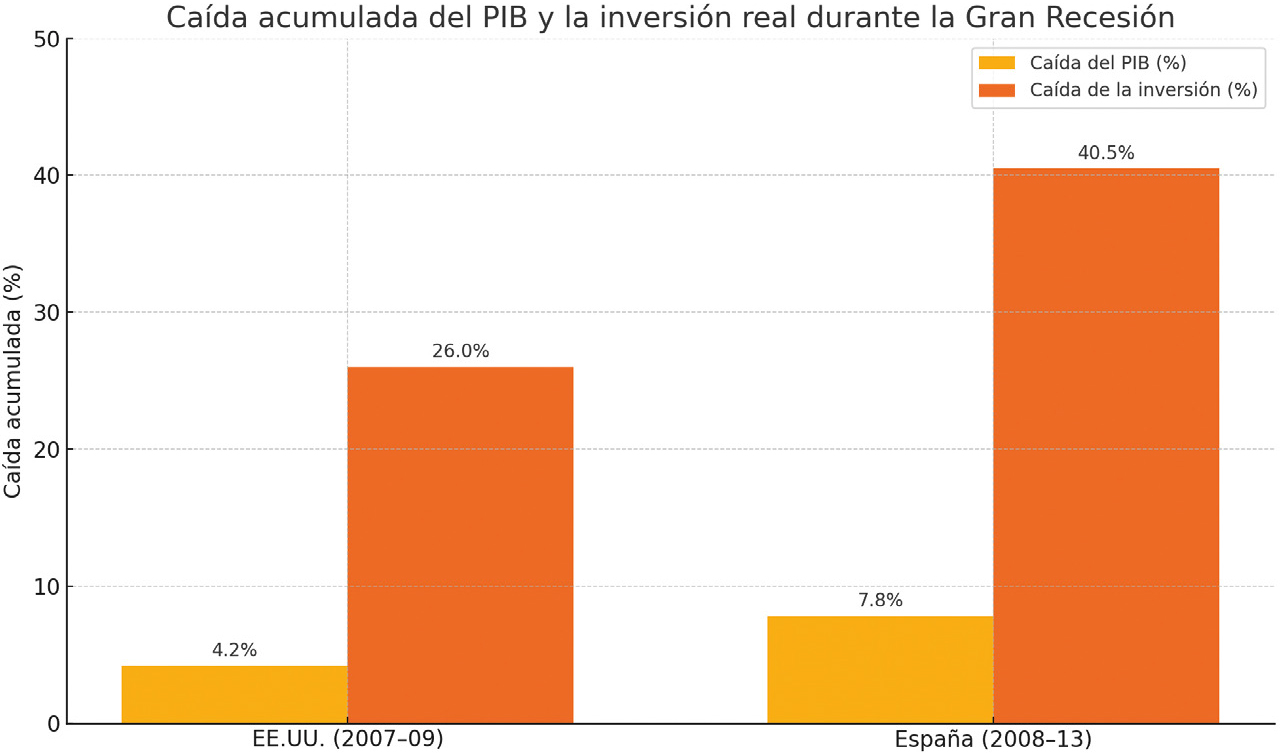
Figure 1.
COMPARISON OF THE CUMULATIVE FALL IN GDP AND REAL INVESTMENT DURING THE GREAT RECESSION IN THE UNITED STATES (2007–2009) VERSUS SPAIN (2008–2013)
Source: author’s own calculations.
The comparative chart above shows that in both the US and Spain, the recessionary phase following the credit boom entailed sharp falls in investment (gross capital formation), exceeding the contraction in GDP, which is consistent with the idea that long-term investment projects (artificially fuelled during the boom) undergo an abrupt adjustment during the crisis. Spain experienced a particularly severe adjustment in investment (a cumulative fall of over 40 per cent) due to the scale of the misalignments generated during the property and credit bubble of the 2000s.
Overall, the theoretical systematisation and empirical evidence compiled by Alonso Neira and his colleagues in the studies analysed serve to reinforce the validity of TACE and the Theory of Capital, whilst also promoting the field of Macroeconomics of Capital and fostering dialogue with other schools of thought, thereby enabling a wider dissemination of Austrian Theory and its analytical foundations.
Notes
[2] Conflicts of interest Conflict of interest
The authors declare that they have no conflicts of interest.
[4] GESCE-URJC (Consolidated Research Group for the Study and Monitoring of the Economic Cycle at Rey Juan Carlos University) and GID TIC-TAC URJC (Consolidated Teaching Innovation Group in Information and Communication Technologies and Learning and Knowledge Technologies for the Improvement of Studies in Economics and Business).