
1. Introduction
Argentina’s economic crisis at the end of 2023 was not merely a monetary crisis. It was the visible culmination of a deeper fiscal and institutional deterioration: persistent public deficits, high and accelerating inflation, fragmented taxation, pervasive price and capital controls, weak contract enforcement, rigid labor institutions, discretionary public spending, and a state sector whose fiscal claims increasingly exceeded the productive capacity of the private economy. These distortions did not emerge in isolation. They reflected a long trajectory of policy instability, interventionism, fiscal dominance, and recurring emergency governance, in which successive governments attempted to contain the symptoms of economic decline through controls, subsidies, monetary expansion, and discretionary redistribution rather than through durable institutional correction.
The election of Javier Milei in 2023 marked a rupture not only in Argentine politics, but also in the fiscal logic through which Argentina’s crisis could be interpreted. Public attention has often focused on Milei’s monetary proposals, above all dollarization and the abolition of the Banco Central de la República Argentina. Yet the early reform sequence after December 2023 cannot be understood through monetary policy alone. Before full monetary normalization could occur, the government attempted to alter the fiscal and real-side foundations of the economy: reducing the fiscal deficit, shrinking the public sector, cutting subsidies, limiting discretionary federal transfers, reorganizing selected taxes, restoring greater contractual freedom in several markets, and preparing or initiating privatization in state-dominated sectors. The central question is therefore not only whether Argentina could stabilize its currency, but whether fiscal consolidation could become credible in an economy long characterized by deficit monetization, political discretion, and structurally weak public finances.
This paper examines Argentina’s fiscal consolidation under Javier Milei from December 2023 to 2026, while treating structural liberalization as a supporting institutional condition of fiscal adjustment. It analyzes how the Milei administration attempted to restore fiscal credibility through expenditure restraint, public-sector retrenchment, subsidy reduction, federal-provincial realignment, tax reorganization, debt management, and privatization initiatives. Labor-market reform, rental and land-market deregulation, and broader liberalization measures are included only insofar as they affect the fiscal adjustment process: by influencing public expenditure, formalization incentives, investment conditions, relative-price correction, or the capacity of the private sector to absorb resources released from the state sector.
The paper’s guiding research question is: How did the Milei administration attempt to restore fiscal credibility in Argentina after December 2023, and what early evidence exists regarding the mechanisms, limits, and institutional constraints of this consolidation? The argument is not that Argentina had already achieved a fully consolidated liberal economic order by 2026. Rather, the paper evaluates whether the reform architecture was internally coherent, whether the fiscal adjustment was institutionally plausible, and whether early indicators point toward a mechanism of transition away from discretionary crisis management toward harder budget constraints.
Conceptually, the paper treats fiscal consolidation and selected structural liberalization measures as mutually reinforcing rather than separate reform fields. Fiscal consolidation reduces the need for monetary financing, debt monetization, financial repression, and politically allocated credit. Structural liberalization, in turn, can improve the informational role of prices, lower barriers to entry, strengthen contractual autonomy, and broaden the space for private-sector adjustment. Without fiscal consolidation, deregulation remains vulnerable to reversal because governments under deficit pressure tend to reintroduce controls, taxes, subsidies, and discretionary interventions. Without at least some structural liberalization, fiscal austerity risks remaining a purely contractionary exercise, because the private sector may be too constrained to absorb labor, capital, and entrepreneurial initiative released from the public sector. The interaction between these two reform dimensions is therefore central to understanding the Milei administration’s early fiscal strategy.
The paper is situated within an institutional and Austrian political-economy perspective. Argentina’s long-run stagnation is interpreted not only as a problem of aggregate demand management or temporary policy error, but as a consequence of distorted incentives, unstable rules, weakened property rights, fiscal illusion, and the erosion of monetary and contractual credibility. From this perspective, inflation is not only a price-level phenomenon but also a manifestation of fiscal dominance and institutional weakness. Similarly, labor-market rigidity, rent controls, export taxes, state-owned enterprises, and discretionary federal transfers are not isolated policy instruments, but components of a broader system that suppresses market coordination and shifts resources toward politically protected uses. Fiscal consolidation under these conditions is therefore not merely an accounting exercise; it is an institutional attempt to change the constraints under which political actors, public agencies, provinces, firms, and households make decisions.
Methodologically, the article adopts a descriptive and institutional case-study approach. It reconstructs Argentina’s fiscal consolidation under Javier Milei by combining official fiscal and labor-market statistics, legal and policy documents, reform decrees, government communications, contemporaneous reporting, and secondary economic analysis. The paper does not seek to provide econometric causal identification. Given the short observation period, the simultaneity of fiscal, monetary, regulatory, and political reforms, and the recessionary adjustment context, the evidence is interpreted cautiously. The analysis therefore focuses on reform sequencing, institutional mechanisms, internal consistency, political constraints, and early observable outcome patterns. Its conclusions are best understood as institutionally suggestive rather than causally conclusive.
The contribution of this paper is threefold. First, it provides an early fiscal-institutional account of Milei’s consolidation strategy, focusing on how the government attempted to replace deficit monetization and discretionary fiscal federalism with a harder-budget-constraint regime. Second, it connects expenditure restraint, subsidy cuts, public-sector retrenchment, tax reorganization, debt management, and privatization within a single framework of fiscal credibility. Third, it showcases why selected structural liberalization measures matter for fiscal consolidation: not as a separate reform narrative, but as part of the institutional environment that determines whether austerity can move beyond short-term expenditure compression toward durable fiscal adjustment.
The findings suggest that Milei’s early reform package was fiscally coherent and produced several observable short-term effects: a rapid primary fiscal turnaround, significant public-sector retrenchment, lower subsidy burdens, reduced discretionary transfers, selected tax simplification, and a political shift toward privatization and expenditure discipline. At the same time, the results remain incomplete and politically fragile. The adjustment was accompanied by recessionary costs, social strain, employment losses in several sectors, high poverty during the initial shock, and continuing legislative constraints. Moreover, several reform areas remained partial, delayed, or dependent on further congressional support. The paper therefore distinguishes between fiscal correction, fiscal credibility, and fiscal consolidation: the first can occur quickly through cuts, the second requires institutional trust, and the third depends on whether the new constraints become durable.
The remainder of the paper is structured as follows. Section 2 reconstructs Argentina’s fiscal preconditions before Milei, including the historical roots of deficit finance, fiscal instability, and interventionist crisis management. Section 3 examines Milei’s government, political mandate, fiscal reform strategy, and selected structural measures insofar as they support fiscal consolidation. Section 4 analyzes the core fiscal consolidation program, including expenditure cuts, subsidy removal, federal–provincial realignment, tax changes, debt constraints, and privatization initiatives. Section 5 discusses implications for Argentina and further research through an institutional and Austrian political-economy lens, with particular attention to fiscal dominance, hard budget constraints, public choice, price signals, and the analytically separate question of monetary restabilization. Section 6 concludes.
2. Argentina’s Fiscal Preconditions
“No hay plata.” With this blunt verdict – there is no money – Javier Milei set not only the tone of his inaugural address (Casa Rosada 2023), but his presidential platform to overcome Argentina’s prior inflationary and interventionist fiscal model by replacing decades of deficit finance, discretionary redistribution, and monetary accommodation with market discipline and institutional constraints. This section reconstructs the historical and fiscal preconditions that shaped Argentina before Milei’s ascent to power. It does not provide a full economic history of the country, but does rather focus on the gradual emergence of the institutional pattern that became central to Argentina’s pre-2023 predicament: recurrent fiscal imbalance, monetary financing, interventionist controls, weak property-rights credibility, and a state sector whose political commitments increasingly exceeded its sustainable revenue base.
2.1. Historical Roots of Argentina’s Fiscal and Institutional Predicament
The Rise of Argentina’s Economy
At the beginning of World War I, Argentina ranked among the world’s wealthiest nations, benefiting from sustained growth, institutional modernization, and integration into global trade (Spruk 2019, p. 1). Since its 1853 Constitution, it had developed into a largely laissez-faire economy with a strong central government and comparatively secure property rights, giving rise to the “Belle Époque” as a period of particularly high economic growth (Spruk 2019, p. 4). Argentina attracted many European immigrants in the late nineteenth and early twentieth centuries, drawn by its economic opportunity and political stability (Spruk 2019, pp. 4, 5; Bagus 2024, p. 43). As rule of law and security of property supported both robust economic growth and political stability (Schnabl 2025), the country became a quintessential symbol of modern prosperity, even entering contemporary European sayings such as “riche comme un Argentin” (“rich as an Argentine”) (Bagus 2024, p. 43). Bolt et al. (2018) recorded that in 1896 Argentina even ranked first globally in income per capita and that the country was consistently placed among the world’s wealthiest nations until the 1920s.
This high-income level was sustained by agricultural exports, foreign capital inflows, and an increasingly globalized trade system (Bagus 2024, p. 44). In the early twentieth century, Argentina was widely regarded as the “breadbasket of the world,” exporting beef, wheat, and maize, mainly to Great Britain as its largest trading partner and investor (Cortés Conde 2009, p. 15). At its peak, the combined value of exports and imports exceeded 100% of GDP (Bagus 2024, p. 44). Argentina’s early prosperity was therefore closely linked to relatively open markets, external capital, and an institutional environment in which private production and international exchange could expand.
From Prosperity to Interventionism
The “Golden Age” of relatively open markets and abundant external capital ended during the Great Depression and the increasingly unfavorable terms of trade of the 1930s. In 1930, a military coup initiated a political shift toward economic autarky as well as centrally planned and state-led economic development (Spruk 2019, p. 5). Import-substitution industrialization was promoted through subsidies to domestic industries at the expense of agriculture, accompanied by rising public spending and an increasingly interventionist state. In 1935, the Argentine Central Bank was established, modeled on the Bank of England, while the gold standard, which had been de facto abandoned in 1929, was not restored (Bagus 2024, p. 44). The new monetary framework was intended to counteract peso appreciation from capital inflows and artificially stimulate exports (Bagus 2024, p. 44). Another coup followed in 1943, during which Juan Domingo Perón emerged as Minister of Labor (Spruk 2019, p. 8). After World War II, growth slowed, economic volatility increased, and the fiscal role of the state expanded continuously.
Peronist Fiscal Expansion and Institutional Legacy
Perón’s presidency, beginning in 1946, marked a decisive shift toward interventionism, widely regarded as pivotal in Argentina’s long-term economic decline (Spruk 2019, p. 9). Peronism combined political nationalism, previous autarky aspirations, redistributionism, and corporatist bargaining (Ocampo 2020, p. 6; Bagus 2024, p. 45). Economic isolationism was reinforced through nationalization of companies, railways, and utilities; price and wage controls; close alignment with powerful unions; expanded welfare programs; and import substitution made possible by subsidies and tariffs (Gerchunoff and Díaz Alejandro 1989, pp. 59–60; Bagus 2024, p. 45; Kleinheyer and Schnabl 2025, p. 2). Perón increased the number of people entitled to pension payments from half a million to 10 million (Schnabl 2025).
State-owned or state-directed enterprises increasingly replaced private service provision, crowding out market-based suppliers (Schnabl 2025). This consolidation of economic control was supported by a corporatist alliance between government, unions, and media, concentrating political power and reducing private-sector dynamism. Over time, these policies diverted resources away from Argentina’s areas of comparative advantage, reduced investment incentives, and weakened productivity growth. More importantly for the fiscal trajectory, they created durable spending commitments and politically protected constituencies that became difficult to reverse.
The Peronist mode of cronyist regulation, economic isolation and inflationary finance undermined Argentina’s previous comparative world market advantage in agricultural and resource exports (Bermudez 2024). Protectionist measures shielded domestic industry and fostered dependency on subsidies. To finance expansive welfare programs and increasingly tight labor regulation, Perón relied on a state-controlled banking system that directed credit toward favored industries and state programs. Revenue shortfalls were met through monetary expansion, driving inflation. The resulting environment of persistent inflation eroded productivity and distorted resource allocation (Flossbach von Storch Research Institute 2025, 6:09). Argentina’s first episode of exceptionally high inflation occurred in the 1970s.
Perón remained politically influential for nearly three decades (Bagus 2024, p. 46). Ocampo (2020, p. 5) argues that Peronism continued to shape Argentine political, cultural, and economic life well into the Kirchner era. Perón’s first presidency ended with a coup in 1955 and a ban on the Peronist party. Although some controls were later eased, the central fiscal pattern persisted: deficits financed by monetary expansion, import substitution, export taxes, subsidies, and state ownership remained recurrent tools of economic governance.
When democracy returned under President Raúl Alfonsín (1983–1989), whose policies closely mirrored European social democracy (Bagus 2024, p. 46), half of Argentina’s productive assets were state-owned, leading to chronic inefficiencies, blackouts, and poor service provision (Bagus 2024, p. 46). His presidency ended amid hyperinflation exceeding 3,000%. Argentina’s longterm decline has been linked to weak contract enforcement and insecure property rights, reflected in falling contract-intensive money (Prados de la Escosura and Sanz-Villarroya 2009). Dysfunctional political structures additionally amplified policy volatility and thus hampered entrepreneurial financial planning security (Spiller and Tommasi 2003), while low capital accumulation provided a weak basis for economic growth (Taylor 1992). Misallocation of labor and capital further depressed productivity (Kydland and Zarazaga 2002). These institutional weaknesses have at any time been directly relevant to fiscal stability because as they reduced growth, they also weakened the tax base, in turn increasing fiscal reliance on monetary softening and expansionism.
Convertibility, Fiscal Rigidity, and the 2001 Crisis
President Carlos Menem (1989–1999), though a Peronist, implemented market-oriented reforms, including labor deregulation and privatization, often benefiting politically connected buyers. Inflation, averaging 254% annually from 1972 to 1991 (Ocampo 2021, pp. 13, 17), was halted by the Convertibility Plan of 1991, which pegged the peso to the dollar and limited money issuance to dollar reserves (International Monetary Fund 2004a, p. 3). Inflation fell from 27% monthly in early 1991 to low single digits by 1997, a transformation that later inspired debates on full dollarization and foreshadowed elements of Milei’s agenda (Velde 2000, p. 3).
The 1990s brought growth averaging 7.5% and falling poverty, but fiscal discipline remained incomplete. According to the IMF’s Independent Evaluation Office, Argentina’s fiscal policy initially improved under convertibility, but these gains were not sustained; the consolidated fiscal balance remained in deficit throughout most of the 1990s, and an election-driven increase in public spending in 1999 sharply weakened fiscal discipline (International Monetary Fund 2004b, pp. 14–15). Initial deficits were covered by privatization proceeds and tax increases; later, International Monetary Fund loans filled part of the financing gap (Bagus 2024a, p. 47). While the convertibility regime initially restored monetary stability, fiscal rigidities, inefficient tax federalism, common-pool and procyclical provincial spending patterns, dollar-denominated liabilities, and declining external competitiveness gradually weakened its credibility (Saiegh and Tommasi 1999; Dominguez and Tesar 2005). By 2001, the combination of recession, debt distress, deposit freezes, and social unrest culminated in sovereign default and a rapid succession of presidents (Jonas 2002).
McKinnon’s “order of economic liberalization” theory elucidates why the Menem reform plan went awry: To prove both long term-stable and efficacious, an economic liberalization program not only hinges on the consequent implementation of the three classical pillars of market order restoration – fiscal stabilization, monetary hardening and deregulation/privatization –, but on the specific sequence in which they are implemented. Fiscal stabilization must come first, for a government that still depends on deficits, monetary accommodation, or unstable borrowing cannot credibly sustain monetary hardening. If disinflation is attempted before the budget is stabilized, higher real interest rates and tighter credit conditions can raise the state’s debt-service burden and thereby produce renewed fiscal stress as in the case of the Menem administration. Only after budgetary consolidation, a credible tax system, and banking-sector stabilization can disinflation and monetary restraint become durable; broader market and external liberalization should follow once the monetary regime is no longer undermined by fiscal imbalance (McKinnon 1982, pp. 159–186; McKinnon 1993, pp. 1–10, 55–83). Argentina’s convertibility regime therefore stabilized money more quickly than it stabilized the fiscal foundations on which monetary credibility contingently depended.
The ensuing crisis damaged confidence in monetary institutions and representative politics, reinforcing the long-run pattern of unstable rules, weak property-rights credibility, and recurrent emergency governance that persisted well into the Kirchner era (Barlow and Peña 2022). Thus, the Menem reform episode became central to Argentina’s later political economy. In the eyes of the political establishment it discredited partial liberalization and left subsequent governments with a strong political incentive to yet again return to inflationary finance, controls, subsidies, and discretionary redistribution.
From Kirchnerism to Milei
Kirchnerism (2003–2015) sustained high public spending during a commodity boom, masking structural weaknesses. The public workforce expanded by 1.4 million (Urien 2016), and corruption became emblematic of governance under Kirchnerism (Bagus 2024, p. 49). A short phase of gradual and partial liberalization occurred under Mauricio Macri (2015–2019), but it did not fundamentally resolve Argentina’s fiscal and institutional fragility (Kleinheyer and Schnabl 2025, p. 3). Under Alberto Fernández (2019–2023), inflation reached 50% by 2019. Pandemic policies included the world’s longest lockdown, lasting 234 days in Buenos Aires, contributing to economic contraction and rising poverty (Bagus 2024, pp. 48–49).
By 2023, poverty affected roughly half the population and annual inflation reached 211% (see Figure 1). The central bank’s issuance of high-interest liabilities, financed by money creation, expanded the monetary base by approximately 30% per month (Bagus 2024, p. 51). Milei later claimed that the inherited inflationary dynamic had been equivalent to an annualized rate of approximately 17,000%, referring specifically to wholesale-price inflation: Argentina’s wholesale price index had increased by 54.0% monthon-month in December 2023, which Milei described as moving from “17,000 to 50” when comparing the annualized wholesale inflation rate with later monthly figures (INDEC 2024; Casa Rosada 2024). This should be understood as a political-economic extrapolation rather than observed annual CPI inflation. Nevertheless, it captured the perceived urgency of the situation: Argentina entered the Milei presidency with a fiscal state that had lost credibility, a currency under severe pressure, and a public sector whose commitments could no longer be financed without inflationary or debt-based mechanisms.
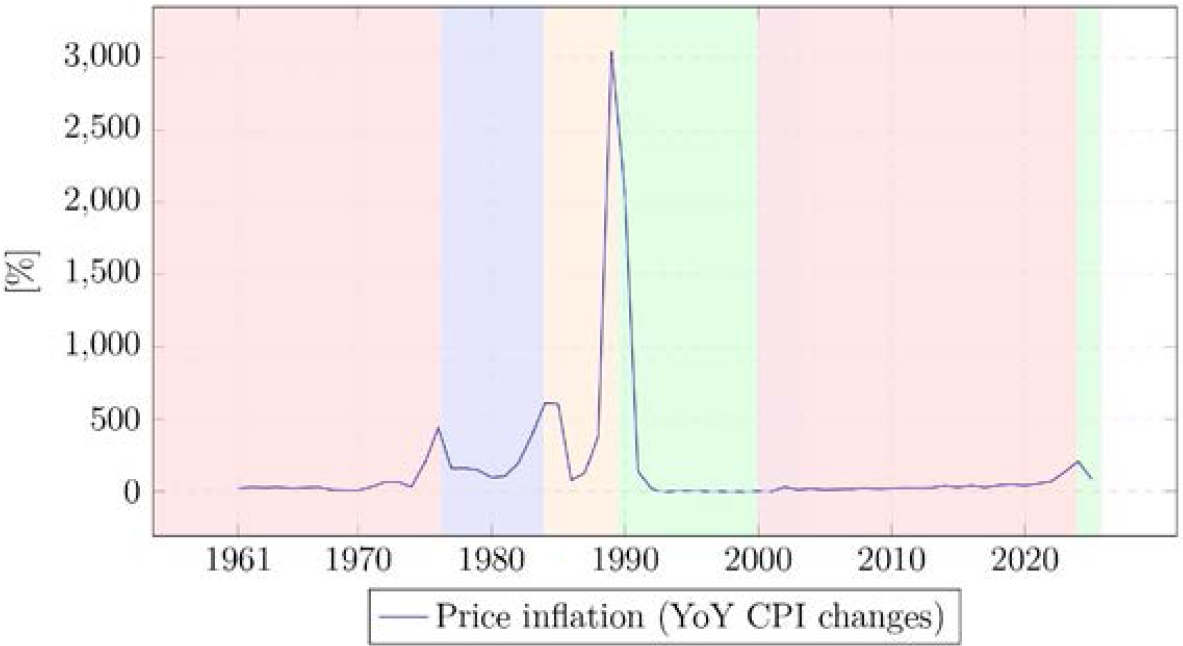
Figure 1:
Argentina’s price inflation from 1961 until 2025 including Perón Era (1946–1976), Military Regime (1976–1983), Alfonsín (1983–1989), Menem (1989–1999), Crisis & Transitional Presidencies (1999–2003), Kirchnerism (2003–2023), and Milei (2023–present)
(Source: World Bank Group (1961-2024), Reuters (2024-2025)).
3. Milei’s Government and Fiscal Reform Strategy
3.1. Fiscal Crisis as Electoral Opportunity
Argentina’s prolonged economic deterioration was central to Milei’s electoral success. Decades of high inflation, declining real wages, stagnant productivity, high tax burdens, price controls, and regulatory rigidity created a perception of structural exhaustion. Between the early 2010s and 2023, Argentina experienced a lost decade of income stagnation. GDP per capita in 2023 was approximately at its 2006 level, while average real per-capita household income was 40% lower than in 2016 (World Bank 2024). Fundar’s Argendata series shows a similar deterioration in labor income: real wages expanded until 2013, stagnated until 2017, and then entered a contractionary phase; by 2023, real wages were 8% below their 1970 level and 30% below their 1974 historical peak (Fundar 2025). Cumulative inflation during the Fernández administration alone exceeded 1,100% (Buenos Aires Times 2024). By the end of 2023, annual inflation reached 211%, poverty affected roughly half the population, and the central bank’s issuance of high-interest liabilities had intensified the link between fiscal imbalance and monetary expansion (Bagus 2024, p. 51).
Inflation was experienced as a hidden tax on workers and savers, disproportionately affecting lower-income groups and those unable to protect themselves through dollarized assets or foreign holdings (Falcone 2024). The loss of confidence in the peso had already led many Argentines to dollarize their savings informally. Milei’s campaign proposals to eliminate the fiscal deficit, cut public spending, dollarize the economy, and close the Banco Central de la República Argentina resonated with a discontent populace as they promised a radical break with the vicious cycle of deficit spending, inflationary finance, and emergency controls.
Additionally, years of economic mismanagement and perceived political privilege had weakened general trust in democratic institutions and established parties. Support for democracy fell from 90% in 2008 to 68% in 2023, a decline of 22 percentage points (LAPOP 2023, p. 14). Bagus (2024a, p. 51) describes a “perfect storm” of strategic errors among traditional parties that opened Milei a path to power as neither of his opponents could credibly embody a full break with Argentina’s fiscal and institutional status quo.
3.2. Political Constraints and the Limits of Executive Reform
The Milei administration’s reform strategy was shaped by severe political constraints. La Libertad Avanza entered government without a stable congressional majority, which limited the scope of immediate legislative reform. This mattered especially for taxation, labor regulation, privatization, and durable institutional changes. Emergency decrees and executive action could initiate reform, but they could not substitute permanently for congressional approval.
The Ley de Bases y Puntos de Partida para la Libertad de los Argentinos — the “Law of Bases and Starting Points for the Freedom of Argentines,” commonly referred to as the Ley Bases — therefore became central to the government’s strategy. It gave the executive greater room to reorganize the state and pursue deregulation, while also revealing the limits of reform under fragmented legislative conditions. Several initial proposals had to be reduced, delayed, or negotiated before they could pass. The fiscal consolidation process was not only an economic adjustment but also a test of Argentina’s institutional capacity to transform emergency stabilization into durable rules.
This distinction is important for evaluating the Milei presidency. A government can produce fiscal correction quickly through cuts, freezes, and emergency measures. Fiscal credibility, however, requires that markets, households, firms, provinces, and political actors believe that the new constraints will persist. Fiscal consolidation, in the stronger sense, requires that the adjustment become embedded in institutions rather than remaining dependent on presidential discretion. The following sections therefore assess Milei’s fiscal reforms not only by their immediate budgetary effects, but also by their mechanisms, institutional constraints, and durability.
3.3. Supporting Structural Conditions for Fiscal Consolidation
3.3.1. Public Employment Retrenchment and Labor-Market Adjustment
A central component of Milei’s fiscal consolidation strategy was the reduction of public-sector employment and the attempt to loosen labor-market constraints that had long limited formal hiring. Argentina’s labor framework reflected a longstanding legacy of Peronism: rigid employment rules, strong union structures, high separation costs, widespread informality, and a dense regulatory environment. Before Milei, Argentina reportedly had around 300,000 laws, decrees, and regulations across multiple areas (Schnabl 2025). For the new administration, labor reform was therefore not merely a supply-side objective. It was also fiscally relevant because an oversized public payroll, rigid labor institutions, and weak private-sector absorption capacity limited the sustainability of expenditure cuts.
Public employment became one of the earliest targets of the austerity program. Since the detailed public-payroll reductions are analyzed in Section 4.1, this subsection focuses on the complementary labor-market question: whether private employment could absorb workers and resources released from state-dependent sectors. The payroll cuts contributed directly to the fiscal turnaround, but they also raised the central adjustment problem of the reform program: whether labor and capital released from the state sector could be absorbed by a private economy still constrained by recession, uncertainty, and inherited regulation.
The private sector initially did not compensate for the contraction. It experienced larger employment losses, with 119,700 jobs reportedly eliminated. Although a modest recovery began in July 2024, it remained insufficient to offset earlier declines (El Cronista 2025). The contraction reflected public-sector downsizing, the suspension of public works, falling demand, and a freeze on new hiring. These developments reversed the post-pandemic unemployment recovery and showed the social costs of an austerity-centered stabilization strategy. For this reason, the labor-market dimension of Milei’s program cannot be separated from fiscal consolidation: public employment cuts improve the budgetary position in the short run, but their long-term success depends on whether private-sector job creation can eventually replace state-dependent employment.
From an Austrian perspective, the reduction of public payrolls can be interpreted as an attempt to reallocate labor away from the distorted state of politically financed employment toward stable market-based activity. Mueller (2024) argues that reducing public payrolls is necessary to enable private-sector expansion through the release of unproductive labor and market reallocation. López (2024) observes that within Milei’s first quarter, 93,000 public jobs had been eliminated, with further reductions planned, alongside the elimination of 200,000 social programs and public works. Yet state functions continued and even generated three consecutive fiscal surpluses, which he interprets as evidence of prior over-bureaucratization. Cachanosky (2024) similarly argues that multigen-erational unemployment, fostered by an expansive welfare state and institutional decay since the 2001 crisis, entrenched dependence on state provision and weakened incentives to work.
Labor-market reform was intended to complement this fiscal retrenchment by lowering barriers to formal hiring. One of Milei’s first reform instruments was the omnibus Decreto de Necesidad y Urgencia (DNU) 70/2023, which declared a broad economic emergency and introduced labor-regulation reforms (Urieta 2024). However, the labor provisions of the decree were suspended and later struck down by the national labor court in January 2024 on constitutional grounds (Urieta 2024). The administration then reintroduced a narrower version through the omnibus reform law Ley de Bases y Puntos de Partida para la Libertad de los Argentinos.
After congressional negotiations, the labor chapter was reduced from 60 to 14 articles. The final version retained provisions aimed at easing formal hiring while dropping several union and benefit reforms (Urieta 2024). Enacted in July 2024, as Law 27.742, the reform included several measures relevant to employment costs and formalization (Funes de Rioja and Barbieri 2024; Urieta 2024). Probationary periods were extended from three to six months for large firms and to eight or twelve months for smaller firms. Employers were allowed, subject to collective bargaining, to replace traditional severance obligations with fixed payments, savings funds, or insurance-based systems. A regularization program forgave up to 90% of social security debts to incentivize formalization. Registration procedures were simplified, and a new “independent collaborator” category allowed freelancers to hire up to three assistants without creating a standard employment relationship. Additional provisions clarified contractor status, enabled severance insurance, increased compensation for discriminatory dismissals, and removed some punitive damages in order to reduce litigation risks.
These reforms were fiscally relevant in three ways: first, by encouraging formalization, they had the potential to broaden the contribution and tax base. Second, by lowering expected dismissal and litigation costs, they could improve the capacity of firms to absorb labor after public-sector retrenchment. Third, by weakening the structural dependence of employment on state payrolls and public works, they supported the broader shift from deficit-financed employment toward market-based job creation. The fiscal effect was therefore indirect, but important: austerity could become more durable if private employment expanded under less rigid labor conditions.
The evidence remained mixed. The government cited a 19.2% real wage increase for registered private-sector workers since December 2023 until August 2025, while independent estimates placed the increase closer to 3% (Chequeado 2024). Net job creation remained limited, as the economy contracted through 2024 and unemployment data showed only modest improvements. Bagus (2024b) supports the reforms, citing inherited conditions of high poverty, an oversized public sector, and rapid inflation, and views labor liberalization as a necessary complement to monetary and fiscal stabilization. Yet the short-term data suggest that labor reform could not immediately offset the employment losses caused by recession, public works suspension, and public-sector downsizing.
Union power remained a further institutional constraint. For more than seventy years, Argentina had maintained a corporatist labor system in which powerful unions controlled important parts of labor supply and policymaking (Vásquez 2025). Law 27.742 allowed employers and unions to opt into a funded severance indemnity system through collective bargaining, replacing statutory severance pay with employer-funded insurance or separation funds (Funes de Rioja and Barbieri 2024). The stated aim was to reduce labor disputes and integrate informal workers into the formal sector. Major unions responded with a nationwide strike on May 9, 2024, and mass protests during the Senate debate in June, some of which turned violent (Reuters 2024b). The International Monetary Fund welcomed the approved labor reform, noting that lower dismissal costs, easier probationary contracts, and formalization incentives should support job creation and productivity over time (International Monetary Fund 2024, p. 20).
Overall, labor-market reform and public employment retrenchment formed an essential bridge between fiscal austerity and structural adjustment. Public payroll cuts contributed directly to expenditure reduction, while labor liberalization sought to make the private sector more capable of absorbing workers and sustaining a lower-spending fiscal regime. However, this bridge remained fragile. In the short term, the adjustment increased social pressure and did not immediately generate strong net employment gains. The success of this ongoing reform area therefore depends on whether fiscal consolidation can be accompanied by sufficient private-sector recovery, formalization, and institutional durability.
3.3.2. Real-Asset and Resource-Market Deregulation as Supporting Conditions of Fiscal Consolidation
In parallel with labor-market reform and public-sector retrenchment, the Milei administration pursued deregulation in real estate, rental, land, resource, and investment-related markets. These reforms were not fiscal measures in the narrow budgetary sense. However, they were relevant to fiscal consolidation because they aimed to restore property rights, remove price distortions, attract private capital, reduce administrative burdens, and expand the productive base from which future fiscal stability would have to arise. In a country where recurrent deficits had often been managed through controls, subsidies, and discretionary intervention, deregulation was presented as a necessary institutional complement to expenditure restraint.
Housing and Rent Deregulation
One of the earliest reforms under DNU 70/2023 was the repeal of the 2020 Rental Law, which had mandated three-year leases and capped annual rent adjustments. The repeal returned the sector to freer contracting, allowing leases of varying duration, flexible rent adjustments, and foreign-currency denomination. Within one month, rental listings in Greater Buenos Aires rose by 90.3%, and by June 2024 they were up 211.9% from pre-reform levels. Inflation-adjusted rents fell by 6.7% in January 2024 and by 26.6% by June 2024 (República Argentina, Ministerio de Desregulación y Transformación del Estado 2024, p. 2). As of mid-2025, no major political party had moved to reinstate the previous controls.
Although rental deregulation did not directly reduce the central-government deficit, it mattered for the broader fiscal adjustment process. Rent controls had distorted housing supply, weakened contractual certainty, and shifted adjustment pressures into informal or politically mediated channels. By restoring greater contractual freedom, the reform reduced the need for future intervention, lowered relative-price distortions, and created an early example of how deregulation could generate visible supply responses without direct public spending. In that sense, the housing reform supported the fiscal strategy indirectly: it demonstrated that some social and economic bottlenecks could be addressed through institutional liberalization rather than through subsidies or expanded public expenditure.
Property and Land Market Reforms
DNU 70/2023 also repealed the Ley de Tierras Rurales, Law 26.737 of 2011, which had limited the amount of farmland that foreign individuals or companies could own (MDZ Online 2024). The government argued that removing these restrictions would “liberate” economic activity and attract capital, particularly to underutilized land (Agenda Malvinas 2024). The measure generated backlash from nationalist and rural groups. FIPCA filed a lawsuit in 2024 claiming that unrestricted foreign land ownership endangered national sovereignty (MDZ Online 2024). Critics argued that the original law had protected strategic resources (Agenda Malvinas 2024). By mid-2025, however, Argentina’s land market was open to foreign buyers.
For the purposes of fiscal consolidation, the relevance of land-market reform lies in its investment and credibility effects. Restrictions on land ownership had limited the mobilization of agricultural and resource assets, thereby constraining investment, productivity, and future taxable activity. Chafuen (2024) links the repeal of rural-land ownership restrictions, the restoration of freer contracting in rental markets, and the broader opening of resource and investment markets to Hayekian principles of private property and limited government, framing decades of prior controls as consistent with the interventionist trajectory criticized in Hayek’s The Road to Serfdom. The measure therefore formed part of a broader attempt to replace discretionary control with clearer property-rights rules.
Resource Sector and RIGI Program
The 2024 Ley Bases authorized privatizations and established the Régimen de Incentivos a las Grandes Inversiones (RIGI) for projects exceeding US$200 million in sectors such as energy, mining, and infrastructure. RIGI grants tax incentives, exemptions from certain currency controls, and 30-year legal stability. By mid-2025, four projects worth approximately US$14 billion had been approved, with additional projects pending, many of them in lithium mining (Maza 2025). IndustriALL Global Union (2024) noted environmental risks and warned that the regime might generate limited domestic value added.
RIGI illustrates a central tension in Milei’s fiscal strategy. On the one hand, investment incentives may reduce immediate revenue or create preferential treatment for selected large projects. On the other hand, they may strengthen fiscal sustainability if they attract capital, expand production, raise exports, and broaden the future tax base. The fiscal case for RIGI therefore depends not only on the nominal value of approved investments, but on whether these projects generate durable productive capacity, foreign-exchange earnings, employment, and taxable activity without creating new forms of privilege or fiscal dependency.
Deregulation and Bureaucratic Cuts
The newly created Ministry of Deregulation and State Transformation, led by Federico Sturzenegger, became central to the government’s attempt to reduce administrative barriers and state operating costs. Reuters describes the ministry as the “nerve center” of Argentina’s effort to cut regulation and shrink government; under Milei, the number of ministries was halved to eight, several ministries were downgraded, and the number of public-sector workers fell by around 10% in 2024, equivalent to nearly 40,000 jobs (Elliott 2025). Price distortions in sectors such as imports, aviation, and telecommunications were reduced, contributing to lower consumer prices and improved services in selected areas (Vásquez 2025). Privatization plans, however, met resistance in certain provinces, particularly over dams and energy infrastructure (Ámbito 2024).
These measures had both direct and indirect fiscal relevance. Directly, bureaucratic cuts reduced administrative costs, public employment, and institutional duplication. Indirectly, deregulation sought to lower compliance costs for firms and weaken the channels through which politically connected groups could obtain privileges, subsidies, or regulatory protection. In this respect, deregulation supported fiscal consolidation by limiting the state’s operational scope and reducing the number of policy instruments through which future spending pressures could re-emerge.
Real-asset, resource-market, and bureaucratic deregulation should be understood as supporting conditions of fiscal consolidation rather than as separate reform fields. Their purpose was to make expenditure restraint more sustainable by restoring price signals, property rights, investment incentives, and private-sector adjustment capacity. At the same time, these reforms remained politically and institutionally fragile. Resistance from unions, provinces, nationalist groups, and sectoral interests showed that fiscal consolidation cannot rely on budget cuts alone. It requires a broader institutional environment in which private investment, contractual freedom, and hard budget constraints can replace the previous model of controls, subsidies, and discretionary state allocation.
4. Fiscal Consolidation
Ronald McKinnon’s theory of financial repression holds that administratively controlled interest rates, directed credit, and inflationary monetary conditions impair financial development by weakening saving incentives and disconnecting capital allocation from market signals, thereby reducing the efficiency of investment (McKinnon 1973). Inequality rises as the state channels scarce resources to favored groups such as unions and pensioners. Everyone pays through higher prices and eroded savings (Schnabl 2025).
This was the condition of Argentine fiscal policy when Milei entered the presidential office, where excessive government credit-financed spending drove money creation and inflation. The close link between public-sector credit, monetary expansion, and inflation suggests that cutting fiscal deficits was essential to stabilize prices (Kleinheyer and Schnabl 2025, pp. 10–11).
Public deficit spending imposes inflationary costs on the populace through two main channels: (a) a government-induced increase in aggregate demand and (b) expansions in the money supply used to refinance bond purchases that enable (a).
The mechanism of (a) arises because the aggregate supply of goods and services is not perfectly elastic. As a result, government-driven demand shocks tend to raise overall price levels in the short term. To finance such spending, the government issues bonds. In fractional-reserve fiat systems, these bonds may be purchased with newly created central bank money rather than genuine savings—especially when monetary authorities accommodate fiscal deficits.
Under financial repression, this possibility can become a necessity: monetary institutions are pressured or compelled to monetize debt. As a result, increases in public debt directly fuel monetary expansion.
Beyond inflation, deficit-financed public spending can also crowd out private investment. When governments absorb a large share of domestic credit, interest rates may rise or lending to the private sector may shrink, especially in underdeveloped financial markets. In financially repressed environments, which are marked by mandated holdings of public debt and directed credit, the distortion is further amplified, reducing capital allocation efficiency and private sector growth.
As described by McKinnon (1973) and Shaw (1973), financially repressed regimes artificially depress real interest rates and constrain financial freedom. Reinhart and Sbrancia (2015) provide a detailed overview of mechanisms typical of financially repressive regimes, including:
interest-rate caps and ceilings,
mandatory domestic bond holdings by captive audiences,
credit allocation via state-owned or state-influenced financial institutions,
regulatory pressure to favor government securities through prudential or liquidity rules.
As will be shown over the course of this paper, all of these features characterized pre-Milei Argentina, rendering the Kirchnerist regime a textbook case of financial repression.
Given these structural distortions, the Milei administration inherited a country plagued by chronic fiscal deficits, soaring inflation, and a heavy debt burden. In response, it launched a sweeping fiscal consolidation program aimed at reducing government activity and breaking the inflationary spiral driven by deficit spending (Kleinheyer and Schnabl 2025, pp. 8–9). This section analyzes the three main pillars of Milei’s fiscal reform strategy: (1) expenditure cuts, (2) tax simplification and rate reductions, and (3) the privatization of state-owned enterprises.
4.1. Implementation of Austerity Measures: Reduction in Public Expenditure
4.1.1. Budgetary Reforms and Federal–Provincial Realignment
Decentralization through Fiscal Federalism
In line with direct central spending cuts detailed in following sections, Milei also tackled Argentina’s traditional federal model, in which provinces depended on shared revenue and discretionary funds from the center (known as coparticipación), by sharply reducing discretionary transfers to provinces (Kleinheyer and Schnabl 2025, p. 9). This radical federalist shift was embedded in the Ley Bases, passed mid-2024, which granted Milei’s executive broad powers to reorganize the state, enforce fiscal restraint, and institutionalize the ongoing decentralization agenda in a powerful Ministry of Deregulation and State Transformation (Kleinheyer and Schnabl 2025, p. 15). Later in December 2024, the government proposed eliminating 90% of federal taxes, shifting most of Argentina’s tax authority to its provinces whilst promoting interprovincial tax competition. The government initially increased the country tax on foreign currency purchases for imports, but later reduced and ultimately abolished it by the end of 2024 (Kleinheyer and Schnabl 2025, p. 9).
As the central government stopped compensating low tariffs (Associated Press 2024a), governance capacity in several provinces weakened sharply, with delays in provincial infrastructure projects and rising utility rates as immediate fiscal consequences. While some Peronist governors—like La Rioja’s Ricardo Quintela—resisted, with his province even issuing its own scrip currency (“chachos”) to cope with the funding loss (Associated Press 2024a), others signed the “Pacto de Mayo” (May Pact) with Milei. This agreement endorsed fiscal and economic principles such as the inviolability of private property, a reduction of overall public spending to 25% of GDP, and reforms to simplify the tax system and promote free trade (Bagus & Ferrero 2024). By 2025, most provinces had adopted leaner budgets, with the initial freeze on transfers being attributed as a major driver of Milei’s early fiscal consolidation (Associated Press 2024a).
Cuts to Subsidies and Public Services
Inheriting the fiscal deficits from his predecessor, Milei and his finance minister declared that fiscal deficit elimination was “non-negotiable” in being the foundation of Argentina’s economic stabilization (Bagus & Ferrero 2024).
On the central level, one of Milei’s first actions was slashing state subsidies for electricity, gas, and public transport, which had kept prices artificially low (Kleinheyer and Schnabl 2025, p. 9). As subsidies were withdrawn, energy prices have continued to rise at an above-average rate and bus tickets in Buenos Aires rose tenfold (Paqué and Holtzmann 2024).
Budget reductions in public services affected also education, science, and healthcare. Milei vetoed university budget increases (Associated Press 2024b), forcing universities also to scale back on centrally financed operations, potentially reviving previously crowded-out competition in the field of research outside of the state sector.
Entire government departments deemed non-essential were downsized or eliminated: Milei downgraded the culture ministry, closed the national theater institute, shuttered a state-funded news agency and defunded scientific research (Associated Press 2024b). With that the number of ministries halved (Kleinheyer and Schnabl 2025, p. 9).
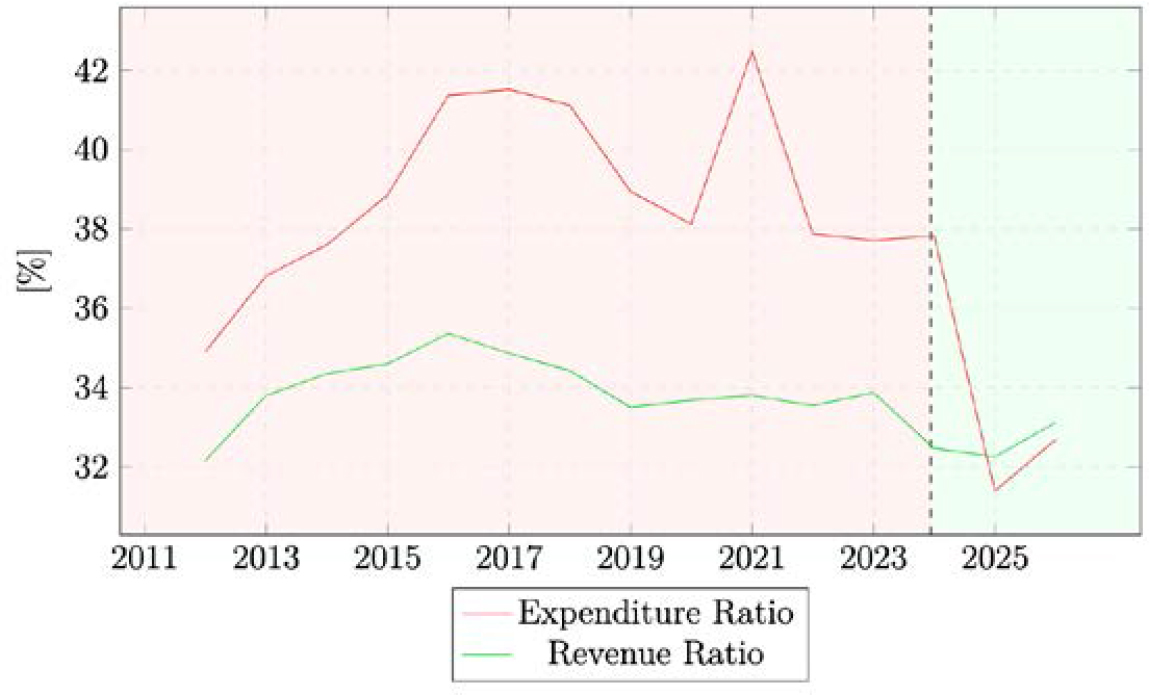
Figure 2:
Central government expenditure and revenue as a fraction of GDP under the pre-Milei administrations and the Milei presidency (Source: Ministry of Economy; IMF (World Economic Outlook)).
Downsizing the Public Sector Workforce and Wage Bill
Accompanying the elimination and downsizing of government agencies, the Milei government enacted mass layoffs of public employees: over 52,309 government workers were dismissed by June 2025, including 26,991 in the first six months alone (Infobae 2024a).
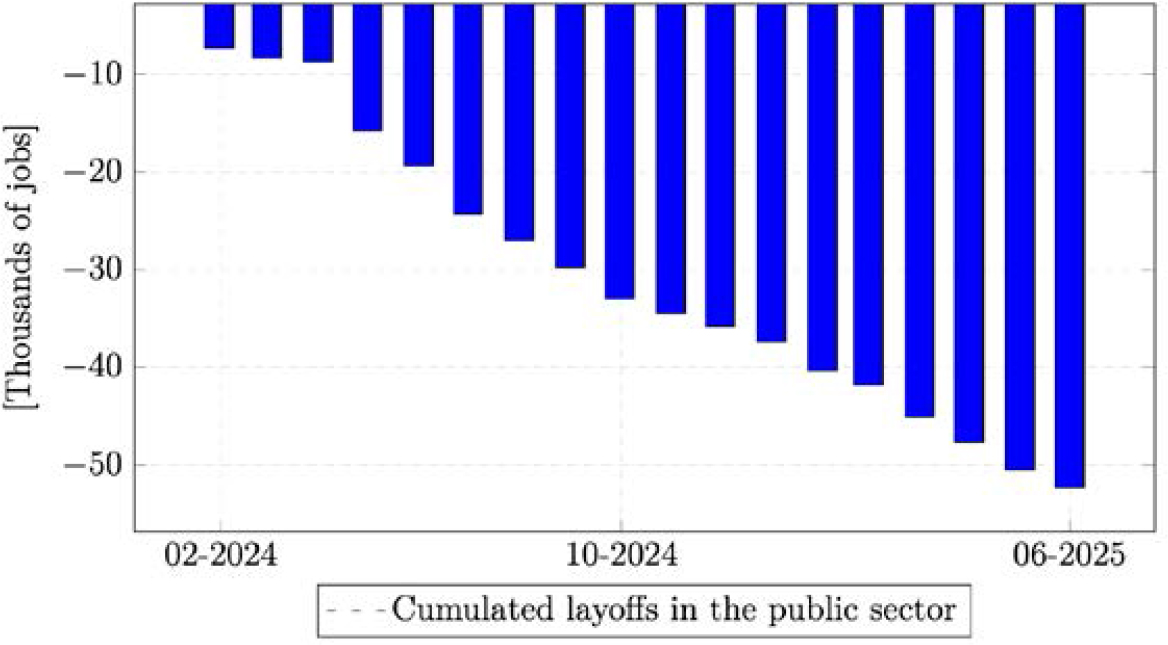
Figure 3:
Cumulated reduction in public employment by month since the Milei presidency (Source: Ministerio de Desregulación y Transjormación del Estado).
Employees who remained in public service saw their wages, pensions, and social benefits frozen or only slightly adjusted but still below the rate of inflation (Associated Press 2024b). This significantly reduced the real wage bill and generated fiscal savings (Debre 2024).
Interestingly, in a country with a long history of raucous street protests, the mass unrest many pundits predicted did not materialize (Associated Press 2024b).
Milei’s policy course of devolving central government powers to the local area and drastically cutting the number and wages of government agents aligns with classical Austrian prescriptions for shrinking bloated bureaucracies and ending unsustainable entitlements (Bagus & Ferrero 2024).
4.1.2. Economic Outcomes of Fiscal Austerity
Fiscal Surplus and Macroeconomic Turnaround
Milei’s austerity measures produced a swift and historic shift in Argentina’s fiscal balance. After running deficits every year since 2009 (peaking at 9% of GDP in 2020) the government posted a budget surplus in 2024, Milei’s first year in office.
Though modest (0.3% of GDP, or 1.76 trillion pesos) (Reuters 2025a), it marked the first surplus in 14 years and symbolized the success of Milei’s “zero deficit” pledge (Kleinheyer and Schnabl 2025, p. 11). For eleven months in 2024, Argentina ran consistent primary surpluses, driven by aggressive spending cuts outpacing declining revenues. A small December deficit (attributed to seasonal spending) did not offset the full-year result (Reuters 2025a). The primary surplus reached 1.8% of GDP (Reuters 2025a).
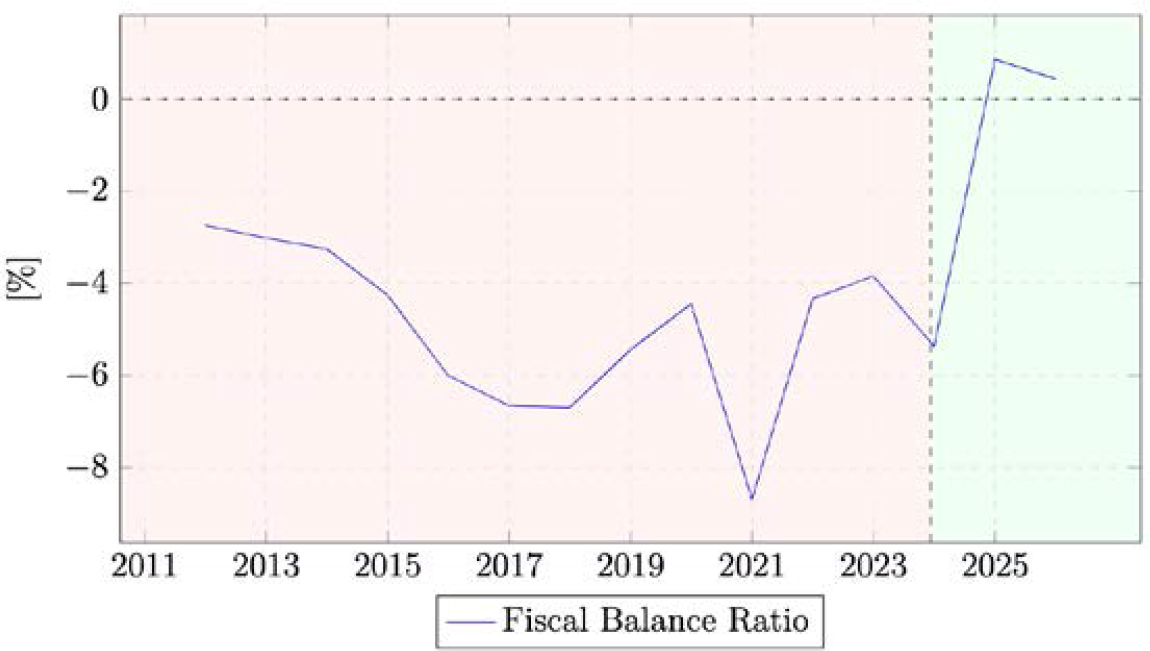
Figure 4:
Central government fiscal balance as a fraction of GDP under the pre-Milei administrations and the Milei presidency (Source: Ministry of Economy; IMF (World Economic Outlook)).
Effects on Central Government Debt
Hoppe (2025, 36:00-39:30) criticizes that central government debt increased in absolute terms under the Milei presidency, taking on more debt than any of his predecessors, with future taxpayers having to carry the burden fiscally.
The sharp increase in the central-government debt ratio, followed by an observable decline in recent months as shown in Figure 5, coincided with a major liability-restructuring process. The government converted inherited high-yield central-bank liabilities, including LELIQs, pases, and puts, into short-term Treasury instruments such as LEFIs and LECAPs. This shifted part of the quasi-fiscal burden from the central bank to the Treasury, making fiscal discipline more transparent but also placing greater pressure on the government’s explicit fiscal accounts. Because this restructuring strained fiscal capacity and reserve management, the Milei government concluded an IMF agreement to support the debt-restructuring process, rebuild the Central Bank’s dollar reserves, and stabilize the new foreign-exchange band system. Although the repayment prospects and scale of the agreement remain contested (La Política Online 2025), the agreement helped reverse the decline in reserves and supported a subsequent reduction in the central-government debt ratio.
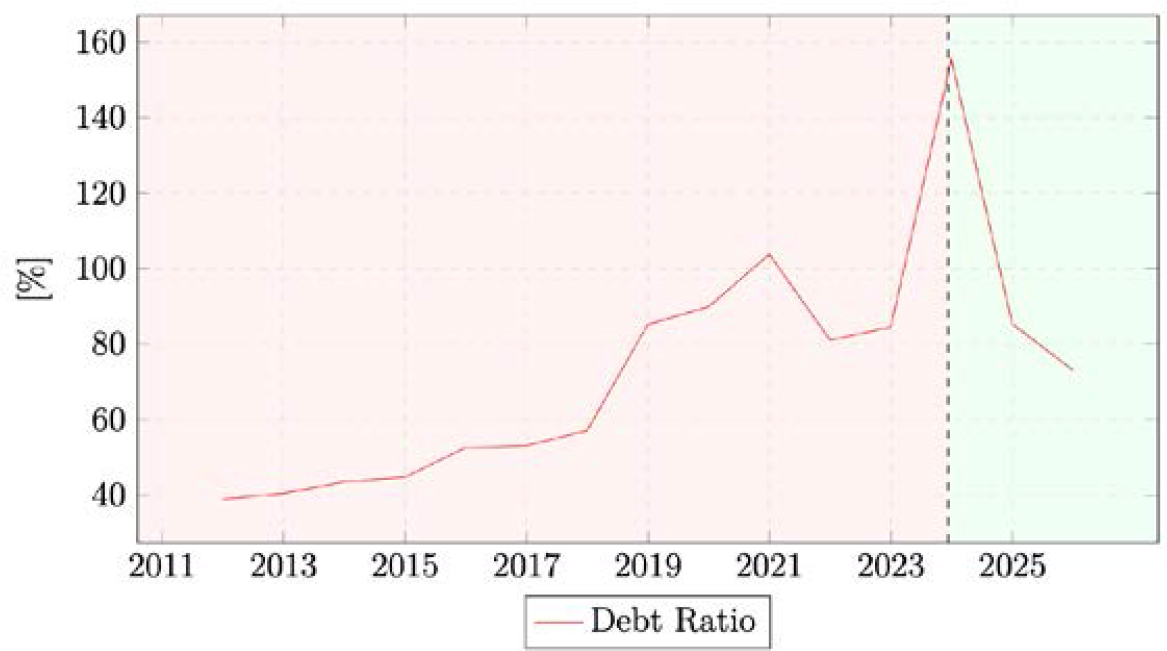
Figure 5:
Central government debt as a fraction of GDP under the pre-Milei administrations and the Milei presidency (Source: Ministry of Economy; IMF (World Economic Outlook)).
It has, however, been questioned whether the IMF agreement and debt restructuring were necessary in the first place. From a deontological Austrian perspective, Hansen (2021a) and Hoppe (2025, 36:00–39:30) argue that repudiating inherited public debt may be ethically defensible where repayment burdens taxpayers who did not voluntarily assume the obligation. Hansen (2021b) further argues that government debt finances consumption rather than productive investment and may therefore be understood as “fictitious capital,” so that default could redirect resources from taxation toward private saving and investment.
This argument is theoretically relevant, but it is less persuasive as a practical fiscal strategy for Argentina in 2024–2026. A unilateral repudiation of debt could have reduced the burden on taxpayers in the narrow sense, but it would likely have imposed severe reputational costs, weakened access to international capital markets, and increased uncertainty for future private investment. For a government attempting to restore fiscal credibility, contractual reliability was itself part of the consolidation strategy. Milei’s decision to restructure and refinance inherited liabilities rather than repudiate them can therefore be interpreted as an attempt to preserve the legal and reputational foundations of future market access.
Consistent with this credibility-oriented approach, Argentina’s sovereign risk spread fell to a five-year low by late 2024 (Associated Press 2024b). Milei’s fiscal consolidation also reduced the need for central-bank financing, ending years of monetized deficits (Associated Press 2024b).
Recessionary Effects of Austerity
Milei’s austerity measures, while effective in curbing inflation, triggered a sharp short-term economic contraction. In early 2024, public spending cuts led to a steep decline in aggregate demand. Consumer spending dropped by an estimated 20% year-on-year, while rising costs and falling sales forced businesses to scale back (Associated Press 2024b). The construction sector was especially impacted: public works were frozen, and around 200,000 construction jobs were lost due to the freeze in infrastructure projects (Associated Press 2024b). Industrial output and retail activity also declined.
GDP contracted significantly in the first half of 2024, falling approximately 5.1% in Q1 year-on-year (Tobias 2024), followed by a 1.7% decline in Q2 (Reuters 2024a), as fiscal tightening and elevated interest rates weighed heavily on growth. Unemployment rose sharply—from 5.7% in late 2023 to 7.7% by Q1 2024 (Nessi and Pelaez-Fernandez 2024)—while many Argentines turned to informal or precarious subsistence work in the wake of mass layoffs and economic hardship, with informal employment reaching 42% by year-end (OECD 2025).
Poverty and Recovery
Following cuts in social spending and public employment, the poverty rate rose to 52.9%. This pushed over half the population below the official poverty line, the highest level in two decades (Associated Press 2024b).
As inflation slowed and wages began stabilizing, however, poverty declined sharply. By late 2024, the rate dropped to 38%. By mid-2025, poverty remained high (~36–38%), but the peak had passed. Observers noted that the poverty spike was severe but short-lived (Lo Bianco and Bustamante 2025).
Milei’s administration preserved core anti-poverty programs but removed intermediaries in aid distribution by shifting delivery from social organizations to direct support to soup kitchens to curb corruption and reduce administrative costs (Dubois 2024).
4.2. Tax Reforms: Simplification and Reduction of Tax Burdens
4.2.1. Implemented Tax Changes in 2023–2025
President Javier Milei undertook a sweeping tax overhaul between December 2023 and June 2025, aiming to radically simplify Argentina’s tax system and lower the burden on the private sector. He inherited one of the world’s most complex regimes—around 155 federal, provincial, and municipal levies in 2024 (Consejo Profesional de Ciencias Económicas de Santa Fe (CPCE) 2024)—with effective tax rates sometimes exceeding 106% of business profits (Brattström 2024).
Export Duties and Trade Taxes
One of Milei’s first reforms targeted Argentina’s export taxes (retenciones), long seen as distortive. In December 2023, a decree eliminated the 3–4.5% duty on over 4,400 industrial and value-added products, benefiting nearly 40% of exporters (Martinez 2025). Temporary cuts were also applied on major agricultural commodities exports (soybean, corn, sorghum, sunflower, wheat, and barley) through June 2025 (later extended to March 2026 for wheat and barley) (Giménez 2025). Smaller regional exports (cotton, paper, food, and beverages) received in January 2025 permanent tax exemptions (Martinez 2025). While regional relief had limited fiscal impact, cuts on soy and corn (previously taxed at 33% and 12%) were estimated to cost 0.13% of GDP in lost revenue (Tendata 2024; Escobar 2025). Economy Minister Luis Caputo tied these cuts to fiscal balance and confirmed reinstatement for major grain duties after June 2025 without broader reform (Escobar 2025; Blue Dollar 2025).
Hoppe (2025, 41:50), however, raised concern over Milei’s tax policies, noting that contrary to his promises on the campaign trail, “he raised taxes”.
This criticism, however, should be fairly assessed under the scope of institutional realities: Politically, a comprehensive tax reform could not be implemented by executive will alone but required congressional negotiation, particularly through the Chamber of Deputies. Before the new Congress took office in December 2025, Milei governed with just a fragile legislative base, making a deep tax overhaul both politically costly and procedurally difficult. After the 2025 midterm elections, La Libertad Avanza became the largest minority in the Chamber of Deputies with 95 of 257 seats, but still required allied votes to reach the absolute or qualified majorities necessary to pass major reforms (Honorable Cámara de Diputados, 2026).
The Milei government has maintained that several tax increases were temporary and must be understood alongside simultaneous tax reductions. Its longer-term objective remained a broader simplification of the tax system, including the announced plan to reduce the number of taxes substantially (Infobae 2024b; International Monetary Fund 2025). In the short term, however, tax reduction was constrained by the priority of maintaining the fiscal balance.
On the import side, the 2024 “Fiscal Package” eliminated duties on capital goods and reduced tariffs on inputs like textiles, footwear, and machinery (Giménez 2025). The government also abolished the flat 7.5% blanket tax on all imported goods (Kleinheyer and Schnabl 2025, p. 19). Cell phone tariffs dropped from 16% to 8% (set to reach 0% by 2026), and video game console duties fell from 35% to 20% (Giménez 2025). These cuts, alongside the removal or reduction of numerous minor excise taxes on goods, were intended to boost investment and productivity by cheapening equipment and encouraging trade. The 20% luxury tax on midpriced cars was removed, and the top rate on high-end vehicles was cut to 18% from previously 35%, a move expected to lower vehicle prices broadly. Electronics taxes were halved for imports (19% to 9.5%) and abolished for locally produced goods (Giménez 2025). The government is reducing bureaucracy at the customs authority. Requirements for domestic industries to approve certain imports were abolished (Schnabl 2025). These changes marked a pivot toward open markets. The removal of trade restrictions was accompanied by rising exports, which helped improve the trade balance.
Foreign-exchange and Financial Taxes
Milei’s government eliminated key taxes on foreign-exchange to strengthen the peso and encourage dollar repatriation. The 30% Impuesto Para una Argentina Inclusiva y Solidaria (PAIS) surcharge on foreign currency purchases and foreign transactions expired on December 23, 2024, and was not renewed. This tax had accounted for around 5% of total revenue in 2024, so its removal helped reduce barriers to holding dollars and boosted confidence in the peso (Giménez 2025). A 30% prepayment on “savings dollar” purchases (creditable against the assets tax) was also scrapped. These changes, alongside looser capital controls, contributed to the peso’s appreciation in late 2024 (Associated Press 2024b).
The longstanding cheque tax on bank transactions remained in place (scheduled for elimination by 2027), as Milei balanced reform goals with IMF commitments (Tristán & Asociados 2024). The overall strategy was tax simplification without immediate revenue loss.
Income, Wealth, and Payroll Taxes
Law 27.743 modified the existing Impuesto a las Ganancias framework for labor and pension income by repealing the separate cedular regime for higher income from dependent employment, pensions, and related categories, adjusting deductions and rate schedules, and removing or limiting several exemptions with effect for fiscal year 2024. The reform therefore broadened the taxable base by subjecting previously exempt forms of compensation to taxation and changed the structure of labor-income taxation without constituting a wholly new tax. The law was formally regulated through Decreto 652/2024 and RG (AFIP) 5531/2024, which operationalized the updated withholding mechanisms for employees and pensioners (Heller et al. 2024). Though politically difficult, this reversal aimed to restore fiscal discipline.
The same law also reformed the Bienes Personales (assets tax): the non-taxable threshold was raised to AR$100 million, the primary residence exemption increased to AR$350 million, and top marginal rates were reduced from 1.75% to 1.5% for 2023, with a planned gradual decrease to 0.25% by 2027. Taxpayers who prepay the tax receive fiscal stability guarantees through 2038 (WSC Legal (Wiener Soto Caparrós) 2025). A 2024 tax amnesty program brought an estimated US$18 billion of previously undeclared savings back into the banking system by October 2024, further strengthening foreign reserves (Otaola and Elliott 2024).
The payroll reform raised the annual cap for employee social security contributions to approximately AR$5.24 million in 2024 and reaffirmed that these contributions remain deductible for income tax purposes (Jurgens and Ashmore 2024).
Incentive Regime for Large Investments
Law 27,742, enacted in July 2024, established the RIGI, a flagship program providing preferential tax, customs, and foreign-exchange treatment to large-scale investment projects. Key provisions include a reduced corporate income tax rate of 25%, accelerated depreciation, unlimited tax-loss carryforwards transferable after five years, and a lower dividend withholding tax of 3.5%. Beneficiaries also receive Value-Added Tax (VAT) relief through transferable tax credit certificates, and exemptions from import duties on capital goods, spare parts, and consumables. To ensure compatibility with the Organisation for Economic Co-operation and Development (OECD)’s global minimum tax, however, the law limits the benefits so that effective rates cannot fall below 15% (Iglesias Mamone 2024).
Tax Reductions and Eliminations under Milei (to May 2025)
Milei’s administration reduced or eliminated 19 distinct taxes, a sweeping reform that decreased tax complexity, eased administrative burdens for bureaucrats, and provided meaningful tax relief. Refer to Table 1 in the appendix for the full breakdown of changes from December 2023 to May 2025 (based on Lisicki, Litvin & Abelovich via Giménez (2025)).
4.2.2. Proposed and Pending Reforms (Beyond mid-2025)
As of June 2025, the Milei administration is preparing a second wave of tax reform focused on radical simplification. Because the IMF deal imposes stringent fiscal surplus targets for the upcoming years, this significantly limits the potential for reducing the tax burden. Milei has stated his intention to reduce Argentina’s tax system to “no more than six taxes”, eliminating 90% of existing levies by number—not by revenue share (Spirlet 2024). Plans include merging national, provincial, and municipal taxes into a limited set of broad-based instruments, potentially retaining only VAT, a corporate or simplified income tax, one social security contribution, and a few excises (Blue Dollar 2025; Consejo Profesional de Ciencias Económicas de Santa Fe (CPCE) 2024).
According to IARAF, 33 federal taxes generate minimal revenue and could be repealed with little fiscal impact. These include luxury charges, cellphone and cable TV taxes, and obsolete items such as a tax on VHS tapes (Consejo Profesional de Ciencias Económicas de Santa Fe (CPCE) 2024). By mid-2025, the government was drafting legislation to consolidate and eliminate dozens of such charges.
Federal–Provincial Tax Restructuring
Aligned with broader decentralization efforts, Milei has proposed replacing the provincial Gross Income Tax (Ingresos Brutos)—a cascading levy blamed for price distortions—with a harmonized provincial VAT (“Super VAT”) (Infobae 2025). This would entail renegotiating the federal revenue-sharing agreement and giving provinces autonomy over major taxes. Taxes identified for elimination include Impuesto sobre los Ingresos Brutos (IIBB), stamp duties, fuel levies, the Buenos Aires inheritance tax, and multiple local fees. By June 2025, negotiations for a “Federal Tax Agreement” were ongoing (Consejo Profesional de Ciencias Económicas de Santa Fe (CPCE) 2024; Blue Dollar 2025). However, resistance remains: IIBB generates 26% of provincial revenue (Instituto para el Desarrollo Social Argentino (IDESA) 2025). Some governors have proposed a “compensated Super VAT” in exchange for dropping IIBB. The full implementation may require constitutional reform.
Maintaining Fiscal Discipline
All proposed tax reductions are conditioned on meeting IMF-defined fiscal benchmarks. The Fund’s 2025 review emphasized that widespread tax cuts must follow the attainment of a 2.5% primary surplus by 2027 (Blue Dollar 2025). As a result, many 2024 tax cuts were phased or reversible. Comprehensive tax code reform, announced for 2025, remains contingent upon successful fiscal consolidation.
4.2.3. Early Outcomes and Empirical Indicators
Argentina’s tax burden did not decline sharply during the first phase of reform. The latest comparable annual OECD data show that Argentina’s tax-to-GDP ratio decreased only slightly, from 27.7% in 2023 to 27.6% in 2024, indicating broad revenue stability rather than a major collapse in tax receipts (OECD et al. 2026). Monthly tax-collection data for June 2025 likewise show that federal revenue remained substantial: total tax revenue reached ARS 16.184 trillion, with VAT accounting for ARS 5.110 trillion, income tax for ARS 2.886 trillion, social-security revenue for ARS 3.540 trillion, and export duties for ARS 1.220 trillion (ARCA 2025). The most visible compositional change was the elimination of the PAIS tax, which had still raised ARS 780.042 billion in June 2024. At the same time, VAT, income tax, social-security contributions, and trade-related taxes remained central to federal collection (ARCA 2025).
Evidence of general Laffer-curve dynamics should therefore be formulated cautiously. The available data support selected taxbase and timing effects, but not a general causal claim that tax cuts increased total revenue. In June 2025, export-duty revenue rose by 183.9% year-on-year, partly because this was the final month of the temporary reduction in agricultural export duties under Decree 38/2025. The reduced rates applied, inter alia, to soybeans, soybean oil and pellets, wheat, maize, and regional economies (ARCA 2025). Reuters similarly reported that the expected July increase in export taxes on soybeans, soybean derivatives, and maize led farmers to bring forward sales before the rate change (Reuters 2025b). This should be interpreted as front-loaded export declarations and temporary revenue acceleration rather than as conclusive evidence of a general revenue-maximizing tax-cut effect.
Compliance and Formalization
Tax simplification helped reduce informality. Previously, effective tax rates for Small and Medium-sized Enterprises (SMEs) sometimes surpassed 100% of profits (Brattström 2024). Raising the Monotributo threshold and easing burdens on the self-employed contributed to increased registration. Public perception of tax fairness improved modestly, as indicated by mid-2025 surveys (Giménez 2025; Associated Press 2024b). However, real revenue from IIBB declined by 17.5% in early 2025 (Somos Cítrica 2025).
Investment and Growth Effects
Tax and spending reforms supported a modest recovery from recession. Q3 2024 GDP grew by 3.9%, driven by private investment under the RIGI regime and stronger household demand (Spirlet 2024). Trade liberalization and currency appreciation also supported capital upgrades.
Short-term hardship was significant. Inflation and subsidy cuts led to a poverty spike in early 2024, peaking at 52.9%. Unemployment rose, and 200,000 construction jobs were lost (Associated Press 2024b). By mid-2025, however, inflation had fallen to ~3% monthly, and the economy showed signs of renewed growth (Brattström 2024).
4.3. Privatization Initiatives: Transitioning State-Owned Enterprises to Private Ownership
4.3.1. Reform Framework
The original Ley Bases bill included the sell-off of high-profile firms such as Yacimientos Petrolíferos Fiscales (YPF), Aerolíneas Argentinas, and Correo Argentino. However, political resistance led to major revisions: Some were removed from the list entirely, others were restricted to partial sales. The final Law 27.742, enacted by mid-2024, granted legal authority to proceed with privatizing a first batch of eight State-Owned Enterprises (SOEs) (La Derecha Diario 2025; Grainger 2025).
A dedicated Public Enterprises Transformation Agency, led by Diego Chaher, was established to accelerate preparations for nearly 60 companies, with a structured timeline of 6–8 months per company (Oficina del Presidente 2024; Grainger 2024). Privatization methods include Initial Public Offerings (IPOs), direct tenders, operational concessions, or transfers to provinces or employee cooperatives. Milei reaffirmed his commitment to privatization as a long-term strategy, describing it as the end of the “Estado empresario” (business state) in Argentina (Oficina del Presidente 2024).
4.3.2. Energy Sector: Oil, Gas, and Power
YPF (Oil & Gas)
Milei’s original privatization plan included Argentina’s largest oil company, YPF (majority state-owned since a 2012 renationalization), but it was removed from the reform bill in January 2024 due to strong cross-party opposition (Grainger 2023). While YPF remains public, the government has moved to decentralize operations, returning some mature oil fields to provinces like Santa Cruz (Grainger 2023).
Enarsa (Energy Integration)
In contrast, Enarsa entered active privatization in April 2025 under Decree 198/2025 (Newbery 2025). The company is being unbundled into about 15 units, including its 50% stake in Citelec/Transener, to be sold or concessioned through competitive bidding. Enarsa’s role has diminished as Liquefied Natural Gas (LNG) imports dropped (only 30 cargoes in 2024) thanks to rising domestic shale gas production (Newbery 2025). As of mid-2025, asset valuation and divestment planning were underway (La Derecha Diario 2025). The challenge will be ensuring competitive bidding and avoiding a fire-sale.
Nucleoeléctrica (Nuclear Energy)
Nucleoeléctrica was included in Law 27.742 for partial privatization, allowing up to 49% of shares to be sold while maintaining state control and veto rights (El Economista 2024). The government intends to launch an international tender to attract investment without compromising safety oversight (La Derecha Diario 2025). Legislative safeguards were added to ensure a state golden share and preserve strategic oversight, reflecting cross-party consensus that nuclear energy should not be fully subject to profit motives (El Economista 2024).
Yacimientos Carboníferos Río Turbio (YCRT) (Coal Mine)
YCRT in Santa Cruz province was authorized for full sale. Known for inefficiency and high subsidies, it is viewed even by the opposition as a “white elephant”. A tender granting the operator management control is being prepared as of June 2025, though the mine’s low output and remote location deter investors (La Derecha Diario 2025).
Other Energy Measures
Beyond headline cases, the government is selling transmission assets via Enarsa’s breakup and liberalizing energy markets (La Derecha Diario 2025). Milei’s philosophy is that the state should regulate rather than operate in energy. Accordingly, fuel price controls were loosened, and regulatory bodies strengthened to prepare for greater competition. These policy shifts, while not privatizations per se, complement the sell-off efforts by liberalizing the energy sector’s operating environment. Success will depend on attracting serious investment and avoiding past mistakes of underregulated monopolies. Argentina attemps to follow Chile’s example of private-led efficiency gains, though that model also required strong regulatory institutions (Megginson and Netter 2001, p. 5).
4.3.3. Transportation Sector: Airlines, Railways, and Roads
Aerolíneas Argentinas (Flag Carrier Airline)
Aerolíneas Argentinas has received over US$8 billion in subsidies since its 2008 renationalization (Madry 2025). Although initially included in the Ley Bases, privatization was dropped during Senate negotiations (Cantando 2024). By mid-2025, Congress had not approved its sale, but restructuring led to a monthly profit in July 2024—its first in seven years (Madry 2025). The government aims to deregulate air routes via an “open skies” policy and is exploring divestment options, such as spinning off Embraer jets into a new provincial airline with Córdoba (Grainger 2024). Despite interest, no buyer has emerged and labor unrest remains a major hurdle (Madry 2025).
Railways – Freight and Passenger
Argentina’s rail network, much of it re-nationalized between 2013 and 2015, is targeted for privatization under Milei. The government distinguishes between freight rail, seen as commercially viable, and passenger rail, deemed a social service. Freight operator Belgrano Cargas y Logística S.A., managing 7,600 km across 17 provinces, will be dismantled under Decree 60/2025: rolling stock auctioned, infrastructure concessioned with open access, and workshops leased (Ámbito 2025b). The firm was deficit-prone and stagnant despite agricultural export growth (Oficina del Presidente 2024). Nearly 1,900 layoffs in 2024 preceded the reform, sparking union protests (Oficina del Presidente 2024; Hospital 2025). Passenger operator SOFSE remains state-owned but is authorized for service concessions under the Ley Bases; routes were reduced and State-Owned Enterprise (SOE) Trenes Argentinos Capital Humano Highways and Roads
The highway SOE Corredores Viales S.A., created in 2017 to manage national toll roads, is being privatized via long-term concessions authorized by Decree 97/2025 (Feb 2025) (Memo 2025). Between 2020 and 2023, Corredores Viales required about AR$6.7 billion (~US$6.2 million at the time) in state subsidies to meet its operational and safety standards (Swissinfo 2025).
Airports and Navigation Services
Intercargo S.A.U., the state airport ground-handling monopoly, was deregulated in November 2024 and set for privatization via Decree 198/2025 (Ámbito 2025a; Swissinfo 2025). Despite charging airlines, it required AR$6.7 billion in subsidies between 2020–2023 to meet standards (Ámbito 2025a). Privatization aims to attract private capital for needed upgrades in equipment, IT, and training, improving service efficiency amid fiscal constraints.
4.3.4. Communications and Media: Postal Service, News Agency, and Telecom
Correo Argentino (Postal Service)
Privatized in 1997 and renationalized in 2003, Correo Argentino has since operated as a SOE with 1,400 branches and ~I5,000 employees (El País 2024). Initially included in the Ley Bases, its privatization was shelved amid political pushback. Instead, Milei deregulated the postal sector via decree in November 2024, ending Correo’s monopoly and opening the market to private competitors (Clarín 2024; El País 2024). The firm has ceased receiving Treasury subsidies, and privatization plans remain under consideration (Ámbito 2025a).
Télam (State News Agency)
In early 2024, Milei ordered the closure of Télam, the state news agency founded in 1945, accusing it of serving as a kirchnerista propaganda tool (D’Eramo 2024). Unlike other SOEs, it was not included in the Ley Bases but liquidated directly via decree. Most staff were dismissed through a “Procedimiento Preventivo de Crisis” process, a legal mechanism for collective layoffs with reduced severance (D’Eramo 2024). The move sparked criticism from unions and press freedom groups (France 24 2024), but Milei defended it as ending state-sponsored media and fostering independent journalism—echoing Rothbards critique of government control over information (D’Eramo 2024).
Radio y Television Argentina Sociedad del Estado (RTA) (Public Broadcasting)
Public broadcaster RTA, which includes TV Pública (Channel 7), Radio Nacional (with dozens of stations) and associated digital channels, remains under state control but was authorized for privatization in Law 27.742 (D’Eramo 2024). Unlike Télam, RTA was initially included in the privatization law’s annex. The law’s passage means RTA is legally authorized to be privatized or reformed. However, Milei’s government has trod carefully here. Recognizing the sensitive nature of public broadcasting, the administration chose to intervene RTA by appointing an outsider as interventor to manage it temporarily (D’Eramo 2024). The government has cut budgets, reduced programming, and floated options including concession, partial privatization, or closure. Formal action is still pending, but restructuring has begun (D’Eramo 2024).
Empresa Argentina de Soluciones Satelitales S.A. (ARSAT) (Telecom Infrastructure)
ARSAT, which manages Argentina’s telecom satellites and broadband network, is pursuing a partial Initial Public Offering (IPO) to sell up to 49% of its equity while maintaining state control (El Economista 2024; Grainger 2024). The goal is to improve performance by introducing private capital and market discipline. While state influence may limit full efficiency, even partial privatizations tend to boost profitability and productivity (Megginson and Netter 2001).
4.3.5. Banking Privatization Efforts
Banco de la Nación Argentina (BNA), Argentina’s largest state-owned bank, was initially slated for full privatization, but political resistance limited the Ley Bases to permit only a partial sale with majority state control (El Economista 2024). Decree 121/2025 converted it into a sociedad anónima, enabling private capital raising (Grainger 2025). By mid-2025, the state still holds 99.9%, but up to 49% can now be sold via IPO or private placement (Grainger 2025). Advocates argue privatization would improve efficiency and align with a state focused on regulation, not ownership (Grainger 2025).
4.3.6. Theoretical Reflection
Milei’s privatization agenda draws on both neoclassical and Austrian economics. Neoclassical theory highlights efficiency gains from private ownership due to profit incentives, competition, and hard budget constraints, while SOEs face soft budget constraints and X-inefficiency. Empirical studies show that privatized firms tend to improve in performance and profitability (Megginson and Netter 2001, p. 1; Shleifer 1998, p. 147).
Austrian economists like Mises, Hayek, and Rothbard offer a deeper critique: state ownership misallocates resources due to the absence of price signals and profit-loss mechanisms. Mises argues bureaucracy cannot replicate market coordination (Mises 1977, p. 159), Rothbard sees government enterprise as inherently inefficient (Rothbard 2022), and Hayek warns of the planner’s knowledge problem. State firms may mask inefficiency with subsidies, but these distortions eventually become fiscally unsustainable.
In this sense, privatization links fiscal consolidation to institutional liberalization: it seeks to remove soft budget constraints and transfer production decisions from political allocation to market discipline.
5. Conclusion
This paper examined Argentina’s fiscal consolidation under Javier Milei as an institutional attempt to move the country away from deficit finance, discretionary redistribution, inflationary accommodation, and recurrent emergency governance. Its central argument is that Milei’s reform program cannot be understood solely through monetary restabilization alone but the fiscal consolidation that accompanies this process. Before a durable monetary order could plausibly emerge, Argentina first had to confront the fiscal foundations of its instability if it was to avoid repeating the failure of the Menem era: chronic deficits, subsidy dependence, public-sector overextension, fragmented taxation, discretionary federal transfers, and weak budgetary discipline all had to be addressed.
The evidence suggests that the Milei administration achieved a rapid fiscal correction as a necessary precondition for long-term monetary reform. Expenditure restraint, subsidy reduction, public-sector retrenchment, lower discretionary transfers, and selected revenue measures produced a marked improvement in the primary fiscal balance within a short period. In this narrow accounting sense, the program showed that even a state long considered fiscally rigid could reduce spending commitments once political incentives changed. The primary balance, however, should be analytically separated from debt management. Liability restructuring, the conversion of inherited central-bank obligations into Treasury instruments, and the support from the International Monetary Fund affected financing conditions, reserve accumulation, rollover risks, interest burdens, and credibility.
This distinction is important for assessing the reform process. The restructuring of inherited quasi-fiscal liabilities made the fiscal position more transparent, but also shifted pressure onto the Treasury. In a Hoppean perspective, the decision not to repudiate inherited public debt remains open to criticism, since repayment burdens future taxpayers who did not voluntarily assume those obligations. From a credibility-oriented institutional perspective, however, avoiding unilateral default can be interpreted as part of the government’s attempt to restore contractual reliability and future market access.
The broader fiscal strategy combined several mutually reinforcing elements. Public-sector retrenchment addressed the immediate expenditure problem. Subsidy cuts corrected relative prices and reduced fiscal and quasi-fiscal distortions. Federal–provincial realignment attempted to weaken common-pool incentives and impose harder budget constraints on subnational governments. Tax reorganization reflected the tension between long-term liberalization and short-term revenue needs. Privatization initiatives sought to reduce the fiscal burden of state-owned enterprises and limit future contingent liabilities. Together, these measures formed a serious attempt to replace soft budget constraints with a more disciplined institutional order.
At the same time, the adjustment imposed substantial shortterm costs. Public works suspension, employment losses, falling real incomes in parts of the economy, and high poverty during the initial shock increased social pressure and exposed the political limits of austerity.
Selected structural liberalization measures matter in this context as supporting conditions rather than as a separate reform narrative. Labor-market reform, rental deregulation, land-market liberalization, investment incentives, and bureaucratic simplification affect the conditions under which expenditure restraint can become durable. A lower-spending state requires a private sector capable of absorbing labor, capital, and entrepreneurial activity previously tied to public payrolls, subsidies, controlled prices, or protected sectors. Without such adjustment capacity, austerity risks remaining contractionary rather than transformational.
The Argentine case highlights the importance of distinguishing between fiscal correction, fiscal credibility, and fiscal consolidation. Fiscal correction can be achieved quickly through expenditure cuts, subsidy reductions, public-sector retrenchment, and temporary revenue measures. Fiscal credibility, however, requires that households, firms, provinces, and investors believe that the state will not return to deficit monetization, discretionary transfers, or emergency controls once political pressure rises. Fiscal consolidation, in the stronger sense, depends on whether these constraints become durable institutions rather than temporary emergency measures.
Further research should examine whether Argentina’s fiscal correction can survive electoral cycles, social strain, provincial resistance, and renewed demands for redistribution. Particular attention should be paid to expenditure composition, tax reform, debt service, poverty, informality, real wages, and private-sector recovery. Also monetary restabilization and financial liberalization under Milei should be analyzed, since fiscal balance is a necessary but not sufficient condition for durable monetary credibility.
The Argentine case is relevant for Austrian and institutional political economy because it illustrates the connection between fiscal dominance, monetary instability, and distorted market coordination. Inflation was not merely a technical monetary phenomenon, but the consequence of a fiscal regime in which political promises repeatedly exceeded sustainable financing capacity. Monetary expansion then became the mechanism through which fiscal conflict was postponed and redistributed. Under these conditions, fiscal consolidation is not simply an accounting exercise. It is an attempt to alter the incentive structure of the political system itself.
The contribution of this paper is therefore limited but specific. It offers an early fiscal-institutional interpretation of Argentina’s adjustment process, identifies the main mechanisms of consolidation, and evaluates their sequencing, constraints, and early observable effects. Milei’s early fiscal consolidation represents one of the most ambitious attempts in recent Argentine history to break with deficit spending, inflationary finance, interventionist controls, and discretionary state allocation. Its early results indicate a serious fiscal correction and a coherent effort to impose harder budget constraints.
Notes
[1] Conflicts of interest Conflict of Interest Statement
The author declares that there are no conflicts of interest regarding the research, authorship, or publication of this article. The author received no specific funding for this work.
Appendix
Tax Reductions and Eliminations under Milei (to May 2025)
Below is a summary of the taxes reduced or abolished by the Milei administration as identified by Lisicki, Litvin & Abelovich (via Giménez 2025):
PAIS tax on foreign currency, abroad services, and imports eliminated (expired 23 Dec 2024).
Export withholding taxes on key agricultural commodities temporarily canceled (some extended to 2026).
Monotributo reform: maximum annual invoicing threshold raised from AR$16 m to AR$68 m.
Bienes Personales (assets tax) reform: higher non-taxable floor and installment discount options.
Reduced tax burden for self-employed via adjustments in Monotributo.
Internal vehicle taxes removed for cars priced between AR$4l m–75 m and above.
Import duties reduced for electric/hybrid cars under US$16,000 (quota: 50,000 units/year).
Cell phone import duties reduced gradually from 16% to 8% by 2026.
Internal taxes on imported electronics lowered from 19% to 9.5%; zeroed for Tierra del Fuego production.
Import duties on video game consoles cut from 35% to 20%.
Real estate transfer tax (ITI) eliminated.
Tariffs removed on first US$400 of online purchases via courier.
Export retentions reduced or removed for dairy, pork, select beef cuts, and poultry.
Retentions eliminated on exports of over 4,400 industrial products.
30% withholding on “savings dollars” (USD purchases for saving) removed.
Tariffs on capital goods imports eliminated.
Import duties lowered on textiles, footwear, yarns, and fabrics.
Fee for exhibiting foreign films domestically abolished.
RIGI incentives granted: tax and import-duty benefits for large investments.
Table 1: Key tax reductions and eliminations under President Milei (≤ May 2025).