
1. Scientific significance of this article
The Austrian School has analysed the consequences of state planning on human action, to the extent of distorting the business function and causing recurring economic cycles. This article aims to demonstrate how such planning by the derived powers (legislative and executive) (i) has overstepped the bounds of the 1978 Spanish Constitution by en masse overturning court rulings against a coup d’état, and (ii) has undermined the right to property and the free movement of capital and services within the EU.
Having demonstrated how the powers of the State know no bounds when it comes to infringing upon liberty and property, a proposal is put forward to curtail the powers of the State under a Constitution that guarantees the absence of coercion through citizens’ juries presided over by judges. The aim is to ensure that the entrepreneurial function can operate free from coercion arising from the State’s declaratory self-protection and executive. The scholarly novelty of this article lies in analysing the Spanish and European cases and translating the ideas of the Austrian School into a draft constitutional reform, which guarantees free social cooperation between individuals without state coercion arising from legislative planning or taxation.
2. Mises and the Austrian School on human action: the State as a destroyer of processes of voluntary cooperation and individual rights
As Mises demonstrates in *Human Action*1, the elements of human action are individually subjective (ends, means, value, utility, plans, scarcity, etc.), and these change over time2 as each individual acquires new information whilst acting, which dooms any state planning to failure. Moreover, such planning (however minimal it may be) undermines the exercise of individual rights and the process of voluntary cooperation without coercion that is the market.3
Therefore, every human being pursues subjectively different ends depending on the value they attach to them; this value is constantly changing in accordance with these causal connections and the information available at any given moment, differing for each individual and emerging as they act. As Hayek (2010:148) explains, A proper understanding of the role played by the transmission of information (that is, of specific knowledge regarding the prevailing circumstances) is the key to understanding the functioning of large-scale social orders. Hayek formulated his concept of ‘dispersed knowledge’ as follows in *The Use of Knowledge in Society* (1945): given that knowledge arises subjectively in accordance with the ends that each individual gradually discovers, planning is inefficient due to the impossibility for state structures to have at their disposal all the subjective knowledge that each individual generates. Only entrepreneurial vigilance (not state planning) will enable the individual entrepreneur to identify imbalances between supply and demand in order to offer the consumer a product of better quality and at a better price. And as Rüstow (1980, 563) explains: “It has been demonstrated that private property—particularly in terms of productivity, and distributed amongst as many hands as possible—is the best guarantee of political and economic freedom; the total socialisation of the means of production, by contrast, leads to the greatest lack of freedom and exploitation of the worker under a totalitarian state and its dictatorial rules,”4
This demonstrates why state planning is impossible—that is, the “theoretical impossibility of socialism”, in the words of Huerta de Soto5. In the question posed by Carl Menger and quoted by Hayek in *The Fatal Conceit* (2010)—’How could it be that institutions which serve the common good and contribute so much to development could have come into being without a common will directed towards that end? ‘— embodies the empirical conclusion reached in this essay following an analysis of the repeal of the Constitution by Organic Law 1/2024 on Amnesty, accompanied by declaratory and executive self-protection measures which failed to guarantee the separation of powers or the rule of law as set out in Article 1 of the 1978 Constitution, as well as the State’s interference in the right to property to the point of effectively nullifying it (thereby infringing the free movement of capital and services under Articles 56 and 63 of the Treaty on the Functioning of the EU).
In this regard, Rothbard explains (2000[1974]:68): “The State has always demonstrated an impressive talent for expanding its powers beyond any limits that might be imposed upon it. Since the state necessarily subsists on the compulsory confiscation of private capital, and since its expansion necessarily entails ever-greater encroachments upon the individual and private enterprise, we must conclude that the state is profoundly and inherently anti-capitalist”.
Hoppe (2020) also argues that, whilst spontaneous orders tend to facilitate the achievement of most of the individual objectives of all members forming part of that order, organisations tend to serve the ends of the members who have created or who direct them6.
Hayek, as a leading disciple of Mises, demonstrated that laws enacted by political power cannot predict the behaviour of individuals; in other words, legal planning of individual behaviour is doomed to failure (1960:204): “Since the law determines only part of the conditions which the actions of individuals must satisfy, applying to anyone whatsoever provided that certain circumstances exist and irrespective of most of the facts of each specific situation, the legislator cannot foresee what its effect will be with regard to certain individuals or for what purposes they will use it. When we say that the law is instrumental, we mean that by obeying it, the individual pursues his own ends and not those of the legislator.”
Hayek also understood that the foundations of liberty require that the law cannot be applied differently depending on the person to whom it applies (precisely what the Amnesty Act has brought about, as we shall analyse): “The concept of freedom under the rule of law, the main concern of this work, rests on the argument that, when we obey laws in the sense of abstract general rules established independently of their application to us, we are not subject to the will of another man and are therefore free. It can be said that laws, and not men, reign supreme, insofar as the legislator is unaware of the particular cases to which their provisions apply, and also because the judge who applies them has no choice when it comes to drawing the conclusions that follow from the body of law in force and the particular circumstances of the case under consideration. ‘The law is not arbitrary because it is established without knowledge of the particular case, and no individual will determines the coercion used to enforce it’ (1960: 205).
Professor Huerta de Soto (2017:17) has explained that when the State acts in an interventionist manner through its monopoly on force, it exerts a decisive influence by distorting individual behaviour: “It is particularly important to understand that the definition, acquisition, transfer, exchange and defence of property rights—which structure and drive the social process—do not require a monopoly on violence (the state). Not only do they not require it, but, on the contrary, the state always acts by trampling on multiple legitimate property titles, defending them very poorly and corrupting individual behaviour (both moral and legal) with regard to respect for the private property rights of others.”
Following in the footsteps of the legal scholar Bruno Leoni, Huerta de Soto concludes “that no free market is, ultimately, compatible with the centralised process of parliamentary legislation to which we have become so accustomed today; thus, there is a clear parallel between the concept of positive law and socialism, on the one hand, and the concept of law understood as an evolutionary and customary product and freedom, on the other’ (Leoni 2010:3). Professor Huerta de Soto cites as an example the distortion caused by the State to freedom and the spontaneous market order when, since the modern era, it has allowed banks to lend money without maintaining a 100 per cent cash reserve ratio, through fractional reserve banking (Huerta de Soto 2023:25)7.
Fernández Cadavid (2024: 496) elaborates on this idea of the alteration of the market’s cooperative processes whenever those holding public power intervene; for, to the extent that such actors—who claim to pursue the common good—actually pursue subjective interests, they cause harm to individuals by wielding a monopoly on force8.
3. The restoration of inalienable rights: tyrannicide among the Spanish Scholastics and constituent power in our own time
As is well known, Juan de Mariana, in his work *De rege* (1599), like Francisco Suárez9, considers that individual natural rights are inalienable because they derive from God, and that when the sovereign disregards them, individuals have the right to depose him. On economic matters, in his book *De monetae Mutatione* (1609), published as *Discurso de la moneda de vellón*, Mariana considers it illegitimate for the monarch to devalue the currency by reducing the amount of gold, a view which led to an Inquisition trial brought against him by King Philip III himself. Both of Mariana’s works serve to emphasise the natural law character of the legal order, that is, the inalienable rights that cannot be infringed upon by any human decision.
This conception of natural rights preceding political power was used by Locke in his well-known Second Treatise on Civil Government (1690) to justify the validity of the social contract, whereby subjects delegate limited powers to the State only when individual rights are respected; otherwise, subjects have the right to rebel10. Building on this, Thomas Paine, in his *Common Sense* (1776), justified the US Declaration of Independence of July that same year as a human act of rebellion against the oppression of the British monarch11. In further elaboration of that Declaration, the Federalist Papers by Hamilton, Jefferson and Madison reiterate that the founding commitment of the Union, as set out in the Constitution of 1787, is based on the protection of individual rights and a voluntary union, in which individual rights are affirmed as deriving from God and not from the State.
It is evident, therefore, that the theory of the supremacy of the Constitution, set out by the founding fathers of the United States (Hamilton, Jefferson, Madison) as the supreme norm of constituent power to guarantee individual rights, acts as a counterbalance to the actions of derived powers that infringe upon the natural rights of man and distort market processes. This supremacy has been guaranteed ever since the famous Marbury v. Madison ruling, handed down by Chief Justice Marshall of the US Supreme Court (1803).12
However, the two approaches to guaranteeing this supremacy of the Constitution—and thus individual rights—namely that of the Constitutional Court (Kelsen) and that of the Head of State (Carl Schmitt), as we shall see, have failed in the Spanish case. It is thus evident that the theory of human action – that is, the impossibility of legally planning human actions to prevent conduct harmful to individuals outside the sphere of power – could also be applied to the concepts of the Constitution’s ‘supremacy’ and ‘normativity’. In other words, although the Spanish Constitution of 1978 provides for mechanisms to safeguard these rights (or even the case law of the Court of Justice of the European Union would allow judges to set aside national laws that infringe the rule of law as set out in Article 2 of the Treaty on European Union), as we shall demonstrate, these mechanisms, which rely on human beings (the King, legal advisers to Parliament, judges of the Constitutional Court), have not been sufficient to guarantee the supremacy of the Constitution and of individual rights (the right to equality before the law).
As Juan de Mariana also theorised, if the authorities disregard natural rights, subjects have the right to tyrannicide; that is, to depose the sovereign in order to restore natural rights. In the following chapter, we shall demonstrate the lack of self-restraint on the part of the State’s powers, and the inability of the current legal system to guarantee individual rights to liberty and property, which must lead to the abolition of the current system through constituent power, as we shall explain later.
4. The 2024 Organic Law on Amnesty, which abrogates the rule of law enshrined in the Constitution without the consent of the individuals who constitute the constituent power
Organic Law 1/2024 on Amnesty led to the annulment of hundreds of court judgements handed down against the perpetrators or collaborators of the 2017 secessionist coup in Catalonia, and the dismissal of ongoing legal proceedings, with the expungement of criminal records, for acts committed between 2012 and 2023 and even those still being committed. In other words, it entailed the legitimisation of secession and the delegitimisation of the King, the Senate and the judiciary, which had prosecuted these acts in accordance with the law. Consequently, it entails the repeal of the rule of law enshrined in Article 1 of the Constitution, the fundamental right to equality before the law (Article 14 of the Constitution) and the exclusive power of the judiciary to adjudicate and enforce judgements (Article 117 of the Constitution)13.
Article 9 of the Constitution states that ‘Citizens and public authorities are subject to the Constitution and the rest of the legal system’, consequently, the separation of powers established by the Constitution cannot be disregarded by the legislature, specifically the exclusive power granted to judges by Article 117 of the Constitution to adjudicate and enforce judgements. As John Locke noted as far back as 1690 (2004: 149–150): ‘The power of the legislature, being derived from a voluntary cession by the people and from an institution established by them, can be no other than that which has been positively granted to it, namely: the power to make laws, and not the power to make legislators. Therefore, the legislature is unable to transfer to others the authority to make laws’. These concepts are rooted in the inalienable natural rights of subjects, which precede power as the foundation of the political order, as had already been theorised by the Spanish scholastics of the 16th and 17th centuries (Juan de Mariana, Francisco Suárez, Francisco de Vitoria, etc.)14 This concept of the legislature’s subordination to a supreme text is clearly set out in the constitutions of several American states prior to the Federal Constitution of 1787 and in the Declaration of Independence of 1776 itself.
As we shall explain, the Organic Law on Amnesty was able to be passed following a chain of failures on the part of state institutions, which were controlled by specific individuals; this would seem to prove the Austrian School’s thesis regarding the impossibility of subjecting human action to planning15. As Mises explains in Human Action (2001: 51–52), there are no acts of the state or of institutions, but only of conscious human beings:
“First and foremost, it should be noted that action is always the work of individual beings. Collective entities inevitably operate through one or more individuals, whose actions are attributed to the collective in a mediated manner. It is the meaning attributed to the action by its author and those affected by it that determines its nature. This meaning of the action leads to one act being regarded as of a private nature whilst another is considered to be of a state or municipal nature. It is the executioner, not the state, who physically executes the criminal. Only the meaning attributed to the act transforms the executioner’s action into a state action. A group of armed men occupies a square; whether such an occupation is attributed to the nation rather than to the officers and soldiers present there depends on intention. If we come to understand the essence of the myriad individual actions, we will necessarily have grasped everything pertaining to the actions of collectives. For a collective lacks its own existence and reality, independent of the actions of its members. Collective life is embodied in the actions of those who make it up. It is not even conceivable that a social entity could operate without individual mediation. The reality of any association lies in its capacity to drive and direct specific individual actions. Therefore, the only path leading to an understanding of collective entities begins with an analysis of the individual’s actions.”
Consequently, from the Austrian perspective, it is worth analysing which personal factors within the institutions allowed for the destruction of the Constitution and of individual rights (particularly the right to equality before the law and the exclusivity of the judiciary as a reflection of the separation of powers).
Firstly, the Organic Law on Amnesty was able to be tabled in Congress due to the King’s proposal to appoint Pedro Sánchez as Prime Minister, despite the fact that none of the political groups supporting Pedro Sánchez met with the King, as required by Article 99 of the Constitution: “Following each renewal of the Congress of Deputies, and in any other constitutional circumstances where this is appropriate, the King, after consultation with the representatives designated by the political groups with parliamentary representation, and through the President of the Congress, shall propose a candidate for the Presidency of the Government”. Furthermore, the Head of State proposed Pedro Sánchez for investiture, knowing full well that his programme contained an Organic Law on Amnesty which would entail overturning court rulings and legitimising the pro-independence coup that the King himself had called for action against in his speech of 3 October 2017, addressed to the Spanish people and their institutions16.
Secondly, the draft Organic Law on amnesty was processed in Parliament, despite the fact that the Rules of Procedure of Parliament require the Parliamentary Legal Advisers to reclassify such a bill as a constitutional reform17, and that in 2021 an amnesty had already been deemed unconstitutional by those same advisers18.
Finally, this Organic Law was signed into law by the King of Spain and was consequently promulgated and published in the Official State Gazette (BOE) on 11 June 2024, despite the fact that the Head of State’s duty is to uphold and ensure the upholding of the Constitution, and to guarantee the unity and permanence of the State19, and as Manuel García Pelayo (2024:72–73)20, the first President of the Constitutional Court, argued, the King has the power to guarantee the permanence of the constitutional order by refusing to sanction laws that could lead to the destruction of the Constitution (as might be the case with the Organic Law on Amnesty, which in practice repeals the rule of law, the separation of powers and equality before the law; in other words, an Organic Law that undermines the permanence of the constitutional state established by the Spanish constituent power).
Following its adoption and publication in June 2024, Spanish judges have been unable to apply the rule of law enshrined in Article 2 of the Treaty on European Union in relation to the Amnesty Act.
Indeed, Spanish judges could invoke the principle of sincere cooperation (Article 4 of the TEU) and the case law of the CJEU, which obliges judges to disapply a law – or even a constitutional provision – that is contrary to the Treaties, such as a law contrary to the rule of law enshrined in Article 2 of the TEU. Furthermore, neither the Constitutional Court nor the General Council of the Judiciary could sanction judges for applying EU law in such cases; however, the chances of a judge daring to do so are remote, as has been seen (to date, not a single judge has directly refused to apply the Amnesty Act).
Thus, the CJEU, in its judgment of 2 March 2021 in Case C-824/18, concerning a request for a preliminary ruling made pursuant to Article 267 of the TFEU by the Supreme Court of Poland (Administrative Chamber), has set out why national judges, in accordance with Articles 2 and 19 of the TEU, may disapply a law which they consider to be in breach of the rule of law as a fundamental value of the EU and its Member States, in the face of any pressure from the legislative and executive branches.
“116. As the Court of Justice has emphasised on numerous occasions, this requirement of judicial independence, which is inherent in the judicial function, forms part of the essential content of the right to effective judicial protection and the fundamental right to a fair trial, which is of paramount importance as a guarantor of the protection of all the rights conferred by EU law on individuals and of the safeguarding of the common values of the Member States set out in Article 2 TEU, in particular the value of the rule of law [judgment of 5 November 2019, Commission v Poland (Independence of the ordinary courts), C-192/18, EU:C:2019:924, paragraph 106 and the case-law cited]. (…)
150. In the event of an established infringement of those articles, the principle of the primacy of EU law must be interpreted as requiring the referring court to disapply the amendments in question, whether of legislative or constitutional origin, and, consequently, to continue to exercise the jurisdiction conferred upon it to rule on disputes brought before it prior to those amendments taking effect.”.
In one of the most recent cases, in a judgment of 26 September 2024 (Case C-792/22)21, the Court has reiterated, in the context of a reference for a preliminary ruling made by a Romanian court, that the courts and tribunals of the Member States are obliged to follow the interpretation of EU law given by the Court of Justice of the European Union, even in the face of a contrary interpretation that may be given by their Constitutional Court, although they are obliged to comply with the latter’s rulings under national law22. It is worth quoting paragraphs 63 to 67 of this judgment of the CJEU (emphasis added):
“63 In this context, it must be recalled that the principle of interpretation in conformity requires national courts, taking into account the entirety of their domestic law and applying the methods of interpretation recognised by it, to do everything within their power to ensure the full effectiveness of the directive in question and to arrive at a solution consistent with the objective pursued by it. The requirement of interpretation in conformity includes, in particular, the obligation on national courts to amend, where necessary, their established case-law if it is based on an interpretation of national law that is incompatible with the objectives of a directive (judgment of 6 November 2018, Max-Planck-Gesellschaft zur Förderung der Wissenschaften, C-684/16, EU:C:2018:874, paragraphs 59 and 60 and the case-law cited therein).
“64 As regards the possible disciplinary liability of a national judge, the Court of Justice has held that EU law precludes national legislation or practice which allows a national judge to be held disciplinarily liable for any failure to comply with the rulings of a national constitutional court [see, to that effect, the judgment of 22 February 2022, RS (Effects of judgments of a constitutional court), C-430/21, EU:C:2022:99, paragraph 87 and the caselaw cited therein].
65 There is no doubt that, as regards the disciplinary liability to which ordinary judges may be subject should they fail to apply the rulings of a national constitutional court, the safeguard of judicial independence cannot, in particular, mean that it is entirely ruled out that a judge may incur disciplinary liability, in certain highly exceptional circumstances, such as serious and wholly inexcusable conduct on the part of a judge in relation to judicial decisions he or she has handed down [see, to that effect, the judgment of 22 February 2022, RS (Effects of judgments of a constitutional court), C-430/21, EU:C:2022:99, paragraph 83 and the case-law cited]. (…)
67 In the light of the foregoing considerations, the answer to the second question referred for a preliminary ruling is that the principle of the primacy of EU law must be interpreted as precluding legislation of a Member State under which the ordinary national courts cannot, on pain of their members facing disciplinary proceedings, set aside of their own motion decisions of the constitutional court of that Member State, even where they consider, in the light of the interpretation given by the Court of Justice, that such decisions infringe the rights conferred on individuals by Directive 89/391.”
Consequently, relying on the judgments of the CJEU concerning the breach of the rule of law by laws of Poland and Hungary, Spanish judges could have directly set aside the amnesty law, without being subject to disciplinary sanctions by the Council of the Judiciary or the Constitutional Court, in accordance with the judgment of 26 September 2024 (Case C-792/22). However, they preferred to refer questions for a preliminary ruling or raise issues of unconstitutionality before the Constitutional Court, with the result that the Amnesty Act remained in force – a law which, it should be recalled, leads to the annulment of dozens of judgments handed down against offences committed by those within the Generalitat de Catalunya who carried out a secession not provided for in the 1978 Constitution.
Nor has the European Commission (composed of the European People’s Party and the Party of European Socialists) sought to challenge this Act before the Court of Justice of the European Union (CJEU), as it did against Polish laws on the retirement of judges, securing their suspension before the CJEU, as I have highlighted in Pernas Alonso (2025), The suspension by the Court of Justice of the European Union of national laws contrary to the rule of law and the European Commission’s inaction regarding the Amnesty Act.
And given that both the high courts (the Supreme Court, the High Courts of Justice, the National High Court) and the Constitutional Court are appointed by parliament through the General Council of the Judiciary, it is hardly surprising that the Constitutional Court, in ruling on various appeals on grounds of unconstitutionality, validated the constitutionality of the Amnesty Act in 2025 on the farfetched grounds that the Organic Law on Amnesty does not interfere with judicial work (which implies ignoring the fact that it is the judges—the only ones who may adjudicate and enforce judgements pursuant to Article 117.3 of the Spanish Constitution—who have established this), and that amnesty is a valid measure for resolving a political conflict23. In other words, it has been demonstrated how the Constitutional Court allows the legislature to pass whatever laws it wishes, even if they nullify the judicial work that, under Article 117.3 of the 1978 Constitution, falls exclusively to the judiciary: “The exercise of judicial power in all types of proceedings, adjudicating and enforcing judgements, falls exclusively to the courts and tribunals determined by law, in accordance with the rules of jurisdiction and procedure established therein”.
From all this, we conclude that none of the state institutions provided for in the Spanish Constitution of 1978 has guaranteed the supremacy of the judiciary or the enforcement of its judgements, with the result that the rule of law proclaimed in Article 1 of the Constitution and the exclusive right of the courts to adjudicate, as set out in Article 117, have become a dead letter. Furthermore, not only have the branches of government derived from the State repealed the principle of equality before the law enshrined in the 1978 Constitution, these powers have also, on more than 270 occasions since 2020, rendered ineffective the free movement of capital and services set out in Articles 56 and 63 of the Treaty on the Functioning of the EU, as well as the right to property recognised in Article 33 of the Spanish Constitution and in the Charter of Fundamental Rights of the EU.
5. The State’s growing interference in property rights, in breach of the Treaty on the Functioning of the EU
Law students and those studying other social sciences are taught “that public order could not exist in societies without the authoritarian and rigid institutions of the State “. However, as Bruce Benson (2000:21) explains, ‘one way of dispelling this illusion is to show that a nation-state is not an essential prerequisite, for the. existence of law’. As Vincent Ostrom explains, we cannot base the idea of order in social relations on the existence of a State as something inevitable for guaranteeing that order (1991:3).
In the words of Rothbard (2013:13), “The intellectual arguments that the state has used throughout history to obtain public consent can be classified into two categories: 1) that rule by the existing government is inevitable, absolutely necessary and far better than the unspeakable evils that its downfall would entail; and 2) that the leaders of the State are exceptional men, whose greatness, wisdom and altruism could never be matched by their mere subjects”.
As Agustín Laje (2022:93) explains, “modern society is a society dominated by the State. (…) Thus, the State, which manages to stabilise, expand and intensify its dominance, regulates life in society as an authority situated above society itself, upon which social relations depend to a large extent. The vast majority of subjects come to take the existence of the State for granted as an organisation that has always existed and without which no existence would be possible.”
Moreover, in recent years, the so-called ‘state capitalism’ has been gaining ground in the long-established liberal democracies, taking the form of public investment, state-owned enterprises, money creation, state investment funds, or golden shares and vetoes over corporate transactions, so that, as Alami and Dixon (2024) explain, in 2020, the capital of state-owned enterprises accounted for half of global GDP (45 trillion dollars). According to these authors, the capital controlled by these funds rose from less than one trillion dollars in 2000 to a staggering 11.8 trillion in 2023 – figures that exceed the combined value of hedge funds and private equity firms. Years earlier, Kurlantzik, J. (2016) had published *State Capitalism: How the Return of the State is Transforming the World*.
One example of this is the Trump administration’s intervention, imposing conditions on the sale of US Steel to Japan Steel, which is also reflected in the dismissal of members of the Federal Reserve (under the Biden administration as well). The European Union, having breached the freedom of establishment, the free movement of capital and services, and the prohibition of public monopolies (Articles 56, 63 and 101 of the Treaty on the Functioning of the EU), has, since the 2020 pandemic, allowed Member States to acquire controlling stakes in companies (as in the case of Telefónica) and to veto or impose conditions on commercial transactions on grounds of national interest (the Spanish Government’s veto of a Hungarian company’s acquisition of shares in Talgo, the three-year ban on a merger between BBVA and Banco Sabadell, etc.)24. All of this is done under Article 7 bis of Law 19/2003 of 4 July, on the legal regime governing capital movements and economic transactions with foreign countries and on certain measures to prevent money laundering25, and Royal Decree 571/2023 of 4 July on foreign investments, which clearly infringes the free movement of capital as set out in Articles 56 and 63 of the Treaty on the Functioning of the EU, but which the EU does not intend to apply to Spain. Article 63 of the aforementioned TFEU is very clear:
“1. Within the framework of the provisions of this Chapter, all restrictions on the movement of capital between Member States and between Member States and third countries shall be prohibited. 2. Within the framework of the provisions of this Chapter, any restrictions on payments between Member States and between Member States and third countries shall be prohibited.”
Article 56 of the TFEU sets out the same principle with regard to the free movement of services: “Subject to the following provisions, restrictions on the freedom to provide services within the Union by nationals of Member States established in a Member State other than that of the person for whom the service is intended shall be prohibited.”
However, since 2020, more than 500 transactions have had to be submitted to the Government for authorisation (or rejection)26 and in 2024 the Government’s so-called ‘anti-takeover shield’ received a total of 167 applications for prior authorisation to invest in Spain27. This anti-takeover shield simply requires the Spanish Government to authorise the purchase of 10 per cent or more of a company’s share capital in a wide range of sectors (defence, security, energy, telecommunications, banking, etc.), as set out in Article 7 bis of the aforementioned Law 19/2003, plus other sectors which the Government may, at its discretion, deem appropriate.
In this regard, following the pandemic, the EU permitted national governments to intervene by bailing out companies at risk of bankruptcy, which was carried out by injecting public funds into these companies, primarily through the SEPI (Strategic Enterprise Support Fund)28. As Huerta de Soto (2023:344) explains, “granting new loans to companies in the most capital-intensive stages to prevent them from entering a crisis, suspending payments and being forced to restructure (…) merely delays the onset of the crisis, at the cost of making the necessary readjustment much more severe and difficult later on. (…)Any policy of further credit expansion must therefore be avoided”.
The very same EU that in 2012 forced Spain to incorporate into Article 135 of the Spanish Constitution compliance with the European Stability and Growth Pact – which prohibits the public debt-to-GDP ratio from exceeding 60 per cent and a deficit of more than 3 per cent – is allowing the Spanish Government, in breach of EU fiscal rules, to have a public debt exceeding 100 per cent of GDP (currently 103.3 per cent according to the AIREF Debt Observatory29).
As we have explained, this increase in the state’s role in people’s lives is inherent to the party-based state, given that both rightwing and left-wing parties need to place their supporters within state structures. If the powers of the state persist, as we shall see, the purchasing power of citizens and businesses will continue to erode, without them being able to react as they are subject to the state’s declaratory and executive powers of self-regulation.
This growing collectivisation of the welfare state or any other form of centralised planning is brilliantly explained by Alexander Rüstow (1980:588):
“In a world based on the liberal market economy of free competition, there are no leadership positions or spheres of power. Only totalitarian movements can grant and distribute positions of power, and it is through obedience that followers obtain such positions. That is why totalitarian movements such as communism can promise their followers far greater rewards of power than less authoritarian ones, and why their propaganda is more effective in winning over support (…) by cloaking these positions of power in a supposed common interest.”
Hence, when the State intervenes through legislation or taxation (coercively), that is to say, always – whether through bailouts of companies or banks, subsidies, state aid, creating liquidity or allowing others to create it (banks’ fractional reserve system) – what it is doing is preventing various privileged companies or individuals from having to put their own skin on the line, and passing on their asymmetry to the rest of the citizens who are not to blame; this amounts to arbitrarily exempting a privileged few from the consequences of their actions30. In this regard, Hayek (2010:65) explains that “The opportunities afforded by long-distance trade conferred a relative advantage on those communities that were prepared to grant their members the freedom to make use of personal information, over those in which it was the knowledge available at a collective level – or, at most, that held by the ruler of the moment – that determined the actions of all”.
In the words of Rüstow (1980:117, own translation):
“The market economy automatically rewards good economic performance and penalises poor performance; thus creating an autonomous system of booms and busts, free from political influence (…). The picture changes under a centralised economy or government planning. In such cases, the economy is managed by those who hold social and political power, and therefore there is no longer an independent economic mechanism capable of correcting existing social and political inequalities.”
Centralised planning through the legislative and executive branches is not efficient because, as we have explained, the State cannot possess all the information that individuals subjectively generate through their human or business activities.
Further evidence of the lack of self-restraint on the part of the State’s powers and its agents is the constant rise in public debt to continue funding expenditure designed to appease voters—in this case, pensioners. Thus, as reported by the newspaper Vozpopuli, Spain’s Social Security debt is set to reach 136,000 million euros by 202531, whereas in June 2027 it stood at 17,000 million euros, as shown in the graph:
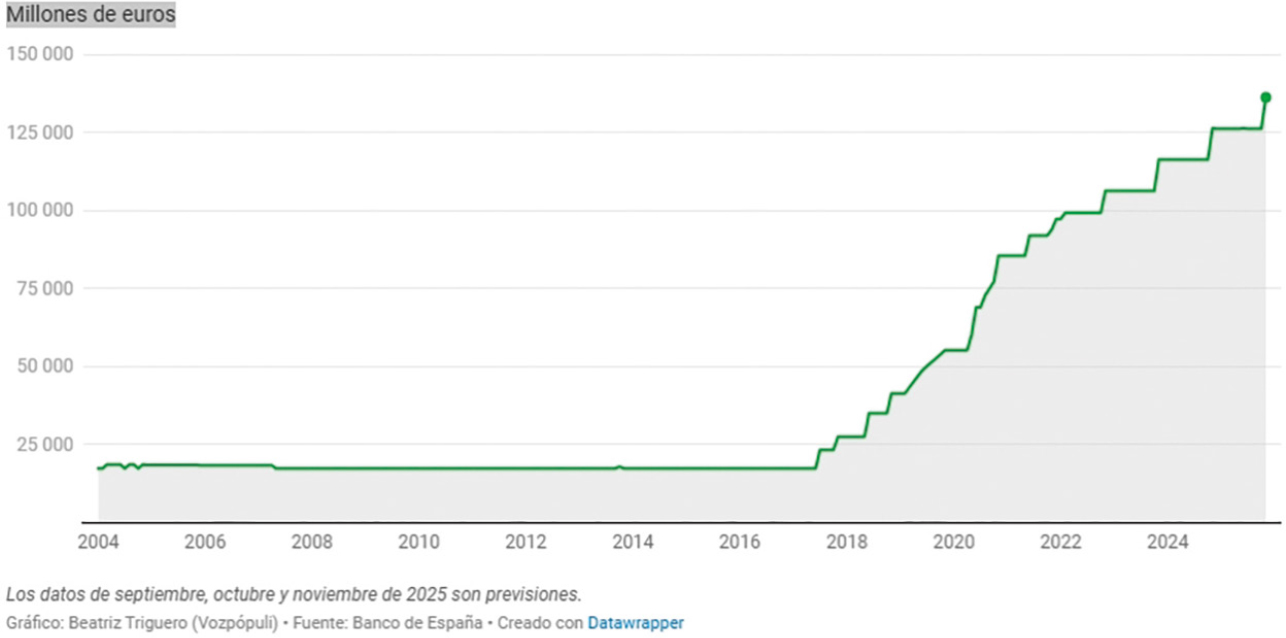
Chart 1.
TREND IN SOCIAL SECURITY DEBT
Source: Beatriz Triguero (Vozpopuli), based on data from the Bank of Spain.
The State and its institutions, driven by a desire to appease captive voters, continue to increase social security contributions for employees and the self-employed by 7 per cent annually; yet, due to rising costs, they are unable to pay pensions and must therefore burden citizens with ever-increasing debt. As reported by The Objective, Spain has 53 dependants for every 100 workers, making the situation unsustainable32. Consequently, the State’s very existence is based on appeasing the voters who depend on it (more than 10 million pensioners, more than 3.5 million public sector employees, public enterprises, regulated companies), so that the persistence of state powers (executive and legislative) only leads to greater public debt and a constant passing on of that debt in the form of higher taxes and money supply expansion, which results in a loss of purchasing power (12 per cent annually since 2021).
Rothbard (2013:206–213) points out that, for much of the nineteenth century, when there was hardly any increase in the money supply, ‘prices were falling, and yet the economy was growing and industrialising. Falling prices do not constitute an absolute obstacle to business or economic prosperity. Therefore, falling prices are, apparently, part of the normal functioning of a growing market economy.” Thus, “inflation is not something inevitably embedded within the economy. (…) However, since the Second World War, the growth in the money supply—both in the United States and abroad—has been much faster than that of the supply of goods. The consequence is inflation.” In contrast, following the 2020 pandemic, the ECB’s policy of increasing the money supply and the EU’s policy of increasing public debt to inject the EU Next Generation funds (over 1 trillion euros) into the economy has caused inflation of more than 35 per cent in food and housing prices, and even higher inflation in industrial prices (in just four years). Specifically, the share of public debt borne by each Spaniard has soared from 6,300 euros in 1994 to nearly 35,000 euros today33. In constant euro terms, this represents a 2.5-fold increase. The exponential rise in public debt in Spain is illustrated in this graph:
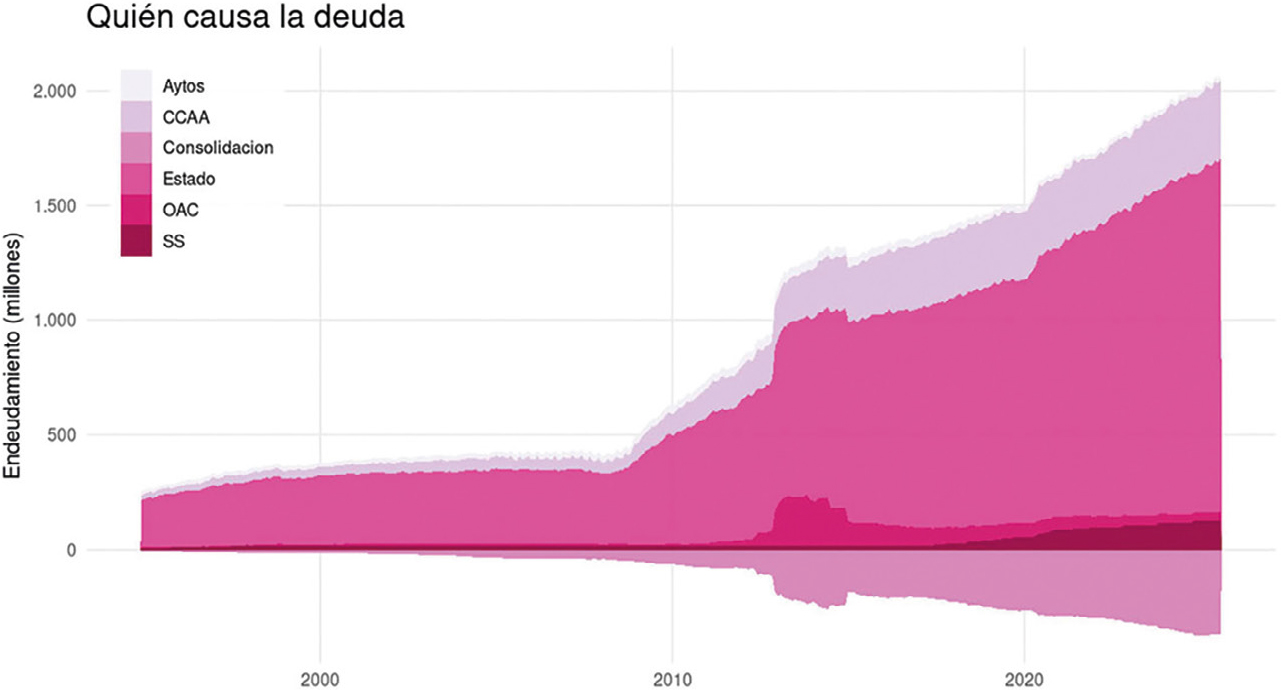
Chart 2.
GROWTH IN PUBLIC DEBT IN SPAIN 1994–2025
Source: Juan Manuel López Zafra, ’You owe 35,000 euros more than you think, and you’ll have to pay it’, The Objective, 4 November 2025: ‘You owe 35,000 euros more than you think, and you’ll have to pay it’
What this state paternalism encourages is a refusal to take individual risks and an erosion of individual responsibility, so that citizens depend on the state in exchange for not being held accountable for their actions. But this does not come free of charge; it leads to citizens becoming indebted through government debt, monetary expansion and the banks’ fractional reserve system, which distorts time preference and prevents prices from serving as an accurate signal, thereby causing systemic crises. Without individual responsibility, it is very difficult for capitalism—arising from spontaneous, free cooperation between individuals—to flourish.
Furthermore, such state coercion through the collection of taxes and social security contributions also funds a costly administrative apparatus comprising more than 3.5 million public sector employees, across more than 4,850 public bodies (at national, regional and local levels)34. Consequently, this coercive interference in people’s lives, through the transfer of income from the working population to the non-working population, in turn generates perverse effects on demographic trends, leading to a decline in the birth rate, and consequently leads the public pension system to become unsustainable, as demonstrated by the Spanish Court of Auditors’ calculation that the Spanish Social Security deficit in 2025 will already amount to 100,000 million euros35
The restriction on economic freedom entailed by the compulsory collection of taxes and social security contributions not only undermines individuals’ right to life, liberty and property, but is also economically unsustainable, given that it will be impossible to continue paying pensions averaging 2,000 euros a month to almost a third of the population whilst the working-age population continues to decline.
Since 2020, it has been reported that the number of people in Spain who depend on the state for their livelihood – through public sector wages, pensions or benefits – stands at over 20 million, out of a total population of 48 million36. Added to this is the fact that most of the large companies in the Ibex 35 are regulated enterprises (remuneration for electricity transmission and distribution activities; public-law obligations of electricity or telecommunications companies; construction firms dependent on public works; the banking and insurance sector supervised by the Bank of Spain and regulated by the State in terms of solvency and bail-outs, etc.). Furthermore, the EU has allowed the Spanish Government to control the purchase of shares in strategic sectors (more than 270 authorisation or supervision procedures according to El Economista over the last three years), to even veto such acquisitions (the takeover bid for Talgo), or to promote the State’s entry into companies such as Telefónica, Indra and other regulated companies (electricity grid, natural gas, etc.) (through SEPI). This runs counter to the free movement of capital and services as set out in Articles 56 and 63 of the Treaty on the Functioning of the EU.
We might also mention the financial dependence of universities on the accreditation of their degree programmes by ANECA (the National Accreditation Agency), or of lecturers on their six-yearly performance reviews, or of the media (the State is the largest advertiser, followed by the regulated companies listed on the Ibex 35).
It has recently come to light that the Spanish Government will table a bill to restrict the establishment of private universities37, a move that undoubtedly constitutes a limitation on the right to education enshrined in the European Charter of Fundamental Rights, which includes the right to establish educational institutions. This is yet another example of the lack of self-restraint on the part of the legislative and executive powers, which curtails any fundamental right and thus highlights the need for the abolition of these powers.
All of this constitutes state planning – whether through laws, regulations, subsidies or controls – which ensures that economic variables are influenced by the state or the central bank, thereby generating economic growth unsupported by real savings38, leading to economic cycles and a lack of free cooperative processes in the market, and ultimately to the weakening or abolition of individual rights.
Even at the business level, all plans drawn up in advance regarding the evolution of income or social needs to be met are bound to fail, since, as Huerta de Soto and Mises explained in their *Human Action*, business knowledge is subjective and is generated through custom by the entrepreneur as they act and interact cooperatively with other individuals or entities, through a process of trial and error that discards failed projects as they are empirically proven to be unsuccessful. Only if individuals are able to explore and make mistakes can they generate new information that enables them to become more efficient and meet market needs; for if the State provides incentives, plans or imposes bans, it will be impossible for the individual, as an entrepreneur, to discover what can satisfy human needs39.
Not only is such planning and coercive intervention immoral, but it is also inefficient, as demonstrated by the major power and telecommunications blackout that affected the whole of Spain on 28 December 2025, without the Government or its state-owned company, Red Eléctrica de España, explaining why, suddenly, “at 12:33,15 gigawatts (representing 60 per cent of demand at that time) were suddenly lost from the system in barely 15 seconds”, leaving homes without electricity or electronic communications, including public transport. Furthermore, the company responsible for operating the electricity system and the transmission grid, Red Eléctrica, is a company in which the State holds a 20 per cent stake and has controlling influence. The blackout and the absence of mobile networks for almost 24 hours mean that the country is not a safe place for investment. The anti-fragility of systems governed by the state and its public or regulated enterprises (the electricity and telecommunications systems) was demonstrated as a result of the planning of renewable energy projects funded by public debt, which led to 20 hours of chaos in Spain. What is more, in the absence of traffic lights, law enforcement officers and telecommunications, citizens demonstrated exemplary individual social cooperation, allowing vehicles to give way to pedestrians and cooperating to use vehicles to collect their children – in a spontaneous order far more effective than centralised planning.
This ‘chaos’—brought about by the State itself through the use of public funds to promote renewable energy without backing from other energy sources that had been demonised (nuclear, gas, coal, etc.)—caused serious hardship to citizens who were forced to abandon their vehicles on the roads and walk for kilometres to collect their children from school, as trains and underground services were unable to operate due to the power cut. It was thus demonstrated that, following the amnesty law and the major blackout, the institutional system is far more fragile than the systems of voluntary cooperation—free from state interference—that existed in ancient times.
As we have shown, the State and its officials (who enjoy a privileged status such that they cannot be removed from office), by failing to assume risks and instead externalising them onto the general population, are precisely those who do not guarantee freedoms, but rather undermine them through central planning. Moreover, it was these very officials who allowed the rule of law to be undermined through the processing of the amnesty (court clerks) and who defend its application (crown prosecutors and judges), in defiance of the Constitution, Article 2 of the Treaty on European Union and the case law of the Court of Justice of the European Union. It was precisely this state planning—through billions in subsidies for renewable energy (drawn from European ‘Next Generation EU’ funds obtained through public debt), and the ban on CO2 emissions and the promotion of the closure of nuclear and combined-cycle power stations, that caused the imbalances in the electricity system which led to the major power and telecommunications blackout of 28 and 29 April 2025.
As Hayek demonstrated in *The Fatal Conceit* (2013:483):
‘The popularity of the idea that “it is always better to cooperate than to compete” demonstrates a general ignorance of the true organising function of the market. Cooperation, like solidarity, is only possible if there is a broad consensus not only on the ends to be achieved, but also on the means to be employed. In small groups — whose members share certain habits, knowledge and expectations — this is indeed possible, but it is hardly so when it comes to adapting to unknown circumstances. However, it is this adaptation to the unknown that underpins the coordination of efforts on a large scale. Competition is nothing other than an uninterrupted process of discovery, present in all evolution, which leads us to respond unconsciously to new situations. It is renewed competition, and not consensus, that increasingly enhances our effectiveness.”
In Taleb’s words (2013:483), entrepreneurs “tend to get things wrong and make mistakes (many mistakes). They are convex. What matters in their case, therefore, is the reward they derive from their successes”, but they stake something of their own for the sake of others, or put their heart and soul into the endeavour, without offloading the risk onto citizens so that they bear the consequences (which is what governments, legislators, planners and companies dependent on government subsidies do). No ruler or thousands of civil servants possess the capacity to understand reality a priori (what Hayek termed ‘constructivist rationalism’), for, as Hayek (2010:55) explains, ‘Man does not come into the world endowed with wisdom, rationality and goodness: these must be taught to him; he must learn them. Morality is not the fruit of reason; rather, it was those processes of human interaction that fostered the corresponding moral order which enabled man to gradually develop not only reason but also that set of faculties with which we usually associate it”.
The consequence is clear, as Hayek (2008:92) explained: “Only within this system (capitalism) is democracy possible, if by ‘capitalism’ we mean a system of competition based on the free disposal of private property. Once it comes to be dominated by a collectivist creed, democracy will inevitably destroy itself”.
Despite the economic impossibility of socialism or central planning, as demonstrated by Mises, Hayek and Huerta de Soto—given that it is the individual who subjectively generates knowledge and opportunities as they act (the entrepreneurial function)— state intervention and control over individuals’ lives is increasing, leading not only to a lack of freedoms but also to the impoverishment and unsustainability of institutions (the legislative and executive branches and the 4,850 associated public bodies), precisely due to the lack of self-restraint on the part of state powers. Those who oppose the market system (or the free cooperation of individuals without coercion) should apply Taleb’s (2019:260) criterion: ‘it is immoral to oppose the market system and not live in a hut or a cave situated far away from the market’
Therefore, the only way to guarantee free human action and entrepreneurial activity—where each individual discovers, through a process of trial and error, opportunities for personal growth40 —is to abolish the legislative and executive branches, as we shall explain, thereby preventing planning or intervention (including the abolition of the power to levy taxes)41.
6. The necessary abolition of the powers of the State to guarantee individual rights and the functioning of enterprise
Following the abolition of the rule of law and equality before the law by the amnesty act, as well as the abolition of community freedoms and the right to property, one might ask whether there is any legal means to guarantee the rights of individuals, a question we shall answer below.
At first glance, we might refer to civil disobedience on the part of judges (Thoreau, H 2012), on a case-by-case basis, but this would not prevent the suspension of legislative activity and the State’s powers of declaratory and executive self-protection. It is true that the origin of the supremacy of the US Constitution of 1787 was not based on an express provision therein, but rather on the doctrine of ‘implied powers’ developed in the rulings of several judges in the late 18th century and consolidated in Justice Marshall’s judgement in ‘Marbury v Madison’ in 1803, which established the ability of the courts (particularly the Supreme Court) to strike down unconstitutional laws from the legal system, in order to guarantee the supremacy of the Constitution as the fundamental law enshrining the individual rights of citizens.
Thus, for example, as Fernández Segado (2011:133) explains: ‘In 1795, Justice Paterson, sitting as a member of a circuit court, in the well-known case of Van Horne’s Lessee v. Dorrance, had already had the opportunity to declare a Pennsylvania state law unconstitutional, attaching to that declaration the effect of nullifying the legal text.’
The case of Calder v. Bull, decided on 8 August 1798 by the votes of four Justices—Chase, Paterson, Iredell and Cushing, who delivered their opinions seriatim—was also to have particular constitutional significance. According to Fernández-Segado, this Supreme Court decision is based on the natural rights of the individual (regardless of the form in which they are codified):
“A section of legal scholarship has placed particular emphasis on the numerous references in Chase’s opinion to principles of natural law, emphasising that, despite his inclination to dismiss the claim, his opinion is replete with suggestions regarding ‘natural rights limitations on legislatures, beyond the limits prescribed by the written Constitution’, and, consistent with this, Chase rejected not only the omnipotence of state legislatures, but also the notion that their power is absolute and unchecked, even where no specific clause in either the federal or state Constitutions provides for this. In doing so, Chase, in line with previous decisions of the Supreme Court, helped to lay the foundations for judicial review. Chase’s opinion appeared to open the way for judicial review of laws not merely on the grounds that they contradicted specific constitutional provisions, but, going beyond that, even on the grounds that they contradicted the principles of what we might call the ‘unwritten constitution’—for example, the principles of natural justice.”
In his concurring opinion, which aligned with that of Justice Chase, Justice Iredell grounded the defence of the Constitution against acts of Parliament in the defence of the natural rights inherent to human beings, which predate any positive law:
“Iredell would begin by pointing out that if the Constitution did not impose limits on the legislative power, the inevitable consequence would be that ‘whatever the legislative power chose to enact, would be lawfully enacted, and the judicial power could never interpose to pronounce it void’42.
The basis for this, of course, lies in the conception—inherited from the School of Salamanca—of individual rights to life, liberty and property as inalienable and part of the very essence of the human being, and naturally enshrined in a Constitution drawn up by the constituent power. This had already been set out in the Declaration of Independence of the United States of 1776 and in several of the bills of rights of the states that made up the Confederation.
In other words, the consolidation of the Constitution and individual rights in the late 18th century in the United States was the result of individual actions by judges of the United States Supreme Court, which is hardly to be expected within a continental and bureaucratic conception of judges as mere automatic enforcers of the law, even though the case law of the Court of Justice of the European Union (CJEU) would support the non-application of the Amnesty Act on the grounds that it contravenes Article 2 of the Treaty on the Functioning of the European Union (TFEU) (and Article 4 bis of Organic Law 6/1985 of 1 July on the Judiciary was itself amended a few years ago in accordance with the EU’s requirements to stipulate that: “1. Judges and courts shall apply European Union law in accordance with the case law of the Court of Justice of the European Union”).
As we have said, given the lack of a tradition amongst Spanish judges of disapplying national laws on the grounds of a breach of Article 2 of the TEU (the rule of law), the only effective and generally applicable means available to suspend the application of the Organic Law on Amnesty and guarantee the separation of powers would have been for the European Commission to have brought an infringement proceedings against Spain in 2024 for breaching Article 2 of the Treaty on European Union (rule of law, democracy and separation of powers), requesting the provisional suspension of the Organic Law before the CJEU, as the European Commission did in the case of a law on the retirement of judges from the Polish Judicial Council (Case 791/19, the Order of the Court of Justice of the European Union of 8 April 2020).
However, the current European Commission, comprising the European People’s Party and the Party of European Socialists, has refused to apply Article 2 of the Treaty on the Functioning of the European Union in relation to the Amnesty Act and has not brought any infringement proceedings against Spain. At most, the judges could apply
As the Amnesty Organic Law entails a derived power such as the legislature en masse overturning court judgements to favour certain politicians, and consequently the right to equality before the law, it brings about a return to a ‘state of nature’, hollowing out the sovereignty of the constituent power that adopted the Constitution, and undermining the principles of the supremacy of the Constitution, the hierarchy of norms and the democratic legitimacy of power.
Therefore, if it has not been possible to prevent the destruction of the Constitution by the Organic Law on Amnesty – promoted by the Government on the basis of its investiture pact with the parties that supported that secessionist coup d’état – it is clear that the actions of individuals in positions of state power have circumvented the Constitution, without the constitutional provisions being able to prevent it. To paraphrase Norberto Bobbio’s phrase (“Government of men or government of laws”43), it would appear that we have a government of men, and that there is no such thing as a government of laws (of the Constitution as the supreme law, as advocated by the founding fathers of the USA).
This44 totalitarian drift (he who can do the most can do the least) has continued with a bill tabled by the PSOE in January 2025 to abolish private prosecution, remove the offence of religious hate, and prevent judges from initiating investigations based on journalistic reports, under threat of disciplinary measures by the General Council of the Judiciary.
To this must be added, as we have explained, the government’s acquisition of controlling stakes in strategic companies (with the appointment of board members) such as Indra (which processes election results) or Telefónica. Regarding the latter, we have witnessed the quasi-Soviet or totalitarian spectacle of the Government’s dismissal of Telefónica’s chairman, after the chairman in question was summoned to the Moncloa Palace, together with the other shareholders (Pallete was sacked at Moncloa in the presence of the heads of Criteria Caixa and STC45). In other words, the government is acquiring shareholdings in companies that are strategic for security and electoral processes (Indra), or for telecommunications (Telefónica, the company that can decide whether to refuse, before a judge, to hand over messages or communications from the mobile phone of the under-investigation Attorney General, or the company that controls the majority of the radio spectrum and has a powerful audiovisual and communications project), and, furthermore, it can dismiss and appoint their chairpersons, through a controlling stake. This is clearly a derogation from the European freedoms of the free movement of capital, companies and persons, which form the basis of the EU project (Articles 63 to 66 of the Treaty on the Functioning of the EU) and of the case law of the Court of Justice of the European Union46, and which, in the wake of the pandemic, have been undermined by the EU itself, by allowing governments to veto share acquisitions on the discretionary grounds of ‘strategic security’ (a provision which was used by the Socialist government to block a takeover bid for Talgo by a Hungarian company).
Consequently, given the de facto absence of freedom of enterprise and the right to private property, coupled with the mass repeal of court rulings by the Amnesty Act, it is necessary to analyse whether constitutional law can act as a sufficient check on the actions of the derived powers (legislative and executive) or the inaction of the neutral power of the Head of State (who has failed to guarantee the continued existence of the democratic rule of law).
7. How can individual rights be protected against the actions of the derived powers?
In the absence of a Constitution (stemming from the lack of constitutional supremacy and the separation of powers following the Amnesty Act, as well as the division of influence between the two major parties within the General Council of the Judiciary (CGPJ), which appoints the majority of Spanish judges47), only a constituent process can restore citizens’ inalienable individual rights, drawing on the theories of ‘tyranicide’ put forward by the Spanish scholastics48 (Suárez49, Mariana50, Francisco de Vitoria), which Locke later formulated in his ‘right of rebellion’ in the Second Treatise on Civil Government51.
The Austrian School of social sciences (particularly Rothbard) has been reluctant to acknowledge the existence of a ‘social contract’ or constituent power that would allow the guarantee of individual rights to be delegated to an institution external to individuals52. Rothbard himself (2020: 177) quotes Ortega y Gasset from *The Revolt of the Masses* on how the inaction of individuals leads to the consolidation of tyranny:
“Civilisation is not something that simply exists; it does not sustain itself. It is artificial … If you wish to reap the benefits of civilisation but do not concern yourself with sustaining it… you will destroy it. Before you know it, civilisation is gone. A moment’s inattention, and when you look around, everything has vanished! As if the curtains concealing pure Nature had been drawn back, the primeval forest reappears in its virgin state.”
Huerta de Soto makes it clear, in line with the 16th-century Spanish scholastics (or the US Declaration of Independence of 1776), that individual rights exist prior to the State, and that the abolition of state structures does not entail the abolition of those rights. In other words, the law must exist even if the State is abolished (2017:18) (emphasis added):
“The legal system is the evolutionary manifestation that incorporates the general principles of law (particularly those relating to property) which are compatible with human nature. The law, therefore, is not what the state decides (whether democratically or not), but rather it exists, embedded in human nature, even though it is discovered and consolidated through case law and, above all, through legal doctrine in an evolutionary manner (in this regard, we consider that the legal system of the Roman and continental tradition, due to its more abstract and doctrinal nature, is far superior to the Anglo-Saxon common law system, which arises from disproportionate state backing for judicial decisions or rulings which, through ‘binding precedent’, introduce into the legal system all manner of dysfunctions stemming from the particular circumstances and interests that prevail in each case). Law is evolutionary and customary and, therefore, predates and is independent of the state; it does not require any agency with a monopoly on coercion for its definition and discovery.”53
Huerta de Soto, whilst recognising that natural rights are inherent to human beings and pre-exist any social order, also acknowledges that these rights must be refined and specified through case law; in other words, he recognises the need for impartial judges or arbitrators to determine how human disputes are resolved when those natural rights are at stake (which does not mean that these arbitrators are dependent on a State).
And secondly, when Huerta de Soto rightly considers the Roman tradition’s system of rights protection to be more appropriate, as opposed to the British common law system, he is not denigrating the US Constitution of 1787, nor the case law of the Supreme Court which protects those individual rights54, but rather, in a sense, considering that, in contrast to the British system’s lack of a constitution, it is necessary to guarantee individual rights against political power in a codification (such as the Digest promulgated in 533 by Justinian I), which today is the Constitution.
Ayn Rand also argued in her works *Capitalism: The Unknown Ideal* (1967) and *The Virtue of Selfishness* (1964) for the need for an arbiter external to individuals to enable the resolution of disputes regarding the fulfilment of contracts, as a guarantee of the legitimate trust required for capitalism to function55.
We might say that, given that the Constitution sets out a list of individual rights (which, according to the Austrian School, consist of life, liberty and property), we believe it is essential to guarantee its supremacy in order to be able to invoke those rights against the State, thereby preventing the State from using coercive force against individuals. This necessity of the Constitution is clearly illustrated when the US Supreme Court, in its judgement in SEC v. Jarkesy (2024), ruled that only a jury (composed of citizens) may authorise the imposition of penalties on companies, in accordance with the Seventh Amendment to the Constitution of 1787, or in its judgement in Loper Bright Enterprises v. Raimondo. Secretary of Commerce, et al, the US Supreme Court stated (p. 35): “And when a particular statute delegates authority to an agency consistent with constitutional limits, courts must respect the delegation, whilst ensuring that the agency acts within it. But courts need not, and under the APA may not, defer to an agency’s interpretation of the law simply because a statute is ambiguous. In this regard, the existence of a Constitution does not presuppose the existence of a State; that is to say, the guarantee of the Constitution is not contrary to the libertarian ideal of the elimination of state structures”.
It is precisely the Constitution, conceived in the terms of the founding fathers of the USA (the Declaration of Independence of 1776 and the Constitution of 1787), that acts as a check enacted by citizens against the encroachment of institutions upon individual rights. Strictly speaking, the existence of a Constitution does not prevent the abolition of taxes, state coercion, etc. The Constitution can be protected by impartial arbiters (judges), who need not be dependent on the State, and whose salaries could be derived from court fees paid by citizens who need to bring cases before them. A system similar to that currently in place for Land Registrars, whose decisions constitute ‘public registry records’; their fees do not depend on the public budget but on voluntary payments from citizens who wish to make use of these public registry records.
Consequently, the reinstatement of a minimal Constitution is necessary to prevent coercion by entities external to individuals, as well as to guarantee this through certain bodies which we summarise here briefly (the Head of State and independent judges with the power to set aside laws contrary to the Constitution).
8. Proposal to abolish the powers of the State in order to safeguard human agency and the role of enterprise
What the powers of the State have brought about can only be halted through a constituent power that guarantees a society without powers. It must be a defence of the common man of whom Chesterton (1996) spoke, a restoration of equality before the law and of the independence of the judiciary that guarantees it (a judiciary which, of course, should not be appointed by the legislature nor on the proposal of the executive, but should be selected through examinations administered by the judicial service, or be voluntarily elected by citizens from among jurists of recognised competence56).
Of course, this task of constitutional reconstruction is something that must permeate the legal community (lawyers, judges, civil servants, Members of Parliament) and other spheres. It is the task of many ordinary people to put an end to this process of destroying the Constitution from within, just as it was Samsagaz Gamyi, a humble but honourable hobbit, and not the great kings of men or elves, who managed to bring the Ring to its destruction (Tolkien, 1999).
The restoration of constitutional democracy requires a constant legal struggle by all those involved, even if the expected results are not achieved in the short term.
The Jesuit Tomás Morales (2004: 97) spoke of ‘never tiring of always starting afresh, even if the objective never seems to be achieved’. I am therefore aware that this proposal for constitutional changes – which affect even the Head of State, the judiciary, the Constitutional Court and the Spanish Parliament – will generate scepticism or rejection within the legal community, as it affects either privileges or the status quo on which many people depend, and will bring me neither favour nor personal gain. However, five centuries ago, Francisco de Vitoria57, Francisco Suárez58 and Juan de Mariana59 all set out their theories on the natural rights of man and suffered reprisals from various kings (although Charles V later acknowledged to Vitoria the sincerity and erudition of his proposals); and more than 400 years later, they were rediscovered as the fathers of individual rights or of the Austrian School. We must not, therefore, be daunted by supposed reprisals, for, albeit belatedly, the truth always prevails.
As Ortega y Gasset recalled in his *España invertebrada*: ‘To live is something that is done moving forwards; it is an activity that extends from this very moment to the immediate future. (…) In the ineffable secret of hearts, a fateful vote is cast every day that decides whether a nation can truly continue to be a nation’ (2000:326).
We cannot continue to look the other way as if the 1978 Constitution were still being upheld by the public authorities; we must ‘purify’ our legal order in order to restore constitutional democracy. We therefore need a new constitutional impetus grounded in constituent power.
This process of constitutional reform should have the following aspects as its fundamental pillars (which I have described in greater detail in a book I hope will be published shortly):
The drafting of the Constitution through constituent power. A direct electoral system based on constituencies. Following the adoption of the Constitution by popular referendum, this Assembly would hold no legislative functions; only by a two-thirds majority could it exercise (i) advisory functions – at the request of the Head of State – (ii) call elections for new constituent assemblies, (iii) authorise the Head of State to commence negotiations on international treaties, ratify their text and call a popular referendum for ratification, and (iv) in the event of a territorial invasion or armed insurrection, grant the Head of State authority to coordinate police forces under the supervision of the Supreme Court, and call up volunteers for a defence force under the command of the Head of State, subject to the oversight of the Assembly and the Supreme Court.
Establishment of courts consisting of juries of citizens guided by district judges as the sole institution guaranteeing the Constitution, with a Supreme Court to ensure the uniform application of legal principles. These c o u r t s would be funded by commercial fees paid by those seeking justice, and citizens could choose the most efficient court in each municipality, resulting in effective competition between courts to serve the public. The commercial fees would fund not only the judges and citizen juries but also the police forces directed by the courts to enforce judgements or provide immediate safeguards for the rights to life, liberty and property.
An elected Head of State every seven years to (i) guarantee the supremacy of the Constitution against violations of fundamental rights by judges or by the Constituent Assembly, (ii) conduct foreign relations, (iii) the negotiation of international treaties, subject to prior authorisation by two-thirds of the Constituent Assembly and their ratification following confirmation by that Assembly and a popular referendum, and (iv) in cases of territorial invasion or armed insurrection, the coordination of court police forces and the call-up of military volunteers, subject to prior authorisation by two-thirds of the existing Constituent Assembly.
To integrate the Constitutional Court into a Chamber of the Supreme Court, as the ultimate interpreter of the Constitution and guarantor of individual rights; this Chamber would consist of 12 judges elected from among judges and legal professionals with more than 15 years’ experience, with the election to be conducted by a committee chosen by lot from among judges with more than 20 years’ experience.
Abolish the General Council of the Judiciary, so that the judiciary would consist of district judges appointed through competitive examination (who would preside over lay juries) and a Supreme Court elected by the judges themselves from among judges with more than 15 years’ experience and a ten-year term of office; this Supreme Court would have the function of unifying legal doctrine and would also include that special constitutional chamber with a three-year term of office.
Diffuse constitutional review: any court (comprising the jury and the judge) would have the power to set aside any legislation or action that is contrary to the Constitution.
The absence of legislative and administrative structures in the Constitution beyond judges and the local police under their command: the abolition of laws, taxes and other coercive measures of the State.
The abolition of declaratory and executive powers of self-governance, given the absence of such State powers and coercive taxation, with judges, jurors and police officers being funded through voluntary contributions in each district or locality
The possibility of coordinating the maintenance and management of communal facilities at district, neighbourhood or village level, through the election of representatives by residents’ associations and by means of contributions from each resident. The provision of functions currently carried out by the State would always be private. Payment for water, electricity, gas, refuse collection or fire service would be made by each property owner, via contributions to residents’ associations. The costs of maintaining communal facilities such as parks, pavements, public roads, fire stations, rivers, sports grounds, libraries and cultural centres would be met by renting out the vast stock of public buildings owned by the State, regional and local governments, which are located in every district or locality.
The obsolescence of a standing army to guarantee the absence of coercion against individual rights, with recourse only to police forces directed by the courts and the calling up of reservists in the event of an armed invasion, subject to prior authorisation by two-thirds of the constituent assembly and coordinated by the Head of State.
The necessary elimination of credit expansion through the abolition of the Central Bank and the fractional reserve system of banks. The gold standard, the absence of legal tender and monetary freedom.
The introduction of a 100 per cent reserve requirement for banks to guarantee deposit contracts, and the elimination of the possibility of creating unbacked credit.
The absence of a central bank, in order to prevent any centralised cuts in interest rates and avoid the credit expansion encouraged by the current legislative and executive branches.
The absence of a monopoly on currency issuance following the abolition of the State and the Central Bank.
The gold standard as a solution to the state’s monopoly on money creation, with banks acting as custodians of the gold backing citizens’ deposits, and those banks being able to issue paper money backed by the gold in their custody.
9. Conclusion
With these proposals, I have sought to explain how it is possible to reconcile the Austrian School’s views on the subjective rights of the individual and the harmful effects of state power upon them, with the need for such rights to be enumerated in a Constitution that can be defended by bodies external to state power (juries presided over by judges independent of the legislative and executive branches).
It is clear that this requires recourse to constituent power, which is necessary given that, following the Organic Law on Amnesty, the 1978 Constitution was repealed, as judicial rulings were annulled en masse and, consequently, the rule of law established by the Spanish constituent power in 1978 was undermined. Only if we wage the struggle for the Law as articulated by Jhering will we be able to preserve our inalienable natural rights in the face of political power, including the rights to liberty and property that are essential to the functioning of business and the free exercise of human activity without coercion.
Notes
[1] “Ultimately, human action invariably seeks to satisfy the desire felt by the individual. It is only through individualised value judgements that one can assess the degree of personal satisfaction; these judgements differ according to the various parties involved and, even for the same person, vary from one moment to the next. It is subj ective assessment — based on one’s own will and judgement — that makes people more or less happy or unhappy. No one is capable of determining what will provide greater well-being for another person.” Mises (2011:19).
[2] ”The man who acts distinguishes between the time prior to the satisfaction of a need and the time during which the need is satisfied. Action always aims to avert future discomfort, which may well refer to the very next moment. Between the moment when the action begins and the moment when the desired end is achieved, there is a certain interval which is like a period of maturation; the seed sown by the action eventually bears fruit. Agriculture provides us with clear examples in this regard. A considerable period of time elapses between tilling the soil and the fruit reaching maturity. The improvement in the quality of wine over time is another example. There are cases, however, in which this period of maturation is so short that we can say the fruit is obtained instantly. Insofar as an action involves labour, it is affected by the time taken to perform that labour. The execution of any task takes time. In some cases, as we have said, this time span is so brief that it can be said the execution requires no time at all.” Mises (2011:573).
[3] We might also quote here from the First Epistle of Saint Paul the Apostle to the Corinthians (1 Corinthians 12:4-1), where Saint Paul explains the different subjective gifts of each individual:
“Brothers and sisters: There are different gifts, but the Spirit is the same. There are different ministries, but the Lord is the same. There are different activities, but God, who works in all, is the same.
In each person the Spirit is manifested for the common good. One receives the gift of wisdom; another, the gift of knowledge. To one is granted the gift of faith; to another, the grace of healing; and to yet another, miraculous powers. One receives the gift of prophecy, and another, the gift of discerning spirits. One is granted the gift of tongues, and another the gift of interpreting them. But it is one and the same Spirit who does all these things, distributing his gifts to each person as he wills.”
[6] Further reading on the subject:, Redondo Fernández, A (2023).
[7] “The actions of the state authorities, in collusion with the banking sector, led to a fraudulent alteration of the institution of the deposit; bankers progressively violated the traditional principles of law governing irregular deposits, as well as the reasons why the social mechanisms of control failed to curb the abuses committed. The role of governments in this process will also be examined. Far from seeking to scrupulously uphold the legal implications of property rights, governments, almost from the outset, backed the bankers’ irregular activities and granted them exemptions and privileges in exchange for being able to exploit these for their own ends. This explains the emergence of the traditional relationships of close complicity and solidarity between state institutions and the banking sector, which have persisted to this day.”
[8] “We must not forget that the government is run by flesh-and-blood human beings who, simply because they are democratically elected, do not cease to be mere mortals, tainted by original sin, and do not become angelic administrators in the service of the common good. And whilst the economic actions of each individual in the market produce unintended consequences, beyond their own control, the decisions taken by those who hold the legitimate monopoly on the use of force—that is, those in government—can produce highly distorting results, even when such decisions are taken with the aim of benefiting some of the most disadvantaged sectors of the population. Barring extremely exceptional circumstances, government intervention in prices leads to shortages—that is, a lack of goods—which will subsequently be sought on the black market at much higher prices. Those most adversely affected will be those who have the least: less money, fewer connections, less knowledge and less time.”
[9] Above all, in Chapter IV of Book VI of the *Defensio Fidei*, a book entitled *De luramento Fidelitatis Regis Angliae* (‘On the Oath of Fidelity of the King of the English’), as explained in the interesting study by Oporto, P F. (2013). “The core of Francisco Suárez’s doctrine on resistance and tyrannicide”. Pensamiento. Journal of Philosophical Research and Information, 69(260), 493-521
[10] “The power of the legislature, being derived from a voluntary delegation by the people and from an institution established by them, can be no other than that which has been expressly conferred upon it, namely: the power to make laws, and not the power to appoint legislators. Therefore, the legislature is unable to transfer to others the authority to make laws”
[11] “When, in the course of human events, it becomes necessary for a people to dissolve the political bonds which have connected them with another, and to assume amongst the nations of the earth that separate and equal station to which the laws of nature and the God of nature entitle them, a due respect for the judgement of mankind requires that they should set forth the reasons which impel them to separation.
We hold these truths to be self-evident: that all men are created equal; that they are endowed by their Creator with certain unalienable rights; that among these are life, liberty and the pursuit of happiness; that to secure these rights, governments are instituted amongst men, deriving their just powers from the consent of the governed; that whenever any form of government becomes destructive of these ends, the people have the right to alter or abolish it and to establish a new government based on these principles, and to organise its powers in such a way as, in their judgement, is most likely to secure their safety and happiness.”
[12] In 2024, the US Supreme Court’s ruling in SEC v. Jarkesy, which prevents the SEC from imposing penalties without a jury trial, on the basis of the Seventh Amendment to the Constitution of 1787, a ruling that struck down the Dodd-Frank Act of 2010 as unconstitutional. Judgment available at: https://www.supremecourt.gov/opinions/23pdf/22-859_1924.pdf (accessed 25 November 2024).
[13] All of this is explained in detail in Pernas Alonso, J.M‥ (2024), “The Amnesty Act and the Repeal of the Constitution. Proposals for its reinstatement”, ed. Universitas, Madrid, and in Pernas Alonso, J.M. (2023), “Why the Amnesty Act constitutes a repeal of the Spanish Constitution and an anti-democratic usurpation of constituent power”, Revista de derecho público, nos. 175-176, 2023, pp. 9-49.
[14] Huerta de Soto, J. (2020), ‘Juan de Mariana and the Spanish Scholastics’, *Procesos de Mercado: Revista Europea de Economía Política*, Vol. XVII, No. 2, Autumn 2020, pp. 415–433.
[15] Following the adoption of the Organic Law on Amnesty and its publication on 11 June 2024, a draft organic law was tabled in January 2025 by the Socialist Parliamentary Group to prohibit private prosecutions, prevent judicial investigations based on newspaper reports, and abolish the offence of religious hatred.
[16] The King’s dereliction of his duties as guarantor of the permanence and unity of the State (Article 56 of the Spanish Constitution), and as Head of State obliged to meet with parliamentary groups before proposing a candidate (Article 99 of the Spanish Constitution), is explained in the book (2024), “The Amnesty Act and the Repeal of the Constitution. Proposals for its Reinstatement’, published by Universitas, Madrid, and in the academic articles ‘The Role of the Head of State in the Survival of the Spanish Constitution of 1978’, *Revista Tachirense de Derecho*, Nos. 33–34, 2022–2023, pp. 247–262; and (2023), ‘Why the Amnesty Act constitutes a repeal of the Spanish Constitution and an anti-democratic usurpation of constituent power’, Revista de derecho público, Nos. 175176, 2023, pp. 9–49.
[17] In accordance with Article 147 of the Rules of Procedure of Congress, the amnesty bill, as it entails a constitutional reform (including a general pardon prohibited by the Constitution as well as nullifying the exclusivity of judicial power under Article 117), should be approved by a two-thirds majority of the plenary sessions of both the Congress and the Senate, after which the Cortes should be dissolved:
‘Bills and legislative proposals seeking a total revision of the Constitution or a partial revision affecting the Preliminary Title, Chapter II, Section I of Title I, or Title II of the Constitution shall be submitted for debate before the plenary session, which shall be conducted in accordance with the rules laid down for debates on matters of the whole.
Once the debate has concluded, a vote shall be taken. If two-thirds of the members of the Chamber vote in favour of the principle of revision, the President of Congress shall notify the President of the Senate.
If this Chamber also secures a two-thirds majority of the Senators, the President of Congress shall notify the President of the Government so that the latter may submit the Royal Decree dissolving the Cortes Generales to the King for his assent.
Once the new Cortes have been constituted, the decision taken by the dissolved Cortes shall be submitted for ratification. If the decision of the Congress is favour able, this shall be communicated to the President of the Senate.
Once the resolution has been adopted by both Houses, Congress shall, in accordance with the ordinary legislative procedure, process the new constitutional text, which, in order to be approved, shall require a favourable vote by two-thirds of the members of Congress. Should it obtain such approval, it shall be forwarded to the Senate.
Once the constitutional amendment has been approved by the Cortes Generales, the President of the Congress of Deputies shall notify the Prime Minister thereof, for the purposes of Article 168.3 of the Constitution.’
The Legal Advisers to Parliament, and in particular the Chief Legal Adviser, are the ones who could have advised the Bureau on the need to process that bill as a proposal for constitutional reform in accordance with the procedures set out in Article 147 of the Rules of Procedure of Parliament.
[18] On 23 March 2021, the Bureau of the Congress of Deputies refused to accept for consideration the draft organic law tabled by the ERC and Plural parliamentary groups (Junts, the CUP and the PDeCAT) on amnesty and the resolution of the political conflict between Catalonia and the Spanish State (document number 122/000132/0000).
[19] Art. 61.1: “Upon being proclaimed before the Cortes Generales, the King shall take an oath to faithfully perform his duties, to uphold and ensure the upholding of the Constitution and the laws, and to respect the rights of citizens and of the Autonomous Communities”. Art. 56 of the Spanish Constitution: “The King is the Head of State, a symbol of its unity and permanence; he arbitrates and moderates the regular functioning of the institutions.”
[20] ”It is the King’s legal duty to uphold and ensure the upholding of the Constitution, (…) and whoever has a mission to fulfil must possess the implicit powers that are a prerequisite for fulfilling it: such has been the doctrine upheld throughout history by the Supreme Court of the United States in the exercise of its constitutional jurisdiction.” Also relevant is the opinion of Eloy García in the Introductory Note: “The King under the Spanish Constitution is neither the neutral monarch of the Swedish Constitution of 1974, nor, of course, the ‘governmentalised’ King that Mussolini’s fascism deliberately designed for Victor Emmanuel III of Savoy, and who would existentially exhaust the monarchy’s time in Italy, making it appear as a tragic buffoon from whom democratic recovery was impossible”, Eloy García, p. XIV of the Introductory Note.
[22] For a detailed analysis, see the blog by Gómez Fernández, Diego, ‘The CJEU reiterates that a national court is not obliged to comply with a ruling of its Constitutional Court if it is contrary to the CJEU’s interpretation of European Union law’ (27 September 2024): https://www.derechoadministrativoyurbanismo.es/post/el-tjue-reitera-que-un-juez-nacional-no-est%C3%A1-obligado-a-cumplir-una-resoluci%C3%B3n-de-su-tribunal-consti
[23] It is well known, in this regard, that the political process of creating a purportedly independent Catalan state – the so-called ‘procés’ – has represented one of the greatest crises our constitutional democracy has had to face, from both a social and an institutional perspective. This process, the social rift it gave rise to, and the state measures that had to be taken to restore the constitutional breach caused – which included the application of the state coercion clause under Article 155 of the Spanish Constitution – may be regarded as extraordinary events in which the granting of an amnesty may be justified. The identification of the grounds for the amnesty cannot, therefore, be regarded as arbitrary. (…) Nor is it possible to discern in the LOANC at the intention to criticise or censure the judiciary that the appellants attribute to it. The contested law merely removes, with retroactive effect, the liability to criminal sanctions arising from the unlawful conduct falling within its scope of application; no legislative assessment can be inferred from this circumstance regarding the judicial activity that the courts may have carried out in the past in relation to the conduct that has now become eligible for amnesty. The application bases the existence of the aforementioned intent to censure or condemn not on the provisions of the LOANCat – to which no reference is made in substantiating this ground of challenge – but on other elements which, by their nature, cannot affect the validity of the law nor be subject to review through an action for unconstitutionality. Access to the judgment: STC 6436-2024.pdf
[24] Government expands the scope of the anti-takeover shield by intervening in 147 transactionsGovernment expands the scope of the anti-takeover shield by intervening in 147 transactions | Business. The ‘Talgo case’ leads to another extension of the Government’s anti-takeover shield, Expansión, 16 September 2024: The ‘Talgo case’ leads to another extension of the Government’s anti-takeover shield | Business. The Government will extend the protection for strategic companies by two years and broaden its scope, El Debate, 12 December 2022: The Government will extend the protection for strategic companies for a further two years. Sánchez consolidates control over strategic companies through SEPI and the anti-takeover shield, The Objective, 28 February 2022, Sánchez consolidates control over strategic companies through SEPI and the anti-takeover shield
[25] 1. For the purposes of this article, foreign direct investment in Spain shall be deemed to include any investment as a result of which the investor comes to hold a stake equal to or greater than 10 per cent of the share capital of a Spanish company, and all other investments where, as a result of a corporate transaction, legal act or business transaction, control is acquired over all or part of the company, in accordance with the criteria set out in Article 7 of Law 15/2007 of 3 July on the Defence of Competition, provided that one of the following circumstances applies:
(a) They are carried out by residents of countries outside the European Union and the European Free Trade Association.
(b) Where they are carried out by residents of countries within the European Union or the European Free Trade Association, but the beneficial ownership lies with residents of countries outside the European Union and the European Free Trade Association. Such beneficial owner ship shall be deemed to exist where the latter ultimately hold or control, directly or indirectly, more than 25 per cent of the investor’s capital or voting rights, or where they exercise direct or indirect control over the investor by other means.
2. The liberalisation regime for foreign direct investment in Spain is hereby suspended in respect of investments made in the sectors listed below which affect public order, public security and public health:
a) Critical infrastructure, whether physical or virtual (including infrastructure relating to energy, transport, water, healthcare, communications, the media, data processing or storage, aero space, defence, electoral or financial systems, and sensitive facilities), as well as land and immovable property that are key to the operation of such infrastructure, understood to mean those covered by Law 8/2011 of 28 April, establishing measures for the protection of critical infrastructure.
b) Critical and dual-use technologies, key technologies for industrial leadership and capacity-building, and technologies developed under programmes and projects of particular interest to Spain, including telecommunications, artificial intelligence, robotics, semiconductors, cybersecurity, aerospace, defence, energy storage, quantum and nuclear technologies, nanotechnologies, biotechnologies, advanced materials and advanced manufacturing systems.
c) The supply of essential inputs, in particular energy, understood to mean those subject to regulation under Act 24/2013 of 26 December on the Electricity Sector and Act 34/1998 of 7 October on the Hydrocarbons Sector, or those relating to strategic connectivity services or raw materials, as well as food security.
d) Sectors with access to sensitive information, in particular personal data, or with the capacity to control such information, in accordance with Organic Law 3/2018 of 5 December on the Protection of Personal Data and the Guarantee of Digital Rights.
e) The media, without prejudice to the fact that audiovisual communication services, as defined in Law 7/2010 of 31 March on General Audiovisual Communication, shall be governed by the provisions of that Law.
3. Furthermore, the liberalisation regime for foreign direct investment in Spain is suspended in the following cases:
a) if the foreign investor is directly or indirectly controlled by the government, including public bodies or the armed forces, of a third country; for the purposes of determining the existence of such control, the criteria set out in Article 7.2 of the Competition Act shall apply.
b) if the foreign investor has made investments or participated in activities in sectors affecting security, public order and public health in another Member State, and in particular those listed in paragraph 2 of this Article.
(c) whether there is a serious risk that the foreign investor may engage in criminal or illegal activities affecting public security, public order or public health in Spain.
4. The Government may suspend the liberalisation regime for foreign direct investment in Spain in those other sectors not covered by paragraph 2 of this article, where such investment may affect public security, public order or public health, in accordance with the procedure laid down in Article 7 of this Act.
[26] “Half a thousand companies have sought Moncloa’s approval to invest in Spain”, The Objective, 16 January 2025: Half a thousand companies have sought Moncloa’s approval to invest in Spain
[27] “Moncloa authorises investment by seven Chinese companies whilst blocking Hungarian investment in Talgo”, The Objective, 8 May 2025: Moncloa authorises investment by seven Chinese companies whilst blocking Hungarian investment in Talgo
[28] rStrategic Companies Support Fund: The Strategic Companies Solvency Support Fund closes 2023 with €110 million in early repayments I SEPI. “SEPI will not recoup the 3,256 million used to bail out companies during the pandemic until 2029”, Cinco Días, 3 October 2024: SEPI will not recoup the 3,256 million used to bail out companies during the pandemic until 2029 I Business I Cinco Días
[30] “For example, in 2008 there was a banking crash due to the accumulation of hidden and asymmetric risks within the system itself. Bankers, masters of risk transfer, were able to secure a steady flow of money by exploiting a series of hidden, explosive risks, using academic risk models that only work on paper (‥), and then, following the collapse, invoking uncertainty (‥)and retaining their previous income (‥) But it was the free market that came off worst, because the public, already predisposed to hate investors, began to link this system with forms of corruption and nepotism in the upper echelons, when in reality the exact opposite is true: it is the government, and not the markets, that enables these practices through its bailout mechanisms. And it is not just bailouts: in general, any government interference tends to involve the assumption of risk.” Ibid., p. 31.
[31] Beatriz Triguero, Vozpopuli, 5 November 2025, Social Security debt to rise to 136,000 million following the new pension loan: Social Security debt to rise to 136,000 million following the new pension loan | Vozpópuli
[32] The unsustainable demographic challenge: Spain now has 53 dependants for every 100 workers, The Objective, 6 November 2025: The unsustainable demographic challenge: Spain now has 53 dependants for every 100 workers
[33] López Zafra, J.M., You owe 35,000 euros more than you think, and you’ll have to pay it, The Objective, 4 November 2025: You owe 35,000 euros more than you think, and you’ll have to pay it
[34] This can be verified in the Inventory of Public Sector Bodies: Inventory of Public Sector Bodies (accessed on 12 March 2025); if downloaded as an Excel file, it lists these 4,850 public bodies.
[36] 16 February 2025: https://www.periodistadigital.com/economia/empleo/20250216/mitad-espana-vive-depende-ayuda-pension-o-salario-publico-noticia-689405060804/ (accessed 17 February 2025).
[37] “The Government is taking steps to curb the establishment of private universities and calls for ‘cracking down on fly-by-night operations that fail to meet standards’; Sánchez announces that he will present a plan to tomorrow’s Council of Ministers to ‘tighten the criteria for the establishment, recognition and authorisation of higher education institutions’
El Mundo, 31 March 2025.
[38] Taleb explains that “GDP growth can easily be achieved by burdening future generations with debt and allowing the economy of the future to collapse due to the need to repay that debt. GDP growth, like cholesterol, appears to be a ‘Procrustean bed’-style reduction that has been used to manipulate systems.(…) Economic growth that is fraught with vulnerabilities should not be called growth, something that governments have yet to understand. During the golden age of the Industrial Revolution – the period that propelled Europe’s hegemony – growth was very modest, at less than 1 per cent. Yet even at that low level, it was robust growth, unlike the reckless race of so many modern states which, in their quest for growth, behave like teenage drivers drunk on speed.” Taleb, N. (2013:206-207).
[39] Thus, “In reality, thanks to a specific mechanism (technically known as the bias-variance dilemma), we often achieve better results when we make “mistakes’, for example when we slightly miss the target we are aiming at. In *Antifragile* I have shown that making certain kinds of mistakes is the most rational choice when the costs of those mistakes are negligible, because they lead us to make discoveries. Take this example: medical ‘discoveries’ are for the most part accidental. A world without mistakes would have neither penicillin nor chemotherapy. That is why I oppose the state telling us what we ‘must’ do: only evolution is capable of determining whether something ‘wrong’ is actually a mistake, provided that risk-taking allows us to choose”, Taleb (2019), op. cit., p. 304.
[40] In Taleb’s words, “it is preferable to have a genuine failure rather than a successful entrepreneur, because it is mistakes, scars and character flaws that make a person human”. Taleb (2019: 177).
[41] As Hayek explains (emphasis added): The question raised by economic planning is not, therefore, merely whether we will be able to satisfy what we regard as our more or less important needs in the manner we prefer. It is whether we ourselves will decide what is more and what is less important to us, or whether this will be decided by the planner. Economic planning would not affect only those of our marginal needs that we have in mind when we speak disparagingly of the merely economic. It would in fact mean that, as individuals, we would no longer be allowed to decide what we regard as marginal. The authority directing all economic activity would intervene not only in that part of our lives concerning lesser matters: it would intervene in the allocation of the limited resources at our disposal for all our purposes. And whoever controls the whole of economic life controls the resources for all our purposes and, consequently, decides which of these are to be satisfied and which are not. This is truly the crucial issue. Economic control is not merely intervention in a sector of human life that can be separated from the rest; it is control of the means that serve all our ends, and whoever has total control over the means will also determine to which ends they are to be directed, which values are to be regarded as higher and which as lower: in short, what men ought to love and strive to attain.” Ibid., pp. 105-106.
[42] Fernández-Segado (2011:171). In that seriatim opinion, Judge Iredell stated that: ‘If any act of Congress, or of the legislature of a state, violates those constitutional provisions, it is unquestionably void; though, I admit, that as the authority to declare it void is of a delicate and awful nature, the court will never resort to that authority, but in a clear and urgent case. If, on the other hand, the legislature of the Union, or the legislature of any member of the Union, shall pass a law, within the general scope of their constitutional power, the court cannot declare it to be void merely because it is, in their judgement, contrary to the principles of natural justice The principles of natural justice are not governed by any fixed standard: even the most capable and upright men have differed on the subject; and all that the court could properly say, in such an event, would be that the legislature (possessing an equal right to form an opinion) had passed an act which, in the judges’ opinion, was inconsistent with the abstract principles of natural justice.”
[43] Chapter 7 of * * Bobbio, Norberto (1985), *El futuro de la democracia*, Plaza Janés Editores, Barcelona, 1985.
[44] The term ‘derivas’ was first coined by Alejandro Nieto (2002) in his work *El desgobierno de lo público*, Ariel, Madrid.
[45] Vozpopuli, 19 January 2025: Pallete was sacked at Moncloa in the presence of the heads of CriteriaCaixa and STC | Vozpópuli
[46] As in the CJEU judgment of 17 July 2008 (Case C-207/07): The European Commission has decided to remind Spain of its obligation to comply with a judgment of the Court of Justice of 17 July 2008, according to which certain provisions of the legislation extending the powers of the National Energy Commission (CNE), in so far as they establish a system of prior administrative approval, constitute a breach by Spain of its obligations under the Treaty provisions relating to the free movement of capital (Article 56) and the right of establishment. The request for information on Spain’s compliance with the Court’s judgment takes the form of a ‘letter of formal notice’, within the framework of the EC Treaty infringement procedure applicable in the event of failure to comply with a judgment of the Court of Justice (Article 228). European Commission press release of 29 October 2009 (accessed on 19 January 2025): https://ec.europa.eu/commission/presscorner/detail/es/ip_09_1628. In Judgment 145/2012 of 30 July, the Constitutional Court quashed a judgment of the National High Court and ordered the Spanish Government to refund the fine to Iberdrola on the grounds that making the purchase of shares on the common market subject to authorisation was contrary to the case law of the CJEU. Available at: https://www.boe.es/diario_boe/txt.php?id=BOE-A-2012-10258
[47] On 23 July 2024, the Plenary Session of Congress agreed to approve and refer to the Senate the draft Organic Law amending Organic Law 6/1985 of 1 July on the Judiciary and amending Law 50/1981 of 30 December, which regulates the Organic Statute of the Public Prosecutor’s Office, tabled by the People’s Party and Socialist parliamentary groups in the Congress (BOCG of 2 July 2024): Available at https://www.congreso.es/public_oficiales/L15/CONG/BOCG/B/BOCG-15-B-130-1.PDF
[48] For a summary of the theories of the natural rights of the individual put forward by these scholastics, see the study by Gómez Rivas, L. (2008).
[49] Font Oporto, P. (2013).
[50] Merle, Alexandre (2014).
[51] According to Locke, it is princes who are generally most prone to violating the rights of their subjects, ‘as if those who, by law, enjoy the greatest privileges and advantages, were thereby empowered to break those very laws that placed them in a better position than their fellow citizens’. In the event of such violations of the natural rights of subjects, it is the government that “places itself in a state of war with those against whom that force is employed” (today we would call this declaratory and executive self-protection); and in such a state, all previous agreements cease to be valid”. It is the rulers who, “when they act contrary to the purpose for which they were instituted (…) are in fact bringing about a state of war (…); and they sever the social bonds (…), and destroy the authority which the people conferred upon them”. In such a situation, the people have the right to rebel in order to restore their natural rights, for “all the bloodshed, all the plunder and all the desolation that the collapse of governments brings upon a country” must be attributed to those who rebelled from above by violating natural rights—that is, to the government itself. Locke (2004: 227–232).
[52] According to Rothbard: “The State has never been created through a ‘social contract’; it has always arisen from conquest and exploitation”, Rothbard (2000), op. cit.
[53] For there is nothing more unjust, immoral and contrary to ethics than imposing equality by force, since man has an inalienable natural right to devise new ends and to reap the rewards he creates through his own entrepreneurial creativity’ (Huerta de Soto, 2020: 392, footnote 49).
[54] Recent examples from 2024 include the judgement in Loper Bright Enterprises v. Raimondo, Secretary of Commerce, et al https://www.supremecourt.gov/opinions/23pdf/22-451_7m58.pdf (accessed 25 November 2024). Also, the aforementioned SEC v. Jarkesy judgment, in which the Supreme Court declares the Dodd-Frank Act of 2010 unconstitutional because it grants the SEC the power to impose penalties on individuals, whereas only a jury may validate the imposition of penalties and sanctions on individuals in accordance with the Seventh Amendment to the US Constitution of 1787 (therefore, the Supreme Court does not recognise the State’s executive power to impose sanctions on its own authority, a power which, regrettably, remains in force in Spain).
[55] “The protection and enforcement of contracts through civil law is the most crucial need of a peaceful society; without such protection, no civilisation could be developed or maintained”. Rand, Ayn (1963) “The Nature of Government”, The Objectivist Newsletter.
[56] In some US states, the popular election of judges is grounded in Thomas Jefferson’s doctrine, in accordance with the system of checks and balances, and on the argument that the only effective safeguard against abuses of power was the power of the electorate, applied to the three branches of government—legislative, executive and judicial—whose members should be elected by frequent votes. On the popular election of judges, see Corva, M.A. (2017).
[57] Initially, following the Americanist Re-elections (January and June 1539), Emperor Charles V reacted with suspicion and even acrimony, going so far as to prohibit the discussion of this matter in academic circles (November 1539). Some time later, having ascertained that Vitoria’s doctrines did not infringe upon his American rights, and recognising the significance and depth of those doctrines, he held Vitoria in such high esteem that he appointed him as imperial theologian for the Council of Trent (1545). See Hernández Martín, R. (1995).
[58] ”For this very reason, following the publication of his work in 1613, James I launched a new campaign of direct attack on Rome. Precisely for this reason, he would ensure that Suárez’s work was refuted by the Oxford doctors, alongside that of Bellarmine, and it was also burned in London and banned throughout England”. Pena González, M.A. (2018:54).
[59] As Benegas Lynch recounts: “Calzada begins his account by describing Mariana’s arrest at the Society of Jesus in Toledo on 8 September 1609, on the orders of the Bishop of the Canary Islands, Francisco de Sosa, ‘whom the king had appointed as judge in the case against the troublesome thinker’.” Prior to that, the Inquisition had taken him to a cell to give evidence before the inquisitors regarding his latest book (…) Towards the end of his thoroughly documented essay, Gabriel Calzada returns to what he said at the beginning regarding Mariana’s arrest on that fateful 8 September 1609, at the age of 73, after decades of study, research and teaching, and states that the scholar learnt there ‘one of the most bitter lessons of his life: if one is prepared to stand up to political power, in defence of individual freedoms and private property, one must be prepared for the possibility of being abandoned by one’s friends and even by the institutions one has served all one’s life. Such was, for example, the case of the Society of Jesus, to which Mariana had devoted, with talent and dedication, the last 55 years of his life’. The trial took place in Madrid, on the basis of thirteen charges brought by the prosecutors, the central tenet of which was ‘denying the king’s right to change the currency’. Father Mariana personally took charge of his own defence, presenting extensive and well-founded arguments; in response, the prosecution added new charges relating to Mariana’s insolence towards the authorities and his superiors. The monarchy sought a conviction for ‘lèse-majesté’ and ‘ordered its ambassadors to buy up and seize as many copies of the book as possible in order to burn them’, but ultimately they had to release Mariana, as the evidence against him gradually weakened, along with the support for keeping him in custody. Bearing the anguish of what he had endured in solitude, he returned to Toledo without writing anything further on the matters that had kept him awake at night regarding the abuses of power.” Benegas Lynch, A. (2019). Benegas Lynch draws the facts of the trial against Juan de Mariana from the essay by Calzada, G. (2019).