Have a personal or library account? Click to login
Multimodality imaging can shift the clinical approach and prognosis of a patient: from heart failure and angina to cardiac amyloidosis Cover

Multimodality imaging can shift the clinical approach and prognosis of a patient: from heart failure and angina to cardiac amyloidosis

Open Access
|Apr 2022

Figures & Tables

Figure 1

ECG image showing sinus rhythm, right atrial enlargement, low amplitude QRS complexes in limb leads, q wave in DIII with flatten T waves in inferior leads, and poor R wave progression in V1–V3.

Figure 2

Transthoracic echocardiographic images for left ventricle showing A: severe concentric left ventricular hypertrophy (IVS=17 mm, PWT =16 mm, RWT =0.8, LV mass =157 g/m2) B: biatrial dilatation (LA volume = 63 ml/m2; RA volume = 54 ml/m2) C and D: restrictive filling pattern (E/A=3, E=97 cm/sec, E’ lateral = 4 cm/sec E/E’=25). IVS: interventricular septum; PWT: posterior wall thickness; RWT: relative wall thickness; LV: left ventricle; LA: left atrium; RA: right atrium. E=peak of early filling velocity; A=peak of late atrial filling velocity; E’lateral = lateral mitral annular peak early diastolic velocity.

Figure 3

Transthoracic echocardiographic images for right ventricle before and after chemotherapy and stem cell transplantation. A and B (before treatment): altered longitudinal systolic function (TAPSE = 8 mm, S’= 5 cm/sec) at initial diagnosis; C and D (after treatment): improvement in longitudinal systolic (TAPSE = 15.5 mm, S’= 9 cm/sec) at 6 months follow up. TAPSE: tricuspid annular plane systolic excursion; s’= peak systolic velocity.

Figure 4

Transthoracic echocardiographic images before and after chemotherapy and stem cell transplantation. A and B (before treatment) images. A: Bull’s eye plot image showing significantly reduced GLS (−8.4 %) with severe altered deformation mainly at the basal and midventricular segments and relatively preserved at the apex, with a typical apical sparing strain pattern or „cherry-on-top” pattern. B: severe tricuspid regurgitation on Colour Doppler images. C and D (after treatment) images. C: Bull’s eye plot image showing an improvement in GLS (−11%) predominantly on the lateral and anterior wall. D: significantly regression of tricuspid regurgitation to mild by Colour Doppler images. GLS: global longitudinal strain.

Figure 5

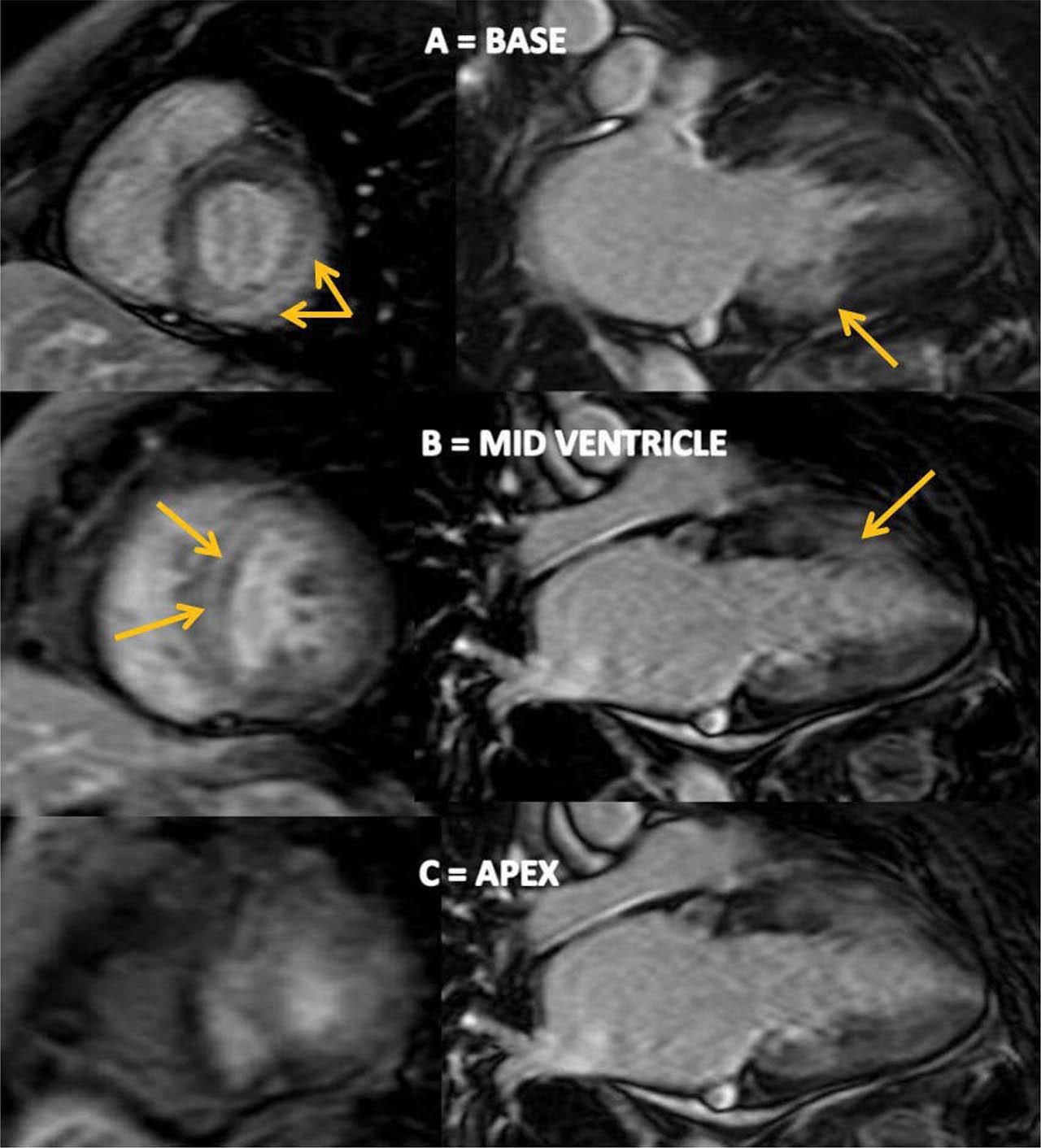
Cardiac magnetic resonance images showing A and B diffuse subendocardial LGE at the base and mid-ventricle in the left ventricle (yellow arrows). C no LGE of the apex. LGE: late-gadolinium enhancement.

Figure 6

Cardiac magnetic resonance images showing A. an increase in right ventricle wall thickness (8 mm). B no LGE of the right ventricle. LGE: late-gadolinium enhancement.

Figure 7

Rectal pad biopsy images showing A. homogenous extracellular fibrils positive for Congo red staining localized in the vascular walls (black arrows); B. These fibrils are positive for green birefringence, specific for amyloid deposits (yellow arrows).
DOI: https://doi.org/10.47803/rjc.2021.31.1.102 | Journal eISSN: 2734-6382 | Journal ISSN: 1220-658X
Language: English
Page range: 102 - 110
Published on: Apr 30, 2022
Published by: Romanian Society of Cardiology
In partnership with: Paradigm Publishing Services
Publication frequency: 4 issues per year

© 2022 Alexandra Maria Chitroceanu, Alina Ioana Nicula, Roxana Cristina Rimbas, Mihaela Andreescu, Cristina Popp, Claudiu Stoicescu, Dragos Vinereanu, published by Romanian Society of Cardiology
This work is licensed under the Creative Commons Attribution 4.0 License.