
Introduction
Anatolia exhibits exceptionally rich plant diversity due to its geographical position, geological structure, diverse landforms, and its inclusion of the Mediterranean, Irano-Turanian, and Euro-Siberian phytogeographical regions. According to Davis (1965–1982), additional factors contributing to this richness include Anatolia’s role as a biogeographical bridge between Asia and Europe, its function as a center of diversification for many genera and sections, and its status as a center of origin for numerous cultivated plants. For these reasons, Anatolia has attracted considerable interest, initially from foreign researchers and, since the 1960s, increasingly from Turkish scientists, leading to numerous studies of its flora and vegetation.
Vegetation studies in Türkiye began in the eighteenth century with the explorations of Tournefort and were subsequently advanced by several European botanists working in different regions of Anatolia (Handel-Mazzetti, 1909; Schwarz, 1935–1936; Czeczott, 1938–1939; Krause, 1940). Later, important contributions by Turkish botanists, particularly Hikmet Birand and subsequent researchers, substantially improved the understanding of the country’s vegetation structure and phytosociology (Birand, 1960; Çırpıcı, 1987).
Türkiye is characterized by vegetation dynamics shaped by diverse climatic conditions and anthropogenic factors. In addition, its biogeographical position has made the country home to three of the 34 global biodiversity hotspots identified worldwide: the Caucasus, the Mediterranean, and the Irano-Turanian regions (Myers et al., 2000). These characteristics make Türkiye one of the most important regions for floristic and vegetation studies in the Mediterranean Basin.
Globally, biodiversity is under serious threat. Access to data repositories facilitates the assessment of biodiversity on a global scale and provides crucial support for decision-makers and conservationists in developing protection strategies, monitoring vegetation changes, and identifying and mitigating existing threats (Sabatini et al., 2021). These goals, however, can only be achieved through local-scale floristic and vegetation studies.
In recent years, quantitative analysis techniques have become increasingly important in phytosociological studies. In particular, multivariate analysis methods such as ordination and clustering provide a more objective representation of the structure of plant communities and their relationships with environmental factors. Classical descriptive approaches often fail to adequately reflect these relationships; in contrast, quantitative methods allow for the statistical evaluation of environmental variables. Today, these methods are widely used in phytosociological studies and significantly enhance the interpretative power in the literature. Accordingly, numerous vegetation studies employing such approaches have been reported in recent years in Türkiye (Kavgacı et al., 2017; Kurt & Negiz 2018; Karaköse, 2019; Özdeniz, 2019; Bonari et al., 2021; Karaköse & Terzioğlu 2021; Kavgacı et al., 2021; Kaytanlıoğlu et al., 2023; Negiz & Erfidan 2024; Aytepe & Kavgacı 2025; Malkoçoğlu & Kara, 2025; Malkoçoğlu et al., 2025; Aytepe, 2026).
The aim of this study is to classify and characterize the plant communities of the Bozburun Peninsula using numerical phytosociological methods and to evaluate their relationships with environmental variables through clustering and ordination analyses. In addition, the study aims to contribute to syntaxonomical knowledge of Mediterranean vegetation by identifying diagnostic species and describing the floristic and ecological structure of the vegetation units.
Materials and Methods
Materials
The Bozburun Peninsula, which constitutes the study area, is located within the boundaries of Marmaris district, Muğla Province, in the southern part of Türkiye, at 36°41′ N and 28°04′ E, and lies within the Mediterranean phytogeographical region.
The Bozburun Peninsula has a predominantly mountainous topography and contains numerous bays of varying sizes. It is characterized by a highly indented coastline and includes many mountains and hills exceeding 500 m a.s.l. in elevation. The main mountains and hills of the peninsula include Palamut hill (879 m a.s.l.), Eren Mt. (842 m a.s.l.), Gökdağ (594 m a.s.l.), Güvenç Mt. (746 m a.s.l.), and Güver Mt. (718 m a.s.l.). The highest point in the area is Palamut Hill, at 879 m a.s.l. (Eken et al., 2006). The peninsula supports Pinus brutia forest communities between İçmeler–Hisarönü and Bayır, maquis communities between Bayır and Söğüt, and phrygana (garrigue) communities in other parts. In addition, the coastal sections, particularly in the southern parts of the peninsula, consist of limestone rocky areas that are largely devoid of vegetation (Figure 1).
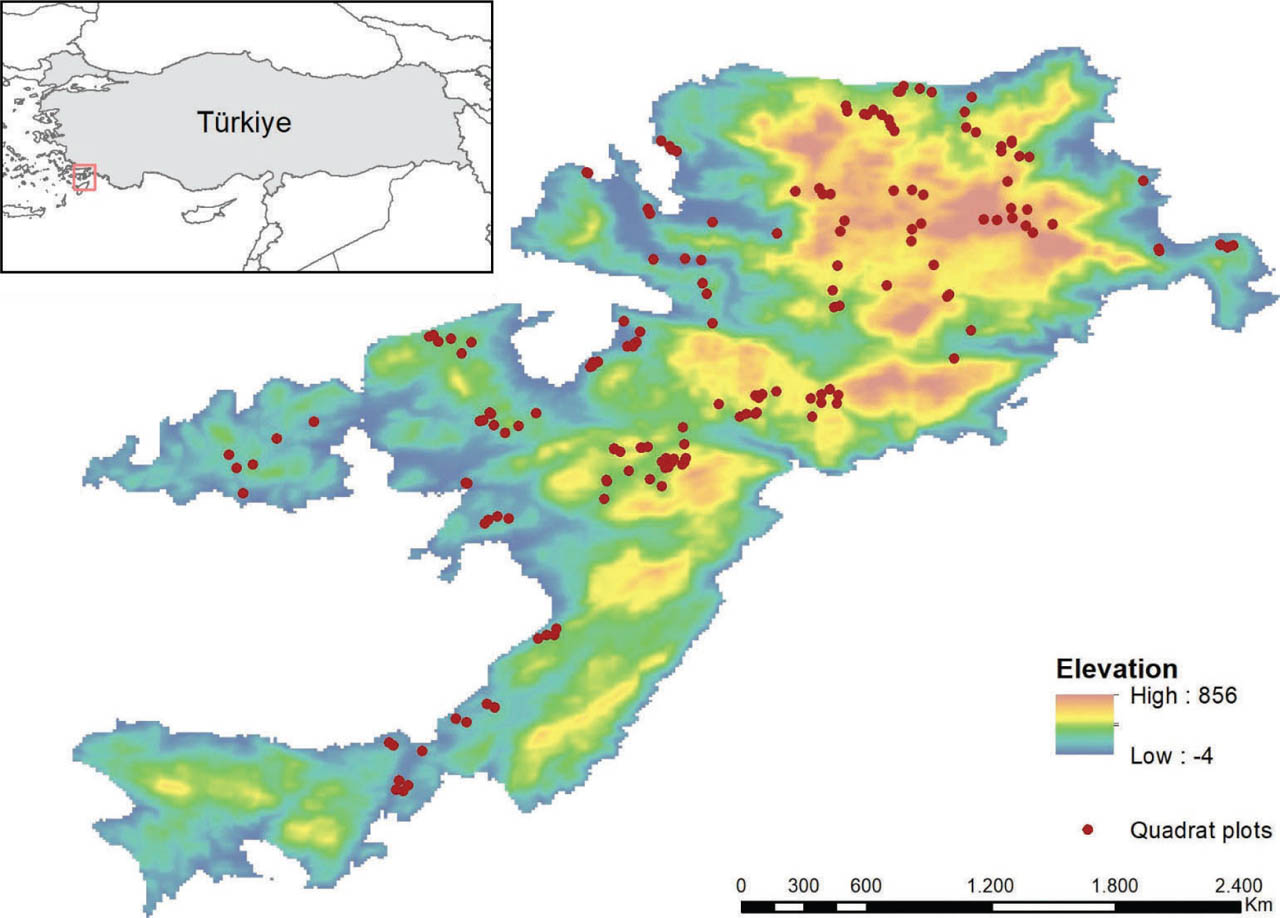
Figure 1:
Geographic map of the Bozburun Peninsula with indicated locations of sampling plots.
Slika 1: Zemljevid polotoka Bozburun z označenimi lokacijami vzorčnih ploskev.
The major soil groups of the study area were mapped using the “Muğla Province Land Assets Map”, published by the General Directorate of Rural Services of the Prime Ministry. Accordingly, the main soil groups in the study area include colluvial soils, red-brown Mediterranean soils, non-calcareous brown forest soils, red Mediterranean soils, bare rock, and scree (Anonymous, 1998).
The geological structure of the study area is mainly dominated by bedrock units composed of limestone and dolomite blocks (Şenel & Bilgin, 1997). Although the presence of peridotite bedrock is observed in a very limited area at the western end of the peninsula, no sampling plots could be established there due to the absence of suitable vegetation cover. The geological map of the area was prepared based on the sheets produced by the General Directorate of Mineral Research and Exploration (MTA) (Figure 2) (MTA, 2026).
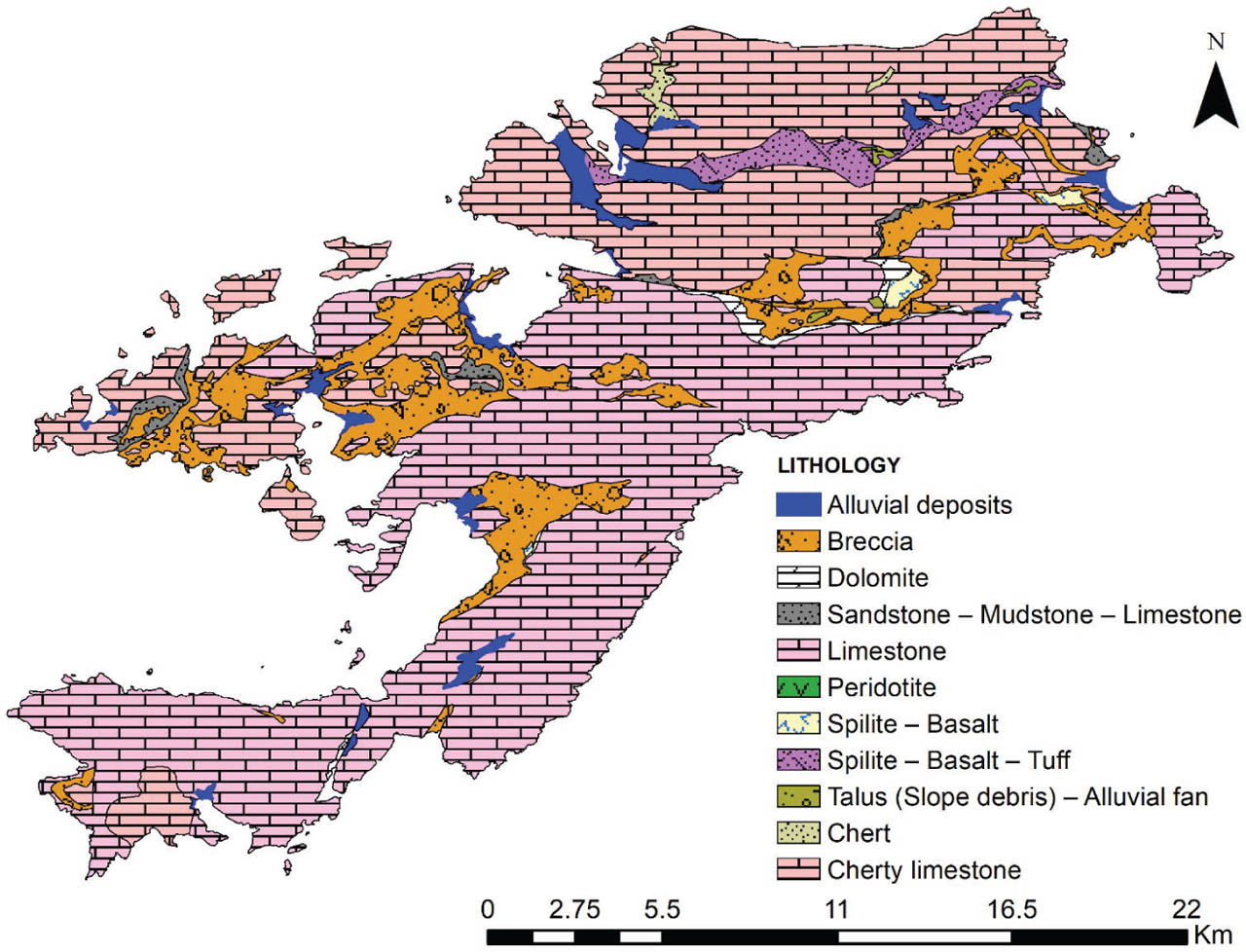
Figure 2:
Geological map of the study area (according to MTA (2026)).
Slika 2: Geološka karta preučevanega območja (v skladu z MTA (2026)).
To describe the climatic characteristics of the study area, long-term data from the Marmaris Meteorological Station were used. The total annual precipitation in the study area is 1258 mm. The wettest month is December, with 288 mm of precipitation, while the driest month is August, with 7 mm. The mean annual temperature at the Marmaris station is 18.7 °C. The highest mean monthly temperature is observed in July (28.2 °C), whereas the lowest mean monthly temperature is recorded in January (10.6 °C) (Meteorology General Directorate, 2014).
Methods
Sampling plots were conducted between 2013 and 2015 during the peak flowering period (April–June). The sampling plot sizes were set at 900 m2 for forest formations, 256 m2 for maquis formations, and 100 m2 for phrygana (garrigue) formations, and a total of 168 vegetation sampling plots were established. These sampling plot sizes were selected according to the minimum-area concept commonly used in Braun-Blanquet phytosociological studies (Braun-Blanquet, 1932; Akman, 2011). In addition, preliminary field sampling begun with smaller vegetation sampling plots and was progressively expanded until the floristic composition of each vegetation type was adequately represented. The selected sampling plot sizes were found to be optimal for reflecting the structural and floristic characteristics of the forest, maquis, and phrygana vegetation units in the study area.
For each sampling plot, topographic characteristics including elevation, slope, and aspect and vegetation attributes such as total vegetation cover and the cover of individual layers were recorded. The heights of the tree, shrub, and herb layers were measured in the field. Species composition was documented by listing all vascular plants, and abundance–cover values were determined according to the Braun-Blanquet (1932) phytosociological method and abundance–cover scale (r: solitary individuals with negligible cover; +: few individuals with cover <1%; 1: numerous individuals with 1–5% cover; 2: 5–25%; 3: 25–50%; 4: 50–75%; 5: 75–100%), following Akman (2011).
The cover and height of the tree, shrub, and herb layers were recorded separately in the field as structural characteristics of each sampling plot. Species composition, however, was recorded using the standard Braun–Blanquet relevé method, in which all vascular plant species were documented within a single relevé irrespective of vegetation layer. Accordingly, all numerical analyses were based on the complete species composition of each sampling plot.
All environmental factors used in the analyses were coded and abbreviated prior to statistical procedures. Temperature and precipitation variables were derived from meteorological observation data obtained from the Turkish State Meteorological Service for the Marmaris region and its surroundings. Considering both data continuity and proximity to the study area, the Marmaris meteorological station was used. Since no meteorological station directly represented the vegetation sampling plots within the study area, station-based climatic data were spatially interpolated in ArcMap using the Inverse Distance Weighted (IDW) interpolation method. IDW is one of the commonly used interpolation approaches for transforming point-based climatic observations into continuous surface data and has previously been applied in ArcMap for estimating long-term precipitation and temperature patterns in Türkiye (Yenipınar et al., 2021; Yılmaz et al., 2023). Separate raster surfaces were generated for temperature and precipitation variables, and the corresponding values for each vegetation sampling plot were subsequently extracted from these raster datasets and used as environmental variables in the ordination analyses.
A total of 470 plant taxa were identified in the study area. However, only taxa with a frequency greater than 10% were included in the ordination analyses, reducing the dataset to 182 taxa. Subsequently, a binary species-by-sampling plot matrix was constructed, with sampling plots arranged in rows and taxa in columns. The exclusion of rare or low-frequency species prior to multivariate analyses is a commonly applied data preprocessing approach in vegetation and ecological community studies (McCune & Grace, 2002). Previous studies have reported the use of different frequency thresholds for excluding rare or low-contribution taxa in vegetation classification studies, and the 10% threshold applied in the present study was considered appropriate within this framework (Addicott et al., 2018). The influence of rare species on vegetation analysis results has also been discussed as an important methodological factor in recent ecological studies (Gillet et al., 2025). The Indicator Species Analysis (ISA) results of the recorded taxa (Observed IV, Mean IV, S.Dev., and p-values) are provided separately for the forest, maquis, and garrigue units in Appendix 1, Appendix 2, and Appendix 3, respectively.
To evaluate the robustness of the different clustering solutions, a Multiple Response Permutation Procedure (MRPP) was performed. The corresponding T, A, and P values are presented in Table 1.
Table 1:
MRPP Analysis Results: T, A, and P-values.
Tabela 1: Rezultati MRPP analize: vrednosti T, A in P.
| Group Discrimination | T | A | P |
|---|---|---|---|
| Sorflex2 | −70.195816 | 0.09478620 | 0.00000000 |
| Sorflex3 | −72.197374 | 0.13828544 | 0.00000000 |
| Sorflex4 | −66.194035 | 0.15890897 | 0.00000000 |
| Sorflex5 | −54.067841 | 0.16657697 | 0.00000000 |
| Exwrd2 | −60.080851 | 0.08109822 | 0.00000000 |
| Exwrd3 | −67.632300 | 0.12968591 | 0.00000000 |
| Exwrd4 | −68.148785 | 0.16033104 | 0.00000000 |
| Exwrd5 | −65.754322 | 0.17977464 | 0.00000000 |
In the first stage of the statistical evaluation, a presence–absence data matrix was constructed for the plant taxa recorded during the inventory studies according to the Braun-Blanquet method, to be used in cluster analysis (Fontaine et al., 2007; Özkan, 2009; Malkoçoğlu & Kara, 2025). Previous studies have demonstrated that Braun-Blanquet data can be analyzed using different transformation approaches and that presence–absence transformation is appropriate for vegetation classification and ordination analyses (van der Maarel, 1979). For the derivation of vegetation groups, the Sørensen–Flexible Beta and Euclidean–Ward clustering methods were tested. To determine the most appropriate separation for the clustering analysis, a Multiple Response Permutation Procedure (MRPP) was applied. The Sørensen–Flexible Beta method was preferred because it produced vegetation groups that were more consistent with floristic composition, ecological gradients, and field observations compared with the Euclidean–Ward method. In the MRPP analysis, the T statistic (test statistic), A value (chance-corrected within-group agreement), and P value (significance level) were compared to determine the optimal group separation.
The dendrogram obtained from the cluster analysis was cut at 2, 3, 4, and 5 group levels, and the cut levels were applied following the procedure proposed by Özkan (2009). To identify the indicator species of the cluster groups, Indicator Species Analysis (ISA, IndVal) was performed using PC-ORD version 6.0 (McCune & Mefford, 2011). Polar Ordination (PO) was used to evaluate the relationships between species composition and environmental factors. Finally, Bray–Curtis Polar Ordination (PO) was applied to determine the relationships between plant community distribution and environmental variables.
Data analyses were conducted using the PC-ORD software package (McCune & Mefford, 2011). PC-ORD was used for multivariate analyses, particularly for Indicator Species Analysis (ISA) to identify diagnostic species of the vegetation groups, as well as for ordination procedures. Relationships between environmental variables and the main ordination axes were evaluated using Pearson correlation coefficients (r).
Diagnostic and constant species were evaluated using the Indicator Species Analysis (ISA) output parameters (Observed IV, Mean IV, S.Dev., and associated p-values) generated in PC-ORD. These numerical parameters were interpreted together with field observations and the ecological characteristics of the vegetation units.
Constant species were primarily identified as taxa occurring in at least 40% of the sampling plots within the relevant vegetation unit, supported by field observations and ecological consistency. Dominant species were identified according to their Braun–Blanquet cover-abundance values together with their physiognomic importance within each vegetation unit; therefore, no fixed cover threshold was applied.
Plant nomenclature follows Plants of the World Online (POWO, 2026). The syntaxonomic nomenclature and evaluation of the identified vegetation units were performed in accordance with the International Code of Phytosociological Nomenclature (ICPN) (Theurillat et al., 2021), while the higher syntaxonomic framework follows Bonari et al. (2021).
Results
The study area is located within the Mediterranean phytogeographical region and includes the characteristic vegetation types of the Mediterranean climate. Forest, maquis, and garrigue vegetation types are well represented within the study area. Considerable degradation is evident on the Bozburun Peninsula due to tourism pressure, fires, agricultural land conversion, and grazing.
Classification
A total of 169 sampling plots were surveyed in the study area. Of these, 70 plots were taken from Pinus brutia forest vegetation, 50 plots from maquis vegetation, and 49 plots from garrigue vegetation. During the field inventory stage, a total of 470 plant taxa were recorded. It was determined that 288 taxa had frequency values below 10% within the dataset. Therefore, these taxa were excluded from the vegetation data matrix due to their low representation. Statistical analyses were conducted using 168 sampling plots and 182 plant taxa, as one sampling plot was excluded due to insufficient species representation after the frequency filtering process.
Cluster analysis applied to the vegetation data matrix using two different distance measures (Sorensen–Flexible Beta and Euclidean–Ward’s) produced vegetation groupings at 2-, 3-, 4-, and 5-group cutting levels. Based on the results of cluster analysis and Indicator Species Analysis (IndVal), the main vegetation units of the study area and their indicator species were identified.
Different cutting levels (2-, 3-, 4-, and 5-group solutions) were evaluated for both Sørensen–Flexible Beta and Euclidean–Ward’s clustering methods. Among these alternatives, the 3-group solution obtained using the Sørensen–Flexible Beta method provided the most ecologically meaningful classification, clearly separating garrigue, maquis, and forest vegetation units. This solution was further supported by MRPP results and Indicator Species Analysis and was therefore selected for subsequent ecological interpretation.
To identify the most appropriate classification among the eight different group solutions, the Multiple Response Permutation Procedure (MRPP) was applied. The MRPP results are presented in Table 1. In MRPP, T values indicate the degree of separation between groups, whereas A values reflect within-group homogeneity. Accordingly, the most suitable classification is expected to have the lowest T value and the highest A value. Across the evaluated cutting levels, T values ranged from −54.06 to −72.19, while A values ranged from 0.081 to 0.179.
Based on the MRPP results, the T and A values of the different group solutions were evaluated using tables and figures. The clustering analysis performed with the Sorensen–Flexible Beta method showed the most suitable results for the 3-group solution and was considered more appropriate for representing the vegetation structure of the study area. In the 2-group solution, the sampling plots were primarily separated into shrub-dominated vegetation units (maquis and garrigue/phrygana) and pine forest vegetation. In the selected 3-group solution, the sampling plots were clearly differentiated into garrigue/phrygana vegetation (Group 1), maquis vegetation (Group 2), and pine forest vegetation (Group 3). Therefore, the 3-group differentiation obtained by the Sorensen–Flexible Beta clustering was selected for the vegetation classification stage, and ecological interpretations were made accordingly (Figure 3). In contrast, the Euclidean– Ward’s method resulted in considerable overlap among forest, maquis, and garrigue sampling plots, leading to less ecologically interpretable groupings.
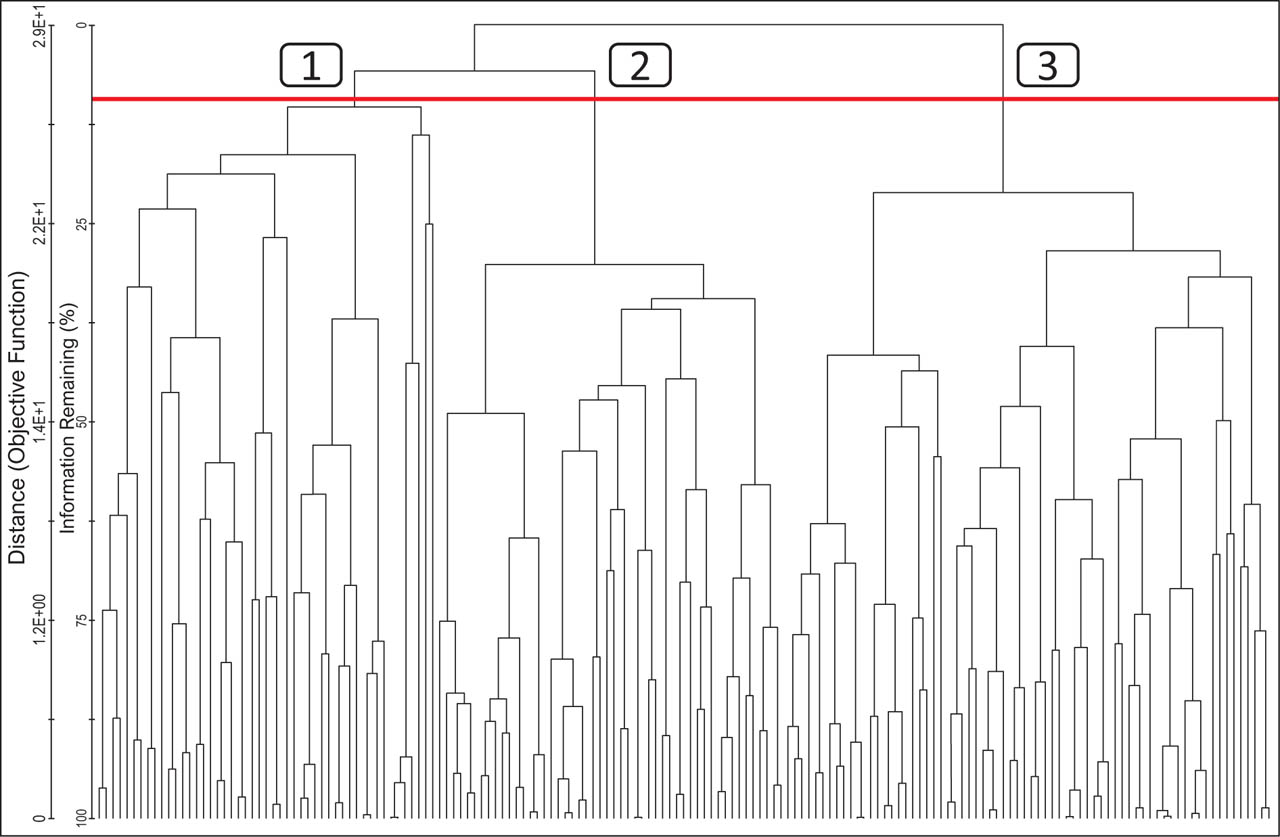
Figure 3:
Group differentiation of clustering analysis according to the Sørensen-Flexible Beta method (Group 1: 48 sample plots, Group 2: 50 sample plots, Group 3: 70 sample plots).
Slika 3: Rezultat klastrske analize z metodo Sørensen-Flexible Beta (skupina 1: 48 vzorčnih ploskev, skupina 2: 50 vzorčnih ploskev, skupina 3: 70 vzorčnih ploskev).
The vegetation classification was based on the results of the Sørensen–Flexible Beta clustering analysis and supported by the MRPP and Indicator Species Analysis (IndVal) results. Sampling plots were not manually reassigned to different vegetation groups during the classification process. Although a limited number of sampling plots showed partial overlap among vegetation types, no sampling plots were manually reassigned after the cluster analysis. Instead, these overlaps were interpreted ecologically based on field observations. Field observations conducted throughout the study area indicated that such overlaps were mainly related to vegetation degradation and human-induced degradation processes affecting the community structure.
Following the exclusion of one sampling plot after the frequency filtering procedure, Bray–Curtis analysis was performed using the remaining 168 sampling plots. Three ordination axes were extracted. The first two axes together explained 28.64% of the total variance (Table 2) and were therefore considered sufficient for ecological interpretation. The distribution of the 168 sampling plots along Axis 1 and Axis 2 is presented in Figure 4.
Table 2:
Percentage of variance explained by the Bray–Curtis ordination axes.
Tabela 2: Odstotek pojasnjene variance Bray–Curtis ordinacijskih osi.
| Components | Variance (%) | Cumulative Variance (%) |
|---|---|---|
| 1 | 17.50 | 17.50 |
| 2 | 11.14 | 28.64 |
| 3 | 7.44 | 36.09 |
Correlation coefficients of environmental variables with the ordination axes are given in Table 3. Only variables with an absolute correlation coefficient of |r| ≥ 0.200 were displayed as vectors in the ordination diagram (Figure 4). Although the first two ordination axes explained a limited proportion of the total variance, the Axis 1–3 configuration provided a clearer ecological separation of the main vegetation groups, particularly in relation to elevation and precipitation gradients. In contrast, the Axis 1–2 ordination showed a greater overlap among vegetation units. Therefore, the Axis 1–3 relationship was considered more informative for ecological interpretation. Elevation and precipitation showed strong negative correlations with Axis 1, whereas mean temperature showed a positive correlation with this axis. The remaining variables exhibited weak correlations and were therefore omitted from the diagram.
Table 3:
Correlations of environmental variables with Bray– Curtis axes.
Tabela 3: Korelacija med okoljskimi spremenljivkami in ordinacijskimi osmi Bray–Curtis analize.
| Variable | Axis 1 (r / r2) | Axis 2 (r / r2) | Axis 3 (r / r2) |
|---|---|---|---|
| Elevation | −0.509 | −0.107 | 0.500 |
| Aspect | −0.047 | −0.033 | 0.026 |
| Slope | −0.106 | 0.005 | −0.051 |
| Precipitation | −0.536 | −0.163 | 0.497 |
| Mean Temperature | 0.210 | 0.164 | −0.138 |
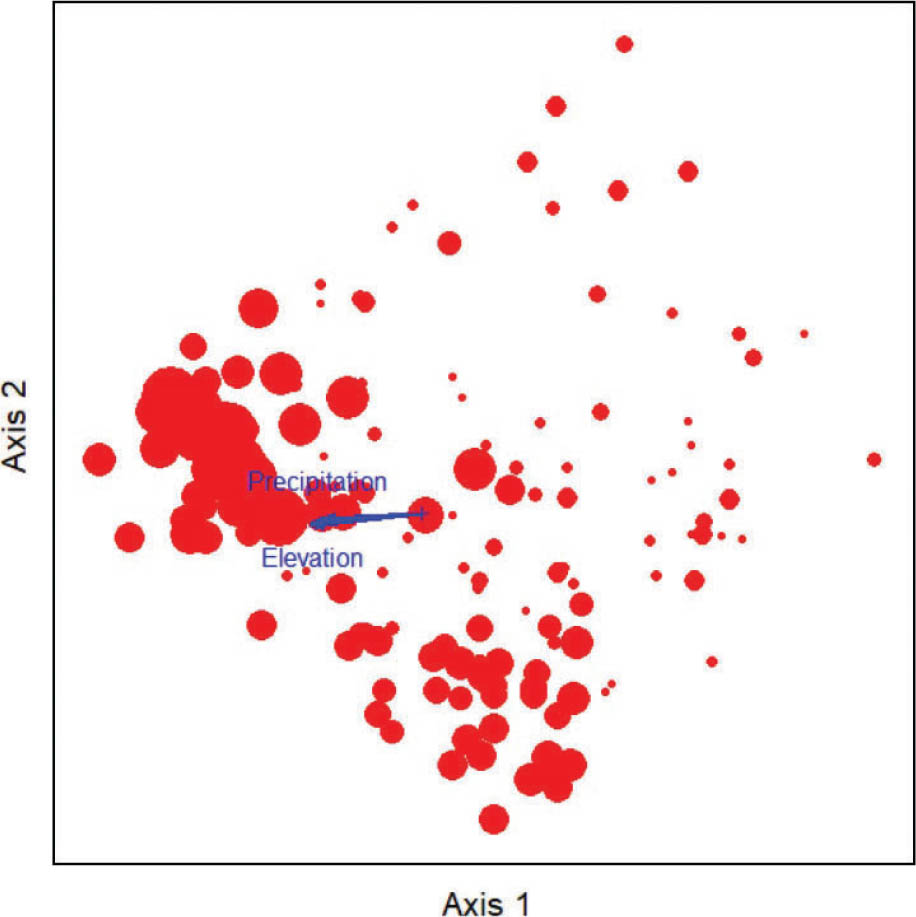
Figure 4:
Distribution of sampling plots along Axes 1 and 2 based on Bray–Curtis ordination. Environmental arrows represent variables with correlation coefficients of |r| ≥ 0.20 with the ordination axes. Symbol size reflects the relative abundance-cover values derived from the Braun–Blanquet data matrix, with larger symbols indicating higher abundance-cover values and smaller symbols indicating lower abundance-cover values.
Slika 4: Razporeditev vzorčnih ploskev vzdolž Bray–Curtis ordinacijskih osi 1 in 2. Puščice predstavljajo okoljske spremenljivke s korelacijskim koeficientom |r| ≥ 0,20 z ordinacijskimi osmi. Velikost simbolov predstavlja relativno velikost abundance in pokrovnosti po Braun-Blanquetu, kjer veliki simboli predstavljajo večje vrednosti, manjši pa manjše.
Elevation and precipitation displayed the strongest relationships with the ordination pattern, particularly along Axis 1 and Axis 3. The negative correlations of elevation (r = −0.509) and precipitation (r = −0.536) with Axis 1 indicate that the main gradient in species composition is associated with topographic and climatic variation, separating lower, drier sites from higher, wetter ones. Similarly, Axis 3 showed positive correlations with elevation (r = 0.500) and precipitation (r = 0.497), suggesting that this axis represents an additional component of the same environmental gradient, possibly related to microhabitat differentiation or vegetation structure. Mean temperature exhibited weaker but still interpretable correlations, whereas aspect and slope showed consistently low correlation values across all axes, indicating their limited influence on species composition at the scale of the study area.
Examination of species positions along the ordination axes and their correlation values revealed clear differentiation in vegetation structure. Species such as Pinus brutia (−0.796), Aristolochia guichardii (−0.524), Asparagus aphyllus subsp. orientalis (−0.541), and Crepis fraasi (−0.576) were located on the left side of Axis 1, corresponding to lower elevations and relatively drier conditions. In contrast, Sarcopoterium spinosum (0.581), Crepis commutata (0.585), and Valantia hispida (0.574) were positioned on the right side of this axis and were associated with different moisture and light conditions.
Along Axis 2, Andropogon distachyos (0.409) showed a right side position, indicating an association with certain topographic variables, whereas Clematis cirrhosa (−0.554), Allium subhirsutum (−0.469), and Anagyris foetida (−0.442) were located at the left end.
Along Axis 3, Pinus brutia (0.542), Aristolochia guichardii (0.488), and Crepis fraasi (0.475) were positioned in the right direction, suggesting a relationship with increasing elevation and precipitation regimes, while Sarcopoterium spinosum (−0.522) and Quercus aucheri (−0.382) were located at the left end, further emphasizing ecological niche differentiation (Table 4).
Table 4:
Relationships of diagnostic taxa with the Bray–Curtis ordination axes.
Tabela 4: Razmerje diagnostičnih taksonov z ordinacijskimi osmi analize Bray–Curtis.
| Taxon | Axis 1 | Axis 2 | Axis 3 |
|---|---|---|---|
| Pinus brutia | −0.796 | 0.287 | 0.542 |
| Quercus aucheri | 0.195 | −0.379 | −0.382 |
| Sarcopoterium spinosum | 0.581 | 0.314 | −0.522 |
| Andropogon distachyos | 0.505 | 0.409 | −0.209 |
| Crepis commutata | 0.585 | −0.085 | −0.320 |
| Valantia hispida | 0.574 | −0.126 | −0.276 |
| Aristolochia guichardii | −0.524 | 0.159 | 0.488 |
| Asparagus aphyllus subsp. orientalis | −0.541 | −0.263 | 0.233 |
| Crepis fraasi | −0.576 | 0.117 | 0.475 |
| Allium subhirsutum | 0.193 | −0.469 | −0.286 |
| Anagyris foetida | 0.084 | −0.442 | −0.156 |
| Clematis cirrhosa | −0.128 | −0.554 | 0.019 |
| Laurus nobilis | −0.133 | −0.414 | 0.139 |
| Phlomis lycia | 0.251 | −0.367 | −0.371 |
The combined ordination diagram clearly illustrates the ecological separation of the three vegetation units identified by the cluster analysis. Plots characterized by Pinus brutia var. brutia were mainly concentrated on the negative side of Axis 1 and the positive side of Axis 3, corresponding to habitats characterized by relatively higher elevation and precipitation. Plots associated with Quercus aucheri occupied intermediate positions within the ordination space and reflected transitional ecological conditions. In contrast, plots characterized by Sarcopoterium spinosum were primarily located on the positive side of Axis 1 and the negative side of Axis 3, indicating their association with lower-elevation and relatively drier habitats. These distribution patterns are consistent with the relationships observed between the diagnostic species of each vegetation unit and the main environmental gradients (Figure 5; Table 4).
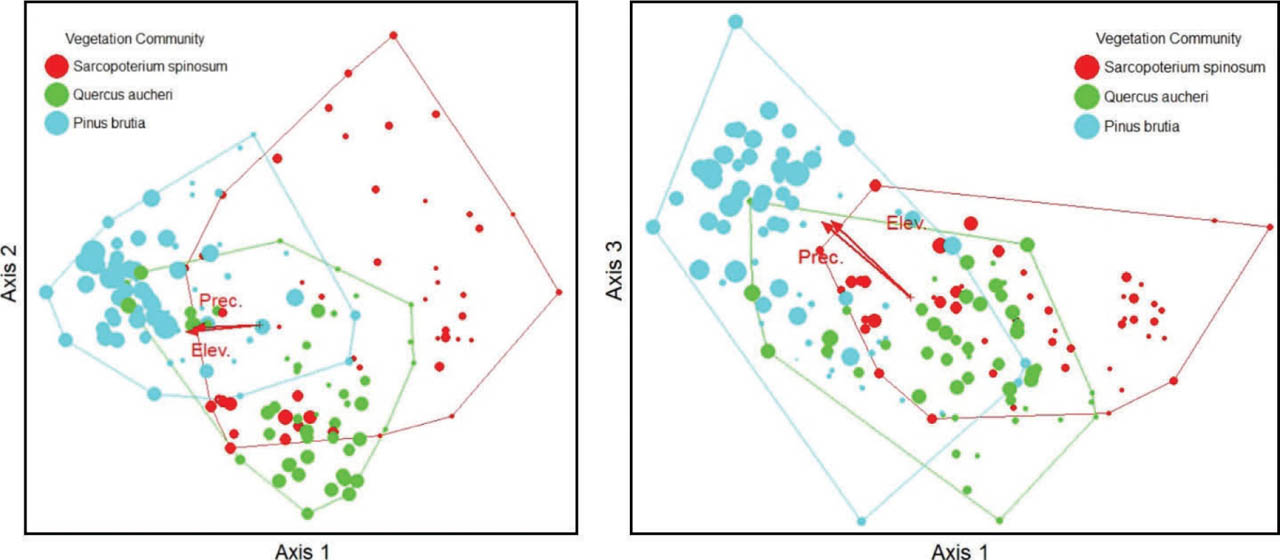
Figure 5:
Bray–Curtis ordination of all sampling plots showing the distribution of the three vegetation units characterized by Sarcopoterium spinosum, Quercus aucheri, and Pinus brutia var. brutia along (A) Axes 1–2 and (B) Axes 1–3. Colors indicate the vegetation units: red = Sarcopoterium spinosum plots, green = Quercus aucheri plots, and cyan = Pinus brutia var. brutia plots. The thin coloured polygons represent the outer distribution limits (convex hulls) of the sampling plots belonging to each vegetation unit in the ordination space. Environmental arrows indicate the main gradients correlated with the ordination axes; arrow direction shows the direction of increasing values, and arrow length reflects the strength of the relationship with the ordination configuration. Only environmental variables with correlation coefficients of |r| ≥ 0.50 were displayed in order to improve graphical clarity, although variables with lower correlations were also considered in the interpretation of the ordination results. Symbol size reflects the relative abundance-cover values derived from the Braun–Blanquet data matrix, with larger symbols indicating higher abundance-cover values and smaller symbols indicating lower abundance-cover values.
Slika 5: Razporeditev vseh vzorčnih ploskev v Bray–Curtis ordinaciji treh vegetacijskih enot z vrstami Sarcopoterium spinosum, Quercus aucheri in Pinus brutia var. brutia vzdolž (A) osi 1–2 in (B) osi 1–3. Barve označujejo vegetacijske enote: rdeča = ploskve z Sarcopoterium spinosum, zelena = ploskve z Quercus aucheri in svetlo modra = ploskve s Pinus brutia var. brutia. Poligoni predstavljajo zunanjo mejo razporeditve ploskev (convex hulls), ki pripadajo isti vegetacijski enoti. Puščice predstavljajo glavne okoljske gradiente; smer puščice predstavlja smer povečevanja vrednosti, dolžina pa odraža moč povezave s konfiguracijo ordinacije. Prikazane so samo okoljske spremenljivke s korelacijskimi koeficienti |r| ≥ 0,50 zaradi preglednosti grafa, čeprav smo spremenljivke z manjšo korelacijo upoštevali tudi pri interpretaciji rezultatov. Velikost simbolov predstavlja relativno velikost abundance in pokrovnosti po Braun-Blanquetu, kjer veliki simboli predstavljajo večje vrednosti, manjši pa manjše.
Symbol size reflects the relative abundance-cover values derived from the Braun–Blanquet data matrix, with larger symbols indicating higher abundance-cover values and smaller symbols indicating lower abundance-cover values.
The classification analyses showed that the vegetation of the Bozburun Peninsula consists of three distinct plant communities corresponding to different vegetation types: pine forest (Group 3), maquis (Group 2), and phrygana (Group 1).
Cluster 1 Andropogono distachyi-Sarcopoterietum spinosi Akbaş & Varol ass. nova
This association represents habitats typical of open areas, where short-lived therophytes and dwarf shrubs coexist, often of secondary origin and susceptible to disturbance (Figure 6). The community occurs between 34 and 296 m a.s.l. and is dominated by Sarcopoterium spinosum and Andropogon distachyos. It is distributed on red-brown forest soils, non-calcareous brown forest soils, colluvial soils, and red Mediterranean soils developed on limestone bedrock. The community occurs under a wide range of aspects (N, S, E, W, NE, NW, SE, and SW) and on slopes ranging from 2° to 35°.
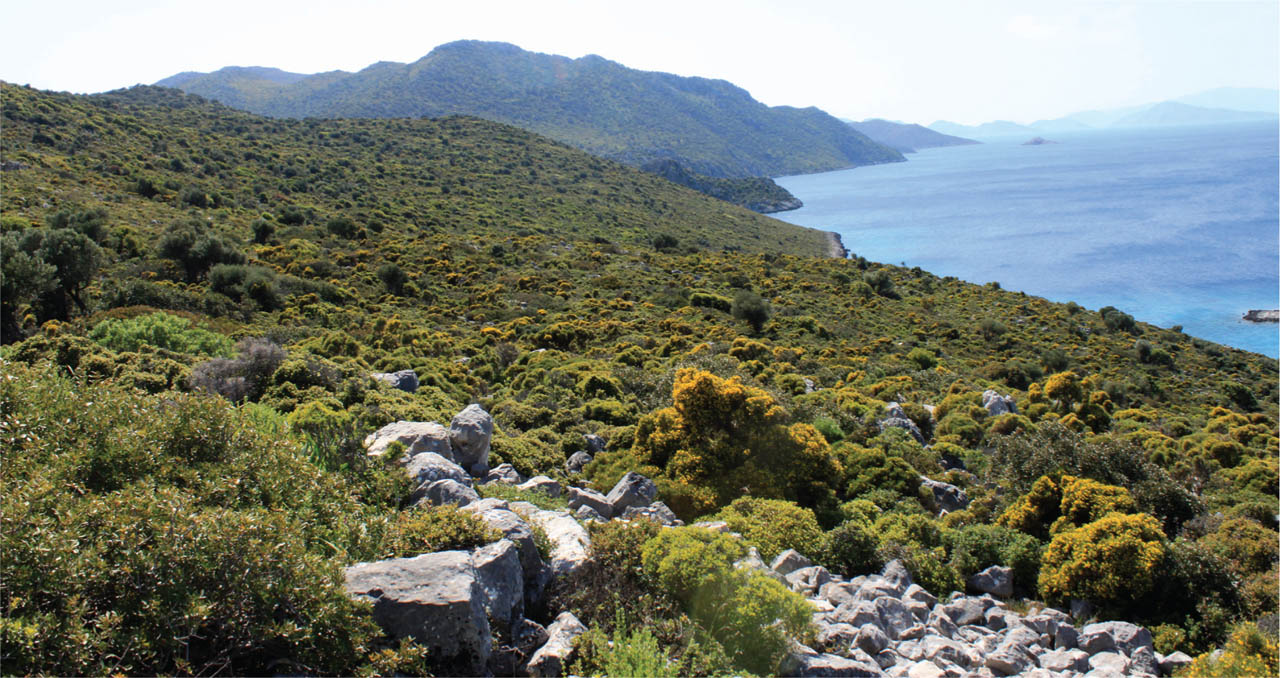
Figure 6:
Andropogon distachyos and Sarcopoterium spinosum community.
Slika 6: Združba z vrstama Andropogon distachyos in Sarcopoterium spinosum.
Structurally, it consists of two vertical layers:
(a) a herb layer with a cover of 15–90% and a height of 0.4–1 m,
(b) a shrub layer with a cover of 45–95% and a height of 0.5–5 m.
Diagnostic species: Andropogon distachyos, Crepis commutata, Sarcopoterium spinosum, and Valantia hispida.
Constant species: Asphodelus aestivus, Bromus fasciculatus, Crepis commutata, Fumana arabica, Genista acanthoclada, Leontodon tuberosus, Plantago cretica, Trifolium scabrum, and Valantia hispida.
Dominant species: Andropogon distachyos, Crepis commutata, Sarcopoterium spinosum, and Valantia hispida.
Cluster 2 Allio subhirsuti-Quercetum aucheri Akbaş & Varol ass. nova
This community represents more stable habitats characterized by Mediterranean woody and perennial species (Figure 7). It occurs between 37 and 406 m a.s.l. and shows progressive development within maquis vegetation. The community is dominated by Allium subhirsutum and Quercus aucheri. It is distributed on red-brown forest soils and red Mediterranean soils developed on limestone bedrock. The community occurs under various aspects (N, S, E, W, NE, NW, SE, and SW) and on slopes ranging from 10° to 33°.
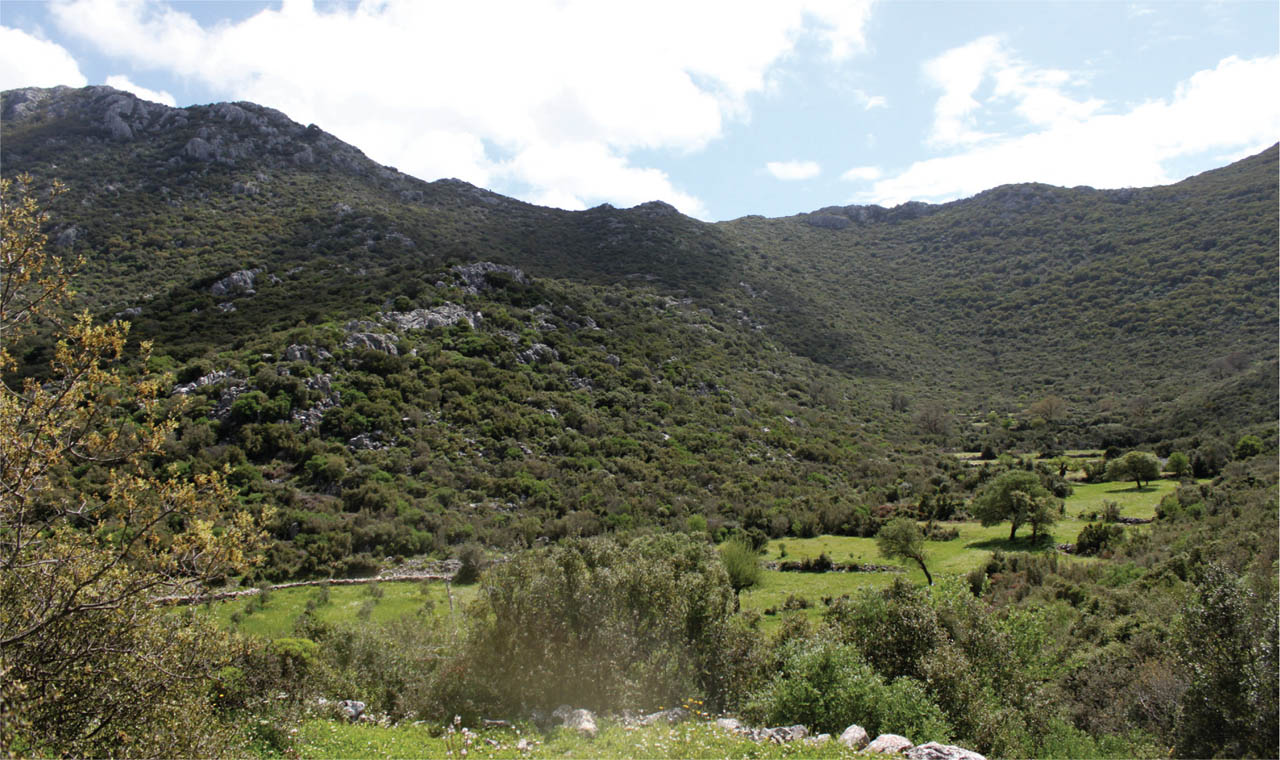
Figure 7:
Allium subhirsutum and Quercus aucheri community.
Slika 7: Združba z vrstama Allium subhirsutum in Quercus aucheri.
Structurally, the community consists of two vertical layers:
(a) a herb layer with a cover of 40–90% and a height of 0.2–1 m, and
(b) a shrub layer with a cover of 60–90% and a height of 3–7 m.
Diagnostic species: Allium subhirsutum, Anagyris foetida, Clematis cirrhosa, Laurus nobilis, Phlomis lycia, Quercus aucheri.
Constant species: Anthemis chia, Arabis verna, Arisarum vulgare, Briza maxima, Euphorbia acanthothamnos, Geranium purpureum, Lagoecia cuminoides, Parietaria lusitanica, Sherardia arvensis, Trifolium campestre subsp. campestre var. campestre, Trifolium stellatum var. stellatum.
Dominant species: Arabis verna, Clematis cirrhosa, Euphorbia acanthothamnos, Geranium purpureum, Lagoecia cuminoides, Phillyrea latifolia, Quercus aucheri.
Cluster 3 Aristolochio guichardii-Pinetum brutiae Akbaş & Varol ass. nova
This group represents less disturbed Mediterranean forest ecosystems approaching climax conditions, where well-developed Pinus brutia forests and some maquis elements coexist (Figure 8). The community occurs between 75 and 630 m a.s.l. and shows progressive development within forest vegetation. The community is physiognomically dominated by Pinus brutia var. brutia and floristically characterized by Aristolochia guichardii. It is distributed on red-brown forest soils, non-calcareous brown forest soils, and red Mediterranean soils developed on limestone bedrock. The community occurs under a wide range of aspects (N, S, E, W, NE, NW, SE, and SW) and on slopes ranging from 5° to 40°.
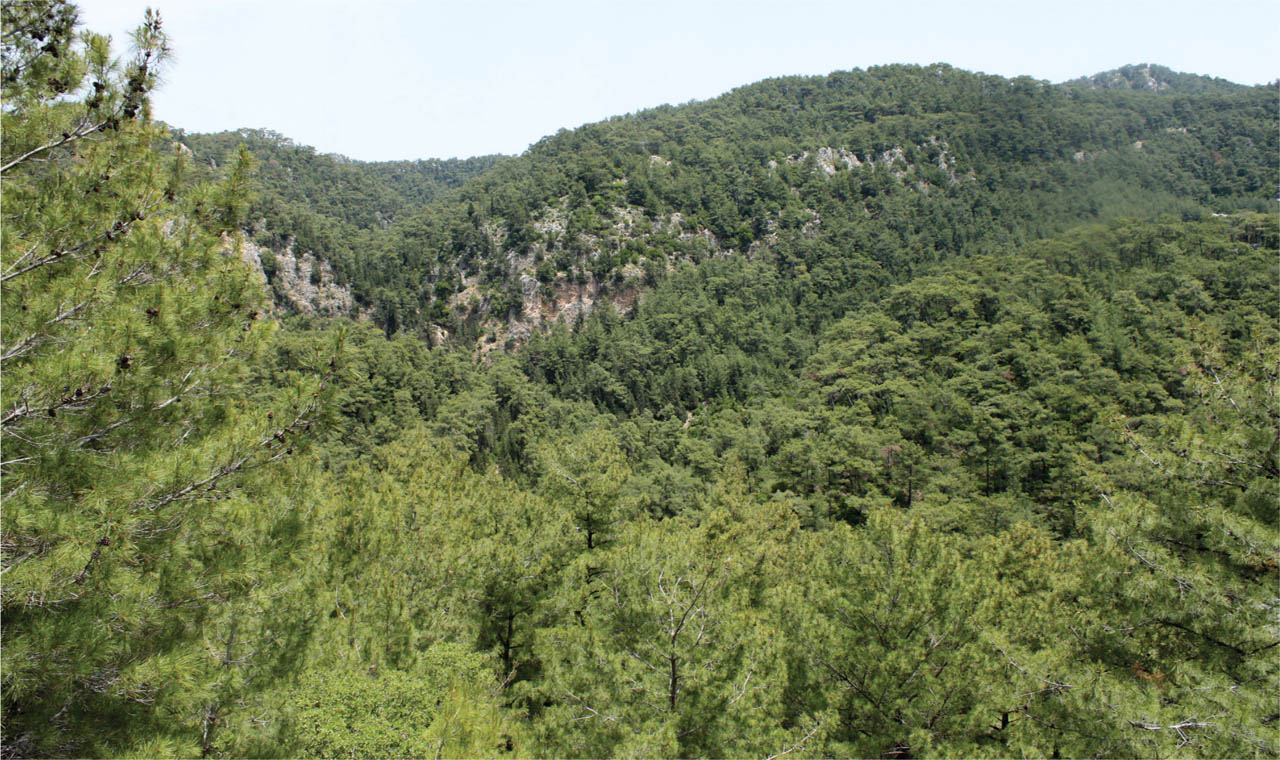
Figure 8:
Aristolochia guichardii and Pinus brutia var. brutia community.
Slika 8: Združba z vrstama Aristolochia guichardii in Pinus brutia var. brutia.
Structurally, the community consists of three vertical layers:
(a) a herb layer with a cover of 5–55% and a height of 0.45–1 m,
(b) a shrub layer with a cover of 15–70% and a height of 1–5 m, and
(c) a tree layer with a cover of 65–90% and a height of 20–30 m.
Diagnostic species: Aristolochia guichardii, Asparagus aphyllus subsp. orientalis, Crepis fraasi and Pinus brutia var. brutia.
Constant species: Aristolochia guichardii, Asparagus aphyllus subsp. orientalis, Cistus creticus, Crepis fraasi, Dactylis glomerata subsp. hispanica, Galium heldreichii, Lathyrus aphaca var. pseudoaphaca, Oryzopsis miliacea subsp. thomasii, Phillyrea latifolia, Phlomis bourgaei, Pinus brutia var. brutia, Quercus coccifera, Quercus pubescens, Salvia fruticosa, Smilax aspera, Sonchus bulbosus subsp. micro-cephalus, Torilis arvensis subsp. purpurea.
Dominant species: Arbutus andrachne, Pinus brutia var. brutia, Quercus coccifera, Styrax officinalis.
4. Discussion
The present study identified three ecologically and floristically distinct vegetation units corresponding to phrygana, maquis, and Pinus brutia forest vegetation. These units were consistently supported by numerical classification and ordination analyses and represent the major vegetation types occurring on the Bozburun Peninsula. Furthermore, the floristic composition, ecological characteristics, and diagnostic species of these vegetation units justified the description of three new syntaxa, contributing to the syntaxonomical knowledge of southwestern Anatolia.
The Bray–Curtis ordination results support the ecological differentiation of the three vegetation units identified by clustering. Pinus brutia plots were associated with relatively higher elevation and precipitation, reflecting the development of forest communities under comparatively moister conditions. Quercus aucheri plots occupied an intermediate position in the ordination space, indicating the transitional character of the maquis vegetation between forest and phrygana formations. In contrast, Sarcopoterium spinosum plots were related to lower-elevation and drier habitats, consistent with the xerophytic character of phrygana vegetation. The widespread occur-rence of S. spinosum may also be associated with vegetation degradation processes in Mediterranean ecosystems, since the species is commonly regarded as an indicator of degraded maquis and secondary phrygana communities formed under long-term human impact and grazing pressure (Naveh & Dan, 1973; Barbero et al., 1990; Quézel & Médail, 2003).
Among the clustering methods applied in this study, the Sørensen–Flexible Beta method produced the most homogeneous and ecologically meaningful results, reflecting the mosaic structure of Mediterranean vegetation and species turnover in transitional zones. Particularly in areas where maquis and phrygana communities intermix, the Sørensen method’s sensitivity to shared species enabled a more accurate assessment of floristic similarity, resulting in the most statistically robust classification, as confirmed by the MRPP analysis.
The high indicator values obtained from the IndVal analysis statistically confirm that the identified vegetation units are floristically well differentiated. This indicates that the plant communities on the peninsula are not merely visually defined groupings but represent ecologically distinct assemblages.
The secondary environmental data matrix used in the ordination analysis (including variables such as elevation, slope, aspect, and annual precipitation) enabled interpretation beyond classifications based solely on species composition. In particular, the Pearson correlations of environmental variables with Axis 1 and Axis 3 allowed a quantitative interpretation indicating that elevation and precipitation gradients constitute the primary drivers of species distribution in the study area.
According to the results, although the combination of Axis 1 and Axis 2 mathematically represents the main structure by explaining 28.2% of the total variation, the relationships between vegetation components and the main environmental gradients (elevation and precipitation) display a more ecologically meaningful differentiation in the Axis 1–3 plane (25.4%). In particular, the contrasting positions of Pinus brutia (0.542) and Sarcopoterium spinosum (−0.522) along Axis 3 indicate that this axis better reflects the moisture and elevation regime of the study area. This suggests that vegetation patterns in the study area are shaped not only by the primary axes with higher mathematical weight but also by vertical gradients that respond more specifically to climatic factors. Consequently, the clearer species turnover observed along this vertical gradient appears to be a key factor determining the ecological boundary between phrygana and forest formations in the region.
In order to place the vegetation units identified in this study within a broader phytosociological context, the results were evaluated in comparison with previously described syntaxa from southwestern and southern Türkiye.
Recent syntaxonomic studies have emphasized the considerable floristic and ecological heterogeneity of Mediterranean Pinus brutia forests across the Mediterranean Basin (Bonari et al., 2021). Various Pinus brutia forest associations have been described from southwestern and southern Türkiye. Aetheorhiza–Pinetum brutiae and Phlomido bourgaei–Pinetum brutiae were described from the Marmaris region (Vural et al., 1995; Akman et al., 1998), whereas Junipero phoeniceae–Pinetum brutiae was reported from the Bodrum Peninsula (Akman et al., 1998). Additional associations reported from southern Mediterranean Türkiye include Asparago acutifoli–Pinetum brutiae from Finike (Karaköse & Terzioğlu, 2021), as well as Glycyrrhizo asymmetricae–Pinetum brutiae and Phlomido leucophractae–Pinetum brutiae from the Antalya Gulf region (Kurt et al., 2015).
However, all these associations differ floristically and ecologically from the Pinus brutia forest association described in the present study. The consistent presence and diagnostic value of Aristolochia guichardii, together with the differential species combination observed in our relevés, clearly distinguish the present association from previously described Pinus brutia associations. In contrast to the Marmaris and Bodrum communities, which are characterized by different shrub-layer dominants and Mediterranean companion species, the present association is distinguished by the consistent occurrence of Aristolochia guichardii, Crepis fraasi, and Asparagus aphyllus subsp. orientalis, together with its distinctive floristic composition. Therefore, Aristolochio guichardii–Pinetum brutiae Akbaş et Varol ass. nova is described as a new association (Table 5).
Several macchia associations have been described from southwestern Türkiye. In the Bodrum Peninsula, the Arbutus andrachne–Calicotome villosa and Umbilicus horizontalis–Olea europaea communities were reported (Aytepe & Varol, 2025). Additional sclerophyllous macchia associations have been identified from different parts of southwestern and southern Türkiye under various alliances of Quercetea ilicis (e.g., Sağlam, 2013; Karaköse & Terzioğlu 2021; Kavgacı et al., 2021).
However, these macchia associations differ floristically from the association described in the present study. The dominance of Quercus aucheri, together with the diagnostic presence of Allium subhirsutum, Anagyris foetida, Clematis cirrhosa, and Laurus nobilis, clearly distinguishes the present association from previously described macchia associations. In contrast to the Bodrum macchia communities, where Olea europaea or Calicotome villosa constitute the main woody elements, Quercus aucheri forms the dominant structural component of the present stands, while Olea europaea occurs only as an accompanying species. Furthermore, the limited contribution of Quercus coccifera and the particular combination of thermophilous Mediterranean species support the distinct syntaxonomical position of this association. Therefore, Allio subhirsuti–Quercetum aucheri Akbaş et Varol ass. nova is described as a new association (Table 6).
Several Mediterranean phrygana associations dominated by Sarcopoterium spinosum have been described from Türkiye and other parts of the eastern Mediterranean, such as Asphodelo aestivi–Sarcopoterietum spinosi, Teucrio micro-podioidis–Sarcopoterietum spinosi, and Asphodelo–Sarcopoterietum spinosi (Géhu, 1987; Durmuşkahya, 2005; Şık & Gemici 2010). These associations are generally characterized by the dominance of Sarcopoterium spinosum accompanied by chamaephytic and hemicryptophytic elements typical of degraded Mediterranean shrublands.
The newly proposed Andropogono distachyi–Sarcopoterietum spinosi Akbaş & Varol ass. nova differs from these syntaxa in several aspects (Table 7). Although Sarcopoterium spinosum is an important structural component, Andropogon distachyos is a co-dominant and physiognomically significant element, giving the association a more open, herb-rich character.
Furthermore, the presence and diagnostic role of Crepis commutata and Valantia hispida, together with the relatively high representation of therophytic taxa, reflect the open and seasonally dry character of the habitats occupied by the association and distinguish it from previously described Sarcopoterietum associations.
In contrast to Asphodelo aestivi–Sarcopoterietum spinosi, which develops on specific lithological substrates and shows a different floristic composition, and Teucrio micropodioidis–Sarcopoterietum spinosi, characterized by a stronger dominance of chamaephytes, the present association reflects a transitional structure between phrygana and open Mediterranean grass-dominated formations.
Based on phytosociological analyses and the floristic composition of the relevés, the studied vegetation units were evaluated using the Braun-Blanquet approach and assigned to the following syntaxonomic categories. The hierarchical position of the newly described syntaxa, together with their related higher units, is summarised below:
Quercetea ilicis Br.-Bl. ex A. & O. Bolòs 1950
Quercetalia ilicis Br.-Bl. ex Molinier 1934 em. Rivas-Martínez 1975
Quercion ilicis Br.-Bl. ex Molinier 1934 em. Rivas-Martínez 1975
Aristolochio guichardii-Pinetum brutiae Akbaş & Varol ass. nov. hoc loco
(Holotypus: Table 5, Relevé: 49)
Quercetea ilicis Br.-Bl. ex A. & O. Bolòs 1950
Pistacio lentisci-Rhamnetalia alaterni Rivas-Martínez 1975
Oleo sylvestris-Ceratonion siliquae Braun-Blanq. ex Guin. & Drouineau 1944
Allio subhirsuti-Quercetum aucheri Akbaş & Varol ass. nov. hoc loco
(Holotypus: Table 6, Relevé: 17)
Cisto-Micromerietea Oberdorfer 1954
Cisto-Micromerietalia Oberdorfer 1954
Cistion orientalis Oberdorfer 1954
Andropogono distachyi-Sarcopoterietum spinosi
Akbaş & Varol ass. nov. hoc loco
(Holotypus: Table 7, Relevé: 67)
Conclusion
This study elucidated the vegetation structure of the Bozburun Peninsula using both classical phytosociological approaches and modern numerical analyses. The findings indicate that topographic factors, particularly elevation and the associated precipitation gradient, are the primary determinants shaping the distribution of plant communities across the peninsula. The integration of numerical methods, including cluster analysis, Bray–Curtis ordination, MRPP, and Indicator Species Analysis (IndVal), contributed to a more objective delineation of vegetation unit boundaries.
In conclusion, the Bozburun Peninsula represents an important centre of Mediterranean vegetation diversity and ecological heterogeneity. The numerical analyses conducted in this study revealed three well-defined vegetation units corresponding to phrygana, maquis, and Pinus brutia forest vegetation. Furthermore, three new syntaxa, namely Andropogono distachyi–Sarcopoterietum spinosi, Allio subhirsuti–Quercetum aucheri, and Aristolochio guichardii–Pinetum brutiae, are described and documented for the first time. These syntaxa contribute substantially to the syntaxonomical knowledge of southwestern Anatolia and represent important components of the biodiversity of the Bozburun Peninsula.
Acknowledgements
This study was produced from the Ph.D. thesis of the first author. The research was financially supported by the Scientific Research Projects Coordination Unit of Muğla Sıtkı Koçman University (Project No: BAP15-018).
Notes
Appendices
Appendix 1
Frequency values and diagnostic parameters (Observed Indicator Values (Observed IV), Mean Indicator Values (Mean IV), standard deviation (S.Dev.), and associated p-values) of taxa recorded in the forest community.
| Taxa | Observed IV (%) | Mean IV (%) | S. Dev. | p-value |
|---|---|---|---|---|
| Pinus brutia var. brutia | 89.5 | 18.7 | 2.48 | 0.0002 |
| Styrax officinalis | 50 | 13.3 | 2.44 | 0.0002 |
| Crepis fraasi | 47.7 | 11.1 | 2.33 | 0.0002 |
| Aristolochia guichardii | 45.2 | 10.2 | 2.28 | 0.0002 |
| Arbutus andrachne | 44.6 | 11.2 | 2.33 | 0.0002 |
| Quercus coccifera | 43.9 | 27.3 | 2.11 | 0.0002 |
| Smilax aspera | 42.6 | 22 | 2.41 | 0.0002 |
| Asparagus aphyllus subsp. orientalis | 39.7 | 24.8 | 2.3 | 0.0002 |
| Phillyrea latifolia | 36.5 | 12 | 2.33 | 0.0002 |
| Cistus creticus | 34.3 | 26.6 | 2.17 | 0.0026 |
| Sonchus bulbosus subsp. microcephalus | 32.9 | 7.7 | 2.1 | 0.0002 |
| Quercus pubescens | 31.4 | 7.5 | 2.1 | 0.0002 |
| Galium heldreichii | 30 | 7.2 | 2 | 0.0002 |
| Phlomis bourgaei | 28.3 | 10.2 | 2.26 | 0.0002 |
| Hypericum empetrifolium | 28 | 13.6 | 2.48 | 0.0002 |
| Salvia fruticosa | 27.6 | 17.3 | 2.5 | 0.0026 |
| Oryzopsis miliacea subsp. thomasii | 26.8 | 13.3 | 2.47 | 0.0004 |
| Vicia pubescens | 26.7 | 14 | 2.48 | 0.0004 |
| Torilis arvensis subsp. purpurea | 26.3 | 17.9 | 2.53 | 0.0062 |
| Quercus infectoria subsp. veneris | 25.3 | 7 | 2.06 | 0.0002 |
| Dactylis glomerata subsp. hispanica | 22.1 | 21.7 | 2.48 | 0.3433 |
| Teucrium divaricatum subsp. divaricatum | 20 | 8.4 | 2.14 | 0.0004 |
| Cupressus sempervirens | 20 | 5.4 | 1.82 | 0.0002 |
| Oryzopsis coerulescens | 19.7 | 16.3 | 2.49 | 0.0944 |
| Lathyrus aphaca var. pseudoaphaca | 19.6 | 14.2 | 2.44 | 0.0254 |
| Carlina corymbosa | 17.5 | 7.9 | 2.09 | 0.0024 |
| Trifolium lappaceum | 17.1 | 4.9 | 1.75 | 0.0006 |
| Myrtus communis subsp. communis | 15.4 | 5.2 | 1.86 | 0.0004 |
| Carex distachya var. phyllostachioidea | 13 | 6.2 | 1.92 | 0.0056 |
| Picnomon acarna | 13 | 6.3 | 1.95 | 0.0086 |
| Stipa bromoides | 14.3 | 4.4 | 1.73 | 0.0004 |
| Limodorum abortivum var. abortivum | 14.3 | 4.4 | 1.71 | 0.0004 |
| Brachypodium pinnatum | 12.9 | 4.1 | 1.68 | 0.001 |
| Euphorbia apios | 12.9 | 4.1 | 1.69 | 0.0006 |
| Stachys cretica subsp. smyrnaea | 10 | 5.2 | 1.85 | 0.0292 |
| Crucianella latifolia | 10 | 5.2 | 1.89 | 0.0348 |
| Dioscorea communis | 8.1 | 8.2 | 2.15 | 0.3817 |
| Campanula lyrata subsp. lyrata | 5.5 | 4.7 | 1.7 | 0.1766 |
| Scorzonera elata | 5.3 | 6.5 | 1.95 | 0.6385 |
| Vicia hirsuta | 5 | 4.1 | 1.67 | 0.2827 |
| Asperula brevifolia | 4.4 | 4.4 | 1.74 | 0.4509 |
| Blackstonia perfoliata subsp. perfoliata | 4.4 | 4.4 | 1.67 | 0.4393 |
| Scaligeria napiformis | 3.9 | 4.7 | 1.72 | 0.5659 |
Appendix 2
Frequency values and diagnostic parameters (Observed Indicator Values (Observed IV), Mean Indicator Values (Mean IV), standard deviation (S.Dev.), and associated p-values) of taxa recorded in the maquis community.
| Taxa | Observed IV (%) | Mean IV (%) | S. Dev. | p-value |
|---|---|---|---|---|
| Euphorbia acanthothamnos | 57.3 | 16.5 | 2.5 | 0.0002 |
| Clematis cirrhosa | 51.2 | 18.5 | 2.51 | 0.0002 |
| Arabis verna | 49.8 | 10.7 | 2.27 | 0.0002 |
| Quercus aucheri | 48.5 | 16.5 | 2.52 | 0.0002 |
| Phillyrea latifolia | 46.7 | 22.8 | 2.41 | 0.0002 |
| Geranium purpureum | 46.2 | 19.5 | 2.49 | 0.0002 |
| Lagoecia cuminoides | 45.9 | 16.6 | 2.53 | 0.0002 |
| Parietaria lusitanica | 44.6 | 14.4 | 2.45 | 0.0002 |
| Anagyris foetida | 44.2 | 9.8 | 2.25 | 0.0002 |
| Muscari comosum | 42.3 | 15.6 | 2.5 | 0.0002 |
| Veronica cymbalaria | 41.4 | 12.4 | 2.37 | 0.0002 |
| Briza maxima | 39.9 | 16.1 | 2.53 | 0.0002 |
| Allium subhirsutum | 39.2 | 11.8 | 2.33 | 0.0002 |
| Sherardia arvensis | 38.3 | 16.1 | 2.48 | 0.0002 |
| Arisarum vulgare | 37.8 | 15.3 | 2.51 | 0.0002 |
| Geranium lucidum | 37.4 | 12.5 | 2.44 | 0.0002 |
| Orlaya daucoides | 36.8 | 10.5 | 2.32 | 0.0002 |
| Melilotus italicus | 36.1 | 7 | 2.02 | 0.0002 |
| Phlomis lycia | 36.1 | 11.9 | 2.39 | 0.0002 |
| Trifolium clypeatum | 36 | 8.2 | 2.15 | 0.0002 |
| Laurus nobilis | 34.7 | 11.7 | 2.44 | 0.0002 |
| Rumex tuberosus subsp. creticus | 34.3 | 7.2 | 2.08 | 0.0002 |
| Rhagadiolus stellatus | 33.1 | 8.9 | 2.22 | 0.0002 |
| Rubia tenuifolia subsp. tenuifolia | 31.5 | 18 | 2.59 | 0.0008 |
| Olea europaea | 31.5 | 15.5 | 2.48 | 0.0002 |
| Cyclamen hederifolium | 30.2 | 15.1 | 2.49 | 0.0004 |
| Bromus diandrus | 29.9 | 14.6 | 2.45 | 0.0004 |
| Trifolium grandiflorum | 29.9 | 13.6 | 2.48 | 0.0002 |
| Trifolium stellatum var. stellatum | 29.6 | 15.4 | 2.48 | 0.0004 |
| Avena sterilis subsp. ludoviciana | 28.4 | 6.5 | 1.97 | 0.0002 |
| Hordeum bulbosum | 26.9 | 6.7 | 2.02 | 0.0002 |
| Valeriana dioscoridis | 26.4 | 6.2 | 1.96 | 0.0002 |
| Securigera cretica | 26.1 | 5.7 | 1.91 | 0.0002 |
| Scrophularia peregrina | 24.9 | 6.5 | 1.96 | 0.0002 |
| Trifolium campestre subsp. campestre var. campestre | 24.5 | 24.6 | 2.38 | 0.4219 |
| Mandragora autumnalis | 24.3 | 7.2 | 2.02 | 0.0002 |
| Ruscus aculeatus | 24.2 | 7 | 2 | 0.0002 |
| Filago eriocephala | 24.1 | 9.3 | 2.22 | 0.0002 |
| Bryonia cretica | 24 | 5 | 1.83 | 0.0002 |
| Valerianella muricata | 24 | 5 | 1.8 | 0.0002 |
| Myosotis ramosissima | 23 | 9.6 | 2.25 | 0.0006 |
| Orchis anatolica | 22 | 4.7 | 1.74 | 0.0002 |
| Vicia villosa subsp. dasycarpa | 20.7 | 5 | 1.78 | 0.0002 |
| Umbilicus horizontalis | 20.5 | 6.8 | 2.01 | 0.0002 |
| Ophrys holosericea subsp. holosericea | 19.1 | 5.7 | 1.88 | 0.0002 |
| Cynosurus echinatus | 19 | 16.5 | 2.5 | 0.165 |
| Origanum onites | 18.9 | 21.3 | 2.49 | 0.8576 |
| Minuartia hybrida subsp. hybrida | 18.6 | 5.2 | 1.88 | 0.0004 |
| Ranunculus neapolitanus | 18.5 | 6.3 | 1.98 | 0.0004 |
| Crepis commutata | 18.2 | 7 | 2.11 | 0.0012 |
| Crataegus monogyna var. monogyna | 18 | 7.9 | 2.11 | 0.0018 |
| Ornithogalum narbonense | 16.9 | 7.7 | 2.13 | 0.0012 |
| Melica minuta | 16.3 | 12.9 | 2.38 | 0.0966 |
| Anthemis chia | 16.2 | 7.2 | 2.02 | 0.0024 |
| Sanguisorba verrucosa | 15.9 | 6 | 1.96 | 0.0018 |
| Campanula drabifolia | 15 | 6.7 | 1.96 | 0.0028 |
| Pistacia lentiscus | 14.8 | 13.6 | 2.43 | 0.2853 |
| Trigonella monspeliaca | 14.2 | 4.1 | 1.71 | 0.0012 |
| Daphne gnidioides | 13.9 | 11.7 | 2.38 | 0.171 |
| Silene italica | 13.9 | 8.9 | 2.19 | 0.0314 |
| Linum bienne | 13.6 | 7.2 | 2.05 | 0.0118 |
| Knautia integrifolia var. bidens | 13.5 | 6.8 | 2.01 | 0.0126 |
| Arrhenatherum palaestinum | 13.4 | 7 | 2.1 | 0.0126 |
| Scandix australis subsp. grandiflora | 13.3 | 6.5 | 1.96 | 0.0074 |
| Trifolium hirtum | 13.1 | 8.6 | 2.13 | 0.049 |
| Vicia villosa subsp. eriocarpa | 12.9 | 7.2 | 2.03 | 0.0202 |
| Lamium amplexicaule var. amplexicaule | 12.7 | 4.4 | 1.68 | 0.0018 |
| Senecio vernalis | 12.7 | 4.4 | 1.75 | 0.0042 |
| Vicia cassia | 12.6 | 4.7 | 1.8 | 0.003 |
| Trifolium tomentosum var. tomentosum | 12.4 | 7.7 | 2.12 | 0.0298 |
| Cerastium glomeratum | 12.3 | 8 | 2.13 | 0.0424 |
| Hymenocarpus circinnatus | 12 | 6.5 | 1.97 | 0.0228 |
| Securigera parviflora | 11.4 | 6.5 | 1.98 | 0.0302 |
| Fritillaria sibthorpiana | 10 | 4.4 | 1.71 | 0.0138 |
| Galium brevifolium subsp. brevifolium | 9.7 | 4.4 | 1.7 | 0.016 |
| Bromus intermedius | 9.6 | 6.2 | 1.93 | 0.0644 |
| Geranium molle | 8.7 | 6.7 | 1.97 | 0.1634 |
| Medicago minima var. minima | 8.3 | 5 | 1.82 | 0.0794 |
| Torilis leptophylla | 7.5 | 5.2 | 1.81 | 0.1258 |
| Pallenis spinosa | 7.4 | 4.4 | 1.68 | 0.0868 |
| Ranunculus asiaticus | 7.1 | 4.4 | 1.72 | 0.0856 |
| Verbascum propontideum | 3.5 | 4.4 | 1.72 | 0.7862 |
Appendix 3
Frequency values and diagnostic parameters (Observed Indicator Values (Observed IV), Mean Indicator Values (Mean IV), standard deviation (S.Dev.), and associated p-values) of taxa recorded in the garrigue community.
| Taxa | Observed IV (%) | Mean IV (%) | S. Dev. | p-value |
|---|---|---|---|---|
| Sarcopoterium spinosum | 47.2 | 12.9 | 2.39 | 0.0002 |
| Andropogon distachyos | 36.3 | 9.7 | 2.29 | 0.0002 |
| Valantia hispida | 35.1 | 10.3 | 2.31 | 0.0002 |
| Crepis commutata | 32.8 | 12.3 | 2.42 | 0.0002 |
| Asphodelus aestivus | 29.3 | 23.5 | 2.4 | 0.0252 |
| Genista acanthoclada | 28.2 | 8.9 | 2.22 | 0.0002 |
| Trifolium scabrum | 25.3 | 7.3 | 2.1 | 0.0002 |
| Leontodon tuberosus | 24.9 | 8.2 | 2.14 | 0.0004 |
| Anagallis arvensis var. caerulea | 24.8 | 12.5 | 2.4 | 0.0008 |
| Biscutella didyma | 24.7 | 8 | 2.18 | 0.0004 |
| Fumana arabica | 24.4 | 6.3 | 1.93 | 0.0002 |
| Bromus fasciculatus | 24.1 | 7 | 2.05 | 0.0002 |
| Convolvulus althaeoides | 24 | 6.3 | 1.94 | 0.0002 |
| Cistus salviifolius | 22.5 | 13.2 | 2.43 | 0.0034 |
| Euphorbia peplus var. peplus | 22.1 | 15.5 | 2.52 | 0.0214 |
| Urospermum picroides | 21.2 | 12.5 | 2.36 | 0.0042 |
| Plantago cretica | 21.1 | 5.5 | 1.86 | 0.0002 |
| Catapodium rigidum subsp. rigidum var. rigidum | 20.8 | 9.8 | 2.27 | 0.001 |
| Onobrychis caput-galli | 19.6 | 6.5 | 1.94 | 0.0004 |
| Salvia viridis | 18.4 | 4.1 | 1.71 | 0.0002 |
| Drimia maritima | 18 | 12.1 | 2.4 | 0.027 |
| Bromus rigidus | 17.5 | 5 | 1.81 | 0.0002 |
| Calicotome villosa | 17 | 11.2 | 2.36 | 0.0302 |
| Sideritis curvidens | 16.6 | 4.5 | 1.77 | 0.0002 |
| Phagnalon graecum | 15.9 | 7 | 1.99 | 0.001 |
| Scorpiurus subvillosus var. subvillosus | 15.8 | 5.9 | 1.92 | 0.001 |
| Linum strictum var. spicatum | 15.8 | 5.2 | 1.82 | 0.0006 |
| Gastridium phleoides | 15.5 | 4.7 | 1.78 | 0.0004 |
| Tuberaria guttata | 15 | 4.1 | 1.69 | 0.0006 |
| Rostraria cristata var. cristata | 14.5 | 8 | 2.13 | 0.0128 |
| Lavandula stoechas subsp. stoechas | 13.8 | 9.1 | 2.24 | 0.0412 |
| Avena sterilis subsp. sterilis | 13.1 | 6 | 1.9 | 0.0062 |
| Micromeria myrtifolia | 13.1 | 14.2 | 2.5 | 0.5741 |
| Crucianella imbricata | 12 | 11 | 2.39 | 0.2721 |
| Lotus peregrinus | 11.2 | 4.1 | 1.7 | 0.0058 |
| Petrorhagia dubia | 10.3 | 5.2 | 1.86 | 0.0232 |
| Trifolium angustifolium | 10 | 7.4 | 2.01 | 0.1162 |
| Ranunculus paludosus | 9.8 | 6.2 | 1.93 | 0.0644 |
| Trifolium nigrescens subsp. petrisavii | 9.5 | 6.7 | 2 | 0.0922 |
| Helichrysum stoechas subsp. barrelieri | 9 | 6 | 1.97 | 0.0786 |
| Gagea graeca | 8.8 | 5.7 | 1.91 | 0.0822 |
| Vulpia ciliata subsp. ciliata | 8.8 | 4.1 | 1.67 | 0.0222 |
| Pyrus amygdaliformis var. lanceolata | 8.2 | 6.7 | 1.98 | 0.1616 |
| Galium murale | 6.7 | 4.7 | 1.73 | 0.156 |
| Plantago lagopus | 6.2 | 5 | 1.8 | 0.2599 |
| Aira elegantissima subsp. ambigua | 6 | 5.3 | 1.87 | 0.3723 |
| Bromus hordeaceus subsp. hordeaceus | 5.7 | 4.1 | 1.67 | 0.1766 |
| Erodium cicutarium subsp. cicutarium | 5.7 | 4.2 | 1.72 | 0.189 |
| Parentucellia latifolia subsp. latifolia | 5.2 | 4.4 | 1.73 | 0.3249 |
| Onosma frutescens | 4.9 | 4.7 | 1.7 | 0.4175 |
| Torilis arvensis subsp. elongata | 4.7 | 6.6 | 2.03 | 0.783 |
| Silene cretica | 3.8 | 4.1 | 1.71 | 0.5575 |
| Daucus guttatus | 3 | 4.9 | 1.73 | 0.9372 |
| Medicago orbicularis | 2.4 | 4.1 | 1.69 | 0.8322 |
Table 5:
Vegetation table of Aristolochio guichardii-Pinetum brutiae Akbaş & Varol ass. nov. (Holotypus: Sampling plot no 49).
Tabela 5: Vegetacijska tabela asociacije Aristolochio guichardii-Pinetum brutiae Akbaş & Varol ass. nov. (Holotip: popis št. 49).
| Sampling Plot No: | 146 | 134 | 145 | 141 | 155 | 49* | 50 | 135 | 131 | 166 | 161 | 48 | 43 | 130 | 132 | 156 | 46 | 108 | 121 | 114 | 168 | 138 | |
|---|---|---|---|---|---|---|---|---|---|---|---|---|---|---|---|---|---|---|---|---|---|---|---|
| LIFE FORMS | Size of sampling plot (m2) | 900 | 900 | 900 | 900 | 900 | 900 | 900 | 900 | 900 | 900 | 900 | 900 | 900 | 900 | 900 | 900 | 900 | 900 | 900 | 900 | 900 | 900 |
| Altitude (m) | 578 | 410 | 580 | 550 | 450 | 410 | 388 | 420 | 400 | 630 | 560 | 400 | 120 | 415 | 435 | 400 | 409 | 110 | 75 | 336 | 630 | 536 | |
| Exposure (°) | NW | E | NW | W | SW | SW | N | NE | SW | NE | SW | N | W | N | NW | NE | SW | W | E | S | NW | NW | |
| Inclination (°) | 5 | 15 | 5 | 20 | 25 | 15 | 10 | 10 | 20 | 20 | 20 | 30 | 26 | 10 | 15 | 15 | 11 | 10 | 40 | 15 | 10 | 10 | |
| Coverage of trees (%) | 75 | 75 | 80 | 90 | 75 | 90 | 80 | 70 | 80 | 75 | 85 | 65 | 70 | 85 | 80 | 90 | 80 | 75 | 75 | 85 | 85 | 90 | |
| Height of trees (m) | 25 | 30 | 20 | 25 | 30 | 25 | 25 | 25 | 25 | 25 | 25 | 20 | 20 | 25 | 30 | 25 | 25 | 30 | 30 | 25 | 25 | 25 | |
| Coverage of shrubs (%) | 35 | 25 | 15 | 35 | 40 | 15 | 20 | 45 | 30 | 20 | 30 | 50 | 50 | 45 | 20 | 30 | 60 | 60 | 70 | 60 | 25 | 25 | |
| Height of shrubs (m) | 3 | 4 | 2 | 3 | 5 | 3 | 4 | 4 | 1 | 3 | 3 | 3 | 2 | 2 | 4 | 2 | 3 | 3 | 3 | 3 | 4 | 3 | |
| Coverage of herbs (%) | 25 | 10 | 10 | 5 | 5 | 25 | 55 | 15 | 40 | 5 | 5 | 20 | 60 | 30 | 30 | 5 | 30 | 25 | 5 | 5 | 5 | 7 | |
| Height of herbs (cm) | 100 | 100 | 100 | 100 | 100 | 45 | 40 | 100 | 100 | 100 | 100 | 45 | 50 | 100 | 100 | 100 | 50 | 100 | 100 | 100 | 100 | 100 | |
| Bedrock | Cal. | Cal. | Cal. | Cal. | Cal. | Cal. | Cal. | Cal. | Cal. | Cal. | Cal. | Cal. | Cal. | Cal. | Cal. | Cal. | Cal. | Cal. | Cal. | Cal. | Cal. | Cal. | |
| Diagnostic species | |||||||||||||||||||||||
| Mezo Ph | Pinus brutia | 55 | 55 | 55 | 55 | 55 | 55 | 55 | 44 | 55 | 55 | 55 | 44 | 44 | 55 | 55 | 55 | 44 | 55 | 55 | 55 | 55 | 55 |
| T | Crepis fraasii | +1 | +1 | +1 | +1 | . | +1 | +1 | +1 | 11 | +1 | +1 | 11 | +1 | 22 | 21 | +1 | +1 | 11 | +1 | +1 | +1 | . |
| H | Aristolochia guichardii | 11 | . | +1 | +1 | +1 | 33 | 22 | +1 | 11 | +1 | +1 | +1 | +1 | . | . | +1 | +1 | . | . | 11 | . | +1 |
| Nan. Ph | Asparagus aphyllus subsp. orientalis | +1 | +1 | +1 | +1 | +1 | +1 | +1 | +1 | +1 | +1 | +1 | +1 | +1 | +1 | +1 | +1 | 11 | +1 | +1 | 11 | +1 | +1 |
| Character species of the alliance Quercion ilicis | |||||||||||||||||||||||
| Nan. Ph | Quercus coccifera | 22 | 12 | 22 | 22 | 22 | 22 | 33 | 12 | 12 | 22 | 22 | 43 | . | 12 | 12 | 22 | 43 | 12 | 22 | 22 | 22 | 22 |
| Nan. Ph | Hypericum empetrifolium | +2 | +2 | . | . | . | 12 | 12 | 12 | +2 | . | 12 | 12 | 23 | 12 | . | . | . | 12 | 22 | . | . | . |
| H | Carex distachya var. phyllostachioidea | +2 | +2 | +2 | +2 | +2 | . | . | . | 12 | . | . | . | . | 12 | 12 | . | . | . | . | . | . | . |
| Nan. Ph | Pistacia terebinthus subsp. palaestina | +2 | +2 | +2 | . | . | . | . | 22 | . | 12 | +2 | . | +2 | +2 | +2 | . | . | . | . | 12 | +2 | . |
| Nan. Ph | Arbutus unedo | . | 12 | . | . | . | . | . | . | . | . | . | . | 12 | . | . | . | . | . | . | . | . | . |
| H | Euphorbia characias subsp. wulfenii | . | . | . | . | . | . | . | . | . | +1 | . | . | . | . | . | . | . | . | . | . | +1 | . |
| Nan. Ph | Quercus ilex | . | . | . | . | . | . | . | . | . | . | . | . | 22 | . | . | . | . | . | . | . | . | . |
| Character species of the order Quercetalia ilicis | |||||||||||||||||||||||
| Nan. Ph | Phillyrea latifolia | 22 | 22 | +2 | 12 | +2 | 12 | . | 22 | 12 | . | 12 | . | 23 | 12 | 22 | . | . | . | 22 | 12 | . | . |
| Nan. Ph | Laurus nobilis | . | . | . | . | . | . | . | . | . | . | . | . | . | . | . | . | . | . | . | +2 | +2 | . |
| Nan. Ph | Melissa officinalis subsp. altissima | . | 22 | . | . | . | . | . | 22 | . | . | . | . | . | . | . | . | . | . | . | . | . | . |
| Nan. Ph | Rhus coriaria | . | . | . | . | . | . | . | . | . | . | . | . | . | . | . | . | +2 | . | . | . | . | . |
| Ch | Ruscus aculeatus var. aculeatus | . | . | . | . | . | . | . | . | . | . | . | . | . | . | . | . | . | . | . | . | +2 | . |
| Character species of the class Quercetea pubescentis | |||||||||||||||||||||||
| H | Silene italica | . | . | +2 | . | . | +2 | +2 | . | . | +2 | . | 12 | . | . | . | . | . | . | . | . | . | . |
| G | Limodorum abortivum | . | . | . | +1 | . | . | . | . | . | . | . | . | . | +1 | . | . | +1 | . | +1 | . | . | . |
| Nan. Ph | Crataegus monogyna subsp. azarella | . | . | +2 | . | . | . | . | . | . | . | . | . | . | . | . | . | 12 | +2 | . | . | . | . |
| H | Brachypodium pinnatum | . | . | . | . | . | . | . | . | . | 12 | . | . | . | . | . | . | . | . | . | . | 12 | . |
| H | Campanula lyrata subsp. lyrata | . | . | . | . | . | . | +1 | . | . | . | . | +1 | . | . | . | . | . | . | . | . | . | . |
| T | Trifolium grandiflorum | +1 | . | . | . | . | . | . | . | . | . | . | . | . | . | . | . | . | . | . | . | . | . |
| H | Luzula forsteri | . | . | +2 | . | . | . | . | . | . | . | . | . | . | . | . | . | . | . | . | . | . | . |
| H | Cicer montbretii | . | . | . | . | . | . | . | . | . | . | . | . | . | . | . | . | . | . | . | . | . | 12 |
| G | Cephalanthera rubra | . | . | +1 | . | . | . | . | . | . | . | . | . | . | . | . | . | . | . | . | . | . | . |
| Nan. Ph | Fraxinus ornus subsp. cilicica | . | . | . | . | . | . | +2 | . | . | . | . | . | . | . | . | . | . | . | . | . | . | . |
| Character species of the class Secalinetea | |||||||||||||||||||||||
| T | Crepis sancta | . | . | . | . | . | . | . | . | . | . | . | . | . | . | . | . | . | +1 | . | . | . | . |
| T | Torilis nodosa | . | . | . | . | . | . | . | . | . | . | . | . | . | +1 | . | . | . | . | . | . | . | . |
| Companion species | |||||||||||||||||||||||
| H | Dactylis glomerata subsp. hispanica | 22 | . | 12 | 12 | . | +2 | 12 | . | 12 | +2 | +2 | 12 | 12 | . | . | . | . | 22 | +2 | 22 | +2 | 12 |
| G | Cyclamen hederifolium | +1 | +1 | +1 | +1 | . | +1 | +1 | +1 | 11 | +1 | . | +1 | +1 | . | +1 | . | +1 | . | . | +1 | . | +1 |
| H | Aetheorhiza bulbosa subsp. microcephala | 11 | +1 | +1 | 11 | +1 | . | . | 11 | 21 | +1 | . | . | . | 22 | 22 | 11 | . | . | . | . | . | 11 |
| Nan. Ph | Phlomis bourgaei | 12 | 12 | +2 | . | 12 | 22 | 12 | . | . | 12 | +2 | 12 | 12 | . | . | . | +2 | . | . | . | 12 | . |
| T | Torilis arvensis subsp. purpurea | +1 | +1 | +1 | . | +1 | . | +1 | +1 | 11 | . | . | . | +1 | +1 | 11 | +1 | . | +1 | +1 | +1 | . | . |
| T | Trifolium campestre | . | . | +1 | +1 | +1 | . | . | +1 | 11 | . | +1 | +1 | +1 | 11 | . | +1 | +1 | 21 | +1 | . | . | . |
| T | Lathyrus aphaca var. pseudoaphaca | +1 | . | +1 | . | +1 | . | +1 | +1 | +1 | +1 | +1 | . | . | +1 | +1 | . | +1 | 22 | . | +1 | . | . |
| H | Origanum onites | 12 | 12 | +2 | 22 | . | 12 | 12 | . | 22 | . | . | 2 | +2 | 12 | 12 | . | 12 | 12 | . | . | . | . |
| H | Vicia pubescens | . | . | . | +1 | +1 | . | +1 | +1 | . | . | +1 | +1 | . | . | . | +1 | . | 22 | +1 | +1 | . | . |
| T | Cynosurus echinatus | . | . | . | +1 | . | . | . | . | +1 | . | +1 | +1 | +1 | +1 | . | +1 | . | +1 | . | . | . | . |
| H | Piptatherum miliaceum subsp. thomasii | . | +2 | +2 | . | 12 | . | . | . | . | +2 | 12 | . | +2 | +2 | . | . | . | 12 | . | . | . | . |
| H | Carex flacca subsp. serrulata | 22 | . | 11 | . | +1 | . | . | . | . | . | . | . | . | 11 | 11 | . | +1 | . | . | +1 | +1 | . |
| H | Galium heldreichii | 11 | +1 | +1 | 11 | . | 11 | . | . | 11 | 11 | . | 11 | . | +1 | . | . | . | . | . | +1 | . | +1 |
| G | Asphodelus aestivus | . | . | . | . | . | 11 | . | . | . | . | . | +1 | +1 | . | . | +1 | +1 | +1 | +1 | +1 | . | . |
| T | Euphorbia peplus var. peplus | . | +1 | +1 | . | . | . | +1 | +1 | +1 | . | . | . | . | . | . | +1 | . | . | . | +1 | . | . |
| T | Briza maxima | . | . | . | . | . | . | . | +1 | . | +1 | . | . | . | . | +1 | +1 | . | . | . | . | . | . |
| Nan. Ph | Quercus pubescens | . | 12 | . | +2 | +2 | . | . | 12 | . | +2 | +2 | . | . | . | . | . | . | . | . | . | . | . |
| T | Bromus diandrus | . | . | . | . | . | . | . | +1 | . | . | . | . | . | . | 11 | +1 | . | . | . | . | . | . |
| T | Myosotis ramosissima subsp. ramosissima | . | . | . | +1 | +1 | . | . | . | +1 | . | . | . | . | . | +1 | . | . | . | . | . | . | . |
| H | Vicia villosa subsp. eriocarpa | . | . | . | +1 | +1 | . | . | . | . | . | . | . | . | . | . | . | +1 | . | . | +1 | . | . |
| T | Trachynia distachya | . | . | . | . | . | . | . | . | . | . | +1 | . | . | . | . | . | . | . | +1 | . | . | . |
| T | Veronica cymbalaria | . | +1 | . | . | +1 | . | . | +1 | . | . | . | . | . | . | . | . | +1 | . | +1 | . | . | . |
| H | Vicia hirsuta | +1 | . | +1 | . | . | . | . | . | 11 | . | . | . | . | +1 | . | . | . | . | . | . | . | . |
| T | Euphorbia apios | +1 | . | . | +1 | . | . | +1 | . | . | . | . | +1 | . | . | . | . | . | . | . | . | . | +1 |
| Nan. Ph | Pyrus amygdaliformis var. amygdaliformis | . | . | . | . | . | . | +1 | . | . | . | . | . | . | . | +2 | . | . | +1 | . | . | +2 | . |
| H | Stipa bromoides | . | 12 | +2 | . | . | . | . | 12 | . | . | . | . | +2 | . | . | . | . | . | . | . | . | . |
| Nan. Ph | Stachys cretica subsp. smyrnaea | . | . | . | +2 | . | 12 | . | . | . | . | +2 | . | . | . | . | . | . | . | . | . | . | . |
| H | Carlina corymbosa | . | . | . | . | . | . | +1 | . | . | . | . | +1 | . | . | . | . | +1 | . | . | +1 | . | . |
Low-frequency taxa: Crucianella latifolia (T) +1 (43), +1 (161); Tamus communis subsp. cretica (G) +1 (50); Parietaria lusitanica (T) +1 (50), +1 (135); Ranunculus neapolitanus (H) +1 (50), +1 (138); Hypericum perfoliatum (H) +1 (50), +2 (114); Pyrus amygdaliformis var. amygdaliformis (Nan. Ph) +1 (50), +1 (108), +2 (132); Trifolium lappaceum (T) +1 (108), +1 (161); Hymenocarpus circinnatus (T) +1 (108), +1 (161); Allium subhirsutum (G) +1 (135); Geranium lucidum (T) +1(132), +1 (134), +1 (156); Rhagadiolus stellatus var. edulis (H) +1 (132), +1 (134), +1 (135); Rubus sanctus (Nan. Ph) +2 (138), +2 (146), 12 (155). Blackstonia perfoliata subsp. perfoliata (T) +1 (43), +1 (121); Quercus aucheri (Nan. Ph) 12 (108), 12 (161); Arenaria oxypetala (T) +1 (135), +1 (168); Piptatherum miliaceum subsp. miliaceum (H) +2 (114); Torilis arvensis subsp. elongata (T) +1 (161); Luzula nodulosa (H) +1 (48), +1 (168); Sanguisorba minor subsp. magnolii (H) +1 (50), +1 (135); Urospermum picroides (T) +1(50); Trifolium arvense var. arvense (T) +1 (155); Trifolium stellatum var. stellatum (T) +1 (161); Arrhenatherum palaestinum (G) 11 (130), +1 (135); Crucianella imbricata (T) +1 (114); Tamus communis subsp. communis (G) +1 (132); Cytinus hypocistis subsp. kermesinus (G) +1 (121), +1 (130); Rhagadiolus stellatus var. stellatus (H) +1 (138), +1 (156); Lens ervoides (T) +1 (131), 11 (132); Leontodon tuberosus (H) 11 (131), +1 (141); Galium aparine (T) +1 (134), +1 (135). Scaligeria napiformis (T) +1 (43); Muscari comosum (G) +1 (50); Cytinus hypocistis subsp. orientalis (G) +1 (43); Gastridium phleoides (T) +1 (43); Vicia cassia (H) +1 (43); Rosa canina (Nan. Ph) +1 (46); Oenanthe aquatica (H) +1 (48); Tragopogon dubius (H) +1 (48); Rubus canescens var. canescens (Nan. Ph) 32 (49); Agrimonia eupatoria (H) 12 (50); Verbascum sinuatum subsp. adenosepalum (H) +1 (50); Asperula brevifolia (Ch) +1 (108); Daucus guttatus (T) +1 (108); Euphorbia acanthothamnos (Ch) +2 (108); Knautia integrifolia var. bidens (H) +1 (166); Lagoecia cuminoides (T) +1 (135); Sherardia arvensis (T) +1 (132); Umbilicus rupestris (Ch) +1 (134); Gladiolus anatolicus (G) +1 (121); Ptilostemon chamaepeuce (H) +1 (114); Anthemis tinctoria var. tinctoria (H) +1 (114); Picnomon acarna (H) +1 (114); Avena sterilis subsp. sterilis (T) +1 (114); Anagyris foetida (Nan. Ph) +2 (121); Centaurium erythraea subsp. turcicum (T) +1 (121); Bromus fasciculatus (T) 11 (130); Bromus rigidus (H) +1 (131); Onosma frutescens (H) 11 (131); Lathyrus sphaericus (T) +1 (132); Trifolium subterraneum (T) +1 (135); Vitex agnus-castus (Nan. F) +2 (138); Ranunculus velutinus (H) +1 (146); Verbascum pinardii (H) +1 (155); Avena wiestii (T) +1 (156); Symphytum circinale (H) +1 (168).
Abbreviations: Cal. = calcareous bedrock; Alt. = altitude (m); Incl. = inclination (%); Tree cov. = tree layer cover (%); Shrub cov. = shrub layer cover (%); Herb cov. = herb layer cover (%); Sampling plot area = vegetation sampling plot size (m2). Life-form abbreviations: Th = Therophyte; H = Hemicryptophyte; G = Geophyte; Ch = Chamaephyte; Nan. Ph = Nanophanerophyte; Mezo. Ph = Mesophanerophyte. Companion species = accompanying taxa without diagnostic value for the association; Low-frequency taxa = taxa recorded in a limited number of sampling plots.
Table 6:
Vegetation table of Allio subhirsuti-Quercetum aucheri Akbaş & Varol ass. nov. (Holotypus: Sampling plot no 17) .
Tabela 6: Vegetacijska tabela asociacije Allio subhirsuti-Quercetum aucheri Akbaş & Varol ass. nov. (Holotip: popis št. 17).
| Sampling Plot No: | 78 | 79 | 21 | 22 | 33 | 39 | 9 | 10 | 11 | 17* | 19 | 30 | 31 | 41 | 42 | 27 | 34 | 38 | 53 | 55 | 101 | 102 | |
|---|---|---|---|---|---|---|---|---|---|---|---|---|---|---|---|---|---|---|---|---|---|---|---|
| LIFE FORMS | Size of sampling plot (m2) | 256 | 256 | 256 | 256 | 256 | 256 | 256 | 256 | 256 | 256 | 256 | 256 | 256 | 256 | 256 | 256 | 256 | 256 | 256 | 256 | 256 | 256 |
| Altitude (m) | 80 | 100 | 350 | 371 | 370 | 366 | 380 | 339 | 329 | 321 | 345 | 397 | 396 | 300 | 320 | 275 | 381 | 406 | 244 | 291 | 100 | 110 | |
| Exposure (°) | N | W | N | SE | SE | SE | W | S | S | SW | W | N | NW | S | SE | NE | SE | E | W | E | N | N | |
| Inclination (°) | 10 | 10 | 20 | 30 | 25 | 25 | 25 | 33 | 33 | 25 | 15 | 30 | 30 | 25 | 30 | 20 | 23 | 25 | 20 | 20 | 10 | 15 | |
| Coverage of trees (%) | |||||||||||||||||||||||
| Height of trees (m) | |||||||||||||||||||||||
| Coverage of shrubs (%) | 60 | 70 | 90 | 70 | 80 | 70 | 80 | 80 | 75 | 70 | 90 | 80 | 70 | 80 | 80 | 80 | 70 | 80 | 80 | 75 | 75 | 75 | |
| Height of shrubs (m) | 5 | 6 | 4 | 3 | 4 | 4 | 5 | 3 | 6 | 3 | 4 | 4 | 4 | 3 | 5 | 4 | 3 | 4 | 3 | 3 | 3 | 4 | |
| Coverage of herbs (%) | 90 | 85 | 50 | 80 | 65 | 75 | 60 | 90 | 50 | 85 | 60 | 70 | 60 | 80 | 80 | 60 | 90 | 80 | 60 | 75 | 85 | 80 | |
| Height of herbs (cm) | 100 | 100 | 30 | 70 | 100 | 20 | 100 | 100 | 80 | 80 | 80 | 80 | 80 | 90 | 80 | 80 | 90 | 100 | 70 | 100 | 100 | 100 | |
| Bedrock | Cal. | Cal. | Cal. | Cal. | Cal. | Cal. | Cal. | Cal. | Cal. | Cal. | Cal. | Cal. | Cal. | Cal. | Cal. | Cal. | Cal. | Cal. | Cal. | Cal. | Cal. | Cal. | |
| Diagnostic species | |||||||||||||||||||||||
| Mic. Ph | Quercus aucheri | . | . | . | . | . | . | 33 | 22 | 22 | 33 | 22 | 22 | 22 | 33 | 12 | 12 | 22 | 12 | 12 | 22 | 12 | 22 |
| G | Allium subhirsutum | +1 | +1 | . | . | +1 | 11 | . | . | . | +1 | 11 | . | 11 | . | . | +1 | . | +1 | 11 | 11 | . | 11 |
| Nan. Ph | Clematis cirrhosa | . | +1 | 11 | . | 11 | 11 | 11 | 11 | 11 | 11 | . | 11 | 11 | . | 11 | . | 11 | 11 | 11 | 11 | +1 | . |
| Nan. Ph | Laurus nobilis | . | . | 22 | . | 12 | . | 12 | . | . | . | 12 | 12 | 12 | 22 | . | 22 | . | 12 | . | . | . | . |
| Nan. Ph | Phlomis lycia | . | . | . | 12 | . | 12 | . | 22 | 22 | 12 | 12 | 12 | 22 | 12 | 22 | 12 | 22 | . | 2 | . | 12 | 12 |
| Nan. Ph | Anagyris foetida | . | +2 | . | . | . | . | +2 | 33 | 22 | 12 | 12 | 12 | . | . | . | . | . | . | . | . | 33 | 22 |
| Character species of the alliance Oleo-Ceratonion | |||||||||||||||||||||||
| Nan. Ph | Asparagus aphyllus subsp. orientalis | +1 | . | 11 | +1 | +1 | 11 | 11 | 11 | 11 | +1 | 11 | +1 | . | +1 | +1 | +1 | . | +1 | +1 | . | . | +1 |
| Nan. Ph | Daphne gnidioides | . | . | 12 | +2 | . | . | . | . | . | . | . | . | . | . | . | 12 | . | . | 12 | 12 | 12 | 12 |
| H | Piptatherum coerulescens | . | . | +2 | 12 | . | . | . | . | 12 | . | . | . | 12 | . | . | . | . | . | . | . | . | 12 |
| Nan. Ph | Prasium majus | . | . | . | . | . | . | . | . | . | . | . | . | 22 | . | 12 | 12 | ||||||
| Nan. Ph | Ceratonia siliqua | . | 22 | . | . | . | . | . | . | . | . | . | . | . | . | . | . | . | . | . | . | . | . |
| Character species of the order Pistacio-Rhamnetalia alaterni | |||||||||||||||||||||||
| Nan. Ph | Rubia tenuifolia subsp. tenuifolia | . | +2 | . | . | 12 | 12 | +2 | 12 | . | 12 | 12 | 12 | 12 | 12 | 12 | . | 12 | 12 | 12 | . | . | . |
| Nan. Ph | Pistacia lentiscus | . | . | 12 | 12 | . | . | . | . | . | . | . | 12 | . | . | 12 | . | . | . | 12 | . | 22 | 22 |
| Mic. Ph | Arbutus andrachne | . | . | 12 | 12 | . | . | . | . | . | . | . | . | . | . | . | . | . | . | . | . | . | . |
| Nan. Ph | Phagnalon graecum | . | . | . | . | . | . | . | . | . | . | . | . | . | . | . | . | . | . | . | . | . | +2 |
| Character species of the class Quercetea ilicis | |||||||||||||||||||||||
| Mic. Ph | Phillyrea latifolia | 22 | 12 | 12 | 22 | 22 | 22 | 22 | 22 | 33 | 22 | 22 | . | 22 | . | 22 | 22 | 22 | 22 | 22 | . | . | . |
| Mic. Ph | Quercus coccifera | . | +2 | 44 | 33 | 33 | 22 | 22 | 33 | . | 22 | 33 | 22 | 22 | 22 | . | 33 | 33 | 33 | 22 | 33 | 12 | 33 |
| Nan. Ph | Olea europaea | . | . | . | . | 12 | . | 12 | . | . | . | . | . | 12 | . | . | 12 | 12 | . | 12 | +2 | 12 | 22 |
| T | Geranium purpureum | 11 | 11 | 22 | 11 | +1 | 11 | 11 | . | 21 | +1 | 11 | 11 | 11 | . | 11 | +1 | . | 11 | 11 | +1 | . | 11 |
| G | Arisarum vulgare subsp. vulgare | . | . | +1 | +1 | +1 | . | . | +1 | +1 | +1 | +1 | +1 | +1 | . | . | . | . | +1 | +1 | +1 | . | . |
| H | Smilax aspera | . | +1 | 21 | 11 | 11 | 11 | . | . | . | . | 21 | 11 | . | . | . | 21 | . | 11 | 11 | . | +1 | +1 |
| T | Trifolium clypeatum | 11 | +1 | . | . | . | . | 11 | . | . | 11 | 11 | 11 | +1 | . | . | +1 | . | +1 | . | . | 11 | . |
| G | Cyclamen hederifolium | +1 | . | 11 | . | +1 | +1 | . | . | +1 | . | 11 | . | . | . | . | +1 | +1 | +1 | 11 | . | . | . |
| Nan. Ph | Pistacia terebinthus subsp. palaestina | 12 | 12 | . | . | . | 12 | . | . | . | . | . | . | . | . | . | . | . | 12 | . | . | . | . |
| Nan. Ph | Jasminium fruticans | +2 | +2 | . | . | . | . | . | . | . | . | . | . | . | +2 | . | . | ||||||
| Nan. Ph | Hypericum empetrifolium | . | . | . | . | . | . | . | . | . | +2 | . | . | . | . | . | . | . | . | +2 | . | . | . |
| H | Carex distachya var. phyllostachioidea | . | . | . | . | . | . | 12 | . | . | . | . | . | . | . | . | +2 | . | . | . | . | . | . |
| Character species of the class Cisto-Micromerietea | |||||||||||||||||||||||
| T | Melica minuta | . | . | +2 | . | . | . | . | . | . | 12 | . | . | 12 | . | 12 | 12 | . | 22 | . | . | 12 | +2 |
| Nan. Ph | Cistus creticus | . | . | 12 | 22 | 12 | 12 | 22 | . | . | 22 | 12 | . | +2 | . | . | 12 | 12 | . | 12 | 22 | . | 12 |
| Nan. Ph | Calicotome villosa | . | . | . | . | 12 | . | . | . | . | 12 | . | . | . | . | . | . | 12 | . | 12 | 12 | 12 | . |
| Nan. Ph | Salvia fruticosa | . | 22 | . | . | . | . | +2 | . | . | . | . | . | . | . | . | 12 | . | . | 12 | . | . | . |
| Nan. Ph | Micromeria myrtifolia | +2 | +2 | . | . | . | . | . | . | . | 12 | . | . | . | . | . | +2 | . | . | . | . | . | . |
| Ch | Sarcopoterium spinosum | . | . | . | 12 | . | . | . | . | . | . | . | . | . | . | . | . | . | . | . | . | +2 | 12 |
| T | Aira elegantissima subsp. elegantissima | . | . | . | . | . | 11 | . | . | . | . | . | . | . | . | . | . | . | 11 | . | . | . | 11 |
| H | Psoralea butiminosa | . | . | . | 22 | . | . | . | . | . | +2 | . | . | . | . | . | . | . | . | . | . | . | . |
| Nan. Ph | Helichyrisum stoechas subsp. barrelieri | . | . | . | . | . | . | . | . | . | . | . | . | . | . | . | . | . | . | 22 | . | . | . |
| T | Anthoxanthum odoratum subsp. odoratum | . | . | . | . | . | . | . | . | . | 11 | . | . | . | . | . | . | . | . | . | . | . | . |
| Ch | Genista acanthoclada | . | . | . | . | . | . | . | . | . | . | . | . | . | . | . | . | . | . | 33 | . | . | . |
| Nan. Ph | Cistus salviifolius | . | . | . | 12 | . | . | . | . | . | . | . | . | . | . | . | . | . | . | . | . | . | . |
| Nan. Ph | Lavandula stoechas subsp. stoechas | . | . | . | . | . | . | . | . | . | . | . | . | . | . | . | . | . | . | 22 | . | . | . |
| G | Drimia maritima | . | +1 | . | . | . | . | . | . | . | . | . | . | . | . | . | . | . | . | +1 | +1 | 11 | . |
| Character species of the order Quercetea pubescentis | |||||||||||||||||||||||
| H | Silene italica | . | . | . | . | 12 | . | +2 | . | . | 12 | +2 | . | . | . | . | 12 | . | 12 | . | . | . | . |
| Mic. Ph | Crataegus monogyna subsp. azarella | . | . | . | . | . | . | . | 12 | . | . | 12 | . | . | . | . | . | 12 | . | . | +2 | +2 | +2 |
| H | Campanula lyrata subsp. lyrata Secalinetea | . | . | . | . | . | . | . | . | . | . | . | . | . | . | . | . | . | 11 | . | . | . | . |
| T | Orlaya daucoides | +1 | . | . | . | +1 | 11 | +1 | 11 | 11 | 11 | . | +1 | 11 | . | 11 | +1 | . | +1 | 11 | . | . | +1 |
| T | Anagallis arvensis var. caerulea | +1 | . | . | +1 | +1 | +1 | . | 11 | . | +1 | . | . | . | +1 | . | . | +1 | . | . | +1 | +1 | . |
| T | Centaurea cyanus | . | . | . | . | +1 | 11 | +1 | +1 | . | . | . | . | +1 | . | +1 | . | . | 11 | . | . | . | . |
| T | Crepis sancta | . | . | . | . | . | . | 11 | . | 11 | . | . | . | . | . | . | . | . | . | 11 | 11 | . | . |
| T | Legousia speculum-veneris | +1 | . | . | . | . | . | 11 | . | . | . | +1 | . | . | . | . | . | . | . | . | . | . | . |
| T | Scandix pecten-veneris | . | +1 | . | . | . | . | . | . | . | . | +1 | . | . | . | . | . | . | . | . | 11 | . | . |
| T | Lolium temulentum | +1 | . | . | . | . | . | . | . | . | . | . | |||||||||||
| T | Papaver rhoeas | . | . | . | . | . | . | . | . | . | . | . | . | . | . | . | . | . | . | . | . | . | . |
| T | Trifolium graniflorum | 11 | +1 | . | +1 | +1 | +1 | . | . | . | 11 | . | 11 | 11 | +1 | 11 | +1 | +1 | 11 | . | . | . | . |
| T | Scandix australis subsp. grandiflora | . | . | . | . | 11 | 22 | 21 | . | . | 11 | . | . | . | +1 | . | . | . | . | . | . | ||
| Nan. Ph | Ruscus aculeatus | . | . | 12 | . | . | +2 | +2 | . | . | . | +2 | . | 12 | . | . | . | . | . | +2 | . | . | . |
| Nan. Ph | Styrax officinalis | . | . | 12 | . | . | . | . | . | . | . | 12 | . | . | . | . | . | . | . | . | . | . | . |
| Companion species | |||||||||||||||||||||||
| G | Asphodelus aestivus | +1 | +1 | 11 | 11 | 11 | +1 | . | +1 | 11 | 11 | 11 | 11 | 11 | 11 | 11 | . | 11 | 11 | 11 | 11 | 11 | 11 |
| Ch | Euphorbia acanthothamnos | 12 | +2 | . | . | . | 33 | 22 | 22 | 22 | 12 | 12 | 12 | 12 | 12 | 22 | 12 | 12 | 22 | 12 | 12 | 12 | 12 |
| T | Sherardia arvensis | +1 | +1 | +1 | . | 11 | . | +1 | 11 | . | 11 | 11 | 11 | +1 | +1 | +1 | +1 | . | +1 | . | 11 | 11 | +1 |
| T | Lagoecia cuminoides | 22 | 11 | . | +1 | 11 | 11 | . | 11 | . | 11 | 11 | 11 | 11 | 11 | 22 | +1 | 11 | 22 | . | 22 | . | 11 |
| T | Parietaria lusitanica | +1 | . | +1 | . | +1 | +1 | +1 | +1 | 22 | +1 | 11 | +1 | +1 | +1 | +1 | +1 | . | . | . | . | +1 | . |
| G | Muscari comosum | . | . | +1 | +1 | +1 | +1 | . | +1 | 11 | +1 | . | +1 | +1 | +1 | +1 | +1 | +1 | +1 | . | . | +1 | +1 |
| T | Briza maxima | +1 | +1 | . | 11 | +1 | 11 | . | +1 | +1 | 11 | . | +1 | +1 | 11 | . | +1 | 11 | 11 | . | . | 11 | +1 |
| T | Trifolium campestre | +1 | +1 | . | +1 | +1 | 11 | . | . | . | 11 | +1 | 11 | 11 | . | . | 11 | 11 | +1 | . | 21 | 11 | 22 |
| T | Trifolium stellatum var. stellatum | 33 | 22 | . | . | 11 | 11 | . | . | . | 11 | 11 | 11 | 11 | 11 | 22 | 11 | 11 | 11 | . | 11 | 22 | . |
| Anthemis chia | +1 | . | . | . | +1 | +1 | . | 11 | 11 | 11 | 11 | 11 | +1 | . | . | +1 | +1 | . | . | +1 | . | +1 | |
| T | Bromus diandrus | . | . | . | . | 11 | 22 | . | 22 | +1 | +1 | . | 11 | 11 | 22 | 22 | . | 11 | 11 | . | . | +1 | . |
| T | Arabis verna | . | . | +1 | . | +1 | . | +1 | 11 | +1 | +1 | 11 | +1 | +1 | . | +1 | +1 | +1 | . | +1 | +1 | . | . |
| T | Anthemis chia | +1 | . | . | . | +1 | +1 | . | 11 | 11 | 11 | 11 | 11 | +1 | . | . | +1 | +1 | . | . | +1 | . | +1 |
| H | Dactylis glomerata subsp. hispanica | +2 | 12 | . | . | 12 | 22 | . | . | . | . | . | . | 12 | 12 | 12 | . | 12 | 22 | +2 | . | 12 | 12 |
| T | Geranium lucidum | +1 | . | 11 | . | 11 | 11 | 11 | 21 | . | +1 | 11 | +1 | +1 | . | 11 | +1 | . | 11 | . | . | . | . |
| T | Cynosurus echinatus | 11 | 11 | +1 | +1 | 11 | 11 | . | . | . | . | . | +1 | 11 | . | 11 | . | . | 11 | . | . | . | . |
| Nan. Ph | Origanum onites | . | . | 12 | 12 | . | . | . | +2 | . | 12 | 12 | 12 | . | . | . | 12 | . | 12 | . | 22 | 12 | . |
| T | Torilis arvensis subsp. purpurea | +1 | . | . | 11 | 11 | 11 | 11 | +1 | . | 21 | . | 11 | 11 | . | . | 11 | 11 | . | . | . | +1 | . |
| T | Urospermum picroides | 11 | +1 | . | . | +1 | . | . | . | . | +1 | . | . | +1 | +1 | +1 | +1 | +1 | . | . | 11 | 11 | . |
| T | Crepis foetida subsp. commutata | +1 | . | . | +1 | . | . | . | . | . | 11 | 11 | +1 | . | . | . | +1 | 11 | . | . | +1 | 21 | 11 |
| T | Veronica cymbalaria | . | . | 22 | . | . | . | +1 | 11 | 11 | +1 | 11 | 11 | . | . | . | +1 | . | +1 | 11 | . | . | . |
| T | Euphorbia peplus var. peplus | +1 | +1 | . | . | 11 | . | 11 | . | 11 | . | +1 | . | . | . | . | . | . | . | . | . | . | +1 |
| T | Filago eriocephala | . | . | +1 | +1 | 11 | . | . | . | . | . | 11 | +1 | . | . | +1 | . | 11 | . | . | +1 | 11 | 11 |
| T | Valantia hispida | +1 | . | . | . | +1 | . | . | . | . | +1 | +1 | . | . | . | +1 | . | +1 | . | . | . | 11 | . |
| G | Hordeum bulbosum | . | . | +2 | . | +1 | . | . | . | . | +1 | . | . | +1 | 11 | 11 | . | 11 | 11 | . | . | 11 | . |
| T | Lathyrus aphaca var. pseudoaphaca | +1 | 11 | . | 22 | . | . | . | . | . | 11 | . | . | 11 | . | . | 11 | 11 | . | . | 11 | . | . |
| T | Coronilla parviflora | 22 | 33 | . | +1 | . | . | . | . | 11 | 11 | 11 | . | . | . | . | . | . | . | . | . | . | . |
| Ch | Umbilicus horizontalis subsp. horizontalis | . | . | +1 | . | . | . | +1 | . | +1 | +1 | +1 | . | . | +1 | . | . | . | . | . | . | . | . |
| T | Rostraria cristata var. cristata | +1 | . | . | . | . | +1 | . | . | . | . | +1 | . | . | +1 | 11 | . | . | +1 | . | . | . | +1 |
| T | Linum bienne | +1 | +1 | . | . | . | +1 | . | . | . | +1 | . | +1 | . | . | . | . | . | +1 | . | . | 11 | . |
| T | Melilotus italica | . | . | +1 | . | . | 11 | 11 | 11 | . | +1 | +1 | +1 | . | . | . | . | 11 | . | . | . | ||
| T | Coronilla cretica | +1 | . | 11 | 11 | . | . | . | 11 | 11 | . | 11 | . | +1 | . | . | 11 | . | . | ||||
| T | Rhagadiolus stellatus var. edulis | . | . | +1 | . | . | . | +1 | . | 11 | . | . | 11 | +1 | . | 11 | +1 | . | . | . | . | +1 | . |
| T | Scrophularia peregrina | +1 | . | +1 | . | . | . | . | +1 | +1 | . | +1 | . | . | . | . | +1 | . | . | . | . | . | . |
| T | Geranium molle subsp. molle | . | . | +1 | . | . | . | . | . | +1 | +1 | +1 | 11 | . | . | . | . | . | . | . | 11 | +1 | . |
| T | Valeriana dioscoridis | +1 | +1 | . | . | +1 | . | . | . | +1 | . | . | . | . | 11 | +1 | +1 | . | . | ||||
| T | Avena sterilis subsp. ludoviciana | +1 | 11 | . | 11 | . | . | . | . | 11 | 11 | 11 | . | 11 | +1 | . | . | . | . | ||||
| T | Cerastium glomeratum | . | . | +1 | . | +1 | . | +1 | . | . | . | +1 | . | . | . | +1 | +1 | . | . | . | . | . | . |
| T | Trifolium hirtum | . | . | . | . | . | +1 | . | . | . | +1 | . | . | . | 11 | 11 | . | . | . | . | . | +1 | 22 |
| T | Crucianella imbricata | +1 | . | . | . | . | . | . | . | . | . | . | . | . | . | . | . | 11 | . | . | +1 | 11 | 11 |
| G | Ornithogalum narbonense | . | . | . | . | . | +1 | . | . | . | . | . | . | +1 | . | +1 | . | +1 | +1 | . | . | +1 | 11 |
| T | Avena sterilis subsp. sterilis | +1 | . | . | . | . | . | . | . | . | . | . | . | . | . | . | . | . | . | . | +1 | 11 | 11 |
| T | Catapodium rigidum subsp. rigidum var. rigidum | . | . | +1 | . | . | . | . | . | . | . | . | . | +1 | . | +1 | . | . | . | 11 | +1 | ||
| H | Mandragora autumnalis | +1 | . | . | . | . | . | . | . | +1 | +1 | . | . | . | . | +1 | . | . | +1 | +1 | . | ||
| H | Rumex tuberosus subsp. creticus | +1 | . | . | . | +1 | . | . | +1 | 11 | +1 | +1 | . | . | . | . | . | . | +1 | . | . | ||
| T | Trigonella monspeliaca | +1 | . | . | . | . | . | . | . | +1 | +1 | +1 | +1 | +1 | . | . | . | . | . | ||||
| H | Sanguisorba minor subsp. magnolii | . | . | . | . | . | . | . | . | . | +1 | +1 | . | . | +1 | . | . | . | +1 | . | . | 11 | . |
| T | Bromus intermedius | +1 | . | . | . | +1 | . | . | . | . | 21 | . | . | . | 22 | . | . | . | 11 | . | . | . | . |
| H | Knautia integrifolia var. bidens | . | . | . | . | +1 | . | . | . | +1 | . | . | . | . | . | . | . | . | 11 | . | . | 21 | 11 |
| T | Myosotis ramosissima subsp. ramosissima | . | . | 22 | . | . | . | +1 | . | . | . | 11 | +1 | +1 | . | . | +1 | . | . | . | . | . | . |
| Nan. Ph | Phlomis grandiflora subsp. grandiflora | 22 | 12 | . | . | 22 | 12 | . | . | . | . | . | . | . | . | . | . | . | 12 | . | . | . | . |
| T | Campanula drabifolia | +1 | . | . | +1 | . | . | . | . | +1 | . | . | . | +1 | +1 | . | . | . | . | . | +1 | . | |
| T | Biscutella didyma | . | . | . | . | . | . | . | . | . | . | . | +1 | . | +1 | +1 | . | . | . | . | +1 | ||
| H | Piptatherum miliaceum subsp. thomasii | +2 | 22 | . | . | . | . | . | . | . | . | . | . | . | . | . | . | . | . | . | . | . | . |
| H | Vicia cassia | . | . | . | . | 11 | +1 | . | . | . | . | . | 11 | 11 | . | . | . | . | . | 11 | . | . | . |
| H | Scorzonera elata | . | . | . | . | . | . | . | . | . | . | . | . | . | +1 | . | . | +1 | +1 | . | . | . | +1 |
| T | Arrhenatherum palaestinum | . | . | . | . | 12 | +1 | . | . | . | . | . | . | . | . | . | 11 | 11 | . | . | . | . | . |
| H | Tamus communis subsp. communis | . | . | . | . | . | . | 11 | . | . | . | . | . | . | . | . | +1 | . | +1 | . | . | . | . |
| H | Bryonia cretica | . | . | . | . | . | . | . | . | +1 | . | +1 | . | 11 | . | 11 | . | . | +1 | . | . | . | . |
| H | Onosma frutescens | . | . | +1 | +1 | . | . | . | +2 | +2 | +1 | . | . | . | . | . | . | . | . | . | . | . | . |
| T | Galium aparine | . | . | . | . | . | . | +1 | 11 | 11 | . | . | . | +1 | . | . | +1 | . | . | . | . | . | . |
| T | Mercurialis annua | . | . | . | . | . | . | . | 11 | +1 | +1 | . | . | . | +1 | . | . | . | . | . | . | . | . |
| T | Ranunculus chius | +1 | . | . | . | . | . | . | . | . | . | . | . | . | . | . | +1 | . | . | 11 | 11 | . | . |
| H | Verbascum propontideum | . | . | . | +2 | +2 | . | . | +2 | +2 | 12 | . | . | . | . | . | . | . | . | . | . | . | . |
| T | Torilis leptophylla | +1 | 11 | . | . | . | . | . | . | . | . | . | . | . | 11 | 22 | . | . | 22 | . | . | . | . |
| G | Ophrys candida subsp. lyciensis | . | +1 | . | +1 | . | . | . | . | +1 | . | . | . | . | +1 | . | +1 | . | . | . | . | ||
| T | Minuartia hybrida subsp. hybrida | +1 | . | . | . | . | . | . | . | +1 | . | +1 | . | . | +1 | . | +1 | . | . | . | . | ||
| T | Valerianella muricata | 11 | . | . | . | . | . | 11 | . | . | . | +1 | +1 | . | . | . | . | . | +1 | ||||
| Nan. Ph | Ballota acetobulosa | . | 12 | . | . | . | . | . | . | 12 | . | . | . | . | . | . | . | . | . | . | . | 12 | . |
| H | Vicia villosa subsp. eriocarpa | . | . | . | . | . | . | 11 | 11 | . | . | . | . | . | 11 | 11 | . | . | . | . | . | . | . |
| T | Daucus guttatus | +1 | +1 | . | . | . | . | . | . | . | . | . | . | . | . | +1 | . | . | . | . | . | . | 11 |
| T | Medicago minima var. minima | . | +1 | . | . | . | . | . | . | . | +1 | +1 | . | . | . | . | 11 | . | . | . | . | . | . |
| T | Trifolium scabrum | . | . | . | . | . | . | . | . | . | . | . | . | . | . | . | . | . | . | . | . | 11 | 11 |
| T | Crepis foetida subsp. rhoeadifolia | 11 | +1 | . | . | . | . | . | . | 11 | . | . | . | . | . | . | . | . | . | . | . | . | . |
| H | Vicia villosa subsp. dasycarpa | . | . | +1 | 21 | . | . | . | . | . | 21 | 11 | . | . | . | . | . | . | . | . | . | . | . |
| T | Pallenis spinosa | . | . | . | . | . | . | . | . | . | . | . | . | . | +1 | . | . | +1 | . | . | . | +1 | +1 |
| T | Bromus rigidus | 22 | . | . | . | . | . | . | . | . | . | . | . | . | . | . | . | . | . | . | 22 | . | . |
| G | Leontodon tuberosus | . | . | . | . | . | . | +1 | . | . | . | +1 | . | . | . | . | . | . | . | 11 | 11 | . | . |
| T | Cerastium illyricum subsp. comatum | . | . | +1 | . | . | . | . | . | . | . | +1 | +1 | . | . | . | +1 | . | . | . | . | . | . |
| G | Fritillaria sibthorpiana subsp. sibthorpiana | . | . | . | . | . | +1 | +1 | . | . | . | . | . | . | . | . | . | . | +1 | . | . | . | . |
| T | Galium brevifolium subsp. brevifolium | . | . | . | . | 11 | . | . | 11 | 11 | . | . | . | . | . | . | . | . | . | . | . | . | . |
| T | Lamium amplexicaule | . | . | . | . | . | . | +1 | . | +1 | . | . | . | . | . | . | +1 | . | . | . | . | . | . |
| T | Trifolium tomentosum | +1 | . | . | +1 | . | . | . | . | . | 11 | 11 | . | . | . | . | . | . | . | . | . | . | . |
| T | Lathyrus annuus | . | +1 | . | +1 | . | . | . | . | . | . | . | . | +1 | . | . | . | . | . | . | . | . | . |
| T | Senecio vernalis | . | . | . | . | . | . | . | . | 11 | +1 | . | . | +1 | . | . | . | . | . | +1 | . | . | . |
| G | Gagea graeca | . | . | . | . | . | . | . | . | . | . | . | . | . | . | . | . | . | 11 | 11 | . | . | +1 |
| T | Thlaspi perfoliatum | . | . | . | . | . | . | +1 | . | +1 | . | +1 | . | . | . | . | . | . | . | 11 | . | . | . |
Low-frequency taxa: Umbilicus horizontalis subsp. intermedius (Ch) +1 (30), +1 (27), +1 (34); Andropogon distachyos (H) +2 (22), +12 (10); Hymenocarpus circinnatus (T) +1 (78), +1 (19), +1 (55); Trachynia distachya (T) 11 (101); Medicago polymorpha var. polymorpha (T) +1 (78), 11 (101); Rhagadiolus stellatus var. stellatus (T) 11 (78), +1 (79); Silene cretica (T) +1 (21), +1 (41), 11 (101); Sonchus oleraceus (T) +1 (10), +1 (11); Urtica membranacea (T) +1 (21); Lavatera punctata (T) +1 (101); Parentucellia latifolia subsp. latifolia (T) +1 (30), +1 (27); Valerianella discoidea (T) 11 (9), +1 (10); Dranunculus vulgaris (G) +1 (78), +1 (27); Orchis anatolica (G) +1 (78), +1 (9), +1 (38); Ranunculus asiaticus (H) +1 (78), 11 (10), 11 (11); Knautia integrifolia var. integrifolia (H) +1 (79), 11 (41), 11 (42); Linum strictum var. spicatum (T) +1 (39), 11 (101); Cuscuta palaestina subsp. palaestina (T) +1 (101), 11 (102); Ranunculus paludosus (H) 11 (21), 11 (30), +1 (53); Veronica arvensis (T) +1 (21), +1 (19), +1 (27); Silene behen (T) +1 (33), +1 (10), +1 (17); Erodium cicutarium subsp. cicutarium (T) +1 (41); Ornithogalum umbellatum (G) 11 (9), +1 (17), 11 (55); Silene dichotoma subsp. dichotoma (H) +1 (10), +1 (41), +1 (38); Tordylium aegaeum (T) +1 (10), +1 (41), +1 (42); Scaligeria napiformis (H) 11 (102); Ranunculus neapolitanus (H) 11 (21), +1 (19); Torilis arvensis subsp. elongata (T) 22 (53); Vicia pubescens (H) 22 (53), 11 (102); Trifolium angustifolium var. angustifolium (T) +1 (78), 11 (101); Picnomon acarna (T) +1 (42); Medicago disciformis (T) +1 (9), +1 (19); Scorpiurus muricatus subsp. subvillosus (T) +1 (55), +1 (102); Cardamine graeca (T) +1 (9); Cutandia stenostachya (T) +1 (39), +1 (19); Vicia cuspidata (H) +1 (38); Picris pauciflora (H) 11 (101), 11 (102); Petrorhagia velutina (T) +1 (39), +1 (34); Poa bulbosa (H) +2 (22), 12 (19); Stellaria media subsp. neglecta (T) +1 (19); Bromus hordeaceus subsp. hordeaceus (T) 11 (42); Trifolium boissieri (T) +1 (42); Vicia villosa subsp. microphylla (H) 11 (27); Lolium rigidum var. rottbollioides (H) +1 (78), +1 (41); Stachys spinulosa (T) +1 (78), 11 (10); Serapias politisii (G) +1 (78), +1 (102); Vicia hybrida (H) +1 (78), +1 (79); Anacamptis pyramidalis (G) +1 (79), +1 (39); Malva sylvestris (T) +1 (79), +1 (101); Galium murale (T) +1 (19), +1 (34); Orobanche ramosa (G) +1 (11), +1 (31); Plantago lagopus (T) 22 (55), 11 (101); Sisymbrium officinale (T) 11 (10), +1 (17); Stellaria media subsp. postii (T) +1 (21), +1 (42); Vicia galilaea (T) +1 (22), 11 (10); Lagurus ovatus (T) +1 (39); Legousia pentagonia (T) +1 (39), +1 (31); Ranunculus creticus (H) +1 (39), +1 (38); Sideritis curvidens (T) 11 (41); Rostraria cristata var. glabriflora (T) 11 (34); Pisum fulvum (T) +1 (9), 11 (10); Ranunculus marginatus var. trachycarpus (T) 11 (9), 11 (19); Stellaria media subsp. media (T) 11 (9), +1 (10); Onopordum bracteatum subsp. bracteatum (H) +1 (10), +1 (41); Senecio vulgaris (T) +1 (10), +1 (19); Falcaria vulgaris (T) +1 (17), 11 (19); Peltaria angustifolia (T) 11 (17), 11 (101); Daucus carota subsp. carota (H) +1 (19), 11 (101); Lathyrus cicera (T) +1 (31), +1 (34); Trifolium argutum (T) 11 (41), 11 (42); Gastridium phleoides (T) 11 (104); Phlomis bourgaei (Nan. Ph) +2 (55); Sonchus asper subsp. glaucescens (T) +1 (101); Stachys cretica subsp. smyrnaea (Nan. Ph) +2 (17); Aristolochia hirta (H) 11 (9); Bromus sterilis (T) 11 (27); Lathyrus aphaca var. affinis (T) +1 (19); Onobrychis caput-galli (T) +1 (34); Trifolium angustifolium var. intermedium (T) 11 (102); Carduus pycnocephalus subsp. albidus (H) +1 (42); Stellaria media subsp. pallida (T) +1 (21); Trifolium nigrescens subsp. petrisavii (T) 22 (101); Gerapogon hybridus (H) +1 (41); Lens ervoides (T) +1 (79); Lolium perenne (H) 12 (34); Linum corymbulosum (T) 11 (102); Polycarpon tetraphyllum (T) +1 (33); Phleum exaratum subsp. aegaeum (T) +1 (101); Geranium columbinum (T) +1 (102); Trigonella spicata (T) +1 (9); Trifolium pilulare (T) +1 (78); Vicia sativa subsp. nigra var. nigra (H) +1 (78); Anemone coronaria (G) +1 (38); Fumaria macrocarpa (T) +1 (10); Bromus chrysopogon (T) +1 (22); Lotus ornithopodioides (T) 11 (22); Bromus scoparius (T) +1 (33); Phleum boissieri (T) 11 (33); Pistacia atlantica (Nan. Ph) 12 (33); Pisum sativum subsp. elatius var. arvense (T) +1 (33); Rumex tuberosus subsp. tuberosus (H) +1 (39); Galium spurium subsp. spurium (T) +1 (9); Carduus pycnocephalus subsp. pycnocephalus (H) +1 (10); Fumaria parviflora (T) +1 (11); Salvia virgata (T) +1 (19); Pisum sativum subsp. elatius var. elatius (T) +1 (31); Sedum litoreum (K) +1 (31); Aegilops umbellulata subsp. umbellulata (T) 11 (41); Medicago littoralis var. littoralis (T) +1 (41); Fraxinus ornus subsp. ornus (Nan. Ph) +1 (42); Pisum sativum subsp. elatius var. pumilio (T) +1 (42); Melilotus elegans (T) +1 (27); Anchusa undulata subsp. hybrida (T) +1 (34); Medicago praecox (T) +1 (34); Sanguisorba minor subsp. minor (H) +1 (34); Medicago coronata (T) +1 (55); Ophrys cinereophila (G) +1 (53); Erodium malacoides (T) +1 (55); Medicago rugosa (T) +1 (101); Plantago cretica (T) +1 (101); Smyrnium rotundifolium (T) +1 (101); Trigonella balansae (T) +1 (101); Bupleurum gracile (T) +1 (102); Centuarium erythraea subsp. rumelicum (T) +1 (102); Vicia sativa subsp. sativa (H) +1 (102).
Abbreviations: Cal. = calcareous bedrock; Alt. = altitude (m); Incl. = inclination (%); Tree cov. = tree layer cover (%); Shrub cov. = shrub layer cover (%); Herb cov. = herb layer cover (%); Sampling plot area = vegetation sampling plot size (m2). Life-form abbreviations: Th = Therophyte; H = Hemicryptophyte; G = Geophyte; Ch = Chamaephyte; Nan. Ph = Nanophanerophyte; Mic Ph = Microphanerophyte. Companion species = accompanying taxa without diagnostic value for the association; Low-frequency taxa = taxa recorded in a limited number of sampling plots.
Table 7:
Vegetation table of Andropogono distachyi-Sarcopoterietum spinosi Akbaş & Varol ass. nov. (Holotypus: Sampling plot no 67).
Tabela 7: Vegetacijska tabela asociacije Andropogono distachyi-Sarcopoterietum spinosi Akbaş & Varol ass. nov. (Holotip: popis št. 67).
| Sampling Plot No: | 80 | 81 | 82 | 83 | 90 | 91 | 93 | 94 | 96 | 1 | 3 | 60 | 61 | 84 | 65 | 86 | 66 | 67* | 69 | 70 | 71 | 87 | 89 | |
|---|---|---|---|---|---|---|---|---|---|---|---|---|---|---|---|---|---|---|---|---|---|---|---|---|
| LIFE FORMS | Size of sampling plot (m2) | 256 | 256 | 256 | 256 | 100 | 100 | 100 | 100 | 100 | 100 | 100 | 100 | 100 | 100 | 100 | 100 | 100 | 100 | 100 | 100 | 100 | 100 | 100 |
| Altitude (m) | 100 | 130 | 160 | 106 | 40 | 70 | 39 | 106 | 105 | 191 | 170 | 167 | 185 | 266 | 170 | 270 | 109 | 138 | 185 | 75 | 75 | 260 | 220 | |
| Exposure (°) | NW | S | SE | N | NE | NE | W | SE | N | E | S | N | W | W | SE | NE | SE | NW | SE | W | E | N | SE | |
| Inclination (°) | 10 | 10 | 10 | 10 | 15 | 15 | 10 | 15 | 10 | 23 | 32 | 10 | 10 | 5 | 5 | 5 | 5 | 10 | 5 | 5 | 2 | 5 | 3 | |
| Coverage of trees (%) | ||||||||||||||||||||||||
| Height of trees (m) | ||||||||||||||||||||||||
| Coverage of shrubs (%) | 75 | 80 | 70 | 70 | 50 | 50 | 50 | 50 | 55 | 90 | 90 | 90 | 90 | 90 | 80 | 70 | 85 | 80 | 80 | 85 | 60 | 85 | 85 | |
| Height of shrubs (m) | 3 | 3 | 3 | 2 | 0,5 | 1 | 1 | 1 | 1 | 0,7 | 0,7 | 1 | 1 | 1 | 0,5 | 1 | 0,5 | 0,5 | 0,5 | 0,5 | 0,5 | 0,5 | 0,5 | |
| Coverage of herbs (%) | 80 | 85 | 80 | 80 | 60 | 60 | 40 | 70 | 40 | 30 | 40 | 50 | 25 | 90 | 60 | 85 | 35 | 30 | 40 | 35 | 40 | 70 | 70 | |
| Height of herbs (cm) | 100 | 100 | 100 | 100 | 100 | 100 | 100 | 100 | 100 | 100 | 60 | 40 | 100 | 100 | 100 | 100 | 100 | 100 | 100 | 100 | 100 | 100 | 100 | |
| Bedrock | Cal. | Cal. | Cal. | Cal. | Cal. | Cal. | Cal. | Cal. | Cal. | Cal. | Cal. | Cal. | Cal. | Cal. | Cal. | Cal. | Cal. | Cal. | Cal. | Cal. | Cal. | Cal. | Cal. | |
| Diagnostic species | ||||||||||||||||||||||||
| Ch | Sarcopoterium spinosum | 12 | 12 | . | 12 | 12 | . | 12 | +2 | 12 | 33 | 22 | 33 | 22 | 33 | 44 | 33 | 44 | 44 | 44 | 44 | 44 | 55 | 55 |
| H | Andropogon distachyos | . | 22 | 22 | . | . | . | 12 | 22 | . | 22 | 33 | . | 32 | 33 | 22 | . | 33 | 33 | 22 | 22 | 22 | . | 22 |
| T | Crepis commutata | +1 | +1 | . | . | 11 | 11 | 11 | . | 11 | . | +1 | +1 | . | . | +1 | +1 | . | +1 | +1 | +1 | . | +1 | +1 |
| T | Valantia hispida | . | +1 | . | . | 21 | 21 | 11 | 11 | 11 | . | . | . | . | . | +1 | +1 | . | +1 | +1 | +1 | +1 | . | +1 |
| Character species of the alliance Cistion orientali | ||||||||||||||||||||||||
| Nan. Ph | Lavandula stoechas subsp. stoechas | . | . | . | . | . | . | . | . | . | 22 | 22 | 22 | 22 | +2 | . | . | . | . | +2 | . | . | . | . |
| Character species of the order Cisto-Micromeritalia | ||||||||||||||||||||||||
| Nan. Ph | Fumana arabica | . | . | . | . | +2 | +2 | +2 | +2 | . | 22 | 22 | . | . | 12 | +2 | . | . | +2 | . | . | . | . | . |
| G | Drimia maritima | . | +1 | . | . | 11 | +1 | +1 | . | +1 | . | . | . | . | . | 11 | . | 21 | +1 | +1 | +1 | +1 | . | 11 |
| Character species of the class Cisto-Micromerietea | ||||||||||||||||||||||||
| Ch | Genista acanthoclada | 12 | 12 | . | . | 33 | 22 | 33 | 33 | 22 | 22 | 44 | . | 33 | 22 | . | . | . | . | . | . | . | . | . |
| Nan. Ph | Calicotome villosa | 22 | 33 | 33 | 22 | . | . | . | . | +2 | . | +2 | 12 | . | 12 | 22 | +2 | . | . | +2 | . | . | . | . |
| Nan. Ph | Cistus salviifolius | 22 | . | . | 22 | . | . | . | . | 22 | 33 | 22 | 33 | 22 | 12 | . | . | . | 12 | 22 | . | . | . | . |
| Nan. Ph | Micromeria myrtifolia | . | . | +2 | . | . | . | +2 | . | . | +2 | 12 | +2 | 12 | +2 | +2 | . | +2 | +2 | . | . | . | . | . |
| Nan. Ph | Cistus creticus | 12 | 12 | . | 22 | +2 | . | . | . | +2 | +2 | 22 | +2 | +2 | 22 | 12 | +2 | . | 12 | 22 | . | . | 22 | . |
| T | Aira elegantissima subsp. elegantissima | . | . | . | . | 11 | +1 | +1 | . | +1 | . | . | . | . | +1 | . | 22 | . | . | +1 | . | . | 22 | . |
| Nan. Ph | Salvia fruticosa | . | . | . | . | +2 | +2 | +2 | +1 | 12 | . | . | . | . | 12 | . | . | . | . | . | . | . | . | . |
| Nan. Ph | Coridothymus capitatus | 12 | 22 | 22 | . | . | 12 | 22 | . | 12 | . | . | . | 22 | . | . | 12 | . | . | . | ||||
| Nan. Ph | Hypericum empetrifolium | 12 | . | . | . | . | . | . | . | . | +2 | 22 | . | 22 | . | . | . | . | . | . | . | . | . | . |
| H | Melica minuta | 22 | . | . | . | . | . | . | . | . | . | . | . | . | . | . | . | . | . | . | . | . | . | . |
| Character species of the class Quercetea ilicis | ||||||||||||||||||||||||
| Nan. Ph | Pistacia lentiscus | 22 | . | 22 | 12 | . | . | +2 | . | 12 | +2 | +2 | . | . | 22 | . | . | . | . | . | . | . | . | . |
| Nan. Ph | Asparagus aphyllus subsp. orientalis | 11 | . | +1 | . | . | . | . | . | +1 | . | . | . | . | +1 | +1 | . | . | . | . | . | . | . | . |
| Nan. Ph | Daphne gnidioides | +2 | 12 | 12 | . | 12 | 22 | 12 | +2 | +2 | . | . | . | . | . | . | . | . | . | . | . | . | . | . |
| H | Piptatherum coerulescens | 22 | . | 22 | . | . | . | . | +2 | +2 | . | . | . | . | +2 | . | . | . | . | . | . | . | . | . |
| H | Piptatherum miliaceum subsp. thomasii | . | . | . | . | . | . | . | . | . | . | . | . | 32 | . | . | . | . | . | . | . | . | . | . |
| Nan. Ph | Phagnalon graecum | . | +2 | . | . | . | . | +2 | +2 | . | . | . | . | . | +1 | +2 | . | . | . | . | . | . | . | . |
| Nan. Ph | Rubia tenuifolia subsp. brachypoda | 12 | . | . | +2 | . | . | . | . | +2 | . | . | . | . | . | . | . | . | . | . | . | . | . | . |
| Nan. Ph | Clematis cirrhosa | . | . | +1 | . | . | . | . | . | . | . | . | . | . | . | . | . | . | . | . | . | . | . | . |
| Nan. Ph | Quercus coccifera | 22 | 22 | 22 | 22 | . | . | . | . | 12 | . | . | . | . | 12 | . | +2 | . | . | . | . | . | . | . |
| Nan. Ph | Olea europaea var. sylvestris | 12 | . | +2 | . | 12 | . | +2 | . | . | . | . | . | . | 12 | . | . | . | . | . | . | . | . | . |
| T | Geranium purpureum | . | . | . | . | +1 | . | . | . | +1 | . | . | . | . | +1 | . | . | . | +1 | . | . | . | . | . |
| Nan. Ph | Smilax aspera | . | . | . | . | . | . | . | . | . | . | . | . | . | +1 | . | . | . | . | . | . | . | . | . |
| Nan. Ph | Phillyrea latifolia | . | . | . | . | . | . | . | . | . | . | . | . | . | +2 | . | . | . | . | . | . | . | . | . |
| Character species of the class Quercetea pubescentis | ||||||||||||||||||||||||
| T | Trifolium speciosum | +1 | +1 | +1 | 11 | . | . | . | +1 | . | . | . | +1 | . | +1 | +1 | 11 | +1 | +1 | +1 | . | . | +1 | +1 |
| H | Silene italica | . | . | . | 12 | . | . | . | . | . | . | . | . | . | +2 | . | . | . | . | . | . | . | +2 | . |
| Nan. Ph | Crataegus monogyna subsp. azarella | . | . | +2 | . | . | . | . | . | . | . | . | . | . | +2 | +2 | . | . | . | . | . | . | . | . |
| T | Scandix australis subsp. grandiflora | . | . | . | . | . | . | . | . | . | . | . | . | . | . | . | . | . | 11 | +1 | ||||
| T | Campanula lyrata subsp. lyrata | . | . | . | . | . | . | . | . | . | . | . | . | . | . | . | +1 | . | . | . | . | . | . | . |
| Companion species | ||||||||||||||||||||||||
| T | Anthemis chia | . | . | . | +1 | . | +1 | . | . | . | . | +1 | . | . | . | . | +1 | . | . | +1 | +1 | . | +1 | +1 |
| T | Plantago cretica | 11 | 22 | . | . | . | . | . | . | . | . | +1 | 22 | 11 | 11 | +1 | 11 | . | 11 | 11 | ||||
| G | Asphodelus aestivus | . | +1 | +1 | +1 | 11 | 11 | +1 | +1 | +1 | 11 | 21 | . | 11 | +1 | 11 | 22 | 11 | . | +1 | +1 | +1 | . | +1 |
| T | Rumex bucephalophorus | . | . | . | . | . | . | . | . | . | . | . | 11 | . | . | . | +1 | . | . | 11 | . | . | 11 | +1 |
| T | Trifolium campestre | 22 | +1 | +1 | 11 | 11 | 11 | +1 | 11 | 21 | . | . | +1 | . | 11 | 11 | 11 | +1 | . | 11 | +1 | +1 | 22 | 22 |
| T | Convolvulus althaeoides | . | . | . | 11 | +1 | +1 | +1 | . | 11 | . | 11 | . | . | . | +1 | . | +1 | . | . | +1 | . | +1 | . |
| T | Linum strictum var. spicatum | +1 | +1 | +1 | . | 11 | 11 | 11 | +1 | . | . | . | . | . | . | . | . | 11 | +1 | . | . | . | . | . |
| T | Anagallis arvensis var. caerulea | +1 | +1 | +1 | +1 | +1 | +1 | +1 | +1 | +1 | +1 | +1 | . | . | +1 | . | +1 | . | +1 | . | +1 | +1 | +1 | +1 |
| T | Trifolium stellatum var. stellatum | 11 | +1 | +1 | 22 | . | +1 | . | +1 | . | . | . | 11 | . | +1 | +1 | 11 | . | +1 | 11 | 11 | 22 | 11 | 11 |
| T | Lagoecia cuminoides | +1 | +1 | +1 | +1 | +1 | 11 | 11 | . | 11 | . | . | . | . | +1 | 11 | +1 | . | +1 | . | +1 | +1 | 11 | 11 |
| T | Bromus diandrus | . | . | +1 | 22 | . | . | +1 | . | +1 | +1 | . | . | 11 | 11 | . | 11 | . | +1 | +1 | +1 | +1 | +1 | +1 |
| Nan. Ph | Origanum onites | 12 | 12 | . | 12 | . | . | 12 | . | 12 | . | 22 | . | . | +2 | . | +2 | +2 | 12 | +2 | . | . | +2 | +2 |
| G | Leontodon tuberosus | . | +1 | 11 | +1 | . | . | . | . | . | 11 | . | +1 | 11 | . | +1 | +1 | +1 | +1 | . | +1 | +1 | +1 | . |
| G | Muscari comosum | . | +1 | +1 | +1 | +1 | +1 | . | +1 | +1 | . | +1 | . | . | +1 | . | . | +1 | +1 | . | +1 | . | +1 | . |
| T | Euphorbia peplus var. peplus | . | +1 | +1 | +1 | +1 | +1 | +1 | +1 | +1 | . | . | . | . | . | . | +1 | . | +1 | . | . | . | +1 | +1 |
| T | Sherardia arvensis | +1 | +1 | +1 | . | +1 | +1 | . | +1 | . | . | +1 | +1 | . | . | +1 | +1 | . | +1 | . | . | . | +1 | . |
| T | Briza maxima | . | +1 | +1 | +1 | . | . | +1 | . | +1 | . | . | . | . | +1 | . | +1 | . | +1 | +1 | +1 | . | . | +1 |
| H | Festuca sp. | . | . | . | +2 | . | . | . | . | +2 | +2 | . | 12 | . | +2 | . | 12 | . | +2 | . | +2 | . | 12 | 12 |
| T | Urospermum picroides | +1 | +1 | +1 | . | +1 | +1 | . | 11 | +1 | . | . | +1 | . | . | +1 | . | . | +1 | . | . | . | . | . |
| H | Dactylis glomerata subsp. hispanica | 12 | 12 | 12 | 12 | . | . | . | . | . | . | . | 12 | 33 | +2 | . | 22 | . | . | . | . | . | 12 | 12 |
| T | Bromus fasciculatus | . | . | . | . | 33 | 22 | 22 | . | . | . | . | . | . | . | . | 11 | 11 | 11 | +1 | 22 | 22 | 22 | . |
| T | Catapodium rigidum subsp. rigidum var. rigidum | +1 | . | . | . | +1 | +1 | +1 | +1 | 11 | . | . | . | . | +1 | . | . | . | +1 | . | +1 | . | . | +1 |
| T | Linum bienne | . | +1 | +1 | 11 | +1 | +1 | . | +1 | . | . | . | . | . | +1 | . | . | . | . | . | +1 | . | . | +1 |
| T | Trifolium nigrescens subsp. petrisavii | 11 | 11 | 11 | . | . | . | . | . | . | . | . | . | . | 22 | . | 22 | . | . | . | 11 | 11 | 22 | 22 |
| G | Gagea graeca | +1 | +1 | +1 | +1 | +1 | +1 | . | . | . | . | +1 | . | +1 | . | . | . | . | . | +1 | . | |||
| T | Onobrychis caput-galli | +1 | 11 | . | . | . | . | +1 | . | . | . | . | . | +1 | +1 | +1 | . | . | . | +1 | . | . | +1 | +1 |
| T | Biscutella didyma | +1 | . | . | . | +1 | +1 | +1 | . | . | . | . | . | . | . | +1 | . | . | +1 | +1 | . | +1 | . | . |
| T | Filago eriocephala | +1 | . | . | . | . | +1 | . | +1 | 21 | . | . | +1 | . | +1 | . | +1 | . | . | . | . | . | 11 | . |
| Nan. Ph | Euphorbia acanthothamnos | . | 22 | 12 | 12 | +2 | +2 | . | 12 | +2 | . | . | . | . | . | . | . | . | 12 | . | . | . | . | . |
| T | Geranium molle subsp. molle | . | +1 | +1 | . | . | . | . | +1 | . | . | . | . | . | . | . | +1 | . | +1 | +1 | +1 | . | . | +1 |
| T | Trifolium scabrum | . | . | . | . | . | +1 | +1 | +1 | +1 | . | . | . | . | . | . | . | 11 | 11 | +1 | . | . | . | +1 |
| T | Avena sterilis subsp. sterilis | . | 11 | +1 | 11 | . | . | . | +1 | +1 | . | . | . | . | . | . | +1 | . | . | . | +1 | . | . | 11 |
| T | Trifolium hirtum | . | . | +1 | . | . | +1 | . | . | . | . | . | . | . | +1 | 22 | 11 | . | +1 | . | +1 | +1 | . | . |
| T | Cynosurus echinatus | +1 | 11 | . | 11 | . | . | . | . | +1 | . | . | . | . | 11 | . | +1 | . | . | . | . | . | 11 | . |
| T | Gastridium phleoides | . | 11 | . | . | +1 | . | +1 | +1 | 22 | . | . | . | . | +1 | . | . | . | . | . | . | . | . | +1 |
| T | Trifolium tomentosum | . | . | . | . | . | . | . | . | . | . | . | . | . | 11 | . | . | . | +1 | 11 | 11 | 11 | 11 | +1 |
| T | Tuberaria guttata var. plantaginea | . | . | . | . | 11 | 11 | . | . | . | . | . | 11 | . | . | . | +1 | . | +1 | . | . | . | 22 | +1 |
| Nan. Ph | Pyrus amygdaliformis var. amygdaliformis | . | . | . | . | . | . | . | . | . | +2 | +2 | . | +2 | . | +2 | +2 | . | . | . | . | . | +2 | +2 |
| T | Trachynia distachya | +1 | . | +1 | . | 11 | +1 | 21 | 21 | . | . | . | . | . | +1 | . | . | . | . | . | . | . | . | . |
| T | Ornithogalum narbonense | +1 | +1 | +1 | . | +1 | +1 | +1 | +1 | . | . | . | . | . | . | . | . | . | . | . | . | . | . | . |
| T | Scorpiurus muricatus subsp. subvillosus | . | +1 | +1 | . | +1 | . | . | +1 | . | . | . | . | . | +1 | . | . | . | . | . | +1 | +1 | . | . |
| T | Torilis leptophylla | 11 | +1 | . | . | 11 | . | +1 | . | . | . | . | . | . | . | . | . | . | 11 | . | +1 | . | . | +1 |
| T | Salvia viridis | +1 | . | . | 11 | +1 | . | 11 | . | . | . | . | . | . | +1 | . | . | +1 | . | . | +1 | . | . | |
| T | Bromus intermedius | 22 | 22 | 22 | 22 | . | 11 | . | . | . | . | . | . | . | . | +1 | . | . | . | . | . | . | . | . |
| T | Crucianella imbricata | . | . | . | . | 22 | 11 | 11 | 11 | +1 | . | . | . | . | +1 | . | . | . | . | . | . | . | . | . |
| T | Petrorhagia velutina | . | . | . | . | . | . | . | . | . | . | . | +1 | . | . | . | +1 | . | . | +1 | +1 | . | +1 | +1 |
| T | Rostraria cristata var. cristata | . | . | . | . | . | +1 | +1 | . | . | 11 | . | . | . | . | 11 | +1 | . | . | . | . | . | +1 | . |
| T | Torilis arvensis subsp. purpurea | . | . | 11 | +1 | . | . | . | . | +1 | . | . | . | . | +1 | . | +1 | . | . | . | . | . | +1 | . |
| H | Ranunculus paludosus | . | . | . | . | . | . | . | . | . | . | . | . | 11 | 11 | 11 | 11 | . | . | . | +1 | . | +1 | . |
| T | Trigonella monspeliaca | . | . | . | . | . | . | . | . | . | . | . | . | . | . | +1 | . | +1 | 11 | +1 | +1 | +1 | . | . |
| T | Parietaria lusitanica | . | . | . | . | +1 | +1 | +1 | +1 | . | . | . | . | . | . | . | . | . | . | . | . | . | +1 | . |
| Nan. Ph | Quercus aucheri | . | . | . | 22 | +2 | . | +2 | . | +2 | . | +2 | . | . | . | . | . | . | . | . | . | . | . | . |
| T | Cerastium glomeratum | . | . | . | . | . | . | . | . | . | . | . | +1 | . | . | . | +1 | . | . | . | +1 | +1 | . | +1 |
| T | Rostraria cristata var. glabriflora | . | . | . | . | . | . | . | . | . | . | . | . | . | . | . | . | +1 | +1 | +1 | +1 | +1 | . | . |
| G | Hordeum bulbosum | 12 | . | +1 | +1 | . | . | . | . | . | . | . | . | . | . | . | . | . | . | . | . | . | +1 | +1 |
| H | Vicia pubescens | +1 | . | . | . | . | . | . | . | . | . | . | . | . | +1 | . | . | +1 | . | . | . | +1 | . | +1 |
| Nan. Ph | Helichyrisum stoechas subsp. barrelieri | +2 | . | . | . | . | . | +2 | . | +2 | . | 12 | . | . | 12 | . | . | . | . | . | . | . | . | . |
| T | Trifolium angustifolium var. angustifolium | . | . | . | . | . | . | . | +1 | . | . | . | . | . | 11 | . | 11 | . | . | +1 | . | . | . | +1 |
| H | Lotus peregrinus var. peregrinus | . | +1 | +1 | . | . | . | . | . | . | . | . | . | . | . | +1 | . | +1 | . | . | . | . | . | +1 |
| T | Senecio vernalis | . | . | +1 | . | +1 | . | . | . | . | . | +1 | . | . | . | . | +1 | . | . | . | +1 | . | . | . |
| T | Hedypnois cretica | . | . | . | . | . | +1 | . | . | . | . | . | . | . | . | . | +1 | . | . | . | . | +1 | +1 | +1 |
| T | Trifolium leucanthum | . | . | . | . | . | . | . | . | . | . | . | . | . | . | 22 | 11 | +1 | +1 | . | . | . | . | +1 |
| Nan. Ph | Phlomis lycia | . | 22 | 12 | . | . | . | . | . | . | . | 12 | . | 12 | . | . | . | . | . | . | . | . | . | . |
| T | Campanula drabifolia | . | +1 | +1 | . | . | . | +1 | . | +1 | . | . | . | . | . | . | . | . | . | . | . | . | . | . |
| T | Vulpia ciliata subsp. ciliata | . | . | . | . | . | . | . | . | . | . | . | . | . | . | . | +1 | . | . | +1 | +1 | . | 11 | . |
| Nan. Ph | Hypericum empetrifolium | 12 | . | . | . | . | . | . | . | . | +2 | 22 | . | 22 | . | . | . | . | . | . | . | . | . | . |
| T | Lysimachia linum-stellatum | . | . | . | . | +1 | 11 | . | . | . | . | . | . | . | . | . | . | . | . | +1 | . | . | +1 | . |
| T | Ornithopus compressus | . | . | . | . | . | . | . | . | . | . | . | +1 | . | . | . | +1 | . | . | +1 | . | . | . | +1 |
| H | Coronilla parviflora | . | +1 | +1 | . | . | . | . | . | . | . | . | . | . | . | . | . | . | . | +1 | . | +1 | . | . |
| T | Bromus hordeaceus subsp. hordeaceus | . | . | . | . | . | . | . | . | . | . | . | . | . | 11 | . | +1 | . | . | . | . | . | 11 | 22 |
| T | Galium murale | +1 | . | . | . | . | +1 | . | +1 | . | . | . | . | . | . | . | . | . | . | . | +1 | . | . | . |
| G | Mandragora autumnalis | +1 | . | . | . | . | . | . | +1 | . | . | . | . | . | . | +1 | . | . | . | . | +1 | . | . | . |
| T | Crucianella latifolia | +1 | 11 | 11 | 11 | . | . | . | . | . | . | . | . | . | . | . | . | . | . | . | . | . | . | . |
| T | Trifolium angustifolium var. intermedium | . | . | . | . | . | +1 | . | . | . | . | . | . | . | . | . | . | . | +1 | . | +1 | . | 11 | . |
| T | Lotus angustissimus | . | . | . | . | . | . | . | . | . | . | . | . | . | . | . | . | . | +1 | +1 | +1 | +1 | . | . |
| T | Sideritis curvidens | . | . | . | . | . | . | +1 | +1 | +1 | . | . | . | . | . | . | . | . | . | . | . | . | . | +1 |
| G | Allium subhirsutum | +1 | +1 | . | . | . | . | . | . | . | . | . | . | . | +1 | +1 | . | . | . | . | . | . | . | . |
| H | Knautia integrifolia var. integrifolia | . | . | . | . | 11 | 11 | . | +1 | . | . | . | . | . | . | . | . | . | . | . | . | . | +1 | . |
| T | Hippocrepis unisiliquosa subsp. unisiliquosa | . | +1 | . | . | . | . | +1 | +1 | . | . | . | . | . | . | . | . | . | . | . | +1 | . | . | . |
| T | Plantago lagopus | . | +1 | . | . | . | 22 | 22 | +1 | . | . | . | . | . | . | . | . | . | . | . | . | . | . | . |
Low-frequency taxa: Scandix pecten-veneris (T) +1 (83), 11 (86), +1 (89); Aira elegantissima subsp. ambigua (T) +1 (80), +1 (83), 11 (89); Geranium lucidum (T) +1 (83), +1 (60), +1 (87); Onosma frutescens (H) +1 (81), +2 (65), +1 (86); Vicia cuspidata (H) 11 (60), +1 (86), +1 (69); Linaria pelisseriana (T) +1 (60), +1 (86), +1 (87); Scorzonera elata (H) +1 (82), +1 (94), +1 (84); Daucus guttatus (T) +1 (82), +1 (91), +1 (93); Hymenocarpus circinnatus (T) +1 (84), +1 (70), +1 (71); Orlaya daucoides (T) +1 (81), +1 (82), +1 (90); Serapias politisii (G) +1 (91), +1 (84), +1 (87); Bupleurum gracile (T) 21 (90), 11 (91), 11 (93); Filago pyramidata (T) +1 (90), +1 (91), 11 (93); Malva cretica (T) +1 (90), +1 (91), +1 (94); Scorzonera eriophora (H) 11 (60), +1 (61), +2 (86); Lotus conimbricensis (T) +1 (86), +1 (87), +1 (89); Medicago coronata (T) +1 (94), 11 (60), +1 (86).Bromus rigidus (T) 11 (60), +1 (61); Parentucellia latifolia subsp. latifolia (T) +1 (87), +1 (89); Erodium moschatum (T) +1 (60), +1 (87); Lathyrus aphaca var. pseudoaphaca (T) +1 (84), +1 (65); Mercurialis annua (T) +1 (93), +1 (94); Senecio vulgaris (T) +1 (69), +1 (70); Ranunculus asiaticus (H) +1 (81), +1 (94); Medicago minima var. minima (T) +1 (81), +1 (70); Ranunculus chius (T) +1 (90), 11 (60); Verbascum propontideum (H) +2 (82), +2 (65); Silene cretica (T) +1 (87), +1 (89); Umbilicus horizontalis subsp. horizontalis (K) +1 (84), +1 (87); Cuscuta palaestina subsp. palaestina (H) +1 (82), +1 (90); Rumex tuberosus subsp. creticus (H) +1 (86), +1 (87); Acinos rotundifolius (T) +1 (67), +1 (71); Cyclamen hederifolium (G) +1 (80), +1 (94); Cytinus hypocistis subsp. orientalis (G) +1 (1), +1 (60); Carex flacca subsp. serrulata (H) +1 (1), +1 (84); Lathyrus aphaca var. affinis (T) +1 (80), +1 (71); Arrhenatherum palaestinum (G) +1 (84), +1 (86); Anagyris foetida (Nan. F) 12 (82), 12 (83); Pallenis spinosa (T) +1 (90), +1 (93); Linum corymbulosum (T) +1 (82), +1 (86); Chrysanthemum segetum (T) +1 (81), +1 (90); Ophrys candida subsp. lyciensis (G) +1 (81), +1 (84); Sisymbrium officinale (T) +1 (81), +1 (91); Anemone coronaria (G) +1 (83), +1 (65); Avena sterilis subsp. ludoviciana (T) +1 (90), +1 (91); Valerianella muricata (T) +1 (84), +1 (86); Medicago praecox (T) +1 (71), +1 (87); Gynandriris sisynrichium (G) +1 (61), +1 (65); Stipa capensis (H) 11 (90), 22 (93); Valerianella obtusiloba (T) +1 (90), +1 (91); Atractylis cancellata (T) 11 (93), +1 (94); Neatostema apulum (T) +1 (67), +1 (71); Stachys arvensis (T) +1 (67), +1 (69); Echium plantagineum (T) +1 (86), +1 (87). Arabis verna (T) +1 (80); Cytinus hypocistis subsp. kermesinus (G) +1 (83); Veronica cymbalaria (T) +1 (86); Poa bulbosa (G) +2 (83); Valeriana dioscoridis (H) +1 (60); Crupina crupinastrum (T) +1 (80); Medicago arabica (T) +1 (83); Myosotis ramosissima subsp. ramosissima (T) +1 (60); Vicia hirsuta (H) +1 (65); Scrophularia peregrina (T) +1 (86); Thesium bergeri (T) +1 (71); Papaver rhoeas (T) +1 (87); Hypochaeris glabra (T) +1 (86); Serapias cordigera (G) +1 (60); Blackstonia perfoliata subsp. perfoliata (T) +1 (93); Phlomis bourgaei (Nan. F) +2 (84); Teucrium divaricatum subsp. villosum (Nan F) 12 (61); Vicia cassia (H) +1 (82); Rosularia serrata (H) +1 (84); Vicia villosa subsp. eriocarpa (H) +1 (87); Hypericum perfoliatum (H) +1 (66); Vicia cretica (T) +1 (84); Avena barbata subsp. barbata (T) +1 (93); Bromus sterilis (T) 11 (69); Medicago disciformis +(T) 1 (89); Knautia integrifolia var. bidens (H) +1 (81); Gladiolus anatolicus (G) +1 (96); Medicago orbicularis (T) +1 (89); Ptilostemon chamaepeuce (H) +2 (84); Picris altissima (H) 11 (94); Trifolium clypeatum (T) +1 (84); Gaudinia fragilis (T) 11 (89); Gerapogon hybridus (H) +1 (94); Trifolium subterraneum (T) +1 (69); Scrophularia lucida (H) +1 (82); Orobanche minör (G) +1 (87); Picris pauciflora (H) 11 (94); Fritillaria sibthorpiana subsp. sibthorpiana (G) +1 (80); Lavatera punctata (T) +1 (82); Valerianella discoidea (T) 11 (87); Lolium rigidum var. rottbollioides (H) +1 (89); Vicia sativa subsp. nigra var. nigra (H) +1 (83); Lathyrus annuus (T) +1 (82);Geranium columbinum (T) +1 (81); Lotus edulis (T) +1 (81); Lotus edulis (T) +1 (81); Trigonella spicata (T) +1 (81); Melilotus italica (T) +1 (82); Oxalis pes-caprea (T) +1 (82); Aegilops triuncialis subsp. triuncialis (T) +1 (89); Tordylium aegaeum (T) +1 (89); Erodium cicutarium subsp. cicutarium (T) +1 (93); Linum strictum var. strictum (T) +1 (96); Lathyrus cicera (T) +1 (60); Tordylium apulum (T) +1 (87); Erodium malacoides (T) 11 (94); Centuarium erythraea subsp. rumelicum (T) +1 (93); Rapistrum rugosum (T) 21 (94); Catananche lutea (T) +1 (91); Medicago rigidula var. rigidula (T) +1 (91); Anthyllis tet raphylla (T) +1 (93); Daucus carota subsp. majör (H) 11 (94); Polygala monspeliaca (T) +1 (3); Logfia gallica (T) 11 (3); Ophrys blitopertha (G) +1 (61); Ophrys lutea subsp. minör (G) +1 (67); Echium angustifolium (T) +1 (70); Valantia muralis (T) +1 (70); Euphorbia exigua var. exigua (T) +1 (71); Hyoseris scabra (T) +1 (71); Plantago afra (T) +1 (71); Centaurium pulchellum (T) +1 (86); Silene gallica (T) +1 (86); Valerianella orientalis (T) +1 (86); Evax pygmaea (T) +1 (87); Lathyrus setifolius (T) +1 (86); Parentucellia viscosa (T) +1 (86); Tolpis barbata (T) +1 (86); Vicia laxiflora (H) +1 (86); Phleum exaratum subsp. exaratum (T) +1 (89); Centaurium tenuiflorum subsp. acutiflorum (T) +1 (89); Juncus bufonius (H) +1 (89).
Abbreviations: Cal. = calcareous bedrock; Alt. = altitude (m); Incl. = inclination (%); Tree cov. = tree layer cover (%); Shrub cov. = shrub layer cover (%); Herb cov. = herb layer cover (%); Sampling plot area = vegetation sampling plot size (m2). Life-form abbreviations: Th = Therophyte; H = Hemicryptophyte; G = Geophyte; Ch = Chamaephyte; Nan. Ph = Nanophanerophyte. Companion species = accompanying taxa without diagnostic value for the association; Low-frequency taxa = taxa recorded in a limited number of sampling plots.