
Introduction
Carex L. (Cyperaceae) is one of the most species-rich angiosperm genera with more than 2,000 species distributed worldwide, with a critical ecological role in wetlands and in high-latitude and high altitude ecosystems (Jimé-nez-Mejías & Larridon, 2021; POWO, 2025). Taxonomically, Carex is one of the most difficult genera due to a high morphological variability (e.g. Więcław et al., 2021; Więcław et al., 2022) and relatively frequent hybridisation (e.g. Więcław & Koopman, 2013; Więcław & Wilhelm, 2014). According to a recent phylogenetic classification the genus Carex has been divided into six subgenera (Villaverde et al., 2020) which are, in turn, subdivided into 62 traditional sections plus 49 informal groups (Roalson et al., 2021).
In Europe, the genus Carex includes 235 species (Koopman, 2022), of which 90 have been recorded in Slovenia (Martinčič, 2007). Eighteen years after the publication of Martinčič (2007), it is necessary to provide a new, updated checklist of Carex taxa and to expand the knowledge about the occurrence of rare Carex species and hybrids in Slovenia. Over the last period, the knowledge of the genus Carex in Slovenia has substantially increased, mainly due to intensive fieldwork. On the other hand, the occurrence of seven Carex taxa could not be confirmed in recent years. Furthermore, there have been changes in the taxonomy and nomenclature of Carex, e.g. the genus Kobresia has been included in Carex (Global Carex Group, 2015).
The aim of this article is to present an update of the knowledge about the genus Carex in Slovenia, based on field investigations, herbarium revisions in LJU and LJS, as well as an analysis of literature data. Particular attention has been paid to hybrids, which appear quite often in the genus Carex (e.g. Cayouette & Catling, 1992; Jermy et al., 2007); however, neither Jogan et al. (2001) nor Martinčič (2007) mentioned any Carex hybrids for Slovenia.
Material and methods
Field research and plant material
Fieldwork was carried out in July 2020 in the mountains and in May-early June 2022 in the lowlands. Besides, the first two authors visited several more sites in the years 2020–2025 as well as in the years before. The authors have tried to find during fieldwork as many as possible of all the Carex taxa mentioned in literature. Special attention has been paid to taxa, either not mentioned or shown to be present in ten or less quadrants in Jogan et al. (2001). For this reason, we have included C. halleriana and C. randalpina in the list of rare species, which were recorded by Jogan et al. (2001) in less than 11 quadrants, although our research has shown that these two species occur much more frequently in Slovenia. On the other hand, C. limosa is recorded by Jogan et al. (2001) from 13 quadrants, but since its occurrence has been confirmed in the last 25 years from only nine quadrants, we have also included this species into the group of rare species.
Moreover, herbarium material from LJS and LJU as well as from the virtual herbaria (JACQ Virtual Herbaria, accessed 2024) has been revised. Collected specimens were deposited in the herbarium of the Institute of Biology ZRC SAZU, Ig (LJS), Herbarium Stetinensis at the University of Szczecin, Poland (SZUB), and in the private herbarium of the fifth author. The nomenclature of carices is according to Koopman (2022), abbreviations of herbaria follow the Index Herbariorum (Thiers, 2025).
Distribution maps
For all rare taxa, including all known hybrids and two introduced species, we have prepared distribution maps with two time periods: before publication of Material for Atlas of the flora of Slovenia (Jogan & al, 2001), and after it (Appendix 1). The legend is as follows: red full circles – period before 31.12.2001; blue full circles – period after 31.12.2001. Erroneous data are shown with an × sign, locally (probably) extinct native taxa or at least not recorded since 1900 are shown with a + sign, and doubtful (identification or locality) with a ? sign. All distribution maps were prepared with FloVegSi application (Seliškar et al. 2003) and finalised with ArcGIS Pro.
In order to prepare the most accurate distribution maps, in addition to the sources cited in the text, we have also used the following literature, listed chronologically: Dolšak (1923), Hruby (1925), Cohrs (1954), Wraber (1973), Seliškar (1986b), Martini & Poldini (1990), Babij (1995), Dakskobler (2005b), Dakskobler & Završnik (2009), Anderle & Leban (2014), Anderle 2023, Dakskobler & Martinčič (2023), Dolinar & Vreš (2023), and Dakskobler et al. (2025).
Frequency of occurrence of Carex taxa in Slovenia
The frequency of occurrence of rare species and hybrids was determined based on our own fieldwork and herbarium research (see Appendix 2). For the remaining taxa (scattered, frequent, common), in addition to our own studies, information from FloVegSi database of Biological institute ZRC SAZU was used (Seliškar et al., 2003). Frequency classes have been assigned as follows: 1. extremely rare: 1–2 quadrants; 2. very rare: 3–6 quadrants; 3. rare: 7–10 quadrants; 4. scattered: 11–40 quadrants; 5. frequent: 41–70 quadrants; 6. very frequent: 71–100 quadrants; 8. common: 101–150 quadrants; 9. very common: more than 150 quadrants (Table 1, 2).
Table 1:
List of Carex taxa recorded in Slovenia and their current status; * according to Roalson et al. (2021), in case of informal groups (clades), the name of the section which the taxon previously belonged to is given; ** according to Villaverde et al. (2020).
| No. | Taxon | Status in Slovenia | Section or clade* | Subgenus** |
|---|---|---|---|---|
| 1. | C. acuta L. | very common | Phacocystis | Carex |
| 2. | C. acutiformis Ehrh. | common | Paludosae | Carex |
| 3. | C. alba Scop. | very common | Albae | Carex |
| 4. | C. appropinquata Schumach. | scattered | Appressa Clade (Heleoglochin) | Carex |
| 5. | C. aterrima Hoppe | very rare | Racemosae | Carex |
| – | subsp. aterrima | |||
| 6. | C. atrata L. | frequent | Racemosae | Carex |
| – | subsp. atrata | |||
| 7. | C. austroalpina Bech. | extremely rare | Flacca Clade (Aulocystis) | Carex |
| 8. | C. bicolor Bellardi ex All. | extremely rare | Paniceae | Carex |
| 9. | C. bohemica Schreb. | scattered | Cyperoideae | Vignea |
| 10. | C. brachystachys Schrank | common | Flacca Clade (Aulocystis) | Carex |
| 11. | C. brizoides L. | very common | Arenaria Clade (Ammoglochin) | Vignea |
| 12. | C. brunnescens (Pers.) Poir. | extremely rare | Glareosae | Vignea |
| – | subsp. brunnescens | |||
| 13. | C. buekii Wimm. | rare | Phacocystis | Carex |
| 14. | C. buxbaumii Wahlenb. | very rare | Racemosae | Carex |
| 15. | C. canescens L. | scattered | Glareosae | Vignea |
| – | subsp. canescens | |||
| 16. | C. capillaris L. | frequent | Chlorostachyae | Carex |
| – | subsp. capillaris | |||
| 17. | C. caryophyllea Latourr. | very common | Mitrata Clade (Mitratae) | Carex |
| 18. | C. cespitosa L. | extremely rare | Phacocystis | Carex |
| – | var. cespitosa | |||
| 19. | C. crawfordii Fernald | introduced (extremely rare) | Cyperoideae | Vignea |
| 20. | C. curvula All. | extremely rare | Curvula Clade (Curvulae) | Psyllophora |
| – | subsp. curvula | |||
| 21. | C. davalliana Sm. | common | Physoglochin | Vignea |
| 22. | subsp. demissa | frequent | Ceratocystis | Carex |
| – | C. demissa Hornem. | |||
| 23. | C. depauperata Curtis ex Woodw. | extremely rare | Flacca Clade (Depauperatae) | Carex |
| 24. | C. diandra Schrank | very rare | Annectens Clade (Heleoglochin) | Vignea |
| 25. | C. digitata L. | very common | Digitatae | Carex |
| 26. | C. dioica L. | extremely rare | Physoglochin | Vignea |
| 27. | C. distans L. | very frequent | Spirostachyae | Carex |
| – | subsp. distans | |||
| 28. | C. disticha Huds. | extremely rare | Disticha Clade (Holarrhenae) | Vignea |
| 29. | C. divisa Huds. | very rare | Divisae | Vignea |
| 30. | C. divulsa Stokes | scattered | Phaestoglochin | Vignea |
| 31. | C. chinata Murray | very common | Echinata Clade (Stellulatae) | Vignea |
| – | subsp. echinata | |||
| 32. | C. elata All. | very common | Phacocystis | Carex |
| – | subsp. elata | |||
| 33. | C. elongata L. | frequent | Echinata Clade (Elongatae) | Vignea |
| 34. | C. extensa Gooden. | very rare | Spirostachyae | Carex |
| 35. | C. ferruginea Scop. | common | Flacca Clade (Aulocystis) | Carex |
| 36. | C. firma Host | very frequent | Flacca Clade (Aulocystis) | Carex |
| 37. | C. flacca Schreb. | very common | Flacca Clade (Thuringiaca) | Carex |
| – | subsp. flacca | |||
| – | subsp. erythrostachys (Hoppe) Holub. | rare | ||
| 38. | C. flava L. | very common | Ceratocystis | Carex |
| 39. | C. frigida All. | rare | Frigidae | Carex |
| 40. | C. fritschii Waisb. | rare | Acrocystis | Carex |
| 41. | C. fuliginosa Schkuhr | rare | Fuliginosa Clade (Aulocystis) | Carex |
| 42. | C. halleriana Asso | scattered | Hallerianae | Carex |
| 43. | C. hartmaniorum A.Cajander | very rare | Racemosae | Carex |
| 44. | C. hirta L. | very common | Hirta Clade (Carex) | Carex |
| 45. | C. hostiana DC. | common | Ceratocystis | Carex |
| 46. | C. humilis Leyss. | very common | Clandestinae | Carex |
| – | var. humilis | |||
| 47. | C. kitaibeliana Degen ex Bech. | extremely rare | Incertae Sedis (Aulocystis) | Carex |
| – | var. kitaibeliana | |||
| 48. | C. lasiocapa Ehrh. | scattered | Hirta Clade (Paludosae) | Carex |
| – | var. lasiocarpa | |||
| 49. | C. leersii F.W.Schultz | very rare | Phaestoglochin | Vignea |
| 50. | C. lepidocarpa Tausch | common | Ceratocystis | Carex |
| – | subsp. lepidocarpa | |||
| 51. | C. leporina L. | very common | Cyperoideae | Vignea |
| 52. | C. limosa L. | rare | Limosae | Carex |
| 53. | C. liparocap>os Gaudin | rare | Liparocarpos Clade (Lamprochlaenae) | Carex |
| – | subsp. liparocarpos | |||
| 54. | C. michelii Host | frequent | Rhomboidales | Carex |
| 55. | C. montana L. | very common | Acrocystis | Carex |
| 56. | C. mucronata All. | common | Incertae Sedis (Aulocystis) | Carex |
| 57. | C. muricata L. | common | Phaestoglochin | Vignea |
| – | subsp. muricata | |||
| 58. | C. myosuroides Vill. | scattered | Kobresia Clade (Kobresia) | Euthyceras |
| 59. | C. nigra (L.) Reichard | common | Phacocystis | Carex |
| – | subsp. nigra | very rare | ||
| – | subsp. juncea (Fr.) Soó | |||
| 60. | C. oederi Retz. var. oederi | common | Ceratocystis | Carex |
| 61. | C. ornithopoda Willd. | very common | Digitatae | Carex |
| – | subsp. ornithopoda | |||
| – | subsp. ornithopodioides (Hausm.) Nyman scattered | |||
| 62. | C. otrubae Podp. | common | Phaestoglochin | Vignea |
| 63. | C. pallescens L. | very common | Castanea Clade (Porocystis) | Carex |
| 64. | C. panicea L. | very common | Paniceae | Carex |
| 65. | C. paniculata L. | common | Paniculata Clade (Heleoglochin) | Vignea |
| – | subsp. paniculata | |||
| 66. | C. parviflora Host | scattered | Racemosae | Carex |
| 67. | C. pauciflora Lightf. | rare | Pauciflora Clade (Leucoglochin) | Euthyceras |
| 68. | C. pendula Huds. | very common | Rhynchocystis | Carex |
| 69. | C. pilosa Scop. | very common | Paniceae | Carex |
| 70. | C. pilulifera L. | very common | Acrocystis | Carex |
| – | subsp. pilulifera | |||
| 71. | C. praecox Schreb. | scattered | Arenaria Clade (Ammoglochin) | Vignea |
| 72. | C. pseudocyperus L. | scattered | Hirta Clade (Vesicaria e) | Carex |
| – | var. pseudocyperus | |||
| 73. | C. pulicaris L. | frequent | Psyllophorae | Psyllophora |
| 74. | C. punctata Gaudin | scattered | Spirostachyae | Carex |
| – | var. punctata | |||
| 75. | C. randalpina B.Walln. | frequent | Phacocystis | Carex |
| 76. | C. remota L. | very common | Arenaria Clade (Remotae) | Carex |
| – | subsp. remota | |||
| 77. | C. riparia Curtis | very frequent | Hirta Clade (Paludosae) | Carex |
| 78. | C. rostrata Stokes | common | Hirta Clade (Vesicariae) | Carex |
| – | var. rostrata | |||
| 79. | C. rupestris All. | scattered | Capitata Clade (Petraeae) | Euthyceras |
| – | subsp. rupestris | |||
| 80. | C. empervirens Vill. | very frequent | Flacca Clade (Aulocystis) | Carex |
| – | subsp. sempervirens | |||
| 81. | C. picata Huds. | very common | Phaestoglochin | Vignea |
| – | subsp. spicata | |||
| 82. | C. strigosa Huds. | rare | Strigosae | Carex |
| 83. | C. ylvatica Huds. | very common | Sylvaticae | Carex |
| – | subsp. sylvatica | |||
| 84. | C. tomentosa L. | very common | Tomentosa Clade (Acrocystis) | Carex |
| 85. | C. umbrosa Host | very frequent | Incertae Sedis (Mitratae) | Carex |
| – | subsp. umbrosa | |||
| 86. | C. vesicaria L. | very common | Hirta Clade (Vesicariae) | Carex |
| 87. | C. vulpina L. | very frequent | Phaestoglochin | Carex |
| 88. | C. vulpinoidea Michx. | introduced (extremely raire) | Annectens Clade (Multiflorae) | Vignea |
Table 2:
List of Carex hybrid recorded in Slovenia and their current status.
| No. | Hybrid | Parental species | Status in Slovenia |
|---|---|---|---|
| 1. | C. × alsatica Zahn | C. demissa × C. flava | scattered |
| 2. | C. × auroniensis L.C.Lamb. | C. acuta × C. acutiformis | very rare |
| 3. | C. × elytroides Fr. | C. acuta × C. nigra | very rare |
| 4. | C. × fulva Gooden. | C. demissa × C. hostiana | scattered |
| 5. | C. × involuta (Bab.) Syme | C. rostrata × C. vesicaria | very rare |
| 6. | C. × leutzii Kneuck. | C. hostiana × C. lepidocarpa | frequent |
| 7. | C. × muelleriana F.W.Schultz | C. distans × C. hostiana | extremely rare |
| 8. | C. × oberrodensis B.Walln. | C. elata × C. randalpina | very rare |
| 9. | C. × oenensis A.Neumann ex B.Walln. | C. acuta × C. randalpina | very rare |
| 10. | C. × ohmuelleriana O.Lang | C. brizoides × C. remota | extremely rare |
| 11. | C. × pauliana F.W.Schultz | C. hostiana × C. oederi | very rare |
| 12. | C. × prolixa Fr. | C. acuta × C. elata | extremely rare |
| 13. | C. × pseudoaxillaris K.Richt. | C. otrubae × C. remota | extremely rare |
| 14. | C. × rotae De Not. | C. appropinquata × C. paniculata | extremely rare |
| 15. | C. × ruedtii Kneuck. | C. flava × C. lepidocarpa | rare |
| 16. | C. × schatzii Kneuck. | C. lepidocarpa × C. oederi | rare |
| 17. | C. × strictiformis Kneuck. | C. cespitosa × C. elata | extremely rare |
| 18. | C. × subviridula Fernald | C. flava × C. oederi | very rare |
| 19. | C. × turfosa Fr. | C. elata × C. nigra | extremely rare |
| 20. | C. × xanthocarpa Degl. | C. flava × C. hostiana | frequent |
Results and discussion
Based on the field research and analysis of herbarium material as well as literature data, a list of 88 Carex species and 20 Carex hybrids reported for Slovenia was established (see Table 1 and 2). These species belong to four subgenera: Carex (61 species), Vignea (21), Euthyceras (3), and Psyllophora (2). We could add C. hartmaniorum and C. nigra subsp. juncea to the list of Carex taxa, which were found for the first time in Slovenia in 2015 and 2022, respectively. During the field studies we confirmed the occurrence of C. dioica and C. flacca subsp. erythrostachys, which were known only from literature data, without convincing herbarium material. Moreover, we found 12 hybrids that had not been mentioned in previous literature for Slovenia. On the other hand, the occurrence of five species, one subspecies and one hybrid is considered doubtful. Furthermore, C. flavella mentioned in the Mala flora Slovenije (Martinčič, 2007) is treated here as a synonym of C. flava, in accordance with Koopman (2022).
Carex atrofusca, C. ericetorum, C. melanostachya, C. pallidula, C. stenophylla, and C. supina are at least doubtful, as there is no herbarium material of these species available and they could not be found during our recent fieldwork either. Additionally, the occurrence of C. nigra subsp. alpina is rather doubtful and therefore not included in the latest edition of Mala flora Slovenije (Martinčič, 2007).
The only source for C. atrofusca is Fleischmann (1844) who mentioned it from Mali Triglav and Tosc, Julian Alps. Later authors, with the exception of Mayer (1952) and Martinčič (1969), did not consider these records reliable.
According to Hayek (1956), O. Murmann found C. ericetorum at Tezenski gozd near Maribor and around Limbuš. This species is not mentioned by Murmann (1874), so Hayek might have seen Murmann’s herbarium sheets. There is at least one herbarium sheet of the supposed C. ericetorum from Ormož, obviously a third known site from Slovenia, collected by O. Murmann and stored in the herbarium of the University of Vienna (WU). It was originally determined as C. supina, a species unknown in Slovenia, and later revised by Bruno Wall-nöfer (Vienna, Austria). We were not able to have this material checked, thus we treat C. supina as doubtful, too, for the time being.
Carex melanostachya was found near Celje by J. Zech-enter in the early 19th century and between Solčava and Črna na Koroškem by F. Unger (Maly, 1868; Hayek, 1956). There are no recent findings of this species known in Slovenia.
Jogan et al. (2001) published a distribution map of C. pallidula (as C. pallens) with one quadrant. It was first mentioned for Slovenia by Holub (1991) and it concerns a collection in the Museum of Helsinki. We have seen the overripe material in which was not left any ripe utricle. Therefore, we think the material belongs rather to C. digitata. During fieldwork in Slovenia, we could not find any material of C. pallidula either.
Maly (1868) mentioned C. stenophylla from near Celje, found by J. Zechenter. Murmann (1874) found it in the vicinity of Maribor, at Brezje and Pobrežje. All three localities from both authors were later summarised by Hayek (1956). A misidentification of C. praecox should not fully be excluded in this case.
The collection of the supposed Carexgoodenoughii Gay. var. stolonifera Aschers., which is according to Koopman (2022) a synonym of Carex nigra subsp. alpina (Gaudin) Lemke, was collected by A. Paulin on Mangart, Julian Alps (Dolšak, 1936) and is stored in LJU; however, it does not belong to C. nigra subsp. alpina but is rather typical subsp. nigra. After revising all available herbarium material of C. nigra, we have not found any sheet with C. nigra subsp. alpina, which is known from two neighbouring countries, Italy and Austria, though (Koopman, 2022). We are of the view that this taxon does not belong to the Slovenian flora.
Dakskobler et al. (2011) recorded C. × danielis [ C. flacca × C. tomentosa] in Slovenia, but we have not seen any herbarium material of this hybrid. Moreover, it is worth mentioning that plants morphologically intermediate between C. flacca and C. tomentosa, thus regarded as their hybrid, from the Czech Republic and Slovakia were examined molecularly and the results show that this supposed hybrid material actually belongs to C.flacca (Řepka et al., 2014). Therefore, the occurrence of this hybrid in Slovenia, providing it exists, is at least doubtful and needs further research.
In Slovenia, two introduced Carex species from North America have been recorded so far. Carex crawfordii was found in the vicinity of Rakovnik near Ljubljana (Martinčič, 2007), and C. vulpinoidea near the village Šentjakob ob Savi, N of Ljubljana (Mihorič, 2020). We visited the site of C. vulpinoidea in May 2022 and could confirm its current occurrence over there, in a rather rich population with more than twenty clumps. As it has been found recently also in Croatia, not far from the border with Slovenia (Király et al., 2021), it is obviously spreading, so more sites in Slovenia in the near future might follow. Although introduced from abroad, it does not look to be invasive.
Below we give an overview of 35 rare native Carex species in Slovenia (and/or considered rare before 2001 – see Material and Methods) as well as 20 hybrids, alphabetically arranged (see also Appendix 2).
Rare Carex species in Slovenia
1. Carexaterrima Hoppe (subsp. aterrima)
Jogan et al. (2001) did not distinguish C. aterrima from C. atrata and treated them together in the C. atrata aggregate, while Martinčič (2007) distinguished them on subspecies level. However, nowadays both taxa are regarded as two separate species (Więcław et al., 2017; Roalson et al., 2021). Carex atrata is rather common in Slovenia above 1300 m in the calcareous mountains, while C. aterrima is a rare mountainous species. Carex aterrima used to be known only from the Julian Alps (Martinčič, 2007). However, the second author and T. Čelik have found it also in Kamnik-Savinja Alps, below Mount Tolsti vrh, in June 2008 and together with U. Šilc near Koča na Loki, under Mount Raduha in July 2021.
2. Carexaustroalpina Bech
This species was found in Slovenia in the Krn Mts. (Julian Alps) by Surina (2004, 2005). It was recorded over there from two locations, on the southern slope of Mount Lemež and between the Mts. Veliki Šmohor and Mali Šmohor. However, it had obviously been overlooked, that T. Wraber collected C. austroalpina in Trnovski gozd plateau in Smrekova draga on 27 August 1980.
3. Carex bicolor Bellardi ex All
The occurrence of this species in Slovenia, in the Julian Alps, was doubtful for a long time, as there were no reliable data (Martinčič, 2007). Carex bicolor was first cited for the flora of Slovenia (then Carniola) by Fritsch (1897) and later summarised by Hegi (1908), but there are no detailed data about this species in the above sources. Therefore, Wraber (1983) proposed that C. bicolor should be deleted from the flora of Slovenia. However, Novak (2010) discovered a site near Prehodavci in the valley of Triglav seven lakes, Julian Alps. Anderle & Leban (2014) reported it from a second site, near Lake Zeleno jezero, not far from the first site. Dakskobler & Martinčič (2022) made a phytosociological investigation of both sites and described a new association, Caricetum bicolori-frigidae Dakskobler & Martinčič 2022.
4. Carexbrunnescens (Pers.) Poir. (subsp. brunnescens)
This taxon is not mentioned by Jogan et al. (2001), although Fleischmann (1844) reported it from Begunjščica and Zelenica in Karavanke Alps. The occurrence on these two sites could not be confirmed by recent fieldwork and there is no herbarium material available. Currently there is only one site known of this species in Slovenia, found in 1991 by B. Anderle (Wraber, 2001; Dakskobler et al., 2021b). In July 2020 we visited that site and could confirm the current occurrence of C. brunnescens in Slovenia.
5. Carex buekii Wimm
This species was mentioned for Slovenia for the first time by Hayek (1956), which actually refers to the finding of E. Preismann near Slovenj Gradec. Later, Seliškar (1986a) published its occurrence near Sinja Gorica in the vicinity of Vrhnika. Kaligarič et al. (2006) mentioned C. buekii from three sites in the vicinity of the River Mura, and Bakan (2011) found it in Prekmurje. Several other sites found in the last decade, all in the NE part of Slovenia, were published by Koopman et al. (2018). Also, three collections in LJU belong to this species. A. Martinčič collected it near Šmartno near Ljubljana in 1956 (here confirmed and collected by the first author in 2015), Š. Špilak near Murska Sobota in 1974 and B. Trčak near Hotiza in 2016.
6. Carex buxbaumii Wahlenb
Jogan et al. (2001) mentioned this species from four quadrants in Slovenia. Kocjan et al. (2014) made a survey of its sites and the number of known quadrants raised to eight altogether. In 2022 we could confirm its occurrence for Slovenia near Ljubljana, SW from Podutik, as well as on Cerknica plateau, SW from Dolenje Jezero and near Kranjska gora, at Zelenci Nature Reserve. Moreover, there is another new site, previously not published, SW from Grahovo at Cerknica plateau, discovered in 2015 by the first author. This species is often mixed up with C. hartmaniorum (Więcław et al., 2017; Więcław et al., 2021). However, the spikes of C. buxbaumii are more club-shaped and the plant is bluish-green, while C. hartmaniorum has more brownish coloured, cylindrical spikes and the plants are dull green-brown. The material we collected in Zelenci Nature Reserve is intermediate between these two species, although it is certainly not a hybrid, as it is completely fertile (the utricles are full, i.e. with developed nuts).
7. Carex cespitosa L. (var. cespitosa)
Martinčič (2007) listed this taxon for Karavanke Alps, which, according to Jiménez-Mejías et al. (2014), refers to A. Paulin’s mention to Križe near Tržič, published in Hayek & Paulin (1907). However, of the Phacocystis section, only C. goodenoughii Gay (= C. nigra (L.) Reichard) is mentioned in Hayek & Paulin (1907) and one of the sites is mentioned Križe near Komenda (not Tržič!), where C. nigra still occurs. There is one more record of C. cespitosa in the vicinity of the village Obrov, Brkini, Primorska region, where it had been recorded by Poldini (1980). This finding is not supported by herbarium material, therefore Jiménez-Mejías et al. (2014) question its occurrence in Slovenia. Carex cespitosa (Figure 1A) has been found on Planina plateau in 2015 (Kocjan, 2016), where it occurs in a relatively large area on the south-eastern side of the River Unica in two quadrants. The site was visited by the authors in 2020 as well as in 2022 to confirm the current occurrence of C. cespitosa in Slovenia. In 2022 we could find a second site, in the Nature Park Radensko Polje, SE of Ljubljana. In the future more sites may be discovered, especially in the NE part of the country, bordering Hungary (Mesterházy & Kulcsár, 2015).
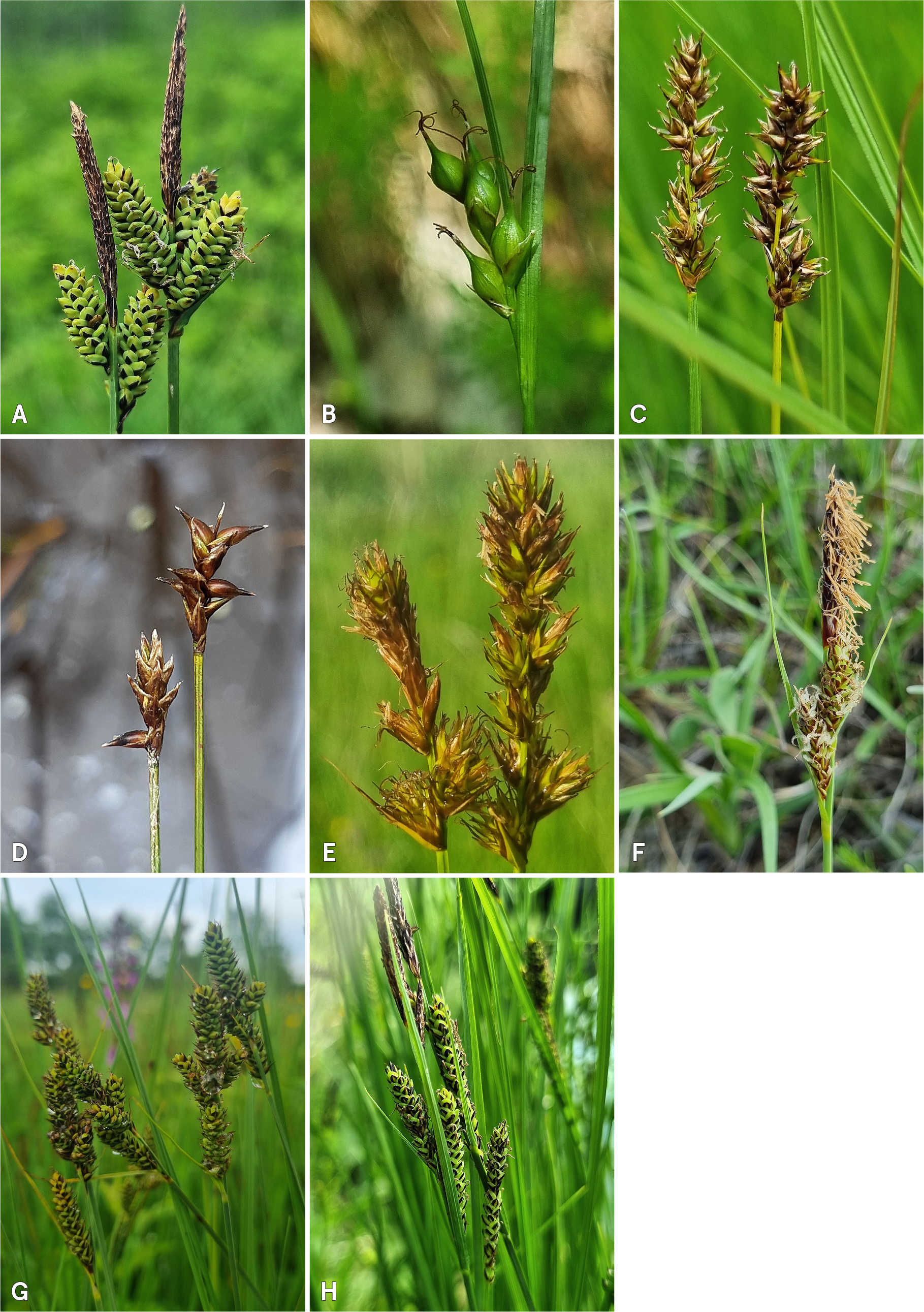
Figure 1 (Slika 1):
A. Carex cespitosa, Radensko polje, 02.06.2022
B. C. depauperata, Dolenji Radenci, 01.06.2022
C. C. diandra, Ljubljana Marshes, 26.05.2022
D. C. dioica, Rakitna, 21.06.2021
E. C. disticha, Planina lake, 01.06.2023
F. C. flacca subsp. erythrostachys, Črni Kal, 27.04.2022
G. C. hartmaniroum, Planina lake, 01.06.2023
H. C. nigra subsp. juncea, Kranjska Gora, 31.05.2022
Photos: J. M. Kocjan
8. Carex curvula All. (subsp. curvula)
Jogan et al. (2001) mentioned this taxon only from two quadrants in the northwest part of the country. It was found in Slovenia for the first time in the Julian Alps, Vrh Križa, in 1966 (Wraber, 1969). We could confirm its occurrence on a second locality, on mount Mangart in July 2020.
9. Carexdemissa Hornem. (subsp. demissa)
This taxon is not mentioned by Jogan et al. (2001), but it was listed in the Slovenian flora by Martinčič (2007). Carex demissa is actually known from almost the whole country (Kocjan et al., 2014; Kocjan, 2015). We have found it on numerous sites (see Appendix 2).
10. Carex depauperata Curtis ex Woodw
This species is not mentioned by Jogan et al. (2001), although it was found for the first time in Slovenia in 1997 by Accetto (1998), in the SE of the country, near the border with Croatia. Carex depauperata (Figure 1B) grows there on a steep calcareous slope in old woodland. We found this species in the same wood, but on another site, in 2022. Probably it grows there at more places. Kocjan (2014b) found it in a neighbouring quadrant, S from the village Stari trg pri Kolpi.
11. Carex diandra Schrank
This species is mentioned by Jogan et al. (2001) from three sites in the northeast part of the country, which refers to sites discovered by Reichardt (1860) and Murmann (1874). Previously, Pokorny (1858) had found it in the Ljubljana Marshes, between Lavrica and Babna Gorica, Pospichal (1897) found it near Vrtojba, and Druškovič & Sušnik (1976) in the surroundings of Gornji Dolič, Koroška region. There it was found first by T. Wraber in 1975. Currently, it is known from only two sites in Slovenia. In May 2022 the authors could confirm its occurrence on the site in the Ljubljana Marshes, SW of Ljubljana, in the Reserve Iški Morost, where it had been found recently (Kocjan et al., 2017). Carex diandra (Figure 1C) grows here in a small population in a shallow depression in Molinietalia meadows. Despite a thorough search we were not able to confirm its second site, in the NW of Slovenia, in the Nature Reserve Zelenci, near Podkoren, W of Kranjska Gora.
12. Carex dioica L
Fleischmann (1844) reported this species from Ljubljana Marshes and near Kočevje, and Murmann (1874) from Lovrenška jezera lakes on Pohorje plateau. Many alleged sites from the second half of the 20th century were summarised by Bačič (2006), however, there was no convincing herbarium material in LJS nor in LJU. Anderle (2023) published its occurrence in two quadrants in the Julian Alps, however the collected material belongs to C. davalliana. Kocjan et al. (2021) mentioned C. dioica (Figure 1D) from Rakitna, S of Ljubljana, in a wetland on a very wet seepage slope. The site was revisited in May 2022 by us to confirm the currently only reliable site of C. dioica in Slovenia.
13. Carex disticha Huds
Jogan et al. (2001) listed this species only in one quadrant, in the vicinity of Celje, where it was found by J. Zechenter (Maly, 1868). In the past it likely grew in Ljubljana Marshes, e.g. along the River Ižica (Fleischmann, 1844). Recently, C. disticha (Figure 1E) has been found under Šmarna gora near the village Skaručna, where it disappeared soon after, due to changes in the environment (Strgulc-Krajšek 2000). We have seen material from that site in LJU. In 2010 the second author and his coworkers discovered its presence on Planina plain, which is up till now the only known site in Slovenia. In May 2022 we could confirm its occurrence on Planina plain, where it grows in a large population in Molinietalia meadows.
14. Carex divisa Huds
Jogan et al. (2001) reported this species from three quadrants along the seacoast in the southwest of the country and from seven quadrants in the east of the country. As these seven quadrants concern inland records, the occurrence over there seems to be at least doubtful; possibly it had been mixed up with C. praecox. These inland sites were found by J. Zechenter near Celje (Maly, 1868; Hayek, 1956) and by Murmann (1874) near Pobrežje and Dogoše in the vicinity of Maribor and near Miklavž na Dravskem polju, Velika Nedelja and Ormož. In May 2022 we could confirm the occurrence of a small population of C. divisa in the southwest, near Koper, in the Nature Reserve Škocjanski Zatok.
15. Carex extensa Gooden
Jogan et al. (2001) mentioned this species from seven quadrants, all situated in the southwest of Slovenia, along the seacoast. Carex extensa has been also reported on several sites around Koper (Glasnović, 2006). In May 2022, we found it near Koper, in the Nature Reserve Škocjanski Zatok. Besides, the first two authors found it on some sites in the Nature Park Sečoveljske soline and in a Mediterranean salt meadow between Sv. Katarina and Sv. Nikolaj in the vicinity of Ankaran. Carex extensa was included in the first edition of the Red list of endangered plants in Slovenia (Wraber & Skoberne, 1989).
16. Carex flacca subsp. erythrostachys (Hoppe) Holub
Neither Jogan et al. (2001) nor Martinčič (2007) mentioned this subspecies for Slovenia, although it was mentioned in older literature. Pospichal (1897) noted this taxon from sites near Loka under the Karst edge, in Izola and on Mount Čaven. Mayer (1952) included this subspecies as being present in Slovenia. We have found C. flacca subsp. erythrostachys (Figure 1F) on several locations, all in the sub-mediterranean, coastal part of the country.
In subspecies flacca the female spikes are long pedunculate, hanging, and the female glumes are about as long as the utricles, while in subsp. erythrostachys the female spikes are upright, even when the fruits are ripe, and the glumes are slightly longer than the utricles.
17. Carex frigida All
Jogan et al. (2001) noted this species in four quadrants, all located in the mountains in the northwest of the country. All sites, known until the late eighties of the previous century, were summarised by Wraber & Skoberne (1989). Carex frigida is now known in total from nine quadrants in Slovenia (Dakskobler, 2003; Dakskobler & Martinčič, 2021). We could confirm its occurrence at the shore of Green Lake in the valley of Seven Triglav lakes, Julian Alps and on Mount Mangart, also Julian Alps.
18. Carex fritschii Waisb
This species is mentioned by Jogan et al. (2001) from five sites, spread over the country. For the first time it was found south of Maribor, between Limbuš and Razvanje, in 1892, by Murr (1906), who erroneously identified it as C. pilulifera. In recent years, the first author was able to confirm or discover several sites: below Korada mountain in Goriška Brda (from here mentioned by Dakskobler et al., 2021a), at Kuk mountain at Banjšice plateau (here first discovered by Dakskobler, 2005a), on the western bank of the River Sava near Zagorje ob Savi (here first discovered by the second author in 2010) and south of the city of Maribor, in Stražun forest. The second author knows it also from the vicinity of the villages Gornji Zemon and Artviže in Brkini. In May 2022 the authors could confirm its present occurrence near Belsko, NW of Postojna, SW of Ljubljana, where it had been discovered in April 2019 by J. Figelj. It grows here on a south oriented slope, together with C. pallescens and C. tomentosa. Recently, Anderle (2023) published a site near Naklo, Gorenjska region.
19. Carex fuliginosa Schkuhr
This rare mountainous species was mentioned by Jogan et al. (2001) from five quadrants in the northwest part of Slovenia. Recently, it has been discovered on many new sites (Dakskobler et al., 2014; Dakskobler & Surina, 2017). Its occurrence we could confirm on Mount Mangart, where it grows at high altitude in wind-exposed alpine meadows. The only site where it had been found outside the Julian Alps so far is on Mount Štruca in central Kamnik-Savinja Alps. Here it was collected by T. Wraber in 1971, but the finding has probably never been published anywhere.
20. Carex halleriana Asso
Jogan et al. (2001) mention this species from nine quadrants in the SW of the country. As a result of a systematic survey in 2012, it was found to be quite common in the southern part of Primorska area, from where many new sites could be published (Kocjan, 2013). Carex halleriana used to grow also in the inner part of the country, near Bled where it was probably found by Beck-Mannagetta (1908), on Paški Kozjak (Reichardt, 1860) and on Šmarna gora (Šuštar, 1998). Despite several attempts, it has later never been found on these three sites, nor in the surroundings of Postojna, from where it had been mentioned by Paulin (1915). In 2022 we saw it on a few sites in Istria.
21. Carex hartmaniorum A.Cajander
This species was found for the first time in Slovenia by the first author on the Planina plain in 2015. Later, he recorded this species along the River Nanoščica on several sites, at Cerknica plain and confirmed its occurrence in Žejna dolina valley near Logatec (here first discovered by B. Trčak in June 2020). In the LJU herbarium we found one collection of C. hartmaniorum (Figure 1G), collected in the early years of the 20th century by A. Gspan near Postojna, erroneously identified as C. buxbaumii. These two species are morphologically similar and are often confused (Więcław et al., 2017); see at C. buxbaumii for the differences.
22. Carex kitaibeliana Degen ex Bech. (var. kitaibeliana)
This mountainous species was mentioned by Jogan et al. (2001) only from the slopes of the limestone Mount Snežnik, E of Ilirska Bistrica, in the Central South of Slovenia. Here it was discovered by A. Paulin (Dolšak, 1936). In July 2022 the authors, guided by B. Surina, were able to confirm its occurrence over there. The site lies at the northernmost border of its overall occurrence and C. kitaibeliana grows mainly in vegetation, described as Edraiantho graminifolii-Caricetum firmae Horvat (1930) 1934 (Surina & Wraber, 2005).
23. Carexlasiocarpa Ehrh. (var. lasiocarpa)
The first record in Slovenia of this species was mentioned by C. Deschmann in 1868 (LJU), who found it in Ljubljana Marshes near Bevke. It was collected on this site for the last time around 1900, as evidenced by the herbarium sheet, stored in LJU (Vreš & Čelik, 2021). With the drying up of Lake Primožičevo jezero as the only known location, the species was considered being extinct (Dolšak, 1936; Mayer, 1952; Wraber, 1972). In the mid-1980s, as part of systematic investigations of minerotrophic bogs, Martinčič (1988) found C. lasiocarpa in the Zelenci Nature Reserve, and later on three other locations: in the Ledine bog on Jelovica plateau, on Bloke plateau near Ulaka village and near Dolenja vas in the vicinity of Ribnica (Martinčič, 1994). We could confirm the presence of C. lasiocarpa on a few sites, at Cerknica plain, where it had been discovered by the first and third author, and also in Ledine bog in Jelovica, in the Zelenci Nature Reserve near Kranjska Gora and twice in Ljubljana Marshes, between Škofljica and Ig, from where it had been published by Čelik et al. (2009). In the vicinity of Lavrica, NE from Hauptmance, from where it had not been known before, it was discovered by the first author in 2021. Later Vreš & Čelik (2021) reported on further findings: in the vicinity of Bevke in Ljubljana Marshes, in Prevojska and Češeniška gmajna woods and under the village Dobeno SW from Mengeš. The second author and T. Čelik found also new sites of this species on Cerknica plain in 2023.
24. Carex leersii F.W.Schultz
Although it was probably first mentioned for Slovenia by Mayer (1952), Jogan et al. (2001) did not record this species. Trčak (2006) revised all available herbarium sheets of the Carex muricata agg. from Slovenia and noted that it occurs only on a few sites scattered over the country. Bakan (2011) added two more sites from the NE part of the country. In 2019 the first and third author found it near Črni Kal in Istria. In 2022 the authors saw a few clumps of this species in Škocjanski zatok Nature Reserve near Koper.
25. Carex limosa L
Although shown for 13 quadrants by Jogan et al. (2001), C. limosa is one of the rarest and most endangered carices in Slovenia, confirmed since 2000 in not more than nine quadrants (Kocjan, 2012). Since then, it has very likely disappeared from the foothills of Rožnik in Ljubljana (Kocjan & Kosič Kocjan, 2021) and also, together with Comarum palustre and Liparis loeselii, from the site near Komenda due to the expansion of the industrial complex. It has first been found here less than 20 years ago. We could confirm its existence on Pokljuka and Jelovica plateau in 2020, Julian Alps, and in Zelenci Nature Park in 2022.
26. Carex liparocarpos Gaudin (subsp. liparocarpos)
Jogan et al. (2001) mentioned it from two quadrants of which one refers to the finding of Paulin (1915) in the vicinity of Črnuče, N of Ljubljana. We have not found the original source for quadrant 9459/1, however J. Zech-enter found it near Celje (Hayek, 1956; we have seen the herbarium specimens). More recently, it has also been found on several other sites: Krško-Brežice plain (Frajman et al., 2009), in Soča valley, Julian Alps (Dakskobler, 2009, 2011) and near Šempas in Vipavska dolina valley (Kocjan, 2013). In 2009, the second author and A. Seliškar found it near Zgornji Obrež, NE Slovenia. Despite these findings it is still very rare in Slovenia as there are not so many suitable habitats. In May 2022 we could confirm its occurrence in Slovenia on the left bank of the River Sava, N of Ljubljana.
27. Carex myosuroides Vill
Its known distribution in Slovenia was limited to Mount Mangart in the W Julian Alps and Mount Stol in the Karavanke Alps, from where the site was published by Dolšak (1936). Wraber (1960) published two new sites in the Julian Alps, Novak (2012) found a second site in the Karavanke Alps, on Mount Košuta and later on Mount Spodnja Vrbanova špica in the Julian Alps (Novak, 2015). Dakskobler & Surina (2017) significantly contributed to the knowledge of the distribution of this species in the Julian Alps, as they have published 47 phytosociological relevés from numerous sites and described a new association: Achilleo clavennae-Elynetum myosuroidis Dakskobler & Surina 2017. Recently, it has been found on Mount Begunjščica in the Karavanke Alps (Anderle, 2023). In July 2020 the authors could confirm its occurrence on Mangart.
28. Carex nigra subsp. juncea (Fr.) Soó
Neither Jogan et al. (2001) nor Martinčič (2007) mentioned this subspecies for Slovenia. For the first time we have found C. nigra subsp. juncea (Figure 1H) in Zelenci Nature Reserve in 2022. Later two new sites in Gorenjska region were found, in Ledine bog on Jelovica plateau and in a marsh above the village Nemški Rovt under the same plateau (Kocjan & Kosič Kocjan, 2023). In addition, we found one collection of this subspecies in the LJU herbarium, collected by T. Wraber, erroneously identified as C. elata.
29. Carexornithopoda subsp. ornithopodioides Hausm
Jogan et al. (2001) provided a distribution map for the entire C. ornithopoda agg. According to Martinčič (2007) the subspecies ornithopodioides grows in Slovenia only in the Julian Alps. However, it had previously been found on Mount Ojstrica in the Kamnik-Savinja Alps by Hayek & Paulin (1907). Lately it has been recorded also from the Karavanke Alps and discovered on new sites in the Kamnik-Savinja Alps (Frajman et al., 2006). Leban et al. (2011) published numerous new sites from the Slovenian Alps and discussed the latest knowledge on the overall distribution in Slovenia. In several relevés, published by Surina & Dakskobler (2017), one can also find a few new sites of this subspecies. The overall distribution for Gorenjska region was presented by Anderle (2023). In 2018 the first author found a site in Štajerska region, while in 2021 the second author and U. Šilc found this taxon on the same plateau on Mount Veliki vrh. The first author also found one specimen of C. ornithopoda subsp. ornithopodioides in LJU, which N. Praprotnik had collected in the Karavanke Alps.
Carex ornithopoda subsp. ornithopodioides differs from the closely related and similar C. ornithopoda subsp. ornithopoda in having shorter, entirely glabrous utricles, very curved stems, shorter female spikes and blackish-purple glumes.
30. Carex pauciflora Lightf
According to Jogan et al. (2001) this species occurs in Slovenia on Pohorje, Jelovica and Pokljuka plateaus, and near Kranjska Gora. However, the site in Zelenci Nature Reserve is erroneous, while Wulfen (1858) found it also in the Ljubljana Marshes in the second half of the 18th century. We do not find any notions of it from this area in the 19th century or later, therefore it must have been extinct here already in the late 18th century. Nevertheless, we could confirm its presence on all three previously mentioned mountain plateaus in 2020.
31. Carex praecox Schreb
More than two decades ago it was still known from only ten quadrants in Slovenia (Jogan et al., 2001). We now know that this species is more widespread, although it should still be considered as rare. In the last few decades several new sites from different regions have been published (Bakan, 2006, 2011; Šilc & Košir, 2006; Dakskobler et al., 2007, 2011; Stergaršek & Jogan, 2010; Anderle, 2023; Dakskobler et al., 2025).
32. Carex punctata Gaudin (var. punctata)
In both editions of the Red list of endangered plants of Slovenia (Wraber & Skoberne, 1989; Wraber et al., 2002) this species is treated as rare. Until 1989 only six sites were known, of which the last had been confirmed in 1968. Jogan et al. (2001) mentioned it from eight sites, while Kocjan (2014a) published a distribution map, where this species is recorded from 15 quadrants. Carex punctata can be found among others in Molinietalia meadows in Ljubljana Marshes, S of Ljubljana. The second author and B. Dolinar found it in the valley of the River Kolpa between Grivac and Kuželj in 2014. Its occurrence over there could be confirmed by the authors in July 2020, in the Reserve Iški Morost, as well as in May 2022, W of this reserve. On both sites it was found first by the second author and U. Šilc in 2015. In May 2021, the first author found a site in Kižlovka valley N of Podlipoglav, SE of Ljubljana, near the valley of Podmolniški graben W of Podmolnik and in May 2024, he found it NW from Dolenja vas pri Polhovem Gradcu.
33. Carexrandalpina B. Walln
Although Jogan et al. (2001) mentioned only three quadrants for this species in Slovenia, C. randalpina is much more common, as shown by Kocjan (2016) and as we have noticed during fieldwork. It can be found in particular in Alnus forests and in wet meadows, bordering forests, rivers and streams. The first author and A. Jakob discovered a new site near Mislinjska Dobrava, SE from Slovenj Gradec in 2016, which lies more than 50 km from the closest known site in the country. Very likely it might also be found in the eastern regions of Slovenia, since we know sites from the vicinity in both Hungary (Mesterházy et al., 2011) and Croatia (Koopman et al., 2026).
34. Carex rupestris All. (subsp. rupestris)
Jogan et al. (2001) mentioned this species for eight quadrants. Many new sites have been discovered in the Julian Alps, Kamnik-Savinja Alps, and in Karavanke Alps more recently (Dakskobler, 2003; Frajman et al., 2006; Dakskobler & Frajman, 2007; Dakskobler et al., 2008; Anderle & Leban, 2011; Novak, 2012; Dakskobler & Surina, 2017). Besides growing in the Alps, it is also known from Mount Snežnik in the Dinaric mountains (Wraber, 1965; Wraber, 1966; Surina & Wraber, 2005).
35. Carexstrigosa Huds
Jogan et al. (2001) mentioned this species from three quadrants in the northeast of Slovenia. Its current distribution in Slovenia is presented by Trčak & Bačič (2017), since many new sites along the River Mura have been discovered. This forest species was found by the authors in an old forest reserve, Krakovski pragozd, SE Slovenia, in 2022, where it grows together with C. sylvatica, C. remota and abundantly C. pendula. Along the River Mura it grows particularly in riparian forests with Alnus glutinosa, Fraxinus excelsior and Salix alba and in mixed oak-elm-ash forests (Trčak & Bačič, 2017), while in Krakovski gozd we found it in Quercus robur forest.
Carex hybrids in Slovenia
Carex hybrids can usually be recognised by empty utricles and anthers that do not dehisce, hidden under the male glumes (Jermy et al., 2007). Moreover, hybrids are generally morphologically and genetically intermediate compared to their parental taxa or they show a mosaic of parental, intermediate and unique characters (e.g. Cayouette & Catling, 1992; Więcław & Wilhelm, 2014).
1. Carex × alsatica Zahn [C. demissa × C. flava]
This hybrid is relatively not very rare in Slovenia, like in other European countries, where it usually grows together with its parental species (see Jermy et al., 2007; Więcław & Wilhelm, 2014; Koopman & Więcław, 2019). Dakskobler et al. (2011) published a few sites with C. × alsatica in the basin of the River Idrijca. Kocjan et al. (2021) and Kocjan & Kosič Kocjan (2023) mentioned C. × alsatica on various sites across central Slovenia and on Jelovica plateau. Most of these sites were confirmed during our fieldwork (see Appendix 2).
Carex × alsatica is morphologically intermediate between the parents, or more similar to C. flava (Więcław & Wilhelm, 2014).
2. Carex × auroniensis L.C.Lamb. [C. acuta × C. acutiformis]
It was found for the first time in Slovenia in 2019 by the first author, near the Biological Centre in Ljubljana, together with both rhizomatous growing parents. This hybrid was still growing there in 2022; moreover, the authors found a new site on Radensko polje plain. Kocjan & Kosič Kocjan (2021) found C. × auroniensis (Figure 2A) in Nature Park Tivoli, Rožnik and Šišenski hrib. Aside from Slovenia this hybrid is known from nine other European countries (Koopman, 2022).
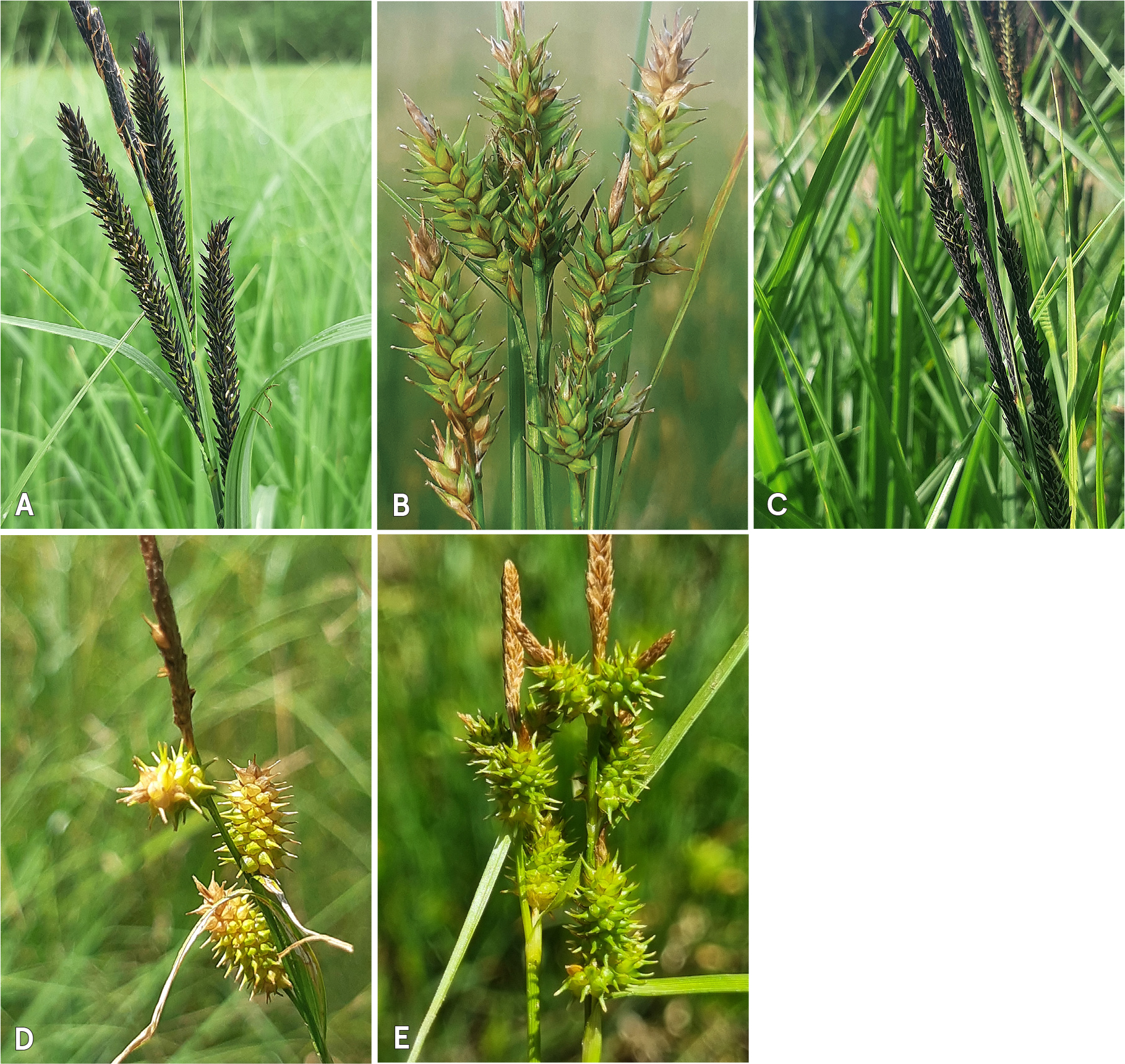
Figure 2 (Slika 1):
A. Carex × auroniensis, Ljubljana, 15.05.2021
B. C. × muelleriana, Ljubljana Marshes, NR Iški morost, 27.06.2021
C. C. × oberrodensis, Grosuplje, 02.06.2021
D. C. × ruedtii, Ljubljana Marshes, 03.07.2021
E. C. × subviridula, Nemški Rovt, 12.06.2022
Photos: J.M. Kocjan
3. Carex × elytroides Fr. [C. acuta × C. nigra]
This is possibly the most common Carex hybrid in Europe (see Koopman, 2022), but probably often overlooked. Both the parental species are rather similar in appearance, which causes that material (including the hybrid) has often been identified erroneously in herbaria as well as in the field. It holds in its characters perfectly the middle of the two parents: it is too tall for C. nigra, too small for C. acuta. However, as C. acuta has, like most carices, stomata on the back side of the leaves and C. nigra, exceptionally, on the upper side, the hybrid has, as a consequence, stomata on both sides, easily to see with a loupe on fresh collected material or in the field (see Wallnöfer, 2006; Jermy et al., 2007)
In Slovenia, Dolšak (1936) published a transcript of a herbarium label of material collected and determined as C. × elytroides by A. Paulin behind Rožnik in Ljubljana. Kocjan & Kosič Kocjan (2021) found this hybrid in Nature Park Tivoli, Rožnik and Šišenski hrib. Carex × elytroides was also recorded on various sites on Jelovica plateau (Kocjan & Kosič Kocjan, 2023).
4. Carex × fulva Gooden. [C. demissa × C. hostiana]
This hybrid is quite frequently recorded in Europe (Koopman, 2022), usually on sites where the parent species co-occur (Jermy et al., 2007; Więcław & Koopman, 2013; Koopman & Więcław, 2019). It forms loosely caespitose plants, with straw-coloured inflorescences. Like in C. demissa the lowest female spike is often somewhat remote, halfway the flowering stem. Specimens of C. × fulva have a characteristic whitish stigma base extended from the utricle beak and a broad scarious margin at the female glume like C. hostiana (Więcław & Koopman, 2013). In Slovenia it is probably not rare, but it might be overlooked.
5. Carex × involuta (Bab.) Syme [C. rostrata × C. vesicaria]
This hybrid has been listed in many European countries (Koopman, 2022). It differs fom both parental species in the stomata, which occur on both sides on the leaf; C. vesicaria has stomata on the back side of the leaves and C. rostrata on the upper side.
Vreš et al. (2013) published two sites in Slovenia, while the first author found it in the vicinity of Horjul in 2016.
6. Carex × leutzii Kneuck. [C. hostiana × C. lepidocarpa]
This hybrid is not rare in Slovenia and it usually grows together with its parental species. Carex × leutzii was reported by Dakskobler et al. (2011) from the basin of the River Idrijca, by Dolinar & Vreš (2012) from Mišja dolina valley near Velike Lašče, by Vreš et al. (2013) mainly from Bloke plateau, by Vreš & Čelik (2021) from Ljubljana marshes, by Kocjan et al. (2021) from various sites across central Slovenia, and by Kocjan & Kosič Kocjan (2023) from various sites on Jelovica plateau.
Carex × leutzii is morphologically intermediate between the parents, or more similar to C. hostiana, also with a white membrane at the beak apex and with a broad scarious margin at the female glumes (Więcław & Koopman, 2013), and the hybrid is probably often mistaken for it. Such mistakes are especially likely during the early stages of their development, when the utricles are not yet fully developed (Więcław & Koopman, 2013).
7. Carex × muelleriana F.W.Schultz [C. distans × C. hostiana]
This rare hybrid was recognised for the first time in Slovenia by the first author in Ljubljana Marshes, W from Iški morost Nature reserve in 2021, and confirmed, albeit tentatively, on the same site in May 2022. After the revision of herbarium material in LJU, another locality was confirmed. A. Podobnik collected this taxon in 1986 close to the village Veliki Otok near Postojna. Apart from Slovenia, it is mentioned from nine other countries in Europe (Koopman, 2022).
Carex × muelleriana (Figure 2B) differs from C. hostiana in the longer male spikes and bracts, while from C. distans in its longer, pale green leaves, its greyer basal sheaths and the hyaline margin of the glumes (Jermy et al., 2007).
8. Carex × oberrodensis B.Walln. [C. elata × C. randalpina]
In Europe, this hybrid had been reported from three countries so far, Austria, Italy (Koopman, 2022) and Croatia (Koopman et al., 2026). In Slovenia it is known from four locations: in the valley of Črna dolina (Kocjan et al. 2021), W from Malo Mlačevo near Grosuplje, SE from Horjul, and between Dvor pri Polhovem Gradcu and Dolenja vas W of Ljubljana. The tussocks of Carex × oberrodensis (Figure 2C) are much bigger than those of C. elata, and the broad and shining leaves show clearly its relationship to C. randalpina, which grows on all four sites in the direct neighbourhood.
9. Carex × oenensis A.Neumann ex B.Walln. [C. acuta × C. randalpina]
This hybrid has been noted in five European countries: Austria, Germany, Italy, and Slovenia (Koopman, 2022) and Croatia (Koopman et al., 2026). Carex × oenensis is morphologically intermediate between the parents. It is a tall plant, like C. randalpina, forming large mats, but the dull coloured leaves are narrower than the glancing ones of C. randalpina (see Wallnöfer, 1992).
10. Carex × ohmuelleriana O.Lang [C. brizoides × C. remota]
This hybrid has first been found in Slovenia by J. Figelj on one site, in 2023. Apart from Slovenia, it is known from eight other countries in Europe (Koopman, 2022).
Carex × ohmuelleriana is morphologically rather intermediate to its parents. The lower, remote spikes, sometimes with an elongated bract, are reminiscent of C. remota, the top of the inflorescence, more compact, is reminiscent of C. brizoides, as is the silvery colour of the inflorescence. It differs from C. remota in its rhizomatous growth, from C. brizoides in its long lower bracts and elongated inflorescence (Koopman, 2018).
11. Carex × pauliana F.W.Schultz [C. hostiana × C. oederi]
This hybrid has first been found in Slovenia SW of the village Ribno near Bled by the first author and V. Leban, and subsequently by the authors on Cerknica plain, together with the parental species.
Carex × pauliana is morphologically rather intermediate to its parents. It is a relatively small plant (stems up to 25 cm) and has a utricle beak less than 1 mm long with a white membrane at the apex (a character inherited from C. hostiana) (see Koopman & Więcław, 2019).
12. Carex × prolixa Fr. [C. acuta × C. elata]
This hybrid has been listed in many European countries (Koopman, 2022). In Slovenia, three localities are known so far (see Appendix 2).
Carex × prolixa has long thin male and female spikes inherited from C. acuta, while the short lowest bracts and pale coloured, somewhat fibrillose basal sheaths are inherited from C. elata (Jermy et al., 2007).
13. Carex × pseudoaxillaris K.Richt. [C. otrubae × C. remota]
Carex material, stored in LJU as C. elongata clearly represents the hybrid between C. otrubae and C. remota. The material was collected by A. Martinčič, in the NE part of Slovenia, close to the settlement Središče ob Dravi in 1955.
Carex × pseudoaxillaris differs from C. otrubae in its more slender stems, its rounded ligule, its distinctly separated spikes and its long lowest bract that often exceeds the inflorescence. From C. remota it can be distinguished by its wider leaf blades, its much stouter, triangular, brownish spikes and shorter distance between the two lowest spikes (Jermy et al., 2007; Koopman et al., 2023).
14. Carex × rotae De Not. [C. appropinquata × C. paniculata]
This hybrid was first found in Slovenia by the authors in Zelenci Nature Reserve, together with both parents, in a wetland, in May 2022.
Carex × rotae differs from C. paniculata by its larger appearance, darker, a bit more fibrous basal sheaths, and shorter and stiff inflorescences. From C. appropinquata it can be distinguished by its dark brown, slightly fibrous basal sheaths and by its occasionally extremely long inflorescences (Jermy et al., 2007).
15. Carex × ruedtii Kneuck. [C. flava × C. lepidocarpa]
It is thought to have been found in Slovenia for the first time in the vicinity of Maribor by J. Murr (Hayek, 1956), however we have not seen the material, providing it exists. Nevertheless, we have found Carex × ruedtii (Figure 2D) on several locations: in the Nature reserve Zelenci, under Mount Šmarna gora N of Ljubljana, near Horjul W from the village Lesno Brdo, in Babni dol in the municipality Medvode and in Ljubljana Marshes not far from Iški morost nature reserve. Sites in the Ljubljana marshes near Ig were first published by Vreš & Čelik (2021).
This hybrid often grows together with both parents. It resembles mostly C. lepidocarpa, generally also with two female spikes, but the straw-coloured inflorescences when ripe and the usually empty utricles are distinctive (Więcław & Wilhelm, 2014).
16. Carex × schatzii Kneuck. [C. lepidocarpa × C. oederi]
We currently know this hybrid from several sites in Slovenia (see Appendix 2). In 2022 the authors could confirm it still grows in Besnica valley E from Ljubljana.
Specimens of C. × schatzii are usually intermediate between both parental species or more similar to C. lepidocarpa; however, the hybrid is smaller than C. lepidocarpa and has straw-coloured inflorescences (Więcław & Wilhelm, 2014).
17. Carex × strictiformis Kneuck. [C. cespitosa × C. elata]
This hybrid has been recorded in 11 European countries (Koopman, 2022). In Slovenia, C. × strictiformis has recently been found by the authors on two sites: on Planina plain in 2020 and on Radensko polje plain in 2022.
18. Carex × subviridula Fernald [C. flava × C. oederi]
In Slovenia, we have found this hybrid on three localities so far: near Nemški Rovt under the Jelovica plateau, Julian Alps, near Zgornje Bitnje in the vicinity of Kranj, and E from the village Ulaka on Bloke plateau.
Carex × subviridula (Figure 2E) is morphologically intermediate between both parental species or more similar to a tall C. oederi (Więcław, 2014).
19. Carex × turfosa Fr. [C. elata × C. nigra]
It had been found for the first time in Slovenia by the second author and U. Šilc in Ljubljana Marshes, between the villages Tomišelj and Lipe in April 2015. We could confirm its occurrence in Slovenia in the Julian Alps, on Jelovica plateau, in July 2020, where we found it in Ledine bog, together with both parents.
Carex × turfosa differs from C. nigra in its broader leaves, usually taller stems, fibrillose basal sheaths, less slender spikes and beaked utricles. From C. elata it differs in its generally less-tussock-forming habit and longer lowest bract. This hybrid has stomata on both sides on the leaves, while C. elata has stomata on the back side of the leaves and C. nigra on the upper side (Jermy et al., 2007).
20. Carex × xanthocarpa Degl. [C. flava × C. hostiana]
This is a tall, loosely caespitose hybrid, with a typically yellowish colour, growing in particular in Molinietalia meadows, often rather abundant. In Slovenia, it is not a rare hybrid and on many places it is more common than either of the parents. Mezzena (1986) mentioned two sites with C. × xanthocarpa near Nova Gorica, collected by C. Zirnich around 1950. Kocjan & Kosič Kocjan (2021) found C. × xanthocarpa in Nature Park Tivoli, Rožnik and Šišenski hrib. Kocjan et al. (2021) and Kocjan & Kosič Kocjan (2023) mentioned C. × xanthocarpa for central Slovenia and Jelovica plateau, respectively.
Carex × xanthocarpa is intermediate between both parental species. It has a relatively tall stem, broad female spikes, bracts and leaf blades which are similar in size to those found in C. flava. Specimens of C. × xanthocarpa have a characteristic whitish stigma base extended from the utricle beak and a broad scarious margin at the female glume like C. hostiana (Więcław & Koopman, 2013).
Conclusions
Intensive field research conducted after the publication of “Gradivo za Atlas flore Slovenije” by Jogan et al. (2001) has contributed to expanding our knowledge about the occurrence of Carex taxa in Slovenia. Since then, the list of sedge taxa has been enriched with C. austroalpina, C. bicolor, C. depauperata, C. flacca subsp. erythrostachys, C. hartmaniorum, and C. nigra subsp. juncea; besides, data on the distribution of some Carex taxa, especially rare and endangered ones, have been updated. Unfortunately, of some species, especially those associated with moist and wet habitats, their area and population size have recently been reduced. This group includes the following sedges: C. brunnescens, C. cespitosa, C. diandra, C. dioica, and C. limosa. On the other hand, some species, previously considered rare, according to the current study, were found to be scattered (C. halleriana) or frequent (C. demissa, C. randalpina) in Slovenia. Two introduced North American species have been found recently: C. crawfordii and C. vulpinoidea, each on one location.
At first in recent years more attention has been paid to the occurrence of Carex hybrids in Slovenia. Currently, 20 Carex hybrids have been recorded in Slovenia, some of which are not rare. Another one, Carex × danielis [C. flacca × C. tomentosa], is doubtful and needs further research. As hybrids within the genus Carex occur relatively often when the parental species grow sympatrically, more hybrids and more of their localities should be expected in the future. According to Table 2 there are seven extremely rare Carex hybrids, seven very rare, two rare, two scattered, and two frequent ones.
Povzetek
Rod Carex L. (Cyperaceae) je eden najobsežnejših rodov kritosemenk v zmernem pasu severne poloble, s približno 2000 vrstami po svetu. Zaradi izrazite morfološke variabilnosti, številnih vmesnih oblik in pogoste naravne hibridizacije predstavlja velik taksonomski izziv. V Sloveniji je bilo doslej zabeleženih 94 vrst šašev, vključno z dvema tujerodnima, ter 21 naravno nastalih hibridov. Prisotnost šestih vrst oziroma podvrst in enega križanca ostaja dvomljiva zaradi zgodovinskih, slabo dokumentiranih navedb in pomanjkanja sodobnega herbarijskega gradiva. Prispevek temelji na dolgoletnem florističnem, herbarijskem in terenskem delu in predstavlja doslej najcelovitejši pregled razširjenosti, taksonomske pripadnosti in pojavljanja križancev rodu Carex v Sloveniji.
Nekatere vrste so bile v preteklosti slabo poznane ali napačno določene, a so bile v zadnjih dveh desetletjih ponovno odkrite ali prvič zanesljivo potrjene. Vrsta C. dioica, borealna specialistka stalno vlažnih izvirskih mest, je bila dolgo znana zgolj iz starejših virov brez herbarijskih primerkov. Danes je potrjena le na eni lokaciji v Sloveniji, na izvirskem mokrišču pri Rakitni, kjer raste v majhni, a vitalni populaciji. Tudi C. diandra je znana le iz ene potrjene lokalitete – travnika v rezervatu Iški morost.
Vrsta C. hartmaniorum, ki jo lahko zlahka zamenjamo s C. buxbaumii, je bila v zadnjih letih prepoznana na več lokalitetah na Notranjskem, predvsem v nižinskih vlažnih habitatih, kot so travišča in barjanski robovi. Tudi C. flacca subsp. erythrostachys je bila dolgo prezrta, čeprav obstajajo starejši podatki o njenem pojavljanju. Danes je ponovno potrjena na več submediteranskih rastiščih v jugozahodni Sloveniji. Carex nigra subsp. juncea je bila v Sloveniji prvič prepoznana šele leta 2020. Za zdaj je bila ugotovljena na štirih lokalitetah na Gorenjskem. Njena prisotnost v Sloveniji je bila dolgo spregledana, kljub sorazmerni pogostosti v Avstriji.
Avtorji izrecno navajajo tudi vrste, ki so bile v Sloveniji sicer zgodovinsko zabeležene, vendar v zadnjih desetletjih kljub ciljnim iskanjem niso bile več potrjene. To so C. atrofusca, C. ericetorum, C. melanostachya, C. pallidula, C. stenophylla in C. supina. Večina teh navedb izhaja iz 19. stoletja in so verjetno brez herbarijskih dokazov. Njihova prisotnost v slovenski flori ostaja negotova, saj so potencialna rastišča pogosto že izginila ali so spremenjena, poleg tega pa obstaja možnost napačne determinacije.
Prispevek prvič sistematično vključuje tudi naravne križance, ki so jih pretekli pregledi bodisi prezrli bodisi obravnavali kot redkosti ali izjeme. Zanesljivo dokumentiranih je 20 križancev, med katerimi jih je 12 prvič ugotovljenih za Slovenijo. Večinoma so bili prepoznani na osnovi morfoloških značilnosti v območjih soobstoja starševskih vrst, posebej v vrstno bogatih mokriščnih habitatih. Pojav križancev potrjuje naravno dinamičnost šašev in potrebo po večji pozornosti pri terenskemu določevanju.
Dve tujerodni vrsti, C. vulpinoidea in C. crawfordii, sta bili v zadnjem desetletju zanesljivo dokumentirani v okolici Ljubljane. C. vulpinoidea se širi in je bila potrjena tudi na Hrvaškem, čeprav v Sloveniji trenutno še ne kaže invazivnega vedenja. Obe vrsti najdemo predvsem na antropogenih, vlažnih rastiščih.
Zemljevidi razširjenosti vključujejo vse redke vrste in križance, ločeno za obdobje pred in vključno z letom 2001 ter obdobje po letu 2001. Podatki temeljijo na zgodovinskih zapisih, herbarijskih določbah in sodobnih terenskih raziskavah. Prikaz vključuje tudi domnevno napačne ali izginule zapise, kar omogoča boljšo oceno sprememb razširjenosti in potencialno usmerjanje prihodnjih iskanj.
Ta sinteza predstavlja doslej najobsežnejši pregled taksonomske in floristične raznolikosti rodu Carex v Sloveniji. Poudarja pomen združevanja terenskega dela s herbarijsko revizijo in zgodovinskimi viri ter izpostavlja naravovarstveni pomen vrst, vezanih na ogrožene mokriščne in suhe traviščne habitate. Delo predstavlja pomembno osnovo za nadaljnje raziskave, sistematsko delo in oblikovanje varstvenih prioritet v okviru slovenske flore.
Acknowledgments
We would like to thank all our botanical colleagues, who have accompanied us on some of our excursions during the field work or provided us with some data for the distribution maps: Aleš Tomažič, Aljaž Jakob, Andrej Paušič, Andrej Seliškar, Boštjan Surina, Brane Anderle, Branko Dolinar, Branka Trčak, Filip Küzmič, Igor Dakskobler, Jernej Figelj, Josip Otopal, Nejc Kavšek, Nina Erbida, Peter Glasnović, Sanja Behrič, Tatjana Čelik, Urban Šilc and Vid Leban. We thank Iztok Sajko for preparing the distribution maps.
We also appreciate the kind help of the following correspondents and curators: Igor Dakskobler alerted us for some overlooked literature references, Marijan Govedič helped us with some of the sources, Simona Strgulc-Krajšek informed us about the current situation with C. disticha near Skaručna, Špela Pungaršek helped us clarify some of Wulfen’s botanical surveys on Ljubljana Marshes, Nejc Jogan and Simona Strgulc-Krajšek allowed us to see and revise Carex material stored in LJU.
Notes
[3] Contributed by Author contribution statement
JMK, BV, DKK, HW and JK – carried out field work, JMK, HW and JK – wrote the first draft of the manuscript. All authors improved the final version of the manuscript.
[4] Conflicts of interest Conflict of interest statement
The authors declare no conflicts of interest.
[5] Research data availability statement
All data supporting this study are included within the article and/or supporting materials.
Appendix
Distribution maps of selected Carex taxa in Slovenia
Priloga 1
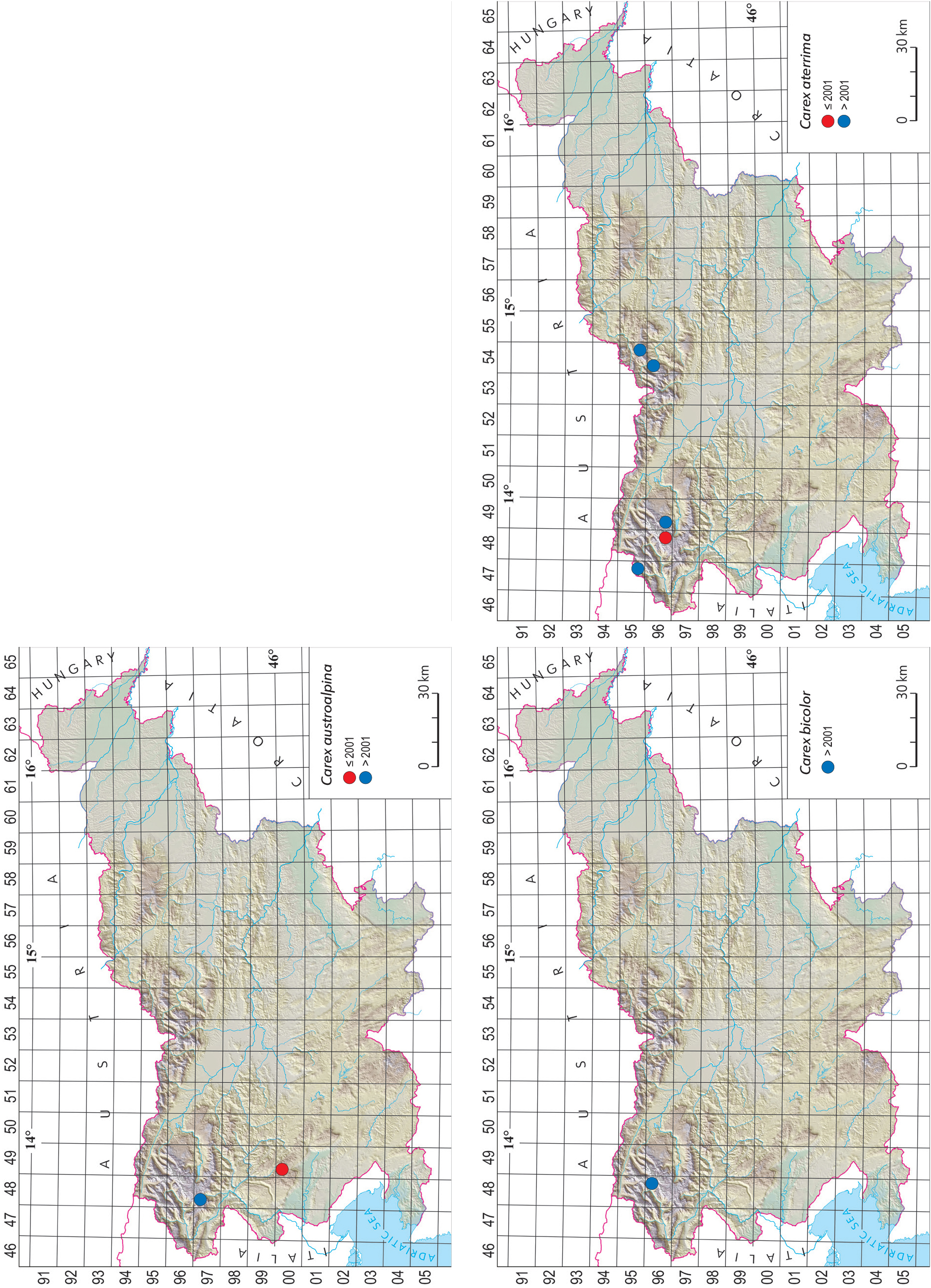
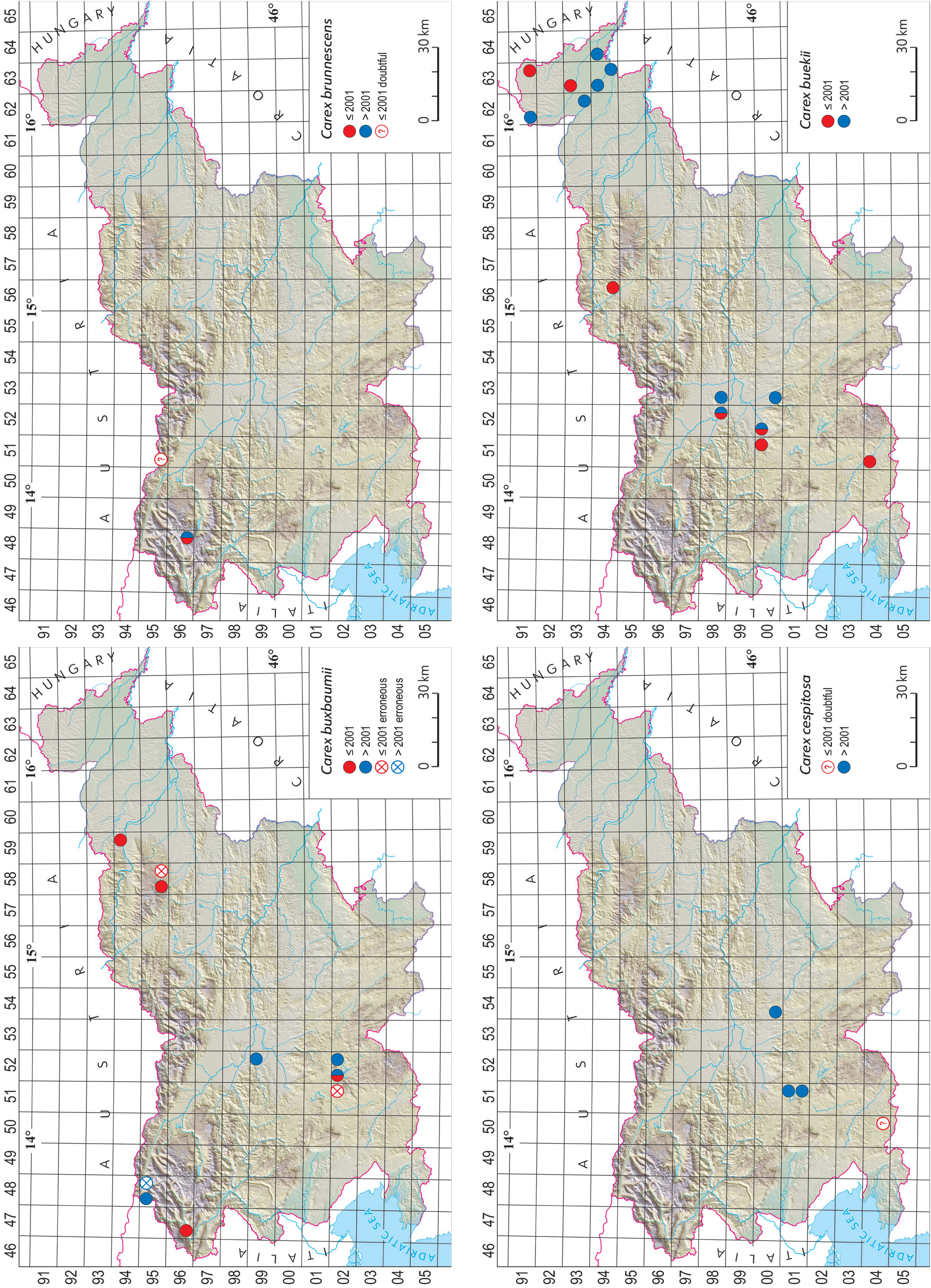
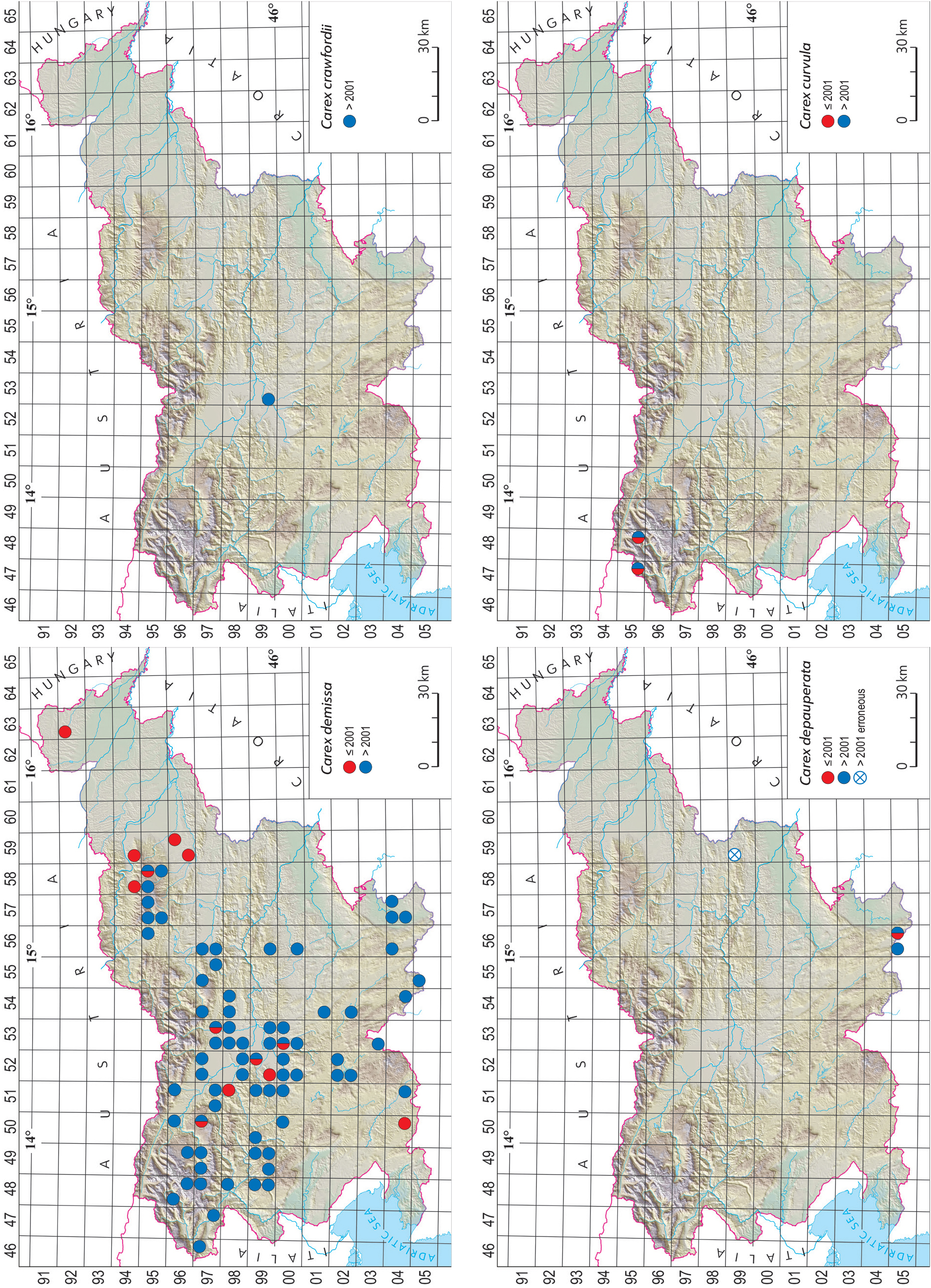
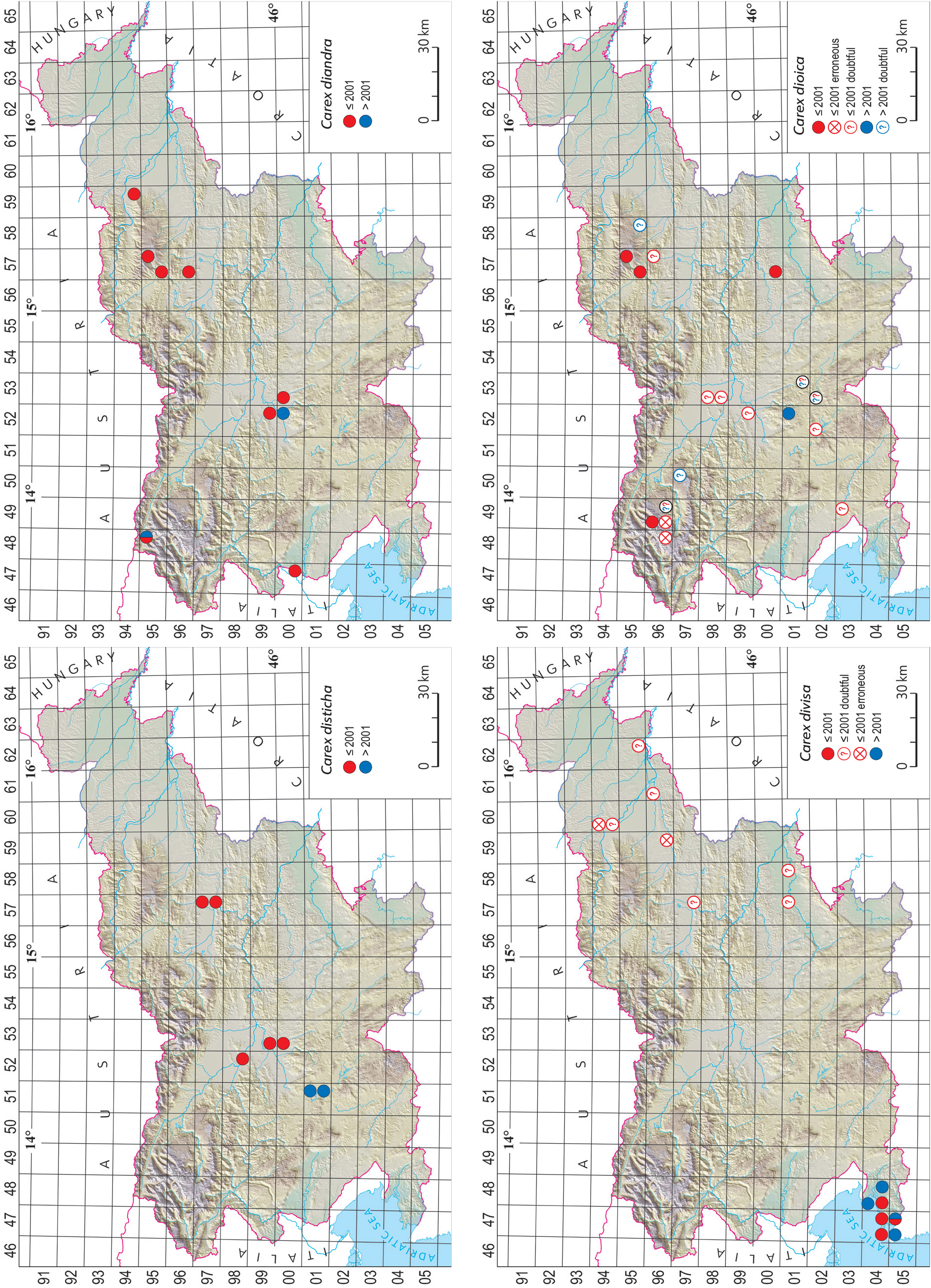
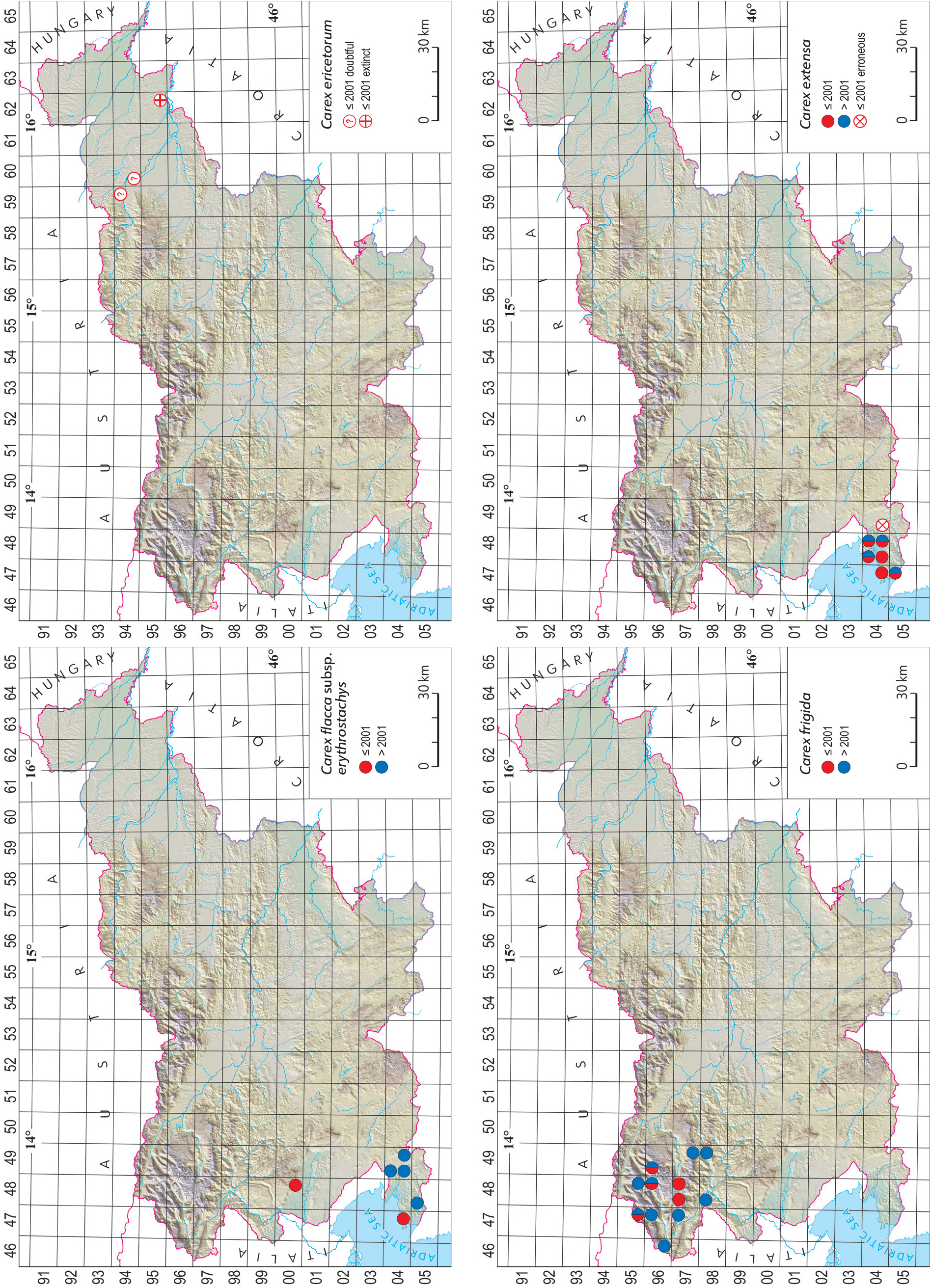
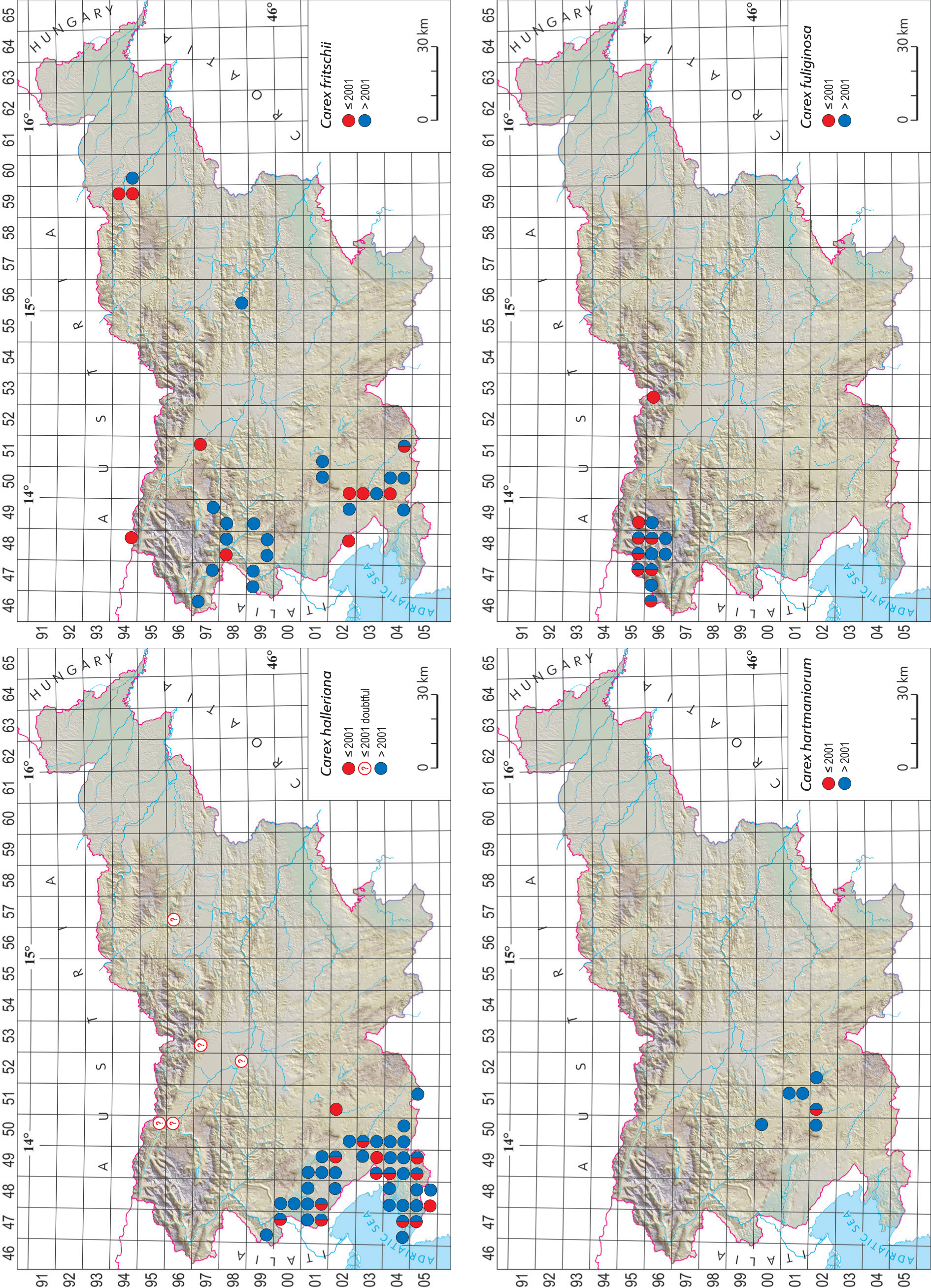
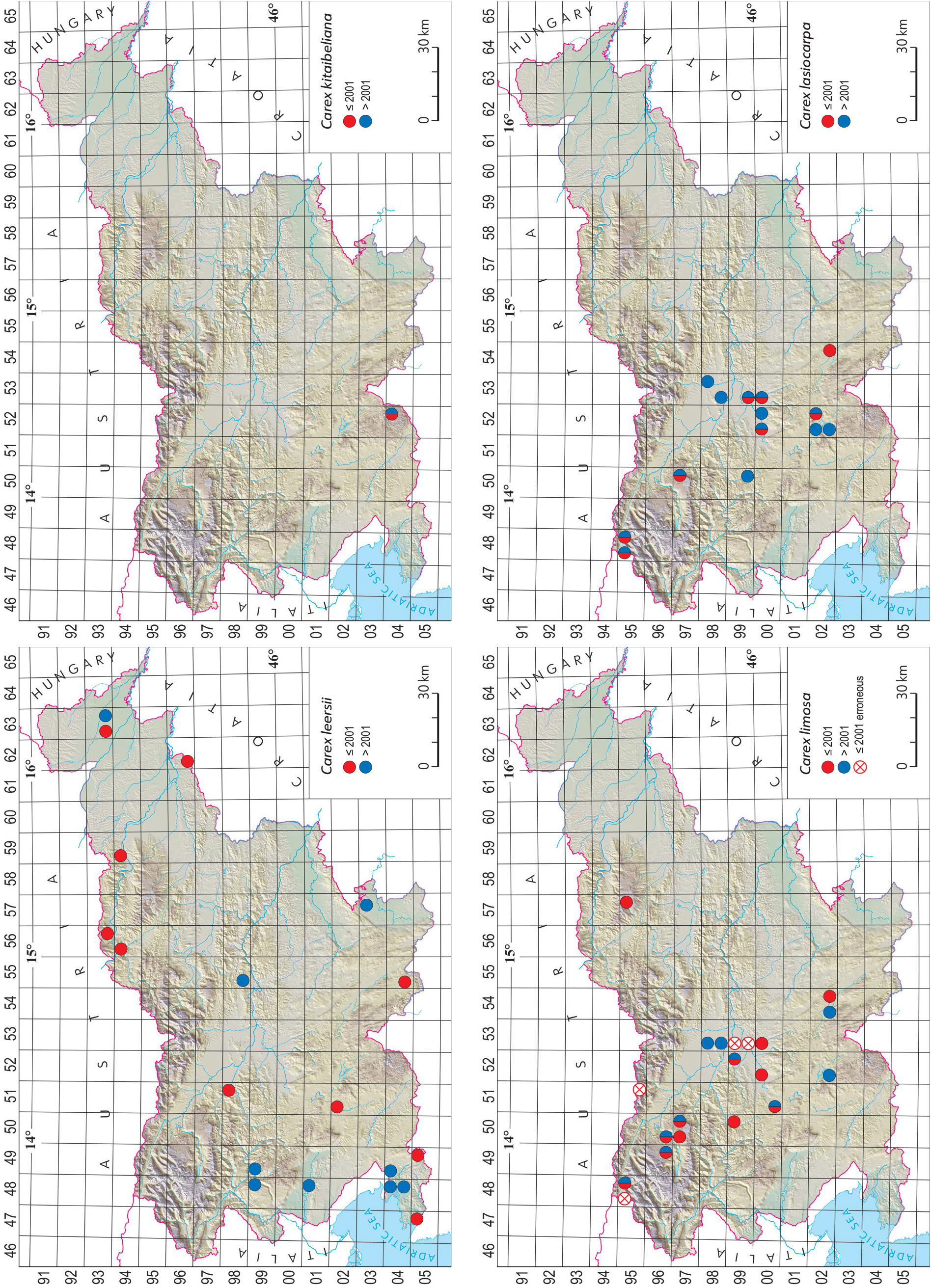
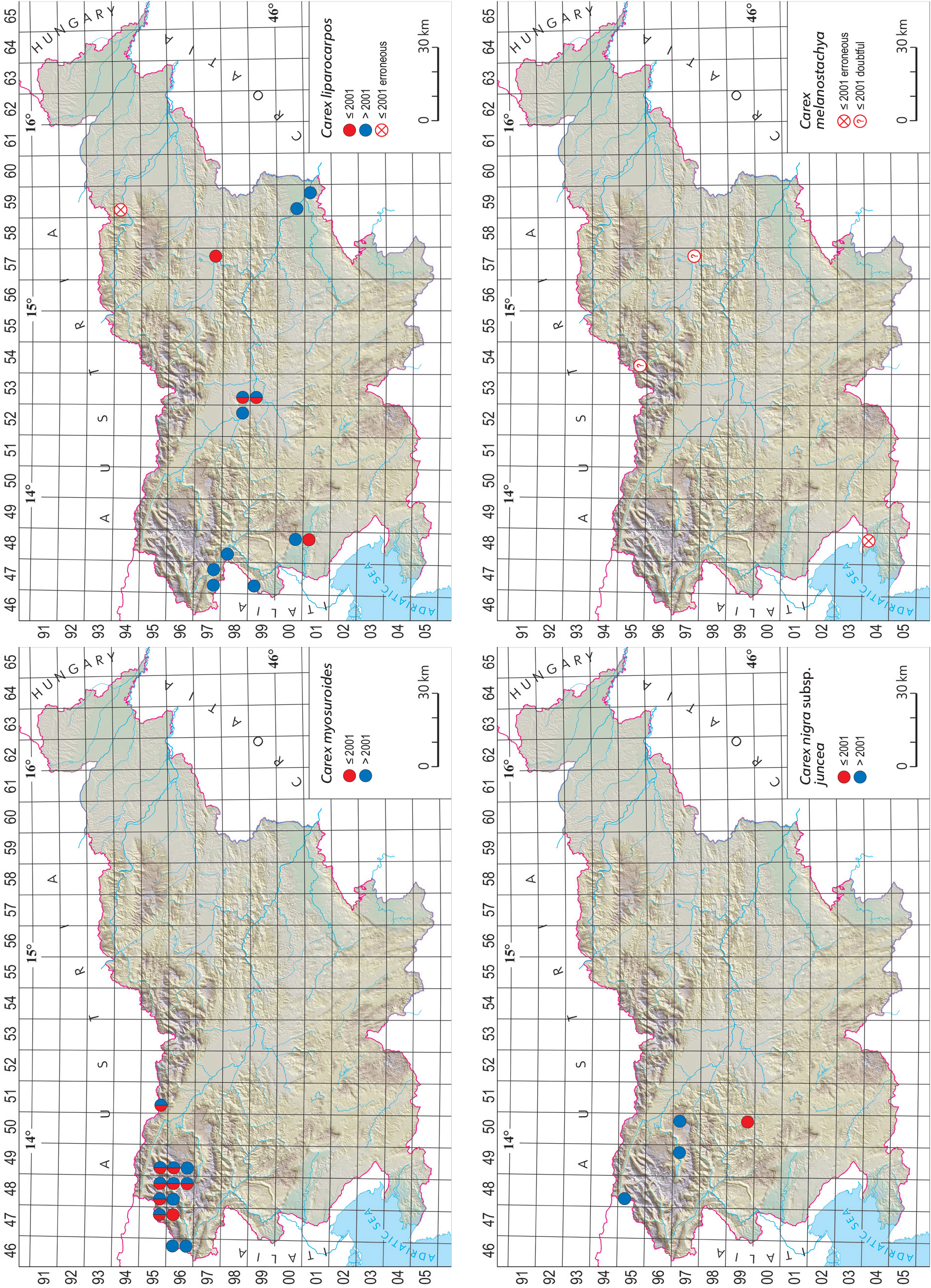
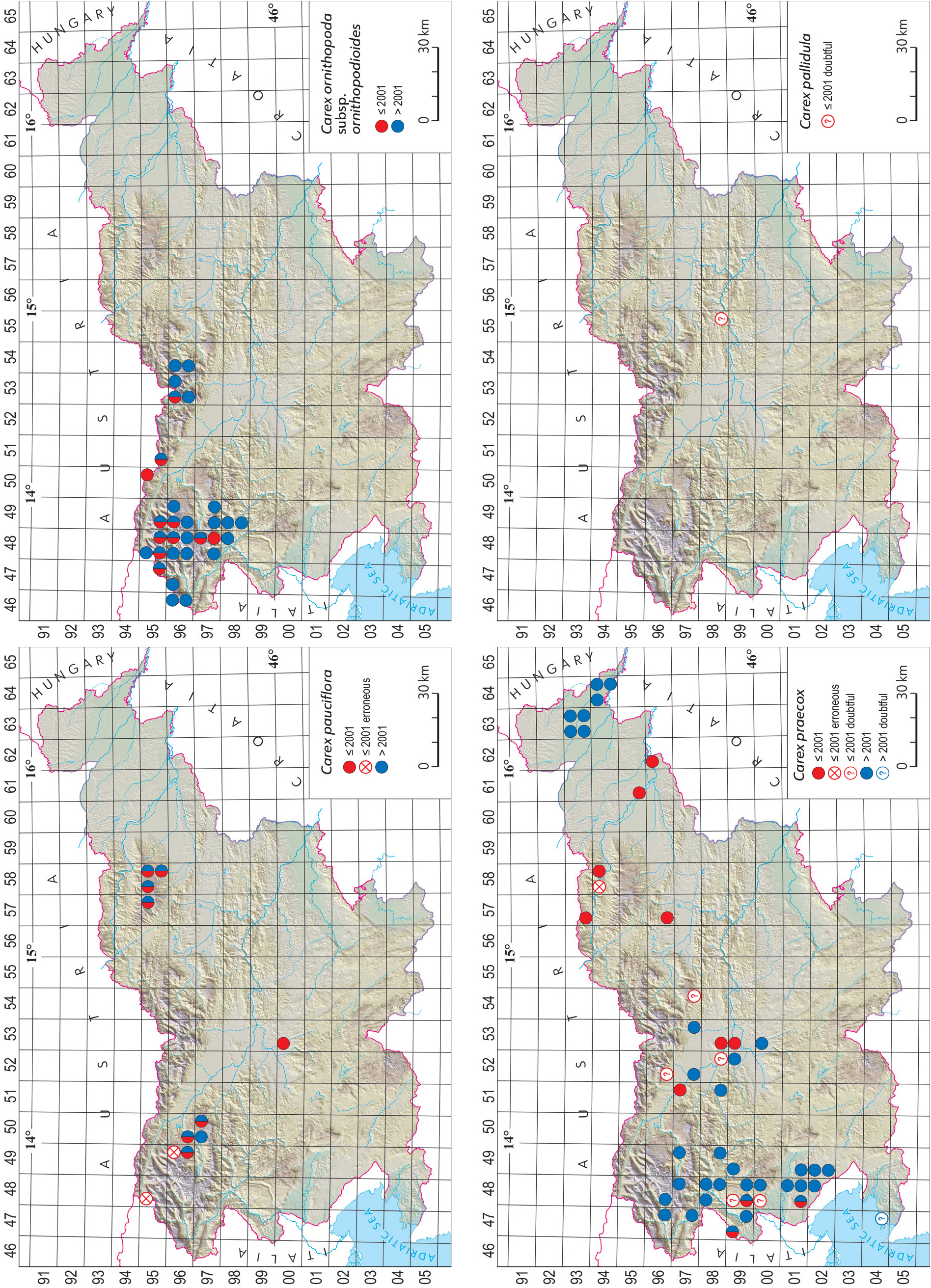
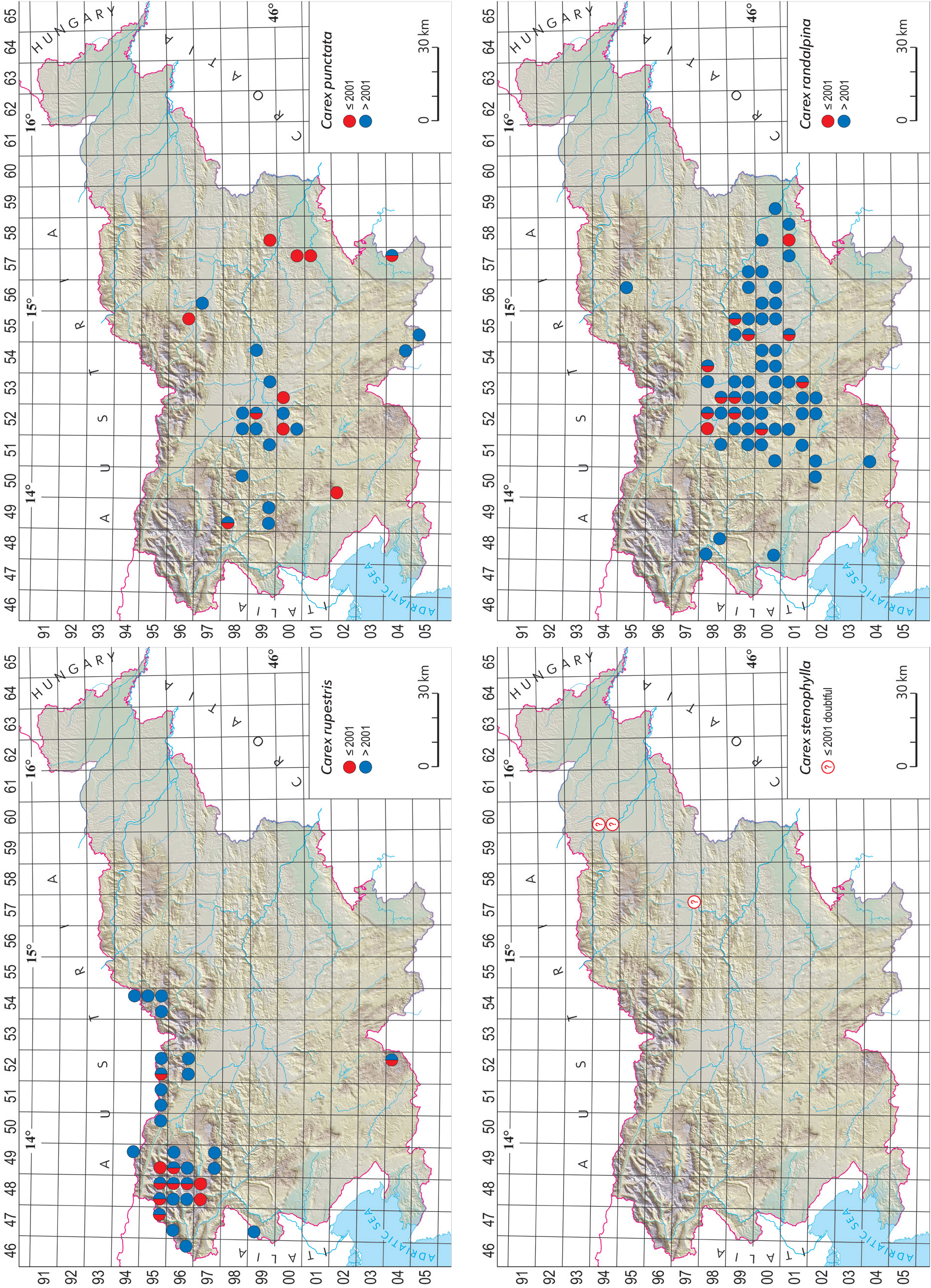
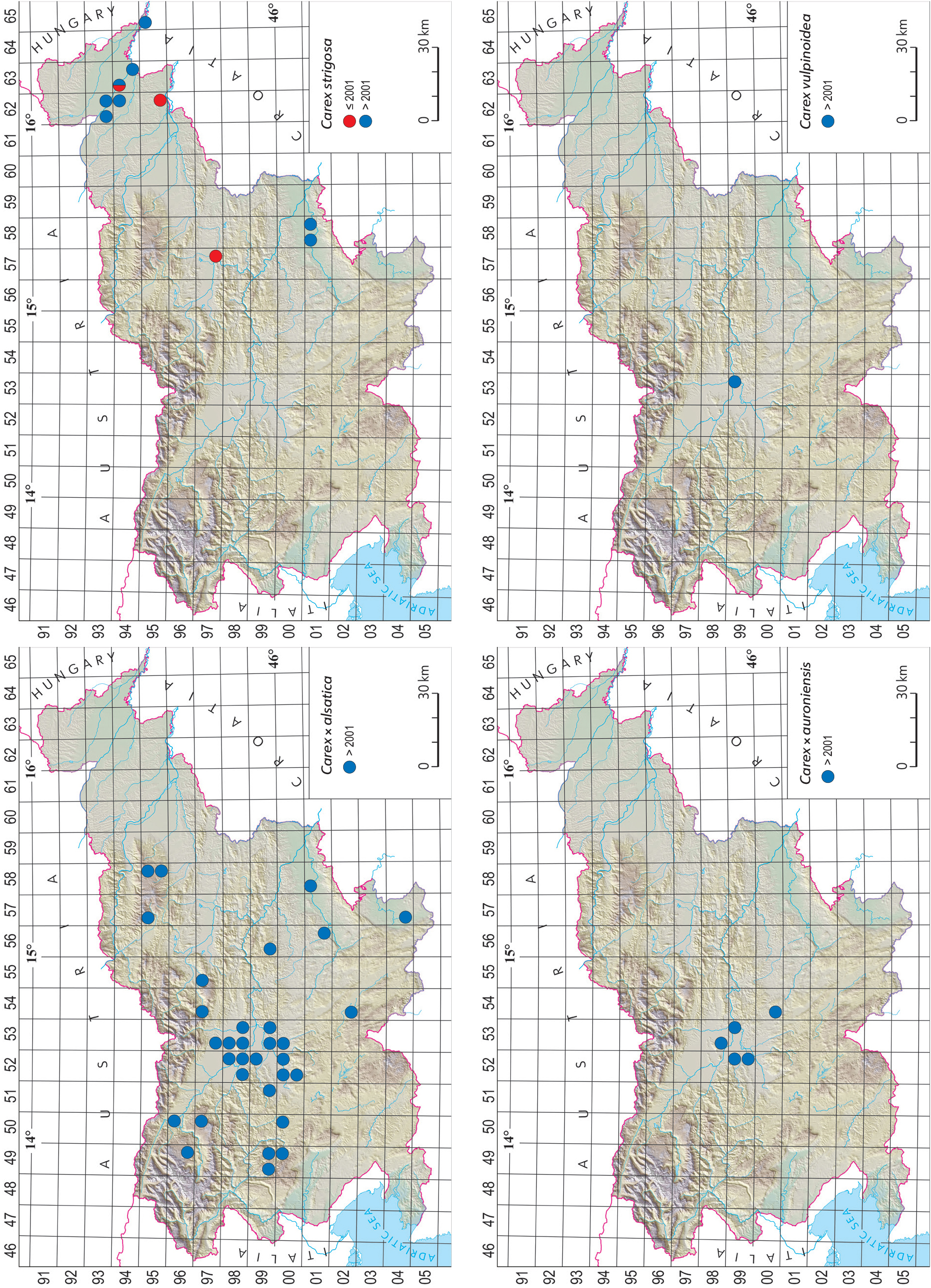
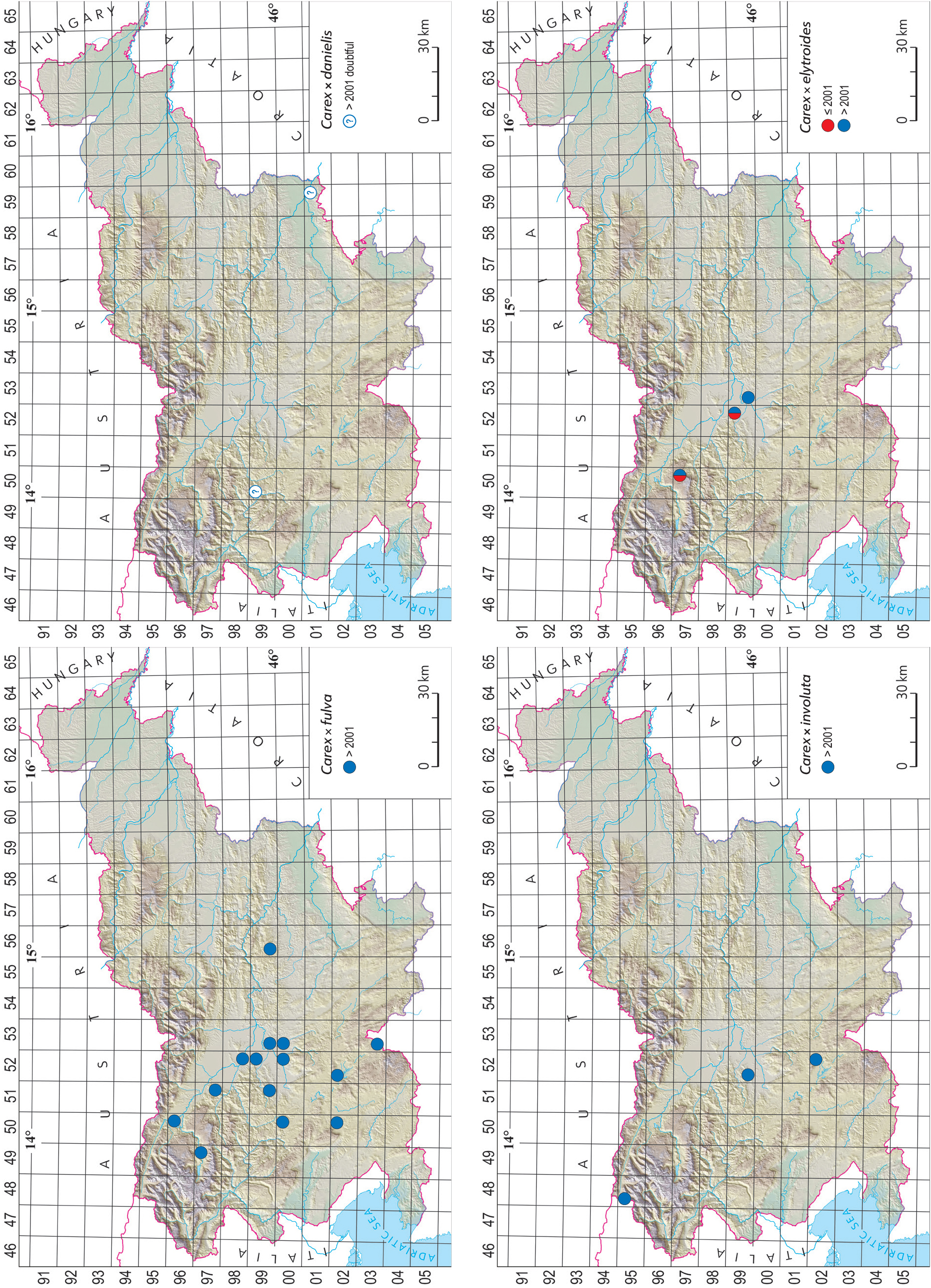
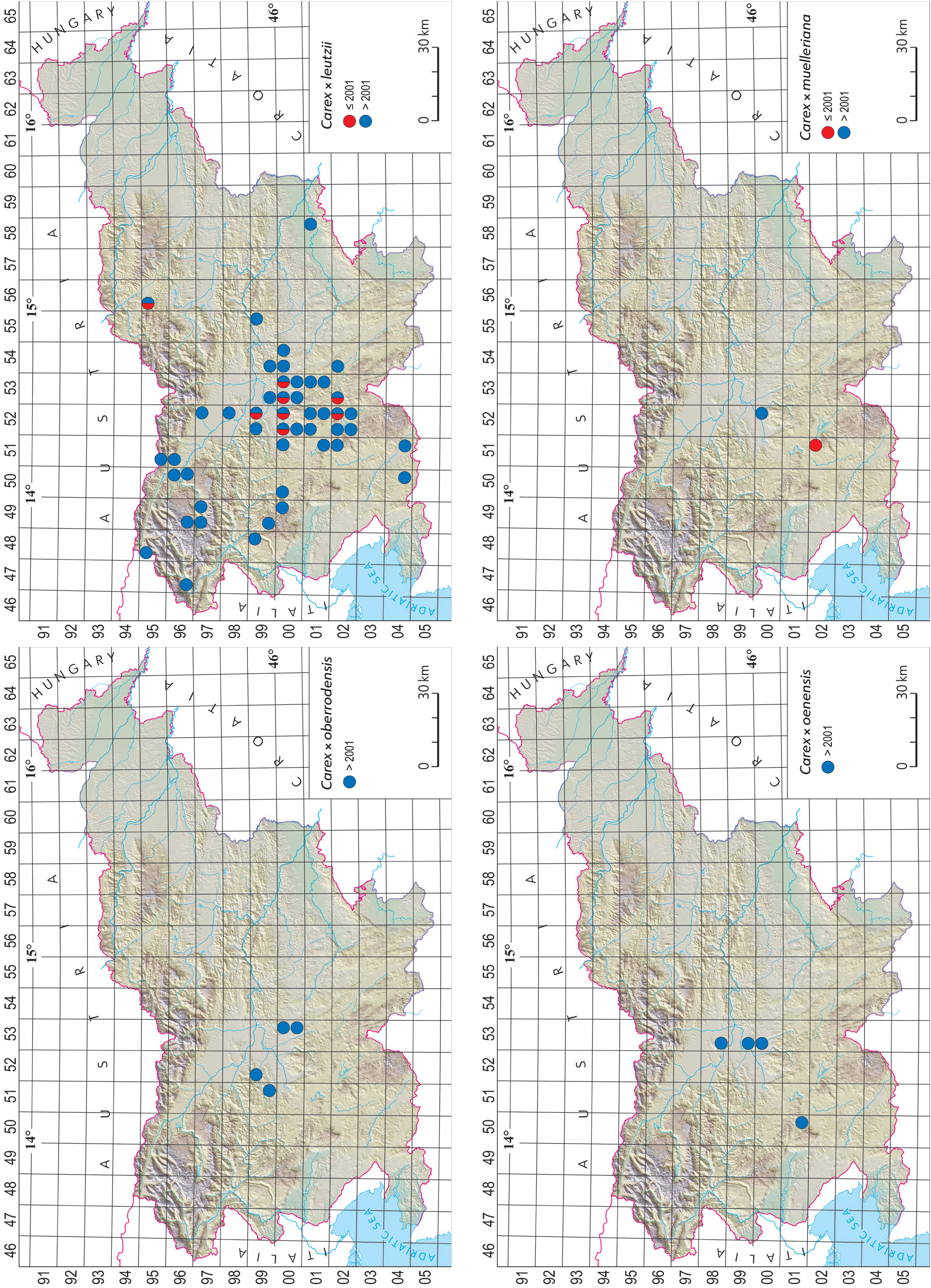
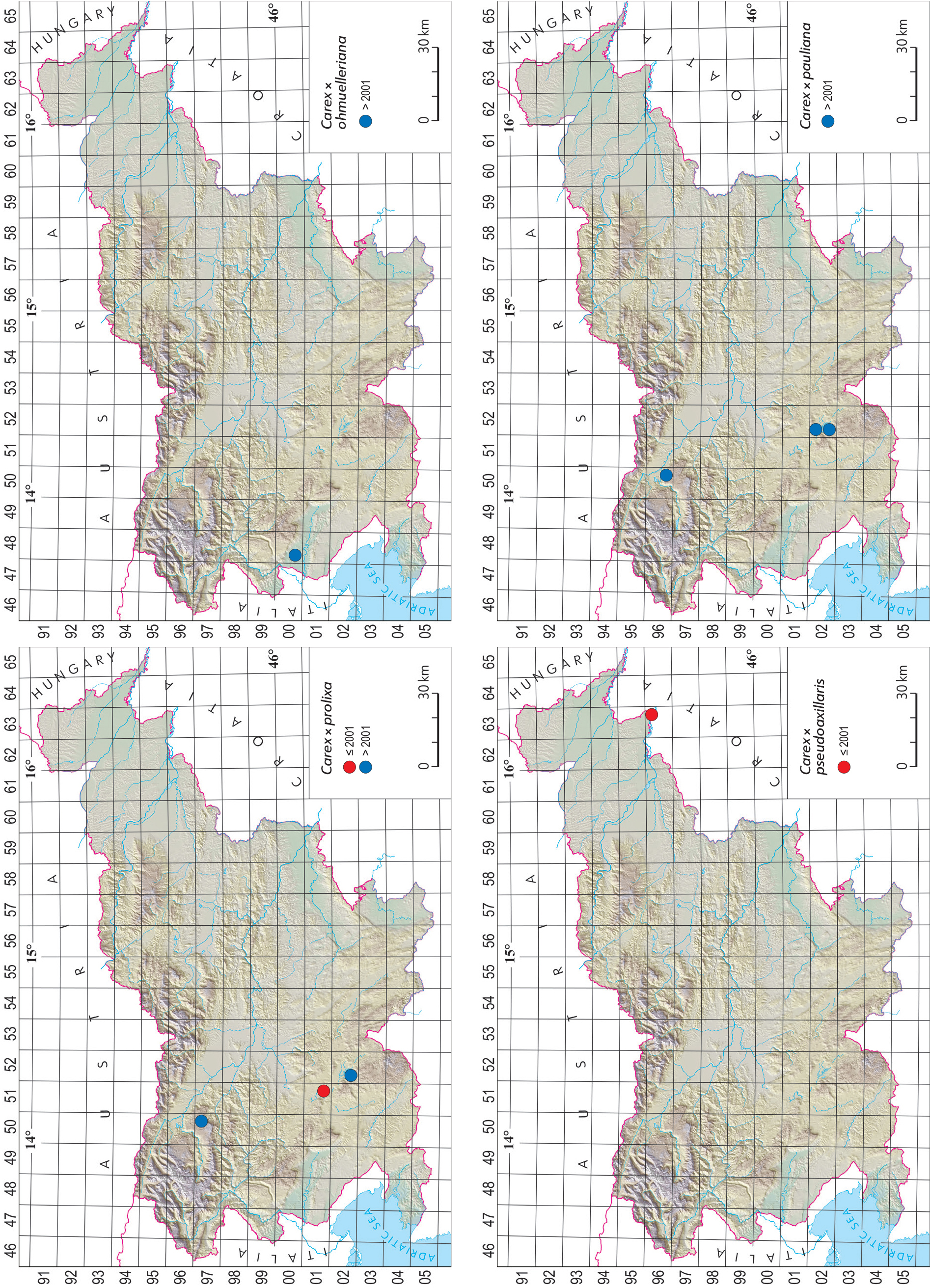
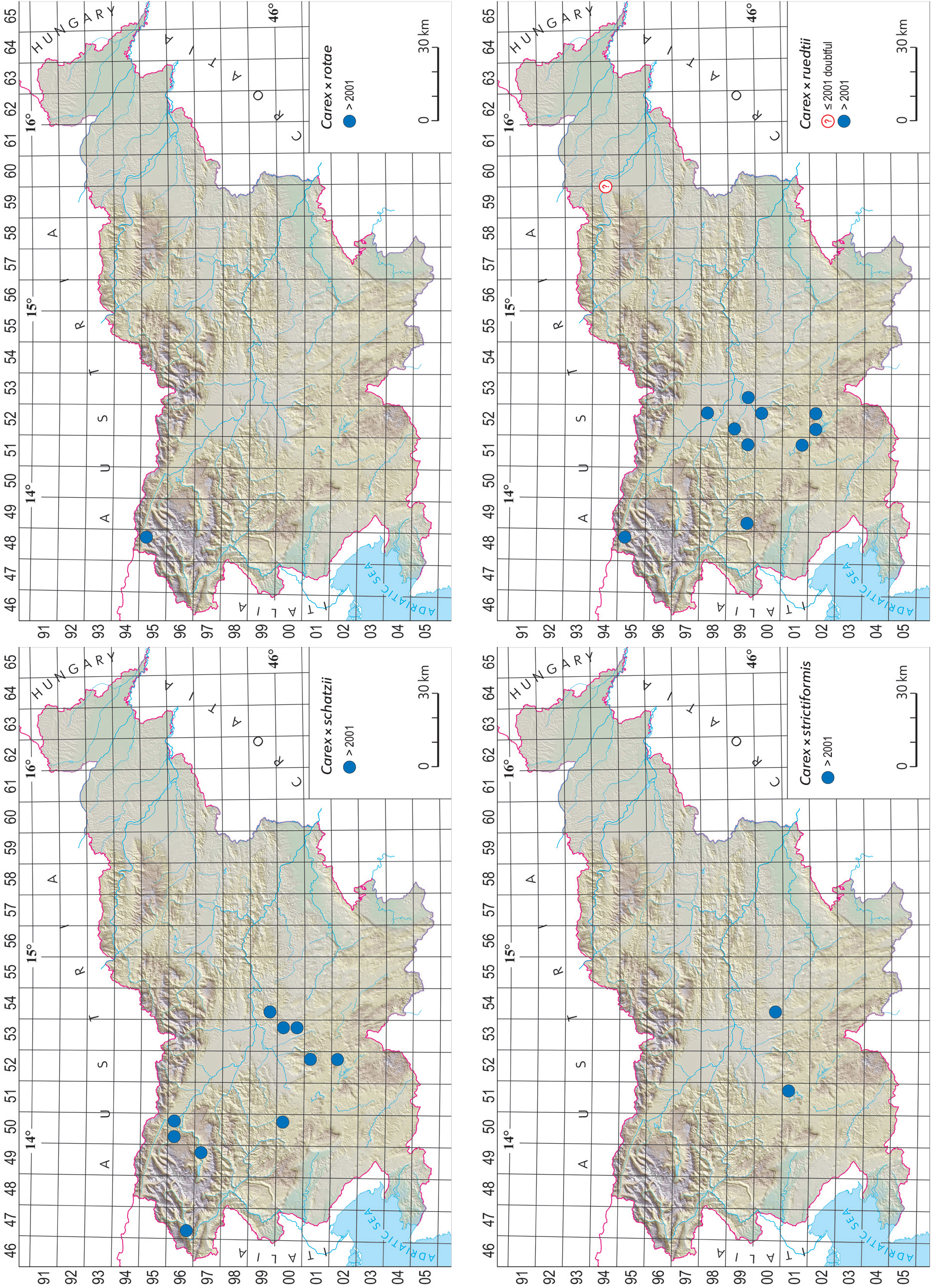
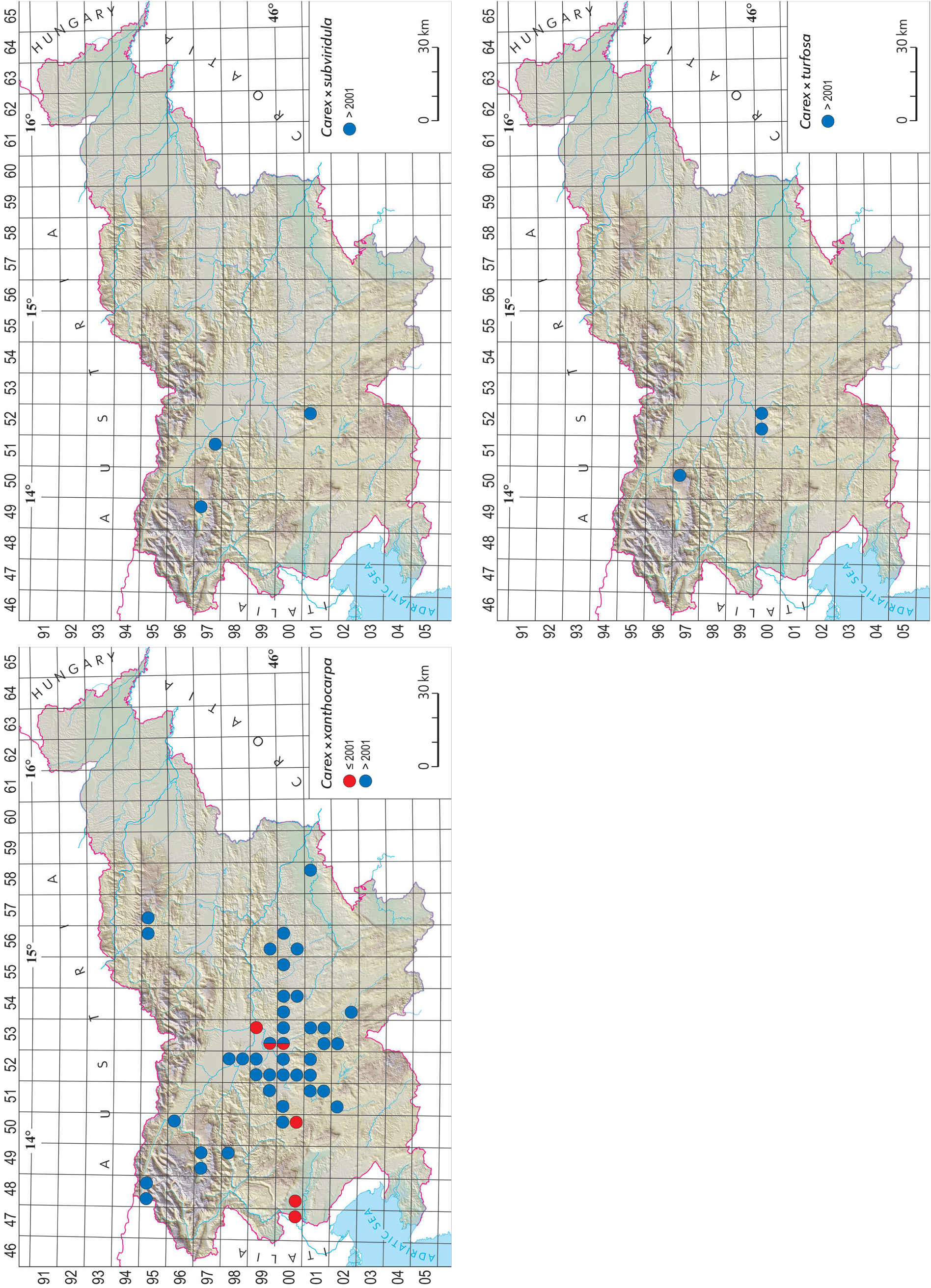
Appendix 2
Herbarium specimens examined
Rare Carex species
1. Carex aterrima (subsp. aterrima)
9648/4 Kranjsko-Gorenjska, valley of the Triglav Lakes, mountain meadows. Leg. & det. R. Justin, 19.07.1929 as C. atrata, rev. J.M. Kocjan to C. aterrima, February 2023 (LJU); 9654/1 Štajerska region, Kamnik-Savinja Alps, along the way under Črni vrh and Tolsti vrh, Pinus mugo stand, rocks, 1865 m a.s.l. Leg. & det. B. Vreš & T. Čelik, 30.07.2008 (LJS).
2. Carex austroalpina
9748/1 Primorska region, Julian Alps, Krn Mts., the S slope of Lemež, 1730 m a.s.l. Leg. B. Surina, 26.06.2002 (LJS); 0049/1 Primorska region, Trnovski gozd plateau, in Smrekova draga, 1150 m a.s.l. Leg. T. Wraber, 27.08.1980 (LJU).
3. Carex bicolor
9648/2 Gorenjska region, Julian Alps, the valley ofTriglav lakes, 100 m SZ from the Lake Jezero pod Vršacem, SE from Lake Mlaka v Laštah, 2010 m a.s.l. Leg. & det. Š. Novak, 06.08.2010 (LJU).
4. Carex brunnescens (subsp. brunnescens)
9648/4 Gorenjska region, Julian Alps, Komna plateau, Planina na Kalu, marsh, 1600 m a.s.l. Leg. & det. B. Anderle, 03.08.1991 (LJS); 9648/4 Gorenjska region, Julian Alps, Komna plateau, Planina na Kalu, marsh, 1600 m a.s.l. Leg. & det. J.M. Kocjan, H. Więcław & Jac. Koopman, 27.07.2020 (Herb. Jac. Koopman); 9648/4 Gorenjska region, Julian Alps, Komna plateau, Planina na Kalu, marsh, 1600 m a.s.l. Leg. & det. I. Dakskobler, 26.07.2021 (LJS).
5. Carex buekii
9363/1 Slovenia, Prekmurje region, the surroundings of Murska Sobota, along the path from Murska Sobota towards Markišavci, 190 m a.s.l. Leg. & det. Š. Špilak, 06.04.1974 as C. elata, rev. B. Wallnöfer, August 1994 to C. buekii (LJU); 9464/1 Prekmurje, Hotiza, Krčje, marsh in a forest. Leg. B. Trčak, 10.04.2016, det. J.M. Kocjan, 30.10.2025 (LJU); 9852/4 Šmartno near Ljubljana, marsh. Leg. & det. A. Martinčič, 12.05.1956 as C. gracilis (=C. acuta), rev. B. Wallnöfer, August 1994 to C. buekii (LJU); 9852/4 Gorenjska region, the surroudings of Šmartno under Šmarna gora, W from the main road towards Povodje, W from the fishing pond, wet meadow, 315 m a.s.l. Leg. & det. J.M. Kocjan, 04.05.2015 (LJS).
6. Carex buxbaumii
9548/1 Gorenjska region, the surroundings of Kranjska gora, W from the village Podkoren, Nature Reserve Zelenci, marsh, 830 m a.s.l. Leg. & det. J.M. Kocjan, B. Anderle & V. Leban, 05.06.2016 (LJS); 9548/1 Gorenjska region, the surroundings of Kranjska gora, W from the village Podkoren, Nature Reserve Zelenci, marsh, 830 m a.s.l. Leg. & det. J.M. Kocjan, B. Vreš, H. Więcław & Jac. Koopman, 31.05.2022 (Herb. Jac. Koopman); 9952/2 Ljubljana, Podutik, S from the settlement, wet meadow, 300 m a.s.l. Leg. & det. J.M. Kocjan, 14.05.2014, 17.05.2015, (LJS); 9952/2 Ljubljana, Podutik, S from the settlement, wet meadow, 300 m a.s.l. Leg. & det. J.M. Kocjan, H. Więcław & Jac. Koopman, 25.05.2022 (Herb. Jac. Koopman); 0252/1 Wet meadow near Cerknica lake. Leg. & det. A. Paulin, June 1911 (LJU); 0252/1 Notranjska region, the surroundings of Cerknica, Cerknica plain, SW from the village Dolenje jezero, wet meadow, 550 m a.s.l. Leg. & det. J.M. Kocjan, 31.05.2015 (LJS); 0252/1 Notranjska region, the surroundings of Cerknica, Cerknica plain, SW from the village Dolenje jezero, wet meadow, 550 m a.s.l. Leg. & det. J.M. Kocjan & D. Kosič, 24.05.2020 (Herb. Jac. Koopman).
7. Carex cespitosa (var. cespitosa)
0054/3 Dolenjska region, the surroundings of Grosuplje, Radensko polje plain, N from the village Velika Račna, wet meadow, 328 m a.s.l. Leg. & det. J.M. Kocjan, H. Więcław & Jac. Koopman, 02.06.2022 (Herb. Jac. Koopman); 0151/2 Notranjska region, Planina plain, SE from the village Laze, wet meadow, 450 m a.s.l. Leg. & det. J.M. Kocjan, D. Kosič & J. Figelj, 03.05.2020 (Herb. Jac. Koopman); 0151/2 Notranjska region, Planina plain, SE from the village Laze, wet meadow, 450 m a.s.l. Leg. & det. J.M. Kocjan, H. Więcław & Jac. Koopman, 27.05.2022 (Herb. Jac. Koopman); 0151/4 Notranjska region, Planina plain, between Dolnja Planina and St. Križ, wet meadow, 450 m a.s.l. Leg. & det. J.M. Kocjan, 17.05.2015 (LJS).
8. Carex curvula (subsp. curvula)
9547/4 Julian Alps, Mangart, Jarečica, in graminosis alpinis, Caricetum curvulae, 2120 m a.s.l. Leg. & det. A. Podobnik & T Wraber 07.08.1983 (LJU); 9548/4 Julian Alps, Vrh Križa, E from the upper edge of Križka stena, snow valley (Potentilla dubia-Homogyne discolor), limestone, 2300 m a.s.l. Leg. & det. T Wraber, 08.09.1966 (LJU); 9548/4 Gorenjska region, Julian Alps, Vrh Križa, Wrabers hill, towards Na Rušju, snow valley, limestone, 2350 m a.s.l. Leg. & det. I. Dakskobler, 08.07.2022 (LJS).
9. Carex demissa (subsp. demissa)
9557/3 Koroška region, the surroundings of Mislinja, N from the village Gornji Dolič, fen in a quarry, 550 m a.s.l. Leg. & det. J.M. Kocjan, 26.05.2012 (LJS); 9558/1 Štajerska region, Pohorje plateau, W from Falski ribnik, transitional bog, 1260 m a.s.l. Leg. & det. J.M. Kocjan, 04.07.2006 (LJS); 9558/2 Štajerska: Pohorje: Osankarica – sphagnetum, solo silicat., ca 1200 m s.m. Leg. A. Martinčič, 02.09.1966, det. J.M. Kocjan, 30.10.2025 (LJU); 9558/2 Štajerska region, Pohorje plateau, SE from Stegnetova bajta, transitional bog, 1110 m a.s.l. Leg. & det. J.M. Kocjan, 03.07.2006 (LJS); 9558/4 Štajerska region, Pohorje plateau, W from Adamov vrh, SW from Črno jezero lake, transitional bog, 1210 m a.s.l. Leg. & det. J.M. Kocjan, 01.07.2006 (LJS); 9558/4 Štajerska region, Pohorje plateau, E from Adamov vrh, between Osankarica and SV. Trije Kralji, fen, 1240 m a.s.l. Leg. & det. J.M. Kocjan, 04.07.2006 (LJS); 9558/4 Štajerska region, Pohorje plateau, SW from Črno jezero lake, transitional bog, 1210 m a.s.l. Leg. & det. J.M. Kocjan, 01.07.2006 (LJS); 9659/3 Štajerska region, Jernej pri Ločah, Štatenberšek, on wet places, 280 m a.s.l. Leg. A. Seliškar, D. Trpin & B. Vreš, 08.07.1992 as C. hostiana, rev. J.M. Kocjan to C. demissa (LJS); 9750/2 Gorenjska region, Jelovica: Plašni vrh, in locis paludosis, solo calcareo, ca 1000 m s.m. Leg. A. Martinčič, 24.07.1996 as C. flava, rev. J.M. Kocjan to C. demissa (LJU); 9750/2 Gorenjska region, Jelovica plateau, Lipniška planina pasture, transitional bog, 1300 m a.s.l. Leg. & det. J.M. Kocjan, 17.06.2007 (LJS); 9751/4 Gorenjska region, the surroundings of Kranj, Zgornje Bitnje, W from Sv. Tomaž, close to a stream Žabnica, 390 m a.s.l. Leg & det. J.M. Kocjan, 04.07.2005 (LJS); 9753/3 Gorenjska region, Tunjiško gričevje hills, S from the village Komendska Dobrava, wet meadow, 340 m a.s.l. Leg. & det. J.M. Kocjan, 06.06.2012 (LJS); 9754/1 Štajerska region, Črnivec, along the main road Podlom – Šmiklavž, SE slopes of Plešivec, fen, 820 m a.s.l. Leg. & det. J.M. Kocjan, 16.10.2010 (LJS); 9851/2 between the bushes under Lubnik, in a village Vešter near Škofja Loka. Leg. & det. M. Šifrar as C. pallescens, 21.05.1989, rev. J.M. Kocjan to C. demissa, 30.10.2025 (LJU); 9852/3 Gorenjska region, Polhov Gradec mountains, the surroundings of Medvode, SW from the village Preska, wet ground, 320 m a.s.l. Leg. & det. J.M. Kocjan, 02.07.2007 (LJS); 9852/4 Ljubljana, Gorenjska region, Polhov Gradec Mountains, the surroundings of Medvode, SE from the village Završe, fragments of a transitional bog, 340 m a.s.l. Leg. & det. J.M. Kocjan, 09.06.2004 (LJS); 9852/4 Gorenjska region, Polhov Gradec mountains, the surroundings of Medvode, between the villages Seničica and Preska, near the forest edge, transitional bog, 330 m a.s.l. Leg. & det. J.M. Kocjan, 03.06.2005 (LJS); 9852/4 Gorenjska region, the surroundings of Medvode, Zgornje Pirniče, W from a small pond behind the cementery, wet ground, 330 m a.s.l. Leg. & det. J.M. Kocjan, 04.06.2005 (LJS); 9853/3 Ljubljana basin, N of Ljubljana, NE of Nadgorica village, transitional bog, 310 m a.s.l. Leg. & det. J.M. Kocjan, 31.05.2005 (LJS); 9949/3 Primorska region, Zgornja Idrijca, Vojsko, under Mrzla Rupa, downwards from Log, 810 m a.s.l. Leg. & det. I. Dakskobler, 10.06.2010 (LJS); 9951/4 Notranjska region, edge of the Ljubljana Marshes, between Drenov Grič and Horjul, between Kurja vas and Bernik, wet meadow, 290 m a.s.l. Leg. & det. J.M. Kocjan, 28.05.2011 (LJS); 9953/3 Ljubljana, Bizovik - Polje, N of Litijska cesta, W from the motorway, wet ground, 280 m a.s.l. Leg. & det. J.M. Kocjan, 07.08.2007 (LJS); 0051/2 Notranjska region, the surroundings of Vrhnika, W from Velika Ligojna, W from Fortuna, 340 m a.s.l. Leg. & det. J.M. Kocjan, 28.06.2007 (LJS); 0052/3, Notranjska region, the surroundings of Borovnica, W from Bistra, between Borovniščica river and Črni graben stream, wet meadow, 300 m a.s.l. Leg. & det. J.M. Kocjan, 28.05.2011 (LJS); 0053/3 Ljubljana basin, Ljubljana marshes, Ig, Draga, along the northern pond Rakovnik, 300 m a.s.l. Leg. & det. B. Vreš, 19.05.2017 (LJS); 0154/3 Dolenjska region, the surroundings of Velike Lašče, along the main road Ribnica – Velike Lašče, between the villages Gorenje Poljane and Finkovo, fen, 580 m a.s.l. Leg. & det. J.M. Kocjan, 23.06.2007 (LJS); 0252/3 Notranjska region, Cerknica lake, Otok, wet meadow, Caricetum elatae × Molinietum, 550 m a.s.l. Leg. & det. U. Šilc & S. Behrič, 29.06.2023, det. B. Vreš, S. Behrič & U. Šilc (LJS); 0454/4 Ljubljana, Dolenjska region, the surroundings of Kočevska Reka, N from the hut on Prežulja, W from the settlement Preža, along the gravel road, small marsh, 600 m a.s.l. Leg. & det. J.M. Kocjan, 05.09.2010 (LJS); 0456/1 Notranjska region, Kočevski rog, the surroundings of Predgrad, E from the village Brezovica pri Predgradu, along the main road, stream, 490 m a.s.l. Leg. & det. J.M. Kocjan, 12.06.2011 (LJ!); 0456/1 Notranjska region, Kočevski rog, the surroundings of Predgrad, NW from the village Knežja Lipa, along the forest road, stream, 520 m a.s.l. Leg. & det. J.M. Kocjan, 12.06.2011 (LJS); 0457/3 Dolenjska region, Bela Krajina, the surroundings of Črnomelj, E from the village Veliki Nerajec, wet meadow, 150 m a.s.l. Leg. & det. J.M. Kocjan & N. Kavšek, 20.05.2012 (LJS).
10. Carex depauperata
9556/1 Dolenjska region, Bela Krajina, S from Stari trg pri Kolpi, slope above the road, bushes, 320 m a.s.l. Leg. &’ det. J.M. Kocjan, 20.05.2012 (LJS); 9556/2 Dolenjska region, Bela Krajina, between the villages Dolenji Radenci and Breg pri Sinjem Vrhu, above the Velika stena wall, rocky steep slopes, 401 m a.s.l. Leg. & det. J.M. Kocjan, H. Więcław & Jac. Koopman, 01.06.2022 (Herb. Jac. Koopman).
11. Carex diandra
9557/3 Zgornji Dolič, in paludosis, 540 m a.s.l. Leg. T Wraber, 19.05.1975, det. J.M. Kocjan, 30.10.2025 (LJU); 0052/2 Ljubljana basin, Ljubljana Marshes, between the villages Črna vas and Brest, Nature Reserve Iški morost, marsh in a small depression, 290 m a.s.l. Leg. & det. J.M. Kocjan & B. Vreš, 21.06.2016 (LJS); 0052/2 Ljubljana basin, Ljubljana Marshes, between the villages Črna vas and Brest, Nature Reserve Iški morost, marsh in a small depression, 290 m a.s.l. Leg. & det. B. Vreš, 17.06.2021 (LJS); 0052/2 Ljubljana basin, Ljubljana Marshes, between the villages Črna vas and Brest, Nature Reserve Iški morost, marsh in a small depression, 290 m a.s.l. Leg. & det. J.M. Kocjan, H. Więcław & Jac. Koopman, 26.05.2022 (Herb. Jac. Koopman).
12. Carex dioica
0152/2 Notranjska region, Rakitna plateau, S of the lake, wet meadow, 800 m a.s.l. Leg. & det. J.M. Kocjan, R. & L. Karl, H. Więcław & Jac. Koopman, 29.05.2022 (LJS).
13. Carex disticha
9852/4 Ljubljana basin, Vojsko pri Skaručni, wet meadow. Leg. S’. Strgulc 06.05.1999, det. B. Trčak (LJU); 9953/3 Carniolia, in pratis paludosis Labacensis, 290 m a.s.l., May (?). Leg. & K. Mulley, det. A. Paulin, FEC 1405 (LJU); 0151/2 Notranjska region, Planina plain, SE from the village Laze, wet meadow, 450 m a.s.l. Leg. & det. Leg. & det. J.M. Kocjan, H. Więcław & Jac. Koopman, 27.05.2022 (Herb. Jac. Koopman); 0151/4 Notranjska region, Planina plain, between Dolnja Planina and St. Križ, wet meadow, 450 m a.s.l. Leg. & det. J.M. Kocjan, 17.05.2015 (LJS).
14. Carex divisa
0447/3 Primorska-Istrian region, near Piran, on wet ground. Leg. & det. R. Justin, 15.04.1906 (LJU); 0447/4 Istria, Strunjan. Leg. & det. T. Wraber, 07.05.1972 (LJU); 0448/1 Primorska region, Istria, Sv. Jernej Bay, coastline in the vicinity of border pass Lazaret, salt marsh with Phragmites australis, 0 m a.s.l. Leg. & det. B. Vreš, 14.05.2002 (LJS); 0448/1 Primorska region, Ankaran, sea shore between Debeli rtič and border Lazaret, 1 m a.s.l. Leg. & det. P Glasnović28.04.2003 (LJU); 0448/1 Primorska region, Istria, Debeli rtič, N from the settlement Miloki, occasionally flooded clay soil, 2 m a.s.l. Leg. & det. J.M. Kocjan, 01.05.2007 (LJS); 0547/2 Primorska region, Istria, the surroundings of Portorož, Seča, above Jernejev kanal channel, along the road, 2 m a.s.l. Leg. & det. J.M. Kocjan & D. Kosič, 19.05.2020 (Herb. Jac. Koopman); 0448/4 Primorska region, Istria, the surrounding of Koper, Škocjanski zatok Nature Reserve, sandy soil, 2 m a.s.l. Leg. & det. J.M. Kocjan, J. Otopal, J. Figelj, R. & L. Karl, H. Więcław & Jac. Koopman, 24.05.2022 (Herb. Jac. Koopman).
15. Carex extensa
0447/4 Strunjan, salt flats, 400 m from the seashore, at the edge of a pool. Leg. & det. M. Grego, 16.07.1998 (LJU); 0448/1 Ankaran, marsh area along the seashore, 500 m SE from Ankaran, 1 m a.s.l. Leg. & det. P Glasnović’, 11.06.2005 (LJU); 0448/1 Primorska, Istria, the surroundings of Koper, S of the village Ankaran, between Sv. Katarina and Sv. Nikolaj churches, salty coast marsh, 1 m a.s.l. Leg. & det. J.M. Kocjan & D. Kosič, 09.05.2020 (Herb. Jac. Koopman); 0448/2 Primorska region, Sp. Škofije, Bonifika, NW part of Bonifika, W from Polje Bay. Leg. & det. P Glasnović’, 09.07.2005 (LJU); 0448/3 Primorska region, Koper – in graminosis lapidosis, solo calcareo, 10 m a.s.l. Leg. & det. A. Martinčič, 10.06.1966 as C. flava, rev. Jac. Koopman & H. Więcław 2022 to C. extensa (LJU); 0448/4 Primorska region, Istria, the surrounding of Koper, Škocjanski zatok Nature Reserve, saline meadow along the coast, 1 m a.s.l. Leg. & det. J.M. Kocjan, J. Otopal, J. Figelj, R. & L. Karl, H. Więcław & Jac. Koopman, 24.05.2022 (Herb. Jac. Koopman).
16. Carex flacca subsp. erythrostachys
0449/3 Primorska region, Istria, Karst edge, in the vicinity of Črni Kal, E of Bezovnica, Plasa, dry karst meadow, 460 m a.s.l. Leg. & det. J.M. Kocjan, J. Otopal, J. Figelj, R. & L. Karl, H. Więcław & Jac. Koopman, 24.05.2022 (Herb. Jac. Koopman); 0449/4 Primorska region, Istria, the surroundings of Črni Kal, between the villages Podpeč and Brezec, dry kart meadow, 460 m a.s.l. Leg. & det. J.M. Kocjan & D. Kosič, 09.05.2020 (Herb. Jac. Koopman); 0548/1 Primorska region, Istria, hills above Koper, Straža, SW from the village Babiči, stoney meadow, 350 m a.s.l. Leg. & det. J.M. Kocjan & A. Paušič, 29.04.2016 (LJS).
17. Carex frigida
9547/4 Julian Alps: Mangart, in a wet gravel (near the well) under Rdeča skala, limestone, 1900 m a.s.l. Leg. & det. M. & T Wraber, B. & S. Pawlowski, 23.08.1966 (LJU); 9547/4 Julian Alps: Mangart, in scaturiginosis montis Rdeča skala, solo calc., 1900 m s.m. Leg & det. B. Druškovič, A. Martinčič & T Wraber, 04.09.1970 (LJU); 9547/4 Primorska region, Julian Alps, Mount Mangart saddle, wet depression in alpine meadow, 1855 m a.s.l. Leg. & det. Jac. Koopman & J. Figelj, 29.07.2020 (Herb. Jac. Koopman); 9649/1 Julian Alps: Malo polje, solo calc., 1650 s.m. Leg. & det. T. Wraber, 29.07.1967 (LJU); 9748/1 Julian Alps: In scaturiginosis lateris occidental-meridionalis montis Veliki Lemež supra lacum Krnsko jezero, solo calc., 1800 m s.m. Leg. & det. T Wraber, 08.07.1986 (LJU); 9748/2 Julian Alps: In rupestribus calcareis udis graminosis prope originem cataractae Savica dictae, 900 m s.m. Leg. & det. T. Wraber, 04.07.1979 (LJU).
18. Carex fritschii
9448/4 In confinibus Carinthiae et Carnioliae in Alpibus Karavanken. In locisfruticosis sub Podkorensko sedlo, solo schistose, e. 900 m s. m., IV. Leg. & det. A. Paulin (LJU); 9460/3 Štajerska region, Maribor, the middle part of Stražun wood, close to a garbage dump, acidis forest, 250 m a.s.l. Leg. & det. J.M. Kocjan, A. Tomažič & N. Erbida, 24.04.2016 (LJS); 9948/3 Primorska region, Banjšice plateau, the surroundings of village Kuščarji, soth slopes of Mount Kuk, dry meadow, 760 m a.s.l. Leg. & det. J.M. Kocjan, 01.05.2012 (LJS); 0150/4 Notranjska region, the surroundings of Postojna, E from the village Belsko, semi dry meadow on slope, 540 m a.s.l. Leg. & det. J.M. Kocjan, D. Kosič & J. Figelj, 03.05.2020 (Herb. Jac. Koopman); 0150/4 Notranjska region, the surroundings of Postojna, E from the village Belsko, semi dry meadow on slope, 540 m a.s.l. Leg. & det. J.M. Kocjan, J. Otopal, J. Figelj, R. & L. Karl, H. Więcław & Jac. Koopm an, 24.05.2022 (Herb. Jac. Koopman); 0249/4 Carso, fra Repen e Kreplje, bosco di Quercus cerris, in dolina su suolo suolo colluviale decalcificato, 300 m. Leg. & det. L. Poldini, 10.06.1973 (LJU).
19. Carex fuliginosa
9547/4 Primorska-goriško, on alpine meadows on Mangart. Leg. & det. R. Justin, 1900 (LJU); 9547/4 Carniolia. In locis lapidosis graminosis montis Mangart in Alpibus Julicis, s. schistaceo, 2300 m s.m. Leg. & det. A. Paulin (LJU); 9547/4 In pratis alpinis jugi Mangartsko sedlo, solo calc., 2100 m s.m. Leg. & det. B. A. Martinčič, 07.08.1955 (LJU); 9547/4 Julian Alps: In lapidosis jugi Mangartsko sedlo dicti, solo calc., 2100 m s.m. Leg. & det. B. Druškovič, A. Martinčič & T Wraber, 01.09.1970 (LJU); 9547/4 Julian Alps, Mangart: Jarečica, in gramonosis lapidosis, Elynetum, 2230 m s.m. Leg. & det. A. Podobnik & T Wraber, 07.08.1983 (LJU); 9547/4 Julian Alps, Mangart, in rupestribus calcareis, 2300 m s.m. Leg. & det. A. Podobnik & T. Wraber, 08.08.1983 (LJU); 9547/4 In pratis alpinis jugi Mangartsko sedlo, solo calc., 2100 m s.m. Leg. & det. B. A. Martinčič, 07.08.1955 (LJU); 9547/4 Primorska region, Julian Alps, under Mali Rateški Mangart, on the border between SI and AT, on the edge of rock face, 2260 m a.s.l. Leg. & det. I. Dakskobler, 29.07.2020 (Herb. Jac. Koopman); 9548/3 Julian Alps: In rupestribus montis Jalovec, s. calc., 2565 m. Leg. & det. T Wraber, 17.09.1965 (LJU); 9548/3 Alpes Julicae: on the way from Loški žleb between Veliki Ozebnik and Jalovec, limestone, 2400 m. Leg. & det. T. Wraber, 17.09.1965 (LJU); 9548/3 Alpes Julicae: on the way from Loški žleb medtween Veliki Ozebnik and Jalovec, limestone, 2400 m. Leg. & det. T Wraber, 17.09.1965 (LJU); 9548/4 Julian Alps: Stenar, on rocks, Potentilletum nitidae, limestone, 2420 m. Leg. & det. T. Wraber, 27.07.1966 (LJU); 9548/4 Julian Alps: Razorska Planja, Caricetum firmae, 2400 m. Leg. & det. T Wraber, 29.07.1966 (LJ!); 9548/4 Julian Alps, Dolkova špica, in rocks, Potentilletum nitidae, limestone, 2530 m. Leg. & det. T. Wraber, 07.09.1966 (LJU); 9548/4 Julian Alps, Gubno near Križ above Kriški podi, Potentilletum nitidae, limestone, 2290 m. Leg. & det. T. Wraber, 07.09.1966 (LJU); 9548/4 Julian Alps: Šrklatica, on rocks, limestone, 2615 m. Leg. & det. T. Wraber, 07.09.1966 (LJU); 9548/4 Julian Alps: Kriški rob above Zgornje Kriško jezero, on rocks, limesntone, 2350 m. Leg. & det. T. Wraber, 08.09.1966 (LJU); 9548/4 Julian Alps: on rocks on top of Kriška stena towards Gubno, limestone, 2350 m. Leg. & det. T. Wraber, 01.08.1967 (LJU); 9549/3 Julian Alps: In rupestribus jugi Grlo inter montes Oltar et Dovški Križ, 2430 m s.m. Leg. & det. T Wraber, 15.09.1967 (LJU); 9646/2 Prestreljnik, a meadow, 2300 m s.m. Leg. & det. A. Martinčič, 22.08.1956 (LJU); 9648/2 Julian Alps: Triglav, za Planjo, on the exit from Bamberger trail, Caricetum firmae, limestone, 2350 m. Leg. & det. T. Wraber, 09.09.1966 (LJU); 9648/2 Julian Alps, Bovški Gamsovec, in rocks just under the mountain top, Potentilletum nitidae, limestone, 2360-2385 m. Leg. & det. T. Wraber, 09.09.1966 (LJU); 9653/1 Kamniške Alpe: In gramonosis lapidosis lateralis septentrionalis montis Štruca prope montem Skuta, Caricetum firmae, 2440 m s.m. Leg. & det. T. Wraber, 11.08.1971 (LJU).
20. Carex halleriana
0047/2 Primorska region, Posočje, Sveta gora, by the lower branch of the road for Sveta gora, opposite the restaurant, along the road, rocks, 323 m a.s.l. Leg. & det. J.M. Kocjan, 01.05.2012 (LJS); 0048/1 Primorska region, Vipava valley, the surroundings of Nova Gorica, between the castle Kromberg and the settlement Breg, stony grassland, 158 m a.s.l. Leg. & det. J.M. Kocjan, 01.05.2012 (LJS); 0147/4 Primorska region, Tržaško komenski kras, Brestovica pri Komnu, slope Reber between the villages Dolenja Brestovica and Sela na Krasu, lope with bushes, 120 m a.s.l. Leg. & det. D. Trpin, B. Vreš & I. Dakskobler, 18.05.1995 (LJS); 0147/4 Primorska region, the surroundings of Brestovica pri Komnu, N from the village, along the asphalt road towards the village Sela na Krasu, stony grassland, 168 m a.s.l. Leg. & det. J.M. Kocjan, 01.05.2011 (LJS); 0148/3 Primorska region, Kras (Karst), the surroundings of Brezovica, S from the village Vale, along the gravel road, stony grassland, 111 m a.s.l. Leg. & det. J.M. Kocjan, 02.04.2011 (LJS); 0149/2 Primorska region, Vipavska dolina valley, the surroundings of Vipava, above the village Žgavska vas, thermophilous Quercus pubescens forest on limestone, 290 m a.s.l. Leg. & det. J.M. Kocjan & D. Kosič, 03.05.2020 (Herb. Jac. Koopman); 0249/2 Nanos, Rebrnice supra vicum Podnanos, in fruticosis apricis (Seslerio-Ostryetum). Solo calcareo. 250 m s.m. Leg. & det. T Wraber, 06.04.1973 (LJU); 0250/3 Primorska region, Kras (Karst), the surroundings of Senožeče, NW from Dolenja vas, along the asphalt road, sunny slope, 508 m a.s.l. Leg. & det. J.M. Kocjan, 27.04.2012; 0349/3 Primorska-Istria region, on the hill above the village Nasirec between Bazovica and Kozina. Leg. & det. R. Justin, 02.04.1905 (LJU); 0349/3 Primorska region, Mihele, slope above Glinščica river, 500 m E from the settlement Botač, forest, limestone, 210 m a.s.l. Leg. & det. I. Dakskobler, D. Trpin & B. Vreš, 26.04.1995 (LJS); 0350/1 Kranjsko-Notranjska region, on dry ground near the castle Školj in the vicinity of Vrem. Leg. & det. R. Justin, 1898 (LJU); 0350/3 Primorska region, Brkini, between the villages Škoflje and Podgrad pri Vremah, by the upper branch of the road, stony grassland, 480 m a.s.l. Leg. & det. J.M. Kocjan, 29.04.2012 (LJS); 0447/4 Istra: In fruticosis promontorii Ronek inter Izola et Strunjan. Solo flyscheo. 60 m s.m. Leg & det. T Wraber, 25.03.1972 (LJU); 0448/1 Istra: In fruticosis (Quercus petraea) supra vicum Ankaran. Solo flyscheo. 100 m s.m. Leg. & det. T. Wraber, 07.04.1973 (LJU); 0448/1 Ankaran, Jurjev hrib hill, area N of the road, 109 m a.s.l. Leg. & det. P. Glasnovic’, 19.04.2005 (LJU); 0448/1 Ankaran, NW part above the settlement Ankaran, 20 m a.s.l. Leg. & det. P. Glasnovic, 28.04.2025 (LJU); 0448/2 Primorska region, Sp. Škofije, Kolombar, Goli hrib, area between the settlement Kolombar and Goli vrh, 200 m a.s.l. Leg. & det. P Glasnović17.04.2004 (LJU); 0448/2 Sp. Škofije, Tinjan, dry meadows 700 m SW of Tinjan, S and N from the road, 320 m a.s.l. Leg. & det. P Glasnović22.05.2005 (LJU); 0448/3 Šmarje supra oppidum Koper, solo flyscheo. 300 m s.m. Leg. & det. A. Martinčič, 27.04.1969 (LJU); 0448/3 Primorska region, Istria, the surroundings of the village Šares, between the settlement Kranci and St. Jacob, along the asphalt road, stony grassland, 218 m a.s.l. Leg. & set. J.M. Kocjan, 31.03.2012 (LJS); 0449/1 In fruticosis lapidosis supra vicum Osp. Solo calc. schist. (Flysch), 100 m s.m. Leg. & det. T. Wraber, 17.05.1969 (LJU); 0449/1 Primorska region, Istria, the surroundings of Osp, above the settlement Katmara, stony grassland, 55 m a.s.l. Leg. & det. J.M. Kocjan, 31.03.2012 (LJS); 0449/3 Primorska region, Istria, Hrastovlje, E from the curch, stony grassland, 160 m a.s.l. Leg. & det. J.M. Kocjan, 18.03.2012 (LJS); 0449/3 Primorska region, Istria, Kraški rob (Karst edge), NW from the village Predloka, along the gravel road, Pinus nigra forest, 106 m a.s.l. Leg. & det. J.M. Kocjan, 24.03.2012 (LJS); 0449/3 Primorska area, Istria, the surroundings of Črni Kal, SW from the village Loka, S from the railway line, dry meadow, 80 m a.s.l. Leg. & det. J.M. Kocjan, 06.04.2014 (LJS); 0449/3 Primorska region, Istria, Kraški rob (Karst edge), S from the village Podpeč, above the railwayline, stony grassland, 300 m a.s.l. Leg. & det. J.M. Kocjan, 26.04.2015 (LJS); 0450/1 Primorska region, Brkini, the surroundings of Kozina, SW from Britof near the village Brezovica, opposite the chapel, stony grassland, 546 m a.s.l. Leg. & det. J.M. Kocjan, 29.04.2012 (LJS); 0450/4 Primorska region, Čičarija, the surroundings of the village Podgrad, NW from the village Poljane pri Podgradu, stony grassland, 585 m a.s.l. Leg. & det. J.M. Kocjan, 02.05.2012 (LJS); 0547/2 In pratis siccis vallis fluvii Dragonja, in ditione vici Sečovlje. Solo dolomitico, 100 m s.m. Leg. & det. A. Martinčič, 27.04.1969 (LJU); 0547/2 Istra: In fruticosis collis Stena prope vicum Dragonja. 25 m s.m. Leg. & det. T Wraber, 21.04.1974 (LJU); 0548/1 Primorska region, Istria, the surroundings of Koštabona, SW slope ob Novi Brič, stony grassland, 219 m a.s.l. Leg. & det. J.M. Kocjan, 24.04.2011 (LJS); 0548/1 Primorska region, Istria, the surrounding of the village Padna, SE from the settlement Medljan, dry stony grassland, 68 m a.s.l. Leg. & det. J.M. Kocjan, 31.03.2012 (LJS); 0548/2 Primorska region, Istria, the surroundings of Pomjan pri Šmarju, between the villages Župančiči and Fjeroga, S from Fjeroga, dry meadow, limestone, 247 m a.s.l. Leg. & det. J.M. Kocjan, 24.04.2011 (LJS); 0551/2 Primorska region, the surroundings of Ilirska Bistrica, W from Sušnjak near the village Novokračine, stony grassland, 546 m a.s.l. Leg. & det. J.M. Kocjan, 02.05.2012 (LJS).
21. Carex hartmaniorum
0050/2 Notranjska region, the surroundings of Logatec, between villages of Hotedrsica and Medvedje Brdo, Žejna Dolina valley, wet meadow, 550 m a.s.l. Leg & det. J.M. Kocjan, D. Kosič & P. Glasnović, 06.06.2020 (Herb. Jac. Koopman); 0151/2 Notranjska region, Planina plain, Luže, wet meadow, 447 m a.s.l. Leg. & det. F. Küzmič, B. Vreš, U. Šilc, S. Behrič, B. Blažič, A. Šabić & A. Kozina, 07.06.2022 (LJS); 0151/4 Notranjska region, Planina plain, between the villages Dolnja Planina and St. Križ, wet meadow, 450 m a.s.l. Leg. & det. J.M. Kocjan, 17.05.2015 (LJS); 0151/4 Notranjska region, Planina plain, Liplje, Trzne, wet meadow, 447 m a.s.l. Leg. & det. U. Šilc, S. Behrič, A. Šabić’, 07.06.2022 (LJS); 0151/4 Notranjska region, Planina plain, mowed meadow, 447 m a.s.l. Leg. & det. B. Vreš & T. Čelik, 18.07.2022 (LJS); 0251/1 Carniolia, prope oppidulum Postojna, in pratis paludosis. Leg. & det. A. Gspan, May (without a date!) as C. buxbaumii, rev. J.M. Kocjan, March 2023 to C. hartmaniorum (LJU); 0250/2 Notranjska region, the surroundings of Postojna, between the villages Hrašče and Zagon, E of Pugled, wet meadow, 540 m a.s.l. Leg. & det. J.M. Kocjan, B. Vreš, R. & L. Karl, H. Więcław & Jac. Koopman, 27.05.2022 (Herb. Jac. Koopman); 0252/1 Notranjska region, the surroundings of Cerknica, Cerknica plain, SZ from village Martinjak, wet meadow, 550 m a.s.l. Leg. & det. J.M. Kocjan, 04.06.2017 (LJS).
22. Carex kitaibeliana (var. kitaibeliana)
0452/2 Kranjsko-notranjska flora, Snežnik, mountain meadows. Leg. & det. R. Justin, July 1902 as C. sempervirens, rev. J.M. Kocjan to C. kitaibeliana (LJU); 0452/2 Carniolia. In rupestribus graminosis apricis montis Kranjski Snežnik, solo calcareo, 1600-1750 m s.m. Leg. & det. A. Paulin, VII as C. laevis Kit. (LJU); 0452/2 Schneberg. Leg. & det. A. Paulin as C. sempervirens Vill. ssp. laevis Aschers. (LJU); 0452/2 Notranjska: Snežnik – in graminosis lapidosis, solo calcareo, ca 1650 m s.m. Leg. E. Mayer, VI.1948, det. K. Ronniger (LJU); 0452/2 Notranjska: Snežnik – in graminosis lapidosis, solo calcareo, ca 1500 m s.m., Leg. & det. V Ravnik, 26.07.1955 as C. laevis Kit. (LJU); 0452/2 In pratis lapidosis montis Snežnik suprva oppidulum Ilirska Bistrica – solo calcareo – ca 1700 m s.m. Leg. & det. A. Martinčič, 02.08.1955 as C. laevis Kit. (LJU); 0455/2 Snežnik. Leg. J. Rataj, 02.08.1955, det. J.M. Kocjan, 30.10.2025 (LJU); 0452/2 Notranjska: Kranjski Snežnik–in graminosis lapidosis, solo calcareo, ca 1750 m s.m. Leg. V Ravnik, 18.07.1956, det. E. Mayer as C. laevis Kit. (LJU); 0452/4 Notranjski Snežnik, in a sinkhole under Veliki Snežnik, 1775 m a.s.l. Leg. T. Wraber, 09.08.1965, det. J.M. Kocjan, 30.10.2025 (LJU); 0452/2 Notranjski Snežnik: Mali Snežnik, in lapidosis. 1680 m s.m. Leg. & det. T Wraber, 11.08.1965 as C. laevis Kit. (LJU); 0452/2 Notranjska region, Notranjski Snežnik, between mountain top and village Sviščaki, above sinkhole Pod Grčovcem, clearing on a sloap, 1513 m a.s.l. Leg & det. J.M. Kocjan, D. Kosič, B. Surina, H. Więcław & Jac. Koopman, 22.07.2020 (Herb. Jac. Koopman).
23. Carex lasiocarpa (var. lasiocarpa)
9548/2 Gorenjska region, the surroundings of Kranjska gora, W from the village Podkoren, Nature Reserve Zelenci, Drni, bog, 830 m a.s.l. Leg. & det. J.M. Kocjan, H. Więcław & Jac. Koopman, 31.05.2022 (Herb. Jac. Koopman); 9750/2 Gorenjska region, Julian Alps, Jelovica plateau, Ledine bog, bog, 1127 m a.s.l. Leg. & det. Jac. Koopman, H. Więcław, J.M. Kocjan & D. Kosič, 25.07.2020 (Herb. Jac. Koopman); 9953/3 Ljubljana basin, Ljubljana Marshes, the surroundings of Lavrica, NE from Hauptmance, E of Stream Izar, depression in wet Molinietalia meadow, 293 m a s.l. Leg. & det. J.M. Kocjan, R. & L. Karl, H. Więcław & Jac. Koopman, 26.05.2022 (Herb. Jac. Koopman); 0052/1 Carniolia. Olin ad margines nuncensic. Cali sfagni Primoževčevojezero dicti prope pagum Bovke in turfosis agri labacensis, 300 m s.m. VI. Leg. & det. C. Deschmann, 1868 (LJU); 0053/1 Forest ditch W from the road towards Matena. Leg. G. Tomažič, det. I. Leskovar (LJU); 0053/1 Ljubljana basin, Ljubljana Marshes, N from the road between Škofljica and Ig, Mostišče (Lazi), mire, 285 m a.s.l. Leg. & det. B. Vreš & T Čelik, 11.07.2011 (LJS); 0053/1 Ljubljana basin, Ljubljana Marshes, N from the road between Škofljica and Ig, Mostišče (Lazi), wet meadow (Molinietum caeruleae s.lat.), 292 m a.s.l. Leg. & det. B. Vreš, 21.06.2019 (LJS); 0252/1 Notranjska region, Cerknica plain, Osredki, wet meadow, 549 m a.s.l. Leg. & det. F. Küzmič, M. Grašič, U. Šilc & A. Šabić13.06.2022 (LJS); 0252/3 Notranjska region, the surroundings of Cerknica, Cerknica plain, SW of the village Otok, wet meadow, 550 m a.s.l. Leg. & det. J.M.Kocjan & D. Kosič, 24.05.2020 (Herb. Jac. Koopman); 0254/4 Dolenjska, the surroundings of Ribnica, between Dolenja vas and Jasnica, wet meadow. Leg. T. Bačič, 05.07.1998, det. B. Trčak (LJU).
24. Carex leersii
9459/1 E part of Kozjak, Šober, forest along the wet meadow, 320 m a.s.l. Leg. & det. Lj. Godicl, 25.05.1972 as Carex pairaei, rev. B. Trčak to C. leersii, 2002 (LJU); 0448/4 Primorska region, Istria, the surrounding of Koper, Škocjanski zatok Nature Reserve, ruderal roadside in small dry ditch along path, 2 m a.s.l. Leg. & det. J.M. Kocjan, J. Otopal, J. Figelj, R. & L. Karl, H. Więcław & Jac. Koopman, 24.05.2022 (Herb. Jac. Koopman); 0449/1 Primorska region, Istria, the surroundings of Črni Kal, E side of a village Gabrovica pri Črnem Kalu, along the roadside, 120 m a.s.l. Leg. & det. J.M. Kocjan & D. Kosič, 01.05.2019 (LJS); 0455/3 In declivibus graminosis humidis prope pagum Kostel supra fluvium Kolpa, 450 m a.s.l. Leg. A. Martinčič, 08.07.1958, det. B. Trčak, 2002 (LJU).
25. Carex limosa
9649/4 Gorenjska region, Pokljuka plateau, Malo Blejsko barje, wet meadow, 1200 m. Leg. & det. A. Martinčič, 09.08.1956 (LJU); 9649/4 Gorenjska region, Pokljuka plateau, bog Sivec (Šijec), 1190 m. Leg. & det. M. Wraber, 05.08.1971 (LJU); 9649/4 Gorenjska region, Pokljuka plateau, Šijec bog, raised bog, 1200 m. Leg. & det. L. Božič & B. Frajmar, 18.06.1999 (LJU); 9950/2 In turfosis inter oppidulum Žiri et vicum Ledinica, secus rivulum Rakulka, 480 m. Leg. & det. T. Wraber, 15.05.1993 (LJU); 9952/2 Notranjska region, the surroundings of Ljubljana, in a bog towards Koseze. Leg. & det. F Dolšak, Maj, June, 1921 (LJU); 9952/2 Notranjska region, the surroundings of Ljubljana, Rožnik, bog. Leg. & det. A. Paulin, June (?) (LJU); 9952/2 Notranjska region, the surroundings of Ljubljana, behind Rožnik along Večna pot. Leg. & det. G. Tomažič, 19.06.1937 (LJU); 9952/2 Notranjska region, the surroundings of Ljubljana, along Večna pot behind Rožnik. Leg. & det. T Wraber, 16.06.1965 (LJU); 9952/2 Notranjska, Ljubljana, in turfosis ad radices collis Rožnik. Leg. & det. D. Trpin & T Wraber, 30.05.1973 (LJU).
26. Carex liparocarpos (subsp. liparocarpos)
9757/4 Hügel near Celje. Leg. & det. J. Zechenter, < 1838, (GJU); 9852/4 Slovenia, Ljubljana region, the surroundings of Šmartno pod Šmarno goro, close to a motorway, dry meadow, 300 m a.s.l. Leg. & det. J.M. Kocjan, 22.05.2006 (LJS); 9852/4 Slovenia, Ljubljana region, between the villages Spodnje Gameljne and Šmartno pod Šmarno goro, right bank of Sava river, basophilous red pine forest, dry meadow, 300 m a.s.l. Leg. & det. J.M. Kocjan, 03.05.2011 (LJS); 9953/1 Slovenia, Ljubljana region, Tomačevski prod, N from Brnčičeva road, SW from quarry, sandy meadow, 300 m a.s.l. Leg. & det. J.M. Kocjan, 28.04.2011 (LJS); 9953/1 Slovenia, Ljubljana region, Tomačevski prod, N from Brnčičeva road, left bank of Sava river, SW from quarry, very dry floor on gravel, 285 m a.s.l. Leg. & det. J.M. Kocjan & D. Kosič, 23.04.2020 (Herb. Jac. Koopman); 9953/1 Slovenia, Ljubljana region, Tomačevski prod, N from Brnčičeva road, left bank of Sava river, SW from quarry, very dry floor on gravel, 285 m a.s.l. Leg. & det. J.M. Kocjan, R. < L. Karl, H. Więcław & Jac. Koopman, 28.05.2022 (Herb. Jac. Koopman); 0048/4 Slovenia, Primorska region, Vipava valley, between the villages Črniče and Malovše, along the asphalt road, black pine forest edge, 170 m a.s.l. Leg. & det. J.M. Kocjan, 01.05.2012 (LJS); 0059/3 Dolenjska region, Mrtvice (Krško), west bank of Sava river, 2 km N from the village, dry meadow, 154 m a.s.l. Leg. & det. A. Seliškar & B. Vreš, 22.05.2008 (LJS); 0148/2 Batuje. Leg. & det. S. Grom, 25.04.1954 as C. pilulifera, rev. J.M. Kocjan 21.10.2025 to C. liparocarpos (LJU); 0148/2 Primorska: Batuje – in graminosis lipidosis, solo calcareo, ca 140 m s.m. Leg. & det. S. Grom, V, 1954 as C. pilulifera, rev. J.M. Kocjan, 21.10.2025 to C. liparocarpos (LJU).
27. Carex myosuroides
9547/4 Under the summit of Mangart in a so called Lakuscharti. Leg. & det. R. Justin, 1900 as C. rupestris, rev. T Wraber to Elyna myosuroides, 15.10.1982 (LJU); 9547/4 Carniolia. IN declivibus graminosis rupestribus montis Mangart in Alpibus Julicis, solo calcareo et ex calcareo et schistose mixto, 2300 m s.m. VII. Leg. & det. A. Paulin (LJU); 9547/4 In pratis alpinis ad pedem montis Mangart in Alpibus Julicis, solo calcareo, ca 2100 m s.m. Leg. & det. A. Martinčič, 07.08.1955 (LJU); 9547/4 Strmi nos prope montem Mangart, 2100 m s.m. Leg. & det. T Wraber, 22.07.1959 (LJU); 9547/4 Primorska region, Julian Alps, Mount Mangart saddle, on rocks in alpine meadow, 1876 m a.s.l. Leg. & det. Jac. Koopman & J. Figelj, 29.07.2020 (Herb. Jac. Koopman); 9548/3 Julian Alps: In pratis alpinis supra Loški žleb inter montes Veliki Ozebnik et Jalovec, 2400 m s.m. Leg. & det. T Wraber, 17.09.1965 (LJU); 9548/3 Julian Alps: Mali Ozebnik, in graminosis lipidosis prope iugum Škrbina za Gradom, 2310 m s.m. Leg. & det. T. Wraber, 18.09.1965 (LJU); 9548/4 Julian Alps: Stenar, 2460 m s.m. Leg. & det. T Wraber, 27.07.1966 (LJU); 9551/3 Carniolia. Alpes Karavanke. In alpinis montis Stol, 2000 m., s. calc et schist. mixto. Leg. & det. F. Juvan, VIII, 1929 (LJU); 9551/3 Karavanke: Stol. Leg. & det. F Juvan, 07.09.1937 (LJU); 9551/4 Gorenjska Region, Karavanke, Košuta, Hajnževo sedlo, Pinetum mugo, 1700 m a.s.l. Leg. Frajman, Schönswetter & Novak, 21.08.2009, det. Frajman & Schönswetter (LJU); 9647/2 Julian Alps: Lepoče in declivitate Meridio-orientali montis Morež, in graminosis, 1810 m s.m. Leg. & det. T. Wraber, 18.08.1963 (LJU); 9647/2 Julian Alps: On a ridge of Konjska Škrbina between Morež and Bedinji vrh, limestone, 2050 m. Leg. & det. T. Wraber, 21.09.1965 (LJU); 9648/2 Julian Alps: Malo Špičje, point 2315, windy ridge. Leg. & det. T. Wraber, 17.07.1959 (LJU); 9648/2 Julian Alps: Prehodavci, rocky ridge between lake under Kanjavec and 1. Triglav lake, 2000 m a.s.l. Leg. & det. T. Wraber, 24.07.1961 (LJU); 9648/4 Julian Alps: Debeli vrh supra alpem Pl. v Lazu, in graminosis lipidosis. Solo calc., 2300 m s.m. Leg. & det. T. Wraber, 04.08.1973 (LJU); 9649/1 Julian Alps: notch between Veliki and Mali Dražki vrh, at the edge of a cliff, 1950 m a.s.l. Leg. & det. T. Wraber, 03.08.1959 (LJU). 9649/1 Julian Alps: Kredrica, 2500 m a.s.l. Leg. & det. T. Wraber, 23.07.1963 (LJU); 9649/1 Julian Alps: In lipidosis graminosis declivitatis meridionalis montis Triglav loco Ledine dicto, 2200 m s.m. Leg. & det. T. Wraber, 31.08.1963 (LJU); 9649/1 Julian Alps: Triglav, Za planjo, Firmetum, 2350 m s.m. Leg. & det. T Wraber, 10.09.1966 (LJU); 9649/1 Julian Alps: Begunjski vrh - Cmir, rocks, 2340 m. Leg. & det. T Wraber, 25.07.1967 (LJU); 9649/1 Julian Alps: Zg. Vrbanova špica, on a rocky ridge, Caricetum firmae, 2400 m. Leg. & det. T Wraber, 28.07.1967 (LJU); 9649/1 Julian Alps: In graminosis humidis montis Rjavina, Homogyneto-Potentilletum, solo calc., 2400 m. s.m. Leg. & det. T Wraber, 29.07.1967 (LJU).
28. Carex nigra subsp. juncea
9548/1 Gorenjska region, the surroundings of Kranjska gora, W from the village Podkoren, Nature Reserve Zelenci, wet meadow, 830 m a.s.l. Leg. & det. J.M. Kocjan, B. Vreš, H. Więcław & Jac. Koopman, 31.05.2022 (Herb. Jac. Koopman); 9950/2 In Alneto glutinosae inter oppidulum Žiri et vicum Ledinica, 480 m a.s.l. Leg. T. Wraber as C. gracilis, 15.05.1993, rev. J.M. Kocjan to C. nigra subsp. juncea, 2023 (LJU)
29. Carex ornithopoda subsp. ornithopodioides
9547/4 Julian Alps: In pascuis humidis montis Visoka špica prope montem Mangart, solo calc., 2000 m s.m. Leg. & det. B. Druškovič, A. Martinčič & T Wraber, 05.09.1970 (LJU); 9547/4 Julian Alps: Mangart, Salicetum serpyllifoliae, 2627 m s.m. Leg. & det. A. Podobnik & T Wraber, 08.08.1983 (LJU); 9548/3 Julian Alps: between the rocks on Špička, 2100 m a.s.l. Leg. & det. T Wraber, 04.10.1960 (LJU); 9548/3 Julian Alps: On the way out from Loški žleb between Vel. Ozebnik and Jalovec, Caricetum firmae, limestone, 2400 m. Leg. & det. T. Wraber, 17.09.1965 (LJU); 9548/3 Julian Alps: Jalovec, on rocks, 2585 m. Leg. & det. T Wraber, 17.09.1965 (LJU); 9548/3 Julian Alps: Jalovec, on wet rocks, Salicetum retusae, 2565 m. Leg. & det. T. Wraber, 17.09.1965 (LJU); 9548/3 Montes Julian Alps: in pratis subalpinis secundum viam turisticam situ occid. a monte Vratica (1807 m s.m.) (situ or.-mer.-or. a casa Dom v Tamarju), ca 1400 - 1800 m s.m. Leg. & det. J. Suda, 27.06.1998 (PRC); 9548/4 Julian Alps, Razorska Planja, Caricetum firmae, limestone, 2400 m. Leg. & det. T. Wraber, 29.07.1966 (LJU); 9548/4 Julian Alps: Križ, on rocks, limestone, 2400 m. Leg. & det. T. Wraber, 01.08.1966 (LJU); 9548/4 Julian Alps, Škrlatica, rocks, limestone, 2680 m. Leg. & det. T. Wraber, 07.09.1966 (LJU); 9548/4 Julian Alps: in snow bed between Križ and Vrh Križa, behind the edge of Kriška stena, limestone, 2300 m. Leg. & det. T. Wraber, 08.09.1966 (LJU); 9548/4 Julian Alps: Kriški podi, on humid meadow, limestone, 1900 m a.s.l. Leg. & det. D. Vrhovšek, 15.08.1970 (LJU); 9549/3 Julian Alps: southwest ridge of Cmir, Seslerio-Semperviretum, 2360 m. Leg. & det. T Wraber, 25.07.1967 (LJU); 9549/3 Julian Alps: In graminosis glareosis montis Dovški Križ, 2400 m s.m. Leg. T Wraber, 13.09.1967 (LJU); 9549/3 Julian Alps: Kukova špica, in rupestribus, 2400 m s.m. Leg. & det. A. Martinčič & T. Wraber, 11.09.1968 (LJU); 9549/3 Julian Alps: “Na Jezeru pod Rokavi” supra vallem Vrata, in lipidosis humidis, 2270 m s.m. Leg. & det. A. Martinčič & T Wraber, 13.09.1968 (LJU); 9551/3 Begunjščica. Leg. & det. A. Paulin as C. ornithopoda, rev. J.M. Kocjan to C. ornithopoda subsp. ornithopodioides, 21.10.2025 (LJU); 9551/3 Gorenjska region, Karavanke, Zelenica, meadow, limestone, 1560 m a.s.l. Leg. N. Praprotnik, 21.07.1973, det. J.M. Kocjan, March 2023 (LJU); 9648/2 Alpes Julicae: In vallecula nivea ad radices montis Šmarjetna glava supra Velo polje, s. calc., 2200 m s.m. Leg. & det. T Wraber, 06.09.1962 (LJU); 9649/1 Carniolia. In rupestribus declivitate meridionali montis Triglav in Alpibus Julicis, s. calc., 2400 m. Leg. & det. A. Paulin, August (LJU); 9649/1 Carniolia. In rupestribus declivium merid. montis Kredarica (Alpes Julicae), s. calc., 2400 m. Leg. & det. F Dolšak, August, 1919 (LJU); 9649/1 Julian Alps: Rjavina, in pratis humidis, Potentillo-Homogynetum, solo calc., 2470 m s.m. Leg. T. Wraber, 29.07.1967 (LJU); 9649/2 Gorenjska region, Julian Alps, Pokljuka, Preval above planina Klek, towards Debela Peč, 1770 m a.s.l. Leg. & det. B. Vreš, M. Culiberg, T Čelik, I. Dakskobler & A. Seliškar, 17.07.2009 (LJS); 9653/1 Kamniške Alpe: In lipidosis montis Grintavec, in declivitate meridionali, solo calc, 2300 m s.m. Leg. & det. T. Wraber, 10.08.1971 (LJU); 9653/1 Gorenjska region, Kamnik Alps, Jezersko, Spodnje Ravne, scree, 1700 m a.s.l. Leg. M. Tonejec, 23.06.2011, det. M. Tonejec & B. Frajman as C. digitata, rev. Jac. Koopman & H. Więcław to C. ornithopoda subsp. ornithopodioides, 2022 (LJU); 9654/3 Štajerska region, Kamnik-Savinja Alps, Dleskovška planota plateau, Pasture Podvežak, E from Mount Deska, 1700 m a.s.l. Leg. & det. J.M. Kocjan, 01.08.2018 (LJS); 9748/4 Julian Alps: In graminosis lipidosis montis Šija, solo calcareo, 1650 m s.m. Leg. & det. T. Wraber, 01.08.1971 (LJU).
30. Carex pauciflora
9557/2 Štajerska: Pohorje: Lovrenška barja - in turfosis, ca 1400 m s.m. Leg. & det. A. Martinčič, 03.09.1966 (LJU); 9557/2 Pohorje: In turfosis circa lacum Ribniško Jezero dictum, 1500 m s.m. Leg. & det. A Martinčič & T. Wraber, 04.06.1967 (LJU); 9557/2 Pohorje: In turfosis “Šentlovrenška jezera” dictis, solo silic., 1515 m s.m. Leg. & det. T Wraber, 05.08.1970 (LJU); 9558/1 Štajerska: Pohorje: Barje na Klopnem vrhu - in paludosis, solo calcareo, ca 1300 m s.m. Leg. & det. E. Mayer, VII, 1950 (LJU); 9558/1 Pohorje, on Sphagnum mosses on a bog Kamenitec close to Klopni vrha, silicate ground, 1350 m a.s.l. Leg. & det. T Wraber, 21.06.1954 (LJU); 9558/1 Pohorje: wet meadow (Sphagnetum) along the Radoljna stream by the ruins of Mašinžaga, 1340 m a.s.l. Leg. & det. M. Wraber, 13.08.1963 (LJU); 9558/1 Štajerska region, Pohorje plateau, E from the elevation angle 1327, S of Škrbinsko borovje, 1290 m a.s.l. Leg. & det. J.M. Kocjan, 02.07.2006 (LJS); 9558/1 Štajerska region, Pohorje plateau, NE from Brvni vrh, raised bog, 1310 m a.s.l. Leg. & det. J.M. Kocjan, 05.07.2006 (LJS); 9558/1 Štajerska region, Pohorje plateau, NE from the elevation angle 1282, along the right tributary of the stream Črnava, raised bog, 1280 m a.s.l. Leg. & det. J.M. Kocjan, 06.07.2006 (LJS); 9558/1 Štajerska region, Pohorje plateau, NW from Dedičev vrh, S from the elevation angle 1313, raised bog, 1300 m a.s.l. Leg. & det. J.M. Kocjan, 06.07.2006 (LJS); 9558/2 Štajerska: Pohorje: Osankarica – in uliginosis/Sphagnetum, solo silicat., ca 1200 m s.m. Leg. & det. A. Martinčič, 02.09.1966 (LJU); 9558/2 Oplotnica, Osankarica, Črno Jezero, 1200 m. Leg. & det. B. Frajman, 05.07.1999 (LJU); 9558/2 Štajerska region, Pohorje plateau, N from the path from Osankarica towards Črno jezero, NW from the lake, raised bog, 1200 m a.s.l. Leg. & det. J.M. Kocjan, 01.07.2006 (LJS); 9558/2 Štajerska region, Pohorje plateau, surroundings of Osankarica, lake Črno jezero, wet lake shore, 1208 m a.s.l. Leg. & det. Jac. Koopman, H. Więcław, J.M. Kocjan & D. Kosič, 23.07.2020 (Herb. Jac. Koopman); 9558/4 Štajerska region, Pohorje plateau, W from Adamov vrh, SW from Črno jezero, raised bog, 1210 m a.s.l. Leg. & det. J.M. Kocjan, 01.07.2006 (LJS); 9649/4 Raised bog on Pokljuka. Leg. & det. A. Paulin, end of August, 1900 (LJU); 9649/4 Carniolia. In sphagneti Ribšica ad vicum Mrzli Studenecin saltu Pokljuka in Alpibus Julicis, 1200 m s.m. Leg. & det. A. Paulin (LJU); 9649/4 Pokljuka, between the Sphagnum mosses on a bog Sivec, 1185 m a.s.l. Leg. & det. T. Wraber, 1956 (LJU); 9649/4 Veliko Blejsko barje, 1200 s.m. Leg. & det. A. Martinčič, 09.08.1956 (LJU); 9649/4 Gorenjska: Pokljuka: Sivec – in paludosis, solo calcareo, ca 1200 m s.m. Leg. & det. A. Martinčič, 05.08.1965 (LJU); 9649/4 Pokljuka, Sivec bog. Leg. & det. M. Wraber, 24.05.1971 as Trichophorum caespitosum, rev. N. Jogan, 2003 to C. pauciflora (LJU); 9649/4 Šijec bog on Pokljuka, 1190 m. Leg. & det. M. Wraber, 05.08.1971 (LJU); 9649/4 Pokljuka: Šijec, in a raised bog, 1100 m Leg. & det. P. Skoberne, 04.07.1985 (LJU); 9649/4 Pokljuka, Močila (Šijec bog), raised bog, 1200 m. Leg. & det. Božič & B. Frajman, 18.06.1999 (LJU); 9649/4 Gorenjska region, Julian Alps, Pokljuka plateau, Šijec bog, raised bog, 1197 m a.s.l. Leg. & det. Jac. Koopman, H. Więcław, J.M. Kocjan & D. Kosič, 25.07.2020 (Herb. Jac. Koopman); 9649/4 Gorenjska region, Pokljuka plateau, Goreljek bog, raised bog with Pinus mugo, 1195 m a.s.l. Leg. & det. B. Vreš, T Čelik, V. Biberdžić, I. Ćetković, S. Malidžan & S. Dragičević 02.07.2021 (LJS); 9750/2 Jelovica, district Martinček, raised bog “Blato” (Sphagnion), 1080 m a.s.l. Leg. & det. M. Wraber, 13.07.1950 (LJU); 9750/2 Gorenjska: Jelovica: Ledina – in graminosis paludosis, solo calcareo, ca 1150 m s.m. Leg. & det. A. Martinčič, 24.07.1966 (LJU); 9750/2 Gorenjska: Jelovica: in turfosis Blatca – in sphagnetis, ca 1100 m s.m. Leg. & det. A. Martinčič, 26.09.1968 (LJU); 9750/2 Jelovica, Blato, raised bog. Leg. & det. P. Skoberne (LJU)
31. Carex praecox
9747/4 Primorska region, Zgornje Posočje, Kobarid, 100 m NE from the cementery, dry meadow, Leg. & det. N. Rejec, 11.05.2008 as C. ovalis, rev. J.M. Kocjan, 2024 to C. praecox (LJU); 9848/2 Primorska region, Bača valley, Bača pri Modreju, along the road towards Klavže near the settlement Grapa, meadow, 174 m a.s.l. Leg. & det. I. Dakskobler, 16.04.2007 (LJS); 9853/3 Carniolia. In locis inculties arenosis prope urbem Ljubljana, 300 m s.m. Leg. & det. A. Paulin, IV (LJU); 9853/3 Carniolia. In arenosis graminosis cicus prope pagum Ježica (ditio Labacensis), Leg. & det. F. Juvan, 08.06.1929 (LJU); 9947/4 Primorska region, Posočje, Plave, meadow above the road, 98 m a.s.l. Leg. & det. I. Dakskobler & B. Vreš, 23.04.2008 (LJS); 9952/2 Ljubljana basin, Ljubljana, Koseze, NE of Koseško jezero lake, 300 m a.s.l. Leg. & det. J.M. Kocjan, 21.05.2020 (Herb. Jac. Koopman); 9953/1 Ljubljana, graveyard Žale, on a meadow near ossuary. Leg. & det. V. Babij, 28.04.1994 (LJU); 0148/3 Primorska region, Kras (Karst), E from the village Temnica, along the asphalt road, dry meadow, 400 m a.s.l. Leg. & det. J.M. Kocjan, 28.04.2012 (LJS); 0148/4 Primorska region, Kras (Karst), E from the village Coljava, dry meadow, 275 m a.s.l. Leg. & det. J.M. Kocjan, 28.04.2012 (LJU).
32. Carex punctata (var. punctata)
9852/3 Ljubljana, Gorenjska region, Polhov Gradec Mountains, the surroundings of Medvode, SW from the village Preska, ditch, 320 m a.s.l. Leg. & det. J.M. Kocjan, V. Leban & B. Anderle, 23.06.2012 (LJS); 9852/4 Ljubljana, Gorenjska region, Polhov Gradec Mountains, the surroundings of Medvode, SE from the village Završe, fragments of a transitional bog, 340 m a.s.l. Leg. J.M. Kocjan, 09.06.2004, det. B. Vreš (LJS); 9952/2 Grows on wet sites along Večni potok behind Rožnik. Leg. & det. R. Justin, 1893 (LJU); 9952/2 Carniolia. In turfosis silvaticis ad pedem montis Rožnik prope pagum Koseze (ditio Labacensis, 300 m s.m. Leg. & det. A. Paulin, V, VI. (LJU); 9952/2 In Sphagnetum sub collem Rožnik prope Labacum, solo shishozo, 300 m s.m. Leg. & det. A. Martinčič, IV., 1953 (LJU); 9954/2 Dolenjska region, Zasavje, Litija, Podšentjur, along the roadside between Podšentjur and Litija, 200 m S from the settlement Grabnar, wet meadow with Molinia caerulea, 240 m a.s.l. Leg. & det. B. Vreš&T Čelik, 06.07.2009 (LJS); 0052/1 Ljubljansko barje: prope Bevke – in graminosis paludosis, ca 300 m s.m. Leg. & det. A. Martinčič, 07.06.1968 (LJU); 0052/2 Ljubljana basin, Ljubljana Marshes, the surroundings of Ig, NW of the village Brest, W of Iški morost nature Reserve, wet meadow, 284 m a.s.l. Leg. & det. J.M. Kocjan, H. Więcław & Jac. Koopman, 26.05.2022 (Herb. Jac. Koopman); 0052/3, Notranjska region, the surroundings of Borovnica, W from Bistra, between Borovniščica river and Črni graben stream, wet meadow, 300 m a.s.l. Leg. & det. J.M. Kocjan, 28.05.2011 (LJS); 0053/1 Near Grmez on Ljubljana marshes. Leg. & det. A. Paulin (without a date!) (LJU); 0053/1 Carniolia. In silvaticis turfosis ad colleum Grmez (ditio Labacensis). Leg. & det. F. Juvan, VI, 1920 (LJU); 0454/4 Ljubljana, Dolenjska region, the surroundings of Kočevska Reka, N from the hut on Prežulja, W from the settlement Preža, along the gravel road, small marsh, 600 m a.s.l. Leg. & det. J.M. Kocjan, 05.09.2010 (LJS).
33. Carex randalpina
9851/4 Gorenjska region: Škofja Loka, Zminec, dry ditch, 90 m NW of the playground at the edge of the forest, 360 m a.s.l. Leg. K. Brecelj, 21.04.2019 (LJU); 9952/2 Ljubljana basin, in a marsch near Podutik, along the road. Leg. & det. A. Budnar, 01.05.1937 as C. acutiformis, rev. B. Wallnöfer, 05.08.1994 to C. randalpina (LJU); 9952/2 Ljubljana, Večna pot, Alnetum. Leg. & det. G. Tomažič, 05.05.1937 as C. acutiformis, rev. B. Wallnöfer, 05.08.1994 to C. randalpina (LJU); 9952/2 Ljubljana, Rožna dolina, the surroundings of Biological centre. Leg. & det. B. Trčak, 10.06.2002 (LJU); 9952/2 Ljubljana, Brdo, along Večna pot road, SW from the Zoological garden, wet meadow, 310 m a.s.l. Leg. & det. J.M. Kocjan, 11.05.2019 (LJS); 9952/2 Ljubljana, Brdo, along Večna pot road, SW from the Zoological garden, Alnetum glutinosae, 310 m a.s.l. Leg. & det. J.M. Kocjan, H. Więcław & Jac. Koopman, 25.05.2022 (Herb. Jac. Koopman); 9953/2 Ljubljana basin, in the surroundings of Zalog, S from Spodnji Kašelj, Quercus robur forest, 390 m a.s.l. Leg. & det. J.M. Kocjan, H. Więcław & Jac. Koopman, 25.05.2022 (Herb. Jac. Koopman); 0051/2 Notranjska region, the surroundings of Vrhnika, S of the village Velika Ligojna, Devci, wet meadow, 300 m a.s.l. Leg. J.M. Kocjan, 09.04.2014, det. H. Więcław&Jac. Koopman, November 2020 (LJS); 0052/1 Ljubljansko barje: In fossis inter vicos Notranje Gorice et Podpeč, 290 m s.m. Leg. & det. T. Wraber, 04.06.1984 as C. gracilis, rev. B. Wallnöfer, 05.08.1994 to C. randalpina (LJU); 0052/1 Ljubljana basin, the surroundings of Ljubljana, Bistra, 100 m S, meadow, 300 m a.s.l. Leg. & det. D. Dereani, 15.04.1999 as C. acuta, rev. J.M. Kocjan to C. randalpina (LJU); 0052/3 Ljubljansko barje, Borovnica, pond in the middle of a meadow, 450 m W of the village Pako, spring. Leg. & det. B. Trčak, 20.05.2015 (LJU); 0053/2 Grosuplje, on a wet meadow along the stream Bičje, 330 m a.s.l. Leg. & det. D. Simonič, 17.05.1996 as C. gracilis, rev. J.M. Kocjan to C. randalpina (LJU); 0053/2 The surroundings of Ljubljana, Grosuplje, Črna dolina, mires. Leg. & det. N. Jogan & B. Trčak, 30.04.2000 (LJU); 0054/2 The surroundings of Ivančna Gorica, Stari trg pri Višnji Gori, the valley of Kosca stream, Caricetum. Leg. & det. N. Jogan, 18.07.2019 (LJU); 0056/4 Dolenjska region, W of the settlement Mokronog, 400 m E of the village Glinek, ditsch and its shore, wet. Leg. & det. M. Pavlin, 18.04.2004 as Carex elata, rev. J.M.Kocjan to C. randalpina, 2023 (LJU); 0058/1 Posavje, Sevnica, Blanca, railway station, 170 m a.s.l. Leg. & det. M. Peterlin & B. Frajman, 28.05.2005 as C. acuta, rev. J.M. Kocjan to C. randalpina (LJU); 0153/4 Mišja dolina near Velike Lašče, along the stream Veliki graben east of village Marinčki, 495 m a.s.l. Leg. & det. M. Kačičnik, 18.06.1996 as C. gracilis, rev. J.M. Kocjan, 2024 to C. randalpina (LJU); 0153/4 Dolenjska region, surroundings of Velike Lašče, between villages Kurja vas and Knej, near stream Rašica, shade forestborder along small river, 499 m a.s.l. Leg. & det. Jac. Koopman, H. Więcław, J.M. Kocjan & D. Kosič, 21.07.2020 (Herb. Jac. Koopman); 0155/1 Krka valley under Zagradec, 260 m. Leg. & det. M. Wraber, 02.05.1965 as C. gracilis, rev. B. Wallnöfer, 05.08.1994 to C. randalpina (LJU); 0157/2 Dolenjska region, surroundings of Šentjernej, W of village Grmovlje, right bank of Radulja, wet meadow, 160 m a.s.l. Leg. & det. J.M. Kocjan & D. Kosič, 17.05.2020 (Herb. Jac. Koopman); 0158/1 Drama pri Šentjerneju. Leg. & det. R. Luštek, 14.05.1967 as C. gracilis, rev. B. Wallnöfer, 05.08.1994 to C. randalpina (LJU); 0158/1 The surroundings of Šentjernej, Gomila pri Dobravi. Leg. & det. R. Luštek as C. gracilis, rev. B. Wallnöfer, 05.08.1994 to C. randalpina (LJU)
34. Carex rupestris (subsp. rupestris)
9445/3 Solčava, Raduha, Pinetum mugo. Leg. & det. B. Frajman, 02.09.2005 (LJU); 9547/4 Julian Alps, Mangart, V Rušah, 2500 m a.s.l. Leg. & det. T. Wraber, 22.07.1959 (LJU); 9547/4 Carniolia. In declivibus graminosis rupestribus montis Mangart in Alpibus Julicis, 2300 m s.m. Leg. & det. A. Paulin, VII (LJU); 9547/4 Julian Alps: In lipidosis jugi Mangartsko sedlo dicti, solo calc., 2050 m s.m. Leg. & det. B. Druškovič, A. Martinčič & T Wraber, 01.09.1970 (LJU); 9548/4 Julian Alps, Vrh Križa above Kriška stena, Caricetum firmae, limestone, 2380 m a.s.l. Leg. & det. T Wraber, 07.09.1966 (LJU); 9548/4 Julian Alps, Škrlatica, Potentilletum nitidae, limestone, 2580 m. Leg. & det. T. Wraber, 07.09.1966 (LJU); 9548/4 Julian Alps, Bovški Gamsovec, southern slope towards Luknja, Caricetum firmae, 2240 m a.s.l. Leg. & det. T Wraber, 09.09.1966 (LJU); 9548/4 Julian Alps: Prisojnik, Prednje Okno, on rock, limestone, 2200 m a.s.l. Leg. & det. T. Wraber, 08.07.1967 (LJU); 9548/4 Julian Alps: In rupestribus declivitatis meridionalis montis Prisojnik, Gentiano-Caricetum firmae, solo calc., 2100 m s.m. Leg. & det. T Wraber, 0108.1973 (LJU); 9549/3 Julian Alps: In rupestribus iugi Grlo inter montes Dovški Križ et Oltar, solo calcareo, 2450 m s.m. Leg. & det. T Wraber, 15.09.1967 (LJU); 9551/4 Gorenjska Region, Karavanke, Košuta, Hajnževo sedlo, Kladivo, rocks meadow, Pinetum mugo, 1700 m a.s.l. Leg. Frajman, Schönswetter & Novak, 21.08.2009, det. Frajman & Schönswetter (LJU); 9552/2 Karavanke: Košuta, in summon jugo montis Macesje, solo calc, 2100 m s.m. Leg. L. Schratt & T Wraber, 01.08.1992 (LJU); 9552/4 Gorenjska region, Karavanke, Košuta, SE from Tolsta Košuta, rocky meadow at the edge of the ridge, 1850 m a.s.l. Leg. B. Frajman, D. Kutnjak & Š. Novak, 08.07.2010, det. Š. Novak & B. Frajman (LJU); 9554/2 East Karavanke, Peca, 300 m SSW of the summit, 2000 m a.s.l‥ Leg. & det. P. Schönswetter & B. Frajman, 03.12.2006 (LJU); 9648/4 Julian Alps: Lepa Komna, in graminosis lipidosis inter stabulas alpinas derelictas Razor et Planina na Kalu, in declivitate occidentali-septentrionali montis Korita, solo calc., 1610 m s.m. Leg. et. det. T Wraber & A. Podobnik, 06.07.1990 (LJU); 9649/1 Julian Alps, rocks between Begunjski vrh and Cmir, 2340 m a.s.l. Leg. & det. T Wraber, 25.07.1967 (LJU); 9649/2 Gorenjska region, Julian Alps, Pokljuka plateau, between Planina Lipanca and summit Brda, on rocks, 1800 m a.s.l. Leg. & det. J.M. Kocjan & D. Kosič, 05.07.2020 (Herb. Jac. Koopman); 9652/3 Kamnik Alps, Storžič, on the path between Bašeljski preval and the summit, exposed limestone ridge, 1950 m a.s.l. Leg. & det. P. Schönswetter & B. Frajman, 10.06.2006 (LJU); 0452/2 Notranjski Snežnik: Mali Snežnik, in rupestribus, 1670 m s.m. Leg. & det. T. Wraber, 11.08.1965 (LJU); 0452/2 In lapidosis graminosis montis Notranjski Snežnik, Caricetum firmae croaticum, solo calc., 1790 m s.m. Leg. & det. T. Wraber, 07.07.1970 (LJU).
35. Carex strigosa
9362/3 Prekmurje, Tropovci, wide sleeve with ponds in a forest 1.8 km SE from the southern edge od the village Sr. Petanjci. Leg. & det. B. Trčak & A. Seliškar, 24.07.2013 (LJU); 9362/4 Prekmurje, Tropovci, backwater of River Mura - dry. Leg. & det. B. Trčak & A. Seliškar, 24.07.2013 (LJU); 0158/1 Dolenjska region, surroundings of Kostanjevica na Krki, Krakovski Gozd, NW of village Malo Mraševo, primeval Quercus robur forest, 153 m a s.l. Leg. & det. Jac. Koopman, H. Więcław, J.M. Kocjan, 01.06.2022 (Herb. Jac. Koopman); 0158/2 Dolenjska region, surroundings of Kostanjevica na Krki, Krakovski Gozd, NW of village Malo Mraševo, Quercus robur forest, 153 m a s.l. Leg. & det. J.M. Kocjan & D. Kosič, 17.05.2020 (Herb. Jac. Koopman).
Carex hybrids
1. Carex × alsatica
9558/2 Štajerska region, Pohorje plateau, SE from Stegnetova bajta, transitional bog, 1110 m a.s.l. Leg. J.M. Kocjan, 03.07.2006, det. Jac. Koopman, H. Więcław, March 2019 (LJS); 9558/2 Štajerska region, Pohorje Plateau, surroundings of Bojtina, near spring of stream Bistrica, NW of Trtnik settlement, acidic mire, 1126 m a.s.l. Leg. & det. Jac. Koopman, H. Więcław, J.M. Kocjan & D. Kosič, 23.07.2020 (Herb. Jac. Koopman); 9558/4 Štajerska region, Pohorje plateau, Kot, S slopes of Mount Adamov vrh, N from the settlement Višič, transitional bog, 1020 m a.s.l. Leg. J.M. Kocjan, 01.07.2006, det. Jac. Koopman, H. Więcław, March 2019 (LJS); 9558/4 Štajerska region, Pohorje plateau, Kot, S slopes of Mount Adamov vrh, N from the settlement Adam, transitional bog, 1010 m a.s.l. Leg. J.M. Kocjan, 02.07.2006, det. Jac. Koopman, H. Więcław, March 2019 (LJS); 9558/4 Štajerska region, Pohorje plateau, E from Adamov vrh, along the road from Osankarica towards Sv. Trije Kralji, fen, 1240 m a.s.l. Leg. J.M. Kocjan, 04.07.2006, det. Jac. Koopman, H. Więcław, March 2019 (LJS); 9649/4 Gorenjska region, Julian Alps, Pokljuka plateau, Golenbrca bog, wet bog, 1208 m a.s.l. Leg. & det. Jac. Koopman, H. Więcław, J.M. Kocjan &D. Kosič, 25.07.2020 (Herb. Jac. Koopman); 9750/2 Gorenjska region, Julian Alps, Jelovica plateau, Ledine bog, bog, 1120 m a.s.l. Leg. J.M. Kocjan, det. Jac. Koopman, H. Więcław, March 2019 (LJS); 9750/2 Gorenjska region, Julian Alps, Jelovica plateau, Ledine bog, bog, 1130 m a.s.l. Leg. & det. Jac. Koopman, H. Więcław, J.M. Kocjan & D. Kosič, 25.07.2020 (Herb. Jac. Koopman); 9753/3 Gorenjska region, Tunjiško gričevje hills, S from the village Komendska Dobrava, wet meadow, 340 m a.s.l. Leg. J.M. Kocjan, 06.06.2012, det. Jac. Koopman, H. Więcław, March 2019 (LJS); 9852/2 Gorenjska region, N from Mount Šmarna gora, Ušica, NE from the settlement Kobiljar, wet meadow, 330 m a.s.l. Leg. J.M. Kocjan, 23.05.2006, det. Jac. Koopman, H. Więcław, March 2019 (LJS); 9852/3 Gorenjska region, Polhov Gradec Mountains, the surroundings of Medvode, SW from the settlement Preska, wet ground, 320 m a.s.l. Leg. J.M. Kocjan, 03.06.2005, det. Jac. Koopman, H. Więcław, March 2019 (LJS); 9852/3 Gorenjska region, Polhov Gradec Mountains, the surroundings of Medvode, SW from the settlement Preska, wet ground, 320 m a.s.l. Leg. J.M. Kocjan, V. Leban & B. Anderle, 23.06.2012, det. Jac. Koopman, H. Więcław, March 2019 (LJS); 9852/4 Gorenjska region, Polhov Gradec Mountains, the surroundings of Medvode, SE from the settlement Završe, fragments of transitional bog, 340 m a.s.l. Leg. J.M. Kocjan, 09.06.2004, det. Jac. Koopman, H. Więcław, March 2019 (LJS); 9853/1 Gorenjska region, the surroundings of Komenda, Suhadole, SW from the village, wet meadow, 320 m a.s.l. Leg. J.M. Kocjan, 11.05.2007, det. Jac. Koopman, H. Więcław, March 2019 (LJS); 9853/3 Gorenjska region, the surroundings of Trzin, W from the settlement, fragment of transitional bog, 300 m a.s.l. Leg. J.M. Kocjan, 07.06.2005, det. Jac. Koopman, H. Więcław, March 2019 (LJS); 9853/3 Ljubljana basin, N of Ljubljana, NE of Nadgorica village, acid site along a forest path, 310 m a.s.l. Leg. & det. J.M. Kocjan, 11.06.2011 (LJS); 9853/3 Ljubljana basin, N of Ljubljana, NE of Nadgorica village, acid site along a path of Pinus sylvestris forest, 302 m a.s.l. Leg. & det. J.M. Kocjan, R. & L. Karl, H. Więcław & Jac. Koopman, 28.05.2022 (Herb. Jac. Koopman); 9853/4 Gorenjska region, the surroundings of Domžale, Zaboršt, S from the exit from a highway, marsh, 320 m a.s.l. Leg. J.M. Kocjan, 27.06.2005, det. H. Więcław & Jac. Koopman, March 2019 (LJS); 0052/1 Ljubljana basin, Ljubljana marshes, the surroundings of Vrhnika, S of the village Bevke, wet meadow, 290 m a.s.l. Leg. & det. J.M. Kocjan & D. Kosič, 25.06.2020 (Herb. Jac. Koopman); 0052/3 Notranjska region, the surroundings of Borovnica, E from Bistra, between River Borovniščica and Črni graben, fen, 300 m a.s.l. Leg. J.M. Kocjan, 28.05.2011, det. H. Więcław & Jac. Koopman, March 2019 (LJS); 0053/1 Ljubljana basin, Ljubljana Marshes, the surroundings of Škofljica, N from the bridge, which crosses stream Strajanov breg, fen, 290 m a.s.l. Leg. J.M. Kocjan, 08.06.2012, det. H. Więcław & Jac. Koopman, March 2019 (LJS); 0053/1 Ljubljana basin, Ljubljana Marshes, surroundings of Ig, between Ig and Škofljica, near stream Dremavščica, wet Molinion meadow, 317 m a.s.l. Leg. & det. Jac. Koopman, H. Więcław, J.M. Kocjan, D. Kosič & B. Vreš, 24.07.2020 (Herb. Jac. Koopman); 0156/4 Dolenjska region, the surroundings of Novo Mesto, NW from the village Češča vas, wet meadow, 170 m a.s.l. Leg. J.M. Kocjan, 03.05.2012, det. H. Więcław & Jac. Koopman, March 2019 (LJS).
2. Carex × auroniensis
9952/4 Ljubljana, Brdo, along Večna pot road, SW from the Zoological garden, wet meadow, 307 m a.s.l. Leg. J.M. Kocjan, 11.05.2019, det. H. Więcław & Jac. Koopman, November 2020 (LJS); 9952/4 Ljubljana, Brdo, along Večna pot road, SW from the Zoological garden, wet meadow, 307 m a.s.l. Leg. & det. J.M. Kocjan, R. & L. Karl, H. Więcław & Jac. Koopman, 25.05.2022 (Herb. Jac. Koopman); 0054/3 Dolenjska region, the surroundings of Grosuplje, Radensko polje plain, at the border of a flood-hole in the meadows, on sand, 324 m a.s.l. Leg. & det. J.M. Kocjan, H. Więcław & Jac. Koopman, 02.06.2022 (Herb. Jac. Koopman).
3. Carex × elytroides
9750/2 Gorenjska region, Julian Alps, Jelovica plateau, Ledine bog, bog, 1130 m a.s.l. Leg. & det. Jac. Koopman, H. Więcław, J.M. Kocjan & D. Kosič, 25.07.2020 (Herb. Jac. Koopman); 9952/2 Carniolia. Inter parentes in locis paludosis ad pedem Rožnik prope urbem Ljubljana, 300 m a.s.l. Leg. & det. A. Paulin, May (?), FEC1413 (LJU).
4. Carex × fulva
9751/4 Gorenjska region, the surroundings of Kranj, Zgornje Bitnje, W from Sv. Tomaž, in a valley of Žabnica stream, mire, 390 m a.s.l. Leg. J.M. Kocjan, 04.07.2005, det. H. Więcław & Jac. Koopman, March 2019 (LJS); 9852/4 Gorenjska region, Polhov Gradec Mountains, the surroundings of Medvode, SE from the settlement Završe, fragments of a transitional mire, 340 m a.s.l. Leg. J.M. Kocjan, 17.05.2015, det. H. Więcław & Jac. Koopman, March 2019 (LJS); 9952/2 Ljubljana basin, Ljubljana, SW from Podutik, along path along Picea forest, 318 m a.s.l. Leg. & det. J.M. Kocjan, R. & L. Karl, H. Więcław & Jac. Koopman, 25.05.2022 (Herb. Jac. Koopman); 0250/2 Notranjska region, the surroundings of Postojna, between the villages Hrašče and Zagon, E of Pugled, wet meadow, 540 m a.s.l. Leg. & det. J.M. Kocjan, B. Vreš, R. & L. Karl, H. Więcław & Jac. Koopman 27.05.2022 (Herb. Jac. Koopman).
5. Carex × involuta
9548/1 Gorenjska region, the surroundings of Kranjska gora, W from the village Podkoren, Nature Reserve Zelenci, the spring of Sava Dolinka river, tall sedges, 835 m a.s.l. Leg. & det. B. Vreš, & T Čelik, 15.07.2014 (LJS).
6. Carex × leutzii
9649/3 Gorenjska region, Julian Alps, the valley Voje, N from the mountain hut, fen, 660 m a.s.l. Leg. & det. J.M. Kocjan, 04.06.2011 (LJS); 9852/2 Gorenjska region, N from Mount Šmarna gora, Ušica, NE from the settlement Kobiljar, wet meadow, 330 m a.s.l. Leg. & det. J.M. Kocjan, 01.06.2004 (LJS); 9952/1 Gorenjska region, Polhov Gradec Mountains, the surroundings of Medvode, Babni dol, NW from the settlement Babnik, fen, 380 m a.s.l. Leg. J.M. Kocjan, 15.05.2007, det. H. Więcław & Jac. Koopman, March 2019 (LJS); 9952/2 Ljubljana, Večna pot. Leg. G. Tomažič, 05.05.1937 as C. fusca, rev. J.M. Kocjan to C. × leutzii (LJU); 0052/2 Ljubljana basin, Ljubljana Marshes, the surroundings of Ig, NW of the village Brest, W of Iški morost nature Reserve, wet meadow, 284 m a.s.l. Leg. & det. J.M. Kocjan, H. Więcław & Jac. Koopman, 26.05.2022 (Herb. Jac. Koopman); 0052/3 Notranjska region, the surroundings of Borovnica, W from Bistra, between Borovniščica river and Črni graben stream, wet meadow, 300 m a.s.l. Leg. J.M. Kocjan, 28.05.2011, det. H. Więcław & Jac. Koopman, March 2019 (LJS); 0053/1 Along the road Škofljica – Ig. Leg. G. Tomažič, 08.05.1937 as C. fusca, rev. J.M. Kocjan to C. × leutzii (LJU); 0053/1 Ljubljana basin, Ljubljana Marshes, north of the road beatween Škofljica and Ig, Podvin (Kršija), wet meadow (Molinietum caeruleae s.lat.), 290 m a.s.l. Leg. & det. B. Vreš, 11.06.2008 (LJS); 0054/1 Dolenjska region, the surroundings of Grosuplje, the valley of Višnjica stream, NW from Višnja gora, fen, 390 m a.s.l. Leg. & det. J.M. Kocjan, 17.05.2011 (LJS); 0054/2 Dolenjska region, the surroundings of Ivančna gorica, between the settlements Debeče and Mala Goričica, along the stream Bukovica, SE from Zavolovšček, E from the asphalt road, fen, 470 m a.s.l. Leg. & det. J.M. Kocjan, 01.06.2011 (LJS); 0151/4 Notranjska region, Planina plain, between Dolnja Planina and St. Križ, wet meadow, 450 m a.s.l. Leg. & det. J.M. Kocjan, 17.05.2015 (LJU); 0152/1 Notranjska region, the surroundings of Borovnica, S from the village Brezovica pri Borovnici, W from the Pružnica strema and military object, fen, 350 m a.s.l. Leg. & det. J.M. Kocjan (LJS); 0158/2 Dolenjska region, Selo/Podbočje, along the road Podbočje – Žabjek, wet meadow. Leg. M. Vučkovič, 23.05.2023 as C. nigra, rev. J.M. Kocjan to C. × leutzii (LJU; 0253/1 Bloke, near Bloško jezero, wet meadow, dolomite, 750 m a.s.l. Leg. & det. I. Leskovar, 11.06.1989 as C. hostiana, rev. J.M. Kocjan to C. × leutzii (LJU).
7. Carex × muelleriana
0052/2 Ljubljana basin, Ljubljana Marshes, the surroundings of Ig, NW of the village Brest, W of Iški morost nature Reserve, wet meadow, 284 m a.s.l. Leg. & det. J.M. Kocjan, H. Więcław & Jac. Koopman, 26.05.2022 (Herb. Jac. Koopman).
8. Carex × oberrodensis
9952/1 Notranjska region, the surroundings of Polhov Gradec, between the villages Dvor pri Polhovem Gradcu and Dolenja vas pri Polhovem Gradcu, under the village Babna Gora, along a ditch in the meadows, 340 m a.s.l. Leg. & det. J.M. Kocjan, D. Kosič Kocjan, H. Więcław & Jac. Koopman, 26.05.2023 (Herb. Jac. Koopman); 0053/2 Dolenjska region, in the vicinity of Grosuplje, Črna dolina valley under the village Dobje, marsh at the border of a pond, 358 m a.s.l. Leg. & det. J.M. Kocjan, H. Więcław & Jac. Koopman, 02.06.2022 (Herb. Jac. Koopman).
9. Carex × oenensis
9853/3 Gorenjska region, the surroundings of Mengeš, between the villages Loka and Dobeno, Alnus glutinosa forest border along Molinietalia meadow, 334 m a.s.l. Leg. & det. J.M. Kocjan„ R. &L. Karl, H. Więcław & Jac. Koopman, 24.05.2022 (Herb. Jac. Koopman); 0053/1 Ljubljana basin, Ljubljana Marshes, Ig, in the vicinity of the channel Smoligojnik outlet into the River Iščica, marsh with sedges, 291 m a.s.l. Leg. & det. A. Seliškar, B. Vreš & T Čelik, 25.05.2010 (LJS); 0150/4 Notranjska region, the surroundings of Postojna, E from the village Belsko, Magnocaricion along mixed forest, 517 m a.s.l. Leg. & det. J.M. Kocjan, J. Otopal, J. Figelj, R. & L. Karl, H. Więcław & Jac. Koopman, 24.05.2022 (Herb. Jac. Koopman).
10. Carex × ohmuelleriana
0048/3 Primorska region, the surroundings of Nova Gorica, near ajševica, flooded forest, 190 m a.s.l. Leg. J. Figelj’, 21.05.2023, det. Jac. Koopman, May 2023 (Herb. Jac. Koopman).
11. Carex × pauliana
9650/4 Gorenjska region, the surroundings of Bled, SW from the village Ribno, left bank of the River Sava Bohinjka, fen next to a small lake, 410 m a.s.l. Leg. J.M. Kocjan & V. Leban, 24.05.2012, det. H. Więcław & Jac. Koopman, March 2019 (LJS); 0252/1 Notranjska region, the surroundings of Cerknica, Cerknica plain, SW of the village Dolenje Jezero, wet meadow, 556 m a.s.l. Leg. & det. J.M. Kocjan, B. Vreš, R. & L. Karl, H. Więcław & Jac. Koopman, 27.05.2022 (Herb. Jac. Koopman); 0252/3 Notranjska region, the surroundings of Cerknica, Cerknica plain, SW of the village Otok, wet meadow, 550 m a.s.l. Leg. & det. J.M.Kocjan & D. Kosič, 24.05.2020 (Herb. Jac. Koopman).
12. Carex × prolixa
9750/2 Gorenjska region, Julian Alps, Jelovica plateau, Ledine bog, bog, 1127 m a.s.l. Leg. & det. Jac. Koopman, H. Więcław, J.M. Kocjan & D. Kosič, 25.07.2020 (Herb. Jac. Koopman); 0151/4 Planinsko polje prope vicum Planina, in pratis paludosis, 450 m s.m. Leg. A. Martinčič, 24.05.1969, det. JM. Kocjan, 28.10.2025 (LJU); 0252/3 Notranjska region, the surroundings of Cerknica, Cerknica plain, SW of the village Otok, Magnocaricion, 550 m a.s.l. Leg. & det. J.M. Kocjan & D. Kosič, 24.05.2020 (Herb. Jac. Koopman).
13. Carex × pseudoaxillaris
9663/2 In silvis umbrosis prope pagum Središče, 180 m a.s.l. Leg. & det. A. Martinčič, 11.06.1955 as Carex elongata, rev. J.M. Kocjan to C. ×pseudoaxillaris, 2023 (LJU).
14. Carex × rotae
9548/2 Gorenjska region, the surroundings of Kranjska gora, W from the village Podkoren, Nature Reserve Zelenci, Drni, bog, 830 m a.s.l. Leg. & det. J.M. Kocjan, H. Więcław & Jac. Koopman, 31.05.2022 (Herb. Jac. Koopman).
15. Carex × ruedtii
9548/2 Gorenjska region, the surroundings of Kranjska gora, W from the village Podkoren, Nature Reserve Zelenci, Drni, bog, 830 m a.s.l. Leg. & det. J.M. Kocjan, H. Więcław & Jac. Koopman, 31.05.2022 (Herb. Jac. Koopman!); 9852/2 Gorenjska region, N from Mount Šmarna gora, Ušica, NE from the settlement Kobiljar, wet meadow, 330 m a.s.l. Leg. & det. J.M. Kocjan, 23.05.2006 (LJS!); 9951/4 Notranjska region, the surroundings of Horjul, W from the village Lesno Brdo, 20 m from the river Horjulščica, wet ditch, 330 m a.s.l. Leg. J.M. Kocjan, prior to 2019, det. H. Więcław & Jac. Koopman, March 2019 (LJS); 9952/1 Gorenjska region, Polhov Gradec Mountains, the surroundings of Medvode, Babni dol, NW from the settlement Babnik, fen, 380 m a.s.l. Leg. J.M. Kocjan, 29.05.2005, det. H. Więcław & Jac. Koopman, March 2019 (LJS); 0052/2 Ljubljana basin, Ljubljana Marshes, the surroundings of Ig, NW of the village Brest, W of Iški morost nature Reserve, wet meadow, 284 m a.s.l. Leg. & det. J.M. Kocjan, H. Więcław & Jac. Koopman, 26.05.2022 (Herb. Jac. Koopman); 0252/1 Notranjska region, Cerknica lake, Martinjak, Boričke, wet meadow, 550 m a.s.l. Leg. U. Šilc &S. Behrič, 29.06.2023, det. B. Vreš, S. Behrič & U. Šilc (LJU).
16. Carex × schatzii
9954/3 Dolenjska region, E of Ljubljana, the surroundings of Zalog, Besnica valley, Ravno Brdo, on dolomite of dry stream along road, 453 m a.s.l. Leg. & det. J.M. Kocjan, R. & L. Karl, H. Więcław & Jac. Koopman, 28.05.2022 (Herb. Jac. Koopman).
17. Carex × strictiformis
0151/2 Notranjska region, Planina plain, SE from the village Laze, wet meadow, 450 m a.s.l. Leg. & det. J.M. Kocjan, D. Kosič & J. Figelj’, 03.05.2020 (Herb. Jac. Koopman).
18. Carex × subviridula
9751/4 Gorenjska region, the surroundings of Kranj, Zgornje Bitnje, W from church Sv. Tomaž, along the stream Žabnica, wet ground, 390 m a.s.l. Leg. & det. J.M. Kocjan, 04.07.2005, det. H. Więcław & Jac. Koopman, March 2019 (LJS).
19. Carex × turfosa
9750/2 Gorenjska region, Julian Alps, Jelovica plateau, Ledine bog, bog, 1127 m a.s.l. Leg. & det. Jac. Koopman, H. Więcław, J.M. Kocjan & D. Kosič, 25.07.2020 (Herb. Jac. Koopman).
20. Carex × xanthocarpa
9548/1 Gorenjska region, the surroundings of Kranjska gora, W from the village Podkoren, Nature Reserve Zelenci, marsh, 830 m a.s.l. Leg. & det. J.M. Kocjan, B. Vreš, H. Więcław & Jac. Koopman, 31.05.2022 (Herb. Jac. Koopman); 9650/2 Gorenjska region, the surroundings of Bled, W from the village Selo pri Bledu, S from Kozarca, fen, 440 m a.s.l. Leg. J.M. Kocjan, 29.05.2012, det. H. Więcław & Jac. Koopman, March 2019 (LJS); 9852/2 Gorenjska region, N from Mount Šmarna gora, Ušica, NE from the settlement Kobiljar, wet meadow, 330 m a.s.l. Leg. J.M. Kocjan, 10.06.2005, 23.05.2006, det. Jac. Koopman, H. Więcław, March 2019 (LJS); 9852/4 Ljubljana, Gorenjska region, Polhov Gradec Mountains, the surroundings of Medvode, SE from the village Završe, fragments of a transitional bog, 340 m a.s.l. Leg. J.M. Kocjan, 09.06.2004, det. H. Więcław & Jac. Koopman, March 2019 (LJS); 9852/4 Gorenjska region, Polhov Gradec Mountains, the surroundings of Medvode, Golo Brdo, W from the settlement Zavaše, fen, 350 m a.s.l. Leg. J.M. Kocjan, 01.06.2005, det. H. Więcław & Jac. Koopman, March 2019 (LJS); 9952/1 Gorenjska region, Polhov Gradec Mountains, the surroundings of Medvode, Babni dol, NW from the settlement Babnik, fen, 380 m a.s.l. Leg. J.M. Kocjan, 29.05.2005, det. H. Więcław & Jac. Koopman, March 2019 (LJS); 9952/2 Ljubljana, Podutik, S from the settlement, wet meadow, 300 m a.s.l. Leg. & det. J.M. Kocjan, H. Więcław & Jac. Koopman, 25.05.2022 (Herb. Jac. Koopman); 9952/2 Ljubljana, Brdo, along Večna pot road, SW from the Zoological garden, Alnetum glutinosae, 310 m a.s.l. Leg. & det. J.M. Kocjan, H. Więcław & Jac. Koopman, 25.05.2022 (Herb. Jac. Koopman); 0050/4 In paludosis vallis rivuli Žejskipotok dicti supra vicum Hotederšica, solo dolomitico, 550 m s.m. Leg. & det. T Wraber, 11.06.1977 as C. hostiana, rev. J.M. Kocjan to C. × xanthocarpa (LJU); 0051/1 Notranjska region, the surroundings of Logatec, Zaplana, upper part of Majerjev graben stream, fen, 520 m a.s.l. Leg. J.M. Kocjan, 18.06.2006, det. H. Więcław & Jac. Koopman, March 2019 (LJS); 0051/1 Notranjska region, the surroundings of Logatec, Zaplana, lower part of Majerjev graben stream, fen, 500 m a.s.l. Leg. J.M. Kocjan, 18.06.2006, det. H. Więcław & Jac. Koopman, March 2019 (LJS); 0052/2 Ljubljana basin, Ljubljana Marshes, the surroundings of Ig, NW of the village Brest, W of Iški morost nature Reserve, wet meadow, 284 m a.s.l. Leg. & det. J.M. Kocjan, H. Więcław & Jac. Koopman, 26.05.2022 (Herb. Jac. Koopman); 0158/2 Dolenjska region, the surroundings of Kostanjevica na Krki, Krakovski Gozd, NW of village Malo Mraševo, wet meadow, 150 m a.s.l. Leg. & det. J.M. Kocjan & D. Kosič, 17.05.2020 (Herb. Jac. Koopman); 0251/1 Notranjska region, the surroundings of Postojna, SZ from a village Zagon, left bank of River Nanoščica, wet meadow, 520 m a.s.l. Leg. & det. J.M. Kocjan, 24.05.2015 (LJS).