
Introduction
Honey plants include all plant species whose natural products (pollen, nectar and honeydew) are the main source of food for honey bees (Dujmović Prugar & Hulina, 2007; Ljevnaić-Mašić et al., 2019; Khan et al., 2024). The distribution of honey plants and the chemical properties of their products are the results of a complex interaction of ecological, geographic, and anthropogenic factors in the corresponding area (Chiş & Purcarea, 2011; Tomczyk et al., 2019; Ivanović et al., 2021). The botanical origin of honey is defined by the floristic composition of the honey pasture, the number of honey plants and the percentage of pollen in the melissopalynological profile, and it is declared as monofloral or polyfloral (RBB&H, 2009; Haidamus et al., 2019; Hailu & Belay, 2020; Homrani et al., 2020). According to the same Rulebook (RBB&H, 2009), the palynological composition of polyfloral honey samples is richer in the number of plant species than monofloral ones, but the percentage share of each species in the palynological spectrum is below 45%. Honey has an apitherapeutic effect, and it is characterized by numerous biological activities such as: antimicrobial, antioxidant, anti-inflammatory, immunomodulatory and antitumor (Almasaudi et al., 2017; Kolayli et al., 2020; Hailu & Belay, 2020; Horčinová Sedláčková et al., 2021; Güneş, 2021; Celebioglu et al., 2021; McLoone et al., 2021; Balázs et al., 2021; Bhatta, 2022; Hulea et al., 2022; Pătruică et al., 2022; Rojo et al., 2023; Ramić et al., 2023; Shakoori et al., 2024). The biological activities of honey depend on the presence of numerous complex phytochemicals, as well as bioactive compounds that are conditioned by the botanical and geographical origin of honey and contribute to the health benefits of honey (Đogo račević et al., 2020; Tasić et al., 2024). Specifically, polyfloral honey samples have up to twice the total phenol content and higher antioxidant capacity than monofloral honey samples (Atanacković Krstonošić et al., 2019).
This research aimed to determine a) specific botanical characteristics and b) the degree of diversity of polyfloral honey samples from different areas of B&H.
Materials and methods
Material
As part of the research, 50 polyfloral honey samples from B&H were collected and analyzed. The collection of honey samples covered the entire territory of Bosnia and Herzegovina. However, the availability of samples was conditioned by the distribution of apiaries and the willingness of honey producers to cooperate, which is why the sampling did not proportionally follow the current geographical regionalization and ecological differentiation of Bosnia and Herzegovina (Drešković et al., 2011; Gekić et al., 2022).
The geographical distribution of the samples is presented by numerical values in Figure 1.
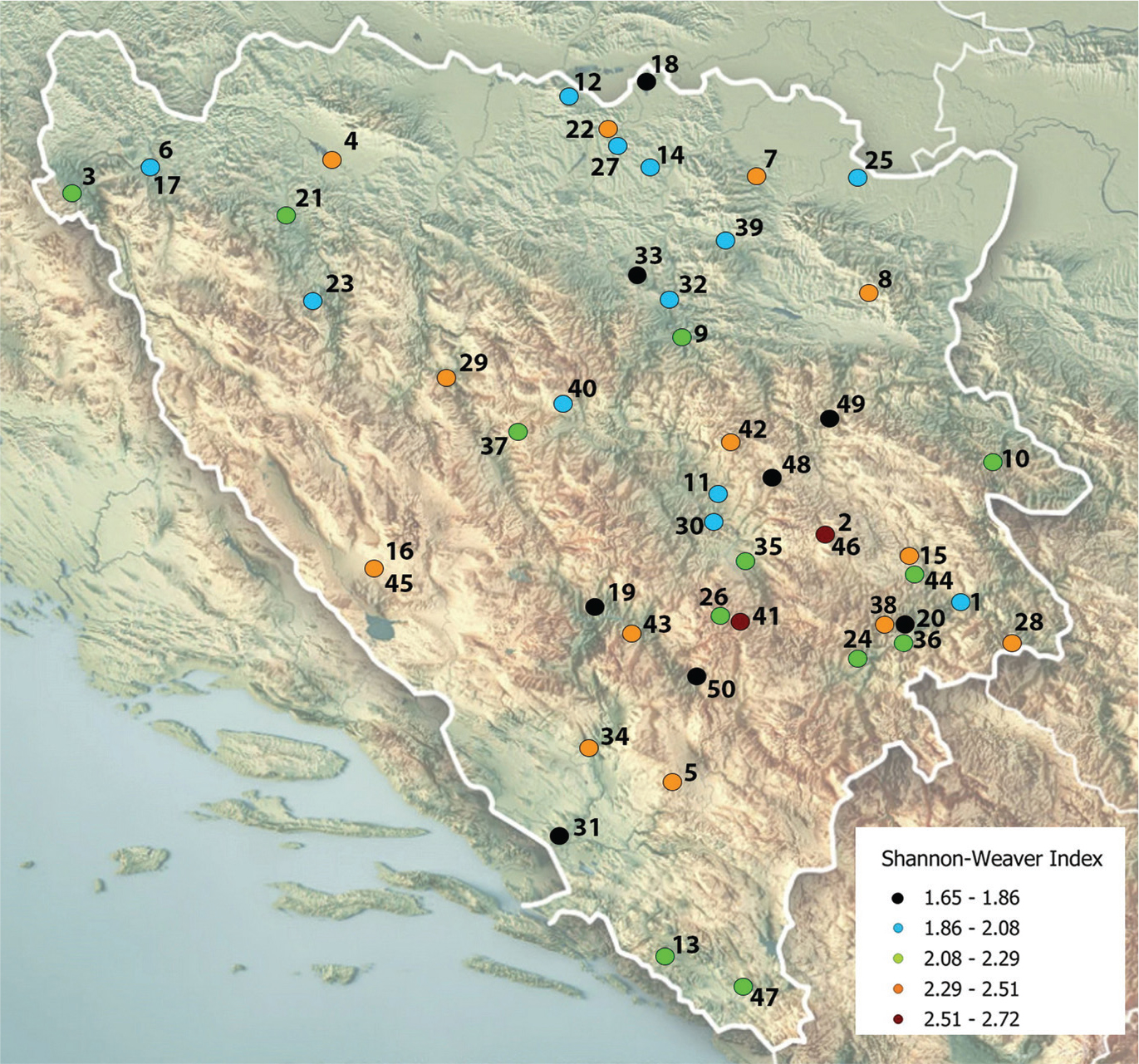
Figure 1:
Geographical distribution of analyzed honey samples.
1—Ustiprača, Radič, 2—Romanija, 3—Bihać, 4—Prijedor, Petrov gaj, 5—Nevesinje, 6—Bosanska Krupa, 7—Gradačac, 8—Majevica, 9-Zavidovići, 10-Srebrenica, Osmanovići, 11—Breza, 12—Bosanski Kobas, 13—Trebinje, Bobani, 14—Brezići, 15—Rogatica, 16—Livno, 17—Bosanska Krupa, 18—Bosanski brod, Zborista, 19— Buturović polje, 20—Goražde, 21—Sanski most, 22—Bosanski Dubačac, 23—Ključ, 24—Ustikolina, 25—Brčko, 26—Trnovo, 27—Derventa, 28—Rudo, 29—Jajce, 30—Ilijas, 31—Čapljina, 32-Maglaj, 33-Tesanj, 34-Mostar, 35—Hrasno, 36—Goražde, 37—Travnik, Goles, 38—Goražde, 39-Gračanica, 40-Vlasić, Suho polje, 41-Bjelasnica, Dejčići, 42-Vares, 43-Konjic, 44-Rogatica, 45-Livno, 46—Romanija, 47—Trebinje, Zubci, 48-Olovo, 49-Kladanj, 50-Crvanj
Methods
Melisopalynological preparations and analysis were made by the RBB&H (2009) as well as the methods proposed by the International Commission for Bee Botany (ICBB) (Von Der Ohe et al., 2004). All melissopalynological preparations were analyzed using a Wild M20 phasecontrast microscope. Plant species identification was performed based on micromorphological features of pollen grains (Erdtman, 1943, 1952; Hesse et al., 2009) and qualitative-quantitative analysis of each sample. Qualitative analysis included a list of determined honey plants, while quantitative analysis involved recording the exact number of pollen grains in the sample. Based on the results of these analysis melissopalynological profiles were created for each sample.
To accurately assess the biodiversity of the samples, both diversity and evenness indices were calculated. The Shannon-Weaver diversity index (H’) (Shannon, 2001) was used to evaluate the diversity of the honey samples, calculated using the formula:
To provide a more comprehensive interpretation of sample diversity, the Shannon evenness index (J’), also known as the equitability index, was employed (Magurran, 2013), and is calculated as:
Results and discussion
A total of 15,000 pollen grains were identified by melis-sopalynological analysis of 50 polyfloral honey samples. Based on micropalynological characteristics, 51 pollen types originating from 24 plant families were determined (Figure 2). The plant families with the highest share in melissopalynological profiles were as follows: Fabaceae with 3,480 pollen grains (23.2%), Rosaceae with 2,650 grains (17.67%) and Asteraceae with 2,312 grains (15.41%). Figure 2 does not show the families Chenopodiaceae, Juglandaceae, Cupressaceae, Corylaceae, Caryophyllaceae, Amaryllidaceae, Ranunculaceae and Cornaceae, since their share in the total sample was only 1.8%.
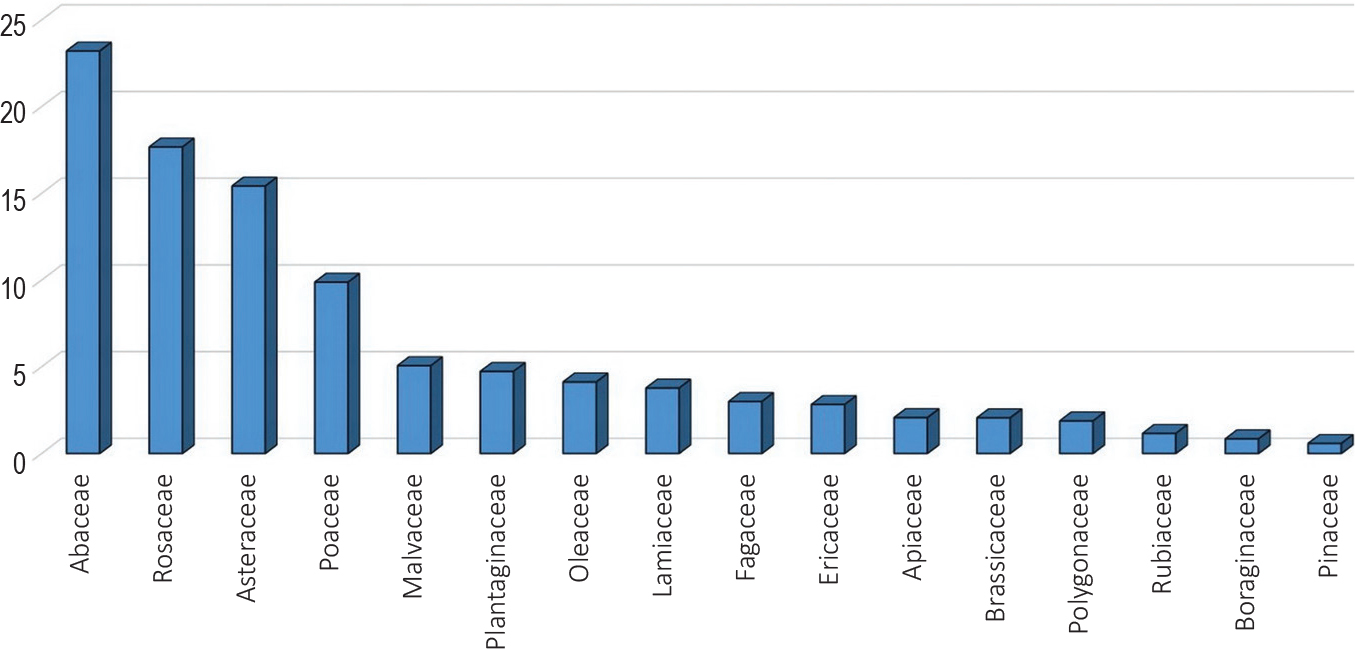
Figure 2:
Families with a percentage share of pollen grains above 0.5% in the total sample.
The species from the Asteraceae family were present in 94% of melissopalynological profiles (47 samples). This was followed by the Fabaceae and Poaceae families, which appeared in 88% of the samples (44 samples), and the Rosaceae family, which was present in 82% (41 samples). The Asteraceae family had the highest number of plant species, with seven taxa detected. It was followed by the Fabaceae family with six species, and the Rosaceae family with five species (Table 1). The sample from the Romanija locality (sample number 46) had the highest number of plant species (17), followed by the Livno locality (sample number 45) with 16 species and Vareš with 14 (Table 1). The average number of species per sample was 11.
Table 1:
Melisopalynological characterization in analyzed profiles of honey samples and values of diversity and evenness indices.
| Location | H’ | J’ | n | Honey plants and proportion of their pollen types in bracket Dominant species in black (≥45%); accessory (from ≥15% to <45%) in red; important in blue (from ≥3% to <15%) and minor (<3%) in green (Louveaux et al., 1978; Villalpando-Aguilar et al., 2022) |
|---|---|---|---|---|
| Ustiprača, Radič | 2.00 | 0.91 | 9 | Prunus sp. (25.33%); Robinia pseudoacacia L. (18%); Castanea sativa Mill. (14%); Fabaceae (12.33%); Poa sp. (11%); Asteraceae (6.67%); Tilia sp. (5.67%); Trifolium repens L. (5.67%); Artemisia sp. (1.33%) |
| Romanija | 2.07 | 1.00 | 8 | Fabaceae (14.33%); Calluna vulgaris (L.) Hull (14%); Poa sp. (14%); Prunus sp. (13.33%); Apiaceae (12.33%); Asteraceae (10.67%); Robinia pseudoacacia L. (10.67%); Plantago sp. (10.67%) |
| Bihać | 2.13 | 0.89 | 11 | Cichorium intybus L. (33.67%); Poa sp. (9.67%); Plantago sp. (9%); Trifolium repens L. (7.33%); Asteraceae (7.33%); Lotus corniculatus L. (6.67%); Fabaceae (6.67%); Apiaceae (6.67%); Prunus sp. (6%); Tilia sp. (5%); Ambrosia artemisiifolia L. (2%) |
| Prijedor, Petrov gaj | 2.49 | 0.97 | 13 | Robinia pseudoacacia L. (15.67%); Poa sp. (11%); Cichorium intybus L. (9.67%); Bellis perennis L. (9.33%); Prunus sp. (8%); Rosaceae (7.33%); Plantago sp. (7.33%); Taraxacum officinale F. H. Wigg. (6.67%); Fraxinus ornus L. (6.33%); Asteraceae (6%); Rumex sp. (5.67%); Apiaceae (4%); Tilia sp. (3.01%) |
| Nevesinje | 2.30 | 0.90 | 13 | Trifolium pratense L. (22.33%); Cichorium intybus L. (14.33%); Prunus sp. (12.67%); Poa sp. (10.67%); Lamium sp. (8.67%); Brassicaceae (8%); Onobrychis sp. (5%); Rumex sp. (5%); Myosotis sp. (4.33%); Tilia sp. (3.33%); Plantago sp. (2.67%); Plantago sp. (2%); Pinaceae (1.67%); Artemisia sp. (1.33%) |
| Bosanska Krupa | 1.89 | 0.91 | 8 | Poa sp. (31.33%); Tilia sp. (20%); Cichorium intybus L. (10.33%); Prunus sp. (10%); Lamium sp. (9.67%); Lathyrus sp. (7.33%); Asteraceae (7%); Plantago sp. (4.33%) |
| Gradačac | 2.36 | 0.95 | 12 | Poa sp. (15%); Tilia sp. (14%); Robinia pseudoacacia L. (13.33%); Plantago sp. (10.33%); Potentilla sp. (9.67%); Bellis perennis L. (8.33%); Brassicaceae (6.33%); Rumex sp. (6%); Prunus sp. (5.33%); Fraxinus ornus L. (5.33%); Apiaceae (5%); Cirsium sp. (1.33%) |
| Majevica | 2.50 | 0.97 | 13 | Tilia sp. (13.33%); Taraxacum officinale F. H. Wigg. (11.67%); Asteraceae (10.67%); Trifolium repens L. (9%); Lathyrus sp. (8.67%); Trifolium pratense L. (7.33%); Robinia pseudoacacia L. (7%); Potentilla sp. (7%); Plantago sp. (6.33%); Brassicaceae (6.33%); Echium vulgare L. (5%); Chenopodium sp. (4%); Lamium sp. (3.67%) |
| Zavidovići | 2.28 | 0.95 | 11 | Robinia pseudoacacia L. (19.33%); Plantago sp. (12%); Tilia sp. (11.67%); Poa sp. (11%); Prunus sp. (10.33%); Taraxacum officinale F. H. Wigg. (8.33%); Asteraceae (7.67%); Potentilla sp. (7%); Rumex sp. (6.33%); Lathyrus sp. (4.33%); Pinaceae (2%) |
| Srebrenica, Osmanovići | 2.27 | 0.91 | 12 | Brassicaceae (20%); Tilia sp. (15%); Asteraceae (13%); Poa sp. (11%); Plantago sp. (10.67%); Trifolium pratense L. (8.33%); Malva sp. (7.33%); Fraxinus ornus L. (4%); Artemisia (3.33%); Cirsium sp. (2.67%); Lamiaceae (2.33%); Chenopodium sp. (2.33%) |
| Breza, Bukovik | 2.02 | 0.84 | 11 | Sanguisorba minor Scop. (33.33%); Robinia pseudoacacia L. (15.67%); Prunus sp. (15%); Plantago sp. (7.67%); Taraxacum officinale F. H. Wigg. (7.33%); Poa sp. (5%); Rubus sp. (5%); Rumex sp. (3.33%); Asteraceae (3.33%); Pinaceae (2.33%); Apiaceae (2%) |
| Bosanski Kobaš | 1.92 | 0.84 | 10 | Potentilla sp. (36%); Tilia sp. (14.33%); Prunus sp. (11.67%); Cichorium intybus L. (11.33%); Lotus corniculatus L. (9.33%); Zea mays L. (6%); Pinaceae (5.33%); Taraxacum officinale F. H. Wigg. (2.67%); Rubus sp. (1.67%); Lamium sp. (1.67%) |
| Trebinje, Bobani | 2.17 | 0.91 | 11 | Ericaceae (19.33%); Fabaceae (16.67%); Cichorium intybus L. (12.67%); Lathyrus sp. (12.67%); Apiaceae (9%); Lamiaceae (9%); Plantago sp. (8.33%); Lotus corniculatus L. (7%); Lamium sp. (2.67%); Salvia officinalis L. (2%); Gallium sp. (0.67%) |
| Brezići | 1.94 | 0.89 | 9 | Ericaceae (31.67%); Prunus sp. (15.33%); Brassicaceae (15%); Trifolium pratense L. (11.67%); Poa sp. (7.33%); Lamiaceae (5.67%); Fraxinus ornus L. (5.67%); Cornus mas L. (5.67%); Pinaceae (2%) |
| Rogatica | 2.36 | 0.95 | 12 | Rumex sp. (18.67%); Prunus sp. (10.33%); Poa sp. (10%); Bellisperennis L. (9.67%); Lamium sp. (9%); Lotus corniculatus L. (8.33%); Trifoliumpratense L. (8.33%); Brassicaceae (7.33%); Plantago sp. (7%); Artemisia sp. (6%); Apiaceae (2.33%); Asteraceae (1.67%) |
| Livno | 1.82 | 0.88 | 8 | Lotus corniculatus L. (27.33%); Gallium sp. (22.67%); Poa sp. (20%); Cichorium intybus L. (11.67%); Apiaceae (6.67%); Juglans regia L. (5%); Brassicaceae (3.33%); Rumex sp. (3.33%) |
| Bosanska krupa | 2.00 | 0.96 | 8 | Tilia sp. (24%); Castanea sativa Mill. (16%); Potentilla sp. (13.33%); Poa sp. (11.67%); Sanguisorba minor Scop (11%); Bellis perennis L. (10.67%); Plantago sp. (6.67%); Prunus sp. (6.67%) |
| Bosanski brod, Zborišta | 1.85 | 0.84 | 9 | Potentilla sp. (40.33%); Prunus sp. (15.67%); Poa sp. (8.67%); Tilia sp. (8.33%); Taraxacum officinale F. H. Wigg. (8%); Lathyrus sp. (6.67%); Plantago sp. (5%); Apiaceae (4%); Zea mays L. (3.33%) |
| Buturović polje | 1.84 | 0.89 | 8 | Potentilla sp. (34.67%); Castanea sativa Mill. (20%); Lathyrus sp. (10.67%); Tilia sp. (9%); Taraxacum officinale F. H. Wigg. (8.33%); Poa sp. (7.33%); Calluna vulgaris (L.) Hull (6%); Lamiaceae (4%) |
| Goražde | 1.71 | 0.78 | 9 | Trifolium repens L. (38.33%); Lotus corniculatus L. (26%); Plantago sp. (11.67%); Bellis perennis L. (7.67%); Trifolium pratense L. (5%); Lamiaceae (4.67%); Artemisia sp. (3.33%); Taraxacum officinale F. H. Wigg (1.67%); Chenopodium sp. (1.67%) |
| Sanski most | 2.19 | 1.00 | 9 | Prunus sp. (14%); Trifolium repens L. (12.67%); Lotus corniculatus L. (12.67%); Lamium sp. (11%); Plantago sp. (11%); Taraxacum officinale F. H. Wigg (10%); Tilia sp. (10%); Zea mays (9.67%); Asteraceae (9%) |
| Bosanski dubačac | 2.50 | 0.95 | 14 | Lotus corniculatus L. (13%); Tilia sp. (12.33%); Poa sp. (12%); Bellis perennis L. (10.33%); Prunus sp. (10.33%); Lamium sp. (7%); Trifolium pratense L. (6.33%); Potentilla sp. (6%); Plantago sp. (6%); Gallium sp. (5.33%); Artemisia sp. (3.67%); Zea mays L. (3%); Onobrychis sp. (3%); Ranunculus sp. (1.67%) |
| Ključ | 1.87 | 0.90 | 8 | Cichorium intybus L. (36.67%); Poa sp. (12.67%); Lotus corniculatus L. (11%); Onobrychis sp. (9%); Prunus sp. (8.67%); Taraxacum officinale F. H. Wigg. (8.33%); Trifolium repens L. (7%); Tilia sp. (6.67%) |
| Ustikolina, Goražde | 2.21 | 0.96 | 10 | Prunus sp. (21.11%); Rubus sp. (14.33%); Potentilla sp. (11.33%); Fraxinus ornus L. (11.33%); Poa sp. (9.67%); Sanguisorba minor Scop (7.67%); Carpinus sp. (6.33%); Asteraceae (6.33%); Cupressaceae (6%); Rumex sp (5.67%) |
| Brčko | 1.97 | 0.90 | 9 | Prunus sp. (29.33%); Trifolium pratense L. (19.33%); Lotus corniculatus L. (10.33%); Echium vulgare L. (9.67%); Rumex sp. (9.33%); Asteraceae (9.33%); Poa sp. (5.67%); Plantago sp. (4.67%); Ranunculus sp. (2.33%) |
| Trnovo, Sarajevo | 2.11 | 0.92 | 10 | Asteraceae (29.67%); Echium vulgare L. (9.67%); Lotus corniculatus L. (8.67%); Taraxacum officinale F. H. Wigg. (8.67%); Tilia sp. (7%); Poa sp. (7.33%); Artemisia sp. (7.67%); Prunus sp. (12.33%); Potentilla sp. (6.33%); Zea mays L. (2.67%) |
| Derventa | 1.94 | 0.93 | 8 | Robinia pseudoacacia L. (19.33%); Asteraceae (19.33%); Potentilla sp. (18.67%); Taraxacum officinale F. H. Wigg (13.33%); Trifolium pratense L. (12.67%); Prunus sp. (7.67%); Plantago sp. (6.67%); Zea mays L. (2.33%) |
| Rudo | 2.41 | 0.97 | 12 | Lotus corniculatus L. (15%); Onobrychis sp. (12.67%); Plantago sp. (11.33%); Ericaceae (9.33%); Trifolium pratense L. (9.33%); Taraxacum officinale F. H. Wigg. (8.33%); Chenopodium sp. (8%); Poa sp. (6.67%); Lamiaceae (6%); Lamium sp. (5%); Trifolium repens L. (5%); Asteraceae (3.33%) |
| Jajce | 2.50 | 0.97 | 13 | Tilia sp. (12%); Plantago sp. (11%); Asteraceae (10%); Poa sp. (9.33%); Brassicaceae (9%); Prunus sp. (9%); Sanguisorba minor Scop (7.67%); Taraxacum officinale F. H. Wigg. (7.67%); Castanea sativa Mill. (6.33%); Lotus corniculatus L. (6.33%); Potentilla sp. (5.67%); Bellis perennis L. (3.33%); Zea mays L. (2.67%) |
| Ilijas, Sarajevo | 1.97 | 0.90 | 9 | Prunus sp. (25%); Fraxinus ornus L. (19%); Sanguisorba minor Scop (16.67%); Potentilla sp. (13.33%); Taraxacum officinale F. H. Wigg. (9.33%); Zea mays L. (6%); Robinia pseudoacacia L. (4.67%); Brassicaceae (4%); Fagus sp. (2%) |
| Čapljina | 1.77 | 0.85 | 8 | Asteraceae (32.33%); Lamiaceae (22.67%); Rosaceae (15%); Poa sp. (10.67%); Fabaceae (10%); Apiaceae (4.67%); Satureja sp. (3.67%); Salvia officinalis L. (1%) |
| Maglaj | 2.01 | 0.97 | 8 | Poa sp. (19.33%); Robinia pseudoacacia L. (19.33%); Plantago sp. (14.33%); Trifolium pratense L. (13.33%); Taraxacum officinale F. H. Wigg. (11.33%); Fagus sp. (7.67%); Asteraceae (7.67%); Tilia sp. (7%) |
| Tešanj | 1.77 | 0.85 | 8 | Oleaceae (36.67%); Ericaceae (19%); Prunus sp. (13.33%); Fraxinus ornus L. (12%); Taraxacum officinale F. H. Wigg. (7.67%); Bellis perennis L. (5%); Poa sp. (3.33%); Caryophyllaceae (3%) |
| Mostar | 2.31 | 0.90 | 13 | Prunus sp. (20%); Oleaceae (19%); Fraxinus ornus L. (13.33%); Lotus corniculatus L. (8.33%); Cupressaceae (7%); Lamiaceae (6.67%); Brassicaceae (5%); Trifolium pratense L. (5%); Onobrychis sp. (5%); Taraxacum officinale F. H. Wigg. (3.33%); Lathyrus sp. (3.33%); Carpinus sp. (2.67%); Potentilla sp. (1.33%) |
| Hrasno | 2.08 | 0.95 | 9 | Castanea sativa Mill. (23.33%); Fraxinus ornus L. (13.67%); Trifolium pratense L. (13%); Poa sp. (12.67%); Lathyrus sp. (11%); Plantago sp. (10%); Lotus corniculatus L. (7%); Rosaceae (5%); Apiaceae (4.33%) |
| Goražde | 2.24 | 0.94 | 11 | Lathyrus sp. (24.67%); Trifolium repens L. (13.67%); Prunus sp. (9.67%); Lotus corniculatus L. (9.33%); Poa sp. (9.33%); Taraxacum officinale F. H. Wigg. (7.67%); Onobrychis sp. (6%); Trifolium pratense L. (5.67%); Fraxinus ornus L. (5%); Lamium sp. (5%); Pinaceae (4%) |
| Travnik, Goleš | 2.25 | 0.94 | 11 | Prunus sp. (21%); Trifolium repens L. (16.33%); rifolium pratense L. (11.67%); Castanea sativa Mill. (9%); Asteraceae (8.33%); Fraxinus ornus L. (8%); Lathyrus sp. (7%); Lamium sp. (7%); Artemisia sp. (4.33%); Gallium sp. (4%); Poa sp. (3.33%) |
| Goražde | 2.31 | 0.93 | 12 | Trifolium repens L. (15.33%); Lotus corniculatus L. (15%); Poa sp. (14%); Taraxacum officinale F. H. Wigg. (11%); Trifolium pratense L. (10%); Rumex sp. (9.33%); Pinaceae (8.67%); Gallium sp. (4.67%); Apiaceae (4%); Cichorium intybus L. (3.33%); Bellis perennis L. (3%); Onobrychis sp. (1.67%) |
| Gračanica | 2.02 | 0.88 | 10 | Poa sp. (26.33%); Tilia sp. (24%); Plantago sp. (11.33%); Taraxacum officinale F. H. Wigg. (11%); Asteraceae (6%); Rumex sp. (6%); Gallium sp. (5.33%); Prunus sp. (4%); Lotus corniculatus L. (3.67%); Trifolium repens L. (2.33%) |
| Vlašić, Suho polje | 2.02 | 0.92 | 9 | Lotus corniculatus L. (25.67%); Prunus sp. (14.33%); Trifolium repens L. (13.33%); Potentilla sp. (12.67%); Plantago sp. (12%); Taraxacum officinale F. H. Wigg. (11%); Poa sp. (4%); Gallium sp. (3.67%); Trifolium pratense L. (3.33%) |
| Bjelašnica, Dejčići | 2.52 | 0.98 | 13 | Poa sp. (12%); Onobrychis sp. (10.67%); Allium sp. (9.33%); Lotus corniculatus L. (8.67%); Trifolium repens L. (8.33%); Lamium sp. (8%); Trifolium pratense L. (7.67%); Lamiaceae (7%); Rumex sp. (7%); Bellis perennis L. (7%); Prunus sp. (6.67%); Gallium sp. (4.33%); Apiaceae (3.33%) |
| Vareš | 2.46 | 0.93 | 14 | Apiaceae (15%); Trifolium repens L. (15%); Fraxinus ornus L. (11.67%); Poa sp. (11%); Lathyrus sp. (7.33%); Prunus sp. (7.33%); Lotus corniculatus L. (7%); Fagus sp. (5.67%); Onobrychis sp. (5%); Lamiaceae (4.67%); Bellis perennis L. (3.67%); Tilia sp. (2.33%); Malva sp. (2.33%); Taraxacum officinale F. H. Wigg. (2%) |
| Konjic | 2.29 | 0.92 | 12 | Trifolium pratense L. (23.33%); Castanea sativa Mill. (12.67%); Fagus sp. (10.67%); Taraxacum officinale F. H. Wigg. (10%); Poa sp. (9.33%); Lathyrus sp. (8.33%); Bellis perennis L. (6.33%); Prunus sp. (6%); Juglans regia L. (4.33%); Onobrychis sp. (3%); Caryophyllaceae (3%); Rumex sp. (3%) |
| Rogatica | 2.25 | 0.94 | 11 | Potentilla sp. (21.33%); Bellisperennis L. (15%); Brassicaceae (10.67%); Artemisia sp. (9.33%); Poa sp. (8.67%); Apiaceae (8%); Taraxacum officinale F. H. Wigg. (7.33%); Helianthus annuus L. (6.67%); Zea mays L. (5.67%); Plantago sp. (5.67%); Malva sp. (1.67%) |
| Livno | 2.38 | 0.86 | 16 | Fabaceae (34.33%); Lotus corniculatus L. (9.33%); Taraxacum officinale F. H. Wigg. (6%); Poa sp. (5%); Rumex sp. (5%); Lathyrus sp. (4.67%); Bellisperennis L. (4.67%); Echium vulgare L. (4.33%); Poa sp. (4.33%); Carpinus sp. (4%); Cichorium intybus L. (4%); Malva sp. (4%); Trifolium repens L. (4%); Ambrosia artemisiifolia L. (3.67%); Boraginaceae (3.33%); Asteraceae (2.67%); Chenopodium sp. (1.67%) |
| Romanija | 2.72 | 0.96 | 17 | Trifolium repens L. (13.33%); Potentilla sp. (13%); Lotus corniculatus L. (8.33%); Lamium sp. (6.67%); Plantago sp. (6.67%); Poa sp. (6%); Echium vulgare L. (5.67%); Taraxacum officinale F. H. Wigg. (5.33%); Lathyrus sp. (5%); Malva sp. (4.67%); Cirsium sp. (4.67%); Asteraceae (4%); Gallium sp. (3.67%); Ranunculs sp. (3.33%); Apiaceae (3.33%); Prunus sp. (3.33%); Lamiaceae (3%) |
| Trebinje, Zubci | 2.12 | 0.88 | 11 | Oleaceae (25%); Prunus sp. (16.67%); Lotus corniculatus L. (14.33%); Trifolium repens L. (13.67%); Lamiaceae (7.33%); Brassicaceae (6.33%); Apiaceae (4.67%); Juglans regia L. (4%); Taraxacum officinale F. H. Wigg. (3.67%); Gallium sp. (2.33%); Malva sp. (2%) |
| Olovo | 1.85 | 0.84 | 9 | Poa sp. (33.33%); Lathyrus sp. (22.33%); Trifolium repens L. (14.67%); Asteraceae (10%); Plantago sp. (4.67%); Potentilla sp. (4.33%); Lamiaceae (4%); Caryophyllaceae (3.33%); Taraxacum officinale F. H. Wigg. (3.33%) |
| Kladanj | 1.75 | 0.70 | 12 | Ericaceae (41.67%); Prunus sp. (25.67%); Fraxinus ornus L. (10%); Asteraceae (4.67%); Apiaceae (4%); Poa sp. (3.67%); Tilia sp. (3%); Pinaceae (2.67%); Plantago sp. (1.33%); Chenopodium sp. (1.33%); Gallium sp. (1%); Lotus corniculatus L. (1%) |
| Crvanj | 1.65 | 0.92 | 6 | Rosaceae (28%); Castanea sativa Mill. (22.33%); Trifolium repens L. (19.67%); Prunus sp. (17.33%); Lamiaceae (9.67%); Poa sp. (3%) |
An overview of the 15 most abundant taxa identified across all analyzed samples is presented in Figure 3. Among these, a total of 1,406 pollen grains were attributed to the genus Prunus, followed by Poa with 1,357 grains, and Lotus corniculatus with 838 grains. Castanea sativa, Cichorium intybus, and the genus Potentilla exhibited the highest mean values across the full dataset, while the greatest standard deviation values were observed for Potentilla and Cichorium. The highest percentage share in an individual sample was that of Potentilla sp. with 121 pollen grains (40.3%) at the Bosanski Brod site (sample number 18 in Table 1), and the lowest was that of Gallium sp. with only two pollen grains (0.7%) at the Trebinje, Bobani site (sample number 13 in Table 1).
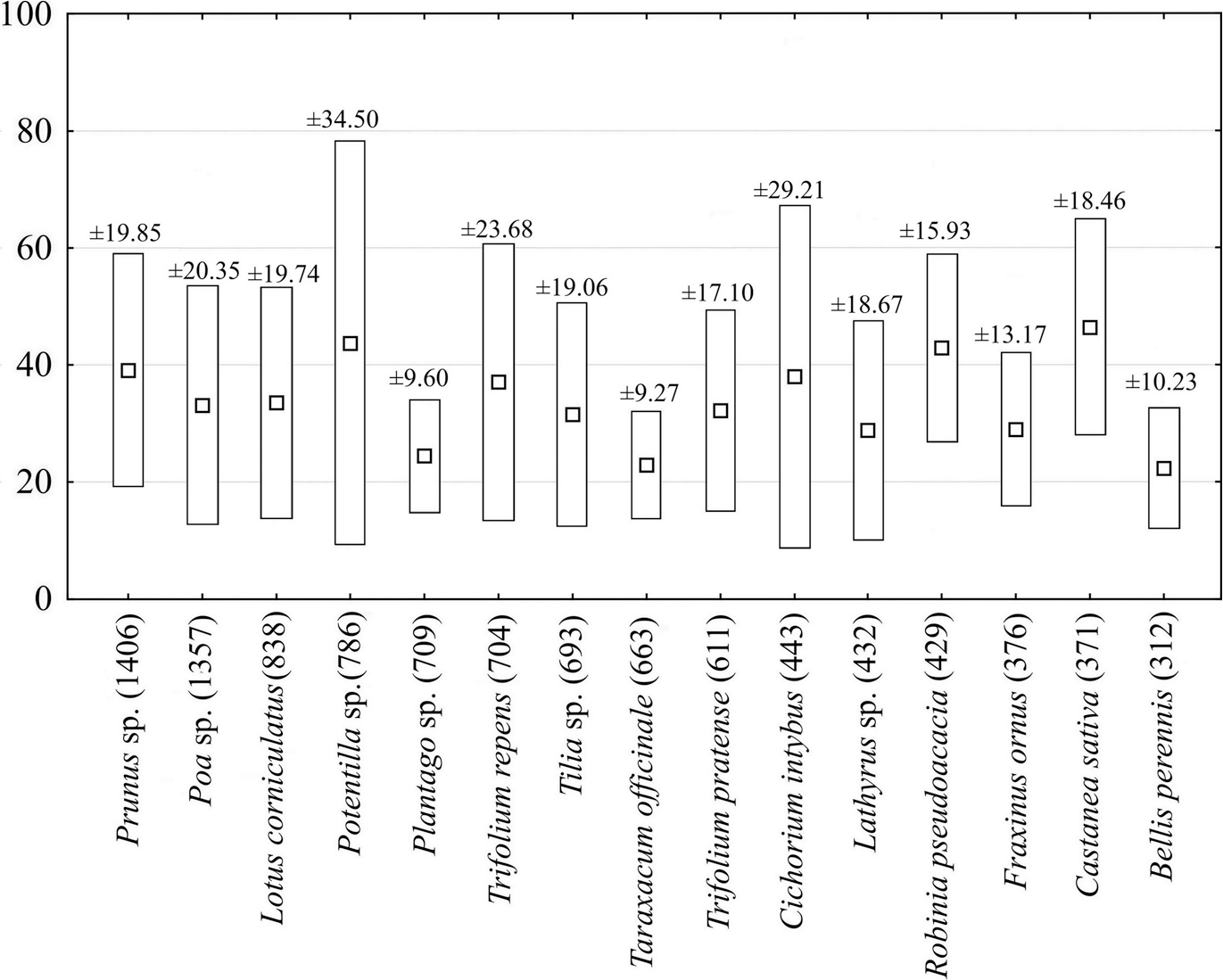
Figure 3:
The top 15 most abundant taxa identified in all analyzed samples (for each taxon, minimal, maximal and mean values are presented along with the total number of pollen grains in parentheses. Standard deviations at the top of each bar).
Pollen grains of ragweed (Ambrosia artemisiifolia L.) were detected in melissopalynological profiles from the Bihać and Livno sites. Given that ragweed pollen is characterized by a combination of specific antigens, lactone compounds, flavonoids, monoterpenes and bitter flavonoids and has a very high allergenic potential (Kanter et al., 2013; Chen et al., 2018), according to the European Food Safety Authority, it may pose a serious health problem (EFSA, 2010). It is noteworthy that the actual distribution of ragweed in Bosnia and Herzegovina does not align with the obtained melissopalinological profiles since the time of bee grazing usually does not coincide with its flowering period.
Although the sampling did not follow to the geographical and biogeographic regionalization of Bosnia and Herzegovina (B&H) as outlined in the previous chapter, we can still draw some conclusions. The samples from the Continental region predominantly featured pollen grains from the Asteraceae, Fabaceae, and Rosaceae families (see Table 1, Figure 1). This finding aligns with the results reported for the continental region of neighboring Croatia by Rašić et al. (2018) and Štefanić et al. (2012). In the Mediterranean region of B&H, the dominant pollen grains come from the Fabaceae and Lamiaceae families, a pattern also observed in Croatia (Zima, 2007; Britvec et al., 2013). In the melissopalynological profiles of honey samples originating from the Alpine region of B&H, pollen grains from the Fabaceae and Asteraceae families were notably dominant. It is important to note that this paper analyzed only polyfloral honey types; therefore, their melissopalynological profiles do not accurately reflect the phytocoenological characteristics of the Continental, Mediterranean, and Alpine regions of B&H. An analysis of the botanical characterization of polyfloral honey samples from other countries in the region reveals that, in Serbia, the Asteraceae family shows great potential among plant species (Mačukanović-Jocić & Jarić, 2015). In contrast, Albania demonstrates a pronounced botanical potential within the Ericaceae family (Pupuleku et al., 2016). Melisopalynological studies indicate that the Fabaceae family comprises the most abundant honey plants across different regions of Turkey (Altay et al., 2018; Topal et al., 2023). Meanwhile, in Bulgaria, the families Fabaceae, Brassicaceae, and Rosaceae exhibit the highest botanical potential (Balkanska et al., 2023).
Representation of pollen types in the analyzed samples: dominant pollen grains (≥45%), accessory (from ≥15% to <45%), important (from ≥3% to <15%) and minor (<3%) (Louveaux et al., 1978; Villalpando-Aguilar et al., 2022) (Table 1).
The degree of the sample’s biodiversity was calculated by the Shannon-Weaver index (Table 1, Figure 1). The highest index values were at the locations of Romanija (2.72) and Bjelašnica (2.52), and the lowest values were at the locations of Goražde (1.71) and Crvanj (1.65). According to Pešić & Tomović (2011), the diversity index increases as the number of honey-bearing species in the sample rises because the proportion of individual species decreases, leading to a more negative value in the logarithm. The results of other studies show that the values of the Shannon-Weaver index for samples originating from Italy ranged from 0.01 to 2.37 (Conti et al., 2016), Mexico from 0.93 to 1.16 (Villalpando-Aguilar et al., 2022), while in China the values index from 1.79 to 2.21 (Song et al., 2012). In Ethiopia, the index values were higher than the previous ones and ranged from 2.377 to 2.541 (Dugda & Addi, 2024). By comparing the results, we can see that honey samples originating from B&H have similar or slightly higher diversity index values. High values of the Shannon-Weaver index and the botanical specificity of each melissopalynological profile (Table 1) reflect the diversity of honey plants and represent the extremely high honey and ecological potential of B&H in honey production.
The interpretation of the honey samples’ diversity is complemented by the evenness or equitability index of the samples (Table 1). Comparing two or more samples with the same number of species, the one with species with an uniform number of individuals has a higher degree of diversity, and the one in which some species dominate while others are present with a small number of individuals in the community is less diverse (Herrmann et al., 2022). In our study, the values of the uniformity index (J’) was from 0.70 to 1, showing that all samples had moderate to uniform numbers of pollen grains of different types in the sample.
The high values of the diversity index and uniformity of the analyzed melissopalynological profiles are the outcome of the floristic richness and uniqueness of the honey-bearing pastures of B&H. Dynamic changes in geomorphological, climatic and edaphic parameters have caused heterogeneous habitat conditions in a relatively small geographical area (Redžić, 2007; Redžić et al., 2008). The complex action of ecological factors has enabled the specific chorology and phenology of honeybearing plants, which is directly reflected in the unique botanical and chemical properties of honey (Homrani et al., 2020; Yıldırım et al., 2021; Ivanović et al., 2021). Ecological heterogeneity has made B&H a biodiversity hotspot in Europe (Grimmett et al., 2017), and one of the most diverse countries in Europe with 4498 described Spermatophyta (Redžić et al., 2008). All this is reflected in the diversity of melissopalynological profiles where the combination of melliferous plants represents a unique imprint of the environment in which melliferous grazing was carried out (Table 1).
Conclusion
As part of the research, 50 polyfloral honey samples from Bosnia and Herzegovina were analyzed, with 15,000 pollen grains from 24 different plant families. Melisopalynological analysis established the botanical uniqueness of each investigated profile. Bosnia and Herzegovina is characterized by a high level of biodiversity (Redžić, 2007; Redžić et al., 2008) which is directly reflected in the floristic richness and diversity of the investigated melisopalynological profiles. The results showed the potential and biodiversity of honey plants and are crucial in expanding knowledge about the diversity of the apiflora of B&H, sustainable use of this important biological resource and increasing the competitiveness of local domestic honey producers on the international market.
Notes
[2] Research data availability
The data analysed during this study are available from the corresponding author upon reasonable request.