
Figure 1:
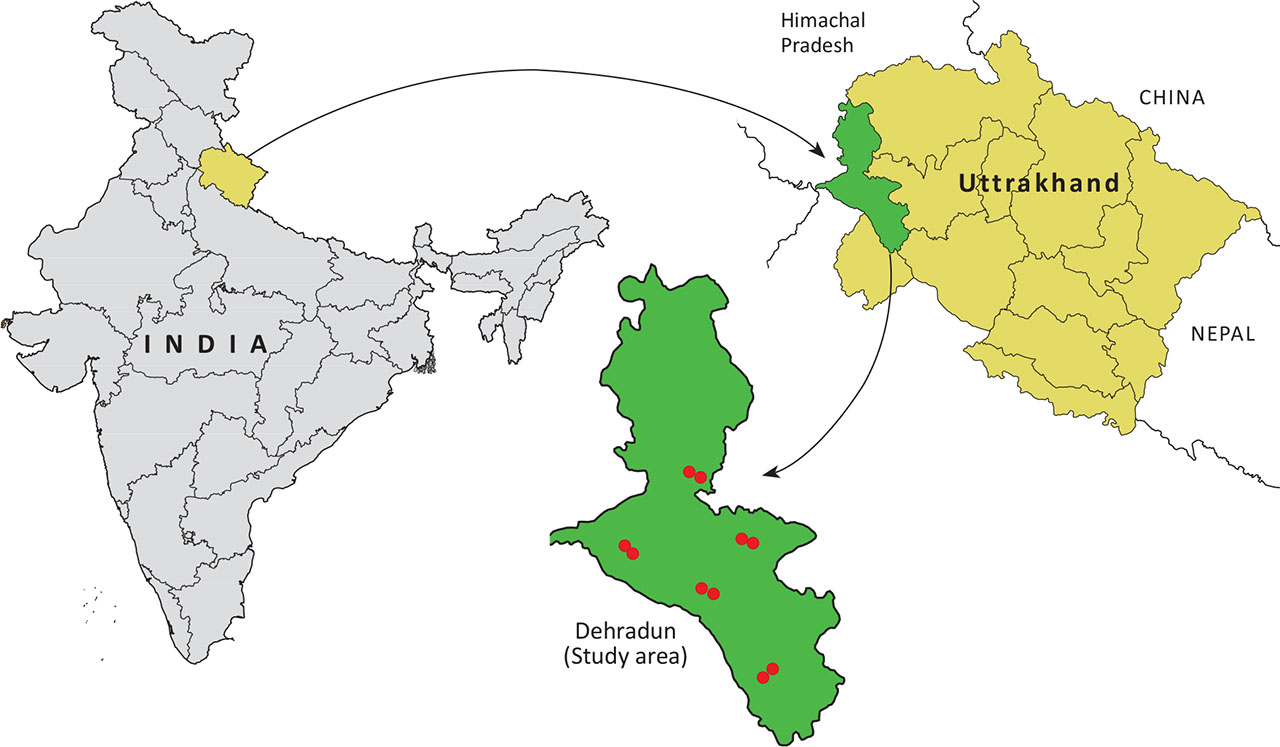
Map of the study area and points (red dots) with sampling sites in Dehradun (Uttarakhand, India).
Slika 1: Zemljevid raziskovanega območja in točke (rdeče pike) z lokacijami vzorčenja v regiji z Dehradun (Uttarakhand, India).

Figure 2:
Different selected habitats: (A) Agricultural areas; (B) Flower gardens; (C) Forests; (D) Mango orchards (Photo: Shafkat Jabbar Mir, 2021).
Slika 2: Različni izbrani habitati: (A) kmetijske površine; (B) cvetlični vrtovi; (C) gozdovi; (D) nasadi manga (foto: Shafkat Jabbar Mir, 2021).
Table 1:
Demographic data of respondents from the Vann Gujjar and Pahari communities of Dehradun, India.
Tabela 1: Demografski podatki intervjuvancev iz skupnosti Vann Gujjar in Pahari iz območja Dehradun (India).
| Demographic features | Total Percentage | Ethnic Communities | |
|---|---|---|---|
| Vann Gujjar | Pahari | ||
| Respondents | 153 | 63 (41.17%) | 90 (58.82%) |
| Male | 87 (56.86%) | 29 | 58 |
| Female | 66 (43.13%) | 34 | 32 |
| Original Language | Gujjari | Pahari | |
| Socio linguistic characteristics | Monolingual (Elder community) Bilingual (Youngest community | Monolingual (Elder community) Bilingual (Youngest community | |
| Age range (27–75) | 27–75 | 27–75 | |
| Profession | Sheppard, Housewives | Farmer, Sheppard, Housewives, Craftsmen, Shopkeeper | |
| Livelihood source | Pastoralism | Agriculture | |
Table 2:
Zootherapy and cultural uses of the collected Coccinellidae fauna across the Vann Gujjar and Pahari ethnic groups in Dehradun, Uttarakhand, India. (** Varieties of the species are written in bold)
Tabela 2: Zooterapija in kulturna uporaba vzorčene favne družine Coccinellidae v etničnih skupnostih Vann Gujjar in Pahari v območju Dehradun, Uttarakhand, Indija. (** varietete vrst so napisane krepko).
| Scientific Name | Local name | Abb | Genus | Zootherapy | Cultural Use | Ethnic Groups | Use Value | Use reports |
|---|---|---|---|---|---|---|---|---|
| Adalia decempunctata (Linnaeus, 1758) | Gupillu | Ada.dec | Adalia | – – – – – | Be kept in a pot placed in front of patients suffering from an evil spirit disease, and then both are bewitched for some time | Gujjar | 0.1 | 16 |
| Angelis cardoni (Weise, 1990) | Bhundia | Ang.car | Angelis | – – – – – | Black magic | Gujjar | 0.1 | 16 |
| Brumoides suturalis (Fabricius, 1789) | Pillu | Bru.sat | Brumoides | – – – – – | Enchanted and eaten for 40 days to gain magical powers. | Gujjar | 0.1 | 16 |
| Cheilomenes sexmaculata (Fabricius, 1781) | Gudbinia | Che.sex | Cheilomenes | Sundried, made into powder, added to honey and with walnuts, to treat infertility in both males and females. | People also believe that the frequent occurrence of this species in the home garden is a sign of good luck. | Pahari | 0.11 | 17 |
| Cheilomenes sexmaculata var. undulata (Fabricius, 1781) ** | Bahv | Che.und | Cheilomenes | Sundried, made into powder, added to honey and with walnuts, to treat infertility in both males and females. | Dried, powdered and applied topically to treat skin diseases, believed to attract the opposite sex. | Gujjar | 0.11 | 17 |
| Chilocorus nigritus (Fabricius, 1798) | Kala Bhundia | Chi.nig | Chilocorus | The whole body is dried and mixed with spider webs to stop bleeding from minor injuries. | This species is made into garlands together with other beetles. | Gujjar | 0.11 | 18 |
| Coccinella hieroglyphica (Linnaeus, 1759) | Kisari | Coc.hie | Coccinella | The whole body is sundried and consumed with honey to treat cough and asthma. | The beetle is dried and burned to produce smoke, which is used against evil spirits. | Gujjar | 0.26 | 41 |
| Coccinella leonine (Fabricius, 1775) | Sursui | Coc.leo | Coccinella | The whole body is dried in the sun and eaten with honey to treat asthma. | Gujjar | 0.22 | 35 | |
| They are collected and kept overnight in traditional houses to avoid spiders. | Pahari | 0.25 | 39 | |||||
| Coccinella quinquepunctata (Linnaeus, 1785) | Pissu | Coc.qui | Coccinella | The whole body is dried and consumed with lemon and honey to treat infertility. | Gujjar | 0.18 | 28 | |
| Coccinella septempunctata (Linnaeus, 1758) | Quleela | Coc.sep | Coccinella | The whole body is dried in the sun and eaten with honey to treat asthma. | These are collected and kept overnight in traditional houses to avoid spiders. Because of their seven tips, locals believe that they have the potential to cure various problems with evil spirits. | Gujjar | 0.4 | 62 |
| Coccinella septempunctata var. divaricata (Olvier, 1808) ** | Cheechad | Coc.div | Coccinella | – – – – – | Placed in a pot in front of patients suffering spiritual disease and then enchanted for ome time | Gujjar | 0.12 | 19 |
| Coccinella transversalis (Fabricius, 1781) | Mugari | Coc.tra | Coccinella | Species are dried, made into powder, mixed with turmeric, added with fresh running, and applied on the skin to avoid sunburns. | Considered a friend of local farmers because she hunts pests such as aphids. | Pahari | 0.12 | 19 |
| Coccinella undecimpunctata (Linnaeus, 1758) | Bugi | Coc.axy | Coccinella | Species are dried, made into powder, mixed with turmeric, added with fresh running, and applied on the skin to avoid sunburns. | These are placed on the belly of a pregnant woman, as they are said to produce male children. | Gujjar | 0.2 | 32 |
| Henosepilachna vigintioctopunctata (Fabricius, 1775) | Chotha | Epi.vig | Epilachna | – – – – – | Used for the practice of black magic | Gujjar | 0.1 | 16 |
| Halmus chalybeus (Boisduval, 1835) | Saamp ki moasi | Hal.cha | Halmus | – – – – – | Used for the practice of black magic | Gujjar | 0.1 | 16 |
| Halyzia sanscrita (Mulsant, 1846) | Behoor | Hal.san | Halyzia | The whole body is dried and made into a paste by adding egg white and applied topically to treat skin wrinkles. | Gujjar | 0.1 | 16 | |
| Harmonia axyridis (Pallas, 1773) | Teetad | Har.axy | Harmonia | – – – – – | Used for the practice of black magic | Gujjar | 0.1 | 16 |
| Harmonia conformis (Boisduval, 1835) | Patbijena | Har.con | Harmonia | – – – – – | Used for the practice of black magic | Gujjar | 0.1 | 16 |
| Harmonia dimidiata (Fabricius, 1781) | Doh | Har.dim | Harmonia | – – – – – | Used for the practice of black magic | Gujjar | 0.1 | 16 |
| Harmonia octomaculata (Fabricius, 1781) | Mokada | Har.oct | Harmonia | – – – – – | Dead specimens are placed in freshwater early in the morning for some time, then the same water is used for bathing to improve spirituality. | Gujjar | 0.1 | 16 |
| Harmonia dimidiata (Fabricius, 1775) | Trak | Hen.vig | Harmonia | – – – – – | Sundried specimens are made in powder and applied on the walls of the home to avoid evil-eye. | Pahari | 0.1 | 16 |
| Hippodamia convergens (Guerin-Meneville, 1842) | Drakcheeda | Hip.con | Hippodamia | – – – – – | Used for the practice of black magic. | Pahari | 0.1 | 16 |
| Hippodamia variegata (Goeze, 1777) | Dora | Hip.var | Hippodamia | – – – – – | Used for the practice of black magic. | Pahari | 0.1 | 16 |
| Illeis cincta (Fabricius,1798) | Ghun | Ill.cin | Illeis | – – – – – | Used for the practice of black magic. | Gujjar | 0.1 | 16 |
| Megalocaria dilatata (Fabricius, 1775) | Bigu | Meg.dil | Megalocaria | – – – – – | Used for the practice of black magic. | Gujjar | 0.1 | 16 |
| Micraspis discolor (Fabricius, 1798) | Sooree | Mic.dis | Micraspis | The whole insect is dried and mixed with turmeric and the resin from Cedrus deodara (Roxb. ex. D.Don) G.Don to treat wounds. | Used for the practice of black magic. | Gujjar | 0.15 | 23 |
| Micraspis vincta (Gorham, 1895) | Teej | Mis.vin | Micraspis | The whole body is dried and mixed with turmeric and the resin from Cedrus deodara (Roxb. ex. D.Don) G.Don to treat wounds. | Used for the practice of black magic. | Pahari | 0.1 | 16 |
| Micraspis allardi (Mulsant, 1866) | Kalikesari | Mic.all | Micraspis | – – – – – | Used for the practice of black magic. | Gujjar | 0.1 | 16 |
| Oenopia sauzeti (Mulsant, 1866) | Mirgachda | Oen.sau | Oenopia | – – – – – | Used for the practice of black magic. | Gujjar | 0.1 | 16 |
| Propylea dissecta (Mulsant, 1846) | Goguu | Pro.dis | Propylaea | The whole in-sects are dried and mixed with turmeric and olive oil to treat sunburns. | Used for the practice of black magic. | Gujjar | 0.11 | 18 |
| Propylea quatuordecimpunctata (Linnaeus, 1758) | Deeraa | Pro.qua | Propylaea | The whole in-sects are dried and mixed with turmeric and olive oil to treat sunburns. | Used for the practice of black magic. | Pahari | 0.1 | 16 |
| Psyllobora bisoctonotata (Mulsant, 1850) | Keedee | Psy.bis | Psyllobora | – – – – – | Used for the practice of black magic. | Gujjar | 0.1 | 16 |
| Rodolia sexnotata (Muslant, 1850) | Bambeeree | Rod.sex | Rodolia | – – – – – | Used for the practice of black magic. | Gujjar | 0.1 | 16 |
| Rodolia sp. (Mulsant, 1850) | Beendh | Rod.sp | Rodolia | – – – – – | Used for the practice of black magic. | Gujjar | 0.1 | 16 |
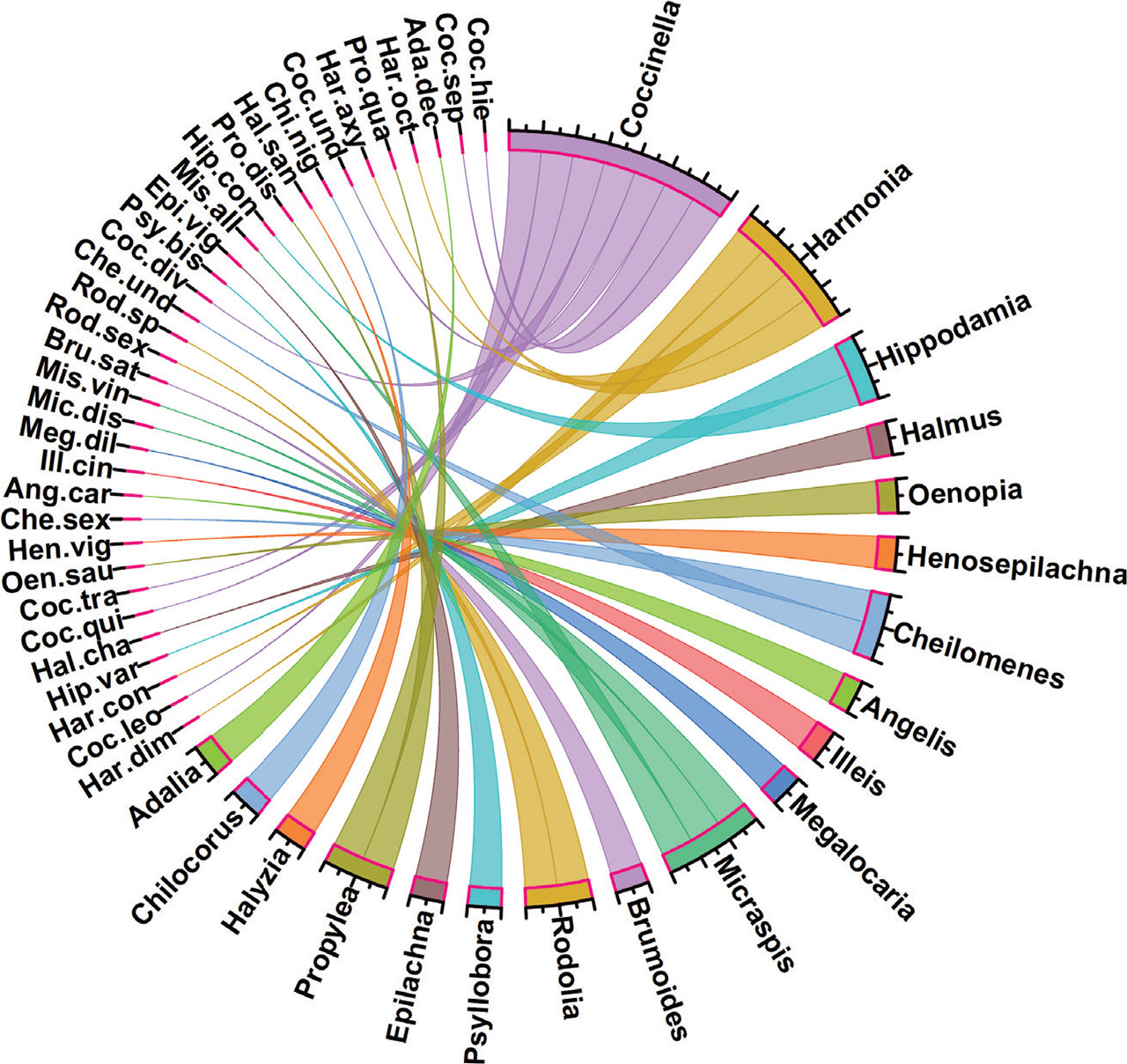
Figure 3:
The chord diagram reveals the number of documented species classified into different genera from the Dehradun district of Uttarakhand. The complete names of the species are provided in Table 2.
Slika 3: Tetivni diagram prikazuje število dokumentiranih vrst, uvrščenih v različne rodove v območju Dehradun (Uttarakhand). Celotna imena vrst so prikazana v Tabeli 2.

Figure 4:
Chord diagram showing the identified insect species at different altitudes of Dehradun (Uttarakhand, India). (“N” is number of species). The full names of the species are given in Table 2.
Slika 4: Tetivni diagram prikazuje vrste žuželk na različnih nadmorskih višinah v območju Dehradun (Uttarakhand, India). (“N” je število vrst). Celotna imena vrst so prikazana v Tabeli 2.
Table 3:
Species diversity at various selected altitudes of Dehradun (Uttarakhand, India).
Tabela 3: Vrstna pestrost na različnih nadmorskih višinah na območju Dehradun (Uttarakhand, Indija).
| Altitude | 300 m | 400 m | 500 m | 600 m | 700 m | |
|---|---|---|---|---|---|---|
| Individuals | 2160 | 1142 | 990 | 291 | 970 | |
| Diversity Indices | Dominance (D) | 0.04651 | 0.05743 | 0.07067 | 0.0971 | 0.1280 |
| Simpson (1-D) | 0.9532 | 0.9421 | 0.9290 | 0.9030 | 0.8720 | |
| Shannon (H) | 3.208 | 2.976 | 2.731 | 2.402 | 2.124 | |
| Evenness (e^H/S) | 0.8531 | 0.8182 | 0.8543 | 0.9245 | 0.9301 | |
| Margalef (D) | 3.641 | 3.21 | 2.460 | 1.930 | 1.160 | |
| Fisher_alpha (α) | 4.731 | 4.270 | 3.120 | 2.502 | 1.369 |
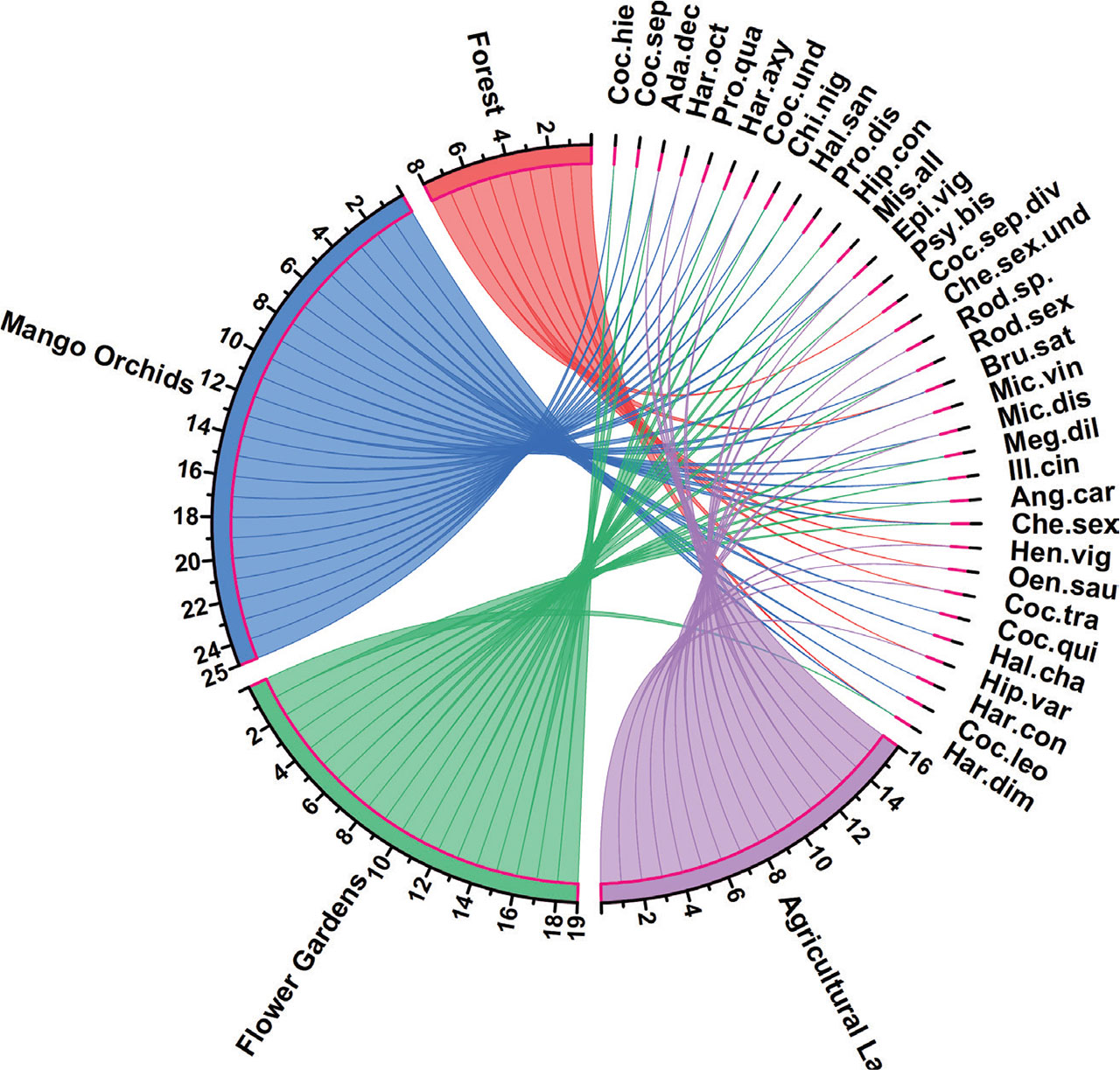
Figure 5:
Chord diagram showing the documented Coccinellids fauna in different habitats. The full names of the species are given in Table 2.
Slika 5: Tetivni diagram prikazuje vrste družine Coccinellidae v različnih habitatih. Celotna imena vrst so prikazana v Tabeli 2.
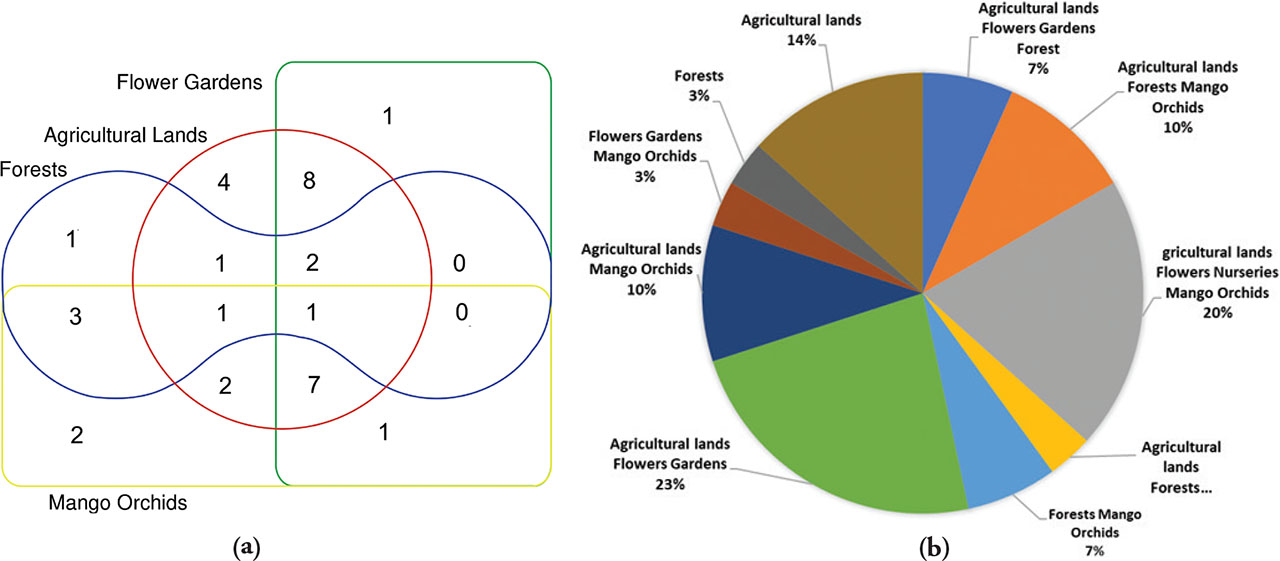
Figure 6:
(a) Venn diagram showing the number of unique and common species in different selected habitats (b) Percentage similarity between different habitats based on the occurrence of identified insect species in Dehradun (Uttarakhand, India).
Figure 6: (a) Vennov diagram specifičnih in skupnih vrst v različnih izbranih habitatih (b) odstotek podobnosti med različnimi habitati na osnovi pojavljanja vrst žuželk v območju Dehradun (Uttarakhand, Indija).
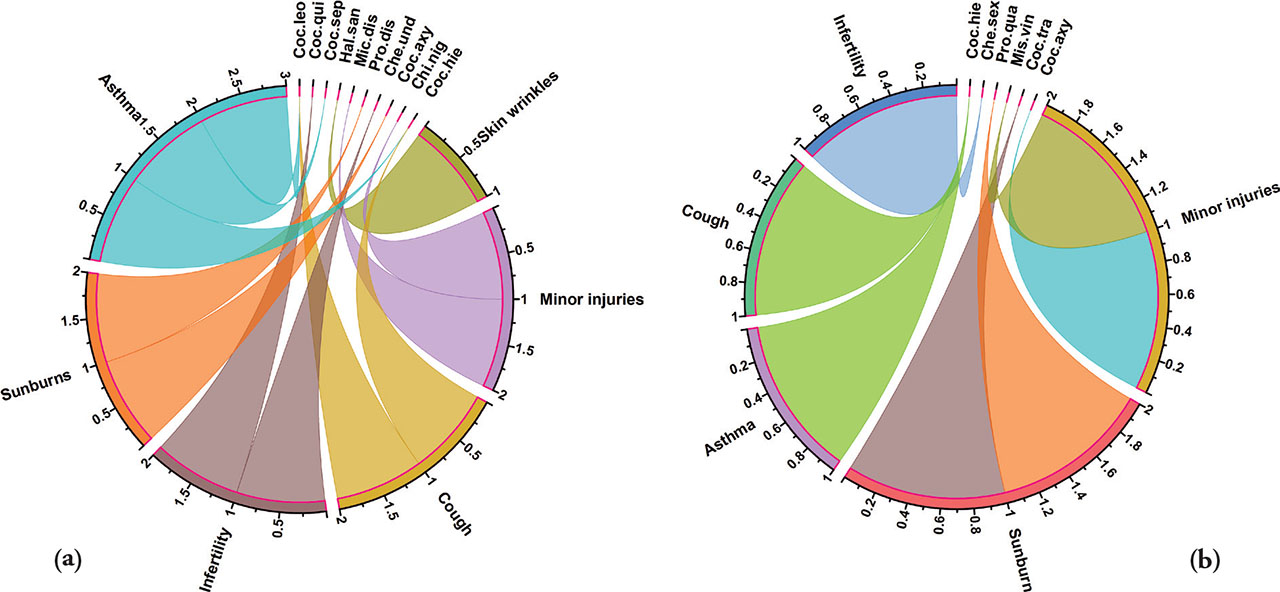
Figure 7:
(a) Chord diagram showing species used in the Gujjar community for a variety of diseases; (b) Chord diagram showing species used in the Pahari community for a variety of diseases. The full names of the species are listed in Table 2.
Slika 7: (a) tetivni diagram vrst, ki jih uporabljajo v skupnosti Gujjar za različne bolezni; (b) tetivni diagram vrst, ki jih uporabljajo v skupnosti Pahari za različne bolezni. Celotna imena vrst so prikazana v Tabeli 2.
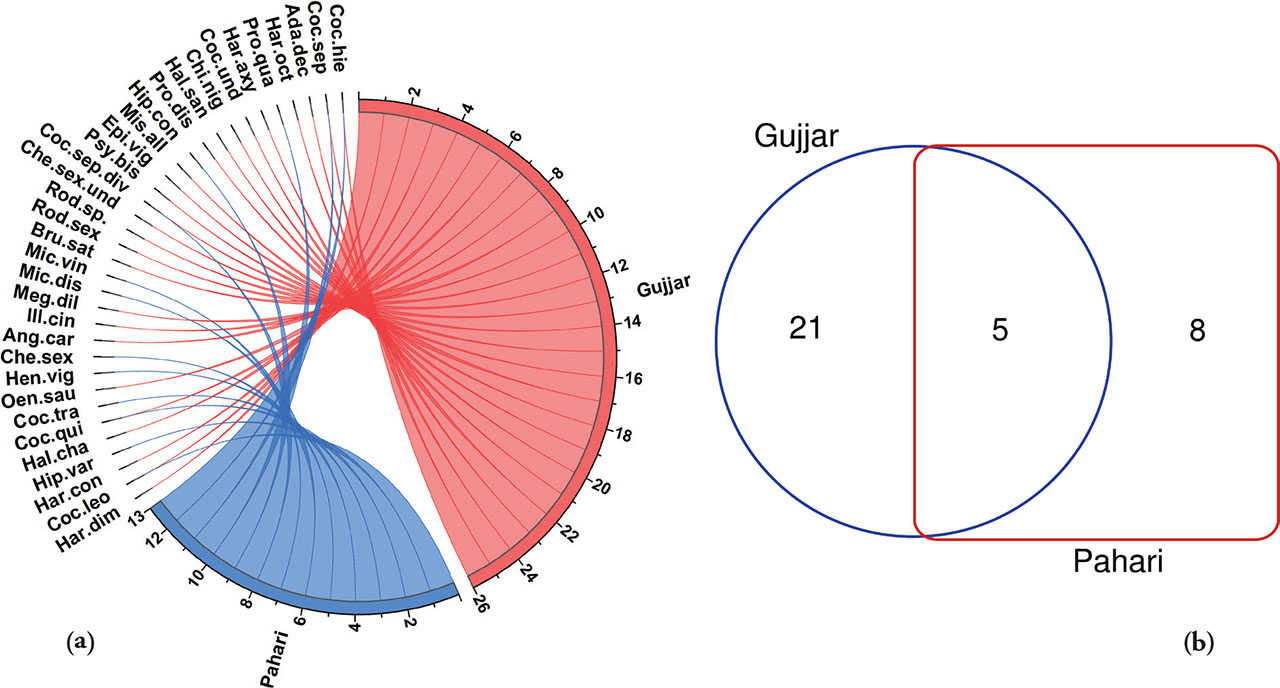
Figure 8:
(a) Chord diagram showing the species used by the ethnic communities (Gujjar, Pahari); (b) Venn diagram showing the number of unique and common species among Gujjar and Pahari in Dehradun (Uttarakhand, India). The complete names of the species are given in Table 2.
Slika 8: (a) tetivni diagram vrst, ki jih uporabljajo v etničnih skupnostih (Gujjar, Pahari); (b) Vennov diagram števila specifičnih in skupnih vrst v skupnostih Gujjar in Pahari v območju Dehradun (Uttarakhand, Indija). Celotna imena vrst so prikazana v Tabeli 2.