
Figure 1:
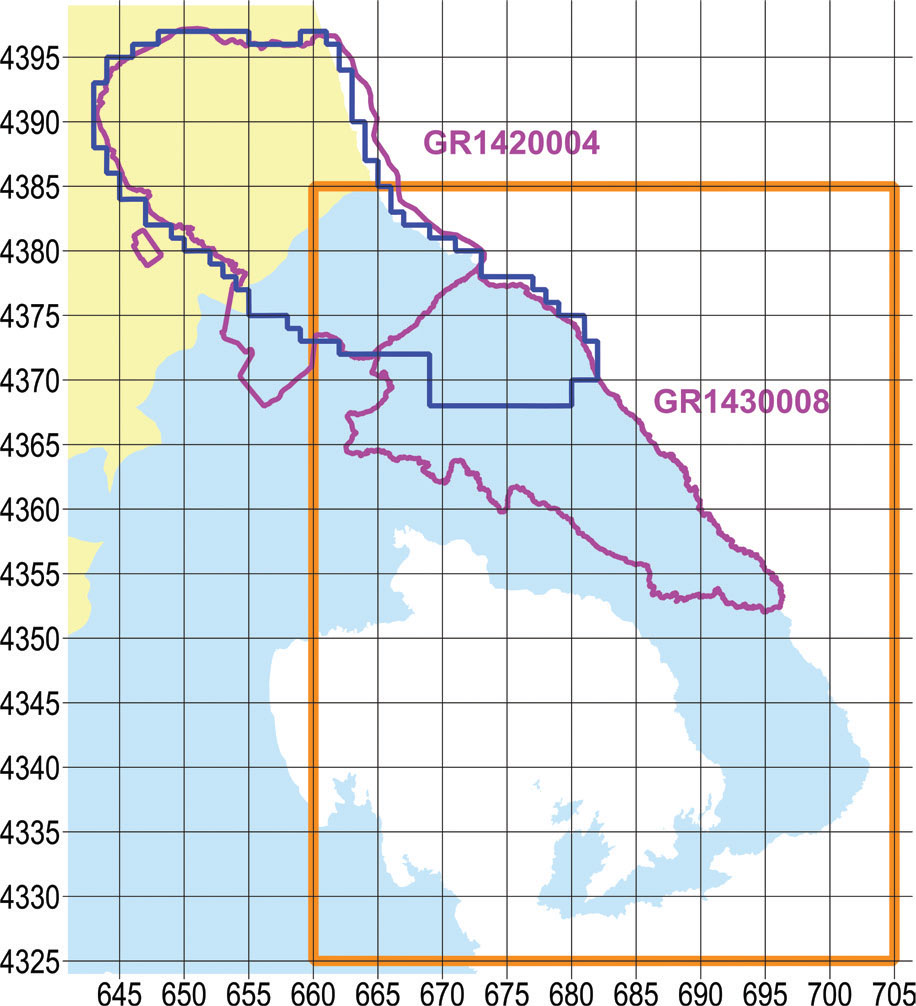
Map of the broader study area. With yellow ochre fill the prefecture of Larissa, with light blue fill the prefecture of Magnesia, with magenta outline the two Natura 2000 sites, with dark blue the outline of the narrow study area, and with orange outline the study area of Biel & Rudolph (1992). UTM grid spacing 5 km.
Slika 1: Zemljevid širšega preučevanega območja. Z rumeno je označena prefektura Larissa, s svetlomodro pa prefektura Magnesia, s škrlatno barvo obe območji Natura 2000, s temno modro barvo je označeno ožje preučevano območje in z oranžno preučevano območje v članku Biel & Rudolph (1992). Velikost kvadrantov UTM mreže je 5 km.
Table 1:
List of taxa (species and subspecies) recorded during the sampling period 2021–22 within the broader study area. In bold are those recorded within the narrow sampling area. Site numbers refer to Appendix I. Checkmark indicates mention of the taxon in the Flora Hellenica Database within the narrow sampling area.
Tabela 1: Seznam taksonov (vrst in podvrst) vzorčenih v obdobju od 2021 do 2022 v preučevanem območju. Številke nahajališč se nanašajo na Prilogo I. Kljukica označuje oznako taksona v bazi Flora Hellenica znotraj ožjega preučevanega območja.
| S/N | TAXON | SITES | FLORA HELLENICA |
|---|---|---|---|
| 1 | Anacamptis coriophora | 99 | ✓ |
| 2 | Anacamptis morio subsp. caucasica | 21, 24, 35, 43, 46, 48, 49, 52, 53, 55, 59, 80, 99, 103, 104, 105, 106 | ✓ (sub A. morio) |
| 3 | Anacamptis papilionacea subsp. papilionacea | 16, 21 | |
| 4 | Anacamptis pyramidalis | 27, 79 | |
| 5 | Cephalanthera longifolia | 29, 32, 33, 37, 46, 68, 71, 74, 76, 77, 82, 84, 85, 88, 89, 90, 96, 100, 104 | ✓ |
| 6 | Cephalanthera rubra | 32, 73, 77 | ✓ |
| 7 | Dactylorhiza romana | 10, 21, 45, 53, 54, 83, 87, 89, 90, 106 | ✓ |
| 8 | Dactylorhiza saccifera | 67, 69, 70, 72, 73, 75, 76, 82, 89, 90 | ✓ |
| 9 | Epipactis helleborine | 64, 68 | ✓ |
| 10 | Epipactis microphylla | 23, 32, 36, 73, 82, 89, 91 | ✓ |
| 11 | Himantoglossum calcaratum subsp. rumelicum | 62, 66 | ✓ (sub. H. jankae) |
| 12 | Himantoglossum robertianum | 3, 4, 28, 46 | |
| 13 | Limodorum abortivum | 3, 5, 8, 11, 14, 43, 66, 77, 84, 90, 94, 100 | ✓ |
| 14 | Neotinea maculata | 27, 32, 60, 76, 77, 89, 90, 91, 92, 94 | ✓ |
| 15 | Neotinea tridentata | 24, 40 | ✓ |
| 16 | Neottia nidus-avis | 73, 77 | ✓ |
| 17 | Ophrys × delphinensis | 12 | |
| 18 | Ophrys apifera | 99 | |
| 19 | Ophrys ferrum-equinum subsp. ferrum-equinum | 33 | |
| 20 | Ophrys reinholdii subsp. reinholdii | 13, 43, 44, 53 | ✓ (sub O. reinholdii) |
| 21 | Ophrys scolopax subsp. cornuta | 13, 18, 20, 25, 41, 43, 58, 65, 66, 77, 78, 81, 99, 103 | ✓ |
| 22 | Ophrys sicula (syn. O. lutea subsp. galilaea) | 12, 18, 26, 29, 33, 37 | |
| 23 | Ophrys speculum subsp. speculum | 6, 7 | |
| 24 | Ophrys sphegodes subsp. sphegodes (syn. O. hebes) | 43 | |
| 25 | Ophrys sphegodes subsp. spruneri | 26 | ✓ |
| 26 | Ophrys sphegodes subsp. taurica | 1, 2, 3, 5, 6, 8, 12, 18, 22, 25, 26, 43, 46, 60, 66 | ✓ (sub O. sphegodes subsp. mammosa) |
| 27 | Ophrys tenthredinifera | 1, 2, 3, 6 | |
| 28 | Ophrys tenthredinifera × O. sphegodes subsp. taurica | 3 | |
| 29 | Ophrys umbilicata subsp. umbilicata | 1, 2, 6, 25, 26 | |
| 30 | Orchis anthropophora | 24, 28, 29, 33, 37, 39, 41, 42, 45, 47, 60, 63 | ✓ |
| 31 | Orchis italica | 3, 12, 17, 18, 21, 33, 37, 38, 40, 42, 45, 46, 47, 50, 51, 52, 53, 56, 57, 66, 79, 80, 81, 86, 101 | |
| 32 | Orchis pauciflora | 24, 28, 42, 63 | ✓ |
| 33 | Orchis provincialis | 9, 35, 60, 77, 83, 89, 90, 91, 92, 93, 95 | ✓ |
| 34 | Orchis quadripunctata | 18, 28, 29, 30, 31, 34, 41, 42, 56, 57, 61, 63 | ✓ |
| 35 | Orchis simia | 24, 29, 34, 39, 42 | |
| 36 | Platanthera bifolia | 76 | |
| 37 | Platanthera chlorantha | 32, 77 | ✓ (sub P. chlorantha subsp. chlorantha) |
| 38 | Serapias bergonii | 103, 104 | ✓ (sub S. vomeracea subsp. laxiflora) |
| 39 | Serapias lingua | 104, 105, 106, 107 | ✓ |
| 40 | Serapias vomeracea | 2, 12, 48, 102 | ✓ (sub S. vomeracea subsp. vomeracea) |
| 41 | Spiranthes spiralis | 3, 5, 9, 10, 15, 18, 19, 31, 35, 66, 97, 98, 99 | ✓ |
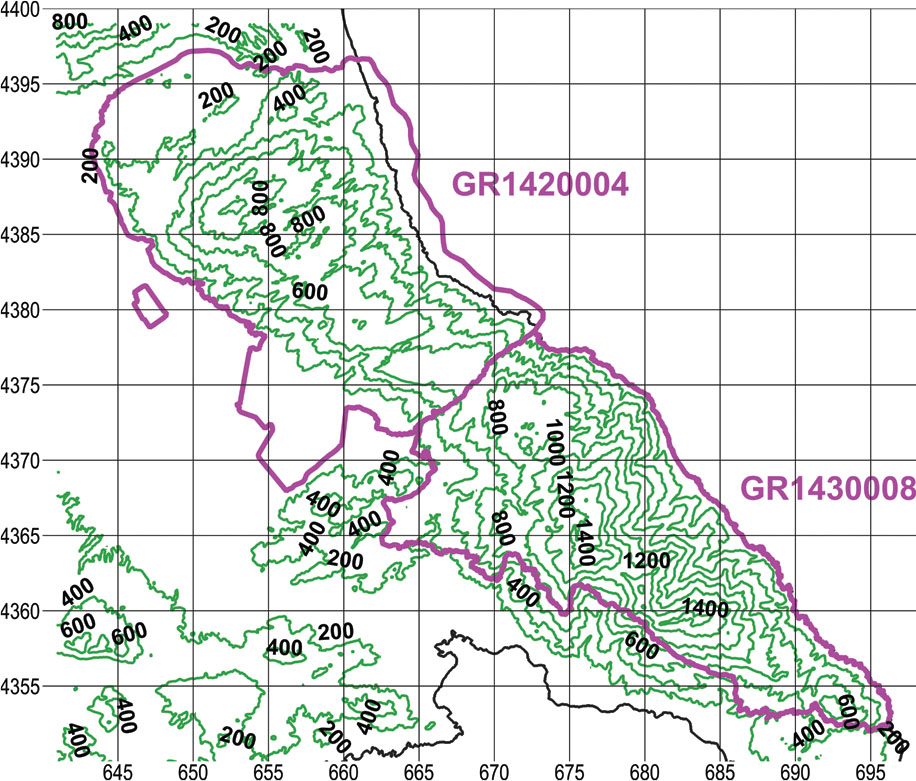
Figure 2:
Elevation map of the two Natura 2000 sites, outlined in magenta. Contour interval 200 m, UTM grid spacing 5 km.
Slika 2: Karta nadmorskih višin obeh območij Natura 2000 označenih s škrlatno barvo. Izohipse so v intervalu 200 m, velikost kvadrantov UTM mreže je 5 km.
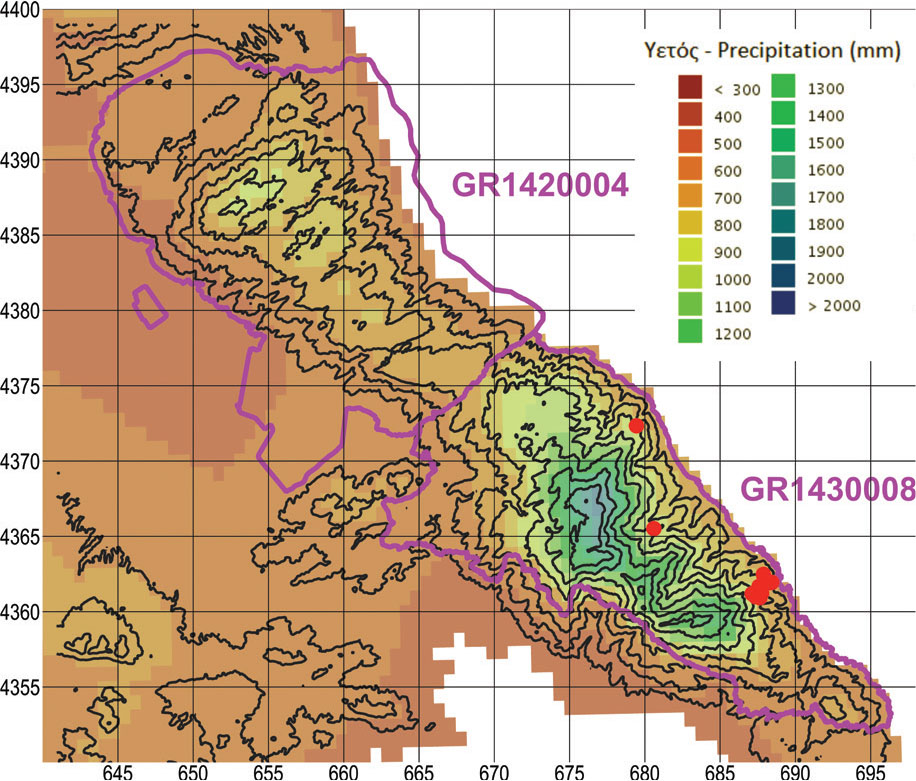
Figure 3:
Precipitation map of the two Natura 2000 sites, outlined in magenta. Red dots represent findings of Orchis provincialis during the preliminary scouting in the spring of 2021. UTM grid spacing 5 km.
Slika 3: Karta padavin dveh območij Natura 2000 označenih s škrlatno barvo. Rdeče točke predstavljajo nahajališča vrste Orchis provincialis med preliminarnim pregledom spomladi leta 2021. Velikost kvadrantov UTM mreže je 5 km.
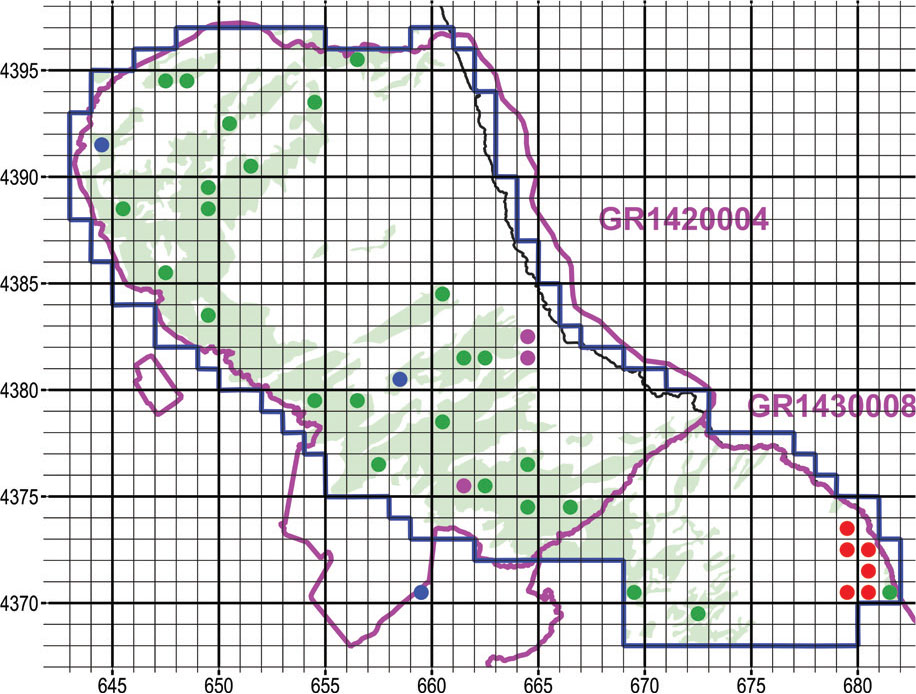
Figure 4:
Map of the sampling design during the main sampling phase, i.e., fall of 2021 (for Spiranthes spiralis) to spring of 2022. Olive green fill: Corine Land Cover classes that correspond to open habitats, i.e., a combination of scrub and/or herbaceous vegetation. Blue dots: Locations suggested by the supervisory authority. Magenta dots: Locations with Ophrys scolopax subsp. cornuta by Biel & Rudolph (1992). Red dots: Locations likely to host Orchis provincialis based on the preliminary scouting. Green dots: Sampling units selected at random. UTM grid spacing 1 km.
Slika 4: Zemljevid prikazuje način vzorčenja med glavno fazo, to je od jeseni 2021 (za vrsto Spiranthes spiralis) do spomladi 2022. Olivno zelena: razredi Corine Land Cover, ki predstavljajo odprte habitate, to je kombinacijo grmiščne in/ali zeliščne vegetacije. Modre točke: lokacije, ki so jih predlagale nadzorne oblasti. Škrlatne točke: lokacije z Ophrys scolopax subsp. cornuta iz publikacije Biel & Rudolph (1992). Rdeče točke: lokacije, na osnovi predhodnega pregleda terena, kjer se verjetno pojavlja Orchis provincialis. Zelene točke: naključne vzorčne točke. Velikost kvadrantov UTM mreže je 1 km.
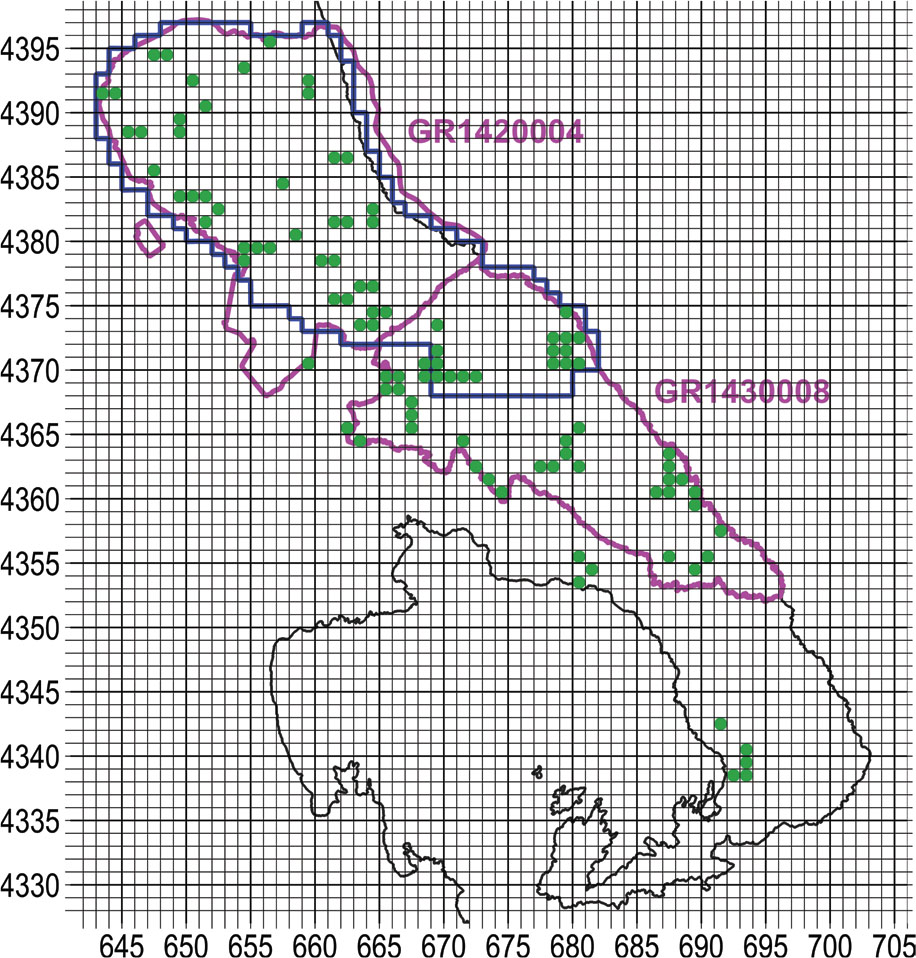
Figure 5:
Map with sampling units 1 km wide that yielded orchid findings within the broader study area during 2021–2022. With magenta outline the two Natura 2000 sites, with dark blue the outline of the narrow study area. UTM grid spacing 1 km.
Slika 5: Zemljevid kvadrantov velikosti 1 km, kjer smo v letih 2012–2022 našli orhideje v večjem preučevanem območju. S škrlatno barvo sta označeni območji Natura 2000, s temno modro pa ožje preučevano območje. Velikost kvadrantov UTM mreže je 1 km.
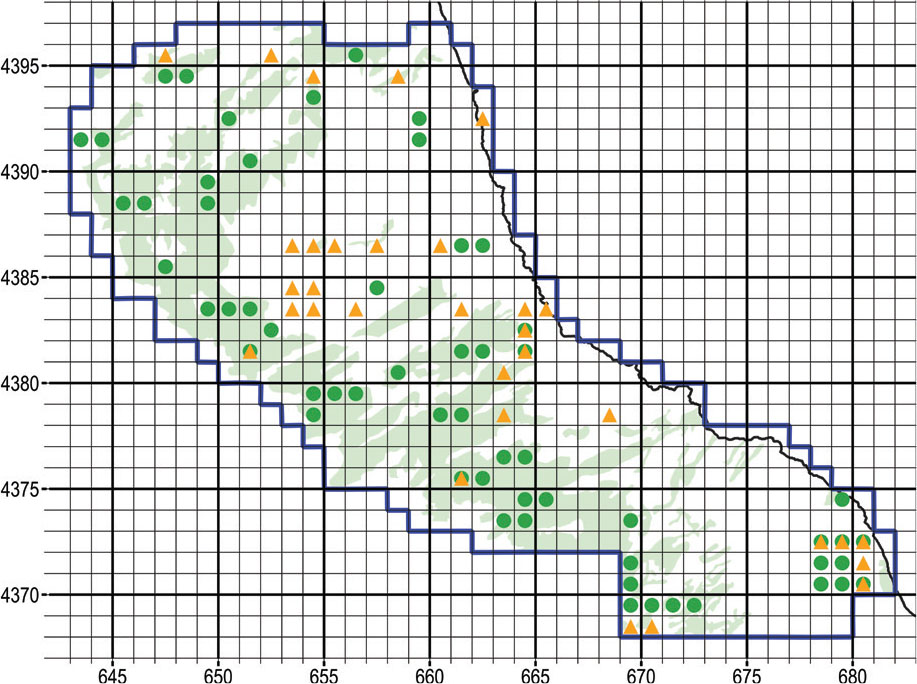
Figure 6:
Map with square cells 1 km wide that yielded orchid findings within the narrow study area during 2021–2022. Green dots represent our findings, orange triangles represent records from the Flora Hellenica Database, mostly predating 1992. UTM grid spacing 1 km.
Slika 6: Zemljevid kvadrantov velikosti 1 km, kjer smo v letih 2012–2022 našli orhideje v večjem preučevanem območju. Zelene točke predstavljajo naše najdbe, oranžni trikotniki so podatki iz Flora Hellenica Database, predvsem pred letom 1992. Velikost kvadrantov UTM mreže je 1 km.
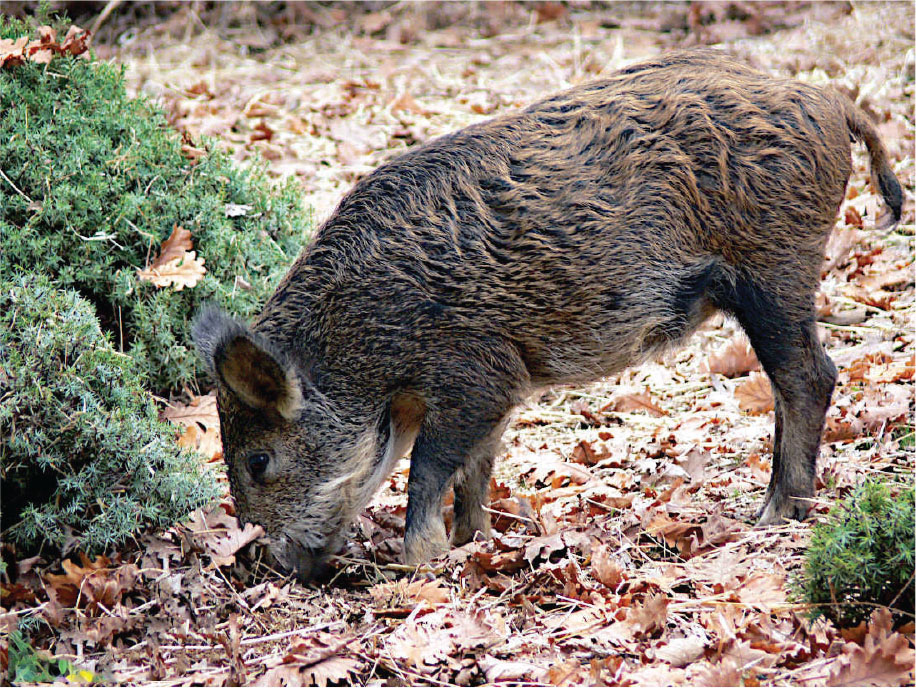
Figure 7:
Fearless of humans, feral swine dig up important orchid biotopes at site Psili Rachi I on Mount Mavrovouni.
Slika 7: Divji prašiči, ki se ljudi ne bojijo, so prekopali pomembna rastišča orhidej na lokaciji Psili Rachi I na gori Mavrovouni.
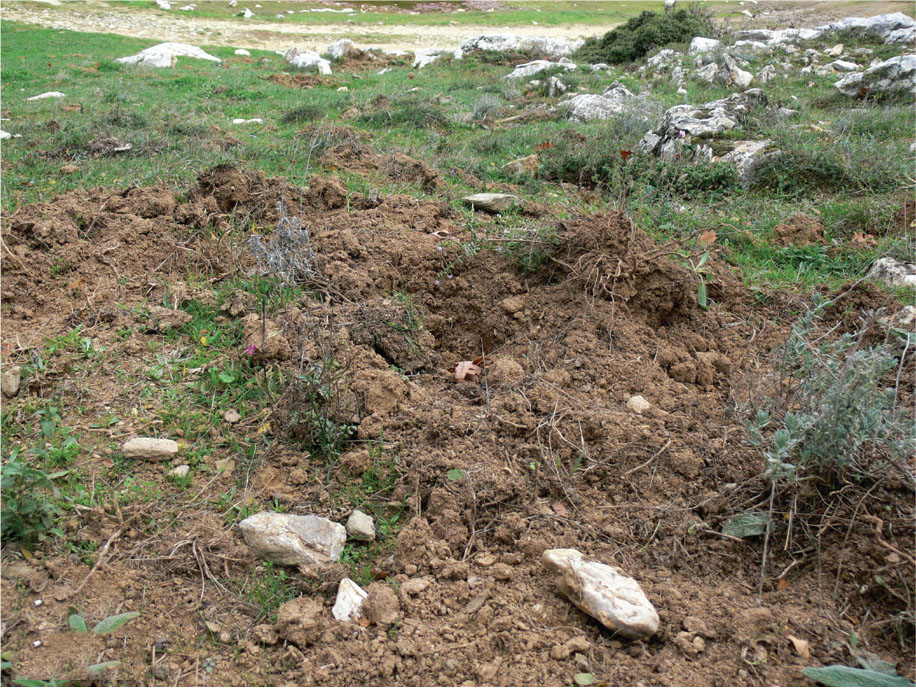
Figure 8:
Feral swine devastate large tracts of land near the hamlet of Ano Kerasia on Mount Pelion. In the fall of 2021, the supervisory authority tipped us off about a sizeable population of Spiranthes spiralis. By the time we got there, the site was all dug up.
Slika 8: Divji prašiči so uničili velike površine zemljišč blizu naselja Ano Kerasia na gori Pelion. Jeseni 2021 so nas odgovorni obvestili o veliki populaciji vrste Spiranthes spiralis, vendar je bilo rastišče do našega prihoda že razrito.
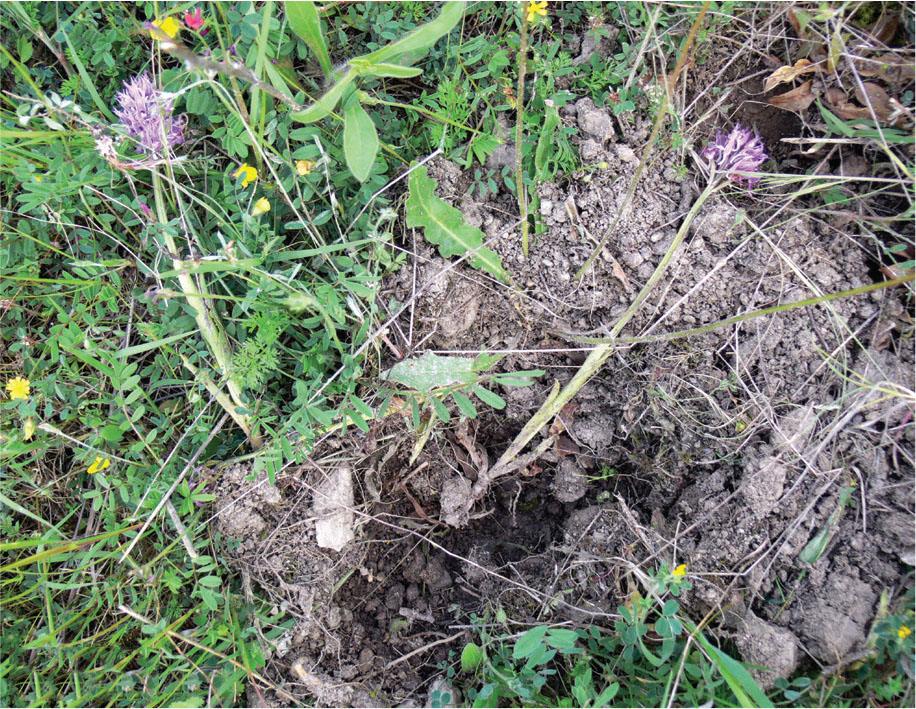
Figure 9:
Specimens of Orchis italica dug up by feral pigs at site Metochi of S Magnesia.
Slika 9: Primerki vrste Orchis italica, ki so jih izkopali divji prašiči na lokaciji Metochi v južnem delu območja Magnesia.
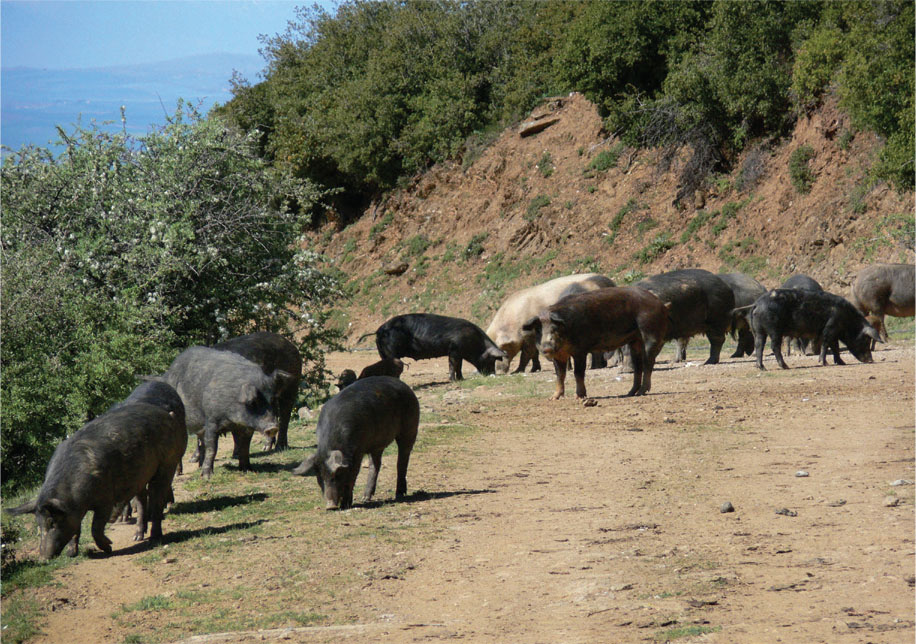
Figure 10:
Domesticated, free-range pigs graze unattended at site Kalamaki of Larissa.
Slika 10: Udomačeni prašiči, na lokaciji Kalamaki v območju Larissa, ki se prosto pasejo.
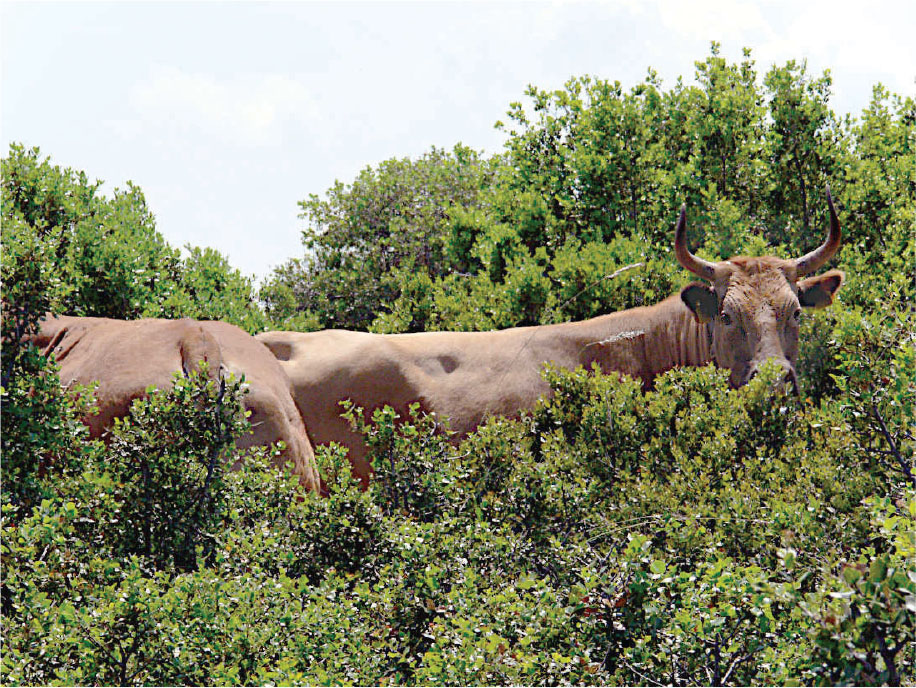
Figure 11:
Beef cattle force their way through the pseudo-maquis, trampling numerous orchids in the process. Site Agrioachladia on Mount Mavrovouni.
Slika 11: Govedo, ki se prebija skozi pseudomakijo, potepta številne orhidje. Lokacija Agrioachladia na gori Mavrovouni.
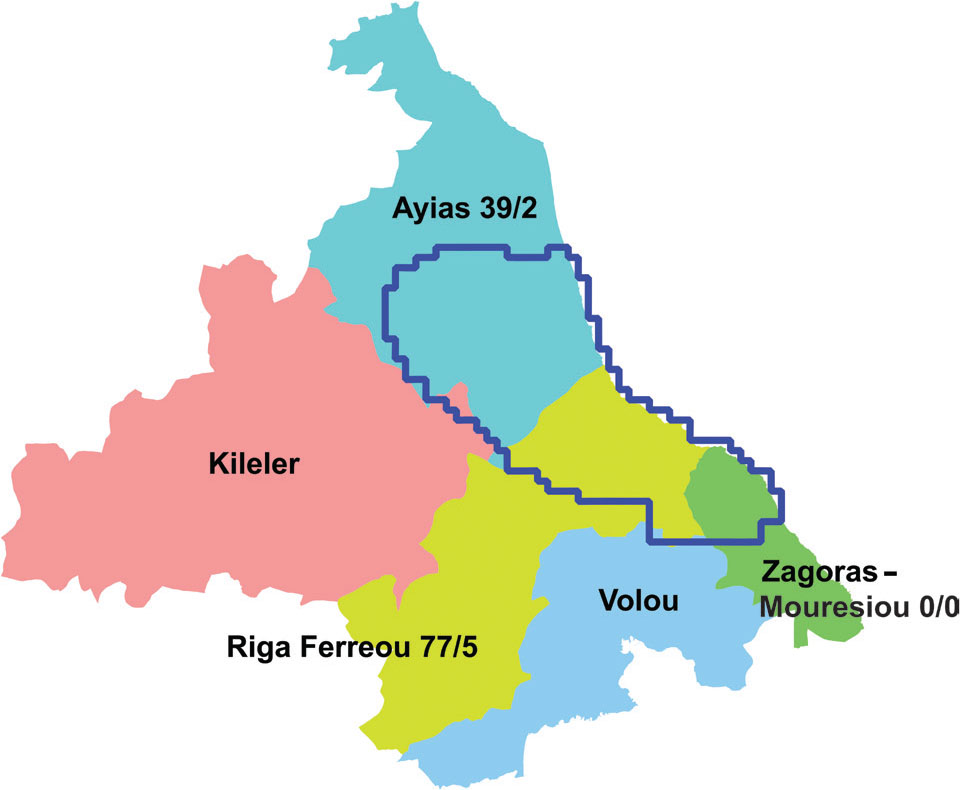
Figure 12:
The narrow sampling area, outlined in dark blue, is shared among the Municipalities of Ayia, Riga Ferreou, and Zagora-Mouresi. The numbers after each Municipality are tallies of small ruminants/bovines, in thousand heads.
Slika 12: Ožje preučevano območje, označeno s temno modro, sega v občine Ayia, Riga Ferreou in Zagora-Mouresi. Številke ob imenu občine so seštevki malih prežvekovalcev/goveda v tisočih glav.
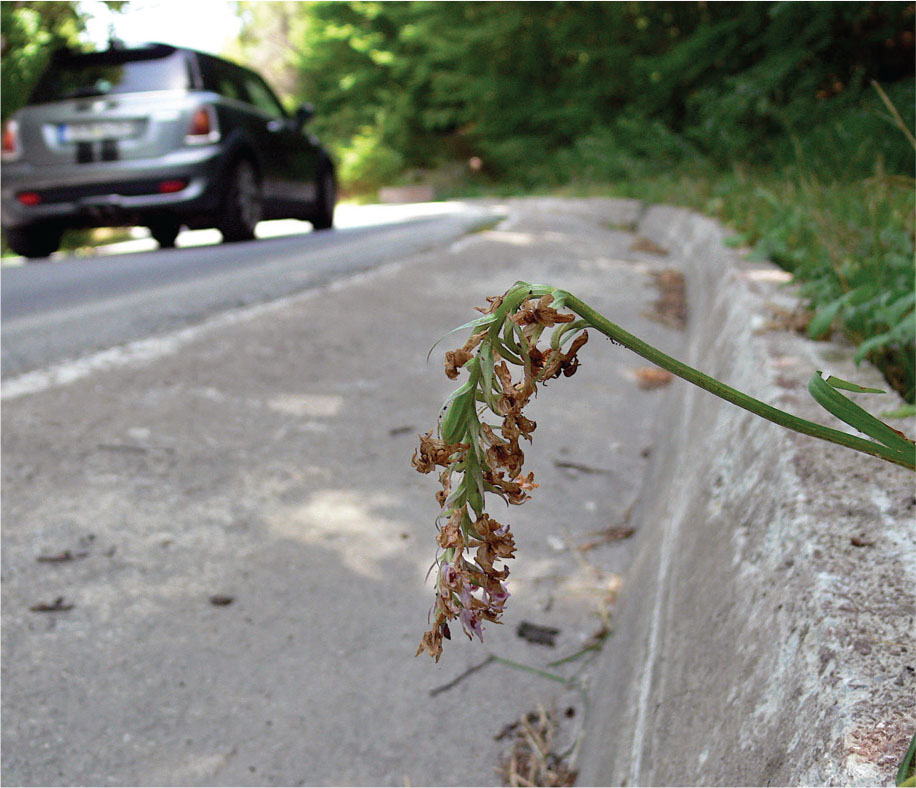
Figure 13:
The verges on either side of the road from Chania to Kissos on Mount Pelion are rich in orchids such as Dactylorhiza saccifera and Epipactis microphylla. A lone inflorescence of D. saccifera escaped mowing.
Slika 13: Na cestnih brežinah na obeh straneh ceste od naselja Chania do naselja Kissos na gori Pelion, so bogata nahajališča orhidej, kot sta Dactylorhiza saccifera in Epipactis microphylla. Le eno socvetje D. saccifera ni bilo pokošeno.
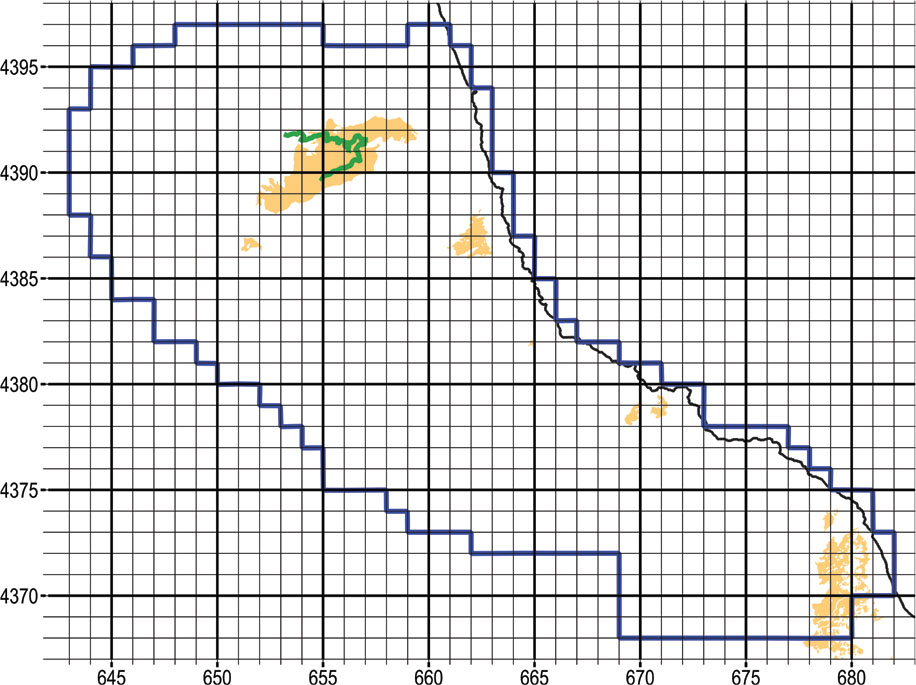
Figure 14:
Orange fill indicates chestnut woods (natural and cultivated) within the narrow study area. Since Corine Land Cover is not so detailed, photo-interpretation was provided by the Management Unit of Protected Areas of Thessaly. We surveyed along the green trail that crosses the expansive chestnut plantations E and S of the village of Potamia. UTM grid spacing 1 km.
Slika 14: Oranžna barva označuje kostanjeve gozdove (naravne in kultivirane) v ožjem preučevanem območju. Ker Corine Land Cover ni tako natančen, smo uporabili foto-interpretacijo, ki nam jo je posredovala Uprava zavarovanih območij Tesalije. Terenski pregled smo opravili ob zeleni poti, ki prečka kostanjeve nasade vzhodno in južno od vasi Potamia. Velikost kvadrantov UTM mreže je 1 km.
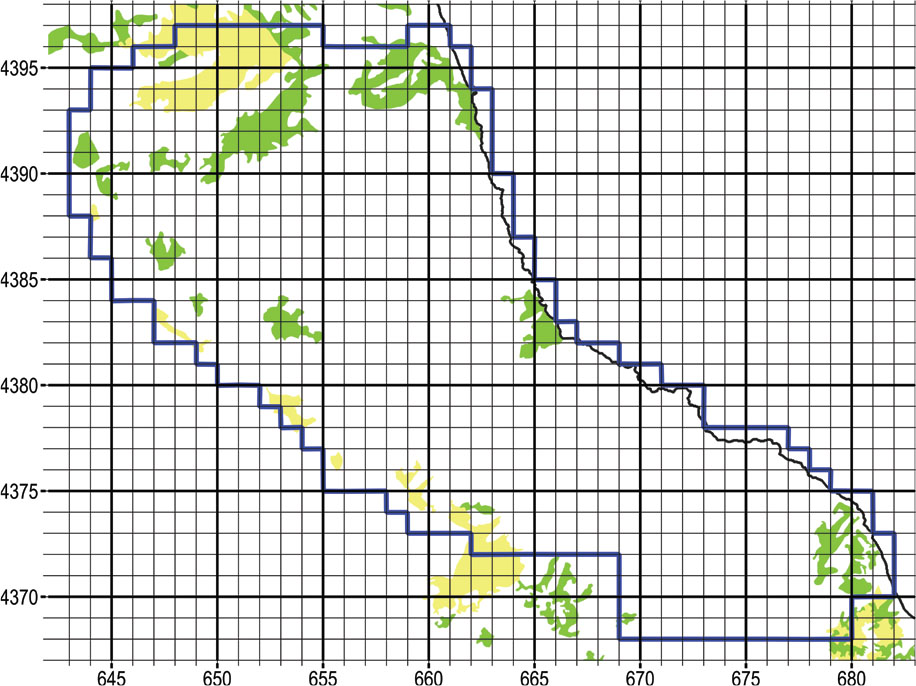
Figure 15:
Yellow fill indicates Corine Land Cover class “2.2.2 Fruit trees and berry plantations”. Green fill indicates class “2.4.3 Land principally occupied by agriculture, with significant areas of natural vegetation.” At the N and the SE part of the narrow study area, these two classes correspond primarily to apple orchards that may be interspersed with patches of natural vegetation. UTM grid spacing 1 km.
Slika 15: Z rumeno je označena Corine raba tal “2.2.2 Sadovnjaki in nasadi jagodičja”. Zelena predstavlja rabo “2.4.3 Kmetijska zemljišča z večjim deležem naravne vegetacije”. Na severnem in jugovzhodnem delu ožjega preučevanega območja ta tip rabe predstavljajo predvsem sadovnjaki jablan, ki se izmenjujejo s pasovi naravne vegetacije. Velikost kvadrantov UTM mreže je 1 km.
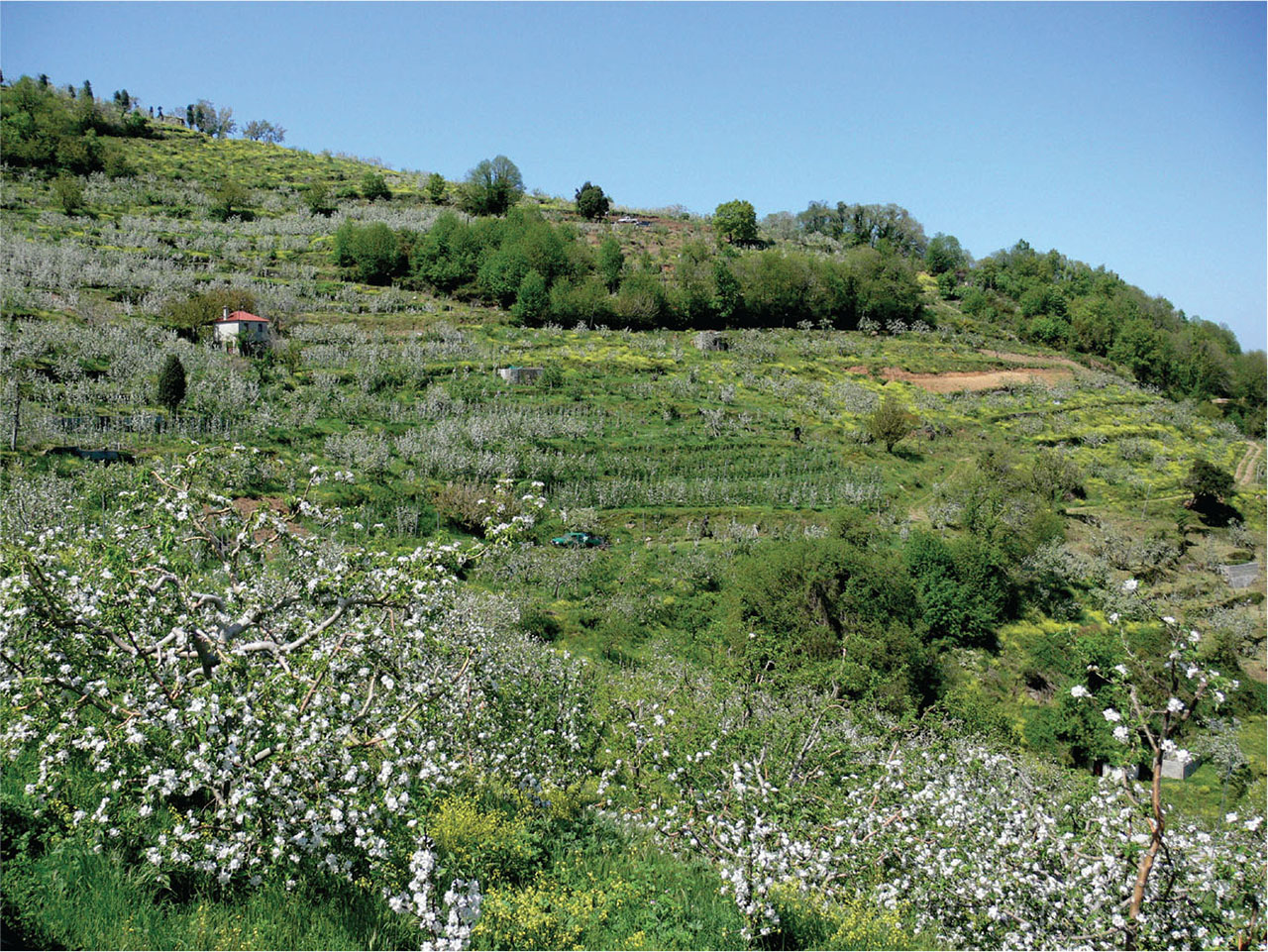
Figure 16:
Hillslopes around the village of Pouri largely covered by intensive apple orchards. The occasional orchids find refuge within patches of native chestnut forest (top).
Slika 16: Pobočja pri vasi Pouri, kjer so intenzivni nasadi jablan. Orhideje občasno uspevajo v zaplatah naravnega kostanjevega gozda (zgoraj).
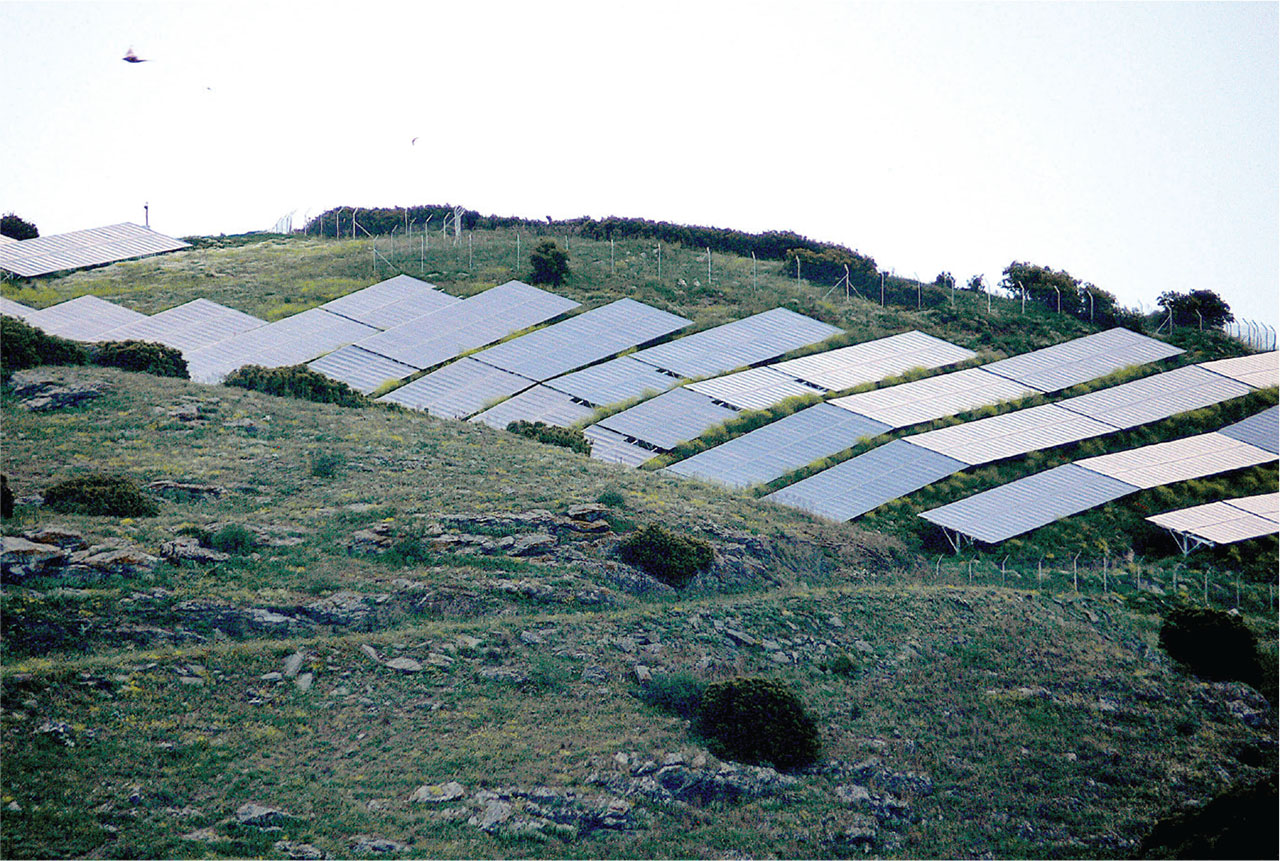
Figure 17:
A large photovoltaic park on the hill NE of the village of Neochori (Plasia) of Larissa, once a rich orchid biotope. The native vegetation has been cleared with fire and bulldozers.
Slika 17: Velik fotovoltaični park na SV hribu pri vasi Neochori (Plasia) v območju Larissa, kjer je bilo nekoč z orhidejami bogato rastišče. Naravno vegetacijo so odstranili z ognjem in mehanizacijo.
| S/N | UTM | SITE | DESCRIPTION |
|---|---|---|---|
| 1 | 643 4391 | Neochori II | Asphodel rangeland dotted with patches of kermes oak on hilly terrrain 0.5 km NE of Neochori, 130 m a.s.l. |
| 2 | 644 4391 | Neochori I | Asphodel rangeland dotted with patches of kermes oak on hilly terrrain at the fringe of vast solar park 0.7–0.9 km NE of Neochori, 100–150 m a.s.l. |
| 3 | 645 4388 | Kastri I | Asphodel rangeland interspersed with patches of short kermes oak on rolling terrain 1.1–1.8 km NE of Kastri, 260–300 m a.s.l. |
| 4 | 646 4388 | Kastri II | Short, thin maquis of kermes oak on rolling terrain 1.9 km NE of Kastri, 250 m a.s.l. |
| 5 | 647 4385 | Ano Amygdali | Mosaic of maquis, phrygana, farmland and cypress stands on rolling terrain 0.2–0.5 km NW of Ano Amygdali, 340–360 m a.s.l. |
| 6 | 647 4394 | Aetolofos II | Sparse abandoned olive grove overgrown with phrygana on hillslope 0.1 km NW of Aetolofos, 130 m a.s.l. |
| 7 | 648 4394 | Aetolofos I | Sparse abandoned olive grove overgrown with phrygana on hillslope 0.3 km N of Aetolofos, 180 m a.s.l. |
| 8 | 649 4383 | Kalamaki Larissas | Dirt road winding through tall, dense maquis of kermes oak on rolling terrain 1.5–2 km N of Kalamaki, 390–490 m a.s.l. |
| 9 | 649 4388 | Stavros II | Dense, impenetrable maquis of kermes oak on hilly terrain 4.8 km SW of Potamia, 220–230 m a.s.l. |
| 10 | 649 4389 | Stavros I | Dirt road winding through tall, dense, impenetrable maquis on hilly terrain 3.8 km SW of Potamia, 200 m a.s.l. |
| 11 | 650 4383 | Konstadouli Rachi I | Dirt road winding through tall, dense maquis of kermes oak on rolling terrain 1.7 km N-NE of Kalamaki, 480 m a.s.l. |
| 12 | 650 4392 | Potamia II | Tiny patches of rangeland among tall, dense maquis of kermes oak on rolling terrain 2.7 km W-NW of Potamia, 140 m a.s.l. |
| 13 | 651 4381 | Petralona | Paved road through degraded maquis on rolling terrain 1.2 km E of Kalamaki, 300 m a.s.l. |
| 14 | 651 4383 | Konstadouli Rachi II | Dirt road winding through tall, dense maquis of kermes oak on rolling terrain 2.4 km NE of Kalamaki, 500 m a.s.l. |
| 15 | 651 4390 | Potamia I | Dirt road meandering through short, thin maquis interspersed with cultivated fields on hilly terrain 1.9 km SW of Potamia, 160–180 m a.s.l. |
| 16 | 652 4382 | Elafos | Dirt road through degraded maquis on rolling terrain 0.2 km SW of Elafos, 460 m a.s.l. |
| 17 | 654 4378 | Gianni Palla III | Abandoned olive grove overgrown with kermes oak and Jerusalem thorn on hillside 2.2 km N-NW of Keramidiotika Kalivia, 220 m a.s.l. |
| 18 | 654 4379 | Gianni Palla I | Thin, tall maquis of kermes oak on steep rocky mountainous terrain 2.5–3.1 km N-NW of Keramidiotika Kalivia, 120–340 m a.s.l. |
| 19 | 654 4393 | Skiti II | Tall maquis at the fringe of cultivated fields on hilly terrain 1.7–2.0 km W of Skiti, 140–190 m a.s.l. |
| 20 | 655 4379 | Souvalitsa | Dirt road winding through maquis of kermes oak on hilly terrain 2.6 km N of Keramidiotika Kalivia, 370 m a.s.l. |
| 21 | 656 4379 | Gianni Palla II | Vast expanse of phrygana interspersed with dwarf kermes oak and tall Hungarian oak on mountainous terrain 2.7–3.5 km N-NE of Keramidiotika Kalivia, 430–540 m a.s.l. |
| 22 | 656 4395 | Skiti I | Road winding through gorge with steep slopes lined with maquis forest and orchards 1.1 km N of Skiti, 250 m a.s.l. |
| 23 | 657 4384 | Koryfi | Dirt road through beech forest 3.4 km SW of Sklithro, 770 m a.s.l. |
| 24 | 658 4380 | Agrioachladia | Rocky clearings within short, dense maquis of kermes oak on relatively flat terrain, heavily grazed by cattle 5.7 km W-SW of Keramidi, 670 m a.s.l. |
| 25 | 659 4370 | Gerani Hill | Phryganic patches among tall, dense maquis of kermes oak and Jerusalem thorn at the foot of Gerani Hill 3.5 km SW of Kanalia, 90–100 m a.s.l. |
| 26 | 659 4370 | Karla | Gently sloping rangeland dotted with kermes oak, wild pear and Jerusalem thorn between Gerani Hill and Lake Karla 3.4 km SW of Kanalia, 50–60 m a.s.l. |
| 27 | 659 4391 | Ano Polydendri | Dirt road through mixed deciduous forest 2.4 km SW of Kato Polydendri, 320 m a.s.l. |
| 28 | 660 4378 | Tsaghiani I | Dwarf maquis of kermes oak degraded by heavy grazing on rocky, hilly terrain 4.7–5.0 km N-NW of Kanalia, 770–790 m a.s.l. |
| 29 | 661 4375 | Kanalia II | Short, thin maquis of kermes oak on rocky hillslope 1.4–1.7 km N-NW of Kanalia, 360–510 m a.s.l. |
| 30 | 661 4378 | Tsaghiani II | Dwarf maquis of kermes oak degraded by heavy grazing on rocky, hilly terrain 4.2–4.3 km N of Kanalia, 740–760 m a.s.l. |
| 31 | 661 4381 | Keramidi I | Clearings among tall, dense maquis of kermes oak on very rocky ground along a valley 2–3 km W-SW of Keramidi, 540–620 m a.s.l. |
| 32 | 661 4386 | Sklithro I | Mixed chestnut/oak forest on sloping terrain 0.4–0.6 km NE of Sklithro, 230–340 m a.s.l. |
| 33 | 662 4365 | Dog refuge | Phryganic patches among maquis of kermes oak at the foot of unnamed hill 1.7 km S-SE of Glafyra, 370 m a.s.l. |
| 34 | 662 4375 | Kanalia I | Short, dense maquis of kermes oak on rocky hillslope 1.4–1.6 km N of Kanalia, 480–560 m a.s.l. |
| 35 | 662 4381 | Keramidi II | Banks of Kakorema Brook running through patches of tall, dense maquis of kermes oak and rangeland dotted with wild pear 1.1–2 km W-SW of Keramidi, 500–560 m a.s.l. |
| 36 | 662 4386 | Sklithro II | Mixed forest of chestnut/Hungarian oak on sloping terrain 1.3 km NE of Sklithro, 230–340 m a.s.l. |
| 37 | 663 4364 | Amygdalia | Large expanse of degraded maquis on rolling terrain 2.4 km N-NE of Melissatika, 300–310 m a.s.l. |
| 38 | 663 4373 | Labitsa III | Short, dense maquis of kermes oak on mountainous terrain 1.6 km E of Kanalia, 210 m a.s.l. |
| 39 | 663 4376 | Psili Rachi I | Abandoned olive grove overgrown with juniper, mock privet, and kermes oak on rolling terrain 2.5 km NE of Kanalia, 670 m a.s.l. |
| 40 | 664 4373 | Labitsa II | Short, dense maquis of kermes oak on mountainous terrain 1.7–2.1 km E of Kanalia, 250–310 m a.s.l. |
| 41 | 664 4374 | Labitsa I | Short, dense maquis of kermes oak on mountainous terrain 2.5 km E of Kanalia, 370 m a.s.l. |
| 42 | 664 4376 | Psili Rachi II | Short, thin maquis of kermes oak and juniper on rocky, rolling terrain 2.8–3.2 km NE of Kanalia, 690–720 m a.s.l. |
| 43 | 664 4381 | Keramidi III | Tall, thin maquis interspersed with rangeland on hilly terrain 0.5 km SE of Keramidi, 360–420 m a.s.l. |
| 44 | 664 4382 | Keramidi IV | Paved road winding through terraces of chestnut forest, farmland, and rangeland 0.5 km E of Keramidi, 290 m a.s.l. |
| 45 | 665 4368 | Paliambela I | Patches of Cistus phrygana among maquis on rolling terrain 1.3–1.6 km S of Kerasia, 320–340 m a.s.l. |
| 46 | 665 4369 | Kerasia I | Paved road winding through tall, dense maquis of kermes oak in the valley S of Kerasia, 150–210 m a.s.l. |
| 47 | 665 4374 | Labitsa IV | Short, dense maquis of kermes oak on mountainous terrain 2.8–3.5 km E-NE of Kanalia, 420–570 m a.s.l. |
| 48 | 666 4368 | Paliambela II | Patches of Cistus phrygana among maquis on rolling terrain 1.6 km SE of Kerasia, 350 m a.s.l. |
| 49 | 666 4369 | Kerasia II | Dirt road winding through tall, dense maquis of kermes oak in the valley 0.7–0.9 km SE of Kerasia, 230–260 m a.s.l. |
| 50 | 667 4365 | Lomvarda | Dirt road winding through maquis on hill slope 1.2 km N-NE of Gioni, 360 m a.s.l. |
| 51 | 667 4366 | Licopazaro | Dirt road winding through maquis on hill slope 2.1 km N-NE of Gioni, 420 m a.s.l. |
| 52 | 667 4367 | Alevizou Bridge | Dirt road winding through maquis on hill slope 2.9 km N-NE of Gioni, 350–380 m a.s.l. |
| 53 | 668 4369 | Panagia Paliochoritisa | Dirt road winding through tall, dense maquis of kermes oak on sloping terrain 2.5 km SE of Kerasia, 340 m a.s.l. |
| 54 | 668 4370 | Agios Athanasios | Dirt road winding through tall, dense maquis of kermes oak on sloping terrain 3.2 km E of Kerasia, 550 m a.s.l. |
| 55 | 669 4369 | Moni Sourvias V | Clearings amidst regenerated forest of Hungarian oak on hillslope 4 km E-SE of Kerasia, 480–530 m a.s.l. |
| 56 | 669 4370 | Moni Sourvias I | Tall, dense maquis of kermes oak on hilly terrain 3.6 km E-NE of Kerasia, 600 m a.s.l. |
| 57 | 669 4371 | Kastanitsa | Tall, dense maquis of kermes oak on hilly terrain 3.6 km E-NE of Kerasia, 680–700 m a.s.l. |
| 58 | 669 4373 | Kosta Rachi | Degraded maquis on steep slope 0.8 km NE of Ano Kerasia, 720 m a.s.l. |
| 59 | 670 4369 | Moni Sourvias IV | Clearing amidst regenerated forest of Hungarian oak on hill slope 4.3 km E of Kerasia, 610 m a.s.l. |
| 60 | 671 4364 | Profitis Ilias Makrinitsas | Mosaic of tall, thin maquis of kermes oak and juniper, phrygana, and farmland on hilly terrain 0.9–1.2 km N-NE of Makrinitsa, 970–990 m a.s.l. |
| 61 | 671 4369 | Moni Sourvias III | Clearing amidst beech forest dotted with dwarf kermes oak on the banks of Kerasiotis gorge 6.2 km E of Kerasia, 830 m a.s.l. |
| 62 | 672 4362 | Moni Sarof | Paved road through mixed deciduous forest 0.3 km NW of Sarof Monastery, 740 m a.s.l. |
| 63 | 672 4369 | Moni Sourvias II | Clearings of rocky rangeland amidst mixed forest of beech and kermes oak along the banks of Kerasiotis gorge 6.7 km E-SE of Kerasia, 840–880 m a.s.l. |
| 64 | 673 4361 | Agia Triada Portarias | Chestnut forest on mountain slope 1 km E of Portaria, 800 m a.s.l. |
| 65 | 674 4360 | Alikopetra I | Phrygana on sloping terrain 1.9 km W of Drakia, 810 m a.s.l. |
| 66 | 674 4360 | Alikopetra II | Phrygana on sloping terrain 1.5 km W of Drakia, 970–1000 m a.s.l. |
| 67 | 677 4362 | Chania | Paved road through beech forest just E of Chania, 1180 m a.s.l. |
| 68 | 678 4362 | Ski Resort II | Beech forest on sloping terrain 1.1 km E-SE of Chania, 1220 m a.s.l. |
| 69 | 678 4370 | Agia Marina | Beech forest on steep slope 1.8 km SW of Pouri, 970–1010 m a.s.l. |
| 70 | 678 4371 | Vlachochorafa | Chestnut forest on sloping terrain 1.5 km W of Pouri, 810 m a.s.l. |
| 71 | 678 4372 | Pouri VII | Terraces of chestnut plantation on steep slope 1.3 km NW of Pouri, 650 m a.s.l. |
| 72 | 679 4363 | Nisaki | Dirt road through beech forest on steep mountain slope 1.1 km N of ski resort, 910–920 m a.s.l. |
| 73 | 679 4364 | Profitis Ilias | Beech forest on sloping terrain 0–0.6 km NE of Profitis Ilias church, 780–830 m a.s.l. |
| 74 | 679 4370 | Pouri V | Stand of native chestnut forest amidst intensively cultivated apple orchards on hilly terrain 1.2 km S-SW of Pouri, 580 m a.s.l. |
| 75 | 679 4371 | Melistres | Chestnut forest on steep slope 0.9 km SW of Pouri, 840 m a.s.l. |
| 76 | 679 4371 | Pouri VIII | Chestnut forest on steep slope 0–0.4 km SW of Pouri, 520–650 m a.s.l. |
| 77 | 679 4372 | Pouri II | Dirt road winding through terraces of chestnut plantation on steep slope 0.2–0.8 km NW of Pouri, 480–630 m a.s.l. |
| 78 | 679 4374 | Areto | Dirt road through maquis dominated by holly oak and strawberry tree 2.1 km N-NE of Pouri, 240 m a.s.l. |
| 79 | 680 4353 | Kato Gatzea | Paved road running through olive groves and residences on gentle slope 0.5 km NW of Kato Gatzea, 30 m a.s.l. |
| 80 | 680 4355 | Agii Apostoli | Paved road winding through tall, dense maquis, farmland, and residential areas on steep slope 0.7 km NW of Ano Gatzea, 330 m a.s.l. |
| 81 | 680 4355 | Agios Georgios Nilias | Trail through abandoned olive grove overgrown with maquis of kermes oak and strawberry tree on sloping terrain 0.8 km SE of Agios Georgios Nilias, 470 m a.s.l. |
| 82 | 680 4362 | Ski Resort I | Paved road through beech forest on sloping terrain 2.4 km E-SE of Chania, 1170–1190 m a.s.l. |
| 83 | 680 4365 | Karavoma | Chestnuts grown on terraces 2.1 km W-SW of Makrirachi, 630 m a.s.l. |
| 84 | 680 4370 | Pouri VI | Chestnut forest on steep slope 0.8–1.3 km S-SE of Pouri, 300–490 m a.s.l. |
| 85 | 680 4372 | Pouri III | Road winding through dense forest of chestnut, strawberry tree, and juniper on hill slope at the outskirts of Pouri, 300–340 m a.s.l. |
| 86 | 681 4354 | Agia Triada Ano Gatzeas | Paved road winding through farmland and residential areas on steep slope in Agia Triada, 240 m a.s.l. |
| 87 | 686 4360 | Taxiarches I | Chestnut forest on gently sloping terrain 0.5 km NW of Taxiarches, 670 m a.s.l. |
| 88 | 687 4355 | Kefales | Dirt road through maquis on sloping terrain 1.9 km E of Milies, 540 m a.s.l. |
| 89 | 687 4360 | Taxiarches II | Chestnut forest on gently sloping terrain at the ouskirts of Taxiarches, 530–630 m a.s.l. |
| 90 | 687 4361 | Taxiarches III | Chestnut forest on gently sloping terrain at the outskirts of Taxiarches, 570–610 m a.s.l. |
| 91 | 687 4361 | S Agia Paraskevi | Private garden in the community of Agia Paraskevi, 510 m a.s.l. |
| 92 | 687 4361 | N Agia Paraskevi | Paved road winding through the community of Agia Paraskevi, 450 m a.s.l. |
| 93 | 687 4362 | Agia Kiriaki | Paved road through the community of Agia Kiriaki, 360 m a.s.l. |
| 94 | 687 4363 | Mouresi | Dirt road through rangeland and olive groves on sloping terrain 0.2–0.5 km E of Mouresi, 220–240 m a.s.l. |
| 95 | 688 4361 | Fakistra | Road winding through olive groves on sloping terrain 0.3 km NE of Agia Paraskevi, 220–250 m a.s.l. |
| 96 | 689 4354 | Choreftra | Dirt road winding through degraded maquis 1.7 km SW of Kalamaki, 520–550 m a.s.l. |
| 97 | 689 4359 | Zoodochos Pigi switchbacks I | Olive groves on terraces along the switchbacks of the paved road descending to Zoodochos Pigi 0.7–0.9 km E of Xourichti, 220–300 m a.s.l. |
| 98 | 689 4360 | Zoodochos Pigi switchbacks II | Olive groves on terraces along the switchbacks of the paved road descending to Zoodochos Pigi 1.3 km NE of Xourichti, 80–90 m a.s.l. |
| 99 | 689 4360 | Zoodochos Pigi | Seaside olive grove on terraces S of Zoodochos Pigi church, 20–30 m a.s.l. |
| 100 | 690 4355 | Choreftra | Dirt road winding through degraded maquis 1.7 km SW of Kalamaki, 520–550 m a.s.l. |
| 101 | 691 4342 | Metochi | Abandoned olive grove overgrown with Cistus on hilly terrain 0.3 km N-NW of Metochi, 250 m a.s.l. |
| 102 | 691 4357 | Kalamaki Magnisias | Phrygana on sloping terrain 0.6 km NE of Kalamaki, 230 m a.s.l. |
| 103 | 692 4338 | Milina | Abandoned olive groves on steep slope at the outskirts of Milina, 30–70 m a.s.l. |
| 104 | 693 4338 | Lafkos trail to Milina | Olive groves sometimes overgrown with phrygana on steep slope 0.2–0.8 km W of Lafkos, 110–290 m a.s.l. |
| 105 | 693 4338 | Lafkos | Olive grove on gentle slope at the outskirts of Lafkos, 290 m a.s.l. |
| 106 | 693 4339 | Chionata | Mosaic of tall, dense maquis, rangeland, and untilled olive groves on hilly terrain 0.2–0.7-km NW of Lafkos, 270–280 m a.s.l. |
| 107 | 693 4340 | Kakouri Brook | Untilled olive grove on hilly terrain 1.1 km NW of Lafkos, 220 m a.s.l. |