
Introduction
Kosovo is located in the central part of the Balkan Peninsula and despite its small territory, it boasts a diverse floral richness with ~ 3000 vascular plant taxa (Stevanović, 1999, 2007; Millaku et al., 2013). The country's favorable climate and varied topography have contributed to the abundance of plant species found within its borders (Rexhepi, 1982; Berisha & Bytyqi, 2021). Among these, approximately 19% are recognized as endemic (Rexhepi, 1982; Krasniqi, 1998; Stevanović et al., 2003; Tomović et al., 2014; Berisha et al., 2020a) with 9.9% of the total being threatened (Millaku et al., 2013; 2017).
Internationally important plant taxa refer to species and subspecies of plants that hold importance beyond national boundaries due to their ecological, economic, or cultural value (Gillespie, 2013; Mateo-Martín et al., 2023). These taxa play vital roles in global ecosystems by providing essential services such as carbon sequestration, soil stabilization, and habitat provision (Dominati et al., 2010; Sekercioglu, 2010). Additionally, they are often economically important through their uses in medicine, agriculture, and industry, making them valuable commodities in international trade (Wiersema & León, 1999). Moreover, certain plant taxa carry cultural significance as they are deeply rooted in the traditions and practices of communities worldwide (Balick & Cox, 2020). Overall, these internationally significant plant taxa serve as crucial components of global biodiversity and necessitate concerted efforts for their conservation and sustainable management. Efforts to conserve internationally important plant taxa must focus on their ecological, economic and cultural value as well as their role in providing important ecosystem services and their contribution to global biodiversity (Heywood & Iriondo, 2003). These efforts should include measures such as the designation of protected areas, sustainable harvesting practices and biodiversity conservation programs (Darbyshire et al., 2017). In addition, cooperation between nations is crucial to ensure effective conservation and management of these taxa, as their importance transcends national boundaries (Caldecott et al., 1996).
Strategies for the conservation of internationally important plant taxa should also include the involvement of local communities and indigenous knowledge systems (Teixidor–Toneu et al., 2021). These communities often have valuable traditional knowledge and practices related to the use, management and conservation of these plants. Incorporating their perspectives and experiences into conservation efforts can increase their effectiveness and promote sustainable management practices. In addition, research and monitoring are essential to understand the dynamics and threats facing internationally important plant taxa. This knowledge can inform targeted conservation measures and adaptive management strategies to ensure their long–term survival. In summary, the conservation of internationally important plant taxa requires a multi– faceted approach that takes into account their ecological, economic and cultural value (Cannon et al., 2023).
The conservation and protection of plant taxa of international importance are crucial for the conservation of biodiversity around the world. Over the past decades, various international agreements, conventions and regulations have been established to address the threats faced by these taxa and promote their sustainable management. The recognition of such plant taxa is often based on their ecological importance, rarity, endemism or vulnerability to extinction (Davies et al., 2011).
Central to conservation efforts for these plant taxa are their designation and protection under various international frameworks. The Habitats Directive (HD), introduced by the European Union (EU), defines the conservation status of plant species based on their ecological requirements and conservation needs (European Commission, 1992). Different levels of protection and management apply to species falling under HD categories II, IV and V, reflecting the diversity of conservation priorities. In addition, the Bern Convention (Council of Europe, 1979), an international treaty for the conservation of European wildlife and natural habitats, designates certain plant species as strictly protected (Bern Convention category I) or as species requiring habitat conservation measures (Resolution 6). These designations underline the importance of addressing both direct and indirect threats to plant species and their habitats. The EU Wildlife Trade Regulation plays a critical role in safeguarding endangered species, conserving biodiversity, and promoting sustainable trade practices within Europe and beyond (European Parliament, Council of the European Union, 1997). In addition, the Convention on International Trade in Endangered Species of Wild Fauna and Flora (CITES) regulates international trade of plant species to ensure their survival in the wild (CITES Secretariat, 2022). The species listed under CITES Appendices II and III, as well as those protected by EU regulations, are subject to strict controls to prevent over exploitation and unsustainable trade practices.
In addition, the European Red List of Vascular Plants (Bilz et al., 2011) and the Red Book of vascular flora of the Republic of Kosovo (Millaku et al., 2013) serve as information repositories for the conservation status of plant taxa in continental and local scales respectively, providing assessments of their extinction risk and serving as a guide for conservation measures.
Against this background, this work aims to comprehensively document the presence of plant taxa of international importance in Kosovo and to highlight their conservation status, threats and habitat characteristics. By integrating data from various international lists and inventories, with local floristic records, we aim to contribute to the ongoing efforts for the conservation and sustainable management of Kosovo's botanical diversity. The main objectives of this study were: i. to identify and document the presence of plant taxa that hold international importance in Kosovo, ii. to provide a general overview of all taxa listed in different international inventories and their importance, iii. to make the data on these plant taxa easily available and accessible to policy makers, conservationists, researchers and the general public, and iv. to increase scientific knowledge on these taxa, including their ecology, distribution patterns, conservation and suggest the need for further studies.
Material and methods
The plant taxa of interest, their data collection and verification included available data from various sources related to plant distribution, population data and habitat preferences as well as known pressures. The checklists of internationally important plants were revised based on old as well as recent taxonomic updates of the flora of Kosovo (e.g. regional floras, Red Book of the Vascular Flora of Kosovo, numerous floristic publications, floristic atlases and herbarium vouchers deposited in the Herbarium of the FMNS of the University of Prishtina), with all entries validated. The core sources were the following: Krasniqi (1972, 1987), Rexhepi (1982, 1986, 1997, 2007), Rexhepi et al. (2005, 2009), Pajazitaj (1985), Krivošej (1989), Millaku (1999, 2001), Millaku et al. (2008, 2013, 2017), Krasniqi et al. (2019, 2020), Krasniqi & Berisha (2023), Tomović et al. (2014), Djordjević et al. (2017), Niketić & Tomović (2018), Prodanović et al. (2020), Berisha et al. (2020a, 2020b, 2021), Mala (2010), etc.
Each of the Annex lists of plant taxa of the respective directives, conventions and books (Habitats Directive, Bern Convention, CITES, EU Wildlife Trade Regulation, EU Red List and the Kosovo Red Book) was carefully checked to determine whether the named taxa occur in Kosovo. If this was confirmed, further analytical steps were taken to obtain information on the plant taxa habitat type, the threats these plant taxa face in Kosovo and the exact location(s) from which they have been reported. Particular attention has been paid to the synonyms of plant taxa of interest, especially in old collections and references and the updated nomenclature of these. The last updated naming of taxa was based on the EuroMed plant database (Euro+Med, 2006+). All graphs and plots, were generated using R (version 4.3.2) in RStudio (2024).
Results
Based on a comprehensive analysis on plants of international importance present in the flora of Kosovo, we have identified a total of 59 plant taxa (Table 1). These taxa were carefully analyzed in terms of their ecological importance, conservation status and potential threats, among other aspects. The identified plant taxa have a wide range of taxonomic affiliations (Figure 1) and are represented in several plant families. The Orchidaceae is the most important family with 33 different plant taxa, which emphasizes the importance of orchids in this context for the country. They are followed by the Amaryllidaceae with four plant taxa, while Liliaceae and Lycopodiaceae are each represented by three taxa. In addition, Compositae, Primulaceae and Ranunculaceae are represented by two plant taxa each, which emphasizes the presence of these families in the studied plant group. Together, these families make up a significant proportion of the total number of plant taxa identified. Orchidaceae taxa also dominate majority of conventions treated in this context (Figure 2). The Habitats Directive identifies a noteworthy presence of taxa from the Orchidaceae family, which leads with four taxa. This is followed by the Compositae and Lycopodiaceae families, each represented by three taxa. Additionally, the Iridaceae and Scrophulariaceae families each have two taxa listed. The CITES (Convention on International Trade in Endangered Species of Wild Fauna and Flora) Convention shows a marked predominance of the Orchidaceae family with an impressive 34 taxa. This dominance is indicative of the high conservation concern for orchids, which are heavily targeted by international trade. The Amaryllidaceae family is represented by three taxa, Primulaceae by two taxa, and Ranunculaceae by one taxon. The EU Wildlife Trade Regulation also reflects a significant emphasis on the Orchidaceae family, mirroring CITES, with 35 taxa. The Amaryllidaceae family follows with three taxa, Primulaceae with two taxa, and taxa from Ericaceae, Gentianaceae, Lycopodiaceae, and Ranunculaceae each represented by a single taxon. The Bern Convention (Convention on the Conservation of European Wildlife and Natural Habitats) exhibits a different pattern of taxa richness. The Liliaceae family is most prominent with three taxa. The Orchidaceae and Rosaceae families follow, each represented by two taxa. Several other families, including those with significant ecological roles, are represented by a single taxon each. Consequently, the most dominant genera (Figure 3) are: Anacamptis, Dactylorhiza and Orchis (with 5 taxa, or 8.47% each), Epipactis and Gymnadenia (with 4 taxa, or 6.77% each), Fritillaria and Neottia (with 3 taxa, or 5.08%), and Galanthus, Cyclamen and Neotinea (with 2 taxa, or 3.38%). Other genera are represented by only one taxon each.
Table 1:
Overview of internationally important plant taxa of Kosovo.
Tabela 1: Pregled mednarodno pomembnih raslinskih taksonov na Kosovu.
| No. | Family | Species ▼ | HD | Bern | CITES | EU | RL (EU-XK) | Threat(s) posed | Habitat description | Localities in Kosovo | ||
|---|---|---|---|---|---|---|---|---|---|---|---|---|
| 1 | Ranunculaceae | Adonis vernalis L. | - | - | II | B | LC - EN | Collection due to its medicinal and decorative properties, ores | Xerophilous forest edges, dry meadows | Gërmi (Prishtinë), Gazimestan, Gllarevë, Burojë, Gllamë (Gjilan) | ||
| 2 | Orchidaceae | Anacamptis coriophora (L.) R. M. Bateman & al. | - | - | II | B | LC - | Habitat conversion and degradation, agriculture and deforestation | Wet meadows and woodland edges prone to flooding, preferable over slightly acidic soils | Sharri Mts. (Maja e Zezë) | ||
| 3 | Orchidaceae | Anacamptis laxiflora (Lam.) R. M. Bateman & al. | - | - | II | B | LC - | Water abstraction for agriculture and urbanization, collection | Wet pastures and marshes, full sunlight slopes | Albanian Alps of Kosovo (Bjeshkët e Deçanit), Ferizaj | ||
| 4 | Orchidaceae | Anacamptis morio (L.) R. M. Bateman & al. | - | - | II | B | NT - | Reduction in habitat quality, agriculture, industrial development, grazing, collection due to its medicinal properties | Broad ecological tolerance: forest fringes, subalpine-alpine grasslands, alkaline rich soils, | Sharri Mts. (Luboten), Malet e Jezercit, Malet e Mushtishtit, Gërmi, Istog, Golesh, Albanian Alps of Kosovo (Bjeshkët e Rugovës), Dragash, Koritnik, wd+ | ||
| 5 | Orchidaceae | Anacamptis palustris (Jacq.) R. M. Bateman & al. | - | - | II | B | - | Collection for ornamental purposes, agriculture, collection due to its medicinal properties | Wet pastures and marshes, full sunlight slopes | Sharri Mts. (Luboten) | ||
| 6 | Orchidaceae | Anacamptis papilionacea (L.) R. M. Bateman & al. | - | - | II | B | LC - | Grazing, agriculture, urbanization, fires, collection due to its medicinal properties | Rocky grasslands, poor soil grasslands and meadows - full sunlight slopes | Gërmi (Prishtinë), Ibër river banks (Mitrovicë), Shalë e Bajgorës, Malet e Jezercit, Sharri Mts. (Lumbardhi i Prizrenit) | ||
| 7 | Ericaceae | Arctostaphylos uva-ursi (L.) Spreng. | - | - | - | D | LC - | Collection due to its medicinal properties. Very valued species | Dry (calcareous & serpentine) grasslands of large Mt. massifs | Sharri Mts., Pashtrik, Koritnik,malet e Mushtishtit (Pashallare, Balkë) Albanian Alps of Kosovo, Bjeshkët e Istogut, Kopaonik Mt. (Bajraku) | ||
| 8 | Compositae | Artemisia umbelliformis subsp. eriantha (Ten.) Vallès-Xirau & Oliva Brañas | V | - | - | - | EN | Skiing, cycling, tourism – habitat degradation | Siliceous rocky slopes and crevices | Albanian Alps of Kosovo (Gjeravicë), Sharri Mts. (Luboten, Livadhishtë, Shtëpi e Malorëve) | ||
| 9 | Buxbaumiaceae | Buxbaumia viridis (Moug. ex Lam. & DC.) Brid. ex Moug. & Nestl. | II | I | - | - | - | Hydrographic changes, trees remain dry and therefore are inadequate for their growth | Wet rotting spruce forests - over felled trees in different stages of decomposition | Albanian Alps of Kosovo (Lumbardhi i Deçanit) | ||
| 10 | Cyperaceae | Carex acuta L. | - | Res6 | - | - | LC - | Habitat drainage and loss | Wet meadows and along lakes. | Kopaonik, Viti | ||
| 11 | Primulaceae | Cyclamen hederifolium Aiton | - | - | II | B | - | Collection and habitat loss due to agricultural expansion, and land development. | On rich humus soils, shaded forests. Woodlands | Central Kosovo (Lipovicë) and North Kosovo (Braboniq, Çubrel), Gjilan, Kaçanik, Malësia e Gjakovës, Sharri Mts.,Malet e Mushtishtit, Koritnik (Vlashnje) Pashtrik and Albanian Alps of Kosovo, Malet e Istogut) wd+ | ||
| 12 | Primulaceae | Cyclamen purpurascens Mill. | - | - | II | B | - | Over-collection and habitat loss | Shrubby vegetation and deciduous forests. Woodlands | Viti, Albanian Alps of Kosovo | ||
| 13 | Orchidaceae | Dactylorhiza cordigera subsp. bosniaca (Beck) Soó | - | - | II | B | LC - | Collection and habitat loss, overgrazing | Wet grasslands, around streams - montane & subalpine belts | Sharri Mts. (Brod, Luboten, Kobilicë, Oshlak) | ||
| 14 | Orchidaceae | Dactylorhiza cordigera (Fr.) Soó subsp. cordigera | - | - | II | B | LC - | Collection due to its medicinal properties and habitat loss, scattered populations | Wet grasslands, round streams - montane & subalpine belts | Albanian Alps of Kosovo (Jabllanicë, Gjeravicë), Sharri Mts. (Piribreg, Brezovicë, Oshlak), Pashallare (Kroni i Alisë) | ||
| 15 | Orchidaceae | Dactylorhiza incarnata (L.) Soó subsp. incarnata | - | - | II | B | LC - | Habitat loss due to agricultural expansion | Wet meadows, along waterlogged forest edges, lowland-to montane | Istog, Artanë, Kaçanik, Albanian Alps of Kosovo (Rugovë), Sharri Mts. (Oshlak, Maja e Zezë) | ||
| 16 | Orchidaceae | Dactylorhiza maculata (L.) Soó | - | - | II | B | LC - | Habitat loss due to agriculture, urbanization and infrastructure | Dry and wet forest meadows (coniferous and deciduous) – from lowland to alpine | Albanian Alps of Kosovo, Sharri Mts., Malet e Mushtishtit (Pashallare), Pashtrik, Koritnik, Kopaonik, wd+ | ||
| 17 | Orchidaceae | Dactylorhiza saccifera (Brongn.) Soó | - | - | II | B | LC - | Habitat loss due to agriculture, urbanization and infrastructure | Wetlands adjacent to the thermophilous forests | Shalë e Bajgorës, Jezercë, Koritnik | ||
| 18 | Lycopodiaceae | Diphasiastrum alpinum (L.) Holub | V | - | - | - | - EN | Small and fragmented populations | Subalpine to alpine meadows (silicate) | Sharri Mts. and Albanian Alps of Kosovo | ||
| 19 | Orchidaceae | Epipactis atrorubens (Hoffm.) Besser | - | - | II | B | LC - | Limited distribution, fragile populations | Deciduous woodlands, woodland edges, and scrubland | Albanian Alps of Kosovo (Liqenat, Koprivnik), Sharri Mts. (Kobilicë), Malet e Mushtishtit (Pashallarë) | ||
| 20 | Orchidaceae | Epipactis helleborine (L.) Crantz subsp. helleborine | - | - | II | B | LC - | Habitat drainage, deforestation and grazing | Medio-European limestone beech forests of the Cephalanthero-Fagion | Sharri Mts. and Albanian Alps of Kosovo, Malet e Mushtishtit (Pashallare) | ||
| 21 | Orchidaceae | Epipactis microphylla (Ehrh.) Sw. | - | - | II | B | NT - | Use of herbicides, limited distribution, fragile populations | Medio-European limestone beech forests of the Cephalanthero-Fagion | Albanian Alps of Kosovo (Lumbardhi i Deçanit, Marjash, Bjeshka e Belegut) | ||
| 22 | Orchidaceae | Epipactis palustris (L.) Crantz | - | - | II | B | LC - | Limited distribution, agriculture, grazing | Alkaline fens. Forest wet meadows, from montane to subalpine regions | Sharri Mts. (Restelicë, Dragash) | ||
| 23 | Liliaceae | Fritillaria graeca Boiss. & Spruner | - | I | - | - | DD - CR | Collection due to its ornamental properties, limited distribution | Calcareous thickets and rocky grasslands | Pashtrik | ||
| 24 | Liliaceae | Fritillaria gussichiae (Degen & Dörfl.) Rix | IV | I | - | - | DD - | Limited distribution, collection by botanists & due to its ornamental properties | Calcareous thickets and rocky grasslands | Domorovc (Kamenicë), Gjurgjevik (Kaçanik) | ||
| 25 | Liliaceae | Fritillaria montana W. D. J. Koch | - | I | - | - | DD - | Habitat loss due to infrastructure and urbanization | Meadows, sparsely vegetated grasslands and thickets | Artanë, Mitrovice, Golesh, Prishtine, Albanian Alps (Gubavc), Sharri Mts. | ||
| 26 | Amaryllidaceae | Galanthus elwesii Hook. f. | - | - | II | B | DD - | Collection for medicinal and decorative purposes. Very small population - sensitive habitats | Subalpine wet meadows | Sharri Mts. (Vracë, Dragash) | ||
| 27 | Amaryllidaceae | Galanthus nivalis L. | V | - | II | B | NT - | Collection due to its ornamental properties | Forest edges and clearings, subalpine. | Gërmi, Mali Drenicë, Viti, Artanë, Jezerc, Koritnik, Koznik, Radipojë, Albanian Alps of Kosovo, Malet e Mushtishtit, Sharri Mts., wd+ | ||
| 28 | Rubiaceae | Galium rhodopeum Velen. | - | I | - | - | DD - CR | Overgrazing, road construction | Rocky slopes, forest edges, and open meadows, calcareous, serpentine rocky grasslands | Artanë | ||
| 29 | Gentianaceae | Gentiana lutea L. | V | - | - | D | LC - VU | Uncontrolled collection due to its medicinal properties | Pastures, ridges, rocky slopes, thickets - up to 2500 m a.s.l. | Pashtrik, Koritnik, Malet e Mushtishtit (Pashallare), Kopaonik, Albanian Alps of Kosovo, Bjeshkët e Istogut, Sharri Mts. | ||
| 30 | Rosaceae | Geum bulgaricum Pančić | - | I | - | - | LC - NT | Collection, limited distribution and small populations, fires | Rocky sites and crevices of subalpine and alpine belts | Albanian Alps of Kosovo (Zhleb, Rusoli, Liqenat, Bjeshkë e Lumëbardhit, Bogë, Koprivnik, Hajlë, Maja e Vjellakut) | ||
| 31 | Iridaceae | Gladiolus palustris Gaudin | II/IV | Res6 | - | - | DD - EN | Threatened by mowing, grazing, pollution by fertilizers and pesticides, construction | Wet meadows and thickets | Sharri Mts. (Brezovicë, Koxha Balkan), Jezerc, Koritnik, Koznik, Radipojë, Novo Bërd (Llabjan), Dragash (Llopushnik) | ||
| 32 | Orchidaceae | Goodyera repens (L.) R. Br. | - | - | II | B | LC - | Collection, limited distribution and small populations | In shaded forests (coniferous and deciduous) in wet habitats and along streams | Albanian Alps of Kosovo (Lumbardhi i Pejës) | ||
| 33 | Orchidaceae | Gymnadenia conopsea (L.) R. Br. | - | - | II | B | LC - | Habitat loss and fragmentation, climate change | Wet grasslands (silicate & calcareous), scrubs | Sharri Mts. (Vërtop), Albanian Alps of Kosovo, Jezerc, Malet e Mushtishtit (Pashallare), Morinë, Pashtrik Dobërdol, Mirushë, Carralevë, Koritnik. | ||
| 34 | Orchidaceae | Gymnadenia frivaldii Hampe ex Griseb. | - | - | II | B | LC - NT | Habitat loss and fragmentation, grazing, | Oligo- to mesotrophic mires, fens and wetlands of the montane and subalpine belts of mountain massifs | Sharri Mts., Albanian Alps of Kosovo, Bjeshkët e Istogut (Mokna) | ||
| 35 | Orchidaceae | Gymnadenia nigra (L.) Rchb. f. | - | - | II | B | LC - | Habitat loss and fragmentation, climate change | Calcareous, rocky grasslands of subalpine to alpine belts | Kopaonik (Bajrak), Shalë e Bajgorës, Sharri Mts., Malet e Mushtishtit (Balke Bjeshkët e Qehajes) Albanian Alps of Kosovo, wd+ | ||
| 36 | Orchidaceae | Gymnadenia odoratissima (L.) Rich. | - | - | II | B | LC - | Tourism, recreation, grazing | Silicate wet grasslands, scrub, subalpine belt | Sharri Mts. (Maja e Zezë) | ||
| 37 | Lycopodiaceae | Huperzia selago (L.) Schrank & Mart. | V | - | - | - | EN | Grazing, infrastructure, tourism & recreational activities | Spruce forests, thickets, fir-spruce-beech forests (subalpine to alpine), Alpine and Boreal heaths | Sharri Mts., (Shutman, Vracë, Rudokë), Albanian Alps of Kosovo (Gjeravicë) | ||
| 38 | Compositae | Klasea lycopifolia (Vill.) Á. Löve & D. Löve | II/IV | Res6 | - | - | DD - | Habitat conversion to arable lands - excessive grazing | Forest edges (dry oak forests). wet grasslands and meadows | Prishtinë, Kijevë, Podujevë, Shtime, Gllogovc (Dobroshec), Pashtrik | ||
| 39 | Orchidaceae | Limodorum abortivum (L.) Sw. | - | - | II | B | LC - | Infrastructure, over-collection, grazing, habitat fragmentation | Montane pasture slopes and pine forest clearings and vicinities, Pannonian woods with Quercus pubescens | Ibër river banks (Mitrovicë), Albanian Alps (Gryka e Rugovës, Koprivnik, Maja e Vjellakut), Firajë (foothill of Luboten Mt.), Luboten Mt. | ||
| 40 | Lycopodiaceae | Lycopodium clavatum L. | V | - | - | D | LC - | Habitat loss & degradation, population declines | Temperate Forests and Woodlands (coniferous and deciduous forests) – Heathy vegetation and coniferous forests vicinities, moist or slightly dry grasslands | Sharri Mts. (Kobilicë, Maja e Zezë), Shalë e Bajgorës | ||
| 41 | Amaryllidaceae | Narcissus poeticus subsp. radiiflorus (Salisb.) Baker | - | I | - | - | DD - EN | Over-collection – due to its ornamental properties | Wet meadows of lowland to mountain regions | Kaçanik, Dumnicë, Ferizaj, Artanë, Dobroshec, Fushë Kosovë, Albanian Alps of Kosovo (Maja e Vjellakut, Llaz Bellopaç, Rugovë), Brezovicë, wd+ | ||
| 42 | Orchidaceae | Neottia cordata (L.) Rich. | - | - | II | B | LC - | Deforestation, fires, grazing | Woodlands and forests / Wet grasslands, peat bogs, mossy ground under pine trees (acidic soils) | Albanian Alps of Kosovo | ||
| 43 | Orchidaceae | Neottia nidus-avis (L.) Rich. | - | - | II | B | LC - | Infrastructure development, collection, habitat fragmentation, fires | Calcareous wetlands and clearings inside beech forests, conifer forests and mixed broad leaved forests | Malet e Mushtishtit, Ibër river banks (Mitrovicë) | ||
| 44 | Orchidaceae | Neottia ovata (L.) Bluff & Fingerh. | - | - | II | B | LC - | Tourism and recreation, deforestation | Wet grasslands, fens and shrubs. Slightly acidic soils | Gërmi (Prishtinë) | ||
| 45 | Orchidaceae | Neotinea tridentata (Scop.) R. M. Bateman & al. | - | - | II | B | - | Plant collection, ecological succession, climate change | Wet grasslands and along forest edges | Gërmi (Prishtinë), Sharri Mts. (Luboten), Malet e Mushtishtit (Rusenicë), Albanian Alps of Kosovo, Bjeshkët e Istogut (Radushë) | ||
| 46 | Orchidaceae | Neotinea ustulata (L.) R. M. Bateman & al. | - | - | II | B | - | Agricultural intensification, collection, tourism, infrastructure development | Alluvial meadows, forest edges, marshland | Koritnik, Kolashini i vjetër (Mitrovicë), Gërmi (Prishtinë), Koznik, Malet e Mushtishtit | ||
| 47 | Orchidaceae | Ophrys apifera Huds. | - | - | II | B | LC - | Plant collection, urbanization, tourism | Forest edges (deciduous and pine forests), grasslands and forest clearings | Gërmi (Prishtinë), Leposaviq (Ibër river banks), Sharri Mts. (Oshlak), Bjeshkët e Istogut (Mbi Syne) | ||
| 48 | Orchidaceae | Orchis mascula subsp. speciosa (Mutel) Hegi | - | - | II | B | LC - | Habitat fragmentation, urbanization, grazing | Rocky mountain ledges, deciduous woodland edges | Gërmi (Prishtinë), Ibër (Mitrovicë) | ||
| 49 | Orchidaceae | Orchis militaris L. | - | - | II | B | LC - | Declining population due to overgrazing, vegetation succession | Dry grasslands, scrub vegetation, forest edges | Malet e Mushtishtit (Baqevc), Kolashini i vjetër (Mitrovicë) | ||
| 50 | Orchidaceae | Orchis pallens L. | - | - | II | B | LC - | Urbanization and infrastructure expansion, deforestation, climate change | Mountain to alpine grasslands, scrub, forest edges | Sharri Mts., Gërmi (Prishtinë) | ||
| 51 | Orchidaceae | Orchis purpurea Huds. | - | - | II | B | LC - | Collection of the tuber for the production of salep, urbanization, tourism, infrastructure | Rocky grasslands, scrub vegetation, alkaline to neutral soils | Gërmi (Prishtinë), Sharri Mts. (Luboten, Maja e Zezë, Bistër), Mushtisht Mts. | ||
| 52 | Orchidaceae | Orchis simia Lam. | - | - | II | B | LC - | Collection of the tuber, agriculture, urbanization | Dry grasslands and scrubland vegetation, dry to slightly wet conditions | Gërmi (Prishtinë) | ||
| 53 | Orchidaceae | Platanthera bifolia (L.) L. C. M. Richard. | - | - | II | B | LC - | Urban and infrastructure development, grazing, collection | Grasslands of subalpine belt, shrubby vegetation, rocky grasslands - silicate | Golesh, Sharri Mts. (Maja e Zezë, Luboten), Koritnik, Malet e Mushtishit (Dolloc, Manastir), Pashtrik (Vlashnje, Kushnin), Albanian Alps of Kosovo | ||
| 54 | Boraginaceae | Pontechium maculatum (L.) Böhle & Hilge (=Echium rubrum Jacq.) | II/IV | Res6 | - | - | - | Habitat loss due to urbanization, afforestation, invasive species | Along-roads, in the mountain belt | Albanian Alps of Kosovo, Pashtrik, Golesh, Kaçanik, Morinë, Qafë Prush,Rajoni i Mirushes, Koznik, Kramovik | ||
| 55 | Gesneriaceae | Ramonda serbica Pančić | IV | I | - | - | LC - VU | The use of plants for scientific or horticultural purposes | Calcareous rocky slopes with chasmophytic vegetation | Pashtrik, Sharri Mts., Malet e Mushtishtit (Gryka e Rusenicës) Albanian Alps of Kosovo | ||
| 56 | Ranunculaceae | Ranunculus fontanus C. Presl | - | I | - | - | DD - | Habitat conversion to arable lands – draining, agriculture | Waterlogged meadows | Sharri Mts. (Luboten - Tupan) | ||
| 57 | Orchidaceae | Spiranthes aestivalis (Poir.) Rich. | - | - | II | B | DD - | Wetlands draining and infrastructure development | Wet and waterlogged meadows and forests | Albanian Alps of Kosovo (Lumbardhi i Pejës) | ||
| 58 | Amaryllidaceae | Sternbergia colchiciflora Waldst. & Kit. | - | - | II | B | LC - | Natural succession, the invasion of Robinia sp. and Ailanthus sp., urbanization | Rocky calcareous grasslands | Fshajë (Drini i bardhë Canynon) | ||
| 59 | Scrophulariaceae | Tozzia alpina subsp. carpathica (Woł.) Pawł. | II/IV | Res6 | - | - | DD - EN | Sensitive mire habitats, weak water inflow, peat habitat degradation | Wet habitats and along rivulets in subalpine-alpine belts of the mountains | Sharri Mts., Albanian Alps of Kosovo |
[i] Explanatory notes: ▼ indicates that the table follows the alphabetical order of taxa, HD - Habitat Directive, Bern - Bern Convention, CITES - Cites Convention (the Convention on International Trade in Endangered Species of Wild Fauna and Flora), EU - EU Regulation on the protection of species of wild fauna and flora, RL (EU – XK) - Listed and assessed in the European Red List of Vascular Plants – Bilz et al. 2011 and in the Red Book of Vascular Flora of the Republic of Kosovo – Millaku, et al. 2013), the small note “wd+” in the column of localities indicates that the respective taxa is widespread in Kosovo.
[ii] EU (D) – Species listed in Annex D of the EU Wildlife Trade Regulations; Bern (Res6) – Species covered by the Bern Convention (Resolution 6), which require habitat conservation measures; HD (II) – Species listed in Annex II of the Habitats Directive, requiring Special Areas of Conservation for their protection; HD (V) – Species listed in Annex V of the Habitats Directive, whose populations must be managed to ensure their sustainable use; HD (IV) – Species listed in Annex IV of the Habitats Directive, requiring strict protection due to their community interest; Bern (I) – Species listed in Annex I of the Bern Convention, receiving strict protection; EU (B) – Species listed in CITES Appendix II, excluding those exempt by the EU; CITES – Species not currently threatened with extinction but whose trade must be controlled to prevent unsustainable use that could harm their survival.
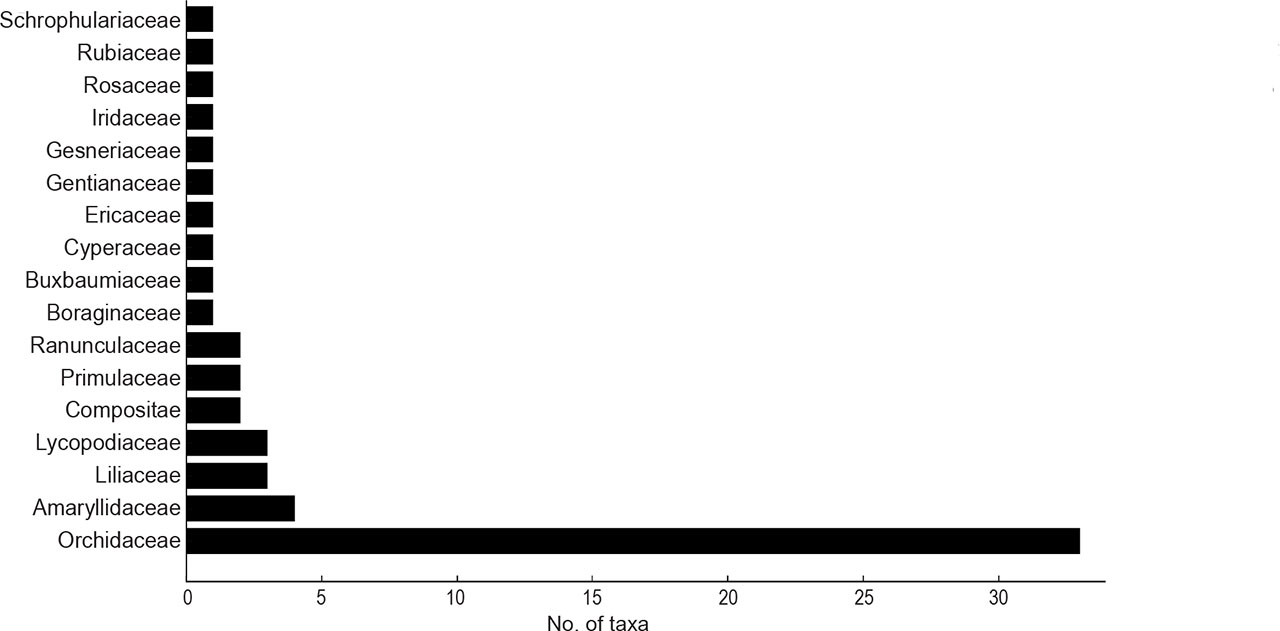
Figure 1:
Plant families of internationally important plant taxa and their number of taxa.
Slika 1: Družine mednarodno pomembnih rastlinskih taksonov in njihovo število.
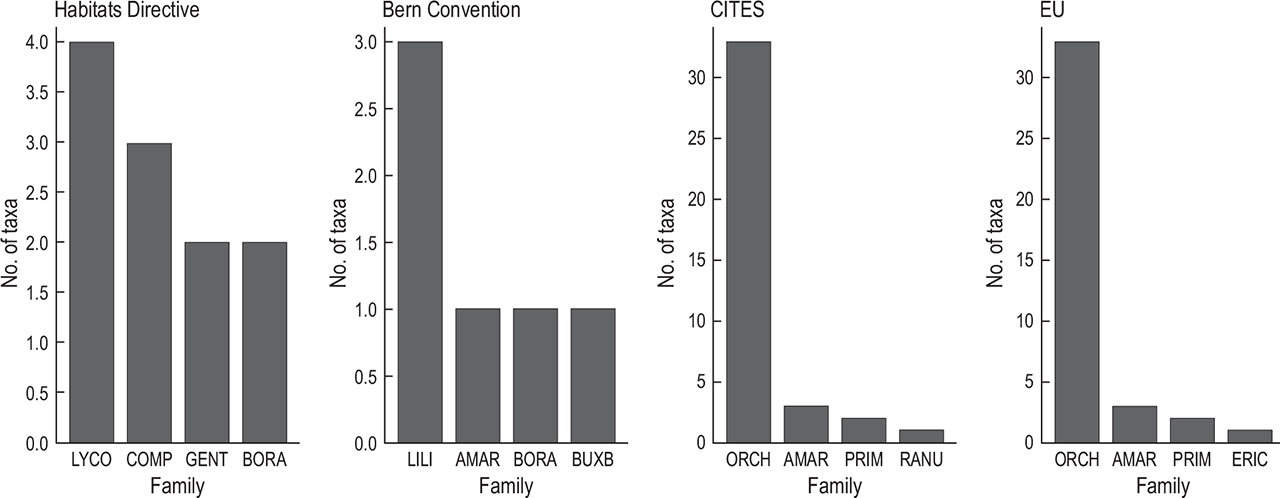
Figure 2:
International directives and conventions and their corresponding numbers of plant taxa of the main 5 families. Abbreviations: LYCO (Lycopodiaceae), COMP (Compositae), GENT (Gentianaceae), BORA (Boraginaceae), LILI (Liliaceae), AMAR (Amaryllidaceae), BUXB (Buxbaumiaceae), ORCH (Orchidaceae), PRIM (Primula), RANU (Ranunculaceae), ERIC (Ericaceae).
Slika 2: Mednarodne direktive in konvencije ter število rastlinskih taksonov za glavnih pet družin. Okrajšave: LYCO (Lycopodiaceae), COMP (Compositae), GENT (Gentianaceae), BORA (Boraginaceae), LILI (Liliaceae), AMAR (Amaryllidaceae), BUXB (Buxbaumiaceae), ORCH (Orchidaceae), PRIM (Primula), RANU (Ranunculaceae), ERIC (Ericaceae).
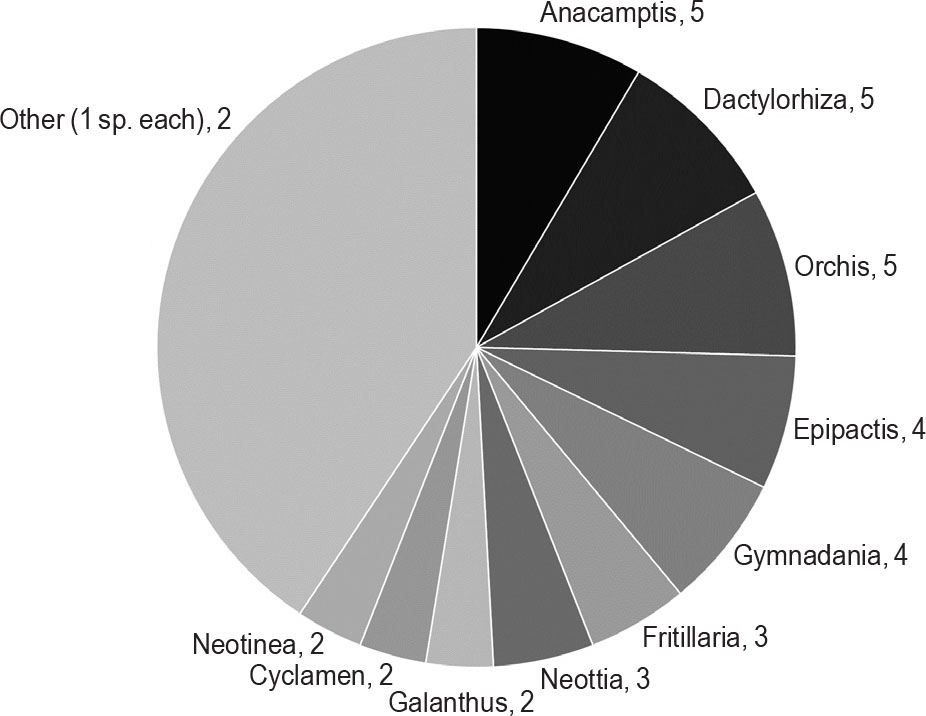
Figure 3:
The most dominant genera of plants and their corresponding numbers of taxa.
Slika 3: Prevladujoči rastlinski rodovi in število taksonov.
In terms of the total number of plant taxa listed in various international directives and conventions (Figure 4), we have observed that EU–B (species listed in CITES Appendix II, excluding species exempt by the EU) and CITES II (species not necessarily threatened with extinction, but whose trade must be controlled to avoid utilization incompatible with their survival) each dominate with 39 taxa. They are followed by the strictly protected flora species of the Bern Convention (Appendix I), which includes 10 plant taxa present in Kosovo's flora. The Habitats Directive Annexes IV (plant species of community interest in need of strict protection) and V (species whose populations must be managed to ensure their sustainable use) are represented by 6 taxa. They are followed by the Habitats Directive Annex II (species that require Special Areas of Conservation (SACs) for their protection, ensuring that these species are given priority in habitat conservation) that is represented by 5 taxa. Just as the Bern Convention (Resolution 6 – plant species requiring habitat conservation measures) is represented by 5 plant taxa in Kosovo. EU–D (species listed in Annex D of the EU Wildlife Trade Regulations; not in CITES Appendices but monitored within the EU due to trade concerns) on the other hand is represented by 3 plant taxa in Kosovo.
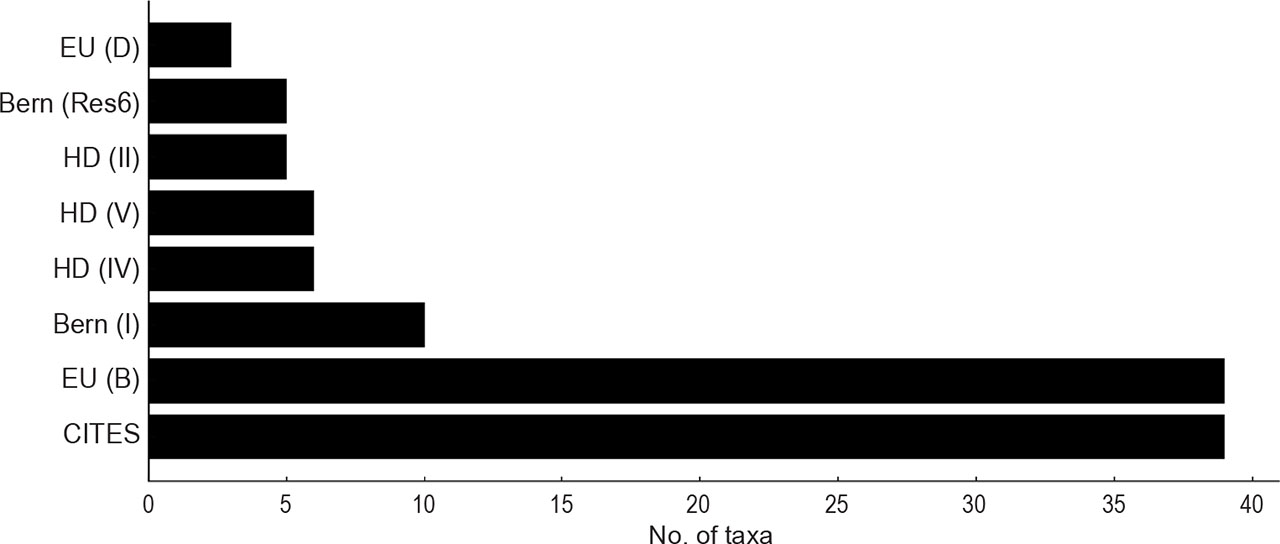
Figure 4:
The treated Conventions and Directives of internationally important plants and the corresponding number of such plants for each directive accordingly. For abbreviations see Table 1.
Slika 4: Obravnavane konvencije in direktive mednarodno pomembnih rastlin in njihovo število. Za okrajšave glej Tabelo 1.
An additional analysis we conducted was to assess whether these taxa of international importance are already included in the Red Lists or Red Books of flora in Europe and Kosovo. We found that 51 plant taxa of international importance from Kosovo are listed in the European Red List of Vascular Plants (Bilz et al., 2011), and 11 taxa are listed in the Red Book of Vascular Flora of Kosovo (Millaku et al., 2013) (Figure 5). It was interesting to observe the differences in the listings of taxa from different families and genera in various categories of the Red Books. In Kosovo, the total number of threatened taxa from this group of internationally important plants is higher compared to that in Europe. In Kosovo, the categories are as follows: Critically Endangered (CR) = 2 taxa, Endangered (EN) = 5 taxa, and Vulnerable (VU) = 2 taxa. In contrast, in Europe, from the same list of taxa, there are no taxa in the CR or VU categories, and only two taxa are classified as Endangered (EN). The Near Threatened (NT) category includes 3 taxa in Europe and 2 in Kosovo.
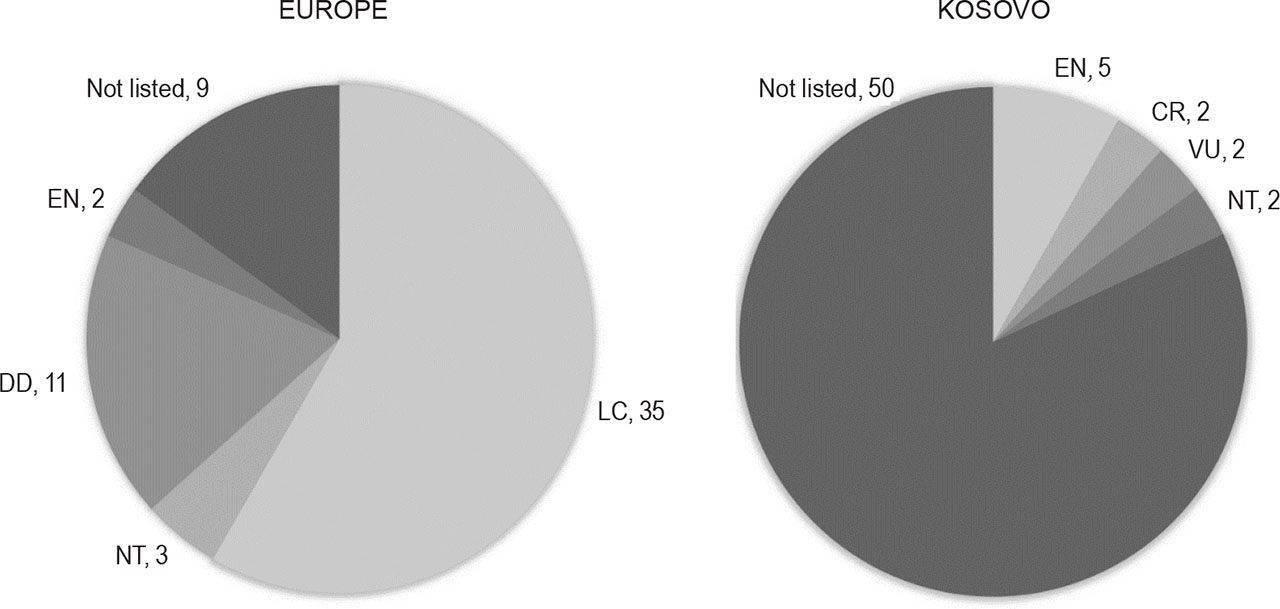
Figure 5:
Taxa of international importance in Kosovo and their proportional presence on the European Red List of Vascular Flora and the Kosovo Red Book of Vascular Flora.
Slika 5: Mednarodno pomembni taksoni na Kosovu in njihov delež v Evropskem rdečem seznamu vaskularnih rastlin in Rdečem seznamu vaskularne flore Kosova.
A clear differentiation between the two listings is observed in the Data Deficient (DD) category, where in Europe, 11 taxa are categorized as DD, while no taxa fall into this category in Kosovo. Perhaps the most evident differentiation between the two listings exists in the Least Concern (LC) category. In Europe, from the same list, 35 plant taxa are categorized as LC, while only 9 are not listed. In Kosovo, none of the taxa fall into the LC category, whereas a significant 51 plant taxa are not listed. This differentiation is particularly evident in terms of plant taxa from the Orchidaceae family (Table 1). In Europe, among other taxa, 27 taxa from this family have had their population status evaluated as LC, while in Kosovo, they have not been evaluated at all, with the exception of Gymnadenia frivaldii Hampe ex Griseb (NT).
In terms of threats posed to these internationally important plant taxa, it was found that habitat loss and fragmentation are leading threats, affecting a total of 26 taxa (Figure 6) just as equally so the collection of these plants in the wild for medicinal and ornamental purposes, which directly threatens 26 taxa. Other main pressures recorded include grazing (16 taxa), agriculture (12 taxa), urbanization and infrastructure development (12 taxa), and tourism (7 taxa), among other factors. When analyzing the main habitat types where these plant taxa have been recorded (Figure 7), it became clear that there are four broadly defined habitat types. It should be noted that many plant taxa thrive in multiple adjacent habitats or in two or more different types of habitats. Therefore, this is a broad comparison of the main habitat types. Specifically, 35% of the taxa were recorded in forests and their fringes, 34% in wet grasslands, 26% in subalpine to alpine grasslands, and 5% in shrubby vegetation and thickets.
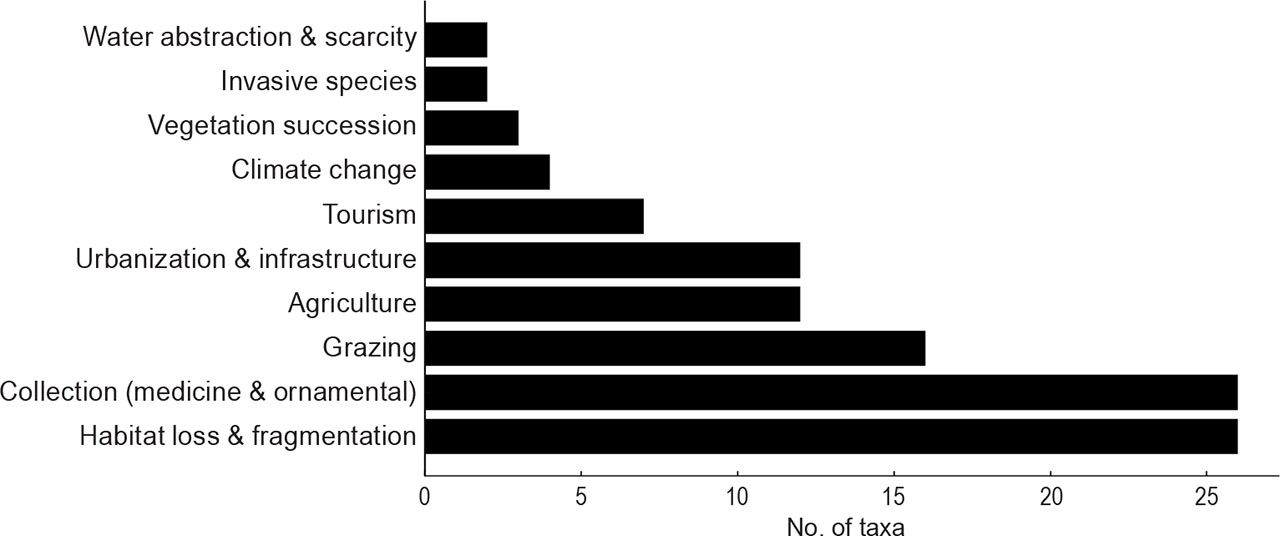
Figure 6:
Threats posed to internationally important plant taxa.
Slika 6: Grožnje mednarodno pomembnim rastlinskim taksonom.
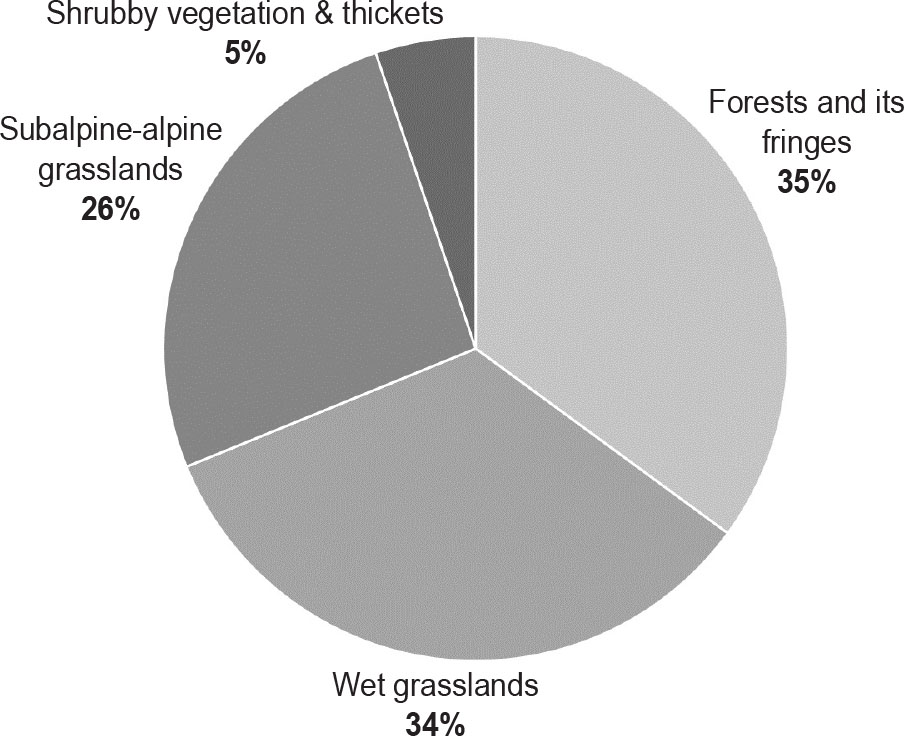
Figure 7:
Main habitat types of internationally important plants in Kosovo.
Slika 7: Glavni habitatni tipi, v katerih se pojavljajo mednarodno pomembni rastlinski taksoni na Kosovu.
Regarding the primary localities where these species have been reported (Table 1, Figure 8), it is evident that the majority originate from two National Parks in Kosovo: the Sharri Mountains and the Albanian Alps of Kosovo (Bjeshkët e Nemuna). These species are distributed across various mountains within these ranges. Additionally, other regions such as the mountain ranges in eastern and central Kosovo, along with notable massifs like Pashtrik Mt., Koritnik Mt., Koznik Mt., Gërmia, Shalë e Bajgorës, and Jezercë, also exhibit a significant presence of internationally important plant taxa.
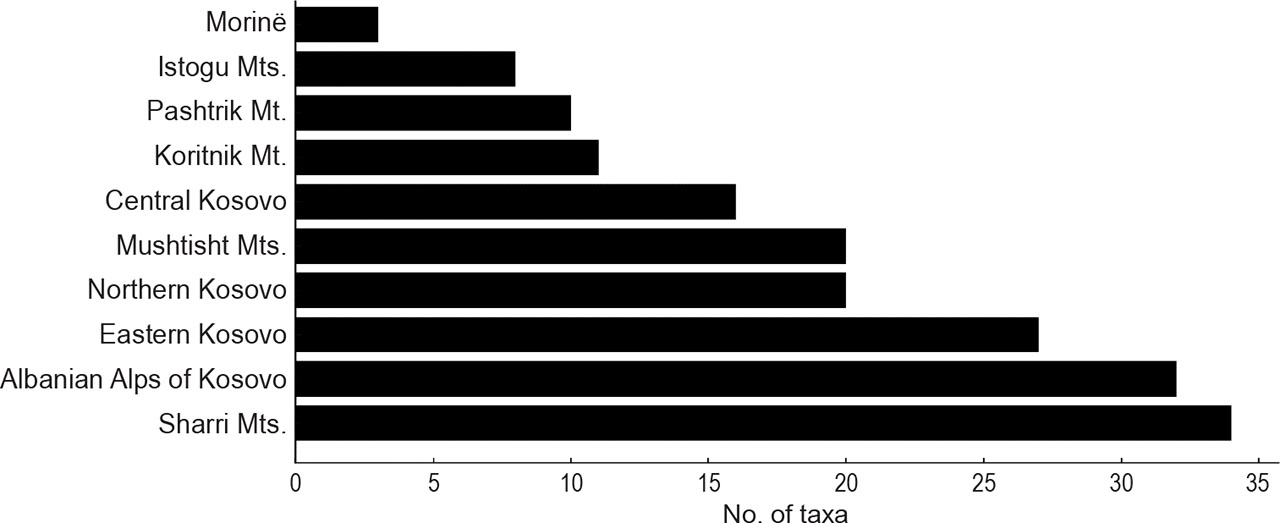
Figure 8:
Distribution of internationally important plant taxa across major mountain ranges and regions in Kosovo.
Slika 8: Razširjenost mednarodno pomembnih rastlinskih taksonov v glavnih gorskih verigah in območjih na Kosovu.
Discussion
The conservation of plant taxa of international importance is a critical endeavor that requires comprehensive understanding and strategic intervention (Darwall & Vie, 2005). In Kosovo, a region known for its rich botanical diversity, the conservation status, threats and habitat characteristics of internationally important plant taxa should be closely examined. This study addresses the occurrence of these taxa in Kosovo and highlights their ecological importance, conservation needs and distribution patterns. This research aims to support informed conservation strategies and encourage dialogue among stakeholders involved in preserving Kosovo's botanical heritage by highlighting the challenges and opportunities in conserving these plant species.
While the high representation of the Orchidaceae family, with 33 different taxa, is particularly notable (Table 1), it should be acknowledged that the actual number of Orchidaceae taxa in Kosovo may be larger, while this figure reflects the data currently available to us. Orchids are valuable and protected under EU directives due to their ecological significance, role in biodiversity, and vulnerability to habitat loss and illegal trade (Hinsley et al., 2017; Wraith et al., 2020). This dominance is consistent across various international frameworks, such as the Habitats Directive, CITES, and the EU Wildlife Trade Regulation, emphasizing the global conservation concern for orchids (Vitt et al., 2023). The significant presence of other families, such as Amaryllidaceae, Liliaceae, and Lycopodiaceae, further demonstrates the diverse taxonomic affiliations of Kosovo's flora. The study reveals a substantial difference between the European Red List of Vascular Plants (Bilz et al., 2011) and the Red Book of Vascular Flora of Kosovo (Millaku et al., 2013) in terms of the conservation status of these taxa. In Kosovo, the higher number of taxa classified as Critically Endangered, Endangered, and Vulnerable reflects a greater perceived threat level compared to Europe, where no taxa from this group are listed as Critically Endangered or Vulnerable. This discrepancy may also be attributed to local ecological pressures, limited conservation resources, or even differences in assessment criteria.
Habitat loss and fragmentation, known globally for being a primary threat to plant diversity (Zambrano et al., 2019), have emerged as the leading threats, affecting 26 taxa. Habitat destruction and fragmentation reduce the available living space for these plants, disrupting their growth and reproductive cycles. The pressures of wild plant collection for medicinal and ornamental purposes, grazing, agriculture, urbanization, and tourism also significantly impact these taxa. Over–exploitation through wild plant collection depletes natural populations, while grazing and agriculture alter and destroy habitats. Urbanization and tourism contribute to habitat encroachment and degradation. These findings just confirm the global patterns of biodiversity loss, where habitat destruction and over–exploitation are primary drivers (Hoffmeister et al., 2005; Wilkinson et al., 2018; Berisha & Geci, 2023), highlighting the urgent need for effective conservation strategies.
The categorization of plant taxa listed in various international directives and conventions provides crucial insights into their conservation status and the measures required to ensure their survival. Our results indicate that EU–B (species listed in CITES Appendix II, excluding species exempt by the EU) and CITES II (species not necessarily threatened with extinction, but whose trade must be controlled to avoid utilization incompatible with their survival) dominate, each with 39 taxa. This prominence underscores the significant international concern regarding the trade and exploitation of these species, emphasizing the need for stringent regulation to prevent their decline (Bruckner et al., 2003).
The inclusion of 10 plant taxa in the strictly protected flora species of the Bern Convention (Appendix I) highlights the critical need for strict conservation measures within Europe. These taxa are recognized for their vulnerability and the necessity for stringent protection to ensure their continued existence (Díaz, 2010).
The Habitats Directive further categorizes plant species into Annexes IV and V, represented by 6 taxa, and Annex II, represented by 5 taxa. Annex II includes species of community interest whose conservation requires the designation of Special Areas of Conservation, reflecting the importance of habitat preservation and targeted conservation efforts. Annex IV lists species that need strict protection, indicating the high level of threat they face, while Annex V covers species whose taking in the wild and exploitation may be subject to management measures, suggesting a more balanced approach between conservation and sustainable use. Additionally, the Bern Convention (Resolution 6) includes 5 plant taxa that require habitat conservation measures. This highlights the necessity for habitat preservation as a key strategy in the conservation (Fenu et al., 2016) of these species, ensuring that their natural environments are protected and managed effectively.
These categorizations not only reflect the varying levels of threat faced by different plant species but also illustrate the comprehensive approach needed for their conservation. By aligning with international directives and conventions, we can implement informed conservation strategies (Rosendal, 2000; Armitage et al., 2020) that address both the direct and indirect threats to these taxa. This framework allows for a coordinated effort among stakeholders to promote biodiversity and sustain the botanical heritage of Kosovo.
The analysis of habitat types reveals that these plant taxa are predominantly found in forests and their fringes (35%), wet grasslands (34%), and subalpine to alpine grasslands (26%). This distribution highlights the importance of conserving diverse habitat types to ensure the survival of these taxa (Millaku et al., 2013, 2017; Berisha et al., 2020a).
As for the implications for conservation strategies, the results underscore the importance of integrating local and international conservation efforts (Cunningham, 1994). The discrepancies between local and European conservation statuses suggest that localized assessments are crucial for accurately determining the threat levels and conservation needs of plant taxa. Additionally, the significant number of taxa not listed in Kosovo's Red Book points to gaps in local conservation efforts and the need for updated assessments.
Conservation strategies should prioritize habitat protection and restoration (Possingham et al., 2015), given the critical role of habitat loss and fragmentation in driving plant taxa declines. Protected areas should be expanded and effectively managed, particularly in regions identified as critical habitats for these taxa. Engaging local communities in conservation efforts is essential. These communities possess valuable traditional knowledge regarding the use and management of plant species, which can enhance conservation outcomes.
Further research is needed to fill knowledge gaps regarding the ecology, distribution, and population dynamics of these plant taxa. Long–term monitoring programs are essential to track changes in plant populations and assess the effectiveness of conservation measures. Studies focusing on the impact of climate change on these taxa would provide insights into future conservation challenges and inform adaptive management strategies.
The following species exhibited highly restricted distributions, often confined to a single locality and characterized by small population sizes: Anacamptis coriophora, Anacamptis palustris, Buxbaumia viridis, Epipactis palustris, Fritillaria graeca, Galium rhodopeum, Goodyera repens, Gymnadenia odoratissima, Neottia ovata, Orchis simia, Ranunculus fontanus, Spiranthes aestivalis, and Sternbergia colchiciflora.
Between 1993 and 2013, the populations of Gentiana lutea in Kosovo, which comprises two subspecies (G. lutea subsp. lutea and G. lutea subsp. symphiandra), experienced a decline exceeding 30% due to the harvesting of rhizomes for trade purposes (Millaku, 1993, 1999, 2013).
Conclusions
The findings of this study highlight the rich diversity of internationally important plant taxa present in Kosovo, underscoring the region's significant botanical value. With a total of 59 identified taxa, this study provides a comprehensive overview of the conservation status, threats, and habitat characteristics of these plants.
In conclusion, the conservation of internationally important plant taxa in Kosovo requires a multifaceted approach that integrates habitat protection, sustainable use practices, community involvement, and robust scientific research. By addressing the identified threats and enhancing conservation efforts, it is possible to safeguard the rich botanical diversity of Kosovo for future generations.