
Table 1:
List of investigated species and specimens of the genus Rubus (ERE – Herbarium of the Institute of Botany after A. Takhtajyan, National Academy of Sciences, Yerevan, Armenia).
Tabela 1: Seznam preučevanih vrst in primerkov rodu Rubus (ERE – Herbarij Botaničnega inštituta A. Takhtajyan, Nacionalna akademija znanosti, Erevan, Armenija).
| Species | Herbarium sheet information |
|---|---|
| R. armeniacus Focke | ERE, 80977; ERE, 93906 |
| R. caesius L. | ERE, 56383; ERE, 63234; ERE, 63238 |
| R. candicans Weihe ex Rchb. | ERE, 58307; ERE, 63240 |
| R. canescens DC. | ERE, 58846; ERE, 98402 |
| R. cartalinicus Juz. | ERE, 63221 |
| R. caucasicus Focke | ERE, 58313 |
| R. ibericus Juz. | ERE, 135970 |
| R. idaeus L. | ERE, 98394 |
| R. sanctus Schreb. | ERE, 56378; ERE, 56381; ERE, 63978; ERE, 98366 |
| R. takhtadjanii Mulk. | ERE, 64509 |
Table 2:
Some palynological and karyological features of the representatives of the genus RubusL. of the flora of Armenia (± SD – standard deviation, CV% – coefficient of variation, LM – light microscopy, SEM – scanning electron microscopy).
Tabela 2: Nekatere palinološke in kariološke značilnosti predstavnikov rodu RubusL. v flori Armenije (± SD – standardni odklon, CV% – koeficient variacije, LM – svetlobni mikroskop, SEM – vrstični elektronski mikroskop).
| Species | Polar axis (P) (μm) ± SD (CV%) | Equatorial diameter (E) (μm) ± SD (CV%) | P/E | Colpus | Exine ornamentation | Chromosome number (2n) | ||
|---|---|---|---|---|---|---|---|---|
| apocolpium diameter(μm) ± SD (CV%) | mesocolpium width (μm) ± SD (CV%) | LM | SEM | |||||
| R. armeniacus Focke | 23.5–25.8 / 24.5 ± 0.7 (2.7%) | 16.9–22.8 / 19.4 ±1.8 (9.2%) | 8/7–8/6 (subprolate) | 4.8–5.9 / 5.3 ± 0.4 (7.1%) | 8.4–12.5 / 10.4 ± 1.0 (9.8%) | finely reticulate | finely striate-perforate or finely striate-microreticulate | 28 (Krahulcová & Holub, 1997) |
| R. caesius L. | 22.2–28.9 / 25.1 ± 1.8 (7.2%) | 19.7–24.1 / 20.9 ± 1.6 (7.4%) | 8/7–8/6 (subprolate) | 4.5–5.3 / 4.9 ± 0.3 (5.3%) | 14.1–15.8 / 14.9 ± 0.4 (2.8%) | finely reticulate | finely striate-perforate or finely striate-microreticulate | 28 (Krahulcová & Holub, 1997) |
| R. candicans Weihe ex Rchb. | 20.3–25.4 / 22.9 ± 1.9 (8.4%) | 17.5–22.1 / 19.0 ± 1.6 (8.7%) | 8/7–8/6 (subprolate) | 5.0–5.6 / 5.3 ± 0.1 (2.8%) | 14.2–15.4 / 14.8 ± 0.3 (2.0%) | granulate | finely striate-perforate | 21 (Gustafsson, 1943) |
| R. canescensDC. | 23.3–25.8 / 24.5 ± 0.7 (3.0%) | 17.7–20.5 / 19 ± 0.9 (4.9%) | 8/7–8/6 (subprolate) | 4.2–5.1 / 4.7 ± 0.2 (4.8%) (sometimes synaperturate) | 10.5–14.3 / 12.4 ± 1.0 (7.7%) | finely striate reticulate | finely striate-perforate, striae linked together by bridges | 14 (Krahulcová & Holub, 1997) |
| R. cartalinicus Juz. | 21.8–30.1 / 25.8 ± 3.1 (11.8%) | 22.1–23.5 / 22.9 ± 0.5 (2.0%) | 8/8–8/7 (prolate spheroidal) | 2.8–4.5 / 3.6 ± 0.4 (11.6%) (sometimes synaperturate) | 14.4–16.8 / 15.6 ± 0.6 (3.8%) | finely striate reticulate | finely striate-perforate | – |
| R. caucasicus Focke | 21.7–33.2 / 26.3 ± 4.1 (15.7%) | 16.8–22.5 / 18.0 ± 3.6 (19.8%) | 8/6–8/4 (prolate) | 4.7–5.9 / 5.24 ± 0.4 (7.5%) | 18.5–19.5 / 19.0 ± 0.3 (1.7%) | granulate | finely striate-perforate | – |
| R. ibericus Juz. | 20.5–22.5 / 21.4 ± 0.7 (3.1%) | 14.6–18.1 / 16.2 ± 1.2 (7.6%) | 8/6–8/4 (prolate) | 3.5–4.8 / 4.2 ± 0.3 (7.8%) | 11.8–14.6 / 13.2 ± 0.7 (5.3%) | finely reticulate | – | – |
| R. idaeus L. | 18.5–25.3 / 21.8 ± 2.5 (11.6%) | 14.1–18.9 / 16.5 ± 1.6 (9.6%) | 8/6–8/4 (prolate) | 3.8–5.7 / 4.8 ± 0.5 (10.0%) | 10.5–14.9 / 12.7 ± 1.1 (8.7%) | finely reticulate | – | 14, 21 (Chen et al., 1993; Ivanova, 2005) |
| R. sanctus Schreb. | 15.5–33.5 / 19.2 ± 5.3 (27.7%) | 12.1–17.5 / 14.4 ± 1.6 (11.3%) | 8/6–8/4 (prolate) | 4.8–6.1 / 5.4 ± 0.3 (6.0%) | 10.9–12.5 / 11.7 ± 0.4 (3.4%) | granulate | finely striate-perforate, diameter of perforation varies | 14 (Runemark, 2006) |
| R. takhtadjanii Mulk. | 12.9–15.6 / 14.2 ± 0.8 (5.6%) | 14.1–16.8 / 15.4 ± 0.9 (6.1%) | 6/8–8/6 (subspheroidal) | 5.3–6.9 / 6.1 ± 0.4 (6.6%) | 9.8–11.5 / 10.7 ± 0.4 (4.0%) | finely reticulate | – | – |
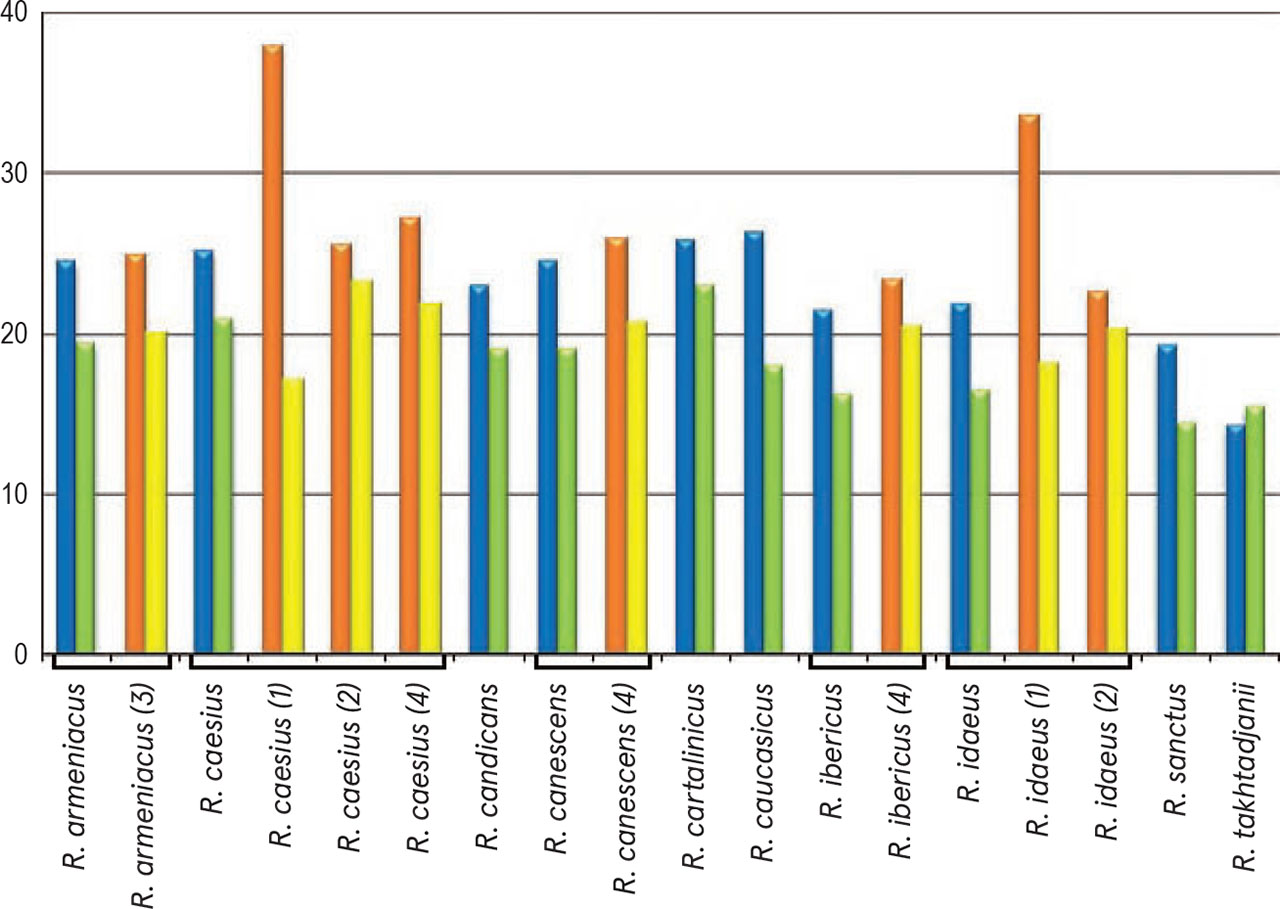
Figure 1:
Average sizes of pollen grains (P × E) in some species of the genus Rubus L.
Our data: blue – polar axis (P), green – equatorial diameter (E). Data from literature: orange – polar axis (P), yellow – equatorial diameter (E). (1) – Li et al. (2001), (2) – Lechnovich et al. (2020), (3) – Tomlik-Wyremblewska (1995), (4) – Monasterio-Huelin & Pardo (1995).
Slika 1: Povprečna velikost pelodnih zrn (P × E) nekaterih vrst rodu Rubus L.
Naši podatki: modra – polarna (vertikalna) os (P), zelena – ekvatorialna (horizontalna) os (E). Podatki iz literature: oranžna – polarna (vertikalna) os (P), rumena – ekvatorialna (horizontalna) os (E). (1) – Li et al. (2001), (2) – Lechnovich et al. (2020), (3) – Tomlik-Wyremblewska (1995), (4) – Monasterio-Huelin & Pardo (1995).
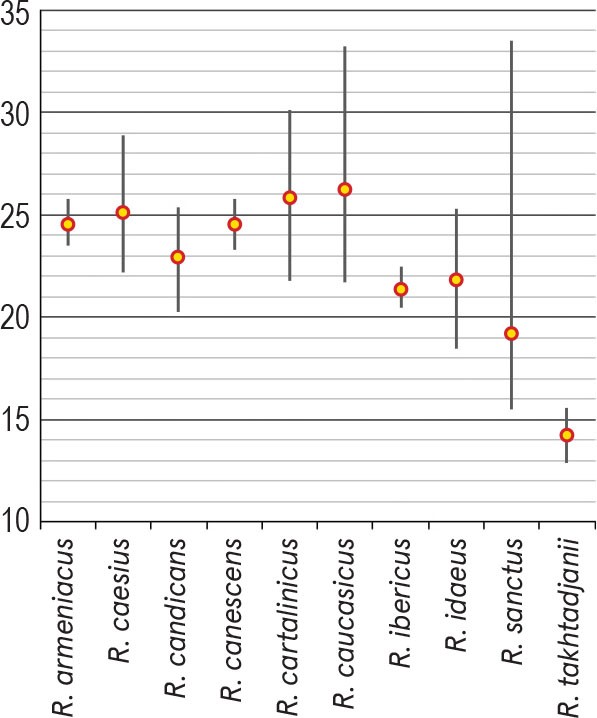
Figure 2:
Comparison of the average values of pollen polar axis (P) of investigated Rubus species using Simpson and Roe test.
Slika 2: Primerjava povprečnih vrednosti polarne (vertikalne) osi (P) preučevanih vrst rodu Rubus s Simpsonovim in Roevim testom.
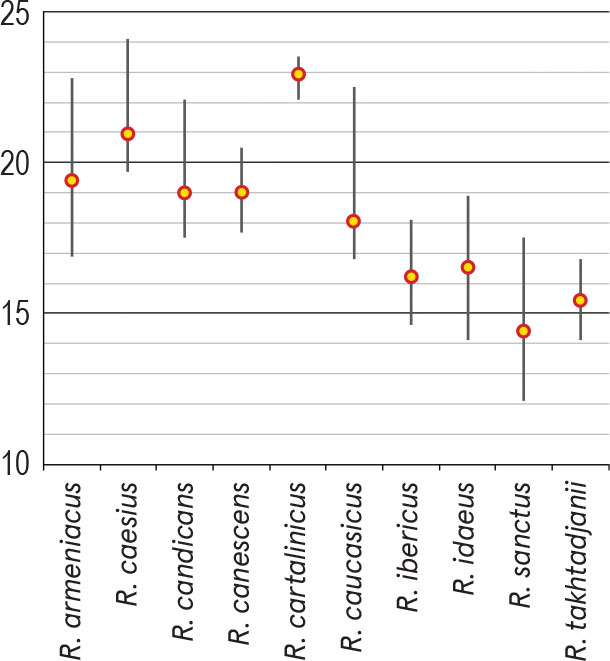
Figure 3:
Comparison of the average values of pollen equatorial diameter (E) of investigated Rubus species using Simpson and Roe test.
Slika 3: Primerjava povprečnih vrednosti premera ekvatorialnega premera pelodnega zrna (E) preučevanih vrst rodu Rubus s Simpsonovim in Roevim testom.
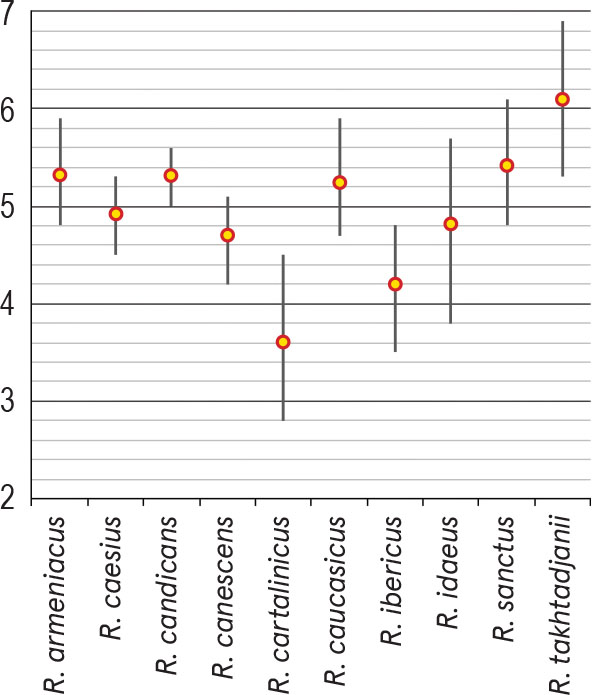
Figure 4:
Comparison of the average values of pollen apocolpium diameter of investigated Rubus species using Simpson and Roe test.
Slika 4: Primerjava povprečnih vrednosti premera apokolpija (brazde) preučevanih vrst rodu Rubus s Simpsonovim in Roevim testom.
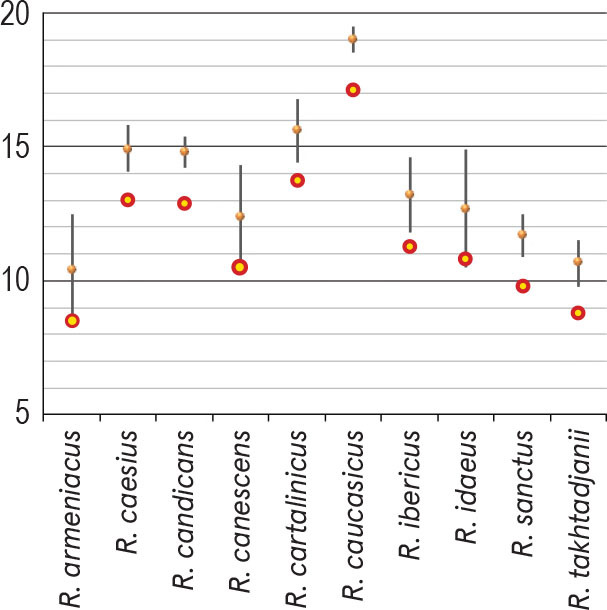
Figure 5:
Comparison of the average values of pollen mesocolpium width of investigated Rubus species using Simpson and Roe test.
Slika 5: Primerjava povprečnih vrednosti premera mezokolpija (brazde) preučevanih vrst rodu Rubus s Simpsonovim in Roevim testom.
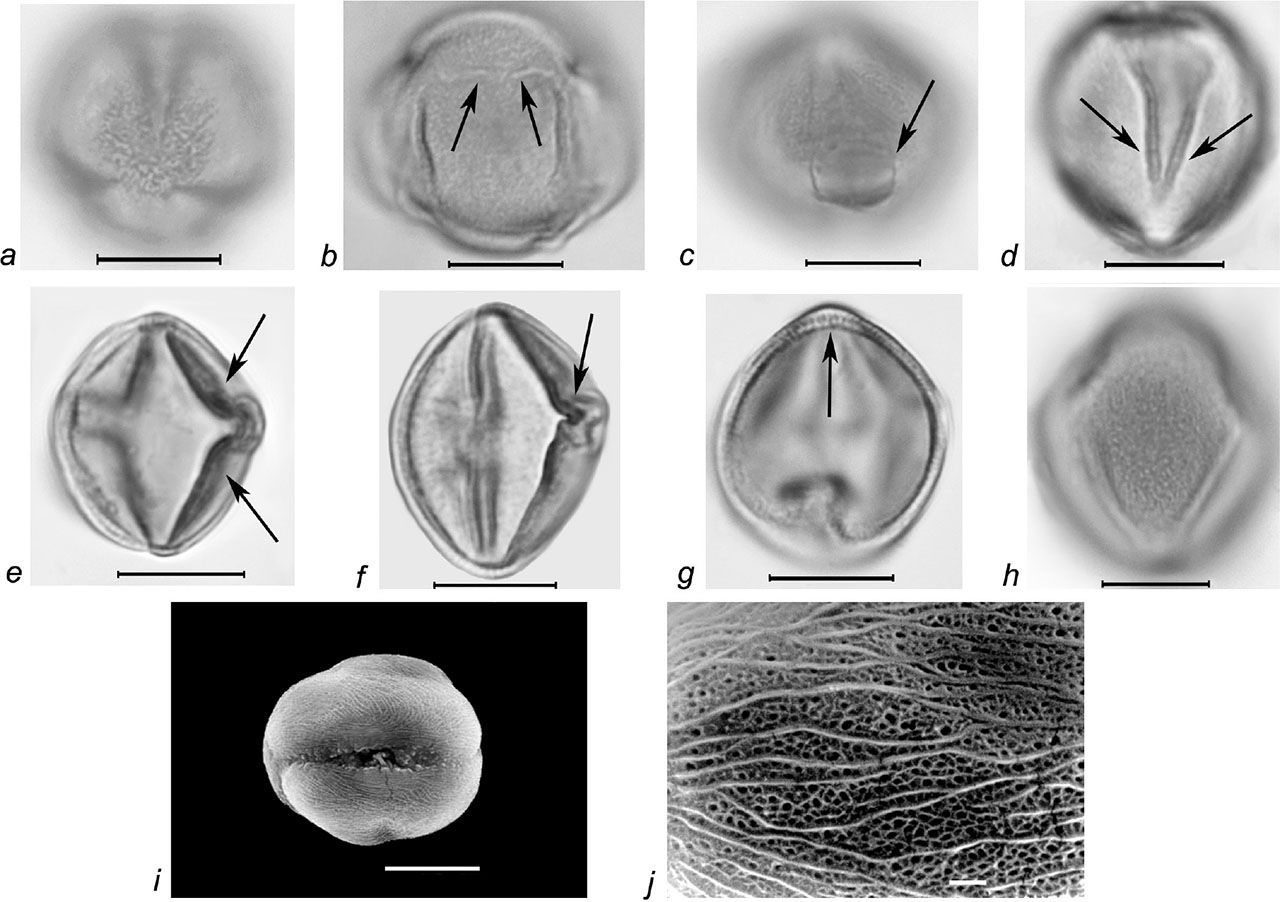
Figure 6:
Pollen grains of Rubus armeniacus Focke. a–h – LM micrographs: a – 3-zonocolp-orate pollen grain, b – 4-zonocolp-orate pollen grain with additional small slit-like apertures at the pole (marked with arrows), c – spheroidal os (marked with arrow), d, e – thickened edges of colpi (marked with arrows), f – geniculum (marked with arrow), g – exine, columellae layer (marked with arrow), h – finely reticulate exine ornamentation; i, j – SEM micrographs: i – pollen grain in equatorial view, colpus, j – striate-perforate exine ornamentation in combination with finely striate-microreticulate one; scale bars: a–i – 10 μm, j – 1 μm.
Slika 6: Pelodna zrna vrste Rubus armeniacus Focke. a–h – LM mikrografi: a – 3-zonokolporatna pelodna zrna, b – 4 zonokolporatna pelodna zrna z dodatno odprtino na polih (označeno s puščico), c – sferoidna os (označeno s puščico), d, e – odebeljen del brazde (označeno s puščico), f – genikulum (označeno s puščico), g – eksina, kolumelna plast (označeno s puščico), h – fino mrežasta ornamentacija eksine, i, j – SEM mikrograf: i – pelodno zrno v ekvatorialnem pogledu, brazda, j – črtasto-luknjičasta ornamentacija eksine v kombinaciji s fino črtastomikroretikuliranim okrasjem; merilce: a–i – 10 μm, j – 1 μm.
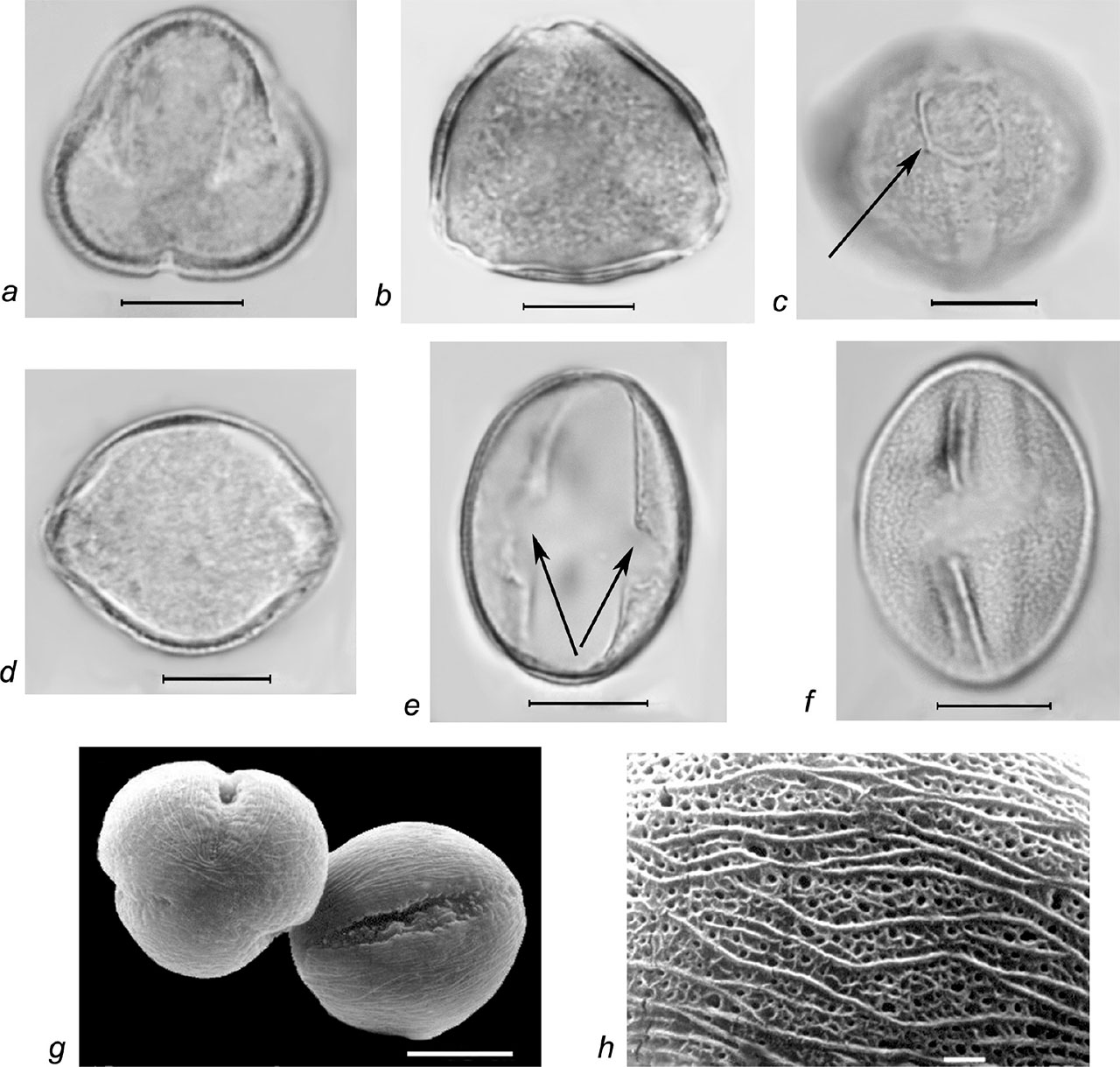
Figure 7:
Pollen grains of Rubus caesius L. a–f – LM micrographs: a–b – pollen grains in polar view (a – colpi, b – exine, columellae layer), c – spheroidal os (marked with arrow), d–f – pollen grains in equatorial view (e – os area, marked with arrows), f – granulate exine ornamentation; g–h – SEM micrographs: g – pollen grains in polar and equatorial view, h – striate-perforate exine ornamentation in combination with finely striate-microreticulate one; scale bars: a–g – 10 μm, h – 1 μm.
Slika 7: Pelodna zrna vrste Rubus caesius L. a–f – LM mikrografi: a–b – pelodno zrno v polarnem pogledu (a – brazda, b – eksina, kolumelna plast), c – sferoidna os (označena s puščico), d–f – pelodno zrno v ekvatorijalnem pogledu (e – osno območje, označeno s puščico), f – zrnata ornamentacija eksine, g–h – SEM mikrograf: g – pelodno zrno v polarnem in ekvatorialnem pogledu, h – črtasto-luknjičasta ornamentacija eksine v kombinaciji s fino črtasto-mikroretikulirano ornamentacijo; merilce: a–g – 10 μm, h – 1 μm.
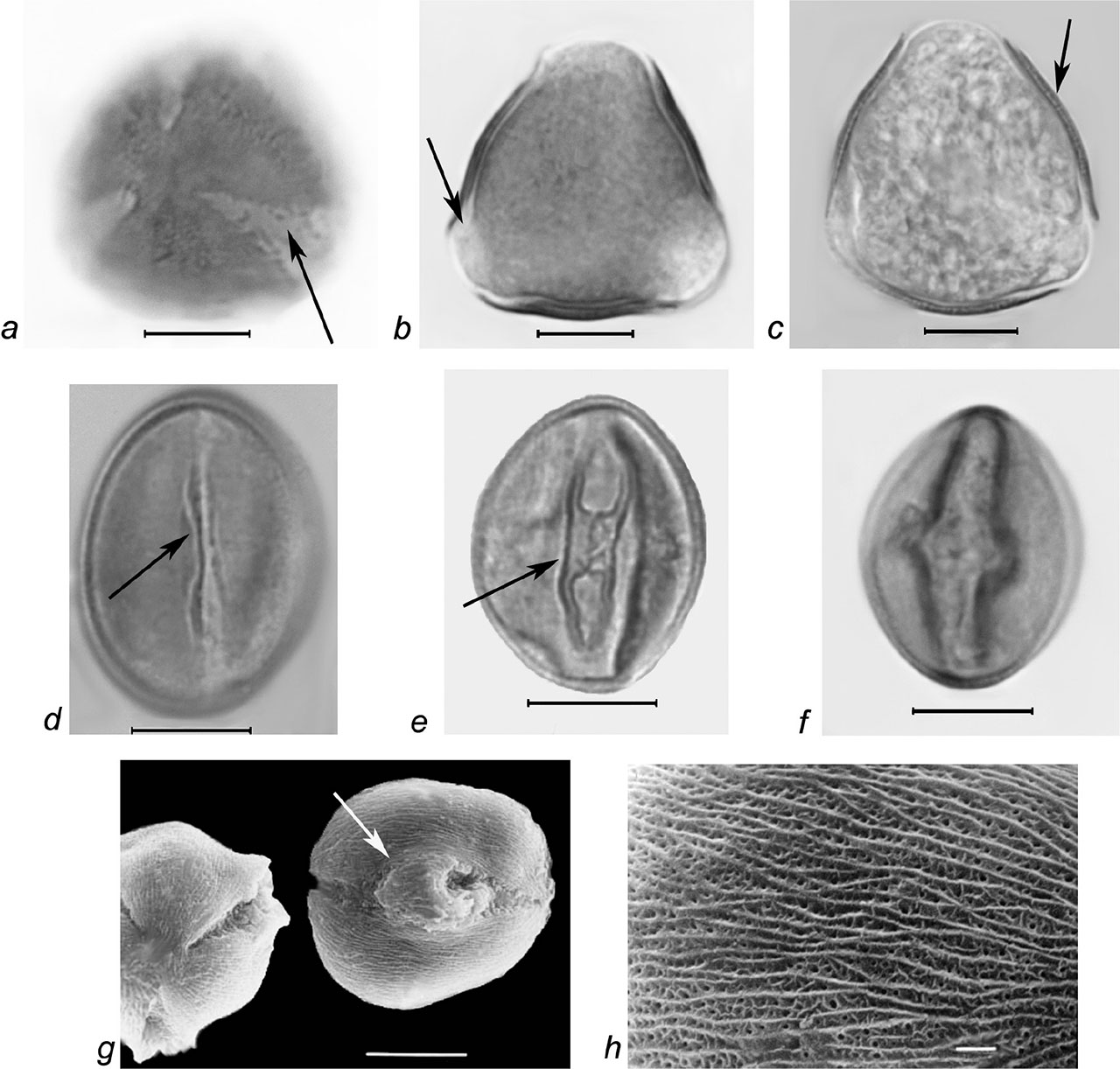
Figure 8:
Pollen grains of Rubus candicans Weihe ex Rchb. a–f – LM micrographs: a–c – pollen grains in polar view (a – colpus membrane ornamentation, b – os area, c – exine, columellae layer, marked with arrows), d–f – pollen grains in equatorial view (d – colpus without genuculum, e – colpus with genuculum, marked with arrows, f – thickened edges of colpi); g–h – SEM micrographs: g – pollen grains in polar and equatorial view (colpus with genuculum, marked with arrow), h – finely striate-perforate exine ornamentation (SEM); scale bars: a–g – 10 μm, h – 1 μm.
Slika 8: Pelodna zrna vrste Rubus candicans Weihe ex Rchb. a–f – LM mikrografi: a–c – pelodna zrna v polarnem pogledu (a – ornamentacija membranebrazde, b – območje osi, c – eksina, kolumelna plast, označeno s puščico), d–f – pelodno zrno v ekvatorialnem pogledu (d – brazda brez genikuluma, e – brazda z genikulumom, označeno s puščico, f – odebeljen del brazde); g–h – SEM mikrograf: g – pelodna zrna v polarnem in ekvatorialnem pogledu (brazda z genikulumom, označeno s puščico), h – fino črtasto-luknjasta ornamentacija eksine (SEM); merilce: a–g – 10μm, h – 1 μm.
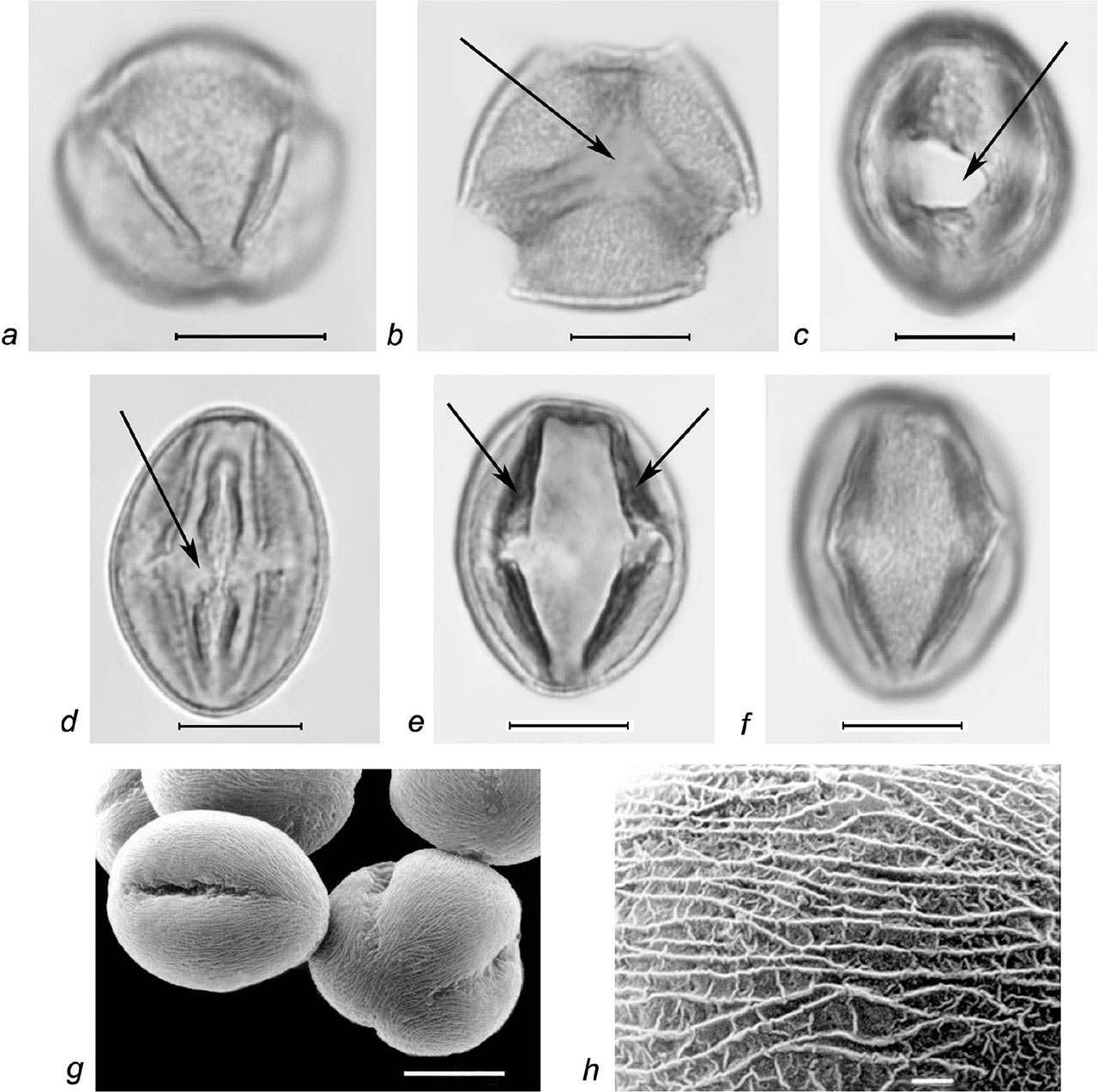
Figure 9:
Pollen grains of Rubus canescens DC. a–f – LM micrographs: a – pollen grains in semipolar view, b – synaperturate pollen grain in polar view (synaperture marked with arrow), c–f – pollen grains in equatorial view (c – os, d – genuculum, e – thickened edges of colpi, marked with arrows, f – striate-reticulate exine ornamentation); g–h – SEM micrographs: g – pollen grains in semipolar and equatorial view, h – finely striateperforate exine ornamentation (SEM); scale bars: a–g – 10 μm, h – 1 μm.
Slika 9: Pelodna zrna vrste Rubus canescens DC. a–f – LM mikrografi: a – pelodno zrno v semipolarnem pogledu, b – po daljšnici anastamozna odprtina (označeno s puščico), c–f – pelodno zrno v ekvatorialnem pogledu (c – os, d – genikulum, e – odebeljeni rob brazde, označen s puščico, f – črtasto-mrežasta ornamentacija eksine; g–h SEM mikrograf: g – pelodno zrno v semipolarnem in ekvatorialnem pogledu, h – fino črtasto-luknjasta ornamentacija eksine (SEM); scale bars: a–g – 10 μm, h – 1 μm.
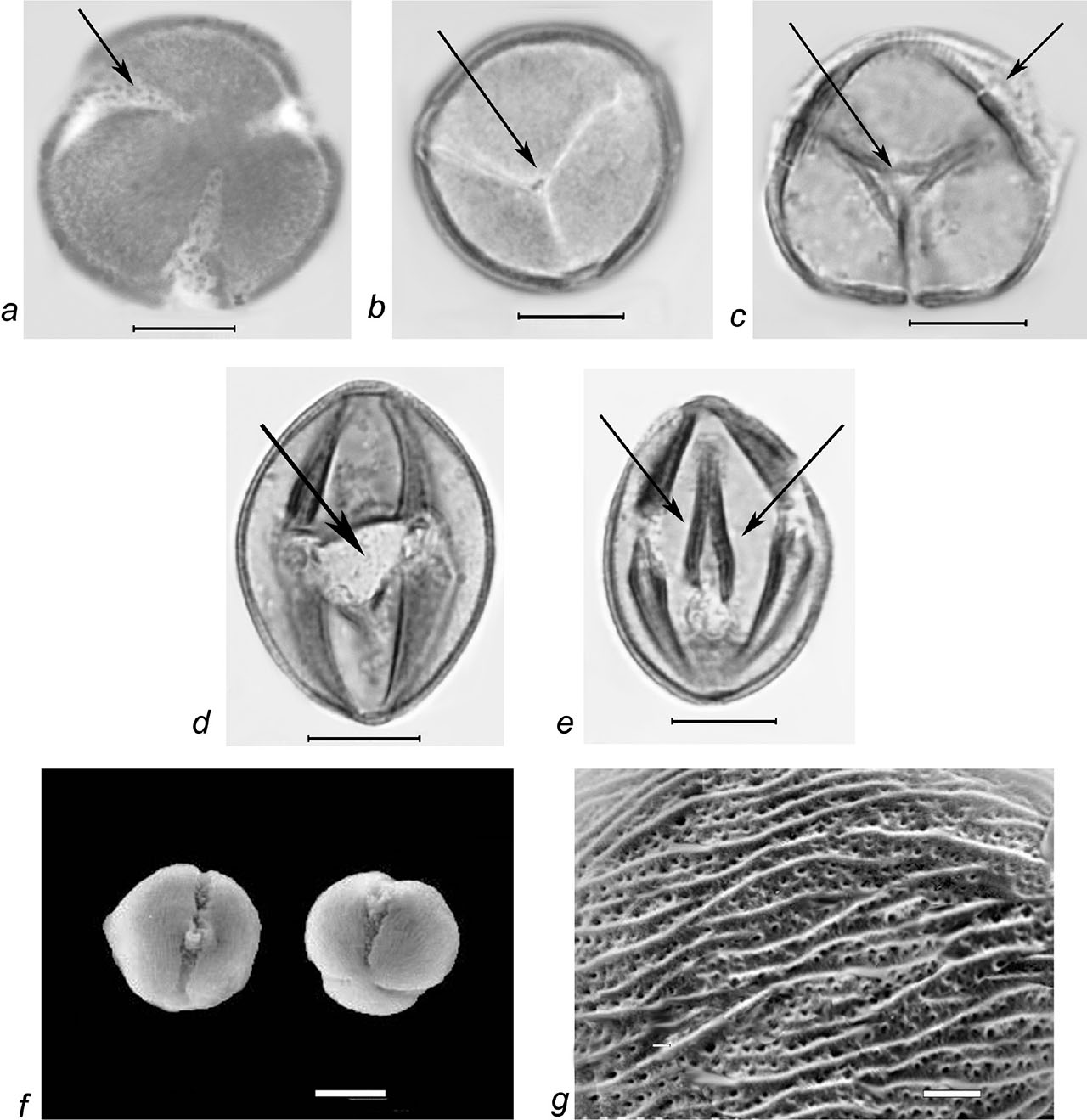
Figure 10:
Pollen grains of Rubus cartalinicus Juz. a–e – LM micrographs: a–c – pollen grains in polar view (a – pollen and colpus membrane ornamentation, b–c – synaperturate pollen grains and os area, marked with arrows), d–e – pollen grains in equatorial view (d – os, e – thickened edges of colpi); f–g – SEM micrographs: f – pollen grains in equatorial and semipolar view, g – finely striate-perforate exine ornamentation; scale bars: a–f – 10 μm, g – 1 μm.
Slika 10: Pelodna zrna vrste Rubus cartalinicus Juz. a–e – LM mikrografi: a–c – pelodno zrno v polarnem pogledu (a – pelod in ornamentacija membrane brazde, b–c pelodno zrno z anastamozno odprtino, označeno s puščico), d–e – pelodno zrno v ekvatorialnem pogledu (d – os, e – odebeljen del brazde); f–g – SEM mikrograf: f – pelodno zrno v ekvatorialnem in semipolarnem pogledu, g – fino črtasto-luknjasta ornamentacija eksine; merilce: a–f – 10 μm, g – 1 μm.
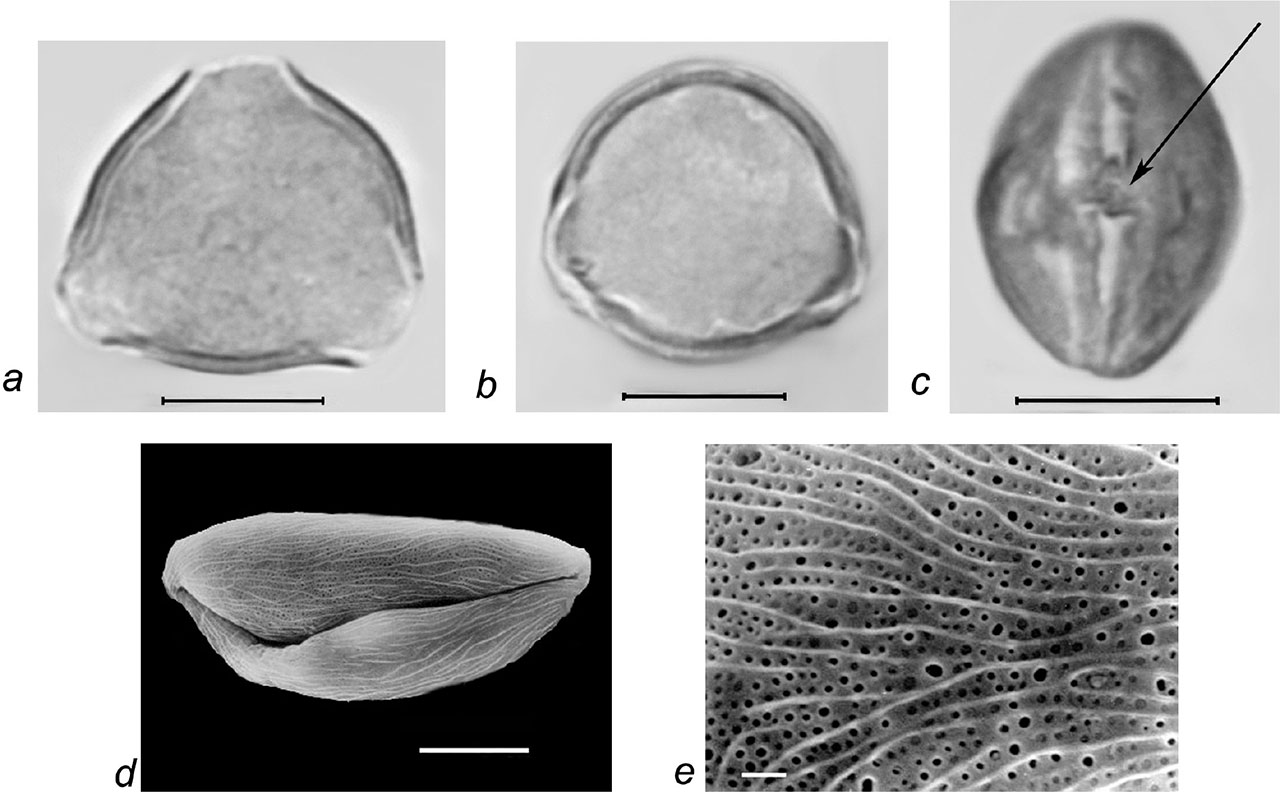
Figure 11:
Pollen grains of Rubus sanctus Schreb. a–c – LM micrographs: a – pollen grain in polar view, b–c – pollen grains in equatorial view (c– colpus with genuculum, marked with arrow); d–e – SEM micrographs: d – pollen grain in equatorial view, e – finely striate-perforate exine ornamentation; scale bars: a–d – 10 μm, e – 1 μm.
Slika 11: Pelodna zrna vrste Rubus sanctus Schreb. a–c – LM mikrografi: a – pelodno zrno v polarnem pogledu, b–c – pelodno zrno v ekvatorialnem pogledu (c– brazda z genikulumom, označeno s puščico); d–e – SEM mikrograf: d – pelodno zrno v ekvatorialnem pogledu, e – fino črtastoluknjasta ornamentacija eksine; merilce: a–d – 10 μm, e – 1 μm.