
Introduction
The escalating demand for food and natural products, driven by the growing human population, accelerates the negative impact on the environment to a great extent, given that agriculture is a dominant form of land management globally (Kanianska, 2016). Conventional agricultural practices are expanding into new territories, leading to habitat destruction and a decline in wildlife populations (Reidsma et al., 2006; Haines-Young, 2009; Dudley & Alexander, 2017; Kumari & Deepali, 2021). The escalating intensity and expansion of agricultural land use pose a substantial threat not only to the environment and biodiversity but also to the future of the human population, as biodiversity is essential for efficient food production and providing vital ecosystem services (Holt et al., 2016; Zhang et al., 2019; Ortiz et al., 2021). Human well-being crucially relies on plant diversity for maintaining human health, supporting food production, providing natural resources, and contributing to cultural and spiritual practices (Whitton & Rajakaruna, 2001). Healthy ecosystems are vital for the services we depend on, and especially support the livelihoods of those who directly depend on nature (Morand, 2010). Diverse plant communities with various interactions between species are more productive and resistant to fluctuations over time, suggesting biodiversity strengthens ecosystems (Isbell et al., 2009; Hong et al., 2022). Higher plant diversity is increasingly considered necessary to maintain healthy ecosystems, so we should adjust agricultural practices to the need for biodiversity conservation across various conditions (Isbell et al., 2011; Turnbull et al., 2016).
Crop biodiversity is both a product of human ingenuity and a crucial resource for future agriculture (Hufford et al., 2019). As modern agriculture relies on a few high-yield crops to feed the constantly growing human population, its negative impact on biodiversity could be so significant, that halting agricultural expansion might be necessary in the long run (Lanz et al., 2018). Massive insect decline since WWII is linked to the spread of intensive agriculture (monoculture, pesticides, etc.), which has taken over huge areas of land. Ongoing climate change additionally threatens species diversity (Raven & Wagner, 2021), and especially those species adapted to specific environments (Muluneh, 2021). Intensive agriculture across Europe reduces soil biodiversity, leading to less complex food webs with smaller organisms and fewer functional groups (Tsiafouli et al., 2015), and also impacts carbon and nitrogen cycling, which is crucial for healthy ecosystems (De Vries et al., 2013).
Vegetated strips along agricultural fields are useful tools for preserving native biodiversity but also serve as filters for pollutants from intensive agriculture, act as sinks for atmospheric CO2 and enhance the landscape beauty (Borin et al., 2009). Vegetated strips usually present semi-natural habitats in agricultural lands and are associated with ecosystem services, which are not provided by the surrounding areas. Following European strategies, the national legislation promotes maintaining buffer strips and diversifying agricultural landscapes (Boteva et al., 2020).
Balancing food security with biodiversity in a growing human population is a pressing issue of our time. Current approaches are inadequate since land-sparing and conventional intensification methods both fail to consider the complexities of real-world agriculture, particularly the role of smallholder farmers in developing countries, and the true value of biodiversity for food production and ecosystem services (Tscharntke et al., 2012). Agrobiodiversity benefits agriculture most when it adds unique or complementary functions to the ecosystem, but simply adding more species might not be effective (Jackson et al., 2007). More research on agrobiodiversity and its ecological benefits is crucial to justify conservation and unlock the potential for sustainable agriculture. Complex challenges exist in understanding how different biodiversity components are affected by the conversion of natural ecosystems to farmland, how these communities interact, and how to manage them effectively (Norris, 2008).
Roses have been cultivated since ancient times due to their beauty and medicinal use. The natural origin of Rosa damascena has been a main reason for the evolvement of the culture, following the history of the Mediterranean civilization and the Middle East. Currently oil production is mostly localized in Bulgaria, Turkey and Morocco (Caissard et al., 2022). The cultivation of oil-bearing roses is traditional in Bulgaria (Kovacheva et al., 2010). Rosa damascena has intentionally been introduced in Bulgaria in historic times. Nowadays for cultivation purposes is mostly used Rosa damascena Mill. f. trigintipetala Dieck. (Kazanlak rose) (Chalova et al., 2017; Caissard et al., 2022). The cultivation of roses and the production of attar and rose water have formed a significant part of the agricultural economy of Bulgaria for years. As the conservation of biodiversity in agricultural lands is important, we set out to investigate what plant species richness thrives in these territories. We were interested in how far the conventional and organic cultivation, and also how far ploughing and mowing management types, affect the plant diversity within the rose fields.
Materials and Methods
The study was conducted in the Kazanlak region (Figure 1), in an area known as the “Bulgarian Rose Valley”. In the studied rose fields, roses are planted to form long hedges, usually separated by 2 m distance from each other. These inter-rows are managed by either mowing or ploughing once or twice in the year, before rose flowering, as needed (Figure 2a, b). The selection of sites for data recording included both conventional and organic farming, with inter-row space maintenance by either mowing or ploughing. Conventional farming prevails in the area, while only three plantations are certified as organic farms (Todorova et al., 2022). Within organic farming bio-pesticides and manure fertilization were applied together with drip irrigation, while conventional farming allows for mineral fertilization and common pesticide appliances. Data was recorded from 44 plots in total, 32 plots in conventional and 12 plots in organic farming. Recording was carried out in two different localities within the studied area. In June 2019, twenty-four plots were recorded to test differences between conventional and organic farming (all with mowing management in the inter-rows) and, subsequently, in June 2023, twenty plots were additionally recorded to test differences between ploughing and mowing management (all in conventional farming). The sample plots were 2 × 2 m in size. Recorded data contains a complete list of species and their abundance, estimated as a percentage cover of the plot area.
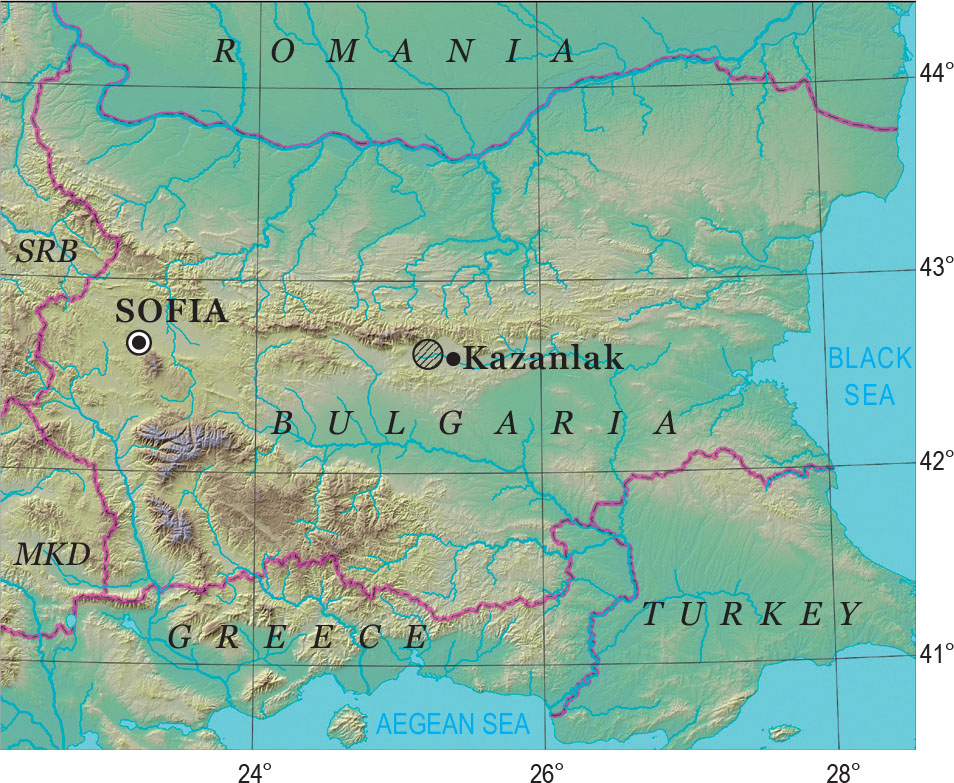
Figure 1:
The region of studied localities embraced in a circle, near the city of Kazanlak.
Slika 1: Območje preučevanih nahajališč, v bližini mesta Kazanlak je označeno s krogom.
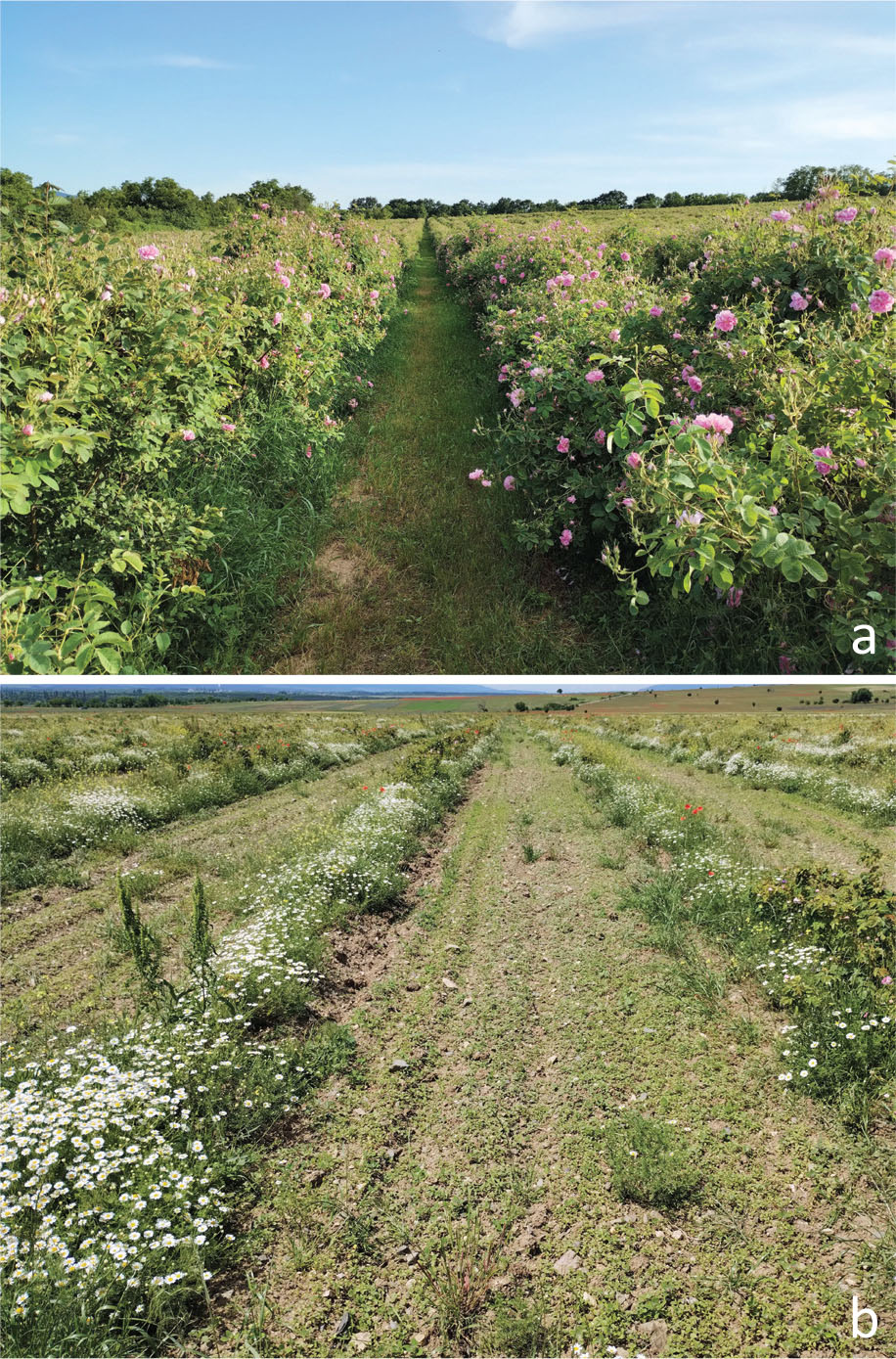
Figure 2:
Rose hedges separated by 2 m distance from each other with two different management types applied in the inter-rows: a) mowing, and b) ploughing.
Slika 2: Vmesni pasovi med nasadi vrtnic s širino 2 m in z dvema različnima načinoma upravljanja: a) košnja in b) oranje.
Species diversity was assessed using the Shannon-Wiener Index and Beta diversity to demonstrate species diversity changes across different environments. Beta diversity, as a measure of overall species turnover, was presented as within-cluster average Whittaker beta diversity, calculated using presence/absence data. Diagnostic species were determined by fidelity measure, expressed as phi coefficient multiplied by 100 (Chytrý et al., 2002). Analysis of results includes DCA ordination and Z statistics, and was performed by JUICE (Tichý, 2002) and PC-ORD (McCune & Mefford, 2006) software.
Results
A total of 141 species was recorded across 44 sample plots. The total variance (“inertia”) of the dataset was 5.1139.
Conventional Agriculture: ploughing vs. mowing management
We found a total of 65 species within 20 sample plots – 10 recorded under ploughing and 10 under mowing management. The vegetation under ploughing management had 31 species in total. Its group was characterized by five diagnostic species (phi ≥ 30), three of which with high fidelity values (phi ≥ 50) – Amaranthus hybridus, Anthemis ruthenica and Sinapis arvensis. Species of high frequency (constancy ≥ 50%) were Chenopodium album, Bilderdykia convolvulus, Amaranthus hybridus, Bromus sterilis, Polygonum aviculare, Lolium perenne, Convolvulus arvensis, Lamium amplexicaule and Fumaria rostellata. Dominant species with cover above 25% among the sample plots were Chenopodium album and Amaranthus hybridus. The average species number per sample plot was 10.3 and the average total cover was 52.5% (Table 1, Appendix 1).
Table 1:
Vegetation parameters and results from Shannon-Wiener Index and Beta diversity from the studied rose fields. Recording of data was performed in two different localities within the research area.
Tabela 1: Vegetacijski parametri, Shannon-Wienerjev indeks in beta raznolikost preučevanih polj vrtnic. Pridobivanje podatkov je potekalo na dveh različnih lokacijah znotraj raziskovanega območja.
| Group no. | Agriculture type | Management type | Total species number | Average number of species | Average total cover | Average Shannon-Wiener Index | Average Whittaker Beta diversity |
|---|---|---|---|---|---|---|---|
| Recorded in 2023 | |||||||
| 1 | Conventional [n=10] | Ploughed | 31 | 10.3 | 52.5 | 1.3317 | 2.0097 |
| 2 | Conventional [n=10] | Mowed | 51 | 16.2 | 68.5 | 1.5185 | 2.1481 |
| Recorded in 2019 | |||||||
| 3 | Conventional [n=12] | Mowed | 55 | 17.5 | 94.25 | 1.4421 | 2.1429 |
| 4 | Organic [n=12] | Mowed | 78 | 21.08 | 82.08 | 1.7098 | 2.6996 |
For the vegetation under mowing management, a total of 51 species were registered. It was characterized by 26 diagnostic species (phi ≥ 30), seven of them with high fidelity values (phi ≥ 50) – Galium aparine, Cynodon dactylon, Chamomilla recutita, Viola arvensis, Stellaria media, Elymus repens and Daucus carota. Highly frequent species (≥ 50%) were Chenopodium album, Polygonum aviculare, Convolvulus arvensis, Bilderdykia convolvulus, Lamium amplexicaule, Galium aparine, Bromus sterillis and Viola arvensis. As dominant species (cover ≥ 25%) among the sample plots acted Lolium perenne, Bromus sterilis and Elymus repens. The average species number was 16.2 and the average total cover was 68.5%.
The analyzed plots did not make mixed groups and form separate ones under different management types (Figure 3).
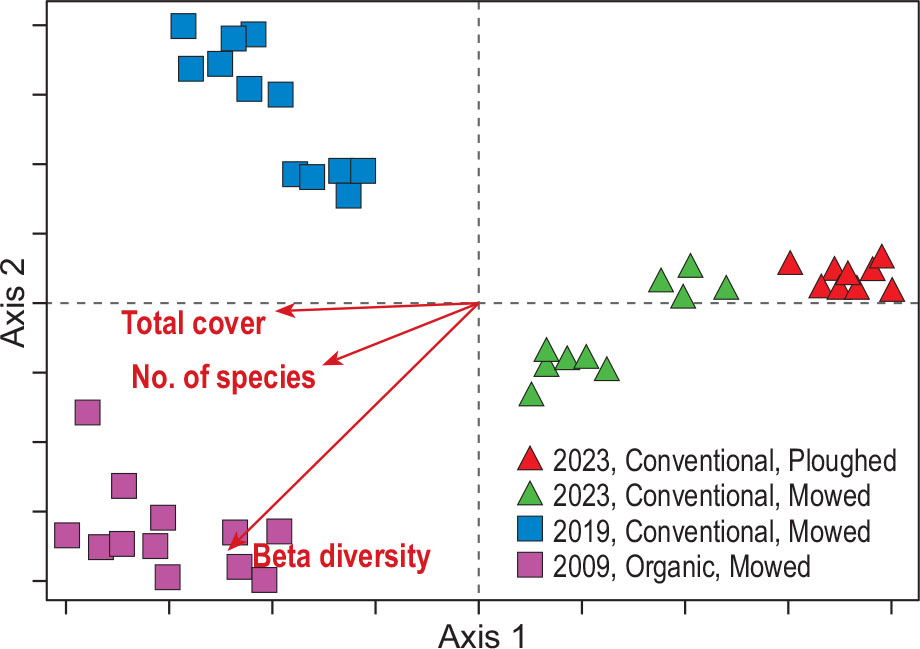
Figure 3:
DCA graph of the plots recorded under different management types. Total variance (“inertia”) in the species data: 5.1139. Gradient length of Axis 1: 4.208; Gradient length of Axis 2: 3.299. Variables Total cover, No. of species and Beta diversity are passively projected onto the ordination space.
Slika 3: DCA diagram ploskev, popisanih pri različnih načinih upravljanja. Skupna varianca (“inercija”) v podatkih o vrstah: 5,1139. Dolžina gradienta na osi 1: 4,208; dolžina gradienta na osi 2: 3,299. Spremenljivke skupna pokrovnost, število vrst in beta raznolikost, so pasivno projicirane na ordinacijski prostor.
The species composition and abundance differed significantly so the two groups had a difference of 56.97% (Z statistics: 70.67, p=<0.0001). Under mowing management species diversity and vegetation cover had higher values, reflected respectively by higher Shannon-Wiener Index and Beta diversity also (Table 1).
Conventional vs. organic Agriculture: Mowing management
We found a total of 102 species within the 24 sample plots – 12 recorded in conventional and 12 in organic farming. The plots in inter-rows under conventional farming harbored 55 species in total. The species group was characterized by 22 diagnostic species (phi ≥ 30), nine of them with high fidelity values (phi ≥ 50) – Taraxacum sp., Geranium rotundifolium, Hordeum murinum, Poa annua, Galinsoga parviflora, Atriplex sp., Malva sylvestris, Papaver rhoeas and Mentha longifolia. Species of high frequency (constancy ≥ 50%) were Taraxacum sp., Lolium perenne, Hordeum murinum, Convolvulus arvensis, Geranium rotundifolium, Veronica polita, Poa annua, Galinsoga parvifolia, Trifolium repens, Rumex patientia and Malva sylvestris. Dominant species with cover above 25% among the sample plots were Taraxacum sp., Hordeum murinum, Trifolium repens, Poa sylvicola, Malva sylvestris, Lolium perenne and Artemisia alba. The average species number was 17.5 and the average total cover was 94.25% (Table 1, Appendix 2).
The plots in inter-rows under organic farming harbored the highest number of species – 78. Its group had 32 diagnostic species (phi ≥ 30) in total, incl. 11 species of high fidelity (phi ≥ 50) – Potentilla argentea, Achillea millefolium, Salvia nemorosa, Cichorium intybus, Cynodon dactylon, Trifolium campestre, Dasypyrum villosum, Trifolium scabrum, Potentilla recta gr., Berteroa incana and Verbena officinalis. Highly frequent species (≥ 50%) were Lolium perenne, Achillea millefolium, Potentilla argentea, Plantago lanceolata, Verbena officinalis, Salvia nemorosa, Cichorium intybus, Cynodon dactylon, Convolvulus arvensis, Trifolium campestre, Medicago minima and Dasypyrum villosum. As dominant species (cover ≥ 25%) among the sample plots were Achillea millefolium, Plantago lanceolata, Trifolium repens, Salvia nemorosa, Potentilla recta gr., Lolium perenne, Dasypyrum villosum, Cynodon dactylon and Bromus tectorum. The average species number per plot was 21.08 and the average total cover was 82.08%.
The species composition and abundance differ significantly so the two groups show a difference of 82.53% (Z statistics: 101.08, p= <0.0001).
Discussion
Obtained results show that the management type of vegetated strips in agricultural areas does affect the vegetation, and plant biodiversity in particular, which supports statements in other studies (e.g. Tscharntke et al., 2021; Schütz et al., 2022). As far as plant biodiversity is concerned, mowing management is more sustainable and supports higher vegetation cover and species diversity (Smith et al., 2018). In the inter-row strips of the studied rose fields, besides some weeds and ruderal plants, we registered a considerable number of species from the autochthonous herbaceous flora in the area. Some of them attract pollinators and act as a refuge for other insects. Herbaceous vegetation prevents the spreading of fertilizers and pesticides in the surrounding pastures and also buffers against soil erosion (Bengtsson et al., 2019). The biomass collected when mowing management is implemented could be used as fodder or manure which enhances the effectiveness of agriculture. There is also an aesthetic value of the mown inter-rows that adds to the beauty of the landscape. The frequency and timing of the mowing most probably influence the species composition. Tillage ploughing is less favorable for the whole ecosystem, as it allows degradation and erosion of the soil and the unhindered passage of fertilizers and pesticides into the surrounding areas (Lal, 2013; Hopwood et al., 2021). Our observations show that weeds and ruderal species with weak competitive capabilities, many of which cannot find a place in already vegetated areas, predominantly take over in the ploughed inter-rows.
Different types of farming practices also affect vegetation and plant biodiversity in inter-row strips. The analyzed plots have not made mixed groups and form separate ones under different management regimes (Figure 3), which helps to conclude that the vegetation forms distinct types. The rose fields’ inter-rows under organic farming harbored the highest species richness confirmed by the Shannon-Wiener Index and observed differences between plots tested by Beta diversity (Table 1). Inter-row species diversity in organic farming maintains species common for the surrounding semi-natural pastures and meadows, while conventional farming frequently allows for common weeds or ruderal plant species. Many studies (e.g. Bengtsson et al., 2005; Tuck et al., 2014; Tschrantke et al., 2021) confirm that organic farming typically supports higher species richness and biodiversity, compared to conventional farming. Rose fields require long-lasting agricultural practice and restricted chemical influence is a biodiversity-friendly land use practice. Organic farming contributes to sustainability by not using chemicals to contaminate also the air and water around, and thus usually adds value to the products that increase human welfare (Cidón et al., 2021). Fertilizers enhance plant growth and hence vegetation cover but also promote ruderal species. The manure fertilization in organic farming is probably a reason for the lower values of the total vegetation cover as compared to the conventional farming, where mineral fertilizers applied (Table 1). A higher percentage of free spaces offers favorable condition for the propagule establishment from the surrounding areas, including ruderal species. The latter are outcompeted and displaced over time by species having competitive advantage through better adaptations.
Recording of rose inter-row vegetation across different years can influence species richness and composition to some extent regardless of the agriculture and management type. To reduce the effect of year-to-year variation of vegetation we applied standardized data recording – multiple sample plots of equal size and same timing (both years recorded in June). All sample plots are recorded in a relatively small area, which implies similar ecological conditions. The high overall variation in species composition that we found (total variance 5.1139) suggests a strong influence of the agriculture and management type on the inter-row vegetation.
Production of organic oil-bearing roses was assessed as one of the fastest growing agriculture in Bulgaria, also supported by higher prices of pure rose oil (Chalova et al., 2017). However, not all farmers are willing to turn to organic farming due to higher production costs. The increasing demand for organic rose oil, and the necessity to maintain biodiversity in the area of their cultivation, determine the need for a more nature-friendly and sustainable way of rose fields management.
Conclusion
Farming Rosa damascena is and will continue to be an essential part of the Bulgarian economy. Sustainable farming which supports the local biodiversity is, now more than ever, important for the future of our environment. The results presented in this study show that organic rose fields managed by mowing support the richest plant communities, and with a higher number of native species common for the surrounding semi-natural grasslands. Our study suggests that organic farming combined with mowing is the most beneficial practice for promoting plant diversity in Bulgarian rose fields. This approach not only supports a greater plant diversity but is also likely to contribute to healthier agricultural ecosystems that provide ecosystem services, such as biodiversity conservation, habitat connectivity, pollination, buffer function and landscape aesthetics. Financial resources provided by the Common Agricultural Policy are necessary measures for the future sustainability and maintenance of this important industry for the local community.
Acknowledgements
The study was supported by the Bulgarian Ministry of Education and Science, National Research Programme “Healthy Foods for a Strong Bio-Economy and Quality of Life” DCM # 577/17.08.2018.
Appendices
Appendix 1
Fidelity (phi-coefficient values) and percentage constancy synoptic table of Conventional agriculture. Ploughing vs. Mowing management. Data was recorded in June 2023 by I. Apostolova and N. Velev from the rose fields located between Gabarevo and Sheynovo villages, and the vicinity of Buzovgrad village.
Dodatek 1
Navezanost (vrednosti koeficienta phi) in sinoptična tabela stalnosti v odstotkih pri konvencionalnem kmetovanju. Upravljanje z oranjem in košnjo. Podatke sta junija 2023 pridobila I. Apostolova in N. Velev s polj vrtnic, ki se nahajajo med vasema Gabarevo in Sheynovo ter v bližini vasi Buzovgrad.
| Group № | 1 | 2 | ||
|---|---|---|---|---|
| Number of relevés | 10 | 10 | ||
| Management type | Ploughed | Mowed | ||
| Fidelity / Constancy | phi | % | phi | % |
| Amaranthus hybridus | 90.5 | 90 | --- | 0 |
| Anthemis ruthenica | 57.7 | 20 | --- | 0 |
| Sinapis arvensis | 50 | 100 | --- | 90 |
| Cirsium arvense | 33.3 | 60 | --- | 70 |
| Cardaria draba | 33.3 | 60 | --- | 40 |
| Galium aparine | --- | 80 | 73.4 | 70 |
| Chamomilla recutita | --- | 70 | 57.7 | 50 |
| Cynodon dactylon | --- | 90 | 57.7 | 80 |
| Viola arvensis | --- | 70 | 52.4 | 80 |
| Elymus repens | --- | 70 | 50 | 80 |
| Stellaria media | --- | 20 | 50 | 0 |
| Daucus carota | --- | 10 | 50 | 0 |
| Geranium dissectum | --- | 10 | 43.6 | 0 |
| Cerastium dubium | --- | 10 | 42 | 0 |
| Orlaya grandiflora | --- | 10 | 42 | 0 |
| Arenaria serpyllifolia | --- | 10 | 42 | 0 |
| Cichorium intybus | --- | 10 | 42 | 0 |
| Lactuca serriola | --- | 10 | 42 | 30 |
| Veronica hederifolia | --- | 50 | 34.6 | 0 |
| Senecio vernalis | --- | 10 | 34.6 | 40 |
| Pimpinella sp. | --- | 40 | 33.3 | 30 |
| Ranunculus sardous | --- | 40 | 33.3 | 0 |
| Lathyrus latifolius | --- | 10 | 33.3 | 10 |
| Hordeum murinum | --- | 10 | 33.3 | 40 |
| Linaria genistifolia | --- | 10 | 33.3 | 10 |
| Papaver rhoeas | --- | 10 | 33.3 | 0 |
| Myosotis arvensis | --- | 10 | 33.3 | 60 |
| Rumex acetosella | --- | 10 | 33.3 | 10 |
| Leontodon hispidus | --- | 10 | 33.3 | 0 |
| Plantago major | --- | 10 | 33.3 | 0 |
| Legousia speculum-veneris | --- | 10 | 33.3 | 50 |
| Rumex crispus | --- | 0 | 25 | 10 |
| Cuscuta europaea | --- | 0 | 22.9 | 10 |
| Taraxacum sp. | --- | 0 | 22.9 | 10 |
| Rumex cristatus | --- | 0 | 22.9 | 50 |
| Ranunculus arvensis | --- | 0 | 22.9 | 20 |
| Onopordum acanthium | --- | 0 | 22.9 | 40 |
| Rorippa sp. | --- | 0 | 22.9 | 20 |
| Capsella bursa-pastoris | --- | 0 | 22.9 | 70 |
| Cirsium vulgare | --- | 0 | 22.9 | 20 |
| Medicago minima | --- | 0 | 22.9 | 10 |
| Chondrilla juncea | --- | 0 | 22.9 | 20 |
| Torilis arvensis | --- | 0 | 22.9 | 30 |
| Medicago sativa | --- | 0 | 22.9 | 10 |
| Convolvulus arvensis | --- | 0 | 11.5 | 20 |
| Polygonum aviculare | --- | 0 | 11.5 | 20 |
| Lamium amplexicaule | --- | 0 | 10.5 | 10 |
| Amaranthus hybridus | 22.9 | 0 | --- | 30 |
| Chenopodium album | 22.9 | 0 | --- | 30 |
| Sonchus oleraceus | 22.9 | 0 | --- | 10 |
| Sisymbrium loeselii | 22.9 | 0 | --- | 40 |
| Lolium perenne | 22.9 | 0 | --- | 20 |
| Buglossoides arvensis | 22.9 | 0 | --- | 20 |
| Centaurea solstitialis | 22.9 | 0 | --- | 20 |
| Convolvulus arvensis | 22.9 | 0 | --- | 10 |
| Cardaria draba | 22.9 | 0 | --- | 10 |
| Fumaria rostellata | 22.9 | 0 | --- | 10 |
| Lolium perenne | 20.4 | 0 | --- | 10 |
| Fumaria rostellata | 20 | 0 | --- | 20 |
| Bilderdykia convolvulus | 14 | 0 | --- | 10 |
| Bromus sterilis | 11.5 | 0 | --- | 20 |
| Xanthium italicum | 10.5 | 0 | --- | 40 |
| Malva sylvestris | --- | 0 | --- | 50 |
| Raphanus raphanistrum | --- | 0 | --- | 30 |
| Erodium cicutarium | --- | 0 | --- | 30 |
Appendix 2
Fidelity (phi-coefficient values) and percentage constancy synoptic table of Mowing management. Conventional vs. Organic agriculture. Data was recorded in June 2019 by I. Apostolova and M. Valcheva from the rose fields located between Gabarevo and Sheynovo villages.
Dodatek 2
Navezanot (vrednosti koeficienta phi) in sinoptična tabela stalnosti v odstotkih pri upravljanju s košnjo. Pri konvencionalem in ekološkem kmetovanju. Podatke sta junija 2019 pridobili I. Apostolova in M. Valcheva s polj vrtnic, ki se nahajajo med vasema Gabarevo in Sheynovo.
| Group № | 3 | 4 | ||
|---|---|---|---|---|
| Number of relevés | 12 | 12 | ||
| Agriculture type | Conventional | Organic | ||
| Fidelity / Constancy | phi | % | phi | % |
| Geranium rotundifolium | 84.5 | 83 | --- | 0 |
| Taraxacum sp. | 84.5 | 100 | --- | 17 |
| Hordeum murinum | 83.3 | 92 | --- | 8 |
| Galinsoga parviflora | 70.7 | 67 | --- | 0 |
| Poa annua | 70.7 | 67 | --- | 0 |
| Atriplex sp. | 57.7 | 50 | --- | 0 |
| Malva sylvestris | 53 | 58 | --- | 8 |
| Papaver rhoeas | 51.3 | 42 | --- | 0 |
| Mentha longifolia | 51.3 | 42 | --- | 0 |
| Bromus arvensis | 38.5 | 42 | --- | 8 |
| Poa sylvicola | 37.8 | 25 | --- | 0 |
| Rumex acetosa | 37.8 | 25 | --- | 0 |
| Bromus sterilis | 35.4 | 50 | --- | 17 |
| Stellaria media | 30.8 | 33 | --- | 8 |
| Convolvulus arvensis | 30.8 | 92 | --- | 67 |
| Geranium molle | 30.8 | 33 | --- | 8 |
| Dactylis glomerata | 30.2 | 17 | --- | 0 |
| Persicaria lapathifolia | 30.2 | 17 | --- | 0 |
| Plantago major | 30.2 | 17 | --- | 0 |
| Apera spica-venti | 30.2 | 17 | --- | 0 |
| Cirsium arvense | 30.2 | 17 | --- | 0 |
| Urtica dioica | 30.2 | 17 | --- | 0 |
| Potentilla argentea | --- | 0 | 84.5 | 83 |
| Achillea millefolium | --- | 8 | 83.3 | 92 |
| Cichorium intybus | --- | 0 | 77.5 | 75 |
| Salvia nemorosa | --- | 0 | 77.5 | 75 |
| Cynodon dactylon | --- | 0 | 70.7 | 67 |
| Trifolium campestre | --- | 0 | 64.2 | 58 |
| Dasypyrum villosum | --- | 0 | 64.2 | 58 |
| Trifolium scabrum | --- | 0 | 57.7 | 50 |
| Potentilla recta gr. | --- | 0 | 57.7 | 50 |
| Berteroa incana | --- | 0 | 51.3 | 42 |
| Verbena officinalis | --- | 25 | 50 | 75 |
| Arenaria leptoclados | --- | 0 | 44.7 | 33 |
| Orlaya grandiflora | --- | 0 | 44.7 | 33 |
| Erodium cicutarium | --- | 0 | 44.7 | 33 |
| Plantago lanceolata | --- | 42 | 43 | 83 |
| Vicia grandiflora | --- | 8 | 38.5 | 42 |
| Chondrilla juncea | --- | 0 | 37.8 | 25 |
| Bromus tectorum | --- | 0 | 37.8 | 25 |
| Vulpia myuros | --- | 0 | 37.8 | 25 |
| Leontodon autumnalis | --- | 0 | 37.8 | 25 |
| Medicago minima | --- | 25 | 33.8 | 58 |
| Viola arvensis | --- | 8 | 30.8 | 33 |
| Trifolium angustifolium | --- | 0 | 30.2 | 17 |
| Erigeron annuus | --- | 0 | 30.2 | 17 |
| Hypericum perforatum | --- | 0 | 30.2 | 17 |
| Ajuga reptans | --- | 0 | 30.2 | 17 |
| Sanguisorba minor | --- | 0 | 30.2 | 17 |
| Cynosurus echinatus | --- | 0 | 30.2 | 17 |
| Centaurea solstitialis | --- | 0 | 30.2 | 17 |
| Crepis foetida | --- | 0 | 30.2 | 17 |
| Phleum phleoides | --- | 0 | 30.2 | 17 |
| Cerastium dubium | --- | 0 | 30.2 | 17 |
| Elymus repens | --- | 8 | 22.4 | 25 |
| Veronica arvensis | --- | 8 | 22.4 | 25 |
| Agrimonia eupatoria | --- | 0 | 20.9 | 8 |
| Leucanthemum vulgare | --- | 0 | 20.9 | 8 |
| Scleranthus neglectus | --- | 0 | 20.9 | 8 |
| Legousia speculum-veneris | --- | 0 | 20.9 | 8 |
| Poa compressa | --- | 0 | 20.9 | 8 |
| Sherardia arvensis | --- | 0 | 20.9 | 8 |
| Clinopodium vulgare | --- | 0 | 20.9 | 8 |
| Herniaria incana | --- | 0 | 20.9 | 8 |
| Holcus lanatus | --- | 0 | 20.9 | 8 |
| Cynosurus cristatus | --- | 0 | 20.9 | 8 |
| Poa trivialis | --- | 0 | 20.9 | 8 |
| Veronica officinalis | --- | 0 | 20.9 | 8 |
| Medicago marina | --- | 0 | 20.9 | 8 |
| Vicia cracca | --- | 0 | 20.9 | 8 |
| Trifolium arvense | --- | 0 | 20.9 | 8 |
| Origanum vulgare | --- | 0 | 20.9 | 8 |
| Lathyrus aphaca | --- | 0 | 20.9 | 8 |
| Bromus mollis | --- | 0 | 20.9 | 8 |
| Cuscuta campestris | --- | 0 | 20.9 | 8 |
| Tragopogon dubius | --- | 0 | 20.9 | 8 |
| Centaurea cyanus | --- | 0 | 20.9 | 8 |
| Viola tricolor | --- | 8 | 12.6 | 17 |
| Rumex acetosella | --- | 8 | 12.6 | 17 |
| Rumex patientia | 25.1 | 58 | --- | 33 |
| Malva pusilla | 20.9 | 8 | --- | 0 |
| Artemisia alba | 20.9 | 8 | --- | 0 |
| Prunella vulgaris | 20.9 | 8 | --- | 0 |
| Lamium purpureum | 20.9 | 8 | --- | 0 |
| Anchusa officinalis | 20.9 | 8 | --- | 0 |
| Festuca valesiaca | 20.9 | 8 | --- | 0 |
| Amaranthus hybridus | 20.9 | 8 | --- | 0 |
| Carthamus lanatus | 20.9 | 8 | --- | 0 |
| Poa angustifolia | 20.9 | 8 | --- | 0 |
| Melilotus officinalis | 20.9 | 8 | --- | 0 |
| Sonchus oleraceus | 17.7 | 42 | --- | 25 |
| Lactuca serriola | 16.9 | 50 | --- | 33 |
| Veronica polita | 16.9 | 67 | --- | 50 |
| Conyza canadensis | 12.6 | 17 | --- | 8 |
| Anagallis arvensis | 12.6 | 17 | --- | 8 |
| Capsella bursa-pastoris | 12.6 | 17 | --- | 8 |
| Veronica verna | 10.3 | 25 | --- | 17 |
| Trifolium repens | 8.4 | 58 | --- | 50 |
| Lolium perenne | --- | 92 | --- | 92 |
| Veronica chamaedrys | --- | 17 | --- | 17 |
| Crepis biennis | --- | 8 | --- | 8 |
| Bilderdykia convolvulus | --- | 50 | --- | 50 |