
1. Introduction
Falls constitute a critical public health issue that significantly compromises the functional independence and healthy life expectancy of older adults [1]. According to the World Health Organization (WHO), falls represent the second leading cause of unintentional injury-related deaths worldwide, with adults aged 60 and older bearing the most substantial burden of fatal falls [1]. Furthermore, the United States Centers for Disease Control and Prevention (CDC) reports that more than one-quarter of adults aged 65 and older experience at least one fall annually, identifying gait and balance impairments as pivotal modifiable risk factors [2]. Against the backdrop of a rapidly aging global population, characterizing the biomechanical markers associated with compromised stability during routine functional movements is of paramount importance for advancing fall risk screening, motor function evaluation, and the targeted design of rehabilitation interventions [3].
The sit-to-walk (STW) transition is a ubiquitous postural-locomotor task in activities of daily living, typically occurring when walking is initiated immediately upon rising from a seated position, such as a chair or the edge of a bed [4]. Distinct from isolated sit-to-stand (STS) or gait initiation (GI) tasks, STW is not a mere sequential concatenation of two discrete movements. Rather, it necessitates seamless spatiotemporal coordination among the forward progression of the center of mass (COM), lower extremity extension, the reduction in the base of support (BOS), and the onset of stepping [4]. Previous literature indicates that although healthy young adults proficiently integrate rising and stepping tasks shortly after seat-off, older adults tend to delay GI. They preferentially commence stepping only upon achieving a near-upright posture, thereby adopting a more conservative postural control strategy [5].
From a motor control perspective, the core challenge of the STW transition lies in simultaneously satisfying the dual demands of propulsion and stability [6]. Specifically, individuals must generate adequate forward horizontal momentum (HM) through trunk flexion and lower extremity extension to facilitate a fluid transition from sitting to walking [7]. Conversely, excessive forward HM or inadequate regulation of the spatial relationship between the center of mass and center of pressure (COM-COP) can exacerbate the risk of postural instability [6]. In this context, Buckley et al. demonstrated that, compared to younger adults, healthy older adults generate significantly less forward HM prior to rising during STW, accompanied by shorter step lengths, slower gait velocities, and a more conservative COM-COP control strategy [8,9]. Building upon this, Chen et al. further highlighted that older adults modulate their COM control around the instant of seat-off to attain a more upright posture prior to stepping; such an adaptation likely reflects a prioritization of dynamic stability [8].
Building upon the concept of the extrapolated center of mass (XCOM), Hof et al. posited that dynamic stability is governed not solely by the spatial position of the COM, but rather by the influence of COM velocity and the boundaries of the BOS [6]. Consequently, the margin of stability (MOS) serves as a robust indicator of an individual’s capacity to constrain COM motion within the limits of support during dynamic transitional tasks [10]. In contrast to conventional spatiotemporal parameters, the MOS concurrently integrates both positional and velocity data of the body. Therefore, it is particularly well-suited for assessing complex motor maneuvers like STW, which are inherently characterized by pronounced acceleration, support surface alterations, and GI [11,12]. Nevertheless, the MOS alone is insufficient to fully elucidate the underlying sources of stability regulation. To comprehensively unravel the biomechanical mechanisms governing stability control strategies across distinct age cohorts, it is imperative to integrate MOS analysis with evaluations of HM, center of pressure (COP) dynamics, and lower extremity joint kinematics.
Flexion and extension kinematics of the lower extremity joints, specifically the hip, knee, and ankle, constitute the primary kinematic and kinetic foundations for executing the STW transition. Specifically, hip flexion and forward trunk lean jointly contribute to the generation of forward HM; knee extension is closely associated with body elevation and seat off control, whereas the ankle joint plays a crucial role in COP regulation, forward progression, and GI [13]. Recent studies have demonstrated that STW strategies can be categorized based on hip and knee joint angles at the onset of gait, with distinct strategies exhibiting significant differences in HM, COP range and velocity, joint moments, and movement fluidity [9]. Furthermore, Miller et al. noted that older adults frequently employ spontaneous compensatory strategies during STW, which are linked to factors such as ankle range of motion (ROM), fear of falling, and neuromuscular reserve [13,14,15]. Consequently, a concurrent analysis of the MOS, HM, and lower extremity kinematics can help elucidate age-related differences in STW at both the outcome level (stability) and the source level (motor control).
Although previous studies have individually investigated spatiotemporal parameters, COM and COP relationships, HM, or compensatory strategies during STW, several notable research gaps remain [2,5]. First, prior research has predominantly analyzed STW as a singular holistic task [4], with limited exploration of the temporal characteristics of stability regulation across distinct functional phases, namely, the flexion momentum, extension, unloading, and swing phases. Second, while existing evidence frequently highlights that older adults adopt a conservative STW strategy, systematic integration is still lacking regarding whether this conservatism manifests primarily as altered MOS, reduced horizontal HM, adjusted COP control, or restricted joint mobility. Third, the associations between lower extremity kinematics and dynamic stability metrics have not been fully elucidated; in particular, there is a paucity of comparative analyses examining the joint, HM, and stability coupling relationships between young and older adults across different STW phases.
To address these gaps, the present study utilized an open-source gait biomechanics dataset to compare the differences in MOS, horizontal HM, COP excursion velocity, and lower extremity kinematics between young and older adults across varying phases of the STW transition. Furthermore, it aimed to explore the associations between joint ROM and dynamic stability metrics. We hypothesized that, compared to their younger counterparts, older adults would exhibit reduced generation of HM, altered MOS modulation patterns, and more restricted lower extremity kinematics during STW. Additionally, the correlations among joint kinematics, horizontal, and MOS would be weaker in the older adult cohort. By elucidating the age-related characteristics of stability control during STW, this study holds promise for providing an evidence base for the assessment of postural and locomotor transition capabilities, the identification of potential fall risks, and the design of targeted biomechanical interventions for older adults.
2. Materials and methods
2.1. Participants and experimental protocol
The present study conducted analyses based on a publicly available biomechanical dataset shared by Perera et al. [16] This dataset encompasses 65 healthy young, middle-aged, and older adult participants, all devoid of any neurological history, musculoskeletal injuries, or pregnancy. The experimental protocol employed a Vicon motion tracking system (Oxford Metrics Ltd., Oxford, UK) to record lower extremity kinematics at a sampling frequency of 200 Hz. Concurrently, Kistler force plates (Kistler Instrumente AG, Winterthur, Switzerland) were utilized to synchronously acquire kinetic data at 1,000 Hz. A total of 36 retroreflective markers were affixed to the pelvis and lower extremities of the participants. Medial knee calibration markers were removed prior to dynamic testing to prevent movement interference. During the testing session, participants were required to perform the STW task. From an initial seated position with both feet positioned on the force plates, knees oriented vertically, and hands resting naturally on their laps, participants were instructed to rise at a self-selected comfortable pace and walk forward for a distance of three meters. The original study protocol received ethical approval from the Monash University Human Research Ethics Committee (Approval No. 32328). The present study specifically extracted continuous data from the STW phase to conduct further in depth analyses.
2.2. Data processing
The raw dataset, comprising 65 participants, was imported in C3D format into Visual3D software (v6; C Motion, Inc., Germantown, MD, USA) for standardized modeling and preprocessing. To ensure the consistency of STW strategies and mitigate movement variability, a rigorous retrospective screening protocol was implemented in this study. Inclusion criteria were defined as follows. (1) Initial screening: The study cohort was restricted to young and older adult populations. (2) Kinematic consistency: To minimize kinematic variability stemming from differences in the leading leg, this study solely included participants who initiated walking with their right leg as the leading limb, provided that the initial foot off event could be accurately identified. (3) Baseline stability: Prior to the transient phase from movement onset to seat off, participants were required to maintain both feet in static and complete contact with the force plates, exhibiting no displacement or anticipatory adjusting movements. Following this screening process, a final cohort of 19 participants met the requisite criteria and was included in the analysis (Figure 1b), comprising 11 individuals in the young adult group and 8 in the older adult group. The basic characteristics of the ultimately included participants are summarized below (Table 1).
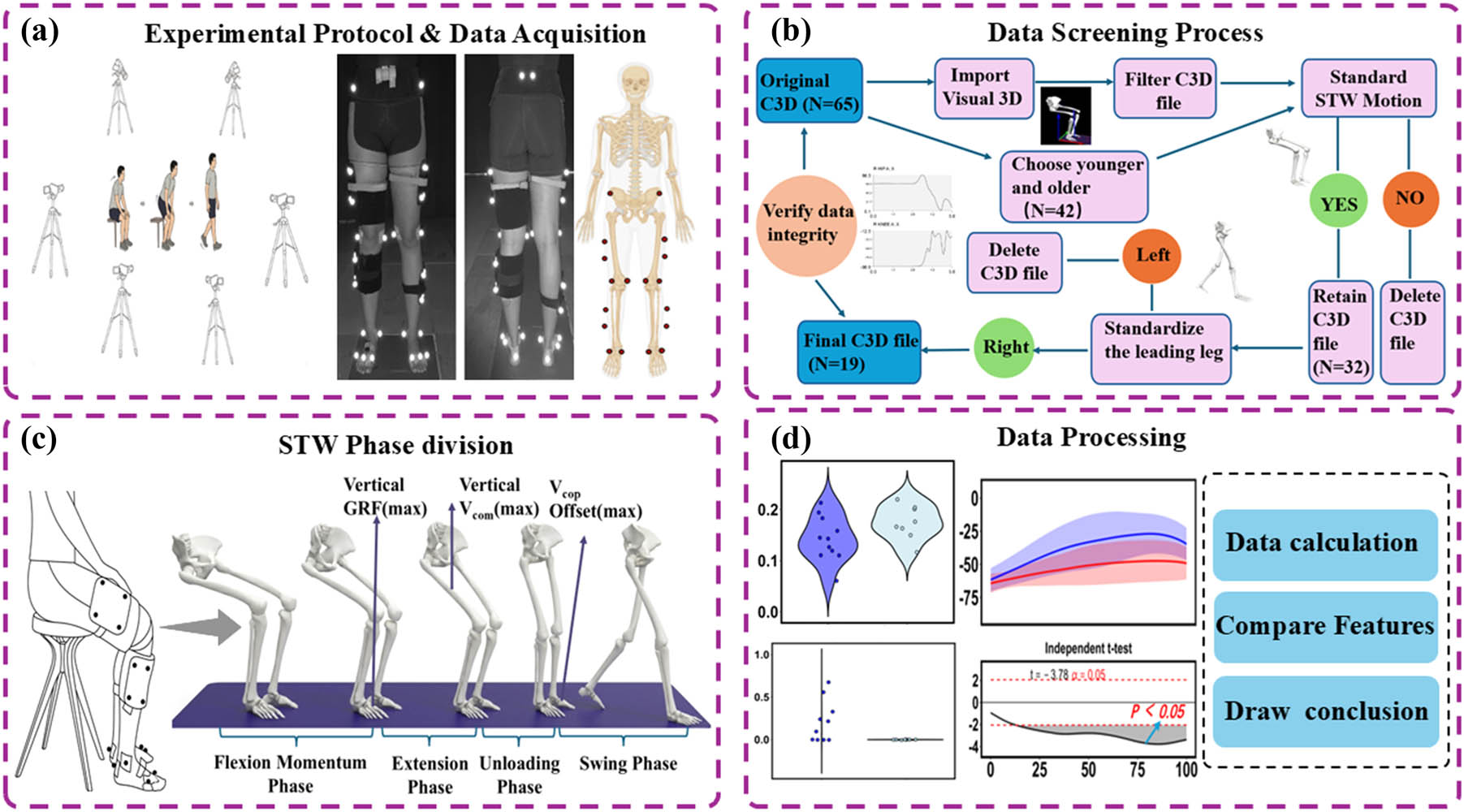
Figure 1
Flowchart of the research protocol. (a) Acquisition of research data; (b) screening of the raw data; (c) segmentation of the STW phases; (d) processing of kinematic and kinetic data.
Table 1
Participant characteristics
| Participant characteristics | Young adults (n = 11) | Older adults (n = 8) |
|---|---|---|
| Sex (male/female) | 8/3 | 6/2 |
| Age (years) | 24.36 ± 4.70 | 62.88 ± 4.94 |
| Height (m) | 1.68 ± 0.09 | 1.59 ± 0.06 |
| Weight (kg) | 68.86 ± 22.97 | 62.36 ± 11.03 |
| BMI (kg/m2) | 23.88 ± 6.48 | 24.65 ± 3.37 |
| Leg length (m) | 0.82 ± 0.04 | 0.76 ± 0.04 |
Note: The values are presented as the mean ± SD.
Following the methodology of Kerr et al. [4,17], the present study precisely delineated the entire STW process into four sequential phases based on specific kinetic and kinematic landmarks. (1) Flexion momentum phase: This phase initiates when the vertical ground reaction force (Fz) demonstrates a pronounced deviation, defined as exceeding the mean baseline sitting value by two standard deviations for a duration exceeding 0.01 s, and concludes at the instant of seat off, the termination marker was defined as the point at which the magnitude of the vertical ground reaction force first reached its peak. (2) Extension phase: This phase commences at seat off and terminates when the vertical velocity of the COM reaches its peak. (3) Unloading phase: This phase begins at the peak vertical COM velocity and ends at toe off of the swing leg. This specific event is identified by the peak excursion velocity of the COP of the stance leg. (4) Swing phase: This phase starts from the lift off of the swing leg and concludes upon the initial foot contact of the same leg (Fz > 20 N).
Both raw kinematic and kinetic data were smoothed using a fourth-order Butterworth low-pass filter with a cutoff frequency of 10 Hz [18,19]. Following data filtering, core kinematic metrics were extracted, including COM position and velocity, foot trajectories, and the lateral excursion velocity of the COP. Building upon this, lower extremity joint angles and ranges of motion for the hip and knee were further computed across each movement phase. To evaluate dynamic balance capabilities, this study further calculated the MOS [20] and HM [21]. The specific calculation formulas are as follows:
Following Kerr et al. [21] the BOS in this study was defined as the area enclosed by the contact between the left foot and the ground, with the spatial extremes in the anterior, posterior, medial, and lateral directions designated as the respective boundaries. Given the forward walking condition, the anterior tip of the second toe was specifically set as the anterior boundary (BOSedge). During forward walking, the XCOM represents the ground projection of the COM incorporating instantaneous velocity effects. The MOS was calculated as the relative distance between the XCOM projection and the boundary, with the anteroposterior and mediolateral margins denoted as anteroposterior margin of stability (AP MOS) and mediolateral margin of stability (ML MOS), respectively. A larger positive MOS value indicates greater dynamic stability, whereas a smaller value implies lower stability. Linear momentum is denoted as P, where m and v represent the subject’s body mass and COM velocity, respectively.
Relevant parameters were defined in standard SI units, with gravitational acceleration set to g = 9.8 m/s2, leg length (l), XCOM, and MOS all measured in meters. To mitigate interindividual morphological variations, MOS was normalized to leg length (l), and momentum (P) was normalized to body mass (m).
Subsequently, time-series data were time normalized. Using an interpolation method, continuous data across all phase stages were rescaled onto a normalized time axis consisting of 101 equidistant data points, corresponding to 0–100% of the phase cycle. Total HM was calculated by summing the normalized momentum values at each data point. To account for varying numbers of valid trials among participants, the measurements were averaged across the valid trials for each subject. The detailed experimental flowchart is illustrated in Figure 1.
2.3. Statistical analysis
All data were imported into SPSS Statistics 26.0 (IBM Corp., Armonk, NY, USA) for statistical processing. The normality of the data distribution was verified utilizing the Shapiro-Wilk test. For variables that satisfied the assumptions of normal distribution and homogeneity of variances, as assessed via Levene’s test, independent samples t tests were employed to evaluate intergroup differences between the older and young adult groups. Regarding the time series data of joint kinematics, the SPM1d plugin was executed within the MATLAB R2024a environment (The MathWorks, Natick, MA, USA) [22]. This facilitated the application of continuous independent samples t tests and subsequent data visualization based on random field theory. The threshold for statistical significance was universally set at 0.05. Finally, Pearson correlation coefficients were calculated to assess the associations among the respective metrics, with correlation coefficient values ranging from negative 1 to positive 1.
3. Results
3.1. Margin of stability
Figure 2 presents the AP MOS and ML MOS for both cohorts during the flexion momentum phase. The analytical findings reveal that within the extension phase (Figure 2b) and the swing phase (Figure 2d), the AP MOS in the older adult group was significantly greater than that in the young adult group (p < 0.05). Although no statistically significant differences in the MOS were observed between the two cohorts across the remaining phases, the overall trend throughout the entire STW transition demonstrated consistently higher MOS values in the older adult group relative to their younger counterparts. Table 2 for details.
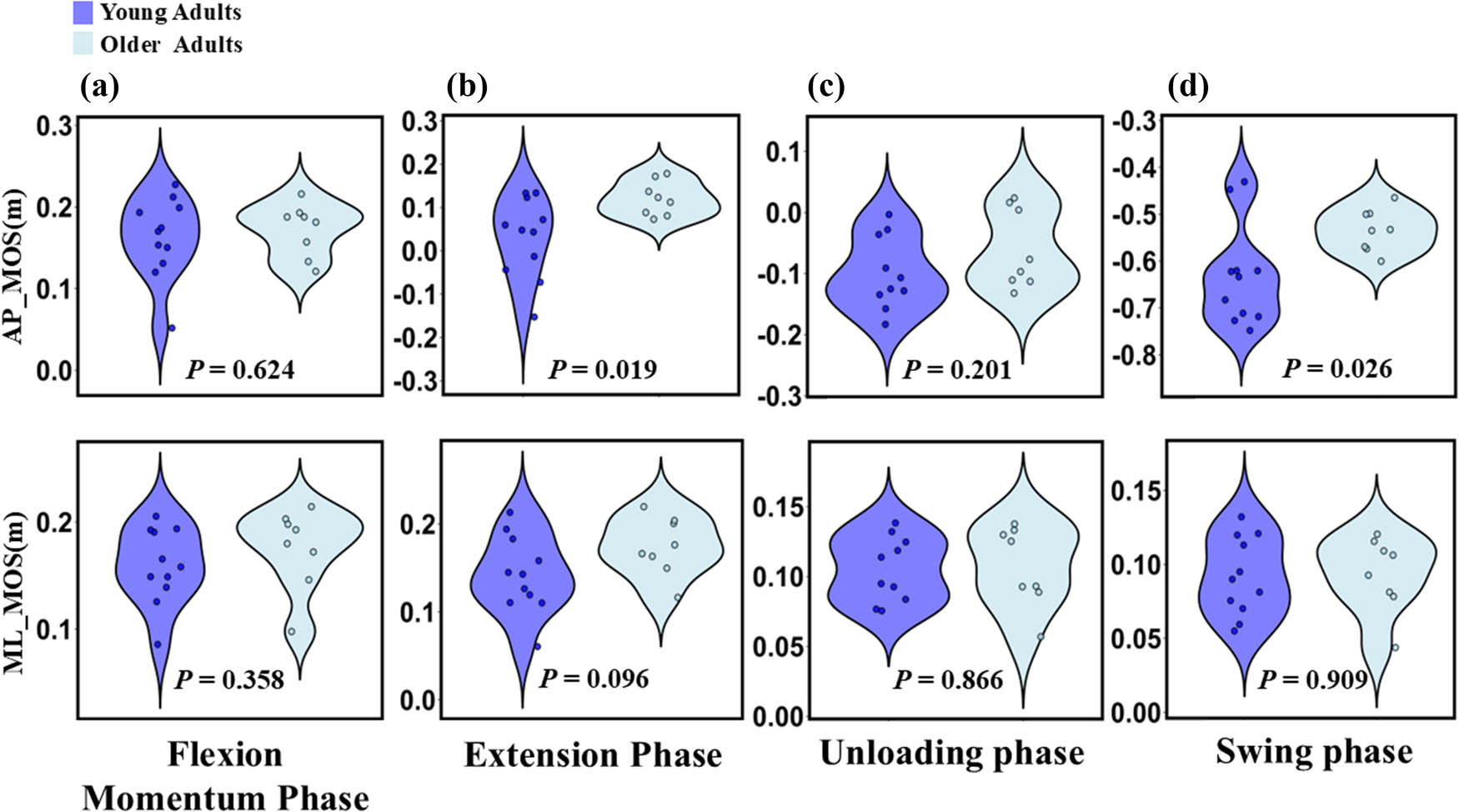
Figure 2
The AP MOS and ML MOS for both cohorts. (a) Flexion momentum phase; (b) extension phase; (c) unloading phase; (d) swing phase.
Table 2
MOS details
| MOS (m) | Phase | Young adults | Older adults |
|---|---|---|---|
| AP MOS | Flexion momentum phase | 0.0160 ± 0.052 | 0.187 ± 0.038 |
| Extension phase | 0.030 ± 0.092 | 0.040 ± 0.014 | |
| Unloading phase | −0.095 ± 0.060 | −0.057 ± 0.025 | |
| Swing phase | −0.63 ± 0.107 | −0.525 ± 0.040 | |
| ML MOS | Flexion momentum phase | 0.157 ± 0.037 | 0.175 ± 0.037 |
| Extension phase | 0.044 ± 0.013 | 0.033 ± 0.011 | |
| Unloading phase | 0.101 ± 0.023 | 0.011 ± 0.029 | |
| Swing phase | 0.092 ± 0.026 | 0.101 ± 0.017 |
Note: The values are presented as the mean ± SD.
3.2. Momentum
Figure 3 illustrates the peak HM and total HM for both cohorts during the STW transition. The results indicate that both the peak HM and total HM in the older adult group were consistently lower than those in the young adult group across all evaluated phases. With the exception of the total HM during the flexion momentum phase, statistically significant differences were observed between the two cohorts for all momentum parameters across the remaining phases (p < 0.05).
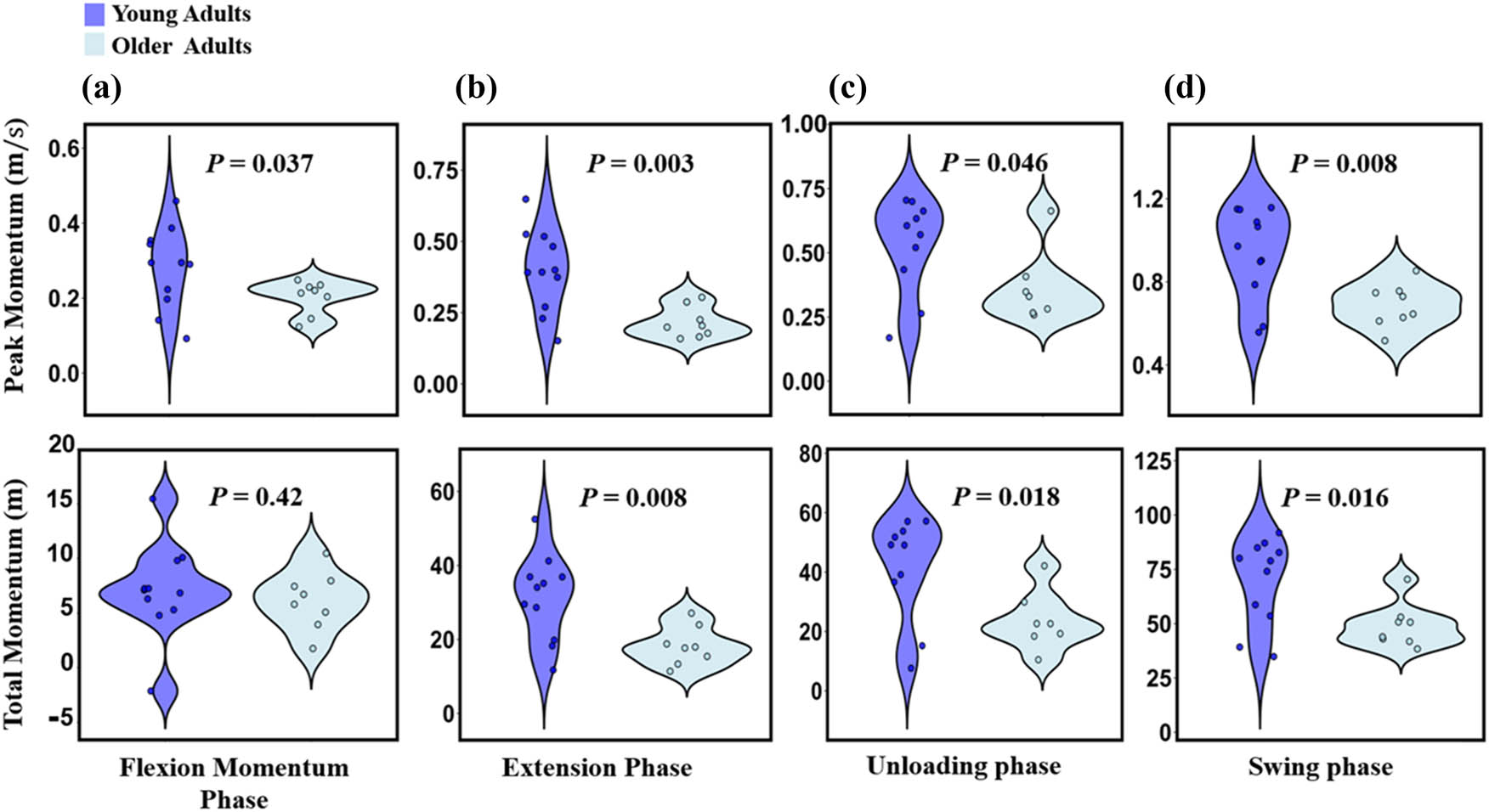
Figure 3
Peak horizontal momentum and total momentum for both cohorts. (a) Flexion momentum phase; (b) extension phase; (c) unloading phase; and (d) swing phase.
3.3. Joint angles
Figure 4 illustrates the sagittal ROM for the hip and knee joints across both cohorts. Overall, the young adult group exhibited a broader ROM in both the hip and knee joints. Regarding the temporal trajectories, statistically significant differences in the knee joint angles between the two cohorts were observed during the flexion momentum phase (15–100%; p < 0.05; Figure 4c) and the late swing phase (88–100%; p < 0.05; Figure 4d). Furthermore, the hip joint demonstrated statistically significant differences during the early swing phase (1–15%; p < 0.05; Figure 4d).
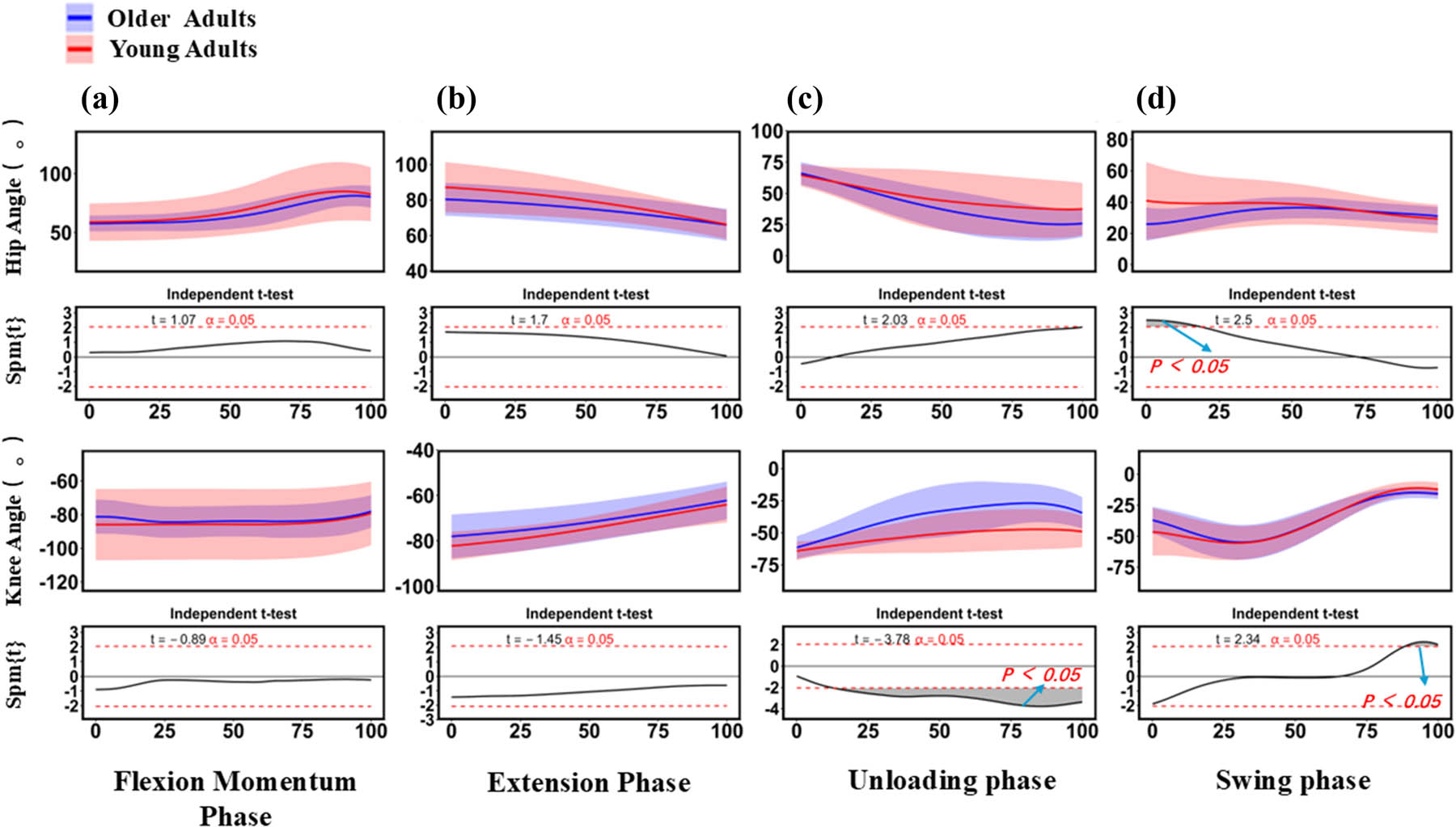
Figure 4
Hip and knee joint ROM for both cohorts. (a) Flexion momentum phase; (b) extension phase; (c) unloading phase; (d) swing phase.
3.4. COP
Figure 5 illustrates the lateral excursion velocity of the COP for both cohorts. The results indicate that during the flexion momentum phase, extension phase, and swing phase, the lateral COP excursion velocities were comparable between the two cohorts, exhibiting no statistically significant differences (p > 0.05). However, during the unloading phase, a statistically significant difference in the lateral excursion velocity was observed between the two cohorts (p < 0.05; Figure 5c).
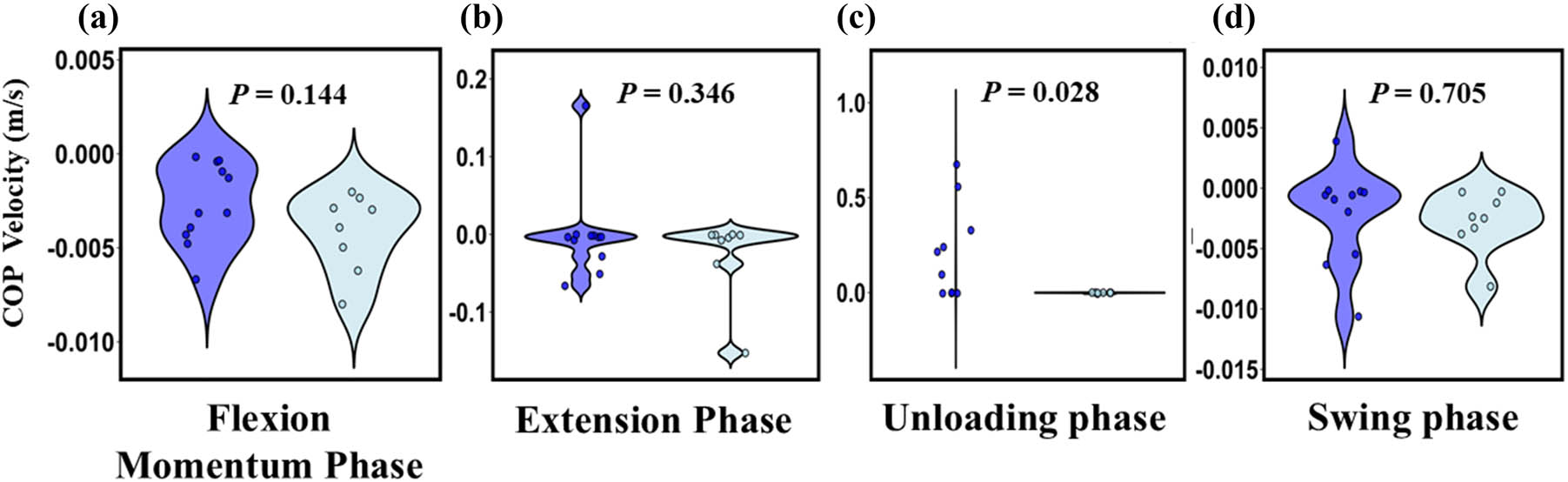
Figure 5
Lateral COP excursion velocity for both cohorts. (a) Flexion momentum phase; (b) extension phase; (c) unloading phase; (d) swing phase.
3.5. Correlation analysis
The correlation matrix in Figure 6 shows differences in neuromuscular and biomechanical coordination. Young adults demonstrated robust and widespread significant negative correlations across all movement phases. Notably, during the extension phase, AP_MOS and ML_MOS showed strong, highly significant negative correlations with Peak_ M, Total_ M, and V_COP (r < −0.5, p < 0.05). In contrast, older adults exhibited a near-complete absence of significant correlations during the first three phases, with only sporadic, weak-to-moderate negative associations emerging during the swing phase (r < −0.5, p < 0.05).
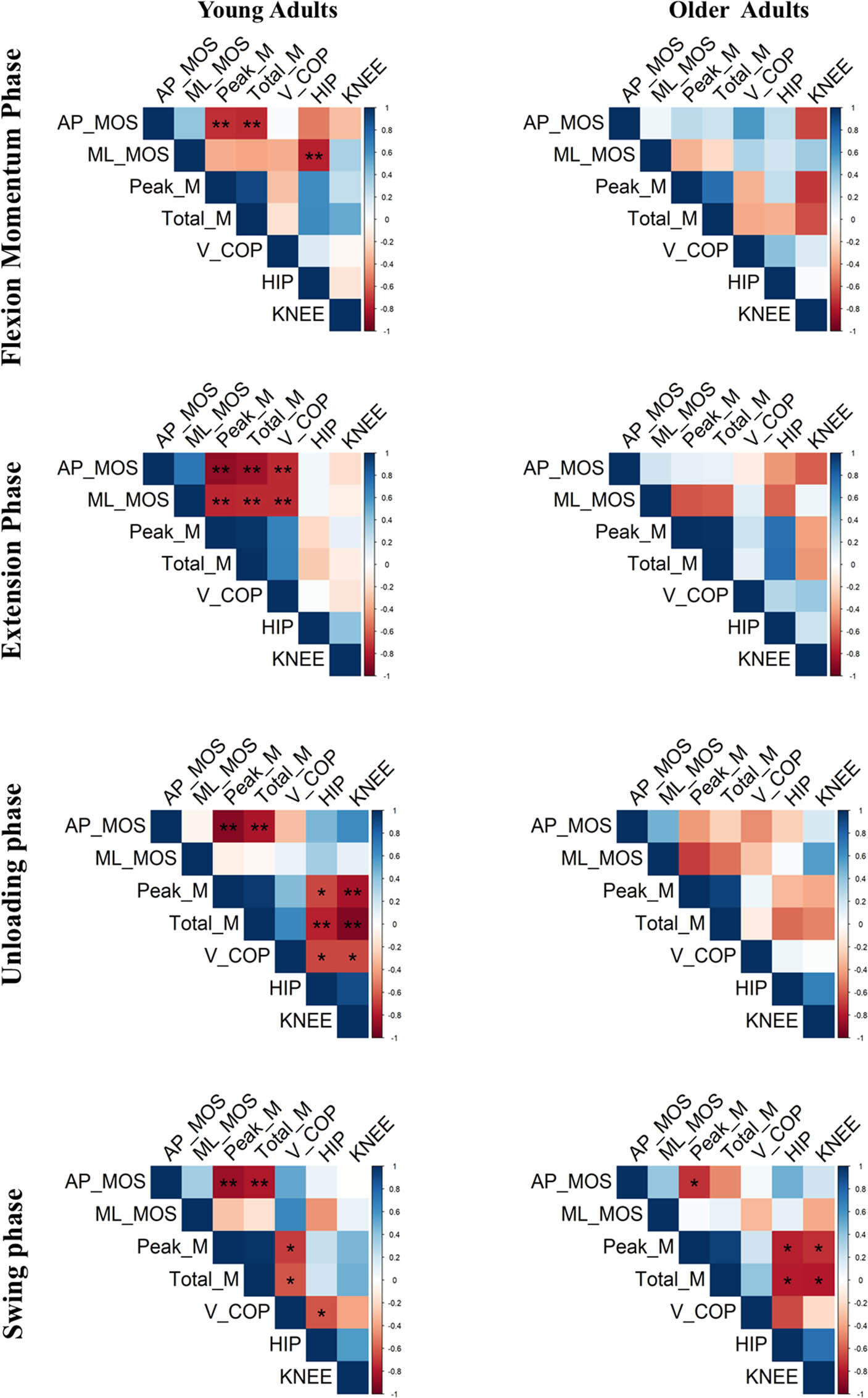
Figure 6
Correlation matrices of biomechanical parameters across STW transition phases in young and older adults. (a) Flexion momentum, (b) extension, (c) unloading, and (d) swing phases. Abbreviations: AP_MOS/ML_MOS, anteroposterior/mediolateral margin of stability; Peak_M/Total_M, peak horizontal/total momentum; V_COP, lateral center of pressure excursion velocity; HIP/KNEE, hip/knee joint range of motion. Color intensity reflects the magnitude of the correlation coefficient (r), with blue and red indicating positive and negative correlations, respectively.
4. Discussion
During the STW task, young adults exhibit an efficient coupling between stability and momentum, whereas this coordination is significantly diminished in older adults. To mitigate fall risk, older adults tend to adopt a conservative compensatory mechanism – essentially trading spatial progression for temporal regulation. Specifically, by decelerating the COP transfer, modulating lower-limb joint support patterns, and increasing the regulatory involvement of proximal joints, they partially sacrifice momentum transfer efficiency to preserve a safe dynamic MOS.
During the flexion momentum phase, the two cohorts exhibited distinct spatiotemporal strategies [23]. In older adults, the velocity and amplitude of forward trunk inclination are relatively constrained, which is likely associated with age-related declines in lower-limb explosive power and trunk mobility, thereby challenging the rapid generation of HM during the initial phase [24]. Aligning with the findings of Eline et al. [25], the present study observed that young adults tend to acquire high HM through rapid forward trunk flexion, whereas older adults employ a compensatory strategy of slowing the flexion velocity and prolonging the flexion duration to accumulate horizontal HM. Correlation analyses revealed that in the young adult group, the AP MOS demonstrated a strong negative correlation with both peak horizontal HM and total horizontal HM, alongside a negative correlation with hip kinematics. This negative correlation illustrates a highly efficient coupling strategy in young adults, who trade stability for propulsion. They utilize fluid active hip flexion to intentionally reduce the forward safety margin, thereby rapidly acquiring horizontal HM [26]. In contrast, among older adults, AP MOS not only lost its negative correlation with HM metrics but also exhibited a weak positive correlation. This shift suggests that older individuals adopt a more conservative postural control strategy during this phase by decoupling HM generation from postural stability control. By intentionally restricting rapid forward COM progression to maintain a safe MOS, they manifest a conservative movement pattern characterized by trading duration for momentum [6,27]. Notably, the AP MOS in the older adult group demonstrated a strong negative correlation with the knee joint ROM. This phenomenon may imply that the older adult population prematurely relies on knee joint fine tuning. This premature compensation by distal lower extremity joints safeguards postural security during the early stages of the movement but may reduce the efficiency of HM transfer [24]. Consequently, this could exert an adverse impact on momentum transfer during the subsequent seat off phase [27].
Seat off represents a node with an exceedingly high fall risk during the STW transition. Upon entering the extension phase, the BOS abruptly diminishes to encompass only the area beneath the feet. Confronted with this sudden alteration in mechanical boundary conditions, older adults exhibit a postural control strategy that actively restricts the amplitude and velocity of forward trunk lean, aiming to prevent the XCOM from approaching or exceeding the stability boundary due to excessively rapid trunk flexion [28]. This phenomenon is consistent with the characteristics of the STS trajectories in older adults observed by Sloot et al. [28]. This conservative control pattern partially attenuates the perturbations of forward inertia on postural equilibrium, thereby enabling older adults to preserve their AP MOS at a relatively ample baseline level. Consequently, this safeguards absolute postural stability during the drastic reduction of the BOS. The results indicate that older adults maintain the AP MOS at a higher baseline, ensuring absolute postural stability even as the BOS undergoes a drastic reduction. Correlation results demonstrate that the AP MOS in the young adult group was highly negatively correlated with various momentum metrics. Young individuals can successfully modulate their MOS to fluidly transfer momentum during this phase. In contrast, the AP MOS in the older adult group exhibited a weak positive correlation with momentum metrics. This indicates that the mechanical coupling between momentum and postural stability has become decoupled in the older adult cohort. This aligns closely with the findings of Liang et al. [29], and these findings highlight a fundamental biomechanical trade-off in older adults, wherein momentum transfer efficiency is compromised to preserve postural stability. Concurrently, the AP MOS remained significantly negatively correlated with knee joint kinematic characteristics. This phenomenon implies a potential association the maintenance of sagittal balance. Furthermore, the ML MOS in the older adult group demonstrated a significant negative correlation with hip joint ROM. During the extension phase following seat off [30], the older adult population likely relies on hip compensation to guide the lateral transfer of the COM [31].
The unloading phase serves as the critical transitional period from sit to stand to GI. During this time, the body COM undergoes complex load transfer. The COP must rapidly shift toward the stance side until the load on the swing leg is entirely released [32]. Faced with this biomechanical challenge, the two cohorts exhibited divergent postural control strategies. Relying on precise neuromuscular control and robust lower extremity explosive power, young adults can rapidly execute the COP transfer and efficiently propel the body forward [5]. The study further found that, to optimize movement efficiency, certain young individuals even adopt a step integration strategy, wherein toe off of the swing leg is completed before body weight is fully transferred. By comparison, the COP transfer velocity in the older adult cohort was significantly reduced. They tend to increase the knee extension angle, locking the lower extremity into a rigid structure to fortify support stability. Adopting a conservative movement strategy, older adults actively prevent the XCOM from excessively approaching the boundaries of the . This directly results in a significant reduction in both the generated peak HM and total HM. It is precisely this conservative compensatory mechanism, comprising slow COP transfer, that increased knee extension and restricted HM, which elucidates why the AP MOS and ML MOS ultimately reached similar levels between the two cohorts. The correlation matrices also unveiled the intrinsic mechanisms and multijoint differences underlying these two strategies. In the young adult group, the AP MOS exhibited an extremely strong negative correlation with both peak and total HM, as well as a high negative correlation with hip and knee joint ranges of motion. This indicates that young adults primarily rely on powerful momentum output to govern anteroposterior balance, demonstrating exceptional transfer efficiency in the lower extremities [21]. Moreover, the ML MOS and AP MOS in young adults showed virtually no coupling, reflecting an exceptionally high degree of postural control independence and movement degrees of freedom across different planes. Conversely, in the older adult group, the correlation between the AP MOS and HM was substantially weakened, whereas a closer association was established with the COP transfer velocity. This corroborates their conservative strategy of utilizing slow COP transfer to compensate for insufficient momentum, while the correlations between total HM and knee joint ranges of motion were also demonstrably weakened. The ML MOS in the older adult group was not only significantly negatively correlated with peak HM and positively correlated with knee joint ROM but also exhibited a moderate correlation with the AP MOS. This suggests that older adults may construct adaptive control strategies through lower-limb joint posture modulation and cross-planar regulation to safeguard lateral stability [33].
During the swing phase of the STW transition, the body rapidly shifts from bilateral stable support to single-leg weight bearing. Confronted with the drastic transfer of the COM, older adults displayed a fall prevention–oriented conservative postural control strategy, the hallmark of which is the maintenance of a larger MOS in the sagittal plane. In the early swing phase, owing to the decline in ankle plantar flexor strength, older adults struggle to acquire initial momentum through forceful ankle plantarflexion like their younger counterparts, subsequently shifting to rely on a proximally dominated (hip joint) activation strategy for compensation [5]. Progressing into the late swing phase, to mitigate the risk of instability stemming from the forward propulsion of the body, the neuromuscular system must more precisely regulate the XCOM. This ensures an ample MOS at the instant of heel strike [34]. The correlation matrices revealed that the AP MOS was negatively correlated with both peak HM and total HM. Nevertheless, the magnitude of this negative correlation in the older adult group was substantially weaker than that in the young adult group. They restrict forward momentum generation during the swing phase to maintain the safety threshold of the AP MOS, thereby prioritizing anteroposterior dynamic stability. The regulatory association of COP velocity was also markedly attenuated in the older adult population [35]. The young adult group effectively utilizes this velocity to regulate both the AP MOS and ML MOS, relying heavily on the ankle joint for flexible distal fine tuning. Conversely, the correlation between COP velocity and the AP MOS almost entirely vanished in the older adult group. This is highly likely attributable to decreased ankle plantarflexor strength or sensory nerve degeneration, causing the body to lose the capacity to rapidly shift the COP to control the center of gravity [36]. Consequently, following this failure of distal regulation, postural control dominance shifts to proximal large joints. This likely represents a quintessential biomechanical compromise strategy adopted by the older adult population to guard against falls during the transition from sitting to walking.
Previous studies have largely been confined to isolated STS or GI movements, fragmenting the dynamic continuity of the STW transition. Furthermore, parameter measurements have frequently focused on single joints, lacking a comprehensive consideration of the entire lower extremity kinematic chain [10]. By segmenting the transition into four sequential phases and applying rigorous data quality control to mitigate kinematic variability, we integrated MOS and HM correlations to elucidate the mechanical decoupling of stability and propulsion. Our findings reveal that older adults adopt a conservative strategy – trading time for space and momentum for stability. While this adaptive strategy helps safeguard dynamic stability, it highlights a functional trade-off between movement efficiency and center-of-mass control in older adults.
4.1. Limitations
Several limitations of this study should be acknowledged. First, to highlight differences related to aging, we directly excluded individuals of middle age from the initial screening pool of 65 subjects, retaining only the extreme cohorts of young and older adults. Subsequently, to ensure motor consistency, we required participants to initiate their steps with the right leg and maintain initial static bipedal contact with the force plates. This stringent screening process reduced the effective sample size to 19 participants, which likely excluded older adults with a high risk of falling who typically exhibit greater movement variability. This inevitably introduced selection bias, thereby limiting the generalizability of our conclusions. Second, multiple statistical analyses were conducted on the older adult group, which consisted of only eight individuals, without rigorous correction for multiple comparisons. Third, the current analysis carries a risk of generating false positive results, and thus, the related findings are better interpreted as preliminary and exploratory. Furthermore, allowing participants to perform the movements at a freely chosen comfortable speed without controlling for total movement time introduced a critical confounding factor. The reduction in momentum among the older cohort may be partially attributable to their slower overall execution speed. Fourth, the absence of neuromuscular data restricts the depth of our mechanistic explanations. The failure to synchronously collect surface electromyography and joint torque data means that our discussion regarding restricted lower limb ROM and postural control strategies relies heavily on inferences drawn from biomechanical phenomena, lacking direct empirical support. Fifth, relying solely on intrinsic passive compensatory mechanisms is insufficient for older adults to effectively mitigate actual fall risks. Future research urgently needs to incorporate targeted biomechanical interventions and external assistive devices. By optimizing plantar mechanosensory feedback or facilitating momentum transfer, future rehabilitation designs hold promise for substantially improving the motor efficiency of transitional movements. This will not only address the shortcomings of observational studies but also provide a viable clinical intervention strategy for enhancing motor control patterns in the older population [37].
5. Conclusion
During the STW task, young adults efficiently couple stability with HM, whereas this coupling is significantly attenuated in older adults. To mitigate fall risk, older adults tend to adopt conservative compensatory mechanisms by reducing COP progression velocity and restricting lower extremity ROM, thereby sacrificing HM transfer efficiency to preserve a safe dynamic stability margin.
Funding information
This study was sponsored by National Key R&D Program of China (2024YFC3607305), the Joint Fund of Zhejiang Provincial Natural Science Foundation of China (LKLY26H170001), General Program of Guangdong Provincial Natural Science Foundation of China (2026A1515010084), Zhejiang Provincial Key Project of Education Science Planning (2025SB084), Scientific Research Fund of Zhejiang Provincial Education Department (Y202559510), Ningbo Key Research and Development Program (2022Z196), Zhejiang Rehabilitation Medical Association Scientific Research Special Fund (ZKKY2023001), Research Academy of Medicine Combining Sports, Ningbo (No. 2023001), Ningbo Clinical Research Center for Orthopedics and Exercise Rehabilitation (No. 2024L004), and K. C. Wong Magna Fund in Ningbo University.
Author contributions
Ganggang Zhang and Fengping Li conceptualized and designed the study. Rui Zhao, Diwei Chen, and Dong Sun curated and organized the database. Yang Song and Danica Janicijevic performed the data processing and statistical analysis. Ganggang Zhang, Xuanzhen Cen, and Yaodong Gu drafted and revised the manuscript. Xuanzhen Cen and Yaodong Gu supervised the project and provided resources and funding support. All authors have read and approved the final manuscript.
Conflict of interest statement
Authors state no conflict of interest.
Data availability statement
The datasets generated during and/or analyzed during the current study are available from the corresponding author on reasonable request.