
1. Introduction
The global prevalence of diabetes mellitus (DM) continues to rise, placing an increasing burden on healthcare systems worldwide. According to the International Diabetes Federation (IDF), approximately 537 million adults were living with diabetes in 2021, and this number is projected to increase to nearly 783 million by 2045 [1]. Among the chronic complications of diabetes, diabetic foot (DF) represents one of the most severe and costly. It is estimated that 19–34% of individuals with diabetes will develop DF during their lifetime, with high recurrence rates, which contribute substantially to healthcare costs [2].
One of the most severe complications of DM is Charcot Neuro-Osteoarthropathy (CNO), commonly known as Charcot foot. This condition is a progressive, inflammatory, and destructive condition affecting the bones, joints, and soft tissues of the foot and ankle, resulting in fractures, dislocations, joint collapse, and profound deformity [3]. CNO primarily develops in individuals with diabetic peripheral neuropathy, where loss of protective sensation and proprioception leads to repetitive microtrauma, progressive deformity, and joint instability [2,4].
The consequences of Charcot foot are severe. The presence of Charcot deformity or ulceration alone increases the risk of lower-limb amputation several-fold, and when both are present, the risk becomes even more dramatic. Patients younger than 65 years with both Charcot foot and ulceration have a twelvefold increased risk of amputation, while those aged 65 or older have a 13-fold increase [5]. Mortality is also markedly elevated, with recent analyses estimating a five-year mortality of approximately 24–30% in people with Charcot foot, comparable to rates observed in individuals with Diabetic Foot Ulceration (DFU) [6].
Managing Charcot foot is challenging due to severe deformities that result from joint collapse, midfoot instability, and altered weight-bearing patterns. Treatment depends on whether the disease is in the acute phase, typically managed with immobilization via total contact cast or other non-removable devices, or in the remission phase, which requires long-term offloading using specialized footwear or orthotic devices. Current guidelines from the International Working Group on the Diabetic Foot (IWGDF) recommend footwear that accommodates deformity and supports foot structure, aiming to prevent recurrence, reactivation of acute Charcot changes, and the development of ulceration [7]. In this phase, footwear is essential not only for pressure redistribution but also for maintaining stability during standing and gait.
Despite its clinical importance, the functional consequences of Charcot-related deformities, particularly regarding postural stability and balance control, remain insufficiently understood. Studies have shown that patients with PN typically walk with reduced speed, shorter stride length, prolonged double-support time, widened base of support, and altered ankle mechanics [8]. These gait adaptations are commonly interpreted as compensatory strategies to enhance stability in the presence of sensory and motor deficits [9]. These abnormalities extend to postural control as well: loss of protective sensation, impaired proprioception, muscular weakness, and joint instability contribute to impaired balance and increased fall risk [10].
While individuals with DM and DPN demonstrate distinct kinetic and kinematic abnormalities, including increased ground reaction forces and elevated plantar pressure values [11,12], evidence specific to patients with Charcot foot remains limited, particularly in relation to balance and standing load distribution [3]. Studies, such as the one conducted by Wang et al. [13], have observed reduced gait velocity, shorter stride length, longer stride duration, prolonged stance time, and increased maximum knee extension moment in this population. Moreover, decreased ankle strength and the presence of Limited Joint Mobility (LJM) further impair gait mechanics and are well-recognized contributors to increased ulceration risk [14,15]. Together, these findings highlight the need for interventions that address both load redistribution and postural stability.
Footwear plays a crucial role in the long-term management of Charcot foot. Rocker-bottom soles are commonly used to improve gait and reduce plantar pressures. The study by Malki et al. [16] demonstrated that while anterior–posterior stability may not be significantly affected in DPN, medial–lateral stability can be altered, likely due to compensatory strategies such as widened step width. Their findings suggest that optimized rocker sole designs may improve gait without compromising balance. However, the effects of specific rocker sole design parameters on balance and postural control in individuals with Charcot deformity remain unclear.
Given the combined challenges of neuropathy, deformity, and instability, a better understanding of how therapeutic footwear influences balance is needed. Accordingly, this study was designed as a balance-focused case study, with additional observations on standing load redistribution. The aim of this study was to evaluate the effect of different rocker angles (15° and 20°) and rocker starting points (approximately 70 and 60% of the shoe length from the heel) in diabetic footwear on postural stability in a patient with Charcot foot in remission.
2. Materials and methods
2.1. The patient profile
The study participant was a 51-year-old man (body mass: 110 kg; height: 189 cm; BMI: 30.8) diagnosed with bilateral Charcot neuro-osteoarthropathy (CNO), type 2 diabetes mellitus (T2DM), and arterial hypertension (HT). His regular medications included Telmizek 40 mg (once daily), Jardiance 10 mg (once daily), Sitagliptin 25 mg (once daily), Siofor 1000 mg (three times daily), and Nebilet 5 mg (once daily). He reported a penicillin allergy.
The patient had a history of left fourth-toe amputation, performed during hospitalization due to traumatic necrosis. He was initially admitted on 24 July 2024 with necrosis of the left fourth toe following an injury. Prior to admission, he had not received chronic medical treatment, and both T2DM and HT were diagnosed during hospitalization. During the healing process, he underwent multiple courses of antibiotic therapy to control infection. The wound was regularly debrided, cleaned, and dressed, achieving complete healing by 20 November 2024.
The diagnosis of Charcot foot was complex and delayed. Approximately two years before the diagnosis of T2DM, an orthopedist noted concerning structural changes in the right foot; however, in the absence of a diabetes diagnosis, these findings were not recognized as diabetic in origin. Bilateral CNO was ultimately diagnosed only after the development of a non-healing wound in the left foot and the subsequent confirmation of T2DM.
At the time of examination (1 December 2025), the patient presented with no active foot wounds or signs of inflammation. Peripheral pulses were palpable in all major arteries bilaterally, and capillary refill time was approximately 3 seconds. The patient reported no pain (NRS = 0). Sensory testing using a 10 g monofilament and a 128 Hz tuning fork indicated partially impaired sensation in both feet.
The study was conducted in accordance with the principles of the Declaration of Helsinki and was approved by the Senate Bioethics Committee of the Józef Piłsudski University of Physical Education in Warsaw, Poland (approval no. SKE.0030.9.2025). Written informed consent was obtained from the participant prior to inclusion in the study.
2.2. Experimental protocol
During data collection, the PAPS® DIAB ME 8000 model (Figure 1) was used. This footwear is specifically designed for the prevention of DFU. The shoes are made of grained leather and feature a wide, high toe box. The sole is constructed from carbon fiber, and double Velcro straps facilitate proper fitting and adjustment. Two footwear configurations were tested: (1) a 15° rocker with the apex located at 70% of the shoe length from the heel (Shoe15), and (2) a 20° rocker with the apex at 60% of the shoe length (Shoe20). In addition to the rocker sole, a custom soft insole was used. It was shaped to provide medial longitudinal arch support for the right foot (to accommodate tarsal collapse) and included a metatarsal pad to offload the left forefoot.
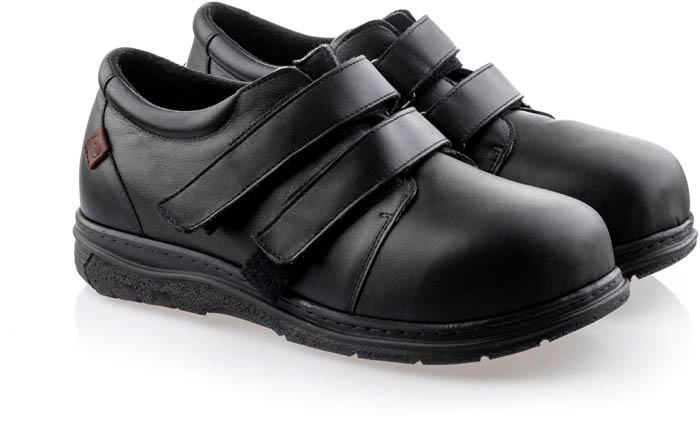
Figure 1
The PAPS® DIAB ME 8000 footwear used during data collection.
The participant’s postural stability was assessed under both dynamic and static conditions using two systems: the Biodex Balance System SD (BBS; Biodex Medical Systems, Shirley, NY, USA) and the Zebris FDM pressure platform (Zebris Medical GmbH, Germany), respectively. Each trial lasted 20 seconds and followed an identical protocol across conditions. A one-minute rest period was provided between trials to minimize fatigue.
For both systems, the participant stood in a standardized position with feet placed at hip width. A total of 21 trials were performed on each platform under three conditions: BF, Shoe15, and Shoe20. The trials were conducted in a cyclic order across all conditions.
The BBS consists of a circular platform capable of moving in both the anteroposterior and mediolateral directions. Dynamic stability was assessed using the Fall Risk Test mode, in which platform stability progressively decreases from level 6 (most stable) to level 1 (least stable). The Fall Risk Test Index (FRTi) was recorded for each condition.
Static stability was assessed using the Zebris platform, sampling at 100 Hz. The participant was instructed to stand quietly while focusing on a fixed point on a wall located one meter ahead. The following parameters were recorded: 95% confidence ellipse area (mm²), center-of-pressure (CoP) path length (mm), CoP average velocity (mm/s), average forefoot forces for the left and right foot (%), average hindfoot forces for the left and right foot (%), and total average forces for the left and right foot (%).
2.3. Statistical analysis
Statistical analyses were conducted using Statistica v.12 software (StatSoft, Tulsa, OK, USA), with the level of significance set at p < 0.05. Data normality was assessed using the Shapiro–Wilk test. As several variables deviated from a normal distribution, results are presented as medians with interquartile ranges (lower and upper quartiles). Differences among the three conditions (BF), 15° rocker shoes (Shoe15), and 20° rocker shoes (Shoe20)) were analyzed using Friedman’s ANOVA, followed by Dunn–Bonferroni post hoc tests.
Foot-loading symmetry was evaluated both between and within feet. Between-foot symmetry was assessed by comparing total plantar load between the left and right foot across conditions using Friedman’s ANOVA, allowing identification of condition-dependent asymmetry. Within-foot symmetry was examined by analyzing load distribution between the forefoot and hindfoot for each foot, also using Friedman’s ANOVA with appropriate post hoc testing. This approach enabled a comprehensive assessment of asymmetry, capturing both inter-limb differences and intra-foot load redistribution associated with the tested footwear conditions.
3. Results
Friedman’s ANOVA revealed significant effects of footwear condition on postural stability and load distribution during standing (Table 1). The Fall Risk Test Index (FRTi) differed significantly among conditions (χ 2(40) = 7.52, p = 0.0232), with higher values in the Shoe20 condition compared with barefoot standing (p = 0.0261), indicating reduced dynamic stability during standing on an unstable platform in the 20° condition.
Table 1
Median (lower; upper quartile) values for dynamic balance, CoP measures, and plantar loading parameters under barefoot and inclined-shoe conditions (Shoe15 and Shoe20)
| Parameters | BF Trial | Shoe15 Trial | Shoe20 Trial | Friedman’s ANOVA and Dunn Bonferroni post-hoc |
|---|---|---|---|---|
| FRTi [−] | 11.2 (10.4; 13.5) | 13.5 (12.1; 16.7) | 13.3 (11.9; 15.1) | χ 2(40) = 7.52, p = 0.0232*; BF < Shoe20, p = 0.0261* |
| 95% Confidence ellipse area (mm²) | 847 (585; 1105) | 702 (541; 862) | 877 (811; 986) | χ 2(40) = 5.51, p = 0.0633 |
| CoP path length (mm) | 381 (350; 447) | 457 (393; 503) | 477 (443; 533) | χ 2(40) = 8, p = 0.0183*; BF < Shoe20, p = 0.0164* |
| CoP average velocity (mm/s) | 19 (17; 22) | 23 (20; 25) | 24 (22; 27) | χ 2(40) = 8.80, p = 0.0122*; BF < Shoe20, p = 0.0129* |
| Left forefoot (%) | 64 (63; 67) | 56 (54; 58) | 54 (52; 55) | χ 2(40) = 31.6, p = 0.0001*; BF > Shoe15, p = 0.0001*; BF > Shoe20, p = 0.0001* |
| Left backfoot (%) | 36 (33; 37) | 44 (42; 46) | 46 (45; 48) | χ 2(40) = 31.6, p = 0.0001*; BF < Shoe15, p = 0.0001*; BF < Shoe20, p = 0.0001* |
| Left total (%) | 91 (86; 94) | 30 (27; 32) | 31 (30; 32) | χ 2(40) = 32.76, p = 0.0001*; BF > Shoe15, p = 0.0001*; BF > Shoe20, p = 0.0001* |
| Right forefoot (%) | 58 (46; 81) | 49 (48; 50) | 50 (49; 51) | χ 2(40) = 5.07, p = 0.0791 |
| Right backfoot (%) | 42 (19; 54) | 51 (50; 52) | 50 (49; 51) | χ 2(40) = 5.07, p = 0.0791 |
| Right total (%) | 9 (6; 14) | 70 (68; 73) | 69 (68; 70) | χ 2(40) = 32.76, p = 0.0001*; BF < Shoe15, p = 0.0001*; BF < Shoe20, p = 0.0001* |
| Symmetry | ||||
| Left–right (%) | 91: 9 | 30: 70 | 31: 69 | χ 2(40) = 96.57, p = 0.0001* |
| Forefoot–Backfoot (left [%]) | 64: 36 | 56: 44 | 54: 46 | χ 2(40) = 96.11, p = 0.0001* |
| Forefoot–Backfoot (right [%]) | 58: 42 | 49: 51 | 50: 50 | χ 2(40) = 12.32, p = 0.0791 |
Static balance measures also demonstrated condition-dependent changes. Although the 95% confidence ellipse area did not differ significantly (p = 0.0633), both CoP path length and CoP average velocity increased significantly in the Shoe20 condition compared with barefoot (p = 0.0164 and p = 0.0129, respectively), suggesting greater postural sway during quiet standing in the more inclined footwear condition (Shoe20).
Within-foot comparisons also revealed notable differences. On the left foot, both inclined shoe conditions significantly decreased forefoot force contribution (p = 0.0001) and increased hindfoot force contribution (p = 0.0001) compared with barefoot standing, indicating a posterior shift of load distribution. In contrast, the right foot showed no significant differences (p = 0.0791), suggesting that footwear effects were more pronounced in the structurally impaired foot.
A clear asymmetry between the left and right foot was observed across conditions. In barefoot standing, the participant transferred significantly more load on the left foot (median 91%) compared with the right foot (median 9%), indicating a strong baseline lateral weight shift. When inclined shoes were introduced, this asymmetry reversed rather than normalized: total load on the right foot increased markedly in Shoe15 (70%) and Shoe20 (69%), while left-foot loading decreased (30–31%).
Overall, inclined shoes, particularly the 20° model, were associated with reduced postural stability and marked redistribution of standing load between limbs, with a shift away from the affected left foot toward the right foot.
4. Discussion
In the present case study, rocker-sole footwear, particularly with a higher rocker angle, was associated with significant changes in postural stability during standing and load distribution, rather than dynamic plantar loading. Specifically, the 20° rocker configuration (Shoe20) was linked to increased postural sway and reduced stability during standing, alongside a marked redistribution of load between and within the feet.
Importantly, the present findings are limited to standing conditions and should not be interpreted as direct evidence of dynamic plantar pressure changes during gait. While rocker-sole footwear is typically designed to influence load transfer during walking, the current protocol assessed quiet standing and balance under controlled conditions, including an unstable support surface. Therefore, the results reflect postural control and force distribution during standing, not the functional rollover process during gait.
The observed redistribution of load resulted in a substantial reduction of weight borne by the previously affected left foot and a corresponding increase in the right foot. Crucially, this represents a reversal of asymmetry rather than normalization, which carries distinct clinical implications. While such redistribution may reduce mechanical stress on the affected structures, it may simultaneously increase loading on the contralateral limb.
Within-foot changes were also evident. On the affected side, a posterior shift in standing load distribution was observed, with decreased forefoot and increased hindfoot contribution. Similar patterns have been widely reported in studies examining plantar pressure during gait, where rocker-sole designs reduce forefoot loading and shift pressure proximally [7,17]. However, in the present study, these findings should be interpreted cautiously, as they reflect static loading patterns rather than dynamic plantar pressure measurements.
The most clinically relevant observation of this study is the apparent trade-off between load redistribution and postural stability. The more aggressive rocker configuration (20°) was associated with greater redistribution of standing load but also with increased instability, as indicated by CoP measures and FRTi. This aligns with previous reports suggesting that rocker-bottom footwear may affect balance depending on testing conditions and design features [18]. Furthermore, altered stability has been widely reported in individuals with diabetic neuropathy, who already present impaired postural control [19].
At the same time, the literature is not entirely consistent. Some studies report no immediate deterioration in balance performance with rocker footwear, particularly when using less aggressive designs such as toe-only rockers [20]. These discrepancies likely reflect differences in footwear construction (e.g., rocker type, apex position, sole stiffness), testing conditions (static vs. dynamic), and selected outcome measures. A systematic review by Healy et al. highlighted that the biomechanical effects of therapeutic footwear are highly dependent on design parameters [21].
In the context of Charcot neuroarthropathy, these trade-offs may be particularly important. Structural deformities, altered joint mechanics, and sensory deficits contribute to both abnormal loading patterns and impaired balance. While redistribution of standing load may reduce localized mechanical stress, increased instability may elevate fall risk, which is already higher in populations with neuropathy [22].
It should also be emphasized that multiple footwear features were modified simultaneously in this study, including rocker angle, apex position, and insole configuration. As a result, the observed effects cannot be attributed to rocker angle alone, which limits causal interpretation.
Recent work suggests that individually optimized rocker footwear may help mitigate this trade-off by preserving stability while achieving load redistribution [23]. This indicates that design parameters can potentially be tuned to balance mechanical and postural demands, which may be particularly relevant in patients with complex deformities such as Charcot foot.
Taken together, the present findings suggest that rocker-sole footwear influences both standing load distribution and postural stability and that these effects may occur in opposite directions. This reinforces the need for individualized footwear prescription, with careful consideration of both mechanical and balance-related outcomes.
Future research should focus on larger cohorts of patients with Charcot foot to determine whether the observed patterns are consistent across individuals. Importantly, future studies should include dynamic gait assessments, as the present results cannot be generalized to walking. Longitudinal designs are also needed to evaluate adaptation, fall risk, and clinical outcomes such as ulcer recurrence. Additionally, systematic manipulation of footwear parameters (rocker angle, apex position, sole stiffness, and insole design) would help isolate their individual contributions.
This study has several limitations. First, as a single-case analysis, the findings are descriptive and exploratory, and should not be generalized. Importantly, the repeated trials within a single participant do not represent independent observations, and therefore the statistical analyses should be interpreted with caution. The results are exploratory and descriptive rather than inferential. Second, the assessment was limited to short-term standing conditions, without evaluation of gait or real-life functional tasks. Third, multiple footwear features varied simultaneously, limiting causal interpretation. Fourth, neuromuscular factors were not assessed, although they may influence both stability and load distribution [24]. Finally, the underlying structural deformity and baseline asymmetry may have influenced the observed responses.
5. Conclusions
On the basis of this single-case study, the following observations can be made:
Rocker-sole footwear with a high rocker angle (20°) was associated with substantial redistribution of load during standing, shifting weight away from the affected foot to the contralateral limb.
Within the affected foot, a posterior shift in load distribution during standing was observed.
These changes were accompanied by reduced postural stability and increased sway.
Importantly, the observed asymmetry reversed rather than normalized under footwear conditions.
Overall, the findings suggest a trade-off between load redistribution and postural stability, with more aggressive rocker configurations increasing instability. Consequently, therapeutic footwear for Charcot foot should be individually assessed, with careful consideration of rocker design parameters. Future studies should include dynamic gait analysis to evaluate whether similar effects occur during walking.
Funding information
Authors state no funding involved.
Author contributions
Conceptualization, S.B. and M.B.; methodology, S.B., M.B., P.C.; software, S.B., M.B., P.C.; validation, J.W.; formal analysis, S.B., M.B., P.C.; investigation, S.B., M.B., P.C.; resources, S.B. and J.W.; data curation, S.B., M.B.; writing—original draft preparation, S.B., M.B., P.C., and J.W.; writing—review and editing, S.B., M.B., P.C., and J.W.; visualization, S.B., M.B.; supervision, M.B., P.C.; project administration, S.B., M.B., P.C.; funding acquisition, M.B, J.W. All authors have read and agreed to the published version of the manuscript.
Conflict of interest statement
Authors state no conflict of interest.