
1. Introduction
This article will address three crucial aspects. Firstly, we will revisit the evolution of SAL in India with a different approach. Secondly, we will track the Indian judiciary’s development in the ICT. Finally, we will discuss how SAL during the COVID-19 pandemic disruption paved the way for the development of increased VC in Indian Courts.
VC emerged as a cornerstone during the lockdown period of the COVID-19 pandemic, since the physical hearing of the cases was not possible during that period. It is essential to note that from 06-04-2020 to 31.08.2024, 33.1 million Indian Court hearings were conducted through VC (the High Courts heard 8,886,450 cases, and the District and Subordinate courts heard 24,218,903 cases)1. As the most populated country, it was not an easy task for India to manage an unforeseen situation like the COVID-19 pandemic.2 Due to the sudden lockdown, the country faced many problems, such as overcrowding in hospitals, managing prisons to prevent the spread of the virus, the burial of the deceased due to the coronavirus, etc. However, the Indian judiciary managed the situation with its own tool, namely SAL. Furthermore, while dealing with the functioning of the Courts during COVID-19, the judiciary unintentionally paved the way for an innovation, that is, integrating VC in court proceedings rather than conducting traditional physical hearings, which resulted in an increase in VC in the Courts of India. Moreover, no one has analyzed this milestone in the administration of Indian Courts, and this article will fill that gap by adopting a doctrinal method of research and using secondary sources such as relevant statistics available in the public domain and landmark cases to present the concept and principles relevant for drawing the conclusion.
2. The Evolution of Social Action Litigation in India
The term SAL is generally known as PIL in India and is called class action litigation in many other countries. Prof. Dr Upendra Baxi, a distinguished Professor of Law, has always advocated PIL as SAL, which is why we also refer to it as such in this article.3 However, the term is also known as Public Law Litigation, a term first coined by Prof. Abram Chayes of Harvard Law School in 1976.4 In the 19th century, the concept of PIL first evolved in the United States of America (USA) as a legal aid movement; in 1876 – the first legal aid office was started in New York5 and the Office of Economic Opportunity first provided financial support for the PIL movement in the USA. This financial aid helped lawyers and socially concerned people to fight for marginalized communities, public health, environmental protection, and against the exploitation of consumers.6
However, in India, there is no specific PIL legislation at the moment – it is primarily judge-led and, to some extent, even judge-induced, essentially being the product of juristic and judicial activism of the Indian Supreme Court.7 It functions based on powers conferred by Articles 32 and 226 of the Indian Constitution upon the Honorable Supreme Court and the Honorable High Court(s) respectively. Where there is a violation of fundamental rights, any citizen can knock on the doors of the above Courts at any time. The procedure for filing a PIL/SAL is the same as for the Writ Petition, but it is vital to note that it cannot be withdrawn once the PIL is filed. Apart from the original and appellate jurisdiction upon filing the Writ Petition, the Court has the power of epistolary jurisdiction and suo motu cognizance of the cases. Epistolary jurisdiction is a mechanism where the Court accepts a letter, postal card, telegram, e-mail, etc., addressed directly by the affected party or any person acting in the social interest, and converts it into a petition, as seen, for instance, in the landmark case of D.K. Basu vs. State of West Bengal, where the Court accepted a letter about custodial death in West Bengal prisons.8 Similarly, suo motu refers to the mechanism where the Court takes cases on its own motion. In this type of SAL, the higher judiciary will take up cases it considers important in the public interest on the basis of newspaper reports, television coverage, or numerous letters raising the same serious concern. Thus, in India, PILs allow the Court to address issues of public concern, particularly those affecting marginalized communities. PILs may originate through various channels, including suo motu petitions by the Chief Justice or any judge of the higher judiciary, the higher judiciary’s decision to treat a pre-existing petition as a PIL, or the direct presentation of a petition in the higher judiciary. This mechanism has made the Court more accessible to individuals seeking justice on broader societal issues.9
2.1. Phase-I (1976 Onward)
In India, social action litigation emerged as a product of judicial activism in 1976, largely credited to Justice V. R. Krishna Iyer, who sowed the seed in the case of Mumbai Kamgar Sabha Vs M/s. Abdulbhai Faizullabhai and Ors, where the traditional rule of locus standi was relaxed for the first time, allowing a union of workers to file a petition on behalf of the workers.10 SAL reached a further milestone in the case of Hussainara Khatoon & Ors vs Home Secretary, State of Bihar, in which 40,000 undertrial prisoners across the country were released pursuant to the judgment delivered by Justice P. N. Bhagwati on the petition filed by Advocate Puspha Kapila Hingorani upon having come across a news report revealing that prisoners in Bihar jails had been detained without trial, exceeding the legally permissible detention period.11 Thus, Justice V. R. Krishna Iyer sowed the seed of SAL, and Justice P. N. Bhagwati nurtured its growth through the Hussainara Khatoon case, thereby laying the foundation for what is known as Phase-I of SAL. Therefore, Phase-I marks the inception of SAL, focusing on cases involving the infringement of fundamental right infringement and ensuring access to justice for, and on behalf of, the downtrodden.
2.2. Phase-II (1980s Onward)
From 1980s onwards, the Apex Court started taking cases involving environmental issues, for instance, the case of M.C. Mehta & Another vs Union Of India & Others, soon after the Bhopal gas tragedy, where 45 tons of methyl isocyanate gas leaked into the air from a chemical industry named Union Carbide India Limited during the midnight of 3–4 December 1984.12 At that time, people in Bhopal were peacefully sleeping, but due to the gas leakage, they began having trouble breathing. It is said that 3,000 people died due to that incident, and six lakhs people survived, albeit with respiratory complications.13 Similarly, here, an industry named Shriram’s Food and Fertilizer Factory, situated in the capital city of Delhi, was found to have a gas leakage due to which an Advocate who was practicing in Tis Hazari Court died, and seeing this, another Advocate, M. C. Mehta, filed this petition in public interest. Here, the Apex Court applied the new concept of absolute liability rather than that of traditionally followed strict liability.14
In another case, Vellore Citizens Welfare Forum vs. Union of India & Others, the Apex Court found that the tanneries were draining their untreated effluents into the Palar River and that the effluents were being dumped onto agricultural lands in the State of Tamil Nadu.15 Here, the Court applied the precautionary and polluters-pay principles and ordered the State Pollution Control Board authorities to ensure that tanneries treated their effluents; otherwise, steps could be taken to close establishments that did not comply with the guidelines. The Apex Court also took strong action by imposing fines on all the tanneries, ensuring that the polluters faced consequences for their actions. Thus, Phase-II deals with the beginning of SAL cases concerning environmental issues.
2.3. Phase-III (1990s Onward)
In the 1990s, the Apex Court started taking cases on promoting good governance, integrity, and probity. Nevertheless, here, not only the Apex Court but also the High Courts started actively participating in accepting and guiding the country on good governance, integrity, and probity. The 2G Spectrum Case, considered one of the biggest scams in India, was the SAL case filed by the Centre of Public Interest Ligation that made the Apex Court declare the licenses allocated by the Department of Telecommunications that made a loss of Rs. 176,000 Crores to Government as invalid.16
Regarding the High Courts, we will take the Madras High Court as an example for ease of understanding. Justice N. Kirubakaran, while inquiring about a Civil Miscellaneous Appeal (CMA) in 2014–15 relating to an accident claim case, found that Section 129 of the Motor Vehicle Act, 1988,17 and the Government Order of the Tamil Nadu Government vide G.O. Ms. No. 292, Home Department, dated 22.02.2007,18 which makes wearing of helmet mandatory for people travelling on a motorcycle or bicycle, were not being properly checked by the authorities (traffic police). In that CMA, the Madras High Court added the Home Department, Government of Tamil Nadu, and the Union of India through a suo motu impleading order with powers conferred on it through Article 226 of the Constitution of India, and directed the Government of Tamil Nadu, all states, and all the Union Territories to ensure implementation of Section 129 of the Motor Vehicle Act, 1988 and to levy fines on defaulters and even cancel driving licenses for habitual defaulters. The authorities were urged not use this direction for any corrupt activities, and if found, the affected parties could directly complain about the issue to higher authorities.19
Thus, Phase-III deals with the beginning of SAL cases that guide the nation on integrity, good governance, and probity.
2.4. Phase-IV (Approach of the Indian Higher Judiciary Toward SAL During the COVID-19 Pandemic)
Many legal experts still think there are only three phases of evolution in India’s SAL segment. However, there is an existence of new phase during pandemic, which can be easily understood with the help of Table 1 below. The number of suo motu cases registered is eight in the year 2020, which is higher compared to other years. The Apex Court has taken eight cases on its own motion because of unforeseen situations like the COVID-19 Pandemic purely for the benefit of its people, which can be clearly understood in Table 2.
Table 1
Letter Petitions and Writ Petitions (Civil and Criminal) Received/Filed under PIL/SAL in the Supreme Court of India.
| YEAR | LETTER-PETITIONS RECEIVED IN ENGLISH, HINDI, AND OTHER REGIONAL LANGUAGES | WRIT PETITION (CIVIL) | WRIT PETITION (CRIMINAL) |
|---|---|---|---|
| 2013 | 45588 | 214(3)* | 45(2)* |
| 2014 | 30404 | 332 | 48(2)* |
| 2015 | 51203 | 264(2)* | 39(1)* |
| 2016 | 53282 | 282 | 35 |
| 2017 | 59561 | 79(2)* | 5(1)* |
| 2018 | 61061 | 350(1)* | 49 |
| 2019 | 70403 | 374(4)* | 59(4)* |
| 2020 | 69124 | 300(8)* | 26(2)* |
| 2021 | 111830 | 1487(4)* | 587(2)* |
| 2022 | 115120 | 1353 | 587(1)* |
| 2023 (until 31.10.2023) | 59162 | 1409(2)* | 637(1)* |
[i] *Figure in brackets shows the number of Writ Petitions registered on Suo Motu.20
Table 2
Suo Motu Cases Taken By the Honorable Supreme Court of India in 2020 Due to the Covid-19 Pandemic.
| SUO MOTU WRIT PETITION (CIVIL) NO. | CASE TITLE |
|---|---|
| 1/2020 | In Re: Contagion of COVID-19 Virus in Prisons21 |
| 2/2020 | In Re: Regarding Closure of Mid-Day Meal Scheme22 |
| 3/2020 | In Re: Cognizance for Extension of Limitations23 |
| 4/2020 | In Re: Children In Need of Care and Protection Due To Loss of Parents During COVID-1924 |
| 5/2020 | In Re: Guidelines for Court Functioning Through Videoconferencing During COVID-19 Pandemic25 |
| 6/2020 | In Re: Problems and Miseries of Migrant Laborers26 |
| 7/2020 | In Re: The Proper Treatment of COVID-19 Patients and Dignified Handling of Dead Bodies in the Hospitals etc.27 |
| 8/2020 | In Re: Financial Aid For Members of Bar Affected by the Pandemic28 |
During the COVID-19 outbreak, the Apex Court gave many directions regarding the condition of prisoners across the country, the Mid-Day Meal Scheme, the care of children who were in the children’s protection homes, the condition of migrant laborers, the proper treatment of COVID-19 patients and the dignified handling of dead bodies in hospitals, as well as concerning one case involving advocates affected by the pandemic, and two cases – Suo Motu Nos. 3 and 5 of 2020 – which were taken up for the administration of Indian Courts for the benefit of judicial officers, Court officials, advocates, para-legal members, and litigants.29 In Re: Cognizance For Extension of Limitation, the Apex Court excluded the period from 15 March 2020 to 28 February 2022 under any special or common laws in all judicial or quasi-judicial proceedings for the purposes of limiting the physical appearance of court officials, advocates, litigants, and the general public in court proceedings, to avoid overcrowding and the spread of the coronavirus.30 At the same time, in another suo motu case regarding the guidelines for the functioning of courts in VC, the Apex Court adjudicated that, to maintain the rule of law even during an COVID-19 outbreak, the courts must function through VC with the modern technology already available across Indian Courts.31 This decision by the Supreme Court of India during the COVID-19 pandemic paved the way for today’s enormous increase in the number of court hearings in the Indian judiciary, which is explained in the upcoming sections of this research paper.
3. Development of ICT in the Indian Judiciary
In 1991–92, the Supreme Court and High Courts of India started using computers for managing payrolls and accounts. From 1997–98 onwards, the Indian judiciary began using computers for printing court orders and judgments.32 The Supreme Court of India then proposed to the Government the constitution of an e-Committee to formulate a national policy to computerize the Indian judiciary. The e-Committee came up with an e-Courts Mission Mode Project, a pan-India project managed and funded by the Government, Ministry of Law and Justice and Department of Justice for all the courts across the country. Its stated mission is to “give time-bound and efficient citizen-centric services, install, develop and implement judicial support systems in courts, and mechanize the processes to provide transparency in accessing information to its stakeholders; to increase judicial productivity, both quantitatively & qualitatively; and to make the delivery of justice accessible, affordable, cost-effective, reliable, predictable and transparent”.33
The e-Court Mission Mode Project is one of the most significant projects in the country because of its practical and strategic phase-wise implementation, and it aims to provide FOSS (Free and Open Sources).34 The e-Court Mission Mode Project has been implemented in following three phases.
3.1. Phase-I
“Phase-I Started in the year 2007 with the sanctioned outlay cost of Rs. 935 Crores in the year 2011,” to provide ICT infrastructure – computers, servers, hardware components, software, etc. – to the courts, with the mission “to develop and maintain websites, train judicial members, officers and its staff, initiate Case Information Systems (CIS), etc., which resulted in certain necessary requirements for all stakeholders. “A comprehensive list of the developments proposed for Phase-I was as follows: (i) establish a server room with internet provisioning at all the court complexes; (ii) provide laptops to judges and judicial officers; (iii) provide ICT training for one year; (iv) procure system software (such as office packages, RDBMS, OS, etc.); (iv) upgrade ICT infrastructure in the Apex Court and High Courts; (v) conduct project management consultancy, change and monitoring management; (vi) provide computer facilities at judges’ chamber, process places, court halls, filing sections, and certified copy sections; (vii) upgrade the power infrastructure; (viii) centralize facility upgradation for system administration; (ix) provide scanners at computing facilities; (xi) provide for manpower and training”.35
Finally, Phase-I concluded in the year 2015 with the achievements of computerizing 14,249 Subordinate and District Courts of the country, providing laptops for 14,309 judicial officers, and training almost 3,900 court staff as system administrators to operate CIS. At last, 493 Courts and 347 jails became VC-enabled.
3.2. Phase-II
It was during Phase-II (2015–23) that Indian courts were among those making the most extensive use of VC during the pandemic. Phase-II started in the year 2015 with an outlay of Rs. 1,670 crores. This phase achieved many implementations, such as: (i) live streaming of proceedings in the High Courts of Gauhati, Gujarat, Orissa, Jharkhand, Karnataka, Patna, Uttarakhand, MP (Madhya Pradesh), and the Constitutional Bench of Honorable Apex Court of India, thus allowing interested persons and media to view the proceedings; (ii) the implementation of the National Judicial Data Grid (NJDG) as part of the e-Courts project to facilitate litigants’ access to judgment orders and case status; (iii) bringing WAN connectivity up to almost 99.5% of total court complexes; (iv) the computerization of 18,735 Subordinate and District Courts; (v) making 3,240 courts and 1,272 jail complexes became VC-enabled in this phase.36
3.3. Phase-III (The Future of the Indian Judiciary)
Even though this phase is not connected to the research topic, since the sub-topic narrates different phases of the development of the e-Courts Mission, it would be incomplete without a narration of this Phase-III. After the end of Phase-II in the year 2023, Rs. 7,210 Crores were allocated for Phase-III by the Union Cabinet of India, chaired by Prime Minister Shri Narendra Modi, with his vision “Sabka Sath, Sabka Vikas Aur Sabka Vishwas” (“together with all, development for all and the trust of all”).37 After the improvements from Phases I and II, the e-Courts Mission Mode Project Phase-III is rooted in the philosophy of access and inclusion. The main aim of Phase-III is to implement an integrated technology platform in the Indian judiciary, which will provide a highly advanced and paperless link between litigants, the courts, and stakeholders. Both the e-Committee of the Supreme Court and the Ministry of Law and Justice work together to make the judicial system more affordable, accessible, predictable, transparent and reliable for all.38
3.3.1. Expected Outcomes of Phase-III
Installing e-Sewa Kendras for people who are unable to access the judiciary services.
Payment of fines, court fees, and penalties from anywhere at any time.
Making processes user-friendly by minimizing physical document movement and reducing paper-based filing through digitizing court records.
Increasing virtual participation in court proceedings to reduce the travel costs.
Increasing e-filing to reduce human errors, so that documents are automatically checked, while simultaneously increasing paperless case filings and records.
Building a smart ecosystem for a smoother experience by using emerging technologies such as Artificial Intelligence (AI) and its subsets – Optical Character Recognition (OCR), Machine Learning (ML), and Natural Language Processing (NLP) – so that registries have less file scrutiny and minimal data entry, facilitating better policy planning and decision-making. These technologies will enable intelligent systems and smart scheduling that provide data-based decision-making for registries and judges and allow greater optimization and predictability of the capacity of advocates and judges.
Increased transparency and accuracy in court proceedings.
“Expansion of the National Serving and Tracking of Electronic Processes (NSTEP) for automated delivery of court summons, which will help minimize case pendency”.39
4. The Impact of SAL during COVID-19 Pandemic on Increased VC Hearings in Indian Courts
In the second section of this paper, we already saw a brief about the case Suo Motu 5/2020, Supreme Court of India. However, in this section, we provide a more detailed account of this landmark case and its impact on today’s functioning of Indian courts. While reading the order of the Apex Court dated April 06, 2020, it was noted that, in 2003, the Apex Court approved the recording of evidence through VC in the case of State of Maharashtra v Praful Desai.40 Finally, the Supreme Court of India, keeping in mind the aforesaid judgment, concluded that the technologies already equipped and upgraded during Phase-II of the e-Courts Mission Project should be used for implementing VC in all the courts of the country.
The Supreme Court also observed that advanced technology has made it possible to hear and see any events occurring far away in real time. VC is such advanced technology that it allows us to hear, see and speak to someone far away with the same ease and facility as if the person were physically present before us. Except for touch, one can hear and see as if a party were present in the court hall. Recording of evidence in VC would be considered a procedure established by law.41
At the same time, the Apex Court gave important directions for initiating VC with the powers conferred on it by Article 142 of the Constitution of India, which are as follows:
The Supreme Court and all the High Courts shall take all necessary measures to minimize the physical presence of all stakeholders, while lawfully considering best public health practices and social distancing guidelines.
All the High Courts and the Supreme Court are permitted to take measures needed to ensure the robust functioning of the judiciary using technology through VC.
Each High Court may determine its model rules for temporarily adopting VC technologies based on the public health situation in its jurisdiction.
There must be a helpline number in the concerned courts so that any complaint about audio or other feed quality can be made during the court proceeding or immediately after its completion; otherwise, grievances regarding the quality of VC shall not be entertained thereafter.
The VC mode prescribed by concerned High Courts shall be adopted by the District Courts.
Litigants without access to, or any means to use, VC shall be duly notified and facilitated by the courts with such amenities. An amicus curia may be appointed, and VC facilities made available.
VC may be used for hearing arguments, whether at the trial or appellate stage, until the High Courts prescribe rules. At the same time, evidence shall not be recorded by VC without the mutual consent of the parties on both sides. If deemed necessary, the presiding officer may ensure that social distancing is maintained during the recording of evidence in a court hall.
The presiding officer may restrict persons’ entry into the court hall or the places from where the advocates address arguments. The presiding officer shall not allow entry to any person who is suffering from an infectious diseases. Wherever the number of litigants is large, the presiding officer shall restrict the number. In the presiding officer’s discretion, the proceedings may be adjourned wherever it is challenging to limit the number.
After mentioning these directions, the Supreme Court stated that the cooperation of all judges, advocates, courts, litigants, staff, parties, and other stakeholders is necessary for the successful implementation of these directions, to ensure that the Indian judiciary can withstand and face the unforeseen challenge caused by the outbreak of COVID-19.42
4.1. Videoconferencing Rules, 2020
Based on the above-mentioned directions issued by the Supreme Court of India in the SAL case Suo Motu No.5 (Civil) of 2020, the e-Committee drafted the Model Rules of Videoconferencing for Courts.43 These were circulated to all High Courts of the country. Further, those Model rules were made known as rules by the High Courts of the Country. For instance, the Madras High Court notified the Madras High Court Videoconferencing in Courts Rules, 2020.44 In order to maintain the decorum of judicial proceedings, certain regulations were framed and mentioned in a Schedule to the Videoconferencing Rules, as follows.
“All participants in the proceedings shall wear sober attire consistent with court decorum. Advocates must dress suitably in professional clothing prescribed by the Advocates Act, 1961. Police officials must appear in the prescribed uniform under the relevant orders or statutes. The attire for court staff and judicial officers shall be as specified in the relevant rules prescribed by the High Court on that behalf. The decision of the Presiding Officer or Judge concerning the dress code is final”.
Proceedings must be conducted at the provided time and date. Punctuality must be carefully observed.
“The case shall be called out, and appearances shall be recorded as per the direction of the Court”.
Every participant shall adhere to the protocols always followed in a physical Court, even in VC. The Presiding Judge or Officer will be addressed as “Your Honor” or “Madam/Sir”. Court staff will be addressed by their designation, such as “Court Master/Bench Officer”. Advocates must be addressed as “Senior Counsel/Learned Counsel”.
Required persons, parties-in-person, advocates, and other participants must keep their microphones muted till they are asked to make submissions.
Remote users must ensure that their devices are malware-free.
Remote coordinators and remote users must ensure that the remote point is quiet, has sufficient internet coverage, and is adequately secured. “Any unnecessary disturbance that occurs during VC may, if the Presiding Judge so directs, render the proceedings non est”.
During court proceedings conducted by VC, all participants must set their devices to airplane mode or switch them off.
During court proceedings, all participants must remain attentive, look into the camera, and refrain from engaging in any other activity.
These regulations played the most important role in making VC Mode in Indian courts a successful platform.
4.2. Impacts of the 2020 Videoconferencing Rules
As of 30.11.2024, all District courts, including taluk-level courts in all 25 High Courts, have adopted the Videoconferencing Rules. Additionally, one set of VC equipment was provided to each court complex, and 14,443 courtrooms were sanctioned VC equipment. An amount of Rs. 7.60 crore was released to procure 1,732 document visualizers. For uniform VC, the Bharat VC app has been selected and it is under trial. From 23.03.2020 to 04.06.2024, the Apex Court conducted 754,443 hearings, and from 06.04.2020 to 30.11.2024, all the High Courts together heard 9,092,493 cases, while all the district and subordinate courts heard 25,105,478 cases through VC. The performance can be easily understood from the statistical representation below (Figure 1).
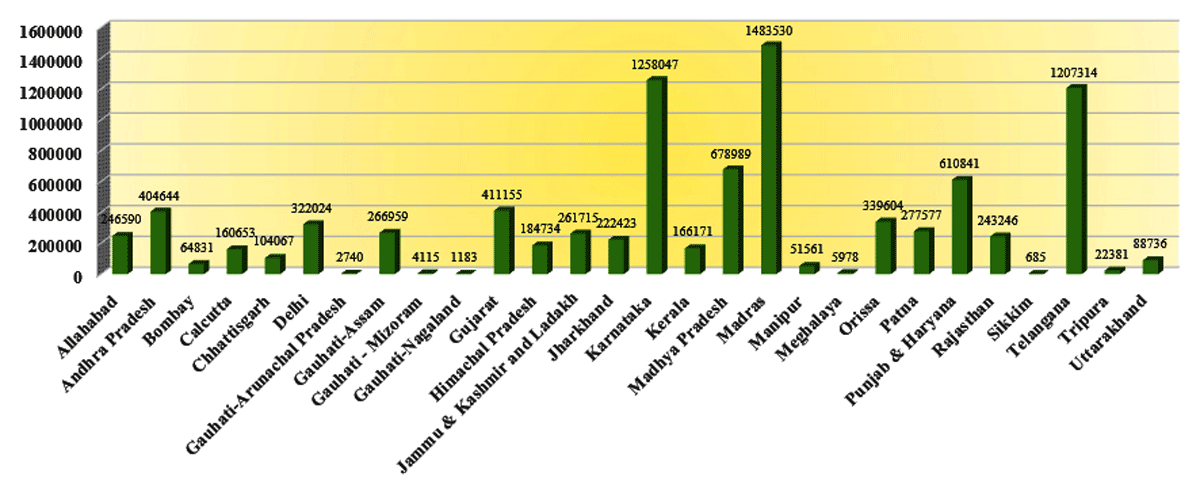
Figure 1
Number Of Hearings Conducted Through VC in High Courts From 06.04.2020 To 30.11.2024.45
From the above illustration, we can identify that the Madras High Court in the State of Tamil Nadu witnessed a high number of VC hearings until 30.11.2024.
Again, from another above illustration, we can identify that the District Courts under Allahabad High Court in the State of Uttar Pradesh witnessed a high number of VC hearings until 30.11.2024 (Figure 2).
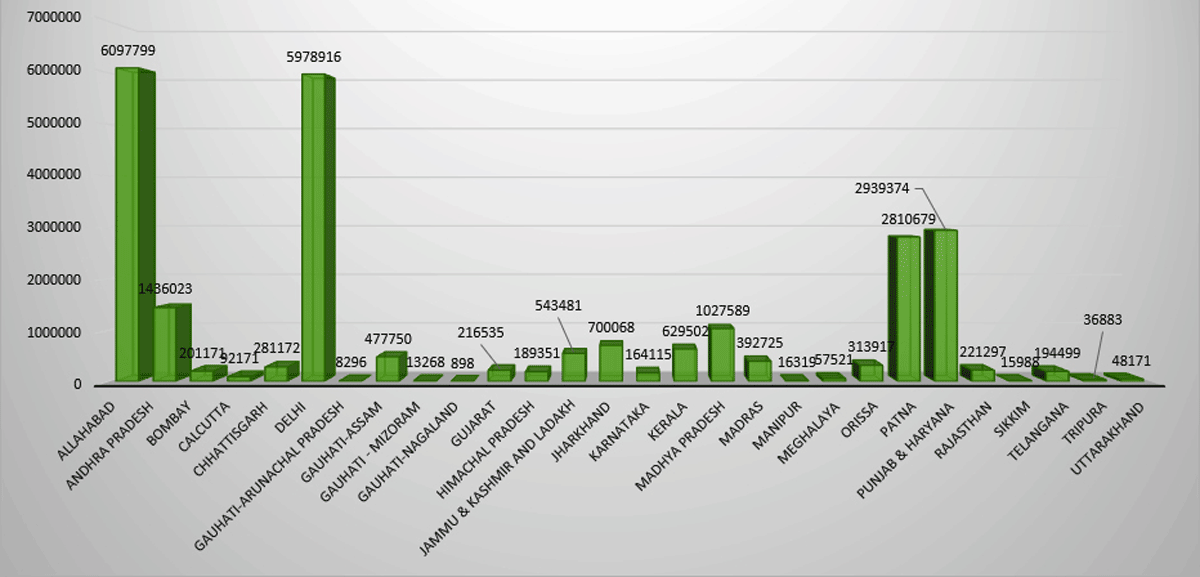
Figure 2
Number Of Hearings Conducted Through VC in District Courts From 06.04.2020 To 30.11.2024.46
Finally, the Allahabad High Court, along with its District courts, held the highest number of hearings through VC, followed by the Delhi High Court (Figure 3).
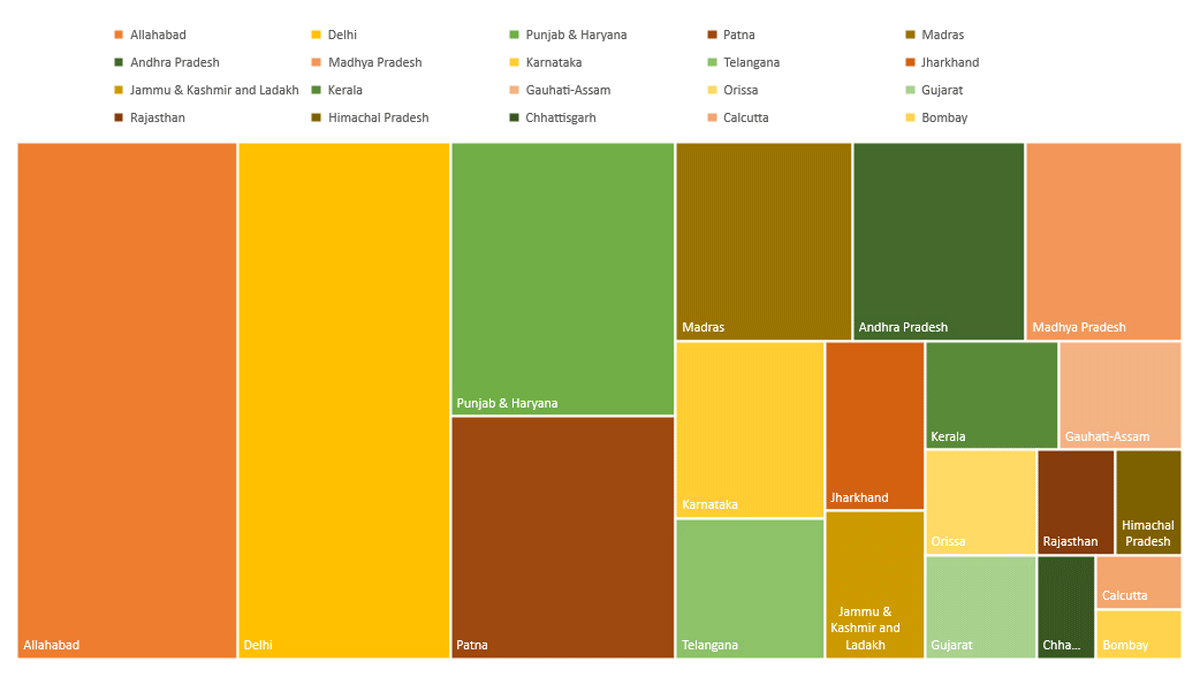
Figure 3
Top 20 High Courts with Highest Number of VC Hearings.47
These statistical figures clearly show the performance of every High Court and the District Courts together with Subordinate Courts as of from 06.04.2020 to 30.11.2024. However, to show that there is an increase in the number of VC even after the pandemic, we have taken the data on the number of cases heard through VC by High Courts and other Subordinate Courts as of 31.01.2022 and compared it with the latest date of 31.12.2024. From 06.04.2020 to 31.01.2022, the High Courts heard 6,021,688 cases, and the District and Subordinate Courts heard 11,140,223 cases through VC (17,161,911 in total).48 Then, from 06.04.2020 to 31.12.2024, all the High Courts heard 9,166,773 cases, and all the District and Subordinate Courts heard 25,392,330 cases through VC (34,559,103 in total).49 This clearly shows that there a significant increase in the number of VC hearings post COVID-19, as shown in the representation below (Figure 4).
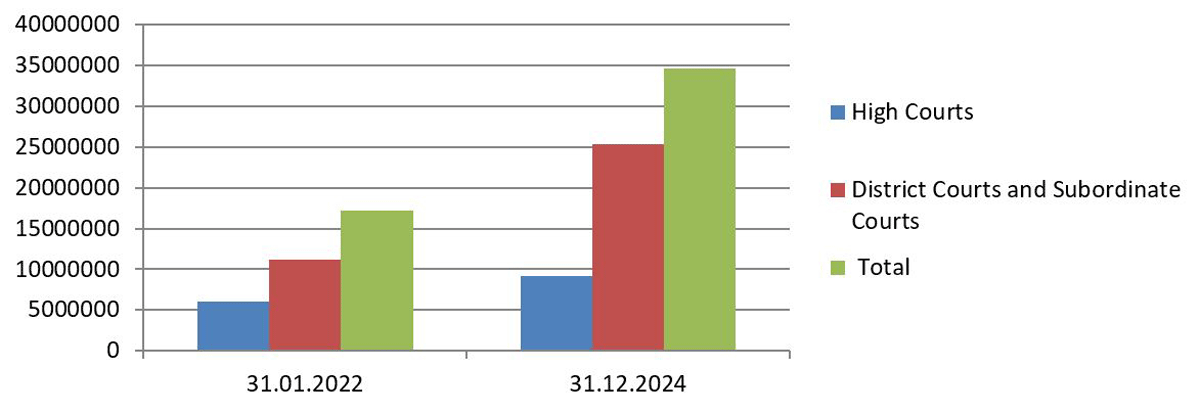
Figure 4
Statistical Representation Showing the Increase in the Number of VC Hearings Post-COVID-19.
4.2.1. Impact on Creating New Employment Opportunities
Recently, the Madras High Court issued a notification to recruit 75 VC hosts (technical staff) on a contractual basis to assist court hearings through VC/hybrid hearing.50 Thus, a SAL case has indirectly led to the creation of new posts in the administration of the High Court of Madras, a 162-year-old court.
5. Conclusion and Remarks
Firstly, regarding the evolution of SAL in India, as already noted in the second part, a new phase has been identified – namely, the approach of the Indian judiciary toward SAL during the COVID-19 pandemic – and have termed it Phase-IV, based on the orders issued by the Apex Court of India in eight unique suo motu SAL cases. Secondly, regarding the development of ICT in the Indian judiciary, we have clearly explained the different phases of development. Finally, regarding the third aspect, in Phase-II of ICT, it is clear from the purpose of the VC equipment installed in courts and jails that it was intended for recording evidence and for using VC between the court and the jail to expedite trials of undertrial cases, as well as to conduct trials of convicted cases in the courts of appeal. However, due to the unforeseen situation caused by the pandemic, the Supreme Court of India, at the right time and through its power conferred by the Constitution of India, took suo motu cognizance and issued directions to frame VC rules in 2020, which became the need of the hour. When we analyze the impact of the SAL on framing the Videoconferencing Rules, 2020, we find that the number of VC hearings has continued to increase even after the pandemic and has become a trendsetter. The judiciary is taking regular steps to install more VC equipment. Many personnel have been recruited to host VC, underscoring the importance of technology, time, and money. For instance, an advocate in Kanyakumari, in the south of India, does not need to go to the Supreme Court of India in Delhi for every court hearing. Instead of travelling 2,777 kilometers via train or flight, they can appear for the proceedings directly from their office in Kanyakumari via VC. Technology and law allow them to address the issue directly to the Honorable Judges through VC, while saving travel expenses and time. Thus, the administration of the judiciary is being updated with new technologies.
More broadly, the role of SAL in India in increasing the number of VC hearings in courts has never been analyzed, and this article fills that gap. At the same time, some may think that the approach of the Indian judiciary toward SAL during the COVID-19 outbreak is already a past event. However, even though it is a past event, the role played by the Indian higher judiciary was tremendous, and this analysis will be helpful for any other unforeseen situation. Recently, we came to know that, after five years, again in China many people are affected by human metapneumovirus (HMPV), and many are rushing to the hospitals with this virus and multiple others.51 Thus, this article will help us understand how the administration of the Indian judiciary may function if any other unprecedented event occurs in the future.
Data Accessibility Statement
Most of the data that supports the findings of this study is openly available in the Indian Judiciary Annual Report and all secondary data, such as case law, are mentioned in citations wherever necessary. Apart from these, no new data were created or analyzed during this study. Data sharing is not applicable to this article.
Notes
[2] India, “Video Conferencing,” Ministry of Law and Justice, Government of India (2024).
[3] Statista, “Countries with the Largest Population 2024” (2024).
[4] Upendra Baxi, “Taking Suffering Seriously: Social Action Litigation in the Supreme Court of India,” Third World Legal Studies 4, no. 1 (1985).
[5] Peter A. Appel, “Intervention In Public Law Litigation: The Environmental Paradigm,” Washington University Law Quarterly 78 (2000), 215.
[6] Saheli Chatterjee, “Criminal Justice System and Public Interest Litigation,” Legal Service India (2023).
[7] Ankush Saraf, “Public Interest Litigation: Genesis and Evolution,” Legal Service India (2019).
[8] P. N. Bhagwati, “Judicial Activism and Public Interest Litigation,” Columbia Journal of Transnational Law 23, no. 3 (1985): 561–578.
[9] Maitreyee Dubey, “Case Comment: DK Basu vs. State of West Bengal,” Jus Corpus Law Journal 2 (2021): 30.
[10] India, “Indian Judiciary Annual Report 2023–24” (Supreme Court of India, 2024).
[11] Bhagwati, “Judicial Activism and Public Interest Litigation” 23; Mumbai Kamgar Sabha, Bombay v. M/s. Abdulbhai Faizullabhai and Others, 1976 AIR 1455 (Supreme Court of India 1976); Rachit Garg, “Origin and Development of PIL in India.” iPleaders (2023).
[12] Hussainara Khatoon & Ors v. Home Secretary, State of Bihar, 1979 AIR 1369 (Supreme Court of India, 1979); Sakshi Jain, “Hussainara Khatoon v. State of Bihar (1979): Case Analysis,” iPleaders (2024).
[13] M.C. Mehta and Another v. Union of India and Others, 1987 AIR 1086 (Supreme Court of India, 1986).
[14] Ayushma Sharma, “Everything You Need to Know about the Bhopal Gas Tragedy.” iPleaders (2019).
[15] Aditya Singh, “Oleum Gas Leak Case – a Case Study.” iPleaders (2020).
[16] Vellore Citizens Welfare Forum v. Union of India & Others, 1996 AIR 2715 (Supreme Court of India, 1996).
[17] Dna Correspondent, “Supreme Court Quashes 122 2G Licenses Awarded in 2008,” DNA India (2012).
[18] Section 129 of the motor vehicles act (India, 1988).
[21] Supreme Court of India, “Indian Judiciary Annual Report 2022–23” (2023).
[22] Suo Motu Writ Petition (Civil) No. 1 of 2020, Order dated March 16, 2020 (Supreme Court of India, 2020).
[23] Suo Motu Writ Petition (Civil) No. 2 of 2020, Order dated March 18, 2020 (Supreme Court of India, 2020).
[24] Suo Motu Writ Petition (Civil) No. 3 of 2020, Judgment dated March 8, 2021 (Supreme Court of India, 2020).
[25] Suo Motu Writ Petition (Civil) No. 4 of 2020, Order dated November 29, 2021 (Supreme Court of India, 2020).
[26] Suo Motu Writ Petition (Civil) No. 5 of 2020, Judgment dated April 6, 2020 (Supreme Court of India, 2020).
[27] Suo Motu Writ Petition (Civil) No. 6 of 2020, Order dated May 26, 2020 (Supreme Court of India, 2020).
[28] Suo Motu Writ Petition (Civil) No. 7 of 2020, Order dated June 12, 2020 (Supreme Court of India, 2020).
[29] Suo Motu Writ Petition (Civil) No. 8 of 2020, Order dated July 22, 2020 (Supreme Court of India, 2020).
[31] Nihit Nagpal and Manmeet S. Marwah, “Extension of Limitation Period- Supreme Court,” S.S. Rana & Co. (2022); Miscellaneous Application No. 21 of 2022 in Miscellaneous Application No. 665 of 2021 in Suo Motu W. P. No. 3, Order dated January 10, 2022 (Supreme Court of India, 2022).
[33] Sunil Ambwani, “Information and Communication Technology in Courts,” National Judicial Academy Bhopal (2018).
[34] India, “E-Courts Mission Mode Project,” e-Committee, Supreme Court of India (2024).
[35] Kritika A. Tiwary, “E-Courts Embarking on Phase-III: Judicious Move for Indian Judiciary,” Chartered Secretary Journal (ICSI) (2023).
[36] Press Information Bureau (PIB) Delhi, “E-Courts Mission Mode Project,” Ministry of Law and Justice, Government of India, Press Release 2085127 (2024).
[37] PIB Delhi, “E-Courts Mission Mode Project” (2024).
[38] “Sabka Sath, Sabka Vikas Aur Sabka Vishwas – Definition,” Law Insider, n.d.
[39] Department of Justice (India), “Cabinet Approves eCourts Phase III for 4 Years,” Ministry of Law and Justice, Government of India (2024).
[41] Suo Motu W.P. No. 5 (Supreme Court of India, 2020); Boaz Kaawe, “Case Brief The State of Maharashtra v. Dr. Praful B. Desai (2003) 4 SCC 601,” Tharuma Trevisan Advocates (2022).
[45] Tamil Nadu, “The Madras High Court Videoconferencing in Courts Rules, 2020,” Tamil Nadu Government Gazette 29 P. 3, s. 2 (2020): 42–50.
[49] PIB Delhi, “Online Courts for Ensuring Fair Trial,” Ministry of Law and Justice, Government of India, Press Release 1807613 (2022).
[51] Tamil Nadu, “Notification for VC Host,” (Madras High Court, 2024).
[52] Varsha Vats, “New Virus Outbreak in China: What Is HMPV? Know Symptoms, Prevention Tips And More,” New Delhi Television (2025).
Competing Interests
The authors have no competing interests to declare.
Author Contributions
The first author (HARI KRISHNAN I) conceived the study, researched, analyzed and wrote the manuscript. The corresponding author (Dr. M. S. SHARMILA) supervised, provided feedback, and helped to shape the research and manuscript. Both the authors read and approved the final manuscript.