
1 Introduction
The new Finnish Court Fees Act (1455/2015, FCFA), when entered into force on January 1, 2016, became applicable to all court proceedings, whether civil, criminal, or administrative (FCFA Section 1), with its key amendment to the previous legal state being the almost doubling of court fees of certain proceedings and assigning fees to others that were previously free of charge. The main objective of the reform was, on the one hand, to improve access to justice1 by increasing court revenues and thereby court resources and, on the other, to improve the guidance effect of the fees to reduce the number of less significant cases, for example, cases in which the need for legal protection is lesser. The intended outcome was freed resources that could be targeted to cases with a greater need for access to justice.2
The reform also aimed to reduce unquestionably groundless use of court services and to encourage parties to consider carefully whether to bring a case to trial or to file for an appeal when they are non-essential. In addition, the reform sought to adjust court fees so that the costs of specific cases would be more proportionate to the costs incurred by the court in managing the cases, as well as other relevant activities. Although these are acceptable aims, court fees should never prevent everyone’s right of access to court.3 Thus, the main criterion for defining the amount of court fees should not be to cover the actual costs of providing court services; rather, the fees should be justly proportionate to the expected outcome. This means that to fulfil the requirements of access to court (and, in effect, access to justice), court fees that are considered reasonable should be positioned well below the actual costs of the proceedings.4 However, in doing so, the possibility of obtaining an exemption from the obligation to pay court fees on the grounds of minimal assets, low income, or the disproportionate nature of the fee in an individual case was included in the reform.5 Thus, an additional aim was to ensure the court fee system under the renewed FCFA would be simpler and clearer.6
An impact assessment of the new FCFA was conducted in 2022–2023, and it concluded that the reform reached its primary objectives. However, it also identified an unforeseen negative effect on the court’s ability to fulfill its societal functions and, thus, on ensuring adequate access to justice; that is, the courts were no longer sufficiently performing their societal functions in (civil and) administrative proceedings due to the changes in court fees. Such outcomes should be questioned in relation to the guarantee of access to justice.7
In response, this article studies the negative effects of the FCFA reform, concentrating on changes in the caseloads of general regional administrative courts (AC) and the Supreme Administrative Court (SAC). As the case material of ACs and the SAC is sufficient to show the problems, cases from other (special) courts that handle administrative matters are outlined from the research.8 The research question of the article is twofold in nature: first, how does the above-described negative effect on fulfilling the societal functions of administrative proceedings emerge in the operations and caseloads of the ACs and the SAC? Second, how can the negative effects of the reform be addressed and eliminated? The research questions are studied via legal dogmatics and theoretical content analyses of interviews conducted in the ACs and the SAC.9 The interview data are assessed by analyzing its interaction with the theory of the courts’ societal functions.10 The findings are supported with statistics maintained by the National Court Administration11 on cases that have been filed with the courts, cases in the court process, and cases that have been decided by courts.12 Regarding the quantitative data, the study focuses on analyzing the correlation between the changes in court fees and the number of cases filed with the courts.13
The article shows that ACs do not see enough variation in case types to be able to exercise their control and guidance duties properly as public authorities, i.e., to execute their societal functions. The key reason for this is that court fees for certain case categories, that is, cases of low financial interest, are unreasonable from the perspective of the complainant. The article thus suggests that the legislation should be reconsidered regarding certain case categories.
2 Access to Justice and the Societal Functions of the Administrative Courts
2.1 Access to Justice and Access to Court as Fundamental Rights
In Finland, litigation is subject to a fee in all forms of procedure and in all courts, i.e. general courts, general ACs, and special courts (FCFA Section 1). General courts, i.e. district courts, appellate courts, and the Supreme Court, handle civil and criminal matters, whereas complaints regarding the decisions of authorities are centralized with the ACs and the SAC.14 The highest courts, i.e. the Supreme Court and the SAC, require a leave to appeal before accepting cases to proceedings. Here, a court fee is charged in full, regardless of whether the leave to appeal is granted. Therefore, a party may have to pay the court fee without the existence of any actual court proceedings for their case.15
The party liable to pay the court fee is the initiator16 in all cases (FCFA Section 6), although several exceptions to this main rule exist based on certain special criteria, for example, the subject matter of the case and the personal circumstances of the complainant (FCFA Sections, 5, 7, and 8). The key exception regarding administrative matters is that if the court changes the decision under appeal in favor of the complainant, the court fee is left uncollected, regardless of whether there are any special criteria for its collection (FCFA Section 9). The court fee amount depends on the matter in question and which court is handling the case. In ACs, the court fees are 310 euros and, in the SAC, 610 euros.17
According to the Finnish Constitution (FC) Section 21 and the European Convention of Human Rights (ECHR) Article 6(1), everyone has a constitutional right to a fair trial, from which the rights of access to justice and access to court stem. Access to court guarantees people concrete opportunities to bring their matters in front of the court, whereas access to justice serves as a wider foundation for people to claim and execute their rights.18 These rights, though strong, are not absolute – they can be limited for justifiable reasons, and the means used are justly proportionate to this objective.19 The European Court of Human Rights (ECtHR) has in multiple cases considered a court fee to be an acceptable example of preventing access to court. The ECtHR has stated that the use of a court fee itself, even a preliminary one, is a justifiable measure to pursue the more efficient use and targeting of jurisdictional resources;20 however, the fee amount must not be disproportionate to the case circumstances, such as the complainant’s financial situation.21 That is, court fees should never hinder the complainant’s access to court; rather, they should only encourage a party to reconsider whether court is a proper way to proceed with one’s case.22 However, under certain circumstances, the court fee is of no relevance to a party’s – or, more precisely, an initiator’s – decision to begin court proceedings, and these circumstances relate to the party’s personal conditions and their attitude towards the case.
The use of court fees in general is acceptable and justifiable, as without them, the likelihood of the court system becoming jammed and inoperable under the burden of a ‘flood’ of cases seems inevitable.23 Court fees must thus be set at an acceptable level, not only due to the requirements of the ECHR, but also due to the negative effects of fees that are either too high or too low. As previous research shows, low (or inexistent) court fees are conducive to causing high levels of litigation, which may lead to a judicial collapse and inefficient access to court and access to justice.24 By contrast, very high court fees are conducive to preventing cases from being trialed in courts and, hence, conducive to preventing intricate situations of legal interpretation from being resolved by them. This increases legal uncertainty, as well as hinders access to court and access to justice.25
Yet, the impact of court fees differs across all complainants of which there are five groups to whom the court fee amount is completely irrelevant. This group division stems from the Finnish national legislation and the national societal environment, as illustrated in the below figure:
As Figure 1 shows, the court fee is, first, self-explanatorily irrelevant to a party who is exempt from paying it under the FCFA. These parties are entitled to free legal aid under the Finnish Legal Aid Act (FLAA) Section 7(1), or they are public authorities, who are exempt from the obligation to pay court fees, according to Section 8 of the same Act. In certain situations, while contemplating whether to initiate court proceedings, the complainant may anticipate the court to waive the court fee due to its apparent unreasonableness in relation to the appellant’s limited financial resources [FLAA Section 7(2)].
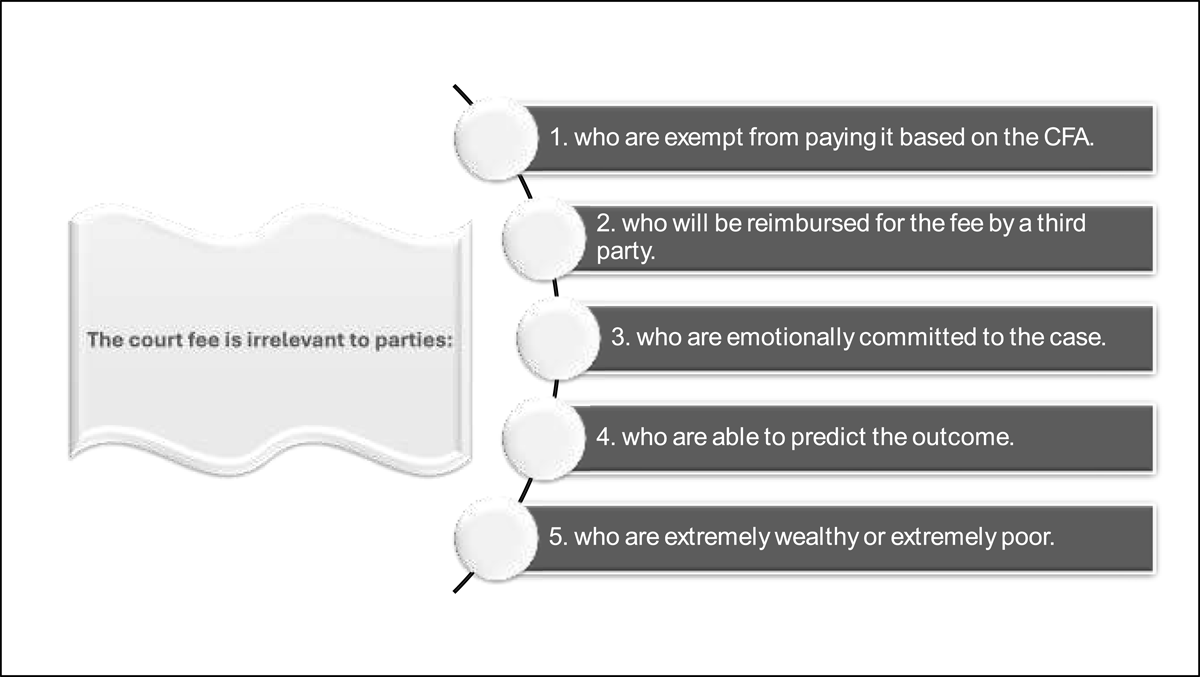
Figure 1
The groups to whom the court fee is irrelevant.
Second, the court fee is irrelevant to the initiator, as they will be reimbursed by a third party regardless of the case outcome. For example, the initiator may have legal expenses insurance that will cover the proceeding costs, including the court fee, up to an insurance-specific maximum amount, less the deductible.
Third, the initiator may be so emotionally committed to the case that the court fee is insignificant to the decision of initiating court proceedings. This may concern a single case or a series of cases, and the latter may also be a question of “legal activism” in a negative sense. This means filing a complaint with the mere aim of pursuing the correction of primarily imagined injustices that have little or no basis in real life or simply putting pressure on an authority or an official by actively challenging their decisions, regardless of their correctness. Certain cases may also involve the deliberate blocking of societally important construction projects.
Fourth, the amount of the court fee is also irrelevant – though rarely – if the initiator can predict whether the complaint will be successful, based on of their own legal expertise or that available to them, and the fee will be uncharged based on FCFA Section 9.
Lastly, the court fee may also be irrelevant because of the financial circumstances of the initiator. For instance, to large companies and wealthy individuals, the fee is usually irrelevant due to being relatively low in relation to their income, their assets, or the size of their business. The fee is also irrelevant to the opposite group of people, i.e., people without any income or assets. These indigent initiators may simply neglect to pay the court fees, which cannot be collected, even by enforcement authorities, due to their lack of means.
As demonstrated, the court fees are irrelevant for many initiators, but for many others, they are at least somewhat relevant, i.e., they must consider the reasonableness of the court fee in relation to the matter they are bringing to the court. The guiding effect (or guidance function) of the court fees is mainly targeted to these parties, i.e., a) individuals who are not particularly wealthy but also not poor enough to have access to legal aid and b) the self-employed and small-sized enterprises (SMEs).
To an extent, the frequency with which someone brings a case to court may also play a role in assessing whether they should initiate court proceedings in the first place. The preliminary works of the FCFA demonstrate that, in general, individuals very rarely bring cases to a court, perhaps once in a lifetime, and as such, a court fee is often a non-recurrent expense for them.26 In these cases, even a significant court fee will not disturb their personal finances, which supports the justification of court fees.
In addition to the complainant’s personal conditions and their attitude towards the case, “case type” becomes a relevant factor in the discussion of court fees and access to court. First, court fees do not have a negative impact on access to court in cases that fall under one of the categories of free-of-charge cases listed in FCFA Section 5. Second, court fees are irrelevant in cases in which the complainant’s claims are successful, as the fee is waived based on FCFA Section 9. However, the effect of the outcome may be considered by the complainant at the very beginning of the proceedings if they have sufficient legal knowledge of the effects of the case outcome on the fee and they are also able – at least to some extent – to predict the outcome of the court decision.
In circumstances other than those mentioned above, deciding whether to bring a case to court is based on balancing various issues. For example, it is a question of the ratio of the court fee to the (economic) interests of the case but also of the ratio of the court fee to other legal costs, such as attorney’s fees. In addition, other alternative remedies – if such are available – and their costs will be assessed when deciding how to proceed.27
Meanwhile, economic interests vary between different case types. For example, in cases regarding parking fines, the economic interest of the complainant may be 20 euros, whereas in a case concerning the dismissal of a civil servant, the economic interest may rise over 100,000 euros if the unlawfully dismissed civil servant is retroactively paid their salary and benefits. Conversely, in a case concerning major construction projects, the economic interests may increase up to tens of millions of euros. The fundamental question is the ratio of the court fee to the potential benefit of the case. In a parking fine case, the court fee (310 euros) is 15.5 times the value of the dispute, while in a dismissal case, the court fee is 3/1,000th the value of the dispute, i.e., rather insignificant. As such, in major construction projects, the court fee can be considered completely irrelevant.
Further, the ratio of the court fee to the total amount of other legal costs is also relevant, such that the greater the other costs in total, the lesser the significance of the court fees, and vice versa. In a simple case, the court fee may be the only legal cost, as a party may represent themselves. If there is a need for legal representation, attorney’s fees may vary significantly between different cases due to the case-specific input required from the attorney.
For instance, in a dismissal case, the court fees in two courts are 920 euros in total (i.e., 310 euros + 610 euros), which is added to the attorney’s fee, which is typically around 20,000 euros in these case types. In this situation, the court fee is approximately 5% of the attorney’s fee. If the case, however, is a parking fine case, the court fee of the first instance (AC) is approximately the same (i.e., 310 euros) as the typical attorney’s fee in these case types (i.e., 310 euros).
The existence of other alternative remedies may affect the number of cases brought to court. However, in administrative matters, alternative remedies are rare. There are, though, situations in which it is more expeditious and economical to bring the matter before the same authority with a new application than to file a complaint challenging the correctness of the existing court decision.
2.2 Administrative Courts’ Role in Ensuring Proper Functioning of Society
In Finland, disputes relating to administrative matters, such as cases concerning permits, licenses, taxation, social benefits, and other administrative matters, are concentrated in ACs, which have jurisdiction over cases concerning decisions made by public authorities, such as government agencies, municipalities, and other administrative bodies, on a regional28 level (Courts Act 673/2016, Chapter 4 Section 1). AC decisions can be appealed to the SAC if it grants a leave to appeal (Administrative Judicial Procedure Act [808/2019], AJPA, Chapter 12).
The ACs, as well as the SAC, are obliged to fulfil different societal functions via their operations. As a constitutional organization, the primary role of the ACs is to control the legality of public authorities’ rulings (control function).29 With their judgments, the courts also guide the practices of public authorities (guidance function) and, simultaneously, provide the appellant with legal protection in individual cases (legal protection function).30 Although the societal functions of various courts are essentially the same, they differ in the importance of their judgments. According to the FC (731/1999), the SAC is the highest authority in administrative matters, and it exercises the highest judicial, as well as supervises the application of the law of lower authorities (including the lower regional ACs). Therefore, the guidance function of the SAC’s judgments is of greater importance than that of the lower courts. The most important judgments of the SAC are published as precedents.31
Courts, as with any other institution, require funding to maintain their activities. In some jurisdictions, (administrative) courts are fully funded by the state, and parties are not required to contribute to funding the proceedings.32 However, it is more common that those who actually use the courts pay a part of the costs in the form of court fees,33 the amounts of which vary significantly from one jurisdiction to another. In member countries of the Council of Europe, a certain upper limit to the court fee guarantees the fulfilment of the requirements of access to justice; however, the court fees must never rise so high that they prevent the full realization of the principles of access to court and access to justice.34 In addition to fulfilling the requirements of fundamental rights,35 another significant element to consider is that the court fee should also never be so high that it prevents the court from fulfilling its constitutional and societal functions. This happens if the courts, and especially the SAC as a supervisory body for the lower courts and authorities, do not receive enough cases to assess and cannot rule in all case categories due to the unwillingness of the parties to initiate proceedings.36 It is not enough that the courts ostensibly fulfill their duties by handling the cases brought to them if the de facto fulfillment of their constitutional and societal functions is hindered by the lack of cases in certain case categories due to high court fees.37 After all, it would be pointless to enact a function – or duty – to control public authority over the courts if no one can afford or, more precisely, if no one thinks it is expedient from the perspective of the potential court fees to bring a case to trial to initiate the control procedure.38
3 Assessing the Court Fee Reform: Its Implications for the Courts’ Societal Functions and Different Case Categories
3.1 Viewpoints of the Administrative Courts Regarding the Influences of the Court Fee Reform
Five ACs and the SAC were interviewed for this study to determine how the courts view the effects of the court fee reform on the fulfillment of their societal duties.39 The ACs were interviewed mainly in relation to the effects of the increase in court fees on access to court. However, the courts pointed out the questions related to fulfilling their societal functions. Six courts were interviewed in total, i.e., the ACs of Helsinki, Hämeenlinna, Eastern Finland, Turku, and Vaasa and the Supreme Administrative Court (SAC). In five of six courts, the interview was given by the chief justice, whereas in one court, the chief administrative officer gave the interview. The interviews were conducted using a semi-structured thematic style in spring 2023. A questionnaire was sent to the interviewees in advance, and they returned it before the interviews during which time the questionnaire functioned as a template. Each interview took approximately 1.5–2 hours, and all interviews were recorded.40
The theoretical content analysis of the interviews in this section focuses on comparing the theoretical starting points of the theory of the societal functions of the ACs to the actual experiences of the courts, particularly their ability to fulfill these functions post-court fee reform. As presented above in Section 2.2, the ACs, and especially the SAC, have a constitutional and societal duty to control and guide lower courts and authorities in their decision-making. Key to fulfilling this duty is presiding over a wide enough variance of cases, as the subsequent party-led assessment of finalized decisions is the only available method of control and guidance. After recognizing how the reform has affected the ACs’ ability to fulfill their functions, the analysis moves toward finding measures to face the detected shortcomings.
The interviews showed that both the ACs and the SAC were worried that the reform would partly endanger the fulfillment of the courts’ societal functions, culminating in the courts inability to control and guide authorities’ practices efficiently, as they do not see enough case material from certain categories to be able to fulfill these tasks. The courts see that not only increasing court fees but also extending them to case categories that were previously free of charge inevitably affected access to justice. In case categories subject to a charge and in which the financial interest is small in relation to the court fee, the number of cases brought to the courts has clearly decreased (e.g., income taxation, basic education) or become nearly nonexistent (e.g., parking fines). The statistics below support the courts’ observations of the developments in the quantity of cases post-reform (see especially Tables 4, 5, 7, and 8). The reduction in case material, however, has not eliminated the possible ambiguity of situations in the above-mentioned case categories nor has it eliminated the need to guide the practices of administrative authorities and case law with judgments and precedents. One AC expressed a literal concern regarding whether the SAC receives enough case material to guarantee the equality and correctness of interpretation in important authoritative activities, such as income taxation, when cases do not find their way to the courts anymore.
According to the ACs, the court fee reform has had different effects on diverse groups of complainants. Concerning corporations, persons with reasonably high incomes, and persons entitled to free legal aid, the effects of the reform are observed to be small or nonexistent (similarly, as in Figure 1 above). As such, cases concerning corporate taxation and other corporate matters have been unaffected by the reform. Further, the effects on cases concerning land use planning and construction, as well as non-chargeable cases and cases subject to free legal aid, have been remote. Conversely, the effects have been the greatest among people of low income, particularly if they are not entitled to free legal aid. In addition, the ACs observed that the reform may have affected the number of complaints filed for ideological reasons. The largest reduction in the number of cases is considered to have been among the case categories in which the financial interests of the complainants are minimal in relation to the court fees, or the value of the matter is small to the person in some other way. For instance, cases concerning personal taxation, basic education, certain waste management fees, and parking fines are within these categories.
As with the ACs, the SAC argues that the court fee reform has had little or no effect on the number of cases if the appellant is a large corporation, an administrative authority, or a person entitled to free legal aid or otherwise insolvent (following Figure 1 above further). However, one effect of the reform on the number of cases was detected, particularly cases in which the appellant oversees some indirect interest, such as when the right to appeal is based on residency in a municipality. The SAC also expressed a specific concern regarding the financial ability of people with average incomes and of SMEs to seek legal protection after the increase in court fees. The developments in the case material indicate that people with average income and SMEs cannot always appeal due to financial reasons, even if there is a clear need for legal protection in the matter. This may first hinder access to court and access to justice for those parties and second lead to the courts receiving only free-of-charge cases or those in which the complainant either isa entitled to free legal aid or is a financially sound legal or natural person. Thus, the ability of the SAC to create precedents in all case categories and thereby fulfill its constitutional and societal duties is undermined.
Naturally, the reform has not affected access to court or access to justice in non-chargeable cases or in cases typically given free legal aid. As well, the number of cases in which the financial interest of the appellant is large in euros, e.g., in relation to commercial activities or competition, remains unaffected. Correspondingly, effects are detectable in cases in which the financial interest in euros is small in relation to the court fee and in cases that aim to ensure public interest in general or to control general administrative practices (usually general municipal matters).
The negative effects of the reform on the courts’ ability to fulfill their societal functions were detected by both the ACs and the SAC. All courts emphasized the importance of receiving cases from all categories to be able to execute their control and guidance functions, but the courts also consider that, concerning municipal matters, the complaints filed by residents (i.e., a form of civil control) are of great significance to optimizing the control and guidance effect of the courts regarding matters that fall under municipal self-government.
Yet, the courts detect problems pertaining to the distortion of the case material in relation to the real world in certain case categories due to the court fee reform. Because the court fees discourage certain groups of complainants from filing their case with the court, the courts receive neither enough diversity in case types nor enough cases in each case category to be able to fulfill their societal duties comprehensively. This results in the formation of case categories whose legal assessment rests on the decisions of lower authorities instead of the courts, enabling defective authoritative practices because of the lack of constitutional supervision.
A number of courts also pondered measures to correct the situation and ensure an adequate “case flow” in the future. A key suggestion was to reduce the court fee in those case categories that have suffered from inflation due to the reform, for example, parking fines, waste management, and basic education (particularly school transport). This could be done by adding a new fee category of approximately 100 euros or, alternatively, half the amount of the current fee for the concerned categories. However, the need to reduce court fees in these categories without further complicating the courts’ ability to process the substance matter in question was emphasized in the suggestions. The courts recognized the possibility of functional distortion between different case categories, particularly if the appeal centers around the case categories assigned new fees.
3.2 Court Fee Reform’s Effects on the Quantity of Cases from Different Categories: Statistics
3.2.1 Court Fees in Administrative Law Cases
Court fees are levied to compensate for the costs of legal proceedings in the courts (FCFA Section 1); they are court-specific, and their amounts vary somewhat depending on the case type. Table 1 demonstrates the changes made to the court fees (in euros) in ACs and in the SAC.41
Table 1
Court fees in regional administrative courts (ACs) and the Supreme Administrative Court (SAC) before the reform (31 December 2015), after the reform (1 January 2016), and at the beginning of 2025 (1 January 2025). Regarding SAC, here, it should be noted here that a full court fee is charged, even if the SAC does not grant a leave of appeal regarding the case.
| BEFORE THE REFORM (€) | AFTER THE REFORM (€) | IN 2025 (€) | |
|---|---|---|---|
| AC | 97 | 250 | 310 |
| SAC | 122–240 | 500 | 610 |
The responsibility for paying the court fee falls on the complainant, as a so-called “judgement fee,” because it is collected after the court has given a judgement or the proceedings have been terminated for another reason. The FCFA contains a 17-point list of case categories that are free of charge, i.e., a court fee does not have to be paid (FCFA Section 5). The most important non-chargeable category among these is cases concerning social welfare and health services or benefits. In general, the other categories of cases that are free of charge relate to restrictions on the right to self-determination and the exercise of other fundamental rights. The categories may also concern the effects of the exercise of power that public authorities have on the legal positions of individuals. In some case categories, the nature of the case leads to an assumption of the complainant’s indigence, such as in cases concerning the granting of free legal aid.
FCFA Section 8 exempts certain authorities and other bodies from having to pay court fees, mainly state, health, and local authorities. This has been justified by the lack of rationalization for imposing a court fee on an authority with a statutory control duty when they are carrying out their duty.42 In an administrative case, the outcome of the appeal has an impact on the court fees; for successful appeals, court fees are not charged (FCFA Section 9). The court fee is also waived if the complainant has limited financial resources. Consequently, the court fee will not be charged in certain specific circumstances in which it would be undeniably unreasonable to do so (FCFA Section 7).
3.2.2 Developments in the Quantity of Cases
In assessing the effects of the court fee reform of 2016 on the principles of access to justice and access to court, as well as on the execution of the court’s societal functions in ACs, studying the developments in the number of cases in the different categories is relevant. The tables in this Section present the number of cases filed in 2014 and 2015 to indicate the total of cases before the reform. The clearest indication of the effects of the increase of court fees on the quantity of cases is the number of cases filed in 2016 and 2017.43 After 2017, the number of cases filed is documented every other year (2019, 2021, and 2023), and we consider this sufficient for describing the development trend and rate in the quantity of cases in general.
Regarding this research, the quantity of cases filed with ACs44 is key, as court fees may affect the potential complainant’s willingness to bring the case to trial. Also, from the perspective of the court fulfilling its societal functions, the quantity of cases decided by the courts is of particular importance. When the necessary information regarding the number of cases filed with courts is unavailable, the research utilizes the number of cases decided by the courts. In drawing conclusions from the available data, it is crucial to recognize possible explanatory factors other than the FCFA reform – such as other legislation or societal phenomena – that may have affected the number of cases. This will be done throughout the analysis.
For instance, in cases concerning foreigners and their affairs these other explanatory factors – in addition to FCFA regulation – play a significant role. Therefore, foreigner-related matters are limited among the analyzed data for two reasons:
the annual variation in the quantity of foreigner-related matters is significant for reasons other than those related to the administration of justice,45 and
foreigner-related matters is a case category that is usually free of charge (FCFA Section 5), and they do not affect the assessment of the effects of court fees on the principles of access to justice and access to court, nor do they affect the execution of the courts’ societal functions.
The study of the statistical data begins by focusing on examining the quantity of cases in ACs from a general perspective to provide a comprehensive overview of the situation. Table 2 presents the total quantity of cases filed to ACs and SAC (excluding foreigner-related cases). As discussed above, the cases that are filed with regional ACs are party complaints of authoritative decisions. Regarding the SAC, 90% of their cases are complaints about the judgments of the ACs.46 The operation of ACs follows the requirements of good practice in the administration of justice, rendering their procedures reliable and thereby reducing the SAC’s caseload, as the parties appeal to the SAC to ensure their legal protection only in some cases. Therefore, the cases overseen by the SAC are significantly fewer than those overseen by the ACs.
Table 2
The total number of cases filed with ACs and the SAC (excluding foreigner-related cases).
| 2014 | 2015 | 2016 | 2017 | 2019 | 2021 | 2023 | |
|---|---|---|---|---|---|---|---|
| ACs | 16,974 | 16,574 | 14,698 | 13,381 | 12,726 | 13,308 | 13,375 |
| SAC | 3,191 | 3,405 | 2,945 | 2,548 | 2,950 | 2,410 | 2,382 |
| In total | 20,165 | 19,979 | 17,643 | 15,929 | 15,676 | 15,718 | 15,757 |
| Change % (in total) | – | –0.9% | –11.7% | –9.7% | –1.6% | 0.3% | 0.2% |
Table 2 shows that after the reform, at the beginning of 2016, the quantity of cases filed to both ACs and SAC reduced significantly. The largest drops in the total number of cases occurred in 2016 and 2017: in 2016, 17,643 cases in total were filed with the courts, which is 11.7% (2,336 cases) less than in 2015. Meanwhile, in 2017, the total number of cases filed with the courts was 15,929, which is 9.7% (1,714 cases) less than in 2016. The change in the number of cases is arguably caused by the court fee reform, as no other legislative changes or societal phenomena have been identified that would explain them.
To obtain an exact perspective of the effects of court fees on the number of cases, the cases subject to a charge and the cases free of charge must be examined separately. The following tables present the number of cases relating to social and health care that are typically free of charge (Table 3) and the number of cases related to self-government, construction, economic activity (including traffic and communications, governmental matters, and general administration), taxation, and the environment, which are usually subject to a court fee (Table 4).
Table 3
Cases related to social and health care matters filed with ACs and the SAC.
| 2014 | 2015 | 2016 | 2017 | 2019 | 2021 | 2023 | |
|---|---|---|---|---|---|---|---|
| ACs | 6,182 | 6,305 | 6,107 | 6,411 | 6,845 | 7,081 | 7,563 |
| SAC | 776 | 887 | 911 | 801 | 730 | 1,036 | 780 |
| In total | 6,958 | 7,192 | 7,018 | 7,212 | 7,575 | 8,117 | 8,343 |
| Change % (in total) | – | 3.7% | –2.4% | 2.8% | 5.0% | 7.2% | 2.8% |
Table 3 shows that the total number of cases free of charge brought to ACs and the SAC increased by 19.9% within the last 10 years. The total number of cases increased by 1,385 cases in the same period, a number that continues to grow. Naturally, the increase in court fees has not had any control effect on the number of cases in this category. Not a single factor can explain the development; however, this growth, may be a result of, for instance, the increase in the number of appealable decisions made by the authorities, combined with the parties’ unchanged activeness to appeal. As well, the parties’ right to appeal may have been extended to new case categories, or the parties have become more active in ensuring their right to legal protection.
Table 4 looks at the court fee chargeable case categories. A decrease in the number of cases, along with the increase in court fees, is clearly detectable: in 2016, 10,625 cases were filed with the courts, which is 16.9%, or 2,162 cases, less than in 2015. In 2017, the decrement was 17.9%, or 1,908 cases.
Table 4
Chargeable cases filed with ACs and the SAC. These include cases in the following categories: self-government; construction; economic activity, including traffic and communications, governmental matters, and general administration; taxation; and the environment.
| 2014 | 2015 | 2016 | 2017 | 2019 | 2021 | 2023 | |
|---|---|---|---|---|---|---|---|
| ACs | 10,792 | 10,269 | 8,591 | 6,970 | 5,881 | 6,227 | 5,812 |
| SAC | 2,415 | 2,518 | 2,034 | 1,747 | 2,220 | 1,374 | 1,602 |
| In total | 13,207 | 12,787 | 10,625 | 8,717 | 8,101 | 7,601 | 7,414 |
| Change % (in total) | – | –3.2% | –16.9% | –17.9% | –7.1% | –6.2% | –2.5% |
By comparing the data regarding the developments in the numbers of cases subject to a charge and those free of charge presented in Tables 3 and 4, it seems likely that the increase in court fees has had a significant effect on the decrease in the number of cases brought to ACs and the SAC. This finding, however, is of little surprise, as the key aim of increasing the court fees through the reform was to prompt parties to consider more carefully the expediency of filing a complaint regarding their case in the first place, as well as to prevent the filing of unquestionably groundless complaints. However, this development raises the question of whether the decrease stays within acceptable limits or leads to an unacceptable hindrance of access to court and access to justice. Although, using court fees as a tool to govern the case load of courts itself is acceptable and justifiable, setting the decrease in caseloads as an aim and accepting an excessive fulfillment of that aim, followed by the unfulfillment of the courts’ societal functions, is not.47
From among the separate court fee chargeable case categories, the number of cases related to income taxation, municipal self-government, parking fines, legal persons and industrial property rights, and basic education is used as an example. In these case categories, the decrease in the number of cases after the increase in court fees was evident. Thus, they work well to exemplify the effects of the court fee reform. Additionally, the interviewed courts identified these case categories as problematic, which supports their suitability for exemplifying the post-reform developments.
Table 5 provides an overview of the complaints about income taxation. Concerning these complaints, the National Court Administration has not itemized them on whether they were filed by a natural or a legal person. Therefore, the table does not differentiate the number of cases filed by natural or legal persons. According to the numbers, it is likely that the increase in court fees at the beginning of 2016 affected the total number of complaints filed to courts regarding income taxation. Compared to 2015, the decrease in case numbers in 2016 was 18.2%, and in 2017, the numbers decreased even more significantly than in the previous by 24.3%. Presumably, the decrement concerned mostly the complaints filed by natural persons, as the effects of the increase in court fees are usually of more importance to individuals than to corporations. The findings of the interviews (Section 3.1) also support the presumption that the effects of the increase in court fees primarily targeted the complaints of natural persons in matters related to income taxation.
Table 5
Cases filed with ACs and the SAC regarding income taxation.
| 2014 | 2015 | 2016 | 2017 | 2019 | 2021 | 2023 | |
|---|---|---|---|---|---|---|---|
| ACs | 1,271 | 1,412 | 1,051 | 770 | 694 | 902 | 864 |
| SAC | 376 | 289 | 346 | 283 | 241 | 196 | 212 |
| In total | 1,647 | 1,701 | 1,391 | 1,053 | 935 | 1,098 | 1,076 |
| Change % (in total) | – | 3.3% | –18.2% | –24.3% | –11.2% | 17.4% | – 2.0% |
Table 6 concerns cases that fall under municipal self-government, i.e., matters of indirect interest. In these cases, the complainant rarely has a personal interest; rather, it is to ensure the municipal authorities follow the law in exercising their statutory duties (i.e., indirect interest). Therefore, a municipal appeal is a form of civil control over municipal authorities.48 The numbers in Table 6 show that the court fee reform has affected the activities of individuals in filing complaints and thereby has impacted the number of cases brought to courts. As shown above, this type of development is generally conducive to hindering the courts’ ability to fulfill their constitutional and societal control and guidance functions and, therefore, conducive to leading to incoherence in applying the law within society. In 2016, there were 16.3% fewer cases than in 2015, and in 2017, the reduction was a further 15.5% compared to 2016.
Table 6
The number of cases concerning municipal self-government filed with ACs and the SAC.
| 2014 | 2015 | 2016 | 2017 | 2019 | 2021 | 2023 | |
|---|---|---|---|---|---|---|---|
| ACs | 1,113 | 785 | 639 | 583 | 468 | 534 | 433 |
| SAC | 192 | 165 | 156 | 105 | 113 | 82 | 96 |
| In total | 1,305 | 950 | 795 | 688 | 581 | 616 | 529 |
| Change % (in total) | – | –27.2% | –16.3% | –13.5% | –15.6% | 6.0% | –14.1% |
Meanwhile, Table 7 depicts the development in the number of parking fine cases brought to ACs following the court fee reform.49 As shown, parking fines are an excellent example of a case category that has been significantly affected by the reform. In 2015, 1,215 complaints regarding parking fines were filed with ACs, while in 2023, the corresponding number was only 205 cases. The decrease in the number of cases in this category has reached 83.1% in under 10 years, the reason for which, particularly compared to other case categories, is that in parking fine cases, the expected profit from the case, i.e., the financial interest, is highly disproportionate to the increased court fee. Other credible explanations for this development cannot be delineated from the data or by considering the real-life circumstances related to this case type.
Table 7
Cases concerning parking fines solved by ACs.
| 2014 | 2015 | 2016 | 2017 | 2019 | 2021 | 2023 | |
|---|---|---|---|---|---|---|---|
| ACs | 1,014 | 1,215 | 955 | 233 | 235 | 155 | 205 |
| Change % | – | 19.8% | –21.4% | –75.6% | –0.9% | –34.0% | 32.3% |
Table 8 presents the data for cases related to educational services, a highly heterogeneous category, as it includes cases concerning the administration of the educational system in its entirety, for example, the establishment and closing of an educational institution, and cases regarding securing people’s municipal benefits, such as pupils’ right to free school transport. Although the total number of cases related to educational services seems to be decreasing, a clear connection to the court fee reform cannot be identified. Partly, this is because, for instance, closing an educational institution is of such financial significance in itself that the court fee becomes irrelevant to the complainant. Further, in cases concerning basic education, the complainant is usually a single pupil who is entitled to free legal aid based on their financial status. As such, the court fee is insignificant to them, because they are exempt from paying it.
Table 8
Cases concerning educational services filed with ACs and the SAC.
| 2014 | 2015 | 2016 | 2017 | 2019 | 2021 | 2023 | |
|---|---|---|---|---|---|---|---|
| ACs | 442 | 348 | 372 | 361 | 322 | 297 | 253 |
| SAC | 25 | 22 | 39 | 38 | 24 | 32 | 31 |
| In total | 467 | 370 | 411 | 399 | 346 | 329 | 284 |
| Change % | – | –20.8% | 11.1% | –2.9% | –13.3% | 4.9% | –13.7% |
Further, Table 9 presents the number of cases concerning legal persons and industrial property rights filed with the ACs during the analysis period. In these example cases, the complainant is typically a legal person. As the number of cases is low, wide conclusions cannot be drawn based on Table 9. However, the table does support the notion that in cases in which the complainant is typically a legal person, the court fee is less significant than in cases in which the complainant is a private person.
Table 9
Cases filed with ACs concerning legal persons and industrial property rights.
| 2014 | 2015 | 2016 | 2017 | 2019 | 2021 | 2023 | |
|---|---|---|---|---|---|---|---|
| ACs | 16 | 26 | 26 | 29 | 23 | 25 | 20 |
| Change % | – | 62.5% | 0.0% | 11.5% | –20.7% | 8.7% | –20.0% |
Next, Table 10 depicts the proportional share of non-chargeable cases among the total cases filed with ACs and the SAC. Some of the increases can be detected in the percentage of non-chargeable cases among all cases overseen in the courts; however, this primarily concerns the ACs. Although the development is not cumulatively visible regarding the SAC, it is clear that non-chargeable cases have gained more ground in the courts than before the reform. This means that the case categories that are free of charge are overly represented in the total caseload of the courts. This is problematic from the perspective of the courts fulfilling their societal functions, as they cannot, for example, control the legality of authorities’ decisions or guide authorities’ practices in case categories they handle only occasionally or not at all. Therefore, the courts’ constitutional duties are unsatisfactorily fulfilled in these case categories.
Table 10
The proportional share of non-chargeable cases (excl. foreigner-related matters) from all cases filed to ACs and the SAC.
| 2014 | 2015 | 2016 | 2017 | 2019 | 2021 | 2023 | |
|---|---|---|---|---|---|---|---|
| ACs | 36.4% | 38.0% | 41.5% | 47.9% | 53,8% | 53.2% | 56.5% |
| SAC | 24.3% | 26.0% | 30.9% | 31.4% | 24.7% | 43.0% | 32.7% |
| In total | 34.5% | 36.0% | 39.8% | 45.3% | 48.3% | 51.6% | 52.9% |
| Change % (in total) | – | 4.3% | 10.6% | 13.8% | 6.6% | 6.8% | 2.5% |
4 Fulfillment of the Courts’ Societal Functions and Court Fees: Suggested Solutions
From the perspective of the courts, court fees should be set such that they support the fulfillment of the courts’ societal functions. For instance, court fees should not be so low that the courts are congested with trivial cases; conversely, it is equally important that the courts oversee a sufficient number of all case types. Especially regarding the control and guidance functions of the courts, ensuring that no case category falls outside the scope of the courts’ supervision is key. The perspectives of good judicature are emphasized: the court fee must be reasonable from the perspective of those who use the courts’ services, i.e., the complainants, so they will consider it expedient to use court procedure as a legal remedy.50 This also serves to secure the adequacy of all case categories.
In assessing the fulfillment of the ACs’ societal functions, problems begin to surface. According to the interviews conducted with the courts, at the moment, they do not receive an adequate variety of cases to fulfill their control and guidance functions appropriately in all administrative sectors under their jurisdiction. The statistics presented above support this finding, as the decrease in certain case categories after the reform is clearly detectable. This especially concerns cases that fall under the categories of personal taxation, basic education, certain waste management fees, and parking fines. Cases concerning basic education also often relate to the execution of children’s rights,51 which increases the necessity of the courts to control and guide the practices of authorities. Although the key aim of the reform was to intensify the functioning of the courts, the line between acceptable intensification of the use of resources through a decrease in case material and hindrance of access to court and access to justice is rather thin.
It can be argued that all problems presented in this article are in fact caused by the legislators themselves, for they have enacted the specific court fees. From the perspective of good judicature, the chosen amounts can be criticized. For instance, in filing a complaint regarding a financially insignificant case, such as a parking fine of 20 euros, the current court fee of 310 euros, 15.5 times higher than the financial interest in the matter. From the perspective of the complainant, the court fee in this situation is clearly disproportionate and unreasonable, as the weighing of interests most likely discourages the complainant from pursuing the complaint, because they consider it neither useful, worthwhile, nor profitable.52 Additionally, issuing parking fines often includes interpretative circumstances and, hence, the need for the court control, which should not be overlooked. These types of disproportionate fees do not fulfill the requirements of good judicature and may form an actual barrier to both an individual’s access to court and access to justice, and the supervision of the legality of authoritative activities. Similar disproportionalities are present, for example, in cases related to waste management fees and income taxation, among others.
For the above-mentioned reasons, the court fees in these types of cases of low economic interest should be reconsidered. As stated above, it is acceptable that some sort of court fee exists to guide people to consider carefully whether court proceedings are, in fact, the most expedient way to remedy the situation. However, the court fee should not be so high that it makes claiming one’s rights entirely unworthwhile and, thus, hinders access to court and further access to justice. As the problems of distortion of case material and parties’ financial inability to bring their cases to court and enforce their right to legal protection were not detected to be critical, or even existent, before the reform, we argue that a court fee closer to the previous legal state would be sufficient to help correct the situation regarding the recognized case categories. Therefore, a suitable amount for the new court fee could be, for instance, half of the current court fee, i.e., 155 euros. We justify this argument on two grounds. The first ground is the principles of good judicature, which state that the court fee should not be too small, nor should it be too large. From this perspective, 155 euros would be an appropriate fee, for it is slightly higher than what the fee was in 2015, accounting for general inflation, and therefore, it can be considered to meet the effects of the 2015 fee. However, 155 euros would not be unreasonably high, as the increase in the fee from 2015 would only be around 20% when considering the change in the value of money.53 Second, as can be inferred from the previous legal state, the 2015 fee was already high enough to encourage people to weigh the pros and cons of court proceedings before filing a complaint, but not so high that few or no cases from some case categories would find their way to courts. Therefore, a slightly lower court fee than the current one for certain case categories would ensure cases do not pile up in courts but would more likely aid the courts in fulfilling their societal and constitutional duties by increasing the number of cases in certain case categories to a sufficient level.
The problems regarding court fees are similar between the SAC and the ACs. Currently, the court fee for an appeal to the SAC, excluding matters handled by the Market Court as a first instance, is 610 euros (before the reform, the fee was between 122 and 240 euros). Increasing the court fee can be argued to have, in some case categories, reduced the number of cases filed to the SAC to more than was intended with the reform, or acceptable for that matter. The legislator surely did not mean to entirely abolish some case categories from the SAC’s supervision. This has also partly distorted the case material related to the real world, as the SAC does not hear enough cases from all case categories. Therefore, instead of choosing the cases to be overseen based on the importance of the legal substance, the SAC’s control and guidance focus groundlessly on non-chargeable cases, cases that fall under free legal aid, and cases in which the court fee is otherwise unimportant to the complainant. A similar problem is detectable already in the ACs; however, it partly accumulates in the SAC.
As the SAC is a court of appeal, to file an appeal usually requires leave to appeal in Finland. After the court fee reform, the court fee was charged in full, even if the leave to appeal was not granted to the appellant. From the perspective of the appellant, an obligation to pay a full court fee without the existence of any actual court proceedings is unreasonable. Charging a full court fee after a rejection of the leave to appeal cannot be justified by the need to limit the number of cases overseen by the SAC either, as the procedure for leave to appeal itself is sufficient to control the workload of the SAC. Therefore, in these situations, the court fee should be halved.
The analysis above shows that the court fees, though a step in the right direction in some areas, still require some adjustments for two reasons: 1. to remove the distortion in the composition of the caseloads of both the ACs and the SAC and 2. to ensure better access to court and access to justice for all complainants in all case categories. One way to seek to correct the situation is to lower the court fee for certain case categories.
5 Conclusions
This article studied the Finnish court fee reform both dogmatically and empirically, with the aim of analyzing the effects of the court fee reform on both the fulfillment of the societal and constitutional functions of the administrative courts and the composition of their caseloads. The article argues that although the court fee reform achieved its primary goals, it can be partly considered to have failed because of its negative effects on the courts’ opportunities to fulfill their societal duties. The preparatory works of the FCFA did consider various perspectives on the effects of increasing the court fees, and they aimed to ensure that no hindrances to individuals’ access to justice and access to court would actualize. The political focus was on adjusting the court fees to correspond more accurately with the actual costs of the procedure itself, as well as the costs of maintaining the court system.
However, the preliminary assessment did not adequately consider the principles of good judicature, which require court fees to be reasonable and fair from the perspective of the complainant. Due to the inadequate preliminary assessment, the court fees appear to have become unreasonably high from the complainant’s perspective, which has caused distortion in the composition of courts’ caseloads. The draft of the reform does not even recognize the possibility of this distortion, which negatively affects both the ACs’ and the SAC’s ability to fulfill their societal duties. As the courts do not see enough cases from different case categories, they cannot guarantee fulfillment of their control and guidance functions over lower authorities.
Currently, there are indications of the right to fair trial is not being secured in certain types of cases in the aftermath of the court fee reform. The shortcomings of the reform are not yet extremely large, and they are fairly easily reparable; however, they are evident, potentially critical, and they should be corrected. If the legislator continues to overlook these clear indications of hindrances to access to court and access to justice, the shortcomings will grow, and the legislator’s indifference towards them can be interpreted as indicating the society’s value judgment between human rights and the State’s fiscal interests.
To correct these shortcomings, the article suggests a significant decrease in court fees for case categories where the complainant’s monetary interest is relatively small compared to the current court fee and in which the distortive effect on courts’ caseloads is evident. As suggested based on the argumentation above, adopting a lower 155 euros court fee for these case categories would suffice. The article also suggests that the fee for rejected leaves to appeal to the SAC should be half of its current rate, as it is unjustifiable to charge the full court fee to appellants whose appeal is never heard.
Notes
[1] Government bill HE 29/2015 vp, 19 (Helsinki: Government of Finland, 2015), which concerns the goals of the reform of the court fee legislation and the means to execute them. Based on the report of the Ministry of Justice that preceded the Government Bill, the main goal of the reform seems to have been mainly fiscal, i.e., to collect more funds for the State. Committee report of the Ministry of Justice, Oikeudenhoidon uudistamisohjelma vuosille 2013–2025, OMML 16/2013, 43–44. It seems that improving access to justice has been emphasized as the main goal of the reform—rather than the state’s fiscal interests—in the Government Bill to obtain and secure the legal political acceptability of the initiative in general.
[3] Government bill HE 29/2015 vp., 22. This requirement stems from Section 21 of the Finnish Constitution and Article 6(1) of the European Convention of Human Rights, which guarantee access to court as part of the right to a fair trial. See more below in Section 2.1.
[7] T. Koskela, M. Launiala, and E. Silvennoinen, Impacts of the Reform of the Act on Court Fees (1455/2015). Rapporteurs’ Report, Ministry of Justice, OM 2024:5, 36–59. In relation to the impact assessment, this article offers a more scientific and thorough legal analysis on the fulfillment of both the requirements of the European Human Rights Convention and the societal functions of the administrative courts (ACs) at the national level in the context of the increase of court fees. In addition, the statistics presented in this article are not included in the impact assessment, and the method of analyzing the interview data is different. In the impact assessment, data-based content analysis was used, whereas in this article, we utilize theoretical content analysis. The more thorough analysis in this article supports and strengthens the findings of the impact assessment.
[8] In Finland, certain administrative matters are overseen upon first instance by special courts, including the Market Court, Labour Court, and Insurance Court. O. Mäenpää, Oikeudenkäynti hallintoasioissa: hallintoprosessioikeuden perusteet (Alma Talent, 2019), 18–20; A. Koivuluoma, M. Paso, P. Saukko, V. Tarukannel, and M. Tolvanen, Hallintolainkäyttö (Alma Talent, 2020), 37–39.
[9] The interviews were conducted using a structured questionnaire. First, the courts gave their answers in written form, after which their representatives were interviewed for additional information. Interviews were done and recorded by the Mika Launiala, and the information and findings of this article are based mostly on the recorded data. See more in Section 3.1.
[10] J. Tuomi and A. Sarajärvi, Laadullinen tutkimus ja sisällönanalyysi, eBook (Tammi, 2018), Section 4.4.4 “Teorialähtöinen sisällönanalyysi”.
[11] The National Court Administration is a national governmental institution that oversees the central administration of the national court system. See more in: https://tuomioistuinvirasto.fi/en/index.html.
[12] The statistics that describe the functioning of the courts are available at: https://oikeus.fi/tuomioistuimet/fi/index/tuomioistuinlaitos/tilastoja.html (only in Finnish). Here it should be noted that any collected data regarding the outcomes of the cases is not available.
[13] P. I. Bhat, “Quantitative Legal Research”, in Idea and Methods of Legal Research, online ed. (Oxford Academic, 23 Jan. 2020), 438–441.
[14] A. Jokela, Oikeudenkäynti I. Oikeudenkäynnin perusteet, periaatteet ja instituutiot (Alma Talent, 2016), 47–54; J. Virolainen and M. Vuorenpää, ”2. Prosessin päälajit ja tehtävät. Prosessin päälajit”, in Prosessioikeus, eds. M. Vuorenpää, D. Helenius, P. Hietanen-Kunwald, T. Hupli, R. Koulu, J. Lappalainen, H. Lindfors, J. Niemi, S. Rantaeskola, J. Rautio, T. Saranpää, S. Turunen,and J. Virolainen (Alma Talent, 2021).
[16] Certain initiators, e.g. the prosecutor in criminal matters and some other public authorities, are always exempt from paying court fees based on FCFA Section 8.
[17] The amounts of court fees are revised every 3 years. The current amounts came into force on 1 January 2025.
[18] J. Virolainen & p. Pölönen, Rikosprosessin perusteet. Rikosprosessioikeus I (Alma Talent, 2003), 257; L. Ervo, Oikeudenmukainen oikeudenkäynti (Alma Talent, 2005), 116–117.
[20] Nalbant and others v. Turkey (59914/16, 3 May 2022), para 34; Pasquini v. San Marino (50956/16, 2 May 2019) paras 156–157 and 163; Weissman and others v. Romania (63945/00, 24/05/2006, Extracts) paras 35; Podbielski and Ppu Polpure v. Poland (39199/98, 26 July 2005) paras 61–65, and Kreuz v. Poland (28249/95, 19 June 2001) paras 52–54 and 59–60; I. Vukcevic and M. Markovic, “Right of Access to the Court and Court Fees: Case Practice of the European Court for Human Rights and the Constitutional Court of Montenegro”, Harmonius: Journal of Legal and Social Studies in South East Europe (2015): 290–291.
[21] Nalbant and others v. Turkey, para 34; Pasquini v. San Marino, paras 164 and 167; Weissman and others v. Romania, paras 37, 39–42; Podbielski and Ppu Polpure v. Poland, para 64, and Kreuz v. Poland, para 60.
[22] H. Danelius, J. Danelius, T. Bull, and I. Cameron, Mänskliga rättgheter i europeisk praxis. En kommentar till Europakonventionen om de mänskliga rättgheterna (Norstedts Juridik, 2023), 203; Government Bill HE vp, 29/2015 59.
[23] R. Mery, “Court Fees: Charging the User as a Way to Mitigate Judicial Congestion”, The Latin American and Iberian Journal of Law and Economics 1, no. 1 (2015): 110 and 113.
[24] J. S. Mora-Sanguinetti and M. Martínez-Matute, “An economic analysis of court fees: evidence from the Spanish civil jurisdiction”, European Journal of Law and Economics 47, no. 3 (2019): 322; S. Shavell, “The Fundamental Divergence between the Private and the Social Motive to Use the Legal System”, The Journal of Legal Studies 26, no.S2 (1997): 586.
Here, it should be noted that the previous legal research regarding court fees, especially in the field of administrative law and administrative procedure, is rather scarce and sporadic. See for example, A. O. Lubbers and L. Stevens, “Economic Obstacles in Access to Courts in Tax Matters”, EC Tax Review 3, no. 3 (1994): 91–100; I. Vukcevic and M. Markovic, “Right of Access to the Court and Court Fees: Case Practice of the European Court for Human Rights and the Constitutional Court of Montenegro”, Harmonius: Journal of Legal and Social Studies in South East Europe, 2015 (2015): 280–298; M. Martínez-Matute and J. S. Mora-Sanguinetti, “Un análisis económico de la jurisdicción contencioso-administrativa: El efecto del nuevo criterio de costas y las tasas judiciales”, Papeles de Economía Española 151 (2017): 88–101.
There are studies from a more economic perspective that analyze the effects of court fees. See for example, J. S. Mora-Sanguinetti and M. Martínez-Matute, “An economic analysis of court fees: evidence from the Spanish civil jurisdiction”, European Journal of Law and Economics 47, no. 3 (2019): 321–359; R. Mery, “Court Fees: Charging the User as a Way to Mitigate Judicial Congestion”, The Latin American and Iberian Journal of Law and Economics 1, no. 1(2015); A. Higgins, “Referral Fees – The Business of Access to Justice”, Legal Studies 32, no. 1 (March 2012): 109–131. However, most of the studies regarding court fees focus on civil procedure and are not entirely utilizable in this research due to the differences in the procedural norms and the goals of the different forms of procedure.
[25] Mora-Sanguinetti and Martínez-Matute 2019, 323; Shavell 1997, 586; Lubbers and Stevens 1994, 94.
[27] Shavell 1997, 581–586.
[28] “Regional” here means the division of jurisdictions amongst the local ACs in Finland. Every local AC has its own court district, while the SAC’s district is national.
[29] M. Launiala, “Hallintolainkäytön ennakkopäätösjärjestelmä”, Edilex, no. 44 (2017): 4. See also U. von Essen, Processramen i förvaltningsmål – ändring av talan och anslutande frågor (Wolters Kluwer, 2016), 33–38.
[30] M. Launiala and L. Tammenlehto, “Reformen av lagen om domstolsavgifter i Finland – förvaltningsdomstolarnas samhällsfunktioner fullgörs inte längre på avsett sätt”, Nordisk Administrativt Tidsskrift 101, no. 3 (2024): 4–5.
[31] Regarding the precedent system of the SAC, see Launiala,Edilex 2017/44 and M. Myrsky, Ennakkopäätökset verotuksessa (Talentum, 2011) passim.
[32] G. McGovern and M. D. Greenberg, Who Pays for Justice? Perspectives on State Court System Financing and Governance (Rand Corporation, 2014), 10. For example, in Luxembourg there are no court fees and in Sweden administrative appeals are free of charge. Council of Europe, European judicial systems, CEPEJ Evaluation Report 2022 Evaluation cycle (2020 data) (Strasbourg: European Commission for the Efficiency of Justice, 2022), 33.
[33] Ibidem and Council of Europe, European judicial systems – CEPEJ Evaluation Report: 2020 Evaluation cycle (2018 Data) (Strasbourg: European Commission for the Efficiency of Justice, 2022), 32–33.
[34] Kreuz v. Poland (2001); Podbielski et al. v. Poland (2005). See also Danelius et al. 2023, 203.
[35] The concept of “fundamental rights” in Finland consists of both basic rights and freedoms defined in the Finnish Constitution and human rights stemming from the European and international human rights conventions. See more, for example, P. Hallberg 2010, Perusoikeusjärjestelmä, in the Section ‘Perusoikeuksien suhde ihmisoikeuksiin’, in P. Hallberg, H. Karapuu, T. Ojanen, M. Scheinin, K. Tuori and V-P. Viljanen, Perusoikeudet (Alma Talent, 2010), [online].
[36] E. N. Griswold, “Rationing Justice the Supreme Court’s Caseload and What the Court Does Not Do”, Cornell Law Review 60, no. 3 (1974–1975): 335–354, 341–342.
[37] M. Susi, “Application of the Access to Court Doctrine by the European Court of Human Rights: Estonia’s Concept of Comprehensive Court Protection”, German Y.B. Int’l L. 52 (2009): 564 and 575–576.
[38] Here, it should be noted that the (administrative) court proceedings on any level do not start unless one of the parties files a complaint or applies for a leave to appeal. Koivuluoma et al., 93–95.
[39] The interviews sought to determine the courts’ answers to certain predetermined questions. The interview request was delivered to the official email address of each court. In five of six courts, the interview was given by the chief justice, whereas in one court, the chief administrative officer gave the interview.
[40] The atmosphere of the interviews was generally pleasant; however, some reservations in expressing criticisms of the existing system were detected in few isolated situations.
[41] As stated above, the statistics are based on the data collected and maintained by the National Court Administration. See more: https://tuomioistuinvirasto.fi/en/index.html.
[43] In Finland, the court fee is paid after the case is solved, and the complainant is not necessarily aware of the changes in court fees when filing the complaint. Therefore, it can be assumed that the effects of the court fee reform on the actions of the complainants are not yet fully visible in the number of cases in 2016.
[44] Regarding this Section, hereinafter, when we use the term “courts,” we mean the ACs, i.e., regional ACs and the SAC, in particular. This terminological choice was made to clarify the presentation.
[45] For instance, in 2015, 3,587 foreigner-related cases were filed to ACs, while the corresponding number in 2016 was 12,920 cases, and in 2023, only 1,178 cases were filed. This can be explained primarily by the number of asylum applications of refugees, who arrived in the country in cycles, and by the rejections given by the Directorate of Immigration.
[46] See the SAC’s website www.kho.fi (accessed 31 August 2025). The SAC handles complaints regarding decisions of certain special courts, for example, the Market Court, regarding matters concerning public procurement, competition, and IPR registration. See more: https://www.kho.fi/fi/index/korkeinhallinto-oikeus/kasiteltavatasiat.html.
[47] Danelius et al. 2023, 203; Government Bill HE 29/2015 vp, 59; Nalbant and others v. Turkey, para 34; Pasquini v. San Marino, paras 164 and 167; Weissman and others v. Romania, paras 37, 39–42; Podbielski and Ppu Polpure v. Poland, para 64 and Kreuz v. Poland, para 60.
[48] The municipal appeal is a legal remedy reserved for members of a certain municipality in matters concerning themselves or certain municipal affairs. H. Harjula and K. Prättälä, Kuntalaki – Tausta ja tulkinnat. 9., uudistettu painos, (Alma Talent, 2005) 881–885.
[49] Regarding ACs, we use data concerning the number of decided cases, as data are unavailable for the number of cases that are filed to ACs but have not necessarily proceeded further.
[50] Mery 2015, 114–115.
[51] “Children’s rights” mean the rights of a child as defined in the UN Convention from 1989. United Nations. 1989. “Convention on the Rights of the Child.” Treaty Series 1577 (November): 3; S. Hakalehto, Lapsioikeuden perusteet (Alma Talent, 2018), 1.
[52] Shavell 1997, 595. While the economic interests of the complainant being disproportionate to the court fee does not form a similar hindrance to access to court, as considered in the ECHR case law regarding the solvency of the complainant, the previous can be seen to fall under the category of “particular circumstances of a given case,” as defined by the ECHR. See, for example, Kreuz v. Poland, para 60.
[53] See, for example, https://stat.fi/tup/laskurit/rahanarvonmuunnin_en.html regarding the calculation of the value of money.
Competing Interests
The authors have no competing interests to declare.