
Introduction
Since 2016, the Kyrgyz Judiciary has implemented e-justice with the support of international donors such as the EU Programme ‘The Rule of Law in the Kyrgyz Republic – second phase (hereinafter: ROLPRO 2)’ and International Development Law Organization (IDLO). The Covid-19 pandemic put pressure on the Kyrgyz judicial system to implement technology-driven courts in a very short time. The effect of Covid-19 on courts was the rapid increase in the use of technology to maintain some functioning during lockdown and thereafter.1 Implementation of e-justice platforms has both achievements and challenges.
This paper uses a tricycle model of information and communication technology (ICT) diffusion in judicial systems. The tricycle model elaborates the utilization of ICT related governance structure (rules, policies, organizations), e-justice government programs, and identifies the factors that are driving or obscuring its advance.2 The main objective of the paper is to analyse the evaluation that the main actors in the judicial proceedings give to the effects of the development of e-justice concerning some relevant dimensions including access to justice, right to a fair trial, right to an effective remedy, data privacy, the rule of law and main judicial values.3 The methodology of the paper includes analysis of national legislation, public information about e-justice complemented by an exploratory empirical study based on ten semi-structured interviews with judges, court staff, advocates and an online survey of twenty-one advocates.
Analysis of the literature on e-justice revealed that only few studies examined e-justice development in Kyrgyzstan.4 This research intends to contribute to the conversation. In Kyrgyzstan e-justice systems assisted to keep the judicial system working during the Covid-19 pandemic.
Overall, studies exploring the impact of e-justice determined several main aspects on which it has impact. Firstly, the judicial governance of IT to safeguard fair procedure during e-justice implementation. Reiling and Contini state that ‘to safeguard fair digital procedure, IT development needs constant alignment and re-alignment of IT, procedural law, and its interpretation. This requirement involves the judicial governance structure as a whole, not just IT governance’.5 Fabri argues that ‘to a greater degree it is the capacity of institutions and organizations to make the changes in actual working practices and attitudes which are necessary in order to reap the potential benefits that the technology can bring’.6 Secondly, Wallace, Roach and Mack identify a number of issues regarding the effectiveness of the use of audio-visual links in court, all of which can limit the capacity of effective communication between judicial officers and remote participants. For instance, ‘potential for de-humanising participants, a negative effect on remote communities, risks of inappropriate behavior from defendants, technical difficulties, and strain on court staff and judicial officers’.7 Thirdly, e-justice systems have an impact on the justice system as far as they could improve efficiency, accessibility, judicial independence, and transparency of justice.8
The article starts by presenting the application of the three-cycle model of ICT diffusion in judicial systems9 within the context of Kyrgyzstan. In the second section of the main research question, the respective methods and main research findings are introduced. The analysis is based on evaluation that the main actors in the judicial proceedings give to the effects of the development of e-justice concerning some relevant dimensions. These include access to justice, right to a fair trial, right to an effective remedy, data privacy, the rule of law and main judicial values. In the last section of the paper, key ‘points of attention’ on how to improve e-justice implementation in Kyrgyzstan are provided.
e-justice in Kyrgyzstan: the three-cycle model of ICT diffusion in courts
According to the tricycle model proposed by Contini, the first cycle elaborates upon the exploratory stage of ICT, the second cycle is ‘dedicated to the establishment of ICT governance structures’, and the third cycle ‘can be considered as the exploration and the exploitation of the possibilities of integrations between the whole of judicial procedures and the web’.10 Contini highlighted that ICT diffusion in judicial systems of the European Union ‘in many cases launched in the absence of managers specialized in this field, of ICT specialists, and – generally speaking – of technological and managerial know-how’. In order to overcome ‘inadequate results and difficulties found in the first cycle’, the governance structures were developed in the second cycle.11 Then, in the third cycle, different ICT programs implemented in courts (e.g., voice recognition systems, video-link, security of electronic communication, and videotape recording) were evaluated and integration among case management systems was explored.
The analysis of ICT diffusion in Kyrgyz courts revealed a slight deviation from three-cycle model. The Kyrgyz judiciary is learning from challenges faced by most European judiciaries more than 40 years ago in the first cycle of ICT diffusion in courts. In contrast to most judicial systems of the EU, in Kyrgyzstan e-justice implementation had started with establishment of ICT governance body ‘Adilet Sot’ of the Judicial Department of the Supreme Court (hereinafter ‘Adilet Sot’). This could be explained by the fact that e-justice development was supported by two foreign donors – the EU ROLPRO 2 and IDLO, familiar with the European pitfalls and successes in e-justice deployment.
Overall, the three-cycle model can be applied in the context of Kyrgyz judiciary with slight changes starting with improving ICT governance structure (first cycle), exploring ICT (second cycle), and moving towards e-justice (third cycle).
First cycle: Improving Governance Structure
In 2015, the Strategic Plan for Development of IT in the judicial system of the Kyrgyz Republic for 2015–2018 settled a framework for introducing of modern IT in judicial system and equipping court buildings with technical means and security systems.
In 2016 institutionalization of ICT governance structure in judicial system had started with the deployment of IT agency ‘Adilet Sot’ which is responsible for development and implementation of the main e-justice systems in both the Supreme Court and local courts.12 The ‘Adilet Sot’ is aimed to ensure operation of software and hardware tools; support users of court information systems; store automated processing of judicial information (including archives of court cases) and integrate information resources and judicial statistics data.13
As a results of work of the ‘Adilet Sot’, different e-justice systems such as e-case management system AIS ‘Sud’, audio and video recording of criminal proceedings, remote hearings via videoconferencing, and online publication of judgements and other judicial acts were implemented in courts. In addition, ‘Adilet Sot’ provides special trainings for judges and court staff in order to increase their capabilities working with these e-justice systems.14
However, improving ICT governance structure raises the important issue of cooperation between judges and ICT specialists. Only mutual cooperation between judges, court staff and ICT specialists can lead to successful implementation of e-justice programs.
Second cycle: Exploring ICT
In 2019, the State Target Program ‘Development of the Judiciary of the Kyrgyz Republic for 2019–2022’, the second Strategic Plan for Development of IT in the judicial system of the Kyrgyz Republic for 2019–2022, and the Digital Transformation Concept ‘Digital Kyrgyzstan 2019–2023’ (at present out of legal force) were adopted. They settled a framework for introducing e-justice platforms within the Kyrgyz judicial system and exploring ICT in courts.
Between 2017 and 2022, several e-justice platforms were deployed in courts: 1) e-case management and electronic workflow system (AIS ‘Sud’), 2) automatic allocation of cases system, 3) remote hearings via videoconferencing, audio-video recording of hearings, 4) AIS Enforcement Proceedings’, 5) publicly available website for publishing court decisions and other judicial acts (act.sot.kg) and 6) digital platform for education of judges ‘Higher School of Justice’. In addition, a legal framework for e-justice was established by amendments to procedural legislation.
Contini points out that the ‘case management system represents the most interesting and complex application of this exploratory cycle’.15 In Kyrgyzstan, e-case management and e-workflow system the AIS ‘Sud’ has been implemented in courts since 2017. The AIS ‘Sud’ is a centralized e-case management system deployed in all 64 courts of the first instance. This e-justice system is only for judges and court staff. It is not open to the public. During the implementation of a pilot project from 2017 to 2019, 140,826 cases were registered through AIS ‘Sud’.16 The AIS ‘Sud’ has five blocks of proceedings: civil, criminal, economic, administrative misdemeanors and administrative.17
The AIS ‘Sud’ provides ‘possibility of transferring cases between first and second instance courts’.18
The AIS ‘Sud’ transforms the main business processes in courts into a digital format. For instance, the creation of court case cards, registration of court cases, court case materials and complaints, automatic/manual distribution of court cases to judges, identification of a full path of the court case, statistical reports etc. Additionally, the AIS ‘Sud’ has prepared templates of court documents and can upload and create documents online.19 The IDLO study on e-justice in Kyrgyzstan elaborates that ‘this system allows to trace any unlawful change to or intentional ‘loss’ of a document to delay a case to the responsible individual. This considerably reduced entry points for external pressure and illegal practices’.20
However, the AIS ‘Sud’ has not been fully integrated into the AIS ‘Uniform Registry of Crimes’ which is governed by the Prosecutor’s Office.21 This prevents the e-exchange of data between courts and prosecutor’s offices thus far.
Another example of e-justice platform is the Automatic Allocation of Cases22 system which is a part of AIS ‘Sud’. It is aimed to digital allocation of judicial cases previously made by chief justices of the courts manually in order to reduce corruption in courts and ensure judicial independence of judges within the courts. The system uses an algorithm to allocate cases to judges.23
The AIS ‘Enforcement Proceedings’ automates the process of enforcement proceedings acts and reduces the burden on bailiffs.24
In 2018, the Audio and video recording of court sessions system (‘AVR’) was implemented for ensuring transparency. Now it is mandatory only for criminal trials.25 In civil and administrative trials, the use of AVR during the proceedings is not mandatory, the court may use them at its discretion.26
Publishing of court decisions and other judicial acts on the official website act.sot.kg is a good example that ensures transparency. Publication on website can demonstrate the legal grounds of an individual decision.27 Since 2013, 409 681 court decisions on constitutional, civil, criminal, economic, administrative cases and cases on administrative misdemeanours of all courts were published on this website.28
E-justice systems are designed for transparency and to strengthen accessibility. In Kyrgyzstan rapid implementation of remote hearings via videoconferencing in courts (‘RHVC’) during the Covid-19 pandemic aimed to keep the judicial system working. The RHVC was the only option to ensure access to justice in criminal cases during the pandemic. In July 2020, the Supreme Court adopted a Decree ‘On Approval of the Regulations for Use of Videoconferencing in Courts of the Kyrgyz Republic’ which laid the legal foundation for using RHVC in order to ensure access to justice.29 To prevent the spread of coronavirus, the State Service for Execution of Punishments suspended the transfer of defendants and accused persons to courts. According to the Judicial Department of the Supreme Court, during Covid-19 pandemic judges submitted 17.522 applications for RHVC via e-portal ‘Remote Court Hearings’.30 Defendants and parties located in different regions of the country were interrogated online via videoconferencing.31 The witnesses and parties who stayed in different regions should have gone to the nearest court and given testimony in the courtroom. However, the RHVC revealed concerns on ensuring right to fair trial for the defendant. During RHVC in the criminal proceedings, the judge, advocate, victim, and witnesses were in the courtroom while the defendant gave testimony from the remand centre via videoconferencing.
Overall, we observe the results and achievements of second cycle of ICT diffusion in courts. First of all, the main achievements included development of technological infrastructure in courts and adoption of amendments to procedural legislation. Second, the judges and court staff began to use different e-justice systems in their daily work. Third, advocates participated in trials held via videoconference and criminal proceedings using audio and video recordings in courtrooms. At the same time, the digital innovation processes in courts were new for judges, court staff, advocates and ICT specialists. Contini pointed out that one of the main outcomes of the ICT diffusion in courts was ‘for the first time, judicial organizations, generally considered very conservative, were drawn into the technological innovation arena, which was becoming a new field with which policy makers had to deal’.32 Similar to most European judiciaries, the Kyrgyz judiciary was faced for the first time with the necessity to apply digital tools in proceedings and challenges that arise after its application.
Finally, the most important outcome of the second cycle connected to exploring ICT tools in courts is the acknowledgement of the lack of integration between the main e-justice platforms of other state bodies. There are several independent e-justice platforms governed by different governmental bodies in the field of justice. The Prosecutor’s Office governs two e-justice platforms: ‘Unique registry of crimes’ (ERP) and ‘Unique registry of offences’ (‘ERN’), the Ministry of Internal Affairs is one of the main users of ERP and ERN and the State Service for Execution of Punishments of the Ministry of Justice governs the e-justice systems for electronic workflow and videoconferencing.
Third cycle: Towards e-justice
In 2022, the third cycle moving towards e-justice began with development of the Digital Justice Portal as a significant element of the ongoing reform aiming to digitalize the judicial system. The portal is being developed by the Supreme Court with support of ‘ROLPRO 2’. It is planned that the Digital Justice Portal will transfer traditional judicial procedures to a digital form.33
The Digital Justice Portal aims to provide access to information systems of the judiciary and other state bodies, the state database of judgements and other acts, case schedules, information on debts and restrictions, announcement of electronic auctions, and notification by electronic summons via personal accounts.34 At present this portal is under development.
In 2023, the new State Target Program ‘Development of the Judiciary of the Kyrgyz Republic for 2023–2026’ was adopted. It establishes subgoals such as integration of e-justice platforms between each other and with other governmental bodies and the deployment of ICT tools in courts which allow online court sessions and other procedural actions.35 In addition, another strategic document The National Development Program of the Kyrgyz Republic in effect until 2026 promotes development of remote hearings and e-court.
Contini pointed out that development of e-justice programs requires legislation, technical infrastructures, and strong governance capabilities in order to harmonize the efforts of independent organizations from technological, normative and organizational perspectives.36 In Kyrgyzstan, e-justice development led several challenges similar to those faced by the most European judiciaries. Firstly, the integration of the e-case management system with e-justice platforms of other governmental bodies since at present these e-justice platforms are fragmented. Secondly, the cybersecurity of courts and data protection. Thirdly, the accessibility of judicial services to the public. Meanwhile, redesigning judicial procedure including an online exchange of information and online courts should be based on fundamental principles of law that ensure access to justice, fair trial,37 effective remedies and privacy.
E-justice implementation should employ a holistic approach which includes technological, normative, organizational,38 human resources39 and educational aspects. All these aspects play an essential role as far as human judges, court clerks, advocates, litigants, law students and ICT specialists stand behind e-justice programs. Educating all of these parties will lead to a successful e-justice implementation. In this regard, the Higher School of Justice under the Supreme Court with the support of ‘ROLPRO 2’ developed the online platform ‘Higher School of Justice’ for training judges and court staff.40 Rosa et al. highlight the importance of the IT skills of justice agents and public awareness of the benefits of e-governance.41
Overall, application of the three-cycle model of ICT diffusion to Kyrgyz context revealed a slight deviation in cycles’ sequence. Thus, this analysis of the three-cycle model in relation to the digitalization of the Kyrgyz judicial system raises a question on how judges, court staff, and advocates evaluate the effects of the development of e-justice concerning relevant dimensions such as access to justice, right to fair trial, right to effective remedy, data privacy and main judicial values such as efficiency, accessibility, judicial independence and transparency. The following section attempts to shade a light on this question.
E-justice and Its Effects on Access to Justice, Right to Fair Trial, Right to Effective Remedy, Data Privacy and Main Judicial Values: Main Findings
This section studies the evaluation that judges, court staff, and advocates give to the effects of the development of e-justice concerning some relevant dimensions such as access to justice, right to fair trial, right to effective remedy, data privacy, and main judicial values such as efficiency, accessibility, judicial independence, and transparency. The ‘effects’ mean the changes that are the consequences of the development of e-justice.
The findings are based on the analysis of national legislation, public information about e-justice. They are complemented by an exploratory empirical study based on ten semi-structured interviews carried out with judges, court clerks of district courts in Bishkek, Chui and Issyk-Kul regions, a court clerk of an appellate court and advocates conducted between 2020 and 2022, as well as an online survey of twenty-one advocates from the Bishkek and Chui region conducted in December 2022 (Figure 1).
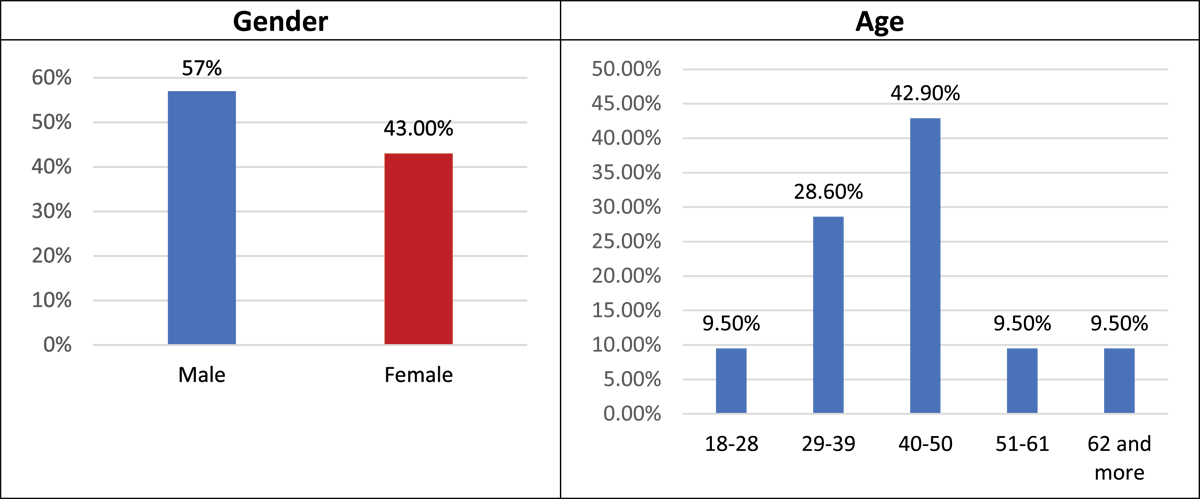
Figure 1
The demographic data of advocates who participated in the online survey.
Source: Author’s online survey of advocates conducted in December 2022.
Effects of e-justice systems on access to justice, right to fair trial, right to effective remedy, and data privacy
The analysis is based on the evaluation that judges, court staff and advocates give to the effects of the development of e-justice concerning some relevant dimensions such as access to justice, right to fair trial, right to effective remedy and data privacy. One of the main achievements of e-justice systems includes ensuring access to justice during the Covid-19 pandemic. However, several e-justice systems raised concerns on ensuring the right to fair trial, the right to an effective remedy, and data privacy.
The case studies below showed the positive effect of the RHVC on the right to access to justice. They demonstrated the Kyrgyz judiciary’s significant efforts to ensure access to justice during the Covid-19 pandemic and operating in line with modern trends of e-justice development. E-justice systems are permitted to conduct RHVC not only at the national level (between different regions), but also at the international level. RHVC reduces convoying costs. However, there are a small number of courtrooms equipped with videoconferencing software in Bishkek and the regions.42
At the national level, Pervomaisky district court in the capital city of Bishkek alongside Bishkek city court conducted remote interrogations of witnesses from Osh city and the Issyk-Kul region.43
In 2022, for the first time, two international RHVC were held in the Pervomaisky district court of Bishkek. First, the remote interrogation of a victim of crime from Republic of Korea and second, the remote interrogation of a litigant from Kazakhstan.44
Despite the RHVC’s positive effect on access to justice, they also raised concerns on ensuring the right to fair trial which was emphasized by judges and advocates. For instance, ‘during RHVC advocates did not have an opportunity to confidentially communicate with their clients’.45 Moreover, ‘RHVC deprived a judge from observing non-verbal cues of communication, which impeded assessment of defendant and witness testimony’s credibility’.46 These data are confirmed by the online survey of advocates. According to the results of the online survey, among the advocates who participated in RHVC more than half encountered challenges (56,3%) such as ‘technical issues and lack of connection’, ‘very poor technical quality’, ‘very little time allotted to a trial’, ‘sometimes there was no connection’ and ‘no electricity, disruptions’. Few advocates were free of these challenges (31,3%) (Figure 2).47
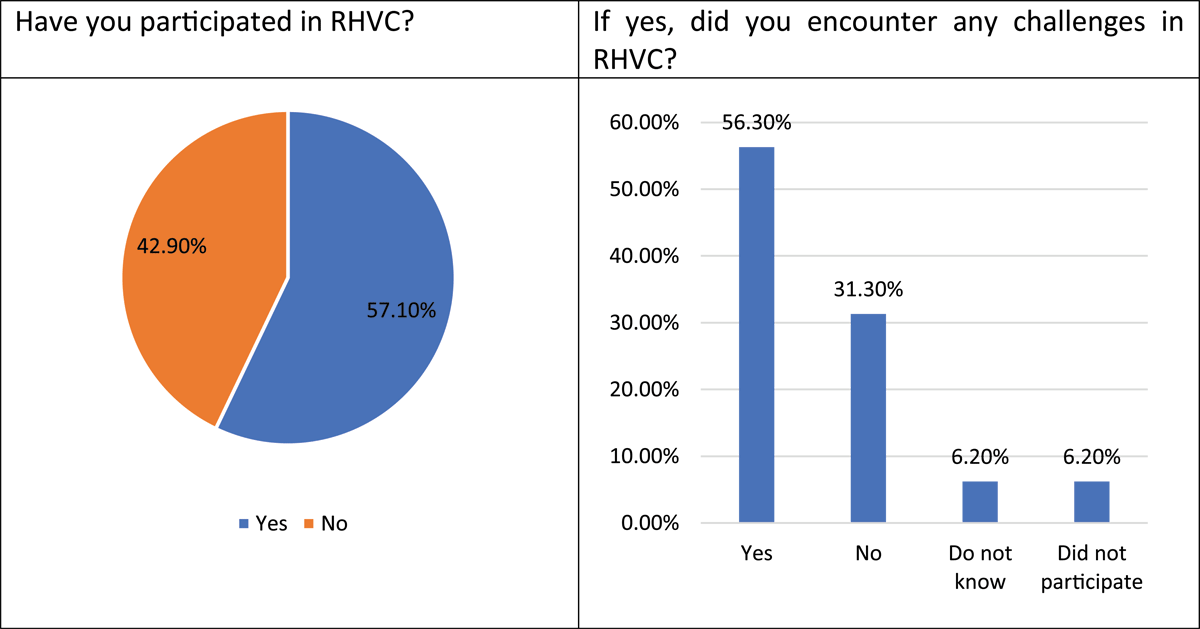
Figure 2
The data on challenges that advocates encountered during RHVC.
Source: Author’s Online Survey of Advocates conducted in December 2022.
AVR in criminal proceedings has effect on the right to fair trial. Moreover, it positively contributes to strengthening discipline in the courtrooms. It protects judges from violations of discipline in the courtroom by other parties.48 In addition, it also protects court clerks from defendants’ unethical behaviour.49 The advocates highlighted that it has a positive effect on the behaviour of judges and litigants as a tool for ‘reducing corruption’, ‘disciplining judges and litigants’, ‘ensuring transparency’ and ‘preventing judges from violating ethical norms by fixation of arguments, testimonies of participants of the trial’.50
Nevertheless, using AVR faced challenges on organizational level, raising the following concerns on ensuring access to justice. According to the results of online survey, 57,1% of advocates encountered challenges in using AVR, while 42,9% did not. The advocates indicated main challenges that they encountered such as ‘technical’ (55%), ‘lack of electricity’ (25%), ‘limited number of courtrooms equipped with system of audio-video recording of proceedings’ (5%), and ‘a lack of awareness that the system of audio-video recording of proceedings works’ (5%). In a much smaller number of cases, the advocates reported that there were no challenges (10%) (Figure 3).51
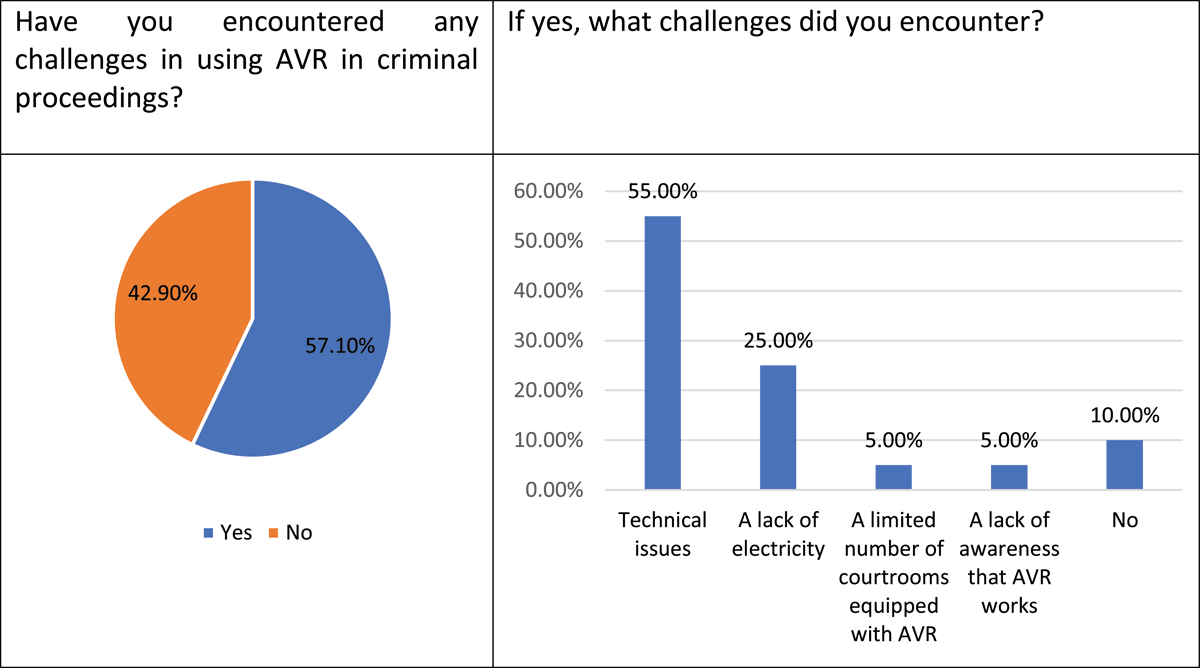
Figure 3
The data on challenges in using AVR in proceedings.
Source: Author’s Online Survey of Advocates conducted in December 2022.
AVR can be used as a method of discovery for ensuring the right to an effective remedy in the appellate courts. An important prerequisite for ensuring the right to effective remedy is access to copies of AVR for litigants and their advocates. It can be used as evidence in appellate courts and the Supreme Court. The online survey of advocates revealed that more than half of advocates apply to the court to obtain a copy of AVR on a CD (66,6%). A smaller number of advocates did not apply (28,6%). In the majority of cases where advocates requested a copy of AVR, they received it (75%). Fewer advocates reported that they did not receive a copy of AVR upon their request (25%) (Figure 4).
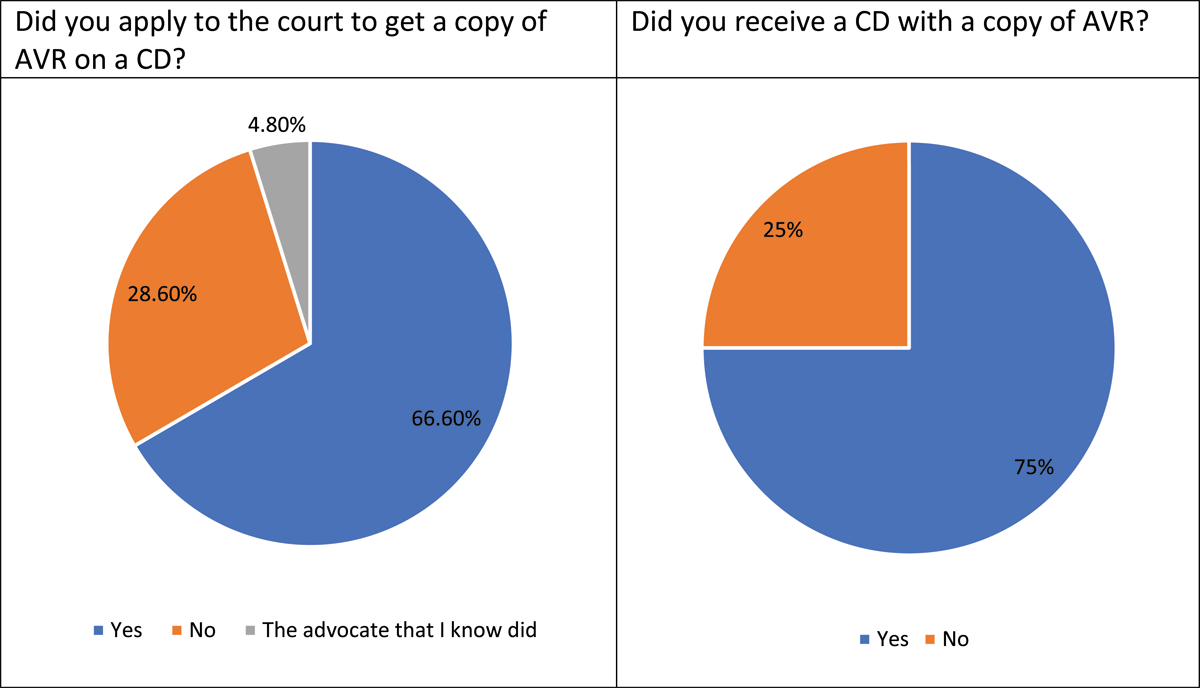
Figure 4
The data on advocates’ requests for copies of AVR on a CD.
Source: Author’s Online Survey of Advocates conducted in December 2022.
Almost half of the advocates did not encounter any challenges in obtaining a copy of AVR (47,6%). Fewer advocates encountered challenges owed to different reasons such as ’lack of CDs and incompetence of some court clerks’ and ‘poor quality of recording’ (42,9%). The advocates also mentioned that ‘it can be difficult and time-consuming to get copies, there is a lot of bureaucracy, sometimes the quality of sound and image is poor’, ‘a copy was not received referring to different persons as executors, ended up receiving only an audio recording of the recorder rather than a full audio-video recording’, ‘you have to make efforts instead of just getting it’, ‘CD is not always provided and if it is provided the quality is very poor’ as well as ‘no response to a written request for a recording’ (Figure 5).52
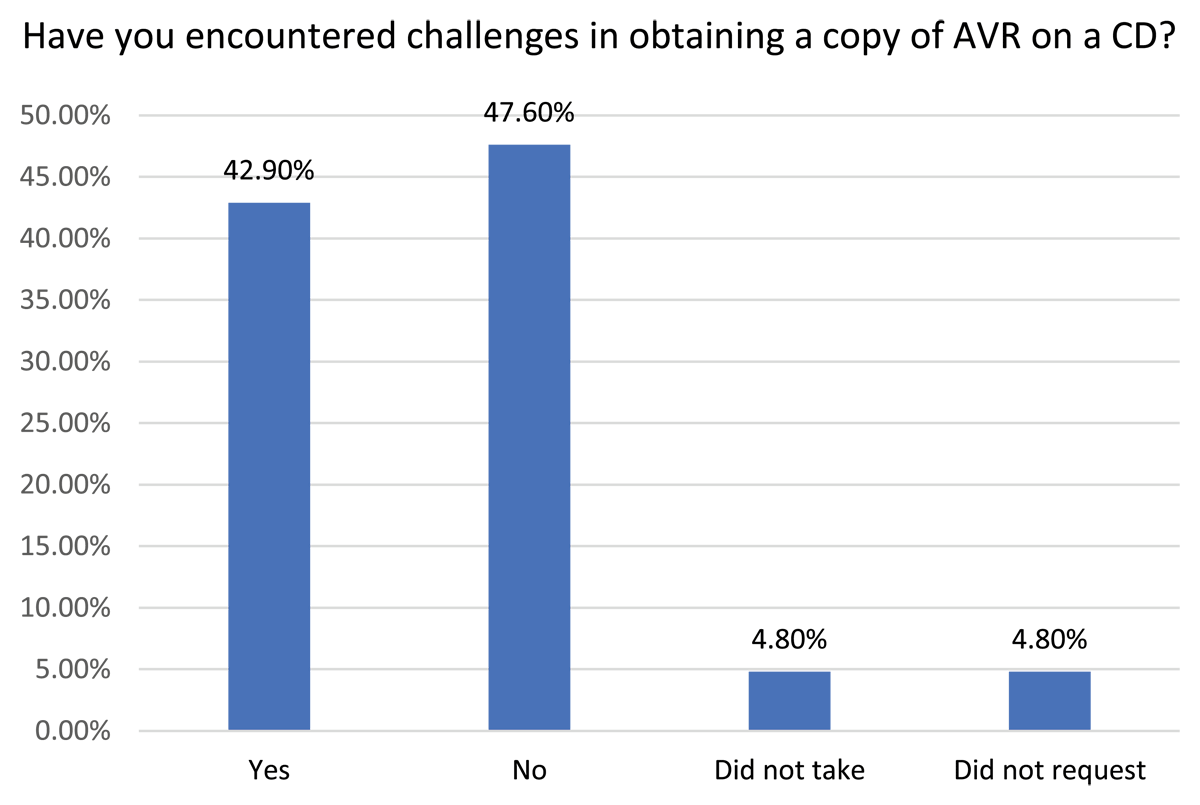
Figure 5
The data on challenges encountered by advocates in obtaining a copy of AVR on a CD.
Source: Author’s Online Survey of Advocates conducted in December 2022.
National legislation establishes several exceptions when a copy of AVR cannot be issued to the parties in order to protect information constituting state and other secrets protected by law, personal and family secrets and privacy rights as well as the honour and business reputation of the parties.53
In addition, access to copies of AVR for parties and their advocates also raised concerns for data privacy. For this reason, there is no online broadcasting of RHVC in the courts at present. In order to protect data privacy, national legislation binds parties or their representatives to sign an obligation to use a copy of AVR only for protection of their own violated rights and legitimate interests, without violating the rights of other participants of the trial and prohibits uploading it on the Internet for public access or transferring it to third parties. Next, parties or their representatives are warned on liability grounds for the violation of rights of citizens and about the Law of the Kyrgyz Republic ‘On Personal Information’.54 The Criminal Code55 and the Code on Offences56 both establish criminal liability for the violation of privacy rights.
In order to protect the data privacy of parties, judges are obliged to publish their decisions and other judicial acts after depersonalizing the data of litigants, except name, surname and patronimic name of a person found guilty.57 In this regard, AI systems which automatically depersonalize personal data of litigants could assist judges and decrease their workload.
The online survey of advocates revealed feedback of the Kyrgyz Bar community on the effectiveness of using these e-justice systems in courts. The survey showed that e-justice systems do not have an entirely homogeneous effect. Almost half of the advocates positively assessed the effect of AVR and RHVC on improving access to justice, right to a fair trial, right to an effective remedy, and the rule of law. At the same time, most advocates considered that these e-justice systems have moderate and low effects on ensuring protection of personal data (Figures 6, 7).
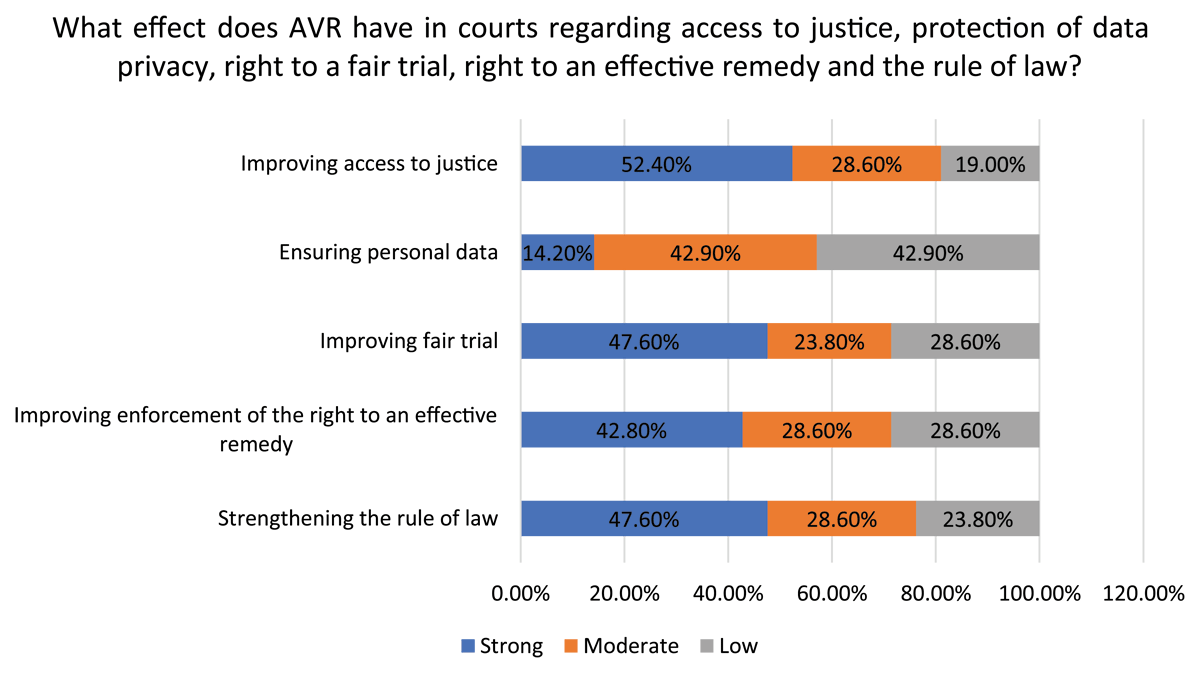
Figure 6
Online survey results concerning effect of AVR in courts on access to justice, protection of data privacy, right to a fair trial, right to an effective remedy, and the rule of law (N = 21).
Source: Author’s Online Survey of Advocates conducted in December 2022.
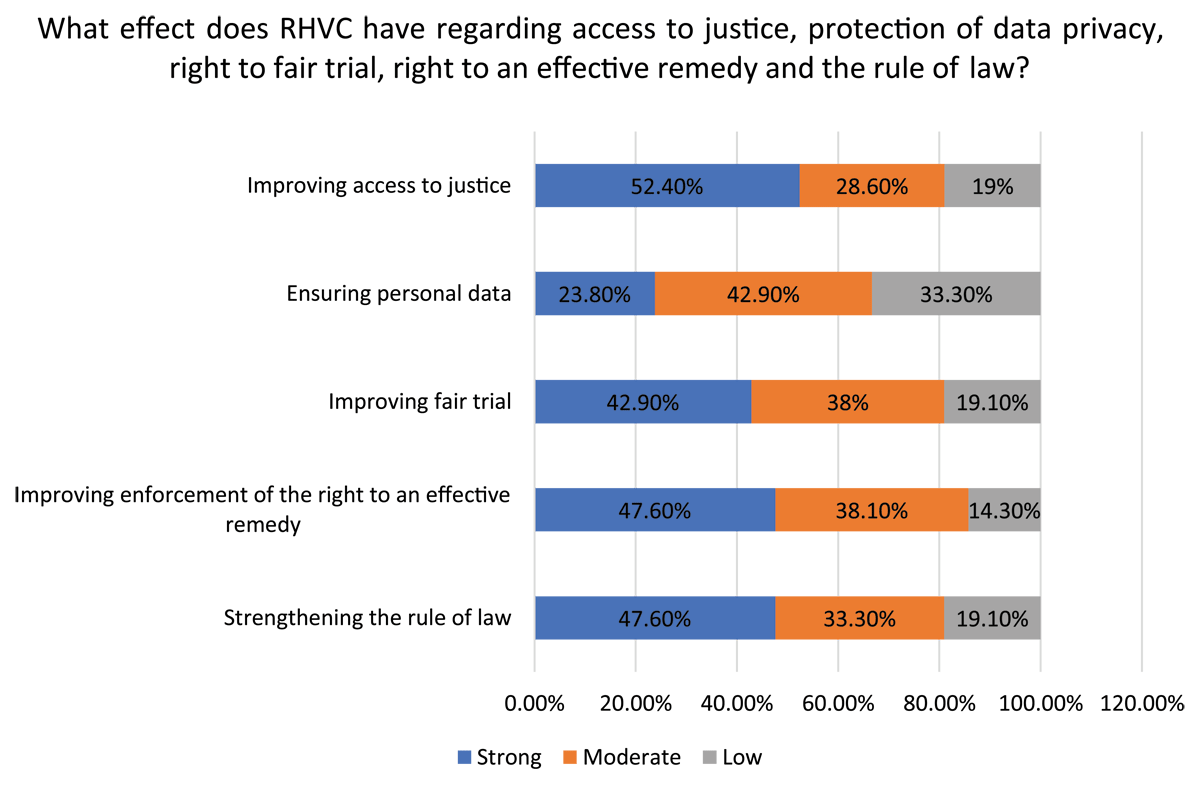
Figure 7
Online survey results concerning the effect of RHVC in courts on access to justice, protection of data privacy, right to fair trial, right to an effective remedy, and the rule of law (N = 21).
Source: Author’s Online Survey of Advocates conducted in December 2022.
In answer to the question what effect AVR has regarding access to justice, 52,4% of advocates reported that this system has strong effect to improving access to justice, whereas 28,6% of advocates argued that its effect is moderate, and 19% of advocates believed its effect is low. Conversely, in terms of ensuring personal data protection, a similar number of advocates stated that its effect is low (42,9%) and moderate (42,9%), whereas a much smaller number of advocates indicated that its effect is strong (14,2%). With regard to the effect on improving fair trial rights, 47,6% advocates described that AVR has a strong effect here. In contrast, a much smaller percentage of advocates reported that it has moderate (23,8%) and low effect (28,6%). In the context of improving enforcement of the right to an effective remedy, 42,8% of advocates indicated a strong effect of AVR, however, almost half of this percentage determined its effect as moderate (28,6%) and low (28,6%). Finally, similar results showed the answers on the question about the effect of AVR on strengthening the rule of law. According to the data, 47,6% of advocates considered that it has a strong effect. In contrast, a smaller number of advocates described that it has moderate (28,6%) and low effects (23,8%).
The data revealed that more than half of the advocates (52,4%) described RHVC as having a strong effect on improving access to justice, whereas 28,6% of advocates indicated its effect as moderate, and 19% of advocates described it as low. Conversely, in terms of ensuring personal data protection, the majority of advocates do not believe that RHVC has a strong effect on ensuring personal data. Only 23,8% of advocates considered that it has a strong effect on ensuring personal data, 42,9% of advocates described its effect as moderate and 33,3% of advocates described its effect as low. With regard to effect on improving fair trial, 42,9% of advocates reported that RHVC has strong effect on improving fair trial, 38% of advocates assessed its effect as moderate, and 19,1% of advocates indicated that it has a low effect. In the context of improving enforcement of the right to an effective remedy and strengthening the rule of law, a similar percentage of advocates (47,6% and 47,6% in both cases) indicated that RHVC has a strong effect. Almost similar number of advocates assessed its effect as moderate, 38,1% and 33,3%, respectively. Finally, only 14,3% of advocates indicated that it has a low effect on improving enforcement of the right to an effective remedy, and 19,1% considered its effect on strengthening the rule of law as low (Figure 8).
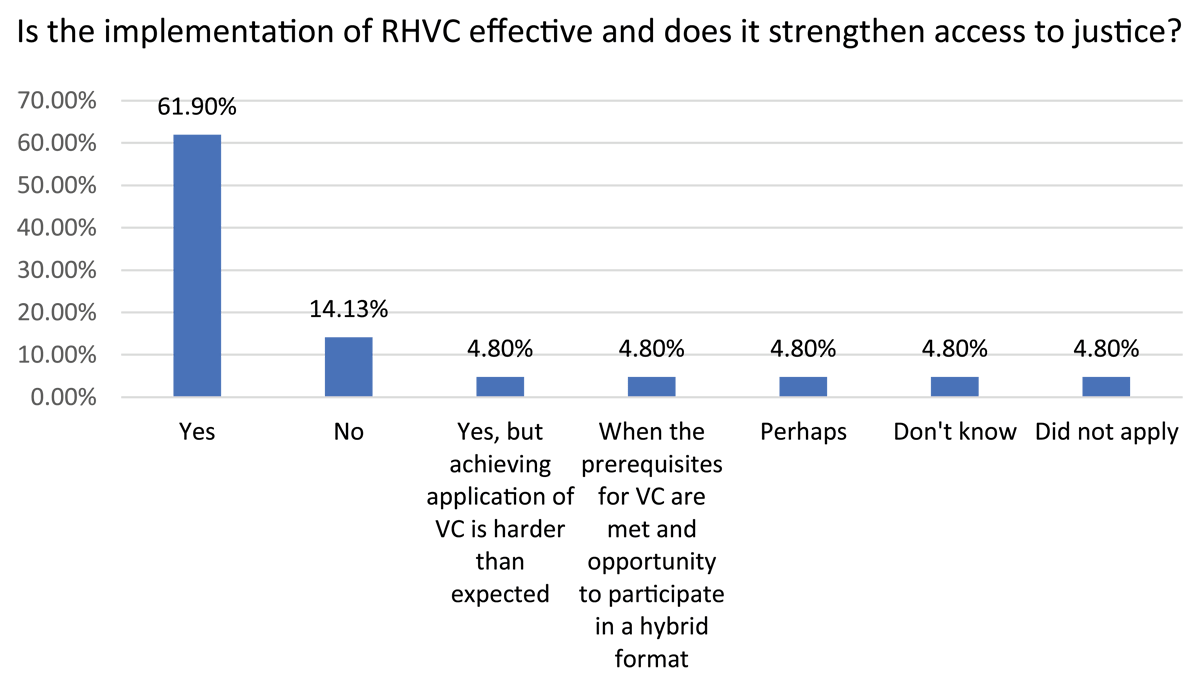
Figure 8
Online survey results concerning the effectiveness of the impact of RHVC and its contribution on strengthening access to justice (N = 21).
Source: Author’s Online Survey of Advocates conducted in December 2022.
In answer to the question regarding whether the implementation of RHVC is effective in strengthening access to justice, 61,9% of advocates positively assessed its implementation, whereas only 14,13% of advocates argued that it is not effective in this sense. Meanwhile, 4,8% of advocates agreed that it is effective and strengthens access to justice, however, achieving application of videoconferencing (‘VC’) in criminal proceedings is harder than expected. Also 4,8% of advocates reported that when the prerequisites for RHVC are met and there is an opportunity to participate in proceedings in hybrid format this could be effective and strengthen access to justice. Finally, similar results showed that not all advocates believe in the positive effect of RHVC. 4,8% of advocates reported that it could likely be effective and strengthen access to justice, another 4,8% of advocates did not know, and 4,8% did not participate in RHVC.
The results of the online survey showed that the majority of advocates positively assessed the effect of AVR and RHVC used in courts on improving access to justice, right to a fair trial, right to an effective remedy, and the rule of law. At the same time, they expressed concerns about the effect of both e-justice systems on ensuring personal data protection, considering this to be low.
Effect of e-justice systems on main judicial values
Lupo points out that ‘in a democratic society e-justice should support judicial values such as equal access, transparency, respect of privacy, and impartiality’.58 In Kyrgyzstan, e-justice systems aimed at increasing accessibility, efficiency, fighting corruption, and ensuring transparency (Table 1).
Table 1
Analytical indicators on e-justice systems quality.
| INDICATORS | E-JUSTICE SYSTEMS |
|---|---|
| Accessibility | Videoconferencing Publishing of court decisions and other judicial acts on the official website act.sot.kg |
| Efficiency | AIS ‘Sud’ Audio-video recording of criminal proceedings AIS ‘Enforcement Proceedings’ |
| Judicial independence | Automated case allocation system |
| Transparency | Automated case allocation system, Audio-video recording of criminal proceedings, Publishing of court decisions and other judicial acts on the official website act.sot.kg AIS ‘Enforcement Proceedings’ |
[i] Source: Authors compilation based on Lupo (2016, pp. 64–67).
The results of the online survey of advocates and interviews with judges and court clerks partially confirmed Lupo’s statement. The majority of advocates reported that e-justice systems (AVR, RHVC, AIS ‘Sud’) have an effect on the quality of judicial system functioning (81%), while only 19% of advocates considered that ‘they do not affect much of quality of judicial system’ (Figure 9).59
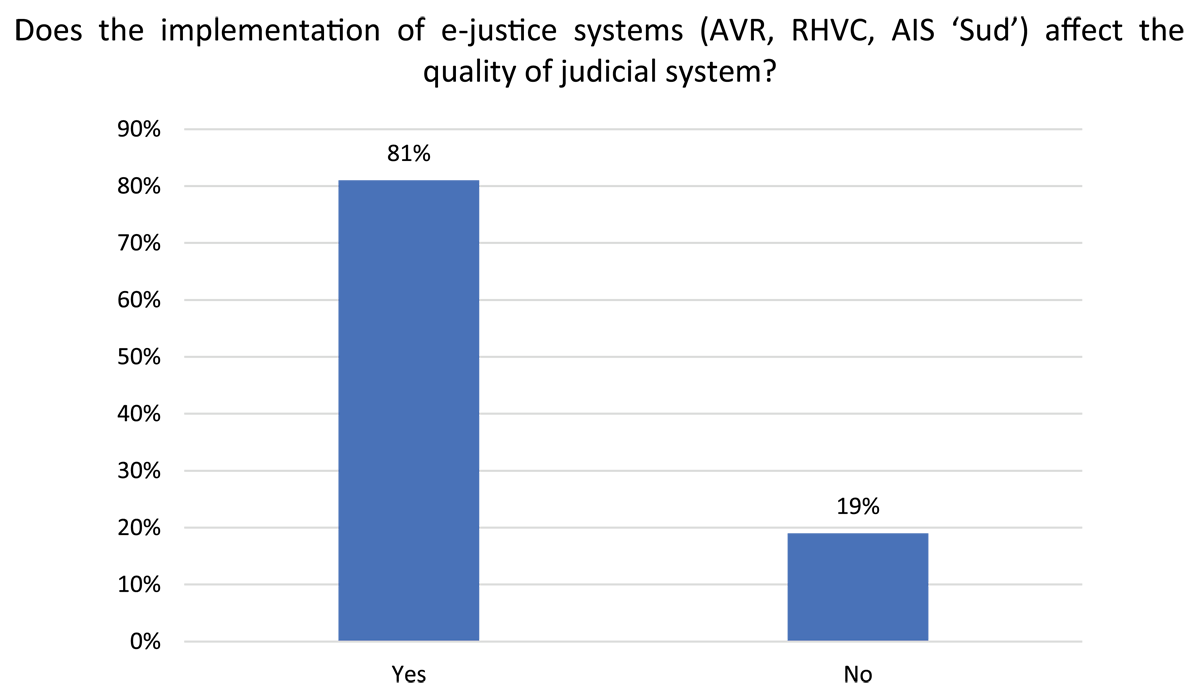
Figure 9
Online survey results on the effect the implementation of e-justice systems has on the quality of judicial system (N = 21).
Source: Author’s online survey of advocates conducted in December 2022.
According to the online survey results, the advocates described how e-justice systems affect the quality of the judiciary. They highlighted several advantages of e-justice systems. The advocates indicated that e-justice ‘facilitates access to justice’ and ‘affects the transparency and fair trial’. Particularly, ‘in addition to monitoring the quality of administration of justice, actual events in court hearings are recorded’, ‘transparency and objectivity in the distribution of cases’, ‘ICT facilitates compliance with procedural rules’, and ‘it provides opportunity to watch recordings of the proceedings’.60
In addition, one advocate shared his experience: ‘there were moments when upon the remark of a participant of the proceeding that AVR was not conducted in the judge’s office, the judge held a session in the courtroom’. The AVR impacts on accuracy of court minutes as far as ‘in a handwritten court minutes cannot be recorded everything’. Moreover, the advocates indicated that e-justice systems ‘reduce corruption and improves the proceeding’, ensure ‘transparency and trust’ and provide control.’ Finally, one advocate noted that ‘ICT should always be applied in court’.61
The results of the interviews also confirmed a positive assessment of implemented e-justice systems by judges and advocates. A judge highlighted that ‘the Automated Case Allocation System supports judicial independence’.62 An advocate indicated that ‘the AIS ‘Sud’ affects unbiased distribution of cases to judges’.63
The AIS ‘Enforcement Proceedings’ transforms the traditional format of case execution to a digital one, providing online control over all subdivisions of the bailiff service.64
Meanwhile, the results of the online survey revealed the challenges of e-justice implementation faced by advocates. They expressed concerns on ‘very poor quality of ICT that affects the judicial system’. An advocate highlighted that ‘it is necessary to increase the responsibility of judges regarding AVR, AVR should be given to parties upon their request, AVR should be full and transparent’. Another advocate expressed concerns that ‘in many cases everything is formal’. Finally, an advocate indicated that ‘the system of AVR does not solve the systemic problems of formal attitude to the law, i.e., the mere recording of any violations does not guarantee that they will be eliminated on further appeal’.65
Overall, the study has confirmed the statement that e-justice systems have an effect on the justice system so far as they can improve efficiency, accessibility, judicial independence and transparency of justice.66 The research also confirmed the Organization for Security and Co-operation in Europe Office for Democratic Institutions and Human Rights’ argument that some IT tools may have ‘insufficiencies for parties, and related fair trial concerns’.67 At the same time, the study revealed that implemented e-justice systems have different effects on access to justice, right to fair trial, right to effective remedy, data privacy and fundamental judicial values. At present, it does not have a homogenous effect thus far.
The Kyrgyz judiciary has a strong commitment towards the development of e-justice. The implementation of e-justice brings a positive effect on the development of the Kyrgyz judicial system. However, in order to achieve its successful deployment, an incremental approach could be used.
Conclusion
This paper explores the evolution of e-justice platforms implemented in Kyrgyzstan based on the three-cycle model of ICT diffusion in courts. The analysis of its application in the context of Kyrgyz judiciary’s digital development revealed slight deviations of cycles’ sequence. In contrast to ICT diffusion in most European judiciaries, the Kyrgyz judiciary in cooperation with international donors such as the ‘ROLPRO 2 ’ and the IDLO firstly established the IT Agency ’Adilet Sot’ and then began exploring ICT in courts, determining steps towards e-justice development. This example shows that the Kyrgyz judicial system is learning from the European experience in order to avoid similar pitfalls.
Overall, the application of three-cycle model of ICT diffusion in courts showed the main results, achievements and challenges faced by the Kyrgyz judiciary on each cycle. The main achievement of the first cycle was the establishment of an ICT governance structure within the judiciary responsible for implementation of ICT in both the Supreme Court and local courts. The main results of the second cycle included the use of ICT tools by judges and court staff in their daily judicial work, the online publication of judgements and the adoption of a legal framework for e-justice development.
Meantime, the analysis of results, achievements and challenges based on the three-cycle model is complemented by the analysis of the evaluation that the main actors in the judicial proceedings (i.e., judges, court staff and advocates) give to the effects of the development of e-justice concerning the relevant dimensions of access to justice, right to a fair trial, right to an effective remedy, data privacy, the rule of law and main judicial values. For instance, during the Covid-19 pandemic remote hearings provided access to justice for the litigants in criminal proceedings. A side effect of using AVR in criminal proceedings includes the prevention of unethical behaviour by parties in the courtrooms. Nevertheless, despite the positive achievements, the online survey also showed that advocates faced challenges concerning access to AVR recordings, which raised concerns.
The preliminary achievements of the third cycle included an understanding of necessity to fully integrate the courts’ e-justice platform with e-justice platforms of the Prosecutor’s Office, police and other governmental bodies. Thus, one of the challenges is the fragmentation of existing e-justice systems. Overall, the three-cycle model is worth following because it helps to analyse the evolution of e-justice platforms.
The analysis of evaluation given by the judges, court staff and advocates revealed that e-justice systems can be considered to have partially successful effect on ensuring access to justice, right to fair trial, right to effective remedy and data privacy. Additionally, they have an effect on main judicial values. They can to some degree improve efficiency, accessibility, judicial independence, and transparency.
Based on the main findings, the following ‘points of attention’ have emerged from the analysis of national legislation, interviews with judges, court staff, advocates, and the online survey of advocates:
Technical dimension of e-justice. The IT agency ‘Adilet Sot’ could provide monitoring of AVR systems in the courts and check the quality of recordings periodically. The Supreme Court in cooperation with the State Service for Execution of Punishments could increase the number of rooms in courts and remand centres equipped with VC software for remote hearings and AVR of proceedings across the country. Implementation of an AI system which automatically depersonalizes the personal data of litigants could assist judges and decrease their workload.
Normative dimension of e-justice. The research revealed loopholes in the Criminal Procedural Code and Instruction for the Audio-Video Recording of Trials. The Zhogorku Kenesh of the Kyrgyz Republic68 could adopt the following amendments to procedural legislation, (i) include a legal provision in the Criminal Procedural Code regarding a statement for the non-distribution of a copy of AVR of proceedings by litigants or their representatives, including the prohibition to upload it in public access on the Internet or to transfer it to third parties; (ii) establish the obligation to use AVR not only in criminal proceedings, but also in civil and administrative proceedings. The Judicial Department under the Supreme Court could determine the procedure of watching or listening to the AVR in the court buildings for litigants and their representatives.
Organizational dimension of e-justice. The Supreme Court could integrate the AIS ‘Sud’ with the official website for the publication of court decisions and other judicial acts on the Digital Justice Portal. This could increase the efficiency of the operation of court processes and reduce the workload of judges and court clerks. In addition, the achievement of e-justice goals requires the integration of all existing e-justice platforms under the umbrella of the Digital Justice Portal.
Human resources and educational dimension of e-justice. The Higher School of Justice of the Supreme Court in cooperation with the IT agency ‘Adilet Sot’ could provide trainings for new judges, court clerks, advocates, ICT specialists and litigants regarding RHVC and AVR in order to increase their awareness. In cooperation with the law faculties of universities, it could introduce special courses for law students in order to increase their e-justice competences. Indeed, as pointed out by an advocate ‘e-justice implementation in the courts mostly depends on human factor’.69
In conclusion, e-justice itself is only a tool for the digital transformation of judicial systems. It implicates the transformation of the state-building in order to establish a strong and independent judiciary, strengthen human resources, financially support the judiciary, and overall increase legal culture. Only in this context could e-justice successfully reach its goals. In this e-justice has the potential to contribute to strengthening the administration of justice in Kyrgyzstan.
Notes
[2] O. Olugasa, ‘Utilising Technology in Making the Nigerian Administration of Criminal Justice Act Effective for Criminal Trials’, International Journal for Court Administration, (2020) 11(2), p.1, available at: <https://iacajournal.org/articles/10.36745/ijca.332> [accessed 15 May 2024].
[3] F. Contini, ‘Dynamics of ICT Diffusion in European Judicial Systems, in: M. Fabri, F. Contini’, (eds.), Justice and Technology in Europe: How ICT is Changing the Judicial Business, Kluwer Law International, 2001 pp. 318–319.
[4] G. Lupo, ‘Evaluating e-Justice: The Design of an Assessment Framework for e-Justice Systems’, in: K. Benyekhlef, J. Bailey, J. Burkell, F. Gélinas, (eds.), E-Access to Justice. University of Ottawa Press, 2016, p. 53.
[5] IDLO, Enabling Sustainable Development: Lessons From E-Justice Programming In Kyrgyzstan, 2018; Zh. Sabyrova, A. Kudaiberdieva, Automated information system (AIS) Sud (Avtomatizirovannaya informacionnaya sistema (AIS) Sud. Metodicheskoe posobie dlya trenerov), 2019; W. Bernhardt, A. Maralbaeva, ‘Platform Solutions for the Digital Justice: Models for Regulation’, in: M.I. Inozemtsev, E.L. Sidorenko, Z. I. Khisamova (eds.) The Platform Economy: Designing a Supranational Legal Framework, Springer 2022, pp. 225–240; E. Lee, ‘The Reasons for Inefficient Use of the Results of AVR Application by Lawyers. Possible Solutions’ (Prichiny neeffektivnogo ispol’zovaniya rezul’tatov primeneniya avf advokatami. Vozmozhnye puti resheniya), Ala-Too Academic Studies 2022(4); M. Bekishova, ‘Procedural Features of Video Conferencing in Criminal Cases’ (Processual’nye osobennosti primeneniya video konferencsvyazi po ugolovnym delam), Ala-Too Academic Studies 2022(4). pp. 306–311.
[6] D. Reiling, F. Contini, ‘E-Justice Platforms: Challenges for Judicial Governance’, International Journal for Court Administration, (2022) 13(1), p. 2, available at: <https://iacajournal.org/articles/10.36745/ijca.445> [accessed 15 May 2024].
[7] M. Fabri, ‘E-justice in Finland and in Italy: enabling versus constraining models’, in: F. Contini, G.F. Lanzara (eds.), ICT and Innovation in the Public Sector. European Studies in the Making of E-Government, Palgrave Macmillan, UK., 2009, p. 140.
[8] A. Wallace, S. Roach Anleu, K. Mack, ‘Judicial Work and AV use: Perceptions from Australian Courts’, Oñati Socio-legal Series, (2017), 7(4), p. 701, available at: <https://opo.iisj.net/index.php/osls/article/view/848/1024> [accessed 15 May 2024].
[9] See Lupo, supra, note 4; note 5, infra; G. Lupo, J. Bailey, ‘Designing and Implementing e-Justice Systems: Some Lessons Learned from EU and Canadian Examples’, Laws, (2014) 3(2) pp. 353–387; M. Velicogna, ‘Electronic Access to Justice: From Theory to Practice and Back’, Droit et cultures, (2011) 61(1), available at https://journals.openedition.org/droitcultures/2447 [accessed 15 May 2024].
[13] Kyrgyz Republic, State Targeted Program ‘Development of the Judicial System of the Kyrgyz Republic for 2014–2017’.
[14] Adilet Sot, About us. History of development. Main purposes, 2015, available at: <http://e-sot.kg/o-nas/> [accessed 15 May 2024].
[15] Higher School of Justice of the Supreme Court of the Kyrgyz Republic, The training of trainers (ToT) has been completed, 2022, available at: <http://vshp.sot.kg/post/zavershilsya-trening-dlya-trenerov-tot> [accessed 15 May 2024].
[17] Cabar, Automated Information System of Courts, 2020, available at:<http://sot.kg/post/iats-kabar-avtomatizirovannaya-informatsionnaya-sistema-sudov> [accessed 15 May 2024].
[18] Judicial Department of the Supreme Court of the Kyrgyz Republic, AIS Suda, 2019, available at: <http://admin-sot.sot.kg/public/sites/4/2019/07/AIS-Suda.pdf> [accessed 15 May 2024].
[19] USAID-IDLO Programme, Increasing Public Confidence in the Judicial System of the Kyrgyz Republic. Public Foundation ‘Civic Initiative for Internet Policy’, 2021, p. 8.
[23] Kyrgyz Republic, Instruction on records management in the Supreme Court of the Kyrgyz Republic and local courts, 2022, [available at]: <http://admin-sot. sot.kg/public/sites/4/2022/08/Dlya-Plenuma-Russ.variant-posle-ISPRAVLENIJ-p.249-325-17.10.2022-12-1.pdf>
[24] IRZ, Kyrgyzstan: The Rule of Law Programme in the Kyrgyz Republic – 2nd phase (ROLPRO2), 2020.
[25] Judicial Department of the Supreme Court of the Kyrgyz Republic, As part of the implementation of AIS ‘Enforcement Proceedings’ computer equipment has been transferred to the Judicial Department, 2022.
[26] Kyrgyz Republic, Criminal Procedural Code of the Kyrgyz Republic, 2021b.
[27] Kyrgyz Republic, Civil Procedural Code of the Kyrgyz Republic, 2017a; Administrative Procedural Code of the Kyrgyz Republic, 2017b.
[29] Court Acts and Sessions, 2023, available at: <http://act.sot.kg/ru> [accessed 15 May 2024].
[30] Supreme Court of the Kyrgyz Republic, Decree of the Supreme Court of the Kyrgyz Republic ‘On Approval of the Regulations for Use of Videoconferencing in Courts of the Kyrgyz Republic’, 2020a.
[31] Judicial Department of the Supreme Court, Information table of the Remote Court Sessions Portal, 2021.
[32] M. Bekishova, ‘Procedural Features of Video Conferencing in Criminal Cases’ (Processual’nye osobennosti primeneniya video konferencsvyazi po ugolovnym delam). Ala-Too Academic Studies, (2022) 4, pp. 306–311.
[34] Evening Bishkek, A Conference Takes Place To Address the Independence of the Judiciary, 2022, available at: <https://www.vb.kg/doc/422598_prohodit_konferenciia_zatragivaushaia_voprosy_nezavisimosti_sydebnoy_vlasti.html> [accessed 15 May 2024].
[35] Digital Justice Portal, 2023, available at: <https://portal.sot.kg/ru/about> [accessed 15 May 2024].
[36] Kyrgyz Republic, State Target Program ‘Development of the Judiciary of the Kyrgyz Republic for 2023–2026’, 2023.
[38] A. Sanders, Video-Hearings in Europe Before, During and After the COVID-19 Pandemic, International Journal for Court Administration 12(2), 2021 https://iacajournal.org/articles/10.36745/ijca.379 (Accessed 15 December 2022).
[40] M. Jneid, R. Fakhoury, S. Imad, ‘Digital Transformation in Justice: Discussion of Challenges and a Conceptual Model for e-Justice Success’, Proceedings of the 19th European Conference on Digital Government, Conference Paper, 2019, p. 5, available at: <https://www.academia.edu/50627914/Digital_Transformation_in_Justice_Discussion_of_Challenges_and_a_Conceptual_Model_for_e_Justice_Success> [accessed 15 May 2015].
[41] European Union, Annual Action Programme 2016 in favour of Kyrgyz Republic for theme ‘Integrated Rural Development’ and ‘Rule of Law’ to be financed from the general budget of the European Union. Annex I. Action Document for the Rule of Law Programme in the Kyrgyz Republic 2nd phase (ROLPRO 2), 2016.
[42] J. Rosa, C. Teixeira, J.S. Pinto, ‘Risk factors in e-justice information systems’, Government Information Quarterly (2013) 30(3), pp. 241–256.
[45] Supreme Court of the Kyrgyz Republic, 2022b, available at:<http://sot.kg/post/v-pervomajskom-rajonnom-sude-goroda-bishkek-proveli-onlajn-dopros-grazhdaninom-yuzhnoj-korei> [accessed 15 May 2024].
[46] Interview conducted with an advocate in December 2020 and interview conducted with a court clerk in September 2021.
[54] Judicial Department of the Supreme Court of the Kyrgyz Republic, Instruction ‘On the Procedure for Using the System of Audio-Video Recording of Court Trials, Storage and Destruction of Audio and Video Recordings, and Providing Materials of Audio-Video Recording of Court Sessions to Parties and Their Representatives’, 2020.
[56] Kyrgyz Republic, Criminal Code of the Kyrgyz Republic, 2021c.
[57] Kyrgyz Republic, Code on Offences of the Kyrgyz Republic, 2021d.
[58] Kyrgyz Republic, The Law of the Kyrgyz Republic ‘On Access to Information Held by State Bodies and Local Self-Governments of the Kyrgyz Republic’, 2006.
[65] Judicial Department of the Supreme Court of the Kyrgyz Republic, As part of the implementation of AIS ‘Enforcement Proceedings’ computer equipment has been transferred to the Judicial Department, 2022.
[67] See Lupo, supra note 4; see Lupo et al., supra note 9; see Velicogna, supra note 9; Olugasa, supra note 2, p. 5.
[68] OSCE ODIHR, The functioning of courts in the Covid-19 pandemic: A Primer, 2020, available at: <https://www.osce.org/odihr/469170> [accessed 15 May 2024].
Acknowledgements
The author thanks the Volkswagen Foundation for the opportunity to develop this research, the President of JAR-Association, Research Director of the Institute of Legal Informatics and Judicial Systems, National Research Council of Italy Dr. Marco Fabri and Research Director of the Institute of Legal Informatics and Judicial Systems, National Research Council of Italy Mr. Francesco Contini for their helpful comments. The early versions of this article were presented at the JAR-Association Inaugural Conference ‘Innovation in Judicial Systems: Human, Cyber and Beyond’, School of Law, University Roma Tre on 25–26 May 2023, and at a workshop at the Institute of Legal Informatics and Judicial Systems, National Research Council of Italy on September 19, 2023. The author appreciates the many helpful comments from participants of the workshop.
Funding Information
This research is conducted in the framework of the Postdoctoral Fellowship Program ‘Institutional Change and Social Practice. Research on the Political System, the Economy and Society in Central Asia and the Caucasus’ funded by Volkswagen Foundation.
Competing Interests
The author has no competing interests to declare.