
1. Introduction
With the solemnity of the legal profession, the future of law in the digital world is tested but the continuous call for a paradigm shift has so far resulted in increased use of technology in courtrooms.1 The infusion of technology into legal practice ranges from the adoption of Electronic Case Management, Audio Visual Links (AVL) for court proceedings, issuance of online legal advice and digital law libraries, to e-filing, e-service, virtual courts and the smart courts.2 The breaking point for many jurisdictions, however, was the year 2020 when Virtual Court Proceedings (VCP) were adopted as a measure for navigating court proceedings during the Covid-19 pandemic.3 This period expounded the VCP jurisprudence in several jurisdictions, including, but not limited to, Singapore, Australia, the United Kingdom, Canada, China, Nigeria and across Africa.
In Nigeria specifically, several courts passed Practice Directions to facilitate the adoption of VCP4 following circular no. NJC/CIR/HOC/II/656 of the National Judicial Council (NJC).5 The silence of the Constitution on the status of VCP resulted in a dichotomy of views on the constitutionality and/or legality of the VCP framework in Nigeria, which was extensively discussed in literature between 2020 and 2023.6 The literature that emerged during the period relied on the Practice Directions and the pronouncement of the Supreme Court in the cases of Attorney General of Lagos State v. Attorney General of the Federation & Anor7 and Attorney General of Ekiti State v Attorney General of the Federation8 (which were eventually withdrawn and struck out as being speculative) that the virtual court was not illegal in Nigeria at that time.9 The divergent views prompted an attempt at constitutional amendments to expressly recognize VCP but this attempt was defeated during the legislative process.10 Accordingly, the jurisprudence and literature of VCP in Nigeria could be described as still lagging behind those of the developed countries where VCP have been formally integrated into everyday court processes. There is need to assess the level of comfort of legal practitioners in the existing framework for VCP and establish the challenges experienced and/or likely to inhibit the sustainable implementation of VCP in Nigeria. Owing to the dearth of empirical studies on this subject in Nigeria, this paper provides an empirical perspective to the conversation on VCP as a sequel to our earlier paper on Remote Court Proceedings: Justice online or Justice on the line published in this journal.11
2. Methodology
The study is empirical but supported by a restricted doctrinal review of literature on VCP in Nigeria. We distributed survey questionnaires to 450 respondents who were drawn from a population of 26 026 legal practitioners in Lagos and Abuja, Federal Capital Territory (FCT). The population was derived from the Final Election Voters’ List published by the Electoral Committee of Nigeria Bar Association (ECNBA) in 2022, where the number of practicing lawyers in the research setting was collated as a total of 16 267 and 9 759 respectively.12 The 450 questionnaires were shared equally in the two locations (i.e. 225 for each location) but distributed on a simple random basis to legal practitioners within the courtroom at each location between the hours of 9:00 and 14:00 daily, being the active time of court operations with an influx of lawyers. 353 practicing legal practitioners responded to the questionnaires.
The reasons for adopting Lagos and Abuja as the research setting include the fact that Lagos State is the commercial hub of the nation, having a high volume of cases compared to other states,13 and Abuja hosts the Federal Courts such as the Supreme Court, Court of Appeal, Federal High Court, High Court of the Federal Capital Territory and National Industrial Court. Although Lagos was one of the first few states to adopt VCP in Nigeria,14 both locations have experimented with VCP,15 and Nigerian lawyers have not been limited by province in the practice of law. The study relied on views of legal practitioners because of their expertise and experience on the components of court proceedings and the fact that they carry on the briefs of litigants who they are in direct relationship with. Although the study had set out to include judicial officers in the quantitative survey, the pretest conducted exposed the reservations of the judicial officers to participate at the time of novelty of the innovation. Therefore, as more legal practitioners express preference for VCP, court systems and judges will need to embrace the innovation at varying degrees and an increased adoption would mean that such studies can be extended to litigants and judges in future research.
3. Literature review
3.1 The emergence and development of virtual court proceedings in Nigeria
The use of Audio Visual Links (AVL) or video conferencing pre-existed Covid-19 and dates back to the 1990s when AVL was adopted for expert and vulnerable witnesses.16 As far back as 2010, the United Kingdom permitted defendants to take pleas virtually.17 However, in Nigeria, the advent of VCP can be traced to 2020 when the National Judicial Council (NJC), through circular NJC/CIR/HOC/II/656, directed the use of VCP during the Covid-19 pandemic.18 This is notwithstanding that electronic filing and service had existed prior to 2020.19 The circular of the NJC became the authority upon which the experimental trials of VCP began in Nigeria. The trend of events can be described as ‘Pre Covid – Year 2020’ and the second phase ‘Year 2021–2023’. During the first phase, existing laws provided for e-filing and service,20 presumption of delivery of documents,21 electronic signature,22 and admissibility of computer generated evidence.23 This phase was further characterized by the introduction of Practice Directions to support VCP in the height of Covid-19 pandemic allowing for further provisions such as the use of audio-visual links for court proceedings,24 required etiquette during VCP and recording of court proceedings during VCP. This era experienced the decision of the legislature not to pass the bill sponsoring VCP in Nigeria.25 In the second phase, ‘Year 2021–2023’, more developments to the law emerged. The Administration of Criminal Justice Law of Lagos State was amended in 2021 to recognize VCP in criminal trials26 and the Evidence Act equally amended in 2023 to recognize the admissibility of computer records, electronic authentication of documents, electronic gazetting, electronic oath taking, and proof of digital signatures.27 The Court of Appeal Rules embraced VCP holistically by harmonizing previous provisions in Practice Directions in its Court of Appeal Rules of 2021.28 More can be done to advance the VCP cause; as such it is necessary to explore the extent of adoption, its acceptability and challenges encountered and/or envisaged in using VCP in Nigeria.
3.2 Arguments on the implications of virtual court proceedings in Nigeria
Literature has projected both the benefits and challenges of VCP with some of the challenges including technophobia, digital exclusion, poor infrastructure and the challenge of assessing credibility of witnesses, amongst others.29 The nature of challenges encountered may, however, differ from jurisdiction to jurisdiction owing to legal and cultural differences. Nigeria enjoyed the comfort of adopting VCP to cushion the effects of the pandemic on the administration of justice but the challenge of constitutionality of VCP was the first to rear its head during the pandemic.30 The challenge stems from the silence of the Constitution on the issue of VCP which as argued by Sunday-Ayerun, Eti and Ole, means that no provision in the Constitution condemns VCP.31 Taking a similar affirmative approach, Oji maintains that though the Constitution was silent on the term ‘public’; publicity could be achieved where unrestricted access is permitted virtually.32 There is a dearth of empirical study documenting the perception of legal practitioners on the subject of the legality of VCP.
Compared to more advanced jurisdictions, VCP appears to be threatened by poor infrastructure in Nigeria.33 This challenge includes the problem of poor electricity supply, lack of decent internet facility, deficient IT infrastructure and basic equipment to conduct VCP, amongst others. Poor infrastructure could limit access to VCP, thus hampering publicity.34 Another critical challenge is the constraint of admitting evidence in contentious matters35 which may require either frontloading the document manually,36 or sharing an online copy in line with the recently amended Evidence Act.37 Whilst these processes are laudable, the constraint of tendering certified true copies (CTC) of public documents could require that such CTCs be saved on the cloud by the public office to be accessible and downloadable. It could also be necessary to reclassify electronic copies of certified true copies of public documents as an acceptable form of secondary evidence by amending Section 90(1)(c).38 This is more so because the 2023 amendment did not amend Section 90(1)(c) of the 2011 Act which currently provides that only a certified true copy (and no other form) of secondary evidence is admissible.39 There are certain challenges unique to the Nigerian experience, including the variance between physical court rules of practice and the practice direction for VCP, but challenges such as privacy concerns, lack of decorum in the courtroom, technophobia and assessment of credibility of witnesses, amongst others, are not unique to Nigeria.40 As reviewed above, the available literature in Nigeria has focused more on the benefits of VCP, challenges of constitutionality and poor infrastructure for VCP. This study advances the literature on VCP in Nigeria by collating the views of legal practitioners on the nature of challenges inhibiting, or that could inhibit, VCP in Nigeria.
3.3 Virtual court practices across jurisdictions
Some of the trends in VCP are documented on Remote Court Worldwide41 and the extent of implementation varies across jurisdiction. Singapore recognized the adoption of VCP in its Supreme Court of Judicature Act Rules of Court 2021, which entered into force in 2022.42 Generally, Order 3 Rule 9 of the Rules permits the ‘court to conduct a case or hearing electronically or mechanically’43 or ‘through any other means as well as allowed for the appearance of persons through the same means’.44 Court processes are filed and served through the Electronic Filing Service (EFS).45 Self-represented litigants are, however, constrained to attend hearings in person.46 Applications for VCP by persons outside jurisdiction must be preceded by an application for permission to testify using audio-visual link.47 Affidavits may also be sworn to through video link.48 Singapore’s bold move to harmonize VCP processes with its Rules of Court is a positive trend Nigeria could learn from.
Similarly, Singapore and Australia require persons interested in VCP to obtain a court order and to provide the address of service for correspondence purposes.49 Australia makes use of e-courtrooms50 where hearings are conducted through video conferencing. Recording and transcription of court proceedings is done through Auscript but it is an offense to record or generate personal transcripts of court proceedings.51 On the need for publicity of trials, participants are expected to obtain permission to join virtual hearings.52 The issue of publicity is pertinent in virtual trials and it could be argued that the mere need to seek permission to observe a trial could inhibit publicity because anything that requires permission could be declined.
In the United Kingdom, VCP commences where there is an executed agreement between the parties for that purpose and a hearing can be conducted by video conferencing or telephone.53 VCP may be held in private where it is impracticable to broadcast the proceedings.54 A list of the bundle of exhibits to be relied on electronically are to be provided55 and it is prohibited for parties or counsel to record court proceedings without leave of court.56 Media personalities may be permitted to attend virtual trials to encourage publicity.57 The challenge is that the issue of publicity is being treated as one that is discretionary as opposed to one that should be mandatory.
Similar to what is obtainable in Singapore and Australia, an application is required to obtain permission to commence virtual hearing in Kenya.58 Filing of processes can be electronic but the legal practitioner must provide the email and contain details for correspondences. The analysis of VCP trends across jurisdiction creates more questions as to the capacity of VCP to deliver a fair trial,59 amongst other challenges recognized by literature, including, but not limited to, the limited ability to cross examine witnesses,60 the possibility of the participant feeling isolated, stressed or exhausted during trial61 and the challenge of assessing the credibility of witnesses.62 The challenges experienced in different jurisdictions is a prompt for continuous empirical studies on the subject of VCP to guide the courts on how best to navigate the dematerialization of courts and implement sustainable VCP.
3.4 Trends of empirical studies on virtual court proceedings
Owing to the evolving nature of VCP, empirical studies on the subject of VCP appear to be gradually progressing. This section explores three empirical studies on the preferences and challenges of VCP.
3.4.1 Turner’s Texas survey
Turner surveyed 568 respondents on the benefits and challenges of VCP. The study revealed the benefits of VCP as including saving of time and resources, reduction in detained defendants, easy access of public to proceedings and quick resolution of cases.63 The challenges identified in the survey included the difficulty in assessing the credibility of witnesses, interference with attorney-client confidentiality, disclosure of sensitive information to the public, lack of access to VCP by indigent parties, difficulty in presenting a party’s case and malfunction of technology.64 On the effect of VCP on case outcome, Turner’s study revealed that the defense attorney held the view that VCP was more likely to produce worse outcomes for the defense while the prosecutor and judges thought otherwise. A significant revelation from Turner’s study is that the prosecutors preferred for VCP to continue while most of the defense attorneys did not.65
3.4.2 Stanford Law School’s national study on the transition to remote criminal court
The study involved 240 respondents. The majority of the respondents had participated in VCP using mostly Zoom or WebEx.66 The study revealed the existence of technological challenges with VCP more with poor audio and video quality than camera placement.67 More defense attorneys were found to take the first appearance and bail hearing virtually but their desire for VCP dropped as the case progressed.68 The ‘in-custody’ defendants were found to have more limited access to technology than the ‘out of custody’ defendants.69 The study further noted challenges to attorney-client communication and confidentiality.70 No less than 77.9% of the respondents agree that VCP compromised access to justice.71
3.4.3 Bild, Redman, Newmann, Muir, Tait and Schwarz’s sound and credibility study
Bild et al.72 conducted an evaluation into the impact of sound on the credibility and reliability of witnesses using 593 respondents. The authors investigated whether audio quality could influence impressions about witness testimony. The respondents were tasked to act as jurors listening to the testimony of a child in the courtroom after which the respondents were asked to evaluate the credibility, reliability and trustworthiness of the child. It was revealed that the respondents gave less favorable ratings to the witness when the audio was difficult to hear. Bild et al. also examined whether the audio quality affected how the respondents recalled facts presented in evidence and the study showed the affirmative confirming that audio quality can affect the evaluation of the credibility of a witness. The evaluation of the witnesses was influenced by the quality of media.
4. Empirical evaluation and results
This study examined the preference and challenges of VCP in Nigeria. The data from the responses was analyzed using Statistical Packages for Social Sciences (SPSS) version 22.
4.1 Demographic data of the respondents
The demographic data of the respondents is summarized in Table 1 below:
Table 1
Demographic Data.
| RESPONDENTS’ DEMOGRAPHIC DATA (N = 353) | ||||
|---|---|---|---|---|
| SN | VARIABLE | FREQUENCY | % | |
| 1 | Age | 20–30 years | – | – |
| 31–40 years | 203 | 57.5 | ||
| 41–50 years | 101 | 28.6 | ||
| 51–60 years | 30 | 8.5 | ||
| 61–70 years | 14 | 4 | ||
| 71 years above | 5 | 1.4 | ||
| 2 | Gender | Male | 207 | 58.6 |
| Female | 146 | 41.4 | ||
| 3 | Year of Call | 1–5 years | 130 | 36.8 |
| 6–10 years | 89 | 25.2 | ||
| 11–15 years | 76 | 21.5 | ||
| 16–20 years | 37 | 10.5 | ||
| 20 years above | 18 | 5.1 | ||
| No response | 3 | 0.8 | ||
| 4 | Area of Practice | Lagos | 186 | 52.7 |
| FCT | 164 | 46.5 | ||
| 5 | Have you participated in any virtual court proceeding in Nigeria? | Yes | 164 | 46.5 |
| No | 181 | 51.3 | ||
| No response | 8 | 2.3 | ||
Of the respondents, 46.5% had participated in VCP at the time of this study and this can be considered a fair representation considering the nascent and low adoption of VCP still reported in Nigeria. The respondents are mature lawyers with decent legal experiences, as such, it is expected that they are reasonably aware of the requirements for VCP in Nigeria. 220 or 62.3% of the respondents had well over six (6) years experience as legal practitioners while 131 or 37% of the respondents could boast of over 10 years experience. Only 130 or 36.8% of the respondents had five years or less experience. 164 or 46.5% of the respondents had participated in VCP at the time of the survey which shows that VCP is gradually gaining momentum in Nigeria.
4.2 Preference and acceptability of virtual court proceedings in Nigeria
The responses were expressed on a five (5) point Likert scale of Strongly Disagree (SD = 1), Disagree (D = 2), Indifferent (I = 3), Agree (A = 4) and Strongly Agree (SA = 5). As summarized in Table 2 below, the results reveal the mean and standard deviation per response and the weighted mean of 3.306 (66.1%) and Standard Deviation of 1.003.
Table 2
Preference and Acceptability of VCP.
| S/N | STATEMENTS FOR CONSIDERATION | SD | D | I | A | SA | MEAN | STANDARD DEVIATION |
|---|---|---|---|---|---|---|---|---|
| 1 | More legal practitioners are appearing for virtual court proceedings in Nigeria | 26 (7.4%) | 118 (33.4%) | 79 (22.4%) | 95 (26.9%) | 28 (7.9%) | 2.95 | 1.11 |
| 2 | More litigants will prefer to attend court virtually | 18 (5.1%) | 72 (20.4%) | 73 (20.7%) | 158 (44.8%) | 25 (7.1%) | 3.29 | 1.04 |
| 3 | Judges and legal practitioners are avoiding the virtual court proceedings because of its challenges | 21 (5.9%) | 46 (13.0%) | 72 (20.4%) | 171 (48.4%) | 36 (10.2%) | 3.45 | 1.04 |
| 4 | Nigeria is not ripe for virtual court proceedings | 45 (12.7%) | 95 (26.9%) | 56 (15.9%) | 99 (28.0%) | 49 (13.9%) | 3.03 | 1.29 |
| 5 | Virtual court proceedings has been a success in Nigeria | 70 (19.8%) | 123 (34.8%) | 99 (28.0%) | 40 (11.3%) | 11 (3.1%) | 2.41 | 1.04 |
| 6 | Virtual courts can improve the efficiency of the court system in Nigeria | 10 (2.8%) | 27 (7.6%) | 31 (8.8%) | 172 (48.7%) | 104 (29.5%) | 3.97 | 0.98 |
| 7 | Virtual court can be included in the Nigerian adjudicatory system at this time. | 11 (3.1%) | 21 (5.9%) | 20 (5.7%) | 184 (52.1%) | 110 (31.2%) | 4.04 | 0.95 |
| Weighted Mean = 3.306 (66.1%), Std. Dev. = 1.003 | ||||||||
VCP is gaining momentum in Nigeria but the level of implementation at the courts is still quite low.73 This trend forms part of the justification for research such as this to uncover the key challenges, as the trend of adoption runs counter to the expectation, given the benefits of VCP. While an overwhelming majority of the respondents agree that VCP can improve the efficiency of the courts in Nigeria and for it to be retained in the adjudicatory system, 54.7% of respondents do not view the adoption as a success. This highlights the need to identify the challenges of VCP to improve its adoption. The conjunctive interpretation of the survey result is that the legal practitioners expect more litigants to prefer VCP and should be willing to accept it.
4.3 Challenges of virtual court proceedings in Nigeria
Table 3 below details the summary of the views of the respondents on the challenges of VCP in Nigeria. The responses were also designed on a five (5) point Likert scale of Strongly Disagree (SD = 1), Disagree (D = 2), Indifferent (I = 3), Agree (A = 4) and Strongly Agree (SA = 5). The results show a weighted mean of 2.884 (57.7%) and a Standard Deviation of 0.988.
Table 3
Challenges of VCP.
| S/N | STATEMENTS FOR CONSIDERATION | SD | D | I | A | SA | MEAN | STANDARD DEVIATION |
|---|---|---|---|---|---|---|---|---|
| 1 | Virtual court hearing as presently constituted is unconstitutional | 133 (32.0%) | 109 (30.9%) | 67 (19.0%) | 33 (9.3%) | 8 (2.3%) | 2.13 | 1.07 |
| 2 | Judges do not have the technological skill to use virtual court proceedings effectively | 60 (17.0%) | 113 (32.0%) | 40 (11.3%) | 110 (31.2%) | 24 (6.8%) | 2.78 | 1.25 |
| 3 | The judiciary lacks the infrastructure to adopt virtual court hearing in Nigeria | 59 (16.7%) | 71 (20.1%) | 33 (9.3%) | 129 (36.5%) | 58 (16.4%) | 3.16 | 1.37 |
| 4 | Practicing lawyers do not have the technological skill to conduct virtual court hearing | 97 (27.5%) | 127 (36.0%) | 50 (14.2%) | 62 (17.6%) | 12 (3.4%) | 2.32 | 1.16 |
| 5 | Virtual court hearing will not deliver fair trial | 135 (38.2%) | 141 (39.9%) | 35 (9.9%) | 24 (6.8%) | 9 (2.5%) | 1.93 | 1 |
| 6 | Lack of privacy is never a challenge with the virtual court hearing | 21 (5.9%) | 52 (14.7%) | 79 (22.4%) | 120 (34.0%) | 63 (17.8%) | 3.45 | 1.45 |
| 7 | Lack of internet connectivity is a challenge to virtual court hearing in Nigeria | 16 (4.5%) | 9 (2.5%) | 22 (6.2%) | 150 (42.5%) | 153 (43.3%) | 4.18 | 0.991 |
| 8 | Lack of electric power supply is a challenge to virtual court proceedings | 11 (3.1%) | 27 (7.6%) | 11 (3.1%) | 148 (41.9%) | 153 (43.3%) | 4.16 | 1.02 |
| 9 | Noise, improper dressing and lack of etiquette amongst stakeholders is a huge challenge for virtual court | 32 (9.1%) | 105 (29.7%) | 83 (23.5%) | 87 (24.6%) | 43 (12.2%) | 3.01 | 1.19 |
| 10 | Virtual court proceeding will hamper lawyer – client confidentiality | 66 (18.7%) | 147 (41.6%) | 82 (23.2%) | 42 (11.9%) | 13 (3.7%) | 2.4 | 1.04 |
| 11 | Lawyers and parties will be unable to maintain decorum in a virtual court | 70 (19.8%) | 147 (41.6%) | 77 (21.8%) | 38 (10.8%) | 18 (5.1%) | 2.39 | 1.08 |
| 12 | Judges will not be able to assess the credibility of witnesses in a virtual court | 37 (10.5%) | 148 (41.9%) | 61 (17.3%) | 74 (21.0%) | 30 (8.5%) | 2.75 | 1.16 |
| 13 | Inability to tender and admit documents is a big challenge for virtual court hearing | 58 (16.4%) | 101 (28.6%) | 67 (19.0%) | 89 (25.2%) | 33 (9.3%) | 2.82 | 1.25 |
| 14 | Some lawyers and judicial officers shy away from virtual court hearing because they are afraid of technology | 47 (13.3%) | 103 (29.2%) | 64 (18.1%) | 113 (32.0%) | 23 (6.5%) | 2.89 | 1.19 |
| Weighted Mean = 2.884 (57.7%), Std. Dev. = .988 | ||||||||
The legal practitioners (63%) appear positive about the constitutionality of VCP, which tends to corroborate existing literature on the subject in Nigeria.74 The challenge of lack of infrastructure appears to be a key concern as 85% of the respondents agreed that problems such as poor electricity supply and lack of internet connectivity pose a challenge to adequate VCP. This may have been influenced by the general notion that millions of Nigerians lack constant electricity supply or internet connectivity.75 This was also the reservation of the Federal High Court in that VCP is handicapped by the absence of infrastructure in Nigeria76 and a protest in Enugu that the courts lacked a decent visual facility to conduct VCP.77 While tendering documentary evidence was revealed to be a challenge, it is the view of the respondents (83%) that the respective parties should be able to maintain decorum during VCP. Challenges such as the inability to assess the credibility of witnesses, the problem of data privacy and the challenge of controlling etiquette were featured as challenges to VCP but in moderate percentages. We view these responses as an indication that the respondents recognize these challenges as issues but nevertheless are of the view that legal practitioners do not envisage that these challenges should deter the adoption of VCP in Nigeria.
To reveal what Nigeria should focus on, the survey tasked the respondents to select what they considered the three biggest challenges to VCP in Nigeria. In posing this question, the survey suggested challenges based on those previously identified in the literature. In addition, the response options allowed the respondents to identify new challenges of their own so as to afford the respondents further flexibility. As seen in Table 4 below, there are four major challenges to be dealt with as suggested by respondents: (a) the lack of infrastructure (232 or 65.7% respondents), (b) fear of technology (160 or 45.5% respondents), (c) the lack of technological skills (123 or 34.9% respondents) and (d) the inability to tender documents (101 or 28.6% respondents).
Table 4
Four Challenges to VCP to watch out for in Nigeria.
| SN | IDENTIFIED CHALLENGES | YES (%) |
|---|---|---|
| 1 | Lack of infrastructure in the judiciary and nation at large | 232 (65.7) |
| 2 | Fear of new technology | 160 (45.5) |
| 3 | Lack of Technological Skill of Lawyers | 123 (34.9) |
| 4 | Difficulty in admitting documents | 101 (28.6) |
| 5 | Unconstitutionality of the virtual court e.g. lack of publicity and fair hearing | 86 (24.4) |
| 6 | Difficulty in evaluating the credibility of witnesses | 86 (24.4) |
| 7 | Problem with maintaining proper etiquette of the legal profession | 79 (22.4) |
| 8 | No lawyer –Client communication during remote court proceedings | 51 (14.4) |
| 9 | Breach of Privacy of participants | 48 (13.6) |
| 10 | Problem of self – representation by litigants | 47 (13.3) |
| 11 | Lack of Control in virtual courtroom | 46 (13.0) |
| 12 | Access to justice | 38 (10.8) |
| 13 | Absence of dock and witness boxes | 34 (9.6) |
From the results, it would be beneficial to improve on these four challenges for the efficient adoption of VCP in Nigeria.
4.4 Influence of the challenges of virtual court proceedings on its acceptability in Nigeria
This study proceeded with the question of whether the challenges of VCP influence its acceptability in Nigeria. We tested the below hypothesis at 5% level of significance:
H0: The challenges of the Virtual Court Proceedings do not significantly affect its acceptability in Nigeria.
To examine the above hypothesis, two items were used from the questionnaire:
Despite the challenges, I trust the virtual court proceedings framework as currently constituted; and
Based on the current rules, should I have a court case today, I will like for it to be heard virtually.
Item 1- Despite the challenges, I trust the virtual court proceedings framework as currently constituted
This question was responded to by 346 respondents and the survey was based on a five (5) point Likert scale, with the mean of the scale set at 3.78 Consequently, our hypotheses are set out as:
Ho: µ = 3
Ha: µ < 3
The responses to Item 1 were collated and summarized in Table 5 below:
Table 5
Statistical Result on Item 1.
| RESPONSE | WEIGHT (X) | FREQUENCY (F) | FX |
|---|---|---|---|
| Strongly Disagree | 1 | 8 | 8 |
| Disagree | 2 | 39 | 78 |
| Indifferent | 3 | 110 | 330 |
| Agree | 4 | 167 | 668 |
| Strongly Agree | 5 | 22 | 110 |
| Total | 346 | 1194 | |
| Sample mean (∑fx/∑f) | 3.451 | ||
| Standard deviation | 0.86085 | ||
| Z-Tab | 1.645 | ||
| Confidence Level | 95% | ||
| Tail test | One–tail | ||
| Level of significance | 5% | ||
| Z-Score | –0.52375 |
Z – Curve for Item 1
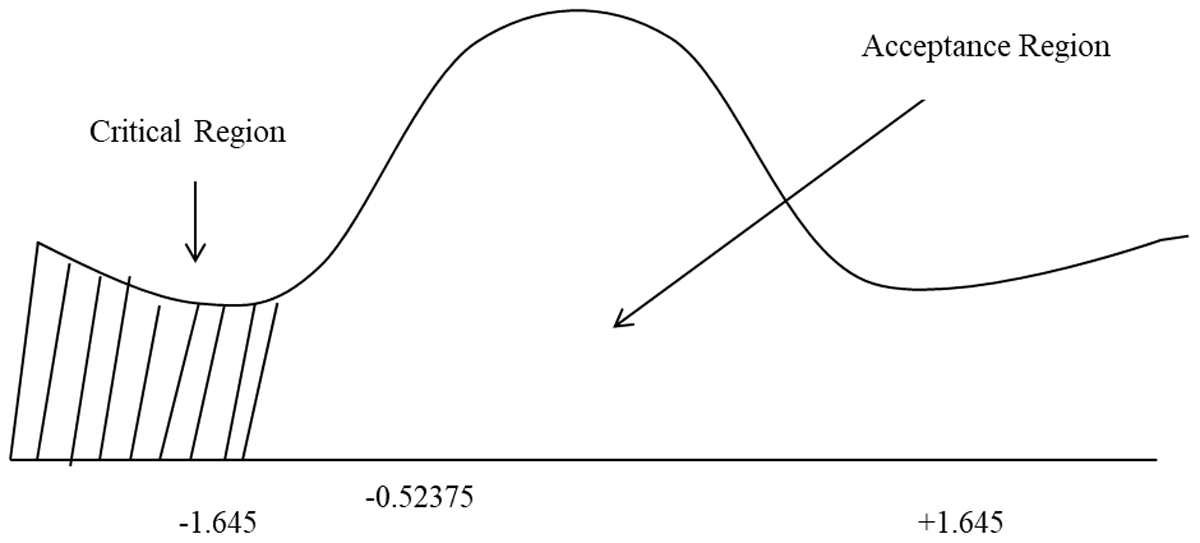
The Z – table indicates a value of 1.645 for a one tail test at 5% level of significance; hence, this figure becomes the mark for determining whether the hypothesis ought to be accepted or rejected. The Z-Score from the result is –0.52375 which is higher than the critical value of –1.645. Consequently, the null hypothesis that the challenges of virtual courts do not impact its acceptability is accepted at 5% level of significance. This means that despite the attendant challenges to VCP in Nigeria, the respondents hold the view that the challenges do not significantly influence the acceptability of VCP in Nigeria at 5% level of significance.
Item 2: Based on the current rules, should I have a court case today, I will like for it to be heard virtually
343 respondents responded to this question on a five (5) point Likert scale with a mean of 3. The null hypothesis is rejected if the weighted mean is less than 3. The hypothesis testing is set out as follows:
Ho: µ = 3
Ha: µ < 3
The result from the survey is reproduced in Table 6 hereunder:
Table 6
Statistical Results for Item 2.
| RESPONSE | WEIGHT (X) | FREQUENCY (F) | FX |
|---|---|---|---|
| Strongly Disagree | 1 | 7 | 7 |
| Disagree | 2 | 38 | 76 |
| Indifferent | 3 | 60 | 180 |
| Agree | 4 | 150 | 600 |
| Strongly Agree | 5 | 88 | 440 |
| Total | 343 | 1303 | |
| Sample mean (∑fx/∑f) | 3.799 | ||
| Standard deviation | 1.01036 | ||
| Z-Tab | 1.645 | ||
| Confidence Level | 95% | ||
| Tail test | One–tail | ||
| Level of significance | 5% | ||
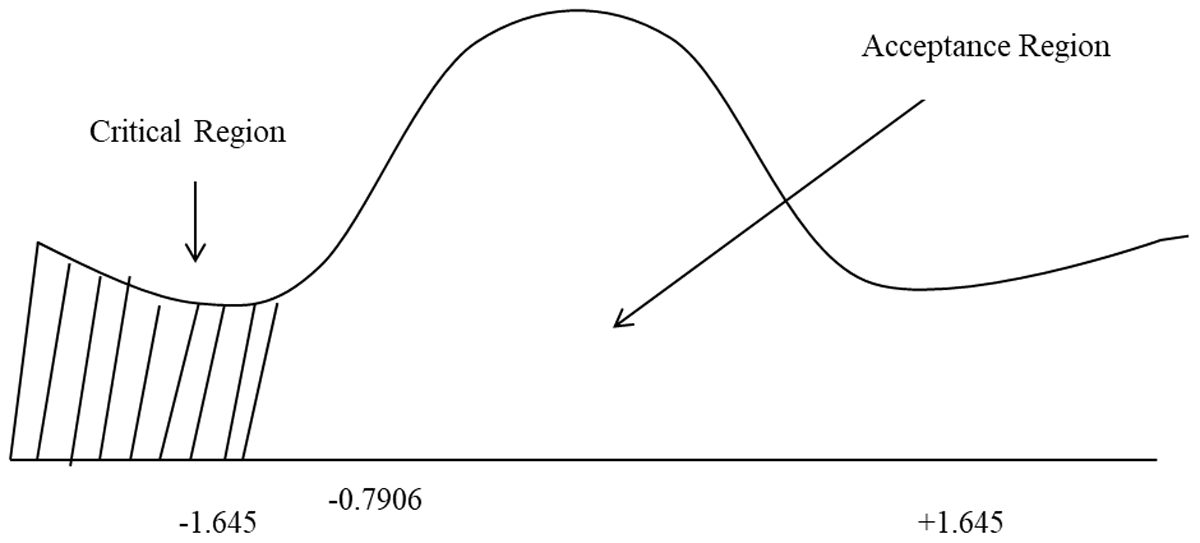
| Z Score | –0.79064 |
Adopting the critical value of 1.645 provided in the Z-table for a one tail test at 5% level of significance, the null hypothesis is expected to be rejected where the Z-score generated from the data is less than –1.645. As observed, the Z-score from the data is –0.79064 which is higher than the –1.645 threshold. The Z-score, therefore, falls within the acceptance region. Consequently, the statistical conclusion is that the null hypothesis cannot be rejected at 5% level of significance.
Z – Curve for Item 2
The inferences derived from the hypothesis framed is that the respondents recognize the existence of challenges to VCP in Nigeria but the general view is that VCP is still preferred despite the challenges. However, since the Z-Scores are as close as possible to the critical region, it would be beneficial to improve on the prominent challenges to VCP identified by this study, i.e. lack of infrastructure, technophobia, lack of skill and inability to tender documents in order to improve trust in VCP in Nigeria as explained in the Virtual Trust Theory of Virtual Court Proceedings.79
5. Recommendation and conclusion
The study explored the views of legal practitioners on the acceptability of VCP and the nature of challenges encountered in the adoption of VCP in Nigeria. As revealed, the legal practitioners expect increased willingness of parties to accept VCP in Nigeria. There, however, exist a few challenges inhibiting the smooth implementation of VCP, including, but not limited to, the challenge of poor infrastructure, technophobia, constitutionality of VCP, lack of technological skills, challenge of tendering documentary evidence and inability to assess credibility of witnesses. These challenges align with those already identified in literature but the study reveals that legal practitioners do not expect that these challenges should inhibit its implementation. Furthermore, legal practitioners consider that lack of infrastructure, technophobia, lack of technological skills and inability to tender documentary evidence are the top four challenges of VCP to be addressed in Nigeria.
To address the infrastructural challenge, investment would be required to improve basic infrastructure to aid the use of VCP. Such infrastructure should include the deployment of fit for purpose audio-visual equipment for court proceedings and improvement of internet connectivity and electrical power. Investment in training by the Judiciary and the Nigerian Bar Association (NBA) is equally necessary to improve skill and limit technophobia. There is a need to align the legal framework for VCP with that of the physical court, particularly in respect of the admissibility of documents. Although the legal practitioners surveyed were positive about the constitutionality of VCP, it is necessary to proceed with the proposed constitutional amendment with a view to laying the matter to rest. Although in the view of the respondents, the challenges of VCP may not influence the decisions to use VCP in the immediate, the challenges should not be ignored either so as not to foist a decline in preference for VCP as was threatened in a recent protest in Enugu State, Nigeria over unavailability of required infrastructure in courts in the State.80 More sensitization is required to promote the adoption of VCP in Nigeria.
Notes
[1] B. Simpson, Algorithms or advocacy: does the legal profession have a future in a digital world? Information & Communications Technology Law 25(1) p. 50.
[2] I. Rodgers, J. Armour, and M. Sako, How Technology Is (or Is Not) Transforming Law Firms, Annual Review of Law and Social Science pp. 299–317; J. Donoghue, The rise of digital justice: courtroom technology, public participation and access to justice, The Modern Law Review 80(6) p. 995.
[3] K. Puddister and T. Small, Trial by zoom: Response to Covid – 19 by Canada’s court, 53 Canadian Journal of Political Science 53 pp. 373–377; A. Bannon and K. Douglas, Remote Court: Principles For Virtual Proceedings During The Covid-19 Pandemic and Beyond, Northwestern University Law Review 115 (6) p. 1875; A. Sanders, Video hearing in Europe Before, During and After the Covid -19 Pandemic, International Journal for Court Administration 12(2) pp. 1–21. The period revived the calls for virtual court proceedings to manage the seemingly disrupted court activities.
[4] See Practice Direction for Remote Hearing of Cases in the Lagos State Judiciary 2020, High Court of the Federal Capital Territory, Abuja Covid – 19 Practice Direction 2020, Federal High Court of Nigeria Practice Direction for Sitting During Covid – 19 Period 2020, National Industrial Court of Nigeria Practice Direction and Guidelines for Court Sitting 2020.
[5] See Hon Dr Justice I.T Muhammad, ‘Preventive Measures On The Spread Of Corona Virus (Covid-19) And The Protection Of Justices, Judges And Staff Of Courts’ National Judicial Council (6 April 2020) <https://njc.gov.ng/26/news-details> [accessed 4 April 2024].
[6] A. M. Chinyere and W. E. Onyedi, The Constitutionality Conundrum on Virtual Court Sittings in the Covid-19 Period in Nigeria, African Journal of International and Comparative Law 31(3) pp. 377–395; P. Aneke, The legality of virtual court hearing in Nigeria: The way forward Madonna University Faculty of Law Law Journal pp. 56–61; E. Emudainohwo, Appraising The Constitutionality of Virtual Court Hearings In The National Industrial Court Of Nigeria, Nnamdi Azikwe University Journal of International Law and Jurisprudence 12(1), pp. 16–24; N. R. Oji, Virtual/Remote Hearing: The Impact of Covid-19 Pandemic on the Justice Sector in Nigeria, IMT International Journal Of The Arts And Sciences 3(4) pp. 1–16; A. Sunday – Ayerun, E. Herbert and N. Ole, Covid 19 Induced Virtual Court Sessions in Nigeria: Practicalities and Impracticalities, Padjadjaran Journal of Law 9 pp. 276–295; O. Olugasa and A. Davies, Remote Court Proceedings: Justice Online or Justice on the line International Journal for Court Administration 13(2) p. 6; A. Davies and O. Olugasa, Advancing Remote Court Proceedings in Nigeria: Lessons from other jurisdiction, Current Trends in Humanities and Law Research 1(2) pp. 1–22.
[7] Attorney General of Lagos State v. Attorney General of the Federation and Anor, (Suit No. SC/CV/260/2020, unreported) Supreme Court of Nigeria per Rhodes Vivour JSC.
[8] Attorney General of Ekiti State v Attorney General of the Federation (Suit No SC/CV/261/2020, unreported) Supreme Court per Rhodes Vivour JSC.
[9] O. Felix, ‘Supreme Court Dismisses Suits against virtual hearing’ Business Day (14 July 2020) <https://businessday.ng/news/article/supreme-court-dismisses-suits-against-virtual-hearing/> [accessed 10 April 2024].
[10] M. Oladeji, ‘Bill for virtual court hearing fails at Senate’ Ripples Nigeria (1 March 2022) <https://www.ripplesnigeria.com/bill-for-virtual-court-hearings-fails-at-senate/> [accessed 10 April 2024].
[11] O. Olugasa and A. Davies, Remote Court Proceedings: Justice Online or Justice on the line International Journal for Court Administration 13(2).
[12] U. Chioma, ‘ECNBA publishes eligible voters for NBA 2022 elections’ The Nigerian Lawyer (1 June 2022) <https://thenigerialawyer.com/download-ecnba-publishes-eligible-voters-list-for-nba-2022-elections/> [accessed 10 April 2024].
[13] The United Nations on Crime and Drugs, ‘Assessment of Justice System Integrity and Capacity in three Nigerian States: Technical Research Report’ UNODC (May 2004) <https://www.unodc.org/pdf/crime/corruption/corruption_nigeria_justice_sector_assessment_2004–05.pdf> [accessed 4 April 2024].
[16] M. Rossner, D. Tait and M. McCurdy, Justice Reimagined: Challenges and opportunities with implementing virtual courts, Current Issues in Criminal Justice 33(1) p. 96, L. Bennett Moses, Artificial Intelligence in the Courts, Legal Academia and Legal Practice Australian Law Journal 91(7) 7 p. 561; Legg and A. Song, The Courts, The Remote Hearing and the Pandemic: From Action to Reflection University of New South Wales (UNSW) Law Journal 44(1) p. 130.
[19] See Order 6A Rule 3–8 of the High Court of River State Practice Direction No. 1 of 2019, National Industrial Court (Civil Procedure Rules) 2017.
[20] See Practice Direction for Remote Hearing of Cases in the Lagos State Judiciary 2020; High Court of the Federal Capital Territory, Abuja Covid-19 Practice Direction 2020; Federal High Court of Nigeria Practice Direction for Sitting During Covid – 19 Period 2020; National Industrial Court of Nigeria Practice Direction and Guidelines for Court Sitting 2020.
[21] Section 153 of the Evidence Act of Nigeria 2011.
[26] Section 12(2) Administration of Criminal Justice (Amendment) Law of Lagos State 2021.
[27] Section 1–10, Evidence (Amendment) Act of Nigeria 2023.
[30] T. Soniyi, ‘Judges oppose virtual court sittings, says it’s unconstitutional’ This Day (2020) <https://www.thisdaylive.com/index.php/2020/05/17/judges-oppose-virtual-court-sitting-say-its-unconstitutional> [accessed 11 April 2024].
[32] See Section 36 of the Constitution of the Federal Republic of Nigeria, N. Oji, Virtual/Remote Hearing: The Impact of Covid – 19 Pandemic on the Justice Sector in Nigeria Institute of Management and Technology Enugu, International Journal Of The Arts And Sciences 3(4) pp. 4–6.
[36] National Industrial Court of Nigeria (NICN) Practice Direction and Guidelines for Court Sitting 2020.
[38] Evidence Act 2011, supra note 21, Section 90(1)(c) provides that a certified true copy of public documents is the only acceptable form of secondary evidence and a copy of such certified true copy is not admissible in evidence. See Minster of Lands v. Azikwe (1969) 1 All NLR 49, Omisore V. Aregbesola (2015) 15 NWLR (Pt. 1482) 205 at 333.
[41] See R. Suskind ‘Remote Court Worldwide’ Law Tech UK <https://remotecourts.org/> [accessed 10 April 2024].
[49] Federal Court of Australia, National Practitioners/Litigants Guide to Online Hearing and Microsoft Teams <https://www.fedcourt.gov.au/online-services/online-hearings/National-Practitioners-and-Litigants-Guide-V5.pd> [accessed 10 April 2024], Article 2.5.
[50] Allsop J.LB, Technology and the Court Practice Note (GPN – TECH) 25 October 2016, Art. 4.5.
[51] Australia Commonwealth Consolidated Regulation ‘Australia Federal Court Rules 2011’ Division 6.2 <https://www8.austlii.edu.au/cgi-bin/viewdb/au/legis/cth/consol_reg/fcr2011186/> [accessed 6 July 2024].
[53] United Kingdom Covid 19: National Guidance for the Family Court 2020, Section 4 Remote Access to Court Protection Guidance 2020, Section 2; United Kingdom Ministry of Justice, Practice Direction 51Y – Video or Audio Hearing During Coronavirus Pandemic, (24 March 2022) <https://www.justice.gov.uk/courts/procedure-rules/civil/rules/part51/practice-direction-51y-video-or-audio-hearings-during-coronavirus-pandemic#:~:text=85A%20of%20the%20Courts%20Act,the%20consent%20of%20the%20court.> [accessed 12 April 2024].
[55] Remote Access to Court Protection Guidance 2020, supra note 53, Section 83.
[56] United Kingdom Covid 19: National Guidance for the Family Court 2020, Section 15, 17.
[57] Remote Access to Court Protection Guidance 2020, supra note 53.
[58] David Maraga, ‘Practice Direction on Electronic Case Management’ (Kenya, 4 March 2020), Section 4, <http://kenyalaw.org/kl/index.php?id=10211> accessed 6 July 2024.
[60] Ibid; HT v The Queen (2019) 93 ALJR 1307.
[61] N. Blake, ‘Understanding Courts : A report by justice’ (Justice Research Report, London 2019) 54 <https://files.justice.org.uk/wp-content/uploads/2019/01/06170235/Understanding-Courts.pdf> [accessed 10 April 2024].
[62] D. Tait and V. Tay, Virtual Court Study: Report of a Pilot Test 2018 (Research Report, Western Sydney University, 16 October 2019) (Virtual Court Study) 30, Legg and Song, supra note 16, p. 137.
[63] J. I. Turner, Remote Criminal Justice, Tex. Tech Law Review 53 p. 23.
[72] E. Bild, A. Redman, E. J. Newman, B. R. Muir, D. Tait and N. Schwarz, Sound and credibility in the virtual court: Low audio quality leads to less favorable evaluations of witnesses and lower weighting of evidence, Law and Human Behavior 45(5) pp. 481–495.
[73] I. Ige, ‘How judges, lawyers, plotted ‘coup’ against virtual court system in Nigeria’ <https://www.vanguardngr.com/2023/04/how-judges-lawyers-plotted-coup-against-virtual-court-system-in-nigeria-2/> accessed 6 July 2024.
[75] T. Ajaja, ‘92 million Nigerians lack access to electricity, worst globally – Report’ Punch (5 June 2022) <https://punchng.com/92-million-nigerians-lack-access-to-electricity-worst-globally-report/#:~:text=Nigeria%20has%20the%20lowest%20access,Tracking%20SDG%207%2C%20has%20revealed> [accessed 27 June 2023].
[76] A. Ejekwonyilo, ‘Strike: Why full virtual hearing is difficult for Federal High Court – Official’ Premium Times (19 May 2021) <https://www.premiumtimesng.com/news/top-news/462512-exclusive-strike-why-full-virtual-hearing-is-difficult-for-federal-high-court-official.html> [accessed 27 June 2023].
[77] U. Chioma, ‘Enugu Lawyers Protest Continuation Of Virtual Court Proceedings As NBA Branches Shut Down Courts Due To Judges’ Refusal To Sit Physically’ The Nigerian Lawyer (23 January 2024) <https://thenigerialawyer.com/enugu-lawyers-protest-continuation-of-virtual-court-proceedings-as-nba-branches-shut-down-courts-due-tojudges-refusal-to-sit-physically/> [accessed 25 January 2024].
[78] This is calculated by the addition of the five point Likert scale (i.e. the addition of figure 1, 2, 3, 4, 5 = 15) and dividing the result by the scale of 5. The mean of the ordinal scale is 3.
[79] A. Davies, ‘Developing a sustainable legal framework for virtual court proceedings in Nigeria’ (2024) Babcock University Thesis, pp. 146–149.
Competing Interests
The authors have no competing interests to declare.
Author Information
Abimbola Davies: Areas of specialization are law and technology, globalization, access to justice and digital sustainability.
Olubukola Olugasa: Areas of specialization are law and technology, globalization, equity and diversity in law through indigenous legal regimes.
Dorcas A. Odunaike: Areas of specialization are commercial law, law and technology, intellectual property law and family law.