
Introduction
The automation of different parts of the judicial process has been gaining the interest of researchers and lawmakers for quite some time.1 There are increasing attempts to automate either the initial or the final phases of the judicial process, such as creating programs that assist courts in assigning cases to panels2 or suggesting appropriate sentences in criminal cases.3 In all of these instances, there is an interaction between humans and machines (e.g., a judge, other court actors, and a software program), resulting in a human-machine cohabitation in the legal system. This cohabitation is referred to as ‘anthrobotic’, a concept which represents the intertwined process of humanity and technology.4
This essay does not delve into the challenges associated with the automation of judicial decision-making and judicial reasoning, a subject that has also received considerable scholarly attention.5 Instead, aims to introduce a theoretical foundation for a socially and philosophically healthy automation of court processes.6
Historically, courts and the judicial system have relied on a strong set of rules and procedures, and this should be considered when optimizing the automation of their processes. Human-machine interactions can take on diverse forms, depending on the setting and environment in which they occur. A universally applicable or normative approach to their design is not feasible. This implies that the automation of legal processes should be tailored to fit the specific legal traditions or group values in which they are developed and implemented.
Building on the work of de Miranda et al, who advocate for the development of more pluralistic social robotics,7 we propose to extend their anthrobotic conceptual framework to the specific context of the judicial system. They claim that artificial cognitive systems should be designed with an awareness of the type of groups they are meant to serve beyond each individual.8 We examine how this framework can be applied to courts in the two major branches of Western legal tradition: civil law and common law. While our analysis inevitably involves generalizations and simplifications, we believe these are valuable tools for understanding and addressing the challenges of designing socially and ethically sound automation of court processes.9
Human Forms of Interaction and the Design of Anthrobotic Systems
An anthrobotic system, or simply ‘anthrobot,’ is a hybrid artificial-natural-human collective unit that transcends the digital realm.10 Anthrobots have existed long before the advent of computers, as de Miranda, Ramamoorthy, and Rovatsos eloquently argue in their essay. They posit that humans have always been anthrobots, ‘unceasingly striving towards social automation, functionality, and the organization and codification of the real.’11 Institutions, themselves collective anthrobots, serve as ‘coordination artifacts’ that demonstrate the inherent human desire for collective organization.12
The authors explore the potential for drawing upon the decisional and value-based intelligence that governs human-human interactions to inform the design of human-machine interactions within digital anthrobots.13 They propose that institutions provide valuable insights into the social protocols that have shaped anthrobotic systems for centuries. These protocols, when applied to the design of digital anthrobots, can lead to the creation of systems that are both socially and philosophically healthy. Socially healthy anthrobots, according to the authors, are those that are deeply embedded in society and operate in harmony with democratic values.14 Philosophically healthy anthrobots, on the other hand, possess a clear sense of purpose and act in a manner consistent with that purpose.
de Miranda et al. advocate for a lucid understanding of a group’s dominant esprit de corps, which is the internal mode of belonging, commitment, and loyalty within that group.15 When co-designing an anthrobotic system, they suggest that the designers should consider the group’s core values and how they can evolve or find a democratically acceptable balance within a pluralistic society. 16 This approach makes use the notion of esprit de corps, extensively studied by de Miranda in his book Ensemblance: The Transnational Genealogy of Esprit de Corps.17 Esprit de corps can be roughly translated as collective organizational bonding,18 but a more accurate definition is a form of cognitive uniformity generated by a more or less conscious adherence to a collective body.19 Through an in-depth historical comparison of esprit de corps discourses in French, English, and American modern intellectual and political thought, de Miranda identifies four scales or types of esprit de corps that are typical of Western modernity: conformative, universalist, autonomist, and creative.20 These typologies correspond to the four core values of duty, service, skill, and enthusiasm.21 However, rather than being rigid categories, these four types should be viewed as dynamic and interwoven processes.22 Although theoretically a group may be dominated by one of these value dimensions, in practice we are more likely to encounter a mix of creative, conformist, autonomist, and universalist esprit de corps, as illustrated by the example of courts.23
de Miranda et al posit that the expanding realm of digital architectures encompasses a continuous process of co-creation between humans and learning machines.24 They envisage these human-robot (or anthrobotic) systems as a ‘collective Janus-faced, coordinated, and dynamic reality,’25 seamlessly intertwining human and machine elements. They perceive human-machine relationships as anthrobotic units, where robotic and human collective flows converge.26 Notably, they emphasize that the distinctions between the robotic and human components of an anthrobotic unit are not as stark as might initially appear. On the one hand, individuals tend to operate on autopilot or default mode,27 relying on well-established routines, essentially becoming ‘automated’ participants within structured groups and institutional frameworks.28 On the other hand, learning machines are evolving to become less predictable and more adaptable, approaching the capabilities of biological neural networks and the plasticity of the brain, albeit not perfectly replicating them.29 This convergence of human automation and machine flexibility poses a challenge, but also opens opportunities, in predicting and designing the behaviour of anthrobotic systems as a whole.30 In the following sections, we aim to expand upon this conceptual framework by examining its implications for the judicial system and its participants, including judges.
Courts and the Four Types of Esprit de Corps
Courts undoubtedly embody esprit de corps, exhibiting a distinct collective agency and identity. Judges within a court system typically hold their positions for lengthy periods, if not for life, fostering a sense of permanence and shared purpose. Their educational background is remarkably uniform, with all judges having received specialized legal training in certain law schools. Across legal systems, judges undergo rigorous examinations to gain admission to the bar and subsequently the judiciary (in common law countries) or directly to the judiciary upon graduation from law school (in civil law countries). This shared educational foundation instills a common language that is only fully comprehended within the legal sphere. As a result of this shared background, judges develop a similar approach to legal reasoning, often referred to as ‘legal thinking.’ While individual judges within lower courts typically make decisions independently, they still operate within a collaborative environment, adhering to established procedures and basing their decisions upon the same legal principles and similar modes of thinking. Furthermore, judges tend to closely follow the rulings of their predecessors and peers, striving to maintain coherence and consistency across judgments rendered by different judges within the same legal system.31 In the common law tradition, this adherence to precedent is even formally mandated.32
Courts are not immune to technological advancements, often incorporating automation or digitization into their proceedings. When this occurs, a convergence of human and algorithmic components emerges. The human component of courts comprises professional judges, clerks, and administrative staff, and in some jurisdictions, juries, or lay judges.33 When discharging their primary function of administering justice and resolving disputes, courts also engage other human actors, such as prosecutors, legal representatives of the parties involved, and the parties themselves. These participants are not permanent fixtures within the court system, hence their contribution to its esprit de corps is less pronounced, though they may reinforce existing norms by adhering to them. The algorithmic component typically encompasses search engines, databases, and may even extend to automated drafting of simpler decisions and automated sentencing.34 In appellate courts, case selection (when permitted) and case assignment (to judicial panels and single-judge rapporteurs) may be partially automated,35 although advanced artificial intelligence (AI) processing is not yet employed for these tasks.36
de Miranda et al provide examples of all four types of esprit de corps, but it has not been applied to the justice system or courts. To determine the type of esprit de corps that courts belong to, we must first examine the distinguishing characteristics of each type, which are summarized in Figure 1 and elaborated upon in subsequent pages.
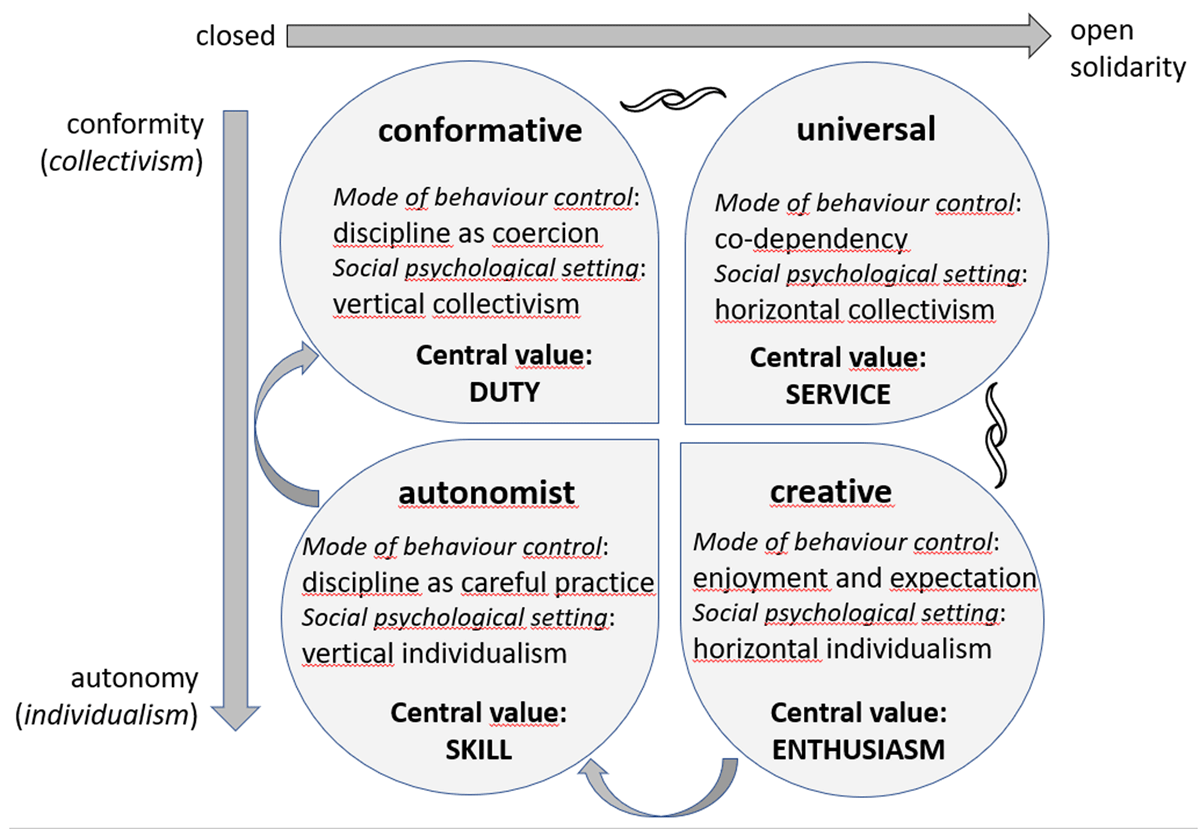
Figure 1
The four types of esprit de corps.
At first glance, the conformative type seems to be the most fitting description of court esprit de corps. Conformative collectives exhibit a strong adherence to group norms and a sense of solidarity among members.37 Becoming a part of the in-group is a selective process that requires significant investment, as evidenced by the lengthy educational process and rigorous examinations that are required to become a professional judge.38 Another hallmark of conformative esprit de corps, which is clearly evident in courts, is the prevalence of strict adherence to group values. The central value – or one of the most important values – is a commitment to duty, whether it is to the judicial system as a whole or to the ideal of justice itself. Courts are obligated to render a decision in every case, even if the matter at hand is complex and challenging.39 Hierarchism, or vertical collectivism in social psychological terms,40 is another defining characteristic of conformative groups,41 and it is readily apparent within the court system. This hierarchy is evident in both the appeal system – where courts are arranged in a hierarchical structure – and in the relationships between the key actors involved in legal proceedings, with the judge occupying a position of superior authority.
de Miranda et al provide the example of a religiously grounded community to illustrate the conformative type of esprit de corps. While modern Western courts are established as secular institutions, devoid of religious values and spiritual discourse, their operational modalities bear resemblance to certain characteristics of a religious community. Decision-making in courts is predicated upon sustained moral and cultural conformity, as judges are bound by the law, which itself is partially rooted in moral and cultural norms. The law can be likened to a system of commandments. However, in today’s multicultural societies, the need to accommodate diverse cultural values necessitates a shift away from strict moral and cultural conformity.42 Can the ideal of courts, which is commonly perceived by the public as justice,43 be regarded as transcendent in the same manner as God is? Legal scholars lack a unified understanding of this ideal; some contend that it is simply internal conformity to legal texts and their spirit.44 While this latter view is logically problematic due to its self-referential nature, its validity would only strengthen the argument that courts exhibit a conformative spirit, where the literal interpretation of the law is elevated to a near-sacred status.
The conformative type of esprit de corps seems to characterize common law and civil law courts to a similar degree. Despite differences in the process of joining and leaving the group, i.e., how individuals become judges and how judges can be removed from office, it is universally a demanding and formative procedure that molds the way judges think. The extent to which judges and lawyers from each legal tradition adhere to the strict ethos of the group remains a subject of debate. On one hand, common law judges are, at least formally, more firmly bound by precedents than their civil law counterparts, although in practice the difference is not that substantial.45 Conversely, in the common law tradition, judicial decisions are perceived as ‘opinions,’ which are largely based on the individual judge’s wisdom and experience. This differs from the civil tradition, which contends that judges are merely the ‘voice of the law’ (la bouche de la loi, in Montesquieu’s words)46 – meaning that the legislature, not the judge, expresses itself and unveils a latent philosophy of justice through the judgment.47 As a result of this meta-subjective approach, separate opinions are not permitted in cases where decisions are made by a panel of judges. The judicial panel must speak with one voice. In fact, even in those rare civil law courts where dissenting opinions are allowed (typically constitutional courts), judges are accustomed to seeking consensus and uphold the principle of collegiality.48 From this vantage point, we can discern a stronger adherence to the group’s strict ethos in civil law courts compared to their common law counterparts, where judges exhibit less self-restraint. In conclusion, while it is challenging to precisely quantify the extent to which the conformative esprit de corps prevails in either legal tradition, we can confidently assert that courts embody conformative esprit de corps, evident in their unwavering adherence to the letter of the law and strict internal protocols.
Yet, when examining the decision-making processes within courts, elements of the universalist esprit de corps also emerge. This relatively open group operates under a system of co-dependency, where individuals rely on each other’s expertise due to the division of labour. 49 This is particularly evident in higher courts, where judicial panels collectively determine outcomes on individual cases. In these panels, judges typically cast votes, each carrying equal weight, mirroring the horizontal collectivism that characterizes the universalist esprit de corps.50 de Miranda et al posit that this esprit de corps manifests itself in collective decision-making through co-created standardized protocols, a hallmark of nation-states and modern democracies since the late 18th century.51
However, the extent to which courts actively participate in the co-creation of standardized protocols, namely procedural rules, varies depending on the legal tradition. While courts in the common law tradition have historically enjoyed rule-making powers, setting their own procedural rules,52 and continue to play an active role in their development,53 courts in the civil law tradition have been subject to the sole authority of the legislature in establishing binding procedural rules since the establishment of royal courts in the late Middle Ages.54 As a result, we propose that the universalist element is more pronounced in common law courts compared to their civil law counterparts, despite its presence in both. This is primarily due to the rule of law, a cornerstone of the democratic ethos that broadly promotes human rights and equitable access to justice for all citizens.
The autonomous spirit of the judiciary is evident in the way courts operate. This insular camaraderie fosters a culture of practical and intellectual independence, upholding the ideal of judicial autonomy that is fundamental to democratic societies. Although there may be doubts about the complete autonomy of judges and lawyers, their integration into society does not diminish their dedication to their profession. Rather, it reinforces the notion that justice is a collective endeavour that relies on the expertise and distinction of those who uphold the law.55 Judges and lawyers wield the power of legal knowledge and experience as their primary instrument. They painstakingly follow the established practice of precedents, which is particularly evident in the common law tradition. In this tradition, judges are legally bound to uphold the binding force of precedents, as mentioned above. Legal counsels (attorneys) and public prosecutors also form their own professional groups, akin to guilds.
The social psychological underpinning of an autonomist esprit de corps is vertical individualism, a mindset that embraces a certain level of inequality between individuals based on the advancement of their skills and the notion of collective progress through individual development.56 The court system also exemplifies vertical individualism by promoting individual improvement and advancements through a mix of seniority and merits. The hierarchical structure of the justice system highlights the profession’s commitment to excellence and growth.57 For an illustration of the hierarchical structure of courts systems see the Swedish example in Figure 2.
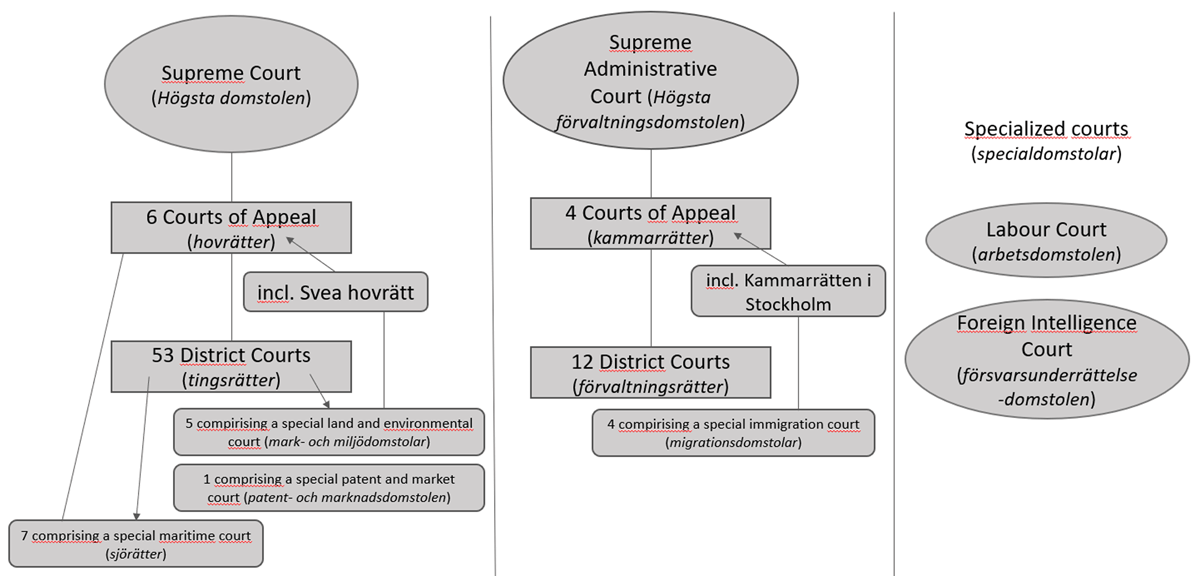
Figure 2
The triple hierarchical structure of courts in Sweden.
The public prosecutor’s office also exhibits a hierarchical structure, albeit one based on a functional division between regional and national authorities. Across the Western legal tradition, the judiciary’s organization embraces a certain degree of inequality among individual judges, acknowledging the progression of skills. The efficiency of judges and the quality of their decisions serve as proxies for evaluating their skills, measured by the number of cases resolved annually and the reversal rate on appeal.
The collective improvement of the legal system through the development of individual expertise is evident in the operation of courts. Case law, a foundational source of legal authority, is meticulously crafted through judgments in specific cases. This practice has a long and established tradition in the common law system, but even civil law systems now place significant weight on case law as a source of law, as discussed previously. Finally, de Miranda claims that an autonomist esprit de corps tends over time to become conformative,58 which also fits well the history of courts.59
The fourth collective bond fits courts the less. de Miranda qualifies this fourth type as ‘creative esprit de corps’.60 Despite the inherent creative demands of resolving legal disputes, courts exhibit a limited inclination towards the open interactions that de Miranda’s theory identifies as a hallmark of this type of group. The primary relational dynamic of a creative esprit de corps is characterized by elan and enthusiasm, guided by a mode of control that fosters enjoyment and expectation. This social psychological setting is rooted in horizontal individualism, where individuals strive for distinctiveness and self-reliance.61 This does not seem to fit well with most judges’ sober attitude but may characterise law firms and therefore the legal counsels participating in the judicial process. de Miranda claims that the creative esprit de corps is often – but not always – related to smaller or emerging groups,62 for example start-ups or newly founded research clusters.63 While juries and law firms may embody this category, professional judges do not. Juries are not a permanent fixture in courts, and not all procedural systems employ them. Rarely are juries required for all types of cases.64
The prevalence of horizontal individualism, a hallmark of a creative esprit de corps, is more pronounced in common law systems, particularly historical ones. Judges in such systems independently crafted their opinions, with the final judgment emerging as a compilation of individual perspectives rather than a collective consensus. Judges, the cornerstones of the common law tradition, often asserted their distinctiveness through the delivery of forceful dissenting opinions. This creative aspect is also fuelled by the nature of common law trials: a single, focused event, often rife with unexpected twists and turns. In contrast, civil law systems employ a sequence of isolated meetings and written exchanges between legal counsel and the judge, effectively minimizing the element of surprise.65 Additionally, although some civil law courts permit the publication of dissenting opinions, there remains a significant inclination towards conformity and consensus.66
As mentioned earlier, the division in four types should be read as dynamic rather than rigid.67 We are more likely to find, in practice, intertwined examples of creative, conformative, autonomist and universalist esprit de corps,68 and the example of courts illustrates this point perfectly. de Miranda et al. claim for example that a universalistic esprit de corps, the one that is characteristic of democracies, constantly oscillates between conformative and creative tendencies.69 While decision-making panels operate with a clear emphasis on universality (equal weight for judges’ and lay members’ opinions, majority rule), they also exhibit certain creative elements. While routine cases may appear mechanical, unprecedented, or complex cases (often referred to as ‘hard cases’)70 necessitate creativity in interpreting and applying the law. The heart of the judicial deliberation process, where panel members engage in discussions to arrive at a decision, reveals a tendency towards open interactions and individual perspectives, hallmarks of a creative esprit de corps. However, these open interactions and individual perspectives remain shielded from public scrutiny, confined within the confines of closed-door discussions.
Concluding, courts in the civil law tradition exhibit a pronounced conformative esprit de corps, interwoven with strong universalist and autonomist elements. Judges in this legal system embrace their role as public servants, diligently applying the law to concrete cases, their private opinions veiled in deference to the authority of the law. Career judges embark on their judicial journey at an early age, ascending from lower courts to appellate chambers, often pursuing the judicial profession until their retirement. While they retain the option of dissenting opinions in higher courts, they tend to exercise this right with greater restraint than their common law counterparts. In contrast, common law courts exhibit a more nuanced and balanced blend of the characteristics of all four esprit de corps types. Common law judges do not follow a traditional career path, often entering the judiciary after establishing themselves as accomplished lawyers in other legal fields. This diverse professional background contributes to a less homogeneous judicial body, fostering a spirit of individualism and a greater inclination towards dissenting opinions.
The legal landscape in the two main legal traditions of the Western world also exhibits distinct characteristics when examining other legal actors involved in the judicial process, such as barristers and prosecutors. In common law jurisdictions, the legal profession is perceived as a unified entity, with individuals seamlessly transitioning between various branches of the profession.71 A barrister might ascend to the bench, a government lawyer might continue as a barrister, and so on. Conversely, the civil law tradition presents a diverse spectrum of distinct legal careers, limiting the flexibility of a young lawyer’s initial choice. Changing from one branch to another is challenging and infrequent.72 This further reinforces our observation that civil law courts exhibit a stronger conformative element and less openness. Furthermore, viewing courts as esprit de corps aligns with de Miranda’s assertion that the classification into four types should be interpreted as dynamic.73
Pluralism by Design in the Digitalization and Automation of Courts
The typology of esprit de corps could help us to introduce more pluralism into our perception and management of human ensembles, and that such a perspective will be ‘especially important if digital automation reaches a ubiquitous momentum, redefining our identities and modes of belonging in the context of techno-social systems’.74 Anthrobotic systems should be designed with an awareness of the type of groups they are meant to serve.75 In the context of digitalization and automation in courts, the principal challenge stems from the intricate nature of this environment and the strong sense of belonging fostered by judges and other procedural actors, collectively known as esprit de corps. Courts represent a dynamic ecosystem, where a multitude of individuals beyond judges play a crucial role in resolving legal disputes. These include parties, their legal representatives, and, on occasion, experts, witnesses, and juries. These intricate settings vary significantly across different legal systems, even within the same legal tradition. This variability further reinforces our initial hypothesis that there exists no singular, universally applicable approach to automating court proceedings.
Recent research identified and ranked many critical success factors for a digital court, claiming that paying attention only to technological factors does not necessarily lead to the efficiency and effectiveness of this kind of court.76 It found that accessibility to the system was the absolute most important critical success factor, followed by user satisfaction and information security.
Implementing these distinctions into digital coding is a crucial challenge that anthrobotics, if it becomes an interdisciplinary field, should address in the future. Human Value Informatics, also known as social informatics, offers valuable insights into this endeavour. Since the late 1970s, this field has delved into the fundamental role of values (such as privacy, reliability, and security) in artificial systems, revealing how designers often implicitly incorporate prevailing models of systems architecture into their designs.77 Friedman and Kahn developed the field of Value Sensitive Design since the late 1980s, an approach to the implementation of technologies that accounts for human values throughout the design process.78 More recent studies in law, AI ethics and AI humanities have also taken up the challenge.79 It is important to be conscious of the values that are implemented, as there is a difference between embedding moral reasoning within computational engines with or without being conscious of it. The risk is to induce practices or reactions that do not represent the underlying dynamics or interests of the specific group.80 In other words, there is a danger of introducing external bias in the design process. Machine learning systems that learn from past data are especially vulnerable to this problem and prone to keep old prejudices alive.81
de Miranda et al proposed to ask which type of esprit de corps is meant to be served primarily by a given anthrobotic system.82 We agreed here that the most dominant esprit de corps of courts is the conformative type. We also determined that this principle applies regardless of the legal tradition within which the court functions, while the implementation of the other three esprit de corps types exhibits greater variation. For groups characterized by strong conformity and enclosed solidarity, robotic systems should be designed with enhanced robustness, limited evolutionary capacities, and protection from external influences. In contrast, these systems should incorporate a regular self-criticism protocol into their anthrobotic framework to safeguard against groupthink, abuse, injustice, and—over time—self-destruction.83
Courts use two modes of intelligence, analytic and dialectic, the articulation of which needs to be creative and contains fuzzy boarders.84 Analytics is the dominant approach to intelligence in our digitalized societies, because it is more easily decomposed and mathematised into sets of operations. It seems to be the most compatible approach with evidence-based decision-making, which is needed in courts.85 When examining judges from a comparative standpoint, it becomes evident that this need is particularly acute in civil law jurisdictions, where, as we have observed, judges aspire to be perceived as dispassionate analytical machines.86
However, our cognition is not only analytic but also creative:87 our consciousness produces meanings that supersede the sum of the observed parts.88 Analytical intelligence alone cannot decipher the ‘random noise of data’ because it requires interpretation.89 And interpretation requires an observer- or subject-dependent perspective.90 Pure analysis cannot provide meaning, nor synthetic unification.91 When interpretation is required, it opens the possibility for disagreement. And disagreement adds a dialectical dimension to intelligence. Dialectics may be defined as ‘the progression of thought through the appearance of oppositions within one and the same unity’.92 Dialectics do not necessarily need two different agents but may also be performed within the same personal mind, for example in the mind of the judge or the lawyer examining opposing views.93 At the same time, the dialectic stage of understanding is necessary to ‘transform a reading of signs into a deliberative interpretation that encompasses real or apparent contradictions’.94 The dialectic mode of intelligence is made more visible in the judicial decisions of the common law tradition, where judges do not hide behind anonymity and usually do not conceal disagreement.95 Dialectics find tangible expression in judicial opinions, where judges engage in a dynamic exchange of ideas, openly debating the merits and demerits of various perspectives and often arriving at divergent conclusions. The common law jurisdictions’ judicial process is inherently dialectical, strengthened by the adversarial procedural model where two opposing parties actively participate and vigorously cross-examine witnesses. In contrast, judgments rendered under the civil law tradition often project an aura of solely analytic reasoning, concealing the inherent tensions and disagreements that may arise during the decision-making process. However, this apparent uniformity masks the underlying dialectical character of civil law courts, where the two adversarial parties play a pivotal role in shaping the issues to be addressed, the evidence to be presented, and the arguments to be considered, 96 while the judge is also an active player in the game.97
The dialectic mode of intelligence, however, is still not sufficient, because it can become an interminable process collapsing into continuous thesis-antithesis dynamics.98 Analytic and dialectic intelligences cannot exhaust our experience of intelligent agency and they do not and should not drive our decisions exclusively.99 In order to avoid dogmatism, groupthink or dialogic indecision or postponing of a synthesis, we need to find a way to inject ‘crealectic’ thinking in the protocols of anthrobotic systems, without jeopardising its robusticity. de Miranda, in his previous works, coined the term ‘crealectic’ to describe ‘the existential form of consciousness that is aware of acting as an engaged person upon a world of multiplicity and possibility’.100 Crealectics is a concept that combines the principles of creativity and dialectics to foster a dynamic and innovative approach to decision-making. It emphasizes the importance of actively engaging with opposing viewpoints, challenging assumptions, and embracing new perspectives to generate fresh solutions and insights. In the context of courts, crealectics can play a crucial role in enhancing the quality of judicial decisions and promoting a more equitable and just legal system.
Non-biological AI cannot replicate crealectic intelligence, as it is rooted in subjective uniqueness, which is the unquantifiable decision-making aspect within us. Crealectic thinking is aware of the influence of the ultimate possible that hides behind each phenomenon, and that we sometimes access consciously, but more often than not unconsciously.101 The person in us is everything that cannot be measured: love, contemplation, hope, the sense of freedom and the sense of the possible, for example. Sublime describes all the phenomena in life that are beyond the regular and predictable patterns, but also that need an aesthetic observer.102 In the judicial system, we would argue, the sublime is absolute justice as an ideal.103 More concretely, Crealectics can encourage judges and legal professionals to embrace diverse viewpoints, including those that may challenge their own preconceived notions. This openness fosters a more comprehensive understanding of the issues at hand and leads to more informed decision-making. Crealectics promotes a spirit of active dialogue and collaboration among judges, lawyers, and other stakeholders involved in the judicial process. This engagement allows for a deeper exploration of arguments, a more rigorous analysis of evidence, and a broader consideration of potential solutions. Crealectics emphasizes the importance of embracing change and adapting to evolving legal landscapes. Judges and legal professionals are encouraged to challenge traditional approaches and explore new methods of resolving disputes, leading to a more dynamic and responsive judicial system.
By incorporating diverse perspectives and actively engaging in dialogue, crealectics can help judges identify and address biases, leading to more fair and impartial decisions. Crealectics encourages judges to critically evaluate arguments and consider multiple perspectives, resulting in more nuanced and well-reasoned decisions. Courts can appoint experts with diverse backgrounds and perspectives to provide specialized knowledge and challenge conventional thinking. Courts can convene panels composed of judges, lawyers, and experts from various fields to foster a broader exchange of ideas. Courts can organize workshops where judges, lawyers and also philosophers of law, actively engage in discussions and debate to refine their understanding of complex legal issues.
Designers of intelligent systems must carefully consider humans’ requirement for a balanced cycle of analytical, dialectical, and crealectic comprehension.104 On top of analytical or dialectical transactions, the crealectical subject is a person aspiring to a meaningful sense of purpose, who cares to take holistic decisions towards a philosophically healthy horizon, the ideal of a healthier and conscientious way of life.105
The most crucial point in the new field of philosophical health,106 of which more below, is the adequation between thoughts and actions, the non-contradiction between our social persona and our private one, and the courage not to dissimulate as well as to thrive towards the integrity of non-contradictory biographies. When considering anthrobotic ensembles, we are concerned here with the health and the holistic optimization of a system, more than its individual parts. Since philosophical health is the adequation to a higher purpose in all we do,107 and since the higher purpose of courts should be, in our view, justice for all, the philosophical health of the judicial system should be that we observe just behaviour at all levels. The ideal of fair behaviour should be adaptable and able to evolve continuously because what is considered just today may not be viewed as just tomorrow.
The public’s trust in courts is an essential component of good governance. Recent empirical evidence suggests that even though court users acknowledge several advantages of algorithms, such as cost and speed, they trust human judges more and are more willing to go to court when a human judge makes the decision.108 Trust for “algorithmic judges” is especially low when the controversy involves emotional complexities compared to cases that are low in complexity or where complexity arises from technical issues.
In one of his recent writings, de Miranda suggested five principles for the cultivation of philosophical health: mental heroism, deep orientation, critical creativity, deep listening, and the ‘Creal’ (the ultimate possibility).109 These five principles could help courts cultivate philosophical health, especially if the time for reflection is liberated by the digitisation of repetitive tasks. Mental heroism, the essence of independent thought and unwavering adherence to a moral compass, is a crucial trait for judges and lawyers. Amidst the complexities of legal proceedings and the allure of groupthink, it takes extraordinary courage to remain steadfast in one’s pursuit of justice, guided by an unwavering commitment to ethical principles rather than the pressures of conformity.110
In 1954, the Supreme Court of the United States ruled in Brown v. Board of Education of Topeka that racial segregation in public schools was unconstitutional.111 This landmark decision overturned the 1896 precedent set in Plessy v. Ferguson,112 which had established the “separate but equal” doctrine. The decision in Brown v. Board of Education was the culmination of years of activism and legal challenges to segregation.113 The Supreme Court justices who ruled in favour of Brown faced enormous pressure from the prevailing social and political norms of the time. Many people believed that segregation was a necessary evil to maintain order and prevent racial violence. Despite these pressures, the Supreme Court justices who ruled in favour of Brown demonstrated extraordinary courage and mental heroism. They stood up for what they believed was right, even though it meant going against the majority opinion. Their decision had a profound impact on American society, leading to the desegregation of schools and other public institutions. Chief Justice Earl Warren, who wrote the opinion of the Court, knew that it would be a controversial decision and that he would face criticism from both sides of the issue. However, he agreed to take the case because he believed that it was the right thing to do.114
Deep orientation serves as the second pillar of philosophical health, representing the unwavering commitment to the pursuit of the highest value – in this context, justice. Just as a ship, even with ample wind, will reach no destination without a guiding compass, so too must individuals maintain a steadfast focus on their core values to navigate the complexities of life’s challenges.
In 1988, the Supreme Court of Canada ruled in R v. Morgentaler that the Criminal Code provision that prohibited abortion, except when necessary to save the life or health of the woman, was unconstitutional.115 This landmark decision legalized abortion in Canada. The decision in R v. Morgentaler was based on the principle of access to medical care. The Court held that women have a right to access safe and legal abortion services, and that the Criminal Code provision was an infringement on that right. The Court also found that the provision was discriminatory, because it disproportionately affected poor women and women who live in rural areas. Although the Court’s decision in R v. Morgentaler was controversial, it can be seen as an example of deep orientation. The Court had a clear understanding of its role in the Canadian legal system, which is to uphold the Charter of Rights and Freedoms. The Court also had a deep understanding of the social and political context of the case, and it carefully considered the impact of the Criminal Code provision on women’s lives.
Critical creativity stands as the third cornerstone of philosophical health. This form of esprit de corps, characterized by personal singularity and a relentless pursuit of meaningful novelty, effectively combats the pitfalls of rigidity, groupthink, and dogmatism. Self-reflection and self-criticism, when coupled with the ability to identify problems and devise innovative solutions, empower individuals to tap into the realm of possibilities and explore unexplored avenues.
Judicial creativity shines through the practice of distinguishing precedent, a technique that may lead to invalidating the application of a precedent due to certain significant differences in either the facts or legal issues. Distinguishing empowers judges to exercise their creative faculties, as they can reconstruct the facts of a case at different levels of abstraction.116 Judges’ critical creativity occasionally leads them to deviate from the court’s conformative spirit, typically manifested through the delivery of separate opinions. A notable example of such divergence is illustrated by Justice Harlan’s dissenting opinion in the aforementioned Plessy v Ferguson case,117 subsequently overruled by the US Supreme Court in Brown v Board of Education. In Plessy, the Court upheld the constitutionality of racial segregation in public transportation, contending that ‘a statute which implies merely a legal distinction between the white and colored races […] has no tendency to destroy the legal equality of the two races’.118 Justice Harlan’s solitary dissent featured a strategic rhetorical manouvre, initially articulating objections from the white man’s perspective. He commenced his dissent by pointing out that ‘a white man is not permitted to have his colored servant with him in the same coach, even if his condition of health requires the constant, personal assistance of such servant’.119 However, his dissent crescendoed with a resounding assertion that left an indelible mark on US legal culture: ‘[I]n view of the Constitution, in the eye of the law, there is in this country no superior, dominant, ruling class of citizens. There is no caste here. Our Constitution is color-blind, and neither knows nor tolerates classes among citizens’.120
Deep listening, the fourth principle of philosophical health, is of paramount importance in the pursuit of justice and the fostering of a philosophically healthy judicial system. Judges, lawyers, and all parties involved in the legal process must cultivate the ability to listen deeply, transcending mere superficial hearing and open themselves to the possibility of being surprised, having their preconceptions challenged, and embracing new perspectives. This deep listening represents a profound respect for diverse viewpoints and a commitment to understanding the multifaceted nature of justice. It is also an act of respect for other forms of thinking. In psychology, we call ‘theory of mind’ the capacity to think into the place of the other,121 which is also one of Kant’s three maxims of wisdom.122
Finally, the fifth principle of philosophical health involves embracing the ‘Real as Creal,’ which entails having faith in infinite possibilities. Creal, as mentioned before,123 is a compound word made of Creation and Real. A Realist is an analytic person that takes reality for granted, as an object out there with regularities and necessities, and little possibility of change – or a belief that change and creation is mostly a recombination of existing parts (hence the connection with analytic intelligence. A crealectician is aware that behind the appearances of solidity, the Real is in fact a constantly creative flux of possibility and that we can constantly propose new ways of doing if we remain connected to the sense of the possible that distinguishes evolving systems from stagnating ones. Indeed, in AI programming, there are efforts to incorporate more crealectic thinking, such as using fuzzy sets and possibility theory.124 Machine learning is also introducing randomness in its protocols.125
Conclusions
While the increasing reliance on digitized protocols and instruments might lead to the perception of courts and judges as anthrobots, their full automation remains a distant prospect. As more aspects of the judicial process become automated, we must not lose sight of the human dimension of justice, which calls for a blend of analytical, dialectic, and creative intelligence, also known as crealectic intelligence. Eloquent judicial reasoning, particularly in the common law tradition, provides ample evidence of this subjective creativity, with judges crafting expressions that have become part of our everyday language.126 The judicial technique of ‘distinguishing,’ employed by judges throughout history, reveals an inherent creativity within the legal system. While judges are nominally bound by precedent, there exists no definitive standard for determining when cases are ‘similar’. Within the framework of established interpretative rules, judges exercise substantial discretion in expanding or restricting the scope of precedent, often guided by conscious or subconscious value judgments.127
As we automate the analytical functions of the courts, it’s essential to ensure that we do so in a way that preserves the other forms of intelligence—dialectic and crealectic—rather than eliminating them. The legal system, in its pursuit of justice, harmonizes the interplay of three distinct modes of intelligence: dialectic, analytic, and crealectic. Lawyers, with their persuasive arguments, embody the dialectic dimension, while judges, tasked with discerning truth, represent the analytic aspect. Ultimately, the judge synthesizes these divergent perspectives, delivering a verdict that reconciles the legal principles and the specific circumstances of the case.
Beyond these formal roles, all participants in the justice system engage in crealectic pondering, weaving together their experiences, intuitions, and values to form a holistic understanding of the case. This crealectic intelligence, often subconscious, is crucial for navigating the complexities of human interaction and societal norms. It allows judges to consider the broader implications of their decisions, ensuring that justice is not merely a matter of legal technicalities but also a reflection of social equity, existential ambiguity, and philosophical coherence.
Esprit de corps is a positive feature when it helps a group to cultivate a sense of duty and a deep orientation, for example when all the agents in the judicial system serve the ideal of justice. On the other hand, esprit de corps can become dangerous if the sense of purpose is forgotten and if the group is only seen as a way to cover for each other and make a career.128 In order to avoid groupthink and in-group corruption, we need to be able to cultivate a form of esprit de corps that is philosophically healthy, that is one where the actions are attuned to the highest purpose in a way or another, but also one that exhibits regularly some critical creativity towards procedures.
The introduction of automated protocols within the judicial system, while preserving its essential framework, holds the potential to liberate time and energy for judges and legal professionals to engage in critical and creative discussions, fostering deeper empathy and understanding for the individuals who enter the justice system. We must recognize that these individuals are not merely legal entities but complex beings with bodily experiences, self-perceptions, sense of belonging, aspirations, life purposes, and philosophical worldviews. By recognizing these multifaceted aspects of human experience, we can move towards a more just and equitable legal system.
The concept of philosophical health, emphasizing the importance of critical reflection and moral integrity, can provide a framework for achieving epistemic justice. As Miranda Fricker’s work on testimonial injustice demonstrates, individuals from marginalized groups may be unjustly disbelieved or given less credence due to societal stigma or prejudice.129
A philosophical health paradigm, by fostering open-mindedness and critical engagement, can help mitigate these biases and ensure that all voices are heard and respected. In this context, automation can play a crucial role in streamlining routine tasks, allowing legal practitioners to focus on the human aspects of justice. By embracing technology while maintaining a commitment to philosophical health, we can move towards a justice system that is both procedurally sound and intellectually empathetic.
Notes
[1] Since at least the 1970s. See Bruce G Buhanan and Thomas A Headrick, ‘Some Speculation About Artificial Intelligence and Legal Reasoning’ (1970) 23 Stanford Law Review 40. Scholarly interest in the topic grew in the 1990s, see Peter Wahlgren, Automation of Legal Reasoning (Stockholm: Kluwer Juristförlaget, 1992), and L. Karl Branting, James C. Lester and Charles B. Callaway, “Automating Judicial Document Drafting: A Discourse-Based Approach”, Artificial Intelligence and Law 6 (1998): pp. 111–149. Academic interest in the topic has become especially strong in the last decade. See, for example, K.D. Ashley, Artificial Intelligence and Legal Analytics (Cambridge: Cambridge University Press, 2017); Tania Sourdin, “Judge v Robot? Artificial Intelligence and Judicial Decision-Making”, UNSW Law Journal 41(1) (2018): pp. 1114–1133; Tania Sourdin and Richard Cornes, “Do Judges Need to Be Human? The Implications of Technology for Responsive Judging”, in T. Sourdin and A. Zariski (eds), The Responsive Judge. International Perspectives (Springer Singapore, 2018), pp. 87–119.
[2] Random case assignment has been utilized by researchers to estimate the effect of partisanship on judges. See Matthew Hall, “Randomness Reconsidered: Modeling Random Judicial Assignment in the U.S. Courts of Appeals”, 7 Journal of Empirical Legal Studies 7(3) (2010): pp. 574–589; or from the Israeli context: Theodore Eisenberg, Talia Fisher, and Issi Rosen-Zvi, “Does the Judge Matter? Exploiting Random Assignment on a Court of Last Resort to Assess Judge and Case Selection Effects,” Journal of Empirical Legal Studies 9(2) (2012): pp. 246–290.
[3] See Giovanni Sartor and Karl Branting (eds.), Judicial Applications of Artificial Intelligence (Dordrecht: Springer, 1998), Dory Reiling, Technology for Justice: How Information Technology Can Support Judicial Reform (Leiden: Leiden University Press, 2009), Richard Susskind, Tomorrow’s Lawyers: An Introduction to Your Future (Oxford and New York: Oxford University Press, 2017), pp. 101–21.
[4] Luis de Miranda, Subramanian Ramamoorthy and Michael Rovatsos, “We, Anthrobot: Learning from Human Forms of Interaction and Esprit de Corps to Develop More Plural Social Robotics”, in J. Seibt, M. Nørskov and S. Schack Andersen (eds), What Social Robots Can and Should Do (Amsterdam: IOS Press, 2016), pp. 48–59, p. 48.
[5] See, e.g., W. Lucy, Algorithms and adjudication. Jurisprudence (2023) pp. 1–31, and the works referenced in the previous footnote.
[6] By philosophically healthy we mean here a harmonious coherence between the values and the actions, the ideal of justice and its process of delivery. Luis de Miranda, Philosophical Health: Thinking as a Way of Healing (Bloomsbury 2024).
[9] The civil law tradition is usually identified with the continental European legal systems and other non-European legal systems on which these had a major impact (for example, the Latin American legal systems). The common law tradition derives from the English common law and today includes those countries’ legal system that at a certain point in history belonged to the British Empire and where the influence of other legal traditions has been marginalized (such as Australia and the United States). Furthermore, there also exist hybrid legal systems that have been subject to equally strong influences from different legal traditions (for example, South Africa or Israel). See any comparative law textbook. For reference, two recent ones are Uwe Kischel, Comparative Law (Oxford and New York: Oxford University Press, 2019) and Mathias Siems, Comparative Law (3rd edn, Cambridge: Cambridge University Press, 2022).
[11] ibid p. 49. The requisites of the democratic social contract imply that the main purpose of any political association is to preserve the rights of its members from the vicissitudes of the state of nature, rendering illegitimate any rule that does not respect the ‘social contract’ between the rulers and the ruled. This theory originates in the Enlightenment and has had a fundamental impact on legal development in the Western world since the 17th century. See the works of Thomas Hobbes, John Locke, and Jean-Jacques Rousseau.
[12] See Porfírio Silva, José N. Pereira and Pedro U. Lima, “Institutional Robotics: Institutions for Social Robots”, International Journal of Social Robotics 7 (2015): pp. 825–40, advocating the importance of an institution-based approach for multi-robot systems (Institutional Robotics) in real-world human populated environments.
[17] Luis de Miranda, Ensemblance. The Transnational Genealogy of Esprit de Corps (Edinburgh: Edinburgh University Press, 2020).
[26] ibid, p. 51. In such a context the robots are ‘co-bots’ rather than replacement robot judges. See Sourdin and Cornes (n 1), p. 94.
[27] de Miranda et al (n 4), p. 50. This means that humans often let their body and brain execute habitual tasks while consciousness is taking a break. See also M.E. Raichle et al. “A Default Mode of Brain Function”, Proceedings of the National Academy of Sciences of the USA 98 (2001): pp. 676-82.
[28] de Miranda et al (n 4), p. 51. The authors also refer to the French sociologist Pierre Bourdieu’s school, which demonstrated that what we consider to be our personal tastes and judgement in music, politics, or food are often determined by our socio-professional belonging. Pierre Bourdieu, Distinction. A Social Critique of the Judgment of Taste (Richard Nice tr, Harvard University Press, 1984).
[31] See, for example, John Bell, Judiciaries within Europe: A Comparative Review (Cambridge: Cambridge University Press, 2006).
[32] That is what in law we call the doctrine of binding precedent or the principle of stare decisis. Notwithstanding the formal absence of this doctrine in the civil law tradition, decisions of higher courts have a strong persuasive authority even in civil law jurisdictions, and in practice they are followed as precedents. See ibid.
[33] For a general and comparative account on how courts work see any comparative law handbook. For example, to mention two recent ones: Kischel (n 9), in particular Part II, and Siems (n 9), in particular Chapters 3 and 6.
[36] European Commission for the Efficiency of Justice (CEPEJ), European Ethical Charter on the Use of Artificial Intelligence in Judicial Systems and their environment (December 2018), pp. 16–18, <https://www.europarl.europa.eu/cmsdata/196205/COUNCIL OF EUROPE – European Ethical Charter on the use of AI in judicial systems.pdf> accessed 29 January 2024.
[38] On legal education and the judicial career from a comparative perspective see, for example, Thomas Lundmark, Charting the Divide Between Common and Civil Law (Oxford and New York: Oxford University Press, 2012), in particular chapters 4 and 5.
[39] This principle is also known as the prohibition of non liquet, which was first codified in Article 4 of the French Civil Code in 1804.
[40] A group is characterised by collectivism if its members define themselves by emphasizing collective aspects, pose in-group goals before personal goals, and norms are given more weight over attitudes. Collectivism, just like individualism, may display either horizontal or vertical patterns. Vertical collectivism consists of hierarchical structures, in which people are willing to sacrifice their personal goals for the sake of in-group goals, and submit to the will of in-group authorities. Harry C. Triandis and Michele J. Gelfand, “Converging Measurement of Horizontal and Vertical Individualism and Collectivism”, Journal of Personality and Social Psychology 74 (1998): pp. 118–28, at pp. 118–9.
[42] However, recent psychological research suggests that cultural differences have a greater impact on men than on women. Karina R. Arutyunova, Yuri I. Alexandrov and Marc D. Hauser, “Sociocultural Influences on Moral Judgments: East-West, Male-Female, and Young-Old”, Frontiers in Psychology 7 (2016): Article 1334.
[43] aThis includes both procedural justice (or fairness) and substantive justice. See William M. O’Barr and John M. Conley, “Lay Expectations of the Civil Justice System”, Law & Society Review 22(1) (1988): pp. 137–162.
[44] This reflects the classic debate between natural law thinkers and legal positivists, the roots of which can be found in classical Antiquity. See J.M. Kelly, A Short History of Western Legal Theory (Oxford: Clarendon Press, 1992).
[46] The whole thought is that judges are ‘only the mouth of the law that pronounces the words of the law, inanimate beings that are not able to modify either its force or its rigour’. See Charles de Montesquieu, The Spirit of the Laws (first published 1748) (Cambridge: Cambridge University Press, 1989), p. 163.
[48] Katalin Kelemen, Judicial Dissent in European Constitutional Court: A Comparative and Legal Perspective (Abingdon: Routledge, 2018), p. 182.
[50] Unlike in groups characterised by vertical collectivism (see n 40 above), in groups displaying horizontal collectivism people see themselves as being similar to others and emphasize common goals with others but do not submit easily to authority. Triandis and Gelfand (n 40), p. 119.
[52] In England, the motherland of the common law tradition, the procedure was based on so-called ‘writs’, standardized forms of action, until the 19th century. Every writ had its own procedural rules, developed by the royal courts, including the rules of evidence and the available remedies. See Kischel (n 9), p. 258.
[53] The most well-known example might be the Woolf Report in the UK, prepared by then Master of the Rolls (President of the Court of Appeal) Lord Woolf, that served as a basis for the comprehensive reform of the English civil justice system in the 1990s. Lord Woolf, Access to Justice Final Report (July 1996) <https://webarchive.nationalarchives.gov.uk/ukgwa/20060213223540/http://www.dca.gov.uk/civil/final/contents.htm> accessed on 29 January 2024.
[54] Konrad Zweigert and Hein Kötz, An Introduction to Comparative Law (Tony Weir tr, 3rd edn, Oxford and New York: Oxford University Press, 1998), p. 79.
[55] See, for example, Richard A. Posner, How Judges Think (Cambridge, Mass.: Harvard University Press, 2008).
[57] John Henry Merryman and Rogelio Pérez-Perdomo, The Civil Law Tradition (4th edn, Stanford: Stanford University Press, 2019), p. 35.
[59] Matthew E.K. Hall, The Nature of Supreme Court Power (New York: Cambridge University Press, 2010).
[64] The jury is a special feature of the adversarial procedure, typical of common law jurisdictions, even though we can also find it in some civil law jurisdictions, most notably in France. Their involvement is usually limited to criminal trials, with the exception of the US legal system, where they are still involved in civil trials as well, as the right to jury is enshrined in the US Constitution. Merryman and Pérez-Perdomo (n 56), p. 115.
[70] The concept of ‘hard case’ has become popular in legal discourse since the 1970s, due to Ronald Dworkin’s influential works in legal theory. See, among others, Ronald Dworkin, “Hard cases”, Harvard Law Review 88(6) (1975): pp. 1057–1109.
[76] N.F. Kondori and S. Rouhani, Identifying and ranking critical success factors for digital court. Journal of Organisational Change Management 36 (6) pp. 1077–1094.
[77] Rob Kling, “Six Models for the Social Accountability of Computing”, ACM SIGCAS Computers and Society 9(2) (1978): pp. 8–18.
[78] Batya Friedman, Peter H. Kahn and Alan Borning, “Value Sensitive Design and Information Systems”, in Kenneth Einar Himma and Herman T. Tavani (eds), The Handbook of Information and Computer Ethics (Hoboken: Wiley, 2008), pp. 69–101.
[79] See, among others, Mika Savola et al., Digital Hearings – Civil Procedure and Arbitration (Stockholm: Norstedts 2022); Karim Benyekhlef et al, eAccess to Justice (Ottawa: University of Ottawa Press, 2016); Dory Reiling, Technology for Justice: How Information Technology Can Support Judicial Reform (Leiden: Leiden University Press, 2019).
[81] Daniel Verona, Yadira Lizama-Mue and Juan Luis Suárez, “Machine learning’s limitations in avoiding automation of bias”, AI & Society 36(2) (2021): pp. 197-203 (concluding that machine learning has some intrinsic limitations which are leading to automate the bias when designing predictive algorithms).
[83] ibid, pp. 54–5. See also John Steven Edwards and Eduardo Rodriguez, “Remedies against bias in analytics systems”, Journal of Business Analytics 2(1) (2019): pp. 74–87 (claiming that remedies to reduce bias in human decision-making also translate into potential remedies for algorithmic systems).
[84] Luis de Miranda, “Artificial Intelligence and Philosophical Creativity: From Analytics to Crealectics”, Human Affairs 30(4) (2020): pp. 597–607.
[87] See Alain Berthoz, Simplexity: Simplifying principles for a complex world (New Haven: Yale University Press, 2012).
[88] See Nancy Murphy and William R. Stoeger (eds.), Evolution and emergence: Systems, organisms, persons (Oxford and New York: Oxford University Press, 2007).
[90] Edith Kaan, “Syntax and semantics?”, Trends in Cognitive Sciences 3(9) (1999): p. 322.
[92] Ernst Bloch, “The dialectical method” (J. Lamb tr.), Man and World 16(4) (1983), pp. 281–313.
[93] Darrin M. McMahon, Divine fury: A history of genius (New York: Basic Books, 2013).
[97] The civil law judge is said to have a managerial role, who is expected to ‘know the law’ (knowns as the principle iura novit curia) and to implement it. However, it is also to be pointed out that there is a convergence going on between the procedural systems of common law and civil law courts, and these distinctions are less sharp than even only three decades ago. See Siems (n 9), p. 61.
[100] ibid. The neologism comes from ‘creal’, a contraction of ‘creation’ and ‘real’. See Luis de Miranda, Paridaiza (Paris: Plon, 2008).
[102] Emily Brady, The Sublime in Modern Philosophy: Aesthetics, Ethics, and Nature (Cambridge: Cambridge University Press, 2013).
[103] This assumption has been under continuous debate in the history of philosophy of law. See, for example, John Rawls, A Theory of Justice (Cambridge, Mass.: Harvard University Press, 1971) (expounding the concept of justice as fairness). Justice has beyond doubt been a central concern of jurisprudence, and it is not by chance that the court system is also commonly called ‘justice system’. Courts are designated ‘courts of justice’. See Raymond Wacks, Philosophy of Law: A Very Short Introduction (Oxford and New York: Oxford University Press, 2006), pp. 52 and 58.
[107] In the notorious spirit of what Aristotle called eudaimonia in Book 1 of the Nicomachean Ethics. Ibid.
[108] G. Yalcin et al., Perceptions of Justice by Algorithms. Artificial Intelligence and Law (2023) 31 pp. 269-292.
[109] Luis de Miranda, “Five Principles of Philosophical Health for Critical Times: From Hadot to Crealectics”, EIDOS. A Journal for Philosophy of Culture 5(1) (2021): pp. 70–89.
[113] Mark V. Tushnet, The NAACP’s Legal Strategy against Segregated Education: 1925–1950 (Chapel Hill: Univ. of North Carolina Press, 2004).
[114] Richard Kluger, Simple Justice: The History of Brown v. Board of Education and Black America’s Struggle for Equality, 1. Vintage Books edition (New York, NY: Vintage Books, 2004).
[121] Meredith Krych-Appelbaum et al., “” I Think I Know What You Mean”: The Role of Theory of Mind in Collaborative Communication”, Interaction Studies 8(2) (2007): pp. 267–280.
[122] ‘[N]ot even the slightest degree of wisdom can be poured into a man by others; rather he must bring it forth from himself. The precept for reaching it contains three leading maxims: (1) Think for oneself, (2) Think into the place of the other (in communication with human beings), (3) Always think consistently with oneself.’ Kant, Anthropology, History, and Education (G. Zöller and R.B. Louden ed. and tr., Cambridge: Cambridge University Press, 2007), p. 307.
[124] Irina Georgescu, Possibility Theory and the Risk (Dordrecht: Springer, 2012).
[125] Soham Raste, Rahul Singh, Joel Vaughan, and Vijayan N Nair, “Quantifying Inherent Randomness in Machine Learning Algorithms”, arXiv:2206 (2022), available at SSRN <https://ssrn.com/abstract=4146989> accessed 29 January 2024.
[126] Two of the most well-known examples are the ‘marketplace of ideas’ as a metaphor for the rationale for freedom of expression by Justice Oliver Wendell Holmes (in Abrams v United States, 250 U.S. 616 (1919)) and the phrase ‘our Constitution is color-blind’ by Justice John M. Harlan (dissenting in Plessy v Ferguson, 163 U.S. 53 (1896)).
[129] Miranda Fricker, Epistemic Injustice: Power and the Ethics of Knowing (Oxford and New York: Oxford University Press, 2007).
Funding information
This work was in part made possible by Riksbankens Jubileumsfond (the Swedish Central Bank’s Tercentenary Foundation) under the research initiation grants F20-0004 and F22-0056.
Competing Interests
The authors have no competing interests to declare.