
Table 1
Behavioural effects of the legitimacy of the judiciary, as attributed by citizens, and their measurement (examples).
| DIRECT EFFECTS: BEHAVIOUR OF PRIVATE LITIGANTS | INDIRECT EFFECTS: BEHAVIOUR OF GOVERNMENT | |||
|---|---|---|---|---|
| QUANTITATIVE MEASURES | OBSERVATION BY JUDGES | QUANTITATIVE MEASURES | OBSERVATION BY JUDGES | |
| Implementation of court decisions | Frequency of follow-up procedures to enforce judicial decisions | Personal experience | Frequency of media reporting on non-compliance Frequency of follow-up procedures Frequency of penalties for non-compliance Frequency of infringement cases25 Incidence of regulation to limit judicial review26 | Experience /perception |
| Respect for independence | Frequency of disorderly behaviour in court Frequency of dismissed challenges of judges Frequency of (threats of) attacks on judges Frequency of extreme (social) media reporting | Personal experience | Frequency of extreme criticism, including personal attacks on judges Frequency of opinions on cases, still in court Frequency of cases on the independence of the judiciary at supra-national courts Level of resources of courts and frequency of conflicts about resources between judiciary and government/parliament | Experience/perception |
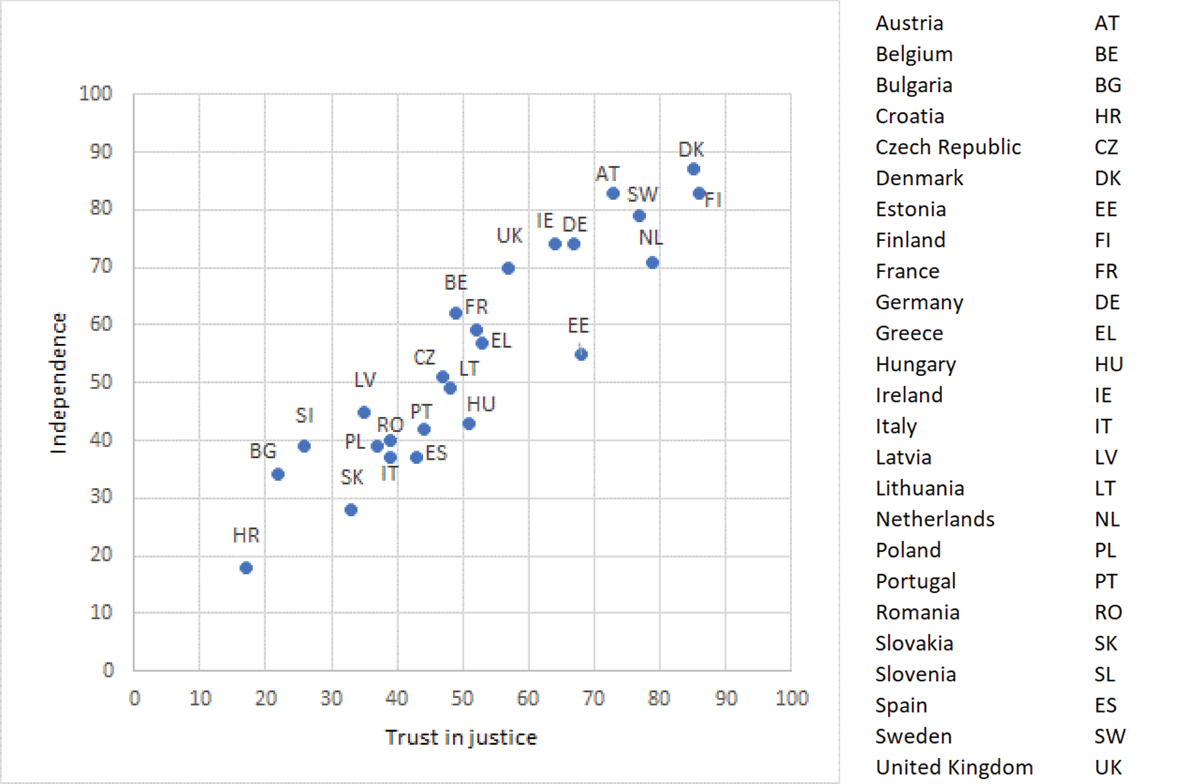
Figure 1
Measures of legitimacy. Independence of the judiciary and trust in justice.
Note: Percentages of respondents that rate the independence of courts and judges as good and percentages that tend to trust justice/the legal system.
Sources: EC 2019, Flash Eurobarometer 474 and EC 2019, Standard Eurobarometer 92, Table QA6.7.
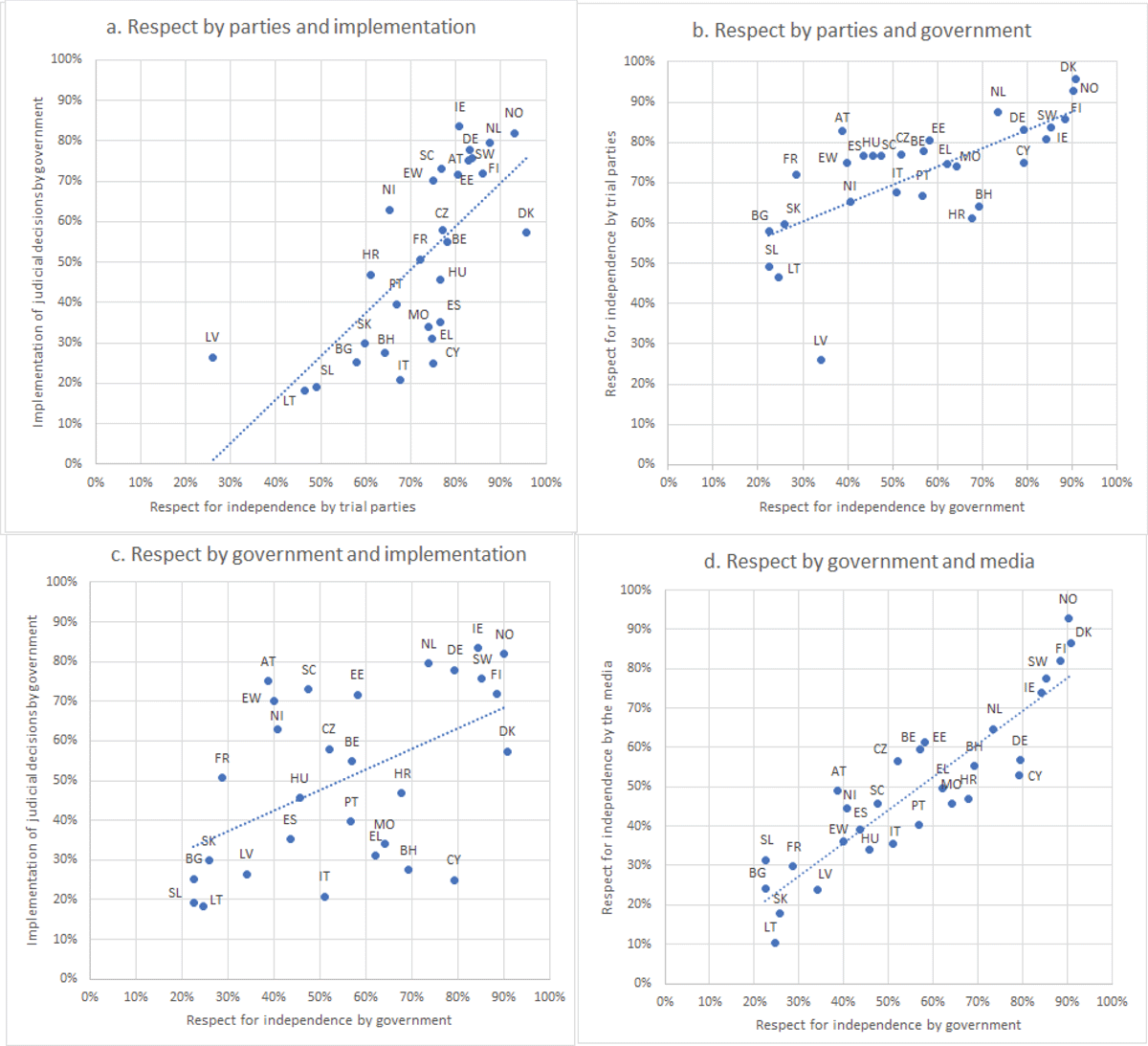
Figure 2
Legitimacy of the judiciary, as represented by respect for independence by parties in court procedures, by government and by the media, and by implementation of judicial decisions by government, as perceived by judges.
Notes: (1) x- and y-axis: percentages of responding judges that (strongly) agree that judgments that went against the interests of the government are usually implemented by government or that the independence is respected by parties, government or media. (2) In addition to country abbreviations as in Figure 1: Bosnia and Herzegovina BH, Cyprus CY, Montenegro MO, Norway NO, UK England and Wales EW, UK Northern Ireland NI and UK Scotland SC. (3) Linear trendline.
Source: F van Dijk, B Diephuis and K Jonski, ENCJ survey on the independence of judges (ENCJ 2022) Tables 6, 26d and 26h.