
1. Introduction
This article concerns the legitimacy of the judiciary, in the sense of the legal and moral authority attributed to it in society to make decisions.1 Without this authority, the judiciary is divorced from society, and its decisions, if solicited at all, are resisted. To understand what determines (changes in) the perceptions of the judiciary in society, a first step is to measure the legitimacy it is granted by (sections of) the population. This is generally done by means of opinion surveys among the population. Such surveys have problematic aspects and a behavioural alternative will be explored. As legitimacy is an abstract concept that has little specific meaning for many respondents, survey questions are put in simple terms that are intended to capture essential elements of legitimacy. This transformation is done in many ways and results in ambiguity. Furthermore, surveys, assuming they are answered truthfully in the first place, do not reveal what the answers are worth to the respondents. Surveys have proved to be effective in answering important research questions, but nonetheless reliance on these types of surveys is one-sided. In view of their potential weaknesses, two matters are particularly relevant here. In the first place, it would be of interest to observe whether the legitimacy attributed by citizens to the judiciary has behavioural consequences for these citizens, and secondly, if so, how the judiciary experiences these behavioural consequences and, thereby, the legitimacy it is granted. This would allow a comparison of what people say with what they do, and what the object of the attention (the judiciary) actually notices of the legitimacy that it is granted.
In the literature on trust, a distinction is occasionally made between trust as an opinion and trust as (trusting) behaviour.2 The latter is the act by which a person actually puts her fate or, less dramatically, well-being in the hands of someone or something else. Thus, the unobservable trust that a person harbours within herself is expressed in opinions and in (other) behaviour. The same could be said about legitimacy. Legitimacy, as the legal and moral authority granted to the judiciary, finds expression in opinions and in behaviour, where the difference is between consequence-free and costless expression of opinion in anonymous surveys and behaviour that has consequences and may incur costs. The expression of opinions is subject to diverse influences, ranging from non-neutrality of survey questions and social desirability of answers to the survey method, and it gives no indication how important matters are relative to issues outside the survey. Low importance may result in people expressing support for an institution, but still voting for a political party that wants to abolish or weaken it. Voting involves a trade-off between the intentions of political parties in different policy areas.
Applying these notions to the legitimacy of the courts, the questions are which behaviours reflect unambiguously a person’s perception of the courts’ legitimacy and whether and how these behaviours can be observed reliably. In this paper, relevant behaviours are explored by examining from this perspective the diverse operationalizations of legitimacy in theory and in surveys, and then a first (albeit second-best) attempt is made at measurement.
Given the current lack of direct data about relevant behaviour, the measurement will be based on another type of survey, i.e. the survey among the judges of Europe about their independence, conducted by the European Network of Councils for the Judiciary.3 In this study, the focus will be on the implementation of judicial decisions and the respect in society for the independence of the judiciary, as experienced by judges in Europe.
To identify relevant behaviour, in section 2 concepts of perceived legitimacy are discussed and in section 3 there is a discussion as to how legitimacy is operationalized in influential surveys. Section 4 turns to the behavioural reactions to the legitimacy that relevant groups in society actually award to the courts and, in section 5, an application is presented. Section 6 concludes.
2. Concepts of legitimacy attributed to the judiciary
It has been noted by many authors that there is a host of closely related concepts that concern the perceptions in society regarding institutions.4 Examples are, next to legitimacy itself, attributed authority, institutional loyalty, institutional support (diffuse or specific), institutional trust (diffuse, specific), confidence, willingness to obey decisions as well as negatively connoted terms such as cynicism and distrust. Respect for the institution and its core values also fits into this list.5 These concepts are difficult to distinguish, theoretically and even more so empirically. In the view of some authors several of these concepts are identical, while in the view of others they are not. Gibson et al. equate legitimacy, authority, diffuse support and institutional loyalty, and suggest that these concepts differ from specific support and confidence.6 In their view, the first group of concepts captures a (relatively) stable opinion about an institution, dependent, for instance, on the relevance attached to the rule of law, while the second reflects volatile opinions dependent on specific decisions made by the institution under consideration. These opinions change according to the popularity of specific decisions of the courts, while legitimacy can be seen as a ‘reservoir of good will’ that serves to overcome the negative short-term impact of unpopular judgments and leads individuals to acquiesce to objectionable decisions.7 This does not preclude the possibility that legitimacy is affected by actual court decisions, but this occurs only gradually, and it can recover from negative events. Legitimacy can be seen as a stock variable, linked to notions such as the social capital of an institution.8
Whether indeed confidence or trust is more volatile than legitimacy, is an empirical issue. This requires longitudinal surveys, such as those in the Netherlands on trust in institutions.9 This quarterly survey shows gradual change over time in trust in the judiciary, and heavily fluctuating trust in government and parliament. The message here seems to be that institutional trust can indeed be volatile, but that that has not been the case for the judiciary so far. Relatively small dips in trust have occurred which, in a few instances, can be traced to miscarriages of justice in criminal cases which received much attention in the media, but recovery was quick. It cannot be excluded, however, that, if a larger shock were to occur, trust in the judiciary would fall or rise more substantially. Similarly, Gibson et al. actually found that confidence has a long-term, stable aspect.10 As these data only concern trust and confidence, the suggested stability of legitimacy is not addressed.
Empirically, Hamm and co-authors have examined, in experiments among students, whether some of the concepts that were listed above can be statistically distinguished.11 This study uses confidence in the courts as the dependent variable, and it finds separable effects on confidence in the courts of general trust in others, trust in institutions, obligation to obey the law and cynicism.
From all these concepts, only willingness to obey and respect for independence are directly linked with the acceptance of authority in behaviour. In the literature, this is reflected in a discussion whether willingness to obey is the same as legitimacy or a consequence of legitimacy. Tyler and Huo see it as a component of legitimacy,12 while Gibson and Caldeira view it as a consequence.13 Whatever one’s view on this, the connection is uncontested. The corresponding behaviour is the implementation of judicial decisions, including when these decisions go against the interests of the losing party.14 This will be further discussed in section 4. The other concept directly linked with behaviour is respect for judicial independence. Also in section 4, respect and its behavioural manifestations will be discussed.
Perceptions of legitimacy may well differ among groups in society (ethnicity, income/education, political preferences). The influential study by Gibson et al., that will be discussed further in section 3, has taken this into account by means of ethnicity and party identification, but perceptions may also differ among influential actors in society, such as government, parliament, media, social media, court users and lawyers. A further complication is the existence of multi-level governance structures such as the European Union. As a result, the legitimacy of the courts cannot be considered solely from the national perspective, and the perceptions in other countries matter as well.
In the next section, the survey questions that are used in influential studies are discussed to get a clearer idea on how the concepts introduced above are actually operationalized.
3. Opinion surveys on concepts related to the legitimacy of courts
If one assumes trust to be sufficiently related to legitimacy, many surveys are available. For instance, in the European Union, the Eurobarometer surveys the trust of the population of member states in a range of institutions, including the justice system, by means of a simple question: ‘for each of the following institutions, please tell me if you tend to trust it or tend not to trust it’.15 At the national level in several countries such surveys are held on a regular basis. The quarterly survey in the Netherlands has already been mentioned.16
In the US, research has been undertaken with an explicit focus on legitimacy, in particular that of the US Supreme Court. Some of these surveys simply ask about approval. An example of such a survey question is: ‘In general do you approve or disapprove of the way the Supreme Court is handling its job?’17 Other surveys focus on trust or confidence: ‘As far as the people running the US Supreme Court are concerned, would you say you have a great deal of confidence, only some confidence, or hardly any confidence at all in them?’18
A more sophisticated survey is used by Gibson et al. to examine the impact of the decision of the Supreme Court in the Bush-Gore election dispute on the legitimacy of the Court or, similarly, the institutional loyalty of citizens towards the Court. This survey has two dimensions. Institutional loyalty is operationalized firstly as opposition to major changes in the institution, and secondly as a generalized trust that the institution will perform adequately in the future. This led to the following general statements that were put to the respondents: (1) ‘If the US Supreme Court started making a lot of decisions that most people disagree with, it might be better to do away with the Supreme Court altogether.’ (2) ‘The right of the Supreme Court to decide certain types of controversial issues should be reduced.’ (3) ‘The Supreme Court can usually be trusted to make decisions that are right for the country as a whole.’ (4) ‘The decisions of the US Supreme Court favour some groups more than others.’ (5) ‘The US Supreme Court gets too mixed up in politics.’ (6) ‘The US Supreme Court should have the right to say what the Constitution means, even when the majority of the people disagree with the Court’s decision.’19 These statements steer away from specific cases to focus on the general opinion about the Court. However, not all of the statements are directly about opposition to change and trust. Several statements concern the impartiality of the Court. Impartiality and, as an enabler, independence, are evidently important for the courts. It seems, however, that impartiality is a factor that determines legitimacy rather than being a measure of legitimacy itself. In a politically divided population it is by no means certain that impartiality leads to the attribution of legitimacy by all groups in society, in particular towards a Supreme Court.
Another example of a survey concerns the state courts of the US. Cann and Yates attempt to measure diffuse support which, as discussed in the previous section, is equated by some with legitimacy.20 The survey consists of the following opposing statements: (1) ‘judges make decisions based on facts and laws vs. judges make decisions based more on politics and pressure from special interests’; (2) ‘judges are fair and impartial vs. judges are not fair and impartial’; (3) ‘the justice system in the US works equally for all citizens vs. there are two systems of justice in the US – one for the rich and powerful and one for everyone else’. The survey also includes the following statement: (4) judges are honest and trustworthy. More than in the survey of Gibson et al., cause and effect merge: by assumption judges and the judicial system have legitimacy, when they are fair and impartial. Thus, when the judge is perceived to be fair and impartial, he or she has legitimacy, according to this research design. Whether respondents actually see it this way does not follow from the survey. This mixing-up of concepts occurs more often. An example is Warner et al. who measure public confidence with the survey question: ‘Are judges out of touch with what ordinary people think?’21 While such questions are relevant in themselves, and the connections with legitimacy are not unreasonable, these connections are assumed and not proven.
In section 2, the concept of felt obligation to obey was highlighted as directly related to behaviour. Tyler and Huo use three statements,22 also used by Hamm et al.:23 (1) ‘I feel I should accept decisions of legal authorities.’ (2) ‘People should obey the law even when it goes against what they think is right.’ (3) ‘It is difficult to break the law and keep one’s self-respect.’ Finally, concepts can be given a negative connotation which may elicit different answers. For instance, Tyler and Huo use the following statements concerning the legitimacy of the legal system:24 (1) ‘The law represents the values of the people in power rather than the values of people like me.’ (2) ‘People in power use the law to try to control people like me.’ (3) ‘The law does not protect my interests.’ In contrast to the surveys discussed before, these statements measure attitudes towards much broader issues (the ‘law’) than the legitimacy of the judiciary.
This admittedly incomplete listing of survey questions illustrates what is in the mind of researchers when they conceptualize legitimacy. Apart from the difficulty that statements may lead respondents to answer in particular ways, many of the survey questions on legitimacy assume a relationship between key values of the judiciary (in particular, impartiality) and legitimacy, and measure legitimacy by means of impartiality. While this is problematic from a methodological point of view, it does show the centrality of impartiality, and thereby independence, for legitimacy. With the exception of survey questions on obligation to obey, surveys focus on opinions about the judiciary and do not ask for behavioural responses in relevant situations.
4. Behaviour reflecting attributed legitimacy
Taking inspiration from the above discussion of concepts and surveys, the behavioural consequences of the legitimacy a person awards to the courts can now be discussed. These consequences should be observable and separable from other influences. Two topics will be discussed: (1) implementation of judicial decisions and (2) shown respect for independence. In both areas it needs to be taken into account that, in democracies in particular, citizens play several roles. They engage in economic and social interaction that occasionally leads to conflicts that reach the courts, but they also participate in political processes, primarily as voters. This implies that government and, a fortiori, parliament cannot be seen as independent actors that interact with the judiciary at will. If these actors want to maintain or improve electoral support, they need to take into account the potential reactions of the electorate in their dealings with the judiciary (see section 4.2). Consequently, the degree of legitimacy that citizens award to the judiciary may have direct and indirect effects on the position and functioning of the judiciary that need to be considered. Table 1 lists these effects and also indicates how effects can be measured. For the purpose of longitudinal or cross-section analysis, effects can be quantified in principle by making use of the administrative systems that the courts use to register cases and other data sources such as on content of media and social media reporting. As a first approximation, the expert opinion of judges can also be sought, as they have the daily experience in the court rooms, and the professional expertise and interest to assess the position of the judiciary. As quantitative data from court registrations and other sources are not readily available, in this explorative article use will be made of a survey among judges. The observation of these effects by judges has value in itself, as it could be a starting point for an analysis of the impact of attributed legitimacy on the functioning of the courts.
Table 1
Behavioural effects of the legitimacy of the judiciary, as attributed by citizens, and their measurement (examples).
| DIRECT EFFECTS: BEHAVIOUR OF PRIVATE LITIGANTS | INDIRECT EFFECTS: BEHAVIOUR OF GOVERNMENT | |||
|---|---|---|---|---|
| QUANTITATIVE MEASURES | OBSERVATION BY JUDGES | QUANTITATIVE MEASURES | OBSERVATION BY JUDGES | |
| Implementation of court decisions | Frequency of follow-up procedures to enforce judicial decisions | Personal experience | Frequency of media reporting on non-compliance Frequency of follow-up procedures Frequency of penalties for non-compliance Frequency of infringement cases25 Incidence of regulation to limit judicial review26 | Experience /perception |
| Respect for independence | Frequency of disorderly behaviour in court Frequency of dismissed challenges of judges Frequency of (threats of) attacks on judges Frequency of extreme (social) media reporting | Personal experience | Frequency of extreme criticism, including personal attacks on judges Frequency of opinions on cases, still in court Frequency of cases on the independence of the judiciary at supra-national courts Level of resources of courts and frequency of conflicts about resources between judiciary and government/parliament | Experience/perception |
It should be noted, however, that, like any other human beings, judges have incomplete information, are subject to biases and may serve their own interests when taking part in surveys.
4.1 Implementation of judicial decisions
Willingness to obey the courts translates into actual acceptance and implementation of court decisions, even if the decisions go against the interests of the parties concerned and parties have a choice. If an enforcement mechanism exists to execute judgments, as in debt recovery cases with a bailiff, and non-compliance is not an option, people may still try to frustrate implementation, by delaying and complicating procedures. The possibility of non-compliance varies with the types of measures ordered. Where the courts have to depend on their own authority, disputes that elicit strong negative emotions, such as divorce cases involving children and labour conflicts, are notoriously difficult to enforce, and often return to court. This shows in the case registrations of the courts. Even parties that generally accept the authority of the court may not bring themselves to overcome their emotions and sentiments, and implement judgments loyally. Analysing these types of cases requires detailed empirical research to establish willingness to obey for different levels of sacrifice and/or costs that is beyond the scope of this article.
The agent that can more readily refuse to implement decisions or frustrate implementation is the government. When outright refusal would be difficult, government can resort to postponing implementation, inter alia by starting new procedures. For instance, after the court has established the liability of the government, the government may loyally reach a negotiated settlement on the damages, but it may also continue litigating to have the court determine the damages. Compliance by government has received much attention in the literature. Kapiszewski and Taylor review this literature and present frameworks for measuring and explaining compliance.27 Their study focuses on the complexities involved and presents two illustrative studies of specific cases, emphasizing the need for in-depth case analysis. Quantitative data on compliance are generally not available, unless courts monitor this, which rarely happens. Rios-Figueroa and Staton provide an overview of cross-national measures of judicial independence, and argue that independence not only concerns – in their words – autonomy but also influence, where influence is the extent to which judicial decisions are implemented. They show that both dimensions of independence are present in the available cross-national measures.28 However, these dimensions are not distinguished and therefore not immediately useful here. As a matter of further study, it would be of interest to examine the underlying data (based on expert opinion and surveys) on reliable figures about compliance.
In political science, the explanation of compliance by government has received attention. In this literature, non-compliance is thought to depend primarily on its political cost.29 Compliance may depend on the legal and moral authority the government attaches to the judiciary,30 but governments and, in particular their political leaders, can be expected to consider the costs and benefits of (non-)compliance. When citizens have a high regard for the courts and expect government agencies to faithfully implement judicial decisions, the threat of losing votes in elections due to non-compliance may compel political office holders to implement judicial decisions with which they do not agree. These electoral costs, assuming that the public is sufficiently aware of non-compliance by government, can exert considerable influence on the acceptance of judicial authority.31 It should be emphasized that public awareness cannot be taken for granted, and its degree is an empirical question. On the other hand, a lack of public support for the courts may severely limit a court’s effectiveness. If courts cannot rely on citizens to put pressure on governments to implement their decisions,32 courts cannot effectively play their constitutional role in ensuring that government acts in full conformity with the law.33 It should be noted, however, that to some extent the government can ‘buy’ support for its ignoring of court decisions by offering rewards to the electorate. In such situations, support for the courts must be large to be effective in controlling the behaviour of government.
To conclude, while the implementation of judicial decisions by all court users is relevant for legitimacy, compliance by government has drawn much more attention in research. It follows from this literature that the degree of compliance by government with court decisions that go against its interests is informative about the legitimacy of the judiciary among the (voting) population. Thus, it would be expected that, in a democracy, high compliance by government reflects high legitimacy of the courts among citizens and low compliance reflects low legitimacy. The follow-up question is then how compliance by government with court decisions can be measured in practice. Monitoring of the media coverage of controversies between government and the courts and analysing published case law, including that of supra-national courts such as the European Court of Justice, can provide the required information, for instance for a longitudinal study or, as this article is concerned with here, cross-national analysis (see Table 1). Within the scope of this article, this is not feasible. As a first approximation, the survey among the judges of Europe by the European Network of Councils for the Judiciary (ENCJ) will be used.34 This survey presents, among other questions, the following statement to judges: ‘In the last three years, I believe judgments that went against the interests of the government, were usually implemented/enforced in my country’. While judges are knowledgeable and can be expected to be interested in following government decisions in this respect, opinions cannot be expected to be precise, given the broad range of government decisions, but these give a first impression, and pave the path for further research.
4.2 Respect for independence
The second aspect to be addressed here is respect for judicial independence. Coming back to the definition, in which legitimacy is defined as the legal and moral authority to make decisions, respect for independence, as shown in and outside the courtroom, exhibits the authority granted in practice to the judiciary to make decisions in the way it sees fit to do. The requirement of independence is, for instance, expressed in Article 6(1) European Convention on Human Rights. Independence and legitimacy are closely linked as was already discussed in the previous section. To quote Lenaerts, the current President of the Court of Justice of the European Union: ‘It is only thanks to their [i.e. the courts] independence and impartiality – as well as the quality of their reasoning – that their rulings enjoy authority and legitimacy’.35 Independence is a requirement for legitimacy, but the independence actually granted to the judiciary also depends on the behaviour in society towards the judiciary, in court by the parties and their lawyers and out of court by a wider range of actors, including the media, government and parliament. In court, respect for independence implies that parties do not try to influence court procedures and court decisions beyond the allowed means. Examples of inappropriate means are threatening of judges, offering bribes, efforts to influence case allocation and obstruction in general (see Table 1 for relevant measures). Out of court, disrespect for independence shows, for instance, in excessive personal criticism of judges. The state powers have more instruments than most private actors to put pressure on the judiciary in specific cases. These range from discussing cases that are still in court and expressing views on what judges should decide, to threats of disciplinary procedures, depending on institutional arrangements, directly or by means of the judicial authorities. Extreme examples are the prohibitions on requesting preliminary rulings of the European Court of Justice and disciplinary procedures against judges who do so, as in Poland and Hungary. Beyond individual cases, disrespect for independence can take the form of insufficient budget allocations and, where institutional arrangements allow, political appointments of judges and appointments to positions in governance institutions such as councils for the judiciary and in efforts to change the institutional arrangements to reduce the independence of the courts. Poland and Hungary use a catalogue of measures, including undermining of public confidence in the judiciary.36
These behaviours of actors in society are partly hidden and partly in the open. Analysis of (social) media would cover a part, while threats against judges and actual (physical) attacks on judges may be documented in the court administration. The same holds for disorderly behaviour in court and (unjustified) challenges of judges. Political attacks on the independence of the courts in some countries such as Poland, Hungary and Romania are well documented.37 Within the scope of this article, the gathering of data that would allow a quantitative measurement of behaviour of court users as well as government is not feasible. In addition, surveys among the population in Europe about the independence of the judiciary are confined to perceptions of independence and do not provide information on what citizens themselves contribute to or detract from independence by their behaviour, in particular, in court, but also through the political system. An alternative is to examine how judges experience respect for their independence by groups in society. The authority granted to the judiciary is then not measured by asking those who grant authority about their (intended) behaviour towards the judiciary, but by actual observation by those in whom authority is vested.
For this purpose, the ENCJ survey can be used as well. It asks judges to assess the respect of independence by different actors. These actors fall into three groups: (1) the leadership of the judiciary, as to content (inter alia, Supreme Courts and Constitutional Courts) and as to governance (court management including court presidents, councils for the judiciary, judges’ associations); (2) parties in a procedure (parties themselves, lawyers and, in criminal cases, prosecutors); and (3) the other state powers (government and parliament) together with the (social) media.38 Respect for independence is highest among court leaders, moderate among the court users and relatively low for the other state powers and media. The focus here is on the court users and on the other state powers. Citizens are engaged in different roles: the citizen as party in a court case and, in a democracy, the citizen as represented by an elected government and parliament.
The behaviour of parties and their legal representation is personally experienced every day by judges in court. The behaviour of government covers a much broader spectrum than the appearance in court and the implementation of judgments, as was discussed above. Such behaviour is less experienced by judges personally than observed by them. Judges observe and hear about the appointment of judges, the funding of the judiciary and the statements about the judiciary of government in parliament and in the media. The way in which government as well as parliament behave towards the judiciary, is influenced by the legitimacy granted by citizens to the judiciary and their (diffuse) support. Also in this area, government and parliament reflect the opinions of the citizens to some extent. However, government and parliament can also shape opinions, in particular when they have a grip on the media. To summarise, two perspectives are particularly relevant for legitimacy: the respect for independence by parties in procedures and the respect for independence by government.
5. Application: legitimacy of the judiciary in Europe
Regular surveys among citizens of EU member states on perceptions about the judiciary are about trust and about perceived independence. The combination of these two aspects gives some idea of the traditional approach towards measuring the popular legitimacy of the judiciary, albeit in an unsophisticated way.39 As is discussed in detail by Van Dijk, trust and perceived independence are highly correlated (correlation coefficient 0.93).40 See Figure 1. Trust in the judiciary seems to be the same as trust in the independence of the judiciary or, alternatively, trust is almost fully determined by perceptions of independence. It is also conceivable that respondents have only a vague understanding of the functioning of the judiciary, and are not able to distinguish between questions. However, perceived independence by citizens is highly correlated with independence as perceived by judges, but with a significant difference in the means (judges are more positive about their independence than citizens).41 These results seem to suggest that citizens have a basic understanding of the independence of the judiciary in their country and that this understanding is a crucial factor for the trust they place in the judiciary. Alternatively, citizens may have reason to trust or distrust the judiciary, and this affects their perception of independence.
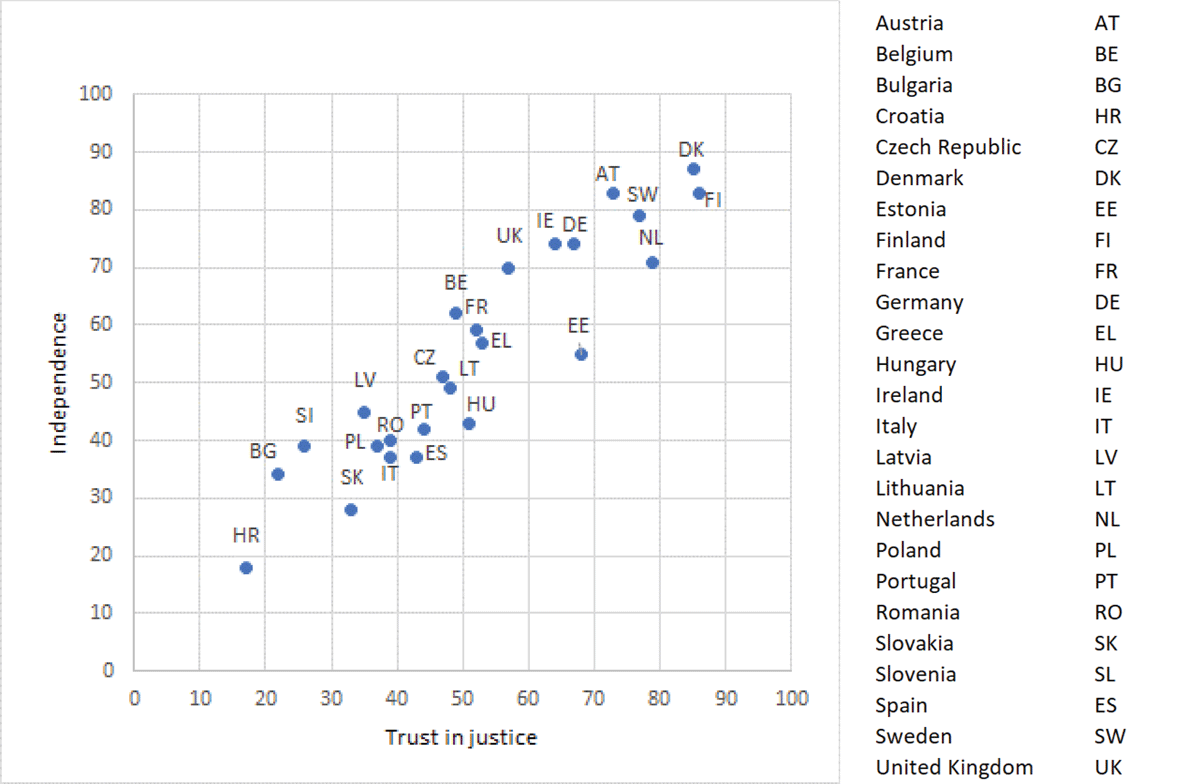
Figure 1
Measures of legitimacy. Independence of the judiciary and trust in justice.
Note: Percentages of respondents that rate the independence of courts and judges as good and percentages that tend to trust justice/the legal system.
Sources: EC 2019, Flash Eurobarometer 474 and EC 2019, Standard Eurobarometer 92, Table QA6.7.
In the previous sections it was suggested that the focus should be on the behavioural consequences of the legitimacy attributed to the judiciary and, given the data limitations, to operationalize this by the implementation of judicial decisions by government and by the respect for the independence of the judiciary by parties (court users) and government, all variables as perceived by judges for conceptual and practical reasons. Figure 2 gives the data on these variables available from the most recent ENCJ survey among judges about their independence.42 The country participation differs slightly from that in Figure 1. This survey has 15,821 respondents from 29 judiciaries of 27 countries of Europe. The three panels a, b and c give the combinations of the three variables that were distinguished. Panel d presents perceived respect for independence of government and of the media to highlight the potential of the media in shaping perceptions.
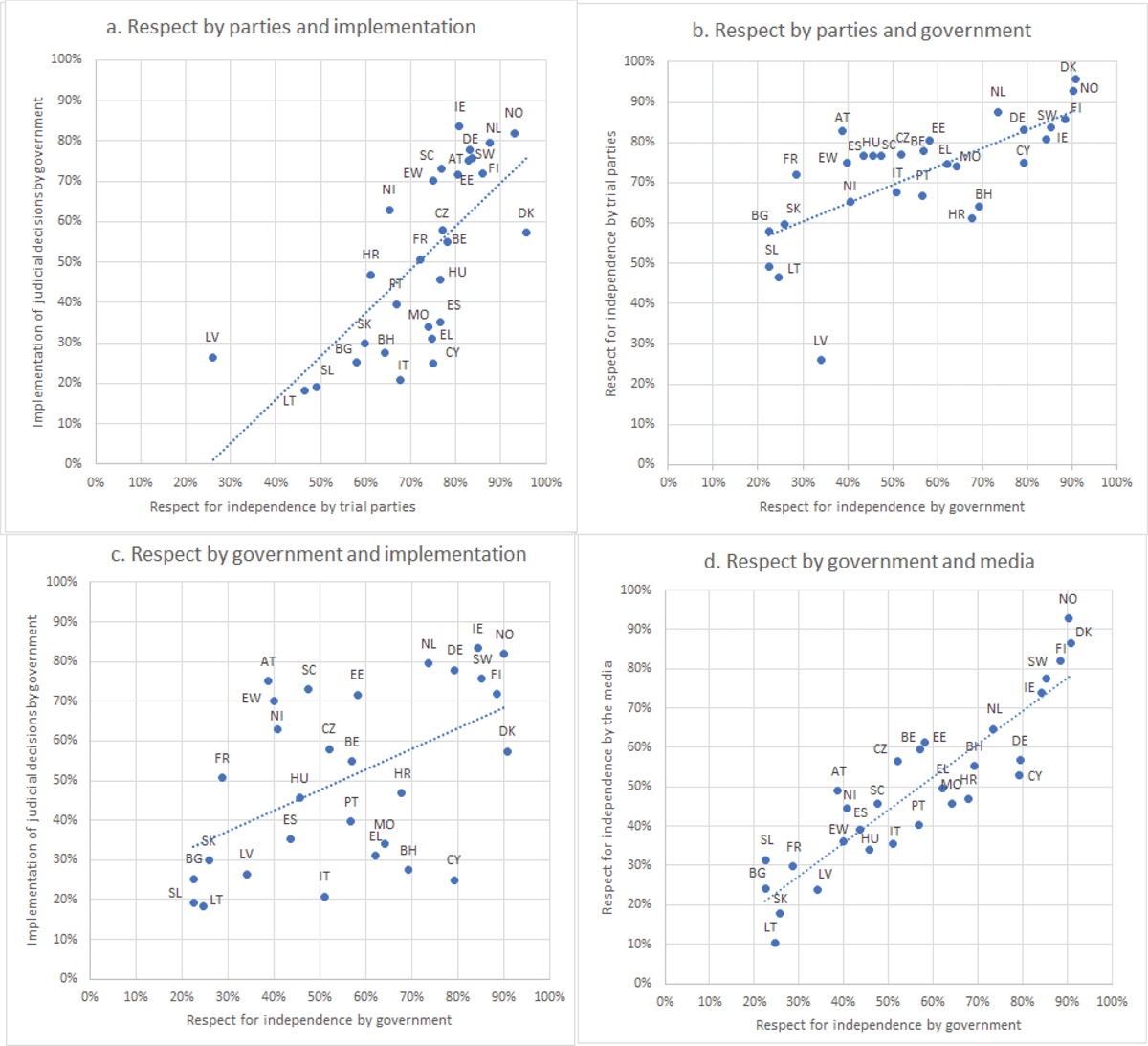
Figure 2
Legitimacy of the judiciary, as represented by respect for independence by parties in court procedures, by government and by the media, and by implementation of judicial decisions by government, as perceived by judges.
Notes: (1) x- and y-axis: percentages of responding judges that (strongly) agree that judgments that went against the interests of the government are usually implemented by government or that the independence is respected by parties, government or media. (2) In addition to country abbreviations as in Figure 1: Bosnia and Herzegovina BH, Cyprus CY, Montenegro MO, Norway NO, UK England and Wales EW, UK Northern Ireland NI and UK Scotland SC. (3) Linear trendline.
Source: F van Dijk, B Diephuis and K Jonski, ENCJ survey on the independence of judges (ENCJ 2022) Tables 6, 26d and 26h.
Figure 2a deals with behaviour in court cases, in court and thereafter: is the independence of the judiciary respected by the parties and are judgments implemented by government? The correlation between these two aspects is high (correlation coefficient .71), but not as high as between trust and perceived independence by citizens in Figure 1. The outcome for judiciaries is different from that of Figure 1. While the rank order of the countries that participated in the three surveys is similar, the position of individual judiciaries differs substantially. For instance, Denmark takes top score on trust, perceived independence and respect for independence, but it fares less well with regard to the implementation of judgments by government. At the lower end of the scores differences are particularly large, with Latvia and Lithuania doing less well on implementation and respect for independence than on trust and perceived independence by the public. Apparently, it does matter which operationalization of legitimacy is chosen. Furthermore, a focus on behaviour gives some indication of what to address, if one looks at possibilities to further the legitimacy of the courts.
Figure 2b maps respect for independence by parties in court cases against respect for independence by government. Respect by parties is much higher than that by government, but there is high correlation (.68).43 The difference in the means reflects to some extent the different scope of parties and government (case versus position of the judiciary in relation to the other state powers), but may also reflect different power relations. In court, a judge wields power over the parties and their lawyers within the constraints of court procedure, and they have an incentive to play along, while at the level of the interaction of the state powers, government wields some power over the judiciary, if only by its influence on budgets and, depending on institutional arrangements, on appointments.
Figure 2c maps respect for independence by government against implementation by government. The correlation of the two variables is low (.22), and combinations of scores differ among countries. For instance, in the UK (England and Wales as well as Scotland) and Austria judges observe a high level of obedience to the decisions of the courts, but experience relatively little respect. In Denmark it is the other way round. Relatively high levels of respect and a low level of implementation are also found in Cyprus and in Bosnia and Herzegovina. These two aspects form different dimensions of governmental behaviour: respect for independence covers many more aspects than the implementation of judicial decisions. Finally, Figure 2d compares, as an extra, respect for independence by government with that by the media. The correlation is very high (.90), while the means are also very similar. This may well indicate that reporting in the media on the opinions of government about the judiciary plays an important role in shaping the perceptions of judges.
In this application of concepts of legitimacy, two ways of operationalizing the legitimacy that is granted to the judiciary are shown. In the first, simplistic approach, legitimacy is primarily equated to trust, expressed in an anonymous opinion survey among citizens. This expressed trust is highly correlated with perceptions of independence by citizens, and trust and perceptions of independence seem indistinguishable. As discussed earlier, this operationalization of legitimacy is unsatisfactory and, at best, superficial. It raises doubts as to whether citizens are sufficiently informed to have anything other than a vague feeling about the judiciary and its independence. If so, the respondents to the surveys among citizens discussed in section 3 can easily be guided by the way questions are formulated. As noted earlier, these surveys do not indicate how important the judiciary is for citizens when compared with other matters they care about, and to what length they would go to support the judiciary, even when they say they support the judiciary.
The second approach is a first and, due to lack of data, incomplete attempt to measure legitimacy by means of its behavioural effects. Do citizens respect the independence of the judiciary in court and do citizens elect a government that obeys the decisions of the courts and that shows respect for the independence of the courts? These questions were answered by means of a survey among judges. In this article, this was done for practical reasons, but also because in itself it is of interest how judges experience the behaviour of citizens directly or through government indirectly. It is likely that this affects their behaviour in turn. As shown in Figure 2, the three components (respect by parties and by government and compliance by government) are internally consistent. This second approach seems to come closer to the core of what is meant by legitimacy, and it is at least less superficial than the first approach. Moreover, both approaches lead to different outcomes. Of course, it would be desirable to have ‘hard’ data on behaviour, instead of only data based on the perceptions of judges about that behaviour.
In terms of construct validity, this approach is based on the idea (‘theory’) that the legitimacy of the judiciary shows in the actual behaviour of citizens and of government towards the courts, and not so much in the expressed perceptions by the public as outside observers. As the behaviour of judges is affected by the behaviour towards them in court and in political debate, legitimacy is the outcome of these interactions. Thus, it is not only relevant how citizens perceive the legitimacy of the judiciary, but also what they contribute to it, positively or negatively. This aspect is missing in the surveys of citizens discussed in section 3.
6. Discussion
This article examines survey methods used to assess the legitimacy attributed to the judiciary by citizens, and it explores the possibilities for an approach based on the behavioural consequences of attributed legitimacy. In the introduction two questions were raised: first, which behaviours reflect unambiguously a person’s perception of the courts’ legitimacy and how to measure these behaviours and, second, to what extent do judges notice these behaviours. Due to lack of data, in the practical application the analysis was confined to the latter aspect: the experience/perception of judges of behaviours towards them, individually and as a whole. The behaviours examined are the respect for independence shown by the parties in judicial procedures and by the government and the implementation of judicial decisions. The last mentioned is confined at this stage to implementation by government. The missing link is the direct observation of behaviour. Table 1 contains suggestions as to how to do this. However, this is outside the scope of this article.
The discussion of current conceptualizations of legitimacy in surveys shows that relatively straightforward measures such as approval rate and trust do not (fully) capture legitimacy in the sense of the legal and moral authority of the courts. In major contributions to the literature, legitimacy is, convincingly, equated to what is known as diffuse support for the courts, the loyalty they command and the degree to which their rulings are obeyed. Legitimacy is viewed as an enduring characteristic that only gradually evolves. The behavioural reactions that are seen as promising here build upon the notions of support for the courts, including adherence to the judiciary’s core principles and values (independence and impartiality) and willingness to obey its decisions.
When considering behaviour, the focus here is on the multiple roles which citizens play. In daily life, citizens do not have contact with the courts. This alters when they get involved in an intractable dispute and become parties in a law suit. The legitimacy they attribute to the court shows in their behaviour towards the court. At the same time, in a democracy, citizens take part in elections, and government has to take their opinions into account to be re-elected. These opinions, even if they are vague, also concern the way in which government deals with the judiciary, with regard to the implementation of judicial decisions and with regard to the independence of the judiciary. In the analysis here, the government is not seen as an independent actor, but as dependent on ‘the will of the people’. In line with the political science literature briefly discussed, the implementation of judicial decisions by government and its respect for judicial independence reflect the popular legitimacy of the judiciary. An important issue is incomplete information about the judiciary among a part of the population and, in particular, the part that has no direct experience with the courts. This may well lead to unstable and easily influenced opinions about the judiciary, as well as to opinions that do not carry a large weight compared with other matters in the lives of citizens. Thus, high legitimacy may be expressed in surveys of citizens, but whether this leads to the independence of the judiciary as an important issue in elections is uncertain.
The article uses the experience of judges to assess the legitimacy granted to them in society, as expressed in a survey among judges. The reason is that judges are in a position to observe the behaviour of the parties in court and also have the professional interest and even responsibility to keep abreast of case law and follow political events concerning the judiciary. It is not intended as a step in a chain of reasoning of judges and parties about each other. One might ask parties in procedures whether they respect the independence of the judges, and subsequently ask judges whether they feel respected, and then ask parties whether they believe that judges feel respected, and so on. While interesting in its own right, this is not what this study is about. It is about the observation of first order effects. As noted, direct measurement of behavioural effects would be preferable to relying on the – imperfect – observations of judges. As suggested above (Table 1), there are many opportunities for further research.
To conclude, observing behaviour towards the judiciary may lead to a better – more accurate and deeper – understanding of its legitimacy than surveys among citizens. The application presented here with regard to the legitimacy of the judiciary in Europe demonstrates that outcomes differ from simple surveys among citizens. Legitimacy shows in the respect of court users, including government, for judicial independence within and outside the courtroom and in the implementation of judicial decisions, in particular by government.
Notes
[1] JL Gibson, GA Caldeira and LK Spence, ‘The Supreme Court and the US presidential election of 2000: Wounds, self-inflicted or otherwise?’ (2003) 33 British Journal of Political Science 535.
[2] M Tanis and T Postmes, ‘Short communication. A social identity approach to trust: interpersonal perception, group membership and trusting behaviour’ (2005) 35 European Journal of Social Psychology 413.
[4] JA Hamm and others, ‘Exploring separable components of institutional confidence’ (2011) 29 Behavioral Sciences and the Law 95; Gibson, Caldeira and Spence, ‘The Supreme Court and the US presidential election’ (n 1).
[5] In the case of the judiciary, respect for independence. See F van Dijk and G Vos, ‘A method for assessment of the independence and accountability of the judiciary’ (2018) 9 International Journal for Court Administration 1.
[7] JL Gibson, GA Caldeira and LK Spence, ‘Why do people accept policies they oppose? Testing legitimacy theory with a survey-based experiment’ (2005) 58 Political Research Quarterly 187.
[8] A Grosskopf and JJ Mondak, ‘Do attitudes toward specific Supreme Court Decisions matter?’ (1998) 51 Political Research Quarterly 633; B Rothstein and D Stolle, ‘The state and social capital: An institutional theory of generalized trust’ (2008) 40 Comparative Politics 441.
[9] SCP, Continue Onderzoek Burgerperspectieven. For the long-term trend see: P Dekker and J den Ridder, Burgerspectieven 2020/1 (SCP 2020), figure 1.6.
[10] JL Gibson, GA Caldeira and LK Spence, ‘Measuring attitudes towards the United States Supreme Court.’ (2003) 47 American Journal of Political Science 354.
[12] TR Tyler and YJ Huo, Trust in the law: Encouraging public cooperation with the police and the courts (Russell-Sage Foundation 2002).
[13] JL Gibson and G Caldeira, ‘Changes in the legitimacy of the European Court of Justice: A post-Maastricht analysis’ (1998) 28 British Journal of Political Science 63.
[14] The primary areas of law in which this occurs are civil and administrative law, but in criminal law as well government agencies may resist implementation of court decisions.
[15] www.gesis.org/en/eurobarometer-data-service/search-data-access/eb-trends-trend-files/list-of-trends/trust-in-institutions accessed 20 December 2022.
[17] VJ Hoekstra, ‘The Supreme Court and Opinion Change: An experimental study of the Court’s ability to change opinion’ (1995) 23 American Politics Quarterly 109.
[19] Gibson, Caldeira and Spence (2003). The Supreme Court and the Presidential Election’ (n 1), Table 1.
[20] DM Cann and J Yates, ‘Homegrown institutional legitimacy, assessing citizens’ diffuse support’ 36 American Politics Research 297.
[21] K Warner and others, ‘Are judges out of touch?’ (2014) 25 Current Issues in Criminal Justice 729.
[27] D Kapiszewski and MM Taylor, ‘Compliance: conceptualizing, measuring, and explaining adherence to judicial rulings’ (2013) 38 Law & Social Inquiry 803.
[28] J Rios-Figueroa and JK Staton, ‘An evaluation of cross-national measures of judicial independence’ (2012) 30 Journal of Law, Economics, and Organization 104. See also DA Linzer and JK Staton, ‘A global measure of judicial independence, 1948–2012’ (2015) Journal of Law and Courts 223.
[29] E.g. JN Krehbiel, ‘Public awareness and the behavior of unpopular courts’ (2021) 51 British Journal of Political Science 1601; G Vanberg, ‘Legislative-judicial relations: a game-theoretic approach to constitutional review’ (2001) 45 American Journal of Political Science 346.
[30] E.g. Kapiszewski and Taylor (n 27) argue that compliance by government should ideally not be subject to cost-benefit analysis but should be normative and automatic.
[31] Vanberg (n 29); JK Staton, ‘Constitutional review and the selective promotion of case results’ (2006) 50 American Journal of Political Science 98.
[32] Krehbiel (n 29) refers to courts that lack diffuse support simply as ‘unpopular courts’. To stop a determined government a high level of support may be needed. This was not available in Poland, for instance, in the crisis concerning the Constitutional Court: www.bbc.com/news/world-europe-35793914.
[33] Also see, JL Gibson, GA Caldeira and VA Baird, ‘On the legitimacy of national high courts’ (1998) 92 American Political Science Review 343.
[34] F van Dijk, B Diephuis and K Jonski, ENCJ survey on the independence of judges (ENCJ 2022), Report ENCJ Survey 2022.pdf (amazonaws.com).
[36] D Mazur, ‘From bad to worse – the Polish judiciary in the shadow of the “muzzle act”’ (2020) Annual report for 2020, Themis Association of judges; M Bencze, ‘Judicial populism and Weberian judge – Strength of judicial resistance against governmental influence in Hungary’ (2021) 22 German Law Journal 1282.
[37] See, e.g., EC, 2022 Rule of Law report (2022) ec.europa.eu.
[38] This categorization is conceptual, but it is also supported by statistical analysis. See van Dijk, Diephuis and Jonski (n 34). See also F van Dijk, Perceptions of the independence of judges in Europe (Palgrave 2021) 69. On average across 24 countries of Europe, group (1) scores 8.3, group (2) 7.9 and group (3) 5.9, on a scale between 0 – 10, where 0 means minimal respect and 10 maximal respect. Differences in means are significant between actors in different groups and predominantly not significant between actors within the three groups.
Competing Interests
The author has no competing interests to declare.