
Table 1.
Changes in maternal serum activin A, inhibin A, follistatin and FSTL3 in preeclamptic pregnancies.
| Reference | Population | Protein | Weeks of gestation | PE subtype | Main outcomes |
|---|---|---|---|---|---|
| Activin A | |||||
| Yu et al. (2012) [15] | Severe PE group: 44 women (30.8±5.1 years) Control group: 51 women (29.8±3.2 years) | Activin A | Five intervals: (1) 15+0–18+0 (2) 19+0–24+0 (3) 25+0–30+0 (4) 31+0–35+0 (5) 36+0–40+0 | Severe PE | From gestational week 25 until delivery, activin A levels increased significantly in women with severe PE when compared to controls (p<0.05). The difference in maternal serum levels of activin A according to week intervals were: (3) 3.6-fold increase in severe PE (16.6 vs. 4.6 ng/mL), (4) 4.2-fold increase in severe PE (30.1 vs.7.2 ng/mL), (5) 3.5-fold increase in severe PE (34.3 vs. 9.7 ng/mL). |
| Baumann et al. (2013) [16] | PE group: 46 women Controls: 92 women | Activin A | First trimester | No distinction | Activin A increased significantly in pregnancies with PE when compared to controls (p<0.05). Activin A yielded an AUC of 0.670 in PE prediction. |
| Lai et al. (2013) [17] | PE group: 50 women Controls: 250 women | Activin A | Two intervals: (1) 11+0–13+0 (2) 30+0–33+0 | No distinction | Activin A increased significantly at 30+0–33+0 weeks of gestation, but not at 11+0–13+0 weeks, in women with PE (1.47 (1.14–2.38) MoM) when compared to controls (0.99 (0.72–1.42) MoM) (p<0.05). Activin A yielded an AUC of 0.722 in PE prediction at 30+0–33+0 weeks of gestation. |
| Tarca et al. (2019) [18] | EO-PE group: 33 women (22 (19.0–25.5) years) Controls: 90 women (24 (21.0–27.8) years) | Activin A | 22+1–28+0 | EO-PE | Activin A yielded an AUC of 0.890 in EO-PE prediction. |
| Hao et al. (2020) [19] | PE group: 20 women (31.8±6.0 years) Controls: 20 women (31.9±4.8 years) | Activin A | Five intervals: (1) 5+0–9+0 (2) 10+0–14+0 (3) 15+0–25+0 (4) 26+0–33+0 (5) 27+0–38+0 | No distinction | Activin A begins to rise around 20 weeks of gestation, yet no significant difference was evidenced between women with PE and normal pregnancies. Activin A yielded an AUC of 0.650 in PE prediction at 16+0–30+0 weeks of gestation. |
| Wong et al. (2022) [20] | PE group: 40 women (31.0 [29.3–34.0] years) Control group: 201 women (32.0 [30.0–35.0] years) | Activin A | Two intervals: (1) 27+0–29+0 (2) 35+0–37+0 | No distinction | Activin A increased significantly at 35+0–37+0 weeks of gestation, but not at 27+0–29+0 weeks, in women with PE (706 (2162–8362) pg/mL) when compared to controls (2050 (1018–3723) pg/mL) (p<0.001). Activin A yielded an AUC of 0.710 in PE prediction at 35+0–37+0 weeks of gestation. |
| Activin A and inhibin A | |||||
| Li et al. (2016) [43] | PE group: 39 women (27.12±3.12 years) Controls: 100 women (28.67±3.51 years) | Inhibin A Activin A | 11+0–13+0 | No distinction | Inhibin A increased significantly in women with PE (1.72±0.02 pg/mL) when compared to controls (1.03±0.06 pg/mL) (p<0.001). Activin A increased significantly in women with PE (1.68±0.38 pg/mL) when compared to controls (1.06±0.42 pg/mL) (p<0.001). |
| Xu et al. (2017) [44] | Mild PE group: 14 women (30.8±1.0 years) Severe PE group: 17 women (31.5±1.1 years) Controls: 18 women (30.4±0.7 years) Among the 31 women with PE, 13 had EO-PE and 18 had LO-PE | Inhibin A Activin A | Before delivery. Weeks of gestation were not specified. | Mild PE Severe PE EO-PE LO-PE | Activin A (23.5±2.1 μg/L) increased significantly in women with severe PE when compared to controls and EO-PE (p<0.05). No difference was found with LO-PE. Inhibin A increased significantly in women with severe PE (1.7±0.2 μg/L) and EO-PE (1.9±0.2 μg/L) when compared to controls and mild PE (p<0.001). No difference was found with LO-PE. Both activin A (26.0±2.3 μg/L) and inhibin A (1.9±0.2 μg/L) were significantly higher in EO-PE when compared with women with LO-PE (activin A: 16.3±1.5 μg/L, inhibin A: 1.1±0.1 μg/L) (p<0.001). |
| Inhibin A | |||||
| Olsen et al. (2012) [21] | PE group: 459 women, out of which 65 delivered before 34 weeks and 294 delivered after 34 weeks of gestation. Controls: 7,308 women | Inhibin A | Second trimester | EO-PE LO-PE | Elevated inhibin A levels were associated with any form of PE (LO-PE: (OR: 3.08; CI 95%: 2.15–4.42) and EO-PE: (OR: 4.17; CI 95%: 2.11–8.27)). The OR increased for each every >2 MoM rise in inhibin A levels. |
| Dugoff et al. (2013) [22] | Severe PE group: 26 women PE group: 56 women Controls: 946 women | Inhibin A | 11+0–14+0 | Severe PE | Inhibin A increased significantly in pregnancies with PE, but not severe PE, when compared to controls (p<0.05). |
| Boucoiran et al. (2013) [23] | PE group: 34 women (31.5 (26.0–35.0) years) Control group: 584 women (30.0 (27.0–34.0) years) | Inhibin A | Two intervals: (1) 12+0–18+0 (2) 24+0–26+0 | No distinction | At weeks 12+0–18+0, inhibin A increased significantly in women with PE (1.10 (0.77–1.52) MoM) when compared to controls (0.96 (0.71–1.25) MoM) (p<0.05). In these same weeks, inhibin A yielded an AUC of 0.590 in PE prediction. At weeks 24+0–26+0, inhibin A increased significantly in women with PE (1.10 (0.89–1.65) MoM) when compared to controls (0.91 (0.66–1.23) MoM) (p<0.05). In these same weeks, inhibin A yielded an AUC of 0.620 in PE prediction. |
| Suri et al. (2013) [24] | PE group: 14 women Controls: 42 women | Inhibin A | 15+0–22+0 | No distinction | Inhibin A increased significantly in women with PE (1.37 (0.95–1.62) MoM) when compared to controls (0.96 (0.79–1.33) MoM) (p<0.05). |
| Park et al. (2014) [25] | PE group: 8 women (33 (25–37) years) Controls: 254 women (33 (20–39) years) | Inhibin A | 11+0–13+6 | No distinction | Inhibin A increased significantly in pregnancies with PE (1.86 (0.82–2.96) MoM) when compared to controls (1.00 (0.39–3.676) MoM) (p<0.05). Inhibin A yielded an AUC of 0.780 in PE prediction. |
| Giguère et al. (2015) [26] | [1] Preterm PE: Cases: 47 women (29.9±5.5 years) Controls: 94 women (30.3±5.2 years) [2] EO-PE: Cases: 13 women (30.1±6.1 years) Controls: 26 women (30.3±5.4 years) [3] Severe PE: Cases: 68 women (29.7±5.0 years) Controls: 94 women (29.6±4.3 years) | Inhibin A | 10+0–18+0 | Preterm PE EO-PE Severe PE | Inhibin A increased significantly in pregnancies with severe PE (267 (176–384) pg/mL) when compared to controls (211 (158–322) pg/mL) (p<0.05), and in preterm PE (1.36 (0.97–1.89) MoM) when compared to controls (1.08 (0.85–1.52) MoM). Inhibin A levels in preterm PE and EO-PE did not change significantly when compared to controls. |
| Kumer et al. (2016) [27] | PE group: 40 women Controls: 28 women | Inhibin A | 25+0–41+0 | No distinction | Inhibin A increased significantly in pregnancies with PE (1,267± 383 ng/L) when compared to controls (660 ± 395 ng/L) (p<0.001). |
| Chrelias et al. (2016) [28] | PE group: 98 women (31.1±4.9 years) Control group: 98 women (31.0±5.7 years) | Inhibin A | 24 hours before delivery | No distinction | Inhibin A increased significantly in women with PE (1.07±0.83 ng/mL) when compared to controls (0.73±0.35 ng/mL) (p<0.05). PE was highly associated with changes in inhibin A levels (OR: 1.09). The likelihood of developing PE increased by 10% for every rise in inhibin A serum levels by 0.1 ng/mL. |
| Broumand et al. (2018) [29] | PE group: 14 women Controls: 286 women | Inhibin A | 16+0–20+0 | No distinction | The sensitivity of inhibin A levels ≥1.25 MoM in PE prediction was 83.83%, its specificity 65.30%, positive predictive value 4.67%, negative predictive value 99.48%, positive likelihood 2.41, and negative likelihood 0.24. Its diagnostic accuracy was 65.66%. Inhibin A levels were directly associated with the incidence of PE (p<0.001) and its severity (p<0.05). |
| Belovic et al. (2019) [30] | 104 pregnant women (30.54±4.93 years), of which 6 developed PE. No available data of the control group. | Inhibin A | 16+0–19+0 | No distinction | No significant difference was evidenced in inhibin A levels among women with PE (1.23±0.11 MoM) and normal pregnancies (1.17±0.98 MoM). |
| Yue et al. (2020) [31] | PE group: 560 women (29.3±2.72 years) Controls: 8333 women (29.0±2.82 years) | Inhibin A | 14+0–20+0 | No distinction | Inhibin A increased significantly in pregnancies with PE (1.34±0.83 MoM) when compared to controls (1.07±0.47 MoM) (p<0.001). Inhibin A was found to be an independent risk factor for preeclampsia (OR: 7.45; CI 95%: 4.69–11.85). |
| Sharabi-Nov et al. (2020) [32] | PE group: 31 women (33.9 (32.3–35.6) years) Controls: 21 women (34.0 (32.0–35.9) years) | Inhibin A | >24+0and before delivery | No distinction | Inhibin A increased significantly in pregnancies with PE (2,097 (1,546–2,660) pg/mL) when compared to controls (724 (491–904) pg/mL) (p<0.05). |
| Kim et al. (2021) [33] | PE group: 13 women (33.50±6.80 years) Controls: 338 women (33.90±4.0 years) | Inhibin A | 14+0–22+0 | No distinction | No significant difference was evidenced in inhibin A levels among women with PE (1.00 (0.39–2.29) MoM) and normal pregnancies (0.93 (0.06–3.86) MoM). |
| Keikkala et al. (2021) [34] | EO-PE: 11 women (31.8±4.6 years) LO-PE: 34 women (31.2±5.4 years) Controls: 89 women (31.8±5.1 years) | Inhibin A | Three intervals: (1) 12+0–14+0 (2) 18+0–20+0 (3) 26+0–28+0 | EO-PE LO-PE | Inhibin A increased significantly in pregnancies with PE at weeks 18+0–20+0 (p<0.05) and 26+0–28+0 (p<0.001) when compared to controls. At weeks 26+0–28+0, inhibin A yielded an AUC of 0.717 in PE prediction, AUC of 0.889 in EO-PE prediction, and AUC of 0.674 in LO-PE prediction. |
| Follistatin and activin A | |||||
| Charkiewicz et al. (2018) [36] | Mild PE group: 21 women (29±5.65 years) Controls: 27 women (28±5.49 years) | Follistatin Activin A | 25+0–40+0 | Mild PE | No significant difference was evidenced in activin A levels among women with PE (801.40±729.47 pg/mL) and normal pregnancies (260.28±212.90 pg/mL). Follistatin decreased significantly in women with PE (20,753.30 ± 3,196.87 pg/mL) when compared to controls (33,290.16±3,217.63 pg/mL) (p<0.05). |
| Follistatin-related proteins | |||||
| Han et al. (2014) [40] | PE group: 39 women (30.54±4.06 years), of which 10 had mild PE and 29 had severe PE. Controls: 73 women (29.10±3.40 years). | FSTL3 | 24+0–28+0 | Mild PE Severe PE | FSTL3 increased significantly in women with PE (26.68±8.20 ng/ml) when compared to controls (21.93±9.02 ng/ml) (p<0.001). No significant difference was evidenced in FSTL3 levels among women with mild PE (29.10±10.29 ng/mL) and severe PE (25.84±7.54 ng/mL). |
| Garcés et al. (2015) [35] | PE group: 20 women (19.5 (18–26) years) Controls: 28 women (23.5 (19–30) years) | Follistatin | Three periods of gestation: (1) 11+5–12+5 (2) 24+2–24+6 (3) 34+2–35+4 | No distinction | Follistatin decreased significantly during late pregnancy (34+2–35+4 weeks of gestation) in women with PE (116.2±50.1 ng/mL) when compared to controls (151.2±36.2) (p<0.05). |
| Horvath et al. (2016) [42] | PE group: 32 women Controls: 44 women | FSTL3 | Third trimester Other gestational periods were not specified. | No distinction | FSTL3 increased significantly during the third trimester in PE pregnancies (25.30 ng/mL) when compared to controls (15.64 ng/mL) (p<0.001) but did not in earlier gestational time periods. |
| Charkiewicz (2016) [37] | Mild PE group: 12 women Controls: 12 women | Follistatin | 25+0–40+0 | Mild PE | Follistatin decreased significantly in women with mild PE when compared to controls (p<0.05). Follistatin yielded an AUC of 0.771 in mild PE prediction. |
| Luo and Han (2017) [39] | PE group: 33 women (30.50±4.12 years) Controls: 71 women (29.30±3.35 years) | FSTL3 | 24+0–28+0 | No distinction | FSTL3 increased significantly in women with PE (0.55 (0.00–1.34) MoM) when compared to controls (1.21 (0.58–1.97) MoM) (p<0.05). FSTL3 yielded an AUC of 0.706 in PE prediction. |
| Nevalainen et al. (2017) [38] | EO-PE group: 29 women in the training set (28 (26–33) years) and 42 women in the test set (29 (25–33) years) Controls: 652 women in the training set (30 (26–34) years) and 141 women in the test set (29 (25–33) years) | FSTL3 | 9+0–13+6 | EO-PE | No significant difference was evidenced in FSTL3 levels among women with PE and normal pregnancies in both sets. FSTL3 yielded an AUC of 0.750 in the training set, and an AUC of 0.650 in EO-PE prediction. |
| Purut et al. (2019) [41] | PE group: 13 women Controls: 131 women | FSTL3 | 11+0–14+0 | No distinction | No significant difference was evidenced in FSTL3 levels among women with PE (10.85±5.55 pg/mL) and normal pregnancies (11.25±4.86 pg/mL). FSTL3 yielded an AUC of 0.522 in PE prediction. |
[i] Abbreviations: FSTL3: Follistatin-like 3, PE: Preeclampsia, EO PE: Early-onset PE, LO PE: Late-onset preeclampsia, MoM: Multiple of the median, AUC: Area under the curve, OR: odds ratio.
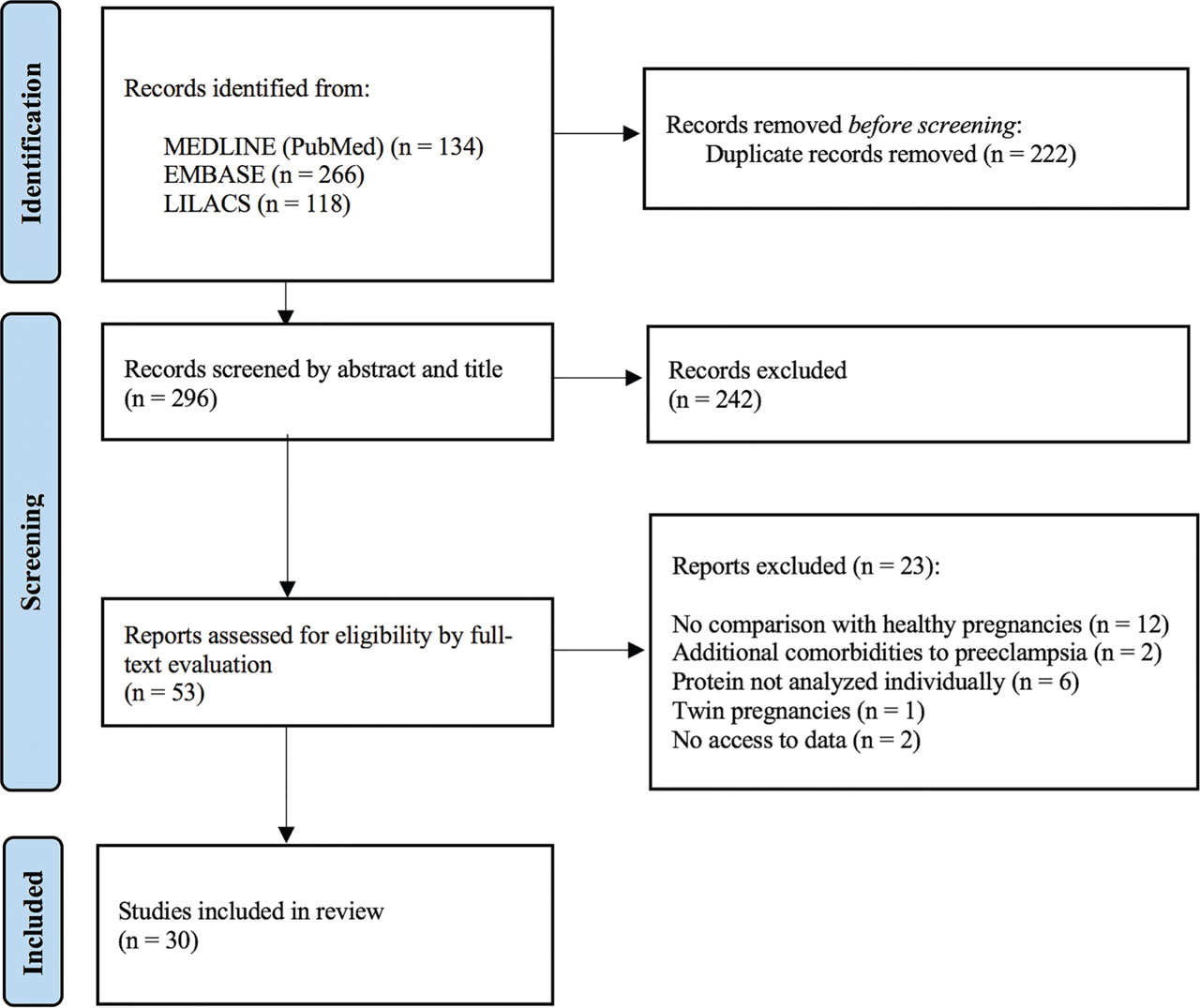
Figure 1.
Flow diagram of study selection.
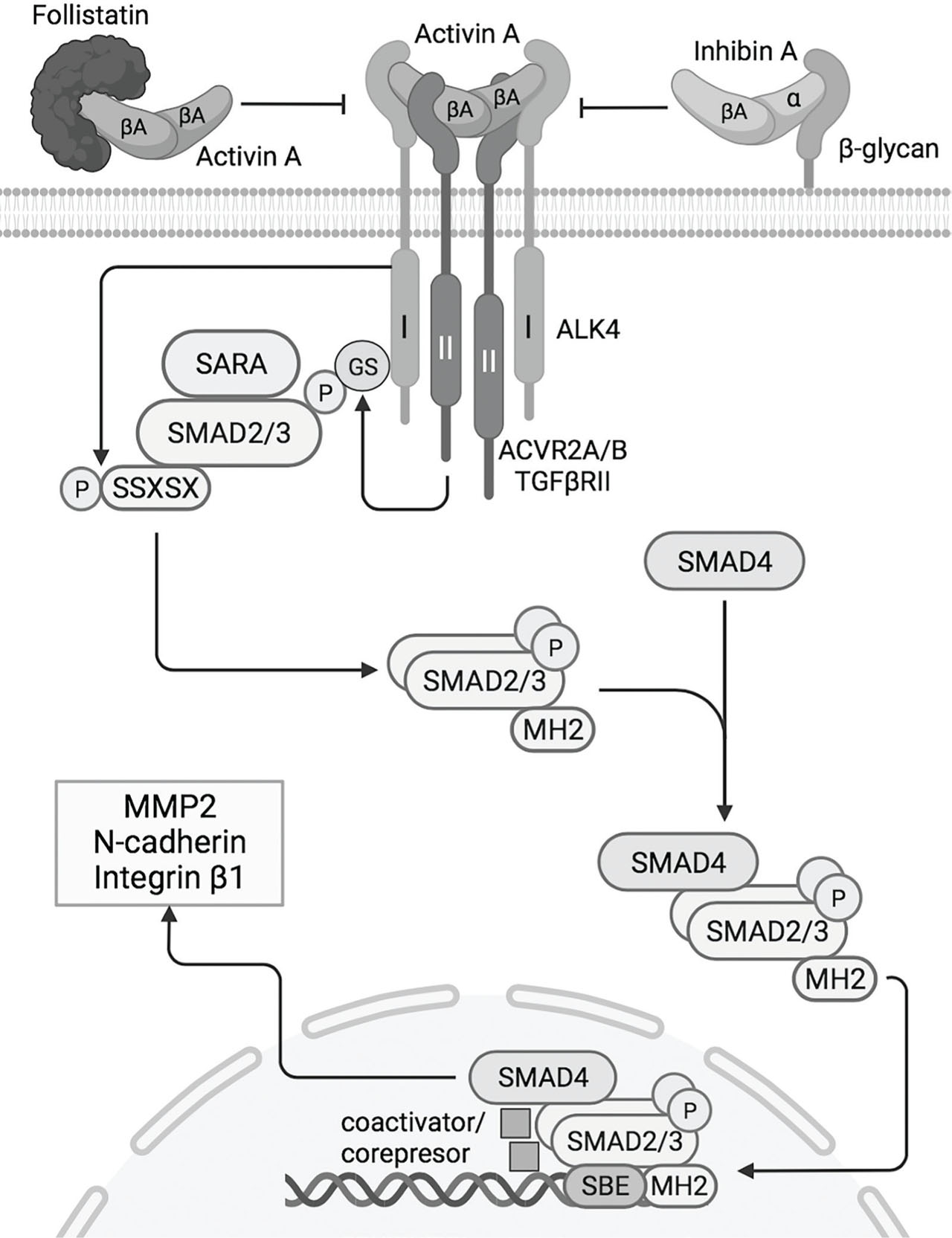
Figure 2.
Activin A canonical signalling pathway in the maternal-foetal interface. Activin binding enables receptor activation by acquiring a tetrameric conformation through ALK4 (TβR-I) interaction with one of the following TβR-II: ACVR2A, ACVR2B or TGFβRII [55]. Activated TβR-II phosphorylates the GS domains of ALK4, which then gain high affinity for the receptor-regulated SMAD proteins (SMAD2 and SMAD3) [56]. Facilitated by the auxiliary adaptor protein SARA, SMAD2 and SMAD3 are recruited in proximity to the kinase domains of ALK4 and, upon binding, they are phosphorylated on the SSXSX motifs [87]. Ser/Thr phosphorylation of receptor-SMADs induces dimerisation and exposure of the nuclear translocation region on their MH2 domain and augments their affinity for a Co-SMAD (SMAD-4) [87]. SMAD2/3-SMAD2/3-SMAD4 heterotrimers are then translocated to the nucleus and bind to specific DNA regions (SBE sequence) and transcriptional coactivators or corepressors [88]. Inhibin A binds to TβR-II through its βA subunit but blocks the phosphorylation of ALK4 by its α subunit, which binds to extracellular matrix β-glycans and block receptor tetramerization [88]. Follistatin-related proteins block ligand-receptor complex formation by binding activins. Abbreviations: TβR-I, type I subunit receptor; TβR-II, type II subunit receptor; ALK4, activin-like kinase 4; ACVR2A/B, activin receptor type 2A/B; TGFβRII, transforming growth factor-β receptor type 2; MMP2, matrix metalloproteinase 2. Source: own elaboration.