
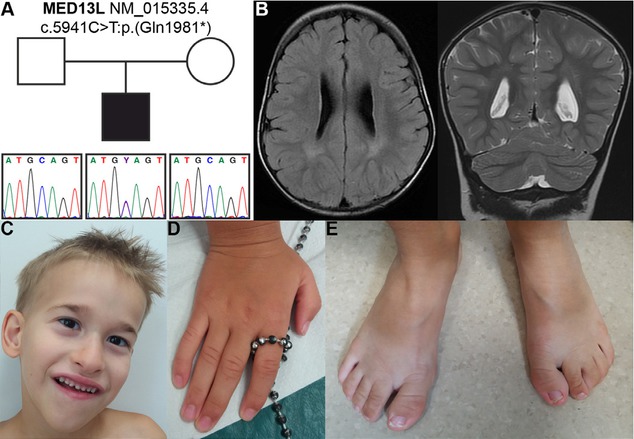
Figure S1
(A) Sanger sequencing confirmed the nonsense variant c.5941C>T in the patient. (B) Axial and coronal brain MRI showing terminal zones of unfinished myelination posteriorly and asymmetric ventricles as well as the Virchow-Robin spaces in the same location. (C) Facial features, (D) hands and (E) feet anomalies in patient at 7 years of age.
Table 1
Comparison of major clinical features and their frequency in patients with likely pathogenic variants in the MED13L gene and this study patient.
| Clinical feature | Number of patients | This study patient | |
|---|---|---|---|
| Clinical findings | ID or DD | 69/69 | +(severe ID and DD) |
| Speech delay | 68/69 | +(no speech) | |
| Hypotonia | 46/66 | +(axial hypotonia) | |
| Coordination problems | 20/60 | +(stereotypic movements, wide-based gait) | |
| Congenital heart defects | 12/64 | – | |
| Autistic features | 16/69 | – | |
| Abnormal brain MRI | 26/58 | +(lateral ventricles asymmetry, wider posterior part of the left ventricle) | |
| Seizures | 10/63 | – | |
| Behavioural problems | 16/51 | +(self-destructive behaviour – biting hands) | |
| Strabismus | 3/24 | +(convergent strabismus – esotropia) | |
| Dysmorphic features | Depressed/flat nasal bridge | 19/33 | +(flat nasal bridge) |
| Broad/prominent forehead | 16/21 | +(prominent frontal eminence) | |
| Bulbous nasal tip | 50/67 | + | |
| Upslanting palpebral fissures | 26/65 | +(slight epicanthic folds) | |
| Low seat ears | 17/33 | – | |
| Bitemporal narrowing | 8/33 | – | |
| Horizontal eyebrows | 7/33 | + | |
| Macrosomia | 14/33 | + | |
| Macroglossia | 9/33 | – |