Have a personal or library account? Click to login
Optical properties of accumulation mode, polluted mineral dust: effects of particle shape, hematite content and semi-external mixing with carbonaceous species Cover

Optical properties of accumulation mode, polluted mineral dust: effects of particle shape, hematite content and semi-external mixing with carbonaceous species

Open Access
|Jan 2012

Figures & Tables

Fig. 1. 

The pure mineral dust (shown with yellow sphere) mixed with the carbonaceous components like organic carbon (OC), brown carbon (BrC) and black carbon (BC) shown with pink, dark tan and black spheres, respectively (first column, top to bottom). Semi-externally mixed polluted mineral dust two-sphere and two-spheroid model shapes consisting of mineral dust with OC, BrC and BC, respectively (second and third columns, top to bottom). BrC mineral dust two-spheroid model shape has not been modelled as BrC occurs in spherical form. The three-sphere model shape of mineral dust with OC, BrC and BC, respectively (fourth column, top to bottom). Some of the three-sphere systems were modelled with fly-ash (shown with grey sphere) based on the experimental observations.
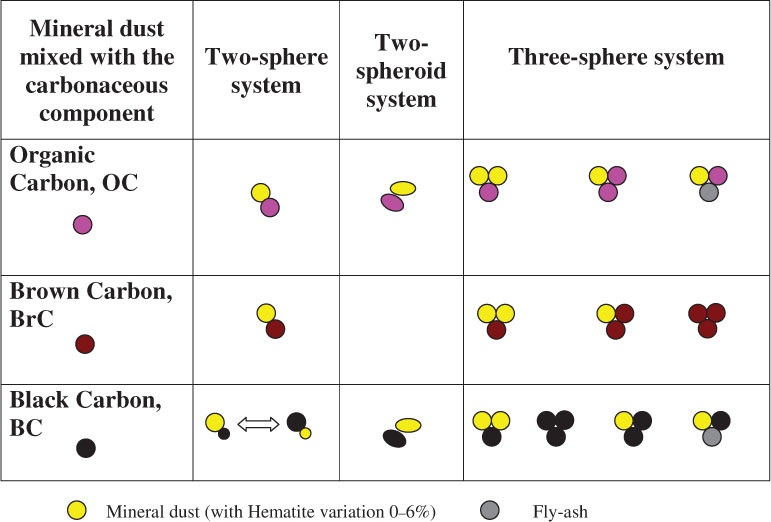
Table 1. The considered model shapes with their abbreviations

Shape abbreviations Interpretations OC Organic carbon sphere BrC Brown carbon sphere BC Black carbon sphere D′-4 Dust spheroid with 4% hematite content D′-6 Dust spheroid with 6% hematite content OCD-0 Organic carbon sphere attached to dust sphere with 0% hematite content OCD-6 Organic carbon sphere attached to dust sphere with 6% hematite content BrCD-0 Brown carbon sphere attached to dust sphere with 0% hematite content BrCD-6 Brown carbon sphere attached to dust sphere with 6% hematite content BCD′-0 Black carbon spheroid attached to dust spheroid with 0% hematite content BCD′-6 Black carbon spheroid attached to dust spheroid with 6% hematite content OCD′-0 Organic carbon spheroid attached to dust spheroid with 0% hematite content OCD′-6 Organic carbon spheroid attached to dust spheroid with 6% hematite content BCDF-0 Black carbon sphere attached to dust (with 0% hematite content) and fly-ash spheres BCDF-6 Black carbon sphere attached to dust (with 6% hematite content) and fly-ash spheres BCDD-0 Black carbon sphere attached to two dust spheres with 0% hematite content BCDD-6 Black carbon sphere attached to two dust spheres with 6% hematite content BCBCD-0 Two black carbon spheres attached to one dust sphere with 0% hematite content BCBCD-6 Two black carbon spheres attached to one dust sphere with 6% hematite content BCBCBC Three black carbon spheres attached to each other BrCBrCBrC Three brown carbon spheres attached to each other BrCDD-0 Brown carbon sphere attached to two dust spheres with 0% hematite content BrCDD-6 Brown carbon sphere attached to two dust spheres with 6% hematite content BrCBrCD-0 Two brown carbon spheres attached to one dust sphere with 0% hematite content BrCBrCD-6 Two brown carbon spheres attached to one dust sphere with 6% hematite content OCDF-0 Organic carbon sphere attached to dust (with 0% hematite content) and fly-ash spheres OCDF-6 Organic carbon sphere attached to dust (with 6% hematite content) and fly-ash spheres OCDD-0 Organic carbon sphere attached to two dust spheres with 0% hematite content OCDD-6 Organic carbon sphere attached to two dust spheres with 6% hematite content OCOCD-0 Two organic carbon spheres attached to one dust sphere with 0% hematite content OCOCD-6 Two organic carbon spheres attached to one dust sphere with 6% hematite content

Table 2. Optical constants (at λ=0.550 µm) of mineral dust component for varying hematite percentage obtained from Mishra and Tripathi (2008)

Composite particle component Hematite (%) NK Mineral dust 0 1.510 0.0001 2 1.540 0.0039 4 1.570 0.0080 6 1.600 0.0125

Table 3. Optical constants of carbonaceous components and fly-ash

Composite particle component Reference NKλ (µm) Organic carbon (OC) Dinar et al. (2008) 1.595 0.0490 0.532 Brown carbon (BrC) Alexander et al. (2008) 1.670 0.2700 0.550 Black carbon (BC) Hess et al. (1998) 1.750 0.4400 0.550 Fly-ash Liu and Swithenbank (1996) 1.500 0.0000 0.550
Fig. 2. 

The ω 0 of the BC-mineral dust two-sphere system for the effective volume equivalent radius of the two-sphere system with the varying hematite percentage in the mineral dust.
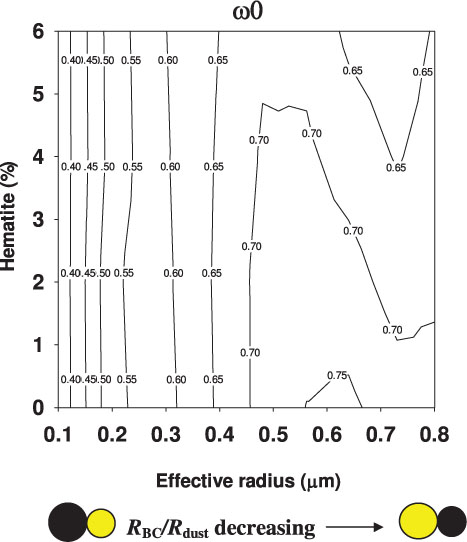
Fig. 3. 

The asymmetrical parameter, g, of the BC-mineral dust two-sphere system for the effective volume equivalent radius of the two-sphere system with the varying hematite percentage in the mineral dust.
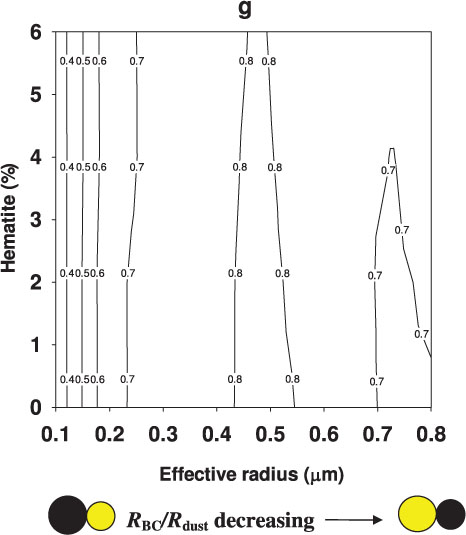
Fig. 4. 

The extinction efficiency, Q ext, of the BC-mineral dust two-sphere system for the effective volume equivalent radius of the two-sphere system with the varying hematite percentage in the mineral dust.
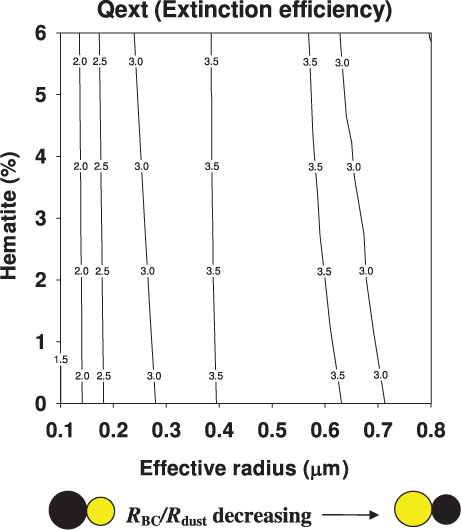
Fig. 5. 

The ω 0 of the two-sphere OC-dust, BrC-dust and two-spheroid OC-dust, BC-dust systems for the effective volume equivalent radius. The two-sphere OC-dust and BrC-dust systems are denoted as OCD and BrCD, respectively, while the two-spheroid systems OC-dust and BC-dust are denoted as OCD′ and BCD′, respectively. Each above-mentioned nomenclature is followed by the hematite percentage. The two-sphere/spheroid systems are compared with that of homogeneous spheres of organic carbon (OC), brown carbon (BrC), black carbon (BC) and dust with 4% hematite (D′-4).
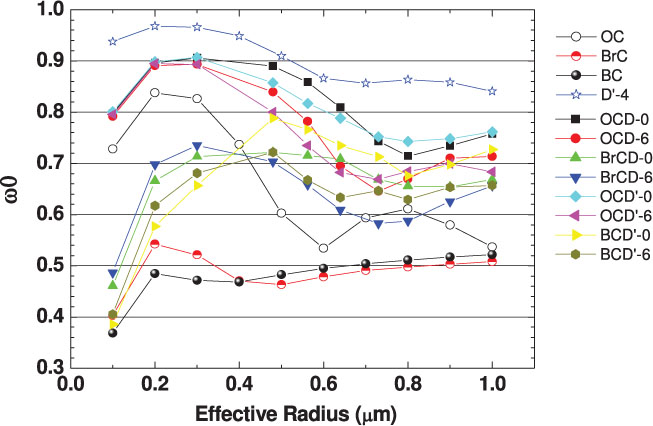
Fig. 6. 

The asymmetrical parameter, g, for all the particle systems discussed in Fig. 5.
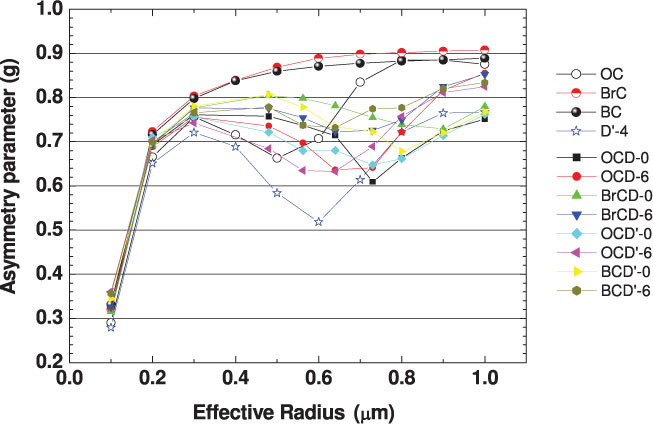
Fig. 7. 

The extinction efficiency, Q ext, for all the particle systems discussed in Fig. 5.
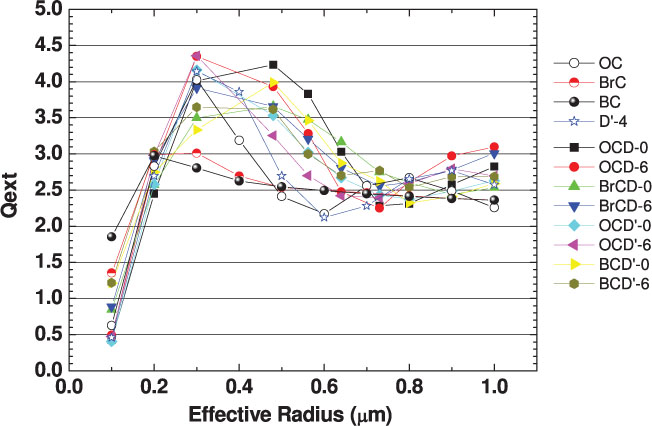
Fig. 8. 

The ω 0 of the three-sphere OC-dust-fly-ash, OC-dust, BrC-dust; three-sphere BrC, BC-dust-fly-ash, BC-dust and three-sphere BC systems for the effective volume equivalent radius. The OC-dust-fly-ash and OC-dust systems are denoted as OCDF, OCDD and OCOCD, respectively. The BrC-dust and BrC three-sphere systems are denoted as BrCBrCD, BrCDD and BrCBrCBrC, respectively. The BC-dust-fly-ash, BC-dust and BC three-sphere systems are denoted as BCDF, BCDD, BCBCD and BCBCBC, respectively. Each above-mentioned nomenclature is followed by the hematite percentage. The three-sphere systems are compared with that of homogeneous spheres of organic carbon (OC), brown carbon (BrC), black carbon (BC) and dust with 4% hematite (D′-4).
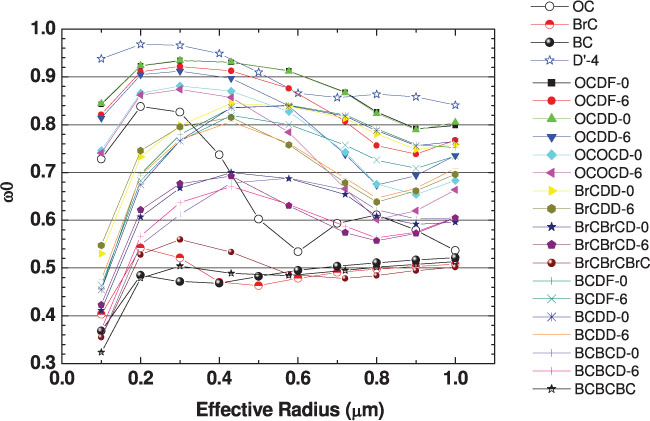
Fig. 9. 

The asymmetrical parameter, g, for all the particle systems discussed in Fig. 8.
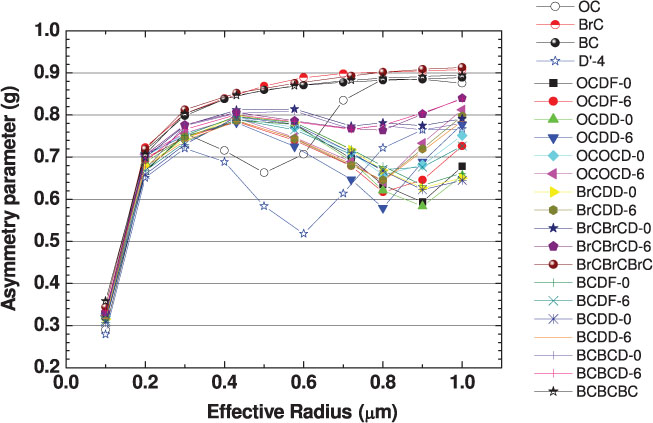
Fig. 10. 

The extinction efficiency, Q ext, for all the particle systems discussed in Fig. 8.
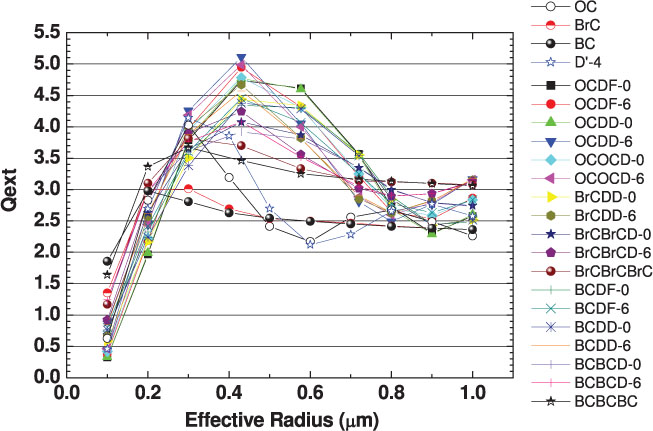
Table 4. The size-averaged optical properties of single-sphere, two-sphere, two-spheroid and three-sphere systems for 0 and 6% hematite and their percentage deviation compared to that of D′-4 and D′-6. The radius of individual sphere/spheroid is same for the considered dust systems

Percentage of deviation in ω0 Percentage of deviation in Qext Shape ω0Qext Compared to D′-4 Compared to D′-6 Compared to D′-4 Compared to D′-6 OC 0.7454 2.3917 – – – – BrC 0.4929 2.4611 – – – – BC 0.4631 2.5397 – – – – D′-4 0.9423 2.4545 – – – – D′-6 0.9125 2.4741 – – – – OCD-0 0.8841 2.7596 6 3 12 12 OCD-6 0.8546 2.8219 9 6 15 14 BrCD-0 0.6843 2.6578 27 25 8 7 BrCD-6 0.6860 2.8015 27 25 14 13 BCD′-0 0.6642 2.8292 29 27 15 14 BCD′-6 0.6460 2.8465 31 29 16 15 OCD′-0 0.8727 2.5972 7 4 6 5 OCD′-6 0.8444 2.6667 10 8 9 8 BCDF-0 0.7666 2.7443 19 16 12 11 BCDF-6 0.7461 2.7937 21 18 14 13 BCDD-0 0.7587 2.7088 19 17 10 9 BCDD-6 0.7374 2.9022 22 19 18 17 BCBCD-0 0.5965 2.9193 37 35 19 18 BCBCD-6 0.5976 2.9613 37 35 21 20 BCBCBC 0.4669 3.0019 50 49 22 21 BrCBrCBrC 0.5133 2.8894 46 44 18 17 BrCDD-0 0.7909 2.6794 16 13 9 8 BrCDD-6 0.7673 2.8813 19 16 17 16 BrCBrCD-0 0.6428 2.7867 32 30 14 13 BrCBrCD-6 0.6384 2.8948 32 30 18 17 OCDF-0 0.9210 2.6851 2 1 9 9 OCDF-6 0.9015 2.8016 4 1 14 13 OCDD-0 0.9213 2.7001 2 1 10 9 OCDD-6 0.8864 2.9339 6 3 20 19 OCOCD-0 0.8554 2.7850 9 6 13 13 OCOCD-6 0.8415 2.9050 11 8 18 17

Table 5. The size-averaged optical properties of BC-dust two-sphere system (with varying radii of individual spheres) for hematite range of 0–6% and their percentage deviation compared to that of D′-4 and D′-6

Percentage of deviation in ω0 Percentage of deviation in Qext Hematite (%) ω0Qext Compared to D′-4 Compared to D′-6 Compared to D′-4 Compared to D′-6 0 0.6079 2.8621 35 33 17 16 2 0.606 2.8712 36 34 17 16 4 0.5944 2.8771 37 35 17 16 6 0.5877 2.8805 38 36 17 16
Fig. 11. 

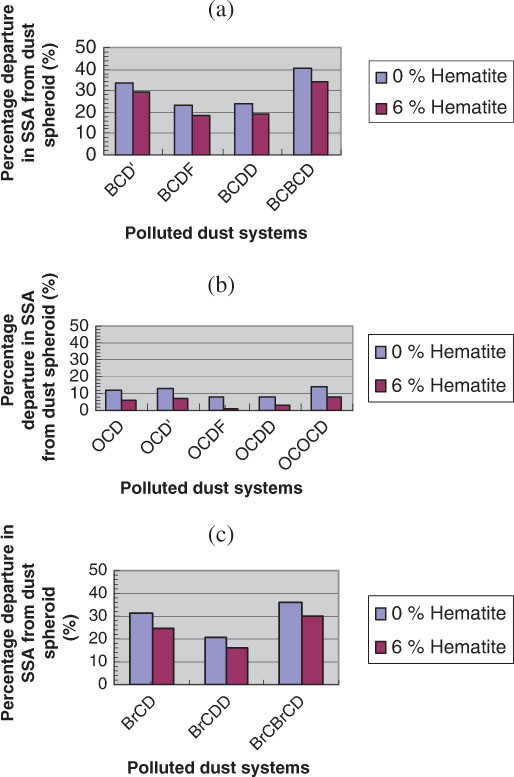
The absolute departure in size-averaged ω 0 for the polluted dust systems formed due to semi-external mixing of accumulation mode mineral dust with (a) BC (b) OC and (c) BrC have been shown compared to pure dust spheroid with 0 (D′-0) and 6% (D′-6) hematite.
Language: English
Page range: 18536 - 18536
Submitted on: Sep 22, 2011
Published on: Jan 1, 2012
Published by: Stockholm University Press
In partnership with: Paradigm Publishing Services

© 2012 S. K. Mishra, S. N. Tripathi, Shankar G. Aggarwal, Anti Arola, published by Stockholm University Press
This work is licensed under the Creative Commons Attribution 4.0 License.