
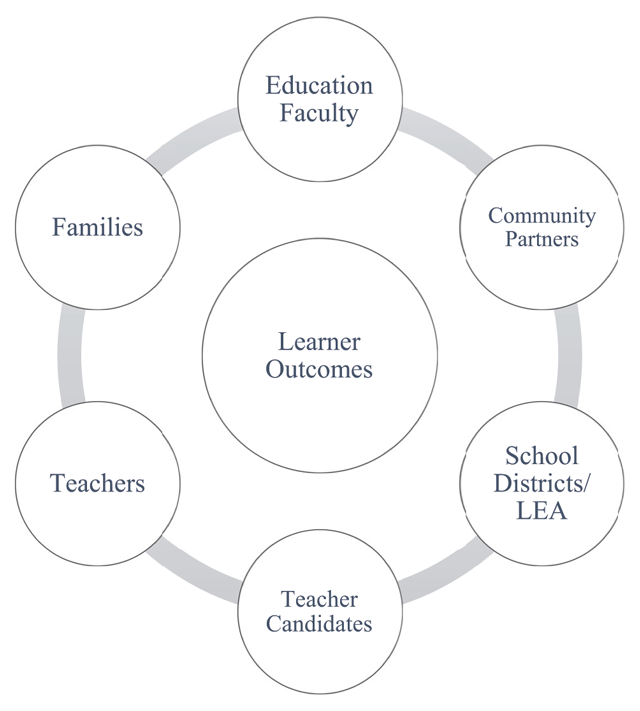
Figure 1
Inclusive teaming centered on learner outcomes.
Table 1
Example of Collaborative Discussions Related to the Key Questions Teams Should Consider.
| Key Questions | Examples of Collaborative Discussions and Decisions |
|---|---|
| Who will be involved in the collaboration? | The director for the Center for Clinical Practice in Education at the institution of higher education and the principal at the partnering school are the first to meet. In addition to their ongoing participation, they identify that one faculty member from the institution of higher education, one teacher from the school, and two community partners who are parents of children in the school will be core leaders in the collaboration. Last, they identify that two other faculty members will be involved, five other teachers, two related service providers, and up to 10 teacher candidates from the institution of higher education. |
| What will be the extent of the collaboration? | Teacher candidates and teachers will co-teach two full days per week. Co-teachers will use multiple co-teaching structures (e.g., one teaches, one observes; parallel teaching; team teaching) daily to deliver instruction to the students and support the development of knowledge and skills in the teacher candidates. The lead faculty member and teacher will co-facilitate a seminar weekly that includes the school’s teachers and teacher candidates. Seminars will be culturally and contextually relevant for the school and community and support the development of new knowledge and skills for all involved. Once per semester, the teacher candidates will organize and implement a family outreach event, where students and their families come to the school for an extramural learning activity. In addition, twice per year, faculty and trained teacher candidates from the institution of higher education will assist with the screening of preschool and kindergarten students. |
| What outcomes does the team expect from the collaborative efforts? | The team aims to increase teacher candidates’ knowledge and skills regarding inclusive practices, co-teaching structures, and effective approaches to instruction. The team also aims to increase teacher and teacher candidates’ confidence and abilities in teaching all students in inclusive environments. The team hopes to see enhanced child outcomes, family engagement, and teachers who desire to remain at the school teaching in inclusive settings for multiple years. |
| What is the importance of these outcomes for the children and their families? | Children and families will benefit from the collaborative teaming, shared expertise, and additional resources available because of the simultaneous renewal approach to teaming. Children will also benefit from the smaller teacher-to-student ratios on the days in which teachers and teacher candidates co-teach together and the extra individualized instruction they receive through this co-teaching. The co-teaching structures, combined with weekly seminars, and assistance in screening all children will promote the identification of learning needs and implementation of effective instruction to meet the needs of all children within inclusive environments. |
| What inter-organizational supports are needed for the success of the collaborative efforts? | The lead faculty member must be supported with a course release each semester, so they have time to come to the school to observe teacher candidates, co-facilitate seminars, and engage in the school’s outreach activities. No more than two teacher candidates will be placed with each teacher; the total number of candidates placed at the school will be dependent on the number of teachers who are willing to provide mentorship to teacher candidates and engage in a co-teaching form of instruction with teacher candidates two days per week. The school leader will submit seminars to state authorities for approval so teachers receive Continuing Education Units for their participation in the weekly seminars. |
| How will the team measure whether the targeted outcomes have been achieved? | The core leaders will meet once every other month to discuss the collaborative activities and the extent to which progress has been made toward the targeted outcomes. The team chooses to use primarily informal measures of data collection such as observation of teacher candidates and teachers in the classroom, reflections from teachers and teacher candidates, the number of joint seminars held, and family engagement in school activities. Some formal measures of data collection will include measures of child learning and teacher retention at the school and evaluations of teacher candidates’ practice. |
| To what extent is the partnership meeting the individual needs of each partnering organization? | Three times per year, the core leadership team reviews the informal and formal data collected and evaluates the extent to which they show progress toward meeting a targeted outcome. The team discusses outcomes related to those that are priorities for each organization to ensure that simultaneous renewal is occurring for all stakeholders. |