
Critics often frame community-based participatory research (CBPR) as a model of collaboration that aspires to equality and mutual benefit. In practice, such partnerships unfold within entrenched power relations that shape the collaboration. Our CBPR project, Refugee States, emerged in response to these tensions. Conceived from frustration with compulsory state structures that compel refugees to share their stories for authentication, the project instead seeks to create conditions for refugees to narrate their experiences on their own terms and for their own purposes. This involves questioning the limits of legal definitions of “refugee” and scrutinizing how settler-colonial nation-states categorize people into restrictive binaries—refugee/migrant, legal/illegal—that obscure the complexity of coercive and forced migration (Luibhéid, 2008; Macklin, 2005).
The project brought together two universities and two community organizations in the Greater Toronto Area and Montreal that serve queer, trans, and racialized refugees. Together, we aimed to co-create a counter-archive of oral histories and digital stories that challenge dominant narratives of displacement. Our commitment was grounded in reciprocity and shared authority, through building digital and oral history skills among community members, supporting community organizations in their own program development, and interrogating how power circulates within and across the institutions involved in this work.
Yet, building this partnership required confronting the very power differentials we sought to address. These dynamics arose not only between universities and community organizations, but also within the research team itself—across ranks, roles, and social locations. In this article, we reflect on the Refugee States project as a case study in navigating these challenges. We argue that ethical CBPR practice requires making power differentials transparent rather than assuming they can be neutralized. By tracing our process of relationship-building, governance design, and decision-making, we show how attention to positionality and accountability can foster more equitable forms of collaboration.
We begin by outlining the theoretical lens through which we understand power and critically reflecting on our positionalities within these power structures. We then describe the process of building relationships with community partners, the governance model we developed to navigate institutional constraints, and conclude with reflections on lessons that might guide future CBPR collaborations.
Conceptualizing Power in Community-Based Participatory Research
Power in CBPR is neither singular nor static. It circulates across structural, interpersonal, and epistemic levels, shaping collaboration, decision-making, and who benefits from research. Understanding these dynamics is crucial for situating CBPR within the larger context of community-university partnerships, which are often idealized as sites of equality but, in practice, are structured by longstanding hierarchies. According to Wallerstein et al. (2019), power within CBPR is situated both within the broader socio-historical context that shapes universities. In addition, university-based research projects must navigate power dynamics imbricated into the partnering processes between researchers and community partners. For university-affiliated individuals (e.g., professors, students, etc.), the forms of social and institutional power that they hold are intimately shaped by their positionality within the university, as well as their social location (Andress et al., 2020).
Indeed, universities are not neutral sites of knowledge, but institutions shaped by neoliberal imperatives and entrenched histories of exclusion. They reproduce racial, gendered, sexual, ableist, and colonial forms of violence (Ahmed, 2021; Bilge, 2020; Monture, 2010). In the Canadian context, universities have been central to settler colonial conquest and to British and French imperial projects (Bannerji, 2011; Simpson, 2014), producing and circulating scientific racism and homophobic discourses that justified the genocide of Indigenous peoples, the enslavement of Black peoples, the indenture of Asian peoples, and the oppression of queer and trans communities (McLaren, 1990; Nelson & Student Authors, 2020; Simpson, 2014; Simpson, 2017; Thobani, 2007). At the same time, oppressed communities have also always found ways to organize and resist racialized and gendered forms of colonial violence within and outside of the university (Wallerstein et al., 2019).
This broader context has shaped the epistemic injustice (Fricker, 2007) faced by Black, Indigenous, and other racialized communities whose knowledges have often gone unrecognized and delegitimized. Beyond this lack of recognition, epistemic injustice is related to “process and output … when the relevant input of some individual or group is obstructed, either by interpersonal or structural forces, the consequences can, and often do, constitute other types of harms as well” (Clairmont et al., 2025, p. 4). For example, universities privilege professional, written, and academic knowledge over lived experience, cultural expertise, and oral traditions. Community expertise is often invited but marginalized or treated as supplementary.
These structural logics persist through university ties to state and corporate institutions, reproducing systemic harm and prioritizing efficiency and risk management over relational, community-centered work (Bailey, 2021; Mbembe, 2016). The university’s Research Ethics Board (REB) exemplifies this dynamic: while designed to minimize harm to participants, it primarily safeguards the institution, imposing rigid timelines, data requirements, and digital preservation policies that can conflict with CBPR principles (Bradley, 2007; Guta et al., 2010; Loewen Walker & Hartman, 2022; Tuck & Guishard, 2013). At the same time, universities provide significant resources and expertise—such as technological infrastructure, IT, and library support—that can enhance project outcomes. Negotiating these benefits while preserving community sovereignty requires creative solutions. The parameters of internal partnership processes for CBPR are also established by principal investigators (PIs) of research projects (Wallerstein et al., 2019). These processes make explicit “how communicative practices, collaborative structures, and negotiation between PIs and community leaders can challenge oppressions and create space to make community knowledge visible” (Wallerstein et al., 2019, p.21).
In addition, structural dynamics manifest in day-to-day relationships within the university structure based on individual positionalities. Within research projects, differences in institutional rank, job security, and social location structure authority and responsibility. Senior faculty hold ultimate accountability to the university and funders, while early-career researchers, graduate assistants, and staff coordinators carry the bulk of day-to-day labor under precarious conditions. These imbalances risk generating tensions over decision-making, responsibility, and recognition.
Community organizations are also situated within this broader socio-historical context, which shapes the positionalities of individuals within each organization. While they are often positioned as conduits for community voice, they carry their own internal hierarchies, governance structures, and resource constraints. Staff, volunteers, and leadership may have differing authority, access to resources, and decision-making power, which shapes whose perspectives guide project priorities and whose labor is most valued. Resource limitations or funding pressures can constrain the ability of organizations to participate fully in research, sometimes reproducing inequities even within projects designed to empower communities (Fuentes-Bernal et al., 2021; Morton Ninomiya & Pollock, 2017). CBPR therefore requires attention not only to university-driven structures but also to the structural dynamics within partner organizations.
Power dynamics within community organizations similarly affect interpersonal relationships in CBPR. Internal hierarchies and governance norms shape who participates in decision-making, whose knowledge is valued, and how responsibilities are distributed. For example, organizational leaders may prioritize institutional mandates or funder requirements, while frontline staff or volunteers may hold closer connections to the communities themselves. Recognizing these dynamics is essential to prevent CBPR projects from unintentionally reproducing inequities within the communities they aim to serve. Practices such as participatory governance, transparent decision-making, and resource-sharing within partner organizations can help mitigate these internal power asymmetries.
Challenging or Transforming Power Dynamics in CBPR
Scholars note that reciprocity is one way to reconfigure research relationships, shifting them from transactional to more equitable and sustainable forms of knowledge building (Godderis & Root, 2023; Malm et al., 2012). Many collectives and organizations have articulated models of accountability that move beyond university-driven frameworks. For instance, the First Nations Information Governance Centre developed the OCAP principles (Ownership, Control, Access, and Possession) to hold researchers accountable in work with Indigenous communities (FNIGC, 2007). Similarly, the BEAR approach (Akom, 2011), used by a Quebec Black-led collective, offers a community accountability model for health data collection (Boatswain-Kyte et al., 2022). Ethical models developed for queer and trans communities stress the importance of intersectional approaches that honor how “communities define and shape their own knowledges, in ways that accord with their sense of being and place in the world” (Henrickson et al., 2020, p. 9).
Decolonial participatory action research methodologies also push back against the over-reliance on university ethics boards. Tuck & Guishard (2013) argue that without robust, community-driven ethical reflection, academic institutions risk reproducing settler colonial projects under the guise of “scientific” research. They propose, instead, that ethics be anchored in reflexivity, the recognition of multiple forms of expertise, embodied humility, and the cultivation of dignity.
At the level of project design, research on CBPR underscores the importance of explicitly addressing power dynamics within partnerships. Studies highlight the value of reflexive positionality (Muhammad et al., 2015; Ruhland et al., 2023), relational trust-building (Wallerstein et al., 2019), and governance structures that institutionalize co-leadership, transparency, and resource-sharing (Sanchez-Youngman et al., 2021). Yet, these studies also caution that advisory boards or consultative bodies can fall short of meaningful participation (Morin et al., 2003; Newman et al., 2011). Moreover, as Fuentes-Bernal et al. (2021) and Morton Ninomiya and Pollock (2017) remind us, the uneven distribution of intellectual and emotional labor can directly burden impacted community members, raising questions about whether university- and funder-driven projects materially benefit the communities they claim to serve.
Ultimately, as Janes (2016) notes, there are no “innocent” research practices: all knowledge workers are enmeshed in relations of power. The challenge for CBPR is therefore not to imagine a space beyond power, but to engage these dynamics reflexively, and to build structures that redistribute authority, sustain reciprocity, and uphold accountability to communities.
The Refugee States project illustrates these dynamics in practice. By foregrounding community and refugee expertise, implementing shared authority, and negotiating transparent governance structures, we sought to align research with CBPR principles while confronting persistent university- and organization-driven power hierarchies. These experiences underscore that CBPR does not entail a naïve “sharing of power,” but instead requires active, reflexive management of structural, interpersonal, and epistemic dynamics, ensuring equitable distribution of responsibilities, recognition of contributions, and responsiveness to community priorities. For this article, we highlight the perspectives of the Refugee States coordination team members and thus provide a partial accounting of how we address power dynamics, relationship-building, and governance within our CBPR project.
Refugee States: Positionalities and Relationship-Building
This section shares our project objectives, the positionalities of the various coordination team members, as well as some key institutional constraints we encountered. Subsequently, we explore the ways in which the coordination team attempted to re-envision the governance structure through an in-depth relationship-building process.
The Refugee States project was based at two universities in Montreal and the Greater Toronto Area, in partnership with two community organizations serving systemically marginalized migrant and racialized communities. Its research team included faculty researchers, community partners, graduate students, research assistants, postdoctoral fellows, and project staff. The project’s main objectives were to: co-develop, with community partners, ethical policies for partnered research; build community capacity through collaborative training, including peer researcher skill development; and create a refugee counter-archive through oral histories and digital stories.
Coordination Team Member Positionalities
The co-authors of this article served on the Coordination Team during the project’s first phase, holding roles ranging from postdoctoral fellow and project coordinator to research assistant and faculty co-director. Team members brought diverse social locations, including racialized identities, refugee or intergenerational migration experience, and membership in queer and trans migrant and racialized communities. Both project co-directors are also racialized with family histories shaped by forced migration, with one also belonging to the queer and trans community.
Within the Coordination Team, university hierarchies also shaped individual positionalities: members varied in access to resources and influence, with co-directors holding greater authority, while graduate research assistants and independent scholars occupied more precarious positions. To attend to these asymmetries meant making power visible by clarifying roles and creating governance structures that acknowledged differences in status and responsibility.
These positionalities shaped how the team engaged with project objectives and methods. For example, the design of the refugee counter-archive drew on team members’ lived experiences to ensure that oral histories and digital stories reflected participants’ perspectives while remaining compatible with institutional protocols. Similarly, knowledge of migration-related networks informed the structure of collaborative trainings, enabling peer researchers to engage meaningfully with ethical and culturally sensitive research practices.
Team positionalities also guided governance adaptations and consultation strategies. The varied institutional roles and experiences of the Coordination Team shaped how responsibilities were distributed, how decisions were negotiated with community partners, and how ethical considerations were foregrounded in project design. These insights illustrate that positionality is not merely descriptive: it actively informs the practical and methodological dimensions of CBPR, influencing how objectives are pursued, how knowledge is co-produced, and how relationships with community partners are cultivated.
Coordination Team members’ racialized identities, lived experience as refugees or as children of migrants, and their queer and/or trans identities influenced both trust-building with community partners and vulnerability to institutional violence. These dynamics also illuminate a broader pattern: racialized researchers often navigate a double bind, balancing institutional precarity with heightened community expectations, while white colleagues may encounter fewer barriers within university structures but more difficulty establishing community credibility. This is particularly the case for research about racialized communities.
Rethinking Governance Models through Relationship-Building
Upon receiving funding, the co-directors decided to deliberately slow the pace of the project during its first year. They drew from their previous research experiences, which included previous tensions and challenges in relation to the CBPR governance structure. Typically, funded research projects are expected to begin data collection within the first three months following university ethics approval. Because this project was supported by a fund designated for community-based research, the co-directors had the flexibility to delay ethics submission. We delayed submission in order to initiate a series of consultations with our community partners and academic researchers affiliated with the broader Critical Refugee and Migration Studies Network (CRMS). During this period, we collaboratively assigned day-to-day coordination responsibilities, taking into account each team member’s expertise, capacity, and existing workload.
A few months into the project, the co-directors organized a retreat to strengthen relationships among the research team and community partners. The retreat provided space for partners to engage directly with one another and with academic researchers, and to reflect on the project’s pace and structure. These process-oriented adjustments were guided by an awareness of power differences among partners and within the team, ensuring that collaboration, decision-making, and responsibilities were distributed in ways that accounted for both institutional constraints and team capacities. By dedicating time to relational work and reflection, the team reinforced that meaningful collaboration requires ongoing attention to interpersonal dynamics and practical equity in project coordination.
These differentials are manifest in terms of the nature of organizations, how long they have been established, their size and access to resources, and their capacity to mobilize community members and influence. Instead of naively disregarding these differentials, we sought to acknowledge them and to establish an equitable governance model that transparently frames the ways each stakeholder approaches collaboration, the labor that it entails, and processes for consultation and decision-making that honor reciprocity. Rather than proceed as though power differentials did not exist, we sought to understand how they informed our project design.
We immediately began addressing issues of power by being transparent about the power differentials that structured relationships between collaborators. At the time, in addition to the co-directors, the Coordination Team included a postdoctoral fellow, research coordinators, and graduate student research assistants. These individuals were also being supervised by one of the co-directors for their (post) graduate studies. Therefore, co-directors had to account for the possible impacts that the supervisor-supervisee asymmetrical power dynamic could have on Refugee States coordination. For example, consultation was used to manage expectations and avoid overburdening junior team members by sacrificing their own studies for the research project. Subsequently, the Coordination Team maintained this commitment to transparency, accountability, and respect for collaborator responsibilities beyond the project as they organized a series of site-specific consultations in collaboration with each community partner to further flesh out community priorities, needs, and capacities.
During these consultations, the research team shared the project objectives and timeline with community partners and then revised them collaboratively, demonstrating that CBPR requires flexibility and responsiveness to community priorities. We discussed key principles of community-based research, introduced the OCAP principles (FNIGC, 2007) as a framework for Indigenous research, and explored their relevance for queer, trans, and refugee communities. One co-director recounted a prior experience with a mostly white research team that had made unilateral decisions, undermining a racialized queer and trans advisory committee (Fuentes-Bernal et al., 2021). This discussion highlighted the importance of designing governance processes that prevent harm and center community authority.
We also explored differing understandings of “community,” the limits of organizational representation, and whose voices were missing. We addressed practical constraints, such as cross-site bilingual collaboration and university regulations, so community partners could actively shape decisions within real-world limitations.
A three-day cross-site consultation in Montreal deepened these commitments. The team ran workshops on solidarity with Indigenous communities, anti-Black racism, queer and trans affirmative practices, and global anti-colonial perspectives (Henrickson et al., 2020). We facilitated discussions on archiving, including who should hold oral histories and digital stories. These conversations revealed varying capacities and preferences: while the team initially proposed a post-custodial approach (Bastian, 2002; Caswell, 2014), one partner preferred a university-held archive to leverage institutional longevity and visibility. We also incorporated options for participants to retain full control over their stories, allowing individuals to decide whether or not to contribute to the archive.
We addressed the risks of “damage-centered” research (Tuck, 2009) and implemented trauma-informed practices that allowed participants to share the stories they valued without being confined to narratives of suffering. Community partners requested certificates of completion for peer researchers, prompting the team to reconcile ethical commitments with practical recognition, even amid slow institutional timelines.
These consultations show that CBPR requires ongoing negotiation of ethics, authority, and collaboration. Importantly, Refugee States is shaped by aligning the pace of research with the temporality of relationship building rather than superimposed institutional deadlines, operating at what adrienne maree brown (2017) calls the “speed of trust.” This purposeful pace is about slowing down in order “to nurture relationships before trust is established” (Bailey, 2021, p. 292). In this project, this meant sharing time and space regularly through monthly site-specific meetings and annual retreats with scholars and community organizations from both cities. Sharing time and space presented opportunities to strengthen a sense of community through, for example, shaping schedules to make time for religious observances; academic resource-sharing through workshops about community archiving possibilities beyond Refugee States; and community organizations teaching about their oral archiving practices.
Early, intentional engagement shaped project design, governance, and methodology in ways that respected participant agency and addressed structural constraints (Fuentes-Bernal et al., 2021; Morton Ninomiya & Pollock, 2017). For example, although one community partner initially considered a university-held archive for its visibility and resources, full consideration of restrictive policies revealed that this approach would limit participant control over oral histories and digital stories. The team responded by creating a project archive outside the university, ensuring participants could maintain ownership, control, access, and possession of their contributions (Bastian, 2002; Caswell, 2014).
Transforming the Project Governance Model
In developing the governance model for Refugee States, we sought to address the hierarchical power dynamics of academia as it manifested within and beyond the Coordination Team. Two events, in particular, pushed us to significantly modify the project’s governance model to account for the complex power dynamics of decision-making within a CBPR project. The first event occurred near the beginning of the project as the Coordination Team worked to plan site-specific consultations. As we tried to divide tasks and responsibilities, one of the junior members of the team expressed frustration that they did not know what all members of the team “do.” This incident revealed that the initial ad hoc approach to decision-making was disempowering for junior colleagues, who were confused about the domains of their responsibilities and the scope of their (limited) authority. It spoke to the necessity for the Team to clarify the roles, responsibilities, and expectations of each member to avoid miscommunication and exploitation. The co-directors encouraged openness and dialogue, emphasizing that identifying challenges would not jeopardize team members’ positions, institutional standing, or academic trajectories, despite the co-directors also serving as their supervisors.
The second event occurred during the process of visually representing the project’s governance model. As consultations took place, the Coordination Team sought to document and refine decision-making processes within and between Refugee States’ different components. Our efforts were directed at revisiting and nuancing the original governance model proposed within the project grant application, which envisioned a non-hierarchical, democratic, and consensus-based decision-making process. During Coordination Team meetings, members emphasized valuing the diverse knowledge and expertise each collaborator contributed, rejecting hierarchical notions of knowledge—a principle central to the project. We also continued our discussion of power disparities and differing positionalities. Following these conversations, a junior member of the Coordination Team created a visualization of the project’s governance structure. To reflect the team’s commitment to valuing all collaborators, the initial diagram did not indicate differences in decision-making authority. Later, another junior scholar revised the diagram, replacing the circular, table-like form of the Coordination Team (then called the “Committee”) with a clearly hierarchical model that positioned the co-directors at the top (see Figure 1). This shift revealed an important insight: even well-intentioned representations of governance can unintentionally reproduce existing hierarchies, making visible the concentration of authority and the potential influence of structural power on team interactions. This experience underscored the necessity of ongoing reflexivity and dialogue to ensure that visualizations, like other project practices, align with the principles of shared authority and equitable participation.
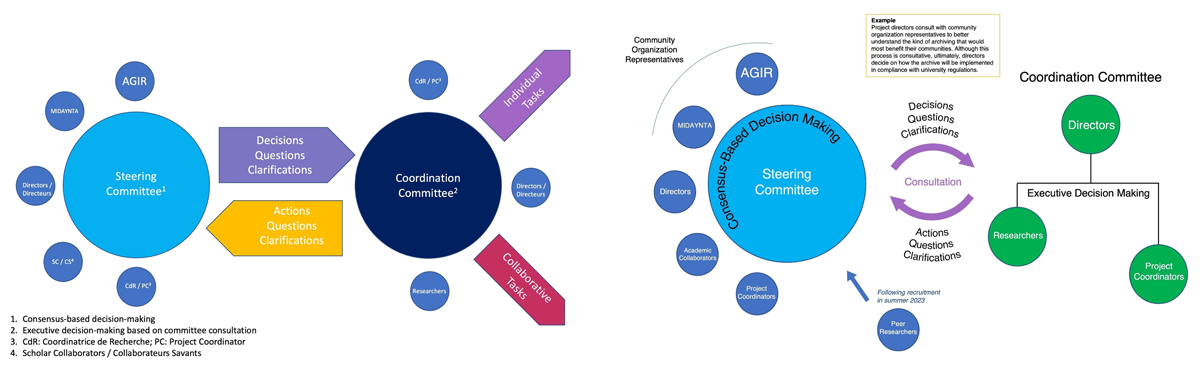
Figure 1
First and Second Governance Model Visualizations.
The stark contrast between the earlier horizontal and later vertical models brought an uncomfortable issue to light: the need to explicitly address and account for power differences. Importantly, this insight came from the most junior and precarious team members, who experienced these disparities most acutely. For instance, although the team regularly consulted on agenda items, co-directors sometimes made decisions independently, leaving the relationship between consultation and decision-making unclear. While power imbalances cannot be fully erased given the structural conditions of the university, we sought to manage them by making these dynamics visible and developing systematic ways to account for authority. Through iterative consultations, visuals, text, and oral presentations, we worked to render the unspoken and unseen dynamics of power both audible and visible.
In discussions, the co-directors also reflected on the challenges they faced in applying their knowledge of university operations from their vantage point as racialized, tenured professors. For example, they noted that research funding structures are closely tied to university employment status, meaning that co-directors are accountable not only for disbursing resources but also for any actions by the Coordination Team that the university might label as “too risky.” By naming this tension, the team highlighted how institutional definitions of risk shape decision-making and reinforce hierarchies within CBPR projects. These sometimes uncomfortable conversations were necessary to foreground and address the constraints on consensus-based decision-making practices in CBPR imposed by the university and funding bodies. Our frank conversations clarified why we had been provisionally deploying a mixture of consultative and executive-based decision-making processes within the project’s first phase. They led us to articulate what we had been doing as a consultative process, whereby the co-directors committed to seeking the perspectives of all team members while recognizing that most decisions required the co-directors’ authorization. In the final visualization, we replaced the hierarchical design with one that depicts the power and responsibility of the co-directors by placing them at the center of the circle, surrounded by other team members to indicate our commitment to valuing all collaborators’ knowledge (see Figure 2).
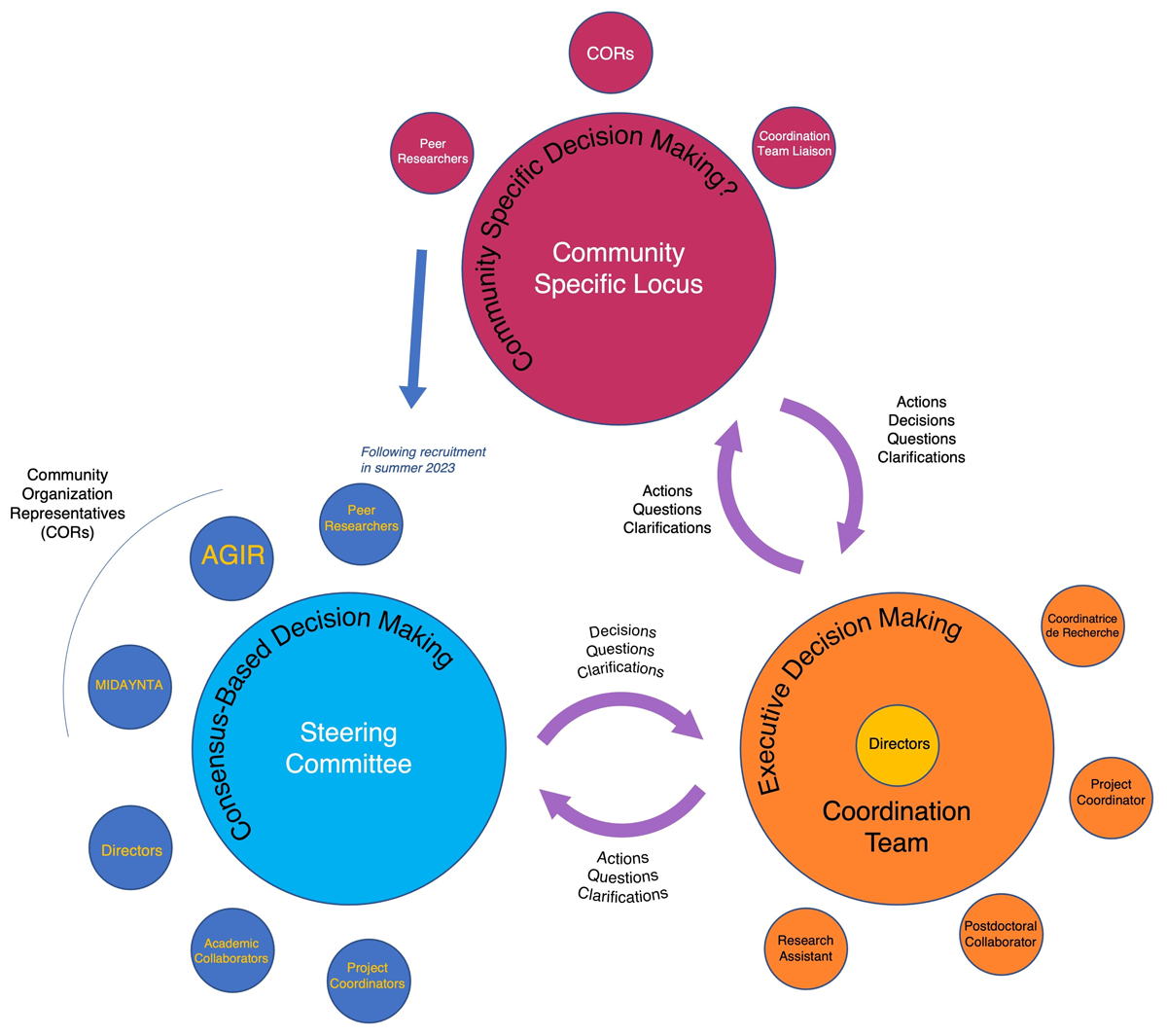
Figure 2
Refugee States Governance Model.
Our process-oriented discussions led to a profound and collective revisioning of the project’s governance model. Although grounded in a collective desire to use consensus-based decision-making, we became equally committed to transparency when power differentials and institutional constraints necessitated a more hierarchical decision-making process. As mentioned earlier, our resolve to move at the “speed of trust” meant that we allocated the first year of the project to deep relationship-building with community partners, with academic collaborators, and within the Coordination Team. Multiple, iterative, process-oriented discussions led the Coordination Team to devise our current governance model, which clarifies the relationship between three main domains of decision-making: the Steering Committee, the Coordination Team, and the Community Specific Locus (see Figure 2).
The Steering Committee is the project’s advisory body, comprising community organizations and academic collaborators. Biannual Steering Committee meetings guide the overall shaping and direction of the project. The Coordination Team is composed of a smaller group of collaborators from the Steering Committee: the project’s co-directors, Thy Phu and Edward Ou Jin Lee, along with project coordinators, research assistants, and other scholars. Its function is to execute decisions made by the Steering Committee. And lastly, the Community Specific Locus refers to the subcommittee of collaborators responsible for implementing site-specific activities, like peer researcher workshops and exhibitions. There are two loci: Toronto and Montreal. It includes peer researchers, community organization representatives, and Coordination Team liaisons. Within each locus, some key decisions were led by community organization representatives (e.g., recruitment strategy, determining training needs for staff and peer researchers, and their roles in the data collection process).
To account for uneven responsibility, accountability, and vulnerability across different parties, Coordination Team member Maral Aguilera-Moradipour conceived of a system of decision-making that draws on both consensus-based and executive decision-making processes and leaves room for decision-making by vote. Aguilera-Moradipour terms this the “Spheres of Responsibility (SoR) Decision-Making System” to foreground relationality and accountability between collaborators with different positionalities and stakes in the project (see Figure 3).
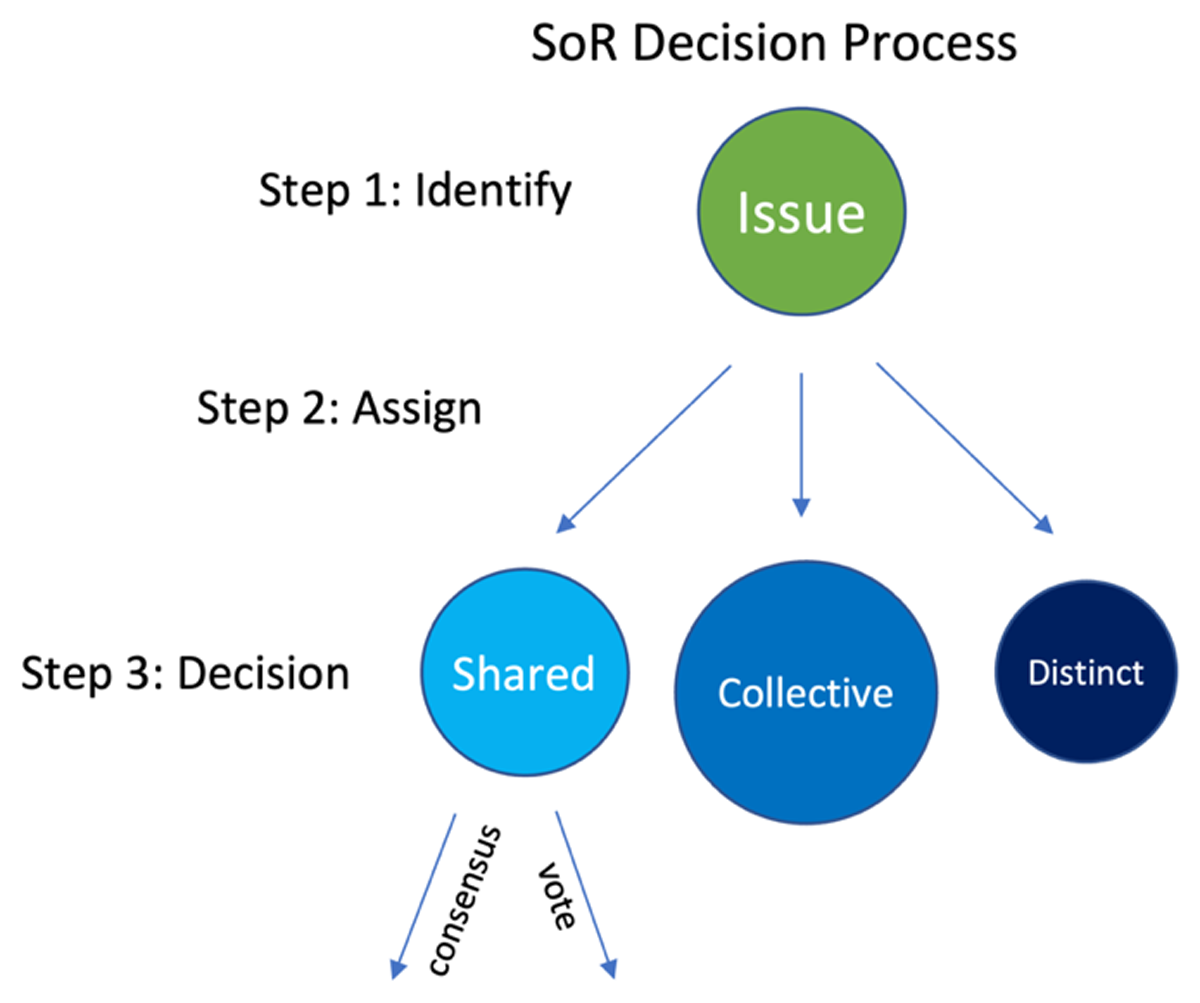
Figure 3
Taxonomy of Collective, Shared, and Distinct Spheres of Responsibility.
The SoR system asks us to consider how an issue in the project impacts collaborators in uneven ways, to identify when some decisions are relevant for everyone, while others impact certain stakeholders. The decision-making process for the Steering Committee must account for the collective, shared, and distinct spheres of expertise and responsibility at play.
Our governance model employs the Spheres of Responsibility Decision-Making System within the Steering Committee and the Community Specific Locus, using consultation as a process to inform consensus-based decision-making where there is a shared (more than one but not all collaborators) or collective (all collaborators) responsibility implicated in a decision (see Table 1). By contrast, the Coordination Team uses an executive decision-making model to ensure that logistics meet the decisions of the Steering Committee or Community Specific Locus. The Coordination Team, as discussed, uses executive decision-making informed by consultation. The SoR Decision-Making System sought to address power inequalities between different collaborators and enact what solidarity across differences might look like.
Table 1
Three Main Steps to the Spheres of Responsibility Decision-Making System.
| Step 1 | Identify the issue for decision-making and note it explicitly as an agenda item. Clearly identify the issue for decision-making to avoid informal decisions. |
| Step 2 | Determine whether the issue falls under a distinct, shared, or collective sphere of responsibility based on accountability, using consultation process. If the decision impacts institutions, organizations, or community members a collaborator is accountable to, then they must be part of the decision-making process as the issue falls under their sphere of responsibility. |
| Step 3 | Assign the Sphere of Responsibility to which the issue pertains:
|
This project included collaborators from diverse positionalities, creating multiple, complex points of interaction where power dynamics can emerge. Early in a Steering Committee meeting, a community representative remarked that they hoped to “be seated at the table and not what’s on the menu,” recounting prior experiences of being treated as raw data by academics. Their statement highlighted how subtle, unspoken signals reveal power imbalances in community-university partnerships. By sharing their perspective, they extended trust while gently reminding the team that this trust could not be taken for granted and needed to be continually earned; they also implicitly demonstrated how such partnerships can become exploitative if power is left unacknowledged. Attending to these cues has proved crucial for fostering trust, practicing shared authority, and aligning the project with the principles of equitable CBPR.
Discussion: Lessons Learned
Although CBPR scholars often uphold the sharing of power as an ethical ideal, our experience designing the Refugee States project showed that a more responsible approach is to make power differentials transparent—because these hierarchies remain deeply entrenched within institutions of higher education in the multiple ways outlined above. We have applied the analytical framework of Sanchez-Youngman et al. (2021) as a self-reflexive tool to evaluate the extent to which our governance model embodies the key features of a structural governance model for CBPR partnerships. The first characteristic—having leaders who can approve research on behalf of the community—is enacted through the Steering Committee and the Community-Specific Loci in our governance model. Community partners attended biannual Steering Committee meetings and led their respective Community-Specific Locus. For the second characteristic—the presence of co-leadership among stakeholders—we decided to hire peer researchers instead of having a Community Advisory Board (CAB). Although the community partner representatives were consulted in the hiring process of the peer researchers, we placed the peer researcher as separate from the community partners within the Community-Specific Locus in our governance model. We wanted to avoid adding hierarchical layers between the research team and community partners. Instead, peer researchers were provided with substantive training and meaningful responsibilities while also contributing to some decisions on how the project unfolded. For example, the Montreal-site peer researchers contributed to adapting the recruitment strategy for the oral history interviews. The third characteristic of resource sharing between community and academic partners has been enacted in site-specific ways (e.g., logistical support, administrative assistance, budget sharing). For example, the academic collaborators have supported community partners in some of their priorities, such as supporting their initiatives outside of the research project, writing a support letter, developing an assessment guideline for research requests by scholars, or revising the community partner’s grant application to a government funder, in which they referred to the Refugee States project. The final characteristic of creating a clear and transparent joint decision-making structure between academic researchers and community members can be demonstrated via our structural governance model.
However, our governance model is a living entity. Since its distribution, collaborators have referred to the governance document to ensure application of the structure as designed, albeit in imperfect ways. Although it is not always possible to apply the structure as visualized, it is the foundation of our collective decision-making processes. Collaborators have obligations to different communities, institutions, organizations, and funding bodies. Each member of Refugee States also has different intersections of lived experience across migration status, sexuality, race, class, age, gender, ability, and profession. The SoR Decision-Making System clarifies our different obligations to one another and to varying communities. It is a practice of situating our various social locations and responsibilities across their alignments and divergences.
A central lesson we learned is that ethical governance is shaped not only by one’s role within a university or organization, but also by one’s social location. Thus, we strive to engage in ongoing critical reflection on the social location of collaborators by paying close attention to the kinds of privilege, power, and precarity this location accords. An ethical model of governance in community-university partnerships requires that individual collaborators identify who they are and what they do, acknowledge and navigate power differentials, and ensure that everyone can fulfil their responsibilities. In Refugee States, we enacted reciprocity as a principle that allows each partner to honor and fulfill their responsibilities as we collectively build a counter-archive of oral histories and digital stories, as opposed to striving for a relationship of equally beneficial exchange.
We caution, however, against the articulation of “sharing power” in CBPR projects in absolute terms or in ways that obscure the power differentials that are intrinsic to academic institutions and baked into community-university partnerships (Fuentes-Bernal et al., 2021; Janes, 2016). Instead of adhering to the ideal of the sharing of power, which we understand as unachievable given these structural conditions, we emphasize the principle of shared authority, which we draw from oral history (Yow, 2015), a core method of the Refugee States project. The principle of shared authority emerged as an important orientation not only for the kind of research we would be conducting but also relevant to the kind of governance model we wanted to create, which would guide us in the implementation of this research.
Shared authority addresses institutional hierarchies by reorienting approaches away from the verticality of top-down processes to more participatory forms of engagement, which create opportunities for consultation and dialogue that ensure expertise would be recognized by and credited to all contributors, and not just those with continuing academic appointments (Frisch, 1990). To understand where reciprocity intersects with the concept of shared authority, consider the way in which Swartz (2011) describes reciprocity as a dimension of emancipatory research. She asserts that the purpose of reciprocity “is to give back both ownership of knowledge and material benefit to those participating in research” (Swartz, 2011, p. 49).
Within the governance model, shared authority means that, structurally, we do not rely on a hierarchization of forms of knowledge or expertise within our decision-making process. Professional or academic knowledge was not to be valued above life experience, cultural, and other ways of knowing. To this end, we consulted extensively to enable all collaborators to share their knowledge and expertise towards either gaining a better understanding of an issue or making decisions. Where decision-making was concerned, we developed a system that favored consensus when possible but tried to ensure it was not at the expense of any of the collaborators’ abilities to fulfill their responsibilities to communities or funders.
Structuring decision-making in accordance with “Spheres of Responsibility” (SoR) makes transparent the power differentials and divergent responsibilities between collaborators, while also enabling them to meet their institutional commitments. The SoR model also proposes a distinction between different processes of decision-making (consensus-based, executive decision-making, voting) for specific aspects of the project that require decision-making within the Steering Committee, Coordination Team, or Community-Specific Locus. In other words, the SoR process allowed all stakeholders to understand better what decisions were being made, how they were being made, and by whom. For the senior faculty members and those with the most institutional power, the SoR process provides a greater framework of accountability and responsibility towards all the actors involved: the “university,” funders, community partners, fellow scholars, early career researchers, graduate students, community partners, and peer researchers. This explicit mapping of decision-making processes within the governance structure allows the community partners not only to participate but, in some cases, to lead some of the decisions being made, particularly within the Community-Specific Locus. Finally, some of the most structurally vulnerable stakeholders—graduate students and/or early-career researchers—actively contributed to the transformation of the governance structure, increasing their capacity to navigate power dynamics moving forward.
Competing Interests
The authors have no competing interests to declare.