
The community-responsive scholar-activist research and service-learning initiatives established in Knights Landing, CA for the past 13 years emerged from us listening to community partners’ desires and needs before undertaking any projects (Deeb-Sossa et al. 2022). Listening from the beginning helped ensure that activities are not skewed toward external interests (i.e., faculty’s class assignments) (Schmidt & Kehoe, 2019). The listening process requires project leaders to engage in bidirectional communication that emphasizes community needs while debating solutions rooted within existing community resources (Balazs & Morello-Forsch, 2013; Gutiérrez & Penuel, 2014; Warren et al., 2014). This approach helps ensure that academic research is relevant and useful to communities; results of the research are disseminated in a way that is meaningful and understandable to community members; and university resources are most effectively used to foster justice and train students in practical problem solving. Community-responsive research attempts to address the ever-changing political, social, health, environmental, and economic issues in Knights Landing, and promotes justice through collaborative partnerships between community and university partners (Deeb-Sossa, 2022; Maistry & Lortan, 2017). This research also promotes undergraduate students’ sense of belonging, social responsibility, and research skills (Ney, 2022).
This study assesses community-responsive scholar-activist research and service-learning initiatives led by university faculty, postdocs, undergraduate students, graduate students, and farmworkers. We use a community-based participatory research (CBPR) framework in our initiatives to affirm students’ sense of belonging and identities for the purpose of strengthening retention. Specifically, this study addresses the following research questions: How and why does our CBPR project framework and collective effort impact undergraduate students’ identities and sense of belonging at a four-year university? How can research institutions adapt their training programs to better prepare students for CBPR and engagement? In this paper, we first provide a literature review of CBPR and sense of belonging. Next, we describe the study context, authors’ positionality, and our ongoing research initiatives. Following the methods section, we present our key findings and discuss their implications for research institutions.
Literature of CBPR
Community-Based Participatory Research (CBPR) is a collaborative process that provides approaches to involve scholars and community members equitably in research (Deeb-Sossa, 2019). The purpose of CBPR is threefold: 1) Build and increase community capacity to conduct research and organize community actions; 2) promote social change through the adoption of sustainable evidence-based practices that enhances programs and partnerships over time (Alexander et al., 2003); and 3) influence outcomes at multiple levels (Pluye et al., 2004; Rappaport et al., 2008). By involving both community partners and students in the research process, research and service-learning initiatives can become more meaningful and engaging for both parties, which can lead to better outcomes and increased impacts (Donahue & Plaxton-Moore, 2018; Gordon da Cruz, 2017; Hale, 2008).
In addition, students engaged in CBPR can benefit by gaining the opportunity to apply their knowledge and skills in a real-world setting, and by acquiring valuable experiences that can be useful in their future careers (Greenberg et al., 2020), especially when research activities are issues important to students and/or the communities they belong to. Researchers have noted how engaging in CBPR has helped students in developing a sense of belonging, a key indicator of college academic achievement and retention (Ahn & Davis, 2020). Similarly, Beckett et al. (2022) contend that community engagement, coupled with ethnographic research training, may further enhance a critical sense of belonging rooted in an analysis of power and oppression.
Literature on Sense of Belonging
In the context of higher learning, sense of belonging is defined by Hurtado et al. (2015, p. 62) as a “measure of integration in the college … and attachment to an institution” that is associated with increased student retention and overall academic success. Strayhorn (2019) contends that students’ sense of belonging includes their perceptions about the social support resources on campus, and feelings of being connected, cared about, accepted, respected, and valued by the campus community including faculty, staff, and peers. There are many factors that influence a student’s sense of belonging at the university level including academic ability, social skills and social support network, their level of engagement with campus activities and organizations, and the overall institutional climate (Hurtado et al., 2015; Museus et al., 2017). Additionally, individual factors such as race, gender, sexual orientation, and socioeconomic status can also influence students’ sense of belonging (Douglass, 2012; Garvey, 2018; Rodriguez, 2021; Stebleton, 2010). For example, positive diversity experiences and engagement in the campus community were positively associated with a sense of belonging (Nuñez 2009).
Researchers have shown that sense of belonging positively impacts students’ wellbeing, self-confidence, academic achievement, and retention (Hurtado & Carter, 1997; Rhee, 2008). Cultivating a sense of belonging for racially minoritized students in predominantly white institutions not only requires efforts to take into account the distinct racialized and cultural experiences of students of color (Hurtado et al., 2015; Strayhorn, 2019), but also the intentional construction of culturally engaging campus environments for students from racially, culturally, and linguistically marginalized communities (Museus et al., 2017).The research literature highlights that students who participate in service through established activities by student organization or university departments are positively associated with students’ sense of belonging; however, finding service opportunities on their own is negatively associated with a sense of belonging (Soria et al., 2003). Ahn and Davis’ (2020) research suggest that universities can intentionally work to foster a sense of belonging among students of color through spaces, programs, and experiences—such as service-learning opportunities, leadership development, cultural centers, mentoring programs, scholarly or creative organizations and publications, and social events that provide a relaxing and fun atmosphere to build connections. McGee (2021) further recommends consciously transforming the curriculum to foster sense of belonging by including a “humanitarian project” in order to appeal to and retain racially minoritized students in science, technology, engineering and math (STEM) fields in addition to establishing “learning communities for students and faculty,” and offering “affirming content” (pp. 86–88).
In this paper we discuss the community-responsive scholar-activist research and service-learning initiatives developed and led, at the behest of the case study community, by Chicana/o studies faculty, postdocs, and multidisciplinary undergraduate and graduate students. These initiatives were launched to address the needs and wants of the community through university-supported programs alongside other community-led interventions. First we describe the community and the research team. Next we describe the diverse CBPR training and leadership opportunities we established and invited students to join. After analyzing students’ perceptions of their sense of belonging when engaging in community-responsive scholar-activism, we conclude with implications of this kind of multidisciplinary training on research universities.
Knights Landing Context
Knights Landing is a rural and unincorporated agricultural community in Northern California composed of approximately 1,000 people, of which 40% work in agriculture and 84% are of Latin American origin (U.S. Census Bureau, 2021). Although many families have lived in Knights Landing for generations, some are recent arrivals. Unlike migrant farmworkers, most residents working in agriculture remain in the community year-round and travel from Knights Landing to their seasonal sites of employment. In part due to low farm wages, the 2021 median household income was $40,583. This was just above the $36,900 California Poverty Measure for a family of four, and 20% of residents in Knights Landing live in poverty by this metric (U.S. Census Bureau, 2021).
Authors’ Positionality
The four authors are community-responsive scholar-activists who have partnered with Knights Landing residents for decades in diverse ways. Our partnerships with students, as well as our reputation as scholar-activists, informs our subjectivity throughout the research process, along with our decisions about data analysis and writing (Freeman, 2019). In this paper, we explicitly identify the serving institution, University of California at Davis (UC Davis), as part of our efforts toward accountability to the institution’s stated mandate as a land grant university and better support of all faculty, student, and community partner scholar-activists.
The majority of authors identify as women, feminists, and/or come from working-class backgrounds. The first author identifies as a brown-skinned Latina originally from Colombia. The second author identifies as a light-skinned Latina originally from the Central Valley of California. The third author identifies as a first-generation Chicano originally also from the Central Valley of California and the son of farmworkers. The fourth author was trained throughout the US and identifies as a white woman from an economically and academically privileged family in Los Angeles. The first three authors are bilingual in English and Spanish and use both languages in their work. This paper reflects our collective scholarly conversations (Mazzei & Jackson, 2012) around how and why community-engaged work cultivates a critical sense of belonging for all students, but in particular for Chicanx/a/o and Latinx/a/o students. As a result, this paper demonstrates genuine discussions among the authors about the role of community-responsive activist-scholar research and service-learning initiatives in cementing university students’ critical sense of belonging.
Community-Responsive Scholar-Activist Research Projects and Students’ Engagement
Partnership formation between the first two authors, members of the community, and undergraduate and graduate students began in 2009 following a number of Knights Landing mothers’ demands for youth mentoring opportunities to be established in the community. As a result, the second author founded a tutoring program as a graduate student with undergraduate volunteers. The mothers also asked the lead faculty researcher (first author) to help challenge the stories told about their educational opportunities by instead documenting stories told by farmworker residents themselves (Deeb-Sossa et al., 2022). Our partnerships evolved as we built community capacity and long-term sustainability using a CBPR framework because the lead faculty researcher consistently responds to community needs while listening to community members’ ideas and concerns. Figure 1 outlines the community-responsive scholar-activist research and service-learning over the last 13 years of our partnership. See Deeb-Sossa et al. (2022) for details about concurrent community events, staffing, and funding.
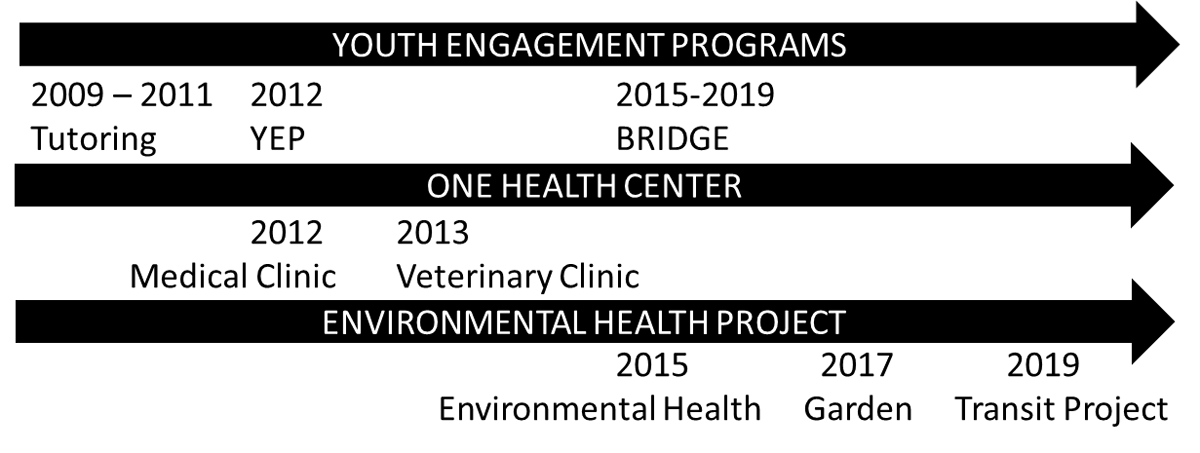
Figure 1
Timeline of Community-Engaged Scholar-Activist Programs.
Abbreviations: Youth Engagement Program (YEP) and Chicana/o Studies Bridge Program (BRIDGE).
One Health Center
Our relationship with the Knights Landing community strengthened after the first author began work to establish the Knights Landing One Health Center (KLOHC), a student-run healthcare clinic providing primary care for residents. Community engagement and input through CBPR continues to drive the mission and functioning of KLOHC. Engagement began when Grupo de Mujeres—a group of women from the community—expressed a need for preventive healthcare. The center expanded by founding a student-run veterinary clinic in 2013 to meet the “One Health” framework envisioned by the community (Sweeney 2018). This partnership conducts community mapping and a community health assessment every five years to understand the changing healthcare needs of residents. In 2020, for example, the KLOHC implemented a narrative medicine approach which “offers fresh opportunities for respectful, empathic, and nourishing medical care” (Charon, 2001).
Youth Programs
The first author partnered with local elementary schools and high schools to provide afterschool programing, tutoring, and mentorship to hundreds of k-12 Knights Landing students from 2015 to 2019. This Chicana/o Studies Bridge Program (BRIDGE) program was pursued at the behest of Latina farmworker mothers to improve the academic achievement of local low-income students performing below grade level and to create a college-aspiration culture among youth. Additionally, the Grupo de Mujeres expressed concerns about teenage reproductive health in Knights Landing. In response, using a CBPR framework, medical student volunteers, and community members established a dedicated committee within the KLOHC called Youth Engagement Program (YEP) to foster relationships, assess medical needs, and collaborate to extend and build resources. Both YEP and BRIDGE coordinated the youth-led creation of murals on KLOHC property and photovoice projects supporting the creative pursuits of Knights Landing youth (Deeb-Sossa & Martinez, 2018).
Environmental Health Project
PhD students in environmental health geography (third author) and pharmacology and toxicology (fourth author) established a transdisciplinary and CBPR framework to address the communities’ longstanding and undocumented concerns about agricultural health risks. Undergraduate student research projects were integrated into this framework, leading to multiple senior projects, McNair Scholar projects, national and local conference presentations, and successful undergraduate grant applications. With the support of residents, this project implemented a sequential design in which qualitative data (e.g., participant-led focus groups and photovoice projects) were first collected to assess residential perceptions of risk for the purpose of quantitative development (e.g., seasonal sampling for pesticides in ten households around Knights Landing and a neighboring organic growing region). The project frequently communicated results of our participant-led research through informational documents and flyers, and even hosted a town hall to verify research result interpretations with residents and representatives from local agencies prior to academic publication.
Transportation
Ongoing CBPR projects revealed a shortage of personal vehicle access, inadequate cycling and pedestrian infrastructure, and the impracticality of existing bus services for Knights Landing residents. In light of our findings, an on-demand microtransit project was established by the local transportation district under guidance from community leaders. This service grants residents better access to employment, health care, educational, and shopping opportunities in nearby towns. The microtransit service also serves as an important example of policy change for neighboring unincorporated communities given that Knights Landing residents helped guide the planning and piloting phases for countywide transportation programs currently under expansion.
Community Garden
Inspired by past youth organizing in the community, and using a CBPR framework, the Environmental Health Project designed, organized, and founded a community garden in Knights Landing. In doing so, students majoring in landscape architecture and Chicana/o studies, together with the UC Davis student farm and ecological garden, created an organizational structure while securing funding through the county, community fundraisers, and student grants/fellowships. Construction began in 2018 as a pilot project on the property of the Methodist Church, and faced delays due to the pandemic. Finally, in 2021, community members celebrated the first harvest of vegetables from the community garden. Moving forward, we expect to continue food production by and for local residents while transferring management to our community partners. Further, we anticipate the reinstatement of recreational and skill-building events and workshops led by students and local residents.
Partnership Summary
Over the course of 13 years, our CBPR framework continues to inspire multiple and diverse forms of community-responsive scholar-activist research and service-learning initiatives developed and sustained by students, faculty, and community partners. All research and training activities, as noted above, began at the behest of the community. Undergraduate and graduate students remain key partners in these initiatives.
Methods
Rutgers University Institutional Review Board determined this study to be exempt from full review (Appendix).1 No compensation was provided for participation.
Survey development
The survey was developed by first author (lead faculty mentor for all community-university projects), second author (founder and former leader of the tutoring program), third and fourth authors (co-founders and co-principal investigators of the ongoing Environmental Health Project). The final English survey included 24 open-ended questions spanning project involvement, career development, skill building, community impact, and demographic information (Appendix). The survey administration and analysis was managed through Qualtrics interface. Personal identifiable information was not collected.
Participant Recruitment
Recruitment was completed between November 2020 and February 2021 by advertising this research opportunity through existing email contact lists of student volunteers from 2009 to the present. Two reminder emails were sent out at monthly intervals. Additionally, two announcements were made by leaders of the current medical clinic and veterinary clinic programs during their regular meetings. Social media posts inviting eligible individuals to participate were made in specialized groups related to student volunteer programs. An exact calculation of the total volunteer population is challenging because recordkeeping is managed independently within each project; students often participate in multiple projects; and students can volunteer during multiple stages of their academic journey. We estimate that 300 to 500 volunteers were active in our initiatives from 2009 to 2021. Authors’ combined contact list included 48 environmental health volunteers, 189 BRIDGE tutors, 195 veterinary undergraduate volunteers, and undisclosed numbers of medical students, veterinary students, and medical clinic undergraduate volunteers. Authors expected unsuccessful contact due to inactive emails which may have reduced our reach to the total volunteer population.
Survey Administration
The fourth author was the contact point for this study and did not professionally mentor, teach, or employ any participants during recruitment, although the fourth author did collaborate with some students on pending manuscripts and pandemic community garden adaptations. From November 2020 to February 2021, a total of 64 student volunteers responded with their interest to participate in the survey and answered screening questions to confirm their eligibility: 1) When did you work in Knights Landing? 2) what project did you work on?, and 3) who was your mentor for the project? The corresponding projects operating under the Knights Landing and UC Davis partnership included: medical clinic, veterinary clinic, BRIDGE, environmental health project, and community garden. Additionally, all participants were adults eligible to consent and participate in English. Participants who confirmed familiarity with Knights Landing and lined up with the project history timelines (Deeb-Sossa, 2022) received a personal link to the online survey. Although reminder emails for nonresponses and incomplete responses were sent twice at weekly intervals, 8% did not complete the consent form or survey after receiving their personal survey link. The final sample represented 12% to 20% of the estimated total volunteer pool and 55 of the respondents participated in scholar-activist programs as undergraduates.
Undergraduate Student Participants
As reported in Manzo et al. (2023), the majority of the participants identified as cis-female (83%); 15% as cis-male; and 2% as nonbinary. More than half of participants identified as Latinx (52%); 39% as Asian/ Pacific Islander; and 26% as white and/or Caucasian. Only 4% of participants identified as international students. Further, more than half of participants identified as first generation college students (54%), and 11% indicated they had agricultural workers in their family while 15% indicated they had lived in a farmworker community at some point in their lifetime. Participants reported diverse fields of study and 8% of respondents reported double majors and/or minors across the following majors: 40% in animal sciences; 15% in neurobiology, physiology, and behavior; 11% in Chicana/o studies; 9% in Spanish; 5% in biological sciences; 5% in global disease biology; 4% in education; 4% in environmental science; 4% in environmental toxicology; and 4% in psychology.
Qualitative Analysis
Open-ended questions were analyzed using summative content analysis, which enables researchers to identify and quantify a given situation (Hseih & Shannon 2005). This analytical approach enabled us to analyze the data of open-ended survey questions through the identification of key words in each question related to our research questions which were determined in advance of the analysis. Two researchers independently read and re-read the text to identify key words in each of the questions. The two researchers then identified categories and subcategories within each of the responses for further interpretation. Once the categories and subcategories were identified, the two researchers independently coded the data. Interrater agreement for open-ended questions was 91%. The researchers then collaborated to reconcile any differences in coding. These were then quantified using frequency counts.
Report Back
This manuscript was shared with the author’s recruitment contact lists. Regardless of participant status, current and former student volunteers were able to comment on the manuscript for two weeks to provide their insights about the results and interpretation of the data. The authors addressed the detailed critiques submitted by four volunteers while completing final revisions (Appendix).
Results
Involvement in Community-Responsive Scholar-Activism
As detailed in Manzo et al. (2023), the vast majority of students began their involvement after their first year of undergraduate education (95%). About a quarter of participants were continuously involved throughout their second year until graduation (24%). Manzo et al. (2023) noted that some participants were still active members that have yet to complete their degree or service objectives before responding to the survey. Duration of involvement was significantly longer for cis males at eight academic quarters, relative to five for cis females (p = 0.04). Manzo et al. (2023) also highlighted how students were involved in more than one activity (22%), including veterinary clinic (47%); BRIDGE and YEP programs (33%); KLOHC (27%); environmental health project (15%); and community garden (7%).
Reasons for Involvement
This study first analyzes the reasons for student involvement in our project initiatives. Through open-ended questions our results indicate that more than two-thirds of those surveyed expressed a genuine desire to help and wanted to be involved in community development at the local level. For many students these reasons were interrelated. For example, three students shared the following:
Student 1: “There are different reasons for my involvement. I have family that lives in Knights Landing. My parents and secondary family have worked in Knights Landing and the nearby area as farmworkers. I felt familiar and somewhat comfortable with the community as my own brother was baptized there and I went to elementary school around 20–25 minutes from Knights Landing. The people volunteering there were kind and I felt included within the group. I was eager to explore the field of medicine more fully and found that Knights Landing seemed like a good fit with my background and goals. I felt very attracted to the idea of providing a service to farmworker community members because of the experience of my own family in that area. I understood there is a deep need to address primary barriers to care such as differences in language, economic disparities, and cultural acceptance but didn‘t understand them so well despite living those challenges and I felt safe to explore those issues as a volunteer while hoping to overcome them.”
Student 2: “I wanted to give back to a community much like my hometown.”
Student 3: “At the time I had started to briefly learn about the field of one health. I was thus interested to learn more about it and what a veterinarian‘s role is. As a person of Latinx heritage I was also motivated to help the underserved community of Knights Landing and give back to my people.”
As indicated in these responses, students conveyed familiarity and connection with the community’s demographic and socioeconomic characteristics while attributing their motivations for participating to a genuine desire for political and structural change. Students noted the numerous barriers to healthcare access including language, lack of transportation and groceries, and occupational hazards like pesticides from neighboring agricultural fields. Likewise, students affirmed that their professional and educational goals strongly correlated with our community-responsive scholar-activist research and service-learning training, thereby cultivating a critical sense of belonging mirroring the struggles of their respective communities.
Experience with Community-Responsive Scholar-Activism & Retention
Through open-ended questions, our results indicate that involvement in community-responsive activist-scholar research and service-learning initiatives serve as retention incentives themselves. For example, two students shared the following:
Student 1: “My experiences with the community are some of my favorite memories from my undergraduate experience. Being in the Knights Landing community, with members from similar ethnic backgrounds and experiences, helped me overcome some of the challenges of navigating a predominantly white institution. I felt at home, welcomed, valued, and recognized whenever in the Knights Landing community. Being in Knights Landing through this program gave me hope. Seeing the potential of programs like the ones in Knights Landing often served as the motivating force to succeed and progress in UCD. Whenever I struggled in my UCD educational journey, working with community members and students reminded me how important it was for me to keep fighting and do my best at UCD, so that I could one day advocate for these communities as well.”
Student 2: “Doing this work inspired me to stay in school and get my 2 majors finished. The busier I was working in the community, the more passionate I became about continuing a career in community engaged research. I wanted and continue to want better research that connects more directly to California community needs.”
Responses illustrated that our initiatives served to retain students in a number of ways. For example, scholar-activism provided opportunities for students to connect with local communities and address issues that were important to them, which helped students feel more invested in their college experience. These activities provided unique opportunities for students to feel they were making an important impact on rural residents while building their confidence in serving diverse populations. At the same time, our community-responsive scholar-activism research and service-learning opportunities provided students with a sense of purpose and fulfillment, which helped them stay motivated and engaged in their studies. Most importantly, student responses indicated that the academic outcomes of our initiatives were fueled by a burgeoning sense of belonging rooted in an analysis of power and oppression.
Experience with Community-Responsive Scholar-Activism & Sense of Belonging
Students also indicated how much they learned and gained from the experience of partnering with members of Knights Landing and being involved in community-responsive scholar-activist research initiatives. Students indicated through open-ended questions how their acquaintance with community members made them feel more integrated to UC Davis, and reminded them why their academic journey is important. For example, two students shared the following:
Student 1: “It was an invaluable experience. I learned so much. First, working with faculty through Knights Landing minimized my insecurities about talking with or working with faculty at UCD. I remember before working with [the first author], I often felt intimidated to talk to faculty from UCD. I also did not feel very welcomed to approach or work with faculty at UCD as an engineering major. I was never affirmed by UCD faculty until my time in Knights Landing. So this experience completely changed my experience, I felt more comfortable and confident about working with faculty. I also learned from the doctoral student I worked with…who provided critical information that to this day I draw on to be successful in my doctoral program. This team was the one who encouraged me to consider and consequently, pursue graduate school. Their affirmations, support, and encouragement helped me see that I was capable of pursuing and entering a graduate program.”
Student 2: “Knights Landing Community is a community similar to my own. I grew up in the San Joaquin Valley, where most of the population consists of farm-working families of Mexican origin and volunteering for UC Davis student-run clinic in Knights Landing, California, a community predominantly populated with farm workers reminded me of where I grew up. I could give back to my community. I also learned the importance of having doctors that were Latinas to go back to San Joaquin Valley.”
As evidenced in students’ responses, our community-responsive activist-scholar research and service-learning activities promoted feelings of being connected, cared about, accepted, respected, and valued. They also promoted self-confidence, academic achievement, and retention. The activities encouraged and nurtured future generations of health care workers to address power imbalances through participation in a multidisciplinary activist-scholar team.
Toward a Critical Sense of Belonging
When students were asked what they had learned and gained from being involved in community-responsive scholar-activist research activities, they mentioned concepts such as cultural humility, equity, and health accessibility. Students indicated in their open-ended responses how learning about community-responsive scholar-activism prompted an analysis of social justice issues in Knights Landing and beyond. For example, three students shared the following:
Student 1: “In being part of establishing the Knight Landing Environmental Health Assessment, I learned how powerful community-based participatory research is in identifying and addressing community health needs. I worked alongside colleagues and promotoras to establish a survey to obtain baseline data about the community’s environmental health concerns. I learned how to reconcile community needs, research goals, and perspectives from multiple disciplines of research. I learned interculturality.”
Student 2: “KLEHP was the first time I actually exposed myself to CBPR as an actual practicing model. It’s completely shifted how I understand rural agricultural California and how I see the University’s responsibility to serve its surrounding communities. I did a McNair project (a senior thesis) on how local policy decisions impact health accessibility and equity. Doing this project not only sparked my passions, but also pushed me into the world of public health research. I learned new career paths that combine my passions for serving communities, and doing rigorous research that has real-world impact.”
Student 3: “The work I did in the clinic I know was impactful for the volunteers and I hope for the community. The biggest thing I did was create an initial orientation and regular workshops to train our interpreter volunteers on how to interpret Spanish. We did not have this in the clinic when I started, and it helped the volunteers be more comfortable communicating across multiple languages while building their Spanish medical vocabulary. I also did try to expand learning cultural humility. I hope this work has improved communication, especially with Spanish-speaking clients in our clinic.”
In their responses, students questioned the skills that all livelihood support systems and healthcare providers must possess when serving and caring for communities. As noted by student 3, cultural humility is an important skill necessary to radically interrogate the interactions between healthcare providers and the community. Tervalon & Murray-Garcia (1998), for example, propose that medical schools should be required to train all medical practitioners on cultural humility:
A process that requires humility as individuals continually engage in self-reflection and self-critique as lifelong learners and reflective practitioners. It is a process that requires humility in how physicians bring into check the power imbalances that exist in the dynamic of physician-patient communication by using patient-focused interviewing and care. And it is a process that requires humility to develop and maintain mutually respectful and dynamic partnerships with communities on behalf of individual patients and communities in the context of community-based clinical and advocacy training models.
We contend that cultural humility is a skill that should be required of all professionals, from engineers to artists, from sociologists to healthcare professionals. We also argue that students felt “at home” in the Knights Landing community and efficacious while working in our diverse research and service-learning initiatives.
Conclusion
…learning how to see oneself in the world more critically is not performed in isolation, but happens through meaningful links to community and through engaging real-world issues that support a student’s sense of purpose. (Beckett et al., 2022, p. 138)
This article focused on the impact of community-responsive scholar-activist research and service-learning initiatives on university students’ sense of belonging. We analyzed students’ perceptions about their engagement in our initiatives using open-ended questions from a survey from 55 undergraduate students and summative content analysis.
Our research suggests that community-responsive activist-scholar research and service-learning initiatives may provide opportunities for students to cultivate a critical sense of belonging rooted in an analysis of power and oppression, particularly among first-generation college students. The importance of the Knights Landing context is underscored by the 13 years of diverse community-university projects in the farmworking community together with project leaders’ unique positionalities. This context provided opportunities particularly for first-generation students to connect with and contribute to rural farmworker communities and their needs, work with and learn from others who share similar experiences and values, develop a sense of identity and pride in their immigrant and/or farmworking culture, and build relationships with faculty and staff who are committed to supporting and advocating for them. This further allowed all participating students to see themselves as changemakers and be part of a safe and/or inclusive community that shared a mission of giving back.
Universities can promote equity, inclusion, and student success by supporting community-responsive activist-scholar research and service-learning initiatives. These can help create a more inclusive and welcoming college experience, provide students with valuable opportunities to develop important skills and knowledge, promote students’ connectedness to their communities and culture, and foster a more collaborative and engaged university community. Our team encourages universities like UC Davis to incorporate community-responsive activist-scholar research and service-learning initiatives into the curriculum and to support faculty and staff who are engaged in this line of research and teaching. For example, universities could: (1) encourage the creation of new courses or the modification of existing courses by prioritizing service-learning opportunities and community-responsive activist-scholar research opportunity for students, (2) offer faculty development workshops that might facilitate grant and manuscript writing of this type of research, (3) create dedicated funding and support for faculty, graduate students, and staff leading community-responsive activist-scholar research and service-learning activities, and (4) provide institutional support for nearby community partners by offering financial assistance to local organizations, partnering with residents for research projects, and hiring community members as staff, lecturers, and researchers. By taking these steps, universities can help students cultivate a more critical sense of belonging, develop important skills and knowledge, gain experience working with professionals in their field, and strengthen a sense of social responsibility.
Additional File
The additional file for this article can be found as follows:
Appendices
Online consent form; survey questions; and report back examples of student comments. DOI: https://doi.org/10.33596/coll.125.s1
Notes
Funding Information
Kelty’s efforts for this manuscript were partially supported by T32ES007148 and full disclosure of partnership funding is summarized in Deeb-Sossa et al. 2022.
Competing Interests
The authors have no competing interests to declare.