
Table 1
Codes and Exemplar Quotes.
| CAPACITY-BUILDING CODES | ||
|---|---|---|
| CODE NAME | CODE DEFINITION | EXEMPLAR QUOTE |
| Partnership | Describes the process of creating new partnerships or maintaining existing partnerships in efforts to create more inclusive local emergency planning. Includes recognition of the need for coordination. | “We developed relationships with shelter operations, who wanted training on how to interact with people with autism. The partnership just kind of developed. Really, it was the connective tissue that we all have together, including the voices of people with disabilities saying, hey, we have a right to be safe too” (AL group participant, 2/24/21). |
| Engage | References connections, outreach, or other involvement with potential partners. Includes descriptions of contact that may not rise to the level of established partnerships. May also include persuasion or methods of getting new partners on board with disability inclusion and equity. | “Keep going…Because it’s not going to take one time or two times or five, it’s going to take 20 times before you get their attention…Get them engaged, make your friendships and your partnerships, share what you do. Ask them, share with me a little bit more of what you do. Can I be a shadow when you’re doing your training exercise?” (AL group participant, 3/24/21) |
| Relate | References the “how” of finding NEW partners. Includes details about finding and engaging new partners that share your values and goals. Also captures identifying shared topics and priorities to work on. | “Check out your local Area Agency on Aging, and Centers for Independent Living need to be on that list [of potential partners]. CILs are a tremendous resource and a tremendous bridge between Emergency Management, Health Departments and the Red Cross.” (AL group participant, 2/24/21) |
| Resource Sharing | Refers to resource-sharing as a way to offer ideas and practices for others to build partnerships and keep moving forward. Relates to building a shared knowledge base and acting upon the latest knowledge. | “We will be recording a workshop video on emergency preparedness, including all types of disabilities and, and then some individuals need a one-on-one planning. We will also provide personalized workshop training for multiple types of disabilities in our emergency planning which will include developing a plan, registering for alerts, and building a kit. We’ll share these materials with you all.” (AL group participant, 6/16/21) |
| Organizational Development | This set of codes references within-organizational capacity in the form of future commitments. Includes further training and education, dedicated staff capacity and/or effort, and plans for receiving and providing ongoing support. Also includes explanations of previous development efforts. | “At our hospital we have a program called Safety Together. So every aspect of the healthcare system, in order to become a high reliability organization. There are several tools that, whether that be creating an SBAR, or stopping the line, or doing a cross check, that terminology and the practices have become so natural and a part of all that we do, but it really did start from the very top and it’s every day, depending on the department, depends on how often we have the safety meetings. But we really talk about these things as a natural part of things we do every day.” (AL group participant, 4/21/21) |
| Critical reflection | Describing taking time to reflect and adapt to what’s going on. References to “not getting stuck”. May include descriptions of organizational recalibrations, and quality improvement. Not an after-action report, a “during-action” report. May include questions about what action to take next. | “So, if there’s one thing we learned from Hurricane Harvey, it’s that we really have a lot of work to do, and our city is so big that it’s really challenging, because everyone wants their voice to be heard the loudest. And we want everyone with disabilities to be included in that voice. And we all joined their call as they tried to organize for the city, but they needed so much help.” (AL group participant, 5/19/21) |
| Staff capacity/effort | Describing key staff dedicated to this work and trainings related to disability inclusion and/or local emergency planning | “We wanted to make sure that the staff at those testing sites were trained in disability etiquette disability awareness, wanted to make sure that they had accessible and inclusive communication materials and products.” (AL group participant, 5/19/21) |
| Interests and Values | References the individual-level knowledge, interest, commitment, and ongoing reflection needed for disability inclusion and equity work. | “We have a lot on our plate, we have so many opportunities to do so much in 18 months but that’s why I’m here today is really to enjoy this conversation and really kind of share. I’m also a parent of an adult child with autism and I also have a physical disability so kind of coming into it with a lot of different ways.” (AL group participant, 2/24/21) |
| Disability Experience | Described an experiential knowledge of disability. This is either through a lived experience, familial experience, or professional experience. | “We brought in the disability perspective to their work…they were just grasping at straws because they didn’t know and so we brought in ASL interpreters whenever there’s a major news conference being held.” (AL group participant, 3/24/21) |
| Emergency/disaster experience | This is a novel code generated in response to the AL group transcripts where experiential knowledge of EDP was cited as a motivation for this work. | “I have a long history professionally of emergency preparedness and response. I am a former elected official, and had to evacuate our beach communities in 2003. So I have first-hand knowledge of all things of emergency response related.” (AL group participant, 2/24/21) |
| Forward Motion | References any actions that move the work forward. Includes references to “next steps,” including actions, planning, and testing ideas out. Related to growth mindset. | “The silver lining is that people with intellectual and developmental disabilities are thought of now, whereas as I can tell you prior to that they were not at the forefront of any thinking and emergency planning. There’s a national model of resource that I think can be developed to be better used for a more diverse population, the Health Care Coalition. And so we’ve been trying to work within our state to expand. My strategy is to just join them and start talking all of the different types of people and that need coordination during an emergency preparedness situation.” (AL group participant, 2/24/21) |
| Pinpoint | Identifying problems or factors that may impact forward motion. | “The hardest part was making sure that the vaccine teams understood the challenges inherent in working with this population. Transportation was an issue, and so we had to get them to understand, you know when you’re scheduling a time and a date to be at this Center for Independent Living, they need an exact time because of transportation reasons. So many of the CIL’s clients were transportation disadvantaged. And so the CIL had to provide that transportation. So, having to coordinate that got a little tricky. And it was definitely a challenge, but I mean, they worked it out.” (AL group participant, 5/19/21) |
| Advance | References planning efforts to move the work forward. | “We sent our Board of County Commissioners a letter highlighting it [need for better communication about COVID-19 vaccines], and that really lit the fire. And we partnered, emergency management got involved.” (AL group participant, 3/24/21) |
| Deploy | References to trying something out and evaluating it. | “They put the phone number on all of the county buses, and they went to all the libraries and trained the staff there, how to maneuver the online registration process so that if somebody came in there, and didn’t know how to didn’t have any idea how to work the system, there was help there. So we’re pretty excited about this.” (AL group participant, 3/24/21) |
| BRIDGING CODES | ||
| Network exchange | Describing efforts to seek or provide support, how being part of a larger network helped them accomplish goals and move work forward, and identifying instances in which partnership has led to success. | “I’ll share some info about the Red Cross. The Red Cross is supposed to use the CMIST framework and ensure that shelters are accessible, working with the Red Cross closely to ensure accessibility with one of our staff. We have established a corporate account with some hotel chains. One of our barriers is the backup batteries are not ADA compliant, including the instruction manuals videos and buttons feedback audio and screen displays are not accessible. If anyone has any ideas about that, please let me know.” (AL group participant, 6/16/21) |
| Envision what’s next | References to planning and designing solutions. | “I think what’s really important is to build authentic partnerships. Not just partnerships for the sake of alliances and for the sake of connection. We’re really building those authentic bridges there. So if you can have those, not just as brokers for the intent of the research initiative or the intervention or even the good goals, but to look at building true, true authentic partnerships that will be sustained.” (AL group participant, 6/16/21) |
| Systematic reflection | References an analysis or synthesis of previous knowledge or experience related to disability and emergencies/disasters/pandemics. | It’s interesting to kind of look at the differences between Florida and DC, we don’t have that many natural disasters in the DC area. So this, you know, Gallaudet and the DC deaf and hard of hearing community hasn’t really looked at this in terms of how we should be involved. A lot of that has always gone to FEMA. And when we needed to, we’ve partnered with FEMA, but I think now we’re starting to see the importance of having that engagement within our community, and really training people in our community. So hopefully, we will start engaging more in this discussion. And that’s why I’m grateful for this group, because it’s really helping to guide how we should start thinking about things and where gaps are. We don’t know what we don’t know. So this group is helpful for that.” (AL group participant, 3/24/21) |
| Valuing partnership | Describing positive feelings or outcomes related to collaboration or partnership, identifying partnership as a way to make progress. | “I’d have to say that one of the resources that we’ve had is one of the agencies we’ve really worked hard with and well with during this latest pandemic is the Area Agency on Aging, in getting information and services to our senior community. We’re a coastal community. So we’re always working on emergency preparedness, that’s something that everybody is always aware of. But this was an area agency that really got into the mental health support, to combat the isolation early on with activity kits and whatnot, and we’re doing the distribution. So there’s that—the Area Agency on Aging in your area, are a very good partner to have in sunshine and in dark times.” (AL group participant, 2/24/21) |
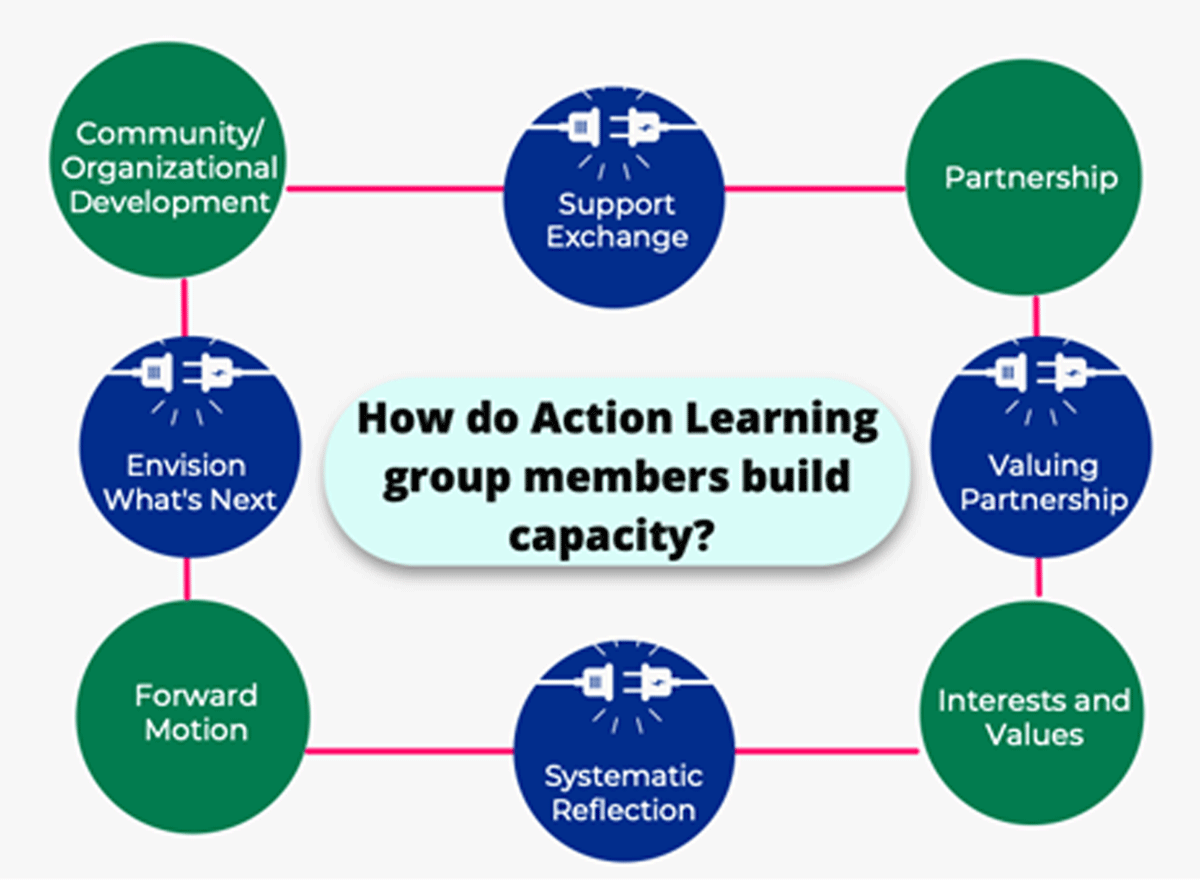
Figure 1
Adaptive Leadership within Capacity-Building: Increasing Disability Inclusion in Emergency Preparedness Planning.