
Introduction
In the post-Cold War era, the overarching foreign policy of the USA has comprised two key pillars: first, the promotion of democracy across the globe; and secondly, the provision of military assistance to allies and friends to support the USA in achieving its strategic defense priorities. Although US governments often spoke about the importance of democracy and development in the aftermath of World War II, they did not heavily promote, or fund, democracy promotion programs until the end of the Cold War. Beginning with the Clinton administration in the 1990s and continuing throughout the Biden administration, the USA treated global democracy promotion as a major part of its approach to international relations (Dalacoura 2005). From 2001 to 2024, the USA spent between US$1.18 billion and US$4.16 billion, annually, on democracy, human rights, and governance programming around the world (ForeignAssistance.gov).
The US approach to military assistance, which focuses on building the capability and capacity of partners, has also spanned multiple administrations under different parties (Omelicheva, Carter, and Campbell 2017). The USA had used military assistance to support coalition partners during the 1990s as part of the Gulf War, but after the terrorist attacks of September 11, 2001 it dramatically increased its military assistance to a variety of countries to build partner capacity and help fight terrorism (Sullivan, Tessman, and Li 2011). That year, the USA provided US$4.35 billion of military assistance to its global partners, which represented about 30% of its total foreign assistance (ForeignAssistance.gov). In absolute terms, this figure increased significantly over the next decade. In 2011, the USA spent US$16.84 billion on military assistance, about 35% of its annual foreign assistance that year (ibid).
Given that the USA has simultaneously pursued both democracy promotion and the improvement of its partners’ military capacity, often in the same country, how have these two tenets of foreign policy imperatives interacted? Are they mutually supportive or have they worked at cross-purposes? This paper examines the relationship between Africa’s democratic progress and US security assistance to the region from the mid-2000s to 2020. This assistance encompasses a variety of defense partnership activities including military assistance. Through a quantitative analysis of trends over time, we are able to link security assistance, democracy assistance, and democratic outcomes.
Why do we examine Africa in particular? These two trends – rapid democratization and an exponential increase in security assistance – are especially pronounced in that region. The third wave of democracy affected much of Africa in a relatively short period of time. During the 1990s, roughly 75% of African countries began to transition to some form of democratic rule. Then, with the proliferation of terrorist threats in the 2010s, security assistance increased markedly. In 2000, the USA provided approximately US$50 million in military assistance to the African continent.1 In 2010, this figure increased to about US$350 million, and by 2020 this amount had increased to at least US$544 million (Foreign Assistance.gov). Thus, there are a number of relatively new democracies in Africa, many with shallow roots, that have received a substantial influx of military assistance over the past two decades. Additionally, the timeframe – 2005 to 2020 – encompasses several relevant factors: the rise of violent extremist movements (2006); the creation of the US Africa Command (AFRICOM) (2007); and new and persistent challenges to democratic governance, including electoral violence, the rise in social and protest movements, the decline in political rights and civil liberties, and the gap between supply and demand of democracy in Africa.
Our analysis of democracy promotion and security assistance, from both a theoretical and an empirical perspective, reveals that military assistance, in particular, can actively undermine democracy promotion, unless specific care is taken to counterbalance these effects. Although this may not be the intention of US military assistance, it is a risk that the USA takes when pursuing multiple, competing goals in a given country. As such, the findings of this paper have significant implications for US foreign assistance and the ways in which external partners may impact a country’s democratic trajectory.
Democracy Promotion and Military Assistance: Mutually Supportive or Inherently at Odds?
US commitment to global democracy promotion has a long history. However, the impact of US foreign assistance on democratic outcomes has been a source of debate, contradiction, and nuance. Direct assistance for democracy focuses on support to key actors and institutions necessary for democracy such as political parties, the judiciary, election management bodies, civil society, and the press. The rationale has been that strengthening the different facets of democracy will, in turn, bolster and deepen the overall quality as well. According to Gisselquist et al. (2021), targeted democracy assistance has had a positive impact on democratic development. However, Finkel et al. (2020) find that targeted democracy assistance is most successful in countries with lower levels of military assistance. Similarly, Savage (2017) argues that democracy assistance fails in countries with larger-sized militaries. He attributes this failure to the relatively “privileged position” the military tends to hold in authoritarian regimes and their ability, due to their large size, to thwart attempts at political liberalization.
Scholars and practitioners also argue that economic development assistance should have a positive, albeit indirect, impact on democracy as many have found a correlation between economic development and democratic development (Lipset 1959; Heo and Tan 2001). The exact nature of this relationship (unidirectional, interdependent, or spurious) is also a frequent source of debate in the literature (Bueno de Mesquita and Downs 2005; Robinson 2006; Gisselquist et al. 2021). Looking at Africa specifically, with data largely from the Cold War period, Goldsmith (2001) found that economic assistance had a positive effect on democracy, although there were very few democracies in Africa during most of the time period he analyzed. Kalyvitis and Vlachaki (2012), on the other hand, when looking globally, found that higher levels of economic support have had a negative impact on democratic development, but that when countries undertook steps towards economic liberalization, this relationship disappeared. Examining data from 1988–2001, Scott and Steele (2011) analyze democratic programming alongside economic assistance and find that specific democracy promotion packages did have a positive impact on democratic quality whereas economic aid had no effect.
Turning to the impact of military assistance, studies conducted during the Cold War generally found no impact of military aid on a country’s democracy, as measured by protection of human rights (Cingranelli and Pasquarello 1985). According to Travis (1995), human rights played little to no role in military assistance decisions in the 1980s. But he also argued that the USA was sending mixed messages about its commitment to democracy promotion: on one hand, the USA withheld economic support assistance to punish countries accused of human rights abuses, yet, on the other hand, military assistance was awarded regardless of a country’s human rights record. It seems that decisions about the provision of military assistance were largely either oblivious or agnostic to the potential impact on democratic development. Military assistance decisions are generally based on a combination of partner needs and willingness, and US strategic considerations. Larry Diamond (2021) argues that the strategic decisions and partnerships the United States made as part of the Global War on Terror (GWOT) have been a major contributing factor to global democratic backsliding. Diamond argues that the United States prioritized support in the GWOT over most other things, which in turn has enabled autocratic rulers to maintain and deepen control. Although an indirect effect on democratic development, Savage and Caverly (2017) found that US military training, in particular, increases the likelihood of a coup attempt taking place in a given country. They argue that the increased professionalism that military training provides to partner nations results in improved “human capital” that can then increase the power and capabilities of the military relative to the government or regime in power. As a successful coup generally leads to an interruption in constitutional government, democratic quality tends to suffer as a result.
US Security Partnerships in Africa
The United States is concerned about a constellation of security threats in Africa that includes piracy in the Gulf of Guinea and off the coast of Somalia and terrorist activity in the Sahel, Lake Chad Basin region, and the Horn of Africa. Over the past two decades, the United States has dramatically increased its security cooperation to African partners. Since 2001, the United States has provided at least US$5 billion in security assistance to a variety of African partners to help address a variety of security threats.2 Between 2009 and 2015, the Department of Defense (DoD) increased spending to the AFRICOM Area of Responsibility (AOR) by an estimated 650%, notifying Congress of more than US$400 million in Title 10 spending – security cooperation programs – in fiscal year (FY) 2016, near the peak of military assistance to Africa (Husted et al. 2020). For FY21, the United States budgeted an estimated US$227 million for security cooperation programs and activities in AFRICOM’s AOR (United States Government, Office of the Secretary of Defense 2020).
Military assistance generally refers to training programs and equipment provided to a partner’s military forces as authorized by US statutes. However, security cooperation entails much more than just military assistance. The DoD defines security cooperation as:
[a]ll…interactions with foreign security establishments to build security relationships that promote specific United States security interests, develop allied and partner nation military and security capabilities for self-defense and multinational operations, and provide United States forces with peacetime and contingency access to allied and partner nations (United States Government, Joint Chiefs of Staff 2017).
Security cooperation includes joint exercises, military basing and overflight agreements, and assist and accompany missions, as well as programs to build partner capacity and strengthen defense institutions, which include the purchasing or transfer of defense equipment.
The US government engages with African countries using various types of security cooperation activities for multiple reasons, not all of which are purely operational. Some assistance is motivated by the need for access and influence while some is directly related to improved security outcomes. Political motivations include: access for basing or operating; support for regional operations and peacekeeping; projecting power against global rivals; and support in international disputes. Defense motivations include building partner capacity and capability to counter threats that may eventually reach the United States. More specifically, the intended operational outputs of US military assistance to partner nations include increased security force capabilities and capacity, increased respect for human rights by security forces, strengthened defense institutions, and increased military professionalism. In the long term, strategic outcomes of military assistance include decreased trafficking and increased interdictions; decreased terrorist group strength, support, and attacks; and increased perception of individual citizen security in partner nations.
To fully understand the impact of security cooperation, it is important to look at a variety of factors in addition to the monetary value of security assistance provided to a partner. Additionally, due to the imprecise nature of security assistance data, especially DoD-reported data, it is preferable to include data from diverse sources for a variety of indicators to better estimate the full impact of US security cooperation (Grill et al. 2017). We collected data on different aspects of the security relationship between the United States and partner countries as a way of triangulating impact and best representing the intensity of US interest in a given country. We collected data on three different annual indicators that reflect the importance of the USA’s security relationship with a partner country: the number of DoD personnel deployed in a country; the total number of foreign troops trained; and the total amount of military assistance disbursed. Each indicator and its incidence in Africa are discussed in depth below. Most data is available beginning in the mid-2000s, so we analyzed data from 2009 through 2020, or when the most recent data are available, for a total of 53 African countries.3 These years cover two different administrations (Barack H. Obama and Donald J. Trump), one Democrat and one Republican, and five different combatant commanders.
DoD Deployments
The DoD reports the number of military and civilian personnel permanently4 assigned duty by US state and country on a monthly basis and makes this data publicly available. The US government has a small military footprint in Africa compared to other regions. During the timeframe that we analyze, this consisted of: one permanent base, Camp Lemonier in Djibouti; two Forward Operating Sites; 13 Cooperative Security Locations; and 12 Contingency Locations in countries including Senegal, Ghana, Gabon, Uganda, and, Kenya (AFRICOM 2019). On average, there were about 2,100 active-duty military service members deployed to Africa in 2010 (DoD Defense Manpower Data Center). This figure increased steadily to more than 6,400 troops deployed in 2017 and then precipitously declined to less than 2,000 in 2018, and less than 1,000 troops in 2019 and 2020. With between 22,000 and 48,000 overseas deployments annually, the number of troops stationed in Africa at any given time over the period 2009–2020 has never been greater than 2.3% of all its international deployments (Ibid). Countries with the largest number of US troops include Niger (554 in 2017); Somalia (289 in 2017); Ethiopia (143 troops in 2011); Kenya (141 troops in 2012); Tunisia (106 in 2017); and Libya (105 in 2013). Table 1 and Figure 1 provide continental trends from 2009 to 2020.
Table 1
DoD Troops Deployed in Africa.
| YEAR | NUMBER OF TROOPS IN AFRICOM’s AOR | PERCENT OF GLOBAL DEPLOYMENTS IN AFRICA | TOP 3 COUNTRIES (NUMBER OF TROOPS IN PARENTHESES) |
|---|---|---|---|
| 2009 | 2215 | 0.46 | Djibouti (1798); South Africa (108); Kenya (73) |
| 2010 | 2171 | 0.48 | Djibouti (1791); South Africa (134) |
| 2011 | 3007 | 0.67 | Djibouti (2215); Somalia (182); Ethiopia (143) |
| 2012 | 3705 | 1.00 | Djibouti (2764); Somalia (174); Kenya (141) |
| 2013 | 3878 | 1.15 | Djibouti (2623); Somalia (314); Kenya (135) |
| 2014 | 3907 | 1.27 | Djibouti (2827); Niger (120); Kenya (118) |
| 2015 | 4928 | 1.74 | Djibouti (3643); Somalia (237); Niger (157) |
| 2016 | 4052 | 1.48 | Djibouti (3406); Somalia (107); Uganda (84) |
| 2017 | 6463 | 2.22 | Djibouti (4715); Niger (554); Somalia (289) |
| 2018 | 1931 | 0.85 | Djibouti (1346); Somalia (60); Kenya (49) |
| 2019 | 665 | 0.29 | Djibouti (91); Somalia (85); South Africa (49) |
| 2020 | 846 | 0.38 | Djibouti (179); Somalia (73); Kenya (55) |
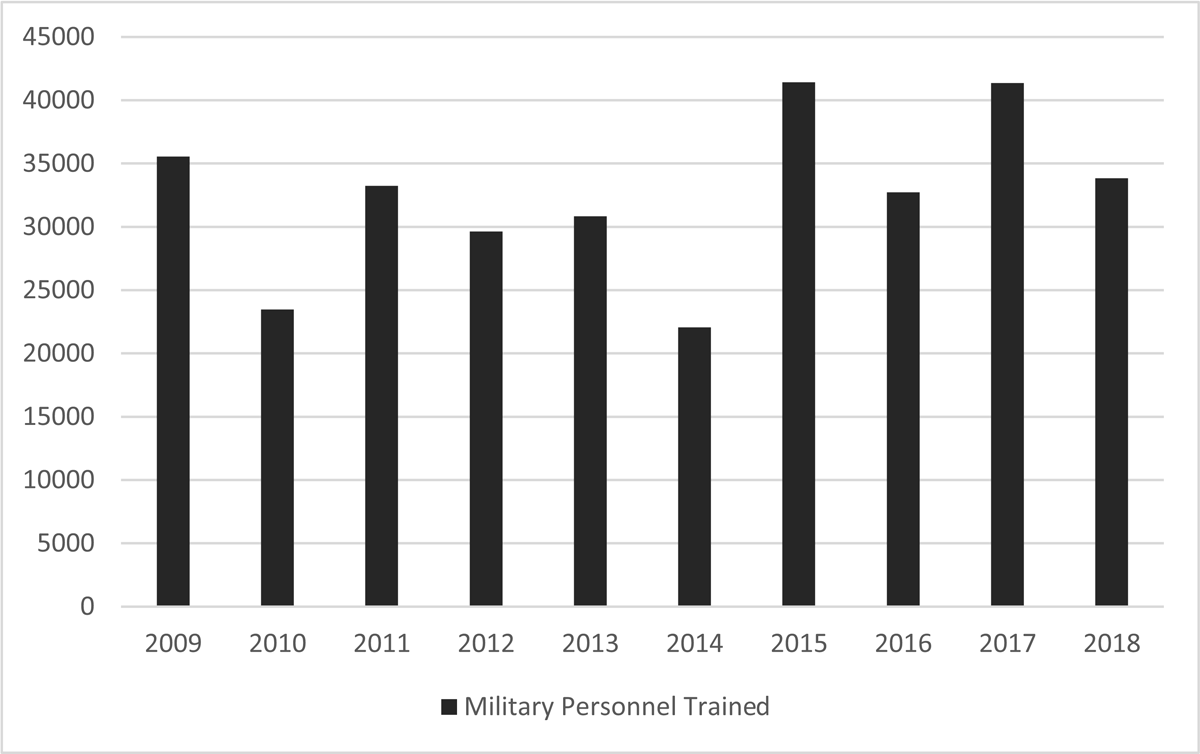
Figure 1
Number of African Military Personnel Trained through US Programming, FY09–18.
US troops are deployed to foreign countries for a number of reasons: to provide training or operational support in response to an immediate threat, to signal US alignment to potential adversaries as a means of deterrence, or to project power to both allies and adversaries. Recent research has found that US troop deployments are associated with regime stability in the host country (Braithwaite and Kucik 2018) and a decreased likelihood of coup attempts (Allen et al. 2023). The presence of US troops tends to convey economic benefits to the host country and can act as a strong indication that the USA supports the incumbent regime. Research on the impact of US deployments on democratic development does not exist. However, by increasing regime longevity, US troops may be inadvertently propping up non-democratic regimes. Based on existing literature, we would expect, in the long term, an indirect but potentially negative impact of US troop deployment on democratic development.
Could it be that US troops are deployed only to countries with security threats and these countries tend to be less democratic? Looking at troop deployments trends in 2008, 19 African countries had no US troops deployed within their borders, while 23 African countries did. Of those 19 countries with no US troops, only one of them had an active conflict.5 In the 23 countries with US troop deployments, almost half (44%) had an active conflict that year. Between the two categories of countries, those with US troops and those without, there was no significant difference in the quality of their democracy. The average Electoral Democracy Index score was 0.42 for those without US troops and 0.42 for those countries with a US troop presence in 2008.
But this relationship changed dramatically by 2018, both in terms of the number of countries that had a US troop presence and which countries had active conflict going on or not. In 2018, 11 countries (or less than 20%) hosted no US troops that year, whilst the majority of countries did. In addition, of the 11 countries without a US troop presence, 6 of them (55%) had an active conflict. Of the countries that did have a US troop presence that year (42 or around 80%), only 19% were experiencing an active conflict. Thus, while it may have been initially true that the USA was deploying troops only to countries with an acute security need, by the late 2010s, this was no longer the case. The USA was deploying broadly across the continent, albeit in small numbers, and mostly to countries without an active conflict. Comparing the two groups of countries, in 2018, those without US troops had a slightly higher average democracy score than those who hosted US troops, 0.48 versus 0.43, respectively.
This leads to our first hypotheses:
Hypothesis 1a: The number of US troops deployed in a country is negatively correlated with democratic development in the host country, all things being equal.
Hypothesis 1b: As the number of US troops deployed in a country increases, government accountability decreases.
Number of Foreign Military Personnel Trained
The Department of State reports to Congress the number of foreign military personnel trained by the United States on an annual basis (US Department of State). This report covers several programs funded by both the Department of State and DoD including: Foreign Military Financing; International Military Education and Training; International Narcotics and Law Enforcement; Nonproliferation, Anti- terrorism, Demining, and Related Programs; African Contingency Operations Training and Assistance; Global Peace Operations Initiative; Partnership for Regional East Africa Counterterrorism; the Trans-Sahara Counterterrorism Partnership; the Global Security Contingency Fund; Section 333 Building Partner Capacity; Humanitarian Assistance; Regional Defense Combatting Terrorism and Irregular Warfare Fellowship Program; and Professional Military Education exchanges. Each report includes the total number of military and security professionals trained, the number of courses provided, the relevant program, and the estimated dollar value of training. The US government engages in additional types of security assistance to partner countries, such as police and justice reform, that are primarily delivered by the State Department and the US Agency for International Development (USAID). For both theoretical reasons – that the provision of assistance for internal policing and justice reform may not affect democratic development in the same manner as assistance for external national defense – and for practical reasons (the unavailability of disaggregated data), this paper focuses more narrowly on security cooperation activities and military assistance.
Figure 1 displays the total number of African troops reported trained in the State Department’s annual Foreign Military Training Report from 2009 to 2018. This number ranges from a low of 22,071 in 2014 to a high of 41,407 in 2015, with an average of roughly 32,000 African troops trained per year. For comparison, in FY2018, the United States trained a total of 62,700 foreign military personnel worldwide, thus African countries comprise a significant portion of this training. Some countries receive a lot of training and some very little. Annually, the United States trains fewer than 10 troops from countries like Central African Republic, Guinea, Namibia, Madagascar, South Sudan, and Sudan. Other countries, such as Burundi, Nigeria, Rwanda, and Uganda receive substantially more training. For example, the United States trained more than 9,000 Nigerian troops and more than 8,500 Ugandan troops in 2009 and 2017, respectively. Associated costs for these trainings range from just a few thousand to millions of dollars. The costs to some countries are small, especially relative to the number of troops trained. This could mean that the United States convened a training activity inside the country for a large number of personnel or that the training was a single day event. Conversely, some trainings, such as those provided as part of Professional Military Education, could be years-long engagements.
The vast majority of this training is to support peacekeeping operations. Other topics include English language training, civilian-military relations, respect for human rights, and various counterterrorism and maritime security special topics. Because foreign military training is meant to build capacity, provide education, and enhance the professionalism of soldiers, we hypothesize that this type of security engagement should have a positive relationship with democratic development. This leads to our second hypothesis:
Hypothesis 2: The number of foreign troops trained by the USA is positively correlated with democratic development in the host country, all things being equal.
Military Assistance
This measure captures training and equipment provided by the United States to partner countries. Both the State Department and USAID maintained online databases of assistance. These two sources presented data in different ways and cover different time periods. The USAID version broke down assistance into two categories: economic and military. Figure 2 details the amount of military assistance reported as disbursed to African countries annually from 2009 to 2020. This data reportedly includes both State Department- and DoD-funded programs, but there are many suspected gaps.
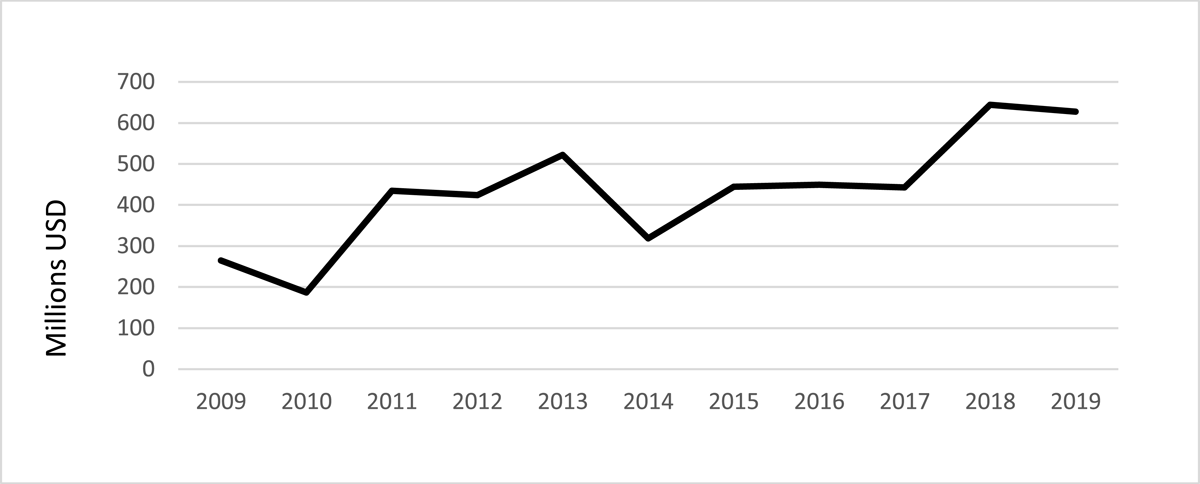
Figure 2
Military Assistance to African Countries, 2009–2019.
Source: US Department of State. Data excludes Egypt.
The United States provides hundreds of millions in military assistance to African countries and this amount has been increasing since the late 2000s. In 2009, the USA provided roughly US$265 million in military assistance to African countries; in 2019, this number had more than doubled to US$627 million. Again, the amount of assistance provided both from year to year and across countries varies widely. Some countries, such as Equatorial Guinea, receive little to no military assistance while others receive significant assistance. Kenya, Uganda, Chad, Niger, and Tunisia, for example, have very large programs that amount to tens of millions in military assistance per year.
The large monetary values associated with military assistance reflect the costs of military equipment, weapons, weapons systems, and the logistics of providing these items, often accompanied by maintenance packages. Providing such large influxes of high value materiel could theoretically have a deleterious impact on the quality of a country’s democracy. High-value security assistance frees up government spending that can be used for clientelistic or other corrupt purposes and can enable governments to maintain power by securing the support of a select segment of the population, namely elites. Alternatively, security assistance, as an external source of revenue and materiel support, can render governments unaccountable to popular demands and pressures.
We hypothesize that the amount of military assistance the USA provides to partner countries can have a negative impact on democratic development, depending on the totality of the US engagement. If the US engagement is primarily militarily or security focused, we believe the relation between military assistance and democratic development should be negative. However, if the US engagement includes increased amounts of economic support and/or democracy support, we believe this relationship should be positive. Thus, our final hypotheses are:
Hypothesis 3a: As the proportion of US military assistance increases relative to all other forms of foreign assistance, the quality of a partner country’s democracy decreases, all things being equal.
Hypothesis 3b: As the proportion of US military assistance increases relative to all other forms of foreign assistance, government accountability decreases.
Results
When looking across the different aspects of security cooperation, some trends emerge. We find, not surprisingly, that many of these measures are only very loosely correlated. Table 2 provides correlation statistics for key independent variables.
Table 2
Correlation Coefficients for Key Independent Variables.
| DOD TROOPS DEPLOYED IN AFRICA | AFRICAN FOREIGN MILITARY TROOPS TRAINED | AMOUNT OF US MILITARY ASSISTANCE DISBURSED | |
|---|---|---|---|
| DoD Troops Deployed to Africa | r = 1.0 | – | – |
| African Foreign Military Troops Trained | r = –.03 | r = 1.0 | – |
| Amount of US Military Assistance Disbursed | r = 0.02 | r = 0.05 | r = 1.0 |
The only negative relationship is that between the number of African military troops trained per year and the number of DoD personnel deployed in Africa, but again, the relationship is very weak. DoD deployments are generally not strongly related to any of the other aspects of security cooperation. This may be because the number of US personnel deployed to Africa is so small that it does not represent any genuine priorities. This may also reflect AFRICOM’s “by, with, and through” approach to African conflicts, in which the United States prefers to provide support to partner militaries as opposed to directly intervening (Vergun 2020). The very weak relationship between these three aspects of security cooperation could also reflect the multiplicity of actors responsible for making decisions about who the United States should partner with in security matters and how. For example, the Office of the Secretary of Defense, AFRICOM, the State Department, and at times the National Security Council all have different roles to play in partnership decisions.
Our multivariate regression analysis examines the relationship between US security cooperation and democracy and governance. As each of the three security cooperation variables is attempting to capture a different aspect of the relationship between the United States and a partner nation, we analyzed each relationship separately using the appropriate control variables and model structure. We are using cross-national time-series data, where years are nested within countries, which requires that we take into account the presence of time-invariant variables and the dependent nature of the residuals produced within each country. We use Random Effects models to address these issues, where the standard errors are clustered by country.
We include the current time period time lags of one, two, and three years for each of our independent variables because we believe that the effects of security assistance on democracy and governance are unlikely to be immediate. To effectively train partner security forces with a sustained capability, for example, takes multiple years of engagement, training of several units, and ideally, institutional capacity support. Additionally, US security cooperation is generally reported by FY, which creates a temporal disconnect between the provision of assistance (which runs from October to September) and annual indices (which typically align with the calendar year). Finally, although the time lags suggest a causal relationship, we are mindful that these are not sufficient to demonstrate causation and that we are reporting on associations that could potentially be explained by other variables.
We used multiple measures of democracy and governance both as a robustness check to ensure that we fully captured what democracy entails and to help identify which aspect(s) of democracy the security cooperation could be affecting. Specifically, we measured democracy and governance with data on the freeness and fairness of elections; respect for political rights and civil liberties; and the quality of governance.
To measure the extent that elections are free and fair and produce accountable governments, we used data from the Electoral Democracy Index. The index ranges from 0 to 1; 0 represents a country where electoral democracy is not achieved and 1 represents a county where democracy is fully achieved (Coppedge et al. 2021a; Coppedge et al. 2021b). For this indicator, the focus is on the responsiveness of the government to citizens through electoral mechanisms. While freedom is considered to some extent, factors like freedom of media and freedom of expression are linked more to electoral outcomes than to other normative conceptions of liberal democracy.
We used data from Freedom House, a non-profit organization that historically has received much of its funding from the US government. Freedom House’s annual Freedom in the World report provides a numeric score for more than 200 countries and territories in the world. The score is the product of an analysis of 10 political rights indicators and 15 civil liberties indicators as assessed by a team of country experts (Freedom House).6 Countries with lower scores (1–2,5) are considered Free; countries with moderate scores (3–5) are considered Partly Free; countries with the highest scores (5,5–7,0) are considered Not Free.
Finally, we included data from the Mo Ibrahim Index of African Governance (IIAG). This provides an annual rating of the overall quality of a country’s governance based on more than 100 factors broken down into four categories: security and rule of law; participation, rights, and inclusion; foundations for economic opportunity; and human development. Of most relevance to this study, we examined sub-categories of data from IIAG on accountability and transparency. Scores range from 0, indicating no governance capacity, to 100, representing high quality of governance.
Using different measures of democracy and governance helps us to get some purchase on the specific mechanisms that could be driving the relationship between security cooperation and democratic development. As with the descriptive analysis, our data ranges from 2009 to 2020 and cover 53 countries in Africa, for a total of more than 500 observations, depending on the specific model. Data availability reduces the total number of cases and countries in some models. Table 3 reports the summary results of all our models tested. Appendix A has more detailed results of our statistical analysis. We discuss each key security cooperation variable in turn below. We note that the relationships show correlation, but do not show a definitive causation.
Table 3
Summary of Findings (Relationship between key variables in top row and democratization-related indices in left column).
| DOD PERSONNEL DEPLOYMENTS | FOREIGN TROOPS TRAINED | U. S. MILITARY ASSISTANCE | |
|---|---|---|---|
| Electoral Democracy Index | • Not significant | • Not significant | • Not significant |
| Freedom House | • Not significant | • Not significant | • Consistently negative |
| Ibrahim Index of African Governance | • Not significant | • Not significant | • Not significant |
| Ibrahim Index of Africa Governance—Transparency & Accountability | • Not significant | • Not significant | • Consistently negative |
DoD Troops Deployed
The number of DoD personnel deployed overseas in a given country is a measure intended to capture the broader definition of security cooperation. Troops and other non-military personnel deploy for multiple purposes: exercises, training, operations, or force projection, for example. Besides the sole US military base in Africa, Camp Lemonier in Djibouti, deployments in Africa are relatively small in number, generally ranging from 0 to 553. The range for personnel deployed in Camp Lemonier is more substantial, from a low of 91 in 2019 to a high of 4,715 in 2017. As Djibouti is such an outlier, we omitted it from this analysis.
Contrary to our first hypotheses – that DoD deployments would have a negative relationship with democratic development and accountability – the relationship between DoD troops deployed and electoral democracy is insignificant across all measures of democracy and all time lags. It is also insignificant across our measure of accountability.
Foreign Military Personnel Trained
To measure the impact of military personnel training we used both the number of foreign personnel trained and the estimated cost of the training per student by country. Contrary to our second hypothesis, namely that the US training of foreign troops would have a positive relationship with democratic development, the relationship between DoD troops deployed and electoral democracy is generally insignificant across all measures of democracy and all time lags. There are a few models where the number of students trained per year is significantly related to our democracy and governance indicators, but the direction of the relationship is inconsistent, that is, there is a positive effect in some years and negative effect in other years.
The number of foreign military personnel that the USA trains per year, either directly or indirectly, appears to have no meaningful relationship to democratic quality in the one- to three-year period after training occurs. Additionally, neither the total estimated financial cost of the training nor the cost per student are related to democracy quality in the short or medium term.
Military Assistance
To test the impact of military assistance on democratic development, we ran models with: the total amount of military assistance provided annually; the total amount of democracy, human rights, and governance (DRG) assistance provided annually; the percent of military assistance that comprised overall US annual assistance (humanitarian assistance, development assistance, and democracy support) annually; and the percent of military assistance and percent of DRG assistance provided annually. We ran alternate models where the percent of military assistance relative to overall assistance was the key independent variable and included percent of annual funding for democracy, human rights, and governance programming.
Our final measurement of security cooperation, the annual amount of military assistance reported by the State Department, is significantly and negatively related to two key aspects of democracy: freedom and accountability. These relationships hold over all lags of our model. Generally speaking, military spending can have a small but negative impact on government protection of civil liberties and personal freedoms and on government accountability. Overmilitarized relationships may be counter- productive to long-term US democracy goals in Africa.
In sum, the scorecard with respect to the impact of US security cooperation on democratic trends in Africa is mixed, but the bulk of the evidence suggests either a weak or negative relationship. However, there is evidence that overmilitarized relationships are specifically problematic. Closer analysis highlights that as military assistance rises, it correlates with weakened accountability and transparency.
Discussion
This article investigated the relationship between US security cooperation activities, and the different facets of assistance that this includes, and key indicators of democratization in Africa between 2005 and 2020. The timeframe is shaped by the availability of specific data, but encompasses a number of key developments in Africa’s security landscape that have shaped US–Africa policy: namely, the creation of AFRICOM in 2007 and its formal establishment in Germany in 2008, and the rise of violent extremist movements in the mid-2000s. At the same time, democratic governance faced new challenges and persistent old ones. For example, electoral violence, which had been expected to decline with the adoption of democratic norms, remained stubbornly constant. In 2005, social and protest movements began to rise sharply in Africa and, after a steady rise, civil liberties and political rights began to decline in 2006. Finally, demand for democracy has consistently outstripped its supply by African governments (Mattes 2019). In the context of the timeframe’s fluid security and governance context, we examined the relationship between democratic trends and high-level security attention on countries through the number of DoD personnel deployed in a country, the number of foreign troops trained, and the amount of military assistance disbursed. Democratic indicators measure good governance, through the IIAG; civil liberties and political rights, through Freedom House; and free and fair elections, through the Electoral Democracy Index.
Overall, the relationship between US security cooperation and democratic indicators in Africa has a mixed, albeit generally moderately negative, track record. The number of DoD personnel deployed and the number of foreign troops trained are generally not consistently correlated with democracy and governance indicators. However, the greater the amount of US military assistance given to African countries in relation to other types of assistance, the stronger the negative impact on protection of freedoms and civil liberties and on government accountability. In other words, overmilitarized relationships may present challenges to advancing democracy and achieving a key tenet of US foreign policy in Africa. However, it is important to note that while our findings of the effects of US security assistance demonstrate correlation and suggestion, we do not conclude that they are monocausal relationships.
This research contributes to our understanding of how the pursuit of security cooperation partnerships, and the provision of military assistance in particular, may result in short-term security gains but at a significant long-term cost to democratic development. A myopic focus on military assistance, with insufficient attention to other facets of international assistance that are indirectly related to the need for military assistance, such as economic development or support for democracy, may result in an unbalanced approach to international assistance, or overmilitarized relationships where the security partnership is prioritized over all else. Although a country or region may experience immediate improvements in their security situation through the stabilization of an acute crisis or the enhanced ability of military professionals to address ongoing insecurity, in the absence of deliberate steps to protect democracy, the long-term impacts of military assistance may be negative and, ultimately, counterproductive. From a foreign policy perspective, addressing today’s security crisis too narrowly may result in a contraction of the democratic space, prompting new grievances against a state, which can then contribute to additional instability and insecurity in the future.
Additional File
The additional file for this article can be found as follows:
Notes
[1] For the purposes of this paper, when we are discussing ‘Africa’ it includes all countries on the continent, except Egypt. The USA generally includes Egypt with other Middle Eastern countries in its defense planning, programming, and operations.
[2] This is a ballpark figure based on data from Congressional Reports, USAID’s Foreign Aid Explorer, and the US State Department’s Foreign Assistance website. Obtaining precise figures is very difficult. For more information see: Grill et al. (2017).
[3] Countries analyzed include: Algeria, Angola, Benin, Botswana, Burkina Faso, Burundi, Cabo Verde, Cameroon, Central African Republic, Chad, Comoros, Côte d’Ivoire, Democratic Republic of Congo, Djibouti, Equatorial Guinea, Eritrea, Ethiopia, Gabon, Gambia, Ghana, Guinea, Guinea-Bissau, Kenya, Lesotho, Liberia, Libya, Madagascar, Malawi, Mali, Mauritania, Mauritius, Morocco, Mozambique, Namibia, Niger, Nigeria, Republic of Congo, Rwanda, São Tomé e Principe, Senegal, Seychelles, Sierra Leone, Somalia, South Africa, South Sudan, Sudan, Swaziland, Tanzania, Togo, Tunisia, Uganda, Zambia, and Zimbabwe.
[4] DoD Personnel Data are reported on an annual basis from 2008 to 2013 and then quarterly from 2014 to 2021. To facilitate comparison, we chose to collect data from September every year. See: Defense Manpower Data Center (ND).
[5] Based on PRIO Conflict Data where the threshold for a minor conflict is a minimum of 25 battle-related deaths in a calendar year; all conflicts with deaths greater than 1,000 are considered major conflicts or wars.
[6] Specific indicators include information on the freeness and fairness of election and election management; political party freedom to organize and realistically contest elections; full rights of all sectors of the population (ethnic, racial, religious, gender, LGTBGI+, etc.); government freedom to make and implement policy; safeguards against corruption; openness and transparency in government functions; free and independent media; freedom of religion and/or no-belief; academic freedom; individual freedom of expression; freedom of assembly; adherence to rule of law; individual freedom of movement; freedom of property and business decisions; and protection of social freedoms. See https://freedomhouse.org/reports/freedom-world/freedom-world-research-methodology.
Competing Interests
The authors have no competing interests to declare.