
Table 1
Position of a selection of bigrams for each decade. Data: JYU People & Parliament, UK, French and German newer corpus, speeches and number of results.
| BIGRAM | POSITION – 1990s | POSITION – 2000s | POSITION – 2010s |
|---|---|---|---|
| Direct democracy | 0 | 53 | 14 |
| Participati* democracy | 0 | 59 | 11 |
| Representative democracy | 6 | 3 | 6 |
| Démocratie directe | 22 | 16 | 19 |
| Démocratie participative | 29 | 8 | 3 |
| Démocratie représentative | 13 | 10 | 4 |
| Direkte demokratie | 17 | 3 | 1 |
| Repräsentative demokrati | 7 | 7 | 9 |
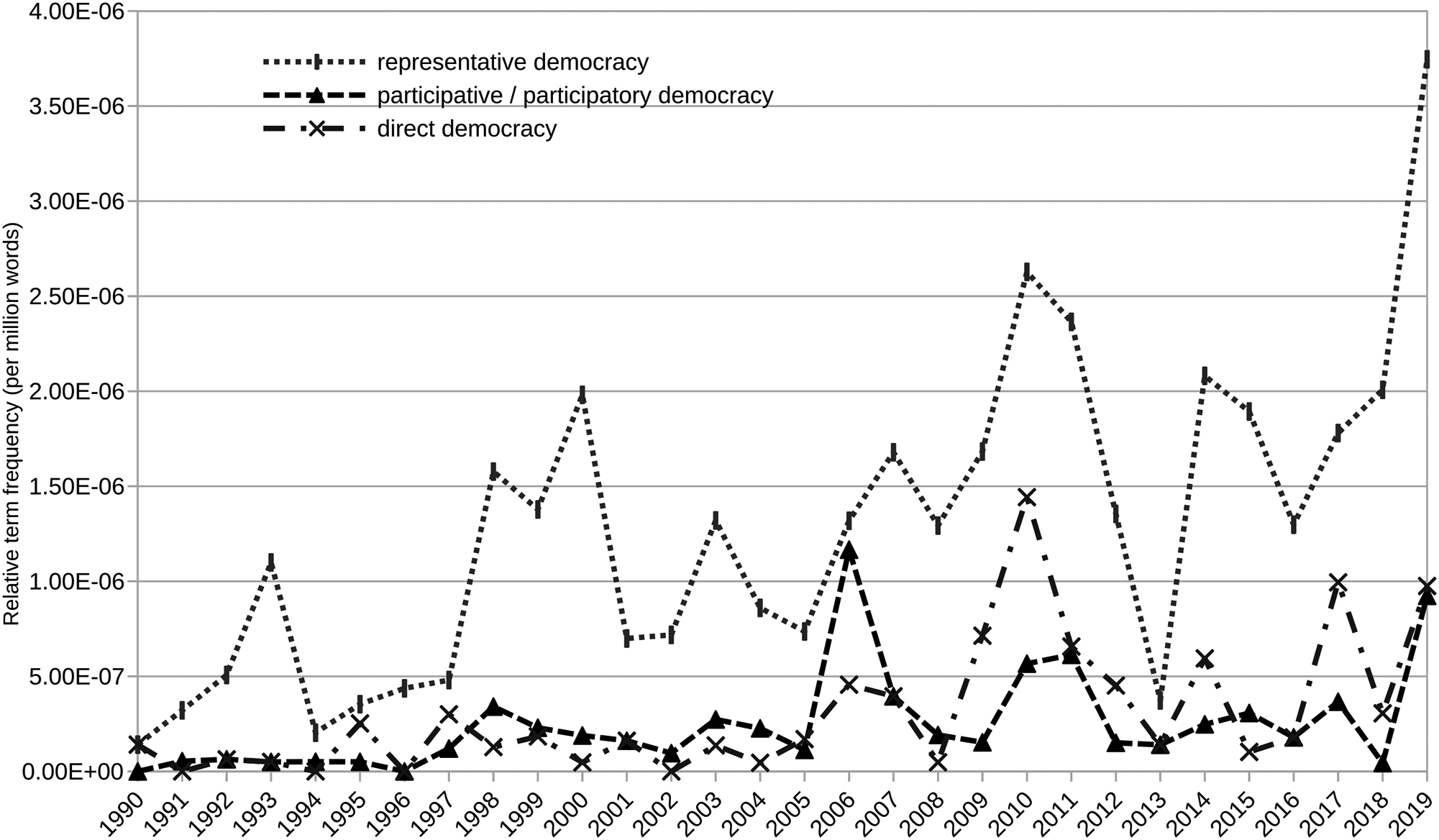
Figure 1
UK, Commons, relative term frequencies of the selected bigrams, 1990–2019. ‘Representative democracy’, n = 340; ‘direct democracy’, n = 97; ‘participative/participatory democracy’, n = 68.
Source: JYU People & Parliament, UK corpus, speeches, frequency of search term. Copyright Hugo Bonin.
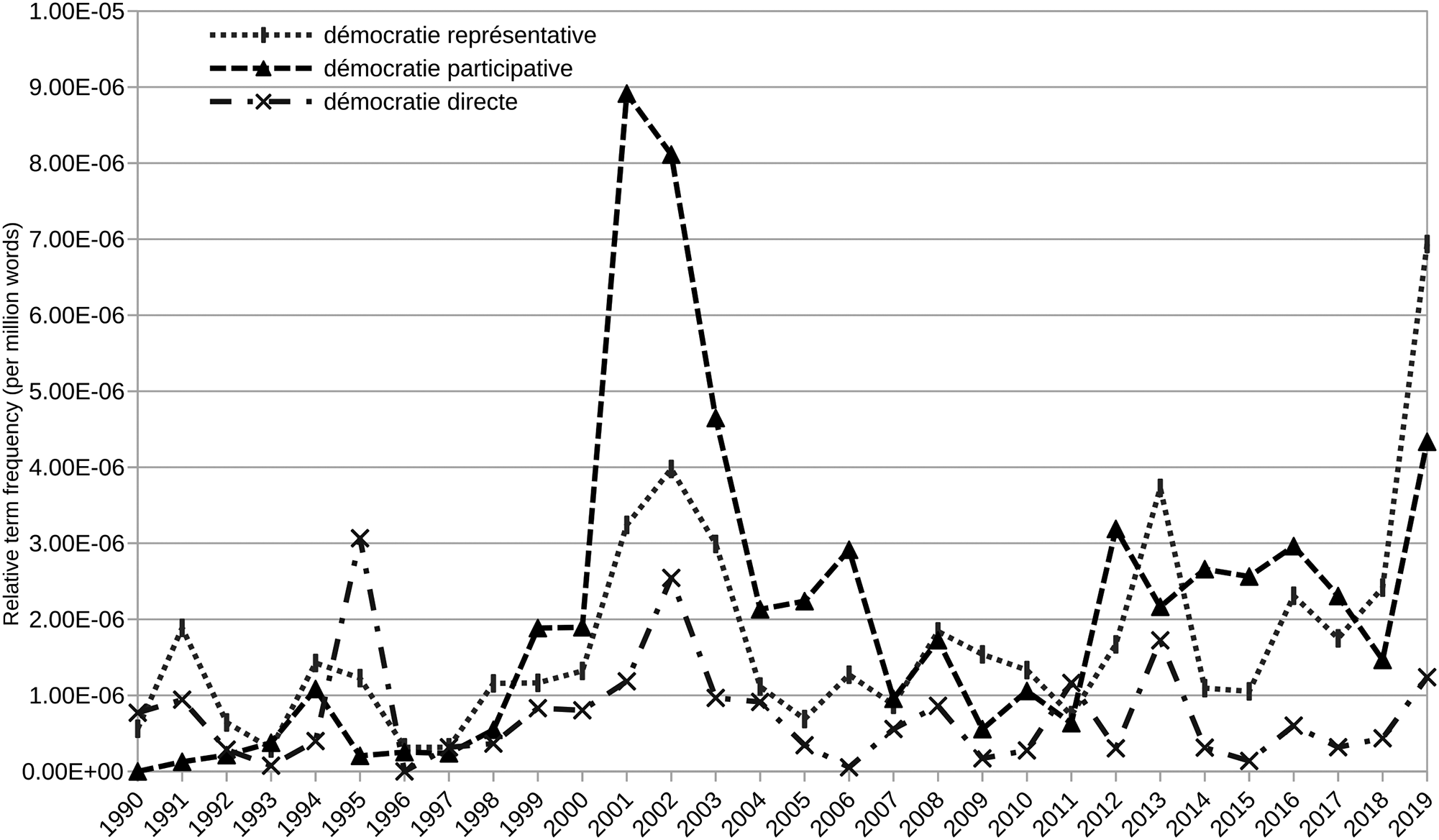
Figure 2
France, National Assembly, relative term frequencies of the selected bigrams, 1990–2019. ‘Démocratie représentative’, n = 466; ‘démocratie directe’, n = 186; ‘démocratie participative’, n = 532.
Source: JYU People & Parliament, French corpus, speeches, frequency of search term. Copyright Hugo Bonin.
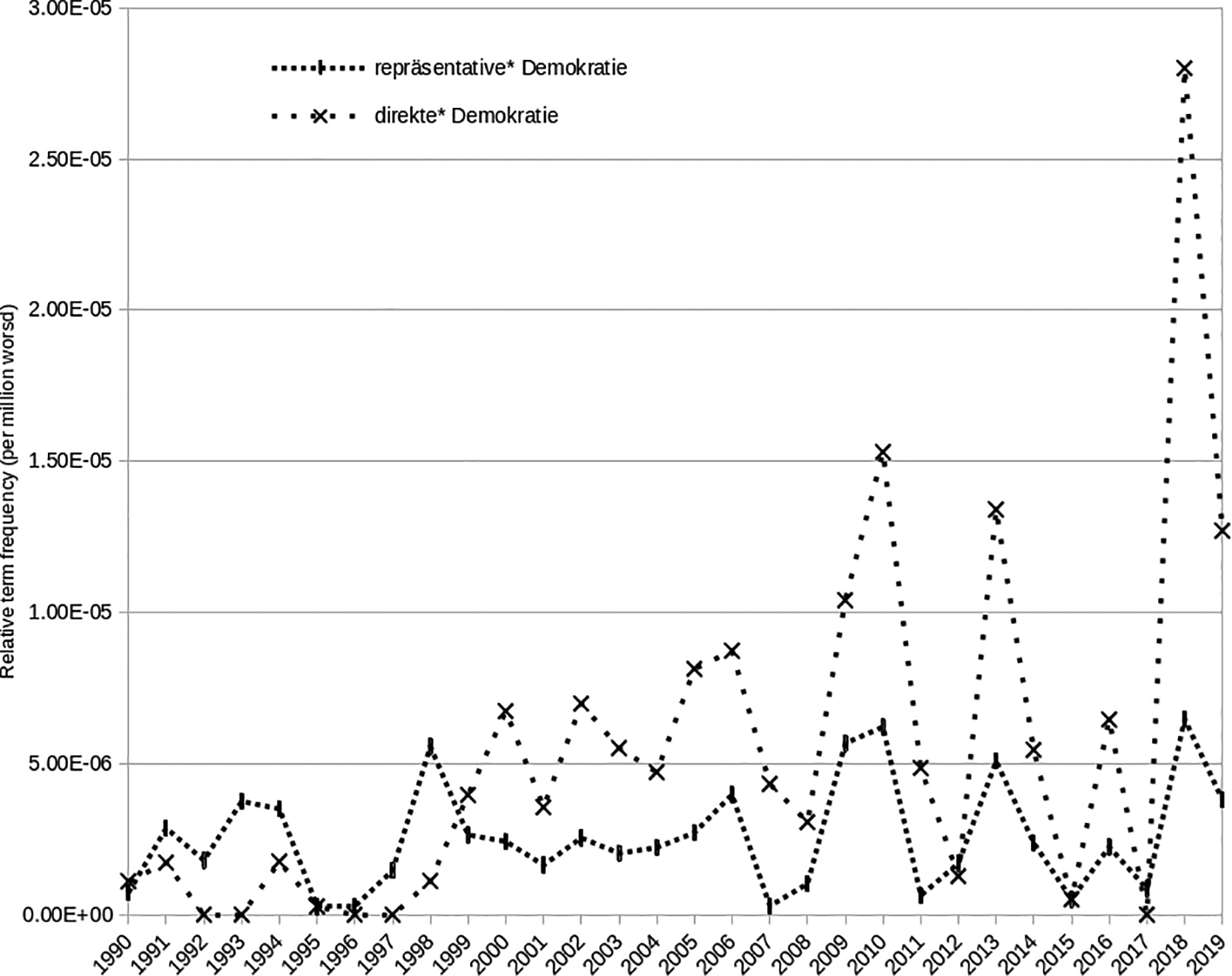
Figure 3
Germany, Bundestag, relative term frequencies of the selected bigrams, 1990–2019. ‘repräsentative* Demokratie’, n = 199; ‘direkte* Demokratie’, n = 281.
Source: JYU People & Parliament, German newer corpus, speeches, frequency of search term. Copyright Hugo Bonin.