
Introduction
Following the Second World War, European democracies were designed to prevent the re‑emergence of authoritarian regimes of the interbellum. This was achieved by focusing on elections, parliamentary representation and negotiations with interest groups, while downplaying direct popular rule (Conway 2020; Corduwener 2016; Müller 2011). This fragile postwar version of representative democracy began to fragment by the 1970s alongside traditional values (such as religion and nationalism) and hierarchies. Ronald Inglehart (1977) has suggested that rising levels of education increased interest in, capability of and willingness to challenge elites and influence policies. Since then, party membership and trust in representatives have declined and perceived disengagement with politics has increased (Dalton 2013; Mair 2013). Political parties moved from being ‘people’s parties’ that connected state and society to governing apparatuses, and party membership figures declined (Corduwener 2023). Transformations of the media landscape and political communication have further weakened the distinction between representatives and the represented (Best and Vogel 2020). These shifts accelerated in the 1990s, leading scholars to talk of trouble in advanced democracies (Pharr et al. 2000).
Since the year 2000, Members of Parliament (MPs) have become increasingly confronted with alternative modes of representation. Unelected bodies based on expertise, such as central banks, courts and independent agencies, play a larger role in contemporary politics (Vibert 2007). At the same time, calls for participatory and direct democracy have been steadily on the rise since the late 1960s (Donovan and Karp 2006; Polletta 2014). These have been responded to with a host of experiments involving citizens’ assemblies, citizens’ initiatives, referendums and digitally driven so‑called ‘democratic innovations’.1
The perception of the relationship between democracy and representation among different publics has been the subject of several studies. One fruitful avenue has been investigations into politicians’ views on democracy. Nicholas Allen and Katja Mirwaldt have studied party manifestos in Britain, France and Germany and shown how, ‘in recent decades, parties have become more supportive of, and more vocal in their calls for, citizen participation in political decision‑making’ (2010, 888). Once some parties began to speak for participatory democracy, other parties were forced to follow and avoid explicit defences of representative democracy, despite general awareness of the problematic union of direct democracy instruments and parliamentary decision‑making (Allen and Mirwaldt 2010, 890). Other studies have attempted to understand, typically based on interviews or questionnaires, European politicians’ support for or opposition to participatory, deliberative or direct democracy. Their results highlight how factors such as ideology, the position of elected representatives or the nature of the democratic innovations proposed explain differentiated levels of support, while showing a general lower support for direct democracy instruments than for participatory experiments (Close 2020; Junius et al. 2021; Jacquet et al. 2022).
Pursuing this trend in a comparative and diachronic perspective, in this article, we examine the conceptions of democracy set out in German, United Kingdom (UK) and French parliamentary debates between 2000 and 2019. Parliaments constitute an exceptional meeting place for a variety of political discourses and concepts in societies at large. These debates can thus be seen ‘as nexuses of societal power relations and ideologies’, where political actors make practical use of ideas within their rhetorical struggles (Ihalainen and Palonen 2009; Ihalainen and Saarinen 2019). Focusing on parliamentary debates as primary sources allows us to complement the research mentioned above: by analysing public positions, we obtain an image of what is possible for elected representatives to state more publicly than in interviews or questionnaires (Bicquelet and Addison 2018). We also see how party manifestos are implemented in political discourse.
Consequently, we focus on how MPs have discussed the question of democracy in a constitutional sense in the early 21st century in the UK, France and Germany. Given the evolution outlined above, we are especially interested in how and why political actors have argued for the need to change democracy. We focus on discourses concerning ‘representative democracy’ and on its most obvious alternative forms, ‘direct’ and ‘participatory democracy’. When have these conceptions of democracy been discussed? For what reasons? And what solutions have emerged to address calls for more participation?
We combine computational methods and qualitative analysis of MPs’ speeches. Digitised parliamentary debates offer vast possibilities for applying digital tools to compare conceptualisations of democracy by considering both general trends quantitatively and individual uses of concepts qualitatively in the three countries’ parliaments, focusing on the lower chambers.
Our analysis shows how, for most parliamentarians in the 2000s, the dominant institutionalised form of democracy – usually dubbed ‘representative’ democracy – had to be reformed with a set of democratic innovations. More participation in political decision‑making was demanded to reflect societal changes, new modes of communication and deepening European integration. Moreover, we demonstrate that this apparent consensus crumbled by the end of the 2010s, with a polarisation over direct democratic instruments and a stronger defence of the representative model overall. By historicising recent conceptions of democracy held by German, French and UK MPs, we place current calls for participation in the long‑term context of the transformations of representative government.
First, we explain our methodology, providing a quantitative perspective on parliamentary discussions of ‘democracy’ from 1990–2019. This helps us to identify a series of country‑specific democratic models which guide our qualitative analysis. Next, we concentrate on the 2000s, when a set of democratic innovations was typically welcomed as improving participation in representative democracy. Finally, we look at the late 2010s, when many MPs ended up doubtful about direct democracy following the rise of populist movements and parties.
Comparing from a Distance
Given the increasingly transnational character of contemporary politics, we opt for a comparative study of the UK, France and Germany, the three largest democracies in Western Europe, representing different but comparable historical trajectories of democratisation and parliamentarisation.
Westminster is often presented as an ideal type of deliberative parliamentarism, characterised by flexibility due to an unwritten constitution, a strong rhetorically oriented House of Commons and a House of Lords reflecting traditions and expertise. From the 1990s onward, however, European integration, a growing emphasis on human rights and identities and devolution challenged parliamentary sovereignty (Bogdanor 2019; Conway 2020, Palonen 2018). Among the leading parliamentary parties, Labour has been more positive towards extended political participation since the 1960s, while the Conservatives began to welcome it only during the 2000s (Allen and Mirwaldt 2010, 877). The UK also followed a distinctive trajectory regarding direct democratic instruments (DDIs). While referendums were long absent from the constitutional toolkit, they were debated intensively in the late 19th and early 20th centuries. Some Liberals and Conservatives – often positioned as outsiders in intra‑party struggles – endorsed referendums as a means to resolve crises and rally their party – for instance, during the 1910–1911 battle over the Parliament Act (Jones 2019; Meadowcroft and Taylor 1990). This instrumental conception foreshadowed later patterns: the first national referendum did not occur until 1975, on European Economic Community membership, which was followed by a series of regional referendums from the late 1990s and ultimately Brexit in 2016 (Gordon 2020). Much like early 20th‑century Conservatives, pro‑Brexit politicians invoked the referendum to settle a divisive issue and unify the party, though with equally destabilising consequences.
French parliamentarism has been seen as constituting an alternative type to the UK one (Garrigues and Anceau 2016). Since 1958, the Fifth Republic has been characterised as a centralised semi‑presidential regime, with the president and parliament sharing sovereignty (Atkin 2017). Political reconfigurations and constitutional reforms have led to an increased ‘presidentialisation’ of the Republic at the cost of a weaker parliament (Rosanvallon 2018; Vintzel 2017). In party manifestos, practically all parties started to view participation and direct democracy positively during the 1990s, while the left had previously been sceptical (Allen and Mirwaldt 2010, 881–882), reflecting French traditions of authoritarian leaders to use top‑down consultations to legitimise their decisions. This caution is rooted in a long and conflicted history with DDIs spanning from the plébiscites of the First and Second Empires to the tightly controlled referendums of the Fifth Republic (Morel 2021). Even the 1958 constitution’s referendum provisions retained this plebiscitarian stigma, which explains why parliamentary debates often invoked foreign experiences rather than domestic precedents. Since the 1980s, however, calls for citizen participation and responses to democratic disaffection have fuelled renewed interest in DDIs, first from new parties such as the Greens and, by the 2000s, from radical‑right actors like the Front/Rassemblement nationals.
In Germany, scepticism about parliaments has a long tradition. Social movements that rose in the late 1960s criticised representative democracy, calling for direct participation by the people (Gilcher‑Holtey 2018; Jörke and Llanque 2016). Yet, the introduction of democratic innovations at the federal level has continued to be curbed constitutionally, reflecting the traumas of the interwar era (Biefang 2022, 44). The Weimar Volksabstimmungen, later exploited by the National Socialist German Workers’ Party, entrenched an association between DDIs and destabilisation or authoritarianism. This troubled legacy explains why federal DDIs were largely absent from the Basic Law, while subnational referendums developed more freely (Jung 1989; 1994). The first parties to call for broader participation were the Liberals (Free Democratic Party) and Social Democrats (Social Democratic Party of Germany [SPD]) in the wake of 1968, later joined by the Greens (Ihalainen 2025). As in France, recent demands for DDIs were increasingly voiced by radical‑right actors, culminating with the Alternative für Deutschland’s (AfD) entry into the Bundestag in 2017.
We made use of digitised sources and computer‑assisted methods to focus on several key forms of democracy that emerged across all three countries. This quantitative overview then forms the basis of our contextual analysis in the following sections. To combine both approaches, we used the comparative interface People & Parliament (P&P), covering the parliamentary debates of several Northwest European countries since the 19th century.2 With the word‑embedding, relative term frequency and n‑gram tools of the interface, we were able to locate key qualifiers of institutional forms of ‘democracy’ in limited time periods as well as to observe long‑term trends. Yet, we base our interpretation about competing applications and evaluations of ‘democracy’ on contextualising textual analysis, focusing on the uses of the key bigrams in practice. Our close reading zooms in on speech acts concerning ‘representative democracy’, as well as its most notable alternatives, ‘direct’ and ‘participatory democracy’.
Word embeddings – in P&P, based on the Word2Vec algorithm – point at up to 100 most related words, i.e. words that the algorithm calculates as having appeared in similar contexts of five words both ways, and hence suggests that these words were semantically connected or associated with the seed term. The most promising aspect about word embeddings is that they go beyond searches with simple keywords to genuinely historical vocabulary, potentially catching the onomasiological aspects of conceptual history in ways that analogue reading is unable to produce. Comparisons of word embeddings over time help formulate hypotheses on overall changes in meaning to be tested through conventionally contextualising close reading. We used the word‑embedding tool of P&P to identify the top 20 terms related to ‘representation’ and ‘participation’ in the UK, French and German parliaments during 1980–2000 and 2000–2020 (Appendix).
Noteworthy in the UK parliamentary debates are the rise of ‘participation’ to among the top related words for ‘representation’ and the extension of ‘participatory’ from racial, confessional and multicultural issues to defining ‘democracy’ and ‘democratic’ in general in the sense of ‘inclusiveness’. In the French and German parliaments, associations between ‘democratic’ and ‘participative’ emerged well before the year 2000. In France, linkages between participation and the representative system rose in the early 21st century, emerging from a trade union context, while an explicit connection to democracy appears as less obvious, the emphasis instead being on ‘citizens’ (citoyenne). In the German parliament, ‘representative’ and ‘democratic’ or ‘democracy’ went hand in hand, yet representation was also associated early with various direct democracy instruments (Volksentscheid, Volksbegehren, Umfrage). Interaction with ‘civil society’ was consistently reinforced discursively through a multifaceted vocabulary (Bürgerschaft, Zivilgesellschaft, Bürgergesellschaft, Bürgerbeteiligung) (see a more extensive analysis in Ihalainen 2025). UK parliamentarians associated representation with legitimacy and accountability; Germans, with transparency, while participation was also about acceptance. For the elites of both parliaments, participation was increasingly about inclusion (Appendix).
Regarding qualifiers of democracy used by parliamentarians, the neighbouring tool of P&P allowed us to identify the 100 most common bigrams containing democracy in each country’s lower house debates. A bigram is a sequence of two adjacent elements in a string of tokens. In our case, this means two words appearing together: ‘local democracy’, ‘parliamentary democracy’, etc. To get a diachronic perspective, we created a list of the 100 most common bigrams containing ‘democracy’ for each decade (1990–1999, 2000–2009 and 2010–2019).3
While there have been many interesting bigrams of democracy, especially since the 1970s, we recognised one that pointed to a more mainstream understanding of democracy (‘representative’) and two to alternative forms: ‘direct’ and ‘participatory/participative’. Their positions vary according to the decade, but they have mostly risen in all three countries over time (see Table 1). We concluded that these bigrams (with linguistic variations) offer a central vantage point to study contemporary redefinitions of democracy. While there are many other qualifiers of democracy, focusing on ‘direct democracy’ and ‘participatory democracy’ enables comparison between the three countries, allows systematic close reading and provides the most obvious contrasts to the more mainstream ‘representative democracy’.
Table 1
Position of a selection of bigrams for each decade. Data: JYU People & Parliament, UK, French and German newer corpus, speeches and number of results.
| BIGRAM | POSITION – 1990s | POSITION – 2000s | POSITION – 2010s |
|---|---|---|---|
| Direct democracy | 0 | 53 | 14 |
| Participati* democracy | 0 | 59 | 11 |
| Representative democracy | 6 | 3 | 6 |
| Démocratie directe | 22 | 16 | 19 |
| Démocratie participative | 29 | 8 | 3 |
| Démocratie représentative | 13 | 10 | 4 |
| Direkte demokratie | 17 | 3 | 1 |
| Repräsentative demokrati | 7 | 7 | 9 |
We are aware that representative government was increasingly called ‘parliamentary democracy’ in several Western European countries in the 1930s, as a reaction to the rise of totalitarian systems, and that ‘representative democracy’ was adopted as an alternative name for the political system in parliaments during the Cold War and more broadly since the rise of social movements calling for citizen participation in political decision‑making beyond mere voting. More recently, ‘parliamentary democracy’ has often been used – especially in the UK and France – as a procedural term to discuss power relations between institutions rather than as a name for representative government as a whole, a usage that is more common in Germany. We have hence chosen to pay attention to ‘parliamentary democracy’ when it appears in the context of ‘representative democracy’, a more exact name for the established political order.
Figure 1 shows the relative term frequencies of the three chosen bigrams in the UK House of Commons, demonstrating the relative strength of discourses on ‘representative democracy’ while illustrating how debates on complementary forms emerged from 1997 onwards. These were more intensive debates especially in the early 2000s, early 2010s and late 2010s.
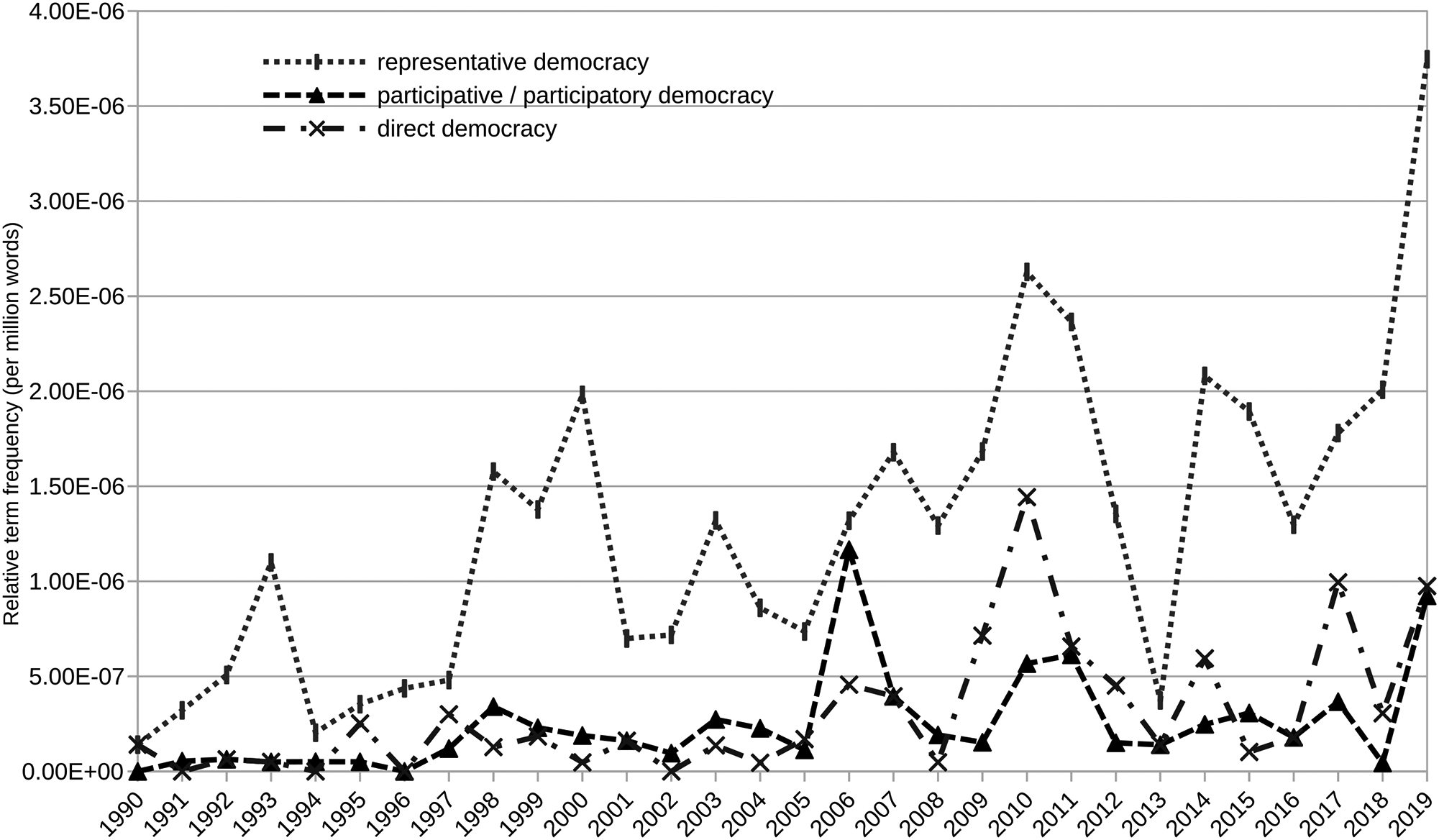
Figure 1
UK, Commons, relative term frequencies of the selected bigrams, 1990–2019. ‘Representative democracy’, n = 340; ‘direct democracy’, n = 97; ‘participative/participatory democracy’, n = 68.
Source: JYU People & Parliament, UK corpus, speeches, frequency of search term. Copyright Hugo Bonin.
In the French case, the presence of alternative conceptions of démocratie is quite visible. Focusing on the same selection of bigrams, Figure 2 illustrates how, while the varieties of democracy were discussed constantly, certain peaks are discernible: a real wave of debate emerged in the early 2000s, regarding the application of participatory principles at the local level. The discussions revived briefly in the early 2010s, followed at the end of the decade by another wave of debates on varieties of democracy.
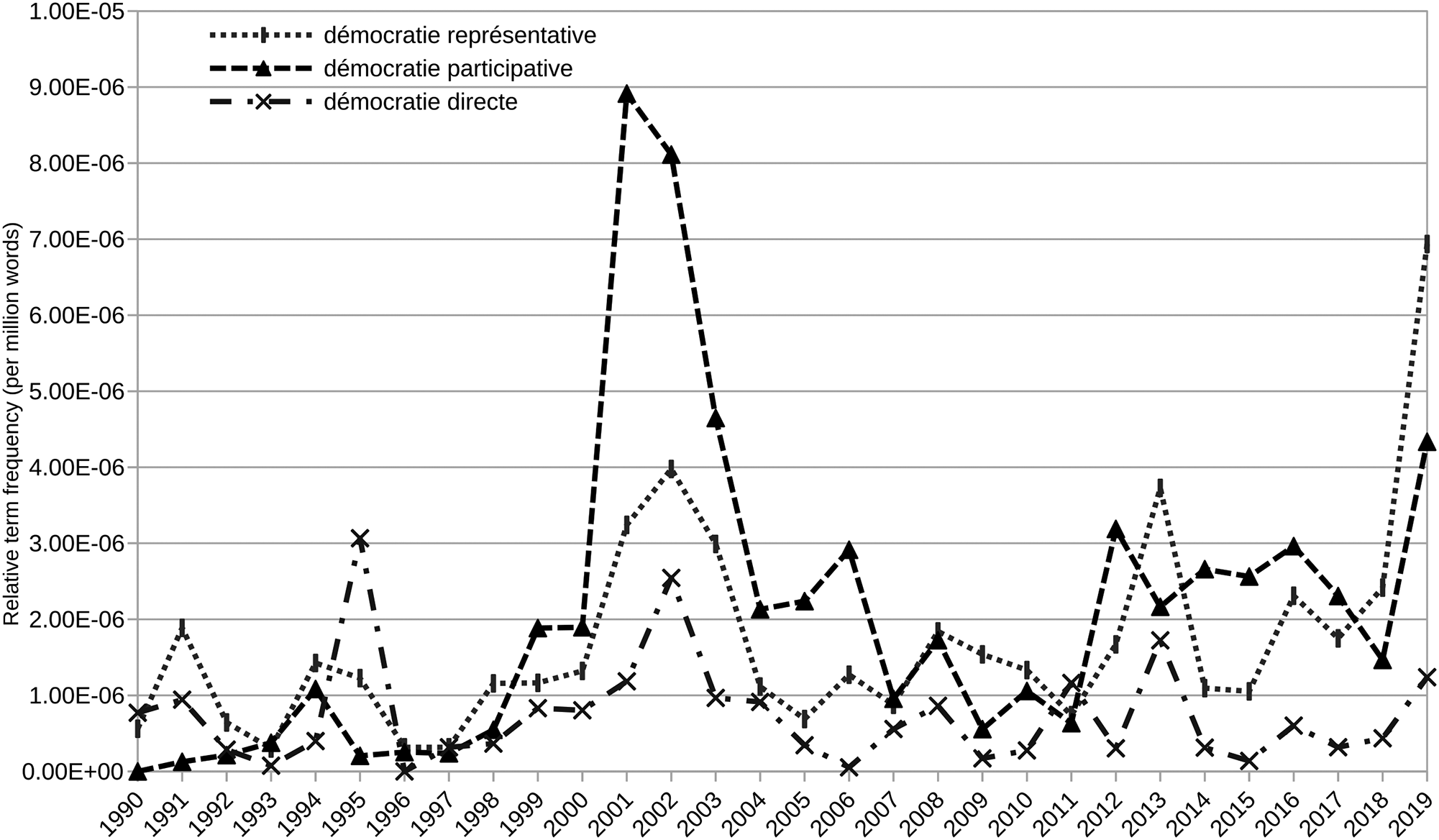
Figure 2
France, National Assembly, relative term frequencies of the selected bigrams, 1990–2019. ‘Démocratie représentative’, n = 466; ‘démocratie directe’, n = 186; ‘démocratie participative’, n = 532.
Source: JYU People & Parliament, French corpus, speeches, frequency of search term. Copyright Hugo Bonin.
As for Germany, as seen in Figure 3, references to ‘repräsentative Demokratie’ remained rather high and stable after unification, whereas discussion on ‘direkte Demokratie’ intensified considerably since the year 2000. The exceptionally high frequency of the bigram differs both from the UK and French debates but is partly explained by the fact that, in German, ‘direkte Demokratie’ often covers elements that might be called ‘participatory’ in the comparator countries. Close reading demonstrates that a broad vocabulary of citizen participation was in use, instead of the umbrella concept ‘partizipatorische/partizipative Demokratie’. ‘Direct democracy’ was at times more commonly used in the Bundestag than the conventional bigram of ‘representative democracy’.
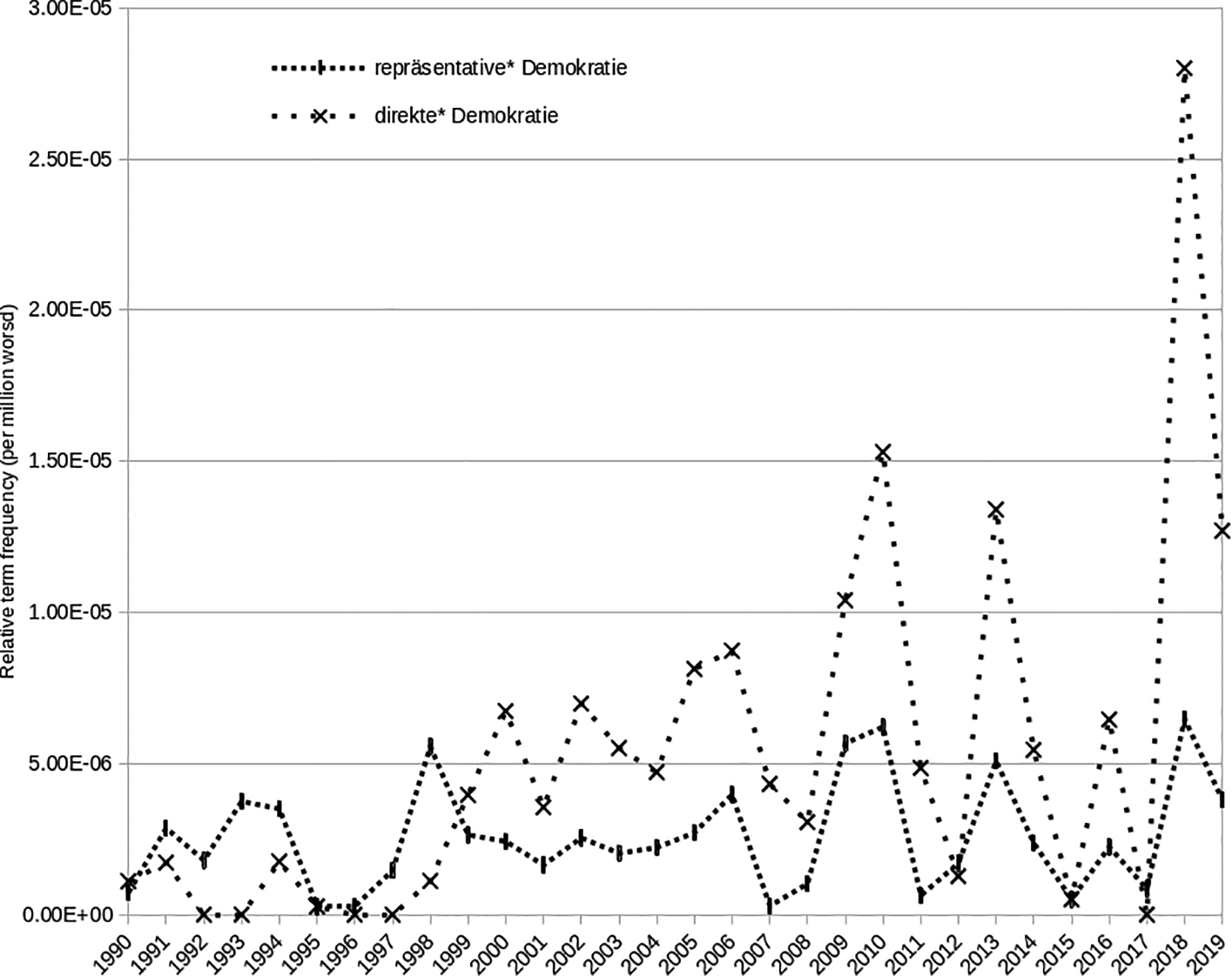
Figure 3
Germany, Bundestag, relative term frequencies of the selected bigrams, 1990–2019. ‘repräsentative* Demokratie’, n = 199; ‘direkte* Demokratie’, n = 281.
Source: JYU People & Parliament, German newer corpus, speeches, frequency of search term. Copyright Hugo Bonin.
All three national cases thus demonstrate how ‘representative democracy’ has become increasingly complemented by references to ‘direct’ or ‘participatory’ democracy since the late 1990s. While references to these three forms of democracy were constant during the two first decades of the 20th century, the most obvious peaks in all three countries appear in the early 2000s and late 2010s, on which we hence focus in the following close reading sections to get hold of changing conceptualisations of democracy in this period. We cite speeches that can either be regarded as representative of a broader debate or include original arguments that deserve attention. We tested the possibility of classifying MPs’ attitudes to various forms of constitutional democracy but found that difficult due to the flexible boundaries of the terms and the tendency of political parties to define them creatively in everyday party political struggles. Yet, for this purpose, we read through practically every reference to ‘representative’, ‘direct’ or ‘participatory democracy’.
‘The era of pure representative democracy is coming to an end’: suggested updates in the UK
During Tony Blair’s premiership (1997–2007), the growing calls to increase participation and the use of referendums led many UK MPs to contemplate tensions between parliamentary representation and popular participation. Most calls to reform the established form of democracy were characterised by a distinct optimism, usually influenced by the emerging information technologies and the growing possibilities of involving citizens at the local level. The optimistic reading is evident in an influential statement Peter Mandelson – serving as a minister without portfolio in Blair’s first government – made in March 1998. Mandelson suggested ‘the age of pure representative democracy’ might be approaching its end, as people seemingly wanted to become increasingly involved in politics. He pointed at ‘plebiscites, focus groups, lobbies, citizens’ movements and the internet’ having become the driving forces of democratic change (Traynor 1998). Mandelson’s speech underlined ongoing structural changes, including civil society activism, the rise of new technologies and growing emphasis on referendums (Bogdanor 2019; King 2007). Claiming to respond to calls for more participation, New Labour represented itself as encouraging people and communities to find their own solutions (Mair 2013).
Over time, Mandelson’s views would be challenged repeatedly by the Conservative opposition. Gillian Shephard (Conservative) used Mandelson’s statement to undermine Blair, presenting it as indicative of his government’s attitude towards representative democracy. Shepherd insisted that there was ‘an essential difference between Parliament and the internet, people’s panels and the other examples cited by the Prime Minister, who gave no sign of understanding Parliament’s meaning and purpose’ (HC Deb, 13 July 2000, 353/1118).4 In response to William Hague, the Conservative leader, Blair explained that his government tried ‘in so far as is possible and consistent with representative democracy – to do the people’s will’ (HC Deb, 13 July 2000, 353/1085–97; ibid, 353/1098).
This question of ‘the people’s will’ became increasingly tied to the issue of referendum. While the UK had its first wave of referendums in the 1970s, another wave followed from 1997 onwards. During a debate on the Political Parties, Elections and Referendums Act, establishing a procedural framework for future referendums, Andrew MacKay (Conservative) noted in line with the traditional Conservative view that, as a ‘believ[er] in our parliamentary democracy’, he had, in general, ‘the greatest reservations about referendums’, calling for their strict regulation (HC Deb, 6 February 2001, 362/879–881; see also HC Deb, 18 July 2001, 372/358–9).
Although the perceived challenges referendums imposed on representative democracy were recognised by both Conservative and Labour MPs, the issue gained partisan undertones after the Conservatives adopted a pro‑referendum stance on European issues. Denis MacShane, Labour minister of state for Europe, accused the Conservative opposition of not wanting ‘a referendum to find out what the British people want [but] to enable them to say no to Europe’ (HC Deb, 11 June 2003, 406/749–50; see also HC Deb, 16 September 2003, 410/819–20), highlighting the instrumental motives of such a demand. Stephen Ladyman (Labour) noted in a similar fashion that ‘Conservative Members, who usually lecture us about the importance of Parliament and the need to ensure that it is supreme again, argue for putting aside our supremacy because they do not like a decision and want a referendum on it’ (HC Deb, 18 July 2001, 372/379). The Labour MPs accused pro‑referendum Conservatives of promoting direct democracy to overrule the decisions of a Labour‑controlled parliament rather than being willing to really involve the people.
Participative innovations were not only addressed on the national level but also with reference to local government, which has been sometimes seen as a more flexible and receptive space, enabling experiments. This focus is evident on both sides of the political spectrum. For example, John Battle (Labour) argued in favour of a complementary view of participation and representation: ‘We should not be setting at odds community participation, through local meetings and representational democracy in the form of elected councillors’ (HC Deb, 26 May 2004, 421/1602). On the other side, Douglas Carswell (Conservative) pushed for the idea of electing local police commissioners with references to direct democracy: ‘we should have a policy based on the principles of downward accountability; decentralisation and localism; and direct democracy’ (HC Deb, 28 June 2005, 435/1229). Similar arguments emphasising the need to delegate decisions to local communities were present in France and Germany.
There was evidently a widely felt need to reform representative democracy in the early 2000s, whether through referendums or greater participation at the local level. In 2006, an independent commission known as the Power Inquiry released a report on ‘how participation in British politics could be increased and deepened’ (Power Inquiry 2006, 2). It made Gordon Brown, then chancellor of the exchequer, conclude that, ‘[a]lthough our system of representative democracy... is at the heart of our constitution, it can be enhanced by devolving more power directly to the people’ – through democratic innovations such as citizens’ initiatives and juries (HC Deb, 3 July 2007, 462/818). Minister of Justice Michael Wills (Labour) nevertheless assured that the suggested ‘measures of direct democracy’ were not intended to ‘to replace our system of representative democracy or go towards in any way a plebiscitary democracy’ (HC Deb, 10 October 2007, 464/425). For most UK MPs at the time, incremental reforms were necessary responses to the changing attitudes of the public.
‘A participatory and direct democracy’: local focus and minor reforms in france
In the French parliament, references to either direct or participatory democracy were often made in passing. However, certain common features are discernible: an emphasis on local politics, a rather vague character of the democratic innovations mentioned and the complementary nature of those alternative forms to representative democracy. The vast majority of uses of both ‘démocratie directe’ and ‘démocratie participative’ were linked to questions of city planning, local politics, ‘proximity’ or ‘decentralisation’. This was particularly the case in the debates on a bill on ‘proximity democracy’ (led by the Interior Socialist Minister Daniel Vaillant in 2001) and on the constitutional reform for the ‘decentralised organisation of the Republic’ (led by the new right‑wing government in 2002–2003).
In both cases, MPs found that frequent contact between citizens and elected officials at the local level facilitated ‘participation’ and ‘direct’ involvement. Communist Jean Vila (Parti communiste français [PCF]; French communist party, far left), himself a local mayor, argued ‘the municipal level is undoubtedly the most democratic level of our political and administrative organisation because, due to its proximity, it gives rise to a participatory and direct democracy on a permanent basis’ (AN, 17 January 2001, 364).5 In the discourse idealising local democracy, ‘participation’ and ‘direct’ have often gone hand in hand, with MPs equating formal and informal consultation and the involvement of citizens with participation – a lot like in the UK and Germany during this time.
The debates on the ‘proximity democracy’ were probably the most significant of the period regarding the question of ‘démocratie participative’. While the initial impulse of the legislation was harmonisation with European law (Le Louarn 2002), the discussions remained Francocentric. Focusing on the local level, the bill proposed to create both ‘neighbourhood councils’ and reinforce the mayor’s powers. In the early stages of the bill, there was semantic debate on the difference between ‘proximity’ and ‘participation’, since an amendment to change the bill’s name to ‘Démocratie participative’ was adopted by the National Assembly. As Marc‑Philippe Daubresse (Union pour la démocratie française [UDF]; Union for French democracy, center right) expressed in supporting his proposition: ‘Rather than talking about proximity democracy, which certainly indicates a desire for rapprochement but not a desire to involve citizens in the life of the city, we prefer to talk about participatory democracy’ (AN, 14 June 2001 [2], 4313).
While this argumentation was initially accepted by the government, it was later overturned, with Vaillant (Parti socialiste [PS]; Socialist party, center left) arguing that proximity was less ambiguous than participation since the first was aimed at ‘bringing elected representatives and citizens closer together’, which was the objective of the bill (Sénat 9 January 2002, 5).6 Apart from this explicit debate on the difference between ‘démocratie de proximité’ and ‘démocratie participative’, MPs often used the terms interchangeably. A few years later, in a critical report on urban politics, scholar Marie‑Hélène Bacqué and activist Mohamed Mechmache argued that the notion of proximity democracy ‘has been used against that of “participatory democracy” to signify the confinement of participation to the local scale and in a purely consultative dynamic’ (2013, 12).
Regarding the relationship of direct and participatory democracy with political representation, very few MPs claimed a primacy of ‘démocratie directe’. Direct democracy needs to be channelled and framed by (representative) institutions. Most MPs have been in favour of ‘a good mix’ – ‘a balance’ between direct and representative democracy (Noël Mamère [The Greens, Les Verts [LV], left], AN, 19 December 2000, 10489; Bernard Birsinger [PCF], AN, 14 June 2001, 4342). Quite similar statements were made regarding ‘démocratie participative’: politicians have underlined the necessity to ‘balance’ it or use it in ‘complement’ or in ‘conjugation’ with ‘démocratie représentative’ (Jean‑Claude Gayssot [PCF], AN, 9 March 2000, 1740; Robert Hue [PCF], 19 December 2000, 10416; Patrick Ollier [Rassemblement pour la République; Rally for the Republic], AN, 13 June 2001 [2], 4239; Marc‑Philippe Daubresse [UDF], AN, 19 June 2001 [2], 4417; Daniel Vaillant [PS], AN, 5 February 2002 [2], 1152). Even for the Greens who, as in Germany, were at the forefront of democratic reformism, participation needed to be combined with parliament. As explained by their leader Noël Mamère regarding referendums, the Green position was ‘to strengthen citizen power and participatory democracy’ while also giving a say to the two chambers (AN, 15 June 2000 [2], 5420). Alternative forms of democracy have had to remain subordinated to the parliament.
The desirability of both ‘démocratie directe’ and ‘démocratie participative’ has remained rather unclear. Some MPs made bold claims about the need for direct democracy, such as Socialist heavyweight Ségolène Royale’s declaration that it should ‘irrigate’ French politics (AN, 4 December 2002, 6149). Interestingly, Royale would turn ‘la démocratie participative’ into her campaign slogan for the presidential elections of 2007 (Allen and Mirwaldt 2010, 871). Already in the early 2000s, several MPs argued that participatory democracy would restore faith in politics and overcome the crisis of representation (Jacques Brunhes [PCF], AN, 15 June 2000, 5382; Robert Hue [PCF], 19 December 2000, 10416; Marie‑Hélène Aubert [LV], AN, 3 April 2001 [2], 1695; Noël Mamère [LV], AN, 13 June 2001 [2], 4235). Whether alternative forms of democracy are desirable has depended a lot on its relationship with representative institutions. As long as democracy has been subordinated to elected representatives (both local and national), most French parliamentarians have been receptive to some articulation for alternative forms of it.
However, this partly changed following the 2005 French ‘No’ to the Treaty establishing a Constitution for Europe (TCE). This event, which followed a heated campaign, contrasted sharply with the tone of the discussions in the early 2000s, which had been much more open. It underscored the increasing estrangement between French citizens and their leaders, reinforcing a cycle of political disillusionment and scepticism towards the EU (Kahn 2021, 293–311). In the 2007 elections, mainstream political parties largely abandoned their prior commitments to enhancing democracy either through participation or direct channels (Allen and Mirwaldt 2010, 880). In parliament as well, the debates on democracy decreased in intensity, as Figure 2 attests.
‘We, the parliament, are the boss’: calls for adding direct democratic elements to the basic law in germany
While the UK MPs debated on democratic innovations advocated by New Labour, and while the French MPs mainly reflected on how to integrate democratic innovations to the local level, the German MPs were divided on the desirability of altering the Basic Law with democratic innovations. In Germany, the reformists appealed to the proposal for the European Constitution as a chance to rethink democracy. Nearly all the parties spoke in favour of increased direct democracy, reflecting their pro‑participation party programmes (Allen and Mirwaldt 2010, 885) and criticising the Christian Democrats Christlich Demokratische Union Deutschlands/Christlich‑Soziale Union in Bayern, Christian Democratic Union of Germany/Christian Social Union in Bavaria (CDU/CSU) for their consistent opposition to constitutional changes and traditional scepticism of popular participation (Accetti 2019, 104–105). Social scientific research, polls on the wishes of the German public for participation and ongoing debate on the European Constitution were all used as arguments to persuade the CDU to reconsider their stand (Cem Özdemir (Greens), Bundestag (BT), 15 September 2000, 14/119/11441; 28 November 2000, 14/135/13142; 26 September 2001, 14/189/18448; Gerald Häfner [Greens], BT, 7 June 2002, 14/240/24023; Michael Roth [SPD], BT, 11 December 2003, 15/82/7149; Axel Schäfer [SPD], BT, 28 May 2004, 15/112/10231).7
The Greens, who had a history of demanding ‘grass‑roots democracy’ and were in coalition with the SPD in 1998–2005, were the most outspoken advocates of direct democracy, appealing to the coalition agreement that promised to advance direct democracy in the form of popular initiatives, petitions and referendums. Such democratic innovations would strengthen the legitimacy of parliamentary democracy rather than challenge the established system. The Swiss cantons and Bavaria (the CSU’s stronghold) were presented as ideal cases of functioning direct democracy at the regional level (Länder and communes), especially by the Greens (Cem Özdemir, BT, 17 February 2000, 14/87/8132; 15 September 2000, 14/119/11441; 27 November 2001, 14/203/19994; 21 March 2002, 14/227/22482; Anne Lührmann, BT, 26 June 2003, 15/53/4322). Referendums were also endorsed by the Party of Democratic Socialism/Die Linke, a hard‑left opposition party, as a way to put limits on parliamentary dominance (Evelyn Kenzler, BT, 17 February 2000, 14/87/8129; Lothar Bisky, 11 May 2006, 16/35/2954), with Petra Pau insisting that ‘[w]hen it comes to direct democracy, the Federal Republic of Germany is a developing country in the EU’ (BT, 30 November 2005, 16/4/149).
Arguing that democratic innovations had been successfully tested on the level of Länder and that most EU member states had already introduced direct democracy instruments, the SPD was also supportive of greater participation, as it had been in its programmes since the early 1970s. As Axel Schäfer put it: ‘[A]n important impulse to implement this is the European Constitution. It incorporates elements of direct democracy throughout Europe’ (BT, 22 September 2006, 16/52/5066). Not even the Dutch and French referendums of 2005 rejecting the TCE shook associations between German involvement in European integration and the need to add direct democracy to the constitution.
Among opposition parties, the centrist FDP presented itself as a defender of representative democracy (Sabine Leutheusser‑Schnarrenberger, BT, 6 November 2003, 15/72/6168) while remaining open to experiments with direct democracy on the federal level to decrease distance between the people and decision‑makers and to look for a balance between representative democracy and popular participation (Max Stadler, BT, 13 October 2000, 14/125/12044; Werner Hoyer, BT, 28 May 2004, 15/112/10211; Guido Westerwelle, BT, 28 May 2004, 15/112/10228). The CDU, by contrast, remained consistently critical of such initiatives, viewing plebiscites as unpractical and unrealistic and as leading to a ‘Räterepublik’ (Georg Fahrenschon, BT, 30 January 2004, 15/89/7933) or ‘emotional democracy’ (Peter Hintze, BT, 28 May 2004, 15/112/10215), referring to 20th‑century experiences of far‑left radicalism, Nazism and the German Democratic Republic (Setälä 1999, 2). While some speakers recognised that the zeitgeist favoured more direct democracy (Volker Kauder, BT, 31 May 2001, 14/173/16947), Andreas Schmidt declared: ‘In a parliamentary democracy, we, the parliament, are the boss. That is the normality’ (BT, 14 December 2006, 16/73/7262. See also Allen and Mirwaldt 2010, 885–886). Despite challenges from the rest of the Bundestag in the early 2000s, the CDU presented itself as the bulwark of German representative democracy.
In all three countries, major political groups were thus open to increased participation in the early 2000s while disagreeing about the means, with the UK parties politicising referendum as a means of participation, the French welcoming participatory methods primarily at the local level and the other German parties pressurising the Christian Democrats in the name of direct democracy. While interesting interventions appeared in the late 2000s and early 2010s as well, the trends in attitudes to direct and participatory democracy became obvious in the late 2010s after the Brexit referendum.
‘A shock to the system’: brexit and representative democracy
By the 2010s, UK MPs often saw referendums as a concrete way to invite participation by the people. Andrew Lansley (Conservative), for instance, amalgamated the concepts of representative, direct and participatory democracy: ‘We are a representative democracy, and we increasingly change the character of our democracy anyway. The referendum is a participatory democratic vehicle’ (HC Deb, 21 October 2014, 586/837). By 2015, for Prime Minister David Cameron (Conservative), a referendum on the EU seemed a way to calm down the Eurosceptics of his party and bring a major divisive question to an end. After the EU Membership Referendum of 2016, however, UK parliamentarians still found themselves deeply divided over its implications. Although disappointed with the result, Cameron explained that ‘I believe in our parliamentary democracy but when it comes to the very big decisions I think it is right to consult the people’ (HC Deb, 27 June 2016, 612/35). Like Blair before him, Cameron felt that there was pressure to modify the modus operandi by introducing elements of direct popular decision.
While many Brexiteers emphasised the will of the people as expressed in the vote, those in favour of continued EU membership emphasised parliamentary sovereignty. The referendum and two general elections (2017 and 2019) pushed MPs to clarify their conceptions of political representation – and often to reaffirm parliament’s supremacy. As Frank Field (Labour) put it, ‘it has been very difficult for most of us to come to terms with what our role has been as MPs in a representative democracy, and with how we digest the fact that a referendum has taken place and the British people have spoken’ (HC Deb, 14 November 2017, 631/193). The opposition between direct (referendum) and representative democracy became quite stark. Yet, in most cases, the expressed opinions rose more from the speaker’s current views on Brexit than from a principled stand on referendums as such. As Bernard Jenkins (Conservative) argued: ‘Although we are becoming used to direct democracy, it contrasts with our constitutional traditions and culture of representative democracy. Direct democracy... can be a shock to the system, particularly when most of the elected representatives disagree with the result’ (HC Deb, 20 April 2017, 624/815).
Some Brexiteers, including Lee Rowley (Conservative), wished to see a ‘theoretical debate on the value of representative versus participative or direct democracy [or] the utility of referendums versus parliamentary democracy’, but divisive interpretations on the will of the people on Brexit have tended to dominate the discussion (W. Deb, 11 December 2017, 633/24).8 Another Brexiteer criticised parliament for aiming to use representative democracy ‘to defeat direct democracy – a direct democracy explicitly agreed and voted for by this Parliament’ (HC Deb, 9 September 2019, 664/630). Some tended to redefine direct and representative democracy as equal elements of the UK constitution (HC Deb, 19 October 2019, 666/640). While the issue of the EU threatening UK representative democracy was being solved, MPs continued to underline the need to do something to improve parliamentary democracy, since the available tools were seen as more limited after Brexit. Whereas participative democracy had been generally viewed in positive terms in the early 2000s, it was more rarely discussed after the 2016 referendum. Direct democracy was mostly viewed with caution, and the optimism on digital democracy had waned (Blick 2019, 199–201, 229–231). Before and after the Brexit referendum, participation and direct democracy have sometimes been mixed. After the referendum, the problems of direct democracy in a representative democracy became obvious.
‘For a democracy more representative’: polarisation at the national level in france
Debate on the improvement of representative democracy evolved along somewhat different lines in France. As in the UK, the scope of both ‘démocratie directe’ and ‘démocratie participative’ had moved from the local to the national. At the same time, a stronger distinction between participation and direct democracy was emerging – the latter being associated with referendums. This led to an increased polarisation, with mainstream parties being critical of and MPs on the fringes supporting direct democracy. Rather than direct involvement, some began to articulate a preference for ‘participation’, in various forms.
While European integration, the rise of populist parties or international events such as Brexit might have had an impact, most uses of ‘démocratie directe’ and ‘démocratie participative’ in the French parliament have been linked to domestic discussions. In 2018, Emmanuel Macron’s centrist government presented a constitutional reform ‘for the renewal of democratic life’, which covered reforms of the legislative process and consultative institutions. One of the bills was titled ‘For a democracy more representative, more efficient and more responsible’. While the proposals were eventually blocked by the Senate, they gave MPs on the left an opportunity to discuss various direct democracy instruments, while those on the right reasserted the importance of local politics (on the Left, see Pierre Dharréville [PCF], AN, 16 July 2018, 7506; Éric Coquerel [La France Insoumise; France Unbowed, far left], AN, 16 July 2018, 7487–8; Cécile Untermaier [PS], AN, 18 July 2018 [2], 7708 and on the Right Valérie Boyer [Les Républicains; The Republicans, right wing], AN, 18 July 2018, 7667).
In December 2018, the Yellow Vests (YV), an anti‑elite movement outside of parties and unions, shook the country for several months (Grossman and Mayer 2022). While initially opposed to an increase in fuel taxes, the YV quickly made the Référendum d’initiative citoyenne (RIC, a direct citizen initiative) a key slogan in its protests during 2018–2019 (Abrial et al. 2022). The referendum consequently became a more polarised and partisan issue in parliament. In February 2019, radical left party La France Insoumise introduced a bill to implement the RIC. While a few defended the proposition with references to ‘démocratie directe’, many criticised the dismissal of parliamentary representation implicit in the bill as well as the creation of two parallel democracies (Sacha Houlié [La République En Marche (LREM); The Republic on the Move, center], AN, 21 February 2019, 1644–5; Cécile Untermaier [PS], AN, 21 February 2019, 1649). The political extremes were felt to challenge representative democracy with their calls for direct democracy, as in Germany.
Some MPs interpreted the YV movement as a call for more participation. One government response was to organise an event called the Great National Debate, which was followed by a citizens’ assembly called the Citizens Convention for Climate. These democratic innovations were heavily debated both in parliament (with MPs arguing that the government was bypassing them) and outside (by critics claiming these were a public relations exercise). The intensity of the YV movement led to important turnarounds. During the debates on the 2018 constitutional reform, Nicole Belloubet (LREM), Minister of Justice, rejected an amendment to include the right of participation in the constitution, arguing that ‘the term “participatory democracy”... is not very precisely defined.... I would be afraid of introducing into the Constitution a concept that has not been fully stabilised’ (AN, 13 July 2018 [2], 7409). Less than a year later, the same minister argued that ‘the conclusions of the Great National Debate should encourage us to reflect on the inclusion of participatory democracy processes in our texts’ (AN, 3 April 2019, 3445). This rhetorical redescription does not mean that she was ready to institutionalise ‘démocratie participative’ or that a consensual understanding of the terms had been reached, but there was a clear change of tone among major government figures such as LREM Prime Minister Édouard Philippe (AN, 9 April 2019, 3664; AN, 12 June 2019, 5735).
During the late 2010s, the issue of articulating direct/participative and representative processes became more pressing. On ‘démocratie directe’ calls for ‘a balanced and harmonious alliance’ (Yannick Favennec Becot [Union des démocrates et indépendants; Union of Democrats and Independents, center right], AN, 3 April 2019, 3429), to ‘stop opposing popular sovereignty [souveraineté populaire] and representative sovereignty [souveraineté représentative]’ (Roland Lescure [LREM], 21 February 2019, 1641) or not to create ‘two parallel democracies’ (Cécile Untermaier [PS], 21 February 2019, 1649) became louder. For some MPs, a stronger parliament within the constitutional framework was necessary before allowing more room for DDIs. Patrick Mignola, chair of the centrist Democratic Movement (MoDem) group, could thus argue that, ‘with a strong executive and a strong parliament, we can open – re‑open – the doors and windows to direct democracy’ (AN, 5 December 2018, 13222).
The question of combining participation and representation thus became more complicated. Calls for the former to ‘complement’ or ‘reinforce’ the latter abounded again (Nicole Belloubet [LREM], AN, 15 January 2019 [2], 58; Bertrand Pancher [Liberties & Territories. LT, center], AN, 30 January 2019, 597; Isabelle Florennes [MoDem], AN, 3 April 2019, 3432). For example, Centrist Prime Minister Édouard Philippe was ‘inspired in particular by the success of the Great National Debate’ and argued that ‘participatory democracy remains to be developed at [a] national level’ (AN, 9 April 2019, 3664). Thus, while a few leftist MPs could argue that ‘démocratie directe’ should come first, albeit in exceptional cases and in conjunction with representation, this was not the case for ‘démocratie participative’. Participation was needed to complement or reinforce the representative system but never seen as an alternative on its own – although there were discussions about ‘how much’ was needed. This reflects a more general, even transnational tendency to complement representative democracy with participation.
While ‘direct’ and ‘participative’ methods were often discussed together, the distinction between them was thus sharpening by the end of the 2010s. While participation was desirable, direct democracy became increasingly seen as dangerous for mainstream parties – a European trend since the early 2010s (Close 2020). By 2019, following the YV movement and possibly Brexit, several MPs rejected frequent referendums, presenting participation as its alternative. For example, in a debate on the RIC, George Pau‑Langevin (PS) said that the direct involvement of the people was a mistake and ‘that it is better to move towards participatory democracy to give a popular impetus to our institutions’ (AN, 21 February 2019, 1638). ‘Démocratie participative’ as enacted by the state was thus seen as a counter‑proposal to demands for more direct involvement from the citizens also in France.
Using direct democracy ‘to fight against parliament itself’: countering a populist challenge in germany in the late 2010s
In Germany, the late 2010s saw a considerable increase in the intensity of the debate on varieties of democracy. The founding of AfD in 2013 and its entrance in the Bundestag in 2017 as the third largest parliamentary group strengthened the far right. The unwillingness of this new populist party to accept compromises and its tendency to talk about political enemies changed the parliamentary culture (Miard‑Delacroix 2022, 353–354). Digital forms of communication were weakening the role of parties and parliament as intermediaries between the people and executive while strengthening polarisation between parliament and the people (Biefang 2022, 47–49). There was continuity in positive discourses on direct democracy but also indications that representative democracy was under pressure. While ‘direct democracy’ was still used as an umbrella concept, referring to democratic innovations categorised as either direct or participatory democracy in the UK and France, rising far‑right calls for direct democracy in Germany forced other parties to clarify what kind of ‘direkte Demokratie’ they advocated for. As in France, this led to favouring rhetoric of participation over that of referendums.
Competing views were articulated most extensively in a series of debates in April 2018. These debates were initiated on the request of the AfD, the largest opposition party, to establish a commission on the introduction of direct democracy at the federal level. Similar initiatives were undertaken by Die Linke in June 2018 and by the AfD again in April 2019. Die Linke carried on lamenting ‘the crisis of representative democracy’ and ‘disenchantment with democracy’ (Petra Pau, BT, 14 June 2018, 19/39/3890), presenting federal referendums as an antidote (André Hahn, BT, 23 March 2018, 19/24/2154; Friedrich Straetmanns, BT, 19 April 2018, 19/26/2320).
In these debates, the AfD was isolated in its radical demands for direct democracy. It presented itself as ‘the party of direct democracy’ (Johannes Huber, BT, 15 May 2019, 19/100/12107) and the only truly ‘patriotic force’ demanding more possibilities for participation of the people (Thomas Seitz, BT, 22 February 2018, 19/14/1215). The party’s talk on popular sovereignty was in drastic contrast with general postwar parliamentary discourse, in which references to popular sovereignty had been sparse, reflecting experiences from Nazi appeals to the will of the people.9 The AfD did not shy away from appealing to the sovereignty of the citizens, demanding the introduction of DDIs in the form of popular initiatives and referendums. According to Alice Weidel, for instance, ‘through direct democracy, parliament and government are even more committed to their first task of serving the people of the state [Staatsvolk]’ (BT, 21 March 2018, 19/22/1839). On behalf of the governing CDU, Philipp Amthor recognised the need for ‘more citizen participation and direct democracy’, as the dominant discourse required, but only if this was used to reconnect voters and politicians and to rebuild trust in politics. In Amthor’s view, the AfD was merely using direct democracy as a partisan instrument ‘to fight against all the other groups in this parliament; as a tool to fight against parliament itself’ (BT, 19 April 2018, 19/26/2327).
As a far‑left proposal for more direct democracy was discussed, Michael Kuffer (CDU) warned likewise of catastrophic consequences if political parties exercised extra‑parliamentary opposition through plebiscitary procedures (BT, 14 June 2018, 19/39/3896). Despite opposing the proposed combination of ‘popular initiatives, popular petitions, popular decisions and popular referendums’ (Volksinitiative, Volksbegehren, Volksentscheid und Volksabstimmung) Axel Müller, too, recognised a need to investigate alternatives for ‘additional elements of citizen participation’ (BT, 14 June 2018, 19/39/3898). Like in the UK and France, the nomination of an Expertenkommission zum Thema Bürgerbeteiligung suggested a clearer distinction between participation as a supportable goal and referendums and other DDIs as to be avoided.
For the SPD, an old champion of direct democracy and the CDU’s coalition partner, AfD‑style direct democracy served populist goals. Sonja Steffen conceded that referendums had been successful at the communal level, but Brexit demonstrated that they were no quick fix for disenchantment with representative democracy (BT, 19 April 2018, 19/26/2329). Regarding Die Linke’s proposal, Helge Lindh deplored the way in which democracy discourse was dominated by forces that ‘use the means of democracy to question this very democracy’, aiming at populistic abuse of referendums ‘to disparage representative democracy and to grind down minority protection and fundamental rights’ (BT, 14 June 2018, 19/39/3897), again referring to the AfD.
Both the far right and far left spoke for direct democracy in the late 2010s from opposite ideological perspectives but with both seeking influence beyond their minority positions in parliament. The AfD managed to take over the agenda in favour of increased direct democracy that had been supported by most parties in the 2000s. This forced all other parties to defend the established representative democracy, demonstrate increased caution with DDIs and cherish the rhetoric of citizen participation.
Conclusion
Focusing on redefinitions of political forms of democracy in parliamentary debates of three major countries in Europe in the early 21st century, we have shown that their MPs focused on ‘improving’ representative democracy through a range of procedures from direct and participatory models. After a general feeling in the 1990s that representative democracy needed modification due to digital communication and deepening European integration, apparent consensus was reached about the need for increased participation in the early 2000s, yet polarisation over direct democracy followed in the late 2010s. While relatively few doubts about the legitimacy of representative democracy were expressed in the UK, despite the challenge of the Brexit Referendum, the political extremes challenged the established system more openly in France and Germany – partly due to their greater access to parliamentary deliberations.
The parliamentary debates of the 2000s and 2010s reveal a significant realignment in the partisan ownership of direct and participatory democracy. In the early 2000s, as had been the case since the 1960s, calls for democratic innovation largely emanated from the left and liberal centre: New Labour in the UK, the PS in France and the German SPD and Greens framed participation as a way to broaden inclusion, enhance citizenship and modernise representation. Conservatives and Christian Democrats, by contrast, were often defensive of representative institutions and suspicious of referendums, evoking their destabilising potential.
By the late 2010s, this configuration had reversed. Far‑right and right‑wing parties increasingly monopolised the language of direct democracy – through the Brexit campaign, the RIC championed by the French radical left and right and the AfD’s demands in Germany – framing it as a means to express the authentic will of ‘the people’ against political elites. Mainstream left and liberal forces increasingly repositioned themselves as defenders of representative democracy, redescribing what direct democracy meant and sometimes promoting participatory methods as a controlled alternative to plebiscitary risks. This partisan shift not only reflects the broader polarisation of the 2010s but also signals a conceptual transformation: participation moved from denoting mere pluralist inclusion to being reinterpreted as a vehicle for majoritarian assertion. While influenced by national events (Brexit, YV, the rise of the AfD, etc.) and by institutional differences within their respective parliamentary systems and political cultures more generally, the simultaneity and similarity of discursive changes seem to point to a broader shift in political discourse.
This trajectory illustrates that debates over representative democracy are not only cyclical but also ideologically contingent. Regardless of the differences in their parliamentary systems, in all three countries, references to participation and direct democracy were often less about institutional design and more about redefining who ‘the people’ are and especially how their voice should be heard. The shifting partisan ownership of these concepts underlines that their meaning is never fixed but instead evolves with political conflict even once it has become mainstream – a dynamic that future comparative research might explore across other European democracies and within the European Parliament itself. Preliminary observations suggest that, in the Irish and Swedish parliaments, emphasis on ‘parliamentary democracy’ has declined, while associations between democracy and citizen participation have risen more distinctly than, for instance, in Westminster. Dutch and Danish MPs have also found an interest in direct and/or participatory forms of democracy, and, in 2010, the Finnish Prime Minister Mari Kiviniemi set the creation of a ‘representative, participatory democracy’ as a goal for her government (Ihalainen 2025). In the European Parliament, however, the rising interest in direct or participatory democracy in the 2000s came to a sudden halt by early 201310 – as Prime Minister David Cameron promised a referendum on UK membership of the EU – and has remained a sensitive topic ever since.11
Notes
[1] ‘Democratic innovations’ refer to referendums, citizens’ initiatives, deliberative mini‑publics, crowdsourcing, participatory budgeting, and various forms of e‑ or digital democracy (see Smith, 2009).
[2] Metadata can be found at People & Parliament: A Comparative Interface on Parliamentary Debates in Northwest Europe since the Nineteenth Century (jyu.fi), and the Dutch corpus is openly available at People & Parliament (uu.nl). P&P currently provides parallel text‑mining tools for national datasets from nine Northwest European countries collected since the 19th century as well as Canada and the European Parliament (over eight billion words). It allows for quick access to individual debates, concordances of keywords, collocates, co‑occurrences, absolute and relative frequencies of words and similarity scores of related words based on word embeddings made with the Word2Vec algorithm for 20‑year slices over time. Access to the interface is currently restricted due to ongoing construction and agreements with representative institutions.
[3] We removed stop‑words (‘the’, ‘of’, etc.) to focus on words with semantic weight and made sure that ‘democracy’ was in first position in French and in second for English and German.
[4] HC Deb refers to debates in the House of Commons. The first number marks the record volume, whereas the second stands for column number.
[5] AN refers to the Comptes rendus des débats en séance de l’Assemblée nationale. In some cases, a number in parenthesis indicates the second or third sitting.
[6] Sénat refers to the Compte rendu intégral des séances du Sénat. In some cases, a number in parenthesis indicates the second or third sitting.
[7] BT refers to the Bundestag debates, followed by the number of the election period, the number of the session and the page number.
[8] W. Deb refers to the Westminster Hall debates, which enable backbench MPs from any party to raise an issue and receive a response from the government.
[10] JYU People & Parliament, European Parliament corpus, number of results for ‘parliamentary democracy’, ‘representative democracy’, ‘direct democracy’ and ‘participatory/participative democracy’, 1999–2017.
[11] The plenaries of the European Parliament contained a mere 29 references to ‘direct’ or ‘participatory’ democracy for the term 2014–2019, 24 for 2019–2024 and just three during the first year of the term that started in 2024. Source: https://www.europarl.europa.eu/plenary/en/debates-video.html#sidesForm.
Acknowledgements
We would like to thank Zoé Kergomard, Jussi Kurunmäki and Jani Marjanen for their comments on this piece at various stages. We also thank the two anonymous reviewers of Redescriptions for their insightful comments. This research has been funded by the Research Council of Finland, under grant numbers 336709, 345111 and 359899.
Competing Interests
Pasi Ihalainen is on the Editorial Advisory Board of Redescriptions.
We have no other conflicts of interest to disclose.
Additional File
The additional file for this article can be found as follows:
Appendix
Twenty words most related to ‘representation’ and ‘participation’ in the UK, French and German parliaments for 1980–2000 and 2000–2020. DOI: https://doi.org/10.33134/rds.452.s1