
1. Introduction
In recent years, immigration has reshaped the economy, population and culture of the continent in dramatic ways, creating debate in the political and social spheres (Denis & Karaman 2023). In Nordic countries such as Finland and Norway, these changes have led to cultural shifts, raised new challenges for social institutions, and provoked public debate (Kyriazi & Visconti 2023). They also remind us of the delicate balance between promoting inclusivity while ensuring cost efficiency in increasingly globalised labour markets. Managers, who continue to shape organisational culture and workplace policies, play a crucial role in this process, as the attitudes they adopt towards immigration can become a decision point for the implementation of integration practices (Van Riemsdijk & Basford 2022). This study examines how human values, media engagement and sociopolitical contexts shape immigration attitudes among European managers.
Integrating immigrants into the workforce in European labour markets is not an easy task, as it is often hampered by cultural differences, language barriers and disagreements about workplace norms and practices (Vasić et al. 2023). Managers often find themselves balancing the need for inclusivity with the practical demands of operations, navigating between internal goals and broader social expectations (Fang et al. 2023). These pressures are particularly noticeable in Nordic welfare states, where equality, cohesion and inclusion are longstanding social values (Jacobs & Hooghe 2020). In 2023, Organization for Economic Co‑Operation and Development (OECD) countries reported their highest immigrant employment rate on record – 71.8% – according to the International Migration Outlook 2024. This figure reflects both the increasing number of foreign‑born workers and the growing emphasis on diversity in workplaces (OECD 2024).
With respect to immigration attitudes, underlying values matter. Schwartz’s theory of basic human values offers a useful lens for understanding how personal beliefs shape attitudes towards immigration. People who emphasise social welfare, compassion and fairness – which the theory refers to as self‑transcendence values – are generally more welcoming towards immigration. Others may be more hesitant, especially when they place greater weight on stability, tradition and order – traits captured under conservation values (Abascal et al. 2021). In the workplace, these value orientations shape how managers think about hiring, lead their teams and set organisational priorities (Davidov & Meuleman 2012). Managers who lean towards inclusion are often more willing to support policies that encourage diversity and fairness (Engbersen et al. 2017).
Media habits shape how people approach immigration. Following political news regularly may bring people into contact with more fact‑based or empathetic stories, which can encourage more inclusive views. In contrast, general internet use covers everything from credible reporting to unverified content, and its influence on attitudes tends to be less consistent (Kondor et al. 2022). It is therefore important to understand how media use interacts with personal values to investigate how immigration attitudes emerge in managerial and organisational contexts (Jacobs & Hooghe 2020).
Events such as Brexit, the coronavirus disease 2019 (COVID‑19) pandemic and the war in Ukraine have made public attitudes towards immigration more uncertain. These crises triggered public alarm and deepened social divides, with some political narratives portraying migrants in a negative light (Heizmann & Huth‑Stöckle 2023). However, institutionalised media – especially in Nordic countries, where public broadcasters are expected to provide balanced and inclusive coverage – has played a role in countering polarising messages and supporting social cohesion (Romarri 2020).
This article explores three main questions:
First, how do people’s core values shape immigration attitudes, and to what extent do these associations take a distinct form among managers compared to other workers?
Second, does the time people spend using the internet or following political news affect how they view immigration, and, again, do managers differ from others in this regard?
Third, have immigration attitudes shifted over time in response to recent sociopolitical events?
In this study, I use data from rounds 8–11 of the European Social Survey (ESS) (2016–2023) to examine how people form attitudes towards immigration, with a focus on values, media habits and recent political events. These rounds include questions about daily time spent using the internet (netustm) and following political news (nwspol), which provide useful insights into patterns of media engagement. Since this period included major events such as Brexit and the COVID‑19 pandemic, it offers a valuable context for tracking changes in public opinion. While the analysis draws on Nordic countries as a point of reference, it includes data from across Europe to reflect broader workplace and societal dynamics.
2. Theoretical Framework: Values, Media and Immigration Attitudes
This analysis uses Schwartz’s theory of basic values to investigate the extent to which basic human values determine attitudes towards immigration. Schwartz (1992) contrasts 10 basic values along two bipolar scales: self‑transcendence versus self‑enhancement and openness to change versus conservation. The values that relate to the task at hand follow the self‑transcendence–conservation scale. Universalism and benevolence, for example, which are self‑transcendence values, value social justice, tolerance and care for others. Conservation values – e.g. tradition and conformity – value order in society and resistance to change (Elster & Sagiv 2015; Schwartz 2012).
While Schwartz’s model incorporates other values, including self‑enhancement and openness to change, this study focuses on self‑transcendence and conservation, as past research has identified these two values as those most predictive of immigration attitudes (Abascal et al. 2021; Davidov & Meuleman 2012). They capture an ethical conflict between social solidarity and stability in culture – an especially salient framing in organisational life.
These values determine how immigrants are viewed. Self‑transcendence values, in turn, correspond with relatively inclusive, empathetic attitudes (Roccas 2003), whereas conservation values correspond with scepticism towards immigrants, fuelled by an apprehension regarding the disruption that immigration may cause (Davidov & Semyonov 2017). In the workplace, these orientations influence how managers approach hiring, team composition and diversity. Managers who emphasise self‑transcendence are more likely to support integration policies, whereas those who lean towards conservation tend to favour more cautious or exclusionary strategies (Davidov & Meuleman 2012; Engbersen et al. 2017). Table 1 shows 10 core universal values that form the foundation for the framework.
Table 1
Definitions of Schwartz’s Universal Human Values (Schwartz 1992).
| VALUE TYPE | DEFINITION |
|---|---|
| Universalism | Understanding, appreciation, tolerance and protection for the welfare of all people and for nature |
| Benevolence | Preserving and enhancing the welfare of those with whom one is in frequent personal contact |
| Tradition | Respect, commitment and acceptance of the customs and ideas that traditional culture or religion provide |
| Conformity | Restraint of actions, inclinations and impulses likely to upset or harm others and violate social norms |
| Security | Safety, harmony and stability of society, of relationships and of self |
| Power | Social status and prestige; control or dominance over people and resources |
| Achievement | Personal success through demonstrating competence according to social standards |
| Hedonism | Pleasure and sensuous gratification for oneself |
| Stimulation | Excitement, novelty and challenge in life |
| Self‑Direction | Independent thought and action‑choosing, creating and exploring |
Media use is central in determining attitudes towards immigration through its impact on how individuals experience and understand immigration issues. Formatted political coverage – especially through public media or formal, high‑standard sources – has been proven to support sympathetic stories and increase knowledge‑based comprehension (Atwell Seate & Mastro 2016; Verduyn et al. 2021). In contrast, general internet use provides access to a far wider and often unregulated range of content. This encompasses both factually accurate and deceptive content, with the potential for very divergent and tolerant impacts on attitudes (Golin & Romarri 2022; Kondor et al. 2022).
Deliberate media use – that is, active attention to political information or digital media – can be very powerful. In Nordic countries such as Finland and Norway, for example, public broadcasting is required to offer balanced, inclusive coverage, which can help reduce exclusionary narratives and promote more informed public discourse (Romarri 2020). For managers working at the interface between institutional requirements and public views, the media sphere can influence the interpretation of immigration issues and the implementation of organisational policies (Grubanov‑Boskovic et al. 2022).
Notably, the media not only influences attitudes but also may mirror them. People tend to select information that supports their already held opinions, solidifying value‑based interpretations of immigration (Atwell Seate & Mastro 2016).
The values and the use of media cannot operate separately. Their combination is necessary to understand how attitudes towards immigration are developed. Individuals with self‑transcendence values are likely to respond positively to inclusive or pluralistic media framing, whereas those with high conservation values are likely to respond in a defensive manner to portrayals of immigration as threatening cultural norms. Media contact, depending on the credibility, quality and framing of information, can enforce existing values, deepen polarisation or invite new views (See et al. 2020; Van Klingeren et al. 2015).
These tensions become most clear‑cut in the instance of sociopolitical crisis. Brexit, the COVID‑19 pandemic and the conflict in Ukraine led the public into intense debates and social tension regarding immigration. In these periods, values and media reporting interact in an active manner, shaping public responses and changing attitudes in the long term (Heizmann & Huth‑Stöckle 2023). In workplace contexts, these shifts can affect how managers perceive and address diversity, integration and employment practices.
This framework combines human values, media engagement and the political context to explain how immigration attitudes develop and solidify – particularly among managers across Europe. It provides the conceptual foundation for the multilevel analysis that follows, drawing on data from 18 European countries (2016–2023) to examine how beliefs and information exposure interact within an evolving political landscape.
3. Data, Measurements and Analytical Methods
3.1 Data
This study draws on data from the ESS, a cross‑national research programme that has collected high‑quality data on public attitudes, behaviours and values since 2001 (Lindstrøm & Kropp 2017). The ESS is well known for its rigorous methodological standards, including face‑to‑face interviews, probability‑based sampling and extensive quality control measures. It is particularly well suited for studying immigration, human values and information behaviours in a comparative European context (Schnaudt et al. 2014).
The analysis uses ESS rounds 8–11 (2016–2023), which are selected for two main reasons. First, these rounds contain fully comparable variables for attitudes towards immigration, Schwartz’s basic values and media engagement – making them ideal for testing the research questions. Second, this period included major sociopolitical events such as Brexit, the COVID‑19 pandemic and the war in Ukraine, which likely influenced both media use and immigration attitudes.
The dataset includes native‑born respondents from 18 European countries with complete data across all four rounds: Belgium, Switzerland, Germany, Spain, Finland, France, the United Kingdom, Hungary, Ireland, Iceland, Italy, Lithuania, the Netherlands, Norway, Poland, Portugal, Sweden and Slovenia. The respondents were grouped by occupational status via the International Standard Classification of Occupations (ISCO‑08) as:
Managers (codes 1000–1439) and
Other workers, used as a comparison group (Farashah & Blomquist 2019; Ganzeboom & Treiman 1996).
The final analytic sample includes 9,263 native‑born managers and 108,489 nonmanagerial workers. Appendix 1 presents the country‑level and round‑specific distributions for both groups. The largest manager samples were found in Germany (940), Poland (831), the United Kingdom (659) and Ireland (657), whereas smaller samples came from countries such as Finland (328), Portugal (279) and Hungary (271). The wider working group provides a stable benchmark for occupational comparison and enhances generalisability.
Appendix 2 provides a sociodemographic profile of the full sample. Across the four rounds, the respondents were generally aged between 35 and 64 years and were predominantly female (52.6%). Educational attainment was high, with nearly two‑thirds holding upper‑secondary or tertiary qualifications. Approximately 7.9% of the respondents met the criteria for managerial status. Political orientation remained near the scale midpoint (≈5.0), religiosity declined modestly from 4.56 in 2016 to 4.33 in 2023 and self‑reported income adequacy was relatively stable – 38% lived comfortably, and nearly half indicated that they were coping.
These characteristics were broadly consistent across countries and survey rounds, supporting the validity of longitudinal and cross‑national comparisons. Additionally, the ESS survey design and question batteries exhibit approximate measurement invariance over this period, enabling meaningful comparisons of immigration attitudes and value orientations across countries (Davidov et al. 2018).
3.2 Measurements
The primary dependent variable, Attitudes Towards Immigration, was measured via three evaluative questions from the ESS: (1) ‘Is immigration bad or good for the country’s economy?’, (2) ‘Is the country’s cultural life undermined or enriched by immigrants?’, and (3) ‘Do immigrants make the country a worse or better place to live?’. Each question used an 11‑point scale ranging from 0 (most negative) to 10 (most positive) points. The items were combined to form a composite score, capturing a general evaluative attitude towards immigration without focusing on specific policy issues. The composite was then standardised (Z‑score) for use in the multilevel models.
The two key independent variables – self‑transcendence and conservation values – were derived from the ESS Portrait Values Questionnaire, in line with Schwartz’s Theory of Basic Human Values. Among them,
Self‑transcendence values (e.g. benevolence, universalism) capture concern for others, fairness and the preservation of nature.
Conservation values reflect a preference for tradition, social order and cultural stability.
The items were coded and processed following ESS recommendations: reversed where needed, centered, averaged into indexes and standardised as Z‑scores.
To assess information‑seeking behaviours, the analysis examined two continuous ESS variables:
Netustm: daily minutes of general internet use
Nwspol: daily minutes of structured political and current affairs news consumption
These variables capture two distinct types of media exposure – broad digital activity and targeted political engagement. Both were log‑transformed to correct for right‑skewed distributions.
Figure 1 shows the distribution of these media use variables across survey rounds. While political news consumption remained relatively stable, general internet use increased slightly between 2016 and 2020. The broader interquartile range and high‑end variation in netustm suggest the presence of a highly engaged subgroup. These patterns highlight the importance of distinguishing between general and structured digital activity when analysing public opinion formation.
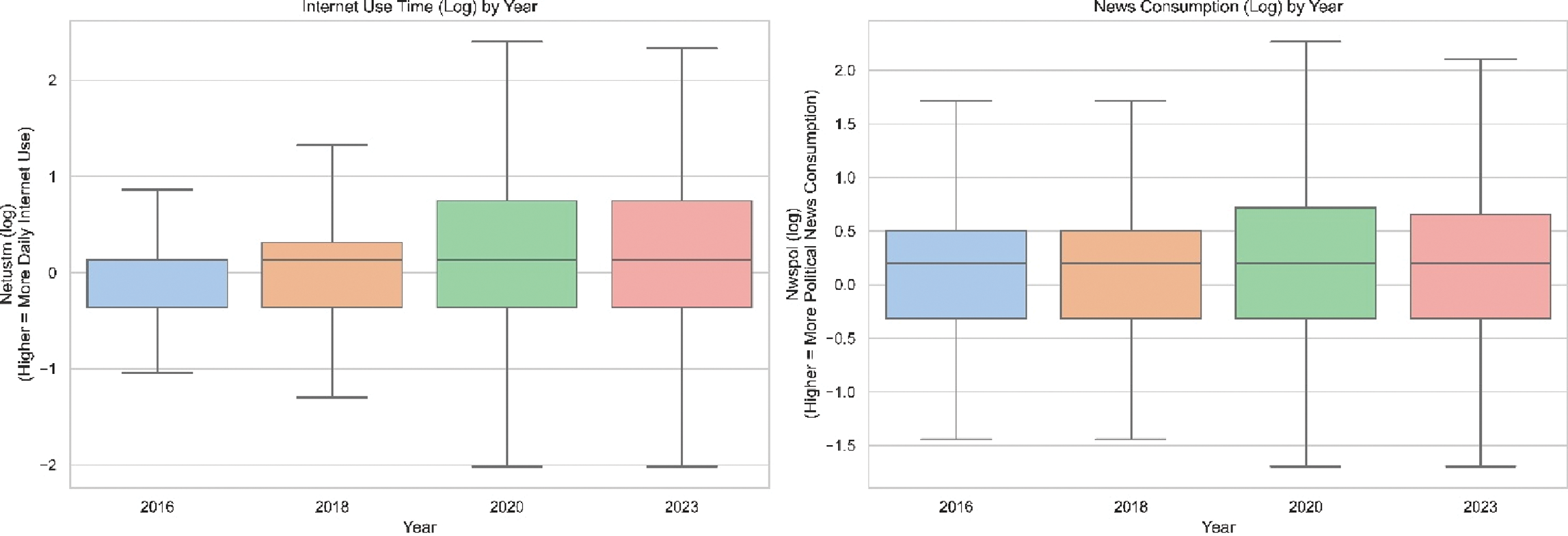
Figure 1
Internet Use and News Consumption Across ESS Rounds 8–11 (Stability in Median with High Individual Variation).
Sociodemographic control variables include gender, age, educational attainment, income adequacy, religiosity and political orientation. These variables are well‑established predictors of immigration attitudes (Davidov & Semyonov 2017) and were included to account for respondent background characteristics. Missing data were handled via standard imputation procedures: median imputation for continuous variables and mode imputation for categorical variables. This approach preserves data quality and statistical power while avoiding systematic bias (Tsiampalis & Panagiotakos 2020).
3.3 Data cleaning and transformation
All processing and transformations of the data were performed through Python, supported by the libraries of Pandas, NumPy and Scikit‑learn. All continuous variables, such as attitudes towards immigration, value indexes and measurement of engagement through the media, were Z‑score–standardised for the sake of comparability across measurement units. In addition, the two media use variables, daily internet use and structured political news consumption, were log‑transformed to correct for significant right skewness in their original distributions.
Outlier analysis was conducted for all core variables included in the study. As shown in Appendix 3, the overall presence of outliers was low, affecting approximately 5.6% of the cases (6,564 out of 117,752 respondents had at least one flagged value). Among the individual variables, three indicators tied to self‑transcendence values – ipeqopt (2.00%), impenv (1.92%) and iphlppl (1.39%) – had the highest rates of outlier values. Meanwhile, the log‑transformed general internet use variable (netustm_log) had only 0.82% outliers, whereas nwspol_log (political news consumption) had none.
Because all flagged cases reflected plausible values – particularly in digital behaviour and personal values – and none appeared erroneous or structurally inconsistent, no outliers were removed. This decision preserves natural variance in media engagement and avoids potential selection bias that could arise from arbitrary trimming. For a complete visualisation of these patterns, including boxplots of key variables, see Appendix 4.
Missing values were handled via median imputation for continuous variables and mode imputation for categorical variables, in line with ESS recommendations and general best practices for large‑scale social survey data. This method accords with traditional methodologies in multilevel survey analysis and minimises the loss of valid cases without releasing systematic bias. Schmidt‑Catran et al. (2019) noted that sample size preservation becomes even more crucial in pooled cross‑country datasets such as the ESS since listwise deletion can compromise statistical potency and diminish cross‑country comparability. In the same way, median and mode imputation methods have proven useful when missingness is minimal and assist in maintaining representativeness and safeguarding the validity of model estimates (Tsiampalis & Panagiotakos 2020).
3.4 Analytical methods
To explore how human values, media use and occupational roles shape immigration attitudes, this study employed a series of multilevel linear models. These models reflect the nested nature of the data, with individuals (level 1) clustered within country–year combinations (level 2). The analysis draws on responses from 18 countries across four ESS rounds (2016–2023), allowing for both within‑country and between‑country comparisons over time. All the models were estimated via restricted maximum likelihood and included robust standard errors to account for potential heteroscedasticity. The dependent variable, Attitudes Towards Immigration, was Z‑score–standardised for comparability. The corresponding equations specify each model below.
Model 1 (individual‑level predictors with country–year random intercepts): This baseline model examines the associations between individual‑level predictors and immigration attitudes. It includes self‑transcendence (SET) and conservation (CON) values, general internet use (NET), structured political news consumption (NWS) and sociodemographic variables (SDVs). Random intercepts for each unique country–year combination are included to control for contextual variation.
where:
i indexes’ individuals,
j indexes country–year combinations,
ATM = attitudes towards immigration (dependent variable),
SET = self‑transcendence values,
CON = conservation values,
NET = daily internet use (netustm_log),
NWS = structured political news consumption (nwspol_log),
SDV = sociodemographic variables (age, gender, education, income, religiosity, political orientation),
= random intercepts for each country–year cell and
= individual‑level residual error term.
Model 2 (managerial status interaction with country–year random intercepts): Building on Model 1, this model adds a binary indicator for managerial status to test whether immigration attitudes differ between European managers and other workers. The manager variable is coded so that other workers serve as the reference group, and the coefficient captures the estimated difference for managers.
where:
Manager = binary indicator of occupational role (2 = European manager, 1 = other European worker [reference]) and
All other terms are defined as in Model 1.
Model 3 (country‑level analysis with random slopes for internet and news consumption among managers): Model 3 restricts the sample to European managers and allows the effects of internet use and political news consumption to vary across countries. By including country‑level random slopes for both media variables, this model captures national heterogeneity in how digital engagement relates to immigration attitudes. Fixed effects for ESS rounds are included to control for survey timing.
where:
j indexes countries,
= country‑level random intercept,
, = country‑level random slopes for internet and news use,
Fixed effects for ESS rounds (2016, 2018, 2020, 2023) are included and
All other variables are as defined previously.
Model 4 (year‑level analysis with country fixed effects among managers): This final model restricts the sample to European managers and introduces random intercepts for ESS rounds to account for longitudinal trends in immigration attitudes. Fixed effects for countries are included to control for time‑invariant national differences. This approach isolates temporal variation beyond individual characteristics and country‑level influences.
where:
Countryj = fixed effects for 18 countries (included using C(cntry)),
= random intercept for each ESS round (2016, 2018, 2020, 2023) and
All other terms are as defined in previous models.
4. Results
4.1 Overview of values, media use and attitudes
Across all four models, human values and media engagement consistently predicted immigration attitudes among European managers. Individuals with strong self‑transcendence values were more supportive of immigration, whereas those with stronger conservation values held more sceptical views. Political news engagement showed a stable and statistically significant positive association with inclusive attitudes. In contrast, the effect of general internet use was more variable across countries, with generally smaller but often positive effects.
Sociodemographic characteristics also contributed to these patterns. Higher educational attainment, religiosity and centrist or left‑leaning political views were associated with more inclusive immigration attitudes. Conversely, older age and financial insecurity were linked to more restrictive positions. Gender differences remained negligible.
Immigration attitudes among managers varied across both time and national contexts. As shown in Appendix 5, countries such as Finland (M = 0.40 in 2023), Iceland (M = 0.53) and Sweden (M = 0.34) reported the highest average levels of support for immigration, whereas the most restrictive views were found in Hungary (M = −0.73), Slovenia (M = −0.21) and Italy (M = −0.38). A notable rise in pro‑immigration sentiment occurred in 2020 across several countries – such as Spain (from 0.07 in 2018 to 0.30 in 2020), Ireland (from 0.16 to 0.29) and the Netherlands (from 0.07 to 0.19) – likely reflecting pandemic‑era solidarity. However, this momentum declined slightly by 2023 in countries such as Portugal and Poland.
These national and temporal patterns provide important context for interpreting the regression results that follow. Figure 2 visualises the association between media use and immigration attitudes among managers across the 18 countries. In each panel, the horizontal axis represents either daily internet use (left column) or structured political news consumption (right column), whereas the vertical axis represents immigration attitudes (Z‑score–standardised). The slope coefficient (β) summarises the direction and strength of association in each country.
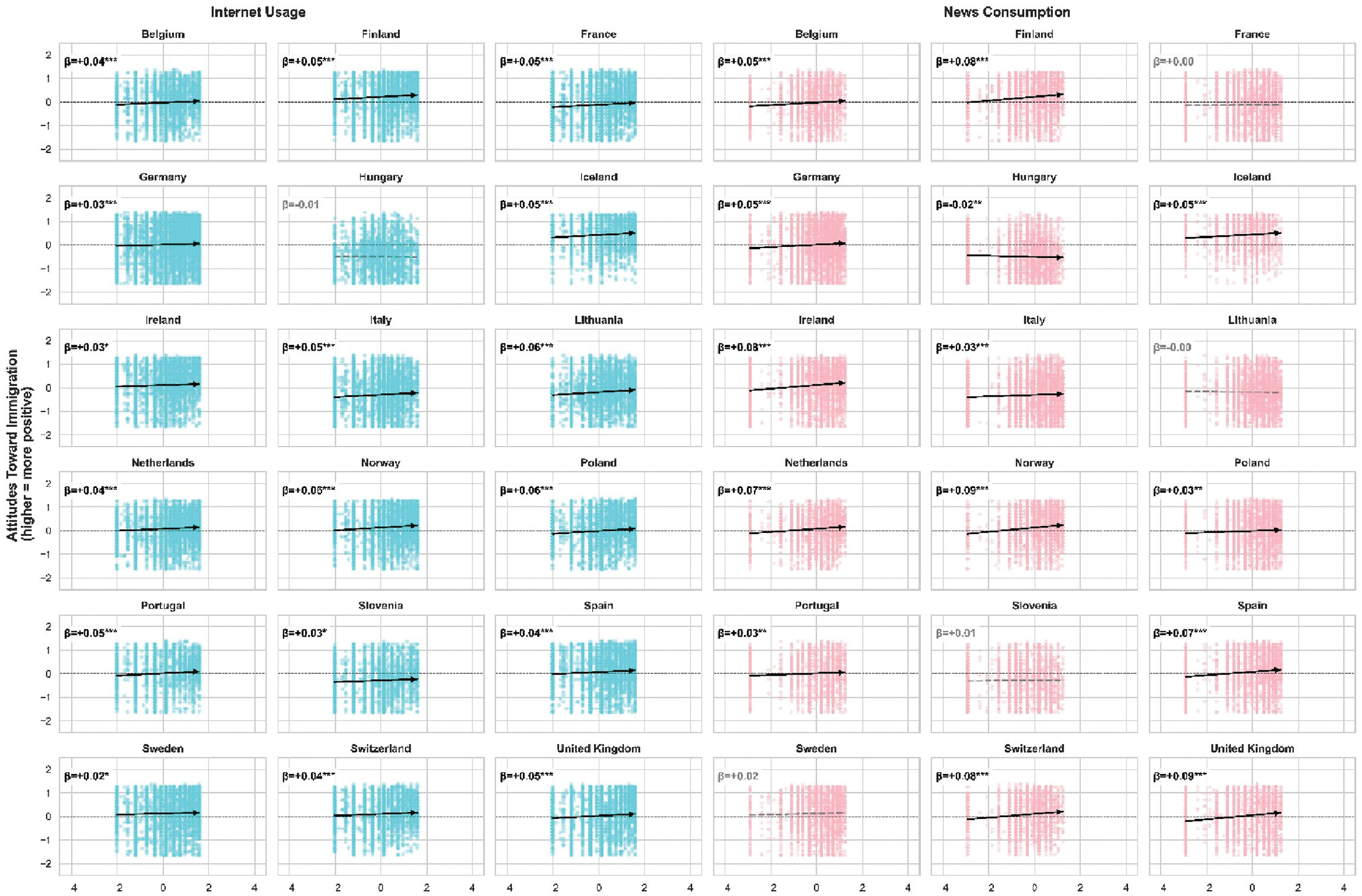
Figure 2
Media Use & Immigration Attitudes by Country.
(Slope label: β ± 1.96 SE (*, **, *** = p < .05/.01/.001).
Structured political news consumption consistently shows positive associations with more inclusive immigration attitudes – particularly in countries such as Finland, Norway, Sweden, the Netherlands and the United Kingdom – where greater news engagement predicts stronger pro‑immigration views. In contrast, the effect of general internet use is more variable. While many countries exhibit small but significant positive effects (e.g. France, Italy, Lithuania), others – such as Hungary – show no meaningful relationship, suggesting that the broader digital environment may influence how online exposure shapes immigration attitudes.
4.2 Multivariate analysis
To analyse how human values, media use and occupational roles shape immigration attitudes, a series of multilevel mixed‑effects linear models were estimated. These models progressively incorporated individual‑level predictors, sociodemographic controls, value orientations, and media engagement, along with country‑ and year‑level effects. This stepwise approach allowed for the examination of both within‑ and between‑country variation over time. A summary of the key coefficients from all four models is presented in Table 2, while detailed country‑level effects and model diagnostics are provided in Appendices 6–9.
Table 2
Multilevel Model Regression Results.
| VARIABLE | MODEL 1 | MODEL 21 | MODEL 3 | MODEL 42 | ||||
|---|---|---|---|---|---|---|---|---|
| ESTIMATE | SE | ESTIMATE | SE | ESTIMATE | SE | ESTIMATE | SE | |
| Fixed Effect | ||||||||
| Intercept | 0.332***3 | 0.034 | 0.332*** | 0.034 | 0.235*** | 0.089 | 0.212*** | 0.080 |
| Sociodemographic Variables | ||||||||
| Age | −0.022*** | 0.001 | −0.023*** | 0.001 | 0.007 | 0.006 | 0.007 | 0.006 |
| Gender | −0.004 | 0.005 | −0.000 | 0.005 | 0.007 | 0.017 | 0.007 | 0.017 |
| Education | 0.108*** | 0.002 | 0.106*** | 0.002 | 0.103*** | 0.007 | 0.103*** | 0.007 |
| Income | −0.145*** | 0.003 | −0.143*** | 0.003 | −0.150*** | 0.013 | −0.149*** | 0.013 |
| Political Orientation | −0.077*** | 0.001 | −0.077*** | 0.001 | −0.081*** | 0.004 | −0.081*** | 0.004 |
| Religiosity | 0.011*** | 0.001 | 0.011*** | 0.001 | 0.002*** | 0.003 | 0.002 | 0.003 |
| Values | ||||||||
| Self‑Transcendence | 0.183*** | 0.004 | 0.183*** | 0.004 | 0.214*** | 0.016 | 0.214*** | 0.016 |
| Conservation | −0.195*** | 0.005 | −0.195*** | 0.005 | −0.217*** | 0.015 | −0.216*** | 0.015 |
| Media Consumption | ||||||||
| Internet Consumption | 0.014*** | 0.002 | 0.014*** | 0.002 | 0.025* | 0.011 | 0.028*** | 0.008 |
| News Consumption | 0.057*** | 0.002 | 0.057*** | 0.002 | 0.051*** | 0.012 | 0.053*** | 0.010 |
| European Manager | — | — | −0.079*** | 0.009 | — | — | — | — |
| Year Effects | ||||||||
| Y.2018 | — | — | — | — | 0.049*** | 0.023 | — | — |
| Y.2020 | — | — | — | — | 0.179*** | 0.022 | — | — |
| Y.2023 | — | — | — | — | 0.059*** | 0.023 | — | — |
| Country Effect | ||||||||
| Switzerland | — | — | — | — | — | — | 0.189*** | 0.049 |
| Germany | — | — | — | — | — | — | 0.002 | 0.043 |
| Spain | — | — | — | — | — | — | 0.236*** | 0.049 |
| Finland | — | — | — | — | — | — | 0.522*** | 0.054 |
| France | — | — | — | — | — | — | −0.091*** | 0.048 |
| Great Britain | — | — | — | — | — | — | 0.197*** | 0.045 |
| Hungary | — | — | — | — | — | — | −0.478*** | 0.057 |
| Ireland | — | — | — | — | — | — | 0.384*** | 0.046 |
| Iceland | — | — | — | — | — | — | 0.546*** | 0.050 |
| Italy | — | — | — | — | — | — | −0.308*** | 0.053 |
| Lithuania | — | — | — | — | — | — | −0.085* | 0.049 |
| Netherlands | — | — | — | — | — | — | 0.023** | 0.047 |
| Norway | — | — | — | — | — | — | 0.167*** | 0.048 |
| Poland | — | — | — | — | — | — | 0.289*** | 0.044 |
| Portugal | — | — | — | — | — | — | 0.251*** | 0.057 |
| Sweden | — | — | — | — | — | — | 0.134*** | 0.049 |
| Slovenia | — | — | — | — | — | — | −0.239*** | 0.054 |
| Random Effects | ||||||||
| Level 1: Residual | 0.596 | 0.595 | 0.551 | 0.552 | ||||
| Level 2: Country‑Year | 0.065 | 0.014 | 0.065 | 0.014 | — | — | — | — |
| Level 3: Country Intercept | — | — | — | — | 0.072 | 0.034 | — | — |
| Level 3: Country × Internet Consumption Covariance | — | — | — | — | 0.004 | 0.005 | — | — |
| Level 3: Internet Consumption Slope Variance | — | — | — | — | 0.0011 | 0.001 | — | — |
| Level 3: Country × News Consumption Covariance | — | — | — | — | 0.004 | 0.005 | — | — |
| Level 3: Internet × News Consumption Covariance | — | — | — | — | 0.001 | 0.001 | — | — |
| Level 3: News Consumption Slope Variance | — | — | — | — | 0.001 | 0.001 | — | — |
| Level 3: Year | — | — | — | — | — | — | 0.006** | 0.007 |
| Model Fit (Deviance) | 273612.92 | 273537.03 | 20938.75 | 20936.51 | ||||
[i] 1Models 1 and 2 are estimated on the full sample (N = 117,752; 108,489 nonmanagers and 9,263 managers).
[ii] 2Models 3 and 4 are restricted to the manager subsample only (N = 9,263).
[iii] Note:*p < .05, **p < .01, ***p < .001. Stars indicate statistical significance of fixed effects. No stars for random effects unless otherwise noted.
4.2.1 Model 1: individual‑level predictors with country‑year fixed effects
The first model examined how personal values and media behaviours predict immigration attitudes across the full sample of native‑born Europeans. Country–year random intercepts were included to account for unobserved contextual variation across space and time.
The self‑transcendence and conservation values emerged as the strongest predictors. Individuals high in self‑transcendence – those who emphasise equality, compassion and universal welfare – expressed significantly more positive immigration attitudes (β = 0.183, p < .001). Meanwhile, those scoring high on conservation – favouring tradition, order and stability – held more negative views (β = −0.195, p < .001).
Media engagement also mattered. Structured political news consumption was a consistent and strong positive predictor of pro‑immigration attitudes (β = 0.057, p < .001). General internet use had a smaller but still statistically significant effect (β = 0.014, p < .001), suggesting that uncurated online content has a more limited role.
Sociodemographic control participants showed the expected patterns. Higher education (β = 0.108, p < .001), religiosity (β = 0.011, p < .001) and left‑leaning political orientation (β = −0.077, p < .001) predicted more inclusive attitudes. In contrast, older age (β = −0.022, p < .001) and financial stress (β = −0.145, p < .001) were associated with more restrictive views. Gender had no significant effect. These results confirm that values and structured media environments are central to shaping immigration attitudes, even after accounting for country–year variation. The full results for Model 1 are reported in Table 2.
4.2.2 Model 2: group‑level analysis with managerial status
Model 2 introduces a binary variable for occupational role to assess whether immigration attitudes differ between European managers and other workers. The results revealed a small but statistically significant difference: managers held more positive attitudes (β = −0.079 for other workers, p < .001), even after adjusting for values, media use and background factors.
Importantly, the addition of managerial status did not substantially alter the influence of other variables. Self‑transcendence remained a strong positive predictor (β = 0.181, p < .001), conservation retained a negative association (β = −0.194, p < .001) and media effects persisted (news β = 0.057, internet β = 0.014; both p < .001).
The sociodemographic patterns mirrored Model 1. Older age, lower income satisfaction and right‑leaning ideology predicted more sceptical attitudes; education and religiosity predicted more inclusive views. The Model 2 results are also presented in Table 2.
Figure 3 visualises the predicted immigration attitudes for both occupational groups over time. Managers consistently held more positive attitudes than workers did, with support rising across both groups until 2020 – likely reflecting pandemic‑era solidarity – and declining slightly by 2023. Key sociopolitical events such as Brexit, the rise of populist movements and the war in Ukraine are annotated to contextualise changes.
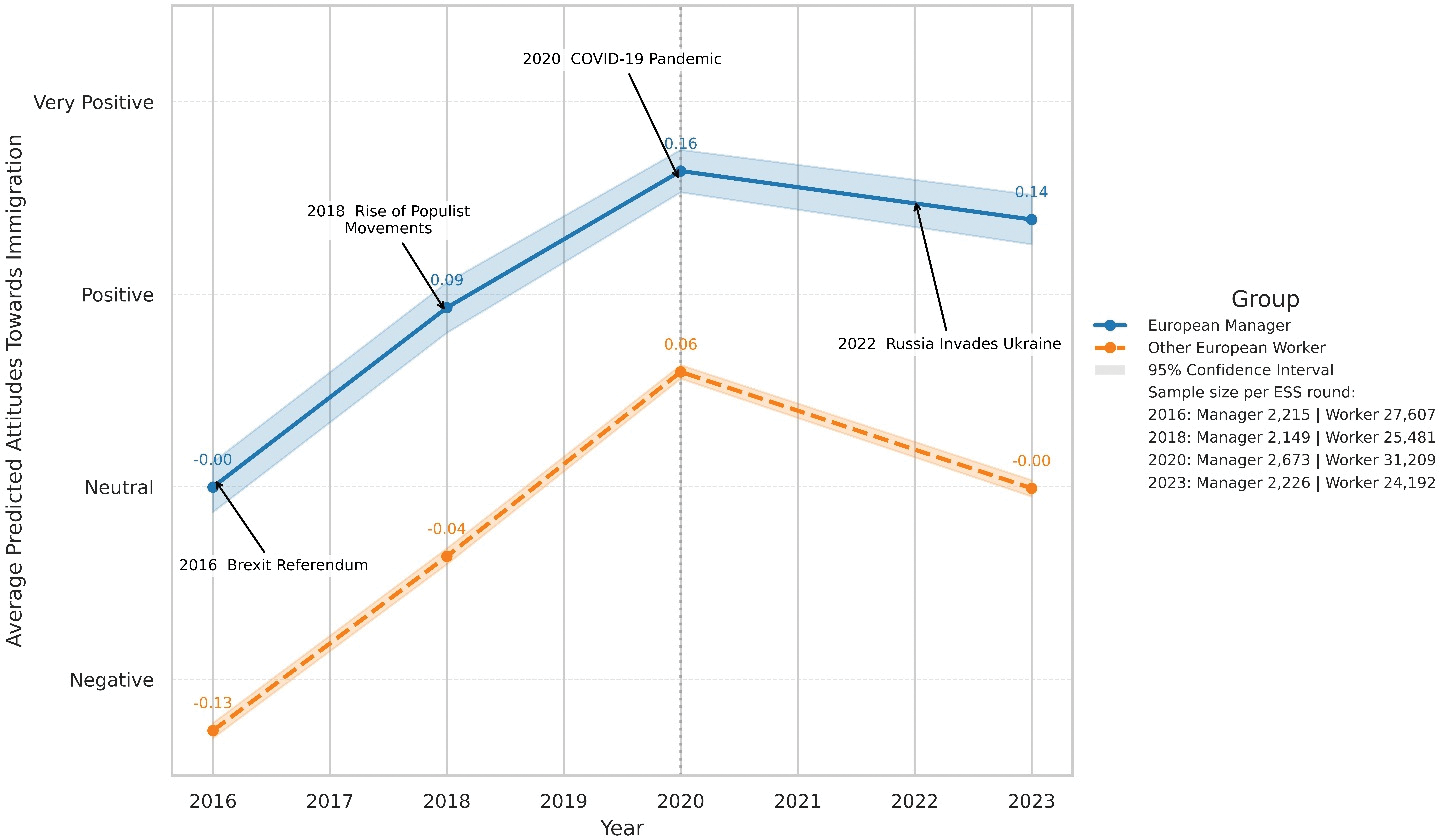
Figure 3
Trends Analysis in Immigration Attitudes by Values and Media Use Among European Managers and Employees.
Figure 4 illustrates how internet and news consumption interact with occupational status. Panel A (left) shows that internet use correlates with rising support for immigration in both groups, with a more pronounced increase among nonmanagers between the medium‑low and medium‑high categories. This narrows the attitudinal gap at higher usage levels. Panel B (right) shows that structured political news consumption is positively associated with pro‑immigration attitudes in both groups, with managers consistently reporting greater support. While both groups converge slightly at the highest level, managers show a somewhat steeper rise between medium‑low and medium–high consumption. These patterns suggest that structured media environments are associated with more inclusive attitudes overall, although the differences between occupational groups vary by engagement level.
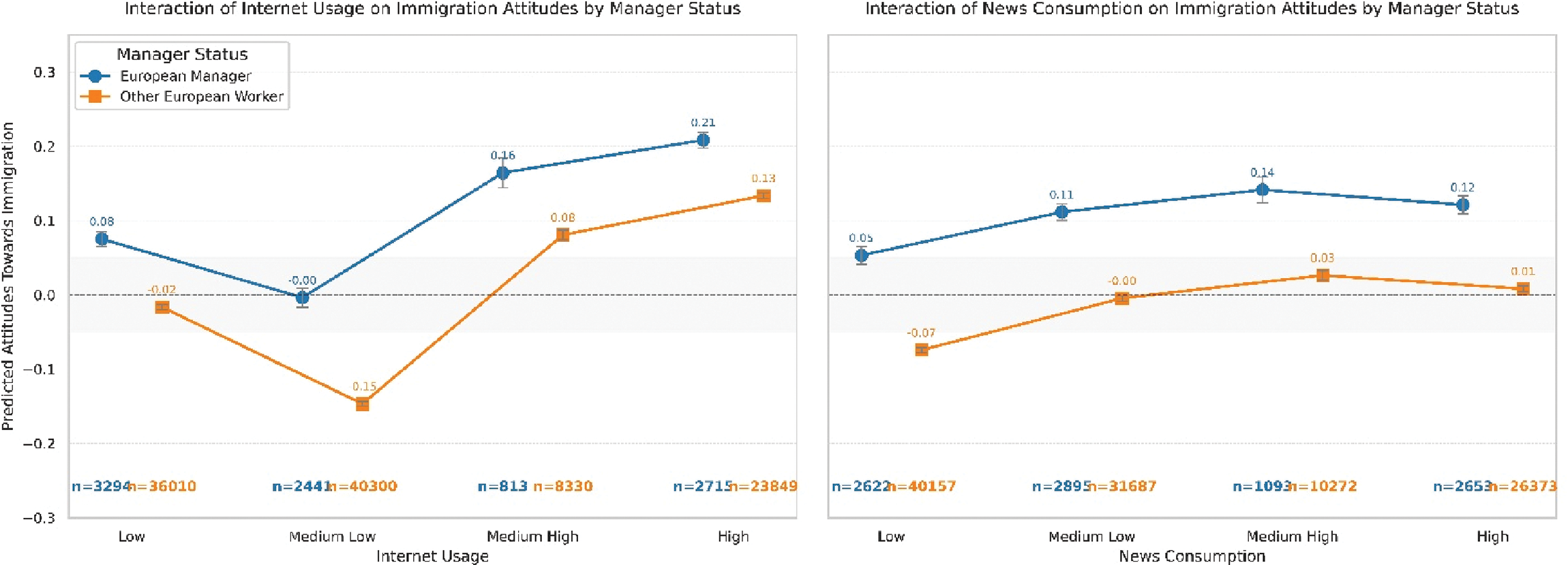
Figure 4
Interaction Effects of the Internet and News Consumption on Immigration Attitudes by Managerial Status in Europe.
4.2.3 Model 3: country‑level variation in media effects
Model 3 restricts the sample to European managers and introduces country‑level random slopes for internet and news consumption to examine cross‑national variation in media effects.
The findings remain consistent with prior models: self‑transcendence was positively associated with immigration support (β = 0.214, p < .001), while conservation was negatively associated with it (β = −0.217, p < .001). Structured political news consumption maintained a strong and significant effect (β = 0.051, p < .001), whereas general internet use had a weaker but still positive effect (β = 0.025, p = .028).
However, the random slope variances indicate important national differences, especially for general internet use. While news effects varied little across countries (Var = 0.001), the effect of internet use showed greater heterogeneity (Var = 0.0011). This suggests that digital environments may reinforce inclusivity in some countries while producing no effect – or even scepticism – in others.
Sociodemographic effects remained stable: education and religiosity supported inclusive views; age, income strain and right‑wing ideology predicted more sceptical attitudes. These results emphasise that, even within the managerial class, the national context matters – particularly regarding the influence of less‑structured digital information flows. See Table 2 for all the coefficients and variance estimates from Model 3.
4.2.4 Model 4: year‑level trends and country fixed effects
Model 4 also focuses on managers only, but instead of varying country effects, it includes fixed effects for countries and random intercepts for the survey year. This structure captures longitudinal trends while controlling for national differences.
The value and media predictors remained stable. Self‑transcendence (β = 0.214, p < .001) and news consumption (β = 0.053, p < .001) were consistently positive; conversely, conservation (β = −0.216, p < .001) and age (β = −0.020, p < .001) were negative. General internet use maintained a modest but significant effect (β = 0.028, p = .009).
Country‑level fixed effects revealed large variation. Managers in Iceland (β = 0.546), Ireland (β = 0.384), Finland (β = 0.522) and Portugal (β = 0.251) showed the most supportive attitudes. In contrast, managers in Hungary (β = −0.478), Slovenia (β = −0.239) and Italy (β = −0.308) were most sceptical (note, all effects p < .001 unless otherwise noted).
Year‑level intercepts (Var = 0.006) indicate modest but meaningful temporal shifts – especially around key events such as the COVID‑19 pandemic and the Russian invasion of Ukraine. These events may have influenced public discourse, shifting attitudes even within professional populations. Model 4 results, including fixed country effects, appear in Table 2.
Figure 5 presents predicted immigration attitudes by occupational role across countries. Managers show significantly greater support than workers do in most Western and Nordic contexts, particularly in Finland, Ireland and Switzerland. Differences were smallest or nonsignificant in countries such as Slovenia, Hungary and Italy. These patterns reinforce the role of political culture and media systems in moderating occupational effects.
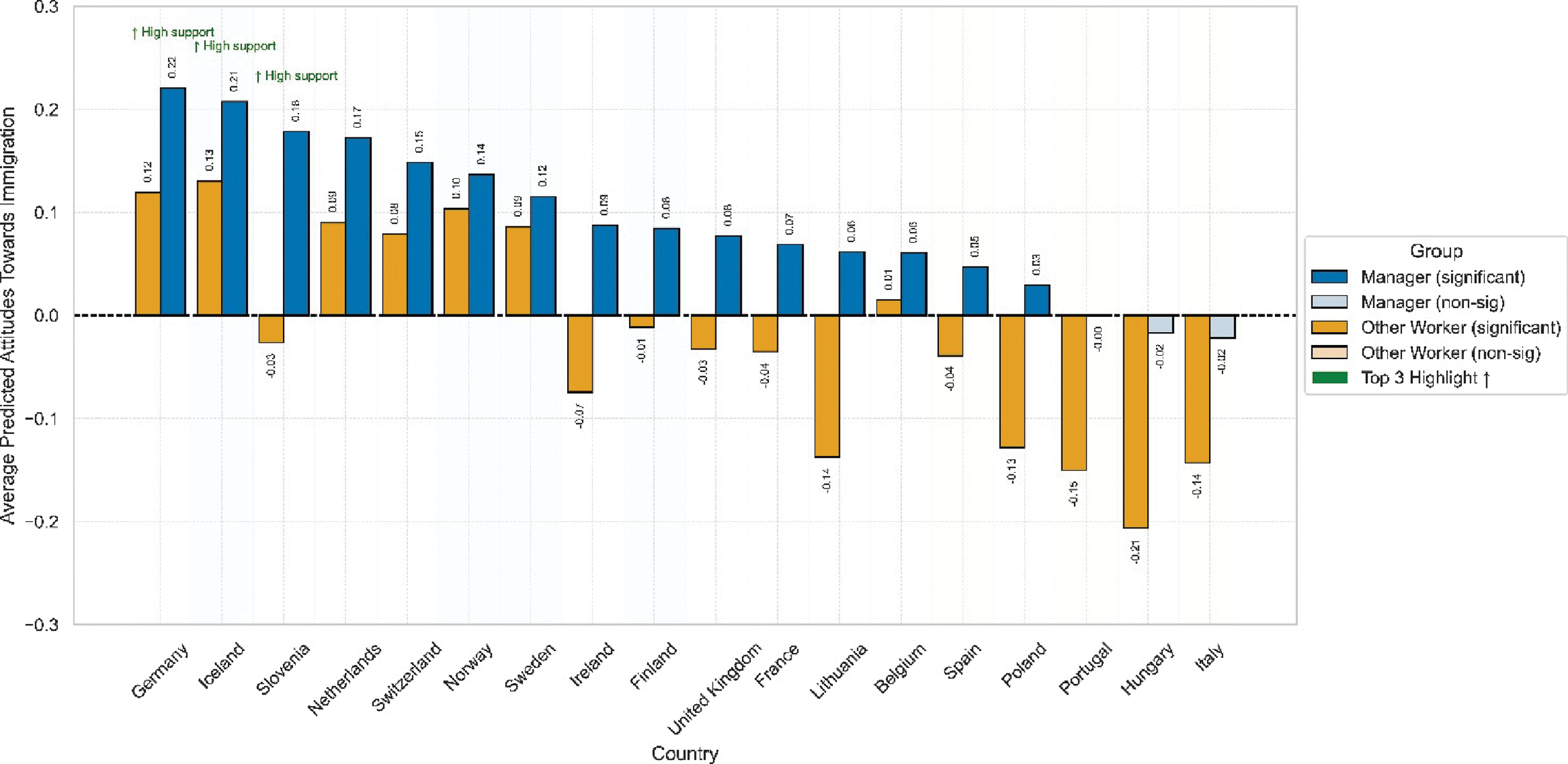
Figure 5
Country‑Level Analysis of Immigration Attitudes by Values and Media Use Among European Managers and Workers.
5. Discussion
This study examined how human values, media engagement and sociopolitical events shaped immigration attitudes in Europe between 2016 and 2023, with a particular emphasis on European managers. By integrating Schwartz’s Theory of Basic Human Values (Schwartz 2012) with multilevel modelling, the analysis demonstrated that value orientations and media behaviours serve as foundational filters through which managers interpret immigration.
Managers who scored high on self‑transcendence – those prioritising compassion, equality and universal welfare – consistently expressed more supportive attitudes towards immigration. These results reinforce prior work linking self‑transcendence values to openness to diversity and integration policies (Davidov & Meuleman 2012; Roccas 2003). Conversely, conservation values – those rooted in tradition, security and resistance to change – were associated with more exclusionary views, aligning with findings on cultural protectionism (Davidov & Semyonov 2017).
The role of media engagement was equally significant. Structured political news consumption emerged as a consistent predictor of inclusive immigration attitudes, especially among managers. Managers who actively followed political news – particularly through public services or institutional media – were more likely to express views of pro‑immigration. These effects were strongest among those already high in self‑transcendence, suggesting a reinforcing interaction between value orientation and the information environment (Atwell Seate & Mastro 2016; Freire‑Vidal & Graells‑Garrido 2019).
In contrast, general internet use had more variable and modest effects. Although it was positively associated with pro‑immigration attitudes in some contexts, its impact fluctuated across countries – likely due to the unregulated and diverse nature of digital content (Golin & Romarri 2022; Kondor et al. 2022). This underscores the importance of content curation and media literacy, even within managerial populations that are typically more media‑literate than the general public.
One of the most important findings concerns the interaction between values, media use and occupational role. Managers exhibited stronger attitudinal shifts in response to structured political news than did other workers. Among managers high in self‑transcendence, news engagement significantly amplified support for immigration. In contrast, conservation‑oriented managers with low media exposure tended to hold more sceptical views. These dynamics suggest that managers are particularly responsive to credible media environments and may serve as leverage points for promoting inclusion within organisations. This aligns with recent scholarship on leadership as a channel through which societal values are translated into workplace practice (Jacobs & Hooghe 2020).
While the overall difference in attitudes between managers and other workers was modest, it became more pronounced in high‑exposure media environments. Once individual values and media habits are accounted for, the occupational role itself contributes less directly. This implies that managerial attitudes are shaped more by their surrounding information and value environments than by their job title alone. However, the enhanced responsiveness of managers to structured news consumption underscores their potential influence within decision‑making structures.
National and temporal variation also mattered. Managers in countries with strong public media systems and progressive policy environments – such as Finland, Ireland and Switzerland – were the most supportive of immigration. In contrast, more sceptical attitudes were observed among managers in Hungary, Slovenia and Italy, where immigration tends to be framed in exclusionary terms. These cross‑national contrasts highlight the importance of national media ecosystems and political cultures in shaping value activation and opinion formation (See et al. 2020; Van Klingeren et al. 2015).
Longitudinal trends further illuminate how public opinion shifts in response to major events. Attitudes towards immigration peaked in 2020, coinciding with the COVID‑19 pandemic and a surge in public solidarity. By 2023, support had slightly declined – likely reflecting economic uncertainty, resource anxieties and the cumulative stress of ongoing geopolitical crises such as the war in Ukraine. These temporal shifts demonstrate how self‑transcendence values may become more salient during moments of shared vulnerability but fade as crises evolve (Heizmann & Huth‑Stöckle 2023; Milova & Trushevych 2023).
In summary, this study shows that immigration attitudes are shaped by a combination of individual values, media environments, and broader sociopolitical conditions. Managers, while not inherently more inclusive than other workers, demonstrate greater responsiveness to structured political information – especially when aligned with self‑transcendent values. These findings underscore the importance of inclusive leadership development and organisational communication strategies that promote empathy, pluralism and evidence‑based discourse. As Europe continues to navigate immigration under conditions of social and political flux, fostering inclusive public opinion will depend not only on policy frameworks but also on the everyday information environments in which decision‑makers – and those they lead – are embedded.
6. Contribution to the Literature and Practical Implications
This study contributes to the migration literature by offering a comprehensive multilevel analysis of how human values, media engagement and sociopolitical contexts shape immigration attitudes in Europe, with specific attention towards how these dynamics operate within the managerial class. By integrating value theory, media sociology and cross‑national political context, the study advances theoretical, empirical, methodological and applied understanding of immigration attitudes – particularly within the workplace and leadership domains.
6.1 Theoretical contributions
This research extends Schwartz’s Theory of Basic Human Values by showing that immigration attitudes are not driven by values alone but are moderated by media engagement. Structured political news consumption was found to amplify the pro‑inclusion effects of self‑transcendence values and, to a lesser extent, buffer the exclusionary effects of conservation values. This highlights the underexplored interplay between personal values and information environments in shaping public opinion (Davidov & Meuleman 2012; Schwartz 2012).
The study also refines our understanding of occupational roles in value expression. While managers did not differ dramatically from other workers in baseline attitudes, they were more responsive to political media, especially when self‑transcendence values were high. This expands theoretical models of workplace diversity by illustrating that managerial attitudes are not fixed traits but instead context‑sensitive outcomes shaped by ethical frameworks and information exposure (Fang et al. 2023; Jacobs & Hooghe 2020). Finally, the study links microlevel attitudes to macrolevel disruptions, showing how events such as the COVID‑19 pandemic and the war in Ukraine interacted with value–media dynamics to reshape immigration sentiment. This temporal lens contributes to scholarship on public opinion formation during periods of crisis (Heizmann & Huth‑Stöckle 2023).
6.2 Empirical contributions
Empirically, the present study draws on survey data from 18 European countries across four ESS rounds (2016–2023) to trace how immigration attitudes evolve over time and across contexts. This finding confirms the robust predictive power of self‑transcendence and conservation values while showing that structured political news is a more stable driver of inclusive attitudes than general internet use is.
Crucially, this study clarifies how managerial roles mediate these dynamics. Although managers were only modestly more supportive of immigration overall, they showed greater attitudinal changes in response to structured news exposure. This finding supports the idea that managers may act as multipliers of inclusive values, especially when embedded in credible information environments.
Cross‑national patterns also highlight that pro‑immigration attitudes are strongest among managers in countries with strong public media institutions and progressive policy frameworks (e.g. Finland, Ireland, Switzerland). These findings underscore the importance of national media ecosystems in moderating value activation and media effects.
6.3 Methodological contributions
This study demonstrates the value of multilevel modelling for capturing the nested and longitudinal structure of immigration attitudes. By clustering individuals within country–year combinations, the models account for contextual heterogeneity that would be missed in cross‑sectional or single‑level designs. The combination of fixed and random effects, as well as cross‑level interactions, offers a nuanced view of how individual values, occupational roles and media use operate together. This framework is especially useful for comparative social research and longitudinal monitoring.
In addition, the clear differentiation between structured and general media use provides a replicable measurement strategy for digital engagement – one that may be applied to other studies examining the attitudinal effects of media environments.
6.4 Practical implications
This study offers several actionable insights for organisational leaders, media practitioners and policymakers:
Organisational leadership: Encourage structured news engagement among managers through training that integrates value‑based reflection and media literacy. Managers exposed to high‑quality political content are more likely to support inclusive policies.
Public communication: Public‑service and institutional broadcasters play a vital role in reinforcing pluralistic narratives. Investment in these platforms is especially important during times of crisis or polarisation.
Diversity and inclusion strategy: Don’t assume that occupational status alone predicts openness. Instead, practitioners developing diversity and inclusion strategies should focus on shaping the informational context in which managers operate, especially through media exposure that activates self‑transcendent values.
Political messaging: Messaging campaigns that promote fairness, compassion and shared humanity – especially when delivered through credible political media – can strengthen support for immigration, particularly among leadership groups.
In sum, fostering inclusive immigration attitudes requires more than demographic targeting. It demands attention to the value environments, media systems and institutional roles that shape how individuals – especially decision‑makers – encounter and interpret immigration in daily life.
7. Limitations and Future Research Directions
This study offers valuable insights into how values, media engagement and sociopolitical contexts shape immigration attitudes among European managers. However, several limitations suggest important avenues for future research.
First, the study relies on repeated cross‑sectional data from the ESS, which limits causal inference at the individual level. Although multilevel modelling allows for the identification of contextual and temporal patterns, future work using panel designs would better capture how individuals’ attitudes evolve in response to media exposure and sociopolitical events.
Second, the ESS rounds analysed (ESS8–ESS11) do not include measures of traditional media use like television, radio and print journalism. This limits the scope of the media analysis, particularly since older or less digitally connected populations may still rely heavily on these channels. Integrating both traditional and digital media metrics would provide a more complete picture of the media–attitude relationship.
Third, self‑reported internet use introduces possible recall bias and lacks detail about specific online behaviours. While structured political news consumption has been captured more precisely, general internet use remains a broad proxy that may conflate entertainment, news and social interactions. Future studies should consider digital trace data, passive tracking, or media diaries to improve measurement accuracy.
Fourth, the ESS does not include direct measures of social media engagement, despite its growing role in shaping immigration discourse. Platforms such as X (formerly Twitter), Facebook and TikTok have become key spaces for both inclusive and exclusionary narratives. Future research could investigate how specific platforms and algorithms shape value‑based interpretations of immigration (Ausat 2023).
Fifth, the ESS covers only post‑2002 digital behaviour and thus misses the early formative period of internet diffusion in the 1990s and early 2000s. Historical analyses or natural experiments could offer insights into how digital transformation shaped attitudes during earlier phases of migration debates (Falck et al. 2014).
Sixth, this analysis does not account for organisational‑level factors – such as industry, firm size or internal diversity policies – that might influence how values are expressed in managerial roles. Linking ESS‑type survey data with organisational datasets could clarify how workplace environments moderate value‑driven attitudes in practice.
Seventh, the study focuses on immigration in general and does not differentiate attitudes on the basis of immigrants’ region of origin. Previous research has shown that non‑European migrants – especially those from Africa or Asia – are more likely to face discrimination (Ahmad 2020). Future studies should examine how ethnic hierarchies affect public and managerial attitudes across contexts.
Finally, the influence of misinformation and information literacy remains underexplored. Given the rise of polarising and false narratives around immigration, future research should investigate how susceptibility to misinformation – and the capacity to critically evaluate media – shapes attitudes, particularly during crises and periods of uncertainty.
Funding
The Strategic Research Council established within the Research Council of Finland, 2021–2027, funded this study as part of the Mobile Futures PROJECT 2022–2027. Decision numbers: 364420, 364422.
Author Contributions
Hamed Ahmadinia is the sole author and was responsible for the conceptualisation, data analysis, manuscript writing and revisions.
Data Availability Statement
The data used in this study are publicly available from the European Social Survey and can be accessed at: https://ess.sikt.no/en/. Python scripts for data cleaning and analysis will be made publicly available upon publication or are available upon request via the author’s GitHub repository (currently private).
Competing Interests
The author has no competing interests to declare.
About the Author
Hamed Ahmadinia is a Senior Researcher in Economic Sociology at the University of Turku and holds a PhD in Information Studies from Åbo Akademi University. With a multidisciplinary background in finance, knowledge management and information studies, his research integrates both quantitative and qualitative approaches to explore information behaviour, digital and health literacy, e‑health and migrant integration. Currently (2025–2027), he conducts research at the University of Turku on the societal impact of unreliable scientific information, focusing on how media misrepresentation and retracted research influence public perceptions, attitudes and evidence‑informed decision‑making. Ahmadinia also contributes to the Mobile Futures project (2023–2024), where he leads quantitative data analysis in Work Packages 3 and 4. In WP3, he examines trust in migration‑related information and its effects on attitudes towards migrants and access to reliable sources. In WP4, he investigates trust and discrimination in labour market integration, particularly among racialised immigrant groups. His interdisciplinary approach supports the development of inclusive policies and integration strategies. His research has been published in journals such as the Journal of Documentation, Library & Information Science Research, International Journal of Migration, Health and Social Care and the Finnish Journal of eHealth and eWelfare.
Acknowledgements
This study was funded by the Strategic Research Council (2021–2027; decision numbers 364420 and 364422) as part of the Mobile Futures project at the Research Council of Finland. The revisions, which required substantial time and effort, were completed after the researcher, no longer working for the project, joined a new research project at the University of Turku. Conducting this study would not have been possible without the guidance, consultation, and support of Associate Professor Marja Tiilikainen, Research Director at the Migration Institute of Finland, as well as Dr. Elina Turjanmaa and Dr. Outi Kähäri from the University of Oulu.
Additional Files
The additional files for this article can be found as follows:
Supplementary Appendix 1
Country‑Wise Distribution of Managers and Other Workers Across ESS Rounds. DOI: https://doi.org/10.33134/njmr.964.s1
Supplementary Appendix 2
Sociodemographic Profile of European Managers and Employees in ESS Rounds 8–11. DOI: https://doi.org/10.33134/njmr.964.s2
Supplementary Appendix 3
Outlier Aanalysis Report (Rows With At Least One Outlier: 6564 / 117752 [5.57%]). DOI: https://doi.org/10.33134/njmr.964.s3
Supplementary Appendix 4
Outlier Visualisation for Key Variables (~2% Outliers). DOI: https://doi.org/10.33134/njmr.964.s4
Supplementary Appendix 5
Mean (SD) Attitudes Towards Immigration Among European Managers by Country and Year. DOI: https://doi.org/10.33134/njmr.964.s5
This finding of multiple local introgression events has at least three key implications.