
Introduction
The promotion of well-being is not only a specific objective in the United Nations’ Agenda 2030 but also has implications for the integration process of newly arrived refugees. Previous studies have emphasised that low levels of well-being may hinder the process of integration, particularly among those forced to leave their homes [e.g. Borevi & Certez 2021; International Organization for Migration (IOM) 2004; 2013; Lulle & King 2019; Tinghög et al. 2017]. Similarly, scholars have documented a restrictive trend in migration policy across the Nordic countries during the past two decades (Hinnfors & Jungar 2024). Sweden is an example of this trend, suddenly abandoning an inclusive, and what is often viewed as an ‘exceptional’ (Schierup & Ålund 2011), approach to migration in 2016 with the introduction of temporary residence (Dahlstedt & Neergaard 2019; Hernes 2018). The current proliferation of restrictive migration regimes, often imposing different forms of time-limited permits, has highlighted the need to examine how security of residence affects well-being. Although the link between migration policy and differential outcomes has received growing attention (for example, Bevelander 2014; Kogan 2007), the empirical assessment of how these policies affect the well-being of refugees has largely been missing (Lulle & King 2019). In general, research attention has instead been focused on migrant establishment within the labour market rather than on the feelings and perceptions of those exposed to the restrictive regulations (IOM 2013). So far, the few studies that have focused on refugee health and well-being have relied on baseline correlational analyses or small samples (Borevi & Certez 2021), calling for more elaborate analyses.
In this study we seek to remedy this knowledge gap and explore how temporary residence permits influence the level of stress and well-being among migrants with a refugee background. The Swedish case offers an opportunity to analyse two different groups who settled in Sweden in the same period but of whom some were affected and some were unaffected by the new regulations. The law, implemented in July 2016, stated that migrants would no longer be granted permanent residence permits. Instead, they would be given a residence permit lasting 13 months or 3 years. Although the law was initially a temporary measure, it was later made permanent in 2022.
In this study, we focus on the swift and sudden implementation of temporary residence in Sweden to compare well-being in two groups of Syrian refugees: those who were exposed and those who were not exposed to this restrictive change. Temporary residence came into force on 20 July 2016. In the months following its implementation, about half of all residence permits were evaluated under the new law (hence, temporary residence was granted), while the other half were exempted (hence, permanent residence was granted). In our analysis, we use a rich set of survey data gathered in 2020 to study the link between residence status and well-being. In contrast to previous comparative studies, our approach, focusing on a policy change within a single nation-state, provides the opportunity to study a shift from an inclusive to a more restrictive policy approach to migration, while holding other important institutional and contextual circumstances constant. For instance, the policy change did not alter access to social rights to anyone with legal residence (temporary or permanent). Rather, provision of central rights such as welfare, housing and financial support remained the same for both groups (Hagelund 2020).1 However, as Hagelund (2020) states, the policy shift introduced a ‘re-commodifying effect’, as the pathway to a secure and permanent status became dependent on labour market achievements. Furthermore, to reunite with family, permanent residence, or well-established prospects to obtain a permanent permit, became a prerequisite in combination with self-sufficiency in terms of housing and personal finance. Thus, even if access to welfare remained the same, the shift introduced uncertainty and a requirement to succeed in the labour market. As refugee migrants are frequently associated with slower labour market integration, and as this group has often experienced trauma and stressors that can have a long-term impact on the individual (Brell, Dustmann & Preston 2020), our aim is to study different residence statuses in relation to well-being. Previous studies have found that health-related problems may hinder the socio-economic integration of refugees. Although this claim has been acknowledged in research internationally (Brell, Dustmann & Preston 2020; Tinghög et al. 2017) as well as in Sweden, it remains unclear whether residence status affects the overall health of individual migrants.
Our study makes several additions to the research field. First, while much existing research has focused on socio-economic outcomes, we draw attention to an often-neglected issue in the empirical investigation of self-stated stress and well-being using survey data. Second, our focus on the months following the 2016 policy change, while controlling for observable differences, allows for a comparison of migrants who were granted residence in the same period but with different statuses. This setup provides an opportunity to compare groups subjected to different migration regimes and, in that manner, increase our knowledge about the impact of inclusive and restrictive approaches to migration that can be significant for understanding development in other countries with similar policy structures. Third, our study introduces novel survey data that were gathered during a critical period in the first large-scale re-evaluation of the temporary permit system in 2019, 3 years after the introduction of the policy change. Hence, during the time the survey was conducted, there was little knowledge of the re-evaluation process and how it should look or proceed.
We conclude that those granted temporary residence permits experience lower levels of well-being in combination with higher levels of stress connected to their residence status. In addition, we conclude that a lower sense of well-being is correlated to higher levels of stress and that the negative influence of temporary permits is most prominent in the group granted the most precarious type of residence status, a 13 month temporary permit. Finally, we conclude that stress related to other areas of the settlement process, such as housing, work and education, seems to be similar across both groups. The latter result points to the detrimental impact of time-limited residence status in inducing lower levels of well-being, stress and anxiety.
The article is structured as follows: first, we review previous research results with a focus on health, migration and status and point to the addition of our study to the research field. Then, we explain our theoretical departure and then proceed with presenting the data and analytical methods used. Thereafter, the results are presented and discussed. We conclude by drawing some conclusions and pointing to areas of further research.
A review of the research field: health, migration and status
In line with the World Health Organization (WHO 1948), we argue that stress and well-being constitute fundamental indicators of the overall state of an individual’s health. Hence, good health cannot merely be defined as the absence of disease but also concerns individual mental state and well-being (Barton et al. 2015: 10). In a similar vein as Lulle and King (2019), we define well-being as individual feelings and perceptions about what constitutes a good life and satisfactory conditions as opposed to a focus on missing aspects, often conceptualised as ill-being. By doing so, we do not focus on objective conditions, as defined by socio-economic indicators such as income, housing or welfare, but rather on the subjective assessments of these aspects in relation to migration and settlement. Within the field of migration and health we argue that refugees constitute a particularly urgent group to study, as they, in comparison to other kinds of migrant categories, seek protection from persecution, war or political hostilities and thus have generally specific needs in relation to their health. As such, this group is affected both by the events that triggered their forced migration (pre-migration health effects) and those occurring afterwards, such as their experiences of the flight and asylum-seeking process and their admittance to a new host community (post-migration effects). Bogic et al. (2012) conclude that traumatic experiences during and after a war are associated with higher rates of anxiety and stress among refugee groups across Europe. Studies have highlighted that refugees’ well-being can be connected to a sense of stability (Belgrade, Kira & Lee 2022) or to an ontological sense of security where stability, finding a place and predictability in life are at the centre of a refugee’s well-being (Chase 2013).
Several studies have focused on refugees from Syria particularly following the high numbers of Syrian asylum-seekers who entered Europe most notably in 2015 (Renner et al. 2020). For instance, in a study of Syrian refugees in Germany, Renner et al. (2020) found that this group commonly reported feelings of hopelessness, fear and worry that were connected to their experiences of war and flight. A common theme affecting the health of the respondents in the German study was the loss of social status, identity and a home. These results have been corroborated by Tinghög et al. (2017) in an analysis of the prevalence of mental health issues among Syrian refugees in Sweden. The study indicates that about one in three Syrian migrants suffered from anxiety, often because of their pre-migration experiences as well as a lack of social support in Sweden. In an earlier study, Tinghög et al. (2009) focus on two migrant populations: one from Syria and one from Eritrea. They found that the prevalence of mental illness in both groups was high, at around 30%. Gottvall et al. (2020), in a study of Syrians arriving in Sweden between 2011 and 2013, highlight social support and the importance of social networks as essential factors necessary to score higher on self-reported health assessments. In particular, their results point to the importance of assisted family reunification as a way to improve refugee mental health. Adding to these conclusions, Ekstrand et al. (2022) have further suggested that stakeholders working with newly arrived refugees often lack the knowledge and tools to address the mental health problems and anxiety in the resettlement process. There are, however, studies that indicate that well-being increases in general over the period after settlement. Using Gallup Poll survey data, the IOM (2013) shows that the general state of well-being among migrants increased over time although it remains lower compared with the general population of host countries.
Recently, the impact of a migrant’s legal status on their mental and physical health has received growing attention. Research has shown the negative effects of temporariness for the migrant individual. For instance, Nickerson et al. (2019) and Newnham et al. (2019) found that refugees with insecure visas in Australia show symptoms of post-traumatic stress disorder (PTSD) and depression to a higher degree than refugees who obtain secure visas. Similarly, in a comparative study, Cetrez, Maluk and Rajon (2021) found that a limited legal status had a negative impact on the health of newly arrived migrants. Johannesson and Westerling (2019) found a negative influence on health among refugees with temporary permits in Sweden. Another study performed in Sweden (Cetrez et al. 2021) found that Syrians granted secure residence status generally reported their mental health as fair, good or even very good. However, the study found pronounced differences between those granted temporary or permanent residence, with a higher percentage of those granted a temporary status reporting that their mental health was poor or very poor. In a Norwegian study, Brekke, Birkvad and Erdal (2021) interviewed people in the process of renewing their residence status. The study showed that the uncertainty of this process had a negative impact on individual health, which added to a stressful situation in which aspirations, future plans and a sense of security changed drastically.
Another thread within the research literature has focused on the link between legal status and integration. In this strand of research, socio-economic outcomes with a focus on the labour market are often used to measure successful integration. For instance, Bakker, Dagevos and Engbersen (2014) found a negative relationship between temporary residence permits and employment, contrary to Jutvik and Robinson (2020), who found positive short-term effects on employment among migrants granted temporary permits. However, Jutvik and Robinson (2020) also found that study grant usage was higher among those granting permanent residence. Da Lomba (2010) has suggested that a precarious legal status hampers integration, while secure residence promotes it. In a qualitative study of young refugees in Sweden, Lind, Hansen and Khoury (2023) found that temporary residence permits forced young migrants to work rather than seeking out education, even if they prefer to do so. The authors argue that their respondents saw this as a limitation, as a situation making them different compared with other young people. Finally, in an interview study by Borevi and Cetrez (2021), the authors conclude that temporary permits are accompanied by ill health, stress over an uncertain future and a more difficult integration process.
These findings point to a few important conclusions within the research field. First, migrants with a refugee background constitute a group with a lower state of health compared with the general population, and that this state is often caused by events taking place in their pre- and postmigration journey. Second, recent studies have indicated that legal status is a central postmigration factor that may increase a sense of exclusion and thus worsen health and well-being. Third, legal status may also affect integration, which again, may have a negative impact on the overall health of individuals in this situation. As an addition to this knowledge, our study introduces a large dataset to scrutinise the above-mentioned assumptions with a focus on subjective well-being and stress. Importantly, our study group migrated to Sweden during the same time and thus faced the same institutional and societal context, with the exception of being granted different residence statuses.
Theoretical departures: immigration regimes, status and well-being
During recent decades, scholars have pointed to significant variations in the migration regimes of nation-states in the global North (e.g. Freeman 1995; Koopmans 2010; Sainsbury 2012). Even if defined somewhat differently, there are some general lines of demarcation to draw between nation-states that have adopted more or less accessible pathways to becoming a citizen. In line with the seminal study by Brubaker (1992), we consider the construction of citizenship, here defined as secure or insecure residence status (Jutvik & Robinson 2020), as an instrument of closure that regulates the conditions of settlement (right to stay) with significant implications for the well-being of individuals.
In recent decades, the theoretical debate about the value and implications of these citizenship regimes has been marked by polarisation (Barry 2001; Kymlicka 1999) in parallel to the somewhat contradictory trends in the structure of migration policies. At the beginning of the 2000s, in his evaluation of the then prevailing policy trend in Europe, Will Kymlicka (1999) announced that migration policies encouraging diversity and promoting integration had won the day. Yet, 20 years later, the now restrictive trend in migration policy gives voice to the argument that claims that restrictive policies promote migrant inclusion because benefits (such as a permanent residence) are now linked to social participation. Citizenship and security is also connected to the ontological security of refugees (Nunn et al. 2016).
However, we consider three other theoretical concepts as central to understanding the position of migrants under different migration regimes: migrants in ‘waiting’, migrant ‘temporality’ and migrant ‘precarisation’. Concerning the first concept, refugees share the condition of waiting over time and space, crossing borders, living in refugee camps, being deported or receiving a residence permit and being subjected to repeated situations of limbo (Khoshravi 2020). Waiting is sometimes institutionalised and may be linked to exclusion and feelings of non-belonging. An insecure residence status prolongs the state of waiting and indicates that the migratory journey is not yet finished. Temporality, however, refers to the uncertainty and unpredictability experienced by those with limited residence status. Compared with citizens or permanent residents, temporary migrants do not share the ‘normal’ rhythm of time or life, as their settlement is always diminishing (Karlsen 2021). This reintroduces the boundaries of exclusion and otherness. Last, along the lines presented by Perocco (2022), we perceive the tightening of migration policy as closely linked to a process of precarisation, inspired by the long-forgotten Gastarbeiter (guest worker) model. In this process, stable residence is subordinated to securing a position in the labour market, which, for the individual, may imply an increase in instability and stress. Another theoretical claim is made by Albers et al. (2021), who argue that place attachment, both in the form of autonomy (the feeling of being the director of one’s own life) and relatedness (the feeling of being connected with others), is an important component of increased well-being. Thus, placing an emphasis on labour market participation and enhancing workplace competence are not effective ways to increase mental stability and well-being if a sense of place attachment cannot be developed. Being accepted as a temporary resident, with its potential implications for autonomy and network building, may thus have a negative impact on the integration process.
In sum, taking into account the regulatory aspects of citizenship, which influence the position of migrants in terms of waiting, temporality, precarisation and place attachment, we hypothesise that insecure migration status affects well-being and stress in a negative manner.
Method and data
Our focus is on the implementation of the new Swedish residence policy in 2016 and the resulting variation in granted permanent and temporary residence status in the months following its introduction. In our study design, we focus specifically on individuals granted residence during August–December 2016, as the mixture between granted permanent and temporary status was about 50% during these months. We depict this variation in Figure 1, which visualises the weekly breakdown of residence decisions. The figure shows an increase in granted temporary statuses after July 2016 up to about 50% in subsequent months. This might be surprising, as one would expect full implementation of the new regulations directly. However, this was not the case. There were two main exemptions to the new regulations: deciding to whom the new regulations applied and to whom they did not. In the first exemption, families with minors (under 18 years old) who applied for residence before the law was announced on 24 November 2015 were to be treated according to the old rules. For those not in a family with minor children, the date of implementation worked as a second exemption in a guideline that stipulated that those granted residence from the 20 July 2016 and onwards were to be granted temporary residence. Our data are comprised of a randomised sample of 3,000 individuals from the described population that has been stratified on the basis of gender, type of residence permit and place of residence (large-, medium- and small-sized municipalities). A more detailed description of the survey’s construction can be found in the Appendix.
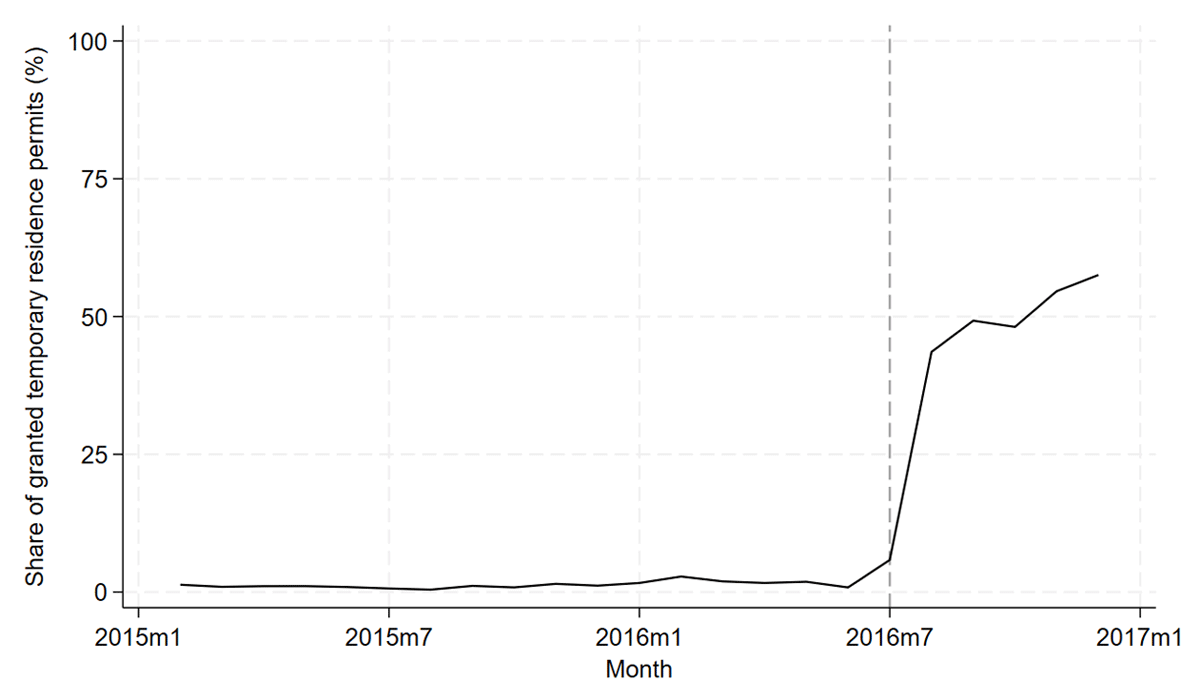
Figure 1
Share of individuals granted temporary residence permits in 2015 and 2016.
Notes: Data from the Swedish Migration Agency (2023).
One advantage of our research design is that the individuals in our sample were granted residence during the same period of time, meaning that they all had a similar experience of Sweden’s societal and institutional context apart from having different status. In addition, none of the individuals in our sample could predict before they applied for asylum whether they were to receive permanent or temporary residence, but we know that this was a decision based on the two main exemptions described above. The latter point is central, as it prohibits self-selection from turning into a specific status category. One drawback when using our setup is the implication that the two identified groups will differ in some respects. Most importantly, since our sample is made up of individuals granted residence between August and December 2016, there will be no applicants without children in the group granted permanent residence. To clarify, for an individual without children to receive permanent status, they needed to be granted a status before the implementation of the new law. Since our sample consists of persons granted residence from August 2016 and onwards, childless individuals will be missing from our sample. However, it is important to be aware that this does not mean that the individuals in this group are not parents, only that they applied for asylum in Sweden alone, or without their children. We will describe the characteristics of our sample more in detail below.
Describing the sample and the outcomes of interest
The study relies on individual-level survey data from the database Preserving2 that have been combined with a rich set of register outcomes from the database STATIV. The data were collected during December 2019 and February 2020, after approval by the Swedish Ethical Review Authority,3 in cooperation with Statistics Sweden (SCB) and a private company specialising in designing and collecting surveys. During the data collection stage, SCB provided contact information for 3,000 individuals from Syria aged between 18 and 64 years who were granted residence between August and December 2016. We initiated the data collection stage by sending out an invitation to everyone in our sample to participate in our survey, either via our digital platform or in paper format. The letter of invitation contained information about the survey and a QR code that linked to the digital platform. Thereafter, we sent out three more items to the respondents in the form of one paper survey with a return envelope and two additional reminders. The survey could be answered in either Arabic or Swedish. We received an answer from 854 individuals, which corresponds to a response rate of 28.8% of the sample.
The characteristics of our sample are outlined in Table 1. Of the respondents 436 individuals, or 51%, were granted temporary residence, and 49% were granted permanent residence. In terms of age, sex and education, the groups are quite similar: those with permanent residence permits are slightly older (by an average of 4.9 years) and less educated (5.3% fewer have a university education). However, almost all individuals granted permanent residence are parents and live with their child in Sweden (a difference of 43.9 percentage points). They are also married to a larger degree (difference of 47.7 percentage points). As described above, these differences are explained by the sample selection, i.e., only including those granted residence just after the implementation of the law. To address this issue, we adopted two strategies: We included control variables to account for the observed differences between the groups, and we performed a separate analysis in which we only included individuals with children. Alongside our difference-in-means approach, we provide a description of the main variables and their distribution across the groups. In our estimations, we focus on the correlation between temporary residence and our outcomes while controlling for observable differences.
Table 1
Characteristics of individuals in the treatment and control group.
| MEAN | N | ||
|---|---|---|---|
| Main variables: | |||
| Temporary | 0.51 | 847 | |
| WHO-5 | 48.0 | 847 | |
| Stress about own status | 0.44 | 847 | |
| Stress about family status | 0.42 | 847 | |
| Control variables: | |||
| Age | 35.9 | 847 | |
| Male | 0.54 | 847 | |
| Married | 0.73 | 847 | |
| University | 0.36 | 847 | |
| Children | 0.79 | 847 | |
| (1) | (2) | (3) | |
| CONTROL | TREATMENT | DIFFERENCE | |
| Control variables: | |||
| Age | 38.02 | 33.12 | 4.90*** |
| Sex | 0.53 | 0.55 | –0.02 |
| Married | 0.93 | 0.45 | 0.48*** |
| University | 0.31 | 0.37 | –0.05 |
| Children | 0.99 | 0.55 | 0.44*** |
| Observations | 450 | 397 |
[i] Notes: The table displays central characteristics of our sample. Data from Preserving (2020). ***p < 0.001.
We use three main measurements as our dependent variables: a measure of well-being in the form of the World Health Organization – Five Well-Being Index (WHO-5) index, the level of stress concerning one’s own residence status, and stress levels concerning the residence status of family members. To measure the level of individual well-being, we rely on the WHO-5. The WHO-5 index has been used in many studies (e.g. Tinghög 2009; 2017; Topp et al. 2015) and consists of five items, each containing a statement to be answered on a scale from zero to five. A score of five indicates that the individual felt in agreement with the statement during the last 6 months. Conversely, a score of zero indicates that the individual felt in agreement with the statement at no time during the same period. The statements in WHO-5 are: ‘I have felt cheerful and in good spirits’, ‘I have felt calm and relaxed’, ‘I have felt active and vigorous’, ‘I woke up feeling fresh and rested’ and ‘My daily life has been filled with things that interest me’. The total score of all statements, ranging from 0 to 25, was then multiplied by four to produce the final score, where 0 indicates the lowest level and 100 indicates the highest level of well-being. In previous studies, index scores lower than 50 have been used as a threshold to indicate low well-being (Tinghög 2017). Table 1 shows that the average level of well-being in our sample is 48. The two other dependent variables were each measured by a survey question that asked the individual to mark their perceived level of stress regarding, first, their own status and, then, the status of their family members during the last 6 months. Each answer could be placed on a scale from zero to five, where zero (0) indicated an absent level of stress and five (5) indicated a very high level of stress. These variables were then recoded into dummy variables in which a value of three or higher indicated stress, while values under three indicated no stress. Table 1 shows that 44% of our sample indicated high levels of stress concerning their own status and 42% indicated high levels of stress concerning the status of family.
There are a few aspects that need to be further discussed. First, with regards to the response rate, we have used the conventional method – calculating weights – to address the problem of the low response rate. The weights used in our estimations are constructed to correct the discrepancies between the distribution of our sample with the distribution of the total population of Syrian refugees granted residence in 2016. The results of our estimations using both samples can be seen in Table 2.
Table 2
Assessing the influence of temporary residence on stress and well-being.
| FULL SAMPLE | CALIBRATED SAMPLE | ONLY WITH CHILDREN | ||||
|---|---|---|---|---|---|---|
| (1) | (2) | (3) | (4) | (5) | (6) | |
| WHO-5 INDEX | ||||||
| Temp.Res | –10.885*** | –6.467*** | –11.670*** | –6.622*** | –7.644*** | –6.363*** |
| (1.908) | (2.318) | (2.009) | (2.407) | (2.410) | (2.391) | |
| N | 767 | 767 | 757 | 757 | 568 | 576 |
| INDIVIDUAL STATUS | ||||||
| Temp.Res | 0.767*** | 0.700*** | 0.780*** | 0.710*** | 0.716*** | 0.721*** |
| (0.023) | (0.028) | (0.023) | (0.032) | (0.032) | (0.031) | |
| N | 772 | 772 | 772 | 772 | 575 | 575 |
| FAMILY STATUS | ||||||
| Temp.Res | 0.439*** | 0.506*** | 0.442*** | 0.521*** | 0.507*** | 0.519*** |
| (0.033) | (0.039) | (0.035) | (0.037) | (0.040) | (0.038) | |
| N | 698 | 698 | 698 | 698 | 553 | 553 |
| Controls | No | Yes | No | Yes | No | Yes |
[i] Notes: Standard errors in parentheses. We show the full regression tables in the Appendix. *p < 0.05, **p < 0.01 and ***p < 0.001.
Results: assessing the influence of residence status on stress and well-being
Descriptive analyses
We start by performing descriptive analyses. Figure 2 presents the level of stress in the groups granted permanent (bars to the left in the figure) and temporary (bars to the right) residence status. The blue bars visualise stress linked to one’s own status, while the orange bars visualise stress related to the status of family members. The y-axis ranges between 0 and 0.8, indicating the proportion in each group experiencing stress. There is a significant difference in the levels of stress experienced by those with permanent (left bar) and temporary (right bar) residence status. Among those with a temporary residence permit, 82.7% indicated stress about their own status. In the group with permanent residence, the corresponding number was 6%. Only 17.3% of the respondents with temporary residence status indicated that they were not stressed concerning their own status; the corresponding figure for those with permanent status was 94%. Concerning the level of stress connected to the status of family members, we see a similar but not as sharp difference. In the group with temporary residence, 64.2% indicated stress because of the status of a family member, while the corresponding number in the group granted permanent residence was 18.7%.
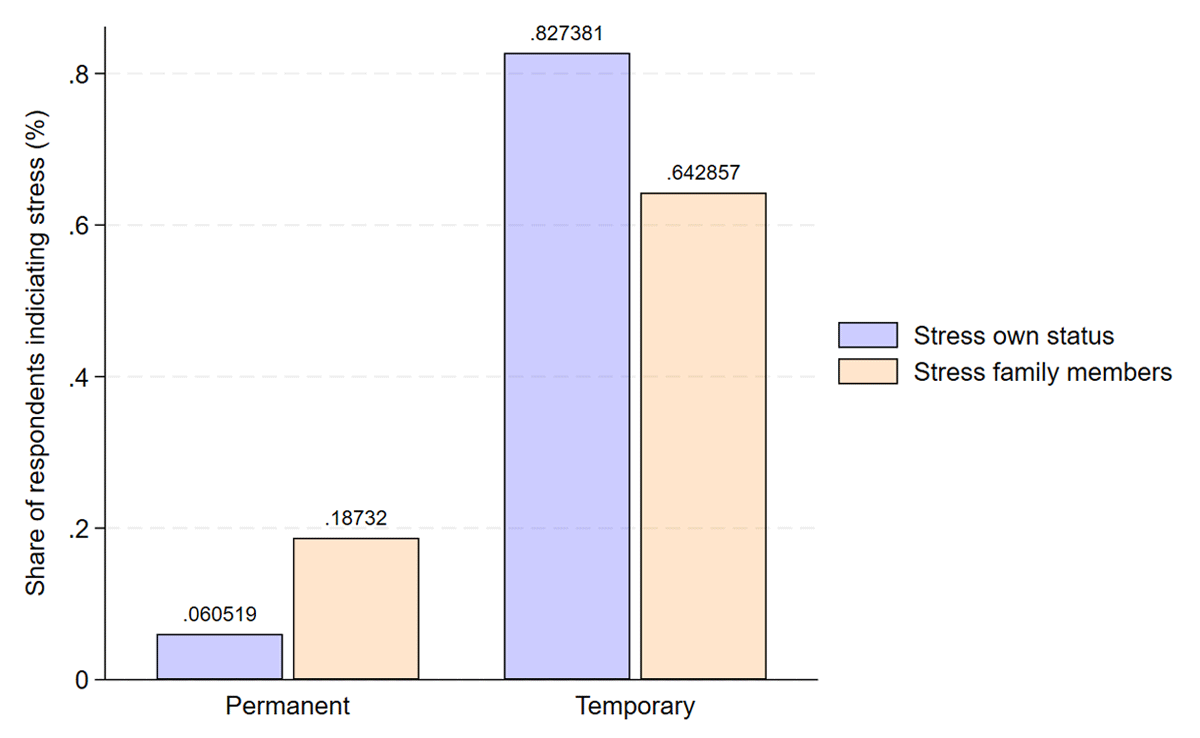
Figure 2
Share of individuals experiencing stress regarding one’s own status (blue) and the status of family members (orange) among individuals granted permanent (left) and temporary (right) permits.
Notes: Data from Preserving (2020).
Our descriptive analyses clearly indicate that those granted temporary status are more stressed about their own status, and that of their family members, than those with permanent residence. The relationship is weaker regarding the status of family members, which may reflect the fact that individual status within families can vary. In some cases, some family members have been granted permanent residence while others were granted only temporary permits. Figure A1 in the Appendix shows that, between 2016 and 2018, 2.5% of all family units received mixed statuses within the family. Although this may seem as though it is a small number, the Swedish Migration Agency (SMA) relies on a narrow definition of a family. It may be that the experienced stress applies to members of an extended family, for instance, adult siblings or other relatives. Thus, the Swedish policy change in 2016 has led to the unique circumstance whereby individuals can experience stress and concern for their family even if they, individually, have obtained secure residence.
Figure 3 uses boxplots to visualise the distribution derived from the WHO-5 index between the two groups. The boxplot to the left shows the distribution among those with permanent status (blue), and that to the right shows the distribution among those with temporary status (orange). The black horizontal line in each box marks the average value. The pattern here is very similar to the previous two analyses. It indicates that those granted permanent residence have a greater sense of well-being compared with those granted temporary status. The average sense of well-being for the group granted permanent status is 53 index points, while the corresponding number for those granted temporary status is 42 index points, which is a difference of about 10 points in the level of well-being.
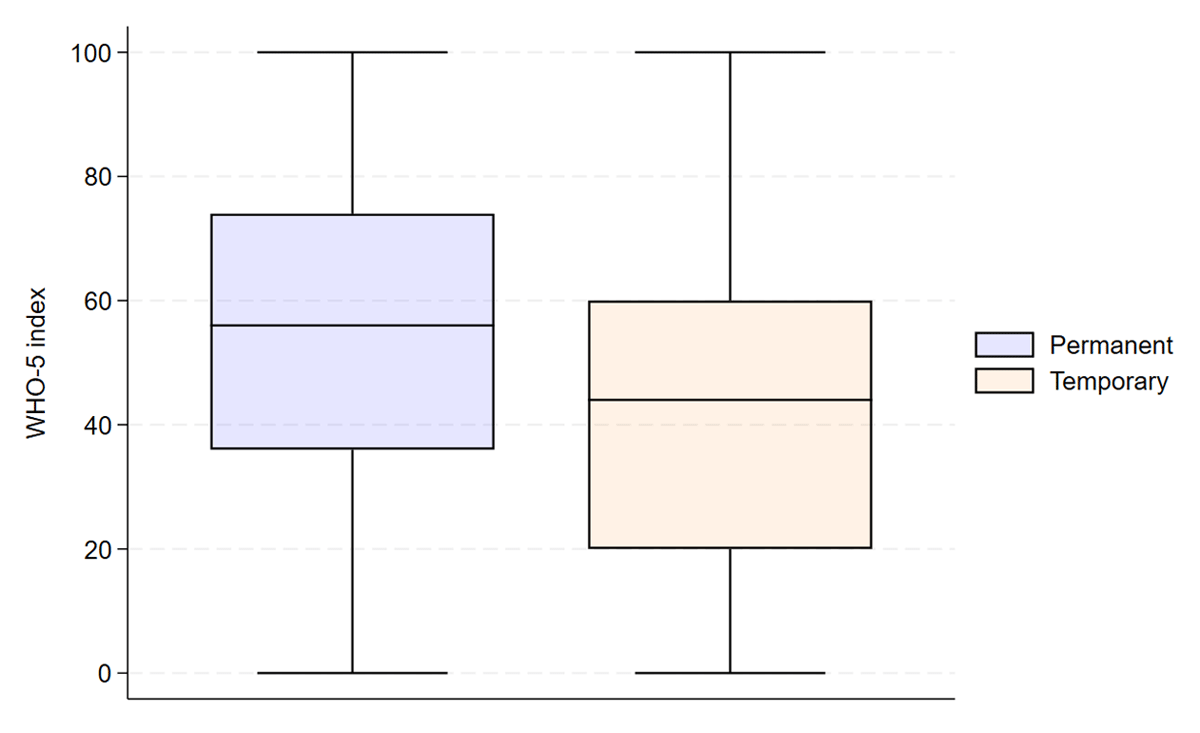
Figure 3
Distribution of the WHO-5 index between groups granted permanent (left) and temporary (right) permits.
Notes: Data from Preserving (2020).
Figures 4a and 4b describe the correlation between stress over residence status and well-being. Considering the importance of well-being in other parts of the integration process, a correlation between these variables should make the implication of a restrictive migration regime relying on time-limited residence status clear. In Figure 4a, we visualise the self-stated level of stress connected to one’s own status on the y-axis. On the x-axis, we visualise average score on the WHO-5 index. Figure 4a shows that higher stress concerning one’s own status is correlated with a lower sense of well-being. Looking at the x-axis indicates a strong negative correlation, in which lower levels of stress are correlated with a higher sense of well-being. The relationship is not as strong in Figure 4b, but the pattern is the same: Higher levels of stress connected to the status of family members are correlated with a lower sense of well-being. With this in mind, we use the WHO index as our main outcome in the analyses below.
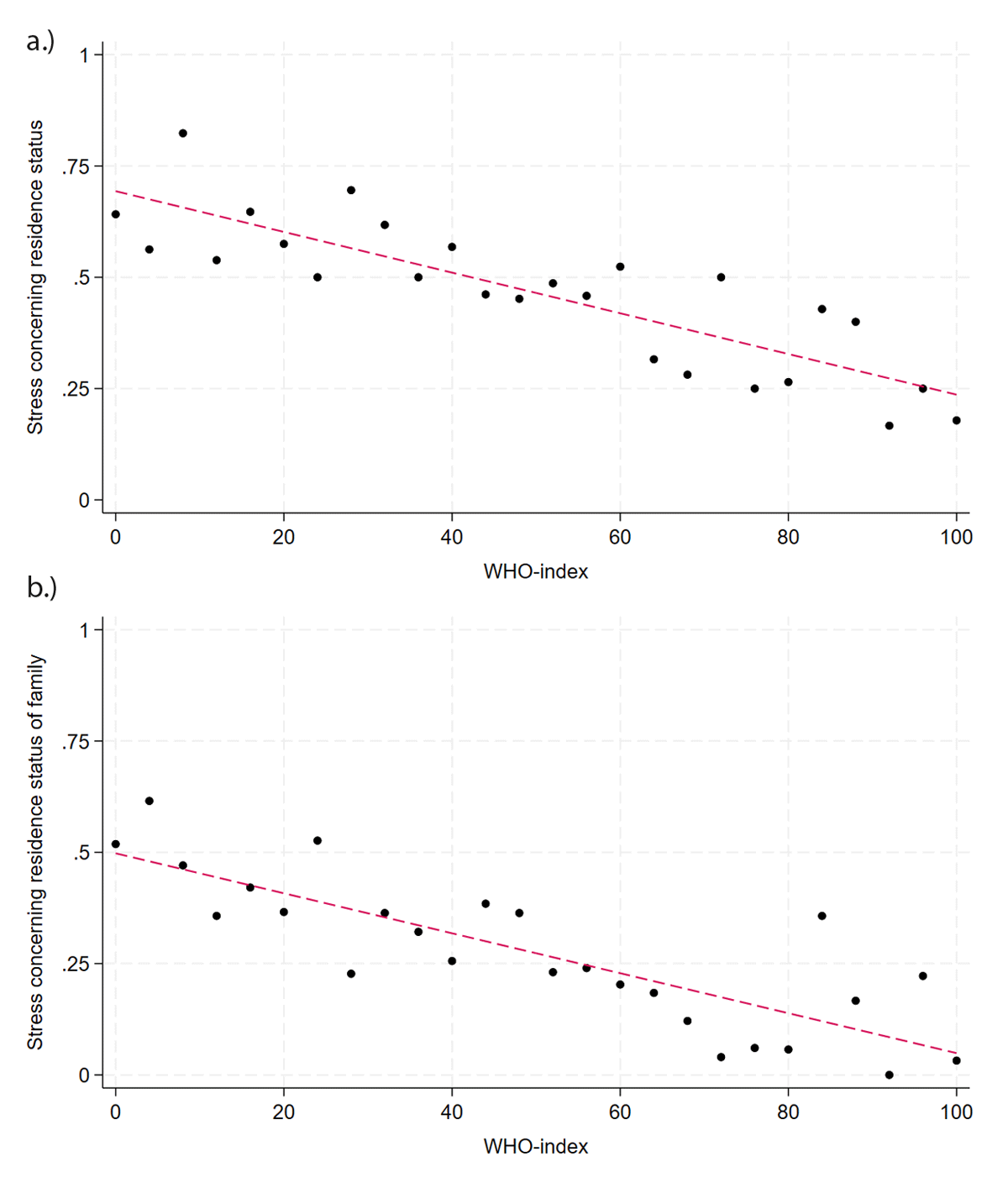
Figure 4
Correlations between stress over one’s own status (a) and the status of family members (b) and well-being.
Notes: Data from Preserving (2020).
Difference-in-means analysis
Although the descriptive analyses give an indication of the impact of residence status, they give little insight into how other factors potentially influence the descriptions and the observed patterns. Such analysis is important, not least because of the differences in characteristics reported between the two groups in Table 1. To account for these factors and assess the impact of residence status in our sub-samples, we implement a direct comparison of the three main dependent variables between the groups of individuals granted permanent and temporary residence. The main coefficient of interest is Temp.Res, which represents the estimated difference between those granted temporary residence, coded as 1, and those granted permanent residence, coded as 0. As the variable is binary, the coefficient should be interpreted as the difference in mean of the dependent variable between the groups, conditional on the included covariates.
Columns 1 and 2 in Table 2 present the estimated impact of temporary residence on each of the dependent variables (rows 1 to 3). In the second column, we include a set of control variables including sex, age and type of municipality (of residence) and a binary variable indicating whether the individual has children or not. The estimates mirror the descriptions above: Individuals with temporary residence permits have a generally lower sense of well-being. In row 1, we report a negative coefficient of about 6 index points, including the control variables. In rows 2 and 3, we show stable coefficients, mirroring the descriptive findings in Figure 2, which indicate that temporary permits increase stress even if control variables are included.
Robustness checks
To test the robustness of the baseline results, the estimated coefficients in the calibrated sample, using weights, are presented in columns 3 and 4. In the calibrated sample, weights were created to compensate for any differences in characteristics between the sample and the full population of Syrian refugees that arrived in 2016. The estimations are robust to these analyses. Because the proportion of families differs between the groups identified in Table 1, in columns 5 and 6 the sample is restricted to individuals with children. This test lends further credibility to our baseline estimates, showing stable and significant estimates across all models.
Finally, we explore potential differences in means in other areas connected to settlement, such as housing, work, education and family situation across the treatment and control group. In this part, we analyse four 5-scale questions, asking whether the respondents are stressed by any of the afore-mentioned areas. A high number (5) indicates high stress, while a low score (0) indicates low stress. Similarly, as in our main outcomes focusing on stress, these variables have been recoded into binary indicators. The results can be seen in Table 3, which suggests that there is no significant difference between the two groups in terms of the stress connected to housing, work or education. Reflecting the baseline results, however, individuals with temporary status are significantly more stressed about their family situation compared with those with secure residence status. Considering the increased state emphasis on self-sufficiency, both in terms of family reunification and in obtaining a secure status, this is not a surprising result.
Table 3
Difference in stress levels across areas connected to settlement.
| STRESS OVER: | |||
|---|---|---|---|
| PERMANENT | TEMPORARY | DIFFERENCE | |
| Housing situation | 0.51 | 0.51 | –0.00 |
| Work situation | 0.48 | 0.55 | –0.06 |
| Study situation | 0.48 | 0.55 | –0.06 |
| Family situation | 0.18 | 0.35 | –0.17*** |
| Observations | 723 |
[i] Notes: *p < 0.05, **p < 0.01 and ***p < 0.001.
Figure 5 visualises the marginal effects in the WHO index across three groups of respondents: those with temporary residence for 13 months, those with temporary residence for 3 years and those with permanent residence. Adding to our baseline estimates, we report that those with the shortest residence permits (13 months) have the lowest sense of well-being. As the length of the permit increases, so does the general feeling of well-being. This is an important addition to the literature, suggesting that, even within the category of temporary residence, there is a hierarchy of precarity in which those with the shortest permits experience the lowest levels of well-being and the highest levels of stress.
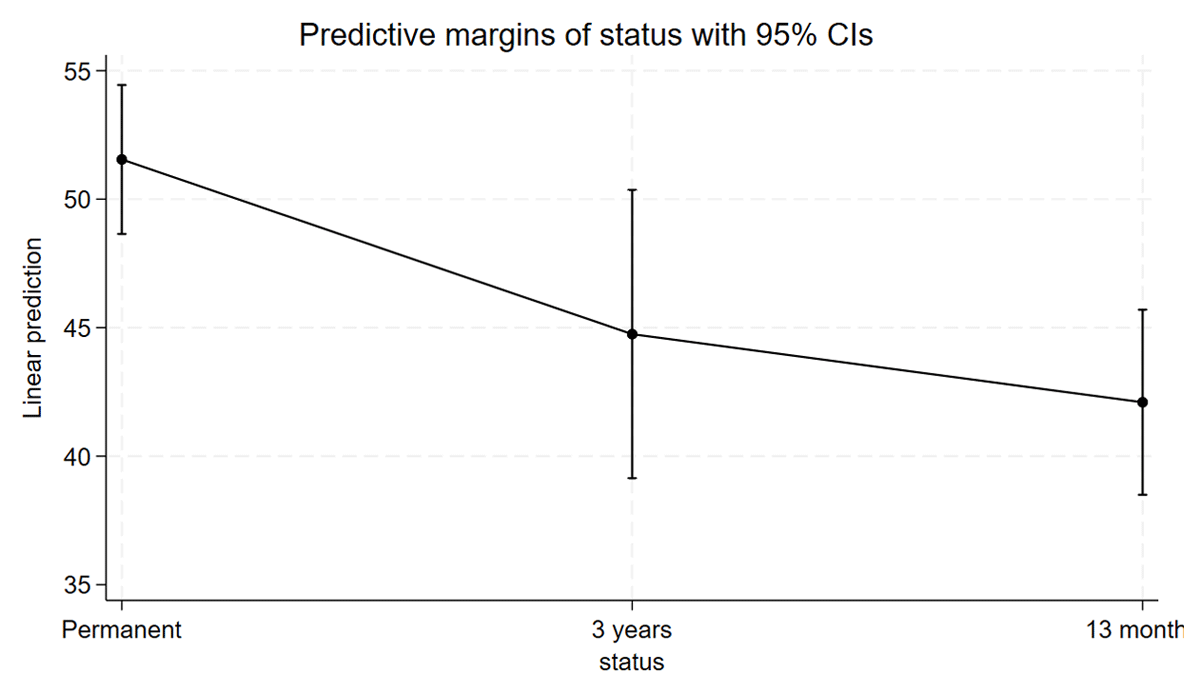
Figure 5
Marginal effects in the WHO-5 index across groups granted permanent statuses, statuses for 3 years, and statuses for 13 months.
Notes: Data from Preserving (2020).
Concluding discussion
This article has explored how permanent and temporary residence status influences the level of well-being and stress among migrants with a refugee background. We focused on a swift change in Swedish migration law, implemented in June 2016, to compare migrants who were granted either permanent or temporary residence status. Our study introduces a new dataset which allows for a comparison of those granted residence in the same period but given a different residence status. In addition, our data focus on subjective, rather than objective, indicators of well-being and stress to understand the implications of a new institutional landscape, one which is defined by temporal borders, waiting and increased precarity.
We reach the following conclusions. In line with several previous studies (Bogic et al. 2012; Gottvall et al. 2020; Tinghög et al. 2017), we show a general prevalence of low well-being among Syrians with a refugee background. Building on these results, along with other previous studies (Johannesson & Westerling 2019; Newnhamn et al. 2019), we conclude that time-limited status increases stress and reduces the general state of well-being among migrant groups. Importantly, our results highlight that, although migrant refugee groups display a general sense of low well-being, the granting of a temporary residence permit can worsen an already precarious health situation. We performed additional analyses to corroborate our main findings, which consistently support the same conclusion: Migrants granted temporary residence report higher stress regarding their status and that of their immediate and extended families, and a lower sense of well-being. This result further confirms earlier research showing that subjective well-being is affected by stability and a sense of ontological security (Belgrade, Kira & Lee 2022; Chace 2013; Nunn et al. 2016). The opportunity of comparing migrants who arrived in a new country at the same time but who were given a different legal status, presented by the policy change in 2016, also adds to the robustness of similar conclusions drawn earlier. Our study adds four important conclusions to the existing debate.
First, we show that the impact of time-limited status seems to be most prominent among those granted the most precarious type of residence status (temporary residence with re-evaluation after 13 months). Hence, the most restrictive category of temporal borders, placing the individual in the most prolonged period of waiting, seems to be most harmful to individual health.
Second, we show that stress related to other areas of the settlement process, such as housing, work and education, is experienced in a similar fashion across both groups. In other words, residence status does little to differentiate the stress levels our respondents indicate when it comes to issues of housing or work. Besides highlighting the detrimental influence of time-limited status on migrant well-being and stress, we believe that this result adds to the credibility of our study design and indicates that the group granted temporary residence is not more stressed in general, but specifically regarding their status.
Third, departing from our main results we further show that the negative impact of temporary status extends beyond the concern one might have for one’s own permit. We conclude that those granted permanent residence continued to worry about the temporary status of their family members. This is an important addition to current knowledge, showing that the uncertainty of temporary settlement also affects individuals at a group level, with potential implications for family decisions regarding, for instance, place of residence, family planning or other life choices, as well as having an impact on place attachment and ontological security. Thus, when considering the implications of residence status, the family is an important unit of analysis. Our results are reflected in a study by Gottvall et al. (2020), who found that migration policies that restrict the functioning of support networks, such as by limiting family reunification, can have a harmful effect on migrant mental health.
Finally, our results show that there is a strong correlation between stress concerning residence status and subjective well-being. Individuals who experience the greater stress connected to an insecure migration status such as a temporary residence decision also experience a lower level of well-being. This relationship highlights an important implication of restrictive migration regimes both globally and in the specific Swedish case. While some studies have indicated that temporary residence may promote labour market participation in the short term while reducing participation in education, (Jutvik & Robinson 2020), our results highlight another part of the integration process focusing on subjective well-being, stress and mental health.
Many studies have suggested that good health and well-being constitute central facilitators for integration because of the interconnections to other societal dimensions (Borevi & Cetrez 2021). Our results, indicating lower levels of well-being among those with time-limited residence status, thus indicate a potential decrease in the rate of integration into, for instance, the labour and housing markets. Such a failure can, in turn, have a negative impact on wider social participation and access. Policies that increase stress and have a negative impact on health can produce a vicious circle and add to the creation of new borders of exclusion and otherness.
Our study is relevant for policy development in migration outside of Sweden. Given the restrictive trend in European migration policy, our conclusions have a bearing on patterns of refugee integration and health across other countries with similar restrictive approaches. Previous research has shown that post-migration stressors may influence the capacity of migrants to participate in different societal spheres. Our results clearly indicate that an insecure legal status constitutes such a factor, with negative implications on stress and subjective well-being. As such, we recommend that future studies explore the link between residence status and other outcomes, such as socio-economic integration, family formation and political participation to facilitate the development of functioning and well-managed migration policies that contribute to, rather than breaking down, individual well-being and integration.
Data Accessibility Statement
In this study, we make use of individual-level microdata from the STATIV database provided by Statistics Sweden. This is restricted access data; we are not allowed by Statistics Sweden to share the data with any third party. All codes and replications files are available upon request.
Additional File
The additional file for this article can be found as follows:
Notes
[4] Newly arrived migrants were eligible for financial and housing support as well as help with a study programme or finding a job. Jobs were part of the Establishment programme and valid for 24 months. As part of the program individuals also received between 231 and 308 SEK in financial support per day, 5 days a week (about 20–26 EUR per day.
Acknowledgements
We would like to thank two anonymous reviewers for their valuable input. We are also grateful for input from Irene Molina, Nicolina Ewards Öberg, Branka Likic-Brboric and seminar participants at the Institute for Research on Migration and Ethnicity, as well as participants at the European Network for Housing research seminar.
Funding Information
The authors have received funding from Formas – a Swedish Research Council for Sustainable Development (Grant Number: 2021–00085). E.H. has received funding from Formas (Grant Number: 2020–02046). K.J. has received funding from Formas (Grant number: 2020–0232).
Competing interests
The authors have no competing interests to declare.
Author Contributions
K.J. implemented the statistical analyses of the survey material. In all other parts, such as the processes of planning, writing and reviewing the article, both authors have contributed equally. Both authors have approved the submitted version.