
Introduction
From 1996 to 2022, 10,940 UMs obtained a right of residence in Norway and settled in a municipality. Of these, 10,173 were still resident at the beginning of 2023 (SSB 2024). The Norwegian state claims to prioritize the welfare and rights of children and sees itself as a pioneer in this area. Nevertheless, Norway has recently been criticized several times by the UN Committee on the Rights of the Child for not providing equal care to unaccompanied refugee minors under and over the age of 15 years (Stang 2012), and Norwegian authorities have been found by researchers to be ambivalent about the treatment and status of unaccompanied refugee minors (Lidén, Stang & Eide 2017). Behind these failures and biases is an immigration system that has been exacerbated by stricter border controls, financial requirements and family reunification policies that have imposed restrictions on unaccompanied refugee minors. The fact that the period of migration often coincides with the period when unaccompanied refugee minors are transitioning into independent adulthood (Eide & Broch 2010) means that attempts at family reunification are often interrupted by regulated age limits and thresholds that exacerbate the disorientation already associated with resettlement.
A problematic1 arises here in the disjuncture between the desire of an unaccompanied minor and young refugee (UM)2 to bring their family to Norway and the complicated institutional systems and regulations that must be overcome to fulfil this aim. Financial strictures and legal regulations produce an unduly challenging process for UMs, as well as for those employees who assist them. In this article I ask: How do UM girls experience the family reunification application process? And how do they and their municipal service providers navigate the institutional system during this process?
This article is based on an institutional ethnographic study of UM girls in three Norwegian municipalities, drawing on interviews with UM girls and municipal staff.
Unaccompanied Minor and Young Refugee Girls in Norway and the Restriction of Family Reunification
Family reunification is the ‘main channel of (legal) migration’ to the Organisation for Economic Co-operation and Development (OECD) countries (Eggebø & Brekke 2018: 7). The increase in migration to Europe in 2015, known as the ‘refugee crisis’, has led to a tightening of family reunification legislation in most European countries, including Norway. Both before and after 2015, several restrictive measures were introduced to prove politically that ‘Norway is not disproportionately lenient compared to other destination countries in Europe’ (Brekke & Staver 2018; Eggebø & Brekke 2018: 10). These measures included the introduction (and extension) of income requirements, age requirements and attachment requirements – measures stating that family reunification can be refused if family life can be practiced in a safe third country that the family has stronger ties to than Norway (Grønningsæter & Brekke 2017) – as well as the shortening of grace periods and exemptions (Ibid.: 10). For UMs, there are several other measures and restrictions on family reunification that come into play, as my analysis will show. The regulation of family reunion also includes laws related to eligibility, integration, payment of fees and access to rights and services (Eggebø & Brekke 2018). As a result of these changes over the last 15 years, Europe and Norway have, by and large, moved towards increasingly constrictive and restrictive approaches to regulating family immigration (Eggebø 2010; Eggebø & Brekke 2018; Leerkes & Kulu-Glasgow 2011; Sirriyeh 2015; Staver 2014).
UMs are defined as children under the age of 18 years who have applied for asylum in Norway and are separated from their parents or other legal guardians (Eide 2012; Lidén et al. 2013; Sandermann, Husen & Zeller 2017). Only a limited number of studies focus on UM girls and their experiences of the family reunification process (Berg & Gravråkmo 2016; Berg & Haugen 2018; Sveaass & Reichelt 2011), and the experiences of municipal employees supporting UMs in their reunification cases are also understudied (Kråkenes 2016; Sveaass & Reichelt 2011; Tørrisplass 2022a; Tørrisplass 2022b).The relatively few existing studies on the latter group have shown that municipal employees find that the legal framework makes it difficult to help and support UMs during and after the family reunion application (Kråkenes 2016; Sveaass & Reichelt 2011; Tørrisplass 2022a; Tørrisplass 2022b).
These gaps in knowledge are perhaps not entirely innocent. Rousseau, Mekki-Berrada and Moreau (2001) argue that research has focused more on the trauma of family separation than on the causes of long-term separation because, unlike externalized wars and conflicts abroad, the latter phenomenon originates in the host countries themselves. Indeed, the authors argue that this evasion can be seen as a form of ‘Western administrative violence’ brought about by institutionally imposed barriers and obstacles (Rousseau, Mekki-Berrada & Moreau 2001: 56). Both Lundberg (2023) and Elsrud (2023) have expressed similar concerns. Lundberg (2023) refers to the ‘limbo’ in which rejected asylum seekers from Palestine in Sweden find themselves because of ‘bureaucratic violence’, and Elsrud (2023) argues that the restrictions and continued ‘tiny acts’ by which asylum seekers from Afghanistan are deprived of their rights can be understood as ‘bureaucratic cruelty’. This is not a new phenomenon and relates to Bauman’s (1998) argument that the true power of institutions and nation-states rests on their control over mobility.
The resettlement and treatment of UMs is subject to the imperative to protect children, but the category of ‘child’ is also politicized in ways that hinder family reunification. Municipalities are responsible for assessing and providing appropriate care and accommodation for UMs (Eide, Kjelaas & Larsgaard 2017) and have some autonomy in organizing and managing these tasks (Berg & Haugen 2018). In the municipalities studied here, the treatment of UMs falls within the remit of The Norwegian Child Welfare Services, which is governed by the Child Protection Act (1993). UMs themselves report considerable feelings of grief and worry about the absence of their families (Lynnebakke, Pastoor & Eide 2020), yet Norwegian authorities regularly consider family reunification to be at odds with a child’s wellbeing (Eide 2012: 162); in their view, family reunification makes children responsible for their parents and reverses the established ‘healthy’ care structures. Even more important, at least from the perspective of Norwegian legislators, is the fact that UMs can serve as so-called anchor children (Eide & Broch 2010): children who are sent abroad by their parents with the intention of establishing grounds for family immigration. Concern about this alleged practice has given rise to arguments for a more restrictive family reunification policy and a tendency to promote family reunification outside Norway in a safe third country (invoking the attachment requirement; AID 2000). The term ‘anchor child’ can thus be understood as a political measure aimed at limiting the number of family reunifications in Norway. Indeed, refusals are often justified by reference to the relative ‘safety’ of reunification conditions in another country, even when families are living in exile or in refugee camps (Engebrigtsen 2012).
The UN Convention on the Rights of the Child, signed and ratified by Norway, clearly emphasizes the need to reunite children with their families. The second paragraph of Article 22 sets out the State’s obligations towards UMs and the right to family reunification, and the States Parties agree to:
[…] protect and assist such a child and to trace the parents or other members of the family of any refugee child in order to obtain information necessary for reunification with his or her family. In cases where no parents or other members of the family can be found, the child shall be accorded the same protection as any other child permanently or temporarily deprived of his or her family environment for any reason, as set forth in the present Convention (UN 1989: art. 22, §2).
Furthermore, as Articles 9 and 10 indicate, it is not only the pursuit of this reunification that is essential but also the process towards it:
In accordance with the obligation of States Parties under article 9, paragraph 1, applications by a child or his or her parents to enter or leave a State Party for the purpose of family reunification shall be dealt with by States Parties in a positive, humane, and expeditious manner. States Parties shall further ensure that the submission of such a request shall entail no adverse consequences for the applicants and for the members of their family (UN 1989: art. 10, §1).
The process of family reunification in Norway is a complex web of administrative factors and considerations that begins with the UM’s first application for residence. The crucial factor is the basis on which the UM was initially granted residence in Norway: either an unrestricted residence permit based on persecution, war and other humanitarian grounds or a limited residence permit that is only valid until they are 18 years old, which is in reality a rejection. UMs who have been granted asylum or residence on the basis of another refugee status (JD 2016: § 28) have the right to family reunification with their parents and siblings under the age of 18 years. UMs who have been granted residence on humanitarian grounds do not have the same right to family reunification (JD 2016: § 38; UDI 2016b).
Statistics from the Norwegian Directorate of Immigration (UDI)3 revealed that between 2010 and 2018 a total of 5395 UMs (757 girls and 4638 boys) were granted residence in the country on the particular protection basis that permits the right to family reunification and as such were technically eligible to act as a ‘reference person’ who could sponsor a reunification application for their family member(s).4
As the data in Table 1 show, UM girls were more likely to act as ‘reference person’ for family reunification than UM boys, and a total of 274 girls served as a ‘reference person’. While the analysis focuses on the experiences of girls in this study, it does not specifically address gender-specific experiences, but simply notes that the work of family reunification, and thus the consequences associated with it, is experienced by a greater percentage of girls.
Table 1
Overview of UM boys and UM girls whose residency provides grounds for sponsoring family reunification applications and number and percentage of all applications, approved applications and rejected applications for family reunification (January 2010–September 2018).5,6
| UM BOYS | UM GIRLS | |
|---|---|---|
| Total number of sponsor-eligible UMs | N = 4638 | N = 757 |
| Total number of applications | N = 666 (14.35%) | N = 274 (36.19%) |
| Applications approved | N = 489 (73.42%) | N = 184 (67.15%) |
| Applications rejected | N = 177 (26.57%) | N = 90 (32.84%) |
Methodological Reflections and Theoretical Concepts
This article is based on a study that predominantly employs institutional ethnography, an exploratory methodology suited to producing an image of society from a particular point of view, often with the aim of uncovering the impact of institutional imperatives on people’s everyday lives (Smith 2005; Smith & Griffith 2022; Widerberg 2015).
The data for this study are drawn from fieldwork in three Norwegian municipalities. In total, 20 interviews were conducted across the three municipalities.7 Of these, seven were interviews with UM girls, see Table 2. The remaining 13 interviews were with 12 employees, among them three personnel from shared housing facilities, five staff from follow-up services, two advisors from child protection and welfare services and two leaders from the municipal settlement service.
Table 2
UM girls.
| ‘NAME’ | ‘ABEBA’ | ‘HIRUT’ | ‘MARIA’ | ‘ALMAZ’ | ‘AMAAL’ | ‘SEBLE’ | ‘SAMIRA’ |
|---|---|---|---|---|---|---|---|
| AGE (YEARS) | 18 | 18 | 23 | 17 | 22 | 18 | 20 |
| NATIONALITY | Eritrea | Eritrea | Congo | Eritrea | Somalia | Somalia | Somalia |
| YEARS IN NORWAY | 3 | 3 | 5 | 2 | 5 | 3 | 4 |
| FAMILY REUNIFICATION | Yes | No | No | No | Yes | No | No |
| WISH FOR FAMILY REUNIFICATION | – | Yes (has tried) | Yes | Yes | – | No | Yes (has applied) |
The UMs experiences were systematized to extract problematics, which can be understood as the fault line between everyday experiences and the institutional logics. The first part of the research question of how UM girls experience the family reunification application process was prompted by the UM girls’ own experiences. This problematic was then explored through interviews with those institutional representatives who have the greatest impact on the UMs’ everyday lives: the service providers. Interviews with municipal employees were pursued largely as a way of further exploring the experiences of the UMs. This dual approach allows for a foregrounding of the embedded experience of UMs but also a querying of their experience with the broader question of how the UMs and their municipal service providers navigate the institutional system during this process. Interviews with the service providers helped to explain parts of the experiences described by the UM girls. At the same time, however, their accounts also raised new questions that directed attention towards systems that had to be probed by exploring textual representations (McCoy 2006) since many of the settings and circumstances under examination are organized, ruled and mediated by texts.
The analysis in this study was a continuous process, such that the interviewees input determined the direction and focus of the subsequent explorations. For example, the attention to family reunification stemmed from the fact discovered in the interviews that UM girls do extensive work (time and effort) in this area. The task, then, was to explore why this work emerged and how it was perceived and, in addition, how institutional policies and systemic constraints contributed to and influenced this phenomenon.
‘Boss’ Texts and the Concept of Bureaucratic Violence
In theorizing the effect of institutional systems and regulations, this study draws on Smith’s (2005) account of ruling relations, which are ‘socially organized exercise[s] of power that shape people’s actions and their lives’ (Campbell & Gregor 2002: 32). Texts figure prominently in this framework, since control often takes place through textual representations because they are replicated and distributed across times and space. The materiality of the text makes visible how we can be present in our everyday world while at the same time remaining connected to translocal social relations through the text. This notion of the importance of texts relates closely to the concept of bureaucratic violence, which can be understood as ‘bureaucratic practices that affect violence upon the lives of’ people (Gren, Abdelhady & Joorman 2023: 1). Most people are subject to bureaucratic practices in some way or another, but refugees, due to being conceived as ‘out of place and in a liminal position in relation to nation-states’, experience these practices to a greater extent (Gren, Abdelhady & Joorman 2023: 2). The concept of text, similar to the concept of work, which in institutional ethnography is understood as everything people do that requires time, effort and intent, can be challenging because of the intuitive preunderstandings inherent in such everyday concepts. However, such inclusive terms for the concepts of text and work are nonetheless useful for identifying ruling relations as influential, socially organized exercises of power (Smith 2005). Texts are a predominant part of bureaucratic practices and coordinate people’s actions. According to Gren, Abdelhady and Joorman (2023: 3), ‘bureaucratic violence is a concept that can be fruitful for critical analyzes of states’ institutional practices towards refugees’, which are exercised in large part through texts.
When approaching ruling relations in this text-oriented fashion, researchers look especially to ‘boss texts,’ which are ‘higher order texts who govern or rule other subordinated texts in the institution’ (Smith 2006). Thus, the practices of municipal welfare services for UMs are linked to ‘boss texts,’ which in turn are reformulated, translated and materialized through daily routines and modes of organizing services. The ways in which boss texts establish guidelines for institutional employees is described as an ‘institutional circuit’ (Griffith & Smith 2014), a term that highlights how boss texts (for example, changes in an economic framework) define action chains. A variant of institutional circuits is called ‘accountability circuits’ (Ibid.). This term can help to explain how employees, through their practice, are made responsible for the institution achieving or fulfilling its duties. Through such accountability, practices are carried out largely to meet institutional expectations. This can result in routines being executed even though they do not work as intended, or in other cases it can mean that alternative practices – ones inconsistent with the dynamics of accountability circuits – are hidden.
Findings: Experiences with the Family Reunification Application Process
The experiences of three UM girls are used as case studies in this section. They were chosen because they all uniquely illustrate different processes of family reunification. The following subsections follow the stories of the girls: ‘Maria’, ‘Abeba’ and ‘Samia’. They illustrate the different experiences of the family reunification process and the ruling relations guiding these experiences. The UM girls’ accounts are contextualized with the help of interviews with municipal employees, which provide an opportunity to examine an issue originally raised by a UM girl. The analyses also draw on boss texts, including §28, §34, §38 and §43 of the Immigration Act, the Family Reunification Guidelines of the Norwegian Directorate of Immigration (UDI), the UN Convention on the Rights of the Child and municipal guidelines. By bringing these boss texts into dialogue with the experiences of UMs and employees, the aim is to highlight and describe the relationship between the local and the translocal levels – the experiences of family reunification processes and the intricate ruling that takes place in social relations governed by texts. This approach illustrates, in other words, ‘how the everyday experience becomes subjected to institutional action’ (Smith 2005: 199).
Maria: Too Late
Maria, who is now 23 years old, came to Norway alone at the age of 17 years. At the reception centre, she discovered that she was pregnant, and by the time she gave birth at the age of 18 years, she had already moved four times within Norway. She is still in regular contact with her family members. They initially travelled from Congo to another country, she reports, but have now moved to a third country owing to further security concerns. She has visited them in their current country of residence, but when asked whether they had visited her in Norway, she replied:
No, […] I have to wait a bit to apply. I’ll see when I finish my apprenticeship, when I get a job. Then I can apply for family reunification.
As this response suggests, Maria directly aligns her choices and behaviour with the rules and regulations surrounding the reunification process, such as income requirements, and her career aspirations are directly tied to these parameters. Because she is now over 18 years, however, it is difficult to find assistance with the application process. ‘Randi’, a team coordinator for one of the municipalities follow-up services, explained:
We don’t have any close cooperation with UDI; it’s the legal guardians who take care of this before the UMs are 18. But after the UM is 18 and is pursuing family reunification, I know that there are a number of contact persons who are authorized to assist the UM or the UM is authorized from their parents to be the one receiving case information. But it’s a difficult matter. I don’t feel like the legal guardians [in Norway] want to get involved with family reunification and it’s not our responsibility either – it is the family’s responsibility, as an applicant. But in practice, they must have help, so it’s a bit…yes…challenging.
Vagueness, deferral and unaccountability ring through Randi’s characterization of institutional responsibility for aiding. Moreover, this problem is exacerbated by the fact that the application for family reunification must be completed by the family member living abroad, although it requires sponsorship from the UM, who must still fulfil several special conditions and is inextricably linked to the process. Even for those who know the regulations well, such as Randi, it is difficult not only to find help but also to rely on it. This is because, in many cases, the helpers are not officially entrusted with this task or obliged to perform it. In other words, a process on which family life hinges ultimately depends on ad hoc and unpredictable institutional relations.
And even for reference persons familiar with the regulations, such as Maria, there are age-related pitfalls that are all but unavoidable. As Maria arrived at the age of 17 years, the period between her residence permit being granted and her 18th birthday was very short, especially as she was pregnant and had little time to pursue reunification before the age regulations came into force. Under current policy, an application for family reunification must be made before the UM turns 18 years old (UDI 2016b). The following figure illustrates the family reunification process as it applies to Maria.
The tightening of family immigration over the last 15 years can trap UMs in a web of countervailing and sometimes contradictory restrictions, as Figure 1 illustrates. In 2003, Norway instituted an income requirement for applicants over the age of 18 years, a policy that heralded a policy shift towards a more restrictive approach to immigration (Eggebø & Brekke 2018). Since then, this requirement has been raised several times. In 2018, the minimum income for a reference person was NOK 250,000, and the bar has now been raised to NOK 320,274 in 2023 (UDI 2023). These amounts often exclude income sources often necessary to UMs in their transition to adulthood, such as housing support and child benefits. Alongside the intensification of financial requirements, was the introduction of a ‘four-year rule’, which required the over-18-year-old UM-as-sponsor to have worked or studied full-time in Norway for at least four years for reunification to be granted. Since Maria could not sponsor an application for family reunification before she turned 18 years old, she must therefore meet the income requirement and must wait at least four years from the time she finishes her apprenticeship and has secured permanent employment and income. This shows how these boss texts create action chains that result in concrete barriers for Maria.
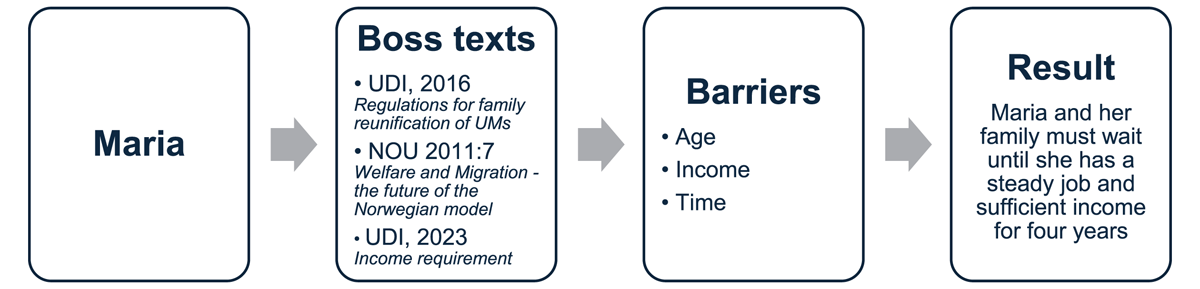
Figure 1
Barriers to family reunification (age and income).
Abeba: A Family Left Behind
Abeba was 15 years old when she left Eritrea. Now 18 years old, she had finally achieved – after three years in Norway – reunification with her father, whom she had not seen for eight years. This was a bittersweet reunion, however, since her mother and three of four siblings still live in Eritrea, while her brother lives in another country. Abeba wants them to come to Norway as well, but there are several factors that make it difficult, foremost among them the financial challenges of an application and the logistics of the application process itself. Abeba says, ‘I asked my contact; he helped me, but they can’t come. They must move to Ethiopia or Sudan. But my family cannot move.’ While it may initially sound as though Abeba has misunderstood the regulations, an employee in one of the municipalities (‘Anne’) explains that this is an accidental effect of the interfacing between Norwegian policy and geopolitical contexts:
[…] It is not the UM here who applies, it is the family who applies, but then we apply on behalf of the family because they may not know how. So, it always ends up that we apply on behalf of the family, and then we have to collect DNA tests for all the persons on the applications that have been submitted. And that’s fine enough for those who are here – they just go to Oslo [capital], for example, and take a DNA test. But for the family, […] everyone in the family must relocate, which is a huge challenge. Because it’s not just one time they must show up [for an appointment], they have to show up several times. […] So [for example,] the two families who lived in Somalia, they moved and lived near the embassy for one to two years. […] it is very difficult when they do not live near a Norwegian embassy, because they must.
While the constraint of needing to live near a Norwegian embassy for an extended period presents difficulties for many refugees, it is especially pronounced for those coming from Eritrea; in 2018 and by the time of writing, there was no Norwegian embassy in the country (UDI 2018), so applicants must report to the Norwegian embassy in Khartoum, Sudan – 890 kilometres from Asmara, the capital of Eritrea. Addis Ababa seems to present another alternative, but Norwegian authorities have declared that applications sent from that location will be rejected, and the application fee of NOK 10,500 per person will not be refunded (Ibid.). In other words, the processes taking place in Eritrea, Sudan and Ethiopia are overlaid by the ‘boss text’ from the Norwegian government, which determines the range of possibilities, the movement of people and the flow of money. As ‘Randi’, a team coordinator for one of the municipalities, describes it, this expensive and elaborate process generates unpredictable results and ad hoc workarounds:
Randi:: […] then the family can apply for reunification with their child who lives in Norway, and then they have to apply before the UM is 18, and applying is not just that the application is submitted, because it is not done online, and you pay NOK 8,000 [10,500 as of 2023] per adult […].
Me:: It costs NOK 8,000 per adult?
Randi:: Mmm. Before it was NOK 1,400, then NOK 3,000, and now it’s NOK 8,000 per adult. And who is paying for it here, do you think? Yes, it’s the UM, […] and then they [the family] must assemble all the attachment documents, go to an embassy, get an appointment. Maybe you’ll get an appointment in three months, maybe you’ll get an appointment tomorrow. [… Randi makes additional reference to confusing instructions and exceptions …] So, it’s pretty hopeless that the dad in Uganda is going to get this done, if we can’t get it done, and we don’t always know either, nor do the guardians.
Besides the often-protracted time this process takes, especially when set against the age limit, the application for reunification presents weighty financial challenges, which almost unavoidably fall on the UMs themselves. Considering that, according to Anne, UMs on average receive only NOK 1600 per month (and understandably spend much of it on necessities), acquiring extra funds to sponsor family members would be prohibitively difficult, especially before the age of 18 years. As Randi’s frustration suggests, these increasing fees generate an ‘institutional action chain’ in which employees are made responsible for enforcing institutional expectations. Though, officially, the responsibility for preparing the application and paying the fee falls on the family member(s) abroad, it is generally understood by municipal employees that these are taken on by the UMs, often with the advice and assistance of employees. This can therefore be understood as an alternative practice that is hidden (Griffith & Smith 2014).
As Figure 2 shows, Abeba is working under a set of interconnected barriers, all of which are authorized by boss texts but manifest in lived time and space. As for the financial burden, employees explain that UMs approach it in different ways. Some may use the saved child benefit, but this is not a sure method, since it is the prerogative of the legal guardian, who may not agree that the money should be used for this purpose. On their own and in desperation, UMs may be driven to harmful and exploitative sources of income, as Anne explains:
It is the [appointed legal] guardian who decides, in the end, whether the money is to be used or not. So, I remember I had a girl where the [appointed legal] guardian initially said no, and she became absolutely desperate and was going to travel abroad to sell her body. She said I’ll get the money anyway, I’ll do what I must; so, we ended up getting child benefit [money].
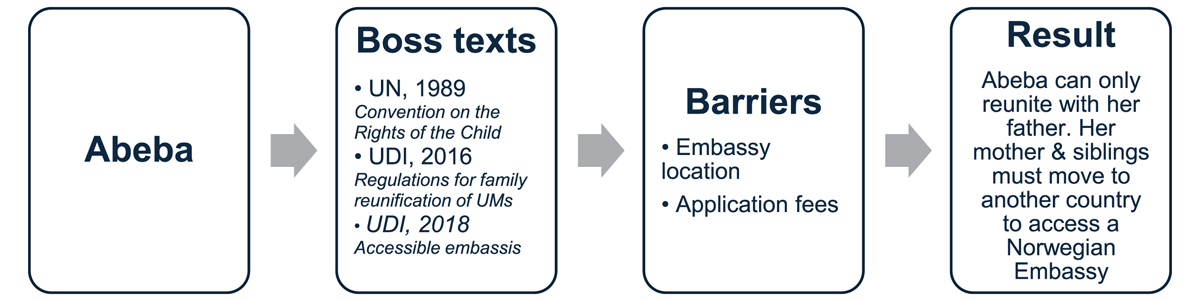
Figure 2
Barriers to family reunification (accessible embassies and finances).
To see this as a personal failing is to misunderstand the ways in which it is influenced by policy (and the hidden alternative practices it engenders) – a policy requiring a vulnerable underaged or recently turned of age refugee to acquire a mass of funds quickly to save their families while they necessarily lack the training, credentials or age to acquire well-paying jobs. Even beyond the evident distress this causes for UMs, it also puts strain on employees. As Anne explains, in this case the threat of endangerment seems to have been enough to acquire the child benefit funds. Such a scenario illustrates how employees are embedded in the process, including in its restrictions and exigencies. And since they do not have control of the financial resources of the UMs, they must also cooperate with guardians. This incidental relationship is reinforced by the fact that there are no funds for this type of application provided in the sum paid to the municipality per UM.
To raise the necessary funds, some municipalities have pursued a route that brings its own constraints and exploitations: an ‘unpaid’ internship. The UMs work for free in a company and in return receive a monthly ‘salary’ of NOK 2500 from the Child Welfare Services. While this is a solution of sorts, it is another example of an ‘accountability circuit’, as it is a practice carried out by the employees to comply with institutional regulations and is thus hidden as an institutional practice and therefore a form of invisible resistance that does not bring about institutional change (Griffith & Smith 2014).
Samira: Risking Reunification
Samira came to Norway from Somalia in 2014, but her family lives in Uganda. She has already applied for family reunification. While some of her friends have applied successfully, she seems to have fallen through an administrative crack in the system:
Samira:: […] I had lived here for three years, because I only had a residence permit for three years, and then they had the DNA, so they [the family] would come. Then they said you no longer have a residence permit, so you must apply. So, I applied one year and four months ago, and then it’s just waiting, waiting and waiting. So, it’s a bit dull. Before it wasn’t like that, before you just had to wait five or six months, but now they say they have become a bit stricter, so…
Me:: But you have been granted a residence permit for longer?
Samira:: No, I haven’t received [an answer], that’s why I’m waiting, if I get it, my family will come too, but I won’t get [a residence permit].
As Samira’s account suggests, in some cases the administrative apparatus of the Norwegian state simply fails: A delay of more than a year, which then threatens a UM’s own residency, certainly does not constitute the ‘positive, humane and expeditious manner’ demanded by the UN (UN 1989: art. 10, §1). One municipal advisor admits that far longer wait times are not unheard of:
[…] they have changed the rules for Somalis who came before they had, yes… so there are UMs coming now who get their families here in a year and there are also some who sit and wait for four years, so it’s pretty brutal.
Since 2015, there have been several increasingly harsh restrictions imposed on family immigration in both Norway and elsewhere in Europe in response to the rise in asylum seekers (Eggebø & Brekke 2018). The list of measures is long, as the overarching goal was to prevent Norway from appearing less restrictive than other countries in Europe. In other words, a kind of European ‘arms race’ of restrictions emerged (Ibid.). These regulations directly impose on Samira’s experience (see Figure 3). Though her application for reunification is still pending, Samira fears that she will be refused further residence in Norway; she shares that she has been told that there is peace in Somalia now, so she can go back. Samira is worried because her family no longer lives in Somalia, and after more than a decade abroad, she does not have much of a social network in Somalia. As such, her application for family reunification is now not only about getting her family to Norway but also about whether she herself can continue to live in Norway. ‘Hilde’, an adviser at a municipal shared housing facility for UMs, highlights a similar challenge when applying for family reunification.
I would have discussed the consequences of that, then. Because it is about getting a family reunification, then suddenly they may not be regarded as unaccompanied refugee minors anymore. And then their status will change. And that would also mean that there could be grounds for repatriation as well, wouldn’t it, and return, then.
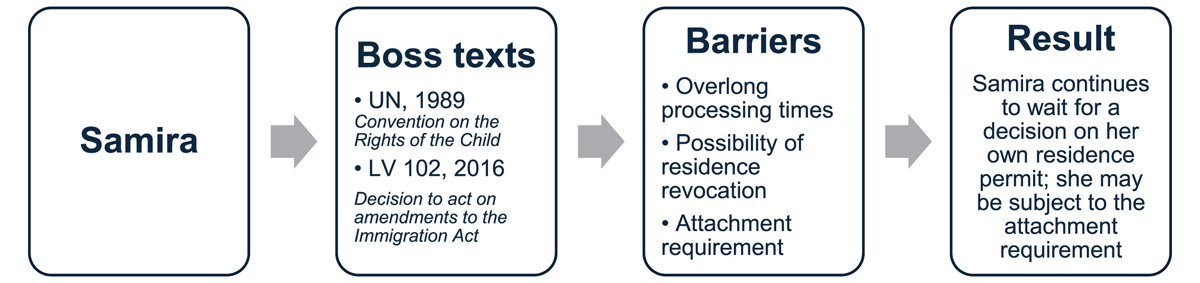
Figure 3
Barriers to family reunification (attachment requirements and restrictions on residence permits).
Seeking family reunification, as this advisor explains, can be quite risky for the refugee status of UMs, in the worst cases providing ‘grounds’ for repatriation. The reason for this is that the UM may no longer be considered an ‘unaccompanied minor’, but rather one with a family. Another risk with applying for family reunification is that, if authorities determine the location of the family abroad to be safe and suitable (whether in the home country or another location outside of Norway – a third country), then reunification there will be recommended and pursued (instead of in Norway), citing the attachment requirement (Bech, Borevi & Mouritsen 2017; Eggebø & Brekke 2018; JD 2015). Randi, who is a team coordinator in Samira’s municipality, explains that in 2016 the Norwegian government revised the Immigration Act’s instructions on the revocation of refugee status and residence permits when the need for protection has ceased (JD 2016: sec. 37, §1, e–f). These instructions now affirm that, if the conditions that led to the foreign national being granted protection in Norway are no longer present, then UDI must initiate a case for the revocation of residence permissions. While it is often impossible to determine direct cause and effect, the grounds of Samira’s residency were reassessed concurrently with the consideration of her application for family reunification.
The narratives provided by the UM girls capture an experience expressed aptly by ‘Heirute’, who is employed by the municipal follow-up services; she explains that those seeking family reunification ‘live in two worlds,’ existing in their everyday lives in Norway while at the same time remaining bonded with their family abroad and yearning to be with them. The findings in this section point to what Elsrud (2023) refers to as ‘bureaucratic cruelty’ and Lundberg (2023) calls ‘bureaucratic violence’, where ‘tiny acts’ done by bureaucrats in accordance with laws and regulations result in actual barriers hindering family reunification.
Concluding Discussion: Ruling Relations as Bureaucratic Violence
Norway has conspicuously distinguished itself as a leading nation when it comes to children’s rights. At the same time, the Norwegian authorities have tightened immigration policy in a way that negatively affects minors. This contradiction has been criticized both in the media and in academia (Lidén, Stang & Eide 2017; Stand 2012).
In a sense, Norway is torn between two conflicting obligations: on the one hand, the strictures of the UN Convention on the Rights of the Child (UN 1989), which Norway has adopted and adapted in detail, and, on the other hand, the political imperative to show rigour to prevent Norway from becoming too attractive as a destination country for refugees (Eggebø & Brekke 2018). According to Rosseau, Mekki-Barrada and Moreau (2001: 56); Lundberg (2023); and Elsrud (2023), the barriers raised in this process can be seen as a form of ‘bureaucratic violence’. As the experiences of Maria, Abeba and Samira show, the difficulties encountered in pursuing family reunification seem to illustrate the political intention to inhibit reunification. The threshold for obtaining family reunification has become higher for all refugees and has thus affected the rights of UMs (Eggebø & Brekke 2018). Although the regulations have been established for refugees in general, they have significant consequences for UM girls, who are children according to the Norwegian definition of the category.
Instead of the ‘positive, humane and expeditious’ process called for by the UN (1989: art. 10, §1), family reunification here is hampered by manifold barriers: financial costs, age limits, bureaucratic failures, residential precarity, geographic inaccessibility, income requirements, attachment requirements and more. As confirmed by the testimony and behaviour of municipal employees, the process far exceeds the power and resources of most UMs. A multifaceted process of workarounds, ad hoc solutions and shadow alternatives has emerged to fill the administrative and morale gaps created by the institutional barriers. But even amid these ‘solutions’, it is undeniable that restrictive immigration policies have a strong impact on the everyday lives of these UM girls. The stories of Maria, Abeba and Samira reveal a contradiction at the heart of Norwegian politics and life: The attempt to restrict immigration has harmful effects on minors despite Norway’s claim to be committed to children’s rights. In practice, this policy response has resulted in the rights of UMs being violated, particularly the right to swift and humane treatment (both in general and in their pursuit of family reunification). Furthermore, it has resulted in the authorities discursively transforming UMs from a risk group into a group considered less vulnerable. This is a discursive reframing that has resulted in authorities – through public discourse, legislation, economic measures and governance – moving further away from a child-centred perspective of care and towards a refugee-centred perspective of control and restriction.
While family reunification is an inherently complex process, the restrictive rules and associated costs – which are not inevitable or inherent – place UM girls in a vulnerable position. As both the UN Guidelines and the interview responses indicate, family reunification is a positive goal for those involved. Therefore, the realities and regulations that hinder this need to be examined more critically.
Notes
[1] In institutional ethnography, a problematic is not necessary a problem, but rather is understood as the fault line between everyday experiences and institutional practices.
[2] I use the term ‘unaccompanied minor and young refugee’ (UM). All the girls in this study came to Norway as unaccompanied minors, but most of them, at the time of the study, had passed the age of 18 years and are no longer considered ‘minors’.
[3] I contacted the Statistics and Analysis Unit (ESA) and the Analysis and Development Department (AUA) at the Norwegian Directorate of Immigration (UDI) and requested to be sent specific statistics regarding unaccompanied minors in relation to family reunification from early 2010 up to and including September 2018. I received these statistics by email from Senior Advisor Helen Sandal at ESA and AUA.
[4] This ‘reference person’ is the individual currently living in Norway, with whom the family wishes to be reunited.
Ethics and Consent
This project was assessed by the Norwegian Center for Research Data (NSD), which determined that collected personal data were processed in line with current legislation.
Funding Information
The data from this article is part of my Ph.D from Nord university and is as such founded by Faculty of Social Science at Nord University. No external founding.
Competing Interests
The author has no competing interests to declare.