
Publisher’s Note: A correction article relating to this paper has been published and can be found at https://journal-njmr.org/articles/10.33134/njmr.950.
Introduction
The question of whether social contacts contribute to gender differences in the labour market has attracted much scholarly attention (e.g. Coleman 2020; Ridgeway 2011). While men and women tend to have access to networks that are similar in size, the composition of their networks often differs (Kalmijn 2012). Resonating with the principle of homophily, individuals tend to have a preference for contact with similar others (McPherson, Smith-Lovin & Cook 2001). Studies have noted a tendency towards decreasing gender homophily, which parallels changes in gender roles (McPherson, Smith-Lovin & Brashears 2006; Smith, McPherson & Smith-Lovin 2014). Still, men tend to have more male-dominated networks than women (Bilecen & Seibel 2021; Huffman & Torres 2002). Network composition can, in turn, impact the types of jobs that men and women get through access to different types of information and resources (Lin 2000).
Refugee and family reunion migrants have been argued to be particularly reliant on their social contacts when transitioning into the destination country (Åslund, Forslund & Liljeberg 2017). These migrant groups often arrive with limited human capital and start looking for work directly upon arrival (Bevelander & Irastorza 2014). Social contacts and the information they pass on can be salient in the job search (Kalter & Kogan 2014). However, less attention has been paid to the gender-specific role that social contacts play for the integration of refugee and family reunion migrants and the potential factors shaping gender differences.
This study contributes to the literature by analysing gender differences in the association between social contacts and time to first job among refugee and family reunion migrants. Data from the Swedish Level of Living Survey of foreign-born and their children from 2010 provide retrospective information on whether migrants have social contacts at arrival in Sweden, defined as family, friends, both family and friends or no contacts. The first part of the analysis assesses the gender-specific relationship between social contacts and time to first job among refugee and family reunion migrants. The second part studies heterogeneity in the gendered relationship, focusing on educational attainment and region of origin. Gaining more insight into the speed at which migrants are able to integrate is important, considering that it structures their longer-term outcomes as well as those of their children (Heath, Rothon & Kilpi 2008).
Sweden is an interesting context to examine, as refugee and family reunion migrants have been the main immigrant groups in recent decades (Bevelander & Irastorza 2014; Migration Agency 2023). Since the 1980s, the native/foreign-born employment gap has been significantly larger in Sweden than in other European countries (Bevelander 2011; Eurostat 2023). This is in part due to high employment rates among native Swedes. However, it also suggests that migrants face discrimination as well as other entry barriers in the Swedish labour market (Quillian & Midtbøen 2021). Refugee and family reunion migrants arriving in the 1980s and 1990s make up the bulk of the sample, allowing me to assess labour market outcomes among the first migrant cohorts that were characterised by a more problematic labour market situation, which continues today.
The paper is organised as follows. The next section discusses the theoretical background, previous literature and expectations. Then, I describe the Swedish context, data and methods. Finally, I discuss the empirical findings and conclude.
Theoretical Background and Previous Literature
Gender Differences and Social Contacts
A substantial literature reveals gender differences in access and returns to social contacts in the labour market (Lin 2000; Ridgeway 2011). Compositional differences in men and women’s networks are largely accounted for by structural factors and gender homophily (Hofstra et al. 2017; Kalmijn 2012; McPherson, Smith-Lovin & Cook 2001). Yet, studies reveal that men’s networks are often more gender-segregated than women’s (Bilecen & Seibel 2021; Huffman & Torres 2002). While men’s social networks tend to include colleagues and business partners, women’s networks more often centre around kin and community-based contacts (Kalmijn 2012; Smith 2000). Research also reveals that male faculty members appear to be more effective in using friends and counsellors to generate resourceful ties in male-dominated university settings than their female colleagues (van Emmerik 2006).
Differences in network composition are important, since they can impact the kinds of jobs that men and women obtain through their networks. Bourdieu (1985) used the term social capital to describe the resources or profits that can be accessed through membership or participation in groups, such as families, parties or associations. For Bourdieu, social capital is the product of time and energy directed towards a series of material and/or symbolic exchanges among members. These help to reproduce social relationships and lead to economic, cultural or symbolic profits. Similar to Bourdieu, Lin (2001: 25) defines social capital as ‘resources embedded in a social structure that are accessed and/or mobilized in purposive actions’. Both conceptualisations of social capital emphasise the resources, such as information or help that contacts provide individuals with, while the contacts themselves remain secondary.
Social capital has been operationalised in a number of ways. Consistent with the theorists’ focus on information, much of the stratification research has measured social capital in terms of social contacts (Smith 2000). Still, some social contacts have novel information to pass on, while others are less influential. To the extent that men have more resources in the labour market, differences in the gender composition of social networks structure access to resourceful contacts (DiMaggio & Garip 2012; Lin 2001).
Beyond network size and resourcefulness, the relevance of information that contacts have access to and their willingness to share advice play important roles in the returns to social contacts (Livingston 2006). Family has been argued to provide social support, while friends are more likely to have new information on job openings (Elrick & Lewandowska 2008). Prior work from the United States also shows that women predominantly receive job information from other women, whereas men tend to find out about jobs from other men (Fernandez & Sosa 2005). Considering gender divisions across employment sectors, women may have more relevant information for other women than men.
Individuals may also be reluctant to share information with contacts who are in the outgroup, as they signal to hiring managers that their job-seeking tie is suitable for the post. Indeed, prior work shows that referrals can have consequences for the individual’s prospects in the firm. For instance, Swedish youth appear to benefit from their parents’ referrals through faster access to jobs and better labour market outcomes, but their parents’ wage growth drops when one of their children enters the firm (Kramarz & Nordström Skans 2014; Marin 2012). Findings based on a sample of professional, technical and managerial workers in California indicate that women tend to receive less work-related help and worse job information from their contacts than similarly positioned men (Huffman & Torres 2002).
In sum, previous findings reveal differences in the composition of men and women’s networks, which may shape the resourcefulness of their networks. The pertinence of information that contacts have access to and their willingness to share advice can also impact men and women’s labour market outcomes differently.
Migrants’ Integration and Social Contacts
According to network theory, the decision of whether and where to migrate is often based on social contacts who have previously migrated and established themselves in the destination country (Garip & Asad 2016). In particular, family reunion migrants relocate to join their family members abroad. Among refugees, the decision to migrate is predominantly driven by war or political unrest. Still, they can, to some degree, choose the country of destination.
Upon arrival, social contacts tend to assist newly arrived migrants by helping them find housing and employment (Lancee 2010). In light of language difficulties, reduced insight into the labour market and discrimination, migrants rely more frequently on their social contacts in the job search than natives (Åslund, Forslund & Liljeberg 2017; Carlsson, Eriksson & Rooth 2018). Still, different aspirations and decisions of where to settle can imply variation in the returns to social contacts. Some individuals apply for family reunification or asylum in Sweden rather than another European country due to perceived opportunities, while others follow or join their family despite uncertainties about work opportunities in the destination country (Crawley & Hagen-Zanker 2019).
Regarding gender differences, research from the United States shows that social contacts are associated with a higher likelihood of employment for migrant men than for migrant women (Aguilera 2005; Hagan 1998; Livingston 2006). Likewise, in the Netherlands, female migrants have been found to be less likely to use social contacts in the job search than male migrants, though men and women have access to similarly resourceful networks (Bilecen & Seibel 2021). Turkish male migrants also appear more likely to rely on their social contacts to find employment than female migrants in Germany (Drever & Hoffmeister 2008), whereas other research from Germany and the Netherlands indicates no gender differences (Kanas, van Tubergen & van der Lippe 2011; Lancee 2010). Heterogeneous findings may be in part related to differences across migrant groups. Studies from the United States focus on one or two migrant origin groups from Latin America. By contrast, prior research from Europe analyses heterogeneous migrant groups, running only a few analyses separately by region of origin. Despite some mixed findings, these studies point to gender differences in the relationship between social contacts and labour market outcomes. They furthermore suggest considerable heterogeneity across migrant groups.
Differences across migrants are important to the extent that they shape integration patterns and returns to social contacts. According to the segmented assimilation theory, distinct integration pathways result from an interaction between migrants’ human capital and pre-migration experiences, on the one hand, and the policies and prejudice in the receiving society, on the other (Portes & Zhou 1993; Zhou & Gonzales 2019). Indeed, male and female migrants with high education levels tend to have a smoother transition into the labour market than those with low education (Åslund, Forslund & Liljeberg 2017; Bevelander & Irastorza 2014). Prior work has also found that social contacts assist migrants and natives in finding work in comparatively low positions in the labour market. In contrast, social contacts do not appear to be as helpful in gaining access to skilled positions (Kalter & Kogan 2014; Oesch & von Ow 2017).
Another aspect that may shape differential returns to social contacts is migrant origin. Migrants from geographically distant countries often receive lower returns for their educational qualifications and work experience on the destination labour market (Andersson Joona, Gupta & Wadensjö 2014; Dahlstedt 2015). Some origin groups also experience a particularly high threshold to entering the labour market, in part due to employer discrimination. Prior work indicates that non-European migrants are more likely to face discrimination in the labour market than European migrants (Drouhot & Nee 2019; Quillian & Midtbøen 2021). For these groups, social contacts can be important in overcoming the threshold to entering the labour market, whereas a lack of social contacts may imply a double burden.
The theoretical and empirical literature reviewed above leads me to a number of expectations. According to Lin’s (2000) theoretical framework, contacts can assist the job search through information and help. However, prior work on gender differences in the returns to social contacts suggests that women’s contacts may have less relevant information than men’s or may be less willing to share advice with them (Huffman & Torres 2002; Livingston 2006; Marin 2012; Smith 2005). This leads me to expect that social contacts will assist entry into employment among men, while the returns to contacts are expected to be lower for women. The type of contact may also play a role. While family often provides a support network, friends may be more likely to have new information on job openings (Elrick & Lewandowska 2008).
Following the segmented assimilation theory (Portes & Zhou 1993), I further expect heterogeneity in the integration pathways by migrants’ human capital and origin. According to this theory, the segmented character of assimilation stems from an interaction between migrants’ human capital, policies and prejudice in the receiving society (Zhou & Gonzales 2019). This leads me to expect that the role of social contacts differs by migrants’ educational attainment and that these patterns are gender-specific. Male and female migrants’ exposure to discrimination also differs across regions of origins, leading me to expect that the importance of social contacts differs across migrants’ origin and gender.
The Swedish Context
Gender Divisions in the Labour Market
Sweden is commonly characterised as having a dual-earner or earner-carer family policy model, that is, supporting female labour force participation by providing public day-care services and paid parental leave (Korpi, Ferrarini & Englund 2013). In 2022, the female relative to male labour force participation was 91% in Sweden when compared to the European average of 82% (ILO 2023). Still, gender differences in terms of income, industry and employment sector prevail (Statistics Sweden 2022). For instance, 70% of employees in the public sector were women in 2015. In contrast, in the private sector, 37% of employees were women (see Table A1 in the Appendix). In the 1970s, the gender wage gap declined, but this trend did not continue into the 1980s or after (Boye, Halldén & Magnusson 2017). Differences are partly related to lower wages in female-dominated occupations, the unequal division of childcare between men and women, and a large proportion of women working part-time when they have children.
Even though obtaining a job is strongly linked to searching through social contacts in certain occupations, there are notable differences in typical recruitment methods across employment sectors (Helgertz 2011). Employers in the public sector are over-represented in the use of formal channels, while the private sector predominantly uses informal recruitment channels such as employees’ referrals (Lundin 2011). In light of gender divisions across employment sectors, this variation in recruitment methods likely rewards men’s use of social contacts more than women’s.
Migration and Integration
Since the 1970s, migration to Sweden has been dominated by refugee and family reunification migration (Migration Agency 2023). They came predominantly from Latin America and the Middle East in the 1970s and 1980s and from Somalia and ex-Yugoslavia in the early 1990s. The economic recession in the 1990s collided with refugee immigration and impacted particularly the employment rate of foreign-born individuals (Bevelander 2011).
The Swedish government has undertaken active integration efforts by providing refugee and family reunion migrants with transition programs and free language classes (Mangrio, Carlson & Zdravkovic 2020). Yet, employment rates were about 10% lower for male migrants and about 20% lower for female migrants compared to their Swedish-born counterparts in 2020 (Eurostat 2023). The larger employment gap among women is only in part accounted for by differences in parental leave, as migrants tend to use less parental leave than natives (Mussino & Duvander 2016). Alternative explanations have underlined female migrants’ limited possibilities for work-related development and gendered as well as ethnic discrimination in the labour market (Helgertz 2011).
Among migrants, gendered sorting into occupation and employment sector parallels patterns observed in the native population. Whereas 69% of foreign-born employees in the public sector were women in 2015, in the private sector 38% of foreign-born employees were women (see Table A1 in the Appendix). This suggests that, similar to Swedish-born women, migrant women have more difficulties in using social contacts to get a job than men. In sum, factors from the origin and destination play a role for entry into employment and returns to social contacts.
Data and Methods
This study analyses data from a supplement to the Swedish Level of Living Survey (LNU) that focuses on individuals born abroad and their children (LNU-UFB). The LNU Survey was first conducted in 1968 and thereafter has been replicated in 1974, 1981, 1991, 2000 and 2010. LNU uses a multidimensional approach, covering a wide range of questions. In 2010, LNU-UFB was initiated. It was designed to examine the living conditions of migrants in Sweden and contains questions that are identical to those found in the LNU 2010, as well as rich information on respondents’ migration experiences, employment and social contacts in the home country and in Sweden.
The data were collected through face-to-face and telephone interviews conducted in the years 2010 to 2012. A representative sample of the foreign-born population, who had been in the country for at least 5 years, was selected from Swedish register data. This was done using a stratified sampling technique to ensure that migrants from different regions of origin were represented in the data. The sampling frame included seven region of origin groups (Nordics, EU15 plus, Rest of Europe, Middle East and North Africa, Rest of Africa, Rest of Asia, Latin America), each of which was divided into three age categories (18–30, 31–55 and 56–74 years of age). EU15 plus refers to the first 15 EU member states, Canada, the United States, Australia and New Zealand. Each age category included 350 potential respondents, and each region of origin group included 1,050 persons who were approached to participate (Göransson & Johansson 2012; Wadensjö 2013). In total, 3,451 interviews were conducted. The response rate was 50% (to be compared to the response rate of 62% for the LNU 2010 Survey).
Given the study’s focus on entry into employment, the analytical sample is restricted to persons aged 16 to 60 at immigration (excluding 1,359 observations). I focus on refugee and family reunion migrants and therefore exclude labour and student migrants as well as those who move for other reasons from the analysis (137 observations). Given that labour migrants are required to apply for a work permit before entering the country, unless they come from a Nordic country or the EU, a majority of labour migrants has located work before arrival. In contrast, refugees and family reunion migrants apply for residence permits in Sweden and generally start looking for employment upon arrival. After these exclusion criteria, the variables used in the analysis provide full information for 98.5% of the sample. The remaining 1.5% (or 30 observations) with missing information on one or more of the variables are excluded from the sample. The final sample includes complete observations and a total of 1,925 persons, among whom 821 are male migrants and 1,104 are female migrants.
Variables
Migrants’ ability to find employment is an important benchmark for integration. Economic integration is measured by the years elapsed between migration and entry into employment, building on the survey questions What year did you immigrate to Sweden? and What year did you start your first job in Sweden? Using a single dependent variable allows me to model the independent variables with greater complexity across various specifications. The variable is censored at ten years. In this way, I capture initial differences in entry into the first job as well as longer-term distinctions in employment chances.
Social contacts are difficult to measure and have been operationalised in a number of different ways: (1) by firm or neighbourhood, generally focusing on the percentage of individuals from the same origin in the firm or neighbourhood (Bygren & Szulkin 2010; Dustmann et al. 2016), (2) social capital indices (Lancee 2010), (3) position generator items regarding work-related and friendship networks, often analysing second rather than first-generation migrants (Nygård & Behtoui 2020), (4) egocentric or sociometric network information (Hofstra et al. 2017), and (5) social contacts at arrival (Kalter & Kogan 2014; Kanas, van Tubergen & van der Lippe 2011).
This paper takes the fifth approach and differentiates between having family, friends, both family and friends or no contacts in Sweden. Specifically, the survey includes the question, Did you know someone in Sweden before you arrived? And if so, who? Respondents can answer if they knew family, friends, others, nobody or a combination of the former. For clarity, the question refers to individuals who were already in the country when the respondent arrived. When answering others, respondents specify who they knew. Their written responses are manually recoded as family or friends. Among those recoded as having family contacts, spouses and cousins are common answers. Among those who are recoded as friends, responses range from members of an organisation to work colleagues.
Despite providing less fine-grained information on social contacts than some of the other approaches used in the literature, this measure has two advantages. First, it pertains to contacts that respondents had at arrival in Sweden and thus precedes entry into employment, as refugees and family reunion migrants generally start looking for employment upon arrival. Second, it provides a strong anchor point (the year of migration) to improve recall (Hipp et al., 2020). Remembering the circumstances surrounding migration, which often represents a substantial change in the life course of individuals, is likely easier than remembering other less salient events (Smith and Duncan 2003).
I also control for a set of individual-level characteristics that have been shown to be determinants of migrant integration in the literature (van Turbergen 2022). They include age at arrival, region of origin, residence permit and year of arrival. I also control for marital status, parenthood and educational attainment as time-varying variables.
Methods
I use an event history set-up, which allows me to assess both the likelihood and the timing of the event. I run piecewise constant exponential models and let the baseline hazard of entering a job to vary on a yearly basis (Blossfeld et al. 2019). Persons enter the risk set (i.e. the observation window) at immigration. The event of interest is entry into the first job.
I present hazard ratios from two specifications that include different subsets of the independent variables. Model 1 controls for demographic characteristics (age and age squared at the time of arrival), region of origin, residence permit and the year of arrival in quintiles. Model 2 additionally includes time-varying variables. They include marital status, parenthood and educational attainment. The indicator for marital status switches from zero to one in the year the migrant marries and subsequent years. Likewise, the indicator for parenthood is coded one in the birth year of the first child and subsequent years, and zero otherwise. Individuals who married and became parents prior to immigration are coded as one throughout the observation window. Educational attainment distinguishes between four levels of schooling: missing education (incomplete compulsory schooling), low (<11 years), intermediate (11–12 years) and high (13–17 years). Among migrants who do not continue their education in the destination country, this variable refers to the highest level of education completed in the home country. Missing education refers to the group with the lowest education, as incomplete compulsory schooling was coded as missing. Still, it is possible that some individuals did not disclose their education level at the interview. I run separate models for men and women to assess the gender-specific relationship between pre-migration contacts and time to first job, as well as allowing the associations between control variables and time to first job to vary by gender.
In a second step, I estimate stratified models by educational attainment and region of origin to assess heterogeneity in the relationship between pre-migration contacts and time to first job among men and women. I stratify the sample by educational attainment, distinguishing between two groups – missing or low education and intermediate or high education at arrival. I have also run sensitivity analyses stratifying by missing, low, intermediate and high education, finding no differences in the patterns observed for missing and low education, and intermediate and high education, respectively. The region of origin distinguishes between Europe, Central Asia and North America; Middle East and North Africa; South and East Asia and the Pacific; sub-Saharan Africa; and Latin America.
Methodological Considerations
This study focuses on associations and relationships. However, when trying to interpret the relationship between social contacts and job entry, endogeneity presents a fundamental challenge. For one, the phenomenon that individuals choose their friends and often prefer contact with similar others, as referred to by the term social homophily, implies that associations in part reflect selection effects based on the non-random ways in which people become friends (McPherson, Smith-Lovin & Cook 2001; Mouw 2006). Second, reverse causality or the tendency of co-workers to become friends can be important. In other words, individuals may find work and then form a new contact. Retrospective assessments that focus on one time point may not be able to disentangle this temporal issue.
Among migrants, these processes are yet more intricate as migration decisions are often linked to social contacts who have previously migrated (Garip & Asad 2016). While some migrants move to Sweden to join family or friends, others relocate due to perceived opportunities in the destination country (Crawley & Hagen-Zanker 2019). This implies that associations between social contacts and the labour market entry of migrants may reflect not only selection into friendships and reverse causality, but moreover selection into migration. Using information from one setting makes it difficult to disentangle selection into migration from other types of selection.
Notwithstanding these concerns, this study has several strengths in relation to previous studies. It focuses on refugee and family reunion migrants, for whom work is not the main driving factor of migration. In addition, it examines contacts that were formed before migration. This indicates that contacts were formed before entry into employment and reduces concerns regarding reverse causality. It can still be that there is selection into friendships and selection into migration, which are partly addressed by controlling for migrants’ characteristics and demonstrating that the coefficients remain robust across models. While this implies that the results present associations that are likely to reflect some degree of endogeneity, it is worth noting that they provide insight into real-life networks. Friendship selection and selection into migration are inherently endogenous processes. Identifying the effect of contacts that individuals did not choose themselves is a different exercise that, while worthwhile, may be difficult to use to understand migrants’ actual experiences in finding a job.
Empirical Findings
Descriptive Results
Table 1 presents descriptive statistics separately by gender, with the dependent variable shown in the top panel. On average, women take longer to enter their first job in Sweden (4.24 years) than men (3.43 years). Likewise, the proportion who have entered a job within 5 years is 61% among women and 68% among men. However, after 10 years, gender differences are relatively small (74% of men have entered a job versus 69% of women).
Table 1
Migrant characteristics by gender and pre-migration contacts.
| MALE | FEMALE | DIFF IN MEANS | TOTAL | |
|---|---|---|---|---|
| Outcomes | ||||
| Mean years to the first job | 3.43 | 4.24 | *** | 3.90 |
| Entered a job within 5 years of arrival | 0.68 | 0.61 | ** | 0.64 |
| Entered a job within 10 years of arrival | 0.74 | 0.69 | * | 0.71 |
| Contacts at arrival | ||||
| Family | 0.45 | 0.55 | *** | 0.51 |
| Friends | 0.18 | 0.15 | * | 0.16 |
| Both family and friends | 0.06 | 0.04 | 0.05 | |
| No contacts | 0.31 | 0.26 | ** | 0.28 |
| Demographic characteristics | ||||
| Mean age at arrival | 28.66 | 28.85 | 28.77 | |
| Region of origin | ||||
| Europe, Central Asia and North America | 0.36 | 0.41 | * | 0.39 |
| Middle East and North Africa | 0.16 | 0.14 | 0.15 | |
| South and East Asia and Pacific | 0.11 | 0.17 | *** | 0.15 |
| Sub-Saharan Africa | 0.19 | 0.11 | *** | 0.15 |
| Latin America | 0.17 | 0.17 | 0.17 | |
| Residence permit | ||||
| Family reunification | 0.43 | 0.67 | *** | 0.57 |
| Refugee | 0.57 | 0.33 | *** | 0.43 |
| Family situation | ||||
| Married before arrival | 0.23 | 0.26 | + | 0.25 |
| Parent before arrival | 0.09 | 0.11 | * | 0.10 |
| Married within 10 years of arrival | 0.35 | 0.51 | *** | 0.45 |
| Parent within 10 years of arrival | 0.14 | 0.23 | *** | 0.19 |
| Educational attainment | ||||
| Low education at arrival | 0.22 | 0.20 | 0.21 | |
| Intermediate education at arrival | 0.30 | 0.27 | + | 0.28 |
| High education at arrival | 0.30 | 0.33 | 0.32 | |
| Missing education at arrival | 0.18 | 0.20 | 0.19 | |
| Low education within 10 years of arrival | 0.22 | 0.21 | 0.21 | |
| Intermediate education within 10 years of arrival | 0.31 | 0.27+ | + | 0.29 |
| High education within 10 years of arrival | 0.34 | 0.37 | 0.35 | |
| Missing education within 10 years of arrival | 0.13 | 0.15 | 0.14 | |
| Observations | 821 | 1,104 | 1,925 |
[i] Notes. Proportion within each group reported. +p < 0.1; *p < 0.05; **p < 0.01; ***p < 0.001 (two-tailed).
Our leading independent variable is contacts at arrival. Family contacts are the most common among men and women. More than half of women have family in Sweden, and 45% of men have family contacts. Nearly a fifth of men and women have friends in Sweden, while having both family and friends is relatively uncommon (5%). Arriving without contacts is more common for men, among whom one in three has no contacts in Sweden. The remaining panels in Table 1 show mean values for the other independent variables.
To gain insight into gender differences in the timing of entry into employment, Figure 1 provides raw survival estimates on time to first job separately for men and women. The top panel reveals that about half of male migrants enter a job in the first year in Sweden. Male migrants, who have family or friends in Sweden, tend to enter employment faster than their peers. They are followed by male migrants, who have both family and friends in Sweden, whereas male migrants who do not have contacts take somewhat longer to locate work. The bottom panel shows that female migrants with friends enter the labour market faster than the other groups during the first 5 years, but are then overtaken by migrants with both family and friends. Female migrants who have family or no contacts tend to take longer to enter employment than their counterparts.
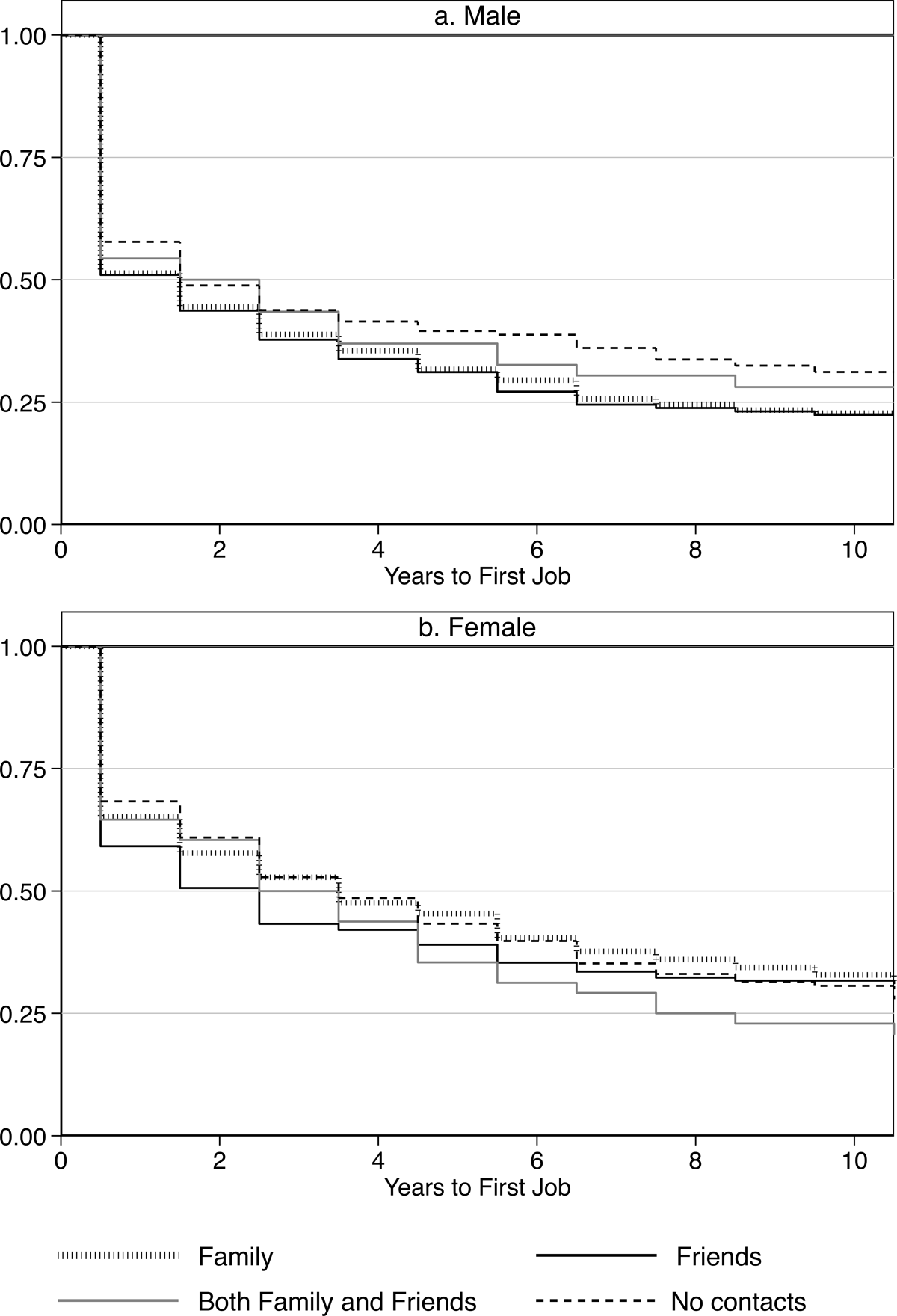
Figure 1
Survival plots on years to first job by gender and pre-migration contacts. Data from the LNU-UFB 2010.
Gender Differences in Time to First Job among Refugee and Family Reunion Migrants
The next section assesses gender differences in the returns to pre-migration contacts at entry into employment. Table 2 provides hazard ratios from models estimating time to the first job. Hazard ratios above one indicate a shorter time to the first job, and hazard ratios below one indicate a longer time to the first job.
Table 2
Hazard ratios from piecewise constant exponential models on years to first job in Sweden.
| MALE | FEMALE | |||||||
|---|---|---|---|---|---|---|---|---|
| (1) | (2) | (1) | (2) | |||||
| Pre-migration contacts (Ref. No contacts) | ||||||||
| Family | 1.26* | (0.13) | 1.20+ | (0.12) | 0.98 | (0.09) | 0.98 | (0.09) |
| Friends | 1.26* | (0.15) | 1.26* | (0.15) | 0.97 | (0.12) | 1.01 | (0.12) |
| Both Family and Friends | 1.11 | (0.22) | 1.14 | (0.21) | 1.11 | (0.19) | 1.14 | (0.20) |
| Demographic characteristics | ||||||||
| Age at arrival | 1.10*** | (0.03) | 1.08** | (0.03) | 1.14*** | (0.03) | 1.11*** | (0.03) |
| Age at arrival squared | 0.99*** | (0.01) | 0.99*** | (0.01) | 0.99*** | (0.01) | 0.99*** | (0.01) |
| Region of origin (Ref. Europe, Central Asia and North America) | ||||||||
| Middle East and North Africa | 0.85 | (0.11) | 0.86 | (0.11) | 0.63*** | (0.08) | 0.61*** | (0.07) |
| South and East Asia and Pacific | 1.19 | (0.16) | 1.21 | (0.16) | 0.86 | (0.09) | 0.87 | (0.09) |
| Sub-Saharan Africa | 1.20+ | (0.12) | 1.27 | (0.13) | 0.64*** | (0.08) | 0.63*** | (0.08) |
| Latin America | 1.09 | (0.13) | 1.08 | (0.13) | 0.96 | (0.10) | 0.92 | (0.10) |
| Residence permit (Ref. Family reunification) | ||||||||
| Refugee | 0.79** | (0.07) | 0.78** | (0.07) | 0.88 | (0.08) | 0.92 | (0.08) |
| Family situation | ||||||||
| Married | 1.50*** | (0.15) | 1.49*** | (0.12) | ||||
| Parent | 1.22 | (0.18) | 0.95 | (0.11) | ||||
| Educational attainment (Ref. Low education) | ||||||||
| Intermediate education | 0.91 | (0.10) | 1.36** | (0.15) | ||||
| High education | 0.83 | (0.10) | 1.44*** | (0.16) | ||||
| Missing education | 0.72** | (0.09) | 1.16 | (0.14) | ||||
| Year of arrival (quintiles) | Yes | Yes | Yes | Yes | ||||
| Person years | 3,637 | 3,637 | 5,789 | 5,789 | ||||
| Observations | 821 | 821 | 1,104 | 1,104 | ||||
| AIC | 2,651 | 2,628 | 3,487 | 3,456 | ||||
| BIC | 2,769 | 2,777 | 3,614 | 3,616 | ||||
[i] Notes. Clustered standard errors at the individual level in parentheses. +p < 0.1; *p < 0.05; **p < 0.01; ***p < 0.001 (two-tailed).
Among men, family and friends are associated with a shorter time to first job when compared to no contacts, as indicated by hazard ratios of 1.26. With respect to demographic characteristics, the association between age and time to first job is curvilinear, with the time to first job declining across younger ages and increasing at older ages. We observe little variation across regions of origin, while refugee status is associated with a longer time to first job than family reunification. Model 2 additionally controls for time-varying variables. Results show that the main relationships for pre-migration contacts hold. While the coefficient for family decreases somewhat, the coefficient for friends remains stable. This model also reveals that married migrants tend to have a shorter time to their first job than unmarried migrants. Parenthood and educational attainment are not associated with time to first job, apart from missing education, which is negatively related to time to first job.
Among women, pre-migration contacts are not associated with an equivalent decrease in time to first job. The curvilinear association between age at arrival and time to first job is similar to that observed among men. In contrast, among women, we observe considerable differences across regions of origin, where female migrants from the Middle East and North Africa and sub-Saharan Africa take longer to enter work than their counterparts from Europe, Central Asia and North America. Residence permit does not appear to be related to time to first job. In model 2, married individuals and female migrants with intermediate and high education tend to enter employment more quickly than their unmarried and low-educated counterparts.
This analysis suggests that different mechanisms are at play for men and women. While men appear to benefit from their contacts, women seem to gain from their education. Among women, we also find considerable differences across regions of origin.
Differences by Educational Attainment and Region of Origin
Having established gender differences, the next part assesses what educational attainment and region of origin can tell us about the differential relationship. Table 3 presents results from models that use a simplified measure of contacts. Specifically, we assess a binary indicator that is equal to one when migrants report having contacts at arrival in Sweden (family, friends and/or family and friends) and zero otherwise. This is done as stratifying the sample leads to small sub-samples. For completeness, results from models using the more detailed indicator of contacts are provided in Tables A2 and A3 in the Appendix.
Table 3
Hazard ratios from piecewise constant exponential models on years to first job in Sweden from stratified analyses by educational attainment at arrival and region of origin.
| MISSING OR LOW EDUCATION | INTERMEDIATE OR HIGH EDUCATION | ||||
|---|---|---|---|---|---|
| a. Male | |||||
| Pre-migration contacts | |||||
| (Ref. No contacts) | |||||
| Contacts | 1.51** | 1.14 | |||
| Person years | 1,458 | 2,179 | |||
| Observations | 324 | 497 | |||
| b. Female | |||||
| Pre-migration contacts | |||||
| (Ref. No contacts) | |||||
| Contacts | 0.93 | 1.04 | |||
| Person years | 2,671 | 3,118 | |||
| Observations | 447 | 657 | |||
| EUROPE, CENTRAL ASIA AND NORTH AMERICA | MIDDLE EAST AND NORTH AFRICA | SOUTH AND EAST ASIA AND PACIFIC | SUB-SAHARAN AFRICA | LATIN AMERICA | |
| a. Male | |||||
| Pre-migration contacts | |||||
| (Ref. No contacts) | |||||
| Contacts | 1.13 | 0.90 | 1.30 | 1.38+ | 1.57+ |
| Person years | 1,298 | 702 | 375 | 678 | 584 |
| Observations | 295 | 132 | 92 | 159 | 143 |
| b. Female | |||||
| Pre-migration contacts | |||||
| (Ref. No contacts) | |||||
| Contacts | 1.10 | 0.61+ | 1.02 | 1.67+ | 0.72+ |
| Person years | 2,090 | 1,061 | 1,008 | 786 | 844 |
| Observations | 452 | 151 | 193 | 125 | 183 |
[i] Notes. Models control for age at immigration, age at immigration squared, residence permit and year of arrival in quintiles. The full set of hazard ratios and clustered standard errors at the individual level are presented in Tables A2 and A3 in the Appendix. +p < 0.1; *p < 0.05; **p < 0.01; ***p < 0.001 (two-tailed).
Table 3 shows that men with low educational attainment and missing information on education tend to benefit from their social contacts. In contrast, contacts are not related to labour market entry among men with higher education. This indicates that the positive association observed among men (in Table 2) is mainly the result of the smoother labour market transition among low-educated men with social contacts. Among women, we find no difference in the returns to social contacts by educational attainment.
Table 3 further shows that men from Sub-Saharan Africa and Latin America benefit from their social contacts, whereas contacts are not related to labour market entry among the other origin groups. Among women, having contacts is related to a shorter job search among Sub-Saharan African migrants. In contrast, female migrants from the Middle East and North Africa and Latin America tend to have a longer job search when they have contacts in Sweden.
Together, these results reveal that social contacts promote labour market entry among low-educated men. Social contacts also appear particularly beneficial for men from sub-Saharan Africa and Latin America. In contrast, among women, social contacts are associated with a shorter job search for some origin groups, while they are associated with a longer job search for others.
Conclusion
This study analysed gender differences in the relationship between pre-migration contacts and entry into employment among refugee and family reunion migrants. Furthermore, it assessed heterogeneity in the gendered dynamics across educational attainment and regions of origin.
The analysis presented reveals three main findings. First, men with pre-migration contacts have a shorter time to first job than those without contacts, whereas pre-migration contacts are not related to a shorter time to first job among women. This may be due to gender differences in the returns to social contacts in the job search. Among men, pre-migration contacts may provide advice on how to navigate the Swedish labour market as well as direct assistance in the job search. In contrast, women may have less resourceful networks or pre-migration contacts’ may be less willing to share information with newly arrived women (Huffman & Torres 2002; Marin 2012; Smith 2005; Livingston 2006).
Second, analyses by educational attainment indicate that the positive association among men is mainly the result of a smoother labour market entry experienced among low-educated men with social contacts. It is possible that low-educated men rely more heavily on informal qualifications than their counterparts with higher education. In line with this result, prior studies have found that social contacts predominantly assist individuals find employment in positions with low skill levels (Kalter & Kogan 2014; Oesch & von Ow 2017). Among women, educational attainment is directly associated with time to first job, but we do not find that social contacts play a different role across educational attainment. Female migrants may be expected to use different search channels, as both low- and high-educated women predominantly find employment in the public sector, which mainly uses formal recruitment methods in Sweden (Lundin 2011). This suggests that women rely more heavily on their formal qualifications than on social contacts.
Third, the results reveal gender differences in the role of pre-migration contacts by region of origin. Though these results should be interpreted with care as they are based on smaller sub-samples, they indicate contrasting results for men and women as well as considerable differences in the returns to social contacts for women across regions of origin. These differences may stem from differential exposure to employer discrimination (Åslund, Forslund & Liljeberg 2017; Drouhot & Nee 2019; Quillian & Midtbøen 2021) and different gender norms in the origin (Grönlund & Fairbrother 2021). It may also be that contacts imply gendered responsibilities that limit opportunities to look for work for some migrants (Elrick & Lewandowska 2008).
While this study has focused on Sweden, the results may be relevant for different settings. The finding that female migrants experience lower returns to their social contacts than men goes in line with some studies from Europe (Bilecen & Seibel 2021; Drever & Hoffmeister 2008). This may be in part due to similarities in the organisation of the labour market and the gender distribution across the public and private sectors in Europe. Still, other European studies indicate no gender differences (Kanas, van Tubergen & van der Lippe 2011; Lancee 2010). This may relate to the fact that a higher share of women select out of the labour force in these countries than in Sweden. In countries where a sizeable share of women select out of the labour force, those who work may be particularly motivated and have more similar networks to men. Although the US labour market is differently structured, Latin American migrant women similarly benefit less from their contacts than men in the US (Aguilera 2005; Hagan 1998; Livingston 2006). Hagan (1998) argues that migrant men predominantly work in industry, where recruitment through informal channels is common. In contrast, migrant women are overrepresented in home care, where sharing information about job opportunities and forming new contacts is more difficult. These considerations lead me to expect that gender differences are similar or smaller in other settings, but that the overall mechanisms and implications of the results extend beyond Sweden.
The analysis presented in this paper has several limitations. First, I cannot rule out that respondents misremember whether they had contacts in Sweden upon arrival. To address this concern, I control for the year of arrival in quintiles, which allows me to compare individuals who migrated in the same period. Still, considering that migration represents a profound change in the individual life course, respondents are more likely to remember the circumstances surrounding migration when compared to other less dramatic events. Furthermore, to the extent that recall bias is random, it implies that estimates are less precise, which would underestimate the associations between social contacts and employment. Second, additional factors may figure centrally in the relationship between social contacts and labour market entry, such as attitudes towards entering work. Incorporating more information on the origin country and individuals’ attitudes provides promising avenues for future research.
From a policy perspective, these results underline the importance of incorporating gender and inter-group differences by educational attainment and migrant origin when designing integration policies. While some migrants have social contacts that provide them with important resources, this may not be true for all migrants, and in particular for women. In future research, it will be important to investigate heterogeneity in the gendered dynamics across additional dimensions and to assess the characteristics of the first job that migrants enter.
Data Accessibility Statement
The analysis presented in the study is based on LNU-UFB data collected by the Swedish Institute of Social Research at Stockholm University. The data are considered sensitive and were made available to the project on the condition that there cannot be further distribution of the data. For access to the underlying data, interested researchers are asked to contact the responsible project manager at Stockholm University.
Additional File
The additional file for this article can be found as follows:
Ethics and Consent
The LNU-UFB data analysed were collected by the Swedish Institute of Social Research at Stockholm University. Ethical approval to collect the data was granted by the Stockholm Regional Ethical Review Board. Research subjects were asked for consent and informed about the aim of the research. The use of the LNU-UFB data for this study was approved by the responsible project manager at Stockholm University. A document stating that the researcher will maintain the confidentiality of the respondents, use the data only for scientific research and will not disseminate the data, together with an outline for the planned research, granted approval.
Acknowledgements
I am very grateful to Marie Evertsson, Magnus Bygren and Ognjen Obucina for their suggestions and feedback. I would also like to thank Douglas Massey, Marta Tienda, Dawn Koffman, Magaly Sanchez, Jennifer Van Hook, Lisa Kaida, Jan Saarela and two anonymous reviewers for their helpful comments.
Funding Information
This work was supported by the Department of Sociology, Stockholm University; the Swedish Research Council for Health, Working life and Welfare (Forskningsrådet om Hälsa, Arbetsliv och Välfärd) [2016 07105; 2021 00026; 2023 00609]; Åbo Akademi University Foundation’s funding of the DemSwed Internal Centre of Excellence 2019–2024; and the Swedish Research Council (Vetenskapsrådet) [340 2013 5164].
Competing Interests
The author has no competing interests to declare.