
Introduction
Moving to another country with the purpose of studying results in academic, social, and financial changes in one’s life. These changes are often perceived as challenges to which the students are required to respond and adapt (see Khanal & Gaulee 2019). Recently, the COVID-19 pandemic brought unexpected changes in the lives of international students. In the Nordic context, specifically in Finland, policy measures similar to other European countries were implemented to combat the virus. Some of these measures declared a state of emergency and closed the national borders. Measures were also enacted that related to social distancing, quarantine, and self-isolation, such as the closure of museums, gyms, and theaters. One of the most significant measures was the physical closure of universities, which began on March 18, 2020, and transformed students’ lives.
Studies on international students and the COVID-19 pandemic have mainly focused on students’ well-being and mental health (e.g., Kivelä et al. 2022; Misirlis et al. 2020) or on online learning environments and students’ emotions (e.g., Susanto & Rahayu 2020). In the Netherlands, a study by Misirlis et al. (2020) found significant correlations among loneliness, anxiety, and COVID-19-related stress among international undergraduate students. In the same context and level of studies, Kivelä et al. (2022) showed that the mental health of international students was worse than before the onset of the pandemic and reported more depressive symptoms, suicidal ideation, anxiety, PTSD, academic stress, and loneliness. In Portugal, the study of Cairns et al. (2021) showed increased concern related to students’ health and well-being and communication problems between the host institutions and students, as well as a lack of social and economic resources. In addition, the role of precarious employment in international students’ lives needs more careful examination under these types of unpredictable conditions (Cairns et al. 2021). Similarly, financial difficulties and the effects of prolonged domestic confinement and separation from families were illustrated by Portuguese-speaking African and Brazilian students in a Portuguese university (Malet Calvo et al. 2021). However, very few studies have focused on international students in the Nordic countries, especially in the Finnish context. A study by Pappa, Yada and Perälä-Littunen (2020) explored international master’s degree students’ well-being at a Finnish university and showed diminished social interaction and challenges in coping with study-related responsibilities and mental health, such as decreases in motivation to study and in concentration. Similarly, the study of Jokila, Filippou and Jolkkonen (2023) analyzed international students’ experiences of everyday life from a sociomaterial standpoint. They identified that the changes in temporality, materiality, and spatiality contributed to the increase in responsibility and freedom related to planning their studies and everyday life (Jokila, Filippou & Jolkkonen 2023).
Early accounts of the pandemic’s effects highlight the unequal impact the pandemic has had on people in different circumstances (see Lupton 2020). By analyzing international students’ experiences during the pandemic, we respond to Lin and Xu’s call (2023) to analyses students’ experiences at a microlevel. Therefore, in this article, we seek to explore the academic, social, and financial changes that international students experienced due to the COVID-19 pandemic. Beyond the pandemic, we note that international students have often been perceived as a homogeneous group, both by researchers and by policy narratives (Buckner et al. 2021; Jones 2017). Based on the results of this study, we argue that international students are more heterogeneous than previously perceived.
In the next sections, we review the literature and justify why the academic, social, and financial changes are put in focus in this study, before discussing the policies related to international students in Finland. The background characteristics of international students in Finland and the differences between exchange students, bachelor’s degree students, master’s degree students, and doctoral researchers are also presented.
The Academic, Financial, and Social Dimensions
Pre-pandemic research on international students was predominantly conducted and analyzed on-site university environments. Even studies on online environments were conducted without the sudden shift to online teaching or major disruptions of teaching and campus life that the COVID-19 pandemic caused. During the COVID-19 pandemic, research on international students and academic-related topics was enriched with studies analyzing the shift to distance learning, which indicated a decrease in studying motivation (see Dos Santos 2021; Pappa, Yada & Perälä-Littunen 2020) and an increase in academic stress (Kivelä et al. 2022). Many international students found studying online as something new and interesting but poor Internet connection and technical problems with computers highlighted that this transformation of higher education benefited some students more than others (see Mospan & Slipchuk 2020). Similarly, access to public resources was often limited for international students because of language, financial, and informational barriers (Chen et al. 2020), whereas significant hardships and economic instability were also noticed (Coffey et al. 2021; Jokila & Filippou 2023). These results challenge once more the former assumptions of international students being a homogenized group with privileged members who are financially independent (as also highlighted in Arkoudis et al. 2019; Mulvey, Morris & Ashton 2023) and increase the need for more studies examining in detail how students finance their studies.
Studying abroad has a significant impact on the formation of social relations in the host country and on contact with family and friends back home (Martin & Rizvi 2014). International students and doctoral researchers must deal with separation from their familiar surroundings and social support systems (Winchester-Seeto et al. 2014). Hence, the formation of social relations among international students (Sinanan & Gomes 2020) and between international students and local students are significant, even though the latter are often found to be limited (Mendoza et al. 2022). Yet, the sudden disruption due to the pandemic broke the sense of community for some students (Jokila & Filippou 2023).
As briefly demonstrated in this section, academic/educational (e.g., teaching, learning), finances, and social (e.g., sense of belonging, friendships) dimensions have been some of the key research areas when investigating international students before and during the COVID-19 pandemic. Jones (2017) also noted these dimensions and explained that they fall under four ‘milieus’ or interrelated environmental factors: personal, familial, institutional, and national (Jones 2017: 936). The last milieu highlights that higher education institutions and nation-states significantly contribute to the international student experience, therefore, amplifying the necessity to investigate these dimensions during a time of a global crisis and a nation-state emergency, which our study responds to. In addition, more critical research and consideration of critical voices are needed. Deuchar (2023) has criticized the ‘challenge-centric’ narrative often associated with international students. This kind of tendency, as noted by Lomer and Mittelmeier (2021) in their literature review, is evident for instance in how international students are discussed in academic settings. Another line of criticism relates to separating international students’ agency from their experiences and referring to the experience as something that just happens to the students (Deuchar 2023).
Similarly, Jones (2017) has pointed out a lack of attention to the heterogeneity among international students as well as categorizing students by their national origin, which reinforces stereotypical perspectives. Policy narratives have also reinforced the idea that international students are a homogeneous group through strategies (Buckner et al. 2021). A different tendency is also noticed between studies investigating one group of international students, for example, based on their level of education (Jones 2017) while in the policy field, all students seem to be under the same umbrella. This study responds to the call of more attention to the heterogeneity among international students and aims to provide insights based on international students’ level of studies while aiming to make a contribution to the existing body of literature with a local and global relevance.
International Students in Finland
Finland has paid attention in internationalizing its universities and welcoming international students, particularly through its English-medium master’s degree programs. There are more than 500 English-taught bachelor’s and master’s degree programs provided by the universities and universities of applied sciences in the country (Study in Finland 2023a). The increasing numbers of inward student mobility in Finland is evident across levels of education since the early 2000s (Vipunen 2023a, 2023b; see Figure 1). Almost half of the international student cohort, studying their bachelor’s and master’s degrees, comes from Asia (Finnish National Agency for Education 2023a). As presented in Appendix I, 73.2% of bachelor’s and master’s degree students come from a non-EU country and the largest number of degree students come from Vietnam, China, Russia, India, Bangladesh, and Nepal (Finnish National Agency for Education 2023a, 2023b). The background information for doctoral researchers is not available as doctoral researchers have a different status in Finnish higher education.
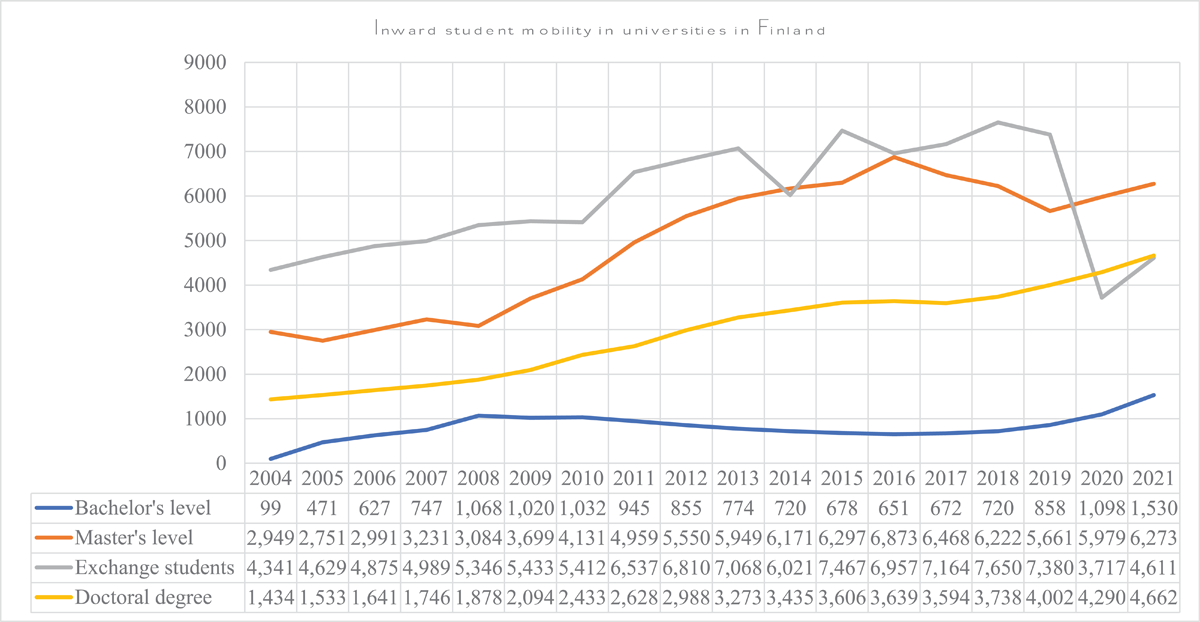
Figure 1
Inward student mobility in universities in Finland (Vipunen, 2023a, 2023b).
In the Finnish higher education system, students’ experiences are framed differently based on varying aspects, such as their citizenship and level of education. Finnish citizens have the right for tuition free education and receive financial support from their government. Students whose citizenship is not from an EU/EEA country and who are enrolled in bachelor’s or master’s degree programs (with the program language being other than Finnish or Swedish, most commonly in English) need to pay tuition fees (Filippou 2020). Doctoral studies are tuition fee-free regardless of citizenship. Thus, tuition fee education is one of the key differences between international students’ groups. More specifically, tuition fees range from 4,000 to 18,000 euros per academic year (Study in Finland 2023b) and scholarships are available to cover part or the complete amount of tuition fees. In addition to the tuition fees, non-EU/EEA students are obliged to obtain health insurance and apply for a residence permit across all levels of education. All bachelor’s and master’s degree students, who pay a compulsory health care fee every semester, are entitled to use the Finnish Student Health Service. Doctoral researchers are not entitled to use these services and exchange students’ accessibility to these health services depends on their citizenship if they are EU or non-EU citizens.
To receive a residence permit, non-EU/EEA bachelor’s and master’s degree students also need to prove that they have the necessary funds to cover their living expenses in Finland for a year, which is estimated to be at least 560 euros per month (Migri 2023a). For completing a bachelor’s or a master’s degree in Finland, students can be granted a continuous residence permit (an A permit), and for other degrees, a temporary residence permit (a B permit; Migri 2023b). With an A permit, students can complete some of their studies in another EU member state, whereas with a B permit, they cannot (Migri 2023b). Doctoral researchers can gain a residence permit for researchers but first, they need to prove that either they are in an employment relationship with an organization and earn a gross salary of at least 1,331 euro, or if they are not in an employment relationship, they need to prove that they have at least 1,000 euro per month, for the amount of their stay (Migri 2023c). It is worth noting that doctoral researchers’ positions are usually different, compared to the rest of the groups, as some of them have funded working positions at universities, grants, or work while conducting their doctoral research. However, many of them only have the study rights and rely on savings, and financial support from their family. On the other hand, it is common that exchange students get funding support during their exchange period, for example, via the ERASMUS + scheme. Hence, the financial reliance for short-term jobs is more significant for bachelor’s and master’s studies.
Even though, recent policy reforms included the extension of working hours from 25 to 30 hours per week (Migri 2022) to a large extent international students in Finland are still financially reliant on their personal or family savings, their home countries’, and/or hosting institutions’ (scholarships) support. For many international students, working in part-time, precarious jobs significantly affects their financial stability during their studies (Maury 2017). Maury (2017) argues that the student visa conditions favor low-paid job markets and eventually, this type of student–migrant–workers positionalities develop precarious life conditions for international students. According to the 2019 Eurostudent survey, over 40% of international students work during their studies and academic semesters (a number higher than that of domestic students), and over 60% work during holidays (Saari et al. 2020). Given the current trends and policies within Finland, understanding the diverse impact that the COVID-19 pandemic had on international students while considering their level of studies is deemed critical.
Methods
Research Questions
In our exploratory research, we aim to examine the academic, social, and financial changes that international students experienced due to the COVID-19 pandemic. In an attempt to investigate the homogeneity/heterogeneity of international students, we also aim to identify, based on the students’ studying status, in which dimension these changes have been more diverse. Therefore, the following research questions are addressed in this article:
How have the academic, financial, and social dimensions of international students been affected during the early stages of the pandemic?
Have these dimensions been experienced in a similar way across international students’ levels of study (exchange students, bachelor’s degree students, master’s degree students, and doctoral researchers)?
Development of an Online Questionnaire
During March and April 2020, we developed a comprehensive online questionnaire, using the Webropol survey tool, on students’ experiences during the early phase of the pandemic. We created the statements and questions with specific themes in mind; these were based on both our experiences as teachers and researchers and on discussions we have had with our students and each other. These themes ranged from the decision to stay in or leave Finland to academic, social, financial, and working aspects. After the questionnaire was created, we tested it to ensure its reliability and conducted pilot studies with five international students who were studying at universities in Finland. The pilot participants gave detailed feedback and suggestions about the instrument, its content, and design. This feedback was considered when revising the survey as suggested by Neuman (2012).
The online questionnaire was available in English and included 5 open-ended and 26 close-ended questions. In this article, we focus on the close-ended questions. Those with quantitative statements aimed to measure how students’ social lives (16 statements), academic issues (12 statements), and financial situations (5 statements) have been impacted by the pandemic, and these were rated on a five-point Likert-type scale ranging from ‘strongly disagree’ (1) to ‘strongly agree’ (5). The multiple-choice questions related to work (five statements) and summer work plans (five statements) were chosen to collect categorical data that was used for further descriptive information. Other multiple-choice questions were included to collect categorical data for comparisons and descriptive information, such as the students’ educational level. The time needed to complete the questionnaire was approximately 15–20 minutes.
Ethical Considerations
During each stage of our research, we carefully followed the guidelines on the ethical principles of research as published by the Finnish National Board on Research Integrity (2019). A question about giving consent to provide anonymous responses for research purposes was included on the first page of our survey. The participants had the freedom to discontinue their participation at any time and withdraw their responses if they wished. According to the ethical principles of research, our research design elements did not require an ethical review statement from a human sciences ethics committee (see Finnish National Board on Research Integrity 2019). We note that our familiarity with the international community, as researchers in the field and teachers in an international degree program, was an asset for conducting this study and avoiding causing unnecessary harm to the participants (see Finnish National Board on Research Integrity 2019).
Data Collection Procedure
The data collection began in May 2020. We sent an e-mail invitation to the student unions of 13 universities in Finland and to the directors and coordinators of English-medium programs with a request to forward the e-mail to exchange and degree students in different levels and fields of study. The e-mail invitation was sent in both Finnish and English, and it included information about the research purposes, the time needed to complete the survey, its voluntary nature, confidentiality, the survey link, and the researchers’ e-mails in case there were further questions or concerns. The same information was provided on the first page of the survey with an additional link to a privacy notice that contained more information on data management. To increase the number of respondents, we sent a reminder to the same recipients two weeks after our first contact as suggested in Cohen, Manion and Morrison (2007).
Participants
There were 193 respondents to our questionnaire. We ultimately excluded one of them, as the respondent did not give consent to use their responses in this research. Thus, the responses of 192 students and doctoral researchers were analyzed. Most respondents were master’s degree students (n = 99), followed by exchange students (n = 61), doctoral researchers (n = 17), and bachelor’s degree students (n = 15). Table 1 presents the frequencies and percentages of respondents and international students registered in Finnish universities by their studying status. More descriptive information about the participants is available in Appendix II. As seen in Table 1, there were differences compared to the overall population and our sample (e.g., less doctoral researchers and bachelor’s degree students), which may have influenced the results. This is considered as a limitation for our study which is discussed in the last section of this article.
Table 1
International students in Finland by studying status.
| CHARACTERISTICS | STUDENTS IN FINLAND (Vipunen 2023a; Vipunen 2023b) | RESPONDENTS | |||
|---|---|---|---|---|---|
| FREQUENCY | PERCENTAGE | FREQUENCY | PERCENTAGE | ||
| Status | Exchange student | 7,380 | 41.2% | 61 | 31.8% |
| Bachelor’s degree student | 858 | 4.8% | 15 | 7.8% | |
| Master’s degree student | 5,661 | 31.6% | 99 | 51.6% | |
| Doctoral researcher | 4,002 | 22.4% | 17 | 8.9% | |
| Total | 17,901 | 100% | 192 | 100% | |
Data Analysis
We analyzed the survey data related to students’ academic studies, social lives, and financial and working conditions. The statistical analysis was conducted using IBM SPSS Statistics Version 25. First, we explored the participants’ demographic information while using descriptive statistics, such as frequencies, means, and standard deviation. The categorical variables that we analyzed were level of study (BA/MA/PhD/Exchange), gender (male/female/other/I don’t want to tell), and age group (18–25/26–35/36–45/46–60). Then we ran the cross-tabulations with Pearson’s chi-squared test to determine if there is evidence of relationships among the statements related to social life, academic studies, finances, and the students’ levels of study. To confirm the instrument’s reliability regarding the quantitative data, we used Cronbach’s alpha, which showed a high level of internal consistency (α = 0.75).
To investigate how the COVID-19 pandemic has influenced different groups of students, and to what extent, we used one-way analysis of variance (ANOVA). This test allowed us to examine significant differences between the means of the statements and the students’ group, in this case the students’ level of study. We chose the level of study as a variable due to the abovementioned research gap and because we expect that the students’ statuses in the given institutions can indicate differences in experiences. In this article, we focused on the results at a significance level of p ≤ 0.05 (confidence interval of 95%). We then used post hoc tests to confirm the exact groups of students in which differences were noticed. We also ran Tukey’s test when the data met the assumption of homogeneity of variances, and Duncan’s test was used when the data did not meet that assumption.
Results
Academic Determination
Table 2 presents the statistical results for the statements related to the students’ academic experiences. Their responses indicated that they had good communication with their teachers and received adequate information on how the situation affected their studies. Their studies continued as planned, even though the online teaching mode was not preferred. The respondents noted that they were struggling with their time management and were more stressed about their studies and study progress, despite the fact that they were expecting to gain as many credits as planned. This stands in clear contrast to the challenge-centric narrative that is often assigned to international students.
Table 2
Responses to study-related statements (1 = strongly disagree; 5 = strongly agree).
| NO. | STATEMENT | 1 | 2 | 3 | 4 | 5 | M | S.D. |
|---|---|---|---|---|---|---|---|---|
| 1 | I have been able to continue my studies as planned | 12% | 24% | 14.6% | 40.1% | 9.4% | 3.11 | 1.221 |
| 2 | My graduation will be delayed due to the current situation | 15.1% | 30.7% | 29.2% | 17.2% | 7.8% | 2.72 | 1.150 |
| 3 | Online teaching has increased my workload | 6.8% | 22.9% | 31.8% | 24% | 14.6% | 3.17 | 1.141 |
| 4 | Communicating online with my teachers is easy | 3.6% | 21.9% | 22.4% | 43.2% | 8.9% | 3.32 | 1.027 |
| 5 | I have been more productive | 21.4% | 38% | 25% | 10.9% | 4.7% | 2.40 | 1.083 |
| 6 | I have received adequate information on how the situation affects my studies | 4.2% | 18.8% | 25% | 42.2% | 9.9% | 3.35 | 1.027 |
| 7 | I have been worried about my time management | 2.6% | 13% | 17.2% | 40.6% | 26.6% | 3.76 | 1.067 |
| 8 | Now I am more stressed about my studies | 6.8% | 21.4% | 22.4% | 26.6% | 22.9% | 3.37 | 1.239 |
| 9 | I prefer online teaching to face-to-face teaching | 42.2% | 28.1% | 20.3% | 5.2% | 4.2% | 2.01 | 1.102 |
| 10 | I have been feeling stressed about my study progress | 5.2% | 15.1% | 22.4% | 31.3% | 26% | 3.58 | 1.178 |
| 11 | I expect to gain as many credits as planned | 5.2% | 13.5% | 19.8% | 41.7% | 19.8% | 3.57 | 1.109 |
| 12 | I had to drop out of courses | 31.8% | 25.5% | 12% | 21.4% | 9.4% | 2.51 | 1.373 |
To examine possible differences and similarities between students from different levels of study, we conducted one-way ANOVA for the next statements with the level of study as an independent variable. Comparisons between students’ study progress and their level of studies showed no statistically significant differences for any of the statements; hence, the experiences were similar.
Financial Distress
The results from the students’ financial situation statements are presented in Table 3. Considering that these results include all the participants’ responses, we noticed a divergence of experiences. The descriptive statistics showed that more than 40% of the students agreed that their financial situation had worsened, with 20% of them strongly agreeing with that statement, whereas slightly fewer than 40% of the students disagreed with the same statement. Almost 70% of the students disagreed that their financial situation had improved, and more than 60% of the participants answered that they had been worried about their financial situation. Around 30% of the students had to rely on their parents and/or relatives for financial support.
Table 3
Responses to financial-related statements (1 = strongly disagree; 5 = strongly agree).
| NO. | STATEMENT | 1 | 2 | 3 | 4 | 5 | M | S.D. |
|---|---|---|---|---|---|---|---|---|
| 1 | My financial situation got worse* | 9.9% | 25.7% | 20.9% | 23% | 20.4% | 3.18 | 1.295 |
| 2 | My parents and/or relatives have helped me financially* | 25.1% | 22.5% | 16.2% | 20.9% | 15.2% | 2.79 | 1.418 |
| 3 | My financial situation improved | 36.6% | 32.5% | 20.4% | 8.9% | 1.6% | 2.06 | 1.034 |
| 4 | My spouse/partner/ boyfriend/girlfriend has helped me financially | 45% | 27.2% | 18.3% | 6.8% | 2.6% | 1.95 | 1.070 |
| 5 | I have been worried about my financial situation* | 6.8% | 15.7% | 15.7% | 31.9% | 29.8% | 3.62 | 1.250 |
[i] *Statement with p < 0.05 between the groups of students.
The ANOVA tests showed that there were statistically significant differences between how the pandemic influenced the finances of the student groups. These tests revealed a division between students’ financial situations based on their level of study: bachelor’s and master’s degree students versus exchange students and doctoral researchers. The statistical results showed that the financial situations of the students, especially the bachelor’s degree students, had been severely influenced. More specifically, bachelor’s degree students highly rated that their financial situation had gotten worse (M = 3.80, S.D. = 1.207), with the differences at the p < 0.05 level [F (3, 187) = 8.383] compared to the doctoral researchers (M = 2.41, S.D. = 1.176). Close to bachelor’s degree students were the master’s degree students (M = 3.50, S.D. = 1.270), followed by the exchange students (M = 2.74, S.D. = 1.168). More statistically significant results indicated that more bachelor’s degree students received financial help from their parents and/or relatives (M = 3.27, S.D. = 1.486) [F (3, 187) = 5.414] than did the exchange students (M = 3.07, S.D. = 1.276), master’s degree students (M = 2.73, S.D. = 1.454), or doctoral researchers, who strongly disagreed with that statement (M = 1.65, S.D. = 1.057). All groups felt worried about their financial situation, with bachelor’s degree students rating this statement the highest (M = 4.00, S.D. = 1.069) and having a statistically significant difference with the doctoral researchers [F (3, 187) = 6.384] at the p < 0.05 level, even though they also felt worried about their financial situation (M = 3.12, S.D. = 0.993).
Work-Related Changes
We also asked international students if they worked during the semester, and 79 (41.1%) answered ‘yes’. Of those 79 respondents, 44 (22.9%) noted that their work is related to their studies, whereas 33 (17.2%) respondents answered that their work was not related to their studies. Overall, more than 60% of those who were working had been affected by the pandemic, either by being given fewer working hours, being laid off temporarily, or becoming unemployed (see Appendix III).
When we compared the students’ responses based on their level of study, the results showed that most master’s degree students (n = 55, 56.1%) and doctoral researchers (n = 13, 76.5%) had jobs. These numbers were lower for exchange (n = 6, 21.4%) and bachelor’s degree students (n = 5, 41.7%). For almost 80% of the doctoral researchers, work continued as usual, but this was not the case for bachelor’s degree students (40%), exchange students (33.3%), or master’s degree students (25.5%). The results showed that bachelor’s and master’s degree students had been affected to a larger extent than had the rest of the groups, as one-fifth of them had fewer working hours than before the pandemic, and another one-fifth was laid off temporarily. Many students also became unemployed (50% of exchange students, 40% of bachelor’s degree students, and 34.5% of master’s degree students), except doctoral researchers.
Most students’ summer working plans were influenced negatively, as most no longer had a summer job, and some had fewer working hours (see Appendix III). Many students lost their jobs and needed to apply for a new one, while some decided that they would not work during the summer. The respondents who chose ‘other’ explained that their summer job situation was still uncertain and that it was difficult to find one due to the pandemic. When we compared the students’ responses, the results showed that more than 80% of the doctoral researcher’s working plans had not been affected by the pandemic. However, a division was noticed between the exchange students: almost 40% noted no changes in their summer working plans, whereas others had lost their work (25%) and needed to apply for another job (14.3%). A similar division was evident within the master’s degree students, as one-third noted no changes related to their summer working plans, and the same number responded that they no longer have a work position (28.6%) and hence need to reapply (14.3%).
Social Life Alterations and Transnational Worries
Table 4 presents the statistical results for the whole sample and each statement related to the students’ social lives. Overall, the students’ responses about their social lives highlighted the health-related worries that they shared. More than 60% of the students agreed that their lives have changed, and approximately 50% have felt lonely. It was clear that the students were worried about themselves, but they were even more worried about their families and friends. More than 80% of the participants were worried about the COVID-19 situation in their home countries. Even though student unions and associations organized online events and webinars, this survey showed that most students did not participate. More specifically, more than 80% of the respondents noted that they did not participate in events organized by student organizations.
Table 4
Responses to social life statements (1 = strongly disagree; 5 = strongly agree).
| NO. | STATEMENT | 1 | 2 | 3 | 4 | 5 | M | S.D. |
|---|---|---|---|---|---|---|---|---|
| 1 | I have been in contact with my classmates | 6.8% | 15.6% | 18.8% | 49% | 9.9% | 3.40 | 1.078 |
| 2 | I have participated in events organised by the student organisations | 37.5% | 44.3% | 10.9% | 6.8% | 0.5% | 1.89 | 0.891 |
| 3 | I have not met people face-to-face | 6.3% | 36.5% | 12% | 20.8% | 24.5% | 3.21 | 1.330 |
| 4 | I have been mostly by myself | 6.8% | 18.8% | 13% | 33.3% | 28.1% | 3.57 | 1.264 |
| 5 | I have felt lonely | 9.4% | 18.2% | 22.4% | 28.1% | 21.9% | 3.35 | 1.265 |
| 6 | My social life has not been as active as before | 3.1% | 10.4% | 8.9% | 47.4% | 30.2% | 3.91 | 1.042 |
| 7 | I have been particularly active in keeping in contact with my friends in my home country* | 3.6% | 15.6% | 21.4% | 45.3% | 14.1% | 3.51 | 1.033 |
| 8 | I have been particularly active in keeping in contact with my family in my home country | 2.1% | 8.9% | 17.2% | 44.3% | 27.6% | 3.86 | 0.988 |
| 9 | Staying at home has been difficult for me | 7.8% | 17.2% | 22.4% | 33.9% | 18.8% | 3.39 | 1.197 |
| 10 | I have not continued my life as it was | 4.7% | 13% | 18.8% | 31.8% | 31.8% | 3.73 | 1.175 |
| 11 | I have been having difficulty concentrating | 3.1% | 12.5% | 7.3% | 39.1% | 38% | 3.96 | 1.113 |
| 12 | It has been more difficult for me to plan my daily schedule | 4.7% | 21.9% | 18.8% | 33.3% | 21.4% | 3.45 | 1.183 |
| 13 | I have been worried I will get sick | 12% | 20.8% | 17.2% | 31.8% | 18.2% | 3.23 | 1.299 |
| 14 | I have been worried about my friends’ and family’s health | 1.6% | 7.8% | 12.5% | 45.3% | 32.8% | 4.00 | 0.954 |
| 15 | I have been worried about the COVID-19 situation in Finland | 9.9% | 15.6% | 13.5% | 45.8% | 15.1% | 3.41 | 1.207 |
| 16 | I have been worried about the COVID-19 situation in my home country | 2.6% | 7.8% | 7.8% | 41.1% | 40.6% | 4.09 | 1.014 |
[i] *Statement with p < 0.05 between the groups of students.
According to one-way ANOVA, a statistically significant difference between the subgroups at p < 0.05 was only found for statement 7: ‘I have been particularly active in keeping in contact with my family in my home country’. The results showed significant differences between the exchange students and master’s degree students [F (3, 188) = 4.436]. Post hoc comparisons indicated that exchange students were more active in keeping in contact with their friends back at home (M = 3.89, S.D. = 0.858) than were master’s degree students (M = 3.36, S.D. = 1.083).
Discussion and Conclusions
This study addresses international students during the COVID-19 pandemic and the academic, financial, and social changes in their lives. The findings of this study signify the strength and resilience of international students to continue their studies despite financial distress, transnational worries, and academic changes. This academic resilience was similar between students, regardless of their level of study. Following the argument made by Deuchar (2023), the findings are an indication of international students’ agency across levels of education and an illustration that they are not a ‘passive group’. From the institutional side, it was shown that teachers communicated effectively and provided adequate support, which differs from the results of Cairns et al. (2021). Yet a question is raised regarding financial issues and how those issues could be addressed by institutions and the state.
Generally, the finances of the students were negatively affected by the pandemic, yet the financial situation of bachelor’s and master’s degree students was hit significantly harder than that of exchange students and doctoral researchers. In line with Appleby et al. (2022), our study underlines the financial anxiety caused by the loss of income and the need for a larger international network of support for students who study abroad (Cairns et al. 2021). Data analysis confirms a heterogeneity between students’ financial and work-related situations, with master’s degree students being more financially dependent on their part-time jobs and hence, more easily exposed financially when external disruptors, such as a pandemic, occur. In line with Maury (2017), this study shows that the pandemic further underlined precarious student–migrant–worker positionalities. Its insightful view into students’ experiences will have repercussions for possible future crisis conditions but also rings the alarm beyond the pandemic regarding students’ financial instability.
The findings support Forbes-Mewett’s (2020) conclusion that the vulnerability of international students is a concern that needs to be addressed but that their resilience should also be recognized. Following Lupton (2020), we highlight how the pandemic has brought to the surface the underlying heterogeneity within the international student body in Finland. Beyond the pandemic, we evaluate that international students have often been perceived as a homogeneous group by both researchers and policy narratives. However, based on the results of this study, international students are more heterogeneous than previously perceived. Recent financial and working uncertainty has unraveled a dichotomy, which emphasizes the heterogeneity of international students and hence should be studied further.
Despite the level of study, recent alterations to students’ social lives seemed to be broadly similar and transnational worries were evident in the results. The transnational connections between international students and their families and friends became more prevalent during the pandemic. Social isolation, as well as difficulties concentrating and worries about time management and planning daily schedules, support the findings of Pappa, Yada and Perälä-Littunen (2020). Thus, we support the call for more attention to international students’ well-being and mental health (Zhai & Du 2020).
Despite the public and academic attention paid to students’ well-being and studies, our examination extends the knowledge to areas, such as their social lives and financial situations. Nonetheless, certain limitations should be considered. First, we recognize that our study was based on a small number of participants and relied on a nonrandomly selected sample, hence generalizability is limited. During spring 2020, there were multiple studies conducted at the same time that invited students to participate. To increase the number of responses in our study, we sent a reminder to the institutions and student unions that agreed to forward our survey link (see Cohen, Manion & Morrison 2007). However, the number of doctoral researchers remained low, since doctoral researchers are not obliged to be members of the student unions and, therefore, reaching them was a challenge.
Second, while our sample included international students from diverse backgrounds and is relatively representative when considering the percentages of students and their continent, there are substantial differences when considering their studying level, gender, and age, which limits the representativeness of our sample. These limits should be addressed and taken into consideration when attempting to generalize the results. For example, the large representation of female participants, which is common in online surveys (Smith 2008) and can also be observed in studies for international students during the COVID-19 pandemic (such as in Kivelä et al. 2022; Pappa, Yada & Perälä-Littunen 2020). Another limitation is that our survey was distributed only in the early pandemic stages, and the impact on students may have changed over time. However, we collected qualitative data through interviews in both summer 2020 and winter 2020/2021. This step was taken to expand the study’s scope and further analyze students’ experiences.
This study contributes to the research field of international students and the pandemic in the Nordic regional context, specifically in Finland. Expanding this knowledge and understanding from other regional contexts would be significant contributions to the development of policies related to the provision of resources and support to international students. Future research could focus on and analyze these changes based on other factors, such as family situations and socioeconomic backgrounds.
Data Accessibility Statement
The participants of this study did not give written consent for their data to be shared publicly. Due to the sensitive nature of the research, supporting data is not available.
Appendices
Appendices
Appendix I
International students in universities in Finland by continent and respondents.
| CHARACTERISTICS | DEGREE STUDENTS (Finnish National Agency for Education, 2023a) | EXCHANGE STUDENTS (Vipunen, 2023b) | TOTAL | RESPONDENTS | |||||
|---|---|---|---|---|---|---|---|---|---|
| FREQUENCY | PERCENTAGE | FREQUENCY | PERCENTAGE | FREQUENCY | PERCENTAGE | FREQUENCY | PERCENTAGE | ||
| Continent | Europe total | 4,023 | 35.3% | 4,932 | 77% | 8,955 | 50.3% | 105 | 54.7% |
| EU/EEA | 3,099 | 27.2% | N/A | N/A | N/A | N/A | 95 | 49.5% | |
| Europe but non-EU/EEA | 921 | 8.1% | N/A | N/A | N/A | N/A | 10 | 5.2% | |
| America | 825 | 7.2% | 480 | 7.5% | 1,305 | 7.3% | 20 | 10.4% | |
| Africa | 897 | 7.9% | 57 | 0.8% | 954 | 5.4% | 5 | 2.6% | |
| Asia | 5,556 | 48.8% | 828 | 13% | 6,384 | 35.9% | 53 | 27.6% | |
| Oceania | 54 | 0.5% | 102 | 1.6% | 156 | 0.9% | 2 | 1% | |
| Unknown/Do not want to share | 30 | 0.3% | 4 | 0.1% | 34 | 0.2% | 7 | 3.6% | |
| Total | 11,382 | 100% | 6,403 | 100% | 17,788 | 100% | 192 | 100% | |
Appendix II
International students in universities in Finland by gender and age group, and respondents.
| CHARACTERISTICS | DEGREE STUDENTS IN FINLAND 2020 (Vipunen, 2023a) | RESPONDENTS | |||
|---|---|---|---|---|---|
| FREQUENCY | PERCENTAGE | FREQUENCY | PERCENTAGE | ||
| Gender | Female | 6165 | 47% | 133 | 69.3% |
| Male | 7050 | 53% | 53 | 27.6% | |
| Other | N/A | N/A | 2 | 1% | |
| I don’t want to tell | N/A | N/A | 4 | 2.1% | |
| Age group | 18–25 | 3333 | 23.7% | 97 | 50.5% |
| 26–35 | 6882 | 48.9% | 79 | 41.1% | |
| 36–45 | 2010 | 14.3% | 15 | 7.8% | |
| 46–60 | 1701 | 12.1% | 1 | 0.5% | |
| 60– | 145 | 1% | 0 | 0% | |
| Total | 14071 | 100% | 192 | 100% | |
Appendix III
Current working situation and summer work statements.
| STATEMENT | n | (%) | |
|---|---|---|---|
| Question: Has the COVID-19 situation affected your work? | No, I have continued as usual | 28 | 35.4% |
| Yes, now I have less hours than before | 14 | 17.7% | |
| Yes, now I have more hours than before | 1 | 1.3% | |
| Yes, I have been laid off temporarily | 12 | 15.2% | |
| Yes, now I am unemployed | 24 | 30.4% | |
| Total | 79 | 100% | |
| Question: Has the COVID-19 situation affected your plans to work during the summer? | No, I will not work during the summer | 34 | 21.9% |
| No, I will work during the summer as planned earlier | 22 | 14.2% | |
| Yes, I do not have work for summer anymore | 43 | 27.7% | |
| Yes, I have fewer working hours for the summer | 11 | 7.1% | |
| Yes, I have to apply for a new job for the summer | 19 | 12.3% | |
| Other, what? | 26 | 16.8% | |
| Total | 155 | 100% | |
Acknowledgements
We would like to thank all the students who took the time to respond to our survey, documenting their lives, concerns, and thoughts in these challenging times.
Funding Information
This work was supported by Turku University Foundation.
Competing Interests
The authors have no competing interests to declare.